November 19, 1863 – Gettysburg Address

November 19, 2010

A mostly encore post about today’s anniversary of Lincoln’s speech at Gettysburg.


Prior to 2007, this was the only known photo of Lincoln at Gettysburg, on the day of his address - Library of Congress

Prior to 2007, this was the only known photo of Lincoln at Gettysburg, on the day of his address – Library of Congress

147 years ago today, Abraham Lincoln redefined the Declaration of Independence and the goals of the American Civil War, in a less-than-two-minute speech dedicating part of the battlefield at Gettysburg, Pennsylvania, as a cemetery and final resting place for soldiers who died in the fierce battle fought there the previous July 1 through 3.

Interesting news for 2007: More photos from the Library of Congress collection may contain images of Lincoln. The photo above, detail from a much larger photo, had been thought for years to be the only image of Lincoln from that day. The lore is that photographers, taking a break from former Massachusetts Sen. Edward Everett’ s more than two-hour oration, had expected Lincoln to go on for at least an hour. His short speech caught them totally off-guard, focusing their cameras or taking a break. Lincoln finished before any photographer got a lens open to capture images.

Images of people in these photos are very small, and difficult to identify. Lincoln was not identified at all until 1952:

The plate lay unidentified in the Archives for some fifty-five years until in 1952, Josephine Cobb, Chief of the Still Pictures Branch, recognized Lincoln in the center of the detail, head bared and probably seated. To the immediate left (Lincoln’s right) is Lincoln’s bodyguard, Ward Hill Lamon, and to the far right (beyond the limits of the detail) is Governor Andrew G. Curtin of Pennsylvania. Cobb estimated that the photograph was taken about noontime, just after Lincoln arrived at the site and before Edward Everett’s arrival, and some three hours before Lincoln gave his now famous address.

On-line, the Abraham Lincoln Blog covered the discovery that two more photographic plates from the 1863 speech at Gettysburg may contain images of Lincoln in his trademark stove-pipe hat. Wander over to the story at the USA Today site, and you can see just how tiny are these detail images in relation to the photographs themselves. These images are tiny parts of photos of the crowd at Gettysburg. (The story ran in USA Today last Thursday or Friday — you may be able to find a copy of that paper buried in the returns pile at your local Kwikee Mart.) Digital technologies, and these suspected finds of Lincoln, should prompt a review of every image from Gettysburg that day.

To the complaints of students, I have required my junior U.S. history students to memorize the Gettysburg Address. In Irving I found a couple of students who had memorized it for an elementary teacher years earlier, and who still could recite it. Others protested, until they learned the speech. This little act of memorization appears to me to instill confidence in the students that they can master history, once they get it done.

To that end, I discovered a good, ten-minute piece on the address in Ken Burns’ “Civil War” (in Episode 5). On DVD, it’s a good piece for classroom use, short enough for a bell ringer or warm-up, detailed enough for a deeper study, and well done, including the full text of the address itself performed by Sam Waterson.

Edward Everett, the former Massachusetts senator and secretary of state, was regarded as the greatest orator of the time. A man of infinite grace, and a historian with some sense of events and what the nation was going through, Everett wrote to Lincoln the next day after their speeches:

“I should be glad, if I could flatter myself that I came as near the central idea of the occasion in two hours, as you did in two minutes.”

Interesting note: P. Z. Myers at Pharyngula notes that the Gettysburg Address was delivered “seven score and four years ago.” Of course, that will never happen again. I’ll wager he was the first to notice that odd juxtaposition on the opening line.

Resources for students and teachers:


Civil War week, had I been on the ball

April 15, 2010

April would be a great month to study the Civil War, what with all the Civil War anniversaries of high import.

April 14 is the anniversary of the assassination of Abraham LincolnApril 9 is the anniversary of Lee’s Surrender at Appomattox Courthouse, and April 12 is the anniversary of the attack on Fort Sumter in Charleston Harbor.

But of course, we studied the Civil War in our U.S. history classes last fall, in the first six weeks, as a review of what the students were supposed to get in 8th grade.

In your classroom, how do you deal with anniversaries when they are out of the current course of study?  How have you seen it done well?

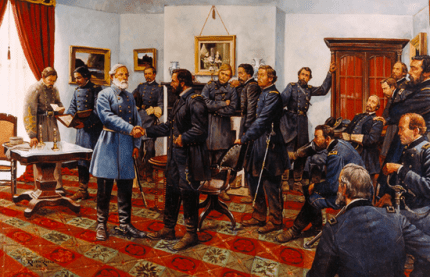
The Surrender, by Keith Rocco - image from National Park Service

The Surrender, by Keith Rocco – image from National Park Service, via Pillar to Post

Notes:

Help others remember history:

Add to FacebookAdd to NewsvineAdd to DiggAdd to Del.icio.usAdd to StumbleuponAdd to RedditAdd to BlinklistAdd to TwitterAdd to TechnoratiAdd to Furl

Below the fold, the identities of the soldiers in Rocco’s painting above.

Read the rest of this entry »


Does this photograph show Teddy Roosevelt at Lincoln’s funeral procession?

February 22, 2010

1865 - Lincoln's funeral procession; Passing the (Cornelius) Roosevelt Mansion, sw corner 14th Street, Broadway, view looking North on Broadway

1865 – Lincoln’s funeral procession; Passing the (Cornelius) Roosevelt Mansion, sw corner 14th Street, Broadway, view looking North on Broadway – Flickr image from Stratis

See the house on the corner, at the left?  Look at the second story, at the window on the side of the house facing the camera.  Is that young Theodore Roosevelt watching Lincoln’s funeral procession?

Stratis, who posted this photo at Flickr, added the note at that window:

6 year old, Theodore Roosevelt watches Abraham Lincoln’s funeral procession from an upstairs window of his grandfather, Cornelius Roosevelt’s mansion on Union Square with his younger brother Elliott and a friend.  Teddy lived at 28 East 20th Street.

Is that accurate?  Is that his grandfather’s house?  I assume that it is not 28 East 20th Street, which is where he was born and the house of his father.

A timeline of TR’s life said he watched the passing funeral entourage:

  • 1865  –  Watches Abraham Lincoln’s funeral procession from an upstairs window of his grandfather’s house on Union Square, New York City. With him are his younger brother Elliott and a friend named Edith Kermit Carow.

Interesting intersection of history.  This would probably be the only meeting of Theodore Roosevelt and Abraham Lincoln, though Teddy almost certainly knew Lincoln’s sole surviving son, Robert, pretty well.  Both were in Buffalo when William McKinley was assassinated; Robert Lincoln, having lived through his father’s assassination, and then been present at the assassinations of James Garfield and McKinley, declined an invitation to Roosevelt’s inauguration in 1905, not wishing to extend one of the oddest bad luck streaks ever imaginable.

Can you add details about the photo?

More:

Add to FacebookAdd to NewsvineAdd to DiggAdd to Del.icio.usAdd to StumbleuponAdd to RedditAdd to BlinklistAdd to TwitterAdd to TechnoratiAdd to Furl


Who invented Santa Claus? Who really wrote the “Night Before Christmas?”

December 7, 2009

An encore post from 2007

Thomas Nast invented Santa Claus? Clement C. Moore didn’t write the famous poem that starts out, “‘Twas the night before Christmas, and all through the house . . . ?”

The murky waters of history from Millard Fillmore’s Bathtub soak even our most cherished ideas and traditions.

But isn’t that part of the fun of history?

Santa Claus delivers to Union soldiers, "Santa Claus in Camp" - Thomas Nast, Harper's Weekly, Jan 3, 1863
Thomas Nast’s first published drawing featuring Santa Claus; for Harper’s Weekly, “A Journal of Civilization,” January 3, 1863 Nast portrayed the elf distributing packages to Union troops: “Santa Claus in camp.” Nast (1840-1904) was 23 when he drew this image.

Yes, Virginia (and California, too)! Thomas Nast created the image of Santa Claus most of us in the U.S. know today. Perhaps even more significant than his campaign against the graft of Boss Tweed, Nast’s popularization of a fat, jolly elf who delivers good things to people for Christmas makes one of the great stories in commercial illustration. Nast’s cartoons, mostly for the popular news publication Harper’s Weekly, created many of the conventions of modern political cartooning and modeled the way in which an illustrator could campaign for good, with his campaign against the graft of Tammany Hall and Tweed. But Nast’s popular vision of Santa Claus can be said to be the foundation for the modern mercantile flurry around Christmas.

Nast is probably ensconced in a cartoonists’ hall of fame. Perhaps he should be in a business or sales hall of fame, too.  [See also Bill Casselman’s page, “The Man Who Designed Santa Claus.]

Nast’s drawings probably drew some inspiration from the poem, “Account of a Visit from St. Nicholas,” traditionally attributed to Clement C. Moore, a New York City lawyer, published in 1822. The poem is among the earliest to describe the elf dressed in fur, and magically coming down a chimney to leave toys for children; the poem invented the reindeer-pulled sleigh.

Modern analysis suggests the poem was not the work of Moore, and many critics and historians now attribute it to Major Henry Livingston, Jr. (1748-1828) following sleuthing by Vassar College Prof. Don Foster in 2000. Fortunately for us, we do not need to be partisans in such a query to enjoy the poem (a complete copy of which is below the fold).

The Library of Congress still gives Moore the credit. When disputes arise over who wrote about the night before Christmas, is it any wonder more controversial topics produce bigger and louder disputes among historians?

Moore was not known for being a poet. The popular story is that he wrote it on the spur of the moment:

Moore is thought to have composed the tale, now popularly known as “The Night Before Christmas,” on December 24, 1822, while traveling home from Greenwich Village, where he had bought a turkey for his family’s Christmas dinner.

Inspired by the plump, bearded Dutchman who took him by sleigh on his errand through the snow-covered streets of New York City, Moore penned A Visit from St. Nicholas for the amusement of his six children, with whom he shared the poem that evening. His vision of St. Nicholas draws upon Dutch-American and Norwegian traditions of a magical, gift-giving figure who appears at Christmas time, as well as the German legend of a visitor who enters homes through chimneys.

Again from the Library of Congress, we get information that suggests that Moore was a minor celebrity from a well-known family with historical ties that would make a good “connections” exercise in a high school history class, perhaps (”the link from Aaron Burr’s treason to Santa Claus?”): (read more, below the fold)

Clement Moore was born in 1779 into a prominent New York family. His father, Benjamin Moore, president of Columbia University, in his role as Episcopal Bishop of New York participated in the inauguration of George Washington as the nation’s first president. The elder Moore also administered last rites to Alexander Hamilton after he was mortally wounded in a tragic duel with Aaron Burr.

A graduate of Columbia, Clement Moore was a scholar of Hebrew and a professor of Oriental and Greek literature at the General Theological Seminary in Manhattan. [See comment from Pam Bumsted below for more on Moore.] He is said to have been embarrassed by the light-hearted verse, which was made public without his knowledge in December 1823. Moore did not publish it under his name until 1844.

Tonight, American children will be tucked in under their blankets and quilts and read this beloved poem as a last “sugarplum” before slipping into dreamland. Before they drift off, treat them to a message from Santa, recorded by the Thomas Edison Company in 1922.

Santa Claus Hides in Your Phonograph
By Arthur A. Penn, Performed by Harry E. Humphrey.
Edison, 1922.
Coupling date: 6/20/1922. Cutout date: 10/31/1929.
Inventing Entertainment: The Motion Pictures and Sound Recordings of the Edison Companies

Listen to this recording (RealAudio Format)

Listen to this recording (wav Format, 8,471 Kb)

But Henry Livingston was no less noble or historic. He hailed from the Livingtons of the Hudson Valley (one of whose farms is now occupied by Camp Rising Sun of the Louis August Jonas Foundation, a place where I spent four amazing summers teaching swimming and lifesaving). Livingston’s biography at the University of Toronto site offers another path for a connections exercise (”What connects the Declaration of Independence, the American invasion of Canada, the famous poem about a visit from St. Nick, and George W. Bush?”):

Henry Livingston Jr. was born in Poughkeepsie, New York, on Oct. 13, 1748. The Livingston family was one of the important colonial and revolutionary families of New York. The Poughkeepsie branch, descended from Gilbert, the youngest son of Robert Livingston, 1st Lord of Livingston Manor, was not as well off as the more well-known branches, descended from sons Robert and Philip. Two other descendants of Gilbert Livingston, President George Walker Herbert Bush and his son, President-Elect George W. Bush, though, have done their share to bring attention to this line. Henry’s brother, Rev. John Henry Livingston, entered Yale at the age of 12, and was able to unite the Dutch and American branches of the Dutch Reformed Church. At the time of his death, Rev. Livingston was president of Rutgers University. Henry’s father and brother Gilbert were involved in New York politics, and Henry’s granduncle was New York’s first Lt. Governor. But the law was the natural home for many of Henry’s family. His brother-in-law, Judge Jonas Platt, was an unsuccessful candidate for governor, as was his daughter Elizabeth’s husband, U.S. Supreme Court Justice Smith Thompson. Henry’s grandson, Sidney Breese, was Chief Justice of the Illinois Supreme Court.

Known for his encyclopedic knowledge and his love of literature, Henry Livingston was a farmer, surveyor and Justice of the Peace, a judicial position dealing with financially limited criminal and civil cases. One of the first New Yorkers to enlist in the Revolutionary Army in 1775, Major Henry Livingston accompanied his cousin’s husband, General Montgomery, in his campaign up the Hudson River to invade Canada, leaving behind his new wife, Sarah Welles, and their week-old baby, on his Poughkeepsie property, Locust Grove. Baby Catherine was the subject of the first poem currently known by Major Livingston. Following this campaign, Livingston was involved in the War as a Commissioner of Sequestration, appropriating lands owned by British loyalists and selling them for the revolutionary cause. It was in the period following Sarah’s early death in 1783, that Major Livingston published most of his poems and prose, anonymously or under the pseudonym of R. Ten years after the death of Sarah, Henry married Jane Patterson, the daughter of a Dutchess County politician and sister of his next-door neighbor. Between both wives, Henry fathered twelve children. He published his good-natured, often occasional verse from 1787 in many journals, including Political Barometer, Poughkeepsie Journal, and New-York Magazine. His most famous poem, “Account of a Visit from St. Nicholas,” was until 2000 thought to have been the work of Clement Clarke Moore (1779-1863), who published it with his collected poems in 1844. Livingston died Feb. 29, 1828.

More on Henry Livingston and his authorship of the Christmas poem here.

Thomas Nast, Merry Old Santa Claus, Harper's Weekly, Jan 1, 1881

Our views of Santa Claus owe a great deal also to the Coca-Cola advertising campaign. Coca-Cola first noted Santa’s use of the drink in a 1922 campaign to suggest Coke was a year-round drink (100 years after the publication of Livingston’s poem). The company’s on-line archives gives details:

In 1930, artist Fred Mizen painted a department store Santa in a crowd drinking a bottle of Coke. The ad featured the world’s largest soda fountain, which was located in the department store of Famous Barr Co. in St. Louis, Mo. Mizen’s painting was used in print ads that Christmas season, appearing in The Saturday Evening Post in December 1930.

1936 Coca-Cola Santa cardboard store display

  • 1936 Coca-Cola Santa cardboard store display

Archie Lee, the D’Arcy Advertising Agency executive working with The Coca-Cola Company, wanted the next campaign to show a wholesome Santa as both realistic and symbolic. In 1931, The Coca-Cola Company commissioned Michigan-born illustrator Haddon Sundblom to develop advertising images using Santa Claus — showing Santa himself, not a man dressed as Santa, as Mizen’s work had portrayed him.
1942 original oil painting - 'They Remembered Me'

  • 1942 original oil painting – ‘They Remembered Me’

For inspiration, Sundblom turned to Clement Clark Moore’s 1822 poem “A Visit From St. Nicholas” (commonly called “‘Twas the Night Before Christmas”). Moore’s description of St. Nick led to an image of Santa that was warm, friendly, pleasantly plump and human. For the next 33 years, Sundblom painted portraits of Santa that helped to create the modern image of Santa — an interpretation that today lives on in the minds of people of all ages, all over the world.

Santa Claus is a controversial figure. Debates still rage among parents about the wisdom of allowing the elf into the family’s home, and under what conditions. Theologians worry that the celebration of Christmas is diluted by the imagery. Other faiths worry that the secular, cultural impact of Santa Claus damages their own faiths (few other faiths have such a popular figure, and even atheists generally give gifts and participate in Christmas rituals such as putting up a decorated tree).

For over 100 years, Santa Claus has been a popular part of commercial, cultural and religious life in America. Has any other icon endured so long, or so well?

________________________
Below:
From the University of Toronto Library’s Representative Poetry Online

Major Henry Livingston, Jr. (1748-1828)

Account of a Visit from St. Nicholas

1 ‘Twas the night before Christmas, when all thro’ the house,
2 Not a creature was stirring, not even a mouse;
3 The stockings were hung by the chimney with care,
4 In hopes that St. Nicholas soon would be there;
5 The children were nestled all snug in their beds,
6 While visions of sugar plums danc’d in their heads,
7 And Mama in her ‘kerchief, and I in my cap,
8 Had just settled our brains for a long winter’s nap –
9 When out on the lawn there arose such a clatter,
10 I sprang from the bed to see what was the matter.
11 Away to the window I flew like a flash,
12 Tore open the shutters, and threw up the sash.
13 The moon on the breast of the new fallen snow,
14 Gave the lustre of mid-day to objects below;
15 When, what to my wondering eyes should appear,
16 But a miniature sleigh, and eight tiny rein-deer,
17 With a little old driver, so lively and quick,
18 I knew in a moment it must be St. Nick.
19 More rapid than eagles his coursers they came,
20 And he whistled, and shouted, and call’d them by name:
21 “Now! Dasher, now! Dancer, now! Prancer, and Vixen,
22 “On! Comet, on! Cupid, on! Dunder and Blixem;
23 “To the top of the porch! to the top of the wall!
24 “Now dash away! dash away! dash away all!”
25 As dry leaves before the wild hurricane fly,
26 When they meet with an obstacle, mount to the sky;
27 So up to the house-top the coursers they flew,
28 With the sleigh full of Toys — and St. Nicholas too:
29 And then in a twinkling, I heard on the roof
30 The prancing and pawing of each little hoof.
31 As I drew in my head, and was turning around,
32 Down the chimney St. Nicholas came with a bound:
33 He was dress’d all in fur, from his head to his foot,
34 And his clothes were all tarnish’d with ashes and soot;
35 A bundle of toys was flung on his back,
36 And he look’d like a peddler just opening his pack:
37 His eyes — how they twinkled! his dimples how merry,
38 His cheeks were like roses, his nose like a cherry;
39 His droll little mouth was drawn up like a bow.
40 And the beard of his chin was as white as the snow;
41 The stump of a pipe he held tight in his teeth,
42 And the smoke it encircled his head like a wreath.
43 He had a broad face, and a little round belly
44 That shook when he laugh’d, like a bowl full of jelly:
45 He was chubby and plump, a right jolly old elf,
46 And I laugh’d when I saw him in spite of myself;
47 A wink of his eye and a twist of his head
48 Soon gave me to know I had nothing to dread.
49 He spoke not a word, but went straight to his work,
50 And fill’d all the stockings; then turn’d with a jerk,
51 And laying his finger aside of his nose
52 And giving a nod, up the chimney he rose.
53 He sprung to his sleigh, to his team gave a whistle,
54 And away they all flew, like the down of a thistle:
55 But I heard him exclaim, ere he drove out of sight –
56 Happy Christmas to all, and to all a good night.

Online text copyright © 2005, Ian Lancashire for the Department of English, University of Toronto. Published by the Web Development Group, Information Technology Services, University of Toronto Libraries. Be sure to visit this site for more information on this poem, on Maj. Livingston, and on poetry in general.


We become the ephemera of history: ‘Only the privileged few of us get to be fossils’

October 21, 2009

From “Whose father was he?” a four-part essay on tracking down the story of three children whose photograph was discovered on the corpse of a Union soldier killed at the Battle of Gettysburg, in 1863:

Perhaps more than any other artifact, the photograph has engaged our thoughts about time and eternity. I say “perhaps,” because the history of photography spans less than 200 years. How many of us have been “immortalized” in a newspaper, a book or a painting vs. how many of us have appeared in a photograph [32]? The Mayas linked their culture to the movements of celestial objects. The ebb and flow of kingdoms and civilizations in the periodicities of the moon, the sun and the planets. In the glyphs that adorn their temples they recorded coronations, birth, deaths. Likewise, the photograph records part of our history. And expresses some of our ideas about time. The idea that we can make the past present.

The photograph of Amos Humiston’s three children — of Frank, Alice and Fred — allows us to imagine that we have grasped something both unique and universal. It suggests that the experience of this vast, unthinkable war can be reduced to the life and death of one man — by identifying Gettysburg’s “Unknown Soldier” we can reunite a family. That we can be saved from oblivion by an image that reaches and touches people, that communicates something undying and transcendent about each one of us.

And the footnote, number 32:

[32] I had an opportunity to visit the fossil collections at the Museum of the Rockies in Bozeman, Montana. It was part of a dinosaur fossil-hunting trip with Jack Horner, the premier hunter of T-Rex skeletons. Downstairs in the lab, there was a Triceratops skull sitting on a table. I picked it up and inserted my finger into the brain cavity. (I had read all these stories about how small the Triceratops brain had to have been and I wanted to see for myself.) I said to Jack Horner, “To think that someday somebody will do that with my skull.” And he said, “You should be so lucky. It’s only the privileged few of us who get to be fossils.”

See Errol Morris’s whole series, “Whose father was he?” at the New York Times blogs:

  • Whose Father Was He? (Part Five)
  • Whose Father Was He? (Part Four)
  • Whose Father Was He? (Part Three)
  • Whose Father Was He? (Part Two)
  • Whose Father Was He? (Part One)

  • Frederick Douglass Book Award nominees (read ’em!)

    August 16, 2009

    What to read this year for U.S. history?

    Kevin Levin at Civil War Memories notes three worthy candidates for outside reading, for student projects, and other good use (I’ve stolen his whole post — you’d do well to go visit his site and see what else he has):


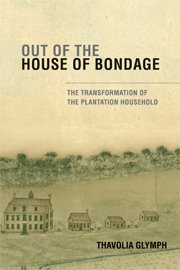
    Out+of+the+House+of+BondageI‘m a little late in posting this, but wanted to point your attention to the three finalists for this year’s Frederick Douglass Book Award that is sponsored by Yale’s Gilder-Lehrman Center for the Study of Slavery, Resistance and Abolition.

    The finalists are Thavolia Glymph for Out of the House of Bondage: The Transformation of the Plantation Household (Cambridge University Press); Annette Gordon-Reed, The Hemingses of Monticello: An American Family (W.W. Norton and Company); and Jacqueline Jones, “Saving Savannah: The City and the Civil War (Alfred A. Knopf Publishers).  The prize comes with a generous check of $25,000.  I’ve read both Annette Gordon-Reed’s book (a National Book Award winner) and Glymph’s study.  Although the publisher sent me a copy of Saving Savannah, I have not had a chance to look through it.   My money is on Glymph’s Out of the House of Bondage.


    Moving Civil War Memory. No, I mean, it’s really moving.

    July 22, 2009

    Civil War Memory said:

    This past weekend I mentioned that there are some big changes to Civil War Memory on the horizon.  Well, today is the day that I announce that Civil War Memory is moving to WordPress.org.  All the posts and comments have been moved to the new site, which can be found at http://cwmemory.com/.   Please update your blogroll as soon as possible.  In about a month I will unveil a brand new theme for the blog.


    Juneteenth 2009

    June 19, 2009

    [This is mostly an encore post, from 2008 — fyi.]

    Oldest known photograph of a Juneteenth celebration, in Austin, Texas, in 1900 - Austin Public Library image

    Oldest known photograph of a Juneteenth celebration, in Austin, Texas, in 1900 - Austin Public Library image

    The Texas State Archives offers a succinct history:

    Juneteenth, celebrated on June 19, is the name given to emancipation day by African-Americans in Texas. On that day in 1865 Union Major General Gordon Granger read General Order #3 to the people of Galveston. General Order #3 stated “The people of Texas are informed that, in accordance with a proclamation from the Executive of the United States, all slaves are free. This involves an absolute equality of personal rights and rights of property between former masters and slaves, and the connection heretofore existing between them becomes that between employer and hired labor. The freedmen are advised to remain quietly at their present homes and work for wages. They are informed that they will not be allowed to collect at military posts and that they will not be supported in idleness either there or elsewhere.”

    Large celebrations on June 19 began in 1866 and continued regularly into the early 20th century. The African-Americans treated this day like the Fourth of July and the celebrations contained similar events. In the early days, the celebration included a prayer service, speakers with inspirational messages, reading of the emancipation proclamation, stories from former slaves, food, red soda water, games, rodeos and dances.

    The celebration of June 19 as emancipation day spread from Texas to the neighboring states of Louisiana, Arkansas and Oklahoma. It has also appeared in Alabama, Florida, and California as African-American Texans migrated.

    In many parts of Texas, ex-slaves purchased land, or “emancipation grounds,” for the Juneteenth gathering. Examples include: Emancipation Park in Houston, purchased in 1872; what is now Booker T. Washington Park in Mexia; and Emancipation park in East Austin.

    Celebration of Juneteenth declined during World War II but revived in 1950 at the Texas State Fair Grounds in Dallas. Interest and participation fell away during the late 1950’s and 1960’s as attention focused on expansion of freedom for African-Americans. In the 1970’s Juneteenth revived in some communities. For example, in Austin the Juneteenth celebration returned in 1976 after a 25 year hiatus. House Bill no.1016 passed in the 66th legislature, regular session, declared June 19, “Emancipation Day in Texas,” a legal state holiday effective January 1, 1980. Since that time, the celebration of Juneteenth continues across the state of Texas with parades, picnics and dancing.

    Texas State Library Reference Services 3/95

    Celebrations across Texas started last Saturday, and will continue for another three or four days, I gather. Thought it’s an official State of Texas holiday, few people take it off. So celebrations are scheduled when they can be.

    The great mystery to me is why the holiday seems to have spread so far outside Texas. Juneteenth is based on a uniquely Texas event — it involved notifying only the slaves in Texas that they had been freed. Celebrations go much farther today, even to places the Civil War didn’t touch.

    Resources:


    Cinco de Mayo explained

    May 5, 2009

    You thought Cinco de Mayo was Independence Day for Mexico?

    No, it’s not.

    History.com has a nice explanation, with a nice little video.

    Perhaps the U.S. should celebrate the day, too, at least in those states who were not in the old Confederacy.  On May 5, 1862, Mexicans under the command of 33 year old Commander General Ignacio Zaragoza Seguín stopped the quick advance of superior French forces trying to invade Mexico to take it over, at the Battle of Puebla.  While France did eventually defeat Mexican forces (after getting 30,000 men in reinforcements), the spirit of May 5 inspired Mexicans to continue to fight for freedom.  And ultimately, Mexican forces overpowered and captured the French forces and Emperor Maximilian, who was executed.

    Thus ended a great hope for the Confederacy, that French-supported Mexican Army would lend aid to the Confederates in their struggle to secede from the Union.

    It is one of the great what-ifs of history:  What if France had kept Mexico, and what if French-led Mexican forces backed up the Confederate Army?

    One thing is rather sure:  Had that happened, and had the Confederacy been successful, we wouldn’t be celbrating Cinco de Mayo in Texas today.

    Also in Texas, on May 5, 2009, AP Spanish tests.  Good luck, kids!

    Battle of Puebla, Wikimedia (artist?)

    Battle of Puebla, Wikimedia (artist?)

    Mexican Independence Day is September 16.


    President Grant’s papers moving – to Mississippi

    January 28, 2009

    It’s either a sign of how old wounds have healed, or it’s another step in the cryptic and slow, cold war in which the South works to overcome the victory of the Union in the Civil War.

    Ulysses S Grant as a Lt. General, Library of Congress image

    Ulysses S Grant as a Lt. General; photo by Alexander Gardner, Library of Congress image

    Associated Press reports (via Federal News Radio) the papers of President Ulysses S Grant will move from the University of Southern Illinois at Carbondale,  to Mississippi State University, in Starkville, Mississippi.

    The fact that a collection about a Union hero who helped topple the Confederacy has wound up in Dixie is not lost on [John Marszalek, a Civil War scholar and Mississippi State history professor emeritus who’s now shepherding the collection].

    “There’s an irony in it,” he said with a laugh. “People recognize this for its scholarly worth, and I think what has happened over time is that people have come to realize that the Civil War is over and we’re a united nation again.”

    Still, Grant’s return to the South doesn’t thrill Cecil Fayard Jr., the Mississippi-based leader of the Sons of Confederate Veterans.

    “U.S. Grant is not beloved in the state of Mississippi. Southern folks remember well his brutal and bloody tactics of war, and the South will never forget the siege of Vicksburg,” he said.

    The Ulysses S. Grant Association, which owns the papers, decided to move them at the request of Marzsalek, who was named conservator after the death of John Y. Simon, the historian who had curated the collection during the publication of more than 30 volumes of Grants papers, beginning in 1962.  Simon lost his professorship at SIU last year, and died in July 2008.

    The modern concept of a presidential library did not exist until 1939.  The first such library was the Franklin D. Roosevelt Library in Hyde Par, New York, established with papers donated in 1939.  There are now official libraries, parts of the U.S. National Archives system, for Herbert Hoover (who preceded FDR) in West Branch, Iowa, Harry Truman, in Independence, Missouri, Dwight Eisenhower, in Abilene, Kansas, John Kennedy, at Harvard University near Boston, Lyndon Johnson at the University of Texas, Austin, Richard Nixon at Yorba Linda, California, Gerald Ford library at Ann Arbor and museum (still under construction) in Grand Rapids, Michigan, Jimmy Carter in Atlanta, Ronald Reagan at Simi Valley, California, George H. W. Bush at Texas A&M University, College Station, Texas, and Bill Clinton in Little Rock.  George W. Bush is working to establish a library and institute at Southern Methodist University in Dallas, the library an extension of the National Archives, and the institute modeled roughly after the Herbert Hoover Institution affiliated with Stanford University in Palo Alto, California.

    George Washington and Abraham Lincoln are honored with institutions, too.  Washington’s home at Mount Vernon, Virginia, is held by the Ladies of Mount Vernon Association, which originally saved the mansion; the Abraham Lincoln Presidential Library and Museum is in Springfield, Illinois.  Neither of those institutions has much formal tie to the federal library system.

    Because of their places in history, even at the risk of enlarging the institutionalness and management problems of these libraries, I would like to see libraries established for Theodore Roosevelt, perhaps in South Dakota; for Woodrow Wilson; For Andrew Jackson, probably near his home in Tennessee; and for John Adams and/or John Quincy Adams, outside of Boston.  These institutions could bolster the spread of knowledge and preservation of history of our freedoms and liberties; if we were rich, it would be useful and productive to put libraries in Ohio — for William Howard Taft, or for Taft and Garfield and Buchanan — and far upstate New York for Millard Fillmore, perhaps at the University of Buffalo.  Libraries honoring James Madison and James Monroe could be useful, too, but would put a great concentration of such institutions close to Charlottesville, Virginia.

    Resources:

    Under the fold:  Quotations from U. S. Grant, from the Grant papers collection.

    Read the rest of this entry »


    Who invented Santa Claus, and the Night Before Christmas?

    December 24, 2008

    An encore post from 2007

    Thomas Nast invented Santa Claus? Clement C. Moore didn’t write the famous poem that starts out, “‘Twas the night before Christmas, and all through the house . . . ?”

    The murky waters of history from Millard Fillmore’s Bathtub soak even our most cherished ideas and traditions.

    But isn’t that part of the fun of history?

    Santa Claus delivers to Union soldiers, "Santa Claus in Camp" - Thomas Nast, Harper's Weekly, Jan 3, 1863

    Thomas Nast’s first published drawing featuring Santa Claus; for Harper’s Weekly, “A Journal of Civilization,” January 3, 1863 Nast portrayed the elf distributing packages to Union troops: “Santa Claus in camp.” Nast (1840-1904) was 23 when he drew this image.

    Yes, Virginia (and California, too)! Thomas Nast created the image of Santa Claus most of us in the U.S. know today. Perhaps even more significant than his campaign against the graft of Boss Tweed, Nast’s popularization of a fat, jolly elf who delivers good things to people for Christmas makes one of the great stories in commercial illustration. Nast’s cartoons, mostly for the popular news publication Harper’s Weekly, created many of the conventions of modern political cartooning and modeled the way in which an illustrator could campaign for good, with his campaign against the graft of Tammany Hall and Tweed. But Nast’s popular vision of Santa Claus can be said to be the foundation for the modern mercantile flurry around Christmas.

    Nast is probably ensconced in a cartoonists’ hall of fame. Perhaps he should be in a business or sales hall of fame, too.  [See also Bill Casselman’s page, “The Man Who Designed Santa Claus.]

    Nast’s drawings probably drew some inspiration from the poem, “Account of a Visit from St. Nicholas,” traditionally attributed to Clement C. Moore, a New York City lawyer, published in 1822. The poem is among the earliest to describe the elf dressed in fur, and magically coming down a chimney to leave toys for children; the poem invented the reindeer-pulled sleigh.

    Modern analysis suggests the poem was not the work of Moore, and many critics and historians now attribute it to Major Henry Livingston, Jr. (1748-1828) following sleuthing by Vassar College Prof. Don Foster in 2000. Fortunately for us, we do not need to be partisans in such a query to enjoy the poem (a complete copy of which is below the fold).

    The Library of Congress still gives Moore the credit. When disputes arise over who wrote about the night before Christmas, is it any wonder more controversial topics produce bigger and louder disputes among historians?

    Moore was not known for being a poet. The popular story is that he wrote it on the spur of the moment:

    Moore is thought to have composed the tale, now popularly known as “The Night Before Christmas,” on December 24, 1822, while traveling home from Greenwich Village, where he had bought a turkey for his family’s Christmas dinner.

    Inspired by the plump, bearded Dutchman who took him by sleigh on his errand through the snow-covered streets of New York City, Moore penned A Visit from St. Nicholas for the amusement of his six children, with whom he shared the poem that evening. His vision of St. Nicholas draws upon Dutch-American and Norwegian traditions of a magical, gift-giving figure who appears at Christmas time, as well as the German legend of a visitor who enters homes through chimneys.

    Again from the Library of Congress, we get information that suggests that Moore was a minor celebrity from a well-known family with historical ties that would make a good “connections” exercise in a high school history class, perhaps (”the link from Aaron Burr’s treason to Santa Claus?”): (read more, below the fold)

    Clement Moore was born in 1779 into a prominent New York family. His father, Benjamin Moore, president of Columbia University, in his role as Episcopal Bishop of New York participated in the inauguration of George Washington as the nation’s first president. The elder Moore also administered last rites to Alexander Hamilton after he was mortally wounded in a tragic duel with Aaron Burr.

    A graduate of Columbia, Clement Moore was a scholar of Hebrew and a professor of Oriental and Greek literature at the General Theological Seminary in Manhattan. [See comment from Pam Bumsted below for more on Moore.] He is said to have been embarrassed by the light-hearted verse, which was made public without his knowledge in December 1823. Moore did not publish it under his name until 1844.

    Tonight, American children will be tucked in under their blankets and quilts and read this beloved poem as a last “sugarplum” before slipping into dreamland. Before they drift off, treat them to a message from Santa, recorded by the Thomas Edison Company in 1922.

    Santa Claus Hides in Your Phonograph
    By Arthur A. Penn, Performed by Harry E. Humphrey.
    Edison, 1922.
    Coupling date: 6/20/1922. Cutout date: 10/31/1929.
    Inventing Entertainment: The Motion Pictures and Sound Recordings of the Edison Companies

    Listen to this recording (RealAudio Format)

    Listen to this recording (wav Format, 8,471 Kb)

    But Henry Livingston was no less noble or historic. He hailed from the Livingtons of the Hudson Valley (one of whose farms is now occupied by Camp Rising Sun of the Louis August Jonas Foundation, a place where I spent four amazing summers teaching swimming and lifesaving). Livingston’s biography at the University of Toronto site offers another path for a connections exercise (”What connects the Declaration of Independence, the American invasion of Canada, the famous poem about a visit from St. Nick, and George W. Bush?”):

    Henry Livingston Jr. was born in Poughkeepsie, New York, on Oct. 13, 1748. The Livingston family was one of the important colonial and revolutionary families of New York. The Poughkeepsie branch, descended from Gilbert, the youngest son of Robert Livingston, 1st Lord of Livingston Manor, was not as well off as the more well-known branches, descended from sons Robert and Philip. Two other descendants of Gilbert Livingston, President George Walker Herbert Bush and his son, President-Elect George W. Bush, though, have done their share to bring attention to this line. Henry’s brother, Rev. John Henry Livingston, entered Yale at the age of 12, and was able to unite the Dutch and American branches of the Dutch Reformed Church. At the time of his death, Rev. Livingston was president of Rutgers University. Henry’s father and brother Gilbert were involved in New York politics, and Henry’s granduncle was New York’s first Lt. Governor. But the law was the natural home for many of Henry’s family. His brother-in-law, Judge Jonas Platt, was an unsuccessful candidate for governor, as was his daughter Elizabeth’s husband, U.S. Supreme Court Justice Smith Thompson. Henry’s grandson, Sidney Breese, was Chief Justice of the Illinois Supreme Court.

    Known for his encyclopedic knowledge and his love of literature, Henry Livingston was a farmer, surveyor and Justice of the Peace, a judicial position dealing with financially limited criminal and civil cases. One of the first New Yorkers to enlist in the Revolutionary Army in 1775, Major Henry Livingston accompanied his cousin’s husband, General Montgomery, in his campaign up the Hudson River to invade Canada, leaving behind his new wife, Sarah Welles, and their week-old baby, on his Poughkeepsie property, Locust Grove. Baby Catherine was the subject of the first poem currently known by Major Livingston. Following this campaign, Livingston was involved in the War as a Commissioner of Sequestration, appropriating lands owned by British loyalists and selling them for the revolutionary cause. It was in the period following Sarah’s early death in 1783, that Major Livingston published most of his poems and prose, anonymously or under the pseudonym of R. Ten years after the death of Sarah, Henry married Jane Patterson, the daughter of a Dutchess County politician and sister of his next-door neighbor. Between both wives, Henry fathered twelve children. He published his good-natured, often occasional verse from 1787 in many journals, including Political Barometer, Poughkeepsie Journal, and New-York Magazine. His most famous poem, “Account of a Visit from St. Nicholas,” was until 2000 thought to have been the work of Clement Clarke Moore (1779-1863), who published it with his collected poems in 1844. Livingston died Feb. 29, 1828.

    More on Henry Livingston and his authorship of the Christmas poem here.

    Thomas Nast, Merry Old Santa Claus, Harper's Weekly, Jan 1, 1881


    Our views of Santa Claus owe a great deal also to the Coca-Cola advertising campaign. Coca-Cola first noted Santa’s use of the drink in a 1922 campaign to suggest Coke was a year-round drink (100 years after the publication of Livingston’s poem). The company’s on-line archives gives details:

    In 1930, artist Fred Mizen painted a department store Santa in a crowd drinking a bottle of Coke. The ad featured the world’s largest soda fountain, which was located in the department store of Famous Barr Co. in St. Louis, Mo. Mizen’s painting was used in print ads that Christmas season, appearing in The Saturday Evening Post in December 1930.

    1936 Coca-Cola Santa cardboard store display

    • 1936 Coca-Cola Santa cardboard store display

    Archie Lee, the D’Arcy Advertising Agency executive working with The Coca-Cola Company, wanted the next campaign to show a wholesome Santa as both realistic and symbolic. In 1931, The Coca-Cola Company commissioned Michigan-born illustrator Haddon Sundblom to develop advertising images using Santa Claus — showing Santa himself, not a man dressed as Santa, as Mizen’s work had portrayed him.
    1942 original oil painting - 'They Remembered Me'

    • 1942 original oil painting – ‘They Remembered Me’

    For inspiration, Sundblom turned to Clement Clark Moore’s 1822 poem “A Visit From St. Nicholas” (commonly called “‘Twas the Night Before Christmas”). Moore’s description of St. Nick led to an image of Santa that was warm, friendly, pleasantly plump and human. For the next 33 years, Sundblom painted portraits of Santa that helped to create the modern image of Santa — an interpretation that today lives on in the minds of people of all ages, all over the world.

    Santa Claus is a controversial figure. Debates still rage among parents about the wisdom of allowing the elf into the family’s home, and under what conditions. Theologians worry that the celebration of Christmas is diluted by the imagery. Other faiths worry that the secular, cultural impact of Santa Claus damages their own faiths (few other faiths have such a popular figure, and even atheists generally give gifts and participate in Christmas rituals such as putting up a decorated tree).

    For over 100 years, Santa Claus has been a popular part of commercial, cultural and religious life in America. Has any other icon endured so long, or so well?

    Add to FacebookAdd to NewsvineAdd to DiggAdd to Del.icio.usAdd to StumbleuponAdd to RedditAdd to BlinklistAdd to TwitterAdd to TechnoratiAdd to Furl

    ________________________
    Below:
    From the University of Toronto Library’s Representative Poetry Online

    Major Henry Livingston, Jr. (1748-1828)

    Account of a Visit from St. Nicholas

    1 ‘Twas the night before Christmas, when all thro’ the house,
    2 Not a creature was stirring, not even a mouse;
    3 The stockings were hung by the chimney with care,
    4 In hopes that St. Nicholas soon would be there;
    5 The children were nestled all snug in their beds,
    6 While visions of sugar plums danc’d in their heads,
    7 And Mama in her ‘kerchief, and I in my cap,
    8 Had just settled our brains for a long winter’s nap –
    9 When out on the lawn there arose such a clatter,
    10 I sprang from the bed to see what was the matter.
    11 Away to the window I flew like a flash,
    12 Tore open the shutters, and threw up the sash.
    13 The moon on the breast of the new fallen snow,
    14 Gave the lustre of mid-day to objects below;
    15 When, what to my wondering eyes should appear,
    16 But a miniature sleigh, and eight tiny rein-deer,
    17 With a little old driver, so lively and quick,
    18 I knew in a moment it must be St. Nick.
    19 More rapid than eagles his coursers they came,
    20 And he whistled, and shouted, and call’d them by name:
    21 “Now! Dasher, now! Dancer, now! Prancer, and Vixen,
    22 “On! Comet, on! Cupid, on! Dunder and Blixem;
    23 “To the top of the porch! to the top of the wall!
    24 “Now dash away! dash away! dash away all!”
    25 As dry leaves before the wild hurricane fly,
    26 When they meet with an obstacle, mount to the sky;
    27 So up to the house-top the coursers they flew,
    28 With the sleigh full of Toys — and St. Nicholas too:
    29 And then in a twinkling, I heard on the roof
    30 The prancing and pawing of each little hoof.
    31 As I drew in my head, and was turning around,
    32 Down the chimney St. Nicholas came with a bound:
    33 He was dress’d all in fur, from his head to his foot,
    34 And his clothes were all tarnish’d with ashes and soot;
    35 A bundle of toys was flung on his back,
    36 And he look’d like a peddler just opening his pack:
    37 His eyes — how they twinkled! his dimples how merry,
    38 His cheeks were like roses, his nose like a cherry;
    39 His droll little mouth was drawn up like a bow.
    40 And the beard of his chin was as white as the snow;
    41 The stump of a pipe he held tight in his teeth,
    42 And the smoke it encircled his head like a wreath.
    43 He had a broad face, and a little round belly
    44 That shook when he laugh’d, like a bowl full of jelly:
    45 He was chubby and plump, a right jolly old elf,
    46 And I laugh’d when I saw him in spite of myself;
    47 A wink of his eye and a twist of his head
    48 Soon gave me to know I had nothing to dread.
    49 He spoke not a word, but went straight to his work,
    50 And fill’d all the stockings; then turn’d with a jerk,
    51 And laying his finger aside of his nose
    52 And giving a nod, up the chimney he rose.
    53 He sprung to his sleigh, to his team gave a whistle,
    54 And away they all flew, like the down of a thistle:
    55 But I heard him exclaim, ere he drove out of sight –
    56 Happy Christmas to all, and to all a good night.

    Arc of history under the St. Louis Arch

    November 7, 2008

    This is just so, so, so delicious.

    Look at this photo.  It’s a shot of the crowd gathered in St. Louis on October 19 to see and hear Barack Obama — about 100,000 people.  Study the buildings in the photo.

    Supporters of Barack Obama rally in St. Louis, Missouri, on October 19, 2008

    Supporters of Barack Obama rally in St. Louis, Missouri, on October 19, 2008

    See the building with the green dome?  Recognize it?

    Elizabeth Kaeton wrote at Telling Secrets:

    If you look in the distance there, you can see a building with a greenish-copper dome. That’s the Old St. Louis Courthouse. For years and years, slaves were auctioned on the steps of that courthouse.

    The Old Courthouse used to be called the St. Louis State and Federal Courthouse.

    Back in 1850, two escaped slaves named Dred and Harriett Scott had their petition for freedom overturned in a case there. Montgomery Blair took the case to the US Supreme Court on Scott’s behalf and had Chief Justice Roger Taney throw it out because, as he wrote, the Scotts were ‘beings of an inferior order, and altogether unfit to associate with the white race, either in social or political relations, and so far inferior that they had no rights which the white man was bound to respect.’

    Hard to imagine, isn’t it?

    What is rather uplifting is that, 158 years later, the man who will most likely be the first black US President was able to stand outside this very same courthouse and gather that crowd. Today, America looked back on one of the darkest moments in its history, and resoundingly told Judge Taney to go to hell.

    That case is the first one I thought of when Sarah Palin got caught by Katie Couric unable to explain Supreme Court decisions with which she might have disagreed.  In re Dred Scott is right at the top of my list, and generally on the tip of my tongue.  We fought a great and bloody war to overturn that decision, amended the Constitution, bore another 100 years of atrocities, then passed the Civil Rights Act of 1964 and the Voting Rights Act of 1965, all to blot out the dreadful decision those conservative, activist judges wrought on the nation.

    Kaeton posted the photo and comments last Saturday, before Freedom Tuesday when we voted as nation to clean up even more of the mess of the Dred Scott case.

    History teachers:  I’ll wager that’s a photo you can get cheap, to blow up to poster size for your classrooms.  You ought to do it.  Students should not only understand history, they ought also be able to take delight in watching it unfold, especially when justice comes out of the unfolding.

    Found the photo and post, with a tip of the old scrub brush to Blue Oregon, while looking at the astounding number of literary and history allusions in Obama’s unique victory speech, in which he talked about Americans trying to “bend the arc of history.”  I knew I’d heard that line before.  It’s from Martin Luther King, who saidm “The arc of history is long, but it bends toward justice.”  (Where did he say that?  When?)

    Those allusions, and the speech, may be a topic for another post.

    Resources:


    Millard Fillmore, statesman. What?

    November 2, 2008

    Elektratig relates views in a new book that makes a case that Millard Fillmore acted decisively and powerfully to prevent a war between the states in 1850, and thereby force the Compromise of 1850.

    Among its many other virtues, Mark J. Stegmaier’s Texas, New Mexico, & The Compromise of 1850: Boundary Dispute & Sectional Crisis contains a detailed and balanced discussion of Millard Fillmore’s contributions toward the resolution of the Crisis of 1850.

    A cartoon from April 1850 shows how raw were some of the emotions among national leaders, especiallyi n the Senate.  It illustrates an incident that occurred April 17, 1850, when Sen. Henry S. Foote of Mississippi drew a pistol on Missouri’s Sen. Thomas Hart Benton.  Elektratig used the cartoon to illustrate his post; it’s good enough to repeat here.

    A somewhat tongue-in-cheek dramatization of the moment during the heated debate in the Senate over the admission of California as a free state when Mississippi senator Henry S. Foote drew a pistol on Thomas Hart Benton of Missouri. In the cartoon Benton (center) throws open his coat and defiantly states, Get out of the way, and let the assassin fire! let the scoundrel use his weapon! I have no arms! I did not come here to assassinate! He is attended by two men, one of them North Carolina senator Willie P. Mangum (on the left). Foote, restrained from behind by South Carolinas Andrew Pickens Butler and calmed by Daniel Stevens Dickinson of New York (to whom he later handed over the pistol), still aims his weapon at Benton saying, I only meant to defend myself! In the background Vice President Fillmore, presiding, wields his gavel and calls for order. Behind Foote another senator cries, For Gods sake Gentlemen Order! To the right of Benton stand Henry Clay and (far right) Daniel Webster. Clay puns, Its a ridiculous matter, I apprehend there is no danger on foot! Visitors in the galleries flee in panic.

    Cartoon by Edward Williams Clay, from the Library of Congress Collection. LOC Summary: A somewhat tongue-in-cheek dramatization of the moment during the heated debate in the Senate over the admission of California as a free state when Mississippi senator Henry S. Foote drew a pistol on Thomas Hart Benton of Missouri. In the cartoon Benton (center) throws open his coat and defiantly states, "Get out of the way, and let the assassin fire! let the scoundrel use his weapon! I have no arm's! I did not come here to assassinate!" He is attended by two men, one of them North Carolina senator Willie P. Mangum (on the left). Foote, restrained from behind by South Carolina's Andrew Pickens Butler and calmed by Daniel Stevens Dickinson of New York (to whom he later handed over the pistol), still aims his weapon at Benton saying, "I only meant to defend myself!" In the background Vice President Fillmore, presiding, wields his gavel and calls for order. Behind Foote another senator cries, "For God's sake Gentlemen Order!" To the right of Benton stand Henry Clay and (far right) Daniel Webster. Clay puns, "It's a ridiculous matter, I apprehend there is no danger on foot!" Visitors in the galleries flee in panic.

    Real history:  Stranger than you can imagine.


    Can Texas split itself into five states? Is West Virginia legal?

    September 15, 2008

    Elektratig has found a legal scholar with a wild bent who has penned a couple of scholarly articles designed to give heart to conspiracy nuts, anarchists and radical libertarians.

    One article [by Michael Stokes Paulsen], “Let’s Mess With Texas,” actually was published in the Texas Law Review in 2004, arguing the case that the odd treaty negotiations/statehood legislation that led to Texas becoming part of the U.S. in 1845 included a clause that would allow Texas to split itself into as many as five states.  The authors speculate as to chaos this would cause in U.S. politics.  The article is available in a free download from SSRN.

    The other, “Is West Virginia Unconstitutional” was published in the California Law Review. It offers a good history of the creation of West Virginia from the northwestern territory of Virginia in 1863, when the pro-Union counties of the northwest part of the state declared a government in exile and consented to the Union’s partition of Virginia.

    Both stories pose interesting questions for government classes, U.S. history classes (especially with regard to the Civil War), and possibly for Texas history classes, though the discussions may not seem germane to the 7th grade minds it would need to entertain.

    Both articles breezily discuss history in a wry, humorous way.  A lot more history for high school students should be written this way.

    I can’t find it at the moment, but it seems to me that most authorities determined Texas’s right to self-partition expired when the state tried to secede in 1861, and, in any case, did not survive the readmission process subsequent to the end of the war and reconstruction. Although Texas U.S. Rep. John Nance Garner (future vice president under FDR) threatened to exercise the clause in 1930 to fight a tariff he didn’t like, it’s unlikely Texans would consent to lose their bragging rights to being bigger than anybody else in the Lower 48.  The issue is generally considered dead to Texans, if not in law.

    Plus, there isn’t enough hair in the Lone Star State for four more Rick Perrys.

    If you think history can’t be fun, you haven’t read this stuff.  Go check it out.

    Resources:


    But, did Lee really say it?

    September 9, 2008

    Kevin Levin at A Civil War Memory checks out an almost-Sherman-like quote attributed to Gen. Robert E. Lee. “It is good that war is so terrible,” Lee is reputed to have started out . . .

    Levin shows again why so many regard him as a very good historian.