Newtongate shakes anthropogenically-generated mathematics at the foundation

November 22, 2009

Satire, hoax, fact — how can we tell the difference?

Maybe more importantly, how can we tell early on that the “Climategate” kerfuffle, involving purloined, but otherwise dull e-mails from climate scientists, is nothing to worry about?

Look at history!  Remember Newtongate?  Read it here, at Carbon Fixated.

If you own any shares in companies that produce reflecting telescopes, use differential and integral calculus, or rely on the laws of motion, I should start dumping them NOW. The conspiracy behind the calculus myth has been suddenly, brutally and quite deliciously exposed after volumes of Newton’s private correspondence were compiled and published.

When you read some of these letters, you realise just why Newton and his collaborators might have preferred to keep them confidential. This scandal could well be the biggest in Renaissance science. These alleged letters – supposedly exchanged by some of the most prominent scientists behind really hard math lessons – suggest:

Conspiracy, collusion in covering up the truth, manipulation of data, private admissions of flaws in their public claims and much more.

But perhaps the most damaging revelations are those concerning the way these math nerd scientists may variously have manipulated or suppressed evidence to support their cause.

What kind of conspiracy keeps calculus being taught to innocent children today?  Exactly the same conspiracy that causes scientists to sound the alarms about climate change.

Tip of the old scrub brush to Tim Lambert at Deltoid.


Al Gore shows how green investing works

November 3, 2009

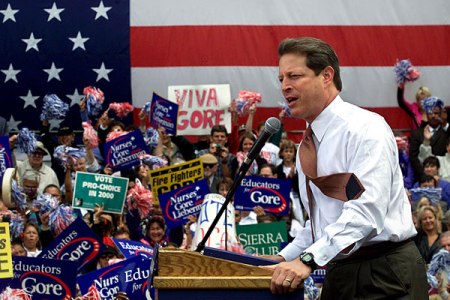
Then Vice President Al Gore campaigning in Des Moines, Iowa, November 25, 1999.

Then Vice President Al Gore campaigning in Des Moines, Iowa, November 25, 1999.

Among the more amusing about-faces in conservative knee-jerk politics is conservative criticism of Al Gore for being a successful investor.

No, I’m not kidding.

Back in April, Gore testified to a House Energy and Commerce Committee in April — one of the committees where Gore was a shining star when he was a Member — and he ran into a challenge from Tennessee Rep. Marsha Blakburn who tried to play bad cop in grilling Gore about his investment work.  Since leaving politics Gore has worked to put his money where his advocacy is, backing green industries and energy efficiency projects. Blackburn is a Republican representing Tennessee’s 7th District. Blackburn appears not to understand how cross-examination works.

In most discussions I’ve had on warming issues over the past two months, advocates for doing nothing almost always bring up Gore as as “profiteer” for investing in green businesses.

It’s as if conservatives and Republicans have forgotten how business works in a free-enterprise system, and they think that free enterprise is tantamount to communism.

T. Boone Pickens used to be a favorite witness for Republicans to call at Congressional hearings.  Pickens was, and still is, a staunch advocate of free enterprise, and he advocates a lot less regulation than most Democrats want.  Then Pickens’s investments, especially his vulture investments in dying companies where he’d sell off the assets and put the company out of existence, were touted by Republicans as indication that Pickens is a genius.

A hard look at Gore’s investments shows him to be nothing more than a free-enterprise advocate who leads the way in green investments.  He has made huge gambles in businesses that warming skeptics claim won’t work — and his investments have tended to pay off, to the great consternation of warming do-nothings who understand markets.

This story in the New York Times suggests just how well Gore has done, and how much his leadership in investing might benefit us.  It’s worth bookmarking for your next discussion on what we should do about global warming — because you know somebody will try to make it about Al Gore.  It just galls the heck out of conservatives and anti-science folks that Gore is right so often, and that he is such a practitioner of the Scout Law.

Anti-pollution is good business.  Reducing the dumping of poisons into the air and water makes sense, and it makes a better economy in the long run.  Sometimes it makes a better economy in the short run, too.  Gore stepped into the marketplace, a very capitalist act.  His investments paid off, demonstrating that markets do work, and demonstrating that green business is smart business.  What are Republicans and conservatives thinking in taking after Gore’s business success?

Oh — Boone Pickens? He used to have an office in Trammell Crow Tower when our offices at Ernst & Young LLP were a floor or so away.  We shared elevator rides many times, and he is in person as gracious and smart as he appeared in those Congressional hearings years ago.

His money today?  He’s investing in wind power, because he thinks we need to act now to reduce dependency on oil imports.

Maybe Republican anti-green politics is coming home to roost.

Add to FacebookAdd to NewsvineAdd to DiggAdd to Del.icio.usAdd to StumbleuponAdd to RedditAdd to BlinklistAdd to TwitterAdd to TechnoratiAdd to Furl


Naomi Oreskes: The lecture Lord Monckton slept through, which he hopes you will not see

October 23, 2009

Here’s another example of where historians show their value in science debates.

Naomi Oreskes delivered this lecture a few years ago on denialism in climate science.  Among other targets of her criticism-by-history is my old friend Robert Jastrow.  I think her history is correct, and her views on the Marshall Institute and denial of climate change informative in the minimum, and correct on the judgment of the facts.

You’ll recognize some of the names:  Jastrow, Frederick Seitz, S. Fred Singer, and William Nierenberg.

Oreskes details the intentional political skewing of science by critics of the serious study of climate warming.  It’s just under an hour long, but well worth watching.  Dr. Oreskes is Professor of History in the Science Studies Program at the University of California at San Diego.  The speech is titled “The American Denial of Global Warming.”

If Oreskes is right — and I invite you to check her references thoroughly, to discover for yourself that her history and science are both solid — Lord Monckton is a hoaxster.  Notice especially the references after the 54 minute mark to the tactic of claiming that scientists are trying to get Americans to give up our sovereignty.

Nothing new under the sun.

“Global warming is here,  and there are almost no communists left,” Oreskes said.

Nudge your neighbor:

Add to FacebookAdd to NewsvineAdd to DiggAdd to Del.icio.usAdd to StumbleuponAdd to RedditAdd to BlinklistAdd to TwitterAdd to TechnoratiAdd to Furl


Watts falls victim to Monckton’s voodoo

October 19, 2009

Among those who call themselves “skeptical” of claims about climate change, Anthony Watts has distinguished himself from time to time for often using solid science and raising good questions.  His campaign to look at the placement of weather reporting stations indicates an understanding of the way science should work (though we haven’t seen results).

So, what’s Watts doing repeating Monckton’s hysterical, inaccurate rantWe already know Monckton’s testimony is impeached.

Is Watts so politically naive as to think any nation would cede sovereignty on an issue of climate change? One more indication that people should stick to their knitting, and not venture into areas where they have no expertise.


Monckton lies again (and again, and again, and again, and again . . .)! The continuing saga of a practicer of fictional science

October 18, 2009

When Monckton claimed that Jackie Kennedy was responsible for malaria in Africa, I thought it a great stretch.

Holy cow!  Monckton gave a speech in Minnesota, and if this quote is representative, it was a one man re-enactment of the Burlington Liar’s Club quarterfinals for 2002 through 2008 (he was disqualified for lack of humor).  Monckton spoke at Bethel University in St. Paul on October 15, 2009:

Here is an excerpt from his speech:

Here is why the truth matters. It was all very well for jesting Pilate to ask that question and then not to tarry for an answer. But that question that he asked, “what is the truth?” is the question which underlies every question and in the end it is the only question that really matters. When you ask that question what you are really asking is “what is the truth about the matter?” And we are now going to see why it matters morally, socially, and politically, as well as economically and scientifically. That the truth, the whole truth and nothing but the truth should inform public policy on this question. Now, 40 years ago, DDT, the only effective agent against the malaria mosquito was banned. And you saw in that film [Cascade Policy Institute film “Climate Chains” was shown prior –ed] what the effect of that ban was. Before the ban, the inventor of DDT got the Nobel Peace Prize because he had saved more lives than anyone else in the history of the planet. Malaria, one of the greatest killers of children in the Third World had all but been eradicated. There were still 50,000 deaths per year. But when DDT was banned by exactly the same faction, that is now trying to tell us we must close down five sixths of the United States economy that figure is actually in the Waxman- Markey bill. That same faction banned DDT worldwide. The consequences are on the slide there. The number of deaths went up from 50,000 to a million a year and stayed there. For 40 years. 40 million people, nearly all of them children, died of malaria solely and simply because DDT had been banned for no good scientific reason or environmental reason whatsoever. And it was only after every single one of the people responsible for that dismal, murderous decision had retired or died that on September the 15th 2006, Dr. Arata Kochi of the World Health Organization said “Normally in this field, science comes second and politics comes first. But we will now take a stand on the science and the data, and he ended that ban on DDT and made it once again the front line of defense against the malaria mosquito. After pressure from me, among others.

Right there Monckton disqualified himself from ever being a Boy Scout with egregious disregard for the first point of the Scout Law. Oh, Monckton is dependable, but dependable only to tell falsehoods and stink up the place.  That excerpt provides the Recommended Annual Dose of both voodoo science and voodoo history.  Count the problems with me:

1.  DDT has never been the only effective means to fight malaria-carrying mosquitoes. DDT was  a very effective pesticide, though dangerous — but never the “only effective agent against the malaria mosquito.”  The U.S., for one example beat malaria (and yellow fever, and other mosquito-borne diseases) well enough to finish the Panama Canal in 1915 without DDT, by controlling mosquito breeding areas and using screens to protect sleeping workers from mosquitoes.  Malaria, once endemic in much of the U.S., was practically eliminated by 1939.  DDT was used in limited fashion to complete the eradication in the U.S., after World War II — but most of the work had already been done.  The Centers for Disease Control (CDC) (founded to control malaria) relates at its website:

Control efforts conducted by the state and local health departments, supported by the federal government, resulted in the disease being eradicated by 1949. Such measures included drainage, removal of mosquito breeding sites, and spraying (occasionally from aircrafts) of insecticides.

Aircraft spraying insecticide,  1920's
Aircraft spraying insecticide, 1920s
Drainage activities, Virginia, 1920's
Drainage activities, Virginia, 1920s

We still have the non-pesticide solutions, and they still work.  But 40 years ago, there were other pesticides that worked against the malaria vector mosquitoes.

The national library of the ancient Kingdom of Ghana had volumes on how to eradicate malaria, more than 500 years ago.  Monckton can’t even be bothered to Google the topic, let alone visit one of America’s more than 15,000 free county libraries, to get the facts?

2.  No Nobel Peace Prize was ever given for DDT, and the prize given wasn’t for saving malaria victims. Paul Müller won the Nobel in Physiology or Medicine in 1948, for his discovery that DDT killed insects.  There was no Peace Prize awarded in 1948.  A chemist working in biological chemicals won the Peace Nobel later — but it was Linus Pauling, who won in 1962 for his work against the proliferation of nuclear weapons.  [UPDATE:  Listening to Monckton’s speech, I note that the transcriber made a serious error.  Monckton did not specify the Nobel Peace Prize; it is still true that the Medicine Prize that Müller won was not on the basis of DDT’s saving an uncountable number of lives.  The chief medical advantage cited was the use of DDT fighting typhus; malaria gets a mention.  Monckton can’t be bothered with accuracy on such things, however, as is clearly shown.]

The bizarre claim about saving “more lives than anyone else in the history of the planet” comes from a wacko claim of the Lyndon Larouche cult, apparently based on a typographical error in a 1980 book from the National Academy of Sciences.

3.  Malaria rates have been greatly reduced in the 20th century, but malaria has never been “all but eradicated.” In the past 120 years, malaria has always killed more than 900,000 people a year; for most of the past 60 years, the death toll has been more than a million people a year, sometimes as high as 4 million people killed.  Annual malaria deaths have never been under a half million, let alone as low as 50,000.

4.  DDT has never been banned for use to control malaria. 40 years ago, in 1969, DDT was freely available world wide.  Sweden banned the stuff from agricultural use in 1970; the U.S. followed with a ban on agricultural use of DDT, especially sprayed from airplanes.  DDT for fighting malaria has always been a feature of the U.S. ban.  As a pragmatic matter, DDT manufacture on U.S. shores continued for more than a dozen years after the restrictions on agricultural use of the stuff.  In an ominous twist, manufacture in the U.S. continued through most of 1984, right up to the day the Superfund Act made it illegal to dump hazardous substances without having a plan to clean it up or money to pay for clean up — on that day the remaining manufacturing interests declared bankruptcy to avoid paying for the environmental damage they had done.  See the Pine River, Michigan Superfund site, or the Palos Verdes and Montrose Chemical Superfund sites in California,  the CIBA-Geigy plant in McIntosh, Alabama, and sites in Sand Creek, Colorado, Portland, Oregon, and Aberdeen, North Carolina, for examples.

5.  Nothing in Waxman-Markey anticipates closing down any part of the U.S. economy. This is a claim Monckton appears to have plucked from between his gluteals.  Here’s one summary of the bill (notice the money allocated to boost industry), here’s another, and here’s the summary from the House Energy and Commerce Committee.

6.  There’s no way to blame malaria deaths on a lack of DDT. As noted, DDT has been available for use in Africa and Asia since its patent.  More importantly, malaria death rates have been influenced by the failure of effectiveness of pharmaceuticals against the malaria parasite itself in humans.  DDT fights only the mosquitoes that carry the parasite.  But the difficulty wasn’t in beating the mosquitoes; the difficulty was in curing humans (from whom the mosquitoes get the parasite to pass along).

7.  DDT was restricted on the basis of overwhelming evidence of harms. This is one of those charges that is self-refuting in the hands of DDT advocates and anti-science people.  You don’t have to go far to find claims that EPA acted contrary to an extensive hearing record that took months to compose.  But then they turn around and claim, as Monckton does here, that there is no such record?  The facts are that the Environmental Protection Administration (EPA) hearings were conducted under the gun.  Two different federal courts had ordered the review, which had been started with the Department of Agriculture before the creation of EPA.  The hearing record itself fell out of favor with some officials, and even EPA’s library had difficulty finding a copy of the decision by Administrative Law Judge Edmund Sweeney — but intrepid fact seekers like Jim Easter tracked down the documents and posted them for all to see.  Easter notes that the record is clear on harms to wildlife, bio-magnification, and other dangers of DDT.  In fact, the only place Ruckelshaus differed from Sweeney was on the issue of cotton.  Sweeney thought he couldn’t prohibit use on cotton, Ruckelshaus found authority in the law and did so.

Be clear:  EPA banned DDT use on agricultural products, especially cotton, and broadcast spraying.  EPA’s “ban” allowed continued manufacture of DDT, and it allowed use for health emergencies and other emergencies.

8.  There never was a ban on DDT by the World Health Organization (WHO). So Monckton’s bizarre fiction that “. . . it was only after every single one of the people responsible for that dismal, murderous decision had retired or died that on September the 15th 2006, Dr. Arata Kochi of the World Health Organization said normally in this field, science comes second and politics comes first,” and then Kochi ended the ban, is whole cloth.

9.  There is no evidence anybody ever paid any attention to Monckton on DDT, but Monckton took credit for the imaginary end of the imaginary ban: ” After pressure from me, among others.”  There’s a distant possibility that Monckton might have written a letter to WHO — but let Monckton produce the thing from the archives of WHO.  Until that time, we should classify Monckton as an emboldened prevaricator, perhaps a victim of Munchausen’s Syndrome (not by proxy in this case).   I’m calling Monckton’s bluff.   Let’s see his cards on this issue:  When did he say anything to WHO about DDT, to whom, and what did he say?  He’ll not be able to produce any documentation, I’ll wager — and I’ll bet he can’t even produce hearsay testimony.

Nine falsehoods in a paragraph — a rate of falsehood not equalled even by Jon Lovitz’s pathological liar character. What is wrong with the excrement detectors of the people who sit in those audiences with this guy?

How far out of bounds is Monckton?  Even the shrill discussion at Little Green Footballs puts Monckton in the not-to-be-taken-seriously category.

Monckton, the Burlington Liars Club called:  They want their good reputation back.  Check your answering machine, too — the Bethel College group should be calling any minuted, to ask you to pay for the exorcism of their building after you spoke there.

By the way, how do we know Monckton is a coward?*  He has refused to debate me.  As he notes, anyone who refuses a debate is a coward.  And yet, he refuses each of my challenges.  Now he’s refusing to debate a Tenderfoot Boy Scout using Boy Scout Law rules.  How much of a coward does that make him?

_______________

* Of course that logic is flawed.  But he uses it against Al Gore.  Monckton can’t get Gore to suffer him, and so, Monckton, a moral pipsqueak, calls Gore a coward.  The “Freemarket Institute” people ate it up.  It’s more likely that Gore simply refuses to get into a urination contest with a known skunk.  Still, Monckton refuses to debate — what is he afraid of?

No lie!

Add to FacebookAdd to NewsvineAdd to DiggAdd to Del.icio.usAdd to StumbleuponAdd to RedditAdd to BlinklistAdd to TwitterAdd to TechnoratiAdd to Furl


Killer CO2 cloud – the story climate change “skeptics” hope you won’t read

October 14, 2009

From Neat-o-rama: Grazing cattle killed in the 1986 Lake Nyos disaster (Image Credit: Water Encyclopedia)

From Neat-o-rama: Grazing cattle killed in the 1986 Lake Nyos disaster (Image Credit: Water Encyclopedia)

It’s not even secret.  But those propagandists who run advertising claiming that carbon dioxide is natural and, therefore, harmless, hope against hope that you don’t know the true history, that you’ve never heard of Cameroon, that you don’t know about volcanic emissions, and that you forgot the story of the killer CO2 cloud of 1986.

Read it here, “Cameroon:  The Lake of Death.”

More information:

Lake Nyos, in Cameroon, shortly after the 1986 killer CO2 cloud. Image from Neat-o-rama.

Lake Nyos, in Cameroon, shortly after the 1986 killer CO2 cloud. Image from Neat-o-rama.

Help make a cloud of witnesses:

Add to FacebookAdd to NewsvineAdd to DiggAdd to Del.icio.usAdd to StumbleuponAdd to RedditAdd to BlinklistAdd to TwitterAdd to TechnoratiAdd to Furl

Save


Quick assist for students doing papers on climate change

October 14, 2009

So, you’re a student doing a paper on climate change, and you need help limiting the topic, or finding information about related topics.

Hot Topic has just the thing:  Interactive “debate maps.

Hot Topic is a website dedicated to the issue climate change in New Zealand — after the book by the same name.

Does anyone know where similar maps might exist for other social studies topics?


Anti-Gore film’s producer tries tantrum to get publicity

October 13, 2009

Phelim McAleer, one of the producers of the anti-Al Gore film “Not Evil, Just Wrong,” sneaked into a Gore press event and threw a tantrum the other day.

Why is this relevant?  Oh, the tantrum was rude, but if you’re a hack film producer with a political screed whose film looks like a flop, you’ll do anything to get publicity for the film.  Perhaps we should not be too critical of publicity whores.

It’s not relevant because of that.

It’s relevant because one of the charges against Gore by the fruit-and-nut brigade is that Gore refuses to talk to the press.  How can they complain about Gore’s treatment of them when any mention of this event makes the Gore critics appear untruthful?


Peter Sinclair update: Mars still doesn’t deny Earth’s warming

September 21, 2009

Cleverly avoiding real discussion of greenhouse gases and their effects on Venus, climate change denialists often claim warming to be a solar system-wide event, caused by the Sun — evidenced, they say, by warming on all the other planets in the solar system.

Peter Sinclair’s “Climate Denial Crock of the Week” dealt with the issue several months ago, but he’s redone the piece, with improvements in sound especially.

Spread the word:

Add to FacebookAdd to NewsvineAdd to DiggAdd to Del.icio.usAdd to StumbleuponAdd to RedditAdd to BlinklistAdd to TwitterAdd to TechnoratiAdd to Furl


Climate change denialists cripple American industry

September 16, 2009

Did you see Tom Friedman’s column today?

Is there any way to interpret away his conclusions that the war against green jobs is killing American industry?

Is there any way he could be wrong?  Read it; doesn’t it make you want to fix things?

O.K., so you don’t believe global warming is real. I do, but let’s assume it’s not. Here is what is indisputable: The world is on track to add another 2.5 billion people by 2050, and many will be aspiring to live American-like, high-energy lifestyles. In such a world, renewable energy — where the variable cost of your fuel, sun or wind, is zero — will be in huge demand.

China now understands that. It no longer believes it can pollute its way to prosperity because it would choke to death. That is the most important shift in the world in the last 18 months. China has decided that clean-tech is going to be the next great global industry and is now creating a massive domestic market for solar and wind, which will give it a great export platform.

In October, Applied will be opening the world’s largest solar research center — in Xian, China. Gotta go where the customers are. So, if you like importing oil from Saudi Arabia, you’re going to love importing solar panels from China.


“The GOP used to be the party of business”

September 10, 2009

Santayana’s Ghost notes there’s an 1852 Whiggy smell about the Republican Party these days.

Thomas L. Friedman writes at the New York Times:

The G.O.P. used to be the party of business. Well, to compete and win in a globalized world, no one needs the burden of health insurance shifted from business to government more than American business. No one needs immigration reform — so the world’s best brainpower can come here without restrictions — more than American business. No one needs a push for clean-tech — the world’s next great global manufacturing industry — more than American business. Yet the G.O.P. today resists national health care, immigration reform and wants to just drill, baby, drill.

“Globalization has neutered the Republican Party, leaving it to represent not the have-nots of the recession but the have-nots of globalized America, the people who have been left behind either in reality or in their fears,” said Edward Goldberg, a global trade consultant who teaches at Baruch College. “The need to compete in a globalized world has forced the meritocracy, the multinational corporate manager, the eastern financier and the technology entrepreneur to reconsider what the Republican Party has to offer. In principle, they have left the party, leaving behind not a pragmatic coalition but a group of ideological naysayers.”

Drum up some business:

Add to FacebookAdd to NewsvineAdd to DiggAdd to Del.icio.usAdd to StumbleuponAdd to RedditAdd to BlinklistAdd to TwitterAdd to TechnoratiAdd to Furl


More evidence of climate change: Arctic methane hydrates evaporating

August 21, 2009

It’s a pretty picture, but it should strike a bit of fear once you know what it is.

New Scientist explains:

Sonar image of methane plumes rising from methane hydrates on the Arctic Ocean floor; image from National Oceanography Centre, Southampton (Britain)

Sonar image of methane plumes rising from methane hydrates on the Arctic Ocean floor; image from National Oceanography Centre, Southampton (Britain)

It’s been predicted for years, and now it’s happening. Deep in the Arctic Ocean, water warmed by climate change is forcing the release of methane from beneath the sea floor.

Over 250 plumes of gas have been discovered bubbling up from the sea floor to the west of the Svalbard archipelago, which lies north of Norway. The bubbles are mostly methane, which is a greenhouse gas much more powerful than carbon dioxide.

The methane is probably coming from reserves of methane hydrate beneath the sea bed. These hydrates, also known as clathrates, are water ice with methane molecules embedded in them.

The methane plumes were discovered by an expedition aboard the research ship James Clark Ross, led by Graham Westbrook of the University of Birmingham and Tim Minshull of the National Oceanography Centre, Southampton, both in the UK.

Fortunately, the methane is not making it out of the water — yet.  The gases are absorbed before they get to the surface — but that increases ocean acidity.  If, and when, the methane hits the atmosphere, it will contribute to greenhouse warming of the planet.  This could create a runaway heat effect:  Warmer waters cause hydrates to release methane to the atmosphere, which causes the atmosphere to warm more, faster.

Scientists have not dismissed all other possibilities, but methane hydrate melting is the most likely cause:

Cohen cautions that the Arctic methane may not be from hydrate, but could be coming from the methane’s primary source, which might be deep within the Earth.

If that was the case, the warming of the West Spitsbergen current may not be to blame.

He says that the large amounts of methane being released make this unlikely, however: “If the methane is all primary, it would be an unprecedented amount.” So the idea that the hydrates are at least partly to blame is more plausible. “It’s not definitively proven, but it’s certainly reasonable,” he says.


Alaska’s salmon go missing. Why?

August 21, 2009

It’s one of those environmental mysteries that would be fun and intrigueing, were it not so worrisome.

Alaska’s King Salmon disappeared from traditional river runs this year.  Again.

From Reuters:  A sockeye salmon scurries through shallow water in the Adams River while preparing to spawn near Chase, British Columbia northeast of Vancouver October 11, 2006.  REUTERS/Andy Clark

From Reuters: "A sockeye salmon scurries through shallow water in the Adams River while preparing to spawn near Chase, British Columbia northeast of Vancouver October 11, 2006. REUTERS/Andy Clark"

Reasons could be one of many, or several:  Changing ocean currents, pollock fishing accidental catches of salmon, plankton blooms, conditions on the rivers, competition from “ranched” salmon.

Consumers may see only the rise in price and a change in labeling in the supermarket.

Effects on employment and food supply in Alaska are huge, and crippling.

Canada fisheries are affected, too.

Climate change probably plays a role, in any scenario anyone poses:

“It’s quite the shocking drop,” said Stan Proboszcz, fisheries biologist at the Watershed Watch Salmon Society. “No one’s exactly sure what happened to these fish.”

Salmon are born in fresh water before migrating to oceans to feed. They return as adults to the same rivers to spawn.

Several theories have been put forward to try to explain the sockeye’s disappearance:

* Climate change may have reduced food supply for salmon in the ocean.

* The commercial fish farms that the young Fraser River salmon pass en route to the ocean may have infected them with sea lice, a marine parasite.

* The rising temperature of the river may have weakened the fish.

The Canadian government doesn’t know what’s killing the fish, but believes the sockeye are dying off in the ocean, not in fresh water, based on healthy out-migrations, said Jeff Grout, regional resource manager of salmon for the Department of Fisheries and Oceans.

In this case, even a small change in climate can have huge effects on ecosystems and specific populations of animals.  It’s one of those climate change issues that climate change skeptics and denialists prefer not to talk about at all.  If, as they allege, concern over climate change is entirely political, driven by bad information and false claims from over-active environmentalists, these problems should not exist at all.

But the problems do exist.  A fishery that had been stable for 50 years previously, the entire time it was tracked so carefully, suddenly becomes fishless.  Watch those rivers and fisheries.

Tip of the old scrub brush to Pamela Bumsted.

Help save the salmon; tell others:

Add to FacebookAdd to NewsvineAdd to DiggAdd to Del.icio.usAdd to StumbleuponAdd to RedditAdd to BlinklistAdd to TwitterAdd to TechnoratiAdd to Furl


How about another cup of coffee? (Global Warming Conspiracy)

August 18, 2009

Encore post from September 17, 2007 — maybe more appropriate today than ever before.

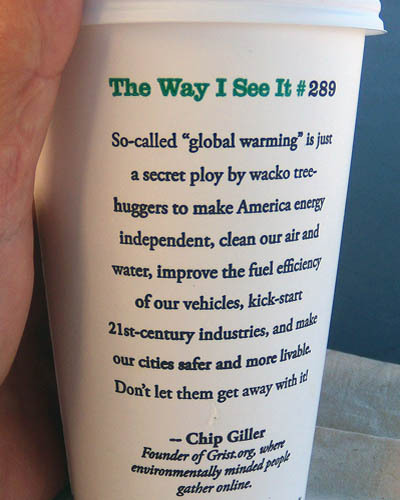
Found this on my coffee cup today:

The Way I See It #289

So-called “global warming” is just

a secret ploy by wacko tree-

huggers to make America energy

independent, clean our air and

water, improve the fuel efficiency

of our vehicles, kick-start

21st-century industries, and make

our cities safer and more livable.

Don’t let them get away with it!

Chip Giller
Founder of Grist.org, where
environmentally-minded people
gather online.

Starbucks Coffee Cup, The Way I See It #289 (global warming)

Look! Someone found the same cup I found!

Add to FacebookAdd to NewsvineAdd to DiggAdd to Del.icio.usAdd to StumbleuponAdd to RedditAdd to BlinklistAdd to TwitterAdd to TechnoratiAdd to Furl

Save


New junk science movie: “Not evil, just wrong”

August 16, 2009

I warned you about it earlierCrank science sites across the internet feature news of another cheap hit on Rachel Carson and science in movie form.

“Not Evil, Just Wrong” is slated for release on October 18. This is the film that tried to intrude on the Rachel Carson film earlier this year, but managed to to get booked only at an elementary school in Seattle, Washington — Rachel Carson Elementary, a green school where the kids showed more sense than the film makers by voting to name the school after the famous scientist-author.

The film is both evil and wrong.

Errors just in the trailer:

  1. Claims that Al Gore said sea levels will rise catastrophically, “in the very near future.”  Not in his movie, not in his writings or speeches.  Not true.  That’s a simple misstatement of what Gore said, and Gore had the science right.
  2. ” . . . [I]t wouldn’t be a bad thing for this Earth to warm up.  In fact, ice is the enemy of life.”  “Bad” in this case is a value judgment — global warming isn’t bad if you’re a weed, a zebra mussel, one of the malaria parasites, a pine bark beetle, any other tropical disease, or a sadist.  But significant warming as climatologists, physicists and others project, would be disastrous to agriculture, major cities in many parts of the world, sea coasts, and most people who don’t live in the Taklamakan or Sahara, and much of the life in the ocean.  Annual weather cycles within long-established ranges, is required for life much as we know it.  “No ice” is also an enemy of life.
  3. “They want to raise our taxes.”  No, that’s pure, uncomposted bovine excrement.
  4. “They want to close our factories.”  That’s more effluent from the anus of male bovines.
  5. The trailer notes the usual claim made by Gore opponents that industry cannot exist if it is clean, that industry requires that we poison the planet.  Were that true, we’d have a need to halt industry now, lest we become like the yeast in the beer vat, or the champagne bottle, manufacturing alcohol until the alcohol kills the yeast.  Our experience with Rivers and Harbors Act of 1899, the Clean Air Acts and the Clean Water Act is that cleaning the environment produces economic growth, not the other way around.  A city choked in pollution dies.  Los Angeles didn’t suffer when the air got cleaner.  Pittsburgh’s clean air became a way to attract new industries to the city, before the steel industry there collapsed.  Cleaning Lake Erie didn’t hurt industry.  The claim made by the film is fatuous, alarmist, and morally corrupt.

    When the human health, human welfare, and environmental effects which could be expressed in dollar terms were added up for the entire 20-year period, the total benefits of Clean Air Act programs were estimated to range from about $6 trillion to about $50 trillion, with a mean estimate of about $22 trillion. These estimated benefits represent the estimated value Americans place on avoiding the dire air quality conditions and dramatic increases in illness and premature death which would have prevailed without the 1970 and 1977 Clean Air Act and its associated state and local programs. By comparison, the actual costs of achieving the pollution reductions observed over the 20 year period were $523 billion, a small fraction of the estimated monetary benefits.

  6. “Some of the environmental activists have not come to accept that the human is also part of the environment.”  Fatuous claim.  Environmentalists note that humans uniquely possess the ability to change climate on a global scale, intentionally, for the good or bad; environmentalists choose to advocate for actions that reduce diseases like malaria, cholera and asthma.  We don’t have to sacrifice a million people a year to malaria, in order to be industrial and productive.  We don’t have to kill 700,000 kids with malaria every year just to keep cars.
  7. “They want to go back to the Dark Ages and the Black Plague.”  No, that would be the film makers.  Environmentalists advocate reducing filth and ignorance both.  Ignorance and lack of ability to read, coupled with religious fanaticism, caused the strife known as “the Dark Ages.”  It’s not environmentalists who advocate an end to cheap public schools.
  8. The trailer shows a kid playing in the surf on a beach.  Of course, without the Clean Water Act and other attempts to keep the oceans clean, such play would be impossible.  That we can play again on American beaches is a tribute to the environmental movement, and reason enough to grant credence to claims of smart people like Al Gore and the scientists whose work he promotes.
  9. “I cannot believe that Al Gore has great regard for people, real people.”  So, this is a film promoting the views of crabby, misanthropic anal orifices who don’t know Al Gore at all?  Shame on them.  And, why should anyone want to see such a film?  If I want to see senseless acts of stupidity, I can rent a film by Quentin Tarantino and get some art with the stupidity.  [Update, November 23, 2009: This may be one of the most egregiously false charges of the film.  Gore, you recall, is the guy who put his political career and presidential ambitions on hold indefinitely when his son was seriously injured in an auto-pedestrian accident; Gore was willing to sacrifice all his political capital in order to get his son healed.  My first dealings directly with Gore came on the Organ Transplant bill.  Gore didn’t need a transplant, didn’t have need for one in his family, and had absolutely nothing to gain from advocacy for the life-saving procedure.  It was opposed by the chairman of his committee, by a majority of members of his own party in both Houses of Congress, by many in the medical establishment, by many in the pharmaceutical industry, and by President Reagan, who didn’t drop his threat to veto the bill until he signed it, as I recall.   Gore is a man of deep, human-centered principles.  Saying “I can’t believe Al Gore has great regard for real people” only demonstrates the vast ignorance and perhaps crippling animus of the speaker.]

That’s a whopper about every 15 seconds in the trailer — the film itself may make heads spin if it comes close to that pace of error.

Where have we seen this before?  Producers of the film claim as “contributors” some of the people they try to lampoon — people like Ed Begley, Jr., and NASA’s James E. Hansen, people who don’t agree in any way with the hysterical claims of the film, and people who, I wager, would be surprised to be listed as “contributors.”

It’s easy to suppose these producers used the same ambush-the-scientist technique used earlier by the producers of the anti-science, anti-Darwin film “Expelled!

Here, see the hysteria, error and alarmism for yourself:

Ann McElhinney is one of the film’s producers.  Her past work includes other films against protecting environment and films for mining companies.  She appears to be affiliated with junk science purveyors at the Competitive Enterprise Institute, an astro-turf organization in Washington, D.C., for whom she flacked earlier this year (video from Desmogblog):

Remember, too, that this film is already known to have gross inaccuracies about Rachel Carson and DDT, stuff that high school kids could get right easily.

Anyone have details on McElhinney and her colleague, Phelim McAlee?

More:

Related posts, at Millard Fillmore’s Bathtub:

Please spread the word:

Add to FacebookAdd to NewsvineAdd to DiggAdd to Del.icio.usAdd to StumbleuponAdd to RedditAdd to BlinklistAdd to TwitterAdd to TechnoratiAdd to Furl