On the evening of December 1, 1955, Rosa Parks, an African American, was arrested for disobeying an Alabama law requiring black passengers to relinquish seats to white passengers when the bus was full. Blacks were also required to sit at the back of the bus. Her arrest sparked a 381-day boycott of the Montgomery bus system and led to a 1956 Supreme Court decision banning segregation on public transportation.
Rosa Parks made a nearly perfect subject for a protest on racism. College-educated, trained in peaceful protest at the famous Highlander Folk School, Parks was known as a peaceful and respected person. The sight of such a proper woman being arrested and jailed would provide a schocking image to most Americans. Americans jolted awake.
Often lost in the retelling of the story are the threads that tie together the events of the civil rights movement through the 1940s, 1950s and 1960s. As noted, Parks was a trained civil rights activist. Such training in peaceful and nonviolent protest provided a moral power to the movement probably unattainable any other way. Parks’ arrest was not planned, however. Parks wrote that as she sat on the bus, she was thinking of the tragedy of Emmet Till, the young African American man from Chicago, brutally murdered in Mississippi early in 1955. She was thinking that someone had to take a stand for civil rights, at about the time the bus driver told her to move to allow a white man to take her seat. To take a stand, she remained seated. [More below the fold]
On the one hand it’s nice to see cool heads and wisdom prevail.
On the other hand, the Orly Taitz, Stumbling and Bumbling Bros., Barnyard Bailout Circus provided belly laughs for everyone who watched it. How can such outstanding legal pratfall comedy possibly be replaced? “Boston Legal” can’t hold a candle to Orly Taitz.
CNN and other sources report that Judge Carter booted the suit late Thursday, noting that the question is one for Congress, and Congress’s earlier decision sticks.
The lawsuit represented the claim by the so-called “birthers” movement that Obama was not born in Hawaii – despite a birth certificate to the contrary – or that if he was, his citizenship was invalidated by living overseas as a child.
In a 30-page ruling, U.S. District Judge David O. Carter of California said his court lacked the jurisdiction to rule on a case intended to unseat a sitting president.
Carter’s ruling said the plaintiffs were trying to persuade him to “disregard the constitutional procedures in place for the removal of a sitting president.”
“The process for removal of a sitting president – removal for any reason – is within the province of Congress, not the courts,” the ruling said.
Carter’s ruling also noted that the plaintiffs “have attacked the judiciary, including every prior court that has dismissed their claim, as unpatriotic and even treasonous for refusing to grant their requests and for adhering to the terms of the Constitution.”
“Respecting the constitutional role and jurisdiction of this court is not unpatriotic,” the ruling said. “Quite the contrary, this court considers commitment to that constitutional role to be the ultimate reflection of patriotism.”
Will Orly Taitz go quietly? How can she replace the daily adrenaline rush of knowing she’s earned the official ire of judges from Chesapeake Bay to Long Beach Harbor?
It may be unrelated, but sketchy early reports say Orly Taitz has climbed aboard a mylar balloon shaped like a flying saucer . . .
If by some sad twist of fate you missed the earlier comedy, you can check out an almost-running comedy commentary at Dispatches from the Culture Wars here, here, here, here, here and here. Oh, heck, Ed Brayton has more — but you get the general idea. Taitz doesn’t.
This isn’t exactly an error, but it creeps me out. Barton goes on at length about incorporating the views of a scholar of economics — but he never names the guy, and Barton seems overly affected and concerned about the guy’s residence and Jewishness.
See the section of Barton’s report talking about free enterprise (page 7). The real experts, the social studies teachers and professors whose work the Board appears to have rejected, suggested bringing the economic discussion into the 21st century and use “capitalism” instead of “free enterprise.” This would make the Texas curriculum correlate with the studies in the area done by social scientists, especially economists, and more accurately and precisely describe the system.
That is one reason given for rejecting their work, that the Board doesn’t want to mention capitalism. They don’t want to call capitalism by the name economists use.
But look at Barton’s suggestion. He veers off on a tangent about ethics in capitalism — I would venture that Barton never took any economics courses he can remember, and he’s never read Adam Smith, judging from the nature of his complaint (ethics is very much a discussion in economics). But it just gets weird. He refers to a paper, without citation, by a “Jewish economist” in the “Pacific Northwest.”
Barton doesn’t name the paper. He doesn’t say where it was published, nor offer any other citation by which it might be tracked down. Most creepily, he keeps referring to the “Jewish economist” as if his faith or ethnic background has any relevance, without ever naming the guy.
That isn’t scholarship. He almost makes a good point, but any valuable point is completely overcome by the bigoted lack of scholarship, the mere convention of naming the author of the paper and offering a citation.
Expert? No, certainly not in manifestation. That’s just creepy.
Here is the section I’m talking about:
Comment D: Free-Enterprise & Capitalism
Throughout the TEKS, the term “free enterprise” has been followed by the parenthetical “(free market, capitalism)”.By including the terms capitalism and free-market as synonyms for free-enterprise, perhaps it is now time to consider the merits of an observation concerning capitalism raised by a Jewish economist in the Pacific Northwest.
In previous generations, capitalism and the free-market system was universally operated on the unstated but unanimously assumed foundation of general societal virtue – there was a general set of assumed values and ethics that remained at the basis of transactions.
For example, to this day we assume that when a waiter brings us a glass of water that he did not spit in it before he delivered it to us. We assume that when we get the oil in our car changed that the mechanic actually changed the oil rather than just put a new sticker on the windshield. We make many Golden Rule type assumptions in the operation of the free-market system of capitalism.
When these general societal principles of ethics and morality are observed, the Free Enterprise System works as it should; but when these principles are ignored, the FreeEnterprise System breaks down and produces Bernie Madoff, Kenneth Lay, Jeffrey Skilling, Dennis Kozlowski, John Rigas, Joe Nacchio, Gregory Reyes, James McDermott, Sam Waskal, Sam Israel, Bernie Ebbers, and many others recently convicted of fraud, theft, corruption, and other white collar crimes that bilked clients of billions of dollars. The traditional Free Market System will not operate properly if the guiding premise is the egocentric Machiavellian principle that the end justifies the means.
We are now at a point in our history where we can no longer assume that the previously universally understood ethical basis of the Free Enterprise System will still be observed, understood, or embraced. Therefore, the Jewish economist in the Pacific Northwest has proffered that rather than using “Capitalism,” we instead begin using the term “Ethical Capitalism,” for it captures the historical import of the system and identifies an underlying principle without which the free-enterprise system will not work.
Therefore, I recommend that when we have the phrase “free enterprise (free market, capitalism)” that we instead consider using “free enterprise (free market, ethical capitalism).” It is an accurate recognition of what is one of the unspoken but indispensable elements of the free enterprise system. This change also reinforces the long-standing premise of political philosophers across the centuries that the continuation of a republic is predicated upon an educated and a virtuous citizenry.
Who is he talking about? What is he talking about?
More information:
Steve Schaffersman, the intrepid force behind Texas Citizens for Science, has a longer exposé of Barton’s odd claims and work to frustrate accurate history in Texas at Schaffersman’s Houston Chronicle hosted blog, EvoSphere. It’s well worth the read, just to see how intricately bizarre and erroneous Barton can be about simple facts of history, and how Barton chooses to misinterpret the Constitution, especially the First Amendment, and how he exaggerates little facts of history into gross distortions of the American story. I regret I failed to note this article here, in the first edition.
Judge Sotomayor would bring more federal judicial experience to the bench than any Supreme Court justice in 100 years. Over her three-decade career, she has served in a wide variety of legal roles, including as a prosecutor, litigator, and judge.
Judge Sotomayor is a trailblazer. She was the first Latina to serve on the Court of Appeals for the Second Circuit and was the youngest member of the court when appointed to the District Court for the Southern District of New York. If confirmed, she will be the first Hispanic to sit on the U.S. Supreme Court.
While on the bench, Judge Sotomayor has consistently protected the rights of working Americans, ruling in favor of health benefits and fair wages for workers in several cases.
Judge Sotomayor has shown strong support for First Amendment rights, including in cases of religious expression and the rights to assembly and free speech.
Judge Sotomayor has a strong record on civil rights cases, ruling for plaintiffs who had been discriminated against based on disability, sex and race.
Judge Sotomayor embodies the American dream. Born to Puerto Rican parents, she grew up in a South Bronx housing project and was raised from age nine by a single mother, excelling in school and working her way to graduate summa cum laude from Princeton University and to become an editor of the Law Journal at Yale Law School.
In 1995, Judge Sotomayor “saved baseball” when she stopped the owners from illegally changing their bargaining agreement with the players, thereby ending the longest professional sports walk-out in history.
Judge Sotomayor ruled in favor of the environment in a case of protecting aquatic life in the vicinity of power plants in 2007, a decision that was overturned by the Roberts Supreme Court.
In 1992, Judge Sotomayor was confirmed by the Senate without opposition after being appointed to the bench by George H.W. Bush.
Judge Sotomayor is a widely respected legal figure, having been described as “…an outstanding colleague with a keen legal mind,” “highly qualified for any position in which wisdom, intelligence, collegiality and good character would be assets,” and “a role model of aspiration, discipline, commitment, intellectual prowess and integrity.”
3. Cases: Archie v. Grand Cent. Partnership, 997 F. Supp. 504 (S.D.N.Y. 1998) and Marcella v. Capital Dist. Physicians’ Health Plan, Inc., 293 F.3d 42 (2d Cir. 2002).
4. Cases: Flamer v. White Plains, 841 F. Supp. 1365 (S.D.N.Y. 1993), Ford v. McGinnis, 352 F.3d 382 (2d Cir. 2003), and Campos v. Coughlin, 854 F. Supp. 194 (S.D.N.Y. 1994).
5b. Cases: Bartlett v. N.Y. State Board, 970 F. Supp. 1094 (S.D.N.Y. 1997), Greenbaum v. Svenska Hendelsbanken, 67 F.Supp.2d 228 (S.D.N.Y. 1999), Raniola v. Bratton, 243 F.3d 610 (2d Cir. 2001), and Gant v. Wallingford Board of Education, 195 F.3d 134 (2d Cir. 1999).
10c. Honorary Degree Citation, Pace University School of Law, 2003 Commencement.
Judge Sotomayor is a widely respected legal figure, having been described as “…an outstanding colleague with a keen legal mind,” “highly qualified for any position in which wisdom, intelligence, collegiality and good character would be assets,” and “a role model of aspiration, discipline, commitment, intellectual prowess and integrity.”ere are the sources for the ten statements:
Spread the word; friends don't allow friends to repeat history.
Rick Perry put his foot into something during one of the Astro-turf “tea parties” on April 15. Someone asked him about whether Texas should secede from the United States, as a protest against high taxes, or something.
The answer to the question is “No, secession is not legal. Did you sleep through all of your U.S. history courses? Remember the Civil War?”
Alas, Perry didn’t say that.
Instead, Perry said it’s not in the offing this week, but ‘Washington had better watch out.’
He qualified his statement by saying the U.S. is a “great union,” but he said Texans are thinking about seceding, and he trotted out a hoary old Texas tale that Texas had reserved that right in the treaty that ceded Texas lands to the U.S. in the switch from being an independent republic after winning independence from Mexico, to statehood in the U.S.
So, rational people want to know: Does Perry know what he’s talking about?
A&M professor Walter L. Buenger is a fifth-generation Texan and author of a textbook on Texas’ last secession attempt. (The federal occupation lasted eight years after the Civil War.)
“It was a mistake then, and it’s an even bigger mistake now,” Buenger said by phone from College Station, where he has taught almost since Perry was an Aggie yell leader.
“And you can put this in the paper: To even bring it up shows a profound lack of patriotism,” Buenger said.
The 1845 joint merger agreement with Congress didn’t give Texas an option clause. The idea of leaving “was settled long ago,” he said.
“This is simple rabble-rousing and political posturing,” he said. “That’s all it is. . . . Our governor is now identifying himself with the far-right lunatic fringe.”
Three false beliefs about Texas history keep bubbling up, and need to be debunked every time. The first is that Texas had a right to secede; the second is that Texas can divide itself into five states; and the third is that the Texas flag gets special rights over all other state flags in the nation.
Under Abraham Lincoln’s view the Union is almost sacred, and once a state joins it, the union expands to welcome that state, but never can the state get out. Lincoln’s view prevailed in the Civil War, and in re-admittance of the 11 Confederate states after the war.
The second idea also died with Texas’s readmission. The original enabling act (not treaty) said Texas could be divided, but under the Constitution’s powers delegated to Congress on statehood, the admission of Texas probably vitiated that clause. In any case, the readmission legislation left it out. Texas will remain the Lone Star State, and not become a Five Star Federation. (We dealt with this issue in an earlier post you probably should click over to see.)
Gov. Perry is behind Sen. Kay Bailey Hutchison in polling of a head-to-head contest between the two to see who will be the Republican nominee for governor in 2010 — Hutchison is gunning to unseat Perry. He was trying to throw some red meat to far-right conservative partisans who, he hopes, will stick by him in that primary election.
Alas, he came off throwing out half-baked ideas instead. It’s going to be a long, nasty election campaign.
Another update: How much fuss should be made over the occasional wild hare move for some state to secede? Probably not much. A few years ago Alaska actually got a referendum on the ballot to study secession. The drive to secede got nowhere, of course. I was tracking it at the time to see whether anyone cared. To the best of my knowledge, the New York Times never mentioned the controversy in Alaska, and the Washington Post gave it barely three paragraphs at the bottom of an inside page.
Spread the word; friends don't allow friends to repeat history.
For you Austinites, or someone close enough to make this training:
The Bill of Rights Institute at the
Texas Law-Related Education Conference
February 6-7, 2009
Event Website
Date: February 6-7
Where:
Hilton Austin Airport 9515 Hotel Drive Austin, TX 78719
The Bill of Rights Institute is pleased and honored to be exhibiting and presenting at the 2009 Texas Law-Related Education conference on Friday and Saturday, February 6 & 7. We hope while you are attending the conference, you will stop by our booth in the exhibits area and see our wide range of materials and programs that can enrich as well as bring new excitement to your lessons. Also, on Friday at 10:00 AM, we will be presenting a session at the conference on Lincoln’s Leadership: Secession and Emancipation (with free lesson plans distributed at the end of the session!).
Have a terrific time at the conference and we hope to see you at our booth or our session!
Bill of Rights Institute
200 North Glebe RD
Suite 200
Arlington, Virginia 22203
703-894-1776
Spread the word; friends don't allow friends to repeat history.
Here’s a map that should be more viewed in America, but a map which has been much overlooked in the post-election euphoria, or post-election gloom. It’s the map of electoral college results, still showing Republicans in a Soviet/Maoist red, and Democrats in blue:
Electoral College results from the 2008 presidential election - American Presidency Project
Note especially the blue dot in Nebraska, around Omaha. Nebraska splits its electoral college votes, giving each congressional district’s vote to the elector for the candidate who actually won in that district. Obama won Omaha’s district; Nebraska is officially a red and blue state. Maine also allows a split in electors, but this year did not see a split among the electorate.
America is not so red as some claim, even in the electoral college. More states are surrounded by blue states than surrounded by red states.
Perhaps it’s time to find other ways to color these maps, so that we cannot so easily speak of a red state/blue state split that does not reflect politics, economics, or much of anything else in America.
Dallas students are out on inauguration day. We can hope our government and history students will glue themselves to the television to watch the ceremony, but we know better than to expect it.
Will you discuss the inauguration in your classes, whatever the subject? Here are some sources you could use:
There’s an air of hypocrisy about the whole thing, and an air of sadness, and oddly, an air of fire and brimstone that makes Hugo Chavez look like a prophet. Anything with anyone who makes Hugo Chavez look good is beyond funny. Farce or tragedy, Madison worried, or maybe both; in this case tragedy eclipses farce.
Cort Wrotnowski alleged that Obama’s father’s British citizenship made Obama’s birth citizenship different from “natural born” citizenship as the Constitution says the president must be.
There was no comment on the case from the Court, just a note that the appeal was not taken.
Tinfoil hat concessionaires on Capitol Hill were disappointed.
In other news, electors are meeting today to elect Obama president.
Spread the word; friends don't allow friends to repeat history.
Responsible media, generally called in denigrating styel “mainstream media” by many of our more nutty nut cases, have held off in commenting on the Supreme Court’s position on the case against Obama’s election discussed in conference last Friday, December 5.
In a conference today [December 5, 2008] the Supreme Court will reconsider together whether to take on a suit challenging the eligibility of Barack Obama to be president of the United States under a sometimes-arcane section of Article II of the Constitution.
Is Barack Obama a “natural born” citizen of the U.S.?
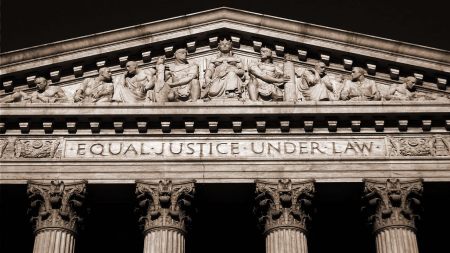
In the building where “Equal Justice Under Law” is engraved high over the front door, poker-player Leo Donofrio’s challenge will be examined to see whether at least four of the nine justices of the Court think he has enough of a case to actually merit a hearing. Justice David Souter rejected Donofrio’s case earlier, so this is a hail-Mary play on the part of Obama’s opponents.
Equal Justice Under Law, the West Pediment of the U.S. Supreme court. AAPF image
The Court takes seriously the principle engraved over the door, however. This is the same Court that ruled earlier this year an accused terrorist and all-around bad guy held at Guantanamo Bay has the right to a writ of habeas corpus over the objections of the Most Power Man in the World, U.S. President George W. Bush. The humble, gritty, or even unsavory history of litigants does not limit their rights under the law.
Leo Donofrio in his usual office. Leo Donofrio image
So the question is, what sort of case does Donofrio have against Obama’s eligibility?
Would Justice Clarence Thomas have agreed to bring this case to the conference if it doesn’t have a chance to succeed?
I’ve not lunched with Thomas in more than two decades, so I can’t speak with any inside knowledge. Historically, the Court, and indeed all the federal courts, have agreed to examine cases like this often simply to provide an authoritative close to the issue. In this case, the outright hysteria of the anti-Obama partisans suggests the issue should be put to bed if possible.
Under usual Court procedures, we won’t learn the results of the conference until Monday. I would not be surprised if the results are announced today, just to promote the settling of the issue.
Does Donofrio have a case?
I don’t see a case. It’s clear that Obama is a U.S. citizen now. Donofrio’s argument is rather strained, and sexist. He claims that Obama’s father having been a British subject in 1961 (Kenya was not yet independent), Obama had dual citizenship at birth — and, further, Donofrio alleges, this dual citizenship trumps both Obama’s birth on U.S. soil (which should be dispositive) AND Obama’s mother’s U.S. citizenship, conferring a special status that doesn’t meet the intentions of the framers of the Constitution.
Donofrio’s claim is odd in that it would grant a lesser-status to children of legal immigrants than is allowed by law to children of illegal immigrants, or temporary visitors. It also is bizarre, to me, in the way it dismisses Obama’s mother’s existence as a factor in Obama’s citizenship status — and while equal rights for women were not wholly obtained in 1961, no one has successfully argued that the citizenship of the father trumps that of the mother in citizenship cases.
Donofrio is arguing that Obama’s dual citizenship at birth disqualifies him from holding the presidency, technically, in a very narrow reading — though Obama would have absolutely every other right of a natural born citizen.
A couple of observations:
First, this is not an easy issue to litigate. Standing is the easiest way for a federal court to avoid a decision — what harm can a citizen claim from letting Obama be president? It’s difficult to find an injury even were Donofrio’s claims valid. No blood, no foul. No injury, no standing to sue. It is upon this basis that most of the cases against Obama’s eligibility have been tossed out, as Donofrio’s has been tossed, twice already.
Second, it is unclear what entity enforces the eligibility clause of the Constitution, or indeed, whether any entity can. For most of the summer Obama’s critics were pressuring the Federal Election Commission (FEC) to do something, even though the FEC lacks a quorum of members to do anything. More to the point, there is nothing in any law that confers on the FEC the function of checking the citizenship status of any candidate. Sometime in October they finally figured out that state secretaries of state might have a role, since they set up the ballots in each state.
I admit I thought that, until I reflected on the issue of the electoral college. In U.S. presidential elections, voters do not vote directly for president and vice president. Instead, we vote to elect people who will be the electors who decide — electors of the electoral college. The history of this institution can be found elsewhere. For the sake of these suits, however, it means that the secretaries of state have no role at all in the eligibility of the candidates. They rule on the eligibility of the electors, which is an entirely different kettle of fish. Some states even list the electors on the ballot.
But in any case, it means Donofrio is suing the wrong entity, even if we can’t tell him what the correct entity is.
Third and most important, Donofrio is asking for U.S. citizenship law to be overturned in a most inconvenient time and place. Dual citizenship is a bar to very little in American life. There is an assumption that people who hold that status are fully American citizens, absent a showing of contrary facts. There are no contrary facts in evidence from Donofrio, nor from anyone else, despite promises of the revelation of conspiracies.
In short, Donofrio is arguing that there is, somewhere, somehow, some information that Barack Obama is not the shining patriot his life story reveals. Donofrio doesn’t know what that information is, or where it might be found, but he thinks maybe the State of Hawaii is complicit in a conspiracy to hide this information, which is hidden on the hand-written records of Obama’s birth in 1961. You might think Donofrio has watched “National Treasure” a few too many times, and whether it’s that movie or some other source, you’d be right — paranoid suspicions of conspiracy are not the stuff good court cases are made of.
The dozen or more cases against Obama’s eligibility all suffer from this astounding, dramatic lack of evidence. Is there an affidavit from someone who alleges that Obama’s citizenship should be called into question? If so, they’ve not been presented to any court. (Obama tormentor Corsi claims to have interviewed Obama’s Kenyan grandmother, and he alleges she said through an interpreter that Obama was born in Kenya; oddly, he didn’t bother to get an affidavit from the woman, nor from anyone else — and others who listen to the tape think she thought Corsi was asking about the birth of her son, not grandson. This is not solid evidence.)
This is not an issue solely for the hysterical. Lawyers and scholars have looked at the issue through the years, and intensely this year, and arrived at the conclusion that Obama is perfectly eligible for the presidency.
This one, not safe for work (profanity, usually mild – democratic ideas), but much funnier, and much more serious at the same time — I wish I’d known about it two months ago. Not nearly enough people have watched these, according to the YouTube counts:
If I can get five readers of this post, we’re home free, right?
Tip of the old scrub brush to UBZonker.
Spread the word; friends don't allow friends to repeat history.
Obama and the Democratic National Committee had asked Surrick to dismiss Berg’s complaint in a court filing on Sept. 24.
They said that Berg’s claims were “ridiculous” and “patently false,” that Berg had “no standing” to challenge the qualifications of a candidate for president because he had not shown the requisite harm to himself.
Surrick agreed.
In a 34-page memorandum and opinion, the judge said Berg’s allegations of harm were “too vague and too attenuated” to confer standing on him or any other voters.
Surrick ruled that Berg’s attempts to use certain laws to gain standing to pursue his claim that Obama was not a natural-born citizen were “frivolous and not worthy of discussion.”
The judge also said the harm Berg alleged did “not constitute an injury in fact” and Berg’s arguments to the contrary “ventured into the unreasonable.”
For example, Berg had claimed that Obama’s nomination deprived citizens of voting for Sen. Hillary Clinton in November. (Berg backed Clinton in the primaries.)
Berg could not be reached for comment last night.
Obama was born in Honolulu on Aug. 4, 1961, and the campaign posted a document issued by Hawaii on its Web site, fight thesmears.com, confirming his birth there.
Berg said in court papers that the image was a forgery.
The nonpartisan Web site FactCheck.org examined the original document and said it was legitimate.
Further, a birth announcement in the Aug. 13, 1961, Honolulu Advertiser listed Obama’s birth there on Aug. 4.
Update, 10-27-2008: Here’s an example of how lunatic this issue is, and how bizarre are the arguments. This blog argues that Judge Surrick had the decision dictated to him from someone else in the Obama camp — the same lunatic argument creationists made against the decision of Judge Jones in the Dover, Pennsylvania, “intelligent design” trial. Could it be that all lunatics are creationists? Or is it just that lunatics all stumble into the same lunatic arguments?
Spread the word; friends don't allow friends to repeat history.
The 3rd Infantry Division’s 1st Brigade Combat Team has spent 35 of the last 60 months in Iraq patrolling in full battle rattle, helping restore essential services and escorting supply convoys.
Now they’re training for the same mission — with a twist — at home.
* * * * *
They may be called upon to help with civil unrest and crowd control or to deal with potentially horrific scenarios such as massive poisoning and chaos in response to a chemical, biological, radiological, nuclear or high-yield explosive, or CBRNE, attack.
Training for homeland scenarios has already begun at Fort Stewart and includes specialty tasks such as knowing how to use the “jaws of life” to extract a person from a mangled vehicle; extra medical training for a CBRNE incident; and working with U.S. Forestry Service experts on how to go in with chainsaws and cut and clear trees to clear a road or area.
The 1st BCT’s soldiers also will learn how to use “the first ever nonlethal package that the Army has fielded,” 1st BCT commander Col. Roger Cloutier said, referring to crowd and traffic control equipment and nonlethal weapons designed to subdue unruly or dangerous individuals without killing them.
“It’s a new modular package of nonlethal capabilities that they’re fielding. They’ve been using pieces of it in Iraq, but this is the first time that these modules were consolidated and this package fielded, and because of this mission we’re undertaking we were the first to get it.”
The package includes equipment to stand up a hasty road block; spike strips for slowing, stopping or controlling traffic; shields and batons; and, beanbag bullets.
“I was the first guy in the brigade to get Tasered,” said Cloutier, describing the experience as “your worst muscle cramp ever — times 10 throughout your whole body.
“I’m not a small guy, I weigh 230 pounds … it put me on my knees in seconds.”
The brigade will not change its name, but the force will be known for the next year as a CBRNE Consequence Management Response Force, or CCMRF (pronounced “sea-smurf”).
“I can’t think of a more noble mission than this,” said Cloutier, who took command in July. “We’ve been all over the world during this time of conflict, but now our mission is to take care of citizens at home … and depending on where an event occurred, you’re going home to take care of your home town, your loved ones.”
You read it right. The Army is coming to “take care of you in your home town.”
Were they being deployed to rebuild New Orleans, I’d regard it as a noble undertaking. Am I wrong to worry about what is up with this?
Or, until that account is unsuspended by the forces supporting Donald Trump: Follow @FillmoreWhite, the account of the Millard Fillmore White House Library
We've been soaking in the Bathtub for several months, long enough that some of the links we've used have gone to the Great Internet in the Sky.
If you find a dead link, please leave a comment to that post, and tell us what link has expired.
Thanks!
Retired teacher of law, economics, history, AP government, psychology and science. Former speechwriter, press guy and legislative aide in U.S. Senate. Former Department of Education. Former airline real estate, telecom towers, Big 6 (that old!) consultant. Lab and field research in air pollution control.
My blog, Millard Fillmore's Bathtub, is a continuing experiment to test how to use blogs to improve and speed up learning processes for students, perhaps by making some of the courses actually interesting. It is a blog for teachers, to see if we can use blogs. It is for people interested in social studies and social studies education, to see if we can learn to get it right. It's a blog for science fans, to promote good science and good science policy. It's a blog for people interested in good government and how to achieve it.
BS in Mass Communication, University of Utah
Graduate study in Rhetoric and Speech Communication, University of Arizona
JD from the National Law Center, George Washington University


 Posted by Ed Darrell






 Millard Fillmore's Bathtub