Ha. I am amused at people so anxious to take material from this blog, or complain about something I’ve written, that they can’t be bothered to look around for names of the blog, or author, or otherwise look for proper attribution.
I’ve been called “Tim Panogos” several times, “Tim Pagonos” a few. I’ve had a few zombies from Santayana’s nightmares insist on calling me Millard.
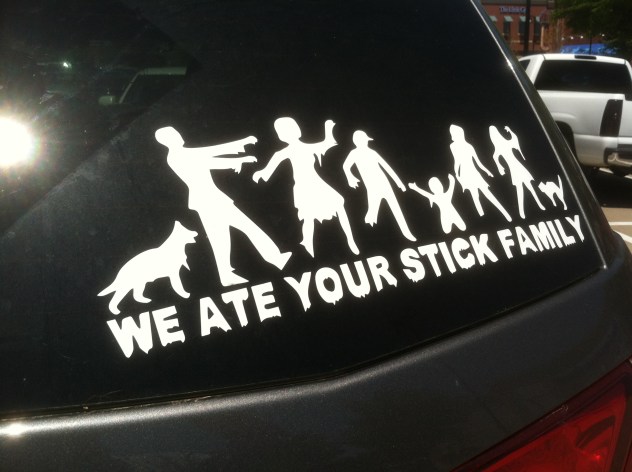
Here’s my photo, as featured at “Funny Bumperstickers” by Latina Mom. ” Zombies. They’ll get you every time. Image via Tim Pangos. Photo and original post by Ed Darrell at Millard Fillmore’s Bathtub — use of photos encouraged, with attribution. This photo from my iPhone, by the way.
For the record, the URL of this blog features the name of that great Utah landmark, MountTimpanogos. I do not intentionally use the pseudonyms “Tim Panagos,” “Tim Pangos,” nor any other derivative from the mountain’s moniker.
Spread the word; friends don't allow friends to repeat history.
What if he, or UC-Davis, wanted to slow down the parodies, to catch their breath? Could he, or the university, copyright the image and enforce copyright? Do such over-the-top and often abusive parodies fall within the parody rules?
What say you, legal beagles? What say you, anyone?
One of the least offensive parodies using the cop's image.
Spread the word; friends don't allow friends to repeat history.
You’re internet and culture savvy — you probably already know all about this stuff.
OK Go’s music appeals to many. The appeal convinced a major record label, Capitol/EMI, to sign the band to a deal. OK Go worked hard to promote the music of the band, including videos. Capitol looked at the videos, intensely creative works of art on their own, and pulled in the reins. Okay to show the vids, the label said, but don’t allow downloads . . .
Minor twist on the old band meets label, band wins label story: OK Go got out of the contract. They lost the label.
Now they’ve got an astounding new video to go viral, one that simply delights younger viewers and brings in older viewers with whispers of “shades of Rube Goldberg!” (Who was Rube Goldberg? Younger readers go here.)
After the overwhelming success of the video for its 2006 song “Here It Goes Again,” in which its four band members execute a tightly choreographed dance routine built around a handful of treadmills, OK Go has lofty standards to live up to. With roughly 50 million views on YouTube, “Here It Goes Again” stands as one of the most popular music videos of the Internet era.
Not one to shy away from a challenge, the band set about constructing a painstakingly executed two-story Rube Goldberg machine, set to trigger in time to the music for its latest video, “This Too Shall Pass.” Although it starts out small, with a toy truck knocking over some dominoes, the contraptions that make up the machine rapidly get larger and much more complex — pianos are dropped, shopping carts come crashing down ramps, and one band member is launched headlong through a wall of boxes. After assembling a team of dozens of engineers to construct the set, more than 60 takes were needed to get everything working just right during filming.
Toughest part? EMI, parent of Capitol, didn’t want to allow downloads of the music or video.
The band’s label, EMI, didn’t see things the same way. In an effort to maintain some control over the dissemination of the music video, EMI denied listeners the ability to embed it on their own Web sites and blogs. After receiving a deluge of complaints, the band eventually persuaded EMI to enable embedding. Soon afterward, however, OK Go parted ways with EMI to start its own record label, Paracadute.
Personal quandary: I’m not sure that I don’t like this version of the song, with the Notre Dame marching band, better than the Rube Goldberg version. What do you think?
Personal confession: Problems of mishearing lyrics abound. I listened probably a dozen times thinking the refrain was “When the money comes.” It makes more sense, and is much less cynical and wooish, with the real lyric, “When the morning comes.”
More:
OK Go’s website — with upcoming shows highlighted (Oh, to be in Salt Lake City on April 13, 2010, or St. Louis on April 18 . . .) (From the website: “PS… Oh, fine. More news now: If you can’t get to one of the thirty-plus shows on the upcoming tour, fear not: the boys will be on your TV. In the next month they’ll visit Carson Daly (4/16), David Letterman (4/28), Steven Colbert (4/29), and Jimmies Kimmel (4/1) and Fallon (5/4). They’ll also be at Bamboozle, Bonnaroo and Sasquatch. Some busy months ahead.”)
Update: See comment from Mr. Higginbotham; AP claims machine error and not arrogance.
Potential collisions are delicious: Associated Press versus the Library of Congress’s “Thomas” legislation tracker; Associated Press versus the Supreme Court for quoting the Declaration of Independence.
Associated Press versus the Southern Baptist Convention and Holy See for quoting the Bible, in phrases Jefferson used in his mashup of the New Testament.
Sotomayor either doesn’t know what she’s in for, or she saw this coming and is going to relish the ride.
James Grimmelman at The Laboratorium has been tracking AP’s attempts to wring pennies out of penniless bloggers and scholars for using AP product. On the one hand, AP certainly deserves credit and payment for the great work it does reporting the news.
On the other hand, AP policies don’t seem much concerned with reporting news or creating new product that can make money for the organization, but instead seem bent on punishing people who read Associated Press stories. (Full disclosure: I make it a point to avoid AP stories and images on topics of my interest just to avoid the conflict — oddly, I’ve found that this actually does shift my news sources on major stories.)
Grimmelman caught AP red-handed in what must be a much embarrassing gaffe: He asked permission from AP to quote from a letter written by Thomas Jefferson which AP had not published.
Sure enough, AP told him he owed them $12 to quote the letter, and AP offered to restrict the uses of the letter.
Grimmelman said:
The Associated Press has become so deranged, so disconnected from reality, that it will sell you a “license” to quote words it didn’t write and doesn’t own. Here, check it out:
Screen capture of Associated Presss charging for a Thomas Jefferson letter in the public domain – The Laboratorium
These things threaten to put hoax makers out of business. Who could think of something so absurd? Grimmelman said:
I paid $12 for this “license.” Those words don’t even come from the article they charged me 46 cents a word to quote from (and that’s with the educational discount). No, they’re from Thomas Jefferson’s letter to Isaac McPherson, in which Jefferson argues that copyright has no basis in natural law.
(A commenter notes that Jefferson was actually writing about patents, but close is good enough in hand grenades and freedom of the press and freedom of thought.)
Larry Lessig, speaking at TED, makes the case for kids who use stuff borrowed from others in their classroom presentations.
First, this speech should open your eyes to the danger of our only preaching against plagiarism to kids who borrow copyrighted stuff off the internet (see especially the last two minutes of his almost-19 minute presentation). What’s the alternative, you ask? See what Prof. Lessig says. What are the alternatives?
Second, Lessig shows how to use slides in a live presentation, to significantly increase the content delivered and the effectiveness of the delivery.
Or, until that account is unsuspended by the forces supporting Donald Trump: Follow @FillmoreWhite, the account of the Millard Fillmore White House Library
We've been soaking in the Bathtub for several months, long enough that some of the links we've used have gone to the Great Internet in the Sky.
If you find a dead link, please leave a comment to that post, and tell us what link has expired.
Thanks!
Retired teacher of law, economics, history, AP government, psychology and science. Former speechwriter, press guy and legislative aide in U.S. Senate. Former Department of Education. Former airline real estate, telecom towers, Big 6 (that old!) consultant. Lab and field research in air pollution control.
My blog, Millard Fillmore's Bathtub, is a continuing experiment to test how to use blogs to improve and speed up learning processes for students, perhaps by making some of the courses actually interesting. It is a blog for teachers, to see if we can use blogs. It is for people interested in social studies and social studies education, to see if we can learn to get it right. It's a blog for science fans, to promote good science and good science policy. It's a blog for people interested in good government and how to achieve it.
BS in Mass Communication, University of Utah
Graduate study in Rhetoric and Speech Communication, University of Arizona
JD from the National Law Center, George Washington University


 Posted by Ed Darrell





 Millard Fillmore's Bathtub