Wall Street Journal’s DDT-fueled war on science

May 12, 2010

I don’t subscribe to the Wall Street Journal — their discounts to educators are lousy.

So I missed this editorial when it ran on April 24, 2010 (page A12), “DDT and population control – malaria still kills one million every year.”

Nominally, that should be good news.  At the peak of DDT use in the early 1960s, malaria killed about 3 million people annually.  By the time we banned DDT use on cotton crops in the U.S., the death toll was still about 2 million people annually.  From the heyday of DDT, we’ve decreased malaria’s death toll, to less than half what it was.

Editorial writers at the Journal don’t let facts get in their way when they go off on a misdirected political jihad or crusade.  Gross error Number 1:  They mislead readers about the facts.

They are claiming that a million is too many (it is), but they claim that the total would be significantly less if only Americans would attack Africa with poison.  We have trouble enough with wars in Afghanistan and Iraq, it seems to me.  There is no indication that we could reduce malaria rates with a lot of extra poison.  Malaria is a parasite in human blood.  To defeat the disease we have to defeat the infections in humans.  Mosquitoes just spread the disease from one human to another.  DDT does not cure malaria in humans; it is one preventive device of limited effectiveness.

What are they on about?

The Journal’s editorial writers said:

Environmental activists this week marked the 40th anniversary of Earth Day, which happened to fall three days before World Malaria Day. Insofar as Earth Day politics have contributed to today’s malaria epidemic, the two events are related.

You could see this one coming.  The reactionaries at the editorial seek out opportunities to criticize environmentalists, whose cause they see as anti-business.   The Journal’s editorial page usually carries an op-ed piece by Hoover Institute maven Henry I. Miller about once a year (see here, for example), claiming we need DDT to fight West Nile virus.  We don’t, of course.  West Nile virus-carrying mosquitoes are best fought with other pesticides, when pesticides are used.  They need to be hit before adulthood, while they are still larva, in the water.  DDT is exactly wrong for such applications.  But Miller’s piece comes around almost every year, as soon as the first West Nile virus infections in humans are noted.

So, since they so soundly disregard science on that diatribe, why not here, too?  DDT offers a great target for Tea Baggers, Know-Nothings, and truth bashers.  Most of the history of DDT was written before the internet, so it’s easier to spread falsehoods without contradiction.

Disinformation.  Propaganda.  Shame on the Wall Street Journal.

Earth Day and World Malaria Day are related in this way:  Environmentalists warned us that doing the wrong stuff in the environment would make it harder to fight malaria, and they were right.  People who resist clean air and clean water legislation also resist legislation to stop poisoning our planet.  Those people rarely do anything to fight malaria, either.  Human comfort, human health, human survival, is not what they are concerned about.

Earth Day founder Gaylord Nelson, a U.S. Senator from Wisconsin, was a leading opponent of the insecticide DDT, which remains the cheapest and most effective way to combat malarial mosquitoes.

Gaylord Nelson, the father of Earth Day, was governor of Wisconsin when the University of Wisconsin did the first studies showing that songbirds and raptors in Wisconsin were being wiped out by DDT. We should expect him to be an opponent of indiscriminate use of the stuff.  His state was on the road to ruin, and long before the federal government acted against DDT, Wisconsin had laws and regulations to limit its use.  Wisconsin’s wild populations recovered a bit more quickly because Wisconsin had acted.

Gaylord Nelson at the Apostle Islands, Photograph by Frank Wallick, 1967.

Gaylord Nelson at the Apostle Islands, Photograph by Frank Wallick, 1967.

Nelson also knew that, in the U.S., malaria was conquered by 1939 (according to the Centers for Disease Control).  DDT came along in 1946, seven years later.  While DDT was used to control mosquitoes in the U.S., it was for no disease control reasons — that was why so many people opposed the rather pointless use of the stuff.  And I suspect Nelson was savvy enough to know that DDT has not been the cheapest means of controlling mosquitoes for several years.  One application of DDT in Africa costs about $12.00, for the professional who must apply it, and the testing to determine whether DDT will even work.  One application lasts about six months.  So, for a year’s protection, DDT costs about $24.00 per house, per year.

Bednets cost about $10.00, and last about five years.  That works out to $2.00 year.  For $24.00, you could provide a dozen different nets in a home, though most homes would use them only to protect children.

Moreover, recent test runs in Africa show DDT about 25% to 50% effective in reducing malaria incidence, while bednets are about 50% to 85% effective.  Nets are cheaper and more effective.

Doesn’t the Wall Street Journal have fact checkers?  Or do they just not care about the facts?

Rachel Carson’s 1962 book, “Silent Spring,” misleadingly linked pesticides to cancer and is generally credited with popularizing environmental awareness.

Wrong on three fronts.  Carson noted that the family of chemicals from which DDT comes might have links to cancer, but she did not make the claim that DDT is carcinogenic.  DDT was banned because it’s a long-term, deadly poison that destroys ecosystems.  Cancer in humans was not a part of the equation.

However, DDT is now known to be a weak human carcinogen.  Every cancer-fighting agency on Earth lists it as a “probable human carcinogen” (it is confirmed to cause cancer in other mammals).  Can’t the Wall Street Journal find the phone number of the American Cancer Society?

DDT earned its ban because of 20 years of research data by 1972, showing that DDT kills virtually everything it comes in contact with that is smaller than a large man, and it destroys ecosystems.  Talking about DDT’s carcinogenicity is a red herring.  Carson didn’t claim DDT was a significant cause of cancer, nor was DDT banned from agricultural use because anyone thought it was a significant cause of cancer.  Yes, DDT is a weak human carcinogen, contrary to the Journal’s implication; but no, that’s not why it was banned.

Carson’s book certainly ignited concerns about human activities affecting environment other than land development.  But “environmental awareness” is as old as our nation, at least.  A hundred years prior to Rachel Carson’s book, the U.S. set aside the world’s first National Park, Yellowstone.  60 years earlier, Teddy Roosevelt and Gifford Pinchot led the drive to conserve the nation’s forests.  The Soil Conservation Service, a New Deal program, worked to save soil on farms and unimproved areas, a good 30 years before Carson’s book.  Environmental awareness is an almost-congenital trait in Americans.  Rachel Carson sounded alarms about new reactive chemical combinations.  Americans were already alert to the need to save soil, water, air and wild spaces.

We banned DDT to save our crops and to save our wildlife.  Those are good reasons to keep the ban today.

But other leading greens of the period, including Nelson, biologist Paul Ehrlich and ecologist Garrett Hardin, were also animated by a belief that growth in human populations was harming the environment.

Nelson thought the U.S. needed to slow immigration (see more below).  Ehrlich feared a massive round of starvation, which was staved off only with the Green Revolution and billions of dollars of foreign aid money, the good luck of our having Norman Borlaug and the Rockefeller Foundation, and major economic change in nation’s like India and China.  Hardin pointed out that even the best intentioned people needed a structure to encourage them to conserve, else conservation would not take place.

They all recognized that while any human could minimize her impact on the natural world, no one person could ameliorate all the effects of billions of people.

“The same powerful forces which create the crisis of air pollution also are threatening our freshwater resources, our woods, our wildlife,” said Nelson. “These forces are the rapid increase in population, industrialization, urbanization and scientific technology.”

Notice, please, that Sen. Nelson did not suggest humans should do anything to cause or encourage massive human death (nor did the Journal do the courtesy of noting where they quoted him from).  He merely notes that air pollution and water pollution, and a lack of freshwater, are created by human populations, industry, urban sprawl and technology.  All of these things threaten human health.  Nelson is concerned that we not add to human illness and misery.  That’s not what the Journal’s editorial wants you to think, however.  It will suggest instead that Nelson urged more human suffering and death.

How craven must an editorial board be to accuse good people, falsely, of such sins?

In his book “The Population Bomb,” Mr. Ehrlich criticized DDT for being too effective in reducing death rates and thus contributing to “overpopulation.”

I doubt it.  I can’t find anything quite to that description in my copy of the book.  It’s a common internet legend (one level dumber than urban legend) — but shouldn’t the Wall Street Journal have higher standards than to use for documentation, “my cousin Clem heard a story about a person his aunt once knew?”

Hardin opposed spraying pesticides in the Third World because “every life saved this year in a poor country diminishes the quality of life for subsequent generations.”

Now the Journal is making things up.  In the essay from which the Journal quotes him, Hardin wrote about the dangers of uncontrolled immigration and population growth — almost sounding like an angry Arizona Tea Partier at times — but never did he get close to suggesting that we should not suppress malaria, for any reason.  (Wise readers may wish to see what Hardin actually said, where he really went awry if he did, and how his words resonate today, at his essay, “Living on a Lifeboat.”  Writers at the Journal should be ashamed of savaging the reputation of a guy who is so much in tune with what they usually write.  Notice Hardin does not mention DDT, use of pesticides in foreign nations, malaria, nor any other disease.  He rails at starvation, however.)  When the Wall Street Journal engages in fiction, shouldn’t they let us know?

For these activists, malaria was nature’s way of controlling population growth, and DDT got in the way.

Gee, in context, that’s all fiction. Never did Sen. Gaylord Nelson claim malaria was a good population control tactic, nor that we should stop using DDT to allow more people to die. Those are whole cloth lies. Never did Garrett Hardin say either of those things. Never did Paul Ehrlich say those things.

Cover of 2003 Science Magazine special on Garrett Hardin's essay

Cover of 2003 Science Magazine special on Garrett Hardin’s essay, “Tragedy of the Commons”

For anti-science activists, like the writers at the Wall Street Journal’s editorial page, falsehoods have become coin of the realm, and DDT is just one more sciency thing to try to use as whip against political opponents. The serious question is, why is the Wall Street Journal opposed to clean air and clean water?  Why are they trying to politicize things at all?

The writers at the Journal continue:

Today, malaria still claims about one million lives every year—mostly women and children in sub-Saharan Africa. There’s no evidence that spraying the chemical inside homes in the amounts needed to combat the disease harms humans, animals or the environment. Yet DDT remains severely underutilized in the fight against malaria because the intellectual descendants of Senator Nelson continue to hold sway at the World Health Organization and other United Nations agencies.

Full disclosure would be good here.  Malaria death rates are at the lowest point in history, at least since 1900.  Yes, too many die — but it’s not the fault of “not enough DDT.”  No nation that uses DDT has ever succeeded in eradicating malaria with pesticides alone.  Only those nations that assaulted malaria from the  human side, treating malaria in human victims, have been successful in eradicating the disease.  DDT use was essentially suspended in Africa by the World Health Organization in about 1965, because overuse of DDT in agriculture had bred mosquitoes that are resistant and immune to the stuff.  No amount of DDT spraying, anywhere, can reverse that.  Spraying DDT where mosquitoes are unaffected by it, is stupid.

Plus, studies indicate a correlation between DDT use, even in those small amounts, and premature deaths to children in the households sprayed.  DDT is not harmless.  DDT is not benign.

DDT has never been banned in Africa, and even under the 2001 Persistent Organic Pesticides Treaty (POPs) DDT has a special carve out to keep it available to fight malaria, despite its being a destroyer of worlds.  So implicit in the Journal’s screed here is that Africans are too stupid or lazy to use a substance that would save their children and themselves from malaria, though it’s available relatively cheaply.

Is DDT “underutilized?”  Again we should ask, why would anyone use DDT where it is not effective? Then we should ask, who would use DDT in fighting disease in Africa, and do they use it?  It turns out that DDT is not completely superfluous to all mosquito populations.  But testing is required to be sure DDT will work — were an organization to use ineffective pesticides, thousands could die, and the testing is therefore a preservation of human life.  And, because of past incidents in Africa, for example when DDT killed off the fish local populations depend on for their food, DDT use is extremely limited, to indoor applications only, and only by trained professionals who limit its spread.

WHO has been using DDT in Africa for indoor residual spraying (IRS) since the 1950s.  Use was slowed when DDT’s effectiveness was compromised.  In recent years WHO held a press conference on DDT to encourage locals who fear DDT poisoning to go along, and since 2005 DDT’s effectiveness appears to be dropping.  But DDT is available for use wherever it is needed to fight malaria in Africa.

Is the Wall Street Journal calling for mass poisoning of Africa?  What else could they be talking about?  Why would they call for such a thing?

The Journal claims WHO and other UN agencies are “under the sway” of Sen. Nelson, and that’s bad?  Let’s be clear:  Nelson didn’t oppose use of DDT in Africa to fight malaria.  UN’s WHO is the leading continent-wide advocate of proper use of DDT to fight malaria.  If the Journal claims that current, appropriate use of DDT is too little, what is the Journal advocating?

The good news is that the Obama Administration has continued the Bush policy of supporting DDT spraying in Zambia, Mozambique and other countries where the locals want it used. “Groups like the Pesticide Action Network have lobbied the U.S. Agency for International Development to stop spraying DDT, and Obama is ignoring them so far,” says Richard Tren of Africa Fighting Malaria, an advocacy group. “They’re prioritizing what makes sense from a science and public health point of view.”

Let’s be clear:  The Bush administration refused to allow U.S. money to be used to purchase DDT, or to use DDT, until about 2005.  Environmental Defense, the organization that first sued to stop DDT use in the U.S., argued for years that DDT should be allowed in the limited use WHO proposed, but Bush’s people stood firmly opposed, though never explaining why.  In any African nation where local people want DDT, it’s freely available with other money, of course.  So U.S. opposition, bizarre as it was, was not and is not a barrier to DDT use.

Most environmental groups favor beating malaria, and if a bit of DDT carefully controlled will help do the trick, so much the better.  While business lobbyists have falsely impugned environmentalists for years on this point, actual opposition to DDT use has come, in Uganda for example, from business groups.  Tobacco growers claim they fear some DDT will somehow get on tobacco leaves, and that will make the stuff unsaleable in the European Union.  Cotton growers fear any faint traces of DDT will ruin sales of organic cotton to the EU.  These business groups sued to stop DDT use against malaria in Uganda.

But environmental organizations, like ED, the Sierra Club, and others, have been fighting malaria for 40 years.

Which is more than we can say for Richard Tren.  Tren is one of two or three of the leading false propagandists for poisoning Africa in the world.  He tells false tales about Rachel Carson, false tales about DDT’s harms and effectiveness, and as best I can tell he has never lifted one finger or written one check to fight malaria himself, while taking tens of thousands of dollars to spread his false tales.

There are dozens of noble malaria fighters out there whose opinions we should seek — Socrates Litsios, the late Fred Soper, to mention two.  Why does the formerly august Wall Street Journal use Richard Tren as a source, when there are authoritative people handy to talk?

DDT helped to eradicate malaria in the U.S. and Europe after World War II, and the U.S. is right to take the lead in reforming public health insecticide policy and putting the lives of the world’s poor above green ideology.

Printed in The Wall Street Journal, page A12

According to the history of malaria at the CDC, malaria was essentially wiped out in the U.S. by 1939.  DDT was not available for use for another seven years.  Malaria was gone from northern Europe by World War II.  DDT was a tool in the final eradication of the disease in Italy and Greece.  But the main campaign against malaria was in curing the disease in humans, before the mosquito populations could rise up.

Among the nasty facts of science the Journal either does not know, or refuses to say, DDT can’t eradicate mosquitoes.  In anti-malaria campaigns, DDT is used to knock down the mosquito populations temporarily, so that the disease can be cured in humans.  Mosquito populations will quickly rise again, and in even greater numbers — but if there is no human reservoir of malaria parasites for mosquitoes to draw from, they cannot spread the disease.  Malaria parasites must spend part of their life cycle in humans, and part in mosquitoes.

Curing malaria in humans is the tough part.  It requires money to improve medical care, for accurate and speedy diagnoses, and for prompt and complete treatment of the disease in each patient.  Preventing malaria is aided greatly by better-built homes with screens on windows, the sort of stuff that requires people to have more than subsistence incomes.  So beating malaria generally requires economic development, too.

How much easier is it to bash environmentalists than to confront the real causes of malaria.  Bashing environmentalists won’t do anything to relieve human suffering nor eliminate the disease, so we can bash environmentalists again next World Malaria Day, and next Earth Day — all at no cost to us, safe in our Wall Street Journal offices in Manhattan, New York, U.S.A.  The Journal has fallen victim to bold purveyors of junk and voodoo science, and bogus and voodoo history.  Shame on the Journal.

Curing the disease in humans means the mosquitoes are mere nuisances, and no longer vectors of disease.  Killing the mosquitoes with poison means the disease will be back with a vengeance in a few weeks or months.  Curing humans is more difficult, and more costly — but it saves lives and can save Africa.  We cannot poison Africa to health.

It’s curious, though:  How did they get so poisoned by DDT, up in that office building?

More:

Help stop the poisoning of discussion:  Share this post:

Add to FacebookAdd to NewsvineAdd to DiggAdd to Del.icio.usAdd to StumbleuponAdd to RedditAdd to BlinklistAdd to TwitterAdd to TechnoratiAdd to Furl

Save


The Nature Conservancy: Rachel Carson

May 3, 2010

It’s way too short, but a great idea.

More:


Quote of the moment: Jonathan Weiner’s Pulitzer-winning explanation of mosquitoes developing immunity to DDT

April 30, 2010

When evolutionists study these worldwide resistance movements, they see four classes of adaptations arising, because an insect under attack has four possible routes to survival.

Jonathan Weiner, author of The Beak of the Finch

Jonathan Weiner, author of The Beak of the Finch, a story of evolution in our time

First, it can simply dodge. Strains of malarial mosquitoes in Africa used to fly into a hut, sting someone, and then land on the hut wall to digest their meals. In the 1950s and 1960s health workers began spraying hut walls with DDT. Unfortunately in every village there were always a few mosquitoes that would fly in through the window, bite, and fly right back out. Millions of mosquitoes died, but these few survived and multiplied. Within a short time almost all of the mosquitoes in the villages were hit-and-run mosquitoes.

Second, if an insect cannot dodge, it can evolve a way to keep the poison from getting under its cuticle. Some diamondback moths, if they land on a leaf that is tainted with pyrethroids, will fly off and leave their poisoned legs behind, an adaptive trick known as “legdrop.”

Third, if the insect can’t keep the poison out, it may evolve an antidote. A mosquito species called Culex pipiens can now survive massive doses of organophosphate insecticides. The mosquitoes actually digest the poison, using a suite of enzymes known as esterases. The genes that make these esterases are known as alleles B1 and B2. Many strains of Culex pipiens now carry as many as 250 copies of the B1 allele and 60 copies of the B2.

Because these genes are virtually identical, letter by letter, from continent to continent, it seems likely that they came from a single lucky mosquito. The mutant, the founder of this particular resistance movement, is thought to have lived in the 1960s, somewhere in Africa or Asia. The genes first appeared in Californian mosquitoes in 1984, in Italian mosquitoes in 1985, and in French mosquitoes in 1986.

Cover of Jonathan Weiner's book, The Beak of the Finch, a story of evolution in our time

Finally, if the insect can’t evolve an antidote,it can sometimes find an internal dodge. The poison has a target somewhere inside the insect’s body. The insect can shrink this target, or move it, or lose it. Of the four types of adaptations, the four survival strategies, this is the hardest for evolution to bring off — but [entomologist Martin] Taylor thinks this is how Heliothis [virescens, a cotton boll-eating moth] is evolving now.

“It always seems amazing to me that evolutionists pay so little attention to this kind of thing,” says Taylor. “And that cotton growers are having to deal with these pests in the very states whose legislatures are so hostile to the theory of evolution. Because it is evolution itself they are struggling against in their fields each season. These people are trying to ban the teaching of evolution while their own cotton crops are failing because of evolution. How can you be a creationist farmer any more?”

Jonathan Weiner, The Beak of the Finch, a story of evolution in our time, Alfred A. Knopf 1994, pp. 254-255. The book won the Pulitzer Prize for general non-fiction in 1995.


Decline and fall of the Wall Street Journal — DDT poisoning to blame?

April 27, 2010

Rupert Murdoch’s purchase of the Wall Street Journal provoked groans in 2007, but especially among those of us who had dealt with the news teams of the paper over the previous couple of decades.

For good reason, we now know.  An opposite-editorial page article in the European edition shows why.

Wall Street Journal images - Gothamite New York image

Richard Tren and Donald Roberts, two anti-environmentalist, anti-science lobbyists, wrote a slam at scientists, environmentalists, malaria fighters and the UN, making false claims that these people somehow botched the handling of DDT and allowed a lot of children to die.  Tren, Roberts and the Wall Street Journal should be happy to know that their targeting essentially public figures, probably protects them from libel suits.

Most seriously, the article just gets the facts wrong.  Facts of science and history — easily checked — are simply stated erroneously.  Sometimes the statements are so greatly at odds with the facts, one might wonder if there was malignant intent to skew history and science.

This is journalistic and newspaper malpractice.  Any national journal, like the WSJ, should have fact checkers to check out at least the basic claims of op-ed writers.  Did Murdock fire them all?  How can anyone trust any opinion expressed at the Journal when these guys get away with a yahoo-worthy, fact-challenged piece like this one?

Tren and Roberts make astounding errors of time and place, attributing to DDT magical powers to cross space and time.  What are they thinking?  Here are some of the errors the Journals fact checkers should have caught — did Murdoch fire all the fact checkers?

  1. Beating malaria is not a question of having scientific know howCuring a disease in humans requires medical delivery systems that can diagnose and treat the disease.  DDT does nothing on those scores.  Beating malaria is a question of will and consistency, political will to create the human institutions to do the job.  DDT can’t help there.
  2. DDT wasn’t the tool used to eradicate malaria from the U.S.  The U.S. Centers for Disease Control — an agency set up specifically to fight diseases like malaria — says malaria was effectively eradicated from the U.S. in 1939.  DDT’s pesticide capabilities were discovered in mid-1939, but DDT was not available to fight malaria, for civilians, for another seven years.  DDT does not time travel.
  3. DDT doesn’t have a great track record beating malaria, anywhere. Among nations that have beaten malaria, including the U.S., the chief tools used were other than pesticides.  Among nations where DDT is still used, malaria is endemic.  DDT helped, but there is no place on Earth that beat malaria solely by spraying to kill mosquitoes.  Any malaria fighter will tell you that more must be done, especially in improving medical care, and in creating barriers to keep mosquitoes from biting.
  4. Beating malaria in the U.S. involved draining breeding areas, screening windows to stop mosquitoes from entering homes, and boosting medical care and public health efforts. These methods are the only methods that have worked, over time, to defeat malaria.  Pesticides can help in a well-managed malaria eradication campaign, but no campaign based on spraying pesticides has ever done more than provide a temporary respite against malaria.
  5. DDT is not a magic bullet against malaria. Nations that have used DDT continuously and constantly since 1946, like Mexico, and almost like South Africa, have the same malaria problems other nations have.  Nations that have banned DDT have no malaria.
  6. DDT has never been banned across most of the planet.  Even under the pesticide treaty that specifically targets DDT-classes of pesticides for phase out, there is a special exception for DDT.  DDT was manufactured in the U.S. long after it was banned for agricultural use, and it is manufactured today in India and China.  It is freely available to any government who wishes to use it.
  7. People in malaria-prone areas are not stupid. Tren and Roberts expect you to believe that people in malaria-prone nations are too stupid to buy cheap DDT and use it to save their children, but instead require people like Tren and Roberts to tell them what to do.  That’s a pretty foul argument on its face.
  8. DDT is a dangerous poison, uncontrollable in the wild. Tren and Roberts suggest that DDT is relatively harmless, and that people were foolish to be concerned about it.  They ignore the two federal trials that established DDT was harmful, and the court orders under which EPA (dragging its feet) compiled a record of DDT’s destructive potential thousands of pages long.  They ignore the massive fishkills in Texas and Oklahoma, they ignore the astounding damage to reproduction of birds, and the bioaccumulation quality of the stuff, which means that all living things accumulate larger doses as DDT rises through the trophic levels of the food chain.  Predatory birds in American estuaries got doses of DDT multiplied millions of times over what was applied to be toxic to the smallest organisms.
    DDT was banned in the U.S. because it destroys entire ecosystems.  The U.S. ban prohibited its use on agriculture crops, but allowed use to fight malaria or other diseases, or for other emergencies.  Under these emergency rules, DDT was used to fight the tussock moth infestation in western U.S. forests in the 1970s.
  9. Again, DDT’s ban in the U.S. was not based on a threat to human health. DDT was banned because it destroys natural ecosystems. So any claim that human health effects are not large, misses the point.  However, we should not forget that DDT is a known carcinogen to mammals (humans are mammals).  DDT is listed as a “probable human carcinogen” by the American Cancer Society and every other cancer-fighting agency on Earth.  Why didn’t the Journal’s fact checkers bother to call their local cancer society?  DDT is implicated as a threat to human health, as a poison, as a carcinogen, and as an endocrine disruptor.  Continued research since 1972 has only confirmed that DDT poses unknown, but most likely significant threats to human health.  No study has ever been done that found DDT to be safe to humans.
  10. Use of DDT — or rather, overuse of DDT — frequently has led to more malaria. DDT forces rapid evolution of mosquitoes.  They evolve defenses to the stuff, so that future generations are resistant or even totally immune to DDT.  Increasing DDT use often leads to an increase in malaria.
  11. Slandering the World Health Organization (WHO), Rachel Carson, the thousands of physicians in Africa and Asia who fight malaria, or environmentalists who have exposed the dangers of DDT, does nothing to help save anyone from malaria.

Tren and Roberts have a new book out, a history of DDT.  I suspect that much of the good they have to say about DDT is true and accurate.  Their distortions of history, and their refusal to look at the mountain of science evidence that warns of DDT’s dangers is all the more puzzling.

No world class journal should allow such an ill-researched piece to appear, even as an opinion.  Somebody should have done some fact checking, and made those corrections before the piece hit publication.

Full text of the WSJ piece below the fold.

Read the rest of this entry »


Strike a blow against malaria, for World Malaria Day, April 25, 2010

April 25, 2010

Today is World Malaria Day.

Not a day to celebrate malaria, but to encourage the fight against it.

What can you do?  One good thing would be to give $10 to Nothing But Nets, the campaign to get bednets for every kid in an African area affected by malaria.

Bednets save lives of kids like this 4-year old - Photo by Paul Bettings/World Vision

Bednets save lives of kids like this 4-year old - Photo by Paul Bettings/World Vision

Another thing to do would be to remember that fighting malaria does not require DDT, and in fact fighting malaria might be hampered by DDT.

Go donate.  We’ll worry about the charlatans later.


World Malaria Day, 2010 – April 25

April 18, 2010

April 25, 2010, is World Malaria Day.

Malaria plagues too many nations, still.  Between 400 million and 500 million people in the world get infected with one form of the malaria parasites every year.  About a million die, most of those children.  Death disproportionately strikes pregnant women, too.

Life cycle of malaria, from the World Health Organization (WHO)

World Health Organization (WHO) chart on the life cycle of malaria

Advances in medicines and advances in controls of the insects that help transmit the disease led to several campaigns to eradicate the disease over the past 60 years.  Malaria no longer torments most of Europe and most of North America, but it remains a serious, economy-crippling disease across Africa and Asia.

Malaria also poses as a political football.  Over the next couple of weeks you can find dozens of articles on valiant efforts to fight malaria, including the RollBack Malaria Campaign, and efforts by the Gates Foundation and histories of the work of the Rockefeller Foundation.  But you can also find a pernicious political campaign against malaria fighters and “environmentalists,” claiming that DDT is a magic potion that could have ridded the world of malaria by killing off all the mosquitoes, if only that great mass murderer, Rachel Carson, had not imposed her will on the unstable dictators of African nations who did all they could to prove to Ms. Carson that they were environmentally friendly by banning DDT.

All of that is a crock.  But we see it every year.

It’s already shown up in the formerly-known-as-accurate Wall Street Journal, European edition.  (Please watch — I may have more to say on that piece, later.)

Over the next two weeks I will ask myself a hundred times, why do these people fiddle with trying to impugn scientists, physicians and environmentalists, while fevers burn in the brains of children across Africa and Asia?

With action, hope is that we can save the million lives lost annually by stopping malaria, by 2015.  Please consider joining the effort.

You should wonder about that, too.  If you find a good answer, please let me know.

Roll Back Malaria World Malaria Day 2009

Welcome, Pharyngulites!

March 29, 2010

You’ll find one of the posts I mentioned at P.Z.’s house, here.


Voice of America on Rachel Carson

March 14, 2010

Broadcast from March 13, 2010; transcript and link to MP3 version of the broadcast, here.

A few minor errors, but overall a good history of Rachel Carson and DDT.


Libertarians for junk science

February 21, 2010

Yeah, I agree — but ask yourself, you who call yourselves “libertarian” or “skeptic,” why you’re not asking the same questions?

From the Murph Report, “Libertarians for junk science.”  From a guy named Kevin Carson, a self-described anarchist — and voice in the wilderness.

He discusses the unthinking acceptance political libertarians and conservatives give to all stories against  doing something about global warming, and about DDT’s problems.


Monckton lies over the ocean

January 28, 2010

Christopher Monckton continues his “No Tern Left Unstoned, No Lie Left Untold” tour of Australia, trotting out all the old falsehoods about DDT — did he continue to falsely blame President John Kennedy and Jackie Kennedy for malaria?

Does he know malaria is spread by mosquitoes, and not Kennedys?


DDT propaganda machine

January 23, 2010

Media Check carries edited excerpts from a book by Daniel Gutstein from last year, Not A Conspiracy Theory: How Business Propaganda Hijacks Democracy (Key Porter, 2009) by Donald Gutstein, Key Porter (2009).

In the excerpted chapter Gutstein details how nefarious interest groups conspired to ruin the reputation of Rachel Carson and environmental protection activists with false claims about DDT and environmentalist aims.

The problem with the coverage of the DDT issue and with the eco-imperialism charge is that they are based on falsehoods that the media did not investigate. Former CBC-TV National News anchor Knowlton Nash once said that “…our job in the media… is to… provide a searchlight probing for truth through the confusing, complicated, cascading avalanche of fact and fiction.” In this case, the media let their audiences down; fiction prevailed over fact.

Despite what the pro-DDT organizations alleged, DDT was not banned for use in mosquito control and could continue to be used in 25 countries in malarial regions. In these countries, limited amounts of DDT can be sprayed on the inside walls of houses to combat malaria-carrying mosquitoes. “The environmental community is collaborating with the World Health Organization to ensure that the phase-out of the remaining uses of DDT does not undermine the battle against malaria and the well-being of people living in malarial zones,” the United Nations Environmental Programme reported when the treaty came into force.

Has anyone read the book?  Has anyone seen it?  (So what if it’s aimed at Canada?)

More thoughts:  Years ago, when Jan Brunvand first achieved some fame cataloging urban myths, it occurred to me that his books should be required reading in the very first survey classes in journalism school.   Maybe they should be required reading in political science, rhetoric, and philosophy, too.

Gutstein’s book would be a good reader for a class on reporting, or investigative reporting, or science reporting, or political reporting.  I’m not sure where it would fit in to a science curriculum, but I wish more scientists came out of undergraduate years aware that they can get hammered by these hoax-selling, axe-grinding disinformation machines.  All those reports about how Rachel Carson is the “murderer of millions?”  They coarsen dialog, they misinform, disinform and malinform the public.  They do great disservice to citizenship and voters, and ultimately, to our democratic institutions.

It’s not enough to have a counter, good-information plan.  These people must be convinced to stop.

More:


Tonight in Iowa City! DDT and myth lecture

January 19, 2010

A reminder that Prof. O’Shaughnessy’s lecture on DDT and myths rolls tonight in Iowa City.  We hope to have a report, later.

As we posted earlier:

Do we have any readers in Iowa City?  Near Iowa City?

A presentation on the history of malaria and DDT, and the recent use and abuse of those stories to flog environmentalists and others on the internet, is set for the Hardin Library for Health Sciences at the University of Iowa in Iowa City, on January 19, 2010 (next Tuesday).

If you’re there, can you snap a couple of pictures to send, and get any handouts, and write up a piece about it?

Here is the press notice on-line:

Presentation on the History of Malaria and DDT

The University of Iowa History of Medicine Society invites you to hear Patrick T. O’Shaughnessy, PhD, Associate Professor, Department of Occupational and Environmental Health, University of Iowa, speak on “Malaria and DDT: the History of a Controversial Association” on Tuesday, January 19th, 5:30 to 6:30, room 2032 Main Library. [in Iowa City, Iowa.]

Dr. O’Shaughnessy observes:  ”Although it helped prevent millions of cases of malaria after its widespread use in the 1950’s, the pesticide DDT was banned from use in the United States and fell out of favor as an agent to reduce cases of malaria around the world. This history of the events associated with the effort to eradicate malaria, as well as the environmental movement that led to the ban on DDT, will center on the story of a story that incorporated both issues and grew into a modern myth still seen in books and multiple websites today.”

The session is free and open to the public.  Light refreshments will be served.

Hardin Library for the Health Sciences stands on the campus in Iowa City.

Hardin Library for the Health Sciences
600 Newton Road
Iowa City, IA 52242-1098

319-335-9871

The Hardin Library for the Health Sciences is located on Newton Road, directly north of the University of Iowa Hospitals and Clinics and approximately 1/2 mile east of Carver-Hawkeye Arena.  Go here for directions and more information.

Maybe I’m not the only bothered by the usual abuse of history and science on the issues of DDT and malaria.

Note: Tim Lambert notes at Deltoid that O’Shaughnessy is the guy who wrote what may be the definitive work on the famous — or infamous — Borneo Cat Drop. If you live in or near Iowa City, this lecture may be a wise investment of time.  High school teachers, your students could benefit, too.


Malaria, DDT and internet myth: Lecture at University of Iowa on January 19

January 14, 2010

Do we have any readers in Iowa City?  Near Iowa City?

A presentation on the history of malaria and DDT, and the recent use and abuse of those stories to flog environmentalists and others on the internet, is set for the Hardin Library for Health Sciences at the University of Iowa in Iowa City, on January 19, 2010 (next Tuesday).

If you’re there, can you snap a couple of pictures to send, and get any handouts, and write up a piece about it?

Here is the press notice on-line:

Presentation on the History of Malaria and DDT

The University of Iowa History of Medicine Society invites you to hear Patrick T. O’Shaughnessy, PhD, Associate Professor, Department of Occupational and Environmental Health, University of Iowa, speak on “Malaria and DDT: the History of a Controversial Association” on Tuesday, January 19th, 5:30 to 6:30, room 2032 Main Library. [in Iowa City, Iowa.]

Dr. O’Shaughnessy observes:  ”Although it helped prevent millions of cases of malaria after its widespread use in the 1950’s, the pesticide DDT was banned from use in the United States and fell out of favor as an agent to reduce cases of malaria around the world. This history of the events associated with the effort to eradicate malaria, as well as the environmental movement that led to the ban on DDT, will center on the story of a story that incorporated both issues and grew into a modern myth still seen in books and multiple websites today.”

The session is free and open to the public.  Light refreshments will be served.

Hardin Library for the Health Sciences stands on the campus in Iowa City.

Hardin Library for the Health Sciences
600 Newton Road
Iowa City, IA 52242-1098

319-335-9871

The Hardin Library for the Health Sciences is located on Newton Road, directly north of the University of Iowa Hospitals and Clinics and approximately 1/2 mile east of Carver-Hawkeye Arena.  Go here for directions and more information.

Maybe I’m not the only bothered by the usual abuse of history and science on the issues of DDT and malaria.

Update: Tim Lambert notes at Deltoid that O’Shaughnessy is the guy who wrote what may be the definitive work on the famous — or infamous — Borneo Cat Drop. If you live in or near Iowa City, this lecture may be a wise investment of time.  High school teachers, your students could benefit, too.


Chris Rock: Funny, but wrong in his slam of medical science

January 1, 2010

I usually like Chris Rock’s comedy. He’s profane, so you can’t use it in class. But he’s often quite witty while exposing  key problems of society.

I bumped into a YouTube video of a few minutes of Rock’s rant against doctors and science at an odd site called HealthNoob.com. On the one hand, Rock is ripping off Voltaire and others from the 18th century who noted that doctors of that time rarely cured anyone — without antibiotics and a very incomplete understanding of the human body and diseases, how could they?

On the other hand, the idea that physicians don’t want to cure people gained considerable traction among African Americans over the past 40 years, especially fueled by comedians like Dick Gregory who, God bless him otherwise, thought most of the medical establishment conspired against African Americans at every turn. Rock builds on that platform. This is not a good trend. Especially to the extent that wrong views of medicine discourage African Americans from seeking health care that could prevent serious disease until it’s too late, spreading disinformation does no one any good.

Past that, such comedy encourages crazies to crawl out of the woodwork and spread even more disinformation. For example, in the comments at HealthNoob.com, some wag claims that DDT caused polio in the 1930s, apparently ignorant of the fact that DDT was not available for use until after 1939, and not available for use on farms until 1946.  This is grotesque urban legend.

Here’s Rock’s rant, below (not safe for work or school due to profanity); below that, the response I left at HealthNoob.com (which is “in moderation” as I write this).

Give us your views in comments, will you? Is Rock way off base? Is his comedy routine here more damaging than funny?

At HealthNoob.com, I responded:

January 1st, 2010 at 10:46 pm

This conversation is certainly deteriorating.

A couple of observations:

Polio is caused by a virus. No one is sure exactly where it came from, or why it wasn’t more widespread prior to the 20th century. It well may be that it was around, but harmless, until a 20th century mutation caused it to become deadly. In any case, we know it’s a virus, and that’s why and how the vaccines worked against it. It’s not caused by chemical exposure, though some exposures may insult human immune systems and make some people more prone to get the disease the virus causes.

2. We know it wasn’t DDT, too. DDT was not available for use against insects by anyone prior to 1942. Polio was rampant before then (my brother caught polio in 1939). DDT was not available for use outside the military prior to 1946.

3. Diseases cured by medical care? Streps and bacterial infections, including tuberculosis (save for the drug-resistant kinds). Leukemia. Measles, almost. Polio wasn’t counted as eradicated until very recently (if at all). Goiter and iodine deficiency ($0.15 per ton of salt to “iodize” it, and cure goiter; the cheapest public health action ever).

4. Do you want to know how good cures work? The American Dental Association pushed for fluoridation to help prevent and cure dental caries. It worked fantastically. Now dentists spend more time fixing other stuff, and dental caries is basically a disease of the past — except for those people who don’t take care of their teeth or have some other special weakness to decay. Of course, were Rock to do something on that, he’d probably complain that fluoride causes disease instead of prevents it.

5. Ever heard of Voltaire? In the 18th century, he noted that doctors never cure anyone, but just hold the hand of the patient until the patient gets better, or dies. That changed with the advent of antibiotics. Interesting to hear Chris Rock rip off Voltaire.


Climate change, and DDT: Monckton’s inconvenient and inaccurate history

December 31, 2009

Oh, Christopher Monckton raves on, and gullible or horribly ignorant journalists let him.  Maybe Michael Coren is both gullible and horribly ignorant.

Monckton’s grotesque errors of history suggest that he’s probably wrong on the science, too, considering that his studies were in the classics, and not science.  If he can’t get stuff right in his area of expertise, it’s almost impossible that he’d be right far afield.

I don’t know Coren’s other work, but the way he turned his microphone over to Monckton in the interview below is disturbing, with no challenge given to wild flights of imagination Monckton took, posed as history.  The Kennedy administration wasn’t that long ago; Rachel Carson’s book Silent Spring had a 40th anniversary edition that is still on the shelves.  Bald eagles, the national bird of the United States, climbed off the endangered species list just a few months ago with accompanying dozens of news stories that explained DDT had nearly wiped the species out.

Coren slept through all of that?  Monckton thought no one would remember the accurate history?

Monckton’s appearance on Michael Coren’s program on CTS (a Canadian network) obnoxiously slapped my browser.  You may recall I had checked out Monckton’s speech to an unquestioning group of students at a religious college in Minnesota.  At about the same time, he showed up on Coren’s program, saying much of the same things he’d said earlier in Minnesota.

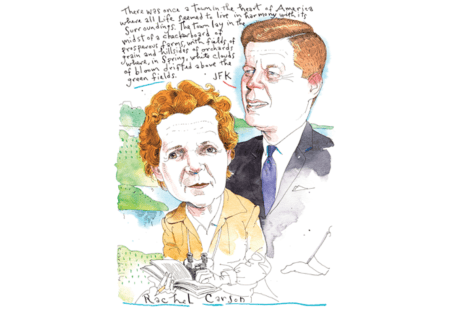
Rachel Carson persuaded President John Kennedy on her knowledge of oceans; it was the good science that hooked him. Illustration from Audubon Magazine: CARSON AND CAMELOT, Illustration by Joe Ciardiello

Rachel Carson persuaded President John Kennedy on her knowledge of oceans; it was the good science that hooked him. Illustration from Audubon Magazine: CARSON AND CAMELOT, Illustration by Joe Ciardiello

Have you ever interviewed a truly pathological liar?  Hoaxsters tell falsehoods, and the truly pathological ones keep exaggerating as they tell, testing the waters to see how much the audience will believe.  I think Monckton is one of those.

Consequently, the falsehoods grow grander as the hoaxster finds the audience gullibly lapping up the milk of human imagination.

Take this example, Monckton in part 5 of his interview comedy routine with Coren.  Coren doesn’t question any of the confabulations Monckton comes up with, apparently having been born after 1975 and never read much history of science or the enviornmental movement, and apparently having somehow missed the dozens of news stories in recent years on the recovery and removal from the Endangered Species List of the bald eagle and brown pelican, and recovery of osprey and peregrine falcons (does Canada have Google?  does Coren know how to use it?  does Coren have no producer, no fact checkers?)

Nor, apparently, does Monckton have any ability to control his ability to say patently offensive and absolutely impossible things to blame others.  Monckton blames Jackie Kennedy for killing 40 million kids with malaria; never mind that he’s wrong, he pushes on to call President Jack Kennedy “her foolish husband;” never mind that he’s got all his facts wrong, he proceeds to call William Ruckleshaus “an environmental nincompoop”:

[At 2:50 of the video]

LORD MONCKTON: I think it is particularly sad that what is essentially a scientific question has been politicized.  In Britain it’s different.  All parties have sort of gone along with the bedwetting theory.  They’ve all said, “Oh, yes!  We’re doomed!”

The Conservative Party — which is nominally the right-wing party, though now it’s kind of center-left, really — it has come out and said — in fact it has produced the stupidest document on climate change that I’ve ever seen, it’s even stupider than Al Gore’s film; it’s unbelievable how half-witted it is.  It isn’t universal that it’s right-left.

Certainly it is true to say that the left are more enthusiastic about this, worldwide, than anyone else.

But, you see, then, they’ve got it wrong before.  Let’s take the DDT example, where 41 years ago, Jackie Kennedy read Rachel Carson’s Silent Spring.  And the thesis of this book was that because of DDT and other chemicals we were pouring into the atmosphere, the world was going to be so grossly polluted that every species other than humankind would die, and then eventually we would die, too.  And it was all going to be terrible.

From where did Monckton get the idea that Jackie Kennedy read Carson’s book, and that she initiated action? Famously, President Kennedy took a question about DDT in one of his popular afternoon press conferences.  He said he had read the book, and that he was looking into it.

President Kennedy did in fact task his science advisers to check out the book.  The President’s Science Advisory Council (PSAC) reported on May 15, 1963.  They said Carson’s book was accurate, and that the government should act immediately to investigate harms from synthetic chemicals including DDT.

Carson didn’t write anything about ‘pouring chemicals into the atmosphere.’  One of the great concerns among wildlife biologists was the damage done in water — where, it turned out, DDT was quickly absorbed into all living things, which then multiplied the dosages of DDT several million times as it climbed up the trophic ladder (food chains).  The problem with DDT is that it doesn’t go into the air, or water, but is instead rapidly absorbed by living tissue.  DDT sprayed in an estuary is taken up by first-level producers, including zooplankton, phytoplankton and plants, as well as any other creature that happens by.  As these producers are consumed by creatures higher up the food chain, the dosage multiplies geometrically.

Carson didn’t whine as Monckton claims she did.  She coolly and calmly laid out the facts.  The facts were, and are, that DDT and its sister compounds pose serious dangers to living things.

And Jackie Kennedy read this, and shivered, and plucked at the sleeve of her husband — who was then President of the United States — and said:  “Look.  You’ve got to do something about this!  We’ve got to save the planet from DDT!”

Isn’t that a remarkable coincidence?  Jackie Kennedy’s husband was president of the United States! He always had such cute cuffs to tug on, too.  Monckton’s infantilizing the First Lady and President of the U.S. lacks the charm Monckton must think it adds.

Jackie Kennedy was a smart and capable woman, a journalist who went on to a long and successful career as an editor at a major publishing house.  Monckton’s disparaging of Mrs. Kennedy here is uncalled for, untoward, and ugly — and factually wrong.

I’m sure that if the president’s wife told him to look into an issue, he did.  She was not in the habit of being frivolous or silly.  There is film of President Kennedy at a press conference, being asked by a reporter if there is any official reaction on Carson’s book (hardly the pillow-side sleeve tug Monckton imagines); and anyone can check the presidential papers to see the report from the science advisors.  As we know now, Carson was right.  The Nobel winners  and others on the PSAC agreed.  Incidentally, they won their Nobels for hard research, not by writing letters to the editor of an publication from an organization that won a Nobel and then getting a sycophant to manufacture a replica Nobel, as Monckton claims with his dime-store “Nobel pin” (like a man whose mother refused to buy a deputy sheriff star for his cowboy games).

In his efforts to make the story entertainingly memorable, Monckton gives us the equivalent of passed gas in a crowded elevator.

But, Dear Reader — Dear God! — brace yourself:

And so Kennedy appointed a friend of his who was an environmental nincompoop, to take charge of the Environmental Protection Agency.

How can we know Monckton is lying? Well, John Kennedy died in November 1963.  The Environmental Protection Agency took form seven years later, in the administration of Richard Nixon, the man Kennedy defeated for the presidency in 1960.  John Kennedy was dead, and his younger brother suffered assassination, too.  Monckton’s English — U.S. history is not his forte.

So, EPA did not exist in John Kennedy’s life.  Unless Monckton claims Kennedy came back from the grave and wrested the pen from Nixon’s hand, it would have been impossible for Kennedy to appoint anyone to be in charge of the Environmental Protection Agency.

To whom is Monckton referring as director?  William Ruckelshaus, the old Republican political operator?  Monckton’s slip of the grip on history is so severe that it can’t be restored.  He’s so far out in fantasy land it’s difficult to tell.

But let’s take the next line:

Result:  Unfortunately; they banned DDT.

Ruckelshaus was Director of EPA when DDT was banned.  Ruckelshaus signed the documents.  Monckton could only be referring to Ruckelshaus.  To make his case for DDT, Monckton must bend time and all of politics.

And then, Monckton, of all people, refers to Ruckelshaus as a “nincompoop.” Um, Monck, this is one of the heroes of the Saturday Night Massacre, one of America’s better lawyers of that time or any time, a committed man of reason and solid environmental credentials.  If Ruckelshaus is an environmental nincompoop, Monckton is a lobotomized environmental pisant with a bad attitude.  (Regardless whatever he may be, Monckton has a bad attitude.)

We confront the reality here that Monckton is not engaging in any discussion about science, where simple facts of history got wrong can be subject to swift and gracious correction.  He’s off in Faux Propagandaland, making up nasty things to say as he bulldozes through the facts and truth, pushing them out of the way of his rant.  Facts, history and science be damned!, Monckton froths.  This is a crusade against the evils of socialism, and Monckton will carry on the war even when there are no socialists and no evil!  So what if they are not socialists!  Monckton will label them so and that will be that!

Oy.  Monckton’s so far out in left field at Wrigley that he’s in the bar across the street.

This was copied worldwide, because the left got going.  “Aha! We can show who’s boss!  We can ban DDT!”

Nope, sorry.  Sweden banned DDT, and then the U.S. banned DDT from use around babies, and then in 1972 the U.S. banned use of DDT in agriculture.  Most European nations eventually followed with tighter regulations.  History shows, however, that DDT was never banned in most of the world.  In the U.S., sadly, DDT manufacture for export continued until 1984 (to the day before the enactment of the Superfund bill), and DDT manufacture continues today in India and China.

Not only did the left not ban DDT around the world, no one did.

Not content to merely rape history and stuff its bloody body in a garbage can, Monckton then invents a whole new class of evil for environmentalists to do:

And of course a lot of them were in league with people who were producing chemicals other than DDT, which they wanted to replace, so they were making money out of it the usual — unfortunately the usual money-packed story, and inglorious story.

Got that?  He says Kennedy, though dead for nearly a decade, conspired to ban DDT so he could get kickbacks from companies who manufactured competing pesticides. And so did Ruckelshaus, one of the few men who stood up to Richard Nixon and refused to fire Archibald Cox.  Monckton says Ruckelshaus was crooked, and taking kickbacks from chemical companies.

So, they banned DDT.  Now, DDT is, in fact, safe enough you can eat it by the tablespoonful — I wouldn’t recommend that, but you can do that, it won’t hurt you if you do.  It’s completely harmless to humans.  It’s completely harmless to birdlife and animals.

In 1975 a committee of the House of Representatives asked for a history of EPA.  Among other topics, the DDT restrictions were discussed — here’s a 312-page document showing which harms were of greatest concern, and what was the science that backed the analysis of those harms.  It’s 312 pages that Monckton hopes you will never read.  He probably hopes it doesn’t even exist anymore.

By 1975 all the harms of DDT worried about by Rachel Carson 13 years before had been confirmed, with the slightly happy news that DDT is not a potent human carcinogen, but a weak one.

The only thing it’s harmful to is the anopheles mosquito, which is the vector that carries the falciparum parasite that causes malaria.  And to the aedes egyptii mosquito, which carries the yellow fever parasite.  It’s fatal — and really fatal — to both of them.

DDT acutely kills fish, birds and bats.  Had Monckton done his research, he’d have seen the plea from the U.S. Army to keep DDT available for poisoning bats in old, dilapidated barracks.  (EPA did not keep that use.)  DDT manufacturers bragged about how deadly the stuff was, in trying to make a case that it should be left on the market for unrestricted use.  40 years later, wild populations of bats are beginning to recover from collateral poisoning from DDT.  Bats fall into that branch of the animal kingdom known as mammals, where humans also fall.  Generally, if a poison is toxic to one mammal, it will be toxic to all others if dose is altered to consider body mass.  But also, if a substance is carcinogenic to one mammal, it will be cancer-causing to other mammals, too.

In mosquito control DDT is problematic.   It kills mosquitoes, but it also kills all other small creatures.  Especially, it kills those things that prey on mosquitoes — other insects, birds and arachnids, fish and small animals especially.  Since mosquitoes recover from DDT rather quickly, and predators take much longer to recover, this means an outdoor dose of DDT will result in a dramatic population explosion of malaria-carrying mosquitoes in a few weeks, as the mosquitoes recover more quickly than their predators do.

Monckton appears to think DDT is selective to mosquitoes.  DDT is a broad-scale killer, not selective in any way we know.

And the guy who invented it, who was German, got the Nobel Prize, because before DDT was introduced, a million people a year around the world, nearly all of them children, were dying of malaria.  It was one of the biggest killers.

Paul Muller won the Nobel in Medicine in 1948 for discovering that DDT kills insects.  But he was not the guy who invented the stuff more than 50 years earlier. Once again, where it’s easy to check facts, Monckton just doesn’t get the facts straight.

Before DDT was introduced, and for a long time thereafter, malaria killed about three million people annually.  When WHO conducted its eradication campaign, malaria deaths fell to about two million per year by the middle 1960s.  Once DDT use in that campaign was stopped, malaria death rates continued to fall to about a million a year today.  Malaria incidence and deaths rose in the 1980s when the malaria parasites themselves developed resistance to medicines used to treat and cure malaria in humans.

The chief barrier to lower malaria infection rates is education on barriers against mosquito exposure.  The chief barrier to lower malaria death totals is the development and delivery of pharmaceuticals to treat infected humans.  DDT is a panacea in neither theatre.

DDT came along and deaths fell to 50,000.

Monckton is flat out wrong.  He’s off by a factor of 20.  He’s making this stuff up.

We were on the point of wiping it out.

Flat out wrong again.  The World Health Organization (WHO) undertook a very ambitious program to eradicate malaria in the 1950s.  By the mid-1960s it was clear the program could not work:  In Africa, overuse of DDT (in agriculture) bred mosquitoes resistant to and immune to DDT.  Worse, in most of Subsaharan Africa, governments were not stable enough to have the discipline required to mount an effective campaign against the disease, knocking down the insect carriers briefly, then furiously treating humans with the disease so that when the mosquitoes returned there would be no pool of human infection from which to draw the disease.  This is all detailed in one of those fascinating New Yorker profiles of the legendary Fred Soper, by Macolm Gladwell.  For most of the world, we’ve never been to the point of wiping out malaria, and in those places where we’ve been successful in wiping out the disease, DDT was not the chief weapon.

When the left got in on the act — it’s exactly the same people:  the Environmental Defense Fund — you know — people who have got hundreds of millions of dollars in the bank!  Goodness knows where they get it from!  Foreign governments, possibly!  I don’t know!  I haven’t looked.  But it’s certainly an alarming question:  Are the environmental movements being backed by China or India so they won’t have to compete with us for natural resources because we will have shut our industry down.  It’s a question that the security services, I hope, are looking at, because it certainly worries me.

Monckton at his most scurrilous, and most distant from the facts.  Are environmental groups funded by China?  No.  In any case, the environmental groups don’t have nearly the funding of the pro-DDT groups, with their corporate funds. While we’re thinking about it, we should think about which side China would intervene on, were China to follow through on its historic reluctance to do anything about global warming.  Who is running around the world claiming we need to do nothing, and should do nothing?  Christopher Monckton.

If Monckton is worried about who is funding him, I’m sure the CIA and FBI would be happy to let him tell them about his well of money  he uses to frustrate the United Nations and treaty obligation of a hundred nations.  (Bill Dembski?  Are you still alive?  Why don’t you turn Monckton in — you’ve still got the number of Homeland Security, don’t you?)

Perhaps most egregious, or most funny, is this:  Environmental Defense has been a leader among all agencies, governmental and NGO, to urge the extremely limited use of DDT in indoor residual spraying – and yet, they are the one group Monckton complains about.

It’s a wonder to me that Monckton can figure out which part of his foot goes into his shoes first, in the mornings.  He has such a flair for getting the facts exactly wrong, and then getting into a dudgeon about his own error.  Monckton:  Not only wrong, but 180 degrees precisely wrong.

But there was the Environmental Defense Fund, and it came in and said, “Right, we’re going to press for a ban on DDT.” They succeeded.

The number of deaths went back up, from 50,000 a year to a million a year, and it stayed there for 40 years, while the likes of me were saying, “This is killing millions.  It ought to be stopped.  What on Earth is the World Health Organization doing?”

And eventually, just three years ago, on the 15th of September, 2006, Dr. Arata Kochi of the World Health Organization said, “Right.”  He said, “In this field, politics usually predominates.  Now we are going to take a stand on the science and the data.”  He ended the ban on DDT and declared that once again it would be the frontline of defense against the mosquito.

DDT has never been banned in most of the world — especially not in Africa.  WHO never banned DDT, they simply stopped using it when it ceased to be effective. Plus, you’ll recall from just a few paragraphs above, Environmental Defense (formerly EDF)  led the campaign to get DDT restored to use in IRS campaigns in Africa.

Monckton’s game is worse than blaming the messenger — he’s blaming the heroes.

COREN:  40 million people died . . .

MONCKTON:  Children!

COREN:   . . . because Jackie Kennedy read a silly book.

MONCKTON:  Yep.

COREN:   . . . and her foolish husband bought into it.

So, Coren’s bought Moncktons rude infantilizing of the Kennedys and all the false claims that went into it.  Anybody know how old Coren is?  Was he even alive in 1962?  If not, can he read?  Does he?  Carson’s book is out now in the 2002 40th anniversary edition, still available for anyone interested in the facts.

MONCKTON:  And then, the entire international left came in on the act.  And that was what did the damage.

And so the problem is that you have this political faction which likes to show who’s boss.  That’s the characteristic of the left.  They are instinctive interventionists.  And I know this is a little much of a political point, but it is unfortunately true that it was they who pushed the DDT ban.  And it was they who — to this day! — will say that David Suzuki and others who advocated this ban — and David Suzuki will tell you today that he regards this as one of the most successful campaigns he ever conducted.  That killed 40 million people, nearly all of them children. And it took 40 years before this decision could be reversed.  Why?  Because we had to wait until all the people responsible for the original decision had either retired or died, and were no longer in the way of doing the decent thing.

COREN:  Because they thought it was harmful to people, to animals . . .

MONCKTON:  They didn’t think any such thing.  It was purely to show who was boss.  There was never any scientific case for this.

Well, it’s in Canada, after all, so Monckton feels obligated to take a swipe at the most prominent local scientist who urges environmental protection.  David Suzuki was probably active in Canada on pesticide regulation, but of course he played only a tangential role in the U.S. action, which is what Monckton complains about here.  Suzuki was no personal confidante of the Kennedys.  Suzuki was 27 in 1963, probably completing graduate school.  Monckton’s swipe at Suzuki is almost completely gratuitous.

This is where the serious charges come.  Monckton accuses Carson, and all environmentalists, of ignoring human conditions.  He accuses us — he accuses you, since you were not active to stop the DDT ban — of being mass murderers, because, he claims, DDT would have been a safe and effective way to fight malaria, which has killed about a million people a year worldwide over the past 40 years.

Monckton is dead wrong.

First, malaria fighters stopped using DDT heavily in Africa in the early 1960s, years before any nation banned the substance.  There were three problems that contributed to the cessation of DDT use, as outlined by Malcolm Gladwell in his heavily researched and authoritative tribute to malaria fighter Fred Soper in The New Yorker:

  1. Many nations in Africa did have governments capable of conducting the regimented campaign necessary to successfully eradicate malaria — and in fact, most of the nations in Subsaharan Africa didn’t participate in the campaign at all.  Soper’s goal was to knock down mosquitoes for at least six months, and in that time cure malaria in every human.  When the mosquitoes came roaring back — as everyone in the program knew they would — there would be no pool of malaria in humans from which the mosquitoes could get infected.  The program was to break the chain of transmission required for the life cycles of the malaria parasites.  But that meant that governments had to have health care systems that could accurately diagnose malaria, and often which malaria parasite, and complete a cycle of treatment needed to flush the parasites out of the infected humans.  In the end, many entire nations simply did not participate.
  2. Malaria fighters were well aware of the race they were running:  Mosquitoes breed quickly, and consequently evolve quickly.  WHO’s malaria fighting teams understood it was a simply matter of time before mosquitoes became resistant or immune to DDT.  If that happened before malaria could be eradicated in a country or region, the game was over.  Resistance to DDT in mosquitoes started showing up as early as 1948 in Greece; by the 1960s several populations of mosquitoes were highly resistant.  (Today, every mosquito on Earth carries at least one of the two alleles that produces DDT immunity — and some carry as many as 60 copies of the two alleles, leaving them completely unaffected by DDT.)
  3. Industry didn’t get on board with the campaign.  Over-use of DDT out of doors by agricultural interests speeded the evolution of DDT-resistant mosquitoes.  Industrial use competed against, and ultimately frustrated, health care use of DDT.

Gladwell describes how WHO abandoned the eradication campaign with DDT as the key element, in the middle 1960s.  This was done not as a reaction to Carson’s book, but because the mosquitoes showed resistance.  Malaria fighters couldn’t build medical care in several nations at once while racing agriculture to use DDT.  WHO turned to other methods of fighting the parasites.

It’s important to note that WHO cannot dictate to nations what they do, nor did WHO ever “ban” DDT.  There are a lot of claims that there was pressure applied by environmentalists to get DDT use stopped, but the facts remain that DDT manufacture for export to Africa continued in the United States for more than a decade after DDT use was stopped in the U.S.  Manufacture of DDT moved to Africa and Asia — India and China make the stuff today.  Any African nation who wished to use DDT could have gotten it cheaply and in great quantity.

Second, there is no indication that DDT could have saved any more lives.  Simple mathematics tells the story:  The WHO eradication campaign reduced world-wide deaths from a high of 4 million annually, to about 2 million annually.  Each nation that eradicated malaria did so by raising incomes and improving the housing of poor people, making effective screening from mosquitoes the central part of the campaign.  Also, nations copied what the U.S. had done prior to the discovery that DDT killed insects:  They institute improved public health campaigns to educate people how to avoid being bitten, and to diagnose the disease and deliver knock-out pharmaceuticals quickly.

But, since heavy DDT use was stopped, the malaria rates continued to fall until recently.  Over the last decade, annual deaths numbered under a million, lower than when DDT use was at its greatest.  It’s impossible to square decreasing death rates with Monckton’s claim that DDT is a panacea against malaria, still.

Finally to this point of DDT and malaria, we have a conundrum:  Those nations who still use DDT, still have epidemic malaria.  If, as Monckton says, DDT is a miracle weapon against malaria, those nations that use DDT should be malaria-free.  If we think through the process, we see that malaria eradication is a much greater task that simply killing mosquitoes, and too complex to be cured simply by poisoning Africa and Africans.

Monckton ultimately tries to reduce the complex science, medical, geographical, political and education issues of malaria to a political question.  He accuses everyone who ever worked to reduce DDT use of being part of an out-of-control, monolithic and unthinking “left.”  It’s a popular idea among loud talkers from the right, including Monckton, Limbaugh, Rockwell, Hannity, the Hoover Institute, and most people who resist the science of global warming.  Monckton’s crude revisions of history away from accuracy might be justified as proper propaganda, if there were a noble political goal behind his work.  No noble goal can be discerned, latent or patent.

Many on the western left, in North America and Britain, urged tighter controls on DDT, especially once it became clear that the stuff was dangerous.  They got this from a long tradition of conservation in the U.S., for example, and not from any particular political orientation.  Fact is, the radical, socialist left who took over Russia and created the Soviet Union, who dominated Eastern Europe after World War II and who created the Peoples Republic of China, have always been unfriendly toward environmental protection, including the banning of DDT.  There was no ban on DDT use in the Soviet Union, nor in China.

Conservation, and the fight against pollution, is a product of western, capitalist nations.  It may be surprising news to a few, but the American conservation movement was led by people like John D. Rockefeller II, and Laurance Rockefeller, the Vanderbilts, and other people who were wealthy enough to have time to look around to see what was happening to America’s wild resources — or who appreciated the value of wilderness and conservation and the role it played in making America great.  Monckton is turning his back on one of the greater achievements of American capitalism, the strong desire to preserve the wild, and have clean air and clean water, for the health and benefit of all citizens.  Monckton completely shuns this great heritage of western civilization.  It’s quite astounding.

Ultimately, the decisions to reduce the use of, and now to phase out DDT (under 2001’s Persistent Organic Pesticides Treaty (POPs)) were scientific decisions.  In the U.S., the National Academy of Sciences wrote about DDT early on, noting (with an egregious typographical error) the great utility and benefit DDT provides to humans, but finally weighing the harmful effects and finding that they outweigh the benefits.  The number of assessments of DDT by august scientific and policy bodies is impressive, each deciding DDT had to go:  The 1958 U.S. Forest Service, the 1963 President’s Science Advisory Council, two federal courts in the U.S., the Food and Drug Administration in 1969, the U.S. Environmental Protection Agency in 1972, two more federal appellate courts ruling on the appropriateness and scientific soundness of EPA’s rule, the National Academy of Sciences, Congress under the Resource Conservation and Recovery Act (RCRA, the Superfund Act), and finally an international treaty between nearly 100 nations.  At each step science was the driving force.  At most steps, an absence of sound science would have made the ruling go the opposite way.

But all that is legal “mumbo-jumbo” to Monckton.  All that science is for naught, to Monckton’s classics trained mind.  What Monckton wants, Monckton should have, damn the facts, damn the courts, damn the scientists, damn history.

It’s really astonishing to add up the error Monckton piles on.

It’s the same with global warming.  There is no scientific case for this, either.  It’s the same people, trying to assert themselves in the same way.  They have succeeded, yet again, in getting the entire classe politique . . .

COREN:  I wish we had another hour.

So, with Monckton dead wrong or hallucinating on DDT, we should now trust him on global warming? No, we should not trust him on any issue.

Monckton will not understand those issues, either.  They are even more complex.

Update:  Monckton continues to smear the Kennedys in Australia, nearly two months later.

More:

Help others to remember history, so as not to be condemned to repeat it:

Add to FacebookAdd to NewsvineAdd to DiggAdd to Del.icio.usAdd to StumbleuponAdd to RedditAdd to BlinklistAdd to TwitterAdd to TechnoratiAdd to Furl