Remember that the weekend was a Crazy Liberal Idea™, and that union men and women died for the right to have them.
See this and more at PoliticalLoudmouth.com
Text of the poster: “The weekend was a crazy liberal idea. In 1886, 7 union members in Wisconsin died fighting for the 5-day work week, and 8-hour work day.”
Apathy is a cruel political philosophy. It supports despots, fools, crooks and partisan hacks — more often than it supports good government, in my humble opinion.
In Wisconsin, had all those who signed the petitions to recall Tea Party Republicans, voted, the results would have been more favorable to Democrats. Tea Partiers won big in 2010 on the basis of poor voter turnout nationally (could it really have been as low as 18% of all voters?).
Look at it this way — 26,000 people in the 2nd Senate District signed the petition to recall Sen. Rob Cowles of Allouez in the spring. But only 18,000 people ended up voting for Cowles’ opponent, Nancy Nusbaum on Tuesday.If the 26,000 petition-signers would have voted for Nusbaum, she only would have needed 1,500 more votes to beat Cowles, who had 27,500 votes.
From Appleton, in one contested district, only 35 voters showed up to vote.
It is clear why Republicans work so hard, nationally, to restrict voter turnout by making it difficult, onerous, or just bothersome to vote. And no doubt, they think that they will make better decisions than those who didn’t vote and thereby handed them the reins of power. Despots, fools, crooks and partisan hacks rarely confess they are not the purveyors of good, democratic government.
Spread the word; friends don't allow friends to repeat history.
So, why don’t the Republicans do what the people of Wisconsin want, instead? Why are Wisconsin Republicans acting as a special elite, ignoring voters’ wishes?
A Rasmussen poll out today reveals that almost 60% of likely Wisconsin voters now disapprove of their aggressive governor’s performance, with 48% strongly disapproving.
While these numbers are clearly indicators of a strategy gone horribly wrong, there are some additional findings in the poll that I suspect deserve even greater attention.
It turns out that the state’s public school teachers are very popular with their fellow Badgers. With 77% of those polled holding a high opinion of their educators, it is not particularly surprising that only 32% among households with children in the public school system approve of the governor’s performance. Sixty-seven percent (67%) disapprove, including 54% who strongly disapprove.
Can anyone imagine a politician succeeding with numbers like this among people who have kids?
These numbers should be of great concern not only to Governor Walker but to governors everywhere who were planning to follow down the path of war with state employee unions. You can’t take on the state worker unions without taking on the teachers – and the teachers are more popular than Gov. Walker and his cohorts appear to realize.
Tip of the old scrub brush to Wisconsinite Jean Detjen.
Spread the word; friends don't allow friends to repeat history.
I get e-mail — with a few million others, I’m sure:
Ed —
Today, we are filing papers to launch our 2012 campaign.
We’re doing this now because the politics we believe in does not start with expensive TV ads or extravaganzas, but with you — with people organizing block-by-block, talking to neighbors, co-workers, and friends. And that kind of campaign takes time to build.
So even though I’m focused on the job you elected me to do, and the race may not reach full speed for a year or more, the work of laying the foundation for our campaign must start today.
We’ve always known that lasting change wouldn’t come quickly or easily. It never does. But as my administration and folks across the country fight to protect the progress we’ve made — and make more — we also need to begin mobilizing for 2012, long before the time comes for me to begin campaigning in earnest.
As we take this step, I’d like to share a video that features some folks like you who are helping to lead the way on this journey. Please take a moment to watch:
In the coming days, supporters like you will begin forging a new organization that we’ll build together in cities and towns across the country. And I’ll need you to help shape our plan as we create a campaign that’s farther reaching, more focused, and more innovative than anything we’ve built before.
We’ll start by doing something unprecedented: coordinating millions of one-on-one conversations between supporters across every single state, reconnecting old friends, inspiring new ones to join the cause, and readying ourselves for next year’s fight.
This will be my final campaign, at least as a candidate. But the cause of making a lasting difference for our families, our communities, and our country has never been about one person. And it will succeed only if we work together.
There will be much more to come as the race unfolds. Today, simply let us know you’re in to help us begin, and then spread the word:
Nelson Lichtenstein, University of California - Santa Barbara, Santa Barbara Independent photo
Most jobs in America are not in manufacturing or subject to international competition. So the service sector, retail, construction — there are a huge number of jobs where international competition has nothing to do with it. The obstacles there are domestic. Labor law is totally dysfunctional. Workers really don’t have the right to form unions of their choosing. So you’re right to be pessimistic, just for different reasons.
I also have a mega-historical answer to that question, though. If you look at the last 150 years of history across all nations with a working class of some sort, the maintenance of democracy and the maintenance of a union movement are joined at the hip. We’ve seen this dramatically reconfirmed in Spain and South Korea and Poland over the years. If democracy has a future, then so too must trade unionism. Sadly, that doesn’t offer much hope for my lifetime. But there is such a thing as conflict between capital and labor.
[On the slashing of arts education funding:] It’s especially discouraging when you live in a democracy where anything good is possible, if only we have the courage to deal with it.
Stalking America and haunting the shadows of every capitol building in America today are people who would profess, if asked, that they fashion themselves in the mold of Herbert Hoover. Little Hoovers, we might call them. Unlike Hoover, and unlike the friendly “Little Hoover” phrase we might apply to them, the welfare of America is not their concern. We might worry about that.
President Harry Truman in 1947 appointed former President Herbert Hoover to head a commission on how to reform the federal government. I do not know of a high school history text that even mentions this effort today.
Herbert Hoover on the cover of Time Magazine, 1925
Hoover’s commission made 273 recommendations that were taken to heart, then taken to Congress. Many were enacted into law.
Several states followed the example, as in Utah and famously in California. These groups were often called “Little Hoover” commissions. In no case that I have found did any of these commissions ever recommend stripping union collective bargaining agreements out of any situation.
But again, this history is mostly lost. Hoover is remembered today for his failure to stop the Great Depression, for his seeming unwillingness to do what was necessary in great enough effort to relieve the nation’s serious hurts. That’s too bad, really.
Herbert Hoover was not opposed to government action to fix the depression on most counts. In his correspondence with Franklin Roosevelt, especially after Roosevelt replaced him in the presidency, Hoover often complained that Roosevelt’s actions were in the right vein, but too much.
We should remember this.
Are we in a Great Depression? Economically, technically, our nation is in “recovery.”
Realistically, our nation is teetering on the brink of great financial disaster. Sadly, most people ignore the lessons of history, and consequently, actions of many governmental units today seem driven to push the nation over the brink. Home prices have not recovered. Millions are out of work — millions of highly-trained workers cannot find jobs with pay adequate to support a family.
We appear not to have learned these lessons that should not have been forgotten:
Stimulus from the government creates demand, which fuels manufacturing recovery, and more jobs. Tax cuts, such as Hoover’s 1932 tax cut for the wealthy, drive us deeper into recession.
Labor unions form vital components of a healthy manufacturing segment; they stand up for worker health and safety, for fair pay and work conditions that spur productivity. When we ignore or fight unions, we damage economic productivity. When we work with unions, we make progress.
Cracking the whip may get a temporary reaction from workers that looks good. In the long run, if not immediately, such actions damage productivity and creativity.
Unions do not make the big financial decisions that cripple industry. Unions don’t decide the products to be produced. Unions cannot gamble a company’s future on ill-advised acquisitions or switches in corporate focus, usually. Union demands for restrooms improve the sanitation and health of our food supplies. Union demands for limited work hours lead to productive workers, better safety, and better products.
In almost every case where foreign corporations compete successfully with U.S. companies on high-tech and high-skill jobs, and take away U.S. jobs, the government of that foreign nation provides health care for all citizens, so that health care costs are not a cost of business. In the case of most industrial nations, foreign pension laws are much stiffer than U.S. laws, stiffer in protecting generous benefits for pensioners.
All workers benefit when unions gain, traditionally. It wasn’t Andrew Carnegie who invented the two-week vacation.
Workers can do more for consumers when they are treated well and listened to by company management.
I’m depressed at the nasty actions in so many places, in so many ways, designed to thwart progress to good ends, and instead drive our nation into mediocrity. I find it difficult to post when there is so much disaster looming in so many places.
When political movements from the right go after one group with hammer and tongs, we might do well to remember the old, wise words. With a full-on awareness of Godwin’s Law, we might do well to remember the words attributed to Martin Niemöller, and the moral of that story:
“Then they came for the trade unionists,
and I didn’t speak out because I wasn’t a trade unionist.”
What has Scott Walker done for anyone who makes less than $500,000 a year, anyway? So you should ask: What has Scott Walker ever done for you, or your family? If the bargaining rights of any union are removed, anywhere in the U.S., who will speak up for your vacation, pension, health care benefits, and job safety? OSHA? Are you sure?
The U.S. economy appears to be coming apart at the seams. Unemployment remains at nearly ten percent, the highest level in almost 30 years; foreclosures have forced millions of Americans out of their homes; and real incomes have fallen faster and further than at any time since the Great Depression. Many of those laid off fear that the jobs they have lost — the secure, often unionized, industrial jobs that provided wealth, security and opportunity — will never return. They are probably right.
Cover of Winner-Take-All Politics, by Jacob Hacker and Paul Pierson
And yet a curious thing has happened in the midst of all this misery. The wealthiest Americans, among them presumably the very titans of global finance whose misadventures brought about the financial meltdown, got richer. And not just a little bit richer; a lot richer. In 2009, the average income of the top five percent of earners went up, while on average everyone else’s income went down. This was not an anomaly but rather a continuation of a 40-year trend of ballooning incomes at the very top and stagnant incomes in the middle and at the bottom. The share of total income going to the top one percent has increased from roughly eight percent in the 1960s to more than 20 percent today.
This what the political scientists Jacob Hacker and Paul Pierson call the “winner-take-all economy.” It is not a picture of a healthy society. Such a level of economic inequality, not seen in the United States since the eve of the Great Depression, bespeaks a political economy in which the financial rewards are increasingly concentrated among a tiny elite and whose risks are borne by an increasingly exposed and unprotected middle class. Income inequality in the United States is higher than in any other advanced democracy and by conventional measures comparable to that in countries such as Ghana, Nicaragua, and Turkmenistan.
This is a mostly encore post, emphasizing George Washington’s astounding ability to draw from history just exactly the right lesson, and then set the example that makes history.
Washington, though having never attended college, was an inveterate reader, and a sharp student of history. Early he read the story of the great Roman, Cincinnatus, who made the Roman Republic great with his refusal to lust for power. Cincinnatus twice was named Dictator, and both times resigned the commission rather than personally profit as others did — after saving Rome both times, of course.
In his own life, Washington also twice cast off the mantle of top leader, once when he resigned his commission as Commander in Chief of the Continental Army when so many assumed he would just keep on, and add the title of “King of America;” and the second time when, as president, he stepped aside and retired, leaving the leadership of the nation up to the Constitutional processes that had never before been tried successfully in any nation.
Washington’s resignation from the army command came on December 23, 1783 — such an important anniversary usually gets lost in preparations for Christmas, so I’ll post it a bit early. In your holiday toasts, lift a glass to George Washington, who gave us civilian rule, an end to monarchy, and an example of responsible leadership making way for peaceful succession.
Washington had been thought to be in a position to take over the government and declare himself king, if he chose. Instead, at some cost to himself he personally put down a rebellion of the officers of the army who proposed a coup d’etat against the Continental Congress, angered that they had not been paid. Washington quietly asked that the men act honorably and not sully the great victory they had won against Britain. Then Washington reviewed the army, wrapped up affairs, journeyed to Annapolis to resign, and returned to his farm and holdings at Mount Vernon, Virginia.
Because Washington could have turned into a tyrant, it is reported that King George III of England, upon hearing the news of Washington’s resignation, refused to believe it. If the report were true, George is reported to have said, Washington was the greatest man who ever lived.
Washington’s resignation set precedent: Civilian government controlled the military; Americans served, then went back to their private lives and private business; Americans would act nobly, sometimes when least expected.
What event critical to western history and the development of the democratic republic in the U.S. happened here in 1215?
A teacher might use some of these photos explaining the steps to the Constitution, in English law and the heritage of U.S. laws. Other than the Magna Carta, all the events of Runnymede get overlooked in American studies of history. Antony McCallum, working under the name Wyrdlight, took these stunning shots of this historic meadow. (He photographs stuff for studies of history, it appears.)
Maybe it’s a geography story.
View of Runnymede Meadow from Engham Village -- Wyrdlight photo through Wikimedia
Several monuments to different events of the past millennium populate the site. The American Bar Association dedicated a memorial to the Magna Carta there — a small thing open to the air, but with a beautiful ceiling that is probably worth the trip to see it once you get to England.
Wikipedia explains briefly, with a note that the ABA plans to meet there again in 2015, the 800th anniversary of the Great Charter:
Magna Carta Memorial
The Magna Carta Memorial & view towards the ‘medes’
Engraved stone recalling the 1985 ABA visit
Situated in a grassed enclosure on the lower slopes of Cooper’s Hill, this memorial is of a domed classical style, containing a pillar of English granite on which is inscribed “To commemorate Magna Carta, symbol of Freedom Under Law”. The memorial was created by the American Bar Association to a design by Sir Edward Maufe R.A., and was unveiled on 18 July 1957 at a ceremony attended by American and English lawyers.[5]
Since 1957 representatives of the ABA have visited and rededicated the Memorial renewing pledges to the Great Charter. In 1971 and 1985 commemorative stones were placed on the Memorial plinth. In July 2000 the ABA came:
to celebrate Magna Carta, foundation of the rule of law for ages past and for the new millennium.
In 2007 on its 50th anniversary the ABA again visited Runnymede and during the convention installed as President Charles Rhyne who devised Law Day which seeks in the USA an annual reaffirmation of faith in the forces of law for peace.
The ABA will be meeting at Runnymede in 2015 on the 800th anniversary of the sealing of the original charter.
The Magna Carta Memorial is administered by the Magna Carta Trust, which is chaired by the Master of the Rolls.[10]
In 2008, flood lights were installed to light the memorial at night, but due to vandalism they now lie smashed.
I’ll wager the lights get fixed before 2015.
Detail of ceiling of the Magna Carta Memorial detailing play of light, and star pattern, Runnymede - Wikimedia image
Utah has a movement out to slander education and the Constitution, with a pointless claim that the Constitution cannot be called a “democracy,” damn Lincoln, Hamilton, Madison, Washington, both Roosevelts, and Reagan.
Sadly, it started in my old school district, the one where I got the last nine years of public school education, Alpine District, in the north end of Utah County.
They even have a website, Utah’s Republic. (No, Utah was never an independent republic before it was a state — it’s not like the Texas Republic wackoes, except in their wacko interpretations of law and history, where they are indistinguishable.)
Can you vouch for any of these “quotes?” Is any one of them accurate?
The Jefferson “mob rule” quote isn’t in any Jefferson data base that I can find. I find it also attributed to George Washington — but almost always without any citation, so you can’t check.
That maneuver is one of the key indicators of Bogus Quotes, the lack of any citation to make it difficult to track down. All of these quotes come without citation:
As for a moral people, Washington said there could be no morality without religion and called it the “indispensable support,” not education. Obviously Jefferson and the Founders wanted education of the constitution to take place but we are very far removed from it in our education system.
Democracy… while it lasts is more bloody than either aristocracy or monarchy. Remember, democracy never lasts long. It soon wastes, exhausts, and murders itself. There is never a democracy that did not commit suicide. – John Adams
A democracy is nothing more than mob rule, where fifty-one percent of the people may take away the rights of the other forty-nine. – Thomas Jefferson
The democracy will cease to exist when you take away from those who are willing to work and give to those who would not. – Thomas Jefferson
Democracy is two wolves and a lamb voting on what to have for lunch. Liberty is a well-armed lamb contesting the vote. – Benjamin Franklin
Democracy is the most vile form of government… democracies have ever been spectacles of turbulence and contention: have ever been found incompatible with personal security or the rights of property: and have in general been as short in their lives as they have been violent in their deaths. – James Madison
As I would not be a slave, so I would not be a master. This expresses my idea of democracy. – Abraham Lincoln
The last one is probably accurate, but irrelevant to this discussion (nice red herring, there, Oak). Can you offer links to verify any of them?
Is this what I suspect? The “Utah Republic” drive is not only a tempest in a teapot (though perhaps caused by other more serious maladies), but also a tempest based on false readings of history?
Funny: Nowhere do these guys discuss one of the greatest drivers of the republic, over more egalitarian and more democratic forms of government. Remember, Hamilton preferred to have an aristocracy, an elite-by-birth group, who would rule over the peasants. He didn’t trust the peasants, the people who he saw as largely uneducated, to make critical decisions like, who should be president. Norton doesn’t trust the peasants to get it right, and so he wants to dictate to them what they are supposed to know, in Nortonland.
Just because Oak Norton slept through high school history and government is no reason to shut down Utah’s Alpine School District or any other school; he’s not offered much evidence that everyone else missed that day in class, nor evidence that it has any significant effect.
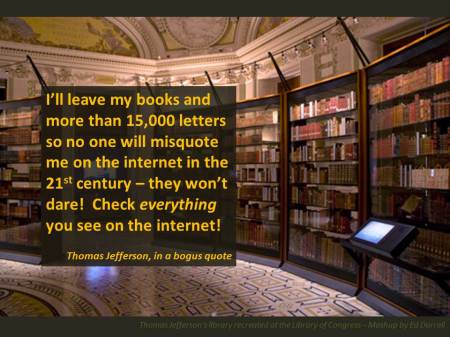
Jefferson’s advice on quotes found on the internet, backdropped by his books now held by the Library of Congress.
Spread the word; friends don't allow friends to repeat history.
Informing Georgia Supreme Court Chief Justice Carol W. Hunstein that Georgia is a republic, not a democracy; recognizing the great differences between these two forms of government; and for other purposes.
WHEREAS, on March 16, 2010, Georgia Supreme Court Chief Justice Carol W. Hunstein appeared before the Georgia General Assembly for the State of the Judiciary address, and in her speech Chief Justice Hunstein mistakenly called the State of Georgia a democracy; and
WHEREAS, the State of Georgia is, in fact, a republic and it is important that all Georgians know the difference between a republic and a democracy -– especially the Chief Justice of the Georgia Supreme Court; and
WHEREAS, the word “republic” comes from the Latin res publica, which means “the public thing” or “the law,” while the word “democracy” comes from the Greek words demos and kratein, which translates to “the people to rule”; and
WHEREAS, most synonymous with majority rule, democracy was condemned by the Founding Fathers of the United States, who closely studied the history of both democracies and republics before drafting the Declaration of Independence and the Constitution; and
WHEREAS, the Founding Fathers recognized that the rights given to man by God should not be violated by an unrestrained majority any more than they should be restrained by a king or monarch; and
WHEREAS, it is common knowledge that the Pledge of Allegiance contains the phrase “and to the Republic”; and
WHEREAS, as he exited the deliberations of the so-called Constitutional Convention of 1787, Founding Father Benjamin Franklin told the awaiting crowd they have “A republic, if you can keep it”; and
WHEREAS, a republic is a government of law, not of man, which is why the United States Constitution does not contain the word democracy and mandates that “the United States shall guarantee to every State in this Union a Republican Form of Government”; and
WHEREAS, in 1928, the War Department of the United States defined democracy in Training Manual No. 2000–25 as a “government of the masses” which “[r]esults in mobocracy,” communistic attitudes to property rights, “demagogism, … agitation, discontent, [and] anarchy”; …
NOW, THEREFORE, BE IT RESOLVED BY THE HOUSE OF REPRESENTATIVES that the members of this body recognize the difference between a democracy and a republic and inform Georgia Supreme Court Chief Justice Carol W. Hunstein that the State of Georgia is a republic and not a democracy….
Tip of the scrub brush to the Volokh Conspiracy, where you’ll find erudite and entertaining comment, and where Eugene Volokh wrote:
Now maybe this is just a deep inside joke, but if it’s meant to be serious then it strikes me as the worst sort of pedantry. (I distinguish this from my pedantry, which is the best sort of pedantry.)
Whatever government Georgia has, and whatever government the English language has, it is not government by ancient Romans, ancient Greeks, the War Department Training Manual, or even the Pledge of Allegiance. “Democracy” today includes, among other meanings, “Government by the people; that form of government in which the sovereign power resides in the people as a whole, and is exercised either directly by them (as in the small republics of antiquity) or by officers elected by them. In mod. use often more vaguely denoting a social state in which all have equal rights, without hereditary or arbitrary differences of rank or privilege.” That’s from the Oxford English Dictionary, but if you prefer the American Heritage Dictionary, try “Government by the people, exercised either directly or through elected representatives.” Government by the people’s representatives is included within democracy, as is government by the people directly.
“Joke” is an accurate description, but one that escapes the sponsors and irritates the impedants on the Texas SBOE.
When legislatures have too much time on their hands, and engage in such hystrionics, one wonders whether the legislature wouldn’t be better off left in the dark by not inviting the views of the Chief Justice in the future. Perhaps the Chief Justice should decline any invitation offered.
What we now know is that some Georgia legislators are all het up about the difference between a republic and a democracy, though I’ll wager none of them could pass an AP world history or European history quiz on Rome and Greece. And what is really revealed is that some Georgia legislators don’t know their burros from a burrow.
You can also be sure of this: Such action is exactly what the so-called conservatives on the Texas SBOE wish to have happen from their diddling of social studies standards.
Spread the word; friends don't allow friends to repeat history.
The conjunction of a black president and a female speaker of the House — topped off by a wise Latina on the Supreme Court and a powerful gay Congressional committee chairman — would sow fears of disenfranchisement among a dwindling and threatened minority in the country no matter what policies were in play. It’s not happenstance that Frank, Lewis and Cleaver — none of them major Democratic players in the health care push — received a major share of last weekend’s abuse. When you hear demonstrators chant the slogan “Take our country back!,” these are the people they want to take the country back from.
Demographics are avatars of a change bigger than any bill contemplated by Obama or Congress. The week before the health care vote,The Times reported that births to Asian, black and Hispanic women accounted for 48 percent of all births in America in the 12 months ending in July 2008. By 2012, the next presidential election year, non-Hispanic white births will be in the minority. The Tea Party movement is virtually all white. The Republicans haven’t had a single African-American in the Senate or the House since 2003 and have had only three in total since 1935. Their anxieties about a rapidly changing America are well-grounded.
Now you know, too, why so many Republicans and Tea Baggers complain about the U.S. Census and its simple, unintrusive questions. It’s not really the census taking that bothers them; it’s the census counting what they know to be true, now.
This one, not safe for work (profanity, usually mild – democratic ideas), but much funnier, and much more serious at the same time — I wish I’d known about it two months ago. Not nearly enough people have watched these, according to the YouTube counts:
If I can get five readers of this post, we’re home free, right?
Tip of the old scrub brush to UBZonker.
Spread the word; friends don't allow friends to repeat history.
Rick Noriega is a rising star, a good man who has served his nation and state well, in Iraq, in the Texas legislature, and now — he hopes — in the U.S. Senate.
Or, until that account is unsuspended by the forces supporting Donald Trump: Follow @FillmoreWhite, the account of the Millard Fillmore White House Library
We've been soaking in the Bathtub for several months, long enough that some of the links we've used have gone to the Great Internet in the Sky.
If you find a dead link, please leave a comment to that post, and tell us what link has expired.
Thanks!
Retired teacher of law, economics, history, AP government, psychology and science. Former speechwriter, press guy and legislative aide in U.S. Senate. Former Department of Education. Former airline real estate, telecom towers, Big 6 (that old!) consultant. Lab and field research in air pollution control.
My blog, Millard Fillmore's Bathtub, is a continuing experiment to test how to use blogs to improve and speed up learning processes for students, perhaps by making some of the courses actually interesting. It is a blog for teachers, to see if we can use blogs. It is for people interested in social studies and social studies education, to see if we can learn to get it right. It's a blog for science fans, to promote good science and good science policy. It's a blog for people interested in good government and how to achieve it.
BS in Mass Communication, University of Utah
Graduate study in Rhetoric and Speech Communication, University of Arizona
JD from the National Law Center, George Washington University


 Posted by Ed Darrell






 Millard Fillmore's Bathtub