Hain’t we got all the fools in town on our side? and ain’t that a big enough majority in any town?
— Mark Twain (Samuel Langhorn Clemens),
Adventures of Huckleberry Finn

Mark Twain, Library of Congress image
— Mark Twain (Samuel Langhorn Clemens),
Adventures of Huckleberry Finn
Mark Twain, Library of Congress image
 Leave a Comment » |
  Books, Democracy, Famous quotes, History, Humor, Literature | Tagged: Books, Democracy, Huckleberry Finn, Humor, Mark Twain, Quotes |
  Permalink
 Posted by Ed Darrell
Your kids don’t quite get the point of non-violent protest? The “Scarface” t-shirts outnumber “I Have A Dream” t-shirts on August 28? Do you wish you had some current examples of non-violent protest for classroom discussion?

Nonviolent protest helped disrupt a rally of VNN Vanguard Nazi/KKK in Knoxville, Tennessee, last may — courtesy of the usual clowns. You know, the ARA (Anti-Racist Action) clown block. It’s a good example of using peace to combat violence and hate.
Ridicule and laughter proved tougher than hate. Cooler, too. From a story at Asheville Indymedia:
“White Power!” the Nazi’s shouted, “White Flour?” the clowns yelled back running in circles throwing flour in the air and raising separate letters which spelt “White Flour”.
“White Power!” the Nazi’s angrily shouted once more, “White flowers?” the clowns cheers and threw white flowers in the air and danced about merrily.
“White Power!” the Nazi’s tried once again in a doomed and somewhat funny attempt to clarify their message, “ohhhhhh!” the clowns yelled “Tight Shower!” and held a solar shower in the air and all tried to crowd under to get clean as per the Klan’s directions.
At this point several of the Nazi’s and Klan members began clutching their hearts as if they were about to have a heart attack. Their beady eyes bulged, and the veins in their tiny narrow foreheads beat in rage. One last time they screamed “White Power!”
The clown women thought they finally understood what the Klan was trying to say. “Ohhhhh…” the women clowns said. “Now we understand…”, “WIFE POWER!” they lifted the letters up in the air, grabbed the nearest male clowns and lifted them in their arms and ran about merrily chanting “WIFE POWER! WIFE POWER! WIFE POWER!”
Tip of the old scrub brush to Bug Girl’s Blog, and Neat-o-rama.
2 Comments | Current History, Democracy, Education, First Amendment, Free speech, Freedom - Political, History, Humor, Nonviolent protest, Peace, Racism | Tagged: Citizenship, Democracy, First Amendment, Free Speech Racism, History, Knoxville, Non-violent Protest, Peace, Racism, White Power | Permalink
Posted by Ed Darrell
Whose voice do you hear, really, when you read material that is supposed to be spoken by God? Morgan Freeman is a popular choice — he’s played God at least twice now, racing George Burns for the title of having played God most often in a movie. James Earl Jones?

Statue of Rep. Barbara Jordan at the Austin, Texas airport that bears her name. Photo by Meghan Lamberti, via Accenture.com
For substance as well as tone, I nominate Barbara Jordan’s as the voice you should hear.
I’m not alone. Bill Moyers famously said:
When Max Sherman called me to tell me that Barbara was dying and wanted me to speak at this service, I had been reading a story in that morning’s New York Times about the discovery of forty billion new galaxies deep in the inner sanctum of the universe. Forty billion new galaxies to go with the ten billion we already knew about. As I put the phone down, I thought: it will take an infinite cosmic vista to accommodate a soul this great. The universe has been getting ready for her.
Now, at last, she has an amplifying system equal to that voice. As we gather in her memory, I can imagine the cadences of her eloquence echoing at the speed of light past orbiting planets and pulsars, past black holes and white dwarfs and hundreds of millions of sun-like stars, until the whole cosmic spectrum stretching out to the far fringes of space towards the very origins of time resonates to her presence.
Virgotext carried a series of posts earlier in the year, commemorating what would have been Jordan’s 71st birthday on February 21. (Virgotext also pointed me to the Moyers quote, above.)
Now, when the nation seriously ponders impeachment of a president, for the third time in just over a generation, Ms. Jordan’s words have more salience, urgency, and wisdom. It’s a good time to revisit Barbara Jordan’s wisdom, in the series of posts at Virgotext.
“There is no president of the United States that can veto that decision.”
“My faith in the Constitution is whole.”
“We know the nature of Impeachment. We’ve been talking about it a while now.”
“Indignation so great as to overgrow party interests.”
And finally:
The rest of the hearing remarks are all here. It’s a longer clip than the others but honestly, there is not a good place to cut it.
This is Barbara Jordan on the killing floor.
This was a woman who understands history, who illustrates time and again that we are, with every action, with every syllable, cutting the past away from the present.
She never mentions Nixon by name. There is the Constitution. There is the office of the Presidency. But Richard Nixon the president has already ceased to exist. By the time she finishes speaking, he is history.
“A President is impeachable if he attempts to subvert the Constitution.”
Also see, and hear:
Virgotext’s collection of Barbara Jordan stories and quotes is an excellent source for students on Watergate, impeachment, great oratory, and Barbara Jordan herself. Bookmark that site.

Rep. Barbara Jordan sitting calmly among tension, at a House Committee meeting (probably House Judiciary Committee in 1974).
Update 2019: Here is the full audio of Barbara Jordan’s speech. It is still salient, and if you listen to it you will understand better what is going on in Congress today.
Barbara Jordan, Statement on the Articles of Impeachment, at AmericanRhetori.com.
3 Comments | Barbara Jordan, Democracy, Ethics, Famous quotes, Free press, Good Quotes, Heroes, History, History audio sources, Justice, Leadership, Patriotism, Presentations, Presidents, Quotes, Reason, Scandals, Texas, Texas history, Texas Lege, U.S. Constitution, U.S. House of Representatives, Watergate scandal | Tagged: Barbara Jordan, Democracy, Ethics, Famous quotes, Heroes, History, Texas | Permalink
Posted by Ed Darrell

Winston Churchill delivering the “Iron Curtain” speech, Westminster College, Fulton, Missouri, March 5, 1946 – Photo by George Skadding
“From Stettin in the Baltic to Trieste in the Adriatic, an iron curtain has descended across the Continent. Behind that line lie all the capitals of the ancient states of Central and Eastern Europe. Warsaw, Berlin, Prague, Vienna, Budapest, Belgrade, Bucharest and Sofia, all these famous cities and the populations around them lie in what I must call the Soviet sphere, and all are subject in one form or another, not only to Soviet influence but to a very high and, in many cases, increasing measure of control from Moscow.”
Some historians mark the beginning of the Cold War from this speech, in which a respected world leader first spelled out the enormous stakes at issue, and also pointed out that Russian, communist totalitarian governments were replacing more democratic governments in nations only recently freed from the spectre of Nazi rule, in World War II.
Oh, why not: Below the fold is the speech in its entirety, from the transcript at the Churchill Centre. Read the rest of this entry »
5 Comments | Accuracy, Cold War, Democracy, Freedom - Economic, Freedom - Political, Quotes, Winston Churchill | Tagged: Accura, Accuracy, Cold War, Democracy, Famous quotes, freedom, Quotes, Westminster College, Winston Churchill | Permalink
Posted by Ed Darrell
August 13, 2006, is the 45th “anniversary” of the erection of the Berlin Wall, the totem of the Cold War that came down in 1989, pushing the end of the Cold War. Residents of Berlin awoke on this day in 1961 to find the communist government of East Germany erecting what would become a 96-mile wall around the “western quarters” of the city — not so much to lay siege to the westerners (that had been tried in 1948, frustrated by the Berlin Airlift) as to keep easterners from “defecting” to the West. The Brandenburg Gate was closed on August 14, and all crossing points were closed on August 26.
From 1961 through 1991 1989, teachers could use the Berlin wall as a simple and clear symbol for the differences between the communist Eastern Bloc, the Soviet Union and her satellite states, and the free West, which included most of the land mass of Germany, England, France, Italy, the United States and other free-market nations — the North Atlantic Treaty Organization (NATO) countries. I suspect most high school kids today know very little about the Wall, why it was there, and what its destruction meant, politically.
This era of history is generally neglected in high school. Many courses fail to go past World War II; in many courses the Cold War is in the curriculum sequenced after the ACT, SAT and state graduation examinations, so students and teachers have tuned out.
But the Wall certain had a sense of drama to it that should make for good lessons. When I visited the wall, in early 1988, late at night, there were eight fresh wreaths honoring eight people who had died trying to cross the Wall in the previous few weeks (in some places it was really a series of walls with space in between to make it easier for the East German guards to shoot people trying to escape) — it’s an image I never forget. Within a year after that, East Germans could travel through Hungary to visit the West, and many “forgot” to return. Within 18 months the wall itself was breached.
The Wall was a great backdrop for speeches, too — President John F. Kennedy visited Berlin in June 1963, and expressed his solidarity with the walled-in people of both West and East Berlin, with the memorable phrase, “Ich bin ein Berliner,“ which produced astounding cheers from the tens of thousands who came to hear him. There are a few German-to-English translators who argue that some of the reaction was due to the fact that “Berliner” is also an idiomatic phrase in Berlin for a bakery confection like a jelly doughnut — so Kennedy’s words were a double entendre that could mean either “I am a citizen of Berlin,” or “I am a jelly doughnut.” [Be sure to see the comments below, from Vince Treacy (9/28/2010).] Ronald Reagan went to the same place Kennedy spoke to the Berlin Wall, too, to the Brandenburg Gate, in his famous June 1987 speech which included a plea to the Soviet Union’s Premier Mikhail Gorbachev: “Mr. Gorbachev, tear down this wall!”
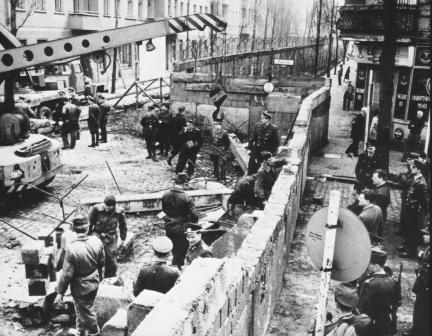
Construction of the Berlin Wall in August 1961 –photo from University of Utah, by Corey Hatch.
Update March 9, 2007: Berlin Airlift information and lesson plans are available from the Truman Library, here, here and here.
Update November 9, 2009: Notes on the 20th anniversary of the fall of the Wall


27 Comments | Cold War, Democracy, Economics, Famous quotes, Free market economics, Freedom - Political, Geography - Political, History | Tagged: Berlin Wall, Cold War, Democracy, Economics, Famous quotes, Free market economics, freedom, geography, History | Permalink
Posted by Ed Darrell


Ed Darrell on Texas's Colorado River


Come on in, the water's fine. Come often: Cleanliness is next to godliness.


 Millard Fillmore's Bathtub