How to fight malaria – Kenya’s example

August 17, 2007

Kenya has cut malaria by nearly half. Without further comment from me, here’s the news story from Gulf Times, Doha, Qatar, and below that, from a few other sources:

Kenya nearly halves child deaths from malaria

Published: Friday, 17 August, 2007, 01:27 AM Doha Time

NAIROBI: Kenya announced yesterday that it almost halved malaria deaths among small children by using insecticidal nets (INTs), spurring the World Health Organisation (WHO) to advocate free nets for all as it tackles Africa’s deadliest disease.

Health Minister Charity Ngilu said distribution of 13.4mn INTs over the past five years among children and pregnant women had helped curtail infections, a key success against a disease threatening 40% of the world’s population.

“Childhood deaths have been reduced by 44% in high-risk districts, in-patient malaria cases and deaths are falling (and) there are reduced cases at the community level,” she said in a statement.

“For every 1,000 treated nets used, seven children who might have died of malaria are saved.”

Malaria kills 34,000 children under the age of five each year in Kenya, and threatens the lives of more than 25mn of its population of 34mn people, the ministry said.

Children sleeping under INTs in malaria risk areas are 44% less likely to die than those who are not, according to a survey carried out in four districts representing the country’s epidemiological pattern.

The government has distributed 12mn doses of artemisinin-based therapy (ACT), the latest surefire anti-malaria drug cocktail to replace the mono-therapies that had developed resistance.

In addition, some 824,600 houses in 16 epidemic-prone districts underwent indoor spraying this year.
The government and donors spent 4.7bn shillings ($70.2mn) for the campaign, yet the funds were not enough.

Ngilu said the government would freely provide 2mn treated nets annually to ward off mosquitoes at night when they are active, calling on donors to boost the blanket distribution.

“The impact we have seen and the lessons we have learnt through massively distributing INTs, rather than selectively marketing and selling them, will not only benefit Kenya’s children but all Africa’s children,” she said.

In a statement, the WHO said it had abandoned its earlier guideline of targeting only vulnerable groups – under fives and pregnant women – in favour of “making their protection immediate while achieving full coverage”.

“Recent studies have shown that by expanding the use of these nets to all people in targeted areas, increased coverage and enhanced protection can be achieved while protecting all community members.”

WHO chief Margaret Chan said that Kenya’s success “serves as a model that should be replicated throughout ‘malarious’ countries in Africa.”

“This data from Kenya ends the debate about how to deliver the long-lasting nets. No longer should the safety or well-being of your family be based upon whether you are rich or poor,” said WHO’s Global Malaria Programme director Arata Kochi.

Chan and Kochi were deriding the “social marketing” model widely backed by donors of distributing INTs by selling them at subsidised rates, even to vulnerable groups, and raising awareness of their importance.

Although supporting anti-malaria campaigns, public health watchers have chided British and US foreign development agencies for pushing for social marketing in the world’s poorest continent.

The WHO launched a global programme in 1955 to eradicate the disease that has frustrated attempts to create a vaccine owing to its constant mutations.

Using dichloro-diphenyl-trichloroethane (DDT), a powerful insecticide, and the drug chroloquine, the organisation managed to eradicated the disease in the West by the 1960s.

But the programme never got off the ground in the humid and low-lying tropics in sub-Saharan Africa where the disease persisted.

By 1969, the programme collapsed as financing withered in the face of rising poverty, political upheavals and surging opposition to DDT for misuse, not by anti-malaria campaigners, but farmers.

But Kochi said the Stockholm Convention on Persistent Organic Pollutants allowed the use of DDT in endemic countries for “public health only” and Uganda and Malawi were the only African nations keen on the chemical.

Malaria affects more than 1bn people worldwide and kills 1mn – mainly under age five – every year, the vast majority in sub-Saharan Africa. – AFP (Agence France Press) Read the rest of this entry »


Jefferson, economics and history

August 15, 2007

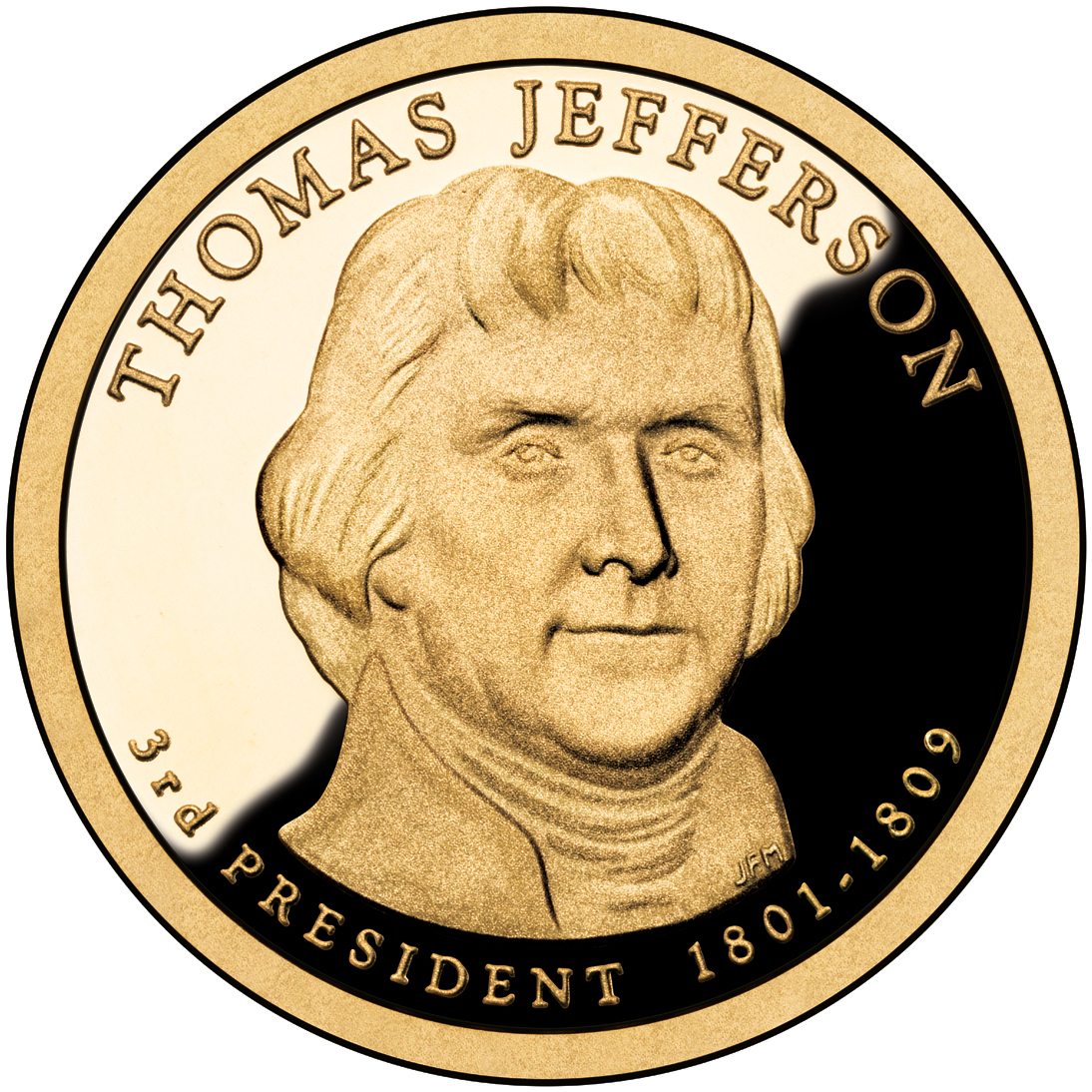
Jefferson dollars will be unveiled today in a ceremony at the Jefferson Memorial in Washington, D.C. They officially go into circulation tomorrow, August 16, 2007.

Jefferson dollar; U.S. Mint image via Associated Press

Jefferson dollars are the third in a series commemorating U.S. presidents. The series started with Washington and will proceed, three new coins a year, through all the presidents. (Quick: What’s the cheapest amount you can invest to get dollars representing all 43 administrations? Don’t forget Grover Cleveland’s anomaly . . .)

The Associated Press story notes three things of interest:

History: Fewer than a third of Americans know Jefferson was the third president. They did better with Washington as the first president. I had a few scary moments last year covering a Texas history course when kids kept answering either “George Washington” or “Abraham Lincoln” to the questions, “Who was the the Father of Texas?” (Stephen F. Austin) and “Who was the first president of the Republic of Texas?” (Sam Houston).

Economics: The vending machine industry loses about $1 billion each year when dollar bills jam in the machine’s vending mechanism. The U.S. Mint and vending machine operators hope the dollar coins catch on and help reduce those losses.

Dollar coins are unpopular: This is another in a series of efforts to “wean” people from paper dollars to coins — remember the Sacagawea dollar? The Eisenhower dollar? The Susan B. Anthony dollar? Just last week I got an Eisenhower dollar in change from our local Starbucks — they had mistakenly put it in the coin drawer for quarters. You can get dollar coins in change at the U.S. Post Office, but not at many other places. Our local post office occasionally sneaks a Euro into the dollar change mechanism. Bonus!

The Washington Post story carried more details of the poll, conducted by the Gallup organization for the U.S. Mint: Read the rest of this entry »


Leo Rosten on Adam Smith

July 29, 2007

Leo Rosten writes clearly, concisely, and often with great humor. Consequently, his essays make good fodder for classroom use.

British bank note featuring Adam Smith

Rosten is probably most famous for the introduction he once gave to the comedian W. C. Fields, a spur-of-the-moment bon mots that so exactly described Fields comedian persona that it is often listed as a line Fields himself wrote: “Any man who hates dogs and children can’t be all bad.”

That story also tells us that Rosten looks at Adam Smith coolly, through no rose-colored glass.

The Adam Smith Institute carries Rosten’s essay on Smith in its entirety. Go read it:

It is a clumsy, sprawling, elephantine book. The facts are suffocating, the digressions interminable, the pace as maddening as the title is uninviting: An Inquiry into the Nature and Causes of the Wealth of Nations. But it is one of the towering achievements of the human mind: a masterwork of observation and analysis, of ingenious correlations, inspired theorizings, and the most persistent and powerful cerebration. Delightful ironies break through its stodgy surface:

“The late resolution of the Quakers [to free] their Negro slaves may satisfy us that their number cannot be very great …”

“The chief enjoyment of riches consists in the parade of riches.”

“To found a great empire for the sole purpose of raising customers [is] unfit for a nation of shopkeepers, but extremely fit for a nation whose government is influenced by shopkeepers.”

So comprehensive is its range, so perceptive its probings, that it can dance, within one conceptual scheme, from the diamond mines of Golconda to the price of Chinese silver in Peru; from the fisheries of Holland to the plight of Irish prostitutes in London. It links a thousand apparently unrelated oddities into unexpected chains of consequence. And the brilliance of its intelligence “lights up the mosaic of detail,” says Schumpeter, “heating the facts until they glow.” Sometimes.

Adam Smith published The Wealth of Nations in 1776 – not as a textbook, but as a polemical cannon aimed at governments that were subsidizing and protecting their merchants, their farmers, their manufacturers, against “unfair” competition, at home or from imports. Smith set out to demolish the mercantilist theory from which those politics flowed. He challenged the powerful interests who were profiting from unfree markets, collusive prices, tariffs and subsidies, and obsolete ways of producing things.

[More at the site of the Adam Smith Institute, including the continuation of this essay.]

Leo Rosten, publicity shot

Leo Rosten


Pre-July 4 special: “English only” video insults U.S. flag

June 29, 2007

Okay. I’ve had five or six people send me links to a YouTube video of Ron and Kay Rivoli singing “Press One for English.” Ha. Ha.

It’s a rant about language accommodations. Some Americans, free marketeers for the most part, get all buggy when confronted with a free market in language choices. America is becoming more global, marketing more goods in more places, and getting visited by more people. This growth in commerce brings things like American Airlines’ Spanish language reservations center (Who would have thought? When they can make reservations in Spanish, Spanish speakers buy a lot more airplane tickets.)

And Ron and Kay Rivoli put these fears into a song. Funny.

Can we talk? Can I pick a bone? Ron and Kay Rivoli insult the U.S. flag. They may not mean to do it, they may have done it unthinkingly — but that’s the problem with the whole rant: It’s all unthinking.

Here are the flag insults:

  1. 44 seconds into the video three servicemen are shown saluting the U.S. flag, displayed with the flag of California and the POW-MIA flag. Contrary to the Flag Code and good flag etiquette, the U.S. flag is in the center, rather than to its own right. A center display would be acceptable if the center flag pole were higher than the others — but in this case the U.S. flag’s pole is lower than the other two. Two flag insults at once.
  2. At 2:59 into the video, the flag is shown as cut into an agricultural field of some kind. The Flag Code specifies that the flag is never to be displayed flat. The flag should fly free. Since this flag is cut into a crop on the ground, it cannot be displayed properly. Further, it is generally considered poor etiquette to make representations of the flag out of things other than cloth.

This is all highly ironic. At 1:37 into the video, a scroll of the famous Theodore Roosevelt quote on English as the only language scrolls by. “We have room for but one flag, the American flag,” Roosevelt said (oops — there goes the POW-MIA flag). “We have room but for one language, and that is the English language,” Roosevelt continues.

They use the flag they insult as a model for going for one language? This makes no sense.

Do I pick nits? No, I think that every educated American should know the flag code, and should avoid insult to the U.S. flag at least, if not honor it correctly. I am not pedantic about a lot of things, but this is one.

Ron and Kay Rivoli, you owe America and its flag apologies. Get straight with the flag, before you ask me to insult the traditional languages and free enterprise heritage of our nation. If you want my support, don’t tread on the American flag when you ask it.

The Rivolis owe apologies to the U.S. flag. Will we see it?


Blue Bell Ice Cream, a tastier part of Texas history

March 18, 2007

My first visit to Texas in the early 1980s, to visit friends in Houston and in-laws in Dallas, I met Blue Bell Ice Cream. It was love at first bite, of course.

Bluebell Creamery's ad, barn and blue sky

Blue Bell Creamery ad, barn and blue sky, and their memorable slogan

Ice cream plays an important role in my family. Family reunions, or just any celebration in summer, were excuses to pull out several hand-cranked ice cream makers, and freeze away. Homemade vanilla delights the palate, and family gourmands grind vanilla beans to add a little extra oomph. When grandfather Leo Stewart had peaches from his orchard, or later just peaches from our backyard tree in Pleasant Grove, Utah, fresh peaches went into the mix. Only someone who experienced my father’s peaches in my mother’s custard, frozen in a hand-cranked freezer, could fully appreciate Willie Stark‘s lines about peach ice cream in Robert Penn Warren’s book, All the King’s Men.

White Mountain 6-quart hand crank ice cream freezer

White Mountain 6-quart hand crank ice cream freezer, one of the better freezers

Homemade ice cream is a bother. Better freezers are not cheap, and they don’t travel well. My mother’s mini-freezer disappeared sometime in one of her later-life moves. My father’s much larger, two-gallon colossus simply wore out, with most of the ferrous metal parts rusting away, and even the wood of the barrel crumbling to dust. Proper salt to get the solution colder than freezing is sporadically available in city supermarkets. My mother’s recipe for the custard, unwritten as all her better recipes, died with her.

Bluebell Peaches and Homemade Vanilla

Bluebell Peaches and Homemade Vanilla

Utah is a haven for ice cream makers. Snelgrove’s on 33rd South in Salt Lake City is tradition in many families (Snelgrove is now owned by Dreyer’s, but still operates as Snelgrove in Utah) (Update, July 2008: Snelgrove’s is dead). My wife’s family is partial to Farr’s in Ogden, “Farr better ice cream” — and it is very, very good. Trips to visit family include stops at Farr’s.

Blue Bell Homemade Vanilla tastes like my mother’s custard frozen in a hand-cranked freezer. It is consistently the best-tasting ice cream, for a very reasonable price.

Blue Bell celebrates its 100th anniversary as a company in 2007, the “little creamery” in Brenham, Texas, where Blue Bell is made.

Even better, the company wants you to suggest new flavors, and is holding a contest to get good, local flavors. Winners of the Taste of the Country Flavor Contest get a trip to Brenham for the 100th anniversary celebration.

Plus, winners get a year’s supply of Blue Bell ice cream.

Blue Bell is a nice local company making good. Though the production is limited (and I believe it is still true that all the ice cream is made in Brenham), so it is available only in 17 states concentrated in the southeast, the brand is the third best-selling brand in the U.S.

If you’re near Houston, you would be well advised to make a side trip to Brenham to tour the Blue Bell ice cream factory (plus, the bluebonnets will be in bloom shortly).

North America is a big continent, with international brands that work for international consistency of products, so that the company’s customers get the same experience regardless where the customers are — think McDonalds, Burger King, and Coca-Cola. Large conglomerates often own even nominally regional brands. As I noted earlier, Snelgrove’s in Salt Lake City is now run by a national ice cream giant — even Ben & Jerry’s brand is now owned, produced and marketed by a national marketing giant. Blue Bell is a standout, an almost-local brand, with limited distribution. Part of the joy of a well-working free enterprise system is finding a well-run local company, with a unique product.

Blue Bell could make a fortune bottling their success formula, too, in addition to their ice cream.

Bluebell logo

Glen Dromgoole at the Abilene Reporter-News reviewed the book about Blue Bell’s history in his column February 18, 2007, “Blue Bell Ice Cream, a Texas Staple, Turns 100.”


After the end, Hoover showed the way for Bush

December 28, 2006

Herbert Hoover, White House Portrait

Herbert Hoover, White House Portrait

Herbert Hoover is one of the great foils for U.S. history courses. The Great Depression is on national standards and state standards. Images from the dramatic poverty that resulted win the rapt attention of even the most calloused, talkative high school juniors. Most video treatments leave students wondering why President Hoover wasn’t tried for crimes against humanity instead of just turned out of office.

In most courses, Hoover is left there, and the study of Franklin Roosevelt‘s event-filled twelve years in office (with four elected terms) takes over the classroom. If Hoover is mentioned again at all in the course, it would likely be for his leading humanitarian work after World War II.

But there is, hiding out in California, the Hoover Institution. Hoover’s impact today? Well, consider some recent fellows of the Hoover Institution: Condaleeza Rice, Milton Friedman, George Shultz, E. D. Hirsch, Jr., Gary Becker, Diane Ravitch, Chester Finn. The Hoover Institution, “at Stanford University,” is the conservatives’ anchor in the intellectual and academic world.

Hoover’s legacy is being remade, constantly, through his post-Presidential establishment of an institution to promote principles of conservatism (and liberalism in its old, almost archaic education sense). The Hoover Institution has carried Hoover’s ideas and principles back into power.

Dallas has been wracked recently with the shenanigans and maneuvers around the work of Southern Methodist University to be named as the host for the George W. Bush Presidential Library. In a humorous headline last week the Dallas Morning News (DMN) said such a library could lead Dallas’s intellectual life in the future (the headline is different in the on-line version — whew!).

Humor aside, there is grist for good thought there. Read the rest of this entry »


Texas Republicans urging Marxism be taught?

October 19, 2006

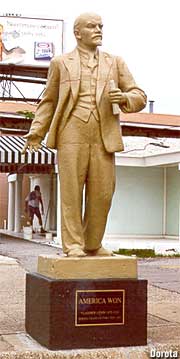
Lenin at Goff's Hamburgers, Dallas (2003)

Lenin does Dallas

No rational person would believe Texas Republicans would call for Marxist economics to be taught in Texas high schools, not even as a part of a “teach the controversy” movement.

The one-semester economics class does not lend itself to giving students backgrounds in economic models that compete with the consensus, free-market view, and even if it did, Marxism would be way down the list of what most Texans would think appropriate to teach. For illustration, consider that when the Soviet Union broke up, a Soviet-produced statute of Lenin was purchased by a Dallas hamburger magnate, placed outside one of his outlets with a plaque commemorating the Cold War, and noting: “America won.” (Alas, Goff’s is gone, as is the statue.)

So, either the Texas Republicans have gone non-rational, or they just were not thinking when they put in their party platform a requirement that alternative theories and their controversies be taught, in social studies.

Confused yet? Tony Whitson at Tony’s Curricublog explains:

But why is this provision regarding social studies tucked into the platform point on “Theories of Origins”? Apparently it reflects an agenda that includes teaching from a creationist standpoint not only in science, but in social studies and other subjects as well.

Someone who’s familiar with curriculum conflicts over recent years will recognize the entire education section of the platform as coming chapter and verse from Phyllis Schlafly’s Eagle Forum. The agenda they are pushing here is not something home-grown in Texas, but an agenda that we can expect to see being advanced all over the United States.

Well, Texas politics being what it is, the likelihood that a plank from any party’s platform could make it into law is a bit remote right now. And it seems clear that the intent was to go after science and evolution, not economics. Udall’s Law of Unintended Consequences says such efforts will produce unexpected and undesired results, and here we have a good case in point.

People are gearing up for fights on history and biology texts in Texas — economics, too? Ouch.


Berlin Wall’s 45th

August 13, 2006

August 13, 2006, is the 45th “anniversary” of the erection of the Berlin Wall, the totem of the Cold War that came down in 1989, pushing the end of the Cold War. Residents of Berlin awoke on this day in 1961 to find the communist government of East Germany erecting what would become a 96-mile wall around the “western quarters” of the city — not so much to lay siege to the westerners (that had been tried in 1948, frustrated by the Berlin Airlift) as to keep easterners from “defecting” to the West. The Brandenburg Gate was closed on August 14, and all crossing points were closed on August 26.

From 1961 through 1991 1989, teachers could use the Berlin wall as a simple and clear symbol for the differences between the communist Eastern Bloc, the Soviet Union and her satellite states, and the free West, which included most of the land mass of Germany, England, France, Italy, the United States and other free-market nations — the North Atlantic Treaty Organization (NATO) countries. I suspect most high school kids today know very little about the Wall, why it was there, and what its destruction meant, politically.

This era of history is generally neglected in high school. Many courses fail to go past World War II; in many courses the Cold War is in the curriculum sequenced after the ACT, SAT and state graduation examinations, so students and teachers have tuned out.

But the Wall certain had a sense of drama to it that should make for good lessons. When I visited the wall, in early 1988, late at night, there were eight fresh wreaths honoring eight people who had died trying to cross the Wall in the previous few weeks (in some places it was really a series of walls with space in between to make it easier for the East German guards to shoot people trying to escape) — it’s an image I never forget. Within a year after that, East Germans could travel through Hungary to visit the West, and many “forgot” to return. Within 18 months the wall itself was breached.

The Wall was a great backdrop for speeches, too — President John F. Kennedy visited Berlin in June 1963, and expressed his solidarity with the walled-in people of both West and East Berlin, with the memorable phrase, “Ich bin ein Berliner, which produced astounding cheers from the tens of thousands who came to hear him. There are a few German-to-English translators who argue that some of the reaction was due to the fact that “Berliner” is also an idiomatic phrase in Berlin for a bakery confection like a jelly doughnut — so Kennedy’s words were a double entendre that could mean either “I am a citizen of Berlin,” or “I am a jelly doughnut.”  [Be sure to see the comments below, from Vince Treacy (9/28/2010).]  Ronald Reagan went to the same place Kennedy spoke to the Berlin Wall, too, to the Brandenburg Gate, in his famous June 1987 speech which included a plea to the Soviet Union’s Premier Mikhail Gorbachev: “Mr. Gorbachev, tear down this wall!”

Construction of the Berlin Wall, photol collected by Corey S. Hatch

Construction of the Berlin Wall in August 1961 –photo from University of Utah, by Corey Hatch.

Update March 9, 2007: Berlin Airlift information and lesson plans are available from the Truman Library, here, here and here.

Update November 9, 2009: Notes on the 20th anniversary of the fall of the Wall

Please share this post:

Add to FacebookAdd to NewsvineAdd to DiggAdd to Del.icio.usAdd to StumbleuponAdd to RedditAdd to BlinklistAdd to TwitterAdd to TechnoratiAdd to Furl


Einstein, compound interest: Does not compute

July 22, 2006

Earlier, in the thread about bad quotes, bad scholarship and Ann Coulter, a person asked about another quote that has dogged speech writers and investment seminars for years:

I am trying to discern the author of the quote “compound interest is the greatest invention of the 20th century.” Since you mention neither Twain nor Einstein remarked this, do you know who did?? I would be very grateful.

Comment by fact checker 07.11.06 [emphasis added]

Twain’s words are well enough cataloged that, had he said it, one would be able to track it down. Think for a few minutes about Twain’s finance issues, however, and you realize it is highly unlikely that he would have said it. Twain invested heavily in a machine to mechanically set type, to publish the memoirs of former-President Ulysses Grant; the machine did not work, and Twain lost his fortune. He undertook a grueling lecture tour to make money back. Later financial setbacks forced another long lecture tour. It is not probable that Mark Twain (Samuel Clemens) would ever have said anything about simple compound interest. It was not his style to invest passively, or for long-term returns.

The line about compound interest being the “best invention” of mathematics, or of the 20th century, or whatever, is more often attributed to Albert Einstein. Google “compound interest” and “Einstein” and you get tens of thousands of hits.

It’s a good line, a snappy introduction to the Rule of 72 for a presentation to potential investment clients or for the introduction to the rule in a high school classroom. I have a short PowerPoint presentation on the Rule of 72 for economics classes, and I would have used the quote — had it checked out. My experience as a journalist and speechwriter urged caution.

I wrote to the Albert Einstein Institute, to the American Institute of Physics, and to other places where people might know obscure sources of Einstein’s sayings and writings, to try to verify the quote. It surely did not turn up in Bartlett’s Familiar Quotations, nor in the Oxford Dictionary of Quotations. Those specialists in Einstein data and history could not verify the quote (which is the careful way of phrasing it). One fellow I spoke with said if he had a nickel for every time he was asked to verify the compound interest quote, he would have no need for compound interest.

I can say with confidence that Albert Einstein never wrote or said anything about compound interest. While Einstein wrote about a wide variety of topics, compound interest is not among them.

Fatherflot at Daily Kos wrote about this quote in early 2005, after several advocates of privatizing Social Security had used the quote in one version or another to introduce their own remarks. A lot more people read that blog, but no one there could verify it, either. There are several variants on the quote illustrated there. I think that an alleged quote’s lack of veracity is often demonstrated by mutations. For real quotes from real people, generally someone knows the original work and starts writing about what it’s supposed to be — at many cocktail parties a line about “consistency being the hobgoblin of small minds” will be corrected (Emerson said it is “a foolish consistency,” and it is “little minds”), for one example.

Einstein didn't say what this poster claims he said, either.

Einstein didn’t say what this poster claims he said, either.

As I told fact checker, I think the line was invented 40 or 50 years ago. From my checking, I would bet it was a copywriter or speechwriter working for some investment house. We may hope to someday track down the origin of the quote, and if the originator is still alive, ask her or him why the line was attributed to Einstein.

Fillmore’s bathtub runneth over with bad quotes, hoaxes gone amok, and other errors. We just try to flush a few down the drain.