And, why do people so very, very much, want that story to be true and not fictional?
Here’s the list of stories from this blog that were most popular over the past seven days; the top two stories hold about those ranks week in and week out:
Other fronts in the War on Education may have earned more attention here in the Bathtub, lately — and in state legislatures. Threats from the dilution and elimination of good, hard science courses continue to pose problems, especially from creationists and their shyer, camouflage troops from the Chapel of Intelligent Design.
We need to stay aware of the creationist/creationism threat. At its heart, creationism requires adherents to reject the facts of science, to reject the workings of science, and to reject the functions of debate about what is real, and what is not. It is to me a rather simple discussion of the quality of evidence.
Eugenie Scott and her colleagues from the National Center for Science Education provide a great update in what is going on, with a great video, and an informative and troubling explanation of the links between creationism and the “unbelievers” in climate change.
Be sure to watch the first ten minutes, to see the video update on the fight to keep good science education in schools, especially the teaching of evolution.
Spread the word; friends don't allow friends to repeat history.
One of our very good art teachers at Moises Molina High School, William Adkins, works with a group called Big Thoughts. Big Thoughts interviews teachers who work with the program about how arts education boosts student achievement in core areas, and how to leverage arts to improve the boost. Adkins had some thoughts about how art really is a core part of education , and on the role of administrators in helping teachers:
Adkins’ students regularly win awards, often outperforming the many more students at our district’s arts magnets. One of his students, Moses Ochieng, too the top prize at the state art meet this year for a brilliant sculpture he did. Moses was my student in U.S. history, too — a great adventure, since he emigrated from Kenya just a few years ago, and he lacks the familiarity with so many American things that we, and the textbooks, and the state tests, take for granted that students know. Ochieng’s art helped focus him on history. It supplemented his studies so that he picked up two years of history work in just one year.
Bob Schieffer plugs education and worries about last week’s NAEP report on what students know about history:
Schieffer is right: Teachers deserve better pay, and that’s probably the quickest and best solution to get our kids up to snuff on history.
And history is our first line of defense. Minutemen at Lexington and Concord knew why they were fighting, and fought to victory as a result. Don’t our kids deserve as good an education today?
[I’m posting this on Wednesday — the YouTube version had only 54 views when I did. Spread the word, will you?]
Spread the word; friends don't allow friends to repeat history.
Five days on the road and we hoped to make it home Friday night.
"I've got the Presidential Seal / I'm up on the Presidential Podium. / My Mama loves me, she loves me . . ."* Playing around with the podium and teleprompter at the George H. W. Bush Presidential Library and Museum in College Station, Texas.
Air conditioning on the bus failed, and then the vacuum system failed and we lost the ability to close the door, and we started to lose brakes. Fortunately, we were within sight of Dallas when things really came to smash.
So our Teachers Tour of Presidential Libraries came to an interesting end last night. More good fortune — the bus stalled out in the parking lot of a gas station with a Dickey’s Barbecue attached. Ross Perot is right, at least about this: Dickey’s food is worth the stop.
Other stops along the way provided nutrition for our minds, and for our classroom preparation. Education experts at the 13 National Archives-related Presidential Libraries work together, and work separately, to create classroom friendly and classroom ready materials. Beyond the museums, we were looking for history to use in our classes. We got a lot of pointers to documents our students can use in class to learn history and how to write it.
This is the second year of this particular Teaching American History grant, from the U.S. Department of Education to the Dallas Independent School District. It’s important that you know that, because Republicans in Congress propose to cut this program out. This is one of the few programs I think has value way beyond the dollars spent on it. TAH may become just one more victim of the conservatives’ War on Education.
It was a rowdy group of teachers, of course, and we closed down every bookstore we found along the way. The bus driver hopes never again to hear a single verse of “99 Student Essays to Grade on the Desk.”
So, why don’t the Republicans do what the people of Wisconsin want, instead? Why are Wisconsin Republicans acting as a special elite, ignoring voters’ wishes?
A Rasmussen poll out today reveals that almost 60% of likely Wisconsin voters now disapprove of their aggressive governor’s performance, with 48% strongly disapproving.
While these numbers are clearly indicators of a strategy gone horribly wrong, there are some additional findings in the poll that I suspect deserve even greater attention.
It turns out that the state’s public school teachers are very popular with their fellow Badgers. With 77% of those polled holding a high opinion of their educators, it is not particularly surprising that only 32% among households with children in the public school system approve of the governor’s performance. Sixty-seven percent (67%) disapprove, including 54% who strongly disapprove.
Can anyone imagine a politician succeeding with numbers like this among people who have kids?
These numbers should be of great concern not only to Governor Walker but to governors everywhere who were planning to follow down the path of war with state employee unions. You can’t take on the state worker unions without taking on the teachers – and the teachers are more popular than Gov. Walker and his cohorts appear to realize.
Tip of the old scrub brush to Wisconsinite Jean Detjen.
Spread the word; friends don't allow friends to repeat history.
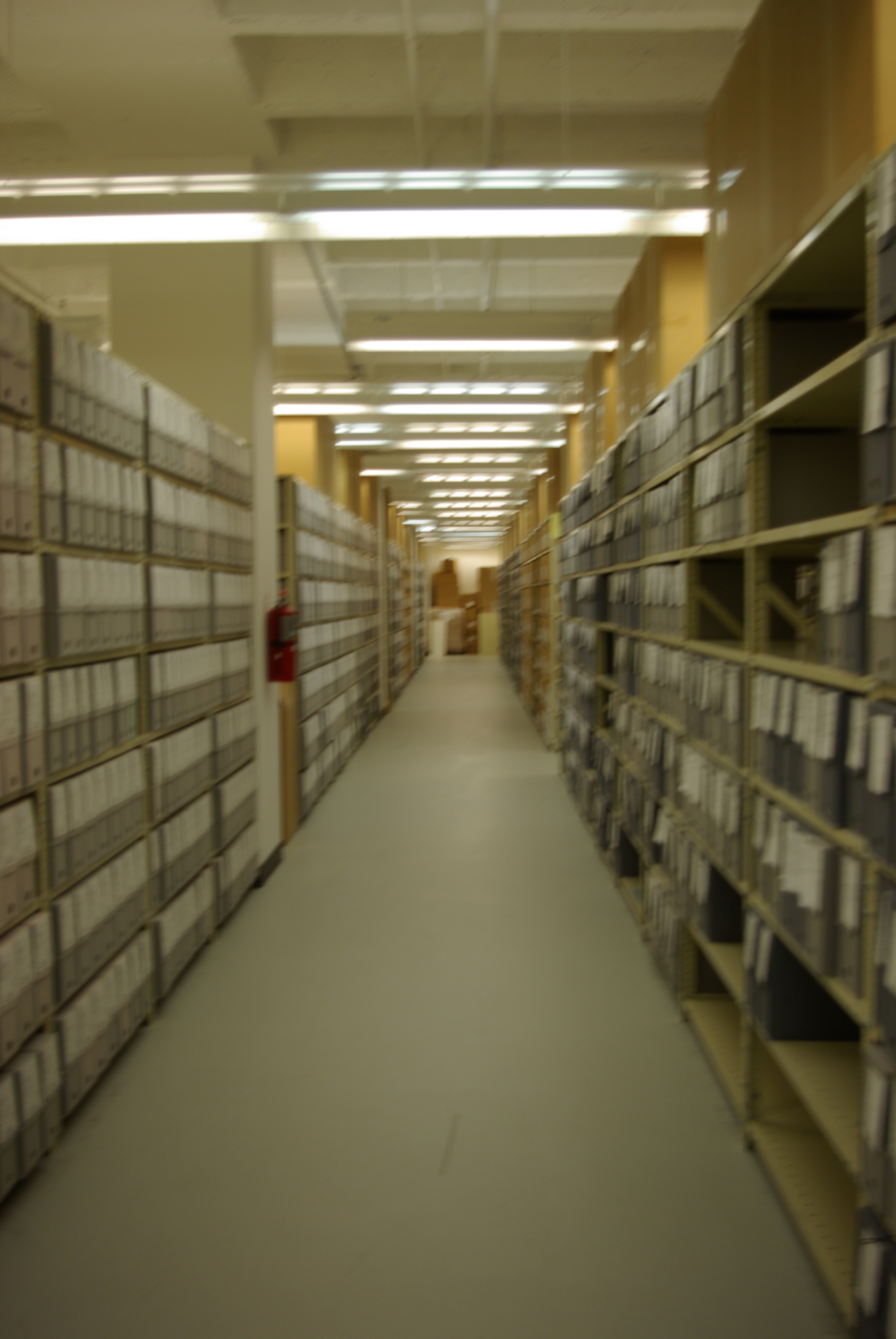
It’s not really that big — but what do you think of when you see this photo of the unindexed files at the George H. W. Bush Library and Museum (at Texas A&M at College Station, Texas)?
Hello? Which row has the Arks of the Convenants?
Yeah, we all thought the same.
The big difference: In College Station, archivists are working through these documents, indexing them for use.
They use Freedom of Information Act requests to set their agenda, which strikes me as bass ackwards, but they’re working on getting it done.
Spread the word; friends don't allow friends to repeat history.
With a group of history teachers from Dallas Independent School District, I’m off on a trip that will take us to three Presidential Libraries in the system operated by the National Archives. This study is underwritten in part by a grant from the Teaching American History program at the U.S. Department of Education, one of those good programs that is on the chopping block.
Yesterday we toured and talked at the George H. W. Bush Presidential Library and Museum in College Station, Texas. Today it’s the LBJ in Austin.
I hope your summer is as productive.
Spread the word; friends don't allow friends to repeat history.
From my earlier post on the Texas Tribune interview with Michael Marder, in which he questioned the assumptions that monkeying with teacher discipline, accountability, pay, training, vacations, or anything else, can produce better results in educating students, especially students from impoverished backgrounds.
Marder is the director of the University of Texas’s program to encourage much better prepared teachers, UTeach.
Michael Marder’s numbers show that it’s not the teachers’ fault that so many students are not ready for college, and not learning the stuff we think they should know.
Texas Tribune said:
In the popular 2010 documentary Waiting for Superman, former DC schools chancellor Michelle Rhee said, “But even in the toughest of neighborhoods and circumstances, children excel when the right adults are doing the right things for them.”
After looking at the data, Marder has yet to be convinced that any teaching solution has been found that can overcome the detrimental effects of poverty on a large scale — and that we may be looking for solutions in the wrong place.
[Reeve] Hamilton’s interview of Marder takes up three YouTube segments — you should watch all three.
For the record, Michelle Rhee is probably right: In the toughest neighborhoods, children excel when the right adults do the right things for them. But the right adults usually are parents, and the right things include reading to the children from about 12 months on, and pushing them to love learning and love books. Teachers get the kids too late, generally, to bend those no-longer-twigs back to a proper inclination. The government interventions required to boost school performance must come outside the classroom. Michelle Rhee’s great failure — still — is in her tendency not to recognize that classroom performance of a student has its foundations and live roots in the homes and neighborhoods who send the children to school every day.
Spread the word; friends don't allow friends to repeat history.
Anathema to many partisans of the immigration debates: What if we look at the real value of immigration? The U.S. needs more to encourage immigration than to discourage it. God, and devil, in the details.
From the Dallas Federal Reserve Bank:
In advance of an immigration policy conference, Dallas Fed Senior Economist Pia Orrenius discusses how immigration policy can help the U.S. economy and how the global competition for high-skilled immigrants is increasing. The Dallas Fed and the John Goodwin Tower Center for Political Studies at Southern Methodist University are co-sponsoring “Immigration Policy in an Era of Globalization” at the Dallas Fed on May 19-20, 2011.
This piece had only 329 views when I posted it. Shouldn’t carefully studied views of immigration get more circulation on the inter’tubes?
Do you recall seeing any coverage of the May 19-20 conference in your local news outlets, or anywhere else? The conference included high-faluting experts who discussed immigration policies for the U.S., Canada, the EU, Europe, Britain, Australia, Japan, South Korea, Italy, Switzerland, the Netherlands, Spain and Germany. One might think to find some value in the information there.
Can we get the immigration we need, legally? Do present proposals in Congress offer to boost our economy, or hurt it?
Dallas Independent School District’s (DISD) Superintendent Michael Hinojosa resigned about an hour ago to accept the job in Cobb County, Georgia. The board meets tonight, perhapsto appoint an interim superintendent.
Here’s the message sent out through the Dallas systems today, to teachers and administrators:
SUPERINTENDENT MICHAEL HINOJOSA RESIGNS FROM DALLAS ISD
Accepts Superintendent Position in Cobb County, Georgia
Superintendent of Schools Michael Hinojosa submitted his letter of resignation from the Dallas Independent School District today to accept a similar position in Cobb County, Georgia.
Dr. Hinojosa has served as the superintendent for the stateâs second-largest school district for six yearsâthe longest term since Linus Wright held the position in the 1980s. His last day with Dallas ISD will be Thursday, June 30, 2011.
“It has been an honor to serve as superintendent for the school district I attended as a child and where I started my teaching career,” said Hinojosa. “I am enormously proud of our shared accomplishmentsâthe biggest of which is that the number of students graduating from Dallas ISD schools is at its highest since 1983.”
This school year, Dallas ISD expects to graduate a total of 7,200 students, up from 5,800 four years ago. The number has steadily risen each of the last four years.
Under Dr. Hinojosaâs leadership, the school district implemented a systemwide curriculum that was developed by teachers. In addition, principals for schools that had vacancies during the last six years were selected through a collaborative process that allowed staff and the community to provide input.
A $1.37 billion bond program to build and improve school facilities that was approved by voters in 2002was implemented on schedule and under budget. Another $1.35 billion bond program that was approved by voters in 2008 will build 14 more schools, 13 additions, and provide renovations to more than 200 district facilities.
Dallas ISD also became known throughout the country for its leadership in arts education. The Wallace Foundation provided an $8 million grant for the district to partner with Big Thought and the City of Dallas to provide more arts opportunities for students both during and after school.
Under Dr. Hinojosa’s leadership, schools in the southern sector received a significant boost. Two early college high schools are now operating, an all-boys school will open this fall as will a New Tech High School, and three renovated/new schools will open in Wilmer-Hutchins signaling a rebirth of public education in that community.
Grants from the Michael and Susan Dell Foundation and Bill and Melinda Gates Foundation enabled the Dallas Independent School District to become a pioneer in the world of student data. The grants gave principals and teachers access to data dashboards, as well as established a Parent Portal for parents to monitor the progress of their students.
During his six-year tenure, Dr. Hinojosa responded to several crises, including the dissolution of neighboring Wilmer-Hutchins ISD and hurricanes Katrina and Rita, all of which caused an unexpected influx of additional students into Dallas ISD. The biggest crisis was a budget miscalculation that eventually forced the layoff of hundreds of staff during the 2008-09 school year.
Since then, the district has put in place a number of financial controls and rebuilt its fund balance to safer levels. The district now faces a significant cut in state funding because of a statewide budget shortfall.
“It certainly isn’t easy to be an urban school superintendent in todayâs environment, but I am proud of what this community has accomplished during the last six years,” said Hinojosa. “More students are graduating, more students are scoring at college-ready levels and our teachers and principals are better-trained. I hope whoever the board chooses as its next superintendent is provided the same opportunities to make improvements to continue the momentum on behalf of the students of this community. I am thankful to trustees, our staff and so many other leaders and stakeholders in Dallas who have been part of this experience.”
One of Dr. Hinojosaâs hallmarks was to make unannounced visits to the district’s 225 schools each Wednesday morning. He said the experiences kept him grounded on what was most important in the life of a large, urban school district.
“Every school has individuals who are devoted to helping our students succeed,” said Hinojosa. “I couldn’t help but be moved by the dedication of so many people, from custodians to food service workers, librarians to counselors, aides to front office staff and of course, principals and teachers. The Dallas Independent School District will continue to shine because of each of them. My address may soon be in Georgia, but a part of me will always be in Dallas. It has been a privilege.”
Dr. Hinojosa said he is moving to Georgia in part to be closer to his son whose wife is pregnant with their first child. He has two sons who have recently graduated from Hillcrest High School in Dallas who will be attending Ivy League colleges in the fall.
In Fort Worth, the board is expected to approve a separation agreement for Superintendent Melody Johnson, who is resigning to move to California to be closer to her aged mother. Most people expect a tough fight to find a capable person to head either district.
Spread the word; friends don't allow friends to repeat history.
Yeah, this video was first created for the April 2 teacher demonstrations in Austin; but the Texas Lege got filibustered at the last minute. Now the Lege is in special, emergency session.
They still plan to begin the dismantling of Texas public education. After the Brown vs. Board of Education decision, Texas did not follow the errors of Mississippi, Arkansas and Virginia, shutting down some or all of the state’s schools rather than education students of color. As a result, Texas students leapt ahead of their counterparts in those states.
But today, in 2011, the Texas Lege plans two years of budget cuts that will kill Texas education reform efforts and backtrack on 20 years of progress.
It may be like Canute speaking to the sea, the Texas Lege is that stone deaf (water deaf?) — but if Texas teachers don’t stand up for education and Texas kids, who is left to do it? Niemöller is dead. Who is left?
Spread the word; friends don't allow friends to repeat history.
Franklin Roosevelt voting in Hyde Park, New York, November 2, 1937 - FDR LIbrary image
In the Dallas district, and across much of Texas, field trips are being cut out. Budget restraints, you know. Rick Perry’s math is atrocious, and the “surplus” he claimed we had in the budget turned out to be a $27 billion deficit.
For information call:
Clifford Laube at (845) 486-7745
YOUR BUS COULD BE ON US!
New funding available for field trips to historic Hyde Park destinations
HYDE PARK – Field trips are back! The National Park Service and FDR Presidential Library and Museum are pleased to offer new transportation grants for 2011 field trips to five renowned Hyde Park destinations – FDR Presidential Library and Museum, Home of FDR National Historic Site, Eleanor Roosevelt National Historic Site, Top Cottage and Vanderbilt Mansion National Historic Site.
The new grants are managed by Teaching the Hudson Valley (THV), a nonprofit that helps educators and students discover and appreciate the natural, historical and cultural treasures of the Hudson Valley. A list of available programs and grant application form are available in the Grants section of THV’s website.
“These sites are brimming with world-class learning opportunities for local students,” said Sarah Olson, superintendant of the Roosevelt-Vanderbilt National Historic Sites. “We recognize that many school districts have cut back or eliminated field trips due to budget constraints. These grants are designed to put great field trips back in reach.”
Educators are free to create their own curriculum, and the sites have a wide variety of prepared curricula, including:
Pretend You are the President, grades 4-6
Eleanor Roosevelt: First Lady of the World, grades 4-6
FDR’s Boyhood Farm, grades 1-3
Searching for Salamanders, grades 7-12
Podcasts interpreting the many trails that traverse the 5 sites
“To walk in the footsteps of history, to touch and hear nature – these are the experiences that make learning vivid and memorable,” said Lynn Bassanese, director of the FDR Presidential Library & Museum. “Field trips are becoming an endangered species, but the need for them is still great. Together these sites have provided decades of great experiences for educators and students. These new grants will help us continue the tradition.”
K-12 educators in public and private schools may apply for regular, summer or after-school programs. Trips should be related to core curriculum or programs and take place by December 31, 2011. Teachers in the same school or district may apply together.
ABOUT THV
Launched in 2003, Teaching the Hudson Valley (THV) helps educators and students discover and appreciate the natural, historical, and cultural treasures of the Hudson Valley. THV programs foster collaboration between schools and informal learning sites. Our growing collection of free K-12 lessons uses significant Valley sites to teach all subjects. For details, visit http://www.TeachingtheHudsonValley.org.
THV is a program of the Hudson River Valley National Heritage Area and HRV Greenway Conservancy, Inc.; National Park Service – Roosevelt-Vanderbilt National Historic Sites; Hudson River Estuary Program/NY State Dept. of Environmental Conservation; and Hudson River Valley Institute at Marist College.
# # #
Alas, it turns out it’s not intended for Texas classrooms. Drat.
I’ve taken large groups of 14-16 year-olds through those sites. An halfway interested teenager can get eyes opened seeing how FDR grew up, in the place he grew up. The library and museum offer spectacular displays on FDR’s presidency and the times. It’s exactly the sort of experience a lot of my students have never had, but need.
I’ll have to see what we can do with museums and libraries a little bit closer — the George H. W. Bush Library in College Station, Texas, the Lyndon Johnson Library in Austin, and the Bill Clinton Library in Little Rock. Possibilities of touring close-by sites make me quiet about the odd situation at the George W. Bush Library and Center for Right-Wing Propaganda planned for Southern Methodist University. There’s a great chance that the advantages of having the educational resources will outweigh the ignominy of the propaganda activities (though the Hoover Institute makes one appropriately wary).
Generally, Texas school districts need to lock down their school year budgets by about the end of April.
Of course, that’s not possible this year. As of this morning, it looked as though the Texas Lege could not agree on school funding, and they will have to return for a special session to set education budgets in June or July.
Can you imagine being the budget officer for a Texas school district?
But, sorta good news in Dallas: Budget officers, making their best guesses on what will happen, created Budget 5.0 (the fifth iteration of this process — one is usually all a district gets, or needs).
Here’s the message from Downtown on the school’s internal communication system:
Budget Plan 5.0 presented to trustees
Budget Plan 5.0 was presented to trustees today during a budget workshop. The administration is optimistic that this particular scenario, which envisions a $90 million cut in state funding to the district, will be closest to the final budget presented to the board for approval in June.
Here are some of the highlights of Budget Plan 5.0:
No additional layoffs at the campus level will be necessary.
There will not be an additional loss in the number of teaching positions. The early resignation incentive offered earlier in the spring cut enough from the payroll to make any additional loss of positions unnecessary. It must be noted, however, that some reassignments will need to occur to level campuses depending upon staffing needs.
Full day pre-kindergarten for eligible Title I students, which has been a priority of the Board of Trustees, will be funded.
Certain teacher stipends will be eliminated.
Secondary schools will be staffed at a 27-1 class-size ratio, an increase over the current level of 25-1. While this is not ideal, it is preferable to earlier budget versions that included a 35-1 ratio.
Texas lawmakers remain gridlocked on the funding mechanism for schools yet have indicated an agreement in principle on the amount that will be available. The latest funding scenarios from the state give the district confidence to move forward with Budget Plan 5.0, with the possibility of some modifications, prior to its approval by the Board of Trustees in June.
Spread the word; friends don't allow friends to repeat history.
Or, until that account is unsuspended by the forces supporting Donald Trump: Follow @FillmoreWhite, the account of the Millard Fillmore White House Library
We've been soaking in the Bathtub for several months, long enough that some of the links we've used have gone to the Great Internet in the Sky.
If you find a dead link, please leave a comment to that post, and tell us what link has expired.
Thanks!
Retired teacher of law, economics, history, AP government, psychology and science. Former speechwriter, press guy and legislative aide in U.S. Senate. Former Department of Education. Former airline real estate, telecom towers, Big 6 (that old!) consultant. Lab and field research in air pollution control.
My blog, Millard Fillmore's Bathtub, is a continuing experiment to test how to use blogs to improve and speed up learning processes for students, perhaps by making some of the courses actually interesting. It is a blog for teachers, to see if we can use blogs. It is for people interested in social studies and social studies education, to see if we can learn to get it right. It's a blog for science fans, to promote good science and good science policy. It's a blog for people interested in good government and how to achieve it.
BS in Mass Communication, University of Utah
Graduate study in Rhetoric and Speech Communication, University of Arizona
JD from the National Law Center, George Washington University


 Posted by Ed Darrell






 Millard Fillmore's Bathtub