Students frozen out of schools, education, maybe hope

February 9, 2011

Does the headline pertain to Dallas ISD’s being closed for cold weather for the fifth day in eight, or does it refer to the situations in Austin, where Gov. Rick Perry insists Texas is better off than the rest of the nation with a $25 billion deficit it can’t close, and all education institutions being given solitary confinement or death penalties?

Gov. Rick Perry, Texas State of the State Address, February 8, 2011

Photo by Ralph Barrera/Austin American-Statesman; Dallas Morning News caption: "Texas Gov. Rick Perry, with Lt. Gov. David Dewhurst after delivering the State of the State address Tuesday, said there are 'no sacred cows' in the strapped Texas budget." Reality caption: Texas Emperor Rick Perry gives thumbs up to the lions who will face education's representative, Hypatia, in the Lege Arena fight-to-the-death; Perry promised not to be present for the final moments of the fight.


Can’t fire the bums to make a quality school: Principals division

February 8, 2011

Be sure to see the story in the New York Times today. Obama administration “Race to the Top” money went to states who proposed to replace principals in failing schools. A problem in the strategy threatens the program:  Not enough qualified people exist to replace all the “bad” ones.

Wrong-headed education “reformers” keep talking about “firing the bad ones,” teachers, administrators, or janitors.  Without significantly raising the pay for teachers, without greatly increasing the number of teachers and administrators in the pipeline from teaching colleges or any other source, reformers can’t attract anyone better qualified than the people they wish to replace.
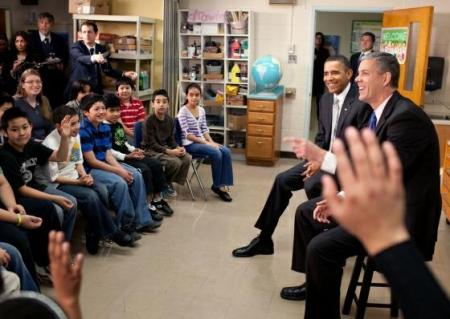
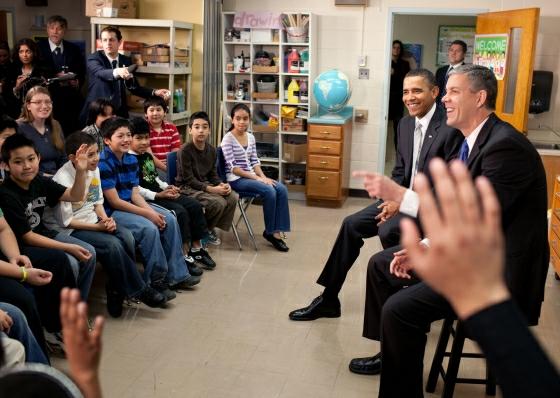
Pres. Obama and Sec. Duncan and the 6th grade at Graham Road Elementary, Falls Church, Virginia

President Barack Obama and Education Secretary Arne Duncan took questions from a 6th grade class at Graham Road Elementary School in Falls Church, Virginia, January 18, 2010 – photo credit unknown

Maybe, just maybe, it’s time these reformers took a step back and did some study, perhaps from the quality gurus, Deming and Juran and Crosby, or from the heights of championship performance, in basketball, football, soccer, sailing (try the America Cup), horse racing or politics:  No one can use firing as a chief tool to turn an organization around, nor to lead any organization to a championship.  Threatening people’s jobs does not motivate them, nor make the jobs attractive to others.

How can we tell the fire-the-teachers-and-principals group is on the wrong track?  See the article:

“To think that the same leader with a bit more money is going to accomplish tremendous change is misguided,” said Tim Cawley, a managing director at the Academy for Urban School Leadership, a nonprofit group that began leading turnaround efforts in Chicago when Mr. Duncan was the superintendent there.

“This idea of a light-touch turnaround is going to sully the whole effort,” Mr. Cawley added.

Tell that to Steve Jobs, who turned Apple around.  Tell it to Jack Welch, the tough-guy boss from GE (who had his own peccadilloes about firing, but who emphasized hiring and pay, at least, as the way to create a succession plan for the vacancies).  Tell it to any CEO who turned around his organization without falling on his own sword.

Any competent quality consultant would have foreseen this problem:  Nobody wants to train for a job with little future, less money to do the job right, little authority to get the job done, and the sole promise that the exit door is always open.

Secretary of Education Arne Duncan should know better, intuitively.  He used to play basketball, professionally.  Surely he knows something about team building and team turnarounds.  What caused his astounding, expensive amnesia?

Part of the issue identified in the article is training:

Because leading schools out of chronic failure is harder than managing a successful school — often requiring more creative problem-solving abilities and stronger leadership, among other skills — the supply of principals capable of doing the work is tiny.

Most of the nation’s 1,200 schools, colleges and departments of education do offer school leadership training. “But only a tiny percentage really prepare leaders for school turnaround,” said Arthur Levine, a former president of Teachers College who wrote a 2005 study of principal training.

That only contributes to the larger problem, that people in the positions are, often, the best ones for the job already; firing them damages turnaround efforts.

In Chicago, federal money is financing an overhaul of Phillips Academy High School. Mr. Cawley’s nonprofit trained Phillips’s new principal, Terrance Little, by having him work alongside mentor principals experienced at school makeovers.

“If we’re talking about turning around 700 schools, I don’t think you can find 700 principals who are capable of taking on the challenge of this work,” Mr. Little said. “If you could, why would we have this many failing schools?”

Education’s problems are many.  Few of the problems are the result of the person at the chalkboard in the classroom.  Firing teachers won’t help.  W. Edwards Deming claimed that 85% of the problems that plague front-line employees, like teachers, are management-caused.  Firing their bosses won’t solve those problems, either, but will just push the problems around.   (What?  “Deck chairs?”  “Titanic?”  What are you talking about?)

Did you hear?  Texas plans to cut state funding to all education by at least 25% for next year, due to Gov. Rick Perry’s $25 billion deficit, which he worked so hard to conceal during last year’s election campaign.

Santayana’s Ghost just dropped by to remind us, suitably the day after Ronald Reagan’s 100th birthday anniversary, of the Report of the Commission on Excellence in Education, the report that saved Reagan’s presidency and got him a second term:

Our nation is at risk. The educational foundations of our society are presently being eroded by a rising tide of mediocrity. If an unfriendly foreign power had attempted to impose on America the mediocre educational performance that exists today, we might well have viewed it as an act of war. We have, in effect, been committing an act of unthinking, unilateral educational disarmament. History is not kind to idlers.

When do we get political leaders who will swim against that tide instead of trying to surf it?


Dan Wasserman cartoon, Boston.com

Dan Wasserman, Boston Globe

See a small collection of  Dan Wasserman’s cartoons on Race to the Top, here.


Is Bill Gates the Superman education needs?

February 3, 2011

At Almost Diamonds, a clear explication of why Bill Gates alone cannot save education:

If you want to improve education in the U.S., fund it properly. Fund the education and salaries of teachers. Fund the building and maintenance of schools. Fund supplies. Fund libraries. Fund good textbooks and other materials. Fund early education. Fund student nutrition and health. Fund community social services that keep parents rooted in one place longer.

In short, fund those things it takes to produce small classes of students undistracted by other problems, taught by experienced teachers who aren’t constantly overworked. Is it a sexy solution? Does it put somebody’s name in lights? No, but it works.

Putting your name on some education initiative somewhere is grand. Nifty, even. The problem is that it really isn’t all that innovative when it comes right down to it. There is plenty of history of experimentation in education. Much of it even produced promising results.

Then it fell by the wayside because the implementation cost money. All the promise in the world can’t produce results if no one is willing to pay the cost. No, if someone really wants to do something new and different in the field of education, they need to implement those solutions that have already been proven.

More good stuff there at Almost Diamonds, keying off an article in The Atlantic by Chrystia Freeland on the “new elite.”

Tip of the old scrub brush to Rational Rant.


American Icons: Half Dome in Yosemite National Park

February 2, 2011

One of what should be an occasional series of posts on American iconic places, natural features, sights to see, etc.  For studies of U.S. history and U.S. geography, each of these posts covers subjects an educated American should know.  What is the value of these icons?  Individually and collectively, our preservation of them may do nothing at all for the defense of our nation.  But individually and collectively, they help make our nation worth defending.

This is a less-than-10-minute video you can insert into class as a bell ringer, or at the end of a class, or as part of a study of geologic formations, or in any of a number of other ways.  Yosemite Nature Notes provides glorious pictures and good information about Yosemite National Park — this video explains the modern incarnation of Half Dome, an enormous chunk of granite that captures the imagination of every living, breathing soul who ever sees it.

Potential questions for class discussion:

  • Have you put climbing Half Dome on your bucket list yet?  Why not?
  • Is it really wilderness when so many people go there?
  • How should the National Park Service, and the Forest Service and Bureau of Land Management, manage these spectacular, completely unique features, both to preserve their wild nature, and allow people to visit them?
  • What are the federalism issues involved in protecting Half Dome, or any grand feature, like the Great Smokey Mountains, Great Dismal Swamp, Big Bend, Yellowstone Falls, or Lincoln Memorial?
  • Does this feature make you wonder about how glaciers carve mountains and valleys?  (Maybe you should watch this video about glaciers in Yosemite.)
  • What is the history of the preservation of the Yosemite Valley?
  • Planning your trip to Yosemite:  Which large city airports might be convenient to fly to?  (What part of which state is this in?)
  • What other grand sights are there to see on your trip to Yosemite?
  • What does this image make you think?  Can you identify the people in it?

    John Muir and Teddy Roosevelt in Yosemite Valley

    Who are those guys? Why might it matter? (Answer below the fold)

  • How about this image? Who made this, and so what?

    Albert Bierstadt, Sunrise, Yosemite Valley, ca. 1870 - Amon Carter Museum, Fort Worth, Texas

    Photo or painting? Where could you see this work?

Read the rest of this entry »


Palin can’t tell satellites from doughnuts

February 1, 2011

You can tell by the dates I’m not following this closely — it’s a Sarah Palin thing, after all, and we all hope it will go away.

Spudnut Shop, Richland Washington, Tri-City Herald photo by Kai-Huei Yau

Baking doughnuts before dawn at the Spudnut Shop, Richland Washington, Tri-City Herald photo by Kai-Huei Yau

Palin wasn’t content to just screw up the history of the phrase “Sputnik moment,” as noted earlier.  Oh, no, she had to go deeper in dumb, and talk about Spudnut shops.  If you’re not from Salt Lake City where the Spudnut HQ sign adorned Interstate 15 for many years, you may never have heard of Spudnuts, doughnuts made with potato dough.

If you’re wondering what in the world Spudnuts have to do with Sputnik, you’ve got more sense than Sarah Palin.

After screwing up the history, like a blind squirrel, Palin blundered on to talk about a vestige Spudnut shop in Richland, Washington.  She found something we all applaud, a good doughnut shop.   On one hand fans of the doughnut are happy to know of one of a tiny handful of such shops left.  Plus, it’s great to boost a small shop in a small Washington town.

On the other hand, doughnuts, even Spudnuts, don’t come close to the movement to improve American education inspired by the Soviet launch of Sputnik.  From just getting history horribly in error, Palin came close to ridiculing American business with her idea of meeting the challenges like space exploration, with doughnuts and coffee.  Doughnuts and coffee will not lift student test scores, nor are they the answer to lifting our economy today and keeping the U.S. competitive and on top, in the future.

Others covered the topic better than I.

Yes, that is what we need to get the economy back on track.

A bakery.

Not more expertise in math and science, engineering, technology, and developing enterprises that will allow us to compete with the rest of the world. A bakery, full of Real Americans.

Do you realize how this sounds? This is like if I were to say, “Hey, I think we need to take a course to familiarize ourselves with what actually caused the Soviet Union to collapse!” and you were to respond, “Anything can be solved with Hard Work, donuts, and the American Way!” It’s as if I were to say, “Let’s study geometry!” and you were to respond, “Let’s study Gia Spumanti, the red-blooded American protagonist of ‘A Shore Thing.'” “Those two sound similar, but are in no way comparable,” I would point out. And that’s what this is. It’s the kind of bizarre semi-sequitur that has always been a hallmark of your speaking style.

Stromberg got serious for a moment, and makes the case against Palin’s claims:

But in claiming that the Soviets incurred their consequential debts long before Reagan was president, Palin ends up arguing that the Gipper wasn’t nearly that responsible for the USSR spending itself to death. If a reverence for Reagan’s anti-Soviet spending inspired her narrative in the first place, then this is incoherent. If she’s just making this all up, then she’s really also claiming that the Reagan-brought-down-the-USSR narrative is overstated.

Palin appears to be lazily checking a lot of Fox News boxes. She wants to criticize Obama’s State of the Union address, so she grabs hold of the Sputnik line. She wants to make a point about debt, so she invents a history in which the USSR had a debt crisis decades before this inference could have made much sense. Even better — her argument sounds like an implicit vindication of Reagan, but that really just makes it either self-contradictory or hostile to Reagan’s legacy.

Even worse, it seems that Palin planned her rhetorical disaster, as she goes on to discuss the “Spudnut Shop,” a bakery in Washington State that’s succeeding without government support. Yet more evidence that her judgment in both what she says and who she has vetting it is pathetic. It’s not even cleverly manipulative. It’s just dreck.

Zeno provides the horrifying evidence that Palin’s stupid is leaking out, and may be contagious.  Zeno caught Brian Sussman at the formerly-august KSFO talking to a woman who would fail the Sputnik issue even by Texas standards.  In Texas, in 11th grade U.S. history, students need to know a half-dozen dates, turning points in U.S. history.  1957 is one of those dates, for the launch of Sputnik.  Oy, what does it say when a San Francisco radio station is dumber than Texas’s weak and skewed social studies standards?

More:

Tip of the old scrub brush to Oh, For Goodness Sake.


The future: Promise, or threat?

January 30, 2011

Rather sweeping changes coming in Advanced Placement courses — World History, German and French for the coming year, Spanish and Latin for 2012-13, and probably Biology.  Changes for U.S. History (APUSH) got delayed however.

At AP’s website where teachers can look at the proposed changes, three quotes alternate on the first page, including one from our resident ghost, George Santayana:

We must welcome the future, remembering that soon it will be the past.

Promise?  Threat?  Meant to cheer, or strike fear and doubt?

Or is it  just a good line from Santayana in an ambiguous situation?

(You’ll find the quote here:  The Philosophy of George Santayana, Northwestern University Press, 1940, p. 560)


“WTF?” Palin completely misunderstands what “Sputnik Moment” means

January 28, 2011

Vodpod videos no longer available.

“WTF?” Palin completely misunderstands what “S…, posted with vodpod

Some bloggers have sworn off comments on Sarah Palin. Good on them.

This fruit is too low-hanging.

Palin doesn’t appear to have a clue about what the phrase “Sputnik moment” refers to — and mistakes it with the much later financial difficulties of the Soviet Union.  You’d think, since she was so close to the U.S.S.R. in Alaska, she’d know something about Sputnik.

And what’s with the “WTF” on television?  Has she no composure, no decency?

Here, Sarah; a primer:

Sputnik was the first artificial satellite launched from Earth, in October 1957.  (Palin wasn’t born for another seven years . . . arguments about teaching history, anyone?)

Please note that the launch of the satellite scared the bejeebers out of Americans.  Most people thought — without knowing anything about how heavy a nuclear device might be, nor how hard it might be to target one — that if the Russians could orbit a satellite the size of a beach ball, they could certainly launch missiles with nuclear warheads to rain down on America.  Maybe, some thought, Russians had already orbited such nukes, which could just fall from space without warning.

That was the spooky, red scary part.  Then there was the kick-American-science-in-the-pants part.  A lot of policy makers asked how the Russians could surpass the U.S. in the race for space (wholly apart from the imported German rocket scientists used by both the U.S. and the U.S.S.R.).  Looking around, they found science and technology education in America sadly lacking.  Congress passed a law that called science education necessary for our defense, and appropriated money to help boost science education — the National Defense Education Act.

The Cold War stimulated the first example of comprehensive Federal education legislation, when in 1958 Congress passed the National Defense Education Act (NDEA) in response to the Soviet launch of Sputnik. To help ensure that highly trained individuals would be available to help America compete with the Soviet Union in scientific and technical fields, the NDEA included support for loans to college students, the improvement of science, mathematics, and foreign language instruction in elementary and secondary schools, graduate fellowships, foreign language and area studies, and vocational-technical training.

(See the Wikipedia entry on NDEA, too.)

The National Science Foundation (NSF) history points to the genuine advances in science the Soviets had made, and the need for the U.S. to quickly catch up:

Sputnik once again elevated the word “competition” in the language of government officials and the American public. Sputnik threatened the American national interest even more than the Soviet Union’s breaking of America’s atomic monopoly in 1949; indeed it rocked the very defense of the United States because Russia’s ability to place a satellite into orbit meant that it could build rockets powerful enough to propel hydrogen bomb warheads atop intercontinental ballistic missiles.  Perhaps more importantly, however, Sputnik forced a national self-appraisal that questioned American education, scientific, technical and industrial strength, and even the moral fiber of the nation. What had gone wrong, questioned the pundits as well as the man in the street. They saw the nation’s tradition of being “Number One” facing its toughest competition, particularly in the areas of science and technology and in science education.

With its ties to the nation’s research universities, the Foundation of course became a key player in the unfolding events during this trying time. An indication is shown by the large increase in Foundation monies for programs already in place and for new programs. In fiscal year 1958, the year before Sputnik, the Foundation’s appropriation had leveled at $40 million. In fiscal 1959, it more than tripled at $134 million, and by 1968 the Foundation budget stood at nearly $500 million. Highlights of this phase of the agency’s history cannot be told in a vacuum, however, but must be placed within the broad context of American political happenings.

The Congress reacted to Sputnik with important pieces of legislation and an internal reorganization of its own committees. Taken together, the action announced that America would meet the Soviet competition.  The National Aeronautics and Space Act, more than any other post-Sputnik law, had great impact on increasing federal funding of scientific research and development. Signed by the president in July 1958, the law created the National Aeronautics and Space Administration (NASA) and gave it responsibility for the technological advancement of the space program. NASA became a major contracting agency and boosted tremendously the extra mural research support of the federal government. NASA not only symbolized America’s response to the Soviet challenge, but also dramatized the federal role in support of science and technology.

Among other things, the National Science Foundation looked at science textbooks used in elementary and secondary schools, and found them badly outdated.  NSF and other organizations spurred the development of new, up-to-date books, and tougher academic curricula in all sciences.

So, when President Obama refers to a “Sputnik moment,” he isn’t referring to a foolish expenditure of money for space junk that bankrupts the nation.  He’s referring to that time in 1957 when America woke up to the fact that education is important to defense, and to preparing for the future, and did a lot about improving education.  Between the G.I. Bill’s education benefits and the NDEA, the U.S. became the world’s leader in science and technology for the latter half of the 20th century.

But we’ve coasted on that 1958 law for too long.  Now we are being lapped by others — India, China, France, Japan, and others — and it’s time to spur progress in education again, to spur progress and great leaps in science.

One gets the impression Palin does not think much of science, nor education, nor especially science education.  She could use some lessons in history, too.  Sputnik didn’t bankrupt the Soviet Union.  Ignoring Sputnik might have bankrupted the U.S.

Santayana’s Ghost is shaking his head in sad disbelief.  And he has a question for Sarah Palin:  Santayana’s Ghost wants to know from Ms. Palin, can the U.S. compete with the Russians?

Tip of the old scrub brush to P. Z. Myers and Pharyngula, and another shake to DailyKos.

More, resources:


Dallas schools superintendent on Texas budget: “Worse than initially projected”

January 21, 2011

$9.8 billion in cuts to Texas education.

If the Chinese did this to us, we’d declare war. When Gray Davis proposed much smaller cuts in California, Californians recalled him from office.

But it’s Rick Perry and the Republicans.  Can anyone think of a good reason to treat them better?

Recall petition on Rick Perry, anyone?

Here’s the reaction from Dallas Independent School District Superintendent Michael Hinojosa:

A message from Superintendent of Schools Michael Hinojosa

First Budget Numbers Look Grim

The Texas Legislature convened this week and provided the first look at how the state’s budget crunch could impact public education. Unfortunately, things do not look good, and that is putting it mildly.

In fact, the scenario that was presented is even worse than was initially projected. Prior to this week’s legislative session, budget analysts had predicted that public education statewide would undergo cuts of approximately $5 billion during the next biennium. The number just presented to the Texas House of Representatives is closer to $9.8 billion.

Right now, various programs that have been fully or partially funded through state grants such as prekindergarten, summer school, teacher performance incentives, and technology infrastructure are not included in the new budget. In addition, current estimates place cuts to Dallas ISD at a staggering $180-$200 million during the next two years. Because 85 percent of the district’s budget goes to personnel, this means that we will have to look at reducing payroll.

Please note that this memorandum is not written to cause a panic. It is important, however, for you to understand that the state’s budget outlook is anything but rosy and funding for education will likely be reduced. It is too early to speculate where cuts in payroll will need to take place, but everything will likely be on the table.

Next week, the Senate will present its version of the budget, and it will likely be similar. At this point, the House version does not include tapping into the state’s Rainy Day Fund, which is still an option to lawmakers. It may be a couple of months before a clearer picture will emerge of how public education will be impacted by the budget.

Please know that I will make every effort to keep you informed throughout the budget process. I also can assure you that our trustees and I will do everything we can to impress upon lawmakers the important work that you do for the children of the Dallas Independent School District.

Thank you for your continued work on behalf of Dallas ISD students.


Republicans and Tea Party usher in school segregation in Wake County, North Carolina

January 17, 2011

No comment here, just the facts:  Republican school board in N.C. backed by tea party abolishes integration policy


University of Buffalo President Simpson to speak at Millard Fillmore’s 2010 birthday observance

January 5, 2011

Baird Point at University of Buffalo's North Campus

Baird Point at University of Buffalo's North Campus; tradition holds that the university was founded by Millard Fillmore, its first chancellor

John B. Simpson, President of the University of Buffalo

John B. Simpson, President of the University of Buffalo, will speak at a ceremony honoring President Millard Fillmore on the 211th anniversary of Fillmore's birth.

Press release from the University of Buffalo:

News Release

Simpson to Speak at Ceremony Commemorating 211th Birthday of Millard Fillmore

Release Date: January 4, 2011

BUFFALO, N.Y. — The 211th anniversary of the birth of Millard Fillmore, the University at Buffalo’s first chancellor and 13th president of the United States, will be celebrated at a ceremony to be held at 10 a.m. Jan. 7 at Fillmore’s gravesite in Buffalo’s Forest Lawn Cemetery.

UB President John B. Simpson will present the memorial address at the annual observance, which honors Fillmore, who played a major role in the founding of numerous cultural, civic and community organizations in Erie County.

Hosted by UB, the Forest Lawn Group and the Buffalo Club, the event will be free and open to the public, and each year draws a wide range of community supporters.

“The annual Millard Fillmore commemoration is a time-honored tradition that celebrates the life of a man who made considerable contributions to Buffalo and the United States,” said William J. Regan, director of special events at UB.”

Col. Jim S. McCready, vice wing commander of the 107th Airlift Wing of the New York Air National Guard based at Niagara Falls Air Reserve Station, will place a wreath from the White House at the gravesite.

Officials from the Buffalo Club, the Forest Lawn Group and UB will also be on hand to present wreaths.

The Rev. Joel Miller of the Unitarian Universalist Church of Buffalo will provide an invocation. The UB Police Color Guard will present the flags. To close the ceremony, West Richter, a UB undergraduate and a member of the UB Marching Band, will play taps.

A reception will follow immediately in the Forest Lawn Chapel.

Born on Jan. 7, 1800, Fillmore was instrumental in founding the Buffalo & Erie County Historical Society, the Buffalo Club and the Buffalo General Hospital. His activities also led to the creation of the Buffalo and Erie County Public Library, the Buffalo Fine Arts Academy and the Buffalo Society of Natural Sciences.

Some historians credit the former teacher, postmaster, lawyer and member of Congress with establishing the White House Library.

This year’s commemoration marks the 46th consecutive year UB has programmed the ceremony, a tradition that dates back to 1937.

From 1937 until 1965, the anniversary ceremonies were a cooperative staging by the City of Buffalo and the Buffalo Board of Education.

The events were administered by Irving R. Templeton, a 1909 graduate of UB, who scheduled two programs annually on or near Jan. 7, one in City Hall and one in Forest Lawn. Templeton was a partner in the law offices of Templeton, Turnabull & Templeton.

Following his death in 1965, responsibility for the event shifted to UB through an agreement between Chancellor Clifford C. Furnas and Alfred E. Kirchhofer, editor of The Buffalo Evening News. While UB participated in programming prior to Templeton’s death, the 1966 event marked the start of UB’s role as official steward of the annual community event.

The vice president for university relations and the Office of Public Affairs programmed the event from 1966-87, when the Office of Special Events began managing the program.

The University at Buffalo is a premier research-intensive public university, a flagship institution in the State University of New York system and its largest and most comprehensive campus. UB’s more than 28,000 students pursue their academic interests through more than 300 undergraduate, graduate and professional degree programs. Founded in 1846, the University at Buffalo is a member of the Association of American Universities.


Where does your state, or nation rank? Advanced level of math proficiency

December 27, 2010

I had to turn the graphic on its side to fit it in here big enough that you can read it. Where does your state, or nation, rank in percentage of students achieving an advanced level of math proficiency? For U.S. citizens, this is not a pretty chart.

Source: The Atlantic, “Your Child Left Behind” and acccompanying charts, “Miseducation Nation,” November 2010.

Math proficiency, country and state comparisons, The Atlantic, 2010

Where does your state, or nation, rank?

Hey, at least we’re ahead of Tunisia and Kyrgyzstan.  Can your students find those nations on a map?  Do they know what continents to look in?

Tip of the old scrub brush to McLeod’s Cartoons.


Texas ranks ahead of Indiana in higher level math proficiency!

December 26, 2010

That’s not really great news — Texas loses to Lithuania.

But without changing the captions on this great cartoon from McLeod Cartoons, it’s about the best we can say.

McLeod Cartoons on U.S. math achievement

Bragging with little to brag about -- your child left behind

McLeod’s inspiration came from The Atlantic’s report, “Your Child left Behind.”


Nuclear weapons: History and policy, in a poster

December 23, 2010

Wish I knew who created this poster, and how.  Some minor inaccuracies — can you find them?  Could you prevail on the Big Format Printer person at your school to print one of these full size for your U.S. history, world history or government class?

Nuclear Weapons, a poster

Nuclear Weapons, a poster

How about a similar poster for the Cold War?  Vietnam War?  Civil Rights Movement?  Gilded Age?

Tip of the old scrub brush to Kenny, cold in Pinggu.


Ohio news: No creationist right to burn crosses on junior high science students

December 1, 2010

Oops!  Update and correction, from NCSE, applies equally here:

Update and correction (December 1, 2010): The case is apparently not officially settled after all. What was approved was not the overall proposed settlement, but the terms of the settlement as it concerns Zachary Dennis (a minor) — the “James Doe” of the suit — and it was approved not by the judge presiding over the case, Gregory L. Frost of the Federal District Court for the Southern District of Ohio, but by Licking County Probate Judge Robert Hoover, acting in his role as Juvenile Court Judge for the county. The settlement still needs to be approved by Judge Frost.

John Freshwater’s side finally agreed to a settlement in the suit against him and the local school district prompted by his using an electrical device, a small Tesla coil testing device, to burn crosses on the arms of students.  Thus mostly ends one of the more bizarre stories of creationism and misguided religion in a public school classroom.

Here is the entire story in all its anticlimactic wonder, from the Mount Vernon (Ohio) News:

Judge approves settlement in civil lawsuit

NEWARK — Licking County Probate Judge Robert Hoover on Nov. 23 approved a settlement agreement with regard to the civil lawsuit filed on behalf of Zachary Dennis against suspended Mount Vernon Middle School teacher John Freshwater.

The lawsuit was originally filed in the U.S District Court on June 13, 2008, and included as defendants the Mount Vernon City Schools Board of Education and various school employees. The suit alleged that Freshwater violated the constitutional rights of Zachary Dennis and those of his parents, Stephen and Jennifer Dennis, by, among other things, displaying religious items in his classroom, by teaching intelligent design and by expressing his own religious beliefs to students in the classroom.

The board’s portion of the lawsuit was resolved on or about Aug. 26, 2009, and Freshwater was the sole remaining defendant.

With Judge Hoover’s ruling last Tuesday, the suit against Freshwater was officially settled. The settlement of $475,000 to the Dennis family includes $25,000 for attorney fees, $150,000 each to Stephen and Jennifer, and $150,000 to be used for an annuity for Zachary.

At Panda’s Thumb, Richard B. Hoppe’s complete covering of the case notes that we still await the decision of the referee in the proceeding of John Freshwater’s appeal of his firing, and school board action on that recommendation.

At length, then, officially, it’s a bad idea for a creationist science teacher to burn crosses on the arms of supposedly-willing students using a Tesla coil, in any configuration. Yet to be determined:  May a school board fire a teacher who does that anyway?

More:


NJ Gov. Christie applauds video/cyber assault on special education teacher

November 28, 2010

You couldn’t make this stuff up.

Teachers, they hate you out there — some people do, at least.  Who?  Republicans.  The War on Education is getting pretty serious, now with Republican operatives using techniques of public shaming made famous in Moscow in the 1920s and in Mao’s China in the 1970s.  Consider this:

  1. Sleazeball political hack James O’Keefe, R-Sodom,  tried to get a New Jersey special education teacher drunk, to hit on her, to get her to dish on her colleagues.
  2. Not just any teacher — a special ed teacher commended by President Clinton for risking her life to save the lives of her students.
  3. New Jersey Gov. Chris Christie (R) then applauded the resulting video, saying it indicates a problem with teachers.  (Christie has his own anger management issues, it appears.)

Godwin’s law prevents us from making the obvious comparisons.

James O'Keefe, hired thug

James O'Keefe, undercover political hoaxster -- teachers, if you see this man and he asks you about education, call the police and your education association that provides your liability insurance, and do not talk to O'Keefe.

Details at The New Republic.

It’s Republicans Gone Wild, with all the depth of analysis and moral backbone such a title implies.

Tip of the old scrub brush to Ed Brayton at Dispatches on the Culture Wars.