Scholarly sleuth James E. Crisp will formally reveal to historians this week a jarring error literally carved in stone at the Bob Bullock Texas State History Museum.
In the sweeping lobby of the 6-year-old museum, a few steps from the state Capitol, visitors read on the wall stirring words of Tejano hero José Antonio Navarro:
“I will never forsake Texas and her cause. I am her son.”
The quote is a permanent feature of the museum – or was. Dr. Crisp says Señor Navarro (1795-1871) didn’t utter those words. But he will tell us who did.
A government is invigorated when each of us is willing to participate in shaping the future of this nation.
In this election year we must define the common good and begin again to shape a common good and begin again to shape a common future. Let each person do his or her part. If one citizen is unwilling to participate, all of us are going to suffer. For the American idea, though it is shared by all of us, is realized in each one of us.
I covered that convention as a stringer for a western television station. I recall the spirit in the hall when Jordan spoke, and the great spirit that enveloped the entire convention and the City of New York. After the convention every night the cops would stop taxis so delegates could ride. I remember watching two cops help a woman out of a wheel chair and into a cab, and the cabbie saying that the cops had never done that before — and he liked it. Jimmy Carter came out of that convention, and won the election, defeating Gerald Ford.
32 years ago. Barbara Jordan didn’t live to see her party come up with a woman and an African American man as the top two candidates for the nomination. That’s too bad. She could have given a great, appropriate speech. Maybe the Dems oughtta just run a film of Jordan from 1976.
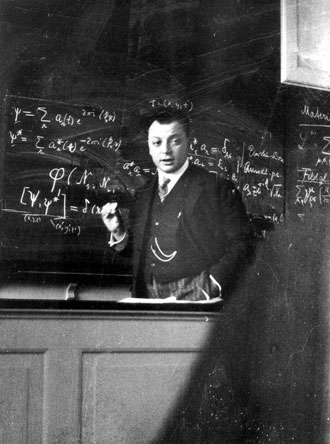
— Wolfgang Pauli (1900-1958), as quoted by R. Peierls
Peierls (1960) writes of Pauli, “… a friend showed him the paper of a young physicist which he suspected was not of great value but on which he wanted Pauli’s views. Pauli remarked sadly ‘That’s not right. It’s not even wrong'”. (Peierls R (1960). “Wolfgang Ernst Pauli, 1900-1958”. Biographical memoirs of fellows of the Royal Society5: 174-92. Royal Society (Great Britain))
Pauli won the Nobel Prize in Physics in 1945: “At this stage of the development of atomic theory, Wolfgang Pauli made a decisive contribution through his discovery in 1925 of a new law of Nature, the exclusion principle or Pauli principle. The 1945 Nobel Prize in Physics has been awarded to Pauli for this discovery.”
Spread the word; friends don't allow friends to repeat history.
On the evening of December 1, 1955, Rosa Parks, an African American, was arrested for disobeying an Alabama law requiring black passengers to relinquish seats to white passengers when the bus was full. Blacks were also required to sit at the back of the bus. Her arrest sparked a 381-day boycott of the Montgomery bus system and led to a 1956 Supreme Court decision banning segregation on public transportation.
Rosa Parks made a nearly perfect subject for a protest on racism. College-educated, trained in peaceful protest at the famous Highlander Folk School, Parks was known as a peaceful and respected person. The sight of such a proper woman being arrested and jailed would provide a schocking image to most Americans. Americans jolted awake.
Often lost in the retelling of the story are the threads that tie together the events of the civil rights movement through the 1940s, 1950s and 1960s. As noted, Parks was a trained civil rights activist. Such training in peaceful and nonviolent protest provided a moral power to the movement probably unattainable any other way. Parks’ arrest was not planned, however. Parks wrote that as she sat on the bus, she was thinking of the tragedy of Emmet Till, the young African American man from Chicago, brutally murdered in Mississippi early in 1955. She was thinking that someone had to take a stand for civil rights, at about the time the bus driver told her to move to allow a white man to take her seat. To take a stand, she remained seated. [More below the fold] Read the rest of this entry »
Spread the word; friends don't allow friends to repeat history.
This is one of the classic stories of public health, an issue that most U.S. history and world history texts tend to ignore, to the detriment of the students and the classroom outcomes.
In the 1850s a Hungarian doctor and professor of obstetrics named Ignaz Semmelweis (pictured at left) ordered his interns at the Viennese Lying-in Hospital to wash their hands after performing autopsies and before examining new mothers. The death rate plummeted from 22 out of 200 to 2 out of 200, prompting the following reception from one of Europe’s most respected medical practitioners:
“It may be that it [Semmelweis’ procedure] does contain a few good principles, but its scrupulous application has presented such difficulties that it would be necessary, in Paris for instance, to place in quarantine the personnel of a hospital during the great part of a year, and that, moreover, to obtain results that remain entirely problematical.”
– Dr. Charles Dubois (Parisian obstetrician), memo to the French Academy September 23, 1858
Semmelweiss’ superiors shared Dubois’ opinion; when the Hungarian physician insisted on defending his theories, they forced him to resign his post on the faculty.
Famous quotations often get cited to the wrong famous person. ‘Somebody said something about standing on the shoulders of giants — who was it? Edison? Lincoln? Einstein? Jefferson?’ It may be possible someday to use Google or a similar service to track down the misquotes.
The inspiration, perhaps
A dwarf standing on the shoulders of a giant may see farther than a giant himself.
Robert Burton (February 8, 1577-January 25, 1640), vicar of Oxford University, who wrote The Anatomy of Melancholy to ward off his own depressions
The famous quote
If I have seen further (than you and Descartes) it is by standing on the shoulders of Giants.
Sir Isaac Newton, letter to Robert Hooke, February 5, 1675, Julian/February 15, 1676, Gregorian
Whose voice do you hear, really, when you read material that is supposed to be spoken by God? Morgan Freeman is a popular choice — he’s played God at least twice now, racing George Burns for the title of having played God most often in a movie. James Earl Jones?
Statue of Rep. Barbara Jordan at the Austin, Texas airport that bears her name. Photo by Meghan Lamberti, via Accenture.com
For substance as well as tone, I nominate Barbara Jordan’s as the voice you should hear.
When Max Sherman called me to tell me that Barbara was dying and wanted me to speak at this service, I had been reading a story in that morning’s New York Times about the discovery of forty billion new galaxies deep in the inner sanctum of the universe. Forty billion new galaxies to go with the ten billion we already knew about. As I put the phone down, I thought: it will take an infinite cosmic vista to accommodate a soul this great. The universe has been getting ready for her.
Now, at last, she has an amplifying system equal to that voice. As we gather in her memory, I can imagine the cadences of her eloquence echoing at the speed of light past orbiting planets and pulsars, past black holes and white dwarfs and hundreds of millions of sun-like stars, until the whole cosmic spectrum stretching out to the far fringes of space towards the very origins of time resonates to her presence.
Virgotext carried a series of posts earlier in the year, commemorating what would have been Jordan’s 71st birthday on February 21. (Virgotext also pointed me to the Moyers quote, above.)
Now, when the nation seriously ponders impeachment of a president, for the third time in just over a generation, Ms. Jordan’s words have more salience, urgency, and wisdom. It’s a good time to revisit Barbara Jordan’s wisdom, in the series of posts at Virgotext.
The rest of the hearing remarks are all here. It’s a longer clip than the others but honestly, there is not a good place to cut it.
This is Barbara Jordan on the killing floor.
This was a woman who understands history, who illustrates time and again that we are, with every action, with every syllable, cutting the past away from the present.
She never mentions Nixon by name. There is the Constitution. There is the office of the Presidency. But Richard Nixon the president has already ceased to exist. By the time she finishes speaking, he is history.
Rep. Barbara Jordan sitting calmly among tension, at a House Committee meeting (probably House Judiciary Committee in 1974).
Update 2019: Here is the full audio of Barbara Jordan’s speech. It is still salient, and if you listen to it you will understand better what is going on in Congress today.
In West Berlin, President John F. Kennedy delivers the famous speech in which he declares, “Ich bin ein Berliner.” Meaning literally “I am a citizen of Berlin,” the statement shows U.S. solidarity with democratic West Berlin, surrounded by communist territory.
This quote actually isn’t a quote. It was never said by the man who wrote it down to say it. It carries a powerful lesson because of what it is.
A few days ago I posted Gen. Dwight Eisenhower’s “order of the day” to the troops about to conduct the Allied invasion of Normandy to establish the toehold in Europe the Allies needed to march to Berlin, and to end World War II in Europe. As a charge to the troops, it was okay — Eisenhower-style words, not Churchill-style, but effective enough. One measure of its effectiveness was the success of the invasion, which established the toe-hold from which the assaults on the Third Reich were made.
Eisenhower wrote a second statement, a shorter one. This one was directed to the world. It assumed the assault had failed. In a few short sentences, Eisenhower commended the courage and commitment of the troops who, he wrote, had done all they could. The invasion was a chance, a good chance based on the best intelligence the Allies had, Eisenhower wrote. But it had failed.
The failure, Eisenhower wrote, was not the fault of the troops, but was entirely Eisenhower’s.
He didn’t blame the weather, though he could have. He didn’t blame fatigue of the troops, though they were tired, some simply from drilling, many from war. He didn’t blame the superior field position of the Germans, though the Germans clearly had the upper hand. He didn’t blame the almost-bizarre attempts to use technology that look almost clownish in retrospect — the gliders that carried troops behind the lines, the flotation devices that were supposed to float tanks to the beaches to provide cover for the troops (but which failed, drowning the tank crews and leaving the foot soldiers on their own).
There may have been a plan B, but in the event of failure, Eisenhower was prepared to establish who was accountable, whose head should roll if anyone’s should.
Eisenhower took full responsibility.
Our landings in the Cherbourg-Havre area have failed to gain a satisfactory foothold and I have withdrawn the troops. My decision to attack at this time and place was based upon the best information available. The troop, the air [force] and the navy did all that bravery and devotion to duty could do. If any blame or fault attaches to the attempt, it is mine alone.
Who in the U.S. command would write such a thing today?
The message may also be viewed here. Yes, it’s incorrectly dated July 5 — should have been June 5.
Spread the word; friends don't allow friends to repeat history.
Soldiers, Sailors, and Airmen of the Allied Expeditionary Force: You are about to embark upon the Great Crusade, toward which we have striven these many months. The eyes of the world are upon you.
It’s a delightful story I’ve heard dozens of times, and retold a few times myself: Abraham Lincoln faced with some thorny issue that could be settled by a twist of language, or a slight abuse of power, asks his questioner how many legs would a dog have, if we called the dog’s tail, a leg. “Five,” the questioner responds confident in his mathematical ability to do simple addition.
Sunrise at the Lincoln Memorial. National Park Service photo.
“No,” Lincoln says. “Calling a dog’s tail a leg, doesn’t make it a leg.”
But there is always the doubt: Is the story accurate? Is this just another of the dozens of quotes that are misattributed to Lincoln in order to lend credence to them?
What did Darwin say about natural selection and humans? Creationists frequently claim Darwin as an advocate of eugenics. Here, below is the section from Descent of Man that they usually quote; and below the fold is the entire quote in its greater context, in which Darwin is shown as an anti-eugenics advocate, at least for humans.
Darwin died 125 years ago, on April 19, 1882.
I borrowed the text from one of the on-line full-text versions of the book. This excerpt is from Chapter 5, “On the Development of the Intellectual and Moral Faculties During Primeval and Civilised Times,” one of the chapters most frequently cited and most often misquoted out of Darwin’s works. Note Darwin’s rather extensive citing to other works of research to support his arguments:
In regard to the moral qualities, some elimination of the worst dispositions is always in progress even in the most civilised nations. Malefactors are executed, or imprisoned for long periods, so that they cannot freely transmit their bad qualities. Melancholic and insane persons are confined, or commit suicide. Violent and quarrelsome men often come to a bloody end. The restless who will not follow any steady occupation–and this relic of barbarism is a great check to civilisation (17. ‘Hereditary Genius,’ 1870, p. 347.)–emigrate to newly-settled countries; where they prove useful pioneers. Intemperance is so highly destructive, that the expectation of life of the intemperate, at the age of thirty for instance, is only 13.8 years; whilst for the rural labourers of England at the same age it is 40.59 years. (18. E. Ray Lankester, ‘Comparative Longevity,’ 1870, p. 115. The table of the intemperate is from Neison’s ‘Vital Statistics.’ In regard to profligacy, see Dr. Farr, ‘Influence of Marriage on Mortality,’ ‘Nat. Assoc. for the Promotion of Social Science,’ 1858.) Profligate women bear few children, and profligate men rarely marry; both suffer from disease. In the breeding of domestic animals, the elimination of those individuals, though few in number, which are in any marked manner inferior, is by no means an unimportant element towards success. This especially holds good with injurious characters which tend to reappear through reversion, such as blackness in sheep; and with mankind some of the worst dispositions, which occasionally without any assignable cause make their appearance in families, may perhaps be reversions to a savage state, from which we are not removed by very many generations. This view seems indeed recognised in the common expression that such men are the black sheep of the family. Read the rest of this entry »
Spread the word; friends don't allow friends to repeat history.
Churchill speaking at the Albert Hall in London, 1944, at an American Thanksgiving Celebration. Churchill Centre image
Never give in, never give in, never, never, never, never — in nothing, great or small, large or petty — never give in except to convictions of honour and good sense!
What fairy story, what tale from the Arabian Nights of the jinns, is a hundredth part as wonderful as this true fairy story of simians! It is so much more heartening, too, than the tales we invent. A universe capable of giving birth to many such accidents is — blind or not — a good world to live in, a promising universe. . . . We once thought we lived on God’s footstool; it may be a throne.
Or, until that account is unsuspended by the forces supporting Donald Trump: Follow @FillmoreWhite, the account of the Millard Fillmore White House Library
We've been soaking in the Bathtub for several months, long enough that some of the links we've used have gone to the Great Internet in the Sky.
If you find a dead link, please leave a comment to that post, and tell us what link has expired.
Thanks!
Retired teacher of law, economics, history, AP government, psychology and science. Former speechwriter, press guy and legislative aide in U.S. Senate. Former Department of Education. Former airline real estate, telecom towers, Big 6 (that old!) consultant. Lab and field research in air pollution control.
My blog, Millard Fillmore's Bathtub, is a continuing experiment to test how to use blogs to improve and speed up learning processes for students, perhaps by making some of the courses actually interesting. It is a blog for teachers, to see if we can use blogs. It is for people interested in social studies and social studies education, to see if we can learn to get it right. It's a blog for science fans, to promote good science and good science policy. It's a blog for people interested in good government and how to achieve it.
BS in Mass Communication, University of Utah
Graduate study in Rhetoric and Speech Communication, University of Arizona
JD from the National Law Center, George Washington University


 Posted by Ed Darrell







 Millard Fillmore's Bathtub