Jeffrey Robbins, a human character in the animated cartoon series, “The Gargoyles”
The written word is all that stands between memory and oblivion. Without books as our anchors, we are cast adrift, neither teaching nor learning. They are windows on the past, mirrors on the present, and prisms reflecting all possible futures. Books are lighthouses, erected in the dark sea of time.
Some scientists claim that hydrogen, because it is so plentiful, is the basic building block of the universe. I dispute that. I say there is more stupidity than hydrogen, and that is the basic building block of the universe.
Cover of The Real Frank Zappa Book - Wikimedia image
Actually, I think the claim is that hydrogen is the most common element in the universe, since it’s so simple. Its abundance is a result of that simplicity.
Physics in 2010 would probably go for dark matter as even more plentiful than hydrogen, but so little is known about dark matter. As we learn more about dark matter, we could discover Zappa was a physics theorist before his time. It’s a short line from Zappa to Zwicky.
______________
I’m relieved to have a credible source for the quote — I had found it attributed to Einstein, another case of Darrell’s Law of Quote Misattribution (“any good quote whose source is unknown will be attributed to Jefferson, Lincoln or Einstein; consequently any quote attributed to those people should be sourced before being taken as accurate”).
A couple more I’d like to put to bed, both attributed to Einstein:
“The difference between genius and stupidity is that genius has its limits” (from a coffee mug I got years ago at the late Shakespeare, Beethoven & Co.).
“Coffee makes me smart” (from another coffee mug).
Simulation of the distribution of dark matter haloes - Max Planck Institute
Like this post? Please share:
Spread the word; friends don't allow friends to repeat history.
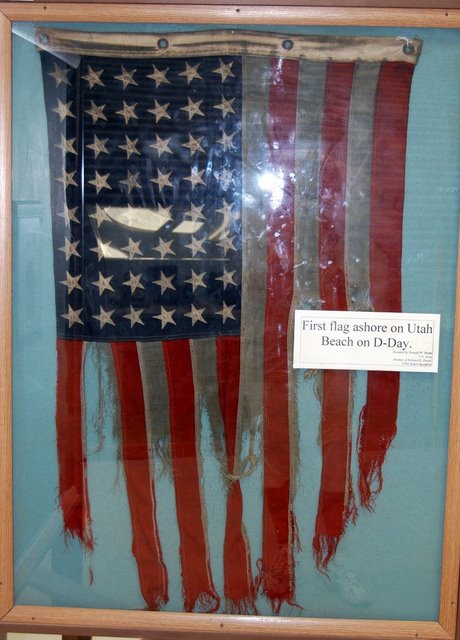
First U.S. flag on Utah Beach, Normandy, D-Day, June 6, 1944; Pima Air Museum, Tucson, Arizona
This mostly an encore post. A reader sent an e-mail with a question: Does U.S. law suggest the flying of the U.S. flag on the anniversary of D-Day?
Today is the 66th anniversary of the Invasion of Normandy in World War II, a date generally called D-Day. No, you don’t have to fly your flag. This is not one of the days designated by Congress for flag-flying.
But you may, and probably, you should fly your flag. If you have any D-Day veterans in your town, they will be grateful, as will their spouses, children, widows and survivors. A 22-year-old soldier on the beach in 1944 would be 87 today, if alive. These men and their memories of history fade increasingly fast. Put your flag up. You may be surprised at the reaction.
If you do run into a D-Day veteran, ask him about it. Keep a record of what he says.
"First Wave at Omaha: The Ordeal of the Blue and the Gray" by Ken Riley: Behind them was a great invasion armada and the powerful sinews of war. But in the first wave of assault troops of the 29th (Blue and Gray) Infantry Division, it was four rifle companies landing on a hostile shore at H-hour, D-Day -- 6:30 a.m., on June 6, 1944. The long-awaited liberation of France was underway. After long months in England, National Guardsmen from Virginia, Maryland and the District of Columbia found themselves in the vanguard of the Allied attack. In those early hours on the fire-swept beach the 116th Infantry Combat Team, the old Stonewall Brigade of Virginia, clawed its way through Les Moulins draw toward its objective, Vierville-sur-Mer. It was during the movement from Les Moulins that the battered but gallant 2d Battalion broke loose from the beach, clambered over the embankment, and a small party, led by the battalion commander, fought its way to a farmhouse which became its first Command post in France. The 116th suffered more than 800 casualties this day -- a day which will long be remembered as the beginning of the Allies' "Great Crusade" to rekindle the lamp of liberty and freedom on the continent of Europe. Image from National Guard Heritage series, from which the caption was borrowed.
Soldiers, Sailors, and Airmen of the Allied Expeditionary Force: You are about to embark upon the Great Crusade, toward which we have striven these many months. The eyes of the world are upon you.
August 17, 1790, found U.S. President George Washington traveling the country, in Newport, Rhode Island.
Washington met with “the Hebrew Congregation” (Jewish group), and congregation leader (Rabbi?) Moses Seixas presented Washington with an address extolling Washington’s virtues, and the virtues of the new nation. Seixas noted past persecutions of Jews, and signalled a hopeful note:
Deprived as we heretofore have been of the invaluable rights of free citizens, we now (with a deep sense of gratitude to the Almighty disposer of all events) behold a government erected by the Majesty of the People–a Government which to bigotry gives no sanction, to persecution no assistance, but generously affording to All liberty of conscience and immunities of Citizenship, deeming every one, of whatever Nation, tongue, or language, equal parts of the great governmental machine.
George Washington's reply to the Newport, RI, "Hebrew congregation," August 17, 1790 - Library of Congress image
President Washington responded with what may be regarded as his most powerful statement in support of religious freedom in the U.S. — and this was prior to the ratification of the First Amendment:
It is now no more that toleration is spoken of as if it was the indulgence of one class of people that another enjoyed the exercise of their inherent natural rights. For happily, the government of the United States, which gives to bigotry no sanction, to persecution no assistance, requires only that they who live under its protection should demean themselves as good citizens, in giving it on all occasions their effectual support.
Below the fold, more history of the events and religious freedom, from the Library of Congress.
The frequently quotable Oliver Wendell Holmes, Jr., circa 1930. Edited photograph from the Library of Congress Prints and Photographs Division. Original photo by Harris & Ewing. LC-USZ62-47817. Copyright expired.
I like paying taxes. With them I buy civilization.
Justice Oliver Wendell Holmes, Jr., attributed. (see Felix Frankfurter, Mr. Justice Holmes and the Supreme Court, Harvard University Press, 1961, page 71.)
I found reference to the quote in a book about eminent economists, through Google Scholar:
Eminent Economists: Their Life Philosophies
By Michael Szenberg
Published by Cambridge University Press, 1993
320 pages
On page 201, Szenberg refers Holmes’s view of “taxation as the price of liberty.” In a footnote, he points to Justice Frankfurter’s book. The quote is dolled up a little. According to Szenberg’s footnote:
More precisely, he rebuked a secretary’s query of “Don’t you hate to pay taxes?” with “No, young fellow, I like paying taxes, with them I buy civilization.”
Frankfurter is a reliable source. It’s likely Holmes said something very close to the words Friedman used.
It is interesting to contemplate a tangled bank, clothed with many plants of many kinds, with birds singing on the bushes, with various insects flitting about, and with worms crawling through the damp earth, and to reflect that these elaborately constructed forms, so different from each other, and dependent upon each other in so complex a manner, have all been produced by laws acting around us. These laws, taken in the largest sense, being Growth with reproduction; Inheritance which is almost implied by reproduction; Variability from the indirect and direct action of the conditions of life, and from use and disuse; a Ratio of Increase so high as to lead to a Struggle for Life, and as a consequence to Natural Selection, entailing Divergence of Character and the Extinction of less improved forms. Thus, from the war of nature, from famine and death, the most exalted object which we are capable of conceiving, namely, the production of the higher animals, directly follows. There is grandeur in this view of life, with its several powers, having been originally breathed by the Creator into a few forms or into one; and that, whilst this planet has gone circling on according to the fixed law of gravity, from so simple a beginning endless forms most beautiful and most wonderful have been, and are being evolved.
First they came for the communists, and I did not speak out—because I was not a communist;
Then they came for the trade unionists, and I did not speak out—because I was not a trade unionist;
Then they came for the Jews, and I did not speak out—because I was not a Jew;
Then they came for me—and there was no one left to speak out for me.
— Pastor Martin Niemöller
German theologian and Lutheran Pastor Martin Niemöller on a postage stamp, painted by Gerd Aretz in 1992 – Wikipedia
It’s spring, and school curricula turn to the Holocaust, in English, in world history, and in U.S. history.
Martin Niemöller’s poem registers powerfully for most people — often people do not remember exactly who said it. I have seen it attributed to Deitrich Bonhoeffer (who worked with Niemöller in opposing some Nazi programs), Albert Einstein, Reinhold Niebuhr, Albert Schweitzer, Elie Wiesel, and an “anonymous inmate in a concentration camp.”
Niemöller and his actions generate controversy — did he ever act forcefully enough? Did his actions atone for his earlier inactions? Could anything ever atone for not having seen through Hitler and opposing Naziism from the start? For those discussion reasons, I think it’s important to keep the poem attributed to Niemöller. The facts of his life, his times, and his creation of this poem, go beyond anything anyone could make up. The real story sheds light.
Illustration from The Adventures of Huckleberry Finn, 1884 edition - the King, "Travelling by Rail" - Wikimedia. (The "King" is being tarred, feathered, and "ridden out of town on a rail.")
Well, the king he talked him blind; so at last he give in, and said all right, but said he believed it was blamed foolishness to stay, and that doctor hanging over them.
But the king says: “Cuss the doctor! What do we k’yer for HIM? Hain’t we got all the fools in town on our side? And ain’t that a big enough majority in any town?”
Robert F. Kennedy speech at the University of Kansas, Lawrence, March 18, 1968 - Photo by George Silk, Time-Life Pictures/Getty Images
RFK said this in 1968. In a speech I heard today it was quoted and it stirred me.
Too much and for too long, we seem to have surrendered personal excellence and community value in the mere accumulation of material things. Our Gross National Product, now, is over eight hundred billion dollars a year, but that GNP — if we judge the United States of America by that — that GNP counts air pollution and cigarette advertising and ambulances to clear our highways of carnage. It counts special locks for our doors and the jails for the people who break them. It counts the destruction of the redwoods and the loss of our natural wonder in chaotic sprawl. It counts napalm and it counts nuclear warheads, and armored cars for the police to fight the riots in our cities. It counts Whitman’s rifle and Speck’s knife, and the television programs which glorify violence in order to sell toys to our children.
Yet the Gross National Product does not allow for the health of our children, the quality of their education, or the joy of their play. It does not include the beauty of our poetry or the strength of our marriages, the intelligence of our public debate or the integrity of our public officials. It measures neither our wit nor our courage, neither our wisdom nor our learning, neither our compassion nor our devotion to our country; it measures everything, in short, except that which makes life worthwhile. And it can tell us everything about America except why we are proud that we are Americans.
Kennedy delivered these words in an address at the University of Kansas, Lawrence, Kansas, on March 18, 1968.
Hidalgo himself was captured by the Spanish in 1811, and executed.
Statue of Father Hidalgo in Dolores, Mexico.
It’s a great story. It’s a good speech, what little we have of it (Hidalgo used no text, and we work from remembered versions).
Why isn’t there a good 10- to 15-minute video on the thing for classroom use? Get a good actor to do the speech, it could be a hit. Where is the video when we need it?
Update for 2008: Glimmerings of hope on the video front: Amateur videos on YouTube provide some of the sense of what goes on in modern celebrations.
The Grito de Dolores (“Cry of/from Dolores”) was the battle cry of the Mexican War of Independence, uttered on September 16, 1810, by Miguel Hidalgo y Costilla, a Roman Catholic priest from the small town of Dolores, near Guanajuato, Mexico.
“My Children, a new dispensation comes to us today…Will you free yourselves? Will you recover the lands stolen 300 years ago from your forefathers by the hated Spaniards? We must act at once.”
Although many mistakenly attribute the Cinco de Mayo holiday as the celebration of Mexican independence, Sept. 16 was the day the enthusiastic Indian and mestizo congregation of Hidalgo’s small Dolores parish church took up arms and began their fight for freedom against Spain.
Portals to the World contains selective links providing authoritative, in-depth information about the nations and other areas of the world. Resources on Mexico include information on the country’s history, religion, culture and society to name a few.
September is also a notable month for Hispanic culture with the celebration of Hispanic Heritage Month Sept 15 – Oct. 15. Sept. 15 is significant because it is the anniversary of independence for Latin American countries Costa Rica, El Salvador, Guatemala, Honduras and Nicaragua. In addition to Mexico’s independence day on Sept. 16, Chile recognizes its independence day Sept.18. Also, Columbus Day or Día de la Raza, which is Oct. 12, falls within this 30-day period.
The theme for the 2009 Hispanic Heritage Month is “Embracing the Fierce Urgency of Now!” To coincide with the celebration, the Library and several partners present a website honoring Hispanic culture and people.
Specifically on the Grito de Dolores, see the Library of Congress’s American Memory Project:
Cry of Dolores
My Children, a new dispensation comes to us today…Will you free yourselves? Will you recover the lands stolen three hundred years ago from your forefathers by the hated Spaniards? We must act at once.Cry of Dolores, attributed to Father Miguel Hidalgo y Costilla, September 16, 1810.
Early on the morning of September 16, 1810, Father Miguel Hidalgo y Costilla summoned the largely Indian and mestizo congregation of his small Dolores parish church and urged them to take up arms and fight for Mexico’s independence from Spain. His El Grito de Dolores, or Cry of Dolores, which was spoken—not written—is commemorated on September 16 as Mexican Independence Day.
Father Hidalgo was born into a moderately wealthy family in the city of Guanajuato, northwest of Mexico City, in 1753. He attended the Jesuit College of San Francisco Javier, received a bachelor’s degree from the University of Mexico in 1774, and was ordained into the priesthood in 1778. He soon earned the enmity of the authorities, however, by openly challenging both church doctrine and aspects of Spanish rule by developing Mexican agriculture and industry.
In 1803, Hidalgo accepted the curacy of the small parish of Dolores, not far from his native city of Guanajuato. Between 1803 and 1810, he directed most of his energy to improving the economic prospects of his parishioners. He also joined the Academia Literaria, a committee seeking Mexico’s independence from Spain.
In September 1810, Spanish authorities learned of the group’s plot to incite a rebellion. On September 13, they searched the home of Emeterio González in the city of Queretaro where they found a large supply of weapons and ammunition. Warned of his impending arrest, Hidalgo preempted authorities by issuing the ElGrito de Dolores on the morning of September 16. Attracting enthusiastic support from the Indian and mestizo population, he and his band of supporters moved toward the town of San Miguel.
The rebel army encountered its first serious resistance at Guanajuato. After a fierce battle that took the lives of more than 500 Spaniards and 2,200 Indians, the rebels won the city. By October, the rebel army, now 80,000 strong, was close to taking Mexico City. Hidalgo, fearful of unleashing the army on the capital city, hesitated, then retreated to the north. He was captured in Texas, then still a part of the Spanish empire, and executed by firing squad on July 31, 1811. After ten more years of fighting, a weakened and divided Mexico finally won independence from Spain with the signing of the Treaty of Córdoba on August 24, 1821.
Learn more about Mexico:
View the Huexotzinco Codex, one of the Top Treasures in the Library of Congress’ American Treasures online exhibition. The codex is an eight-sheet document on amatl,a pre-European paper made from tree bark in Mesoamerica. It is part of the testimony in a legal case against representatives of Spain’s colonial government in Mexico and dates to 1531, ten years after Mexico’s defeat.
Read the Today in History feature on the Mexican holiday Cinco de Mayo, which celebrates Mexico’s defeat of French troops at the town of Puebla in 1862. This event is also widely celebrated by Latinos in the U.S.
Hispanic Heritage Month.gov, from the Library of Congress, National Gallery of Art, National Endowment for the Humanities and several other federal agencies and institutions
To locate resources for the study of Mexico and its history, search the Handbook of Latin American Studies, an online bibliography of works selected and annotated by scholars of Latin American history and culture, or visit the Hispanic Reading Room, which also offers a portal for online information on Mexico.
Share this bit of history:
Spread the word; friends don't allow friends to repeat history.
Kathryn sings with the Arlington Master Chorale. Last week they performed for the Texas Choir Directors Association Convention in San Antonio. Randy Jordan leads and directs the group.
Before the San Antonio performance, they sang the program at St. Marks Episcopal Church in Arlington, a beautifully spare performance space suited well to a hundred good, mature voices.
Joan Szymko‘s “It Takes A Village” made a stunning and rousing finale for the concert. The piece opens with the choir tapping their chests for a heartbeat rhythm, which by itself stirs an audience when performed by so many. It features a simple melody and lyric, though inspiring when done en masse or with a good solo.
And it packs an integral political message. The text is that same phrase that became a watershed between conservatives and liberals in the 1990s.
It takes a whole village to raise the children.
It takes the whole village to raise one child.
We all — everyone — must share the burden.
We all — everyone — will share the joy.
Some music is best experienced live, and this may be one. There are several recordings of this piece available on YouTube, not one done so well as the Arlington Master Chorale last week in my opinion (the choir directors loved it, too, I hear).
Here are two performances of the piece, each done very differently from the other. Until some enterprising group makes a more polished and better recorded video of the Arlington group, these will have to do (there are other versions on YouTube).
It is particularly spine-tingling to hear and see it performed by our children. When sung with gusto, the thought transcends and soars over politics. Song tells truths of the heart that politics needs to hear, and feel, and experience.
The Oklahoma All-State Choir
Oklahoma All-State Choir
Performed by the 2009 All-OMEA Mixed Chorus (Oklahoma All-State Choir).
Clinician: Johnathan Reed
Accompanist: Ron Wallace
Mt. Eden, Tennyson High and Hayward High Honor Choir at Chabot College (California)
Are there good, commercially-available recordings of this song? Please note them in comments. If you are a commercial music producer, I recommend the Arlington Master Chorale’s performance for recording.
Spread the word; friends don't allow friends to repeat history.
John F. Kennedy at Rice University, Houston, Texas, Sept 12, 1962 – photo from NASA
There is no strife, no prejudice, no national conflict in outer space as yet. Its hazards are hostile to us all. Its conquest deserves the best of all mankind, and its opportunity for peaceful cooperation many never come again. But why, some say, the moon? Why choose this as our goal? And they may well ask why climb the highest mountain? Why, 35 years ago, fly the Atlantic? Why does Rice play Texas?
We choose to go to the moon. We choose to go to the moon in this decade and do the other things, not because they are easy, but because they are hard, because that goal will serve to organize and measure the best of our energies and skills, because that challenge is one that we are willing to accept, one we are unwilling to postpone, and one which we intend to win, and the others, too.
President John F. Kennedy, September 12, 1962, at Rice University, Houston, Texas
Why this speech in Houston? There’s more here than just a speech in a football stadium. Kennedy was working to save the space initiative, and to make America more secure.
In this quest, Kennedy lays out the reasons we need strong science research programs funded by our federal government, and strong science educational achievement in all of our schools.
President John F. Kennedy (1961-1963) awoke on April 12, 1961, to the news that the Soviet Union had won the race to put a man into space. Kennedy immediately met with Vice President Lyndon Johnson in the White House to discuss the embarrassment of the Soviets beating America again. “Can we put a man on the moon before them?” Kennedy asked. A few weeks later, Kennedy challenged the nation to “commit itself to achieving the goal, before this decade is out, of landing a man on the moon and returning him safely to earth.”
Kennedy challenged Congress and the imaginations of all Americans a few weeks later, when on May 25, in a special Joint Session of Congress, he proposed a Moon exploration program. In a speech outlining defense and foreign policy needs to make the U.S. secure and safe against threats from Soviet communism, or any other nation or faction, Kennedy spoke openly about the space race that had been waged since October 4, 1957, when the Soviet Union became the first nation on Earth to orbit an artificial satellite, Sputnik.
Finally, if we are to win the battle that is now going on around the world between freedom and tyranny, the dramatic achievements in space which occurred in recent weeks should have made clear to us all, as did the Sputnik in 1957, the impact of this adventure on the minds of men everywhere, who are attempting to make a determination of which road they should take. Since early in my term, our efforts in space have been under review. With the advice of the Vice President, who is Chairman of the National Space Council, we have examined where we are strong and where we are not, where we may succeed and where we may not. Now it is time to take longer strides–time for a great new American enterprise–time for this nation to take a clearly leading role in space achievement, which in many ways may hold the key to our future on earth.
I believe we possess all the resources and talents necessary. But the facts of the matter are that we have never made the national decisions or marshalled the national resources required for such leadership. We have never specified long-range goals on an urgent time schedule, or managed our resources and our time so as to insure their fulfillment.
Recognizing the head start obtained by the Soviets with their large rocket engines, which gives them many months of leadtime, and recognizing the likelihood that they will exploit this lead for some time to come in still more impressive successes, we nevertheless are required to make new efforts on our own. For while we cannot guarantee that we shall one day be first, we can guarantee that any failure to make this effort will make us last. We take an additional risk by making it in full view of the world, but as shown by the feat of astronaut Shepard, this very risk enhances our stature when we are successful. But this is not merely a race. Space is open to us now; and our eagerness to share its meaning is not governed by the efforts of others. We go into space because whatever mankind must undertake, free men must fully share.
I therefore ask the Congress, above and beyond the increases I have earlier requested for space activities, to provide the funds which are needed to meet the following national goals:
First, I believe that this nation should commit itself to achieving the goal, before this decade is out, of landing a man on the moon and returning him safely to the earth. No single space project in this period will be more impressive to mankind, or more important for the long-range exploration of space; and none will be so difficult or expensive to accomplish. We propose to accelerate the development of the appropriate lunar space craft. We propose to develop alternate liquid and solid fuel boosters, much larger than any now being developed, until certain which is superior. We propose additional funds for other engine development and for unmanned explorations–explorations which are particularly important for one purpose which this nation will never overlook: the survival of the man who first makes this daring flight. But in a very real sense, it will not be one man going to the moon–if we make this judgment affirmatively, it will be an entire nation. For all of us must work to put him there.
The race was on. The Soviet Union’s massive rocket engines gave them a decided advantage. Kennedy’s challenge captured the imagination of Americans and America. Necessary money flowed from Congress, but not in a completely free flow. Some opposed the nation’s efforts in space exploration because they thought spending on space exploration detracted from the nation’s defense efforts. Kennedy continued to stress the connection between space exploration and defense. He was backed by successes — Navy Commander Alan Shepard, Jr., had successfully launched into space and returned safely; and on February 20, 1962, pilot Marine Capt. John Glenn orbited the Earth three times, catching the U.S. up almost to where the Soviet Union was in manned space exploration.
Kennedy understood that constant attention, constant selling of the space program would be necessary. So in September 1962 he found himself in Houston, the newly-designated home of the manned space program, and he took the opportunity to cast the American goals in the space race as peaceful, good for all mankind, and definitely worth the massive costs.
Notice in how he casts putting a human on the Moon in league with other great achievements of civilization. Kennedy was truly shooting for the stars.
Notice also how he relates space exploration to practical applications then in existence, such as communication, navigation of ships at sea, and weather forecasting. This was years before geosynchronus satellites were used for everyday telephone conversations, years before quantum theory was harnessed for Global Positioning Systems (GPS) and digital personal, handheld telephones, and before the newly-invented printed circuits were miniaturized to make computer calculating a possibility in space — the Moon landing was done with slide rules and hand calculations.
Just over 14 months later Kennedy would die in Texas, in Dallas, on November 22, 1963. On July 20, 1969, Neil Armstrong and Buzz Aldrin landed the Eagle Lunar Module on the Moon, at the Sea of Tranquility. A few hours later, on July 21, they stepped out on the Moon. From Kennedy’s speech to Congress, the task had taken 8 years, one month and 26 days.
Buzz Aldrin on the Moon, with Neil Armstrong, the U.S. flag, and the Eagle Lunar Module reflected in his helmet visor, July 21, 1969 – NASA photo via Wikimedia
Please share.
Spread the word; friends don't allow friends to repeat history.
Before we move past remembrances of D-Day, let’s take a moment to think about and memorialize the soldiers who fought there, so many of whom died there.
From the National Guard's feature, This Day in National Guard History: "Circular written by General Dwight D. Eisenhower explaining the importance of the Normandy invasion on winning the war. These were distributed to every member of the attacking force the night prior to the D-Day landings. Sergeant J. Robert "Bob" Slaughter, a Guard member of Virginia's Company D, 116th Infantry, passed his copy around among the members of Company D to get their signatures (front and back) as they waited to load aboard the landing craft that would take them to Omaha Beach. By nightfall of June 6, about half of these men were dead or wounded. Courtesy John R. Slaughter"
Normandy, France — The Allied invasion of France, commonly known as “D-Day” begins as Guardsmen from the 29th Infantry Division (DC, MD, VA) storm onto what will forever after be known as “bloody Omaha” Beach. The lead element, Virginia’s 116th Infantry, suffers nearly 80% casualties but gains the foothold needed for the invasion to succeed. The 116’s artillery support, the 111th Field Artillery Battalion, also from Virginia, loses all 12 of its guns in high surf trying to get on the beach. Its men take up arms from the dead and fight as infantrymen. Engineer support came from the District of Columbia’s 121st Engineer Battalion. Despite high loses too, its men succeed in blowing holes in several obstacles clearing paths for the men to get inland off the beach. In the early afternoon, Maryland’s 115th Infantry lands behind the 116th and moves through its shattered remnants to start the movement in off the beach. Supporting the invasion was the largest air fleet known to history. Among the units flying missions were the Guards’ 107th (MI) and 109th (MN) Tactical Reconnaissance Squadrons The Normandy campaign lasted until the end of July with four Guard infantry divisions; the 28th (PA), 29th, 30th (NC, SC, TN) and the 35th (KS, MO, NE) taking part along with dozens of non-divisional units all earning the “Normandy” streamer.
Or, until that account is unsuspended by the forces supporting Donald Trump: Follow @FillmoreWhite, the account of the Millard Fillmore White House Library
We've been soaking in the Bathtub for several months, long enough that some of the links we've used have gone to the Great Internet in the Sky.
If you find a dead link, please leave a comment to that post, and tell us what link has expired.
Thanks!
Retired teacher of law, economics, history, AP government, psychology and science. Former speechwriter, press guy and legislative aide in U.S. Senate. Former Department of Education. Former airline real estate, telecom towers, Big 6 (that old!) consultant. Lab and field research in air pollution control.
My blog, Millard Fillmore's Bathtub, is a continuing experiment to test how to use blogs to improve and speed up learning processes for students, perhaps by making some of the courses actually interesting. It is a blog for teachers, to see if we can use blogs. It is for people interested in social studies and social studies education, to see if we can learn to get it right. It's a blog for science fans, to promote good science and good science policy. It's a blog for people interested in good government and how to achieve it.
BS in Mass Communication, University of Utah
Graduate study in Rhetoric and Speech Communication, University of Arizona
JD from the National Law Center, George Washington University


 Posted by Ed Darrell





![Viva la república! Viva el Cura Hidalgo! Una página de Gloria, TITLE TRANSLATION: Long live the republic! Long live Father Hidalgo! A page of glory. Between 1890 and 1913. Prints and Photographs Division. Reproduction Information: Reproduction Nos.: LC-USZ62-98851 (b&w film copy neg.), LC-DIG-ppmsc-04595 (digital file from original, recto), LC-DIG-ppmsc-04596 (digital file from original, verso); Call No.: PGA - Vanegas, no. 123 (C size) [P&P] Catalog Record: http://hdl.loc.gov/loc.pnp/ppmsc.04595](http://www.loc.gov/wiseguide/sept09/images/Mexican_A.jpg)
![A street in Guanajuato, Mexico. Between 1880 and 1897. Prints and Photographs Division. Reproduction Information: Reproduction No.: LC-D418-8481 (b&w glass neg.); Call No.: LC-D418-8481 <P&P>[P&P] Catalog Record: http://hdl.loc.gov/loc.pnp/det.4a27131](http://www.loc.gov/wiseguide/sept09/images/Mexican_B.jpg)





 Millard Fillmore's Bathtub