Paramount logo inspiration: Mt. Ben Lomond, in Utah

July 1, 2012

This is mostly an encore post — a tribute to Paramount Pictures in the company’s centennial year.

There’s a geography exercise and social studies bell ringer in this somewhere [links added]:

Ben Lomond Peak towers above Ogden. The mountain is believed to have inspired the Paramount movie logo, below, in use since 1914. (Ravell Call, Deseret News)

From the Deseret News: “Ben Lomond Peak towers above Ogden (Utah). The mountain is believed to have inspired the Paramount movie logo, below, in use since 1914. (Ravell Call, Deseret News)

What is the most “paramount” mountain in Utah?

How about Timpanogos Peak, Kings Peak, Mount Nebo, Mount Olympus. Lone Peak or Twin Peaks?

It’s none of the above because one of Hollywood’s most familiar images — the famous Paramount Pictures logo — was inspired by Weber County’s Ben Lomond Peak.

As such, Ben Lomond — not even the highest summit in Weber County — may be the most famous mountain in the Beehive State.

The peak is given credit for prompting creation of the majestic but fictional mountain in the popular Paramount design, based on two histories of the motion-picture company.

According to Leslie Halliwell’s “Mountain of Dreams,” a biography of Paramount, founder William Hodkinson grew up in Ogden and the logo was “a memory of childhood in his home state of Utah.”

Compare it to the Paramount Pictures logo now:

Paramount Pictures logo

Paramount Pictures logo

Teachers may want to hustle over to the Deseret News site to capture the story for classroom use — the online version includes a short set of slides of a hike to the top of the peak (it’s a climb most reasonably healthy people can make in a day – “reasonably healthy” to include acclimated to the altitude).

What other geographic features have become commercial logos? How do images of geography affect our culture?

For my money, I still like Timpanogos better, even if the Osmonds did use it.

Mt. Ben Lomond, in Utah, from a Flickr file

This image of Mt. Ben Lomond looks more like the Paramount logo, some might say.

More, Related Articles:


Time Piece, Jim Henson on life and its brevity, circa 1965

May 30, 2012

Dr. Bumsted found this in her searches, on MySpace of all places, and passed it along for its use of typewriters . . .

Heck, it’s a nice little piece of art all on its own.  It’s fun to watch Jim Henson without any muppets.  It’s eerie, too — Henson argues in film that time is rather precious, and life often too short.  His time was precious, and his life was cut way too short, especially for fans of Kermit and The Muppet Show

This description comes from the MySpace site of “Charlie,” where Dr. Bumsted found it.

Dislocation in time, time signatures, time as a philosophical concept, and slavery to time are some of the themes touched upon in this nine-minute, experimental film, which was written, directed, and produced by Jim Henson-and starred Jim Henson! Screened for the first time at the Museum of Modern Art in May of 1965, Time Piece enjoyed an eighteen-month run at one Manhattan movie theater and was nominated for an Academy Award for outstanding short subject.

Vodpod videos no longer available.
Time Piece Video by Charlie – Myspace Video, posted with vodpod

The full film can be obtained from iTunes, now — in better fidelity, I’d imagine.

From Jim Henson’s 1966 Academy Award nominated short film.  Henson, as the writer/producer/director/star, created the experimental short about the effect of time keeping on us all.  The full video is available on iTunes here:  http://itunes.apple.com/us/movie/time-piece/id283450519?ign-mpt=uo%3D4

Scriptless!

Disney artists Joe Lanzisero and Tim Kirk drew...

Disney artists Joe Lanzisero and Tim Kirk drew this tribute of Mickey Mouse consoling Kermit the Frog, which appeared in the Summer 1990 issue of WD Eye, Walt Disney Imagineering’s employee magazine. (Photo credit: Wikipedia)


Time lapse photos: NYC, before 1975

May 22, 2012

Why does time-lapse photography fascinate me so?  It reveals changes over time we too often miss, or don’t stop to appreciate.

Here’s an excerpt from a 1975 film, set to music recently released.  Watch closely, you’ll see the shadows of the World Trade Center passing over New York City.

Described at Youtube:

A music video for the gorgeous track “Exercise #3 (Building) by CFCF (Mike Silver). Song is from his upcoming EP titled “Exercises,” which arrives on April 24th via Paper Bag Records.

Footage is from the 1975 short film “Organism,” by Hilary Harris.

For more on CFCF:

http://paperbagrecords.com/artists/cfcf
http://soundcloud.com/cfcf
https://www.facebook.com/pages/CFCF/196418801490

edited by https://www.facebook.com/daviddeanburkhart

More:

Tip of the old scrub brush to Slacktivist.


Film in a high school class: Atticus Finch as a role model

April 30, 2012

This year is the 50th anniversary of the release of the film “To Kill a Mockingbird.”

In the American Film Institute‘s polling to find the greatest hero in the movies, Atticus Finch finished first.  Interesting that a class from Arlington, Virginia’s Washington-Lee High School found one of the best venues anywhere to watch the film to study it.

TO KILL A MOCKINGBIRD ranks 25th on AFI’s 100 Years…100 Movies list of greatest American films, and AFI named Atticus Finch the greatest hero in this history of American film when it announced its AFI’s 100 Years…100 Heroes and Villains list in 2003. AFI also recognized the film for its #1 ranking of Best Courtroom Dramas in AFI’s 10 Top 10 list and its #2 ranking on AFI’s 100 Years…100 Cheers America’s Most Inspiring Films list, just behind IT’S A WONDERFUL LIFE. The film, which premiered in Los Angeles on Christmas day in 1962 and opened wide in 1963, was directed by Robert Mulligan and produced by Alan J. Pakula.  [Screenplay was by the great Texas playwright Horton Foote.]

From the White House YouTube site:

President Obama hosted a film screening of To Kill a Mockingbird in the Family Theater at The White House to commemorate its 50th anniversary with guests including local students from Washington-Lee High School, Mary Badham Wilt, the actress who played Scout, and Veronique Peck, widow of Gregory Peck who played Atticus Finch. The President also acknowledged the American Film Institute for their commitment to the fine arts and NBC Universal and USA Network for their efforts to commemorate this important film.

What venues could one use in Dallas?  Check with the Sixth Floor Museum, to see if their 7th floor facility is available.  Check to see if there is a room available at the Earl Cabell Federal Building, or the George L. Allen Court building.  The old, renovated Texas Theater on Jefferson Boulevard might cut a deal.  Surely there is a room big enough at the Belo Mansion, the home of the Dallas Bar Association — if it’s not totally booked up for other events.  With the Horton Foote connection, perhaps the Wyly Theater could find a rehearsal room to throw up a screen. Odds are pretty good you could get an attorney to come talk law and civil rights at any of those locations.

How could a teacher sneak a viewing of this movie into the curriculum?  Isn’t it tragic that we have to sneak in great classics?

More: 


Oscar winner, “The Fantastic Flying Books of Mr. Morris Lesmore”

March 6, 2012

When Bugs Bunny earned the sobriquet, “Oscar-winning rabbit,” there was a good chance that a good cartoon nominated for an Academy Award would be shown at a movie in your neighborhood.  In the past two decades, it has grated on me that so many of the Oscar-nominated short subjects, documentaries and cartoons could not be seen.

If you watched the Oscar broadcast, you may have been tantalized as I was by the view of the “The Fantastic Flying Books of Mr. Morris Lesmore,” which ended up winning the award for Best Animated Short Film

Wonder of wonders:  The makers of the piece put it up on YouTube, so you and I can see it.  God bless “Conceptual designer Brandon Oldenburg and children’s book author/illustrator William Joyce” for doing that, and may they have much more success with similar projects, even and especially out of their New Orleans, hurricane-wracked studio.

For your viewing pleasure:

See also:


Women to match our mountains: Women at Work, Parts 1 and 2

February 12, 2012

I do love the tops of mountains, and I wish I could climb them.  Fortunately, there are cameras, people who know how to use them, and people who know how to edit film to tell a story, and put us all in awe.

Plus, living among us are people brave enough and skilled enough to get to the tops of those mountains, people who make the filming possible and worthwhile.

“Women at Work” is a film of a climb by “the Cirque Ladies 2010,” described by Emily Stifler:

In summer 2010, Lorna Illingworth, Madaleine Sorkin and I spent 25 days in the Cirque of the Unclimbables, Northwest Territories, Canada. Our goal was to free climb the entire 1963 Original Route on the sheer 2000′ Southeast Face of Proboscis, and grants from the American Alpine Club encouraged us to document the adventure. The result: Women at Work (VI 5.12 R).

Cirque of the Unclimbables?  Okay, I’ll watch.

Part 1

Part 2

More: 

Half the fun is getting there:  Camp in shelters made by Mother Nature:

Camping under large boulder in Fairy Meadows, Cirque of the Unclimbables - SummitPost.org

Camping under large boulder in Fairy Meadows, Cirque of the Unclimbables - SummitPost.org - "Nice roof," one wag commented

Map of Cirque of the Unclimbables, from Nahanni.com

Map of Cirque of the Unclimbables, from Nahanni.com; those dots are not settlements


Map to Cirque of the Unbclimbables and area, from BlackFeather.com, a tour company

Map to Cirque of the Unbclimbables and area, from BlackFeather.com, a tour company


Typewriter (film) of the moment: Nicholson and Lockett

September 2, 2011

Not a nostalgic look, Gary Nicholson and Christopher Lockett are making a documentary about typewriters, and people who use them in the 21st century.

Yeah, I’m interested.

Here’s their description of the project:

In May of 2010, Los Angeles-based filmmakers Christopher Lockett and Gary Nicholson read an article on Wired.com about “The Last Generation Of Typewriter Repairmen.” Casual conversation over coffee about the importance of the typewriter in world history eventually turned toward the inevitable conclusion that “this would make a good documentary.”

Lockett and Nicholson agreed that the passing of the typewriter, a portable printing press that moved the world’s communication technology from pen and ink to the QWERTY keyboards on today’s computers, along with the highly skilled technicians who service them, should be documented.

But as so often happens in documentaries, a funny thing happened on the way…  to paraphrase Mark Twain, news of the typewriter’s death is greatly exaggerated.  Three typewriter repairmen the filmmakers have interviewed all agree that their business is better than it has been in years.

Perhaps it is a reaction to the plugged in existence of today’s 24/7 communications world. Perhaps it is mere nostalgia and kitsch. Perhaps it is an admiration for the elegance of design and the value of time-tested workmanship. And for some, like typewriter collector Steve Soboroff, it is the appeal of owning machines on which American writers like Ernest Hemingway, Tennessee Williams, Ray Bradbury, John Updike and Jack London typed some of their finest work. (He also owns typewriters once owned by George Bernard Shaw and John Lennon)

But one thing is certain, from the Typosphere – an online community of bloggers who sometimes meet up for “Type-In” events, to vintage stores in fashionable neighborhoods in Brooklyn and Los Angeles, Portland and Philadelphia, to noted typewriter collector Tom Hanks, to teachers using typewriters to encourage young writers to focus their thoughts without benefit of a delete key – if the typewriter is on the way out, it’s going out with more appreciation that it’s seen in years.

So far, the filmmakers have documented two Type-in events, (Los Angeles and Phoenix, AZ) have interviewed three typewriter repairmen, one noted typewriter collector and already have arranged to interview at least one Hollywood screenwriter who still uses a typewriter. They have also interviewed journalists, authors, teachers, enthusiasts and people who use typewriters in their personal and professional life.

But there are other novelists, screenwriters and enthusiasts out there. And there are so many more typewriters they’d like to feature – typewriters that produced some of the finest works of 20th Century American literature.  They have also interviewed technicians with the L.A. County Sheriff’s Office who repair the typewriters the department still uses. They are handy for typing forms in triplicate and for such communications requiring a personal touch as letters of condolence.

Along with dozens of photographically gorgeous typewriters lovingly restored by repairmen Ruben Flores, Ermanno Manzorati and Bill Wahl, the filmmakers have interviewed Darryl Rehr, the author of the definitive book “Collecting Antique Typewriters” and an artist whose work features typewriters.

On the wish-list are an East Coast-based orchestra that uses typewriters in their music, the US Patent office holding Christopher Scholes original 1868 US Patent for the typewriter, a man in Philadelphia who has wired a manual typewriter to a computer screen via USB cable and a 15-year-old collector in West Virginia who has collected more than 200 machines and has written and published a book about collecting typewriters. A writer who got kicked out of the Writers Room in Grenwich Village for using his grandmother’s 1929 Royal typewriter and making too much noise. He was given an ultimatum: Use a laptop or get out. Also on that wish-list: an artist who creates her work by typing out portraits on the page, an “instant poet” who types spontaneous poetry on the street, and an author who has documented the feminist history of the typewriter’s early days – it was the first piece of office machinery that gave women the opportunity for employment outside the home.

All of which is currently beyond the filmmakers’ financial grasp. Travel isn’t cheap. In terms of technical skills and gear, the filmmakers are covered. Lockett holds an MFA in Cinematography from the American Film Institute and his credits include TV shows for every major TV network and most cable networks, indie features and PBS documentaries. Nicholson holds a BFA in Motion Pictures and Television from the Academy of Art University  and his producing credits include indie features, Broadway, and music. The team is shooting on Canon 7D and 60D DLSRs and editing in 1920 x 1080 full HD on Final Cut Pro and recording sound digitally on a Zoom H4N.

The Typewriter (In The 21st Century) – if the typewriter didn’t exist, the filmmakers couldn’t have typed this. And you probably wouldn’t be reading it on a computer screen. It’s that important.

The film will feature people who demonstrate much greater fanatacism towards typewriters than I do.

My ears are tintinnabulating in anticipation.


Yellowstone, Land to Life — a film to free from bondage

March 20, 2011

Yes, it’s a tease.  Drat.  Just a trailer for the film.

But how exquisite is just the trailer!

Yellowstone National Park Orientation Film (excerpt) from Northern Light Productions on Vimeo.

Northern Light Productions made the film for the “Canyon Visitor Education Center in Yellowstone National Park. The film offers a compelling overview of the ‘big picture’ geology that has shaped and continues to influence Yellowstone and its ecosystem.”

Big picture geology?  How about making this film available to schools to talk about geology, geography, and history?

Yellowstone National Park annually gets about three million visitors.  Yellowstone is one of those places that ever American should see — but at that rate, it would be more than 100 years before everybody gets there.

We need good, beautifully shot, well-produced, interesting films on American landmarks in the classroom.

How do we get this one freed for America’s kids, Yellowstone Park?


Powers of Ten day coming: 10/10/10

August 30, 2010

Press release from the office of the group that manages the estate and work of Charles and Ray Eames:

TENTH ANNUAL INTERNATIONAL POWERS OF TEN DAY

Santa Monica, California, August 27, 2010 /PRNewswire/ — The Eames Office announces with pleasure the Tenth Annual International Powers of Ten Day on October 10, 2010 (10/10/10). Powers of Ten Day promotes and encourages Powers of Ten Thinking, a form of rich, cross-disciplinary thought that approaches ideas from multiple interrelated perspectives, ranging from the infinitesimal to the cosmic—and the orders of magnitude in between.

Milky Way, by Charles and Ray Eames, from

The Milky Way Galaxy from the film, Powers of Ten, by Charles and Ray Eames. For use only in conjunction with press about Powers of Ten Day 2010. © 1977 Eames Office, LLC (eamesoffice.com) (caption provided)

Powers of Ten Day is inspired by the classic film Powers of Ten by designers Charles and Ray Eames. The film, a nine-minute visual journey of scale, takes the viewer from a picnic out to the edge of space and then back to a carbon atom in the hand of the man sleeping at the picnic. Every 10 seconds the view is from 10 times further away. In all, more than 40 Powers of Ten are visualized seamlessly. One of the most widely seen short films of all time—at the Smithsonian Air and Space Museum for decades and still widely used in schools around the world—Powers of Ten has influenced pop culture from The Simpsons to the rock band Coldplay, from Hummer commercials to the movie Men in Black. But Powers of Ten received perhaps the ultimate accolade in 1998 when the Library of Congress selected it, along with Easy Rider, Bride of Frankenstein, and Tootsie, for the National Film Registry—one of the 25 films of great cultural value chosen each year.

And the film’s importance only grows. Scale is not precisely just size, it is the relative size of things. As Eames Demetrios, director of the Eames Office, has said: “Scale is the new geography. So many of our challenges today are ultimately matters of scale. To be a good citizen of the world and have a chance to make it a better place, a person must have a real understanding of scale.”

Powers of Ten Day is for teachers, librarians, architects, designers, store owners, webmasters, business people, scientists, filmmakers, meditation gurus, parents, kids, and anyone wanting to extend the boundaries of their thinking. Participating can be as simple as watching the video (showing online throughout October [the tenth month] at www.powersof10.com), or putting together a screening of the film for friends or co-workers—at home, in a school, or at a library. Our goal is for as many people as possible to watch or share the film on that day. Some will be seeing it for the first time. Some will be revisiting a favorite classic. Everyone can be part of the conversation.

Powers of Ten Day can also be a lot more. Activities are happening worldwide throughout October. With the help of the DVD Scale is the New Geography as well as a Powers of Ten Box Kit, individuals (teachers in the broadest sense) can lead engaging workshops for kids and/or adults that let participants create their own scale journeys. Although those materials may be purchased at www.eamesoffice.com, as Eames Office Education Director Carla Hartman notes, “We’ve set aside some sets to be available at no charge for inquiring schools and teachers.” Those supplies are limited—and some are already being put to use. To inquire about availability of Powers of Ten supplies at no charge, email info@eamesoffice.com.

The Eames Office also encourages you to create and share your contributions. Over the years art has been created, music shared, global pilgrimages performed, and more. But most of all there has been hands-on learning. Events can be registered, and photographs, drawings, and writings uploaded. Sorted by power and by event, these will serve as inspiration and fodder for other events around the world—more than 1,000, possibly 10,000.

Anyone living in or visiting Southern California is welcome to visit the Powers of Ten Exhibition at the Eames Office in Santa Monica from now until the end of the year. There will be an event each day the exhibition is open during the month of October. Many more fun and thought-provoking activities will be available at www.powersof10.com by the end of the summer. The exhibit includes such things as a box that can hold 1 million pennies; as of mid-August, there were already 250,000! All the pennies collected will be given to TreePeople, an environmental nonprofit that unites the power of trees, people and technology to grow a sustainable future for Los Angeles.

Powers of Ten Thinking extends beyond this unique date of 10/10/10. As Demetrios says, “There is a little bit of the numerologist in all of us, so we love celebrating this date, but empowering people to explore and make connections between scales is a year-round goal of ours.” The Eames Office looks forward to tracking and inspiring another decade’s worth of Powers of Ten events. Towards that end, a map of the Earth on the website (and at the Office) will track events around our world.

The Eames Office is dedicated to communicating, preserving, and extending the work of Charles and Ray Eames. Additional information is available online at www.powersof10.com, as well as at www.eamesoffice.com and www.eamesfoundation.org.

The Powers of Ten Exhibition is open from 11 to 6, Wednesday through Saturday at the Eames Office, 850 Pico Boulevard, Santa Monica, CA 90405; 310/396-5991.

Powers of Ten Day is generously sponsored by IBM Corporation with additional support from Herman Miller Inc., Vitra, and Penfolds.

Your school should have one of the Eames versions of the film in the school library (they did more than one).  This is truly a classic, and it should be a good discussion starter for several different topics — map reading, map scaling, environmentalism, existentialism, transcendentalism, and more.

So what will you do for Powers of Ten Day?

Update:  A YouTube edition of the film, “Powers of Ten,” is now available. MFB post about the film, with embedded version and links, here.


Academy Award winner: “Logorama”

August 16, 2010

Delightfully creative.  Surely there is at least a bell ringer in here, just in identifying the different logos.  For economics and sociology classes, this is a study in branding, done in very interesting fashion.

Can you use it in class, even at 16 minutes?  The language may be too edgy for freshman and sophomores, yes?

A short description from the Vimeo post, by Marc Altshuler, who owns the company who created and recorded the music for the film:

This is a short film that was directed by the French animation collective H5, François Alaux, Hervé de Crécy + Ludovic Houplain. It was presented at the Cannes Film Festival 2009. It opened the 2010 Sundance Film Festival and won a 2010 academy award under the category of animated short.

In this film there are two pieces of licensed music, in the beginning and in the end. All the other music and sound design are original. The opening track (Dean Martin “Good Morning Life”) and closing track (The Ink Spots “I don’t want to send the world on fire”) songs are licensed pre-existing tracks. All original music and sound design is by, human (www.humanworldwide.com)

Brilliant little work even if you can’t use it in class.


More Billy Blob: Bumble BeEing and the Butterfly Effect

August 16, 2010

Also from Billy Blob (as the Space Probe cartoon posted here on August 15), “Bumble BeEing, Part 1:  The Butterfly Effect.”

How to categorize such a cartoon:  Philosophy?  Science of Chaos (from which we get the hypothetical “butterfly effect”)?

Education?  Religion?


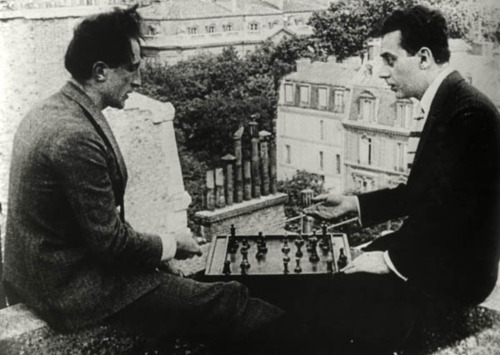
Chess games of the rich and famous: Duchamp vs. Man Ray

July 9, 2010

Marcel Duchamp and Man Ray play chess on a rooftop in Paris.

Duchamp again, this time on a rooftop in Paris, playing chess against Man Ray.

The photograph is later than 1915, when Duchamp moved to the U.S. to avoid World War I, and met Ray; it is probably after 1918.

The two even played chess in a movie:

Man Ray directed a number of influential avant-garde short films, known as Cinéma Pur, such as Le Retour à la Raison (2 mins, 1923); Emak-Bakia (16 mins, 1926); L’Étoile de Mer (15 mins, 1928); and Les Mystères du Château de Dé (20 mins, 1929). Man Ray also assisted Marcel Duchamp with his film Anemic Cinema (1926) and Fernand Léger with his film Ballet Mécanique (1924). Man Ray also appeared in René Clair‘s film Entr’acte (1924), in a brief scene playing chess with Duchamp.

The photo above is a still from that 1924 René Clair movie — it comes about 4:30 into the movie (the version shown here is half of the 20-minute movie, with a very modern, surrealist music score added; you can see the entire movie from Pathé, with a more contemporary score, here).

https://vimeo.com/488844088

Update, March 14, 2011:  See also this story from 2008 about Duchamp’s need to play chess, featuring of photo of Duchamp, Teeny Duchamp and the composer John Cage deeply engrossed in a game.  A good read about chess, and Duchamp.

Tip of the old scrub brush to ArtLex.com.


Typewriter of the moment: Jerry Lewis’s pantomime typewriter (with Leroy Anderson)

May 22, 2010

Ms. Fox’s class had a great time with this video — easy to see why, no?

From “Who’s Minding the Store,” a 1963 Paramount release.

I would have sworn I had a post on Leroy Anderson, but it’s not there to link to; you can check him out on PBS, though.  Another good topic to explore, an oversight to amend.

Jerry Lewis’s pantomime typewriter, always with the Leroy Anderson tune behind it, was one of his most famous comedic routines.  It was very popular in Europe, in both Germany and France.  It’s easy to translate.

Tip of the old scrub brush to Ms. Fox.


Great animation: “The Chesnut Tree”

March 14, 2010

Wonderful film from 2007, by Hyun-min Lee.  I found it on PBS World this weekend, and then found a YouTube version.

Watch it with your young children.

[Youtube=http://www.youtube.com/watch?v=VsS4Tk-lrxo]


Scouting as a tool to fight gang violence

September 22, 2009

Video from my council, Circle 10, in and around Dallas, Texas:

Interestingly, I’ve not seen the video before I found it on YouTube.  Have I just missed chances, or has it not been promoted as well as it should have been?