Especially this year: Fly your flag May 15 for Peace Officers Memorial Day

May 12, 2015

Eden Prairie, Minnesota, May 15, 2013: Eden Prairie officers participated in the tradition of standing guard at the Minnesota Law Enforcement Memorial on the state capitol grounds. The officers stood for twenty minutes, then after the guard duty change, the officers left their posts, rang the memorial bell and stated the name of a Minnesota officer who was killed in the line of duty. This ritual continued every twenty minutes with officers from departments across the state during the 24-hour vigil.

Eden Prairie, Minnesota, May 15, 2013: Eden Prairie officers participated in the tradition of standing guard at the Minnesota Law Enforcement Memorial on the state capitol grounds. The officers stood for twenty minutes, then after the guard duty change, the officers left their posts, rang the memorial bell and stated the name of a Minnesota officer who was killed in the line of duty. This ritual continued every twenty minutes with officers from departments across the state during the 24-hour vigil.

We remember fallen policemen on May 15, every year since 1962 nationally.

This year, the remembrance probably has more meaning, in New York City, throughout Mississippi, and in dozens more states and communities where policemen were killed in the line of duty.

Here is the proclamation from President Obama on Police Officers Memorial Week, and how to fly the flag on Peace Officers Memorial Day, May 15 (Friday).

May 08, 2015

Presidential Proclamation — Peace Officers Memorial Day and Police Week, 2015

PEACE OFFICERS MEMORIAL DAY AND POLICE WEEK, 2015

– – – – – – –

BY THE PRESIDENT OF THE UNITED STATES OF AMERICA

A PROCLAMATION

Each May, our Nation salutes the American women and men who put their lives on the line every day to maintain public safety and hold accountable those who break the law. On Peace Officers Memorial Day and during Police Week, we recognize all those who have dedicated their lives to this vital task. With heavy hearts, we mourn the heroes taken from us only because they chose to serve, and we rededicate ourselves to carrying forward their noble legacy.

Our law enforcement officers have extraordinarily tough jobs. They regularly work in dangerous environments and in difficult, high-tension situations. And they often face challenges deeply rooted in systemic problems and broader social issues. These professionals serve to protect their communities and strengthen their Nation, and they deserve to go home safely to their loved ones at the end of each shift. As President, I am committed to making sure America’s dedicated police officers receive the support and recognition they have earned, and to doing all I can to protect those who protect us.

One important way to make policing safer and more effective is by continuing to enhance relations and trust between law enforcement and the neighborhoods they serve. This will make it easier and safer for police officers to do their jobs, and it will strengthen the places we live and work. This important task will require our Nation — our communities, our law enforcement, and our leaders at every level — to come together to commit to meeting this challenge and moving our country forward, block by block and neighborhood by neighborhood. As President, I firmly believe it is within our power to make progress in our time, and I am dedicated to partnering with all those who are willing to do this necessary work.

My Administration is taking concrete steps to implement the commonsense, pragmatic recommendations my Task Force on 21st Century Policing put forward based on input from law enforcement personnel as well as criminal justice experts, community leaders, and civil liberties advocates. And we are engaging with local jurisdictions so they can begin to make the changes that will help ensure that police officers and their communities are partners in battling crime and that everyone feels safe on and off the job.

Our Nation’s police officers are mentors in our schools, familiar faces on the corner, and pillars of our communities. They keep our borders secure and our roads safe, and in times of crisis, they rush toward tragedy. They are hardworking mothers, fathers, daughters, and sons who have dedicated their lives to public service, working every day to build a brighter future for their families and their Nation. Their selfless commitment and daily sacrifice represent what is possible for every city, town, and reservation in America, and our country has an enormous opportunity to lift up the very best law enforcement personnel as examples — not just to other officers, but to all who aspire to lives of good citizenship. This week and every week, let us remember the patriots who laid down their lives for ours and honor all who strive to make our Nation more safe, more free, and more just.

By a joint resolution approved October 1, 1962, as amended (76 Stat. 676), and by Public Law 103-322, as amended (36 U.S.C. 136-137), the President has been authorized and requested to designate May 15 of each year as “Peace Officers Memorial Day” and the week in which it falls as “Police Week.”

NOW, THEREFORE, I, BARACK OBAMA, President of the United States of America, do hereby proclaim May 15, 2015, as Peace Officers Memorial Day and May 10 through May 16, 2015, as Police Week. I call upon all Americans to observe these events with appropriate ceremonies and activities. I also call on the Governors of the United States and its Territories, and appropriate officials of all units of government, to direct that the flag be flown at half-staff on Peace Officers Memorial Day. I further encourage all Americans to display the flag at half-staff from their homes and businesses on that day.

IN WITNESS WHEREOF, I have hereunto set my hand this eighth day of May, in the year of our Lord two thousand fifteen, and of the Independence of the United States of America the two hundred and thirty-ninth.

BARACK OBAMA

Check your local newspapers and municipal police websites for memorial services near you.
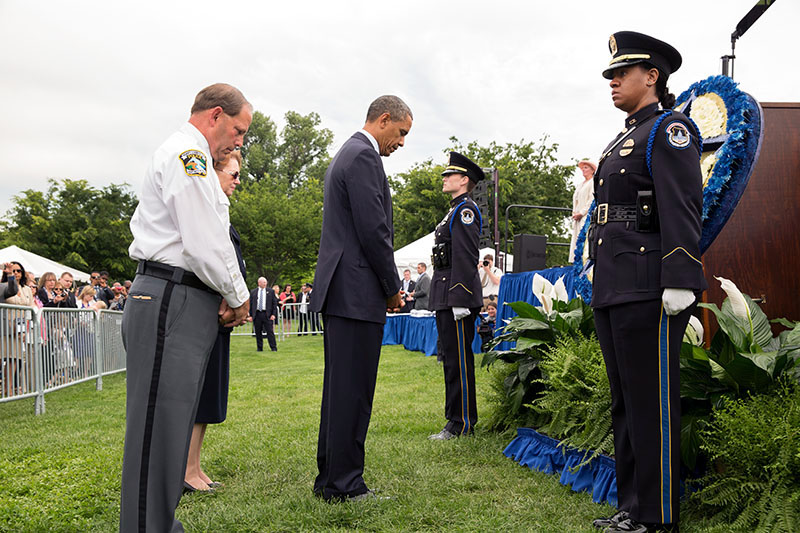
White House caption from 2013 ceremony: President Barack Obama bows his head after placing a flower in a wreath during the National Peace Officers Memorial Service, an annual ceremony honoring law enforcement who were killed in the line of duty in the previous year, at the U.S. Capitol in Washington, D.C. May 15, 2013. Chuck Canterbury, National President, Fraternal Order of Police and Linda Hennie, President, FOP Auxiliary stand with the President. (Official White House Photo by Pete Souza)

White House caption from 2013 ceremony: President Barack Obama bows his head after placing a flower in a wreath during the National Peace Officers Memorial Service, an annual ceremony honoring law enforcement who were killed in the line of duty in the previous year, at the U.S. Capitol in Washington, D.C. May 15, 2013. Chuck Canterbury, National President, Fraternal Order of Police and Linda Hennie, President, FOP Auxiliary stand with the President. (Official White House Photo by Pete Souza)

Save

Save


Fly your flags today in Minnesota: 157th Minnesota Statehood Day, May 11

May 11, 2015

Flag etiquette following the U.S. Flag Code urges Americans to fly U.S. flags on the day of statehood for the state in which you reside.

Minnesota joined the Union on May 11, 1858.

Minnesota Capitol Chandelier, lit for Statehood Day, May 11.

Caption from the Minneapolis Star-Tribune: The Minnesota Capitol chandelier was illuminated today, May 10, 2013 in celebration of Statehood Day. It has 92 bulbs surrounded by 40,000 crystal beads strung together and was recently painstakingly cleaned and refurbished. The fixture is traditionally lit once per year on Statehood Day. Minnesota became a part of the United States as Minnesota Territory in 1849, and became the 32nd U.S. state on May 11, 1858.

At the Library of Congress’s outstanding American Memory site, a much more detailed history of Minnesota statehood is featured on “Today in History,” reproduced here in its entirety:

The Star of the North

facade of a domed building
Capitol Building, exterior, St. Paul, MN
St. Paul, Minnesota 1902
American Landscape and Architectural Design, 1850-1920

On May 11, 1858, Minnesota became the 32nd state admitted into the Union. Minnesota’s application for statehood was submitted to President James Buchanan in January, but became entangled with the controversial issue of Kansas statehood, delaying it for several months until it was finally approved by Congress.

Known as the “Land of 10,000 Lakes,” or “Star of the North,” Minnesota is the northern terminus of the Mississippi River’s traffic and the westernmost point of an inland waterway which extends through the Great Lakes and, with the St. Lawrence Seaway, to the Atlantic Ocean.

The Ojibwa (Chippewa) and Dakota (Sioux) were among the tribal peoples who first made this land their home. For them state borders were non-existent, and their territory extended far beyond what is today Minnesota. The French claimed this region from the mid-1600s to the mid-1700s, developing a strong fur trade but ceding lands east of the Mississippi to Britain. The U.S. acquired the area and its rich natural resources through the Treaty of Paris (1783), and the Louisiana Purchase (1803).

U.S. administration of the northwest lands formally began with the 1787 passage of the Northwest Ordinance. The ordinance, one of the most important pieces of legislation passed by the Continental Congress, set out the requirements for a territory to become a state. The American Memory collection Continental Congress and the Constitutional Convention, 1774-1789 features a discussion of the Incorporation of the Western Territories. For additional information on England’s yielding of land west of the Appalachian Mountains, see the Today in History feature on the Surrender of Fort Sackville. A representation of Fort Sackville is accessible on The George Rogers Clark National Historic Park site.

From the 1820s on, protected the growth of the area now called Minnesota. During the Civil War, the fort served as a training center for thousands of young Minnesota volunteers who joined the Union Army. Twenty-four thousand soldiers who trained at the fort fought in the Union Army, serving gallantly at Gettysburg or during the Indian Outbreak. Once a military outpost at the edge of a small settlement, Fort Snelling is now located at the center of Minnesota’s “Twin Cities”—Minneapolis and St. Paul.

wheat bundle stacks
Wheat Bundle Stacks, Fosston, Minnesota, circa 1900.
The Northern Great Plains, 1880-1920

a horse in a farming rig in a field
Horse powered threshing rig, Blue Earth, Minnesota, 1898.
The Northern Great Plains, 1880-1920

Until the second half of the nineteenth century, immigration into Minnesota was slow. However, as the value of the state’s woodlands and fertile prairie was realized, settlers poured into the region with New England lumbermen leading the way. Between 1850 and 1857, the state population skyrocketed from 6,077 to over 150,000. As a large state with land for homesteading, Minnesota attracted immigrants from Norway, Sweden, Finland, and those seeking to own land in the United States. An 1878 brochure published by the Minnesota State Board of Immigration, describes the many reasons for moving to the state.

19th century advertisements to get people to move to Minnesota. Library of Congress images

19th century advertisements to get people to move to Minnesota. Library of Congress images; see description and link details below

Advertisement for a steamboat company
Northern Line Packet Co.,
Advertisement for a steamship company in The Minnesota Guide. A Handbook of Information for the Travelers, Pleasure Seekers and Immigrants…, 1869.
Pioneering the Upper Midwest: Books from Michigan, Minnesota, and Wisconsin, ca. 1820-1910

Still a leader in farming, lumbering, milling, and medical research, Minnesota is also an important center for the printing industry and a major producer of iron ore. Its largest city, Minneapolis, is home to the University of Minnesota, numerous museums, and theaters such as the Tyrone Guthrie Theater and the Walker Arts Center, and the world’s largest cash grain market.

St. Paul is the state capital.

Bird's eye view of Duluth
Bird’s Eye View of Duluth, Minnesota, copyright 1914.
Taking the Long View, 1851-1991

More:

U.S. and Minnesota flags flying together. Minnesota state flag photo by AlexiusHoratius - Own work. Licensed under Creative Commons, via Wikipedia

U.S. and Minnesota flags flying together. Minnesota state flag photo by AlexiusHoratius – Own work. Licensed under Creative Commons, via Wikipedia

Yes, this is mostly an encore post. Fighting ignorance requires patience.

Yes, this is mostly an encore post. Fighting ignorance requires patience.


Fly your flag for Victory Europe Day, May 8, 2015 – 70th anniversary

May 8, 2015

Yes, you should be flying your flag today for Victory Europe Day (VE Day)!

Caption from Pinterest, World War Items: A huge American flag unfurled in New York’s Herald Square on VE Day on May 8, 1945. This 80x160 foot flag was hung from the eighth floor balcony of Macy’s New York department store, covering the façade from 34th and 35th Streets along Broadway. Beneath it were placed a set of British, Chinese, French and Russian flags, held by two giant mailer fists. (AP Photo)

Caption from Pinterest, World War Items: A huge American flag unfurled in New York’s Herald Square on VE Day on May 8, 1945. This 80×160 foot flag was hung from the eighth floor balcony of Macy’s New York department store, covering the façade from 34th and 35th Streets along Broadway. Beneath it were placed a set of British, Chinese, French and Russian flags, held by two giant mailer fists. (AP Photo)

VE Day is not one listed in the Flag Code for flying the colors, but in most years there is a proclamation from the President urging that we do fly the flag.

This year President Obama noted the 70th anniversary of VE Day with his weekly message:


What dates do we fly the flag in May?

May 2, 2015

"Allies Day, May 1917" -- 1917 oil on canvas by Childe Hassam; National Gallery of Art, Washington, D.C.

“Allies Day, May 1917” — 1917 oil on canvas by Childe Hassam; National Gallery of Art, Washington, D.C. Allies Day is no longer celebrated.

May has three days designated for flying the U.S. flag out of the specific days mentioned in the U.S. Flag Code, and three statehood days, when residents of those states should fly their flags.

Interestingly, the three designated days all float, from year to year:

  • Mother’s Day, second Sunday in May (May 10, in 2015)
  • Armed Forces Day, third Saturday in May (May 16)
  • Memorial Day, the last Monday in May (May 25)

Residents of these states celebrate statehood; South Carolina and Wisconsin share May 23:

  • Minnesota, May 11 (1858, the 32nd state)
  • South Carolina, May 23 (1788, the 8th state)
  • Wisconsin, May 23 (1848, the 30th state)
  • Rhode Island, May 29 (1790, the last of the 13 original colonies to ratify the Constitution)

This year President Obama issued a proclamation calling on citizens to fly the flag on May 1, Law Day (I missed that one).

May 8 marks the 70th anniversary of Victory in Europe Day, the day the Axis Powers in Europe surrendered at the end of World War II.  Some years that day is marked by a proclamation calling for flag flying.  (You may fly your flag then even if Congress and the President do nothing.)

In recent years President Obama has proclaimed May 15 as Peace Officers Memorial Day, with flags to fly at half-staff. We might expect another such declaration in 2015.

May 22 is National Maritime Day, under a Joint Resolution from Congress from 1933. President Obama may be expected to proclaim that day as a day to fly the flag, too.

Gee, eleven events on ten days to fly the U.S. flag.  May could be quite busy for flag fliers.

  1. Law Day, May 1
  2. Victory in Europe Day, May 8
  3. Mothers Day, May 10
  4. Minnesota Statehood, May 11
  5. Peace Officers Memorial Day, May 15 (half-staff flags)
  6. Armed Forces Day, May 16
  7. National Maritime Day, May 22
  8. South Carolina Statehood, AND Wisconsin Statehood, May 23
  9. Memorial Day, May 25
  10. Rhode Island Statehood, May 29

Presidents Day 2015: Fly your flag today

February 16, 2015

It’s Presidents’ Day on most calendars, though the official U.S. holiday is “Washington’s Birthday.”

You’re already flying your flag today, right?  Let’s recapitulate from last year

Dr. Bumsted reminds us we need to emphasize that the federal holiday is Washington’s Birthday, not a day to honor presidents generically.  See the explanation from the U.S. National Archives.

Presidents Day is February 16, 2015 — fly your U.S. flag today.

National Park Service photo, Lincoln Memorial through flags at Washington Monument

The Lincoln Memorial, seen through flags posted at the Washington Monument, Washington, D.C.; National Park Service Photo via About.com

Oddly enough, some controversy arises from time to time over how to honor President Washington and President Lincoln, and other presidents.  Sometimes the controversy simmers over how to honor great Americans — if Lincoln deserves a day, why not FDR?  Why not Jefferson? — and sometimes the controversy covers more mundane ground — should the federal government give workers a day off?  Should it be on a Monday or Friday to create a three-day weekend to boost tourism?  About.com explains the history of the controversy:

Presidents’ Day is intended (for some) to honor all the American presidents, but most significantly George Washington and Abraham Lincoln. According to the Gregorian or “New Style” calendar that is most commonly used today, George Washington was born on February 22, 1732. But according to the Julian or “Old Style” calendar that was used in England until 1752, his birth date was February 11th. Back in the 1790s, Americans were split – some celebrated his birthday on February 11th and some on February 22nd.

When Abraham Lincoln became president and helped reshape our country, it was believed he, too, should have a special day of recognition. Tricky thing was that Lincoln’s birthday fell on February 12th. Prior to 1968, having two presidential birthdays so close together didn’t seem to bother anyone. February 22nd was observed as a federal public holiday to honor the birthday of George Washington and February 12th was observed as a public holiday to honor Abraham Lincoln’s birthday.

In 1968, things changed when the 90th Congress was determined to create a uniform system of federal Monday holidays. They voted to shift three existing holidays (including Washington’s Birthday) to Mondays. The law took effect in 1971, and as a result, Washington’s Birthday holiday was changed to the third Monday in February. But not all Americans were happy with the new law. There was some concern that Washington’s identity would be lost since the third Monday in February would never fall on his actual birthday. There was also an attempt to rename the public holiday “Presidents’ Day”, but the idea didn’t go anywhere since some believed not all presidents deserved a special recognition. [Take THAT you Franklin Pierce and Millard Fillmore fans!]

Even though Congress had created a uniform federal holiday law, there was not a uniform holiday title agreement among the individual states. Some states, like California, Idaho, Tennessee and Texas chose not to retain the federal holiday title and renamed their state holiday “President’s Day.” From that point forward, the term “Presidents’ Day” became a marketing phenomenon, as advertisers sought to capitalize on the opportunity for three-day or week-long sales.

In 1999, bills were introduced in both the U.S. House (HR-1363) and Senate (S-978) to specify that the legal public holiday once referred to as Washington’s Birthday be “officially” called by that name once again. Both bills died in committees.

Today, President’s Day is well accepted and celebrated. Some communities still observe the original holidays of Washington and Lincoln, and many parks actually stage reenactments and pageants in their honor. The National Park Service also features a number of historic sites and memorials to honor the lives of these two presidents, as well as other important leaders.

Fly your flag, read some history, enjoy the day.

More, Resources, and Related Articles:

English: Air Force One, the typical air transp...

President’s airplane, Air Force 1, flying over Mount Rushmore National Monument, in South Dakota – Image via Wikipedia; notice, contrary to Tea Party fears, the bust of Obama is not yet up on Rushmore (and also note there remains no room for another bust).

Yes, this is mostly an encore post.  This event occurs every year.


Remember the day Utah flew the flag backwards, to honor the Union?

January 4, 2015

In 2013, Holly Munson at the Constitution Center wrote up a piece about Utah’s perhaps odd path to statehood, certainly complementary to my reminder that you could fly your flags on January 4, to honor Utah’s statehood, under the U.S. Flag Code.  Munson’s piece was distributed on Yahoo! News.

Yes, this is mostly an encore post. Fighting ignorance requires patience.

Yes, this is mostly an encore post. Fighting ignorance requires patience.  Remembering history takes constant reminders.

Her report is very solid, even though brief, and interesting.  Utah history is nothing if not a convoluted path to statehood through what amounted to a civil war, the Mexican War, the discovery of gold in California, the transcontinental railroads, mining and immigration, Indian wars, old west shootouts, rampant environmental destruction with sheep grazing and mineral extraction and smelting, union strife, astonishing agricultural applications, and a lot of books written from tens of thousands of Mormon pioneer journals — Mormonism appears to be impossible without ink and paper and time to write.

Go read her story.

What caught my eye was the George W. Reed photograph of the Salt Lake City Temple of the Church of Jesus Christ of Latter-day Saints — the LDS, or Mormon church.  The Temple and the Tabernacle, also in the photo, both have their own unique architectural histories, and quirks that make them noteworthy purely from architecture.  (This George W. Reed should not be confused with the Civil War Medal of Honor winner, George W. Reed)

Reed was an early photographer for newspapers in Salt Lake City, and he took some wonderful photos for posterity.  He was also a founder of the leading non-Mormon paper in the state, The Salt Lake Tribune.  At points in its history, it’s been known as an anti-Mormon paper.  The University of Utah’s library holds about five dozen of his photos in their collection, indexed electronically if not quite available yet; there Reed is described:

A pioneer in the development of Utah newspapers, George Reed was originally employed by the Deseret News and in 1871 helped in establishing the Salt Lake Tribune. His photographs include nineteenth century views of Salt Lake City, individuals at Reed’s Avenue home, Wasatch Resort in Little Cottonwood Canyon, and a photograph of the American flag hung on the Salt Lake Temple in 1896 to commemorate Utah’s statehood.

In the collection of Utah State University, in Logan, Reed has yet more papers.  There we get a bit more of his history:

A pioneer in Utah journalism, George W. Reed was born in London, England, on April 7, 1833. He emigrated to Utah in 1862 and became manager of the Deseret News, a position he held until 1871 when he founded the Salt Lake Tribune. In 1882, after a decade at the Tribune, Reed sold his interest in the paper to P. H. Lannan. He married Elizabeth Tuddenham in 1866 and passed away December 1, 1909.

U.S. flag on the Mormon Temple, at Utah statehood in 1896

The Mormon Temple in Salt Lake City, Utah, draped with a U.S. flag in 1896, commemorating the completion of Utah’s statehood campaign when President Grover Cleveland declared Utah a member of the Union. Photo by George W. Reed; Reed worked for the Deseret News, and helped found the Salt Lake Tribune. I do not know whether this photo was published in either paper.  From the George W. Reed Collection, University of Utah Libraries.

Yes, you’re right!  That flag is backwards.  Well, it’s backwards according to the modern U.S. Flag Code, which specifies that when hung from a building, the flag’s union should always be in the viewer’s upper left corner (“northwest” corner were it a standard map).  In the photograph, the union is in the opposite corner.  No, we know the photo is not reversed, because it accurately portrays the location of the Tabernacle, to the west and slightly south of the Temple.

(From what platform did Reed get that photo?  I’ll have to check to be sure it was there in 1896, but I’m thinking he shot from the Salt Lake County Building; it’s a distance, though.  A photographic historical mystery!)

But we hear the protests:  The U.S. Flag Code did not exist in 1896!  How can that be a violation of a code that did not exist?

That’s right, too.

That is an indication that the traditions of flag display that some people get riled up about, that many people think we should amend the Constitution to protect, are new inventions more than old traditions.  Flag code violations are legion by well-meaning citizens celebrating the flag and patriotism, and rare by anyone with any malignant motives.

After a 49-year fight for statehood, through wars with the U.S., fighting with the U.S. forces in Mexico, the administrations of several presidents and 25 different U.S. Congresses, and pledges to change the rules of the church to ban polygamy and put that ban in the state constitution,  the people of Utah, especially the Mormon officials, were not trying to insult America by displaying the flag incorrectly.  Somebody said ‘fly the flag from the Temple,’ and some engineer or custodian got it done.  By 1896, most of the First Amendment litigation done in the U.S. had involved whether Mormons could keep their marriage policies (Mormons lost).  There was no intent to violate any rule of separation of church and state — nor would that be considered a violation today.  Churches may fly the nation’s flag with all the approval that suggests; it’s the government which may not fly a church’s flag.

Finally, there is no grand story in the flag’s being flown backwards.  It’s just one of those historical footnotes that mark the changing mores of the times, in this case, for standards of how to fly the U.S. flag.

Perhaps Utah history textbooks should make note of the day the U.S. flag was flown, backwards, to honor statehood.

More, and related resources:


Utah at 119 years: Fly your flag today for Utah statehood, January 4, 1896

January 4, 2015

Utah Capitol, with flags

South entrance (main) to the Utah State Capitol, with U.S. and Utah flags flying on the single flag poll, and the snow-dusted Wasatch Mountains in the background. Utah State Law Library photo.

Utah joined the Union on January 4, 1896.  It had been a 49-year slog to statehood for Deseret, the Mormon settlement in the Desert.  The size had been pared down, so it would not be the biggest state, incorporating parts of what is now Nevada, Arizona, Oregon, Idaho, Colorado and New Mexico.  New capitals had been tried and cast aside (Fillmore, Utah).  Democratic Party rule was broken when LDS church authorities went door-to-door, calling every other family to the Republican Party, and party parity.  The Mormon Church abandoned polygamy, and adopted a state constitution that gave the vote to women.

Finally, Utah became the 45th state.

You may fly your U.S. flag today for Utah statehood, especially if you’re in Utah.

Happy birthday, Utah!  119 years old today.

More:

U.S. flag in Capitol Reef NP

U.S. flag flying at Capitol Reef National Park, in Utah. Photo by longyang0369, via Flickr

Much of this material appeared here before; this is an annual event, after all.


Fly your U.S. flags on these dates in January

January 3, 2015

Flag House in 1936, 844 East Pratt & Albemarle Streets (Baltimore, Independent City, Maryland) (cropped). Image courtesy of the federal HABS—Historic American Buildings Survey of Maryland.

Flag House in 1936, where Mary Pickersgill sewed the garrison-sized, 15-star flag that flew over Fort McHenry at the Battle of Baltimore in 1814; one of the sites where the U.S. flag may be flown 24 hours. The house is at 844 East Pratt & Albemarle Streets (Baltimore, Independent City, Maryland). Cropped image courtesy of the federal HABS—Historic American Buildings Survey of Maryland.

January is loaded with flag flying dates, when we add in statehood days, dates those states are invited to fly their U.S. flags.

In January, the U.S. Flag Code urges citizens to fly flags on these dates:

  • New Year’s Day, January 1, a federal holiday
  • Martin Luther King’s Birthday, a federal holiday on the third Monday of January; that date is January 18, in 2014; King’s actual birthday is January 19, and you may fly your flag then, too
  • Inauguration Day, January 20, the year after election years (next one in 2017)
  • January 2, Georgia Statehood Day
  • January 3, Alaska Statehood Day
  • January 4, Utah Statehood Day
  • January 6, New Mexico Statehood Day
  • January 9, Connecticut Statehood Day
  • January 26, Michigan Statehood Day
  • January 29, Kansas Statehood Day

You may fly your flag any other day you wish, too; flags should not be flown after sundown unless they are specially lighted, or at one of the few places designated by Congress or Presidential Proclamation for 24-hour flag flying.  According to Wikipedia’s listing, those sites include:

  • Fort McHenry, Baltimore, Maryland (Presidential Proclamation No. 2795, July 2, 1948).
  • Flag House Square, Albemarle and Pratt Streets, Baltimore, Maryland (Public Law 83-319, approved March 26, 1954).
  • Marine Corps War Memorial (Iwo Jima Memorial), Arlington, Virginia (Presidential Proclamation No. 3418, June 12, 1961).
  • Lexington Battle Green, Lexington, Massachusetts (Public Law 89-335, approved November 8, 1965).
  • White House, Washington, D.C. (Presidential Proclamation No. 4000, September 4, 1970).
  • Washington Monument, Washington, D.C. (Presidential Proclamation No. 4064, July 6, 1971, effective July 4, 1971).
  • Any port of entry to the United States which is continuously open (Presidential Proclamation No. 413 1, May 5, 1972).
  • Grounds of the National Memorial Arch in Valley Forge State Park, Valley Forge, Pennsylvania (Public Law 94-53, approved July 4, 1975).

Iowans fly flags: Iowa Statehood, December 28, 1846

December 27, 2014

Iowans may fly their flags today in celebration of the anniversary of Iowa statehood.  Iowa’s admission to the Union came on December 28, 1846; Iowa was the 29th state admitted.

“Millions of acres. Iowa and Nebraska. Land for sale on 10 years credit by the Burlington & Missouri River R. R. Co. at 6 per ct interest and low prices.” Poster advertising land in Iowa, circa 1872, from the Burlington & Missouri River Railroad Co. – Library of Congress Printed Ephemera Collection; Portfolio 134, Folder 13; via Wikipedia

The Flag Code, 4 USC §6 (d), notes that the U.S. flag may be flown on “the birthdays of States (date of admission),” in addition to the other score of dates specifically written into law.

Randy Olson photo of flags at rodeo in Spencer, Iowa, 1996

American Flag, Spencer, Iowa, 1996caption from the National Geographic Society: A man rolls up U.S. flags at the end of the Clay County Fair in Spencer, Iowa. “Although the population of Spencer is only about 12,000, the fair draws some 300,000 visitors. Once a year, rising from the endless flatness of the Iowa countryside, a crowd forms—to stroll, to hear big country music acts like the Statler Brothers, to sell a grand champion boar, to buy a new silo.” (Photographed on assignment for, but not published in, “County Fairs,” October 1997, National Geographic magazine) Photograph by Randy Olson; copyright National Geographic Society

More:

Yes, this is mostly an encore post.  Fighting ignorance requires patience.

Yes, this is mostly an encore post. Fighting ignorance requires patience.


Is December the flag-flyingest month?

December 16, 2014

November offers several flag flying days, especially in years when there is an election.

But December may be the month with the most flag-flying dates, if we include statehood days.

December 7 is Pearl Harbor Remembrance Day.  It’s not in the Flag Code, but it is in a public law (P.L. 103-308) that the president should issue a proclamation asking Americans to fly flags.

December 25 is Christmas Day, a federal holiday, and one of the score of dates designated in the Flag Code.

Other dates?

Several states attained statehood in December, so people in those states should fly their flags (and you may join them):

  • Illinois, December 3 (1818, 21st state)
  • Delaware, December 7 (1787, 1st state)
  • Mississippi, December 10 (1817, 20th state)
  • Indiana, December 11 (1816, 19th state)
  • Pennsylvania, December 12 (1787, 2nd state)
  • Alabama, December 14 (1819, 22nd state)
  • New Jersey, December 18 (1787, 3rd state)
  • Iowa, December 28 (1846, 29th state)
  • Texas, December 29 (1845, 28th state)

December 15 is Bill of Rights Day, marking the day in 1791 when the Bill of Rights was declared ratified; but though this event generally gets a presidential proclamation, there is no law or executive action that requires flags to fly on that date, for that occasion.

Eleven flag-flying dates in December.  Does any other month have as many flag flying opportunities?

Have I missed any December flag-flying dates?

Flags at the Washington Monument, looking down the Capital Mall towards the U.S. Capitol.

Flags at the Washington Monument, looking down the Capital Mall towards the U.S. Capitol.


Fly your flag December 7, 2014, for National Pearl Harbor Remembrance Day

December 7, 2014

President Obama paid respects to those who died at Pearl Harbor on a visit in 2011; White House caption: President Barack Obama places a wreath at the USS Arizona Memorial, part of the World War II Valor in the Pacific National Monument, in Pearl Harbor, Hawaii, Dec. 29, 2011. (Official White House Photo by Pete Souza)

From the White House:

Presidential Proclamation — National Pearl Harbor Remembrance Day, 2014
NATIONAL PEARL HARBOR REMEMBRANCE DAY, 2014

– – – – – – –

BY THE PRESIDENT OF THE UNITED STATES OF AMERICA

A PROCLAMATION

On the morning of December 7, 1941, Japanese planes thundered over Hawaii, dropping bombs in an unprovoked act of war against the United States.The attack claimed the lives of more than 2,400 Americans.It nearly destroyed our Pacific Fleet, but it could not shake our resolve.While battleships smoldered in the harbor, patriots from across our country enlisted in our Armed Forces, volunteering to take up the fight for freedom and security for which their brothers and sisters made the ultimate sacrifice.On National Pearl Harbor Remembrance Day, we pay tribute to the souls lost 73 years ago, we salute those who responded with strength and courage in service of our Nation, and we renew our dedication to the ideals for which they so valiantly fought.

In the face of great tragedy at Pearl Harbor — our first battle of the Second World War — our Union rallied together, driven by the resilient and unyielding American spirit that defines us.The millions of Americans who signed up and shipped out inspired our Nation and put us on the path to victory in the fight against injustice and oppression around the globe.As they stormed the beaches of Normandy and planted our flag in the sands of Iwo Jima, our brave service members rolled back the tide of tyranny in Europe and throughout the Pacific theater.Because of their actions, nations that once knew only the blinders of fear saw the dawn of liberty.

The men and women of the Greatest Generation went to war and braved hardships to make the world safer, freer, and more just.As we reflect on the lives lost at Pearl Harbor, we remember why America gave so much for the survival of liberty in the war that followed that infamous day.Today, with solemn gratitude, we recall the sacrifice of all who served during World War II, especially those who gave their last full measure of devotion and the families they left behind.As proud heirs to the freedom and progress secured by those who came before us, we pledge to uphold their legacy and honor their memory.

The Congress, by Public Law 103-308, as amended, has designated December 7 of each year as “National Pearl Harbor Remembrance Day.”

NOW, THEREFORE, I, BARACK OBAMA, President of the United States of America, do hereby proclaim December 7, 2014, as National Pearl Harbor Remembrance Day. I encourage all Americans to observe this solemn day of remembrance and to honor our military, past and present, with appropriate ceremonies and activities.I urge all Federal agencies and interested organizations, groups, and individuals to fly the flag of the United States at half-staff this December 7 in honor of those American patriots who died as a result of their service at Pearl Harbor.

IN WITNESS WHEREOF, I have hereunto set my hand this fifth day of December, in the year of our Lord two thousand fourteen, and of the Independence of the United States of America the two hundred and thirty-ninth.

BARACK OBAMA

If your flag staff doesn’t have a half-staff ability, fly the flag anyway.

If you’re wondering: no, this flag-flying date has not been added to the Flag Code; but according to the law, it will recur every year.

More: 


Changing a nation’s flag? New Zealand might

December 4, 2014

A few of us, a vanishing few, remember when Canada changed its flag in 1965.

Canada's flag in 1965. Wikipedia image.

Canada’s flag in 1965, featuring the British Union Jack. This design dates from 1957, following several earlier, similar designs. Wikipedia image.

Change the flag?  What a concept!

We probably forget that the U.S. flag, while recognizable since 1789, changed quite a bit between then and now, mostly in stars, but also in stripes.

Here’s what Canada settled on in 1965, after a surprisingly bitter debate that ran for months in 1964:

Wikipedia:  The National Flag of Canada,[1] also known as the Maple Leaf and l'Unifolié (French for

Wikipedia: The National Flag of Canada,[1] also known as the Maple Leaf and l’Unifolié (French for “the one-leafed”), is a flag consisting of a red field with a white square at its centre, in the middle of which is featured a stylized, 11-pointed, red maple leaf. Adopted in 1965 to replace the Union Flag, it is the first ever specified by statute law for use as the country’s national flag. The Canadian Red Ensign had been unofficially used since the 1890s and was approved by a 1945 Order in Council for use “wherever place or occasion may make it desirable to fly a distinctive Canadian flag”

New Zealand contemplates changing her flag, with a referendum on the action pending, probably in 2016.  What are they in for?  Will the debate in New Zealand be so bitter as Canada’s was?

At the BBC site, a few more details:

New Zealand is to hold a binding referendum in 2016 on whether to change the national flag.

The announcement by Prime Minister John Key of the referendum came after his government last month won a third term in a general election.

A panel of “respected New Zealanders” will lead the public discussion on potential designs for a new flag.

Mr Key has previously said he would like to see a new flag featuring a silver fern, on a black background.

That would be similar to the banner already used by many New Zealand teams such as the All Blacks national rugby union team.

“I believe that this is the right time for New Zealanders to consider changing the [flag’s] design to one that better reflects our status as a modern, independent nation,” Mr Key said.

Photo illustrating the BBC story, showing the silver fern flag of the New Zealand All Blacks football club -- Getty Images

Photo illustrating the BBC story, showing the silver fern flag of the New Zealand All Blacks football club — Getty Images

A fern leaf.  Hey, that’s rather like Canada’s switch from the mostly-red flag with a Union Jack to a maple leaf.  Canada’s been happy with that flag for more than 50 years, now.  Right?

Wait. Canadian Prime Minister Harper wants to change the maple leaf now?

OTTAWA — Prime Minister Stephen Harper surprised media this morning by unveiling a “new-look” Canadian flag in red, white, and blue that “just by fluke” matches the colours of the Conservative Party’s logo.

“I was doodling with my magic markers a while back and it just came to me out of the blue. Our flag needs some blue!” said Harper sporting a lapel pin with his proposed new flag design.

“Frankly, the boring old flag doesn’t reflect my new Canada…we needed something with more energy, something gutsier to better reflect my world leadership role.”

Harper’s doodle, cleaned up a bit:

A new flag for Canada, with blue added in?  And what a lovely shade of blue it is . . . why does it make us suspicious?

A new flag for Canada, with blue added in? Stephen Harper’s proposed new flag. And what a lovely shade of blue it is . . . why does it make us suspicious?

When a CBC reporter pointed out that Harper’s new flag colours are identical to the Conservative Party logo the PM said he was surprised by the question and hadn’t really noticed the similarity.

“Wow…I guess if you squint at our new flag you could maybe see some loose, loose likeness to my party’s logo colours.  But my new design really captures the new Canada…bold and not to be messed with.”

ConservativePartyLogoSmaller

“Proud Canadians will rally behind this new flag as a patriotic symbol of what Canada has become.”

Liberal Party leader Justin Trudeau reacted immediately telling the Ottawa Citizen, “I, like most Canadians, must now question the very sanity of Mr. Harper.  Has he gone nuts?  That’s a real and pressing question.  Has Mr. Harper’s ego finally won the sweaty arm-wrestling match that goes on in his brain.”

“The NDP has been calling loudly for increased spending on mental health care and Mr. Harper just proved the need,” said opposition leader Tom Mulcair.

[Well, no, not really.  Notice that the source of the Canadian flag proposal is The Lapine, Canada’s most successful on-line satirical news site — the Onion of the Frozen North.  Yes, I got suckered in, until I read the entire article; if it makes you shake your head, be suspicious, even if it doesn’t trigger your Hemingway™ Shit Detector. New Zealand is serious, though.]

Flag wars ahead!  Social studies teachers, you should tee this up so your students can enjoy the popcorn.

Good thing the U.S. had Betsy Ross around to tell the rebels what the flag would be, eh?*

More, and resources:


Thanksgiving 2014 – Fly your flag today!

November 26, 2014

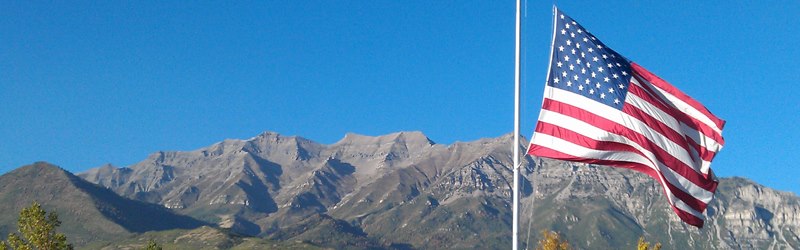
Mt. Timpanogos and the U.S. flag. Photo by Bob Walker of Orem, Utah; from Orem, circa September 2012. That's Mt. Baldy on the left. This site is about six miles from our old home in Pleasant Grove, Utah.

Mt. Timpanogos and the U.S. flag. Photo by Bob Walker of Orem, Utah; from Orem, circa September 2012. That’s Mt. Baldy on the left. This site is about six miles from our old home in Pleasant Grove, Utah, where we celebrated a few dozen Thanksgivings.

Fly  your flag on Thanksgiving — it’s one of about a score of dates Congress designated specially to fly the flag, in the U.S. flag code.

Americans load up this particular holiday with significance, often for no particular reason.  As a holiday, it is really rather uniquely American.  There were feasts of thanksgiving from time to time throughout recorded history, but most often they were one-shot affairs, after a particular event.

In America, Americans eagerly seized on the idea of one day set aside “to give thanks,” both with the religious overtones some wanted to see, and with the commercial overtones others wanted, especially during the Great Depression.  In our 238th year since the Declaration of Independence, the 225th year since the Constitution was enacted, we come to Thanksgiving as a major period of travel to old family homesteads, to Thanksgiving as a period of genuine thanks to American troops fighting in foreign lands half a world away, and as a commercial celebration that sucks the sobriety and spirituality out of all but the most dedicated of profiteers, or bargain hunters.

Vintage Thanksgiving greeting card, from HubPages

In the early 20th century, some people sent greeting cards for Thanksgiving; this is a tradition overtaken by Christmas, Hanukkah and New Years cards, today. (Image from HubPages, unknown year — credit for cards, “Images courtesy VintageHolidayCrafts.com

Thanksgiving often stumbled into controversy.  George Washington issued proclamations calling for a day of thanks, but struck out all references to Christianity.  Some president’s issued similar proclamations up to the Civil War, When Abraham Lincoln used the holiday as a time to remind  Americans that they had a lot to be thankful for, partly as a means to keep Americans focused on the war to be won, and keep supporting troops in the field.  During the Great Depression, Franklin D. Roosevelt juggled dates for Thanksgiving, moving it earlier in November to create a longer Christmas shopping season, hoping to stimulate sales, and thereby push America further out of the Depression.

In 2001 George W. Bush urged Americans to go shopping so terrorists would know America was not defeated by the attack on the World Trade Center, knowing that a stimulus to the economy would help garner support for other policies.

Vintage thanksgiving card, Boy riding turkey with American flag, from HubPages, original date unknown

Children riding large turkeys, waving American flags, made popular images in several years of the early 20th century.

2012 saw controversy over Big Box stores and other major, national retailers pushing their post- Thanksgiving, Christmas sales, into Thanksgiving day itself.  Is this fair to employees?  Is this too much emphasis on purchasing, and too little emphasis on family and giving thanks?

In 2014, we have the same arguments about Big Box stores pushing “Black Friday” into the holiday, and even more arguments about Christmas creep reducing the importance of Thanksgiving to Americans.

You can be sure of one thing:  It’s probably safe to fly your American flag on Thanksgiving, as Congress suggested.  It won’t make your turkey more moist  or your pumpkin pie taste any better.  It won’t boost your sales, if you’re a retailer, nor find you a bargain, if you’re a shopper.

If you have the flag, it costs nothing.  Flying the flag makes no particular religious statement, supports no particular political party, supports no one’s favorite football team.  Flying the flag earns you nothing, usually.

But as a free act of patriotism, support for our nation, and our troops, and a demonstration that even after a divisive election, we’re all one nation, it’s a pretty good deal.

Fly your flag today.

More:


November dates for flag flying

November 14, 2014

Already in November we’ve passed two of the month’s dates for which we are urged to fly the U.S. flag, election day, the first Tuesday after the first Monday in November by law (flag dates including local elections on whatever date, especially at polling places), and Veterans Day, or Armistice Day, on November 11, commemorating the date set for the armistice of World War I.

What could be left?

According to the U.S. Flag Code, 4 USC 1, sec. 6, we should fly the flag on all national holidays, which includes Thanksgiving, though most patriots are busier with turkey baking, football and family that day.

Several states entered the union in November; citizens and residents of those states fly the U.S. flag on those statehood days.

Most states would hope you’d fly the state’s flag on its statehood day, too.  But how many people actually have a state flay for their own state?  (We have a Texas flag; Texas may be the most state-flag-flying state; we also have a Maryland flag, which used to make for great displays when we flew both flags at our Maryland home.)

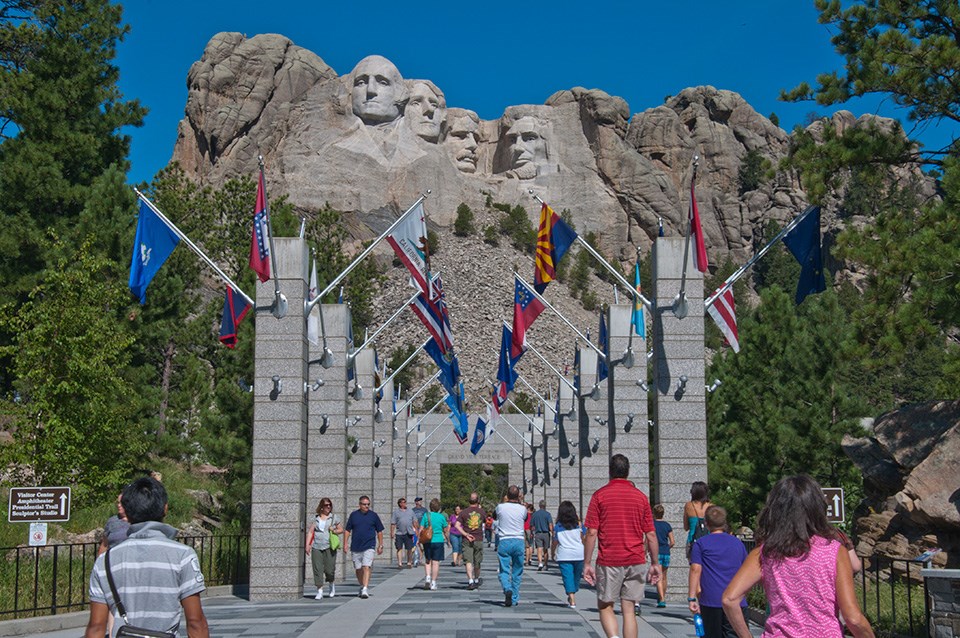
Avenue of the Flags at the Mt. Rushmore National Monument. National Park Service photo.

Avenue of the Flags at the Mt. Rushmore National Monument. Displayed are flags of all 50 states, plus territories, commonwealths and the federal district of the United Sates. National Park Service photo.

This year you may have missed a few already:

  • North Dakota, November 2 (1889, the  39th or 40th state), the same day as
  • South Dakota, November 2 (1889, the  39th or 40th state)
  • Montana, November 8 (1889, the 41st state)
  • Washington, November 11 (1889, the 42nd state) (but, hey, you were already flying your flag, right, Washingtonians?)

You can still catch two states’ statehood days:

  • Oklahoma, November 16 (1907, the 46th state)
  • North Carolina, November 21 (1789, the 12th state)

Veterans Day 2014 – Fly your flag today

November 11, 2014

Veterans Day in the U.S. falls on November 11, the date of the armistice that ended hostilities in World War I.  Under the U.S. flag code, and specific presidential proclamations, it is one of those days U.S. residents get called to fly their flags.

Veterans Day poster for 2014, from the U.S. Veterans Administration

Veterans Day poster for 2014, from the U.S. Veterans Administration

President Barack Obama issues a proclamation on Veterans Day every year.

Presidential Proclamation — Veterans Day, 2014

VETERANS DAY, 2014
– – – – – – –
BY THE PRESIDENT OF THE UNITED STATES OF AMERICA

A PROCLAMATION

Since the birth of our Nation, American patriots have stepped forward to serve our country and defend our way of life.  With honor and distinction, generations of servicemen and women have taken up arms to win our independence, preserve our Union, and secure our freedom.  From the Minutemen to our Post-9/11 Generation, these heroes have put their lives on the line so that we might live in a world that is safer, freer, and more just, and we owe them a profound debt of gratitude.  On Veterans Day, we salute the Soldiers, Sailors, Airmen, Marines, and Coast Guardsmen who have rendered the highest service any American can offer, and we rededicate ourselves to fulfilling our commitment to all those who serve in our name.

Today, we are reminded of our solemn obligation:  to serve our veterans as well as they have served us.  As we continue our responsible drawdown from the war in Afghanistan and more members of our military return to civilian life, we must support their transition and make sure they have access to the resources and benefits they have earned.  My Administration is working to end the tragedy of homelessness among our veterans, and we are committed to providing them with quality health care, access to education, and the tools they need to find a rewarding career.  As a Nation, we must ensure that every veteran has the chance to share in the opportunity he or she has helped to defend.  Those who have served in our Armed Forces have the experience, skills, and dedication necessary to achieve success as members of our civilian workforce, and it is critical that we harness their talent.

Across our country, veterans who fought to protect our democracy around the globe are strengthening it here at home. Once leaders in the Armed Forces, they are now pioneers of industry and pillars of their communities.  Their character reflects our enduring American spirit, and in their example, we find inspiration and strength.

This day, and every day, we pay tribute to America’s sons and daughters who have answered our country’s call.  We recognize the sacrifice of those who have been part of the finest fighting force the world has ever known and the loved ones who stand beside them.  We will never forget the heroes who made the ultimate sacrifice and all those who have not yet returned home.  As a grateful Nation, let us show our appreciation by honoring all our veterans and working to ensure the promise of America is within the reach of all who have protected it.

With respect for and in recognition of the contributions our service members have made to the cause of peace and freedom around the world, the Congress has provided (5 U.S.C. 6103(a)) that November 11 of each year shall be set aside as a legal public holiday to honor our Nation’s veterans.

NOW, THEREFORE, I, BARACK OBAMA, President of the United States of America, do hereby proclaim November 11, 2014, as Veterans Day.  I encourage all Americans to recognize the valor and sacrifice of our veterans through appropriate public ceremonies and private prayers.  I call upon Federal, State, and local officials to display the flag of the United States and to participate in patriotic activities in their communities. I call on all Americans, including civic and fraternal organizations, places of worship, schools, and communities to support this day with commemorative expressions and programs.

IN WITNESS WHEREOF, I have hereunto set my hand this seventh day of November, in the year of our Lord two thousand fourteen, and of the Independence of the United States of America the two hundred and thirty-ninth.

BARACK OBAMA

More: