Geography revolution, next wave: Ready in your classroom?

February 15, 2008

Depression presents a serious occupational hazard, moving back and forth between the classroom and business, classroom and internet. When do administrators and legislators get serious about catching up education?

Microsoft plans a product announcement at the end of this month. Rumors claim it’s a new version of Photosynth. Photosynth mades “3D” touring by computer possible for almost any destination.

I’ll wager not a single classroom in the nation is ready to make this work. If you disagree, I’d love to hear about the class that can make use of it.

System requirements for Photosynth won’t tax the computers that most high school gamers use, but they are beyond most of the classroom computers I’ve seen in the last five years.

Probably more to the point, curriculum designers in public schools don’t even have Google Earth on their horizons. Photosynth? I’ll wager it’s not even on the radar screens of GIS users in the nation’s Council of Governments (COGS).

Geography is an exploding discipline. GIS and computerized map programs make cell phone companies go, not to mention oil and gas exploration, coal mining, air pollution monitoring (for building new power plants, for example), and road building. GPS helps drive express shipping, and all other shipping. RFI and GPS together are revolutionizing retail.

You must know how to read a map just to get a job delivering pizza.

But 9th grade geography classes? The exciting stuff is absent today.

At the Texas Education Agency (TEA), officials fret about how to stop science from being taught in science classes, for fear the facts will skew the religious beliefs of their children. They need to worry about their children not even getting hired by the pizza delivery company for being ignorant of nature and science, and the maps that show them. In a competitive, technologically savvy world, inaction, dithering and damaging action by the TEA mean our kids won’t even have a prayer.

Relevant posts:


Cronkite narrates Texas water supply programs

February 10, 2008

And they are available for classroom use at a very modest price.

A couple of weeks ago I caught most of a program on water resources in Texas, from the Texas Parks and WildlifeDepartment. What caught my ear was the voice of Walter Cronkite, I thought.

Sure enough, it was Cronkite.

Texas Springs trailer image

TP&W produces a weekly program on the lands it manages, recreation and other issues dealing with land and environmental protection in Texas. The weekly programs come packed full of information and great photography — wise Texas history and geography teachers will see whether their local PBS station carries this program and tape it regularly.

Several times in the past five years TP&W produced special programs on Texas water resources. This one was produced in 2007:

Texas, the State of Springs: This hour-long documentary, narrated by Walter Cronkite, examines the alarming decline of Texas’ natural springs and addresses the current issues that directly impact spring flow and what can be done to save these vital resources.

Texas the State of Springs, initially aired on PBS stations across Texas on Thursday, February 15, 2007.

You may purchase a DVD copy of the documentary — and of two previous editions, one narrated by Cronkite and an earlier one narrated by Ray Benson of Asleep at the Wheel. They are available for $12.00 each, a bargain. Copyright expressly encourages use of these productions in classrooms.

Every middle school and high school in Texas should have a copy of these programs in their libraries. Perhaps your PTA would donate the $36.00 to put all three of them there?

Walter Cronkite, recording for Texas Parks & Wildlife

That’s the way it is!


What’s in a name? A Texas town by any other name . . .

January 12, 2008

. . . would still be a Texas town.

But Texas towns have some of the best names of towns in the U.S. Plus, there are a lot of Texas towns, plus 254 Texas counties.

Freckles Cassie at Political Teen Tidbits has a great list:

texas-road-map-tripinfodotcom.gif

Need to be cheered up?

Happy, Texas 79042
Pep, Texas 79353
Smiley, Texas 78159
Paradise, Texas 76073
Rainbow, Texas 76077
Sweet Home, Texas 77987
Comfort, Texas 78013
Friendship, Texas 76530

Go see the entire list — and maybe add a few of your favorites in the comments. An ambitious geography teacher could make a couple of great exercises out of those lists. “What’s the shortest distance one would have to drive to visit Paris, Italy, Athens and Santa Fe? How many could you visit in the shortest time?”

See updated version, here, with more links.


Park your camel, the music’s begun

January 12, 2008

As long as we’re in Mali anyway, why not arrive a couple of days early for this other music festival? Michael Kessler writes about the Festival du Chameau in the Sydney Morning Herald, “The sound of the desert blues”:

A week ago, when the doctor was jabbing me with yellow fever, polio and hepatitis shots and supplying malaria tablets, I’d tried imagining what a camel festival would look like. The Festival du Chameau [in its third year in 2008] is the brainchild of Tinariwen, the international darlings of world music – a group of Touareg nomadic musicians, purveyors of the desert blues, whose political past combined with their hypnotic electric guitars make them local heroes in this, the Adrar des Iforas region of Mali.

Toronto Globe and Mail reporter Stephanie Nolen accompanied a group of Inuit musicians to Mali, documented in a blog for the newspaper, Trail to Timbuktu; from her reports, we know the festival is underway, music is on the dunes:

There’s no down-in-front with a camel, really.

The 8th Festival in the Desert began a couple of hours ago, with several thousand people sitting and standing in the cool, white sand at the edge of the oasis at Essekane. The sun set just as the event kicked off, silhouetting robed men, veiled women and camels on all the surrounding ridges. On the small, raised stage there were speeches by notables including the local governor and Mali’s Minister of Culture.

Then the music began, with the opening provided by Tamnana, a traditional ensemble of men and women from Essekane who drum, chant, clap and ululate. They’re a big hit with the locals, and it turns out that demonstrations of musical appreciation hereabouts take the form of camel tricks. When the spirit moves them, nomads on camelback suddenly charge down from the dunes to the front of the stage, where they coax their camels down to “walk” on their front knees a much-admired feat. Or they dismount and launch sudden sword fights with phantom opponents, before swinging back up and charging the camel back and forth in front of the stage a few times. It’s the Tuareg version of the mosh pit, and it’s magical to watch, but it does tend to blot out the action on the stage.

Inuit performers in the sand at Essakane Festival, Mali, 2008 - photo by Stephanie Nolen, Toronto Globe and Mail

Inuit performers from Canada, in the sands at the Essakane Festival, Mali, 2008; photo by Stephanie Nolen, Toronto Globe and Mail.

News still travels slowly out of Mali’s desert, though. Most of the news about the Mali Festival in the Desert comes in the form of festival veterans spreading the music, in other, far-flung venuues.

Influences of the Essakane Festival of the Desert reach Salina, Kansas, where the Salina Journal talks about the music of Toubab Crewe, a group of North Caronlians who have performed at the big Mali festival in the past.

Oregon feels it, too: MacArthur Foundation grant recipient Corey Harris, a veteran bluesman whose work was featured in the PBS series on the blues, especially his work in Mali with the late Ali Farka Toure, performs at the Rogue Valley Blues Festival in Ashland, Oregon, on January 18 (that’s the Southern Oregon Mail Tribune, not Mali Tribune).

Mali, and Africa, have much more than just these few festivals. Why should we concern ourselves with the Essakane festival at all? Africa. PopMatters carries a column by journalist Mark Reynolds, reviewing events and arts in Africa in 2007, with a look to 2008. It’s a survey of events and publications, but it’s a good backgrounder for a high school student in Africa concerns, an article that should suggest connections to be made in geography, history, government and economics courses.

Thanks to Ann at Peoples Geography for the correction — Sydney Morning Herald.


Festival au Desert Essakane! January 10-12, 2008

January 10, 2008

BBC’s internet services carried this slide and sound account of the 2007 Essakane festival in far off Mali; this is one music festival I would really like to attend. Snippets of songs crop up on NPR or PRI (especially The World), and on PBS, and in record stores with really savvy staff — or where Putumayo discs are on sale. Everything I have heard from these festivals is very, very good.

Robert Plant helped make it famous with his 2003 performance. But its fame is relative; it’s famous only among a select group of people — those who have heard the music.

[Alas, Vodpod died, and the video that I had captured via that service seems to appear nowhere else on the web.  If you should find the piece by Paula Dear which the BBC broadcast in 2007, please note it in comments.]

Vodpod videos no longer available. from news.bbc.co.uk posted with vodpod

.

The festival is set for January 10-12 in 2008. Who is playing? Where are news stories? Where are the CDs? Here’s the official website.

Geography teachers, think of the possibilities this festival offers for fun in the classroom! Adam Fisher wrote about it for the New York Times a couple of years ago:

My real aim is Essakane, an obscure desert oasis a half-day’s drive beyond Timbuktu, and the site of what’s billed as the “most remote music festival in the world.” It’s a three-day Afro-pop powwow held by the Tuareg, the traditionally nomadic “blue people” of the Sahara.

It’s a tribe often feared for the banditry of its rebels and respected for the fact that it has never really been conquered. Historically its great power came from its role in the trans-Saharan trade in gold, slaves and salt. Even now, Tuareg caravans make the 15-day journey south from the northern salt mines to Timbuktu on the Niger River. They rest their camels during the day and use the stars to navigate at night. The skin tint of the nomads comes from the indigo dye they use for their turbans and robes, which leaves a permanent stain.

What more exciting stuff do you have in your classroom on the Tuareg? Does it resonate better with your teenagers than this story would?

Read the rest of this entry »


Addictive quizzes on world geography

January 4, 2008

Well, this is fairly addictive: The Travel IQ Quiz from TravelPod

I’d love to have every kid in the class with a computer to take this thing, or pieces of it, to drill on it, and I’d love the ability to add new stuff to it.

How’d you do? What do you think — are there classroom possibilities here?  (I’ve tried to make the widget work, below . . .)

This Traveler IQ
challenge is brought to you by the Web’s Original Travel Blog

Follow a graduate student to Antarctica

January 3, 2008

Penguin Burgers appears to be a blog of a graduate student who will be off to Antarctica on a project, working with a team at North Carolina State University.

The blog appears to be rather an afterthought, an add-on. But consider: What if your class were able to follow this guy to Antarctica, and keep up regular communication with him through the blog?

There’s some great potential there. I plan to watch. Looks like this fellow is really looking forward to the trip.


Test pressures hammer social studies instruction

December 19, 2007

He’s obviously a bright kid. He’s got good grades. It’s honors U.S. history, which is supposed to be rigorous, to prepare the kid for college studies.

But we’re drawing blanks from the kid on basic stuff: What’s the significance of 1776? Jamestown is in what state? Who was the commanding general of the American Revolution, George Washington or Abraham Lincoln? During the Civil War, on which side did Robert E. Lee fight? Or was he that dude from the Revolutionary War? Was the 1849 Gold Rush in Texas or California?

During the practice tests, he’s got all the skills: Two-colored markers to analyze the reading passages, circles and arrows to show which parts are important to consider. He can break the test question and reading down into all the “proper” parts, it’s a testing procedure he’s been practicing since third grade. After 8 years, he knows it well.

But he’s not sure whether the British fought in the American Civil War.

It’s a composite picture, but not composite enough for any of us to breathe the relief sigh. Too many students I get in class do not have the basic facts down that they need to make sense of anything else in the history course — or economics or geography course — that they struggle in now.

Many of these students have good test scores, too. The test doesn’t phase them, but their performance is not what it ought to be. Instead of acing the annual state exam, they take a couple of hours and complain that it’s a stupid exam with stupid questions.

We’ve taught them “tricks” to analyze the test questions, but they don’t have the background in the subject that they should have in order to quickly answer basic questions. The tricks get them through an exam, but it’s a poor substitute for knowing the material.

How does this happen?

Many schools across the nation have shorted social studies. Confronting pressure to raise average school test scores, basic social studies has been cut back in elementary and middle grades (kids know that stuff anyway, right?). Social studies is crowded out of the curriculum in favor of testing skills, or instruction in science and math.

I suspect much of the instruction in science and math is similarly shallow. Students learn how to analyze the test question, but they don’t know how to do the math required.

We know that students learn more when they spend more time on the learning tasks. Learning time is reduced for testing skills instruction.

Social studies take the hit particularly hard. According to a commentary by Judith Pace of the University of San Francisco, in Education Week this week (subscription may be required):

Surveys have reported reduced instructional time in various states, and organizations such as the National Council for the Social Studies have responded with letters and statements to Congress. Social studies educators have begun to lobby their lawmakers. But the apparent mainstream acceptance of drastic reductions in the amount of time and attention given to one of elementary education’s core academic subjects is shocking. We are in danger of losing a generation of citizens schooled in the foundations of democracy—and of producing high school graduates who are not broadly educated human beings.

In my own state of California, where history/social studies is not tested until 8th grade, this trend began with the state’s Public Schools Accountability Act of 1999, and has accelerated with the No Child Left Behind law. The social studies squeeze occurs disproportionately in low-performing schools with large minority and low-income populations that are under intense pressure to raise scores. And this, too, has alarming implications for educational opportunity and civic participation.

(More of Light’s commentary below the fold.)

One of the old saws of the quality movement in industry (now sadly abandoned in too many places) is “You get what you measure.” We measure average achievement. Consequently, we stifle outstanding achievement, and we don’t give most of the children the background they need to be good citizens.

I see it in students who just don’t know the basics. We should not need to spend time teaching that Abraham Lincoln was not at the Constitutional Convention, but was president during the Civil War.

Improving test scores may be hurting students’ core knowledge in essential areas.

What do we do about it? Comments are open, of course.

Read the rest of this entry »


Geography resource links, from a geography pro

December 6, 2007

A professional geographer?

Yeah, they exist — and it’s a booming area. Teachers miss these boats big time, I think, by not getting these professionals into the classroom to show what they do.

Think about it: Geography is a major concern for cellular telephone towers, which are still being constructed by the thousands across the nation. One of the best parts about work at PrimeCo PCS (which became part of Verizon Wireless) was the great sets of maps to work from. Visual data are much more powerful than print on a page; a great secret of PrimeCo’s success was massive use of maps, for the engineers to plan coverage, but also for site acquisition, sales, marketing, and everything else in between.

Consider the use of chips to track shipping palettes; consider the rise in GPS use. Geography is a key player in all transportation and development industries.

So, do your kids know that? Do they know they will be required to be geographically literate — and it can increase their income — when they get a job delivering pizza?

I digress. Here’s a guy, Scott McEachron, with a blog almost-offensively titled 3D – Paving the Way, which he aims to be a resource for users of Autocad 3D. (Oh, so we’re paving the way to using technology, and not laying down concrete and asphalt? Like I said, almost offensive).

His blog has a side bar that shows tremendous, free resources for professional geographers. Can teachers get some use out of these things? Go see: Check the widget titled “Freely Distributed GIS Data.” (Most of the data are free, mostly.)

These are pro resources. They don’t come neatly packaged with suggested lesson plans. You’re going to have to noodle around to see what’s usable in your class, and what is not.

(Dallas teachers? He’s a Dallas guy. Do I sense a guest speaker?)


Student project: Photography + cartography + internet

December 6, 2007

Ignoble Gases nicely describes the mashup between on-line mapping services and digital photography, with a bit of blogging thrown in.

Mapping services now have the capacity to link photographs of a site with its exact latitude and longitude, or exact address.  Maps of cities can feature links to photos of the site (other than satellite or aerial photos) submitted by readers, and other descriptive material.

So, geography teachers:  Have your kids mapped out your town and put it on the web to encourage tourism?  Great discussion topics:  What are the advantages of such technologies, and what are the parent-scaring disadvantages, or dangers of them?

I really cannot do justice to the concepts here — read the article at Ignoble Gases.


New landmarks

December 5, 2007

When a director wants a movie to demonstrate the British government, we get shots of Whitehall and Big Ben. When it’s the U.S. government to be invoked, the U.S. Capitol appears. A quintessential Russia image is the Kremlin. The Eiffel Tower evokes France. High school geography, history and government students should be able to recognize these sorts of landmarks to identify the nation or area in question.What about new landmarks? Brussels probably least penetrates the U.S. psyche of all the major European capitals. It’s a beautiful city, though, and a fun city, in my brief experience. Tradition and modernity mix and intermingle. While I stayed in a modern hotel, I strolled through plazas hundreds of years old. The city is easy to navigate, especially since it seems smaller than London or Paris, and until recently, it was largely unmarked by very tall buildings.

What will the landmarks be of the next 40 or 50 years? Dallas’s skyline shines at night with green neon outlining the city’s tallest building. Several other buildings retrofitted lights in blue, red and white, partly to compete — and of course, there is the red neon Pegasus, the symbol of the old, Dallas-based Magnolia Petroleum Co., which was bought up by Mobil, now a part of Exxon-Mobil. Lights give interesting ways to make new landmarks at night.

Brussels leaped into the bigtime with the recent opening of the Dexia Towers, a building that is lighted on the outside by a series of light-emitting diodes (LEDs) of various colors, at each window of the building. Will this become a hallmark of Brussels?

What other new structures will become common symbols in the next couple of decades?

Dexia Towers, Brussels - photo by Marc Vanderslagmolen

Doesn’t this photo make you want to go see the thing? 150,000 LEDs can be programmed for elaborate displays. Go see other photos at Room at the Top.


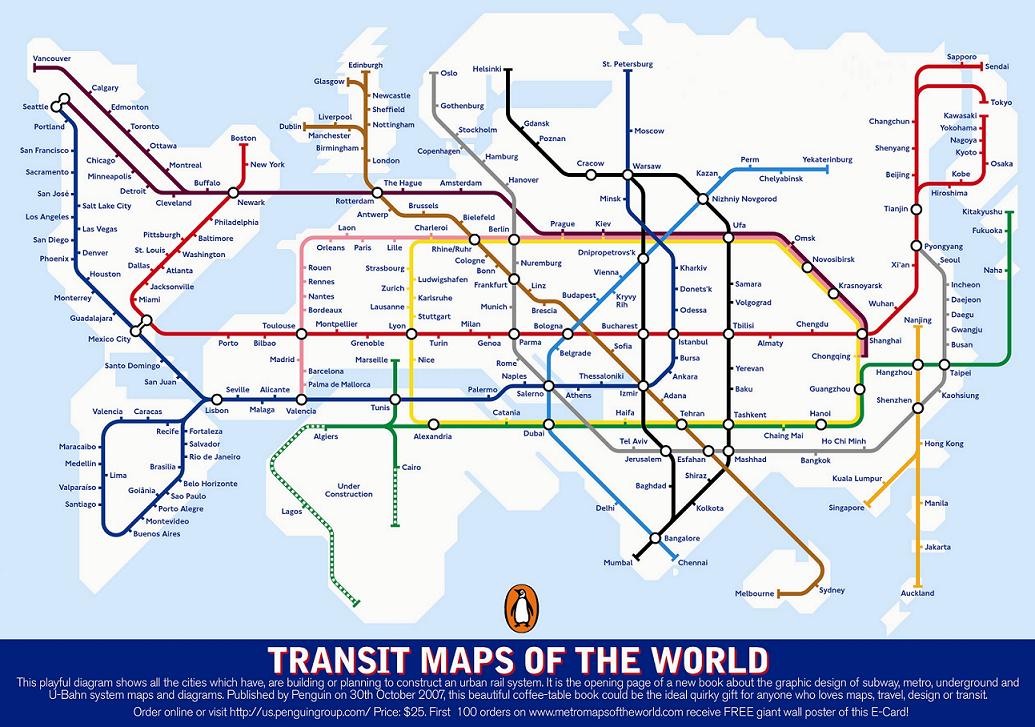
Geography bell ringer: What’s wrong with this map?

December 4, 2007

Penguin Transit Map of the World

Fun map. Readers at Strange Maps noted lots of geographical challenges in these train routes. Wouldn’t this make a great warm-up/bell-ringer, to have students find the geographical difficulties, errors and impossibilities?

And then there’s the book itself. The perfect gift for Dr. Jack Rhodes*, perhaps, or for Jim Lehrer, or someone else to whom transportation has been a great and grand pastime, as it has been for author Mark Ovenden.

Cover, Transit Maps of the World

Cool. Funny. Maybe instructive.

This would be a heckuva two-week study in geography, no? There are those great films on the construction of the New York subway system; there must be wonderful photos of the art in the Moscow system.

Or am I being too pedantic?

(Click thumbnail below for a larger view of the map.)

transit-map-of-world-ecardtransitmaps.jpg

Tip of the old scrub brush, and go visit, Strange Maps.

* Jack Rhodes was director of forensics at the University of Utah when I was an undergraduate there — my old debate coach. He was so familiar with bus and train schedules, as a hobbyist, that we frequently tried to stump him with questions about a passing train or bus we’d see driving around the nation. To my knowledge, he always got the name of the train right, and the bus’s scheduled next stop right. You sorta had to be there, but it was an amazing series of feats of memory.


Pragmatic, applied geography: Baghdad

November 27, 2007

Do your students ever ask why we bother to study geography? Consider these sources for a one-day exercise in geography, world history or U.S. history:

How U.S. forces took back Baghdad


al Quaeda map of Baghdad, used to take back Baghdad by U.S. forces

Geographic Travels with Catholicgauze alerts us to this interesting story of applied geography.

The map of Baghdad, above, was found in a raid on an al Quaeda house in the past year. It details the organization of al Quaeda, especially with regard to shipping guns, ammunition and explosives into Baghdad.

Armed with this knowledge, U.S. forces set about severing each of the cells from each other, separating the pieces of the snake to kill the beast.

Here is the New York Times story. (So much for wild claims that “mainstream media” do not cover such news.) Here is the Fox News story, with a link to a .pdf version of the map.

A map drawn by Al Qaeda in Iraq leader Abu Musab al-Zarqawi — who was killed last year by U.S. forces — turned up last December in an Al Qaeda safe house and essentially gave U.S. war planners insight into the terrorist group’s methods for moving explosives, fighters and money into Baghdad.

“The map essentially laid out how Al Qaeda controlled Baghdad. And they did it through four belts that surrounded the city, and these belts controlled access to the city for reinforcements and weapons and money,” said Maj. Gen. Bob Scales, a FOX News contributor who recently visited Iraq.

That’s what geographic knowledge can do. It can be the difference between peace and war, the difference between life and death.


Brits struggle to save Sherwood Forest

November 21, 2007

Worldwide fans of Robin Hood should be concerned: Sherwood Forest is not even a ghost of what it once was.

The Associated Press carried a story detailing efforts to preserve and revive the forest made famous by the stories of Robin Hood. 900-year-old oaks, encroaching development, a sense of history, and a need to save green space — it’s a good story for warm-up on conservation, development, historical myths, or England’s geography.


Oceans white with foam, mate!

November 19, 2007

This is cool. Natural phenomena, the stuff that makes geography really interesting — where and what is this? (Pictures from August 2007)

Surfer emerges from foam in New South Wales

It was as if someone had poured tons of coffee and milk into the ocean, then switched on a giant blender.

Suddenly the shoreline north of Sydney were transformed into the Cappuccino Coast.

Foam swallowed an entire beach and half the nearby buildings, including the local lifeguards’ centre, in a freak display of nature at Yamba in New South Wales.

One minute a group of teenage surfers were waiting to catch a wave, the next they were swallowed up in a giant bubble bath. The foam was so light that they could puff it out of their hands and watch it float away.

Perhaps a good geography warm-up: Where are these pictures from? What is the phenomenon shown in the photos? Why might it be unusual for these people to be swimming in the ocean in August?

Read the rest of this entry »