Annals of global warming: Climate change hammers the Adelie penguins

July 22, 2013

Adelie penguins struggle to survive changes in their nesting and feeding sites caused by warming air and waters around Antarctica

Adelie penguins struggle to survive changes in their nesting and feeding sites caused by warming air and waters around Antarctica

New, very short film from the E. O. Wilson Biodiversity Foundation highlights threats to Adelie penguins from climate change, already.  Actor and conservation activist Harrison Ford narrated “Ghost Rookeries, Climate Change and the Adelie Penguin.”

Details from the Biodiversity Foundation at their YouTube site:

Published on Jun 26, 2013

“Ghost Rookeries,” narrated by actor, conservationist, and member of the E.O. Wilson Biodiversity Foundation (EOWBF) Board of Advisors Harrison Ford, conveys the story of the Adelie Penguin, whose habitat—and thus the biodiversity of all of Antarctica—is being threatened by real-time environmental changes.

“The consequences of a loss of biodiversity could encompass everything from altering key Antarctic marine food chains to the loss of species that may hold cures to cancer,” writes Dr. James McClintock, whose recent book, ‘Lost Antarctica: Adventures in a Disappearing Land’ (Palgrave/MacMilllan, 2012), forms the basis of “Ghost Rookeries.”

The E.O. Wilson Biodiversity Foundation (EOWBF) and the Association of Zoos and Aquariums (AZA) will be embarking on an exciting new initiative beginning in the summer of 2013. Beginning with “Ghost Rookeries: Climate Change and the Adelie Penguin” (4 minutes, 2013), short videos produced by the EOWBF will be shown at select AZA-accredited zoos and aquariums located in the United States. With the vast reach of AZA-accredited zoos and aquariums, “Ghost Rookeries” and future videos will be seen by millions of visitors.

Dr. Paula Ehrlich, President and CEO of the EOWBF, calls “Ghost Rookeries” and the partnership with AZA “. . . a wonderful way to engage audiences about the importance of preserving our biological heritage through story. The Adelie Penguin is an iconic story, a symbol, of the real-time effect of climate change on biodiversity.”

“Ghost Rookeries” was produced by the E.O. Wilson Biodiversity Foundation, with the University of Alabama at Birmingham, and the the Tennessee Aquarium.

This film looks at a small part of the Adelie penguin population, on Torgerson Island, near Palmer Station.  This population symbolizes the difficulties of dealing with climate change, or even knowing what the effects will be.  Critics of pollution control to stop climate change argue that populations of all animals and plants will adapt.  Indeed the last decade saw a rise in total numbers of Adelies across Antarctic waters, and Gentoo penguins have set up new colonies to avoid warming air and waters.

More careful watchers note problems, though.  Warming air, and decreasing hard ice, brings more snow — nominally good, if one assumes the snow turns to ice.  In this case, the snows are brief, and they melt quickly.  It’s the cold meltwater that kills the chicks, drowning them.  This may be counterintuitive, or even ironic,  that warming causes a cold water seabird to drown, or die of hypothermia.  Nature is stranger than we can imagine, and often strange enough that it defies the understanding of scientifically-dilettante politicians.

Generally the loss of ice is the biggest problem for penguins; specific populations face entirely different threats, however, depending on the local effects of climate change.

Dr. Jim McClintock, in Antarctica.  A professor at the University of Alabama-Birmingham

Dr. Jim McClintock, in Antarctica. A professor at the University of Alabama-Birmingham, he wrote Antarctica Lost, upon which the film about the Adelie penguins is based.

The film is a short project based off of the work of Dr. Jim McClintock, an almost-legendary Antarctic researcher based out of the University of Alabama at Birmingham (UAB).  McClintock published a book on his work last year that deals with many different aspects of climate change in the Southern Ocean and its continental land mass, Lost Antarctica, Adventures in a Disappearing Land.

More:


Again: Why do we worry about global warming? It ain’t the climate, it’s the people

July 15, 2013

This is almost entirely an encore post, repeated for the benefit of the millions who missed it the first time who make fools of themselves when they argue we don’t need to save trees.  It’s not about trees.

Kids hiking in a forest. These are the humans environmentalists worry about, these four, and a few billion like them.  Photo from American Forests.

Kids hiking in a forest. These are the humans environmentalists worry about, these four, and a few billion like them. Photo from American Forests.

Alun Salt gave great advice about not bothering to engage idiots, pigs, denialists or trolls (here, among other places).  He said I should avoid lengthy answers to blogs that have little audience.

This is probably one of those occasions.

But in a running attempt to stimulate serious thought at a denialist blog, I got a question that has been rather common, and a question which indicates the deep serious misunderstanding denialists and even some well-meaning, overly-skeptical sensible people have:

Why worry about  climate change, since the climate is changing all the time?  Especially, why are people like Al Gore urging that we stop climate change, when CO2 has no great direct effect on human health?  Shouldn’t environmentalists be cheering climate change on, since it’s a “natural process?”

The answer is lost on the other blog, as Mr. Salt predicted it would be.  But since I’ve gotten some version of the question repeatedly in the last month, I may as well repeat the answer here, for the record.

The short answer to why we worry about climate change is that, as with almost all environmental protection, we are worried first about the quality of life of humans, and ultimately about the ability of human life to survive at all.

Here’s the question put to me there:

Ed I’m a little confused. I thought we were talking about the effect of co2 on the climate not the effect of co2 on human health. Co2 is not a toxic gas and would have no effect on human health. The fact that humans weren’t around when co2 was 10-20 times higher has absolutely nothing to do with its effect on climate.
Ed there was no runaway greenhouse effect [link added here] or climate catastrophe. The planet was fine during the phanerazoic. There is actually a lack of co2 in the atmopshere comapred to that time.

Here’s my answer, with a few more links than their format would allow:

No, you’re not a little confused.  You’re a lot confused, greatly misinformed, and not thinking hard.

We worry about CO2’s effects on climate only because we worry about the future of humanity.  Many of us who have children and wish them the same blessings of having children and grandchildren, have thought through the truth of the matter that we don’t possess and rule the Earth for ourselves, but instead act only as stewards for future generations.

No Earth, no humans; but at the same time, no habitable Earth, no humans.  In the long run, Earth doesn’t care.  It’ll do fine — without humans.

We can’t damage the planet.  We can only damage its habitability for humans.

I don’t know what sort of dystopian Randian future you and other Do Nothings hope for, but it’s a future contrary to human life, American values, and all known religions.

We’re talking about the future of humans.  I tell “skeptics,” “If you don’t care, butt out.  You’ll be dead in the short run anyway, but that’s no reason to stand in the way of action not to ensure a livable planet for our grandchildren.”

You also fail to understand chemistry, pollution, and how the world works.  CO2 is indeed a toxic gas.  For about a century now we’ve had indoor air standards that require air circulation to keep CO2 down below concentrations of about 500 5000 ppm [see comments], because at that level it starts to have dramatic effects on humans working.  It clouds their thinking and causes drowsiness.  CO2 is a conundrum, in that it is also necessary to trigger mammalian breathing.  If CO2 drops too low, we don’t take in enough oxygen and may pass out.  Too much oxygen in place of CO2 is a problem in that regard.  A substance can be both essential and a  pollutant, at the same time. (This has vexed food safety experts for years, especially after the 1958 Delaney Clause; substances we know to be essential nutrients can be carcinogenic, in the same concentrations, or in the same concentrations with a slight twist in chemical formula — how do we regulate that stuff?)

English: Main symptoms of carbon dioxide toxic...

Main symptoms of carbon dioxide toxicity (See Wikipedia:Carbon_dioxide#Toxicity). References: Toxicity of Carbon Dioxide Gas Exposure, CO2 Poisoning Symptoms, Carbon Dioxide Exposure Limits, and Links to Toxic Gas Testing Procedures By Daniel Friedman – InspectAPedia Davidson, Clive. 7 February 2003. “Marine Notice: Carbon Dioxide: Health Hazard”. Australian Maritime Safety Authority. Model: Mikael Häggström. To discuss image, please see Template talk:Häggström diagrams (Photo credit: Wikipedia)

CO2 is toxic in much greater proportions — it was a CO2 cloud that killed thousands in Cameroon 30 years ago or so, if you know history.

Clearly you did not know that we’ve regulated indoor CO2 for decades.  Clearly you haven’t looked at the medical journals‘ discussion on CO2 — and I’ll wager you’d forgotten the Cameroon incident, if you ever knew about it.

CO2 is a toxic gas (the dose is the poison); CO2 has dramatic effects on human health — too little and we die, too much and we die.

The fact that humans were not around when CO2 was much higher is exactly the point.  That was presented here, as it is in most venues, as support for a claim that we don’t need to worry about CO2 pollution.  Well, that’s right — if we don’t care about a habitable Earth.  But when CO2 was higher, life for humans was impossible.

I think it’s reckless to run an experiment on what would happen with higher CO2 levels, using the entire planet as a testing place, and testing the hypotheses on just how much CO2 will kill us all off, and how.

How about a control group, at least?

In the past, massive CO2 created massive greenhouse effects that would devastate us today — not as a toxic gas, but as a result of the warming that greenhouse gases do.

Let us understand the physical conundrum of CO2 here:  Without the greenhouse effect from the human-historic levels of CO2, this would be an ice planet.  Our lives today depend on the greenhouse effects of CO2.

Consequently, anyone who claims there is no greenhouse effect fails to understand physics, chemistry, biology and history.  (Heck, throw in geology, too.)  Life would be impossible but for the greenhouse effect.  Life is impossible without water, too, but you can’t live totally surrounded by water.

Can it be true that there can never be too much of a good effect, with regard to greenhouse gases?  Ancient Greek ideas of “all things in moderation” applies here.  We need a Goldilocks amount of CO2 in our atmosphere — not to much, not too little; not too hot, not too cold.

To the extent that higher CO2 levels didn’t produce a total runaway greenhouse effect, as some hypothesize exists on Venus, we know that was due to other feedbacks.  Early on, for example, CO2 began to be reduced by photosynthesizing life.  Animal life today would be impossible but for that occurrence.  Few if any modern chordates could breathe the very-low oxygen atmosphere of the early Earth, and live.  Those feedbacks and limiting situations do not exist today.

Greenhouse Effect

Greenhouse Effect. Wikipedia image

So now we face a double or triple whammy.  The reduction in CO2 in the air was accomplished through a couple billion years of carbon sequestration through plants.  In fact, a lot of carbon was sequestered in carbon-rich fossils, stuff we now call coal and oil.  Oxygen replenishment was accomplished with massive forests, and healthy oceans, with a great deal of photosynthesis.  This created a rough CO2 equilibrium (with fluctuations, sure) that existed we know for at least the last 50,000 years, we’re pretty sure for the last 100,000 years (we know that from carbon-dating calibration exercises).

Today we have removed fully 30% of the forests that used to replenish oxygen and lock up a lot of CO2 (some estimates say 50% of the forests are gone); modern plant communities cannot pluck CO2 out fast enough.  Plus, we’re releasing a lot of that old, sequestered carbon in coal and oil — at rates unprecedented in human history.

Will more CO2 warm the planet?  We know from the fact that the planet is warm enough for life, that more CO2 will warm the planet more.  Anyone who says differently does not know physics and chemistry, nor history.

Is there anything that can stop that effect?  Sure — healthy, massive forests, and healthy oceans.  Reducing carbon emissions could help a lot, too.  But we’re committed for about a century.  CO2 in the atmosphere doesn’t fall to the ground like particulate pollution.  it drifts until it is incorporated into something else, either through photosynthesis or other chemical reactions.  It takes a mole of CO2 a couple of centuries to come out of the air.  We’re stuck with elevated and elevating CO2 regardless our actions, for a century or two, even if we are wildly successful in reining in emissions and creating sequestration paths.

What happens when CO2 levels get higher than 350 ppm?  History, physics and chemistry tells us glaciers will melt, rainfall patterns will alter dramatically, sea levels will rise, carbon will be absorbed by the seas in increasing amounts (causing acidification — simple chemistry).  [See the counter in the right column of this blog; by July 2013, CO2 temporarily climbed above 400 ppm in a spike, and rested dangerously close to 400 ppm constantly.]

It’s a very exciting experiment.  The entire human race is at stake. How much CO2 will it take to produce the effects that kill us all?  It’s likely that changing rainfall patterns and rising sea levels will produce wars over resources, long before CO2 itself starts being physically toxic.  That’s what the Pentagon’s big thinkers say.  That’s what the Chinese big thinkers say, which is why they are working to reduce emissions even without an enforceable treaty.

As experiments go, I think it’s immoral to use humans in experimentation without getting their consent, and without passing the entire experiment through the Institutional Review Board to make sure the experiment is useful, necessary, and done ethically.

Do you have those consent statements?  All seven billion of them?  Have you got approval from the research overseers of the institution?

If you don’t have permission to proceed with this progeny-killing experiment, why do you propose to proceed?  Many people believe that, if the courts on Earth don’t get us, a higher court will.

How will you plead wherever the call to justice is delivered?

More:


Doubt climate change? Here, have a cigarette . . .

July 9, 2013

Colorado River runs dry, Peter McBried, Smithsonian

From Smithsonian Magazine: The Colorado River Runs Dry A boat casts a forlorn shadow in a dry river channel 25 miles from the river’s historical end at the Gulf of California. Photo by Peter McBride (Go see the entire slide show; spectacular and troubling images)

As John Mashey has been quietly but consistently warning us for some time . . .

From ClimateRealityProject.org:

Join us and stand up for reality. http://climaterealityproject.org – This film exposes the parallels between Big Tobacco‘s denial of smoking’s cancer-causing effects and the campaign against the science of climate change — showing that not only are the same strategies of denial at work, but often even the same strategists.

If you watched that all the way through, odds are high you’re not a denier.  If you can’t watch it, you really should think about it, hard.

More, and useful resources:


Annals of global warming: Arizona wildfires 2013 and “the new normal”

July 6, 2013

A burned home is seen in an unidentified neighborhood west of Highway 89 in Yarnell, Arizona July 3, 2013. Reuters

A burned home is seen in an unidentified neighborhood west of Highway 89 in Yarnell, Arizona July 3, 2013. Reuters, via International Business Times

From a much longer story you should read by Felicity Barringer and Kenneth Chang  in The New York Times, Tuesday, July 2, 2013, page A13 of the National Edition:

Since 1970, Arizona has warmed at a rate 0.72 degrees per decade, the fastest among the 50 states, based on an analysis of temperature data by Climate Central, an independent organization that researches and reports on climate. Even as the temperatures have leveled off in many places around the world in the past decade, the Southwest has continued to get hotter.

“The decade of 2001 to 2010 in Arizona was the hottest in both spring and the summer,” said Gregg Garfin, a professor of climate, natural resources and policy at the University of Arizona and the executive editor of a study examining the impact of climate change on the Southwest.

Warmer winters mean less snowfall. More of the winter precipitation falls as rain, which quickly flows away in streams instead of seeping deep underground.

The soils then dry out earlier and more quickly in May and June. “It’s the most arid time of year,” Dr. Garfin said. “It’s windy as well.”

The growing season also starts earlier, so there is more to burn.

“The fire season has lengthened substantially, by two months, over the last 30 years,” said Craig D. Allen, a research ecologist at the United States Geological Survey station at Bandelier National Monument in New Mexico.

The fire potential is exacerbated by the past policy, beginning around 1900, of putting out all fires. Fires are a natural way of clearing out the underbrush. With that natural rhythm disrupted, the flammable material piled up, so when it did catch fire, it ignited a giant fire that burned hotter and wider.

This total-suppression policy began to ease as early as the 1950s, when scientists began to see fire’s role in ecosystems. It was completely abandoned nearly two decades ago.

But in the 1970s, the Southwest entered a wet period, part of a climate cycle that repeats every 20 to 30 years. “That wet period helped keep a lid on fires,” Dr. Allen said. “And it also allowed the forests to fluff up.”

Since 1996, the climate pattern, known as the Pacific decadal oscillation, has swung to the dry end of the spectrum, and the region is caught in a long-term drought.

Stephen J. Pyne, one of the nation’s leading fire historians and a professor at Arizona State University, said, “How we live on the land, what we decide we put on public and private lands, how we do things and don’t do things on the land, changes its combustibility.”

In many landscapes, he added, “you’ve enhanced the natural combustibility” by building hundreds of thousands of homes in fire-prone areas, and for years suppressing natural fires, allowing a buildup of combustible materials like the “slash” debris left behind by logging.

The article explains how this is the dry phase of the Pacific Decadal Oscillation; so we can hope the wet phase will be wet enough to suppress fires.  However, the simple fact of additional effects brought on by PDO does not mean warming goes away when the PDO switches phases.  Note especially the lengthening fire season over three decades; incrementally, warming is making these well-known cycles, warmer, and too often, destructive or more destructive.

More: 

Sign welcoming visitors to Yarnell, Arizona:

Sign welcoming visitors to Yarnell, Arizona, with wildfire in the background: “Elevation 4,850 ft., ‘Where the desert breeze meets the mountain air.'” Sedonaeye.com image


English: Monthly values for the Pacific decada...

Monthly values for the Pacific decadal oscillation index, 1900 – 2010 Black line:121-month smooth Data source: http://jisao.washington.edu/pdo/PDO.latest (Photo credit: Wikipedia)


One more time: Basic climate science with Bill Nye

July 4, 2013

What year is this? 2013?

Shouldn’t the Sputnik Revolution in science education have obviated the need for this video, like 30 years ago?

One more time, the basics of climate change/global warming, with Bill Nye the Science Guy explaining; from the ClimateRealityProject.org:

http://vimeo.com/climatereality/climate101

climate change, CO2, global warming, science, Bill Nye, environmental protection, Clean Air, Air Pollution

More:

Newsweek, March 4, 1957,

Cover of Newsweek Magazine, from March 4, 1957; notice this concern about U.S. science competency came seven months before Sputnik was launched by the Soviet Union. Science deniers then delayed action until after the Soviets demonstrated clearly that the U.S. was behind. (Image from Computer History.org)


Annals of global warming: Keeling Curve gone vertical

June 22, 2013

What is the Keeling Curve?

What does it look like now?  See this graphic from the New York Times:

Keeling Curve graph and grahic, New York Times, May 11, 2013

New York Times, May 11, 2013

See the daily update of the Keeling Curve at the Scripps Institute site, University of California at San Diego.

More:


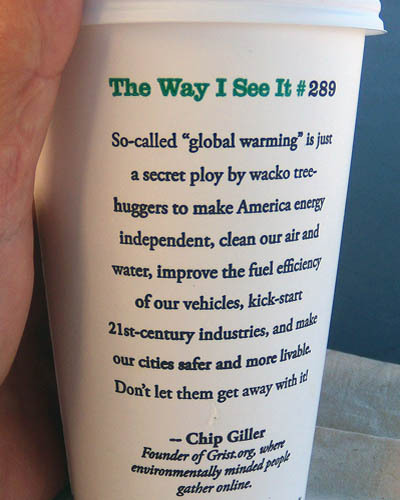
How about another cup of coffee? (Global Warming Conspiracy and Starbucks Cup #289)

June 19, 2013

Encore post from September 17, 2007, and August 2009 — maybe more appropriate today than ever before.

Found this on my coffee cup today (links added here):

The Way I See It #289

So-called “global warming” is just

a secret ploy by wacko tree-

huggers to make America energy

independent, clean our air and

water, improve the fuel efficiency

of our vehicles, kick-start

21st-century industries, and make

our cities safer and more livable.

Don’t let them get away with it!

Chip Giller
Founder of Grist.org, where
environmentally-minded people
gather online.

Starbucks Coffee Cup, The Way I See It #289 (global warming)

Look! Someone found the same cup I found!

I miss those old Starbucks cups — but then, they killed the Starbucks in our town.  I don’t buy the 100 cups of Starbucks coffee I used to get in a year.

More:

Save


Pay attention to the science: James Hansen proved right, critics wrong (reprise)

May 22, 2013

This is mostly a reprise of a post from October, in which we noted that climate scientist James Hansen‘s off-handed prediction of what might be warming damage to New York had come true.  Not that Hansen wanted it to ever occur, but Hansen’s conjecture had been the subject of great ridicule attempts in the warming [choose one: denialists’, critics’, apologists’s] Gish Gallop rebuttal attempts.

As it is again.  This time, a discussant pointed the Anthony Watts’s Carnival of Misbelief as the source of a claim which, the discussant said, proved liberals don’t like facts.

Here’s the run-up question, and my response:

http://twitter.com/EdDarrell/status/336945436613038080

Mr. Mears tried to extend his argument:

http://twitter.com/dave_mears/status/336963677947301889

He should have quit at bafflegab.  His link runs to Anthony Watts’s place, with the same attempted ridicule of James Hansen’s nightmare.

Watts made the same error Steve Goddard made, of course.  Watts corrected one erroneous detail — the time in which Hansen said it might occur — but tried to make the ridicule stick:

As of this update in March 2011, we’re 23 years into his prediction of the West Side Highway being underwater. From what I can measure in Google Earth, Dr. Hansen would need at least a ten foot rise in forty years to make his prediction work. See this image below from Google Earth where I placed the pointe over the West Side Highway, near the famous landmark and museum, the USS Intrepid:

According to Google Earth, the West Side Highway is 10 feet above sea level here – click to enlarge

The lat/lon should you wish to check yourself is: 40.764572° -73.998498°

We turn to the events of last October, and the storm that was Hurricane Sandy, which slammed into New Jersey and New York, and that same West Side Highway.

I noted in an earlier post, on October 30 of last year:

Over at Rabbett Run:

tonylearns said…
Could someone go over to Goddard’s blog for me ( I have been banned three times most recently for having the gall to suggest he was wrong in ridiculing the possibility of a new record minimum SIE this year. ) and ask for his apology to Hansen for ridiculing the possibility of the West Side Highway being underwater. I just saw a video showing the West Side Highway underwater.
29/10/12 7:46 PM

No! Someone whose comments don’t show up at Steve Goddard’s blog? Must be some massive disruption in the force of the Tubes of the Interweb thingy.

What is this guy Tony on about?

At Steve Goddard’s blog — this is the same guy who said the western drought was over because Lake Powell rose a few feet, though the drought raged on everywhere else — Goddard and his flying and limping monkeys have been poking fun at something James Hansen is alleged to have said:

According to NASA’s top scientist, Manhattan has been underwater for the past four years, and is experiencing a horrific drought.

While doing research 12 or 13 years ago, I met Jim Hansen, the scientist who in 1988 predicted the greenhouse effect before Congress. I went over to the window with him and looked out on Broadway in New York City and said, “If what you’re saying about the greenhouse effect is true, is anything going to look different down there in 20 years?” He looked for a while and was quiet and didn’t say anything for a couple seconds. Then he said, “Well, there will be more traffic.” I, of course, didn’t think he heard the question right. Then he explained, “The West Side Highway [which runs along the Hudson River] will be under water. And there will be tape across the windows across the street because of high winds. And the same birds won’t be there. The trees in the median strip will change.” Then he said, “There will be more police cars.” Why? “Well, you know what happens to crime when the heat goes up.”

And so far, over the last 10 years, we’ve had 10 of the hottest years on record. [Quoting an article at Salon]

The West Side Highway under water?  Ha.

Goddard’s blog has used Hansen’s quote as a regular punchline, not noticing that Hansen said “in 20 to 30 years,” and assuming he was just awfully, comically wrong.  30 years from 1988 will be 2018.  This year is 2012, six years to go.  Goddard tried to ridicule Hansen a few times over the past couple of years, for example:

  1. Here on October 4, 2010;
  2. Here on October 10, 2010;
  3. Here on November 13, 2010;
  4. Here on December 19, 2010 (with a photo of Al Gore, Barack Obama and an unidentified guy, maybe Goddard himself?);
  5. Here on January 15, 2011;
  6. Again on March 14, 2011;
  7. A special St. Patrick’s Day posting, March 17, 2011;
  8. Here on April 9, 2011;
  9. Here on May 22, 2011;
  10. Here on May 30, 2011; and obviously running out of comedy material, Goddard went for two in one day,
  11. Here on May 30, 2011, and by this time it’s such a regular meme attempting to mock James Hansen with same old material, Goddard doesn’t refer to the actual quote from Hansen;
  12. Here on June 15, 2011;
  13. Here on July 20, 2011;
  14. Here on July 21, 2011;
  15. Here on August 25, 2011;
  16. Here on May 7, 2012;
  17. Here on May 8, 2012;
  18. Here on May 23, 2012;
  19. June 25, 2012;
  20. August 9, 2012;
  21. August 23, 2012;
  22. August 31, 2012;
  23. September 28, 2012.

AP may complain about this use, but this is an academic, learning exercise:

Photo showing West Side Highway underwater from Hurricane Sandy

Caption from Yahoo! News: This photo provided by Dylan Patrick shows flooding along the Westside Highway near the USS Intrepid as Sandy moves through the area Monday, Oct. 29, 2012 in New York. Much of New York was plunged into darkness Monday by a superstorm that overflowed the city’s historic waterfront, flooded the financial district and subway tunnels and cut power to nearly a million people. (AP Photo/Dylan Patrick) MANDATORY CREDIT: DYLAN PATRICK

Dylan Patrick got the photographic evidence that shows, once again, warming denialists really are a classless, fact-lacking bunch.  CNN has photos from Dylanphoto1 (the same guy, almost certainly), in a slide show, noting, “Most of the Westside Highway south of 49th street is flooded all the way down, and in front of the USS Intrepid.”  Across from Pier 88 and the USS Intrepid, the street is indeed underwater.

So we learn that, as a comedian, Steve Goddard has an extremely limited range and depends on a sympathetic room to get laughs; and as a climate scientist, he is even more limited, and wrong, with 6 years to go in the 20 to 30 year range James Hansen offered.  And we learn once again, sadly, that James Hansen was right back in 1988 when he hit the claxons to warn us of global warming.

23 times Goddard repeated the charge?  Do you get the idea that “climate skeptics” ran out of material years ago, and have been dancing a cover-up for a very, very long time?  Hurricane Sandy blew and floated his claim away.

In this reprise post, I add three photos to make it even more clear what happened:

West Side Highway at Pier 88, flooded

From CNN: By dylanphoto1 | Posted October 29, 2012 | NYC, NY, New York — CNN PRODUCER NOTE dylanphoto1 told me, ‘It was fairly quiet with large gusts of wind and some rain. There were other people out and about taking photos and commenting on how crazy it is to see the water covering the highway. Cops were out chasing people off the highway.’

Yes, Dear Reader, that is indeed Pier 88.  New Yorkers probably recognize it as the berthing place of the U.S.S. Intrepid, the same ship Watts shows in his photo, while laughingly promising that the West Side Highway would never be flooded by the ocean at that spot.  Never?

West Side Highway flooded by Sandy, at Pier 88

CNN image, photo by dylanphoto1; in this view, Pier 88’s denizen, the U.S.S. Intrepid, can clearly be seen by the name on the stern of the ship.

One more photo from dylanphoto1:

Pier 88 during Sandy - CNN image from dylanphoto1

At New York City’s Pier 88, the U.S.S. Intrepid, with the West Side Highway in the foreground, covered by surging and rising ocean waters.

So there you have it.  Some conservatives will deny the science they claim to cling to, blaming liberals or James Hansen for being right all along.

Is this stuff from the anti-warms the Cargo Cult Science Dr. Feynman warned us about, do you think?

More (list from the October post):

Even more, a bit later:

And even more, from May 2013:


Meanwhile, back at the rice paddy, global warming holds families hostage . . .

May 1, 2013

See this United Nations Development Program ten-minute video that, to the wise and concerned, lays out the stakes of delaying action against human-caused climate change.

Without enough funding, NGOs work to help farmers getting hammered in the Southern Philippines, and other places.

In the Southern Philippines, farmers’ lives and the weather are intimately interwoven, but something is changing, now that the rains in Agusan del Norte are too heavy, the sun shines too fiercely. Now there’s hope for poor farmers with the community-based approach monitoring and Weather Index-Based Insurance packages, to warn people when heavy weather is on the way.

Though, I do weary of the astonishing abuse of acronyms in this work-of-the-angels. “WIBI?”

Incidentally, though the phrase doesn’t appear anywhere in this material, this is exactly the sort of work carried on by the UN’s Agenda 21 project.  Doesn’t look subversive to me.

Tip of the old scrub brush to the UNDP and ILO Tweet:

More:

Map of the Philippines with Agusan del Norte h...

Map of the Philippines with Agusan del Norte highlighted. Wikipedia image


Annals of global warming: No, polar bears are not “fine” — suffer from loss of sea ice

March 20, 2013

Press release from The Journal of Animal Ecology (links added here):

For polar bears, it’s survival of the fattest

One of the most southerly populations of polar bears in the world – and the best studied – is struggling to cope with climate-induced changes to sea ice, new research reveals. Based on over 10 years’ data the study, published in the British Ecological Society‘s Journal of Animal Ecology, sheds new light on how sea ice conditions drive polar bears’ annual migration on and off the ice.

Led by Dr. Seth Cherry of the University of Alberta, the team studied polar bears in western Hudson Bay, where sea ice melts completely each summer and typically re-freezes from late November to early December. “This poses an interesting challenge for a species that has evolved as a highly efficient predator of ice-associated seals,” he explains. “Because although polar bears are excellent swimmers compared with other bear species, they use the sea ice to travel, hunt, mate and rest.”

Polar bear and two cubs wait for ice to reform

Caption from EurekAlert: An adult female polar bear wearing a GPS-satellite linked collar with her two 10-month-old cubs waits for the sea ice to re-form onshore in western Hudson Bay, Manitoba, Canada. Photo Copyright Andrew Derocher, Univeristy of Alberta.

Polar bears have adapted to the annual loss of sea ice by migrating onto land each summer. While there, they cannot hunt seals and must rely on fat reserves to see them through until the ice returns.

Dr. Cherry and colleagues wanted to discover how earlier thawing and later freezing of sea ice affects the bears’ migration. “At first glance, sea ice may look like a barren, uniform environment, but in reality, it’s remarkably complex and polar bears manage to cope, and even thrive, in a habitat that moves beneath their feet and even disappears for part of the year. This is an extraordinary biological feat and biologist still don’t fully understand it,” he says.

From 1991-97 and 2004-09, they monitored movements of 109 female polar bears fitted with satellite tracking collars. They tagged only females because males’ necks are wider than their heads, so they cannot wear a collar. During the same period, the team also monitored the position and concentration of sea ice using satellite images.

“Defining precisely what aspects of sea ice break-up and freeze-up affect polar bear migration, and when these conditions occur, is a vital part of monitoring how potential climate-induced changes to sea ice freeze-thaw cycles may affect the bears,” he says.

The results reveal the timing of polar bears’ migration can be predicted by how fast the sea ice melts and freezes, and by when specific sea ice concentrations occur within a given area of Hudson Bay.

According to Dr. Cherry: “The data suggest that in recent years, polar bears are arriving on shore earlier in the summer and leaving later in the autumn. These are precisely the kind of changes one would expect to see as a result of a warming climate and may help explain some other studies that are showing declines in body condition and cub production.”

Recent estimates put the western Hudson Bay polar bear population at around 900 individuals. The population has declined since the 1990s, as has the bears’ body condition and the number of cubs surviving to adulthood.

Young polar bear challenged by lack of sea ice, Andrew Derocher photo

Caption from EurekAlert: This is a subadult polar bear on a lake on the shores of Hudson Bay in Manitoba, Canada in November waiting for the sea ice to re-form. Copyright Andrew Derocher, Univeristy of Alberta.

Because polar bears’ main food source is seals, and these are hunted almost exclusively on sea ice, the longer bears spend on land, the longer they must go without energy-rich seals. “Climate-induced changes that cause sea ice to melt earlier, form later, or both, likely affect the overall health of polar bears in the area. Ultimately, for polar bears, it’s survival of the fattest,” says Dr. Cherry.

He hopes the results will enable other scientists and wildlife managers to predict how potential climate-induced changes to sea ice freeze-thaw cycles will affect the ecology, particularly the migration patterns, of this iconic species.

###

Seth Cherry et al (2013). ‘Migration phenology and seasonal fidelity of an Arctic marine predator in relation to sea ice dynamics’, doi: 10.1111/1365-2656.12050, is published in the Journal of Animal Ecology on Wednesday 20 March 2013.

More:


Annals of global warming: NASA finds amplified greenhouse effects shift northern growing seasons

March 11, 2013

Global warming affects plants in northern hemisphere, NASA chart

From NASA: Of the 10 million square miles (26 million square kilometers) of northern vegetated lands, 34 to 41 percent showed increases in plant growth (green and blue), 3 to 5 percent showed decreases in plant growth (orange and red), and 51 to 62 percent showed no changes (yellow) over the past 30 years. Satellite data in this visualization are from the AVHRR and MODIS instruments, which contribute to a vegetation index that allows researchers to track changes in plant growth over large areas. Credit: NASA’s Goddard Space Flight Center Scientific Visualization Studio; click image for original view; click here for greater detail

Press release from NASA, March 10, 2013 (links in text added here):

RELEASE : 13-069


Amplified Greenhouse Effect Shifts North’s Growing Seasons

WASHINGTON — Vegetation growth at Earth’s northern latitudes increasingly resembles lusher latitudes to the south, according to a NASA-funded study based on a 30-year record of land surface and newly improved satellite data sets.

An international team of university and NASA scientists examined the relationship between changes in surface temperature and vegetation growth from 45 degrees north latitude to the Arctic Ocean. Results show temperature and vegetation growth at northern latitudes now resemble those found 4 degrees to 6 degrees of latitude farther south as recently as 1982.

“Higher northern latitudes are getting warmer, Arctic sea ice and the duration of snow cover are diminishing, the growing season is getting longer and plants are growing more,” said Ranga Myneni of Boston University’s Department of Earth and Environment. “In the north’s Arctic and boreal areas, the characteristics of the seasons are changing, leading to great disruptions for plants and related ecosystems.”

The study was published Sunday in the journal Nature Climate Change.

Myneni and colleagues used satellite data to quantify vegetation changes at different latitudes from 1982 to 2011. Data used in this study came from NOAA’s Advanced Very High Resolution Radiometers (AVHRR) onboard a series of polar-orbiting satellites and NASA’s Moderate Resolution Imaging Spectroradiometer (MODIS) instruments on the Terra and Aqua satellites.

As a result of enhanced warming and a longer growing season, large patches of vigorously productive vegetation now span a third of the northern landscape, or more than 3.5 million square miles (9 million square kilometers). That is an area about equal to the contiguous United States. This landscape resembles what was found 250 to 430 miles (400 to 700 kilometers) to the south in 1982.

“It’s like Winnipeg, Manitoba, moving to Minneapolis-Saint Paul in only 30 years,” said co-author Compton Tucker of NASA’s Goddard Space Flight Center in Greenbelt, Md.

The Arctic’s greenness is visible on the ground as an increasing abundance of tall shrubs and trees in locations all over the circumpolar Arctic. Greening in the adjacent boreal areas is more pronounced in Eurasia than in North America.

An amplified greenhouse effect is driving the changes, according to Myneni. Increased concentrations of heat-trapping gasses, such as water vapor, carbon dioxide and methane, cause Earth’s surface, ocean and lower atmosphere to warm. Warming reduces the extent of polar sea ice and snow cover, and, in turn, the darker ocean and land surfaces absorb more solar energy, thus further heating the air above them.

“This sets in motion a cycle of positive reinforcement between warming and loss of sea ice and snow cover, which we call the amplified greenhouse effect,” Myneni said. “The greenhouse effect could be further amplified in the future as soils in the north thaw, releasing potentially significant amounts of carbon dioxide and methane.”

To find out what is in store for future decades, the team analyzed 17 climate models. These models show that increased temperatures in Arctic and boreal regions would be the equivalent of a 20-degree latitude shift by the end of this century relative to a period of comparison from 1951-1980.

However, researchers say plant growth in the north may not continue on its current trajectory. The ramifications of an amplified greenhouse effect, such as frequent forest fires, outbreak of pest infestations and summertime droughts, may slow plant growth.

Also, warmer temperatures alone in the boreal zone do not guarantee more plant growth, which also depends on the availability of water and sunlight.

“Satellite data identify areas in the boreal zone that are warmer and dryer and ¬¬other areas that are warmer and wetter,” said co-author Ramakrishna Nemani of NASA’s Ames Research Center in Moffett Field, Calif. “Only the warmer and wetter areas support more growth.”

Researchers did find found more plant growth in the boreal zone from 1982 to 1992 than from 1992 to 2011, because water limitations were encountered in the latter two decades.

Data, results and computer codes from this study will be made available on NASA Earth Exchange (NEX), a collaborative supercomputing facility at Ames. NEX is designed to bring scientists together with data, models and computing resources to accelerate research and innovation and provide transparency.

For more information and images associated with this release, visit:

http://go.nasa.gov/12Amv2s

– end –


text-only version of this release

More:


Punchline too brutal for work: Why it is that environmentalists are the real humanitarians (a necessary encore)

March 1, 2013

I wish it weren’t true.  I wish people didn’t appear to be getting stupider, less scientifically literate, and less knowledgeable of history (see Santayana‘s thoughts in the upper right-hand corner of the blog . . .).  My e-mail box is filling today with notes from people claiming environmentalists want to rid the Earth of humans, urging that we should oppose them and let poisoning of our air and water continue . . . oblivious to the irony of the claim coupled with their supposed opposition to the idea.  Here’s the truth, in large part, an encore post from several months ago (I apologize in advance for the necessary profanity):

The fictional but very popular memes that environmentalists hate humans, humanity and capitalism wouldn’t bother me so much if they didn’t blind their believers to larger truths and sensible policies on environmental protection.

One may argue the history of the environmental movement, how most of the originators were great capitalists and humanitarians — think Andrew Carnegie, Laurance Rockefeller, Theodore Roosevelt, Gifford Pinchot, and all the early medical doctors who warned of the dangers of pollution-caused diseases — but it falls on deaf ears on the other sides.

Here’s the 30-second response, from Humon, in cartoon form (or here, at Humon Comics):

First panel of cartoon by Humon at Deviant Art

Mother Gaia explains why environmental protection is important, from Humon at Deviant Art

Facts of life and environmental protection – from Humon at Deviant Art

Tip of the old scrub brush to P. Z. Myers, and Mia, whoever she is.  Myers noted, “Environmentalism is actually an act of self defense.”

More:

Wall of Shame; sites that don’t get it, or intentionally tell the error:

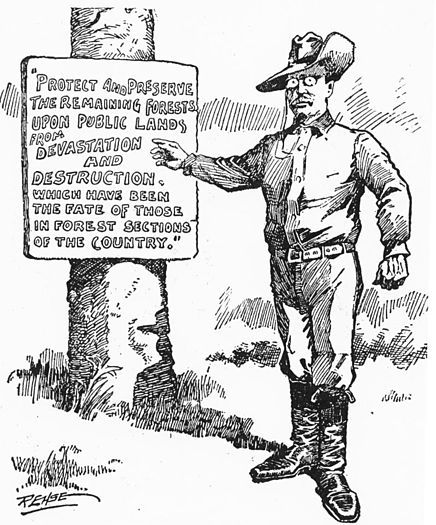
1908 editorial cartoon of President Theodore Roosevelt as “A Practical Forester.”  Source: St. Paul Minnesota “Pioneer Press”. Via GPO's Government Book Talk blog.

1908 Rense editorial cartoon of President Theodore Roosevelt as “A Practical Forester.” Source: St. Paul Minnesota “Pioneer Press”. Via GPO’s Government Book Talk blog.


Anthony Watts’s political push poll, “Gore or Obama?”

February 9, 2013

Al Gore and Barack Obama together in Detroit, June 2012, Rebecca Cook photo for Reuters, via NBC News photo

Al Gore and Barack Obama don’t appear to be on the opposite side of most issues, especially not climate change. Here they appear together in Detroit, circa June 11, 2012 – Rebecca Cook photo for Reuters, via NBC News photo

Anthony Watts strays farther and further from science with every passing day, and most of his new posts.

At the moment he’s got a doozy of a post, citing a bovine excrement question on a CFACT billboard, and offering a push-poll with three choices designed to push Watts’s preferred political answer, that ‘Obama and Gore go in different directions on global warming and climate change, and maybe they are both wrong.’   The end message Watts pushes is wrong, as you can see in the full texts below.(Morgan, here’s the link so you don’t have to flounder around with Google.)

Who do you believe?

◊  Barack Obama
◊  Neither one
◊  Al Gore

It’s based on these two quote mine products from the CFACT billboard:

WHAT DO YOU BELIEVE?

“Hurricane Sandy is a disturbing sign of things to come.”  — Al Gore, 10/30/2012

“We can’t attribute any particular weather event to global warming.”  — Barack Obama, 11/14/2012

Lying with quotes, demonstrated by CFACT

Propaganda group CFACT’s quote mining billboard, on which Anthony Watts’s push-poll is based.

Watts doesn’t offer a “both correct” choice.  That would be the accurate answer.

Gore’s comment at his blog on October 30, 2012, noted that while we can’t attribute the formation of Sandy to climate change, the effects of the storm were magnified by climate change.  Gore called that “disturbing.”

Obama, noting that while we can’t say for certain that any particular storm is caused entirely from human-created global warming, the long-term effects clearly have human causation and we need to act to stop it.

In short, Gore and Obama take the same side on this issue, the side of science and making sound public policy.  Watts works the old tobacco company strategy, suggesting that wherever studies showing health harms from tobacco differ from each other in the slightest jot or tittle, that means scientists can’t decide whether tobacco is harmful — substitute “human-caused climate change” for tobacco in that argument, and you see what Watts is trying to do.

Meanwhile, the Earth still warms:

Gore’s blog post in full:

Statement on Hurricane Sandy October 30, 2012 : 1:21 PM

This week, our nation has anxiously watched as Hurricane Sandy lashed the East Coast and caused widespread damage–affecting millions. Now more than ever, our neighbors need our help. Please consider donating or volunteering for your local aid organizations.

The images of Sandy’s flooding brought back memories of a similar–albeit smaller scale– event in Nashville just two years ago. There, unprecedented rainfall caused widespread flooding, wreaking havoc and submerging sections of my hometown. For me, the Nashville flood was a milestone. For many, Hurricane Sandy may prove to be a similar event: a time when the climate crisis—which is often sequestered to the far reaches of our everyday awareness became a reality.

While the storm that drenched Nashville was not a tropical cyclone like Hurricane Sandy, both storms were strengthened by the climate crisis. Scientists tell us that by continually dumping 90 million tons of global warming pollution into the atmosphere every single day, we are altering the environment in which all storms develop. As the oceans and atmosphere continue to warm, storms are becoming more energetic and powerful. Hurricane Sandy, and the Nashville flood, were reminders of just that. Other climate-related catastrophes around the world have carried the same message to hundreds of millions.

Sandy was also affected by other symptoms of the climate crisis. As the hurricane approached the East Coast, it gathered strength from abnormally warm coastal waters. At the same time, Sandy’s storm surge was worsened by a century of sea level rise. Scientists tell us that if we do not reduce our emissions, these problems will only grow worse.

Hurricane Sandy is a disturbing sign of things to come. We must heed this warning and act quickly to solve the climate crisis. Dirty energy makes dirty weather.

President Obama’s statement, excerpted from his November 14, 2012, press conference:

THE PRESIDENT:  Mark Landler.  Where’s Mark?  There he is right in front of me.

Q    Thank you, Mr. President.  In his endorsement of you a few weeks ago, Mayor Bloomberg said he was motivated by the belief that you would do more to confront the threat of climate change than your opponent.  Tomorrow you’re going up to New York City where you’re going to, I assume, see people who are still suffering the effects of Hurricane Sandy, which many people say is further evidence of how a warming globe is changing our weather.  What specifically do you plan to do in a second term to tackle the issue of climate change?  And do you think the political will exists in Washington to pass legislation that could include some kind of a tax on carbon?

THE PRESIDENT:  As you know, Mark, we can’t attribute any particular weather event to climate change.  What we do know is the temperature around the globe is increasing faster than was predicted even 10 years ago.  We do know that the Arctic ice cap is melting faster than was predicted even five years ago.  We do know that there have been extraordinarily — there have been an extraordinarily large number of severe weather events here in North America, but also around the globe.

And I am a firm believer that climate change is real, that it is impacted by human behavior and carbon emissions.  And as a consequence, I think we’ve got an obligation to future generations to do something about it.

Now, in my first term, we doubled fuel efficiency standards on cars and trucks.  That will have an impact.  That will take a lot of carbon out of the atmosphere.  We doubled the production of clean energy, which promises to reduce the utilization of fossil fuels for power generation.  And we continue to invest in potential breakthrough technologies that could further remove carbon from our atmosphere.  But we haven’t done as much as we need to.

So what I’m going to be doing over the next several weeks, next several months, is having a conversation, a wide-ranging conversation with scientists, engineers, and elected officials to find out what can — what more can we do to make a short-term progress in reducing carbons, and then working through an education process that I think is necessary — a discussion, a conversation across the country about what realistically can we do long term to make sure that this is not something we’re passing on to future generations that’s going to be very expensive and very painful to deal with.

I don’t know what either Democrats or Republicans are prepared to do at this point, because this is one of those issues that’s not just a partisan issue; I also think there are regional differences.  There’s no doubt that for us to take on climate change in a serious way would involve making some tough political choices.  And understandably, I think the American people right now have been so focused, and will continue to be focused on our economy and jobs and growth, that if the message is somehow we’re going to ignore jobs and growth simply to address climate change, I don’t think anybody is going to go for that.  I won’t go for that.

If, on the other hand, we can shape an agenda that says we can create jobs, advance growth, and make a serious dent in climate change and be an international leader, I think that’s something that the American people would support.

So you can expect that you’ll hear more from me in the coming months and years about how we can shape an agenda that garners bipartisan support and helps move this agenda forward.

Q    Sounds like you’re saying, though, in the current environment, we’re probably still short of a consensus on some kind of attack.

THE PRESIDENT:  That I’m pretty certain of.  And, look, we’re still trying to debate whether we can just make sure that middle-class families don’t get a tax hike.  Let’s see if we can resolve that.  That should be easy.  This one is hard — but it’s important because one of the things that we don’t always factor in are the costs involved in these natural disasters; we just put them off as something that’s unconnected to our behavior right now.  And I think what — based on the evidence we’re seeing, is that what we do now is going to have an impact and a cost down the road if we don’t do something about it.

In context, can you point to any points of conflict between what Al Gore said in October, and what President Obama said a couple of weeks later?  To me it looks as if they’re singing very much from the the same hymnal or songbook, and they’re in harmony, if not unison, especially in what I’ve turned into red-letter text.

Here’s the video of the entire Obama press conference (climate question comes at 42:19 in the video transcript):

More:


Annals of global warming: NASA data show warming continues through 2012

January 16, 2013

This is a press release from NASA, presented here for the record, text unedited except for formatting where necessary, and the deletion of the press office phone numbers (I hope that’s not necessary, but earnest information seekers have links to get the information they seek).  Images are inserted from other, related NASA sites.

Steve Cole
Headquarters, Washington
stephen.e.cole@nasa.gov

Leslie McCarthy
Goddard Institute for Space Studies, New York
leslie.m.mccarthy@nasa.gov

Jan. 15, 2013

RELEASE : 13-021

NASA Finds 2012 Sustained Long-Term Climate Warming Trend

WASHINGTON — NASA scientists say 2012 was the ninth warmest of any year since 1880, continuing a long-term trend of rising global temperatures. With the exception of 1998, the nine warmest years in the 132-year record all have occurred since 2000, with 2010 and 2005 ranking as the hottest years on record.

NASA’s Goddard Institute for Space Studies (GISS) in New York, which monitors global surface temperatures on an ongoing basis, released an updated analysis Tuesday that compares temperatures around the globe in 2012 to the average global temperature from the mid-20th century. The comparison shows how Earth continues to experience warmer temperatures than several decades ago.

[Caption to video] NASA’s analysis of Earth’s surface temperature found that 2012 ranked as the ninth-warmest year since 1880. NASA scientists at the Goddard Institute for Space Studies (GISS) compare the average global temperature each year to the average from 1951 to 1980. This 30-year period provides a baseline from which to measure the warming Earth has experienced due to increasing atmospheric levels of heat-trapping greenhouse gases. While 2012 was the ninth-warmest year on record, all 10 of the warmest years in the GISS analysis have occurred since 1998, continuing a trend of temperatures well above the mid-20th century average. The record dates back to 1880 because that is when there were enough meteorological stations around the world to provide global temperature data.
Data source: NASA Goddard Institute for Space Studies
Visualization credit: NASA Goddard’s Scientific Visualization Studio

› Download this video and related materials in HD formats

The average temperature in 2012 was about 58.3 degrees Fahrenheit (14.6 Celsius), which is 1.0 F (0.6 C) warmer than the mid-20th century baseline. The average global temperature has risen about 1.4 degrees F (0.8 C) since 1880, according to the new analysis.

Scientists emphasize that weather patterns always will cause fluctuations in average temperature from year to year, but the continued increase in greenhouse gas levels in Earth’s atmosphere assures a long-term rise in global temperatures. Each successive year will not necessarily be warmer than the year before, but on the current course of greenhouse gas increases, scientists expect each successive decade to be warmer than the previous decade.

“One more year of numbers isn’t in itself significant,” GISS climatologist Gavin Schmidt said. “What matters is this decade is warmer than the last decade, and that decade was warmer than the decade before. The planet is warming. The reason it’s warming is because we are pumping increasing amounts of carbon dioxide into the atmosphere.”

Carbon dioxide is a greenhouse gas that traps heat and largely controls Earth’s climate. It occurs naturally and also is emitted by the burning of fossil fuels for energy. Driven by increasing man-made emissions, the level of carbon dioxide in Earth’s atmosphere has been rising consistently for decades.

The carbon dioxide level in the atmosphere was about 285 parts per million in 1880, the first year in the GISS temperature record. By 1960, the atmospheric carbon dioxide concentration, measured at NOAA’s Mauna Loa Observatory, was about 315 parts per million. Today, that measurement exceeds 390 parts per million.

NASA map, global temperature anomalies averaged from 2008 to 2012 - Goddard Institute for Space Studies

This map represents global temperature anomalies averaged from 2008 through 2012. Data source: NASA Goddard Institute for Space Studies Visualization credit: NASA Goddard’s Scientific Visualization Studio

› Larger image
› Larger image (tif)
› Color bar scale (png)

While the globe experienced relatively warm temperatures in 2012, the continental U.S. endured its warmest year on record by far, according to NOAA, the official keeper of U.S. weather records.

“The U.S. temperatures in the summer of 2012 are an example of a new trend of outlying seasonal extremes that are warmer than the hottest seasonal temperatures of the mid-20th century,” GISS director James E. Hansen said. “The climate dice are now loaded. Some seasons still will be cooler than the long-term average, but the perceptive person should notice that the frequency of unusually warm extremes is increasing. It is the extremes that have the most impact on people and other life on the planet.”

The temperature analysis produced at GISS is compiled from weather data from more than 1,000 meteorological stations around the world, satellite observations of sea-surface temperature, and Antarctic research station measurements. A publicly available computer program is used to calculate the difference between surface temperature in a given month and the average temperature for the same place during 1951 to 1980. This three-decade period functions as a baseline for the analysis. The last year that experienced cooler temperatures than the 1951 to 1980 average was 1976.

The GISS temperature record is one of several global temperature analyses, along with those produced by the Met Office Hadley Centre in the United Kingdom and the National Oceanic and Atmospheric Administration’s National Climatic Data Center in Asheville, N.C. These three primary records use slightly different methods, but overall, their trends show close agreement.

For images related to the data, visit:

http://go.nasa.gov/10wqITW

– end –

Related Links [from NASA]

› Goddard Institute for Space Studies GISTEMP Analysis
› Science Summary of NASA’s 2012 Temperature Analysis (pdf)
› NOAA State of the Climate Global Analysis: 2012
› Slides for Jan. 15 media teleconference (pdf)
› Download related multimedia in broadcast-suitable HD formats

More, and resources:


Annals of global warming: “Federal Advisory Committee Draft Climate Assessment Report Released for Public Review”

January 12, 2013

It’s taken too long, but the reports on climate change, required by a 1990 law, flow down the government report-to-the-public pipeline once again.  Mother Jones reports six chief points in the draft document, for which comments are invited before a final document will be issued:

  1. Climate change is definitely caused by human activities. Always nice to hear government officials acknowledge this essential fact. And the report concedes that our only hope of curbing warming is to kick our addiction to greenhouse-gas spewing fossil fuels.

  2. Extreme weather is increasing, and that’s our fault, too.  In particular, searing temperatures, heavy rain, and prolonged drought.

  3. Weather isn’t the only threat we have to worry about. The list sounds like the side-effect warnings at the end of a prescription drug commercial: decreased air quality, insect-borne diseases, and “threats to mental health” are all on the docket for the coming decades.

  4. Our infrastructure is getting hammered, and we’re not spending enough to save it. Floods are destroying farmland; extreme heat is damaging roads, rail lines, and airports; and military installations are at risk.

  5. Food and water security will be up in the air. Especially in water-scarce regions like the Southwest, decreasing snowpack and shrinking groundwater supplies will spark competition for water between “agricultural, municipal, and environmental” uses. At the same time, heavy floods could put water quality at risk with sediment and chemical contaminates. And by mid-century, efforts to artificially protect agriculture (like expanded irrigation) could be over-ridden by temperature and precipitation extremes.

  6. Climate change is hitting plants and animals just as hard as us. Beaches, forests, wetlands, and other ecosystems could shrink or disappear, especially a problem when they play a role in mitigating the impact from extreme weather. And warming, acidifying seas could slam sea life.

The document is available to read online; public comments are invited, but must come in a specific form to be analyzed (the authors expect a lot of comments, and a lot of detailed comments).  Here’s the transmission document from the agency (a few links added here):

Federal Advisory Committee Draft Climate Assessment Report Released for Public Review

A 60-person Federal Advisory Committee (The “National Climate Assessment and Development Advisory Committee” or NCADAC) has overseen the development of this draft climate report.

The NCADAC, whose members are available here (and in the report), was established under the Department of Commerce in December 2010 and is supported through the National Oceanic and Atmospheric Administration (NOAA). It is a federal advisory committee established as per the Federal Advisory Committee Act of 1972. The Committee serves to oversee the activities of the National Climate Assessment. Its members are diverse in background, expertise, geography and sector of employment. A formal record of the committee can be found at the NOAA NCADAC website.

The NCADAC has engaged more than 240 authors in the creation of the report. The authors are acknowledged at the beginning of the chapters they co-authored.

Following extensive review by the National Academies of Sciences and by the public, this report will be revised by the NCADAC and, after additional review, will then be submitted to the Federal Government for consideration in the Third National Climate Assessment (NCA) Report.  For more information on the NCA process and background, previous assessments and other NCA information, please explore the NCA web-pages. The NCA is being conducted under the auspices of the Global Change Research Act of 1990 and is being organized and administered by the Global Change Research Program.

To simply access and read the draft report, please download the chapters below. However, if you would like to submit comments on the report as part of the public process, you will need to enter the “review and comment system” and register with your name and e-mail address and agree to the terms.  All comments must be submitted through the review and comment system.

Contents of the report, chapter by chapter, for your download:

Download Chapters of the NCADAC Draft Climate Assessment Report! 
Download the Full Report (warning, 147Mb. Very large file)Between chapters, there are some page numbers that are not used. This is intentional and does not reflect missing pages.or download each chapter separately:

Cover page

Introduction: Letter to the American People

1. Executive Summary

2. Our Changing Climate

Introduction to Sectors

3. Water Resources

4. Energy Supply and Use

5. Transportation

6. Agriculture

7. Forestry

8. Ecosystems, Biodiversity, and Ecosystem Services

9. Human Health

10. Water, Energy, and Land Use

11. Urban Systems, Infrastructure, and Vulnerability

12. Impacts of Climate Change on Tribal, Indigenous, and Native Lands and Resources

13. Land Use and Land Cover Change

14. Rural Communities

15. Interactions of Climate Change and Biogeochemical Cycles

Introduction to Regions

16. Northeast

17. Southeast and Caribbean

18. Midwest

19. Great Plains

20. Southwest

21. Northwest

22. Alaska and the Arctic

23. Hawaii and the U.S. Affiliated Pacific Islands

24. Oceans and Marine Resources

25. Coastal Zone Development and Ecosystems

Introduction to Response Strategies

26. Decision Support: Supporting Policy, Planning, and Resource Management Decisions in a Climate Change Context

27. Mitigation

28. Adaptation

29. Research Agenda for Climate Change Science

30. The NCA Long-Term Process: Vision and Future Development

Appendix I: NCA Climate Science – Addressing Commonly Asked Questions from A to Z

Appendix II: The Science of Climate Change

To provide comments:

Between January 14th and April 12th only: Please go to the Review and Comment System to provide comments on the draft.

You must register and accept the terms in the Review and Comment System in order to review this document. Comments will only be accepted through this system.

NOTE: You will not be allowed to create an account in the system prior to 9am ET January 14th, 2013, and the comment period ends at 5pm ET on April 12th, 2013

If 2012 was, indeed, the year excrement got real in climate change, perhaps 2013 can be the year we start to do something about it.

More: