100 things about DDT: Dissecting #10

November 8, 2007

This is another in an occasional series of posts dissecting the claims made by JunkScience purveyor Steven Milloy’s “100 things you should know about DDT.” What I find in this list is a lot of deception, misleading claims, and general unjustified vitriol. In this post I’m looking at Milloy’s point #10.

Milloy said:

10. Rachel Carson sounded the initial alarm against DDT, but represented the science of DDT erroneously in her 1962 book Silent Spring. Carson wrote “Dr. DeWitt’s now classic experiments [on quail and pheasants] have now established the fact that exposure to DDT, even when doing no observable harm to the birds, may seriously affect reproduction. Quail into whose diet DDT was introduced throughout the breeding season survived and even produced normal numbers of fertile eggs. But few of the eggs hatched.” DeWitt’s 1956 article (in Journal of Agriculture and Food Chemistry) actually yielded a very different conclusion. Quail were fed 200 parts per million of DDT in all of their food throughout the breeding season. DeWitt reports that 80% of their eggs hatched, compared with the “control”” birds which hatched 83.9% of their eggs. Carson also omitted mention of DeWitt’s report that “control” pheasants hatched only 57 percent of their eggs, while those that were fed high levels of DDT in all of their food for an entire year hatched more than 80% of their eggs.

Considering Carson’s careful citing of studies on all sides of the issue, and her use of sources dating back 30 years and more, it would be difficult for her to have “represented the science of DDT erroneously.” Carson got the science right. Milloy doesn’t even get the quote of Carson right, however, deleting her main point, and editing it to set up a straw man argument which misleads unwary readers.

Carson represented the science faithfully. Milloy simply dissembles in his accusation that she got it wrong.

In fact, Carson offered more than 50 pages of citations to studies, virtually everything available on DDT and the other chemicals she wrote about, up to the time of publication. Carson had started working on the issue in 1948, and worked almost solely on the work that became Silent Spring between 1959 and the book’s publication. None of the studies she cited has been retracted. Most of the studies were determined to be accurate in follow-up studies.

I discuss this at some length, below the fold. Read the rest of this entry »


Starbucks controversy: The Way I See It #289 (global warming)

September 17, 2007

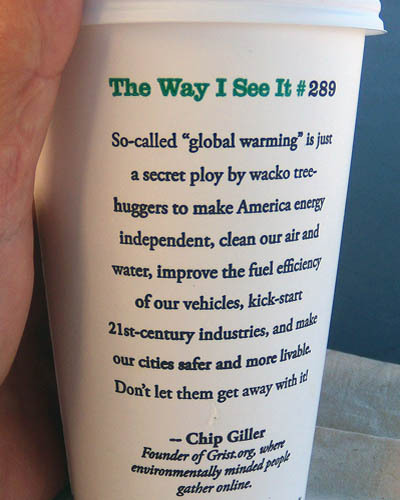
Found this on my coffee cup today:

The Way I See It #289

So-called “global warming” is just

a secret ploy by wacko tree-

huggers to make America energy

independent, clean our air and

water, improve the fuel efficiency

of our vehicles, kick-start

21st-century industries, and make

our cities safer and more livable.

Don’t let them get away with it!

Chip Giller
Founder of Grist.org, where
environmentally-minded people
gather online.

Starbucks Coffee Cup, The Way I See It #289

Add to FacebookAdd to NewsvineAdd to DiggAdd to Del.icio.usAdd to StumbleuponAdd to RedditAdd to BlinklistAdd to TwitterAdd to TechnoratiAdd to Furl

Save


Setting the record straight on Rachel Carson, malaria and DDT

June 19, 2007

The contemptible campaign of hoax and calumny against the work and memory of Rachel Carson continues. You should read more at the sites I cite near the end of this post.

The key false claim of the Carson critics is that, but for the ban on DDT, millions of lives would have been saved over the past 30 years. Chief problem with the claim is that national bans on DDT all preserve DDT use for essential mosquito eradication, especially if there are no other tools to fight the disease. But other problems with the claim include the fact that DDT had stopped being highly effective by the late 1960s; eradication was a pipe dream, and mosquitoes developed resistance to DDT.

That doesn’t stop the critics. So, Dear Reader, when you read criticisms of Rachel Carson and hear the pseudo-science whine that Carson alone has condemned millions to death by malaria, I want you to keep in mind this question: If DDT were such an effective tool against malaria, why didn’t the World Health Organization fight to keep it? Why didn’t the manufacturers fight to keep it? Why would more than 150 nations, tens of thousands of scientists, tens of thousands of health workers, and conservative “I-told-you-so” skeptics who hate environmentalists, all simultaneously fall asleep?

The answer is, Dear Reader, they didn’t all fall asleep. DDT stopped being effective, and malaria fighters realized there were other problems — the parasites that the mosquitoes spread also became resistant to anti-malaria drugs, a bigger problem than DDT resistance. People and organizations who fight malaria did ask that use of DDT be preserved for spraying to fight malaria; but they didn’t defend it against bans on other use because those bans help the malaria fighters.

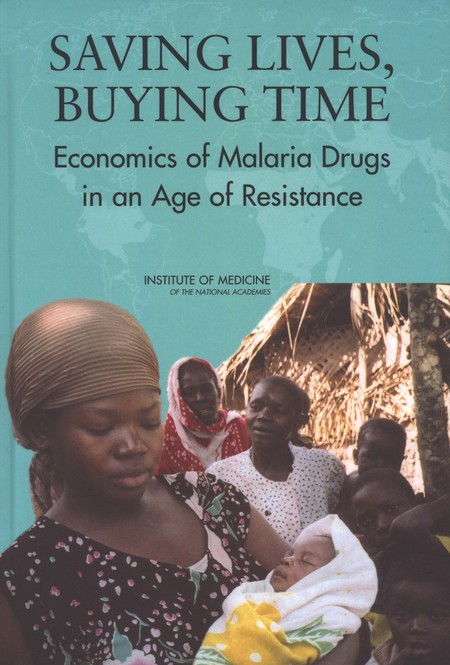
Cover of  Saving Lives, Buying Time: Economics of Malaria Drugs in an Age of Resistance (2004), from the National Academies Press

Cover of Saving Lives, Buying Time: Economics of Malaria Drugs in an Age of Resistance (2004), from the National Academies Press

Below the fold, I offer two quotes from Saving Lives, Buying Time: Economics of Malaria Drugs in an Age of Resistance (2004) Board on Global Health (BGH) (available from the National Academy of Sciences). You can see that DDT is not the golden-egg-laying goose, and that consequently Rachel Carson is not the mindless ogre she is made out to be in recent invectives.

Check out these sites:

Read the rest of this entry »