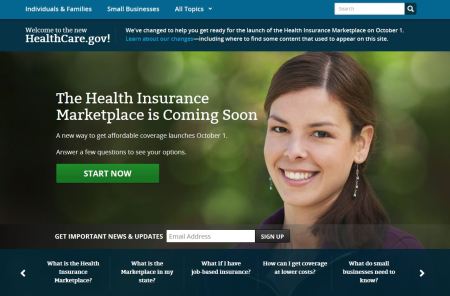
Got questions about ObamaCare? Check out this site

June 24, 2013

I get e-mail; this one may prove useful to more than a few people, especially anyone who owns a small business and has questions about how ObamaCare — the Affordable Care Act — will affect your taxes, your hiring, your expenses, etc.:

The White House, Washington

Hi, all —

In fewer than 100 days, the new health care reform law takes an important step forward. On October 1, 2013, Health Insurance Marketplaces will open in every state, and millions of Americans will be eligible to apply for coverage. Between now and then, we’re sure that lots of people will be looking for information about the upcoming changes.

That’s why we revamped HealthCare.gov.

On the updated site, you’ll be able to get a personalized list of coverage options, tailored to your situation, and a checklist to help prepare for October 1. You’ll find a rich set of answers to frequently asked questions, powerful search features to help you find the specific information you need, and two great ways to talk to customer service representatives, 24/7: a new 1-800 number (1-800-318-2596) and online chat.

When open enrollment starts on October 1, 2013, you’ll be able to use the site to compare various health care plans side by side to find a plan that fits your life and your budget. You’ll even be able to use HealthCare.gov to apply for coverage or be directed to your own state’s application portal.

We hope you’ll use the site to get answers to your questions about the health care law — and forward this email to your friends so they can do the same.

Thanks!

Tara

Tara McGuinness
Senior Communications Advisor
The White House

P.S. — Have questions about what else you can expect from health care reform? Click here for a timeline of the key features of the Affordable Care Act.

Visit WhiteHouse.gov

[My e-mail address cut out ]

The White House • 1600 Pennsylvania Ave NW • Washington, DC 20500 • 202-456-1111

Several people I’ve run into have questions about the program — some of the questions are serious, and difficult for me to answer, and some are silly (“Why do I have to give up my insurance now?” Answer:  You don’t.)  There’s a great need for answers.  Distortions of the plan from the nasty political fights involved, have taken hold in the mind of many as representations of what the plan weill do.

Go try the site.  Does it answer your questions?  What questions do you have that are not answered by this site?

More:

Screenshot of HealthCare.gov. Click to visit the site.

Screenshot of HealthCare.gov. Click to visit the site.


ObamaCare in 90 seconds – from nurses, so you know it’s right

June 18, 2013

Nurses attend signing ceremony

Nurses attended the  signing ceremony for the Affordable Care Act. Photo: flickr.nurse;

Tired of the distortions of ObamaCare all over Facebook, blogs, and Twitter?

Need a quick summary to give your obnoxious brother-in-law something to think about, without seeming rude?

Here, in 90 seconds, a bunch of nurses go over the basics:

Who did this video?

Wondering what the Affordable Care Act can do for you and your family? Check out what nurses have to say about the benefits of the healthcare law and then share this video with friends, family and co-workers!

* HealthLawBenefits.org is a joint campaign of SEIU, the Nurse Alliance of SEIU and 1199SEIU.

Tip of the old scrub brush to the BlueStreet Journal.

More:


April 25 is World Malaria Day — right, Bill?

April 24, 2013

He’s absolutely right.

English: World Malaria Day Button (english)

English: World Malaria Day Button (english) (Photo credit: Wikipedia)

What are you doing to fight malaria today?

More:


National Infant Immunization Week, April 20-27, 2013

April 23, 2013

National Infant Immunization Week:  Find out about the power to protect with immunizations on http://www.vaccines.gov/

This week is National Infant Immunization Week designated by the U.S. Centers for Disease Control (CDC).  Vaccinations worked miracles in extending human lifespans, and in making childhood much safer from disease, for those children who get vaccinated.

Information following comes directly from the CDC:

Protect Your Baby with Immunization

Photo: A mother and childImmunization is one of the best ways parents can protect their infants from 14 serious childhood diseases before age two. Check to see if your baby is up to date on immunizations.

It is important for children to be fully immunized. Diseases that can be prevented with vaccines can be very serious – even deadly – especially for infants and young children. For example, children younger than 2 years old are at the highest risk for serious pneumococcal disease like pneumonia, blood infection (sepsis), and meningitis. Before the pneumococcal vaccine was used routinely, an estimated 17,000 cases of severe types of pneumococcal infection, like meningitis, occurred each year.

Immunization. Power to Protect.

Immunizations have helped to greatly improve the health of children in the United States. Most parents today have never seen first-hand the devastating consequences that vaccine-preventable diseases have on a family or community. While most of these diseases are not common in the United States, they persist around the world. It is important that we continue to protect our children with vaccines because outbreaks of vaccine-preventable diseases can and do occasionally occur in this country.

For example, in 2010, there were 27,550 people reported to have “whooping cough” (pertussis) in the United States. Twenty-seven deaths were reported – 25 of these were in children younger than 1 year old. In 2011, 222 people were reported to have measles in the United States – that’s more than any year since 1996. Measles is brought into the United States by unvaccinated U.S. residents and foreign visitors who get infected when they are in other countries. Measles is still common in many parts of the world, including Europe, Asia, the Pacific, and Africa. In fact, in France alone, more than 15,000 people were reported to have measles in 2011. Measles spreads easily, and it can be serious, causing hospitalization and even death. Young children are at highest risk for serious complications from measles.

Vaccinating your baby according to the recommended immunization schedule gives him or her the best protection against 14 serious childhood illnesses – like measles and whooping cough – before he is two years old. The recommended schedule is designed to protect infants and children early in life, when they are most vulnerable and before they are exposed to potentially life-threatening diseases.

Vaccine Information for ParentsVisit CDC’s vaccine website for parents.

The Diseases Vaccines Prevent

The recommended immunization schedule for babies includes vaccination protection against all of the following diseases:

Vaccinate On Time, Every Time

Even though the United States experiences outbreaks of some vaccine-preventable diseases, the spread of disease usually slows or stops because of immunization. If we stopped vaccinating, even the few cases we have in this country could very quickly become tens or hundreds of thousands of cases. Fortunately, most parents choose to vaccinate their children and immunization rates in this country are at or near record high levels. In fact, less than 1% of children do not receive any vaccines. However, some children have not received all of their vaccines and therefore are not fully immunized. It’s important that children receive all doses of the vaccines according to the recommended immunization schedule. Not receiving all doses of a vaccine leaves a child vulnerable to catching serious diseases.

That’s why it’s important to make sure that your child is up to date on his or her immunizations. Call your pediatrician to find out if your child is due for any vaccinations. Or, you can use this online tool to enter your child’s current record and quickly see if any doses have been skipped or missed. It is important to your child’s health to be up to date on immunizations.

Paying for Immunization

Photo: A babyMost health insurance plans cover the cost of vaccinations, but you should check with your insurance provider before going to the doctor. If you don’t have health insurance, or if your insurance does not cover vaccinations, the Vaccines for Children (VFC) program may be able to help with the cost.

The VFC program helps families of eligible children who might not otherwise have access to immunization. The program provides vaccinations at no cost. Children younger than 19 years of age are eligible for VFC vaccines if they are:

  • Medicaid-eligible
  • Uninsured
  • American Indian or Alaska Native,
  • Underinsured and vaccinated in Federally Qualified Health Centers or Rural Health Clinics.

Parents of uninsured or underinsured children who receive vaccines at no cost through the VFC Program should check with their health care providers about possible administration fees that might apply. These fees help providers cover the costs of giving the vaccines, including storing the vaccines and paying staff members to give vaccines to patients. However, VFC vaccines cannot be denied to an eligible child if a family can’t afford the fee.

Have Questions about Immunization?

  • Talk with your child’s health care professional, contact your local or state health department, or call the CDC at 800-CDC-INFO (800-232-4636).
  • Visit CDC’s vaccine website for parents

More Information

CDC works 24/7 saving lives and protecting people from health threats to have a more secure nation. A US federal agency, CDC helps make the healthy choice the easy choice by putting science and prevention into action. CDC works to help people live longer, healthier and more productive lives.

Last syndicated: April 19, 2013
This content is brought to you by: Centers for Disease Control and Prevention (CDC)

More:


Obamacare: Still the better way, still saving money, still a good deal

January 20, 2013

A guy named William Duncan at a blog called Sensible Thoughts posted something I found inherently unsensible a while back.  He listed six reasons why he thought the Affordable Care Act should be repealed. (“A while?” “Yeah, July 2012 is ‘a while.'”)

His sixth point was the old canard about Congress and the President being exempt.  Of course they are not exempt, and so I told him.

Your sixth reason is in error. There is no provision to exempt either the president or Congress from the act. There is no language in the bill such as you describe. Language from page 114 can be found here:

https://timpanogos.wordpress.com/2012/04/17/obamacare-making-stuff-up-to-complain-about/

At some length, Mr. Duncan removed that point, but said he still thinks the law should be repealed on the other five points I hadn’t dealt with.

Ed:
Thank you for the correction on point #6. I have gone back and looked at this, and you are absolutely right. Although the Wall Street Journal and folks like Sean Hannity reported that the President and members of Congress are exempt from participation in the Affordable Care Act, in the end that did NOT make it into the language of the legislation. I have deleted point #6 from the post as a result. Thank you for the correction. Now, if you copuld only prove me wrong on the rest of the points listed…. Unfortunately, this remains a bill the the American public did not want, and was purchased by shenanigans that the Administration should be ashamed of.

A quick and dirty response; we may need to put more meat on these response bones in the next couple of months, because the opposition to ObamaCare relies on severely distorted claims about the law and what it actually does.  Much if not most of the good stuff in the law is completely ignored by these critics, and we should point that out, too.

I responded (images added here):

Disproof?

What makes you think Americans didn’t want it? There was a whale of an anti-health care campaign after the act passed, but when it passed, it enjoyed a majority of support. And, when we take each provision of the bill and ask people about that provision, they approve overwhelmingly.

English: Depiction of the House vote on H.R. 3...

Depiction of the House vote on H.R. 3590 (the Patient Protection and Affordable Care Act) on March 21, 2010, by congressional district. Democratic yea, dark blue; Democratic nay, light blue; Republican nay, red; No representative seated, white. Image from Wikipedia

For example, not even you are opposed to continuing the Reagan-era program that encourages medical schools to train more general practitioners. No one seriously objects to the provisions that pay physicians to practice in under-served areas, like West Texas, Iowa, and West Virginia. No one objects to the provisions that train more nurses. Only the most rabid racists complain about continuing and expanding the health care clinics on Indian reservations.

The law has dozens of provisions like those, and no one in their right mind objects to them.

Your other five points?

  1. The Supreme Court killed that one for you. They said that, even if you call it a fine, it’s a tax. And at that, it’s a helluva bargain. For those who do not purchase health insurance because they can’t afford to, they must pay $695 additional tax, per year. That’s about what I’d pay monthly on the open market.In any case, there are no fines, according to the Supreme Court.
    English: Depiction of the Senate vote on H.R. ...

    Depiction of the Senate vote on H.R. 3590 (the Patient Protection and Affordable Care Act) on December 24, 2009, by state. Color code is difficult to decipher; let it suffice that if there are two Democratic yea votes, the state is colored deep blue; if two Republican nay votes, very red. Image from Wikipedia

    But I can’t imagine why you oppose bargains in health care, especially when they lower the costs of health care to the insured, who will no longer pay the 15% to 25% premium to cover indigent care.

  2. With all the “new taxes,” CBO, the non-partisan group that scores these issues for Congress, projects the bill will decrease federal spending and cut the deficits annually, when fully enacted in 2014 and all out years.Do you oppose deficits or not?All the other taxes are fair, strike only the tippy-top income tiers, and are cheap at that.These taxes make the system more fair. It’s stacked against anyone making less than $150,000 a year, now. That’s most of us. I don’t like it when government helps the rich, at the expense of the poor — that’s contrary to moral standards my church holds, for example, and it tends to damage the economy.So I think more fair taxes, and lower costs, will be quite popular, once we see them.So, new taxes aren’t a good justification to oppose the law.
  3. Speaking of fallacious accounting — CBO, the group you cite, says the bill will reduce the deficits. You assume the Law won’t work, while small portions of it have already slashed inflation in health care costs, from 20% in 2009 to 4% in 2011 and 2012.But, what about repeal? CBO looked at that, too — repeal of the law will increase deficits, not decrease them. It’s only $109 billion increase in deficits, but these number directly refute all claims that repeal would be cheaper. See the analysis gateway here: http://www.cbo.gov/publication/43471
  4. This Medicare issue was hashed out, accurately and well I thought, in the campaign. Medicare costs will be reduced by holding costs down — benefits will not be reduced. Eric Cantor and Paul Ryan ran into some difficulty with this, because their budget plans assumed the savings from the Affordable Care Act, while eliminating the law that produced the savings.I’m sure there will be some adjustments required. Medicare seems a little ham-fisted when it comes to dealing with local and regional cost differences, but nationwide, over the past 40 years, enormous savings have been realized by reducing some reimbursements for procedures that once were uncommon and expensive, to a less expensive rate, now that they are more common. On the whole, over 40 years, over thousands of procedures, physicians have changed their expectations, and things have worked fine. Oh, there have been grumblings, I know. But the cuts in costs, without cuts in benefits, have stuck.Under the Affordable Care Act, we hope a lot more people will move to company plans from Medicare, or at least to the exchange plans offered in each state.One of the changes already introduced is working [link added here]. Rather than pay providers for each procedure, Medicare now reimburses hospitals for effective hospitalization — that is, when a patient is discharged and then re-enters a hospital for the same complaint, the hospital will lose money. Hospitals are keeping patients a few days longer on many procedures, to insure that one hospitalization is all that is required. Savings are already being made in costs, while improvements have resulted in the health care – better health in the patients!In all, CBO says costs will come down with the Affordable Care Act, as advertised, and costs will rise and deficits will rise if the Act is repealed.
  5. Your abortion argument is too metaphysical, and not enough real-world. Do you want to reduce the number of abortions? Then provide health care, make sure contraception is freely available (not for free, but freely), and stand back. Those two things reduce abortions, as they did during the Clinton administration.Restrictions on abortion, on the other hand, make it more likely a woman will choose to terminate a pregnancy under a number of circumstances: She doesn’t have health care coverage, her coverage does not cover pre-natal care, her coverage won’t cover a new infant, the pregnancy is unplanned due to lack of good information on family planning or lack of access to affordable contraception.You can choose: Restrict abortions and increase the number of abortions, or provide health care, and reduce the number of abortions.It may be a bit counter-intuitive, but you’d better study the issue. The Affordable Care Act’s provisions, Obamacare, have over the years reduced abortions where applied; cutting off that care has increased the number of abortions.My advice would be, don’t kill the babies to make a political point.

I am concerned that you don’t appear much familiar with what the bill actually does. Here are a few reasons to keep the law.

  1. We need more physicians, and the bill provides them.
  2. We need more physicians in underserved areas, and the bill provides them.
  3. We need more nurses, and the bill provides them.
  4. We need more community clinics in underserved urban areas [link added here], where illnesses and injuries frequently go untreated until extreme trauma results, and the victim must get extremely expensive care in an emergency room. This will be one of the biggest cost savers — and the law provides those clinics.
  5. The law will cut the private bureaucracy, and completely dismantle the private death panels set up by insurance companies, saving at least 10% of every health care dollar, applying that money to care instead of bureaucracy. This is already occurring.
  6. Preventive care under the Act is greatly encouraged — if we can boost flu vaccines by another 10%, it will save thousands of lives annually, and millions of dollars in hospitalization costs. Flu shots came with no co-pay this year — did you notice? — so that anyone with any insurance at all could drop by any pharmacy offering flu shots and get one with no out-of-pocket expenses.
    This is huge. Everyone agrees the cheapest health care is for healthy people. The Affordable Care Act changes the way health care is delivered, to emphasize prevention of disease and injury, instead of triage. Prevention usually costs about 10% what the triage would cost.
  7. Removing the lifetime cap on insurance payments, per patient, will save a few thousands of lives, annually. It should kill the phenomenon where many families, hit with a costly disease or accident, had to declare bankruptcy as a result. A significant portion of all bankruptcies have been “not adequately-insured” cases. Those should almost disappear.
  8. Allowing children to stay insured, on a parent’s plan, for those critical years after high school and college and into the second job, with benefits has already benefited millions of Americans, saving millions of dollars and probably a few lives.

I cannot imagine why anyone would want to go back to 20% annual health care cost inflation, the highest per capita health care costs in the world by a factor of two, while leaving one out of every seven people uninsured even though we were paying amounts more than the insurance would have cost.

Obamacare reduces the deficits, and puts our health system on the path to catch up to the rest of the industrialized world, with better care for less cost.

I’ll keep it, thank you.

(See this, too: “More good news about Obamacare: CBO says it will save money”

More:


President Obama: On anniversary of ending of Iraq War, a pledge to heal the wounded

September 1, 2012

President Barack Obama spoke at Fort Bliss, Texas, On August 31, 2012:

Description from the White House:

On the two-year anniversary of the end of our combat mission in Iraq, the President speak to troops at Fort Bliss, and discusses that part of ending wars responsibly demands standing by those who have served. August 31, 2012.

More


Hey, Dallas: Warning labels for the pesticides being sprayed on you

August 18, 2012

Clarke Mosquito Control Co. kindly put up a .pdf of the sample warning label that accompanies Duet, the pesticide the company is spraying to cover all of the City of Dallas and most of Dallas County, in the continuing fight against West Nile virusRead the label at their site, here.

Duet pesticide warning label, from Clarke Mosquito Control Co.

Key information from the label (all links added here):

Active Ingredients

  • Prallethrin: (RS)-2-methyl-4-oxo-3-(2-propynyl) cyclopent-2-enyl-(1RS)-cis,trans-chrysanthemate……………………………………….1.00%
  • Sumithrin®: 3-Phenoxybenzyl-(1RS, 3RS; 1RS, 3SR)-2,2-dimethyl-3-(2-methylprop-1-enyl) cyclopropanecarboxylate ……..5.00%
  • Piperonyl Butoxide, Technical * ………………………………………………..5.00%
  • Other Ingredients ** …………………………………………………………….89.00%
  • 100.00%

Contains 0.085 pounds of Technical Prallethrin/Gallon, 0.37 pounds of Technical Sumithrin®/Gallon, and 0.37 pounds Technical Piperonyl Butoxide/Gallon
* Equivalent to 4.00% (butylcarbityl) (6-propylpiperonyl) ether and 1.00% related compounds.
** Contains petroleumdistillate

CAUTION
KEEP OUT OF REACH OF CHILDREN
PRECAUCION AL USUARIO: Si usted no lee ingles, no use este producto hasta que la etiqueta haya sido explicado ampliamente

FIRST AID
IF SWALLOWED: Immediately call a poison control center or doctor. Do not induce vomiting unless told to do so by a poison control center or a doctor. Do not give any liquid to the person. Do not give anything by mouth to an unconscious person. Have the product container or label with you when calling a poison control center or doctor, or going for treatment. For information regarding medical emergencies or pesticide incidents, call 1-888-740-8712.
NOTE TO PHYSICIAN: Contains petroleum distillate – vomiting may cause aspiration pneumonia.

PRECAUTIONARY STATEMENTS
HAZARDS TO HUMANS AND DOMESTIC ANIMALS
CAUTION. Harmful if swallowed. Wash thoroughly with soap and water after handling and before eating, drinking, chewing gum, or using tobacco. Remove and wash contaminated clothing before reuse.

ENVIRONMENTAL HAZARDS
This product is toxic to aquatic organisms, including fish and aquatic invertebrates. Runoff from treated areas or deposition of spray droplets into a body of water may be hazardous to fish and aquatic invertebrates. Do not apply over bodies of water (lakes, rivers, permanent streams, natural ponds, commercial fish ponds, swamps, marshes or estuaries), except when necessary to target areas where adult mosquitoes are present, and weather conditions will facilitate movement of applied material beyond the body of water in order to minimize incidental deposition into the water body. Do not contaminate bodies of water when disposing of equipment rinsate or wash waters.

BEE WARNING: This product is toxic to bees exposed to direct treatment on blooming crops or weeds. Do not apply to or allow drift onto blooming crops or weeds when bees are visiting the treatment area, except when applications are made to prevent or control a threat to public and/or animal health determined by a state, tribal or local health or vector control agency on the basis of documented evidence of disease causing agents in vector mosquitoes or the occurrence of mosquito-borne disease in animal or human populations, or if specifically approved by the state or tribe during a natural disaster recovery effort.

PHYSICAL OR CHEMICAL HAZARDS
Do not use or store near heat or open flame.

DIRECTIONS FOR USE
It is a violation of Federal Law to use this product in a manner inconsistent with its labeling.

For use only by federal, state, tribal or local government officials responsible for public health or vector control, or by persons certified in the appropriate category or otherwise authorized by the state or tribal lead pesticide regulatory agency to perform adult mosquito control applications, or by persons under their direct supervision.  Before making the first application in a season, it is advisable to consult with the state or tribal agency with primary responsibility for pesticide regulation to determine if other regulatory requirements exist.

IN CALIFORNIA: This product is to be applied by County Health Department, State Department of Health Services, Mosquito and Vector Control or Mosquito Abatement District personnel only.

PROHIBITION ON AERIAL USE: Not for aerial application in Florida unless specifically authorized by the Bureau of Entomology, Florida Department of Agriculture and Consumer Services. Do not contaminate food, feed or drinking water. Do not spray this product on or allow it to drift on pastureland, rangeland, cropland, poultry ranges, or potable water supplies. In treatment of corrals, feed lots, swine lots and zoos, cover any exposed drinking water, drinking water fountains and animal feed before application. Wear long sleeved shirt and long pants, socks and shoes.

DUET™ Dual-action Adulticide cannot be diluted in water. Dilute this product with light mineral oil if dilution is preferred.

USE AREAS: For use in mosquito adulticiding programs involving outdoor residential and recreational areas where adult mosquitoes are present in annoying numbers, and in vegetation surrounding parks, woodlands, swamps, marshes, overgrown areas and golf courses. For best results, apply when mosquitoes are most active and meteorological conditions are conducive to keeping the spray cloud close to the ground. Application in calm air conditions is to be avoided. Apply only when ground wind speed is greater than 1 mph. Air temperature should be greater than 50 F when conducting all types of applications. Do not treat a site with more than 0.0036 pounds of sumithrin or 0.0008 pounds of prallethrin per acre in a 7-day period. More frequent applications may be made if adult mosquitoes have reinfested the treatment area and to prevent or control a threat to public and/or animal health determined by a state, tribal, or local health or vector control agency on the basis of documented evidence of disease causing agents in vector mosquitoes or the occurrence of mosquito-borne disease in animal or human populations, or if specifically approved by the state or tribe during a natural disaster recovery effort. Do not exceed 0.094 pounds of sumithrin or 0.021 pounds of prallethrin in any site in a year.

SPRAY DROPLET SIZE DETERMINATION
Ground-based Application: Spray equipment must be adjusted so that the volume median diameter (VMD) is between 8 and 30 microns (Dv 0.5 < 30 um) and that 90% of the spray is contained in droplets smaller than 50 microns (Dv 0.9 < 50 um). Directions from the equipment manufacturer or vendor, pesticide registrant or a test facility using a laser-based measurement instrument must be used to adjust equipment to produce acceptable droplet size spectra. Application equipment must be tested at least annually to confirm that pressure at the nozzle and nozzle flow rate(s) are properly calibrated.

Aerial Application: Spray equipment must be adjusted so that the volume median diameter produced is less than 60 microns (Dv 0.5 < 60 um) and that 90% of the spray is contained in droplets smaller than 115 microns (Dv 0.9 < 115 um). The effects of flight speed and, for non-rotary nozzles, nozzle angle on the droplet size spectrum must be considered. Directions from the equipment manufacturer or vendor, pesticide registrant, or a test facility using a wind tunnel and laser-based measurement instrument must be used to adjust equipment to produce acceptable droplet size spectra. Application equipment must be tested at least annually to confirm that pressure at the nozzle and nozzle flow rate(s) are properly calibrated.

GROUND ULV APPLICATION
To control Mosquitoes and other listed insects, apply DUET™ Dual-action Adulticide at a flow rate of 2.5 to 7.5 fluid ounces per minute at an average vehicle speed of 10 mph using a swath width of 300 feet for acreage calculations (see chart below). Under normal residential conditions a flow rate of 4.5 fluid ounces per minute is recommended. If a different vehicle speed is used, adjust rate accordingly. These rates are equivalent to 0.0003 to 0.0008 pounds of Prallethrin and 0.0012 to 0.0036 pounds of Sumithrin® and piperonyl butoxide per acre. Vary flow rate according to vegetation density and mosquito population. Use higher flow rate in heavy vegetation or when populations are high. For proper application, mount the applicator so the nozzle is at least 41/2 feet above ground level and directed out the back of the vehicle. Failure to follow the above directions may result in reduced effectiveness. DUET™ Dual-action Adulticide may also be diluted with a suitable solvent such as mineral oil and applied by GROUND U.L.V. equipment so long as 1.24 fluid ounces per acre of DUET™ Dual-action Adulticide is not exceeded. Refer to the tables below for flow rate calculations for diluted end-use formulations of DUET™ Dual-action Adulticide.

Use the following table to calculate application rates:

[table viewable on the .pdf document]

DUET Dual-action Adulticide may also be applied undiluted with non-thermal, portable, motorized backpack equipment adjusted to deliver ULV particles of 50 to 100 microns VMD. Use 0.41 to 1.24 fl.oz. of the undiluted spray per acre (equal to 0.0012 to 0.0036 lb. sumithrin/acre) as a 50 ft (15.2 m) swath while walking at a speed of 2 mph (3.2 kph).

DUET Dual-action Adulticide may be applied for urban ULV mosquito control. For control of resting or flying adult mosquitoes, biting flies and biting midges in areas such as utility tunnels, sewers, storm drains and catch basins, pipe chases, underground basements, underground passages, parking decks, crawl spaces or uninhabited buildings. DUET Dual-action Adulticide may be applied using mechanical foggers, hand-held or truck mounted ULV equipment, non-thermal foggers or other spray equipment suitable for this application. Apply DUET Dual-action Adulticide at rates up to but not exceeding 0.0036 pounds sumithrin per acre in a 7-day period (not to exceed 0.094 pounds sumithrin per acre in any site in any  year).

AERIAL APPLICATION
Application shall be made when ground wind speed is equal to or greater than 1 mph. Applications shall be made when surface temperature exceeds 50ºF. Application shall be made at 75 feet to 300 feet for rotary aircraft and 100 to 300 feet for fixed-wing aircraft. Flow rate and swath width shall be set so as to achieve 0.41 to 1.24 fluid ounces of DUET™ Dual-action Adulticide per acre.  Appropriate spray systems include rotary atomizers, flat fan, high pressure, and high pressure impaction nozzles characterized and oriented to achieve the droplet characteristics above.
DUET™ Dual-action Adulticide may also be diluted with a suitable solvent such as mineral oil and applied by aerial U.L.V. equipment so long as 1.24 fluid ounces per acre of DUET™ Dual-action Adulticide is not exceeded. Refer to the tables below [on .pdf] for flow rate calculations for diluted end-use formulations of DUET™ Dual-action Adulticide.
* based on Sumithrin Concentration

[Dosage table at .pdf site]

DDILUTION CALCULATIONS
DUET™ Dual-action Adulticide (Prallethrin + Sumithrin® + PBO) Formulation Dilution Table
UNDILUTED DUET™ DUAL-ACTION ADULTICIDE

[See .pdf for dilution table]

STORAGE & DISPOSAL

Do not contaminate water, food or feed by storage or disposal.

PESTICIDE STORAGE: Store in a cool, dry place. Keep container closed.

PESTICIDE DISPOSAL:Wastes resulting from the use of this product may be disposed of on site or at an approved waste disposal facility.

CONTAINER DISPOSAL: Triple rinse (or equivalent). Then offer for recycling or reconditioning, or puncture and dispose of container in a sanitary landfill, or by other procedures approved by state and local authorities.

NOTICE: To the extent provided by law, seller makes no warranty, expressed or implied concerning the use of this product other than as indicated on the label. Buyer assumes all risk of use and/or handling of this material when use and/or handling is contrary to label instructions.

DUET™ is a Trademark of Clarke Mosquito Control Products, Inc.
Sumithrin™ is a Trademark of Sumitomo Company, Ltd.
FOR MORE INFORMATION CALL: 1-800-323-5727

Manufactured For
CLARKE MOSQUITO CONTROL PRODUCTS, INC.
Roselle, Illinois 60172 U.S.A.
EPA Reg. No.: 1021-1795-8329 Net Contents: 55 GAL
EPA Est. No.: 1021-MN-2 Lot/Batch:

Just FYI.

More:


Fact vs. Fiction on the Affordable Care Act (Sen. Leahy)

July 2, 2012

From the good offices of Vermont’s Sen. Pat Leahy (a few links added):

Fact vs. Fiction

It is disappointing that inaccurate and purposely misleading information regarding health care reform continues to be widely circulated. Throughout the past two years during the lengthy debate on Health Care Reform, Senator Leahy has continued to post updated information regarding the various health care legislative proposals being debated, including the full text of proposals, questions asked by directly by Vermonters, and daily updates on floor proceedings in the Senate in an effort to provide Vermonters with accurate and timely information on the health care reform debate.

Below are some of the most common myths regarding the Affordable Care Act with accurate information dispelling those myths and providing information about where to learn more.

To review some of the most commonly questions by Vermonters please also visit the Frequently Asked Questions page on this website.

To test your knowledge about what is actually included in the health care reform law visit the Kaiser Family Foundation website and take their Affordable Care Act quiz.

Fact vs. Fiction

  • Fiction

    If you don’t buy health insurance, you will be sent to jail.

  • Fact

    Taxpayers who are required to purchase health insurance and do not will receive a notice from the Internal Revenue Service (IRS) with the amount of the penalty they owe. Individuals who fail to pay the penalty are not subject to criminal prosecutions and the government cannot file notice of lien or levy any property for a taxpayer who doesn’t pay the penalty.

    The obligation for individuals to purchase health insurance beginning in 2014 was included as part of the Affordable Care Act.  The provision requires individuals to maintain minimum essential coverage for themselves and their dependents or pay a penalty of $95 in 2014. Families would pay half the amount for children, and the requirement includes a cap on the total allowable fine per family. If affordable health insurance coverage is not available to an individual, then the penalty would be waived.  Along with the individual responsibility requirement, the Affordable Care Act also provides subsidies to some individuals beginning in 2014 to help pay for their health insurance premiums and other costs associated with their health insurance.

    Taxpayers who are required to pay a fine but fail to do so will receive a notice from Internal Revenue Service (IRS). If an individual still neglects to pay the fine, the IRS can attempt to collect the funds by reducing the amount of their tax refund in the future.  Individuals who fail to pay the penalty, however, will not be subject to criminal prosecution. The government cannot file notice of lien or levy on any property for a taxpayer who does not pay the penalty.

    The aim of this provision is to encourage all Americans to obtain health insurance, which will result in lower health care costs for everyone. The Affordable Care Act relies on the shared responsibility of individuals, employers, states and the federal government.

    For additional information regarding the individual responsibility requirement please visit the Kaiser Family Foundation website.


  • Fiction

    Members of Congress are exempt from the health care reform law.

  • Fact

    No one has received a special exemption from the Affordable Care Act. In fact, the health care reform law explicitly includes language regarding the health insurance plans for Members of Congress and their staff.

    As a United States Senator, Senator Leahy’s health plan options are the same options offered to all federal employees.  Included in the Affordable Care Act, was a provision that requires that “the only health plans that the Federal Government may make available to Members of Congress and Congressional staff shall be health plans that are created under this Act or offered through an Exchange established under this Act.”  Members of Congress and their staffs can only purchase health insurance coverage from the health insurance exchanges that are made available for uninsured Americans. The full text of this provision is available on pages 80-81 in section 1312 of the Affordable Care Act which you can read here.


  • Fiction

    Health care reform will jeopardize Medicare and will mean cuts in services and benefits for seniors.

  • Fact

    Health care reform will help strengthen Medicare so that seniors can continue to receive quality health coverage for years to come.

    The Affordable Care Act explicitly states that no benefits guaranteed under Medicare will be cut as a result of health care reform legislation.  Today’s forecasts estimate that Medicare will be insolvent by 2017 because of ever-rising health care costs.  The Affordable Care Act takes aim at that unfolding threat by addressing cost inefficiencies now, instead of waiting until later.  The Affordable Care Act strengthens the financial stability of Medicare by targeting fraud and ending wasteful overpayments to insurance companies, while maintaining the benefits and services to seniors who use Medicare.  The Act also helps Medicare users by offering prescription drug discounts to seniors who are trapped in the “donut hole,” by creating a better pathway for generic drugs to enter the marketplace, by eliminating the cost-share for preventative services, and by promoting coordinated care to prevent avoidable hospital readmissions.

    For more information about what the health care reform law means for Medicare beneficiaries read Medicare and the New Health Law -What it Means for You prepared by the Center for Medicare and Medicaid Services.

    • Beginning January 1, 2011, Medicare beneficiaries entering the Medicare donut hole will get a 50% discount on brand name prescription drugs. Click here to learn more about this provision.

  • Fiction

    The health care reform law includes a tax on all real estate sales.

  • Fact

    Under the Affordable Care Act, only certain real estate transactions for certain individuals above a particular income level would be subject to a Medicare Tax.

    Unfortunately, much of the information widely circulated about a tax on home sales and other real estate transactions inaccurately describes the purpose and the effect of this provision. The 3.8 percent Medicare tax is often misunderstood, and has frequently been described as a 3.8 percent “sales tax” on all real estate transactions, which is inaccurate.

    The provision that establishes this tax can be found on page 946, Section 1402 of the Affordable Care Act.  This tax is often referred to as the “Medicare tax,” because it was designed to raise funds for Medicare. The Medicare tax goes into effect after December 30, 2012.

    The Medicare tax is not a tax on all new home sales; it only applies to the profit that certain high income Americans make from the sale of their home.  The groups that may be affected by this provision are individuals with annual incomes over $200,000 and married couples with a joint income of over $250,000. The only home sellers who will be affected by this provision are those who fit the above description, and who sell their home for a profit of more than $250,000. The tax will not apply to the first $250,000 in profits for the individual selling his or her home or to the first $500,000 in profits for a married couple.

    While undoubtedly some home sales will see a tax increase under this provision, the tax will affect only a small percentage of home sales.  A report released by the Tax Foundation on April 15, 2010 predicts that the new tax on investment income (including real estate) will affect only the top-earning 2 percent of American families.

    The full text of the Affordable Care Act is available on the health care reform page of this website.


  • Fiction

    Health care reform will hurt small businesses.

  • Fact

    The Affordable Care Act will help small businesses, many of which are struggling now to even afford health plans for their employees.

    Small businesses are a vital engine of Vermont’s economy. Unfortunately, rising health care costs are hitting small businesses especially hard, putting them at an even greater disadvantage against larger corporations. The Affordable Care Act will help level the playing field and give affordable options to small businesses that wish to offer insurance to their workers.

    For example, the Affordable Care Act:

    • Provides tax credits to small businesses to help them offer health insurance to their employees;
    • Requires insurance companies to provide free preventative care so businesses do not suffer productivity costs because of sick employees;
    • End the “hidden insurance tax” that has prevented small businesses from being able to afford to offer insurance to their employees.  This hidden tax is built in to the premiums for insurance to compensate for the unpaid care given to the uninsured.  Health reform will help get Americans health insurance and will end the inflated premium costs.  And investments to lower health care costs overall will help spur the economy, enabling more businesses to thrive;

    For more information regarding how health care reform efforts will help small businesses please visit the Implementation Center on this website as well as the Small Business Administration website and the Small Business Majority website for additional resources.


  • Fiction

    The Affordable Care Act provides subsidies for illegal immigrants to receive health insurance.

  • Fact

    The Affordable Care Act explicitly defines who is eligible for federal payments, credits or subsidies for health insurance coverage and makes clear that undocumented immigrants are ineligible.

    Some have expressed concerned that undocumented immigrants will have the ability to receive subsidies for health insurance under the reform proposals in Congress.  Senator Leahy does not support using government funding to subsidize insurance for those who have entered the United States illegally or who are residing in the United States in an undocumented status. The full text of the law clearly defines who is eligible for federal payments, credits or subsidies.

    The relevant statutory language is below:

    Patient Protection and Affordable Care Act
    Subtitle D—Available Coverage Choices for All Americans
    PART II–Consumer Choices and Insurance Competition Through Health Benefit Exchanges

    • Section 1312 (f)(3) makes clear that undocumented immigrants are ineligible to participate in the health insurance exchanges: “ACCESS LIMITED TO LAWFUL RESIDENTS- If an individual is not, or is not reasonably expected to be for the entire period for which enrollment is sought, a citizen or national of the United States or an alien lawfully present in the United States, the individual shall not be treated as a qualified individual and may not be covered under a qualified health plan in the individual market that is offered through an Exchange.”

    Subtitle E—Affordable Coverage Choices for All Americans
    PART I—PREMIUM TAX CREDITS AND COST SHARING REDUCTIONS
    Subpart B—Eligibility Determinations

    • Section 1412(d) unambiguously states “NO FEDERAL PAYMENTS FOR INDIVIDUALS NOT LAWFULLY PRESENT.—Nothing in this subtitle or the amendments made by this subtitle allows Federal payments, credits, or cost-sharing reductions for individuals who are not lawfully present in the United States.”

    The Act also establishes a fair process to accurately verify eligibility for participation in the benefits of health insurance reform that does not place unnecessary bureaucratic hurdles for U.S. Citizens nor undue administrative costs on the government.

    Patient Protection and Affordable Care Act

    Subtitle E—Affordable Coverage Choices for All Americans
    PART I—PREMIUM TAX CREDITS AND COST SHARING REDUCTIONS
    Subpart B—Eligibility Determinations

    • Section 1411(a) required that the Secretary of Health and Human Services “shall establish a program . . . for determining . . . whether an individual who is to be covered in the individual market by a qualified health plan offered through an Exchange, or who is claiming a premium tax credit or reduced cost-sharing [is] a citizen or national of the United States or an alien lawfully present in the United States.”
    • Section 1411(b) requires applicants for enrollment in a qualified health plan offered through an Exchange in the individual market to provide “name, address, and date of birth.”  For those individuals claiming eligibility based on an attestation of citizenship, they must provide their social security number.  For those individuals whose eligibility is based on an attestation of their immigration status, they must provide “the enrollee’s social security number (if applicable) and such identifying information with respect to the enrollee’s immigration status as the Secretary, after consultation with the Secretary of Homeland Security, determines appropriate.”

    Senator Leahy has also heard from Vermonters with small businesses who employ seasonal workers and their concern about the requirement that employers purchase health insurance for their employees.

    The Act exempts small businesses from the employer mandate to provide health insurance for employees, and employers are not subject to penalties if they employ 50 or fewer employees.  Seasonal workers do not count towards the 50 employee threshold.  And for those employers subject to the penalty, they are only responsible for providing health insurance for full-time employees.

    Patient Protection and Affordable Care Act
    Subtitle F—Shared Responsibility for Health Care
    PART II—EMPLOYER RESPONSIBILITIES
    Section 1513—Shared Responsibility For Employers

    • Section 1513(a) states:

    (B) EXEMPTION FOR CERTAIN EMPLOYERS-

    (i) IN GENERAL- An employer shall not be considered to employ more than 50 full-time employees if—

    (I) the employer’s workforce exceeds 50 full-time employees for 120 days or fewer during the calendar year, and

    (II) the employees in excess of 50 employed during such 120-day period were seasonal workers.

    (ii) DEFINITION OF SEASONAL WORKERS—The term `seasonal worker’ means a worker who performs labor or services on a seasonal basis as defined by the Secretary of Labor, including workers covered by section 500.20(s)(1) of title 29, Code of Federal Regulations and retail workers employed exclusively during holiday seasons.”


  • Fiction

    Health care reform will lead to rationing of health care

  • Fact

    Health care reform is aimed at increasing the options for Americans, not limiting them.

    Unfortunately, prior to the passage of the Affordable Care Act rationing of health care happened all too often. Insurance companies decided whether or not beneficiaries could have a certain test or procedures, based not on medical necessity, but on the insurance plan and whether the test is affordable. This rationing left millions of Americans without adequate care or coverage and is taking away the decision making from patients and their doctors, putting those decisions instead in the hands of insurance company bureaucrats.

    The Affordable Care Act is intended to improve the ability of patients to receive the care they need by setting ground rules for insurance companies to follow.  No longer will insurance companies be allowed to deny coverage for preexisting medical conditions or to discriminate against consumers because of their gender. No longer will insurance companies be allowed to revoke insurance coverage from a patient who has been ill and deemed too sick for coverage. The government will have no role in telling patients what tests they can and cannot have. In fact, for the first time, the Affordable Care Act prohibits insurance companies from limiting choice of doctors.  The Affordable Care Act guarantees your right to choose a primary care doctor from any available participating provider, designate any available participating pediatrician as your child’s primary care provider, and prohibits insurers or employer-sponsored plans from requiring a referral for obstetrical or gynecological (OB-GYN) care. Additionally, the Affordable Care Act prohibits health insurers and plans from restricting access to and charging patients more for out-of-network emergency care.

    Health care reform is about improving choice for all Americans.


  • Fiction

    The health care reform law will force individuals to pay taxes on their health benefits.

  • Fact

    Health benefits will not be taxed under the Affordable Care Act, even though the value of your health insurance will be included on your W-2 form.

    Title IX of the Affordable Care Act, Section 9002 on page 800 states that beginning in the tax year 2011, employers are required to report the value of the health insurance coverage they provide employees on each employee’s annual W-2 Form so that employees can be informed consumers and know the full cost of their plan. The amount reported does not affect tax liability and the value of the employer contribution to health coverage will continue to be excludible from an employee’s income and is not taxable.

    Updates and guidance will be posted regularly on the IRS website regarding all tax provisions included in the Affordable Care Act.


  • Fiction

    The government will encourage or force seniors to choose euthanasia as an end-of-life option.

  • Fact

    This has been shown over and over again to be another false rumor.  Nothing in the Affordable Care Act requires that seniors participate in consultations about their end-of-life wishes.

    Unfortunately, this rumor has been spreading fast and is worrying many Vermonters and Americans across the country. Nothing in the Affordable Care Act will force seniors to have consultations regarding their end-of-life choices, or have a consultation to discuss suicide.

    Currently, voluntary end-of-life planning is covered as a part of the “Welcome to Medicare” doctor visits available to seniors with in the first year of joining the program.   The Affordable Care Act authorized Medicare coverage of yearly physician exams, or wellness visits for beneficiaries. Specifically, section 4103 of the Affordable Care Act provides coverage under Medicare, with no copayments or deductible, for an annual wellness visit and personalized prevention plan services.  Often times patients are not given the time to ask important questions about options available to them such as hospice, or home care, or additional services available to seniors.  This provision would simply give seniors the choice to have a discussion during their wellness visit, about the topics of their choosing, with their doctor. It empowers seniors to have conversations about living wills and other questions they might have but do not have the opportunity to ask.  In no way does the law mandate these conversations or tell doctors what options to discuss.  If seniors do not wish to have these discussions with their doctors and families, nothing will force them to.


Sourced quote of the moment: Tax, or mandate? Lincoln said . . .

June 28, 2012

In light of this morning’s Supreme Court ruling on the Affordable Health Care Act, and questions about whether the law is a “mandate” or a “tax,” we might look to history to see whether the question matters, and what it is.

Lincoln probably had it right, as we noted here many months ago.  So, an encore post:

It’s a delightful story I’ve heard dozens of times, and retold a few times myself: Abraham Lincoln faced with some thorny issue that could be settled by a twist of language, or a slight abuse of power, asks his questioner how many legs would a dog have, if we called the dog’s tail, a leg. “Five,” the questioner responds confident in his mathematical ability to do simple addition.

Sunrise at the Lincoln Memorial; photo by Matthew Cavanaugh, EPA

“No,” Lincoln says. “Calling a dog’s tail a leg, doesn’t make it a leg.”

But there is always the doubt: Is the story accurate? Is this just another of the dozens of quotes that are misattributed to Lincoln in order to lend credence to them?

I have a source for the quote: Reminiscences of Abraham Lincoln by distinguished men of his time / collected and edited by Allen Thorndike Rice (1853-1889). New York: Harper & Brothers Publishers, 1909. This story is found on page 242. Remarkably, the book is still available in an edition from the University of Michigan Press. More convenient for us, the University of Michigan has the entire text on-line, in the Collected Works of Abraham Lincoln, an on-line source whose whole text is searchable.

However, Lincoln does not tell the story about a dog — he uses a calf.

Rice’s book is a collection of reminiscences of others, exactly as the title suggests. Among those doing the reminiscing are ex-president and Gen. U. S. Grant, Massachusetts Gov. Benjamin Butler (also a former Member of Congress), Charles A. Dana the editor and former Assistant Secretary of War, and several others. In describing Lincoln and the Emancipation Proclamation, George W. Julian relates the story. Julian was a Free-Soil Party leader and a Member of Congress during Lincoln’s administration. Julian’s story begins on page 241:

Few subjects have been more debated and less understood than the Proclamation of Emancipation. Mr. Lincoln was himself opposed to the measure, and when he very reluctantly issued the preliminary proclamation in September, 1862, he wished it distinctly understood that the deportation of the slaves was, in his mind, inseparably connected with the policy. Like Mr. Clay and other prominent leaders of the old Whig party, he believed in colonization, and that the separation of the two races was necessary to the welfare of both. He was at that time pressing upon the attention of Congress a scheme of colonization in Chiriqui, in Central America, which Senator Pomeroy espoused with great zeal, and in which he had the favor of a majority of the Cabinet, including Secretary Smith, who warmly indorsed the project. Subsequent developments, however, proved that it was simply an organization for land-stealing and plunder, and it was abandoned; but it is by no means certain that if the President had foreseen this fact his preliminary notice to the rebels would have been given. There are strong reasons for saying that he doubted his right to emancipate under the war power, and he doubtless meant what he said when he compared an Executive order to that effect to “the Pope’s Bull against the comet.” In discussing the question, he used to liken the case to that of the boy who, when asked how many legs his calf would have if he called its tail a leg, replied, ” Five,” to which the prompt response was made that calling the tail a leg would not make it a leg.

I believe it is fair to call the story “confirmed.” It’s not an exact quote, but it’s an accurate story.

_____________

So, is it a tax, or a mandate?  If it’s the right thing to do, does it matter what we call it?  A rose by any other name . . .

Update:  There remains the very strong danger that critics of the Affordable Healthcare Act can’t tell the difference between a calf’s tail and a calf’s leg, or ear, or any other part of the anatomy.


Go to the original source: Supreme Court’s decision on Obamacare

June 28, 2012

You can read the entire decision here:  http://www.supremecourt.gov/opinions/11pdf/11-393c3a2.pdf

5-4 decision, Chief Justice Roberts voting to uphold the bill, Kennedy voting against and leading the dissent.

Official 2005 photo of Chief Justice John G. R...

Official 2005 photo of Chief Justice John G. Roberts (Photo credit: Wikipedia)

Syllabus from the case (links added for your convenience, not in the original):

NATIONAL FEDERATION OF INDEPENDENT BUSINESS ET AL. v. SEBELIUS, SECRETARY OF
HEALTH AND HUMAN SERVICES, ET AL.
CERTIORARI TO THE UNITED STATES COURT OF APPEALS FOR THE ELEVENTH CIRCUIT
No. 11–393. Argued March 26, 27, 28, 2012—Decided June 28, 2012*

*Together with No. 11–398, Department of Health and Human Services et al. v. Florida et al., and No. 11–400, Florida et al. v. Department of Health and Human Services et al., also on certiorari to the same court.

In 2010, Congress enacted the Patient Protection and Affordable Care Act in order to increase the number of Americans covered by health insurance and decrease the cost of health care. One key provision is the individual mandate, which requires most Americans to maintain“minimum essential” health insurance coverage. 26 U. S. C. §5000A.For individuals who are not exempt, and who do not receive health insurance through an employer or government program, the means of satisfying the requirement is to purchase insurance from a private company. Beginning in 2014, those who do not comply with the mandate must make a “[s]hared responsibility payment” to the Federal Government. §5000A(b)(1). The Act provides that this “penalty”will be paid to the Internal Revenue Service with an individual’s taxes, and “shall be assessed and collected in the same manner” as tax penalties. §§5000A(c), (g)(1). Another key provision of the Act is the Medicaid expansion. The current Medicaid program offers federal funding to States to assist pregnant women, children, needy families, the blind, the elderly, and the disabled in obtaining medical care. 42 U. S. C. §1396d(a). The Affordable Care Act expands the scope of the Medicaid program and increases the number of individuals the States must cover. For example, the Act requires state programs to provide Medicaid coverage by 2014 to adults with incomes up to 133 percent of the federal poverty level, whereas many States now cover adults with children only if their income is considerably lower, and do not cover childless adults at all. §1396a(a)(10)(A)(i)(VIII). The Act increases federal funding to cover the States’ costs in expanding Medicaid coverage. §1396d(y)(1). But if a State does not comply with the Act’s new coverage requirements, it may lose not only the federal funding for those requirements, but all of its federal Medicaid funds. §1396c.

Twenty-six States, several individuals, and the National Federation of Independent Business brought suit in Federal District Court,challenging the constitutionality of the individual mandate and the Medicaid expansion. The Court of Appeals for the Eleventh Circuit upheld the Medicaid expansion as a valid exercise of Congress’s spending power, but concluded that Congress lacked authority to enact the individual mandate. Finding the mandate severable from the Act’s other provisions, the Eleventh Circuit left the rest of the Act intact.

Held: The judgment is affirmed in part and reversed in part.
648 F. 3d 1235, affirmed in part and reversed in part.

1. CHIEF JUSTICE ROBERTS delivered the opinion of the Court with respect to Part II, concluding that the Anti-Injunction Act does not bar this suit.
The Anti-Injunction Act provides that “no suit for the purpose of restraining the assessment or collection of any tax shall be maintained in any court by any person,” 26 U. S. C. §7421(a), so that those subject to a tax must first pay it and then sue for a refund. The present challenge seeks to restrain the collection of the shared responsibility payment from those who do not comply with the individual mandate. But Congress did not intend the payment to be treated as a “tax” for purposes of the Anti-Injunction Act. The Affordable Care Act describes the payment as a “penalty,” not a “tax.” That label cannot control whether the payment is a tax for purposes of the Constitution, but it does determine the application of the Anti-Injunction Act. The Anti-Injunction Act therefore does not bar this suit. Pp. 11–15.

2. CHIEF JUSTICE ROBERTS concluded in Part III–A that the individual mandate is not a valid exercise of Congress’s power under the Commerce Clause and the Necessary and Proper Clause. Pp. 16–30.

(a) The Constitution grants Congress the power to “regulate Commerce.” Art. I, §8, cl. 3 (emphasis added). The power to regulate commerce presupposes the existence of commercial activity to be regulated. This Court’s precedent reflects this understanding: As expansive as this Court’s cases construing the scope of the commerce power have been, they uniformly describe the power as reaching “activity.” E.g., United States v. Lopez, 514 U. S. 549, 560. The individual mandate, however, does not regulate existing commercial activity. It instead compels individuals to become active in commerce by purchasing a product, on the ground that their failure to do so  affects commerce.

Construing the Commerce Clause to permit Congress to regulate individuals precisely because they are doing nothing would open a new and potentially vast domain to congressional authority. Congress already possesses expansive power to regulate what people do. Upholding the Affordable Care Act under the Commerce Clause would give Congress the same license to regulate what people do not do. The Framers knew the difference between doing something and doing nothing. They gave Congress the power to regulate commerce, not to compel it. Ignoring that distinction would undermine the principle that the Federal Government is a government of limited and enumerated powers. The individual mandate thus cannot be sustained under Congress’s power to “regulate Commerce.” Pp. 16–27.

(b) Nor can the individual mandate be sustained under the Necessary and Proper Clause as an integral part of the Affordable Care Act’s other reforms. Each of this Court’s prior cases upholding laws under that Clause involved exercises of authority derivative of, and in service to, a granted power. E.g., United States v. Comstock, 560 U.S. ___. The individual mandate, by contrast, vests Congress with the extraordinary ability to create the necessary predicate to the exercise of an enumerated power and draw within its regulatory scope those who would otherwise be outside of it. Even if the individual mandate is “necessary” to the Affordable Care Act’s other reforms, such an expansion of federal power is not a “proper” means for making those reforms effective. Pp. 27–30.

3. CHIEF JUSTICE ROBERTS concluded in Part III–B that the individual mandate must be construed as imposing a tax on those who do not have health insurance, if such a construction is reasonable.

The most straightforward reading of the individual mandate is that it commands individuals to purchase insurance. But, for the reasons explained, the Commerce Clause does not give Congress that power.It is therefore necessary to turn to the Government’s alternative argument: that the mandate may be upheld as within Congress’s power to “lay and collect Taxes.” Art. I, §8, cl. 1. In pressing its taxing power argument, the Government asks the Court to view the mandate as imposing a tax on those who do not buy that product. Because “every reasonable construction must be resorted to, in order to save a statute from unconstitutionality,” Hooper v. California, 155 U. S. 648, 657, the question is whether it is “fairly possible” to interpret the mandate as imposing such a tax, Crowell v. Benson, 285 U. S. 22, 62. Pp. 31–32.

4. CHIEF JUSTICE ROBERTS delivered the opinion of the Court with respect to Part III–C, concluding that the individual mandate may be upheld as within Congress’s power under the Taxing Clause. Pp. 33–44.

(a) The Affordable Care Act describes the “[s]hared responsibility payment” as a “penalty,” not a “tax.” That label is fatal to the application of the Anti-Injunction Act. It does not, however, control whether an exaction is within Congress’s power to tax. In answering that constitutional question, this Court follows a functional approach,“[d]isregarding the designation of the exaction, and viewing its substance and application.” United States v. Constantine, 296 U. S. 287,
294. Pp. 33–35.

(b) Such an analysis suggests that the shared responsibility payment may for constitutional purposes be considered a tax. The payment is not so high that there is really no choice but to buy health insurance; the payment is not limited to willful violations, as penalties for unlawful acts often are; and the payment is collected solely by the IRS through the normal means of taxation. Cf. Bailey v. Drexel Furniture Co., 259 U. S. 20, 36–37. None of this is to say that payment is not intended to induce the purchase of health insurance. But the mandate need not be read to declare that failing to do so is unlawful. Neither the Affordable Care Act nor any other law attaches negative legal consequences to not buying health insurance, beyond requiring a payment to the IRS. And Congress’s choice of language—stating that individuals “shall” obtain insurance or pay a “penalty”—does not require reading §5000A as punishing unlawful conduct. It may also be read as imposing a tax on those who go without insurance. See New York v. United States, 505 U. S. 144, 169–174. Pp. 35–40.

(c) Even if the mandate may reasonably be characterized as a tax, it must still comply with the Direct Tax Clause, which provides:“No Capitation, or other direct, Tax shall be laid, unless in Proportion to the Census or Enumeration herein before directed to be taken.” Art. I, §9, cl. 4. A tax on going without health insurance is not like a capitation or other direct tax under this Court’s precedents. It therefore need not be apportioned so that each State pays in proportion to its population. Pp. 40–41.

5. CHIEF JUSTICE ROBERTS, joined by JUSTICE BREYER and JUSTICE KAGAN, concluded in Part IV that the Medicaid expansion violates the Constitution by threatening States with the loss of their existing Medicaid funding if they decline to comply with the expansion. Pp. 45–58.

(a) The Spending Clause grants Congress the power “to pay the Debts and provide for the . . . general Welfare of the United States.” Art. I, §8, cl. 1. Congress may use this power to establish cooperative state-federal Spending Clause programs. The legitimacy of Spending Clause legislation, however, depends on whether a State voluntarily and knowingly accepts the terms of such programs. Pennhurst State School and Hospital v. Halderman, 451 U. S. 1, 17. “[T]he Constitution simply does not give Congress the authority to require the States to regulate.” New York v. United States, 505 U. S. 144, 178. When Congress threatens to terminate other grants as a means of pressuring the States to accept a Spending Clause program, the legislation runs counter to this Nation’s system of federalism. Cf. South Dakota v. Dole, 483 U. S. 203, 211. Pp. 45–51.

(b) Section 1396c gives the Secretary of Health and Human Services the authority to penalize States that choose not to participate in the Medicaid expansion by taking away their existing Medicaid funding. 42 U. S. C. §1396c. The threatened loss of over 10 percent of a State’s overall budget is economic dragooning that leaves the States with no real option but to acquiesce in the Medicaid expansion. The Government claims that the expansion is properly viewed as only a modification of the existing program, and that this modification is permissible because Congress reserved the “right to alter, amend, or repeal any provision” of Medicaid. §1304. But the expansion accomplishes a shift in kind, not merely degree. The original program was designed to cover medical services for particular categories of vulnerable individuals. Under the Affordable Care Act, Medicaid is transformed into a program to meet the health care needs of the entire nonelderly population with income below 133 percent of the poverty level. A State could hardly anticipate that Congress’s reservation of the right to “alter” or “amend” the Medicaid program included the power to transform it so dramatically. The Medicaid expansion thus violates the Constitution by threatening States with the loss of their existing Medicaid funding if they decline to comply with the expansion. Pp. 51–55.

(c) The constitutional violation is fully remedied by precluding the Secretary from applying §1396c to withdraw existing Medicaid funds for failure to comply with the requirements set out in the expansion. See §1303. The other provisions of the Affordable Care Act are not affected. Congress would have wanted the rest of the Act to stand, had it known that States would have a genuine choice whether to participate in the Medicaid expansion. Pp. 55–58.

6. JUSTICE GINSBURG, joined by JUSTICE SOTOMAYOR, is of the view that the Spending Clause does not preclude the Secretary from withholding Medicaid funds based on a State’s refusal to comply with the expanded Medicaid program. But given the majority view, she agrees with THE CHIEF JUSTICE’s conclusion in Part IV–B that the Medicaid Act’s severability clause, 42 U. S. C. §1303, determines the appropriate remedy. Because THE CHIEF JUSTICE finds the withholding—not the granting—of federal funds incompatible with the Spending Clause, Congress’ extension of Medicaid remains available to any State that affirms its willingness to participate. Even absent §1303’scommand, the Court would have no warrant to invalidate the funding offered by the Medicaid expansion, and surely no basis to tear down the ACA in its entirety. When a court confronts an unconstitutional statute, its endeavor must be to conserve, not destroy, the legislation. See, e.g., Ayotte v. Planned Parenthood of Northern New Eng., 546 U. S. 320, 328–330. Pp. 60–61.

Read the entire decision, and its dissents, for the authoritative view . . .

Earlier related articles:


Whooping cough epidemic in Wenatchee, Washington, makes case for vaccinations

June 19, 2012

Professor Matthew Hay ... assailed by the furi...

Professor Matthew Hay, the famous Scottish physician and public health champion, ” … assailed by the furies of typhoid, measles, influenza, whooping cough and scarlet fever,” the same furies that affect public health around the world, including Wenatchee, Washington  (Photo credit: Wikipedia)

Thinking about skipping the DPT shot for your kids?

Read this story out of the Wenatchee (Washington) World about what happens to a small town when a significant number of people do that, and one of the kids gets sick.

EAST WENATCHEE — With 31 cases of whooping cough reported in Chelan and Douglas counties, health officials are saying the disease has reached epidemic proportions.

“People should be taking action to prevent it from getting worse by getting their Tdap shots, especially those people who are around infants,” said Mary Small, director of community health and preparedness at the Chelan-Douglas Health District. “Infants are at highest risk for death and hospitalization.”

The shots are for tetanus, diphtheria and pertussis, which is also known as whooping cough.

At last report, in early May, the two counties had a total of 22 cases this year. In 2009, there were no cases of pertussis in the two counties; in 2010, there was one case; and in 2011, there were two cases and one probable case, Small said.

You say your town isn’t as isolated as Wenatchee, Alaska?  Then there are higher odds that some stray person with whooping cough will wander into your town.  Your town is not as small as Wenatchee?  Then the odds are higher that you’ve got enough uninoculated kids to make an epidemic spread quickly.

Vaccinate the kids, will you?  They don’t need whooping cough.

More, and Related Articles:


Health care for women . . .

June 5, 2012

What is the largest cancer screening program for  women in the U.S.?   Anyone know?

Notes from Women are Watching:

Since January of last year, bills targeting women’s health have been introduced in all 50 states. But women will remember who turned their backs on us and who voted to keep us healthy. On Election Day, women will be fighting back. Find out who’s standing up for you, visit: http://www.womenarewatching.org

Transcript:

In 2011, times were tough. Recession. Joblessness. So many of us struggling to make ends meet. But for women, times were about to get a lot tougher.

The newly elected U.S. House of Representatives made it their business to cut women off from the health care they depend on.

The House passed the Pence Amendment, which would bar Planned Parenthood from receiving federal funds for any purpose, including preventive and lifesaving services:

Women across America united to defend their access to care.

Champions in Congress stood strong.

And so did President Obama.

The US Senate stood with women and defeated the Pence Amendment.

But sadly that was just the beginning.

Bills targeting women’s health have been introduced in all 50 states since January of last year.

Make no mistake, this is the most relentless attack on women’s health in 40 years.

Politicians have been playing ugly games with women’s lives.

One year after we brought the Pence Amendment down, we remember who turned their backs on us, and who voted to keep us healthy.

November is just around the corner.

Soon it will be our turn to vote.


More good news about Obamacare: No pre-existing conditions clause

May 31, 2012

More:


ObamaCare: Making stuff up to complain about

April 17, 2012

Collected on Facebook, April 16, 2012:

Van painted with hoax claim that Obama and Congress exempt from ObamaCare, Page 114 Line 22. Not so.

It even offers a page and a line — page 114, line 22.  But that page has nothing to do with what the caption on the truck says.  Congress, the President and their families, are not exempt from the Affordable Care Act. The Grassley Amendment expressly puts them in the plan, though they would have been left with their employer-provided plans without that special inclusion clause.

Here’s the text from H.R. 3200, the Affordable Care Act, on page 114.  Where’s the language this guy complains about?

17 ‘‘(b) LIMITATIONS ON USE OF DATA.—Nothing in this
18 section shall be construed to permit the use of information
19 collected under this section in a manner that would ad
20 versely affect any individual.
21 ‘‘(c) PROTECTION OF DATA.—The Secretary shall en
22 sure (through the promulgation of regulations or otherwise)
23 that all data collected pursuant to subsection (a) are—
24 ‘‘(1) used and disclosed in a manner that meets
25 the HIPAA* privacy and security law (as defined in

[continuing to page 115]

1 section 3009(a)(2) of the Public Health Service Act),
2 including any privacy or security standard adopted
3 under section 3004 of such Act; and
4 ‘‘(2) protected from all inappropriate internal
5 use by any entity that collects, stores, or receives the
6 data, including use of such data in determinations of
7 eligibility (or continued eligibility) in health plans,
8 and from other inappropriate uses, as defined by the
9 Secretary.

That GPO version of the bill is searchable in .pdf form — searching for “Congress” I find no reference to any part that exempts Congress.  Searching for “exemption,” I find no mention of any exemption from any provision that applies to Congress or the President.

So, what are the anti-ObamaCare fanatics really concerned about?  Is there language in the bill that exempts either Congress or the President, from any provision?

Some guy is so obsessed with hatred for President Obama and health care reform that he paints the offending part on his truck.  But he gets the law wrong.

Nothing in the Affordable Care Act exempts Congress, nor the President, from its terms.

Dear Reader, what am I missing?  Can you explain?

I wonder if the guy is into tattoos.

_____________

*  HIPAA is The Health Insurance Portability and Accountability Act of 1996 (HIPAA; Pub.L. 104-191, 110 Stat. 1936, enacted August 21, 1996)

_____________

PPS:  Here’s the text of H. R. 3590, the number of the bill that finally passed.  I can’t find any more light there, either.

_____________

Update: In comments, blueollie refers us to a Forbes blog article that both reveals the truth of the matter — Congress and the President get no special treatment — and the origins of the hoax.

So, here’s the real deal –As things currently stand, Members of Congress and their staff, until 2014, will continue to participate in the Federal Employees Health Benefits Program (FEHBP). This program, considered among the best in the nation, allows federal employees- including Members of Congress and their staff- to choose from a wide range of health plans and select the one that best suits their needs. Note that the current plan is neither ‘government’ insurance, ‘free’ insurance nor any other sort of sweet deal that the public has been led to believe is the case. The federal employee’s program involves private insurance policies with premiums, deductibles, co-pays, etc.

Here’s the surprise – come 2014, when the lion’s share of the ACA provisions come on line, Members of Congress and their staff will be required to buy their health insurance on an exchange. In fact, their choices will be even more limited than our own. While it is expected that some 24 million people will elect to purchase their health care policy on a state run exchange, we are not required by law to do so. Members of Congress and their staff, however, must buy their insurance in this way.

There you have it.  That guy, whoever he is, had his truck painted erroneously.  We hope he doesn’t have a close relationship with the tattoo parlor.

_____________

So many hoaxes relating to Barack Obama; do you think there’s a shop somewhere with a dozen people sitting around dreaming up these hoaxes?  What else explains the sheer number of Obama-related hoaxes?

_____________

Welcome to readers of The LOLBRARY.  What do you think?  (Tip of the old scrub brush to CapnUnderpants, who must be a great guy.)

_____________

Dear Readers, in 2013 – how about leaving a note in comments to tell me from where you’re coming?  Who referred you to this set of facts?


More good news about the Affordable Care Act (Obamacare): CBO says it will save money

March 22, 2012

President Barack Obama's signature on the heal...

President Barack Obama's signature on the health insurance reform bill at the White House, March 23, 2010. The President signed the bill with 22 different pens. CBO projections in March 2012 indicate savings under the bill will increase beyond earlier projections, offsetting increased costs from continuing economics woes. (Photo credit: Wikipedia)

Remember, without the Affordable Care Act, the U.S. was experiencing health care cost inflation of about 15%annually.

You might not know it if you read conservative blogs, watch Fox News, or listen to the Republican candidates for president — all of whom seem to have their fact panties on wrong — but the Congressional Budget Office (CBO) projects the bill will reduce federal spending, still, even after accounting for recent changes in law and changes in the economy that will increase costs of the bill’s provisions.

Yeah, Obamacare saves money.

The new law will  not eliminate the problem of people not having insurance coverage to guarantee access to health care, a sad result of Republican efforts to cut the bill’s effectiveness.  But it’s a great first step to making America better, healthier, and economically more sound.  Here’s the blog post from the CBO discussing the bill, and CBO’s continuing studies of the effects of the law:

CBO Releases Updated Estimates for the Insurance Coverage Provisions of the Affordable Care Act

March 13, 2012

In preparing the March 2012 baseline budget projections, CBO and the staff of the Joint Committee on Taxation (JCT) have updated estimates of the budgetary effects of the health insurance coverage provisions of the Affordable Care Act (ACA)—the health care legislation enacted in March 2010. Those provisions:

  • Establish a mandate for most legal residents of the United States to obtain health insurance;
  • Create insurance “exchanges” through which certain individuals and families may receive federal subsidies to substantially reduce the cost of purchasing health insurance;
  • Significantly expand eligibility for Medicaid;
  • Impose an excise tax on certain health insurance plans with relatively high premiums;
  • Establish penalties on certain employers who do not provide minimum health benefits to their employees; and
  • Make other changes to prior law.

The most recent previous estimate of those effects was prepared in March 2011. For more details on the insurance coverage provisions of the ACA, you can see CBO’s cost estimate for the health care legislation, which was issued in March 2010.

The Estimated Net Cost of the Insurance Coverage Provisions Is Smaller Than Estimated in March 2011

CBO and JCT now estimate that the insurance coverage provisions of the ACA will have a net cost of just under $1.1 trillion over the 2012-2021 period-about $50 billion less than the agencies’ March 2011 estimate for that 10-year period. (For comparison with previous estimates, these numbers cover the 2012-2021 period; estimates including 2022 can be found below.)

The net costs–specifically the combined effects on federal revenues and mandatory spending–reflect:

  • Gross additional costs of $1.5 trillion for Medicaid, the Children’s Health Insurance Program (CHIP), tax credits and other subsidies for the purchase of health insurance through the newly established exchanges and related costs, and tax credits for small employers,
  • Offset in part by about $0.4 trillion in receipts from penalty payments, the new excise tax on high-premium insurance plans, and other budgetary effects (mostly increases in tax revenues).

Those amounts do not encompass all of the budgetary impacts of the ACA. They do not include federal administrative costs, which will be subject to future appropriation action. Also, they do not include the effects of the many other provisions of the law, including some that will cause significant reductions in Medicare spending relative to that under prior law and others that will generate added tax revenues relative those under prior law.

CBO and JCT have previously estimated that the ACA will, on net, reduce budget deficits over the 2012-2021 period; that estimate of the overall budgetary impact of the ACA has not been updated.

Gross Costs Are Higher, but Offsetting Budgetary Effects Are Also Higher

The current estimate of the gross costs of the coverage provisions—$1,496 billion through 2021—is about $50 billion higher than last year’s projection; however, the other budgetary effects of those provisions, which partially offset those gross costs, also have increased in CBO’s and JCT’s estimates—to $413 billion—leading to the small decrease in the net 10-year tally.

Over the 10-year period from 2012 through 2021, enactment of the coverage provisions of the ACA was projected last March to increase federal deficits by $1,131 billion, whereas the March 2012 estimate indicates that those provisions will increase deficits by $1,083 billion.

The net cost was boosted by:

  • An additional $168 billion in estimated costs for Medicaid and CHIP, and
  • $8 billion less in estimated revenues from the excise tax on certain high-premium health insurance plans.

But those increases were more than offset by a reduction of:

  • $97 billion in the projected costs for the tax credits and other subsidies for health insurance provided through the exchanges and related spending
  • $20 billion in the projected costs for tax credits for small employers, and
  • $107 billion in deficits from the projected revenue effects of changes in taxable compensation and penalty payments and from other small changes in estimated spending.

The Revisions in Estimates Reflect Legislative, Economic, and Technical Changes

The major sources for the differences between the March 2011 and March 2012 projections are the following:

  • New Legislation. Several laws were enacted during the past year that changed the estimated budgetary effects of the insurance coverage provisions of the ACA.
  • Changes in the Economic Outlook. The March 2012 baseline incorporates CBO’s macroeconomic forecast published in January 2012, which reflects a slower recovery when compared with the forecast published in January 2011 (which was used in producing the March 2011 baseline).
  • Technical Changes. The March 2012 baseline incorporates updated projections of the growth in private health insurance premiums, reflecting slower growth than the previous projections. In addition, CBO and JCT made a number of other technical changes in their estimating procedures.

The Number of the Nonelderly Uninsured Is Higher Than Previously Estimated

CBO and JCT’s projections of health insurance coverage have changed since last March. Fewer people are now expected to obtain health insurance coverage from their employer or in insurance exchanges; more are now expected to obtain coverage from Medicaid or CHIP or from nongroup or other sources. More are expected to be uninsured. The extent of the change in insurance coverage varies from year to year.

Compared with prior law, the ACA is now estimated by CBO and JCT to reduce the number of nonelderly people without health insurance coverage by 30 million to 33 million in 2016 and subsequent years, leaving 26 million to 27 million nonelderly residents uninsured in those years (see Table 3 at the end of the report). The share of legal nonelderly residents with insurance is projected to rise from 82 percent in 2012 to 93 percent in 2016 and subsequent years. That share rose to 95 percent in CBO and JCT’s previous estimate.

According to the current estimates, from 2016 on, between 20 million and 23 million people will receive coverage through the new insurance exchanges, and 16 million to 17 million additional people will be enrolled in Medicaid and CHIP as a result of ACA. Also, 3 million to 5 million fewer people will have coverage through an employer compared with the number under prior law

Estimates Through Fiscal Year 2022

This report also presents estimates through fiscal year 2022, because the baseline projection period now extends through that additional year. The ACA’s provisions related to insurance coverage are now projected to have a net cost of $1,252 billion over the 2012-2022 period; that amount represents a gross cost to the federal government of $1,762 billion, offset in part by $510 billion in receipts and other budgetary effects (primarily revenues from penalties and other sources).

The addition of 2022 to the projection period has the effect of increasing the costs of the coverage provisions of the ACA relative to those projected in March 2011 for the 2012-2021 period because that change adds a year in which the expansion of eligibility for Medicaid and subsidies for health insurance purchased through the exchanges will be in effect. CBO and JCT have not estimated the budgetary effects in 2022 of the other provisions of the ACA; over the 2012-2021 period, those other provisions were previously estimated to reduce budget deficits.

If we could get another stimulus program to goose the economy into quicker recovery, the cost savings would likely grow much faster.  What conservative budget chopper wouldn’t prefer that solution?

Barack Obama signing the Patient Protection an...

Barack Obama signing the Patient Protection and Affordable Care Act at the White House Español: Barack Obama firmando la Ley de Protección al Paciente y Cuidado de Salud Asequible en la Casa Blanca (Photo credit: Wikipedia)

How did your favorite media outlets report the CBO cost projections?

More, Resources (with help from Zemanta and WordPress):