Good news about health care in the U.S.: The case for Obama’s health care reforms

March 7, 2012

Here’s a preview of another piece of television that many Republicans hope you will not bother to see, a piece that explains exactly how and why the health care reforms championed by President Obama will help you and millions of others:

Program: U.S. Health Care: The Good News

Episode: The Good News in American Medicine

Journalist T.R. Reid examines communities in America where top-notch medical care is available at reasonable costs and, in some instances, can be accessed by almost all residents. Included: Mesa County, Colo.; Seattle; Everest, Wash.; Hanover, N.H. In Mesa County, for instance, doctors, hospitals and insurers place an emphasis on prevention; and a program that offers pre-natal care to poor women has proved popular.

T. R. Reid’s report started airing on PBS stations in mid-February.  If you haven’t seen it, go to this site to view the entire production.

More, resources (suggested by PBS, mostly):


DDT news: Ethio Sun reports, “Ethiopia and Botswana in banned DDT pesticide deal”

January 12, 2012

How many hoax claims of Steven Milloy, Roger Bate and other DDT advocates are exposed in this one news story?

Somebody count.  The story reveals

  1. African nations still use DDT.
  2. There’s a lot of DDT in Africa to be used.
  3. Some nations don’t use DDT due to fear of health effects on people; they appear to have weighed the alternatives, and found better ways to fight malaria without DDT.
  4. DDT is cheap in Africa (US$4.50/kilogram).
  5. Despite the U.S. ban on DDT use on U.S. crops, some nations in Africa kept using DDT (the article misstates the case for a worldwide ban — there has never been a worldwide ban).
  6. DDT use is not assumed in Africa to be a great way to fight malaria.

I don’t mean to suggest EthioSun as a sterling source of information; but it’s not difficult to find stories like this with frequency, out of Africa.  Each of them refutes the case for more DDT, so that there really is no good case to be made for more DDT, anywhere.

Ethiopia and Botswana in banned DDT pesticide deal

Posted By On Thursday, January 12, 2012 06:32 AM.

Ethiopia is set to export about 15 tonnes of the banned pesticide, DDT, to Botswana, it has been revealed.

This follows a recent suspension on the use of the pesticide by the Horn of Africa nation, which cited adverse effects of human health and the environment as reasons for the decision.

Adami Tulu Pesticide, a state owned company has huge stocks of DDT, which it will reportedly sell to Botswana at US$4.50 per kilogramme.

It is estimated the company has 450 tonnes of DDT in stock.

The US led a worldwide ban on the use of DDT as a pesticide in 1972 following reports of adverse side effects on humans.

However, Ethiopia along with a few other countries continued the use of DDT in the fight against malaria.

Activists have demanded that the ban be lifted, in order to allow the use DDT in the elimination of malaria, especially in developing countries.

More than half of the estimated 80 million people in Ethiopia are said to be at risk of contracting malaria.

According to the World Health Organisation some countries still use DDT to fight malaria.

The disease killed over half a million people worldwide last year, most of them in Africa.

There was no immediate confirmation from Botswana about the planned export.

Steve Milloy, Roger Bate, Richard Tren, Henry I. Miller and others hoax us when they say DDT can save mankind, or even help save mankind.  See also Tim Lambert’s takedown of Goklany’s post.


Scalia and Thomas: Neither is Caesar’s wife

November 18, 2011

It sure looks like a breach of ethics, but James Oliphant writes in the Los Angeles Times that there is no formal rule prohibiting a sitting Supreme Court justice from hobnobbing with a law firm set to argue a gargantuan case in a few months.

The day the Supreme Court gathered behind closed doors to consider the politically divisive question of whether it would hear a challenge to President Obama’s healthcare law, two of its justices, Antonin Scalia and Clarence Thomas, were feted at a dinner sponsored by the law firm that will argue the case before the high court.

The occasion was last Thursday, when all nine justices met for a conference to pore over the petitions for review. One of the cases at issue was a suit brought by 26 states challenging the sweeping healthcare overhaul passed by Congress last year, a law that has been a rallying cry for conservative activists nationwide.

The justices agreed to hear the suit; indeed, a landmark 5 1/2-hour argument is expected in March, and the outcome is likely to further roil the 2012 presidential race, which will be in full swing by the time the court’s decision is released.

The lawyer who will stand before the court and argue that the law should be thrown out is likely to be Paul Clement, who served as U.S. solicitor general during the George W. Bush administration.

Clement’s law firm, Bancroft PLLC, was one of almost two dozen firms that helped sponsor the annual dinner of the Federalist Society, a longstanding group dedicated to advocating conservative legal principles. Another firm that sponsored the dinner, Jones Day, represents one of the trade associations that challenged the law, the National Federation of Independent Business.

Another sponsor was pharmaceutical giant Pfizer Inc, which has an enormous financial stake in the outcome of the litigation. The dinner was held at a Washington hotel hours after the court’s conference over the case. In attendance was, among others, Mitch McConnell, the Senate’s top Republican and an avowed opponent of the healthcare law.

The featured guests at the dinner? Scalia and Thomas.

One wishes for some of the usual journalistic “balancing,” with someone to note who among the crowd represents the opposite side in the case, and someone else to note that the dinner had a lot of other sponsors.  But one might get uneasy thinking that the usual journalistic balancing can’t be mustered here, and that Scalia and Thomas just don’t care about appearances of ethical violations, if they can get away with it.

Lower court judges have clear ethical guidance on the issue, counseling against such appearances:

It’s nothing new: The two justices have been attending Federalist Society events for years. And it’s nothing that runs afoul of ethics rules. In fact, justices are exempt from the Code of Conduct that governs the actions of lower federal judges.

If they were, they arguably fell under code’s Canon 4C, which states,A judge may attend fund-raising events of law-related and other organizations although the judge may not be a speaker, a guest of honor, or featured on the program of such an event.“

Those rules do not apply to the nine people who sit on the nation’s highest court.

In those few times I lunched with Thomas and worked with him, when he staffed environmental issues for Indiana’s Missouri’s Sen. John Danforth, I found him an agreeable lunch companion and smart, but a great idealogue.  Had I known then what we all know now, I would have paid closer attention, asked different and sharper  questions, and kept notes.  And I might have dropped a few hints about history, and Caesar’s wife.  Supreme Court justices should consider themselves wedded to the American republic, and act accordingly.

What do you think, Dear Reader?  Was this a violation of ethics, even if not required by the rules that apply to Supreme Court justices?


A cure for the ills caused by air pollution: Vitamin D in milk

October 29, 2011

Air pollution texts often made the note, but I’ve not seen it talked about much recently:  Air pollution in the U.S. (and England) was so bad in the first years of the 20th century that it actually shut out the sun, and an epidemic of rickets followed.

FSA photo of child in Jefferson, Texas, with rickets - Library of Congress

Child with rickets, son of relief client near Jefferson, Texas. This child has never talked though he is two years old. He has never received any medical attention. Lee, Russell, 1903-1986, photographer. CREATED/PUBLISHED 1939 Mar. More information about the FSA/OWI Collection is available at http://hdl.loc.gov/loc.pnp/pp.fsaowi; CALL NUMBER LC-USF34- 032719-D REPRODUCTION NUMBER LC-USF34-032719-D DLC (b&w film neg.)

Public health officials, clever devils, discovered a form of vitamin D that prevented rickets.  It turns out that humans manufacture vitamin D from cholesterol, using ultraviolet B from the sun.  So, when the sun was smokily eclipsed, rickets proliferated.

In an era when technical and legal tools were inadequate to clean up the air pollution, physicians, nutritionists and researchers struck on the idea of supplementing food with vitamin D — and that is how we come to have vitamin D-fortified milk today, and a lot less rickets.

I was happy to find a publication at the National Institutes of Health that relates this history, at least in part, “Solar Ultraviolet Radiation and Vitamin D:  A Historical Perspective,” by Kumaravel Rajakumar, MD, Susan L. Greenspan, MD, Stephen B. Thomas, PhD, and Michael F. Holick, MD, PhD, in American Journal of Public Health, October 2007, Vol 97, No. 10.

At the dawn of the 20th century, the expansive industrialization and urban migration in the major cities of western Europe and the northern United States set the stage for the high prevalence of rickets among infants residing in those polluted and “sunless” cities. Overcrowded living conditions in the big-city slums and tenements and the sunlight deprivation precipitated by atmospheric pollution from smoke and smog were responsible for a rickets epidemic.  Increased ozone concentration from industrial pollution and the haze and clouds from atmospheric pollution compromise vitamin D production by absorbing the UV-B photons essential for its synthesis.

*          *          *          *          *

Edwards Park states, “But for rickets vitamin D would not have been discovered. Its discovery was the secret to rickets; its use is essentially the therapy of that disease.” The discovery of vitamin D led to the eradication of the epidemic rickets of the early 20th century. Pioneering advances were made in the understanding of vitamin D and rickets from 1915 to 1935. The discovery of the synthesis of vitamin D by the irradiation of foods was the “jewel in the crown” of vitamin D discoveries. This discovery was a catalyst for the public health triumph against rickets. It became feasible to fortify and enrich milk and other foods with vitamin D to ensure that the general population was likely to consume sufficient vitamin D.

It’s a good article with detailed history of rickets, the search to find what turned out to be vitamin D, and the use of nutritional supplements to eradicate a nasty, crippling disease in children.  Happy to see it online.

Some of our greatest triumphs in science, technology and public health are too little known.  I am working on the history of technology and science, and particularly its wedding with social progressivism in the Progressive Age, part of a project I was fortunate to stumble into in the Dallas Independent School District funded by a Teaching American History Grant from the U.S. Department of Education.  Sadly, Republicans in Congress insisted on cutting those grants to improve teaching with greater emphasis on original sources and original documents.

More Americans, more American school kids, should know about the triumphs of public health and science.  Maybe highlighting some of those advances here can help another teacher somewhere else.


Avoid death panels; let them all die

September 17, 2011

It’s horrifyingly ironic if you think about it:  Republicans opposed expanding access to the health care system with a false claim that the Democratic plan included rationing of health care in a “death panels” clause.  Completely untrue.  The bill barely passed.

But did you see what happened last week at the Republican Party’s event featuring their candidates for president?  Here a citizen responds to the Republicans:

In their silence, Republicans appear to support rolling back current health care, foregoing “death panels” as not harsh enough, and moving on to “let ’em all die.”

Tip of the old scrub brush to MoveOn.org.


Sideshow of DDT and malaria

August 23, 2011

Not exactly a DDT/Malaria carnival.  Just enough for a sideshow.

First, the controversy over use of DDT in Uganda continues, even as DDT is applied daily there.  This demonstrates that DDT remains freely available for use in Africa.  It also demonstrates that Africans are not clamoring for more DDT.

Uganda offers a key proving ground for the propaganda campaign against environmentalists, against scientist, against medical care officials, and for DDT.  Though malaria plagues Uganda today and has done so for the past 200 years at least, it was not a target of the World Health Organization’s (WHO) campaign to eradicate malaria in the 1950s and 1960s, because the nation lacked the governmental structures to mount an effective campaign.  DDT was used to temporarily knock down mosquito populations, so that medical care could be improved quickly and malaria cured among humans.  Then, when the mosquitoes came roaring back as they always do with DDT, there would be no pool of the disease in humans from which the mosquitoes could get infected.  End of malaria problem.

Plus, for a too-long period of time, Uganda was ruled by the brutal dictator Idi Amin.  No serious anti-malaria campaigns could be conducted there, then.

Uganda today exports cotton and tobacco.  Cotton and tobacco interests claim they cannot allow any DDT use, because, they claim, European Union rules would then require that the tobacco and cotton imports be banned from Europe.  I can’t find any rules that require such a ban, and there are precious few incidents that suggest trace DDT residues would be a problem, but this idea contributes to the political turmoil in Uganda.  Businessmen there sued to stop the use of even the small amounts of DDT used for indoor residual spraying (IRS) in modern campaigns.  They lost.  DDT use continues in Uganda, with no evidence that more DDT would help a whit.

Malaria campaign posters from World War II, South Pacific - Mother Jones compilation

Much of the anti-malaria campaign aimed at soldiers, to convince them to use Atabrine, a preventive drug, or to use nets, or just to stay covered up at night, to prevent mosquito bites. Mother Jones compilation of posters and photos.

Second, the website for Mother Jones magazine includes a wonderful 12-slide presentation on DDT in history.  Malaria took out U.S. troops more effectively than the Japanese in some assaults in World War II.  DDT appeared to be a truly great miracle when it was used on some South Pacific islands.  Particularly interesting are the posters trying to get soldiers to help prevent the disease, some done by the World War II-ubiquitous Dr. Seuss.  Good history, there.  Warning:  Portrayals of Japanese are racist by post-War standards.

Third, a new book takes a look at the modern campaigns against malaria, those that use tactics other than DDT.  These campaigns have produced good results, leading some to hope for control of malaria, and leading Bill Gates, one of the biggest investors in anti-malaria campaigns, to kindle hopes of malaria eradication again.  Here is the New York Times  review of  Alex Perry’s Lifeblood: How to Change the World One Dead Mosquito at a Time (PublicAffairs, $25.99).   Perry is chief Africa correspondent for Time Magazine.

This little gem of a book heartens the reader by showing how eagerly an array of American billionaires, including Bill Gates and the New Jersey investor Ray Chambers (the book’s protagonist), are using concepts of efficient management to improve the rest of the world. “Lifeblood” nominally chronicles the global effort to eradicate malaria, but it is really about changes that Mr. Chambers, Mr. Gates and others are bringing to the chronically mismanaged system of foreign aid, especially in Africa.

These three snippets of reporting, snapshots of the worldwide war on malaria, all diverge dramatically from the usual false claims we see that, but for ‘environmentalist’s unholy and unjust war on DDT,’ millions or billions of African children could have been saved from death by malaria.

The real stories are more complex, less strident, and ultimately more hopeful.


Anecdotal evidence: Malaria spreads to Tanzania highlands, warming climate blamed

April 16, 2011

Here’s one story that critics of science and scientists who study global warming will try to avoid mentioning:  Malaria’s spread in Tanzania appears to be due to deforestation plus a warming climate that altered historic rainfall patterns.

It’s anecdotal evidence, partly.  The case reinforces the point Al Gore made in An Inconvenient Truth, that climate change can smooth the path for the spread of diseases like malaria.

Via AllAfrica.com, from The Citizen in Dar es Salaam (Sunday Citizen News):

Malaria Threatens Nation’s Highlands

Felix Mwakyembe, 6 March 2011

Opinion

Mbeya — Tanzania’s southern highlanders have long worried about pneumonia and other respiratory illnesses brought on by the cool, wet weather. But as climate change contributes to warmer temperatures in the region, residents are facing a new health threat: malaria.

In Rungwe, a highland district in the south-western Mbeya region bordering Malawi and Zambia, malaria is fast replacing coughs, fever and pneumonia as the most serious local health problem. The change has taken by surprise the region’s residents, who live over 1,000 metres (3,200 feet) above sea level and outside Tanzania’s traditional malarial zones.

Ms Asha Nsasu, 32, of Isebe village, had no idea she had contracted malaria when she was sent to Makandana District Hospital in late December. “I felt weak. I thought it was pneumonia,” Nsasu said. “Then they told me it was malaria.”

In 2009, health centres in Rungwe district reported 100,966 malaria cases, a jump of 25 per cent from 2006, hospital records show.

Malaria is now the biggest public health threat facing Rungwe district, which lies about 940 kilometres (590 miles) southwest of Dar es Salaam, according to the Tukuyu Medical Research Centre, part of the National Institute for Medical Research. One third of outpatients visiting the hospital were diagnosed with the mosquito-borne illness in 2007, according to records from that year, making it the most common disease for outpatients.

Most highland areas in Tanzania are experiencing a growing burden of malaria cases, officials at the Tukuyu Centre said. Climatic changes brought on in part by local environmental degradation are contributing to the growing prevalence of malaria in the district, said Mr Gideon Ndawala, Rungwe district’s malaria coordinator.

“People have cleared the forests, rain has decreased, temperatures have risen,” Mr Ndawala said in an interview. “(When) I first reported on the district in 1983, it was very cold and it rained throughout the year except from mid-September to early November. The weather was not favourable for mosquito breeding,” he said.

Now, however, temperatures are higher and rain more erratic, he said, and mosquito populations – which thrive on warmer temperatures and breed in pools of stagnant water – are on the rise. Worst hit by the surge in malaria are Tukuyu district town, Ikuti, Rungwe Mission and Ilolo, according to district health officials.

Half a century ago, these traditionally cool areas saw no mosquitoes and did not register any malaria cases, but now the weather is warmer, said Mr Ambakisye Mwakatobe, a 76-year-old man from Bulyaga village in Rungwe.

“In the past, we never saw mosquito nets here. I saw a net for the first time at the age of 20, when I joined Butimba Teachers College in 1957,” he said, in an interview at his village home.

Mzee Mwakatobe said cases of malaria began to appear several decades ago but residents did not relate them to warming temperatures, believing the mosquitoes instead were arriving on buses from lower regions.

“It was in the 1970s when we started getting malaria here. I thought it was the buses from Kyela and Usangu that brought mosquitoes,” he admitted. But “the weather also started to change in those years,” he said.

A half-century ago, “it was very cold here and it rained throughout the year. Three things were compulsory: a sweater, pullover or heavy jacket; an umbrella or raincoat; and gumboots,” he added. “There was frost all day long and cars had to put their lights on.

“But today things have changed,” he said. “Look, now we even put on light shirts. There is no need for sweaters, gumboots or umbrellas.”

Scientists agree that the changing weather is feeding into Rungwe’s worsening malaria problem.

“Up until 1960, districts like Rungwe, Mbeya, Mufindi, Njombe, Makete and Iringa in the southern highland regions were malaria free. Today is quite different – malaria prevalence is high,” said Mr Akili Kalinga, a research scientist at Tukuyu Medical Research Centre.

Malaria accounts for 30 per cent of the burden of disease in Tanzania and is a huge drain on productivity, according to a report produced by research scientists for the Sixth Africa Malaria Day in 2006. In response to the rising malaria caseload, the government is taking steps to stem the disease’s expansion.

Measures include public health education in newly vulnerable districts on home cleanliness and water storage, how to eliminate the places of still water where mosquitoes live and breed, and the use of mosquito nets and fumigation, said Dr Sungwa Ndagabwene, Rungwe’s medical officer.

“The government is taking serious measures to fight malaria. We started with a ‘mosquito nets for all’ campaign – saying every person should sleep under bed nets,” Mr Ndagabwene said.

The government also has begun spraying the inside of homes with insecticide, first in the Kagera Region and now throughout the Lake zone, near Lake Victoria, he said. It plans to expand the spraying programme, which has helped cut malaria transmission in Zanzibar, to the rest of the Tanzania’s malaria-affected regions.

Such spraying programmes aim to kill mosquitoes that land on the inside walls of homes. Spraying can protect homes for between four to ten months depending on the insecticide, according to the World Health Organisation (WHO).

WHO has approved 12 insecticides it considers safe for such spraying programmes, including DDT – a controversial endocrine disruptor that has proved one of the most effective ways to control mosquito populations but that has also been linked to environmental damage and health problems including cancer.

Mr Ndagabwene said spraying the chemical only indoors limited its environmental impact. WHO officials have said they believe the benefits of using the pesticide outweigh its risks. The Stockholm Convention bans the use of DDT but exempts countries that choose to use the chemical to control malaria.

Tanzania is one of the world’s worst malaria-affected countries, recording 14 to 18 million clinical cases annually and 60,000 deaths, 80 per cent of them in children under five years old, according to a 2010 malaria reduction plan put together by USAID.

Children under five and pregnant women are most affected by the disease, official health figures show. (AlertNet)

The author is a freelance writer based in Dar es Salaam

More:


Texas House votes to maim education, cripple health care, send the aged off to ice floes

April 4, 2011

Where anyone can find an ice floe in Texas is a powerful question, but the search will be on to find some soon, if the budget approved by the Texas House of Representatives cannot be fixed.

Texas House Democrats sent out a notice shortly after the vote, explaining some of the cuts:

An hour ago, Texas House Republicans forced through some of the most destructive budget cuts in Texas history.  On a party line vote, 101 House Republicans trampled on the priorities of regular, middle-class Texas families. [1]

Tonight, Republicans voted to:

  • Eliminate 335,000 Texas jobs in both the public and private sectors, threatening our fragile economic recovery [2]
  • Lay off up to 100,000 teachers and school support workers, crowding dozens of kids into unruly classrooms [3]
  • Kick 100,000 kids out of full day Pre-Kindergarten [4]
  • Close half of the state’s nursing homes, leaving thousands of seniors with no place to go [5]
  • Create a ripple effect that will force local governments like cities, counties and local school districts to raise taxes [6]
  • Cut off access to financial aid for thousands of graduating high school seniors [7], while forcing up college tuition through cuts. [8]

They didn’t have to cut this deeply into the priorities set by most Texas families.  They chose to make the deepest cuts public education since the creation of our school finance system in 1949. [9]

For months, Republicans have been yelling “Cuts! Cuts!” and they have ignored the thousands of office visits, letters, emails and phone calls of average Texans protesting these hurtful cuts.

Democrats offered plenty of creative solutions that would keep schools open, spare nursing homes from closing, and keep our promise to graduating seniors who have worked hard for a chance to earn a college education. Republicans shot them down one by one in favor of deeper cuts.
Anybody can swing an axe and slash budgets across the board.  Texas needs people who can lead, set priorities, and protect those priorities.

Remember, Republicans chose to make these cuts. Help us hold them accountable for costing jobs, hurting families, and for choosing to sacrifice the future of too many Texas kids.

Sincerely,

Cliff Walker
Texas HDCC

  1. http://www.capitol.state.tx.us/BillLookup/History.aspx?LegSess=82R&Bill=HB1
  2. http://www.beaumontenterprise.com/news/article/Budget-cuts-could-slash-hundreds-of-thousands-of-1291051.php
  3. http://www.kvue.com/home/117522288.html
  4. http://www.newschannel10.com/Global/story.asp?S=14368977
  5. http://www.reporternews.com/news/2011/mar/09/democrats-cuts-will-hit-homes/?print=1
  6. http://www.star-telegram.com/2011/03/08/2906285/unfunded-mandates-from-the-texas.html
  7. http://blog.mysanantonio.com/texas-politics/2011/03/house-budget-writers-ok-bill-that-would-trim-23-billion/
  8. http://www.newswest9.com/Global/story.asp?S=14310923
  9. http://www.businessweek.com/ap/financialnews/D9MBC0PG1.htm

Fewer teachers when more are needed, bigger classrooms when smaller classrooms are needed, less health care in the state with the largest uninsured population of any state, the highest proportion of uninsured people.

Cleaver prop from YourProps.com

Texas Republicans chose the meat cleaver over the scalpel to try to balance Gov. Rick Perry's $27 billion deficit. Many cuts appear targeted to do the most damage possible to education and other "liberal" state functions. Cleaver prop from YourProps.com

Prisons, highways, state parks, and other programs suffered serious cuts, too.

Had a foreign power done this to Texas, it would be considered an act of war.  How will Texas citizens respond?

More:


“I Have Sex” — students speak out against ideological attack on Planned Parenthood

March 20, 2011

Here’s something to think about, from students at Wesleyan College:

The film’s producers on Facebook.

Tip of the old scrub brush to Dana Goldstein, Lady Wonk.


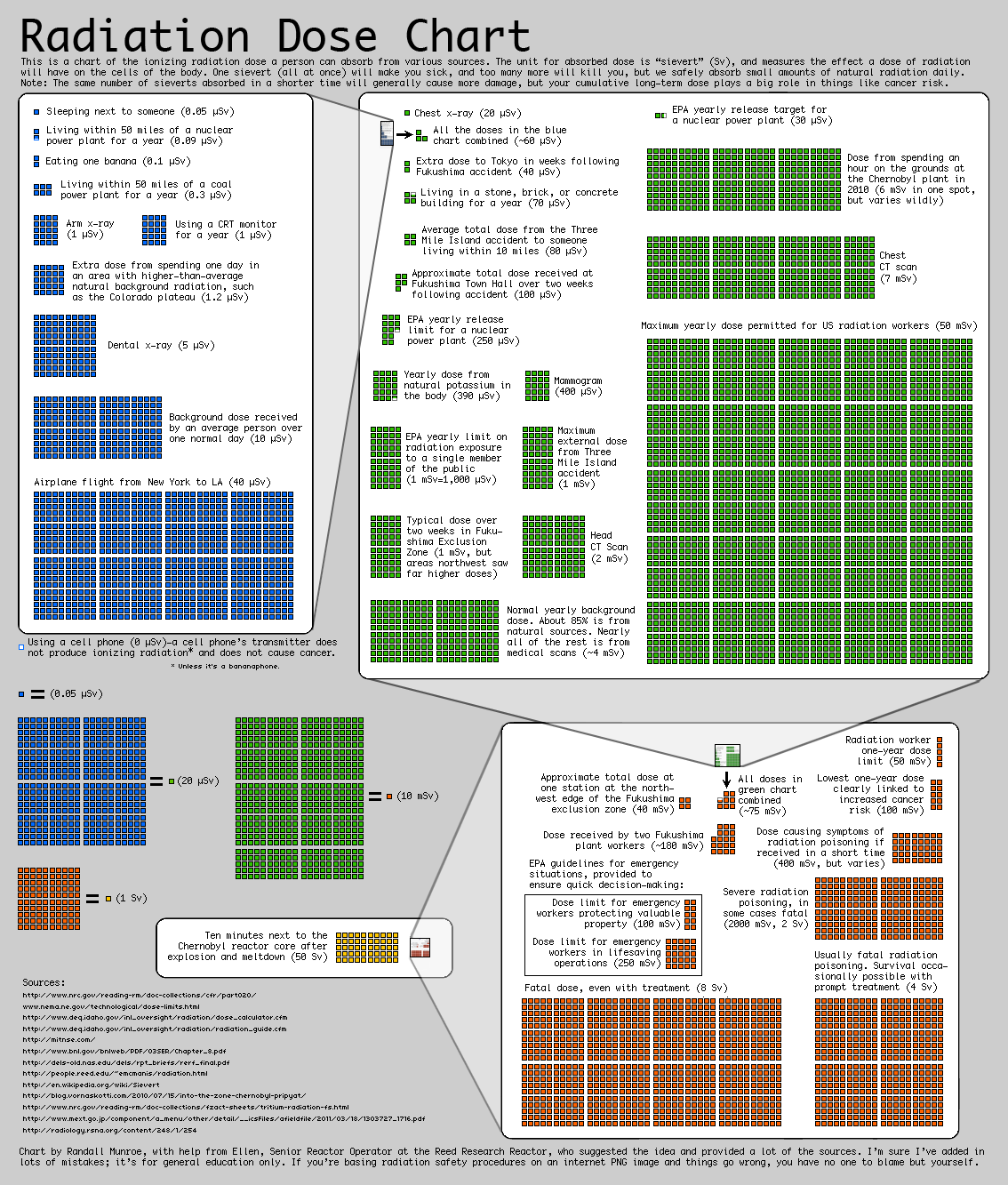
Radiation dose comparison charts from XKCD

March 20, 2011

No, there’s no humor in this thing — just good, solid information.

XKCD put together a chart that shows in geometric terms how various radiation doses work. With a tip of the pen to Bob Parks, the chart notes that cell phones don’t count here because cell phones don’t put out ionizing radiation, the type that causes cancer, but just radio waves.

The chart won’t be easy to read here — click on the image and go to the XKCD site for a bigger, more readable image:

Radiation Dose Chart from XKCD

Radiation Dose Chart from XKCD

It’s a good, clear graphic in its full size.  Go see.


WHO, DDT and the Persistent Organic Pesticides Treaty: Historic view from the inside

March 19, 2011

Rollback Malaria (RBM) was established in 1998 in part to reinvigorate the worldwide fight against malaria, and in part to facilitate the negotiations for what became the Stockholm Convention, the Persistent Organic Pesticides Treaty of 2001.

RBM World Malaria Day 2011

That’s about the time the ungodly assault on WHO and Rachel Carson started, by hysterical DDT advocates.  We now know that Roger Bate, Richard Tren, Donald Roberts and their comrades in pens are stuck in that 1998 fight.

Here’s a short account, from RBM, about just what happened:

The DDT Controversy

In 1999 the RBM Secretariat was called upon to help resolve a controversy emerging from intergovernmental negotiations to establish an international environmental treaty. At the centre of this controversy was DDT, former hero of the malaria eradication campaign and current totemic villain of the environmental movement. The treaty being negotiated was intended to eliminate the production and use of twelve persistent organic pollutants. DDT, still used for malaria control in over 20 countries, was included among ‘the dirty dozen’ chemicals slated for elimination, eliciting a strong reaction from public health activists and malaria specialists who claimed that its elimination would result in unacceptable increases in malaria morbidity and mortality. Environmental specialists and others claimed that environmentally friendly alternatives to DDT, although more expensive, could easily be deployed to guard against such a negative impact.

The controversy over the role of DDT in malaria vector control and the dangers posed to the environment escalated and attracted considerable media attention. The controversy was perpetuated in part because of a relatively weak evidence base on the human toxicity of DDT, the cost-effectiveness of proposed alternatives, and the probable impact of public health use of DDT (compared to agricultural use) on the environment. Resolution was also hampered by the relative lack of public health expertise among the Intergovernmental Negotiating Committee delegates, who were primarily active in the fields of foreign and environmental policy.

The challenges presented to the RBM Secretariat in responding to the controversy were many and varied. They included: evaluation of the evidence base and the drafting of policy guidance (a WHO normative role); a major communications effort; and the establishment of new cross-sectoral partnerships and working relationships. In the process, RBM formed new and highly effective ‘partnerships’ or ‘working relations’ with the United Nations Environment Programme (UNEP), the US Environmental Protection Agency, the environmental policy apparatus of core RBM partners, as well as a variety of health and environmental NGOs. RBM conducted country and informal expert consultations and convened and chaired a special working group on DDT which was able to establish a position on the use of the insecticide in public health and the process for evaluating and moving to alternatives. The weight of WHO’s technical authority contributed greatly toward establishing the credibility of the working group. Information about the treaty negotiations and the WHO position on DDT was disseminated to health specialists via the WHO regional networks and to treaty focal points via UNEP.

The RBM Secretariat led the WHO delegation to all meetings of the Intergovernmental Negotiating Committee and prepared information and media events for each, supporting the participation of health/malaria specialists from a number of countries. The RBM Secretariat also served as the media focal point on malaria and DDT and provided interviews and information to all major media, as well as presentations to professional meetings and interest groups.

RBM’s objectives throughout this process were:

  • to establish consensus on the present and future role of DDT and alternatives in malaria control;
  • to encourage greater involvement of public health specialists in country-level discussions about the treaty and in country delegations to the negotiating sessions;
  • to provide information to negotiators and others that would reduce controversy and result in a win-win situation for public health and the environment (in which the longer term goal of DDT elimination is achieved through strengthened, more robust malaria control);
  • to benefit from the media attention to inform the public about malaria; and
  • to mobilize resources to support malaria control from outside the health sector.

All of these objectives have been met and the final treaty, known as the ‘Stockholm Convention on Persistent Organic Pollutants’ provides for the continued public health use of DDT and international assistance for the development and implementation of alternatives.

Resources to support the initial work of the RBM Secretariat were provided by environmental agencies/offices. In addition, the Pan American Health Organization (PAHO) and the WHO Regional Office for the Americas (AMRO) and most recently the WHO Regional Office for Africa (AFRO) have been awarded project development grants from the Global Environment Facility (GEF) to promote regional efforts to strengthen malaria control and reduce reliance on DDT.

From Final Report of the External Evaluation of RBM, Roll Back Malaria to Date, Chapter 2, page 15 (circa 2001).


A fungus to fight malaria?

February 24, 2011

From a report in The Scientist Daily today:

Researchers have engineered transgenic fungi that drill into mosquitoes and kill the malaria parasite inside — the first tool of its kind — a February 25, 2011 study in Science reported.

Used in conjunction with traditional insecticide methods against mosquitoes, experts say this bioinsecticide has the potential to greatly improve malaria eradication efforts.

Mosquito infected with pathogenic fungus Metarhizium
Image: Courtesy of Raymond St. Leger

“This is a great example of trying to be innovative and use novel ways to look at this problem,” said Matt Thomas, a disease ecologist at Penn State who was not involved in the research. “It’s a move outside the existing insecticide paradigm, which has dominated parasite and vector control for 40-50 years.”

Read more: Fungus fights malaria? – The Scientist – Magazine of the Life Sciences http://www.the-scientist.com/news/display/58028/#ixzz1EuapNz8Z
Difficulties in developing this solution for use in the field promise no quick results.  Testing remains to be done on the process — and then there is the issue of how to infect the proper species of mosquito in the field.  Additionally, since this process involves genetic modification, there will be a raft of government approvals to contend with before deploying it, if it ever is deployed.

Unfortunately, putting the new technique into action may not be an easy task. “There are already difficult challenges in taking forward biopesticide technology,” said Thomas. “Now we’re adding in the additional regulatory and ethical issues around genetically modified organisms. It’s not a hurdle we should just dismiss as unimportant.”

Researchers at several different places pursue very different routes to help ease malaria — not one of them involving an increase in DDT use.
More:
  • Original article in Science:
    W. Fang et al., “Development of Transgenic Fungi That Kill Human Malaria Parasites in Mosquitoes,” Science 311: 1074-77 


Little Hoovers should ask: Are we in a Second Great Depression?

February 23, 2011

Stalking America and haunting the shadows of every capitol building in America today are people who would profess, if asked, that they fashion themselves in the mold of Herbert Hoover.  Little Hoovers, we might call them.  Unlike Hoover, and unlike the friendly “Little Hoover” phrase we might apply to them, the welfare of America is not their concern.  We might worry about that.

President Harry Truman in 1947 appointed former President Herbert Hoover to head a commission on how to reform the federal government.  I do not know of a high school history text that even mentions this effort today.

Herbert Hoover on the cover of Time Magazine, 1925

Herbert Hoover on the cover of Time Magazine, 1925

Hoover’s commission made 273 recommendations that were taken to heart, then taken to Congress.  Many were enacted into law.

Several states followed the example, as in Utah and famously in California. These groups were often called “Little Hoover” commissions.  In no case that I have found did any of these commissions ever recommend stripping union collective bargaining agreements out of any situation.

But again, this history is mostly lost.  Hoover is remembered today for his failure to stop the Great Depression, for his seeming unwillingness to do what was necessary in great enough effort to relieve the nation’s serious hurts.  That’s too bad, really.

Herbert Hoover was not opposed to government action to fix the depression on most counts.  In his correspondence with Franklin Roosevelt, especially after Roosevelt replaced him in the presidency, Hoover often complained that Roosevelt’s actions were in the right vein, but too much.

We should remember this.

Are we in a Great Depression?  Economically, technically, our nation is in “recovery.”

Realistically, our nation is teetering on the brink of great financial disaster.  Sadly, most people ignore the lessons of history, and consequently, actions of many governmental units today seem driven to push the nation over the brink.  Home prices have not recovered.  Millions are out of work — millions of highly-trained workers cannot find jobs with pay adequate to support a family.

We appear not to have learned these lessons that should not have been forgotten:

  • Stimulus from the government creates demand, which fuels manufacturing recovery, and more jobs.  Tax cuts, such as Hoover’s 1932 tax cut for the wealthy, drive us deeper into recession.
  • Labor unions form vital components of a healthy manufacturing segment; they stand up for worker health and safety, for fair pay and work conditions that spur productivity.  When we ignore or fight unions, we damage economic productivity.  When we work with unions, we make progress.
  • Cracking the whip may get a temporary reaction from workers that looks good.  In the long run, if not immediately, such actions damage productivity and creativity.
  • Unions do not make the big financial decisions that cripple industry.  Unions don’t decide the products to be produced.  Unions cannot gamble a company’s future on ill-advised acquisitions or switches in corporate focus, usually.  Union demands for restrooms improve the sanitation and health of our food supplies.  Union demands for limited work hours lead to productive workers, better safety, and better products.
  • In almost every case where foreign corporations compete successfully with U.S. companies on high-tech and high-skill jobs, and take away U.S. jobs, the government of that foreign nation provides health care for all citizens, so that health care costs are not a cost of business.  In the case of most industrial nations, foreign pension laws are much stiffer than U.S. laws, stiffer in protecting generous benefits for pensioners.
  • All workers benefit when unions gain, traditionally.  It wasn’t Andrew Carnegie who invented the two-week vacation.
  • Workers can do more for consumers when they are treated well and listened to by company management.

I’m depressed at the nasty actions in so many places, in so many ways, designed to thwart progress to good ends, and instead drive our nation into mediocrity.  I find it difficult to post when there is so much disaster looming in so many places.

When political movements from the right go after one group with hammer and tongs, we might do well to remember the old, wise words.  With a full-on awareness of Godwin’s Law, we might do well to remember the words attributed to Martin Niemöller,  and the moral of that story:

“Then they came for the trade unionists,
and I didn’t speak out because I wasn’t a trade unionist.”

What has Scott Walker done for anyone who makes less than $500,000 a year, anyway?  So you should ask:  What has Scott Walker ever done for you, or your family?  If the bargaining rights of any union are removed, anywhere in the U.S., who will speak up for your vacation, pension, health care benefits, and job safety?  OSHA?  Are you sure?

Update: It’s not paranoia when they are coming after you with more ill-will than you can imagine — see this Mother Jones update. It appears some people didn’t learn anything from the Tucson shootings.


More:

Cover of Gordon Lloyd's Two Faces of Liberalism:  How the Hoover-Roosevelt Debates Shape the 21st Century

A book you should buy: Gordon Lloyd's Two Faces of Liberalism: How the Hoover-Roosevelt Debates Shape the 21st Century


Bathtub reading on a cold February day . . .

February 10, 2011

Stuff to make you think:

  • Do you care? At least 16 members of Congress passed up on the government-sponsored health care plans, trying to be true to their campaign promises to repeal similar care for all citizens, a plan they try to ridicule as Obamacare.  Some of them discovered other plans “available from the market” are expensive, don’t cover pre-existing conditions, and generally don’t meet their needs.  Crooks and Liars explains:

Nevertheless, Republicans are discovering the truth: The status quo is unsustainable, unaffordable, and discriminatory. Now what will they do about that? And how will they appease their angry hordes of Tea Party members being stoked daily via email and fear campaigns?

  • Arctic Ice disappears, and so does the evidence Tim Lambert notes that those wacky pranksters at the Heartland Institute managed to find one small part of a chart to make a case that Arctic ice is increasing, even as Russia and China prepare to beat the U.S. to trans-Arctic shipping when the ice disappears.  Whose side is the Heartland Institute on, again?  It’s a new propaganda tactic:  The Small Lie.

There are people who need to soak their crania.  Back to work, here.


Bill Clinton on Bachmann/Tea Party “parallel universe” politics: “We need to put our country back in the future business”

February 3, 2011

At Davos, Switzerland, Bill Clinton answered a question from former White House advisor David Gergen, I gather.  American is exceptional, Clinton said — but those who insist on making “American Exceptionalism” a political mantra seriously risk making America unexceptional, and putting us into decline, he argues.

Texas Gov. Rick Perry’s ears are stinging on the issue of unbalanced state budgets.

President Bill Clinton interviewed at the 2011 World Economic Forum Annual Meeting held in Davos, Switzerland. – World Economic Forum

William Jefferson “Bill” Clinton was the 42nd President of the United States, serving from 1993 to 2001. At 46 he was the third-youngest president. He became president at the end of the Cold War, and was the first baby boomer president. His wife, Hillary Rodham Clinton, is currently the United States Secretary of State. Each received a Juris Doctor (J.D.) from Yale Law School.

The complete Clinton discussion can be viewed here.

Tip of the old scrub brush to Nicole Smith.