Doubtless, there are other accomplished photojournalists in Washington who have won an Eagle Scout medal with bronze palm. Luke Sharrett of The Times may be the only one who earned his just six years ago.
And he is almost certainly the only photographer who’ll be leaving the D.C. press corps on Friday to start his junior year in college.
“Why are you doing that?” President Obama asked him as Air Force One was taking off the other day.
Dunlap does not say whether Sharrett earned the Photography Merit Badge. Anyone know?
Spread the word; friends don't allow friends to repeat history.
Troop 1, Brownsville, Texas, May 20, 1916 - photo by Robert Runyon (The Center for American History and General Libraries, University of Texas at Austin; via American Memory, Library of Congress)
On June 15, 1916, President Woodrow Wilson signed the law granting a national charter to the Boy Scouts of America, which had been incorporated six years earlier. The charter is now encoded at 36 USC 309.
The purposes of the corporation are to promote, through organization, and cooperation with other agencies, the ability of boys to do things for themselves and others, to train them in scoutcraft, and to teach them patriotism, courage, self-reliance, and kindred virtues, using the methods that were in common use by boy scouts on June 15, 1916.
Good goals then, good goals now — maybe more important now.
Have you volunteered to be a leader?
Resources (and councils where I’ve Scouted and volunteered):
From the digital collections at the Library of Congress:
Boy Scout wreath, 1924 - Library of Congress Digital Collection, National Photo Company Collection (Call Number: LC-F8- 28581 (P&P))
Three Boy Scouts and a wreath with the BSA’s fleur de lis, in 1924. Who are the Scouts? What was the occasion? Questions we have in the centennial year of Boy Scouting.
This photo is in the middle of a collection of photos taken at the funeral of President Woodrow Wilson, which was on February 6, 1924. Was this the Boy Scouts’ tribute to Wilson? By the way, Wilson is the only president interred in the District of Columbia (Arlington National Cemetery is across the Potomac River, in Virginia). Wilson’s sarcophagus in in the main chapel of the National Cathedral.
Woodrow Wilson's tomb in the National Cathedral, Washington, D.C. - Wikimedia image
Spread the word; friends don't allow friends to repeat history.
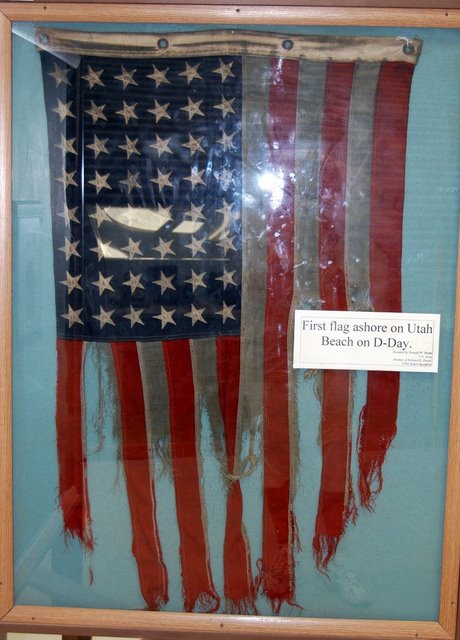
First U.S. flag on Utah Beach, Normandy, D-Day, June 6, 1944; Pima Air Museum, Tucson, Arizona
This mostly an encore post. A reader sent an e-mail with a question: Does U.S. law suggest the flying of the U.S. flag on the anniversary of D-Day?
Today is the 66th anniversary of the Invasion of Normandy in World War II, a date generally called D-Day. No, you don’t have to fly your flag. This is not one of the days designated by Congress for flag-flying.
But you may, and probably, you should fly your flag. If you have any D-Day veterans in your town, they will be grateful, as will their spouses, children, widows and survivors. A 22-year-old soldier on the beach in 1944 would be 87 today, if alive. These men and their memories of history fade increasingly fast. Put your flag up. You may be surprised at the reaction.
If you do run into a D-Day veteran, ask him about it. Keep a record of what he says.
"First Wave at Omaha: The Ordeal of the Blue and the Gray" by Ken Riley: Behind them was a great invasion armada and the powerful sinews of war. But in the first wave of assault troops of the 29th (Blue and Gray) Infantry Division, it was four rifle companies landing on a hostile shore at H-hour, D-Day -- 6:30 a.m., on June 6, 1944. The long-awaited liberation of France was underway. After long months in England, National Guardsmen from Virginia, Maryland and the District of Columbia found themselves in the vanguard of the Allied attack. In those early hours on the fire-swept beach the 116th Infantry Combat Team, the old Stonewall Brigade of Virginia, clawed its way through Les Moulins draw toward its objective, Vierville-sur-Mer. It was during the movement from Les Moulins that the battered but gallant 2d Battalion broke loose from the beach, clambered over the embankment, and a small party, led by the battalion commander, fought its way to a farmhouse which became its first Command post in France. The 116th suffered more than 800 casualties this day -- a day which will long be remembered as the beginning of the Allies' "Great Crusade" to rekindle the lamp of liberty and freedom on the continent of Europe. Image from National Guard Heritage series, from which the caption was borrowed.
Soldiers, Sailors, and Airmen of the Allied Expeditionary Force: You are about to embark upon the Great Crusade, toward which we have striven these many months. The eyes of the world are upon you.
Who is the woman in this photo? This is a chance to play history detective.
Utah Sen. Arthur V. Watkins, Sec. of Agriculture Ezra Taft Benson, and President Dwight D. Eisenhower, with unidentified woman, on September 9, 1958. Photo by Shipler Commercial Photography, scanned at Marriott Library from the collection of the Utah Historical Society (which holds the rights).
I stumbled across the photo at the on-line archives of the Utah Historical Society. At the time of this picture, Watkins was running for re-election in a race he would lose in November, in a three-way vote split, to Democrat Frank E. Moss. Watkins had run afoul of very conservative Utah politics when he chaired the Senate select committee that investigated Sen. Joseph McCarthy, and recommended censure of McCarthy.
Ezra Taft Benson served as Eisenhower’s Secretary of Agriculture for the full eight years of Eisenhower’s administration. Benson was an arch conservative, closely affiliated with the extreme right-leaning John Birch Society, which officially regarded Eisenhower as a bit of a traitor. Benson later served as President of the Church of Jesus Christ of Latter-day Saints (LDS, or Mormon).
Oddly, the picture doesn’t identify the woman. She’s in a wheel chair. The large stone columns suggest this is a government building, or monument. The microphone is set at the level of the woman, so obviously she was speaking at this event, whatever it was. In an election year, such a scene might be played out in the state of the election, Utah — but I suspect it was a Washington, D.C., venue (was Eisenhower in Utah in 1958?). Shipler Photography was a Utah company, though — what would they be doing in Washington?
Who is that woman? What was the event? Where was it?
Students would have to find the old photos at the library, or at your local historical association or museum. Most of your students already have the electronic photo equipment though . . .
In honor of Millard Fillmore’s birthday on January 7, I’ll post a collection of images of Fillmore and his administration that I’ve come across over the past year. Though photography was invented in 1837, and though Fillmore was thought to be a handsome man, not many images of our 13th president survive on the internet. For that matter, there is not a lot of good biographical information, either.
Many of these images come from the Library of Congress’s collections.
Millard Fillmore, undated lithograph, Library of Congress
The Library of Congress has one copy of a print of this image. A note with the image says “Duval,” but little is known about it otherwise, at least to the Library of Congress. No date is given. Judging from the color of his hair, I think this may be an image done for his unsuccessful 1856 campaign.
Only a tiny handful of images of Fillmore show up regularly — this is not one of them. I wonder whether my posting it here will have any effect in spreading its popularity.
Fillmore will perhaps always remain enigmatic, out of step with his own times in many ways, and forced to the edges of history by other events and people more in the mainstream. Fillmore was born January 7, 1800, 24 days after the death of George Washington (d. December 14, 1799), and lived through the administration of Abraham Lincoln, and the Civil War. Fillmore had some things in common with both of those great presidents, but no real dealings except for his opposition to Lincoln.
History uneasily deals with such men, who refuse to be put into pigeon holes.
No, not current senators — don’t get your ignoble hopes up.
With more than 40,000 photographs and other images, the Senate Historical Office has images of almost all people who have served as members of the U.S. Senate. 5o members are completely absent from the Senate collection, however.
Got any idea where to find images of these guys? This comes from the Senate Historical Office:
Senators Not Represented in Senate Historical Office Photo Collection
The Senate Historical Office maintains a collection of more than 40,000 still pictures, slides, and negatives. The collection includes photographs and illustrations of most former senators, but to date no photo or other illustration of about fifty members has been found. Below is a list (by state) of U.S. Senators for whom we have no image in our collection. If you have an image, or information that may lead us to an image, please contact the Senate’s photo historian.
You just know that somewhere out there, a local museum has a painting of one of these guys. Or, someone has a painting or drawing of an old-timey guy hanging over a fireplace, a family heirloom that features one of these guys. I mean, how could a guy like Outerbridge Horsey fail to inspire an artist somewhere?
From “Whose father was he?” a four-part essay on tracking down the story of three children whose photograph was discovered on the corpse of a Union soldier killed at the Battle of Gettysburg, in 1863:
Perhaps more than any other artifact, the photograph has engaged our thoughts about time and eternity. I say “perhaps,” because the history of photography spans less than 200 years. How many of us have been “immortalized” in a newspaper, a book or a painting vs. how many of us have appeared in a photograph [32]? The Mayas linked their culture to the movements of celestial objects. The ebb and flow of kingdoms and civilizations in the periodicities of the moon, the sun and the planets. In the glyphs that adorn their temples they recorded coronations, birth, deaths. Likewise, the photograph records part of our history. And expresses some of our ideas about time. The idea that we can make the past present.
The photograph of Amos Humiston’s three children — of Frank, Alice and Fred — allows us to imagine that we have grasped something both unique and universal. It suggests that the experience of this vast, unthinkable war can be reduced to the life and death of one man — by identifying Gettysburg’s “Unknown Soldier” we can reunite a family. That we can be saved from oblivion by an image that reaches and touches people, that communicates something undying and transcendent about each one of us.
And the footnote, number 32:
[32] I had an opportunity to visit the fossil collections at the Museum of the Rockies in Bozeman, Montana. It was part of a dinosaur fossil-hunting trip with Jack Horner, the premier hunter of T-Rex skeletons. Downstairs in the lab, there was a Triceratops skull sitting on a table. I picked it up and inserted my finger into the brain cavity. (I had read all these stories about how small the Triceratops brain had to have been and I wanted to see for myself.) I said to Jack Horner, “To think that someday somebody will do that with my skull.” And he said, “You should be so lucky. It’s only the privileged few of us who get to be fossils.”
See Errol Morris’s whole series, “Whose father was he?” at the New York Times blogs:
Hidalgo himself was captured by the Spanish in 1811, and executed.
Statue of Father Hidalgo in Dolores, Mexico.
It’s a great story. It’s a good speech, what little we have of it (Hidalgo used no text, and we work from remembered versions).
Why isn’t there a good 10- to 15-minute video on the thing for classroom use? Get a good actor to do the speech, it could be a hit. Where is the video when we need it?
Update for 2008: Glimmerings of hope on the video front: Amateur videos on YouTube provide some of the sense of what goes on in modern celebrations.
The Grito de Dolores (“Cry of/from Dolores”) was the battle cry of the Mexican War of Independence, uttered on September 16, 1810, by Miguel Hidalgo y Costilla, a Roman Catholic priest from the small town of Dolores, near Guanajuato, Mexico.
“My Children, a new dispensation comes to us today…Will you free yourselves? Will you recover the lands stolen 300 years ago from your forefathers by the hated Spaniards? We must act at once.”
Although many mistakenly attribute the Cinco de Mayo holiday as the celebration of Mexican independence, Sept. 16 was the day the enthusiastic Indian and mestizo congregation of Hidalgo’s small Dolores parish church took up arms and began their fight for freedom against Spain.
Portals to the World contains selective links providing authoritative, in-depth information about the nations and other areas of the world. Resources on Mexico include information on the country’s history, religion, culture and society to name a few.
September is also a notable month for Hispanic culture with the celebration of Hispanic Heritage Month Sept 15 – Oct. 15. Sept. 15 is significant because it is the anniversary of independence for Latin American countries Costa Rica, El Salvador, Guatemala, Honduras and Nicaragua. In addition to Mexico’s independence day on Sept. 16, Chile recognizes its independence day Sept.18. Also, Columbus Day or Día de la Raza, which is Oct. 12, falls within this 30-day period.
The theme for the 2009 Hispanic Heritage Month is “Embracing the Fierce Urgency of Now!” To coincide with the celebration, the Library and several partners present a website honoring Hispanic culture and people.
Specifically on the Grito de Dolores, see the Library of Congress’s American Memory Project:
Cry of Dolores
My Children, a new dispensation comes to us today…Will you free yourselves? Will you recover the lands stolen three hundred years ago from your forefathers by the hated Spaniards? We must act at once.Cry of Dolores, attributed to Father Miguel Hidalgo y Costilla, September 16, 1810.
Early on the morning of September 16, 1810, Father Miguel Hidalgo y Costilla summoned the largely Indian and mestizo congregation of his small Dolores parish church and urged them to take up arms and fight for Mexico’s independence from Spain. His El Grito de Dolores, or Cry of Dolores, which was spoken—not written—is commemorated on September 16 as Mexican Independence Day.
Father Hidalgo was born into a moderately wealthy family in the city of Guanajuato, northwest of Mexico City, in 1753. He attended the Jesuit College of San Francisco Javier, received a bachelor’s degree from the University of Mexico in 1774, and was ordained into the priesthood in 1778. He soon earned the enmity of the authorities, however, by openly challenging both church doctrine and aspects of Spanish rule by developing Mexican agriculture and industry.
In 1803, Hidalgo accepted the curacy of the small parish of Dolores, not far from his native city of Guanajuato. Between 1803 and 1810, he directed most of his energy to improving the economic prospects of his parishioners. He also joined the Academia Literaria, a committee seeking Mexico’s independence from Spain.
In September 1810, Spanish authorities learned of the group’s plot to incite a rebellion. On September 13, they searched the home of Emeterio González in the city of Queretaro where they found a large supply of weapons and ammunition. Warned of his impending arrest, Hidalgo preempted authorities by issuing the ElGrito de Dolores on the morning of September 16. Attracting enthusiastic support from the Indian and mestizo population, he and his band of supporters moved toward the town of San Miguel.
The rebel army encountered its first serious resistance at Guanajuato. After a fierce battle that took the lives of more than 500 Spaniards and 2,200 Indians, the rebels won the city. By October, the rebel army, now 80,000 strong, was close to taking Mexico City. Hidalgo, fearful of unleashing the army on the capital city, hesitated, then retreated to the north. He was captured in Texas, then still a part of the Spanish empire, and executed by firing squad on July 31, 1811. After ten more years of fighting, a weakened and divided Mexico finally won independence from Spain with the signing of the Treaty of Córdoba on August 24, 1821.
Learn more about Mexico:
View the Huexotzinco Codex, one of the Top Treasures in the Library of Congress’ American Treasures online exhibition. The codex is an eight-sheet document on amatl,a pre-European paper made from tree bark in Mesoamerica. It is part of the testimony in a legal case against representatives of Spain’s colonial government in Mexico and dates to 1531, ten years after Mexico’s defeat.
Read the Today in History feature on the Mexican holiday Cinco de Mayo, which celebrates Mexico’s defeat of French troops at the town of Puebla in 1862. This event is also widely celebrated by Latinos in the U.S.
Hispanic Heritage Month.gov, from the Library of Congress, National Gallery of Art, National Endowment for the Humanities and several other federal agencies and institutions
To locate resources for the study of Mexico and its history, search the Handbook of Latin American Studies, an online bibliography of works selected and annotated by scholars of Latin American history and culture, or visit the Hispanic Reading Room, which also offers a portal for online information on Mexico.
Share this bit of history:
Spread the word; friends don't allow friends to repeat history.
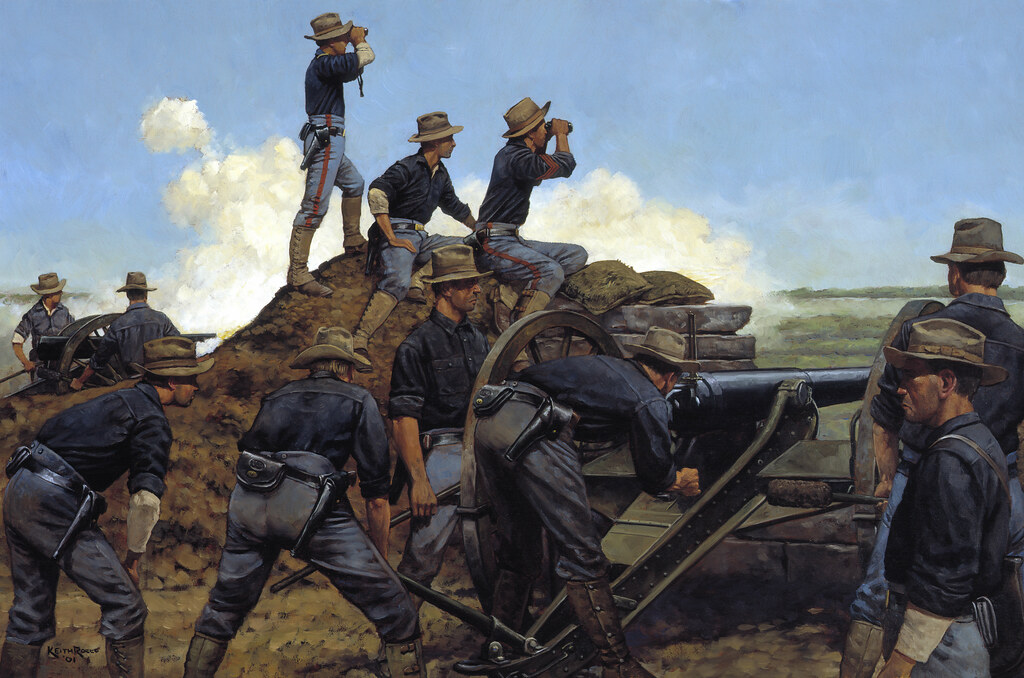
Utah Light Artillery in the Spanish-American War – National Guard Heritage Gallery
On April 6, 1898, Congress declared war on Spain and President William McKinley organized United States forces for the “Splendid Little War.” Of the tens of thousands of regular, volunteer and National Guard (Militia) troops who served, 343 Utah Guardsmen saw service in the Philippine Islands. On May 1st, after the Navy’s stunning victory at Manila Bay, McKinley authorized an invasion force to capture the Philippine archipelago from Spain. Organized into two batteries, the Utah “Light” Artillery mustered into federal service on May 9, 1898 at Fort Douglas, Utah. Shortly thereafter, at Camp Merritt near San Francisco, the Utah Artillery became part of Brig. Gen. Francis V. Greene’s brigade of the U.S. VIII Corps under the command of Maj. Gen. Wesley Merritt.
Leaving San Francisco, Greene’s brigade first raised the U.S. flag in Guam and then arrived on the island of Luzon on July 17, 1898. In the Philippines, 15,000 Americans not only faced 13,000 Spanish soldiers but a second army of some 12,000 Philippine rebels under Emilo Aguinaldo. The rebels had been fighting for national independence from Spain and hoping for American assistance. When Merritt ordered to keep the rebels out of the fight against Spain, the rebels became a second possible enemy.
On August 13th, the Utah Artillery supported Greene’s brigade as it attacked towards the “old” city of Manila. The battle was predetermined to be a “limited” one in order to preserve Spanish honor and minimize casualties. The rebels, however, made this impossible. As American forces moved quickly against the Spanish defenses, a race to the old city center developed between the Americans and Aguinaldo’s rebels. The Utah batteries fired and re-deployed several times providing close and accurate support for the infantry attacks.
The Utah Light Artillery continued in federal service for another year and fought in the Philippine Insurrection until returning to Utah in August 1899. Today’s 145th Field Artillery, Utah Army National Guard, carries on the history and traditions of the Utah Light Artillery.
Magna charta cum statutis angliae, (Great Charter with English Statutes). Library of Congress
These links are to exhibits that are closed, but whose images are still maintained on line. The Library promises to update exhibits, and on line collections will grow, too.
There really is some remarkable stuff, most of it obscure enough to be really cool, still.
A 16th century miniature pictures Rustam, the hero of the Persian national epic, The Shah Namah, tossed into the sea by the demon Akwan. (Library of Congress, Near East Section).
Spread the word; friends don't allow friends to repeat history.
The exhibit left the George H. W. Bush Presidential Library in March 2007 — but the good folks who run the library left an on-line version. It’s a gallery of 100 photographic portraits of important Texans. Click on the photo, you get a short biography of each person.
Red Adair, pioneer in putting out oil field fires - Image from George H. W. Bush Presidential Library
Red Adair holds the first spot on the list, and ZZ Top occupies the last (the list is alphabetical). The list is eclectic, and useful. The list focuses on the 20th century, leaving out the usual Texas luminaries Austin, Houston and de Zavala, and that’s good. This is a great list for junior high Texas history students to use, for learning Texas history, or for selecting the “famous Texan” who will be the subject of their biography project.
A handful of these people are commonly reported on in classrooms. Most are not, however. You’ll learn more about Texas folklore and Texas’s Mexican heritage in music from these short biographies than you can learn in many Texas history courses. Adair to ZZ Top, including John Henry Faulk, John Nance Garner, Walter Cronkite, Bobby Layne, Janis Joplin, Scott Joplin, Michael DeBakey, George Foreman, Lydia Mendoza, Sam “Lightnin'” Hopkins, Hector Garcia, and Bessie Coleman, and 86 others. All the major Texas industries are represented, and all parts of Texas. If a student knew all of these people, the student would have a heck of a bunch of Texas knowledge.
Bessie Coleman, world's first licensed black pilot - image from the George H. W. Bush Presidential Library
Use this exhibit to broaden your knowledge of Texas history, or to invent new teaching points. A savvy teacher could use these to create 100 bell ringers, I suspect — and do a lot more.
It would be great if the library were to publish a poster featuring the 100 portraits. Anybody in College Station listening?
How do you use this exhibit in your classroom?
Spread the word; friends don't allow friends to repeat history.
Hoisting the flag at Guantanamo, Cuba, June 12, 1898. Edward H. Hart, photographer. Image from the American Memory Collection at the Library of Congress
Oh, it’s important in retrospect, no?
On June 10, 1898, U.S. Marines landed at Guantánamo Bay. For the next month, American troops fought a land war in Cuba that resulted in the end of Spanish colonial rule in the Western Hemisphere. Cuban rebels had gained the sympathy of the American public while the explosion and sinking of the U.S.S. Maine, widely blamed on the Spanish despite the absence of conclusive evidence, further boosted American nationalistic fervor.
On June 12, the area was secured and the flag posted.
Or, until that account is unsuspended by the forces supporting Donald Trump: Follow @FillmoreWhite, the account of the Millard Fillmore White House Library
We've been soaking in the Bathtub for several months, long enough that some of the links we've used have gone to the Great Internet in the Sky.
If you find a dead link, please leave a comment to that post, and tell us what link has expired.
Thanks!
Retired teacher of law, economics, history, AP government, psychology and science. Former speechwriter, press guy and legislative aide in U.S. Senate. Former Department of Education. Former airline real estate, telecom towers, Big 6 (that old!) consultant. Lab and field research in air pollution control.
My blog, Millard Fillmore's Bathtub, is a continuing experiment to test how to use blogs to improve and speed up learning processes for students, perhaps by making some of the courses actually interesting. It is a blog for teachers, to see if we can use blogs. It is for people interested in social studies and social studies education, to see if we can learn to get it right. It's a blog for science fans, to promote good science and good science policy. It's a blog for people interested in good government and how to achieve it.
BS in Mass Communication, University of Utah
Graduate study in Rhetoric and Speech Communication, University of Arizona
JD from the National Law Center, George Washington University


 Posted by Ed Darrell




![Viva la república! Viva el Cura Hidalgo! Una página de Gloria, TITLE TRANSLATION: Long live the republic! Long live Father Hidalgo! A page of glory. Between 1890 and 1913. Prints and Photographs Division. Reproduction Information: Reproduction Nos.: LC-USZ62-98851 (b&w film copy neg.), LC-DIG-ppmsc-04595 (digital file from original, recto), LC-DIG-ppmsc-04596 (digital file from original, verso); Call No.: PGA - Vanegas, no. 123 (C size) [P&P] Catalog Record: http://hdl.loc.gov/loc.pnp/ppmsc.04595](http://www.loc.gov/wiseguide/sept09/images/Mexican_A.jpg)
![A street in Guanajuato, Mexico. Between 1880 and 1897. Prints and Photographs Division. Reproduction Information: Reproduction No.: LC-D418-8481 (b&w glass neg.); Call No.: LC-D418-8481 <P&P>[P&P] Catalog Record: http://hdl.loc.gov/loc.pnp/det.4a27131](http://www.loc.gov/wiseguide/sept09/images/Mexican_B.jpg)







 Millard Fillmore's Bathtub