New paradigm for education

October 31, 2010

Not sure where this guy, Sir Ken Robinson,  is going — nor especially how it would relate to education in the U.S. (this group is from Britian — hear the accent?).

The animation is great — I’d love to have someone who could do this for quick history lessons to correspond with what we’re supposed to be doing on the curriculum calendar.

Plus, of course, he’s right.  We need less standardization, and more personalization.  Firing teachers frustrates both ends of that equation. He’s right — the schools are headed in the wrong direction.

I’ll wager Arne Duncan has never seen this.  Any of our old friends at Education know?  I’ll wager this speech and film drop into the abyss, regardless the credentials of Sir Ken Robinson and the good intentions of RSA.

RSA is the acronym for the clumsily-named Royal Society for the encouragement of Arts, Manufactures and Commerce.  “RSA” is a deft recovery from such a nomenclaturical handicap.

This RSA Animate thing has some potential — a lot like some of the animation schemes used by network news.

Resources:


Lancet special issue on malaria eradication: No call for more DDT

October 30, 2010

Lancet is one of the premiere research journals in the world for all of science, but especially for issues of health and medicine.

Image from Lancet illustrating malaria story

Image from Lancet –
Mother and child under a mosquito bite-preventing bednet.

On October 29, 2010, Lancet published a special report, “Malaria Elimination.”  Much science.  Much history.  No call for more DDT.

A plan for research is laid out.  Plans to eradicate malaria from more than 90 nations are laid out, explained and debated.  Calls for more research are made.  Calls for disciplined action from nations and health care organizations, and donor organizations.

But no call for more DDT.

Go take a look at the issue.  Several of the articles are available for no charge, out from behind the usual Lancet paywall.

Get the real science, real history, real policy.  Environmentalists are not evil villains there.  malaria is the villain in that story, and serious health care researchers and deliverers discuss serious methods to beat the disease.  Consequently, DDT has only a bit part.

Resources:


Washington, by Ron Chernow – great scholarship, a good read, significant light

October 28, 2010

Welcome, Book Tourists!  This is the last stop on a virtual book tour for Ron Chernow’s biography, Washington.

Virtual cocktails afterward, I hope.  Then sit down and read the book.

In a piece of great fortune for me, six years ago I spent a week at Mount Vernon, George Washington’s home in Virginia, through the good graces of the Bill of Rights Institute and the National Endowment for the Humanities, studying George Washington’s role in the creation of the U.S. Constitution.

Cover of Ron Chernow's book, Washington

Washington, by Ron Chernow. Penguin Press, 2010; 906 pages, $40.00

My academic interest leaned more toward James Madison’s role.  I thought then, and I still think, that Madison deserves a good, popular biography to complement the great recent work of others on the American Revolution and post-revolutionary organization of the nation.  We’ve had recent books by Edmund Morris, Ron Chernow, David McCullough, Joseph Ellis, Walter Isaacs  and others on Franklin, Jefferson, Adams, the “founding brothers,” Hamilton and Washington.   But for Garry Wills’ short and crabby assessment of Madison’s presidency, I am unaware of a good, popularly-readable Madison book.    As a professional journalist, as a civil libertarian, as a lawyer and occasional investigator, my studies of the era favored Franklin, Jefferson and Madison.  George Washington took the center stage, in my conception of events, while those working around him and in the wings frantically worked to put on the production that made America and allowed Washington to play the role of a hero, the face of the “Father of His Country” role — while the truth was that such success really did have many fathers.

For most history purposes in elementary and secondary schools, for most of the past 200 years, Washington is the easy center of attention, and I suspected a different story.  Jefferson wrote better, and more thoughtfully, did he not?  Madison’s legislative work in Virginia alone shone above Washington’s.  Washington had military experience, and he managed to cling on through the revolution — but his role as president was often more as a referee between the great creative forces driven by Hamilton, Madison and Jefferson.

What I hoped to find at the Mount Vernon meetings were sources to reveal the true role of James Madison — maybe I could get the story together and write it myself.

Simply put, I was not prepared to confront the genius of Washington, nor did I appreciate the depth of his involvement in so many areas where our common understanding of history simply gave Washington the title of hero, but without telling much of the backstory.

I looked for the evidence of Madison’s genius.  What I found was the overwhelming evidence of Washington’s genius, too.

Washington’s economic genius now displays proudly at Mount Vernon, with the reconstruction of his 16-sided barn for wheat thrashing, and with the reconstruction of the distillery which made the man who put down the Whiskey Rebellion, ironically, the leading distiller of whiskey in America shortly before his death.  I learned that Washington got out of tobacco a decade before the revolution, because he didn’t like the economics of sending a crop to agents he did not fully trust in London, for sales in markets whose prices he could not track, for sales to purchasers he could not see.  Instead, he took his business into wheat, a commodity much in demand since most other farmers locally grew tobacco.  Washington became a leading wheat producer, and grew richer as a result of that and other similar decisions of clear-thinking economics.  By the end of his life, he was producing a surplus of wheat — which excited his Scotland-born farm foreman, who had a recipe for whiskey.

Washington was not merely the frontman for the convention in Philadelphia in 1787.  It became clear to me that he was a driving force, introducing Madison to Hamilton, and mentoring both in their work to get the convention approved, and then to get the Constitution written and ratified.   Washington had financial interests in seeing a great, united nation out of the 13 colonies:  He had land in the Ohio River Valley to sell, to get rich, if only there were an authority to made transportation into the valley hospitable to settlers, and transportation out to let those settler farmers get rich from their produce.   Washington’s vision, I learned, was much greater than I had understood.

Ron Chernow’s thick biography of Alexander Hamilton excited historians in 2004.  As studies of Jefferson lead to studies of Madison, and vice-versa, so do studies of Hamilton inevitably lead to studies of Washington.  We are fortunate that Chernow wrote the thick biography of Washington, the first great study of the man for the 21st century.

Chernow’s Washington, A Life (2010, Penguin Press, 906 pages) is every bit the great study of Washington we need and can use.  My bias as a teacher of high school students leans toward usefulness in the classroom — a higher standard than most imagine, since, for a high school classroom, a book must be eminently readable as well as accurate and clear.

Chernow had me at the Prelude.  In a brisk five pages he tells the story of Gilbert Stuart, an often-economically-bereft artist who saw fortune in Washington’s election.  Stuart arranged to get the great man to sit for a portrait — Washington did not like it — but Stuart never finished Washington’s commission in Washington’s life.  Instead, Stuart used the portrait to copy, for others.    Stuart’s fortune came not from Washington, but from the vast throng of Washington admirers who would pay handsomely for an image of the man.  It’s a well-told story, and a great introduction to the lionizing of Washington and his image, the reality of the man who sat for the portrait, and the way history has treated the man and the myth.  [Courtesy of the New York Times, you may read the Prelude, here.]

Readers of McCullough’s 1776 know of some of Washington’s genius at war, and some of his attention to details of making things work right — whether it be the way latrines were dug so an army could relieve itself and avoid disease, or the the exact tints of the color of green paint applied to the massive dining room he had added to the house at Mount Vernon.  McCullough’s book is a taste, a sampling of the work Chernow has.  One may compare Chernow’s story-telling ability to McCullough’s, and Chernow may suffer a bit.  For Washington, the drama is so often in the details, however — and details we have, galore.

Is it too much detail?  For the life of another, it may be.  Not for Washington.  Chernow is able to make readable even the details.  One may open this book at any page, start with a paragraph, and learn something about Washington — most often, learning something one did not know precisely before.  Chernow relied on the massive project at the University of Virginia to publish all the papers of Washington, collected from various sources.  Washington had not been quite so assiduous as Jefferson in making copies of everything he wrote for posterity, though much he was an assiduous diarist and taker of notes.  No biographer before had the advantage of the catalogueing done at Virginia, nor perhaps of the scope of the material there.

For this reason alone, this book should be read.

Chernow’s portrait is painstaking.  What emerges in the end is a George Washington whose vanity would be quirky and irksome in others, but necessary to the building of the image history graces to him, as the standard-bearer for the founders of the nation, truly the Father of His Country.  The vanities quickly become clear as careful consideration by a man who understood, especially as president, that each move he made would be a precedent for those who would follow, he hoped.   One example:  Washington’s work on the bank bill of 1791, made possible as we know by the dinner at Jefferson’s where Hamilton and Madison struck the bargain that sited the District of Columbia on the Potomac, and set up the finances that would make the nation successful in business and international relations over the next 200 years.

Though he had sat through every session of the Constitutional Convention, Washington did not pretend to expertise in constitutional nuances — he nce wrote that he had ‘had as little to do with lawyers as any man of my age” — and engaged in much hand-wringing over the bank bill.  He would be forced to issue a black and white opinion that would alienate some, gratify others, and irrevocably shape the future government.  He called in Madison, supremely well versed in the Constitution, for a series of quiet, confidential talks.  “The constitutionality of the nation bank was a question on which his mind was greatly perplexed,” Madison would recall, noting that Washington was already biased in favor of a national bank and “a liberal construction of the national powers.”  On the other hand, Washington was shaken by uncompromising verdicts from Randolph and Jefferson and asked Madison, as a precaution, to draft a veto message for the bank bill.

When Washington turned to Hamilton, he made plain that, unless he could vanquish the arguments of Randolph and Jefferson, he planned to veto the bank bill, telling him that he wished to “be fully possessed of the arguments for and against the measure before I express any opinion of my own.”  By this point Washington knew the vigor of Hamilton’s mind and his extraordinary knack for legal argument.  In little more than a week, Hamilton, in a superhuman burst of energy, produced more than thirteen thousand words that buried his opponents beneath an avalanche of arguments.  His exegesis of the “necessary and proper” clause not only made way for a central bank but would enable the federal government to respond to emergencies throughout American history.  Hamilton interpreted the “necessary and proper” clause to mean that “every power vested in a government is in its nature sovereign and includes, by force of the term, a right to employ all the means requisite and fairly applicable to the ends of such power.”  In other words, the Constitution gave the federal government not only the powers explicitly enumerated but also a series of unstated or “implied powers” indispensable to attain those ends.  (circa page 649)

Two paragraphs, easily read without seriously taxing the vocabulary of an SAT-studying high school junior.  They clearly detail Washington’s care in analyzing all sides of an issue.  They reveal Washington’s ability to harness the good work of men of greatly differing viewpoints, to the enlightenment of Washington and benefit of the nation — which benefit likely would not have occurred had another man been in Washington’s place (can you imagine anyone else mediating Madison and Hamilton — and keeping them both as friends?).  Chernow gracefully slips from telling a good story to providing scholarly details (I have omitted footnotes here), but not in an eye-glazing fashion — weaving the scholarship into a story fantastic enough that it would not sell for fiction, as Twain warned because it does not stick to the probabilities.

A few years ago a student offered what I considered a great insight.  We were comparing the American Revolution to the French Revolution; naturally, considering the Reign of Terror and the rise of the dictatorial Emperor Napoleon, students wondered where the French went wrong, and where the Americans got luck and went right.  Israel Pena summed it up neatly:  “The French didn’t have George Washington.  Americans came out of their revolution with George Washington; France came out of their revolution with Napoleon.”

Napoleon would have done well to have studied George Washington.

It is reported that when King George III learned that Gen. George Washington had, at the end of the American Revolution and the peace treaty negotiations, resigned his commission to the Continental Congress, the news was met with disbelief.  Washington improbably held together a ragamuffin mob of an army, disciplined them into a fighting force, and through evasion tactics, inspiration and sheer luck, and great aid from the King of France and the French Navy, defeated Great Britain in a war where no one, probably  including Washington had thought it possible to do so.  Many Europeans expected Washington would assume the crown of America and have himself declared king.

Instead, following the story of his Roman hero, Cincinnatus, Washington declined the power, deferring to civilian and more democratic rule, sublimating military might and prowess to the greater powers of reason.  (Washington, following Cincinnatus again, bowed out after two terms in the presidency — the power of story and early education over the fate of a nation.)

King George said he didn’t believe the news.  “But if it is true, [Washington] is the greatest man who ever lived.”

Without unnecessary shine, Ron Chernow has written more than 800 pages of the brief for the case proving King George’s judgment.  In these times, when people claim to wish to follow Washington and the Constitution, we would do well to study what Washington said, wrote and did, and how he came to create the Constitution and the nation it frames.

Note: My review copy did not include an index. The book, Washington covers the man as an encyclopedia.  For the sake of high school teachers and researchers, I hope an index comes with the published text.

More, and resources; other reviews:

Other stops on the virtual book tour:


How to tell the textbook approval process is broken: Virginia’s voodoo history

October 25, 2010

4th graders in Virginia could learn from their history texts that thousands of African Americans formed battalions in the Confederate Army and fought to save the South, during the Civil War — entire battalions under Gen. Stonewall Jackson.

That’s what the book claims, anyway.  It’s fiction.  The author fell victim to a hoax.

Kevin Sieff exposed the book in The Washington Post last week.  Virginia education officials quickly moved to discourage teachers from teaching the erroneous passages.  Some education authorities pulled the books.  The incident exposes problems in the textbook approval processes popular in southern states.

If you had hoped textbook craziness was confined to Texas, you know better now.

More:


Texas State Fair long past

October 24, 2010

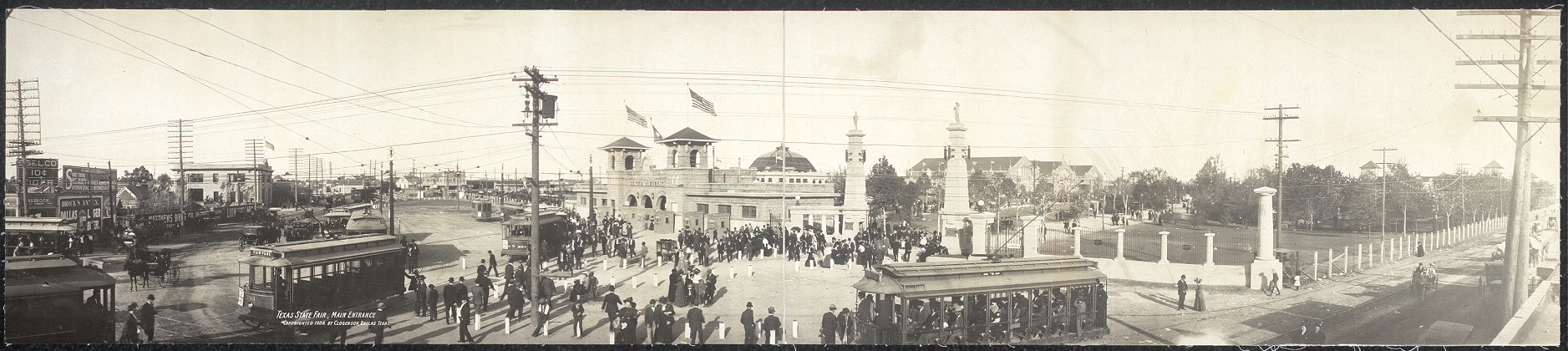
Texas State Fair 1912 - LOC panoramic photo - 6a28033r

Texas State Fair, 1908 - Library of Congress panoramic photo

Click on the photo to see a much larger version.

From the astonishingly vast vaults of the Library of Congress, a panoramic photograph of the main entrance of the Texas State Fair, in 1908.  This is almost certainly Dallas, and this is probably the same entrance where today the short-rail mass transit trains pass by — a century later, and Dallas has once again got mass transit.

This photo contrasts starkly with Fair Park in Dallas today, a week after the closing of the 2010 Texas State Fair.

Details from the Library of Congress:

Item Title

Texas State Fair, Main Entrance.
Created/Published  c1908.

Copyright deposit; H. Clogenson; December 8, 1908; DLC/PP-1908:43634.
Copyright claimant’s address: Dallas, Texas
Medium:  1 photographic print : gelatin silver ; 9.5 x 43 in.

Call Number:  PAN SUBJECT – Events no. 31
REPRODUCTION NUMBER:  LC-USZ62-125457 DLC (b&w film copy neg.)

Who was H. Clogenson?  What other treasures did he leave around?


Relic bomb crater found in Darwin, Australia

October 20, 2010

A bit of World War II history:  Darwin, Australia, took more bombs than Pearl Harbor, during World War II.

We learn this from the Australian Broadcasting Corp. story on the recent rediscovery of a large bomb crater there:

Map of Australia

Map of Australia, from Australia.com

Bomb crater found in Darwin CBD

It has been confirmed that a large hole uncovered by earthworks in Darwin’s CBD is a bomb crater probably created during the first Japanese raid on Darwin in 1942.

The crater was spotted by a passing motorist who reported it to the Department of Heritage.

Archaeologist Silvano Jung has now investigated the site and says it is almost certainly a bomb crater.

“Judging by the diameter of the crater, it was probably a 1,000 pound bomb, or a 500 kilo bomb, dropped by a medium bomber either from Java or Ambon [in Indonesia],” he said.

“Most likely on February 19 [1942] as well.”

Mr Jung says the bomb crater will become a special part of Darwin’s history.

“Often it’s the small things in history that are really important and given that this is the only one, it makes it unique. It’s a unique hole in Darwin,” he said.

Darwin was subjected to 63 bombing raids during the war, with more bombs dropped on the city than Pearl Harbour.

Now we study bomb craters in archaeology.

According to some reports, it is the sole surviving bomb crater from the war, in Darwin:

Northern Territory heritage Minister Karl Hampton said the exciting discovery on McMinn Street provided a clear link with the past.

“World War II is an important part of the Territory’s history and identity,” Mr Hampton said in a statement released on Wednesday.

“Territorians are proud of our unique history, and we now have another attraction no other capital city can match – an authentic World War II bomb crater.”


Annals of DDT: Interior Dept compliments Rachel Carson’s research in Silent Spring

October 17, 2010

One of the most frequent hoax charges against Rachel Carson claims that she didn’t base Silent Spring on research.  Greater hoaxers claim that there is little or no evidence of harm to birds from DDT.

Rachel Carson's book stirs controversy, newspaper headlines

Rachel Carson’s book stirred controversy, as shown in newspaper headlines

These critics forget history, or they try to cover it up so you won’t know any better.  Carson provided more than 50 pages of citations to peer-reviewed research and communications with leading scientists in ornithology and chemistry about DDT and the damage it does.

Carson’s deep research won acknowledgment from the U.S. Department of the Interior, in this 1962 speech before the Audubon Society meeting in Corpus Christi, Texas, by the Special Assistant Assistant Secretary for Fish and Wildlife Robert M. Paul.

Paul told the birders that Interior was proud of the fact that so much of the research in the book relied on Interior’s research, from the U.S. Fish and Wildlife Service:

In addition, we are proud that so much of ‘Silent Spring“ is based on Fish and Wildlife Service research. And, with no modesty at all, we like to point out that Miss Carson is nobly carrying on a tradition that employees of the Department of the Interior, beginning with Walt Whitman nearly a century ago, have written some of the Nation’s most important books.

That’s quite the compliment to Carson, being compared even distantly to Walt Whitman.  It’s also a helluva brag for USFWS.

It’s also a 30-second response to the false charge that Carson’s work was not research based, or that research did not show DDT damage to wildlife.

Paul spoke to the Audubon Society about work to set up and operate the Federal Pest Control Board.

A .pdf of the speech can be found at the website for Interior, in a compilation of information from Interior about DDT between 1945 and 1998.  Full text below the fold.

Read the rest of this entry »


Quote of the moment: Hamilton, on taxes and the Constitution, Federalist #30

October 16, 2010

They claim to be constitutionalists, and they claim to want to uphold the U.S. Constitution.  But here’s an excerpt from Federalist #30, in which Alexander Hamilton explains why it is necessary for a federal government to tax, and sometimes to tax heavily.

Alexander Hamilton

Alexander Hamilton: "Money is, with propriety, considered as the vital principle of the body politic; as that which sustains its life and motion, and enables it to perform its most essential functions."

This is the U.S. Constitution and the “Founding Fathers” the Tea Partiers hope you will never see, and this is the Constitution and Founders they work hard to hide (some highlights added):

IT HAS been already observed that the federal government ought to possess the power of providing for the support of the national forces; in which proposition was intended to be included the expense of raising troops, of building and equipping fleets, and all other expenses in any wise connected with military arrangements and operations. But these are not the only objects to which the jurisdiction of the Union, in respect to revenue, must necessarily be empowered to extend. It must embrace a provision for the support of the national civil list; for the payment of the national debts contracted, or that may be contracted; and, in general, for all those matters which will call for disbursements out of the national treasury. The conclusion is, that there must be interwoven, in the frame of the government, a general power of taxation, in one shape or another.

Money is, with propriety, considered as the vital principle of the body politic; as that which sustains its life and motion, and enables it to perform its most essential functions. A complete power, therefore, to procure a regular and adequate supply of it, as far as the resources of the community will permit, may be regarded as an indispensable ingredient in every constitution. From a deficiency in this particular, one of two evils must ensue; either the people must be subjected to continual plunder, as a substitute for a more eligible mode of supplying the public wants, or the government must sink into a fatal atrophy, and, in a short course of time, perish.

In the Ottoman or Turkish empire, the sovereign, though in other respects absolute master of the lives and fortunes of his subjects, has no right to impose a new tax. The consequence is that he permits the bashaws or governors of provinces to pillage the people without mercy; and, in turn, squeezes out of them the sums of which he stands in need, to satisfy his own exigencies and those of the state. In America, from a like cause, the government of the Union has gradually dwindled into a state of decay, approaching nearly to annihilation. Who can doubt, that the happiness of the people in both countries would be promoted by competent authorities in the proper hands, to provide the revenues which the necessities of the public might require?

The present Confederation, feeble as it is intended to repose in the United States, an unlimited power of providing for the pecuniary wants of the Union. But proceeding upon an erroneous principle, it has been done in such a manner as entirely to have frustrated the intention. Congress, by the articles which compose that compact (as has already been stated), are authorized to ascertain and call for any sums of money necessary, in their judgment, to the service of the United States; and their requisitions, if conformable to the rule of apportionment, are in every constitutional sense obligatory upon the States. These have no right to question the propriety of the demand; no discretion beyond that of devising the ways and means of furnishing the sums demanded. But though this be strictly and truly the case; though the assumption of such a right would be an infringement of the articles of Union; though it may seldom or never have been avowedly claimed, yet in practice it has been constantly exercised, and would continue to be so, as long as the revenues of the Confederacy should remain dependent on the intermediate agency of its members. What the consequences of this system have been, is within the knowledge of every man the least conversant in our public affairs, and has been amply unfolded in different parts of these inquiries. It is this which has chiefly contributed to reduce us to a situation, which affords ample cause both of mortification to ourselves, and of triumph to our enemies.

What remedy can there be for this situation, but in a change of the system which has produced it in a change of the fallacious and delusive system of quotas and requisitions? What substitute can there be imagined for this ignis fatuus in finance, but that of permitting the national government to raise its own revenues by the ordinary methods of taxation authorized in every well-ordered constitution of civil government? Ingenious men may declaim with plausibility on any subject; but no human ingenuity can point out any other expedient to rescue us from the inconveniences and embarrassments naturally resulting from defective supplies of the public treasury.

More

IT HAS been already observed that the federal government ought to possess the power of providing for the support of the national forces; in which proposition was intended to be included the expense of raising troops, of building and equipping fleets, and all other expenses in any wise connected with military arrangements and operations. But these are not the only objects to which the jurisdiction of the Union, in respect to revenue, must necessarily be empowered to extend. It must embrace a provision for the support of the national civil list; for the payment of the national debts contracted, or that may be contracted; and, in general, for all those matters which will call for disbursements out of the national treasury. The conclusion is, that there must be interwoven, in the frame of the government, a general power of taxation, in one shape or another.Money is, with propriety, considered as the vital principle of the body politic; as that which sustains its life and motion, and enables it to perform its most essential functions. A complete power, therefore, to procure a regular and adequate supply of it, as far as the resources of the community will permit, may be regarded as an indispensable ingredient in every constitution. From a deficiency in this particular, one of two evils must ensue; either the people must be subjected to continual plunder, as a substitute for a more eligible mode of supplying the public wants, or the government must sink into a fatal atrophy, and, in a short course of time, perish.

In the Ottoman or Turkish empire, the sovereign, though in other respects absolute master of the lives and fortunes of his subjects, has no right to impose a new tax. The consequence is that he permits the bashaws or governors of provinces to pillage the people without mercy; and, in turn, squeezes out of them the sums of which he stands in need, to satisfy his own exigencies and those of the state. In America, from a like cause, the government of the Union has gradually dwindled into a state of decay, approaching nearly to annihilation. Who can doubt, that the happiness of the people in both countries would be promoted by competent authorities in the proper hands, to provide the revenues which the necessities of the public might require?

The present Confederation, feeble as it is intended to repose in the United States, an unlimited power of providing for the pecuniary wants of the Union. But proceeding upon an erroneous principle, it has been done in such a manner as entirely to have frustrated the intention. Congress, by the articles which compose that compact (as has already been stated), are authorized to ascertain and call for any sums of money necessary, in their judgment, to the service of the United States; and their requisitions, if conformable to the rule of apportionment, are in every constitutional sense obligatory upon the States. These have no right to question the propriety of the demand; no discretion beyond that of devising the ways and means of furnishing the sums demanded. But though this be strictly and truly the case; though the assumption of such a right would be an infringement of the articles of Union; though it may seldom or never have been avowedly claimed, yet in practice it has been constantly exercised, and would continue to be so, as long as the revenues of the Confederacy should remain dependent on the intermediate agency of its members. What the consequences of this system have been, is within the knowledge of every man the least conversant in our public affairs, and has been amply unfolded in different parts of these inquiries. It is this which has chiefly contributed to reduce us to a situation, which affords ample cause both of mortification to ourselves, and of triumph to our enemies.

What remedy can there be for this situation, but in a change of the system which has produced it in a change of the fallacious and delusive system of quotas and requisitions? What substitute can there be imagined for this ignis fatuus in finance, but that of permitting the national government to raise its own revenues by the ordinary methods of taxation authorized in every well-ordered constitution of civil government? Ingenious men may declaim with plausibility on any subject; but no human ingenuity can point out any other expedient to rescue us from the inconveniences and embarrassments naturally resulting from defective supplies of the public treasury.


October 14: Chuck Yeager/BOOM! Day

October 15, 2010

Rats. On October 14 I missed noting the anniversary of Chuck Yeager’s great feat, breaking the sound barrier in level flight.

BOOM! Day.

Greg Laden’s blog reminded me, “Happy Anniversary, the Breaking of the Barrier.” Below, what I wrote in 2007, mostly still accurate.

_____________

Panorama of the Mountains noted the 60th anniversary of the first known faster-than-sound flight by a human — October 14, 1947. Test pilot and all-around good guy Chuck Yeager did it.

Bell X-1, on display at National Air and Space Museum

Bell X-1 displayed at the National Air and Space Museum

This is a great post-World War II, Cold War story of technology that should pique interest in the time and the events for many students. For a 90 minute class, a solid lesson plan could be developed around the science and technology of the flight (yes, even in history — this is key stuff in the development of economics, too). The physics of sound, a brief history of flight and aircraft, the reasons for post-war development of such technologies, the political situation: There are a dozen hooks to get into the topic. Fair use would cover showing a clip from “The Right Stuff” about the flight, and there are some dramatic clips there. (The movie is 3 hours and 13 minutes; great stuff in a format too long for classroom use. Is there any possibility your kids would read the Tom Wolfe book?)

When will someone – the Air Force? NASA? an aircraft company? — put together a DVD with authorized film clips from the newsreels and the movie, and suggested warm ups and quiz questions?

Back in the bad old days one of my elementary school teachers did an entire morning on the speed of sound, aircraft engineering, and the history of faster-than-sound flight. I learned the accurate way to measure the distance to lightning by counting seconds to the thunder (it’s about a mile for every 5 seconds, not a mile for every second, as our school-yard lore had it).

Chuck Yeager at C. R. Smith Museum, 7-25-2010 - photo by Ed Darrell

Brig. Gen. Chuck Yeager at the C. R. Smith Museum at American Airlines HQ, July 25, 2010. Photo by Ed Darrell

This program, to fly at the speed of sound, at what is now Edwards Air Force Base changed the way science of flight is done in the U.S. Yeager led the group of Air Force pilots who proved that military pilots could do the testing of aircraft; the project proved the value of conducting research with experimental aircraft on military time. The methods developed for testing, evaluating, redesigning and retesting are still used today. The drive for safety for the pilots also grew out of these early efforts at supersonic flight.

Yeager’s flight came when technology was cool, not just for the virtual reality role playing games (RPGs), which were still decades in the future, but because it was new, interesting, and it opened a world of possibilities. We all wanted to fly airplanes, especially small, fast airplanes. A sonic boom over southern Idaho produced a couple dozen calls to the local police and fire departments (long before 911 emergency calling systems), and a couple of paragraphs in the local newspaper.Later, when we moved to Utah County at the foot of Mt. Timpanogos, we kids relished the flights of fighter jets at 6,000 or 7,000 feet above MSL on their way to or from Hill AFB in Ogden, only a thousand feet or so above our heads in those mountain valleys.

Whether authorized to fly them or not, the fighter jocks recruited us kids with their ground-hugging forays. And if one jet occasionally passed the speed of sound, the school bus-stop would buzz with it for a couple of days, as we tried to determine whether anybody ever really lost a window to such fun and excitement as a sonic boom. We could hardly wait to be the pilots of those airplanes, giving a start and a thrill to housewives across America who worried their replica Ming vases and picture windows would crash to smithereens.

Supersonic transport excited me then, and still does. As a lover of the environment, perhaps I should have stood firmly against supersonic flights of the British-French Concord over the U.S., but I hoped a compromise could be reached. New York to Los Angeles in two hours seemed like a good idea to me at the time, and it still does. The U.S. legislated ban on supersonic passenger flights probably doomed the idea of supersonic transport. Boeing dropped its plans to build a competitor to the Concord. The Concord itself never got the support it needed to continue production and refinement of the idea. By the time the Concord was retired in October 2004, it was 50-year-old technology.

I wondered at the time what would have happened had research on passenger supersonic flight continued. Shutting off technology is a strange thing. Steam engine technology was poised to make a great leap forward in the early 20th century, some argue. Diesel and gasoline engine sales blocked the leap, especially the creation of the Diesel-electric railroad locomotive engine.

But make no mistake about it: The Concord was fun. My friend Perry W. Buffington — as amiable and useful a traveling companion as is known in the modern world — found a fantastic fare for a Concord flight for us over the Christmas-New Year’s holidays, 1978 and 1979. We flew to London on a Delta L-1011 on Christmas night; we spent a week in London getting cheap tickets to great shows (the Royal Ballet’s Nutcracker, featuring a kid I knew from Spanish Fork, Utah; Pirates of Penzance at D’Oyly Carte; Evita in the first run, as I recall; a great revival of Oliver! Great stuff, cheap tickets). Then, to cap it off, the Concord from London to New York. Mach 2, on January 1.

It snowed record depths in all of southern England. On New Year’s Eve day, we skated the snow-packed streets to Harrod’s for last minute souvenir shopping, and bumped into Lauren Bacall. Then we sat in the bar of the hotel and watched the news reports of how the entire country was shut down by the snow, including the British Railroad. Our flight out seemed to be due a delay, at least. But we got a call from British Airways confirming the flight, later that night. So on January 1 we got a snowcat — not really, just a brave taxi — to the downtown check-in office of BA.

Then the show kicked in. The agent checking us in took our bags, reached into a drawer and pulled out a roll of pound notes. Without breaking his conversation with us, he beckoned over a woman who was helping passengers onto the shuttle bus to Heathrow, handed her the roll of bills and said simply, “Concord for these gentleman.” She sprinted to the curb outside and hailed a taxi. The agent had called the airport and informed us that while nothing else had flown, “The Concord will depart on schedule. Thank you for flying British Air — your taxi is waiting.” The woman at the curb held the door for us — no bus shuttle for Concord passengers!

The taxi rocketed to Heathrow. I don’t know how much BA paid, but the driver was extremely happy to move us at extreme speeds over slippery roads.

Concord waiting lounges provided the best amenities. Separated from even First Class lounges, the free champagne, and any other liquor, was served on the ground as well as in the air. For morning departures, a chef in the lounge created elaborate egg dishes to order, for breakfast.

Flying the Concord was always a celebrity experience. The festive feeling of our New Year’s Day flight zoomed considerably when Lauren Bacall breezed into the waiting room. (The only other time I got into a Concord lounge was at Dulles a few years later; Ray Charles checked in for the flight. He asked for a window seat.) We watched a television news report that all flights at Heathrow were delayed by the snow as we got the announcement the Concord was ready to board, on time. If our flight wasn’t the only flight leaving Heathrow that day, it was definitely the first. “Snow doesn’t bother the Concord,” one agent explained.

Supersonic flight passenger jets present special problems to air traffic control, especially with their speed. Plus, they fly better where the air is thinner. So instead of the normal 30,000 to 45,000 feet altitude of commercial airliners, Concords flew at about 70,000 feet. This becomes clear to a passenger on take off: Concords get off the ground, and then take a radically steeper climb that, from the inside, feels like going straight up. At cruising altitude, at about noon, a passenger looking out the window can look up to see the blue sky disappearing into darkness (a night flight with the Aurora Borealis must have been some great spectacle).

Concord’s cabin was not spacious. It held 100 passengers, a bit smaller than a modern 737. The food service was divine, with plenty of stewards on hand to attend to passengers. Among the best lamb chops I’ve ever had (and mind you, I come from sheep country). Complimentary champagne, wine, and cigars — “not Cuban, I’m sorry,” the steward explained. “U.S. rules.”

Sit back, sip the champagne, or puff a cigar and sip the port, and watch the Machmeter: “0.5 . . . 0.7 . . . 0.9 . . . 1.0 (Mach 1, the speed of sound).” The ride, smooth as it was, got a lot smoother. The entire aircraft was quieter. “1.3 . . . 1.7 . . . 2.0.” Twice the speed of sound is half as scary as Mach 1, once you’re already moving so fast.

Two hours from Heathrow to JFK. We flew faster than the time zones changed, landing a couple of hours earlier than our departure. Time travel!

(The week in London, airfare there, and the Concord back, was under $1,500 in 1978. Inflation affected the prices before the Concord retired.)

Two in my immediate family have flown faster than sound. My brother, Wes, flew F-4s. And champagne and steward service notwithstanding, he had the much better deal. He did it more often, and he had the stick.

Chuck Yeager did it first, in level flight (there is some conjecture that a British pilot had done it earlier, in a dive — but he didn’t recover from the dive).

How best to commemorate breaking the sound barrier? Do it again!

Photo of Astronauts Chuck Yeager and Dave Scott, with their co-pilots, prior to the 60th anniversary sound-barrier breaking flight, 2007 Edwards AFB

Astronauts Chuck Yeager and Dave Scott, with their co-pilots, prior to the 60th anniversary sound-barrier breaking flight, 2007 Edwards AFB

Edwards Air Force Base, September 21, 2007 – General Yeager flew a US Air Force F-16 to commemorate the 60th anniversary of Breaking the Sound Barrier (October 14, 2007), the 60th anniversary of the United States Air Force (September 18, 2007) and 65 years of General Yeager flying in military cockpits. Yeager was part of a flight of four planes; two F-16’s with Gen. Chuck Yeager and Maj. Gen. Joe Engle aboard, and two T-38’s carrying F-15 pilot Fitz Fulton, NASA Astronaut Col. Dave Scott, and Commander Curt Bedke. Yeager and Engle’s F-16’s broke the sound barrier high above the Base Operations Center – a double sonic boom, then the four planes executed a slow straight through pass, pitched out, landed, and taxied up to the hanger where the 2007 Air Force Ball was about to begin, attended by more than 1,000. Hundreds of ball guests, in gowns, tuxedoes, and dress blues, were assembled to greet the flyers, who snapped on black bowties and strolled into the ball wearing their flight suits. Gen. Yeager was honored at the dinner with a 60th Anniversary Sound Barrier Busting cake.

Additional resources:


How evolution makes bedbugs resistant to DDT

October 12, 2010

Our internet’s best expert in bedbugs, Bug Girl, recently featured another post relating how DDT drove evolution of bedbugs, so that bedbugs are no longer susceptible to DDT.  You should go read what Bug Girl said.

And you can view the video here, too; let’s spread the word, eh?

As Bug Girl describes it:

I discovered that bed bug evolution–specifically resistance to pesticides–was also the subject of the National Evolutionary Synthesis Center‘s podcast this month.  A FASCINATING interview with one of the grand old men of evolutionary genetics, James Crow.  He worked on DDT resistance back in the late 40s and 50s.

Watch, and increase your knowledge.


Texas State Fair: U.S. Marine Drum and Bugle Corps

October 11, 2010

Fan makes a video of the U.S. Marine Drum and Bugle Corps at Texas State Fair, 10-8-10 - photo by Ed Darrell

A fan makes a video of the U.S. Marine Drum and Bugle Corps at Texas State Fair, 10-8-10 - photo by Ed Darrell

Friday evenings at the Marine Barracks near the Navy Yard in Washington, D.C., the U.S. Marine Corps Drum and Bugle Corps performs publicly.  It’s a free concert.  It’s a delightful way to spend a spring or fall afternoon-into-evening.  An easy walk from our old apartment on East Capitol Street S.E., and now, offering a dozen venues for a good dinner on the return.

Except, September 24 through October 10 we had them here in Dallas, at the State Fair of Texas.

Statue at front of Texas Women's Museum looks over USMC Drum & Bugle Corps performance at Texas State Fair - photo by Ed Darrell, use permitted with attribution

Statue at front of Texas Women's Museum looks over USMC Drum & Bugle Corps performance at Texas State Fair - photo by Ed Darrell


Kathryn and I took advantage of Dallas ISD’s State Fair Day to carry out a dozen errands including blood chemistry checks and a run to Kenny’s school, the University of Texas at Dallas, to finish some paperwork for his visa in China.  We arrived at the State Fair in mid-afternoon, in time to catch the USMC Drum and Bugle Corps’ entire performance in a venue quite different from their usual spit-and-polish home.

Under the aegis of Big Tex, they performed on the parade ground off to the side of the Texas Women’s Museum.  The grandstands were larger than D.C.’s, but covering only three sides and leaving the backdrop open for tourists wandering by to spoil, or add interest to, the photos of other fair goers.

A woman pauses, a man strolls, becoming part of the changing backdrop of the stage for the USMC Drum and Bugle Corps at the Texas State Fair - photo by Ed Darrell

A woman pauses, a man strolls, becoming part of the changing backdrop of the stage for the USMC Drum and Bugle Corps at the Texas State Fair - photo by Ed Darrell


The group’s performance sparkled with brilliant performances in the drum and bugle corps style — we’ve been spoiled by the Duncanville High School Marching Band’s constant level of near-perfection, but were not disappointed in the crisp musicality delivered by the Marines.  These were performances to make other musicians smile and clap with joy at the sound, but delivered without a smile or hint of satisfaction in Marine unsmiling style.  Such incongruence.

Solos featured young Marines from Texas, no doubt including several who had marched in competition against Duncanville for their Texas high schools.  Performances included a Sousa march, and several new compositions from the director honoring, among others, the Navy Medical Corpsmen.  In a tribute to Texas, the group played Elmer Bernstein’s “Theme from the Sons of Katie Elder,” a John Wayne movie shot in Clearwater, Texas, more than a generation ago.  There were percussion numbers, a calypso, a cover of Gloria Estefan.

The set performance closed out with Lee Greenwood’s “I’m Proud to Be An American.”  This is one of my least favorite tunes to suffer through since most performances turn quickly to maudlin.  Not so here.  Confined to crisp drums and tight brass, the song avoided sappiness, even when the entire Corps put down their instruments for an a capella rendition of the vocal, sung quietly enough the crowd had to strain to be quiet to hear.  This lent a gravity to the lyric that is completely missing from a country band’s high-volume blast.

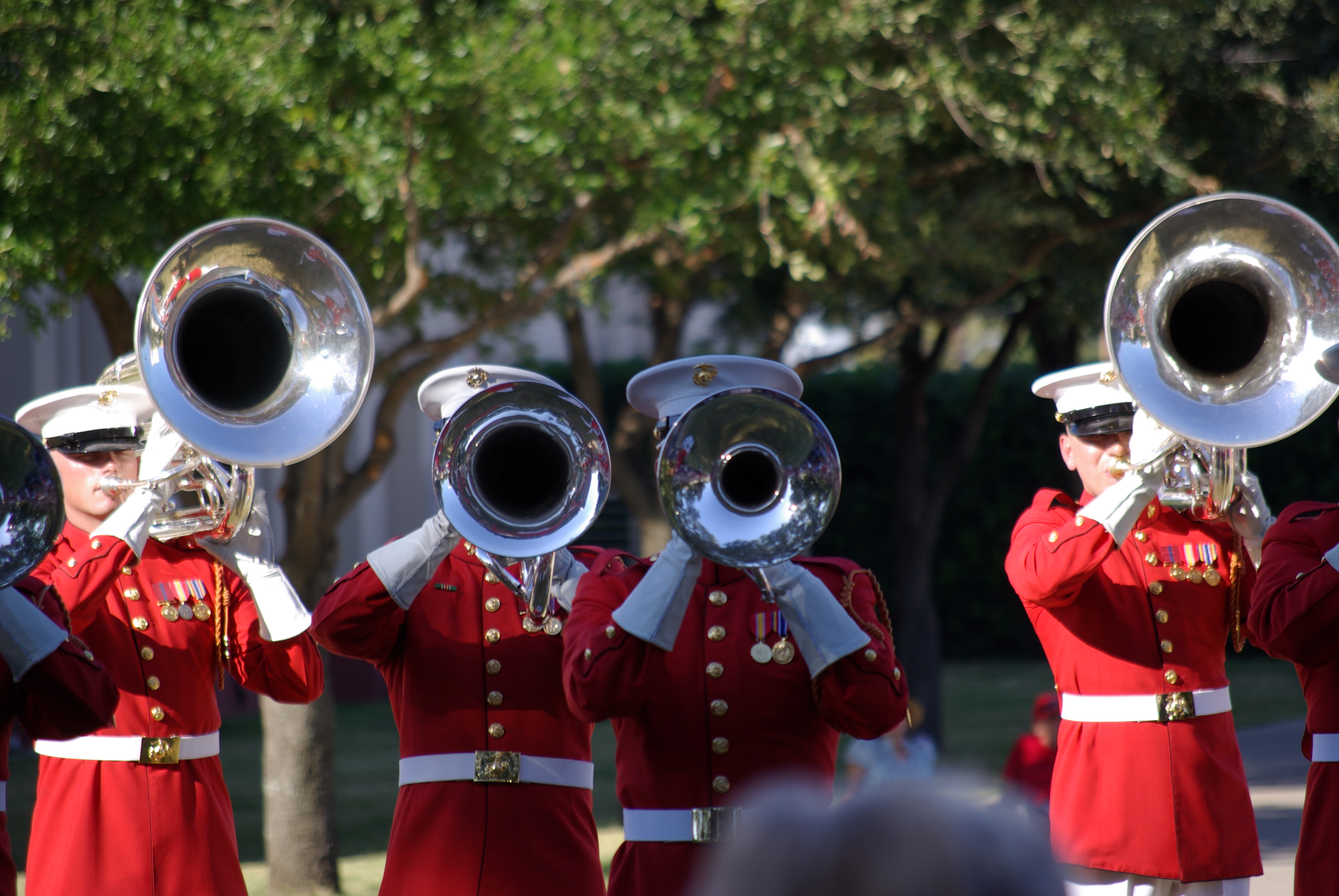
USMC Drum & Bugle Corps at Texas State Fair - Ed Darrell photo

In a drum and bugle corps, all the horns must function as bugles do -- valves are allowable, so trumpets appear in the group. But there are no slide trombones, no French horns. They are replaced instead by euphonium and mellophone. The groups use tubas with mouthpiece extensions to make them work like bugles, no Sousaphones. Note the tuba players hefting the horns on their shoulders. USMC Drum & Bugle Corps at Texas State Fair, October 8, 2010


In the midst of people who didn’t want to pay attention, watched over by the bare-breasted art-deco titaness guarding the Texas Women’s Museum, and in the heat of a Texas October, the USMC Drum and Bugle Corps played as tightly and honorably as they do at more sober and somber venues.  It was great.

I was surprised when the group marched off after an hour’s concert, to the “Marine Corps Hymn.”  They marched a half-mile to one of the fair’s midways, and performed another mini-concert.  Still no visible sweat in the heat.

USMC Drum and Bugle Corps drum major's baton rests while the Corps performs - photo by Ed Darrell

USMC Drum and Bugle Corps drum major's baton rests while the Corps performs - photo by Ed Darrell


Annals of DDT: Remembering Rachel Carson

October 8, 2010

From America.gov, the real story of Rachel Carson, in less than two minutes:

More:


TARP saved my nation, and all I got was this bitter, cold tea party

October 5, 2010

Remember TARP, the Toxic Asset Relief Program?

Oh, that’s right — we hate it.  Big hole in the federal budget and all.

Then you should be dancing that it died Sunday night, right?  Yeah, that’s right:  TARP expired.

But, maybe we should be lamenting its passage, and celebrating it.  It ended up costing us almost nothing but the problem of having Tea Party, ignorant ingrates involved in the campaign.  It might even have turned a profit.  In any case, it didn’t leave a big hole in the federal budget, and there is little doubt that it saved us from the Greater Depression.

See the story at NPR:

What do we do with the end of TARP?

And what do we do with the news that TARP will not have cost anything like the $700 billion we thought it would? What if it really cost $50 billion, or less?

What if, in the end, the Toxic Asset Relief Program so controversial at birth and vilified throughout its two years of life turns out to have turned a profit for the government and the taxpayer?

We — most of the news media this is — simply don’t know what to do with this news.

The suggestion that TARP did not blow a hole in the federal budget potentially blows a hole in some other presumptions as well. Economists will argue for years over the necessity of TARP, and the rest of us can argue over the bonuses investment bankers still got (and continue to get).But we won’t argue about whether the government could or should have done more to prevent the collapse of the credit markets and the mass failure of banks in 2008. Because the government did do TARP, and those other things did not happen. We did not go back to 1929 or worse. And, unlovely as it may be, TARP remains the closest thing we have to an explanation for that.

Still, the expiration of the program as Sunday turned to Monday passed largely unremarked. And insofar as the media have noticed the story of TARP’s apparently much-reduced cost, that tale has been anything but ballyhooed.

(For an exception, see the package offered Sunday evening by Guy Raz and the crew at Weekend All Things Considered.)

On the last business day before TARP expired, The New York Times and The Washington Post did report the much-reduced cost figures — mentioning the potential for the program to actually make money for taxpayers in the final accounting.  But the Times put the story in the Business Section, and the Post played it on the Federal Page.

What other “common sense” delusions will misdirect this year’s election vote?

What thanks do we get?  What thanks do we give?


Eleanor Roosevelt: Didn’t like the description, “No good in a bed”

October 3, 2010

Eleanor Roosevelt, image from MedScape; at Pearl Harbor, 1943

Eleanor Roosevelt at Pearl Harbor in 1943 - image from MedScape

Is this story true? I’ve not been able to verify the quote — it’s a great story, and better if true. From MedScape Today, “The Case of the Well-known Woman with Unexplained Anemia”:

Although reserved, Roosevelt had a quiet sense of humor. When commenting about how she felt about having a rose named after her, she remarked: “I was very flattered . . . but not pleased with the description in the catalogue: no good in a bed, but fine up against a wall.”

Can anyone tell us when and where she said that?  Gardeners, can you confirm?  Can anyone find a photo of the rose, “Eleanor Roosevelt?”  (It’s probably a yellow rose, but I haven’t found a description.)

Eleanor Roosevelt teacup, First Ladies Library

Eleanor Roosevelt teacup, First Ladies Library

More:


Music stopped the deadly sniper

October 2, 2010

Fascinating story well told by the man who lived it:  After D-Day, an Allied unit was pinned down by a sniper.  Unable to move, and on an inspired whim, one of the American soldiers, Jack Leroy Tueller,  took out his trumpet, and played “Lili Marlene.”

Jack Tuler holding his trumpet, at 90 (maniacworld)

Jack Tueller holding his trumpet, at 90 (image from maniacworld/ Wearethemusic.com)

In the morning he was introduced to a German soldier, a sniper who had surrendered, unable to keep fighting after some mysterious trumpeter played the song that made him think of his home, his mother, his girlfriend, and love.

Two minutes of amazing history, vividly told and played, suitable for classroom use.

Go view “Taming a Nazi sniper with a trumpet,” at ManiacWorld.


[Is this the lost video from above? I think so.]

Videos say that Jack Tueller is 90 years old.  I’m guessing the video is about a year old — does anyone know any more about Col. Jack Tuler, his story, or where he livesCould this be the late Jack Tuler of Chicago? Hey, anyone:  Where is Jack Tueller today?  Who has his life details?  (Tueller lives today in Bountiful, Utah, with his wife, Marjorie.  He still plays the trumpet.)

Tip of the old scrub brush to Kenny, in China, and to Common American Journal, who had a YouTube copy.  Special tip of the old scrub brush to J. A. Higginbotham, who tracked down the Deseret News stories.

(Our YouTube host misspelled the name of the song, I think.)

_____________

Update, October 3, 2010: Reader J. A. Higginbotham tracked down two stories in the Deseret News, in Salt Lake City, about Col. Tueller.  I’ve corrected the spellings above, and edited otherwise to point to the details.  A new post is probably warranted.  Go to the Deseret News site and read their fine work, especially the long story by Doug Robinson.

Update March 2019: Both video links above seem to have died; here’s a video from StudiesWeekly.com, put up on YouTube in 2015.

Sad to hear, Jack Tueller died in 2016, at age 95.