Oldest Eagle Scout, Walter Hart

July 20, 2010

Working to confirm, but news from Florida and a highly reliable source is that Walter Hart died over the weekend, at 91 by my calculations.

You would remember Hart as the oldest Eagle Scout, having gotten his award three years ago, when he was 88.

Mr. Hart should be remembered as a hero, and certainly as an inspiration to aspiring Eagle Scouts — especially those facing a short time to their 18th birthday.


A song for our times: Arlo and Pete sing Woody

July 20, 2010

In the late 1960s and the 1970s, conservatives made big displays of singing this song.  The Mormon Tabernacle Choir recorded one very popular version of it; it showed up often.  In those occasional complaints about the difficulty of singing “The Star-Spangled Banner,” this song’s suitability for national anthem status was always raised.

Today?  I haven’t heard it at a Republican gathering in long, long time.  I’m not saying that it’s completely disappeared from the conservative song book — among other things, I don’t attend Republican conventions as often as I once did, but I don’t think I’d hear it if I did.  I am saying that people finally started listening to the song, and it’s been largely dropped from conservative sing alongs for political reasons.

And that tells us a lot.

It would be good to hear this song a lot more; it would be good if more people sang it.

Arlo Guthrie and Pete Seeger leading the congregation in singing Woody Guthrie’s “The Land Is Your Land,” from a 1993 concert at Wolf Trap Farm Park in Virginia (one of my favorite venues for any music):

(Arlo’s got a new release this year, featuring this tune.)

More:


Happy birthday, Peter Schickele

July 17, 2010

Peter Schickele is 75 today.

Peter Schickele, a.k.a. P. D. Q. Bach

Peter Schickele, born July 17, 1935

May he live to be a happy, robust, still-composing, still performing 135, at least.

Some people know him as a great disk jockey.  Some people know him as the singer of cabaret tunes.  Some people know and love him as a composer of music for symphony orchestra, or to accompany Where the Wild Things Are.

Peter Shickele, left, and P. D. Q. Bach, together, in happier times.

Peter Shickele, left, and P. D. Q. Bach, together, in earlier and, some say, happier times.

Then there are those happy masses who know him for his historical work, recovering the works of Johann Sebastian Bach’s final and most wayward child, P. D. Q. Bach.

Tip of the old bathtub-hardened conductor’s baton to Eric Koenig.


White men gave civil rights to women, blacks and Hispanics?

July 16, 2010

It’s maybe an apocryphal story. Republicans in Texas hope so.

It was at a very large, mostly African-American church in Dallas. The social action committee, or whatever it’s name is, was meeting. The only white guy in the room was there to try to get them interested in the elections for the members of the Texas State Board of Education. Normally these races are sleepers, down ballot, and off the radars of almost all interest groups. The social action committee was just as tough an audience as any other group with limited resources and limited time to try to get good political action.

Besides, a good chunk of Dallas is represented by Mavis Knight, an African American who is a pillar of common sense on the Texas education board, and Ms. Knight’s seat isn’t being contested in 2010. Why should Dallas voters be interested in any of these races?

“Before we start talking,” the lone white guy said, “I’d like to show you some of what has been going on in the Texas State Board of Education over the last year, in their work to change social studies standards.”

And he showed the video below. The entire committee grew quiet, silent; and then they started to shout at the television image. “What’s that?” “Is he crazy?” “He said white men gave us civil rights?”  “HE SAID WHAT?”

A 58-second video clip that could greatly animate electoral politics in Texas. The comments came fast and loud.

“That was part of the debate?  What, are they crazy down there?  Don’t they know history?  Don’t they know the truth?  They aren’t going to tell our children that Martin Luther King didn’t work to get civil rights, are they?  They aren’t going to say Martin Luther King died, but some white man gave rights to African Americans — are they?”

It’s a video clip that every Republican candidate in Texas hopes will be hidden away.  The Democratic tide that has swept Dallas County in two consecutive elections threatens to stop the Republican stranglehold on statewide offices in November, if those who voted in such great numbers in 2008 turn out again.

There are other stakes, too — the Republican stranglehold allowed the state education board to gut science standards, to eliminate Hispanic literature from language arts standards, and to try to change history, to blot out Thurgood Marshall and as much of the civil rights movement as they could hide.  So Texas children get a second-rate, incorrect set of standards in social studies, in English, and in science.

Republicans have declared war on good education, war on the children who benefit most from good education.

So, according to Don McLeroy, who lost the primary election to keep his seat, this little piece of history, below, is inaccurate. Tough for McLeroy — the Schoolhouse Rock video sits in too many Texas school libraries. Sometimes, the facts sneak through, defying the best efforts of the Texas State Soviet of Education to snuff out the truth.

But don’t you wonder what every woman, African American, and Hispanic in Texas will think about the importance of the 2010 elections, when they see what Gov. Rick Perry’s appointee to chair the SBOE, thinks about how civil rights were achieved in the U.S.?

Over at Republican headquarters, they hope that story is apocryphal.

Video of the Texas State Board of Education from the Texas Freedom Network.

Here, you can make sure other voters see this video that Don McLeroy hopes you will not see:

Add to FacebookAdd to NewsvineAdd to DiggAdd to Del.icio.usAdd to StumbleuponAdd to RedditAdd to BlinklistAdd to TwitterAdd to TechnoratiAdd to Furl


Typewriter of the moment: Ayn Rand

July 15, 2010

Ayn Rand at her typewriter

Ayn Rand at her typewriter

Ayn Rand at her typewriter, in an undated photo (do you know the date?).

Contrary to a popular myth, Rand did not take her name from the typewriter.  From the website of the Ayn Rand Institute:

What is the origin of “Rand”?

[From ARI’s monthly newsletter Impact, 06/2000]
“Ayn Rand, born Alisa Rosenbaum, based her professional first name on a Finnish one [see above]. The source of her last name, however, has been a mystery.

“Although its origin is still uncertain, recent biographical research by Drs. Allan Gotthelf and Michael Berliner has eliminated one possible source. An oft-repeated story claims that Ayn Rand took her last name from her Remington Rand typewriter while she was living in Chicago in 1926. This is false and we would like to put the error to rest.

“While still in Russia, c. 1925, and long before Remington-Rand typewriters were produced, Alisa Rosenbaum had adopted the name ‘Rand.’ Letters written in 1926 from Ayn Rand’s family in Russia already refer to the name ‘Rand.’ These were sent from Russia before Ayn Rand had communicated from America. The Remington and Rand companies did not merge until 1927; ‘Rand’ did not appear on their (or any) typewriters until the early 1930s.

“One lead to the actual source of the name comes from Ayn Rand herself. In 1936, she told the New York Evening Post that ‘Rand is an abbreviation of my Russian surname.’ Originally, we thought that this was a red herring in order to protect her family from the Soviet authorities.

“In 1997 Dr. Berliner noted an interesting coincidence when looking at a copy of Miss Rand’s 1924 university diploma. On the diploma was the name Rosenbaum in the Cyrillic alphabet:

The last three letters clearly look like the Roman letters ‘ayn.’ Richard Ralston then noticed that by covering those letters—and dropping out the second and fourth letters—what remains bears a strong resemblance to the Roman letters ‘Rand.’

“Although far from certain, it appears that the quote in the New York Evening Post may not have been a decoy.”

Her most often used typewriter was a Remington, I’ve read (but can’t find a reference now that I need it).  So far as I have found, however, typewriters were always manufactured under the “Remington” marque, and never as “Remington-Rand.”  Contrary to the implications from the ARI, Remington typewriters were produced from Reconstruction times (circa 1870), originally by the Remington Arms company.  Typewriter manufacturing was spun off from the arms producer in 1886; that company merged with Rand, forming Remington-Rand in 1927.


Can’t dance to it, but can you learn with it?

July 14, 2010

It’s an awkward scene.  John Goodman has a lousy role (and I’m not fond of the direction for him or Melanie Griffith here).  I’ve never seen the movie, “Born Yesterday,” and I don’t know the context.

But ten important amendments to the Constitution, to the tune of “The Twelve Days of Christmas,” a potentially useful mnemonic device for your U.S. history, and government students; it’s mostly accurate:

There is some skipping around —  the song covers the First, Second, Fourth, Fifth, and Sixth Amendments, then skips to the Thirteenth, Fifteenth, Sixteenth, Eighteenth, and Nineteenth Amendments.  The First Amendment’s five freedoms are covered completely, other amendments not so much.

The actor in the scene, playing the senator who sings the Fifteenth Amendment, is former Tennessee U.S. Sen. Fred Thompson.  Thompson staffed the Watergate Committee chaired by Sen. Sam Ervin of North Carolina, earlier — wouldn’t it be interesting to hear his views on this scene, and song, and what other tricks he may have encountered in the Senate, from Sen. Ervin, or the late Sen. Robert C. Byrd?

It’s not Schoolhouse Rock, but it’s really very good.  Everything covered in the song is in Texas TEKS, but some things skipped, like the Fourteenth Amendment, are also required.  Can you use it in your classes?

And by the way, does anyone know a rap for the Bill of Rights?

Tip of the old scrub brush to the Facebook status of the Bill of Rights Institute.


Tea Party symbols: Forgetting history and science

July 13, 2010

From the Los Angeles Times blogs, Opinion, from February 2010:

Tea Party footnotes

February 7, 2010 |  7:39 am

A couple of musings about the Tea Party convention in Tennessee:

I’m puzzled by the disgruntled reaction among Tea Partiers to the fact that the convention charged money to attend — about $550, it’s been reported — and that the convention organizer was a for-profit company. Yeah, it’s expensive, all right, but isn’t profit-making quintessentially American?

And I’ve seen photos of conventioneers wearing T-shirts with the image of a bald eagle on the back, the national bird, symbol of the nation. When the Founding Fathers were drawing up the blueprints for the United States, there were hundreds of thousands of bald eagles, coast to coast, clime to clime.

But then humans began crowding them out and shooting them down in such numbers that a law protecting them was put into place in 1940. But that was just about the time that DDT began to be used in vast quantities, and there went the bald eagle population again. DDT in the food chain rendered bald eagle shells too thin to incubate or hatch and perhaps rendered some adult birds infertile.

Rachel Carson’s seminal book ”Silent Spring” raised the public’s awareness of the risks of DDT. In 1967, bald eagles were ruled an endangered species in much of the U.S. — a status that was made national on the nation’s bicentennial, in 1976 — and they weren’t declared to be a thriving species once again until 2007.

Which means that, if it hadn’t been for all those tree-hugging pinko environmentalists, the bird of prey on all those T-shirts, the proud bald eagle, might very well have been a dead duck.

— Patt Morrison

Audubon watercolor of bald eagle - Library of Congress image

Audubon watercolor of bald eagle – Library of Congress image

Help save the bald eagle from Tea Party sniping:

Add to FacebookAdd to NewsvineAdd to DiggAdd to Del.icio.usAdd to StumbleuponAdd to RedditAdd to BlinklistAdd to TwitterAdd to TechnoratiAdd to Furl


I get e-mail: Media Matters calls bluffs of climate change “skeptics”

July 10, 2010

Media Matters may be a site worth tracking more closely, not only on climate issues:

Media Matters: The greatest science “scandal” “in the history of man” predictably falls apart

In their never-ending quest to prove that they understand the intricacies of climate science better than actual climate scientists, conservative media figures routinely promote any ridiculous “evidence” they think undermines the scientific consensus about climate change.

This is a group that repeatedly points to snowstorms in February as proof that global warming is not real; claims that CO2 can’t be a pollutant because “we breathe” it; and ignores actual temperature data to baselessly claim that the Earth is really “cooling.”

Last year, conservative climate change skeptics, in the words of Wall Street Journal’s Kimberly Strassel, thought they had found a “gold mine.” Conservative media figures seized on emails stolen from climate scientists and proceeded to completely distort their contents. As we pointed out repeatedly at the time, this “scandal” relied on outrageous misrepresentations of the stolen emails and did not in any way undermine the scientific consensus about climate change.

Nevertheless, conservative media figures incessantly hyped the non-scandal with their usual overblown rhetoric:

  • Glenn Beck — who says he is not a conspiracy theorist, remember — suggested in the wake of “Climategate” that climate change is a “scam.” He also said that if the United Nations’ Intergovernmental Panel on Climate Change report “had been done by Japanese scientists, there is not enough knives on planet Earth for hara-kiri.”
  • Noted climatologist Rush Limbaugh, who frequently decries the supposed global warming “hoax,” proposed that all of the scientists involved in “Climategate” should be “named and fired, drawn and quartered, or whatever it is.”
  • Andrew Breitbart called for “capital punishment” for NASA scientist James Hansen, because “Climategate” was supposedly “high treason.”
  • The Washington Times, Michelle Malkin, Ann Coulter, Investor’s Business Daily, The American Spectator’s Robert Stacy McCain, Rich Lowry, Newsmax’s James Hirsen, and Michael Ledeen all joined forces to smear the scientific consensus on climate change as a “cult.”
  • Fox News’ Mike Huckabee explained that “Jesus would be a truthseeker” while discussing the “revelation” that scientists had “cooked” climate change data.

The crew at Fox & Friends spent this year’s Earth Day promoting an important cause. No, not encouraging environmental consciousness — they devoted the show to pushing “Climategate” falsehoods in order to falsely claim that “scientists held back data that discredits theories on global warming.” They were joined by Brent Bozell of the Media Research Center, who was there to complain about non-Fox networks “dismiss[ing]” and “ignor[ing]” the story.

Last December, Bozell told Lou Dobbs that “Climategate” is the “biggest scandal in terms of science, finance, and politics … in the history of man.” After Bozell compared the climate science “cover-up” to “the craziness” of Dan Brown’s fiction, he actually managed to draw laughter from Dobbs. Unfortunately, contrary to Bozell’s suggestion that media outlets ignored the story, numerous non-Fox “Climategate” stories adopted conservatives’ dishonest framing of the non-story.

And now for the inevitable conclusion of this manufactured controversy.

As reported by The New York Times’ Andrew Revkin — who, by the way, Rush Limbaugh thinks should “just go kill” himself — the Independent Climate Change Email Review “cleared climate scientists and administrators” involved in “Climategate” of “malfeasance.” This follows several other exonerations of the scientists involved in the phony scandal. In response, Media Matters, joined by numerous progressive and clean energy groups, called on all outlets that reported on the original “Climategate” controversy to set the record straight.

So this leaves us where we were before the “Climategate” freakout: There is still overwhelming scientific evidence supporting the theory of global warming.

And once again conservative media proved that they don’t hesitate to rely on blatant distortions, outright falsehoods, and a complete disregard for reality to advance their political causes.

Mainstream media outlets would be doing everyone a service if they remembered that the next time they decide to report on whatever Rush Limbaugh, Glenn Beck, Fox News, and the perpetual conservative outrage machine are yelling about.

Conservatives’ phony scandal of the week: The Obama Justice Department and the New Black Panther Party

While we’re on the subject of manufactured scandals that respectable media outlets shouldn’t take seriously, Fox News and its friends in the conservative echo chamber spent much of the week promoting phony, trumped-up allegations against the Justice Department.

In short, conservative media outlets have been aggressively promoting the charge by GOP activist J. Christian Adams that President Obama’s Justice Department engaged in racially charged “corruption” when it partially dismissed a case against members of the New Black Panther Party for allegedly engaging in voter intimidation outside of a Philadelphia polling center on Election Day in 2008.

As we have documented extensively, Adams should not be trusted. He is a long-time right-wing activist with extensive ties to the Bush-era politicization of the Justice Department. Adams himself has admitted that he lacks first-hand knowledge to support his accusations. Additionally, Adams’ charge that the DOJ’s action in the New Black Panther case shows unprecedented, racially motivated corruption is undermined by the fact that the Obama DOJ obtained judgment against one of the defendants, and that the Bush DOJ declined to pursue similar allegations against a group of Minutemen — one of whom was carrying a gun — in 2006.

Even the Republican vice chairwoman of the U.S. Commission on Civil Rights called the New Black Panthers case “very small potatoes” and said an investigation into the DOJ’s decision is full of “overheated rhetoric filled with insinuations and unsubstantiated charges.”

And yet again, the fact that this is a completely manufactured scandal didn’t stop conservative media figures from engaging in one of their time-honored traditions: attempting to obscure their own problems with race by accusing others of racism.

Radio host Jim Quinn — who once told “race-baiting” African-American “ingrates” to “get on your knees” and “kiss the American dirt” because slavery brought them to the U.S. — hyped the New Black Panther story by calling the civil rights community “race-baiting poverty pimps.”

Rush Limbaugh — who earlier this week announced that if Obama wasn’t black he’d be a “tour guide in Honolulu” and claimed Obama is using the office of the presidency to seek “payback” for the country’s history of racism — forwarded Adams’ charge that the case was dropped because of racially charged corruption.

Beck, who infamously called President Obama a “racist” with a “deep seated hatred for white people or the white culture,” declared that the Obama administration is “full” of “people that will excuse” the “hatred” of the New Black Panthers. He also relied on falsehoods to try to connect Obama to the New Black Panthers, and claimed today that the New Black Panthers are part of Obama’s “army of thugs.”

Of course, the New Black Panthers are a fringe hate group, and only a cynical race-baiter like Glenn Beck would claim they are somehow part of Barack Obama’s imaginary “army of thugs.”

But I’m sure they appreciate all of the publicity, courtesy of Glenn Beck and Fox News.

Bek Younuhvercity

This week also marked the launch of Beck’s latest attempt to grab money from “educate” his audience: Beck University.

As Beck described it, the online Beck University is an “academic program” that would be a “unique experience bringing together experts in the fields of religion, American history, and economics.” At the outset of the first “course” — Faith 101, with frequent Beck guest/promoter of historical misinformation David Barton — Beck announced that viewers “will learn more in the next hour than you’ve probably learned in your entire life about American history.”

Laughable hyperbole aside, as we pointed out this week, Glenn Beck is uniquely unqualified to found a university, considering he regularly traffics in bizarre conspiracy theories, distortions, and downright falsehoods on a wide variety of subjects.

The day after the first “course” at Beck University, Beck stood in front of his blackboard and labeled various historical figures “heros” or “villians.”

And lastly, by my count, between his TV show last night and his radio program today, Beck launched no fewer than four baseless charges that, by his standards, should get him fired.

This weekly wrap-up was compiled by Media Matters’ Ben Dimiero.

Whom the gods destroy, they first make mad, Euripides said (paraphrased).  With that ancient wisdom in hand, one might be well advised not to stand next to Glenn Beck or Fox News.

If Glenn Beck wishes to know the evils of Woodrow Wilson or Theodore Roosevelt, I can point him to sources.  In spite of those evils, however, they remain heroes of American history for the good things they did.  Beck criticizes them for those good things, however, and not for their failures (including Wilson’s patent racism, and Roosevelt’s failure to push for integration at opportune times — to Beck, those would be virtues, I fear).

Visit Media Matters here, sign up for Media Matters’ e-mail newsletter here.


Chess games of the rich and famous: Duchamp vs. Man Ray

July 9, 2010

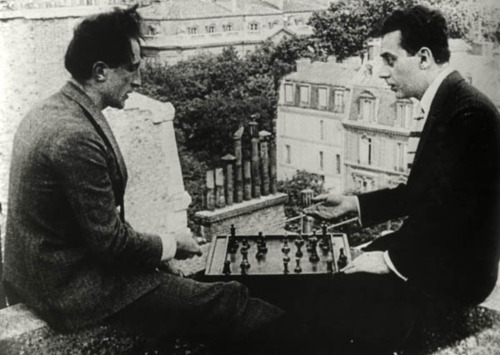
Marcel Duchamp and Man Ray play chess on a rooftop in Paris.

Duchamp again, this time on a rooftop in Paris, playing chess against Man Ray.

The photograph is later than 1915, when Duchamp moved to the U.S. to avoid World War I, and met Ray; it is probably after 1918.

The two even played chess in a movie:

Man Ray directed a number of influential avant-garde short films, known as Cinéma Pur, such as Le Retour à la Raison (2 mins, 1923); Emak-Bakia (16 mins, 1926); L’Étoile de Mer (15 mins, 1928); and Les Mystères du Château de Dé (20 mins, 1929). Man Ray also assisted Marcel Duchamp with his film Anemic Cinema (1926) and Fernand Léger with his film Ballet Mécanique (1924). Man Ray also appeared in René Clair‘s film Entr’acte (1924), in a brief scene playing chess with Duchamp.

The photo above is a still from that 1924 René Clair movie — it comes about 4:30 into the movie (the version shown here is half of the 20-minute movie, with a very modern, surrealist music score added; you can see the entire movie from Pathé, with a more contemporary score, here).

https://vimeo.com/488844088

Update, March 14, 2011:  See also this story from 2008 about Duchamp’s need to play chess, featuring of photo of Duchamp, Teeny Duchamp and the composer John Cage deeply engrossed in a game.  A good read about chess, and Duchamp.

Tip of the old scrub brush to ArtLex.com.


July 8, 1853: Perry anchors U.S. ships in Edo Bay, the beginning of American Imperialism

July 8, 2010

History item:  On July 8,1853 four black ships led by USS Powhatan and commanded by Commodore Matthew Perry, anchored at Edo (Tokyo) Bay. Never before had the Japanese seen ships steaming with smoke. They thought the ships were “giant dragons puffing smoke.” They did not know that steamboats existed and were shocked by the number and size of the guns on board the ships.

President Millard Fillmore, defying H. L. Mencken’s later, crabby, hoax claim of do-little-government, sent Matthew C. Perry to Japan to open Japan as a refuge for shipwrecked sailors, and as a coaling stop for steamships.  For the previous 200 years, Japan had been closed to all but a few Dutch and Chinese traders.   On July 8, 1853, Perry’s small fleet sailed boldly into restricted waters of Japan and anchored.

Delivering the American presents to the Emperor of Japan, at Yokohama.  Nimitz Museum, Annapolis

Delivering the American presents to the Emperor of Japan, at Yokohama. A. O. P. Nicholson image, 1856 publication, “Narrative of the Expedition of an American Squadron to the China Seas and Japan” – artist not identified (Washington, A. O. P. Nicholson, 1856); Nimitz Museum, Annapolis. A list of the presents can be seen at a link near the end of this post; some of the gifts, such as the model of the steam engine, can be identified in this picture.

Perry told the Emperor he would return the following year for an answer.  Perry returned on March 8, 1854, and within a month concluded the Convention of Kanagawa, opening Japan to trade from the west.  Generally unheralded, this may have been one of the more important pieces of U.S. diplomacy in history, especially considering the dramatic rise of Japan as an economic and military power, on the basis of the trade Commodore Perry demanded Japan engage in.

More:

Japanese woodblock print showing one of Perry's ships - Nagasaki Prefecture, via MIT

Japanese woodblock print showing one of Perry’s ships – Nagasaki Prefecture, via MIT

Documents below the fold

Read the rest of this entry »


Chess games of the rich and famous: House Speaker Joe Cannon vs. Congress

July 7, 2010

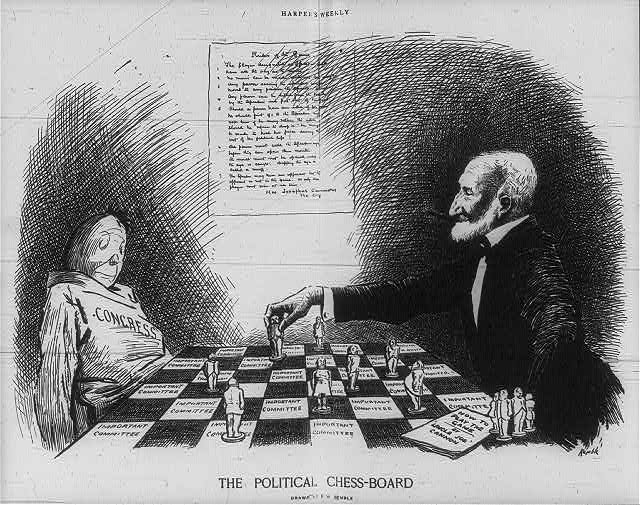
Cartoon - Cannon, Joe, The Poltiical Chessboard, Harpers 2-05-1910 - 3b23316r

The Poltiical Chessboard, Harper's Magazine, February 5, 1910, by E. W. Kemble - Library of Congress image

Description from the Library of Congress:

Joseph Cannon playing chess with straw man labelled “Congress,” using toy men on chessboard with squares labelled “important committee” and “freak committee.”

Legendary House Speaker Joe Cannon — after whom the Cannon House Office Building is named — is remembered for the almost absolute power he held over the House of Representatives.  Here’s the generic description at Wikipedia:

House Speaker Joseph G. Cannon - Wikimedia image, photo from October 1915

House Speaker Joseph G. Cannon - Wikimedia image, photo from October 1915

Cannon wielded the office of Speaker with unprecedented power. At the time of Cannon’s election the Speaker of the House concurrently held the chair of the Rules Committee, which determined under what rules and restrictions bills could be debated, amended, and voted on, and in some cases whether they would be allowed on the floor at all. As such, Cannon effectively controlled every aspect of the House’s agenda: Bills reached the floor of the house only if Cannon approved of it, and then in whatever form he determined—with he himself deciding whether and to what extent the measures could be debated and amended.

Cannon also reserved to himself the right to appoint not only the chairs of the various House committees, but also all of committees’ members, and (despite the seniority system that had begun to develop) used that power to appoint his allies and proteges to leadership positions while punishing those who opposed his legislation. Crucially, Cannon exercised these powers to maintain discipline within the ranks of his own party: the Republicans were divided into the conservative “Old Guard,” led by Cannon, and the progressives, led by President Theodore Roosevelt. His committee assignment privileges ensured that the party’s Progressive element was essentially powerless in the House, and his control over the legislative process obstructed progressive legislation.

Progressives wished to break Cannon’s ability to control so completely the flow of legislation.  By early 1910, progressives in the Republican Party especially chafed under Cannon’s rule.  Anxious for revolt, they struck on March 17, just a few weeks after this cartoon appeared.

On March 17, 1910, after two failed attempts to curb Cannon’s absolute power in the House, Nebraska Representative George Norris [of Nebraska] led a coalition of 42 progressive Republicans and the entire delegation of 149 Democrats in a revolt. With many of Cannon’s most powerful allies absent from the Chamber, but enough Members on hand for a quorum, Norris introduced a resolution that would remove the Speaker from the Rules Committee and strip him of his power to assign committees.

While his lieutenants and the House sergeant-at-arms left the chamber to collect absent members in attempt to rally enough votes for Cannon, the Speaker’s allies initiated a filibuster in the form of a point of order debate. When Cannon supporters proved difficult to find (many of the staunchest were Irish and spent the day at various St. Patrick’s Day celebrations), the filibuster continued for 26 hours, with Cannon’s present friends making repeated motions for recess and adjournment. When Cannon finally ruled the resolution out of order at noon on March 19, Norris appealed the resolution to the full House, which voted to overrule Cannon, and then to adopt the Norris resolution.

Cannon managed to save some face by promptly requesting a vote to remove him as Speaker, which he won handily since the Republican majority would not risk a Democratic speaker replacing him. However, his iron rule of the House was broken, and Cannon lost the Speakership when the Democrats won a majority later that same year.

Instead of the Speaker’s wishes, committee assignments and chairs were selected by a seniority system.

Cannon lost his seat representing Illinois in the progressive tide of 1912, but regained it in 1914, and served another four terms in the House, to 1922.

I have found no information on whether Cannon actually played chess.

Norris’s star was on the rise at the same time.  Though he supported Theodore Roosevelt in the election of 1912, when Roosevelt bolted the Republican Party and ran as a Progressive or “Bullmoose Party” nominee for president, Norris stayed with the Republican Party and won election to the U.S. Senate in 1912.

Norris became an isolationist, and was one of six senators to vote against the declaration of war in 1917 that pushed the U.S. into World War I.  Norris also opposed the Versailles Treaty, and played an important role in keeping the treaty from U.S. ratification.  He supported Franklin Roosevelt’s New Deal Reforms a decade-and-a-half later, and one of the early dams of the Tennessee Valley Authority is named for him.  Norris’s role in the New Deal, and in pushing progressive reforms well into the 20th century, is not fully appreciated, for example:

In 1932, along with Rep. Fiorello H. La Guardia, Norris secured passage of the Norris-La Guardia Act, which outlawed the practice of requiring prospective employees not to join a labor union as a condition of employment (the so-called yellow-dog contract) and greatly limited the use of court injunctions against strikes.

A staunch supporter of President Roosevelt’s New Deal programs, Norris sponsored the Tennessee Valley Authority Act of 1933. In appreciation, the TVA Norris Dam and a new planned city in Tennessee were named after him.[3][4] Norris was also the prime Senate mover behind the Rural Electrification Act that brought electrical service to under-served and unserved rural areas across the United States.

Switching to the Democratic Party in 1936 when the Republicans fell into the minority, Norris generally supported New Deal efforts but did not fear to oppose ideas he found unworthy, regardless their source or party connection.  His opposition to President Franklin Roosevelt’s “court packing” plan helped smother the idea.  Norris finally lost election in 1942.  Norris is one of eight U.S. senators profiled in John F. Kennedy’s book, Profiles in Courage.


I get e-mail: July Econlib newsletter

July 5, 2010

A bit on the right, but generally pointing to useful current stuff for economics teachers, the EconLib Newsletter for July 2010 is out — download it to your e-book for beach or desert reading:

Dear Readers,

Around the world in the last three decades, governments have made dramatic moves toward more economic freedom. While retaining most of the welfare state, governments have cut marginal tax rates from the Olympian heights they had reached in the 1960s and 1970s, deregulated whole industries, and privatized major swaths of the economy. Scott Sumner details the “neoliberal” movement and shows that countries that moved closest to economic freedom also made major gains in per capita income. Read it here:

The Unacknowledged Success of Neoliberalism
http://www.econlib.org/library/Columns/y2010/Sumnerneoliberalism.html

This month, Anthony de Jasay extends his series, asking

Is Society a Great Big Insurance Company?
http://www.econlib.org/library/Columns/y2010/Jasayinsurance.html

On EconTalk this week, Russ Roberts and Arnold Kling talk about the Unseen World of Banking, Mortgages, and Government:

http://www.econtalk.org/archives/2010/07/kling_on_the_un.html

Other recent podcasts include Caplan on Richter and Hayek, Sumner on growth and economic policy, and Blakley on fashion and intellectual property. Check them out at http://www.econtalk.org.

On EconLog, David Henderson discusses the EPA, Bryan Caplan reviews whether students like school, and Arnold Kling talks about green jobs. Read all the latest on EconLog at:

http://econlog.econlib.org

This month in the Concise Encyclopedia of Economics we feature “Fiscal Sustainability,” by Laurence J. Kotlikoff , and the biography of Milton Friedman, whose birthday is later this month. See

http://www.econlib.org/library/CEE.html

We welcome all our new registrants and wish all a fine summer.

Lauren Landsburg, Editor
Russ Roberts, Associate Editor
David R. Henderson, Features Editor
Library of Economics and Liberty
http://www.econlib.org


Helen Thomas and a famous illusion

July 5, 2010

Sometimes people grow into a role they had not intended.

During the recent, sad flap about Helen Thomas’s offensive remarks and forced retirement, some media outlets carried a photo of Thomas that looked almost posed to me.  In our creativity consulting years ago, we used the old, famous optical illusion of the “old woman/young woman.”

Make up your own commentary.  What do you see?  How do you know you’re not looking at an illusion?

Optical illusion, Old woman/Young woman

Famous optical illusion, Old woman/Young woman, color version – borrowed from Mighty Optical Illusions after Gryphons Aerie crapped out.

Helen Thomas in a photo prior to 2009

Veteran White House reporter Helen Thomas, sometime prior to 2009


July 4, 2010 – Fly your flag today

July 4, 2010

Fourth of July:  NPR has already read the Declaration of Independence, PBS has the Capitol Fourth concert this evening (8:00 p.m. Eastern — check your local listings), your town has a parade somewhere this weekend, and fireworks are everywhere.

Remember to put your flag up today.

Astronaut Eugene Cernan and the U.S. Flag -- Apollo 17 on the Moon (NASA photo)

Last flag on the Moon: Astronaut Eugene Cernan and the U.S. Flag -- Apollo 17 on the Moon (NASA photo)

Also:

Lunar Reconnaissance Orbiter photo of Apollo 17 landing site

Lunar Reconnaissance Orbiter photo of Apollo 17 landing site


Chess games of the rich and famous: Bob Dylan, by Daniel Kramer

July 3, 2010

Bob Dylan at the chessboard, Woodstock, New York, 1964 - photo copyright Daniel Kramer

Bob Dylan at the chessboard, Woodstock, New York, 1964 – low resolution version of the original photo, copyright by Daniel Kramer – Barbara Archer Galleries

A good decade before I got to Woodstock.

Daniel Kramer began photographing Bob Dylan early in Dylan’s career, making many of the best shots available.

This 1964 photo of Dylan playing chess in Woodstock, New York, featured in an exhibition of Kramer’s photographs put on by Barbara Archer Galleries in 2005.

From the exhibit’s biography of Kramer:

Daniel Kramer is a New York-based photographer and film director who is long recognized for his portraits and picture stories in national and international magazines and books. Shortly after opening his first studio in New York City, Daniel Kramer saw Bob Dylan perform The Lonesome Death of Hattie Carroll on television in 1964. Even after the show ended, Kramer couldn’t shake the image of Dylan from his mind. “I was completely taken by what this man had done and how he had done it. His performance was perfect. With simple, basic tools – his voice, a guitar, and a harmonica, he drove his message deep into my mind. I was aware that I was seeing a very important talent.”

In August 1964, after months of phone calls and letters to Dylan’s manager, Albert Grossman, Kramer was given the opportunity to arrange a portrait sitting in Woodstock, New York with the twenty-three-year old performer who was by then in the process of becoming an international star. The two men quickly developed a warm and trusting professional relationship that allowed for many extraordinary photographic sessions. “Photography has brought me into contact with many notable people, including Presidents of the United States, and I have happily had the opportunity to meet and talk with prominent people in all walks of life,” comments Kramer. “Although many of these encounters were memorable, my association with Dylan has a special meaning.”

Many of these photographs were first published in Kramer’s 1967 book bob dylan, the first major work about the performer-songwriter (reprinted as Bob Dylan: A Portrait of the Artist’s Early Years, 2001). They were also used on the album covers for Highway 61 Revisited (1965), Biograph (1985) and Bringing It All Back Home (1965), which was nominated for a Grammy and selected by Rolling Stone as one of the “100 Greatest Album Covers of All Time.” A number of rare and previously unpublished pictures by Kramer also appear in the 52-page booklet and packaging that accompanies Bob Dylan’s two-CD set, Live 1964: Concert at Philharmonic Hall – The Bootleg Series, Volume 6 (2004) and on the cover of a three-CD boxed set BOB DYLAN the collection (2004).

Daniel Kramer’s photographs have also been exhibited or collected by such museums as the Whitney Museum of American Art, The International Center of Photography in New York, The Smithsonian’s National Portrait Gallery in Washington, D.C., The Experience Music Project in Seattle, The Rock and Roll Hall of Fame and Museum in Cleveland, and in numerous national and international galleries.

An interesting three-way marriage of the young Bob Dylan, a great photographer in Daniel Kramer, and one of the world’s oldest and most respected games of skill, chess. Go see all the photos.

More: