“The GOP used to be the party of business”

September 10, 2009

Santayana’s Ghost notes there’s an 1852 Whiggy smell about the Republican Party these days.

Thomas L. Friedman writes at the New York Times:

The G.O.P. used to be the party of business. Well, to compete and win in a globalized world, no one needs the burden of health insurance shifted from business to government more than American business. No one needs immigration reform — so the world’s best brainpower can come here without restrictions — more than American business. No one needs a push for clean-tech — the world’s next great global manufacturing industry — more than American business. Yet the G.O.P. today resists national health care, immigration reform and wants to just drill, baby, drill.

“Globalization has neutered the Republican Party, leaving it to represent not the have-nots of the recession but the have-nots of globalized America, the people who have been left behind either in reality or in their fears,” said Edward Goldberg, a global trade consultant who teaches at Baruch College. “The need to compete in a globalized world has forced the meritocracy, the multinational corporate manager, the eastern financier and the technology entrepreneur to reconsider what the Republican Party has to offer. In principle, they have left the party, leaving behind not a pragmatic coalition but a group of ideological naysayers.”

Drum up some business:

Add to FacebookAdd to NewsvineAdd to DiggAdd to Del.icio.usAdd to StumbleuponAdd to RedditAdd to BlinklistAdd to TwitterAdd to TechnoratiAdd to Furl


I get e-mail, on Obama’s education speech

September 9, 2009

A friend notes:

We made [our daughter]l watch it at home, because her school — a Lutheran/Missouri Synod school — wouldn’t show it.  (Of course.)

She has always LOVED President Obama for very eight year old reasons.  He has two little girls.  His wife is pretty.  He bought his daughters a puppy.

Well, after hearing him say “do your homework”…”try again”…”obey your parents and teachers”…”work hard”…”never stop trying”…etc…

She said…

Daddy, I wish Bush was President again.

Now just sit back and let that sink in.


Fly your flag for labor today: Labor Day 2009

September 7, 2009

Labor Day, 2009

Fly your U.S. flag today. This is one of the dates designated in law as a permanent date for flag flying.

Miners and their children celebrate Labor Day, Littleton, Colorado, 1940 - Library of CongressMiners and their children celebrate Labor Day, Littleton, Colorado, 1940 – Library of Congress

Here are some past posts on labor, and Labor Day:

History-minded people may want to look at the history of the holiday, such as the history told at the Department of Labor’s website.

The First Labor Day

The first Labor Day holiday was celebrated on Tuesday, September 5, 1882, in New York City, in accordance with the plans of the Central Labor Union. The Central Labor Union held its second Labor Day holiday just a year later, on September 5, 1883.

In 1884 the first Monday in September was selected as the holiday, as originally proposed, and the Central Labor Union urged similar organizations in other cities to follow the example of New York and celebrate a “workingmen’s holiday” on that date. The idea spread with the growth of labor organizations, and in 1885 Labor Day was celebrated in many industrial centers of the country.

Or this history at the more academic Library of Congress site:

On September 5, 1882, some 10,000 workers assembled in New York City to participate in America’s first Labor Day parade. After marching from City Hall to Union Square, the workers and their families gathered in Reservoir Park for a picnic, concert, and speeches. This first Labor Day celebration was initiated by Peter J. McGuire, a carpenter and labor union leader who a year earlier cofounded the Federation of Organized Trades and Labor Unions, a precursor of the American Federation of Labor.

McGuire had proposed his idea for a holiday honoring American workers at a labor meeting in early 1882. New York’s Central Labor Union quickly approved his proposal and began planning events for the second Tuesday in September. McGuire had suggested a September date in order to provide a break during the long stretch between Independence Day and Thanksgiving. While the first Labor Day was held on a Tuesday, the holiday was soon moved to the first Monday in September, the date we continue to honor.

American Memories at the Library of Congress has several photos of Labor Day celebrations in Colorado, in the mining country.

What do the unions say?  Among other parts of history, the AFL-CIO site has a biography of Walter Reuther, the legendary organizer of automobile factory workersSeptember 1 is the anniversary of Reuther’s birthday (he died in an airplane crash on the way to a union training site, May 10, 1970).

We’re glad to have the day off.  Working people made this nation, and this world, what it is today.  We should honor them every day — take a few minutes today, give honor to workers.  Tomorrow, it’s back to work.

Resources:

Below the fold:  Statistics about working Americans, from the U.S. Census Bureau.

Urge others to fly their flags for working people, too:

Add to FacebookAdd to NewsvineAdd to DiggAdd to Del.icio.usAdd to StumbleuponAdd to RedditAdd to BlinklistAdd to TwitterAdd to TechnoratiAdd to Furl


Global cooling? Sure, if only warming weren’t overpowering nature

September 5, 2009

If you do not read Robert Park regularly, you should.  His weekly missive on September 4 succinctly deals with the two big climate change stories of the week, with vim and vigor:

1.  CLIMATE CHANGE: HOTTEST ARCTIC SUMMER IN 2,000 YEARS.
A major study published in today’s Science marks a seminal advance in Sediments from Arctic lakes were used to compile proxy for the last 2000 years.  Arctic summer temperature declined for thousands of years due to a shift in Earth’s orbit.  Although the orbital shift has been going on for 8000 years and will continue, an increase in greenhouse gases produced by the overpowered the cooling trend. The warming has been more rapid since about 1950.  Moreover, thawing permafrost will release methane into the atmosphere, accelerating warming.  The latest study comes just months after scientists at NOAA warned that within the next 30 years Arctic sea ice could vanish completely during the summer; that will further accelerate warming due to decline in reflective ice cover.

2.  CLIMATE SOLUTIONS: IN THE LONG RUN, THERE IS ONLY ONE.
Even as the study on Arctic warming was making its way into print, a group at the controversial Center proposed a quick geo-engineered solution to.  The group is headed by statistician Bjorn Lomborg, a follower of the late Julian Simon, the libertarian economist at the University of Maryland, who believed there are no limits.  Lomborg proposes puffing lots of white clouds into the atmosphere to reflect sunlight.  It would be the perfect job for Lomborg, who has been puffing clouds of obscurantism since he wrote
(Cambridge, 2001).  Presumably we should just keep puffing out bigger white clouds to compensate for the ever growing population.

White clouds of vapor indeed.  Park is a great fog-cutter.

For example, there is this note from his August 28 edition:

3. SCOPES REDUX: LOBBYISTS MAY BE NOSTALGIC FOR DAYTON.
Newspapers around the country have carried the story of the US Chamber of Commerce, the top US lobbying group, calling for the EPA to hold a Scopes- like hearing on the evidence that climate change is man-made. The EPA dismisses such a stunt as a “waste of time,” but that’s the least of its problems. Having lost the contest over scientific peer review of journal articles, the global warming deniers are accused have cooked up a Hollywood stunt.

Global warming deniers are steamed, and may just stew.

More:


Wirtism? Summer political crazies explained in history

August 30, 2009

Santayana’s Ghost has been restless these past two months.  Now we know why:  Summer 2009 replayed summer 1934.

Micheal Hiltzik explained it in a column in the Los Angeles Times:

To me they’re merely the latest examples of a phenomenon that might be called Wirtism.

If you find the term unfamiliar, that’s because I just coined it to honor the memory of William A. Wirt. Wirt’s day in the sun came back in 1934, when the obscure Midwestern blowhard placed himself at the center of a political maelstrom by “discovering” a plot by members of Franklin Roosevelt’s Brain Trust to launch a Bolshevik takeover of the United States.

That Wirt’s yarn was transparently absurd didn’t keep it from being taken seriously on the front pages of newspapers coast to coast, including the Los Angeles Times and the New York Times. He gave speeches, wrote a book and went to Washington to give personal testimony at a standing-room-only congressional hearing.

If that reminds you of the overly solicitous treatment given by the press, cable news programs and Republican office holders to purveyors of such lurid claptrap as the Obama birth certificate story or the fantasy of healthcare “death panels,” now you know why it pays to study history.

How did it end?  Not soon enough, or well enough, but it ended:

“Roosevelt is only the Kerensky of this revolution,” he quoted them. (Kerensky was the provisional leader of Russia just before the 1917 Bolshevik revolution.) The hoodwinked president would be permitted to stay in office, they said, “until we are ready to supplant him with a Stalin.”

Those words caused an immediate sensation. Wirt hedged on naming the treasonous “Brain Trusters” — which only intensified the public mania. Into the vacuum of information poured supposition masquerading as fact (certainly a familiar phenomenon today). This newspaper, then a pillar of Republicanism, gave Wirt the benefit of the doubt on the grounds that “the activities of the ‘brain trust’ during the past year fit neatly into the Communistic scheme” he described — a reminder that the most potent fabrications are those that confirm what the listener wants to believe.

For that’s what Wirt’s story was — a fabrication. Hauled before Congress, he said he heard of the plot during a party at a friend’s home in Virginia. The other guests, mostly low-level government employees without any connection to the Brain Trust, subsequently testified that none of them could have mentioned Kerensky or Stalin even if they wished, because Wirt monopolized the dinner-table conversation with a four-hour harangue about monetary policy.

Now you know.  So don’t act stupidly.


Ted Kennedy is dead, but “the dream shall never die”

August 26, 2009

Now we know why Sen. Edward M. Kennedy of Massachusetts wrote the state’s governor to urge a change in law to allow a quick appointment of a caretaking successor — Kennedy’s vote could be crucial to legislation in the next few weeks.

Kennedy died last night, felled by brain cancer.

He served longer in the U.S. Senate than all but five other people.  His legislative history on civil rights alone maks him one of the top four or five legislators ever to serve in America — and that ignores his legislation on voting, health care, labor issues, environment, and other places.

There will be tributes to Kennedy over the next few days.  Electronic media being what it is, there will be too many jeers of Kennedy, too.

It’s worth remembering that Kennedy was a gracious man, and that even in defeat himself he could rally others to victory and inspiration.  His speech at the 1980 Democratic National Convention ranks as one of the 100 best speeches in American history, and it is fitting now.

And someday, long after this convention, long after the signs come down and the crowds stop cheering, and the bands stop playing, may it be said of our campaign that we kept the faith.

May it be said of our Party in 1980 that we found our faith again.

And may it be said of us, both in dark passages and in bright days, in the words of Tennyson that my brothers quoted and loved, and that have special meaning for me now:

“I am a part of all that I have met
To [Tho] much is taken, much abides
That which we are, we are —
One equal temper of heroic hearts
Strong in will
To strive, to seek, to find, and not to yield.”

For me, a few hours ago, this campaign came to an end.

For all those whose cares have been our concern, the work goes on, the cause endures, the hope still lives, and the dream shall never die.

We can hope.  We do hope.

Conservatives appear to love to criticize the man.  They are jealous that they had no one like him to carry their banner.

(Audio of the convention speech is here, at American Rhetoric.)


Lou Pritchett, you make me fear for my nation – an open letter to a former soap salesman

August 20, 2009

It looks like an internet hoax, but it’s not. It’s worse than that.  It is a triumph of cynicism and pessimism wedded to false claims, crafted to impugn a good man.  Lou Pritchett’s letter is scary because he appears to believe it, and others may, too.

Lou Pritchett on a yacht, holding his book, which has nothing to do with politics. Notice the lack of libraries in the photo.

Lou Pritchett on a yacht, holding his book, which has nothing to do with politics. Notice the lack of libraries in the photo. Image from LouPritchett.com

It usually comes with this line:  “Subject:  Letter from Procter & Gamble Exec to Obama.”  It may be entitled “An Open Letter to President Obama.”  It’s a letter filled with rant and inaccurate claims against Obama.  But it demonstrates something troubling.  It’s a letter from a guy who should know better, from a guy who can read newspapers and check facts for himself, but a guy who has been suckered in by every false and calumnous claim made against our President.

In short, it’s a letter from a supreme cynic, who has every reason to know better but appears to refuse to think.

Below the fold, I post the letter completely as it came to me, and I respond, with an Open Letter to Former Soap Salesman Lou Pritchett.


Here’s how the letter came to me, and below that, a careful and more pensive response.

“Subject: Letter from Procter & Gamble Exec to Obama

Please read, even if you are an Obama fan.  It is legitimate, written by respected, Lou Pritchett, formerly of Proctor and Gamble.  Lou Pritchett is one of corporate America’s true living  legends- an acclaimed author, dynamic teacher and one of the world’s  highest rated speakers. Successful corporate executives everywhere recognize him as the foremost leader in change management. Lou changed the way America does business by creating an audacious concept that came to be known as “partnering.” Pritchett rose from soap salesman to Vice-President, Sales and Customer Development for Procter and Gamble and over the course of 36 years, made corporate history.

AN OPEN LETTER TO PRESIDENT OBAMA

Dear President Obama:

You are the thirteenth President under whom I have lived and unlike any of the others, you truly scare me.

You scare me because after months of exposure, I know nothing about you.

You scare me because I do not know how you paid for your expensive Ivy League education and your upscale lifestyle and housing with no visible signs of support.

You scare me because you did not spend the formative years of youth growing up in America and culturally you are not an American.

You scare me because you have never run a company or met a payroll.

You scare me because you have never had military experience, thus don’t understand it at its core.

You scare me because you lack humility and ‘class’, always blaming others.

You scare me because for over half your life you have aligned yourself with radical extremists who hate America and you refuse to publicly denounce these radicals who wish to see America fail.

You scare me because you are a cheerleader for the ‘blame America ‘ crowd and deliver this message abroad.

You scare me because you want to change America to a European style country where the government sector dominates instead of the private sector.

You scare me because you want to replace our health care system with a government controlled one.

You scare me because you prefer ‘wind mills’ to responsibly capitalizing on our own vast oil, coal and shale reserves.

You scare me because you want to kill the American capitalist goose that lays the golden egg which provides the highest standard of living in the world.

You scare me because you have begun to use ‘extortion’ tactics against certain banks and corporations.

You scare me because your own political party shrinks from challenging you on your wild and irresponsible spending  proposals.

You scare me because you will not openly listen to or even consider opposing points of view from intelligent people.

You scare me because you falsely believe that you are both omnipotent and omniscient.

You scare me because the media gives you a free pass on everything you do.

You scare me because you demonize and want to silence the Limbaughs, Hannitys, O’Relllys and Becks who offer opposing, conservative points of view.

You scare me because you prefer controlling over governing.

Finally, you scare me because if you serve a second term I will probably not feel safe in writing a similar letter in 8  years.

Lou Pritchett

The letter came with this explanation attached:

TRUE – CHECK:

http://www.snopes.com/politics/soapbox/youscareme.asp

This letter was sent to the NY Times but they never acknowledged it.

Big surprise!  Since it hit the internet, however, it has had over 500,000 hits.  Keep it going.  All that is necessary for evil to succeed is that good men do nothing.  It’s happening right now.

I disagree.  I think people can actively promote evil, even when they do not intend to.  For example, this letter contains a number of nasty, erroneous claims (I have to work hard not to call them “lies,” but I’ll wager Pritchett just doesn’t know better; I can’t pass judgment on his motives).

No rational person should read anything into the failure of the New York Times to publish the letter.  They get thousands of letters on many topics, and they try to pick the best.  Plus, that paper as most responsible, major papers do, put letters through a basic fact check.  This letter wouldn’t survive that.  Had the paper published Pritchett’s letter, he would have been subject to widespread ridicule.

And, this should not be news, The New York Times does not respond to each of the thousands of letters-to-the-editor it gets every day.

I doubt Pritchett will ever get this letter, though I’d like to be proved wrong.  Garbage should be picked up an carted off so vermin can’t breed in it, however, and so I offer my response below

Open letter to Former Soap Salesman Lou Pritchett

Dear Mr. Pritchett,

Knowing that you’re a voting citizen of the United States, and that you have access to vast stores of accurate information, I look at your letter to President Obama, and I fear for my country. Someone noted the old saw that the only thing necessary for evil to succeed is for good people to do nothing.  On that basis, I cannot let your cynical claims go uncorrected where they err, and unrebutted.

I’ve only lived through 11 presidencies, so you have at least 6 years on me.  But you’re comfortably retired, sitting on a fat pile of assets from your comfortable job at Procter and Gamble.  I will be lucky to be able to retire before I hit 85, after years of public service.  I have reason to be cynical [while you don’t].  Your irrational lashing out puzzles me all the more, and troubles me all the more.

You say you don’t know Barack Obama.  That is no one’s fault but your own.

Barack Obama’s been a character on the national stage since he offered a stunningly beautiful keynote speech to the Democratic National Convention in 2004.  There were dozens of profiles written about him in magazines and newspapers, and profiles offered on national television.  His race for the U.S. Senate in Illinois, a major state, got heavy coverage when the Republicans offered a carpet-bagging man from Maryland as candidate for the seat, when the duly-selected Republican candidate dropped out when scandal caught up with him.

Obama won the right to represent Illinois in the U.S. Senate, in the seat occupied before him by people like Alan Dixon, Adlai Stevenson III, Everett Dirksen, and Stephen A. Douglas.  That seat is always watched closely by national media.

Obama’s popularity was based on many things, including two terms in the Illinois State Senate where he pushed through an ethics reform bill, which most people though impossible, and on his best-selling book, Dreams from My Father, a book contracted for by the publishers after Obama had been elected president of the prestigious journal, Harvard Law Review.   Published first in 1995, it was re-published in 2004.  You’ve had 14 years to get to your local library and read the book.

The book wasn’t a secret.  Wikipedia summarizes some of the reaction to the book:

In discussing Dreams from My Father, Nobel Laureate Toni Morrison has called Obama “a writer in my high esteem” and the book “quite extraordinary.” She praised “his ability to reflect on this extraordinary mesh of experiences that he has had, some familiar and some not, and to really meditate on that the way he does, and to set up scenes in narrative structure, dialogue, conversation–all of these things that you don’t often see, obviously, in the routine political memoir biography. […] It’s unique. It’s his. There are no other ones like that.”[28]

The book “may be the best-written memoir ever produced by an American politician,” wrote Time columnist Joe Klein.[29] In 2008, The Guardians Rob Woodard wrote that Dreams from My Father “is easily the most honest, daring, and ambitious volume put out by a major US politician in the last 50 years.”[30] Michiko Kakutani, the Pulitzer Prize-winning critic for The New York Times, described it as “the most evocative, lyrical and candid autobiography written by a future president.”[31]

The audio book edition earned Obama the 2006 Grammy Award for Best Spoken Word Album.[32]

Your library might have the audio book, too.   Have you looked?

After he joined the U.S. Senate, he wrote another book based on his campaign and what he saw in Washington, The Audacity of Hope:  Thoughts on Reclaiming the American Dream.  It topped the New York Times best-seller list in the fall of 2006.

So, you say you don’t know a guy who strode quickly into the limelight in 2004, wrote two best-selling books spilling his guts on his hopes and dreams as an American for a better and stronger America.  Seriously, man, whose fault is it that you didn’t bother to check him out?

You didn’t know anything about George W. Bush, either, even after he’d spent four years as president.  Did you vote for him?

There is no excuse to claim you don’t know about the man we elect president.  Your lack of curiosity, failure to pick up a newspaper or go to the library, is not Barack Obama’s fault.  You need to read more.

If you’d read the books, or the profiles, you’d know that Obama attended Columbia and Harvard on scholarship.  Most students at those schools, today, attend on scholarship.  Several Ivy League schools tell prospective applicants up front that, if they are accepted, they will have the money to go.  Even in the 1990s they prided themselves on helping bright but poor students.

How can you fail to know that?

Barack Obama left the U.S. for a few years early in his life.  He was born in the U.S.A. — in our 50th state! — and he attended school in the U.S. for eight years — longer than Abraham Lincoln, Andrew Jackson and George Washington combined.  He was raised by his two Kansas-born grandparents — as American as L. Frank Baum’s Dorothy, who was raised in similar circumstances (other than her trip to Oz).

Obama grew up playing basketball, the sport invented in a YMCA in New Jersey.  He attended Occidental College in Los Angeles, that all-American megalopolis in California, hoping to play basketball.  But, like William J. Bennett who said he went to Williams College to play football but discovered he had a brain, Obama woke up to scholarship at Occidental — in a big way.  He transferred to Columbia and graduated, worked building a powerful anti-poverty program from scratch in Chicago, and went off to law school at Harvard where he was a smashing success as a scholar and good guy.

These are all grand, American institutions.  Your claiming that basketball, college, Hawaii, California, New York City, Chicago, and Occidental, Columbia and Harvard are outside American culture is a slander to our entire nation and most of the people who live here.

Neither you nor I are more American than any of this culture, or any of these institutions, or Barack Obama.  Your claim insults us all — it is thoughtless, unwarranted and unsupportable.

Why did you not bother to learn this before you wrote your letter?

You accuse Obama of never having had to make a payroll.  I don’t know your early career, but your experience in a large corporation like Procter and Gamble is no better.  You never had to meet a payroll there, either — there was always plenty of money in the bank, a good line of credit from the world’s biggest banks, a good expense account for you, and someone else to do the accounting and cut the checks.

Obama, on the other hand, built from the ground up a non-profit poverty fighting organization for the Catholic Church in Chicago, building it to several employees and a half-million dollar budget in just a few years.

Why do you not know this?

You complain that Obama doesn’t understand the military, but National Guard veteran George W. Bush ignored the advice and wise counsel of the military and led us into a blunder in Iraq.  Military experience is no substitute for genuine curiosity, scholarship and wisdom.

You claim, without any cause I can find, that Obama lacks “humility and class.”  And yet he put his campaign on hold for days to fly to Hawaii for a few moments with his dying grandmother, to say “thank you” for her work raising him.  It could have cost him the election.  Those white, conservatives who voted for him for president of the Harvard Law Review (with many others) note what a good leader he was, not cocky but sure, a class act.

Obama blames others?  What I see is a man who steps up to responsibility, on the economy, on the budget, on our wars, on social issues, though they are all situations he inherited.  He engineered a new budget through Congress — a task George Bush couldn’t get done — in the midst of the greatest economic crisis since the Great Depression.  He went to the Capitol to offer to work with Republicans — an offer they promptly repudiated — and he has soldiered on trying to get America’s course straight without their help since.

Obama has never aligned himself with radicals who want to see America fail.  Specifically, he has never aligned himself with Rush Limbaugh, Bill O’Reilly or Glenn Back.  Nor has he aligned himself with anyone half as radical on the left.  He’s very much a moderate, and his cabinet choices reflect that.  Ray LaHood is no radical of any stripe.

Where did you ever get that odd idea?  Didn’t you read his books?  Don’t you read the newspapers?

Cheerleader for the “blame America crowd?”  No, that’s not Obama.  He did not say America deserved to be attacked on September 11, 2001, as Christian preachers Jerry Falwell and Pat Robertson did.  When he met with Vladimir Putin, unlike George Bush who claimed to have looked into Putin’s eyes and claimed to have seen “trustworthy” man, Obama told Putin the facts and extracted tough agreements to our nation’s advantage.

How could you miss those events?

Obama has never said he wants to change America into a European-style country — though, when we look at greatly reduced heart disease rates in every nation of Europe, or when we look at mass transit in France, Germany and England, we might see places we could do better.

Where did you get such a far-fetched idea?

Obama has never said he wants a government-run health care system.  He has said we have a moral duty to find ways to cover the nearly-50 million Americans who lack insurance and access to timely and inexpensive health care.  He has said we pay too much (we spend $7,000 per capita for health care, way more than double any other nation — and we pay that for the 50 million people who don’t get health care, too).   He has said we need to rein in health care cost inflation, which is double the rate of other goods and services, and which was a major factor in crippling American auto companies competing against foreign producers whose governments offer health coverage for all citizens including auto workers.

Have you read Obama’s statements?  Have you read the House bill, H.R. 3200, which is not Obama’s proposal, but which also doesn’t nationalize health care?  How can you draw that conclusion, when there is no proposal to do so?

Obama wisely urges that we ramp up alternatives to fossil fuels.  But he has also urged that we explore “clean coal,” a proposal that sends environmentalists screaming away. You’re imagining Obama’s opposition to fossil fuels. Windmills?  He’s said we should produce them in the U.S., and not buy them from foreign producers — keep the jobs at home.  Do you favor sending those jobs off-shore?

Where did you get such an idea?  Did you check it out for yourself?

Obama has said not one word in opposition to capitalism. When faced with a choice between nationalizing industries to rescue them, and any other choice, he has in every case avoided nationalization.  The government is a stockholder in some rescued companies, but not the sole owner.  Obama has chosen free market solutions to tough problems where other free-enterprise nations did not.

Why don’t you consider what Obama has done, rather than wild claims from . . . where?

Since when is it “extortion” to give banks enough money to stay in business? Good heavens, man!  The alternative was collapse of our banking system.  Most people complain that the banks were “given” too much!

Plus, most of the banking actions were done by George Bush’s appointee to the Federal Reserve Board, Ben Bernanke, and by the Bush administration prior to January 21, 2009.

Where did you get the idea Obama was behind the actions of the Bush administration, since much of this stuff occurred well before January 21, 2009?

Since when is funding the Pentagon “wild and irresponsible?”  You’ve never heard of the “Blue Dog Democrats,” who threaten to derail our much-needed health care reforms because of the cost?

Surely you live where a newspaper is available, no?

Historian Doris Kearns Goodwin, and others, noted that Obama seems to have paid careful attention to her book on Abraham Lincoln’s cabinet, Team of Rivals.  She summarized lessons for Obama from the book in the Harvard Business Journal earlier this year.  I mention that because you cite that Harvard case study of your project, which tells me that you probably grant credence to that journal — though that makes your disrespect of Obama’s term heading the Harvard Law Review more mysterious and silly. Obama said he wants opposing views in the White House, in the basic discussions in his cabinet room and all other rooms of power.

In any case, Obama has populated his cabinet with people who have opposing views — Hillary Clinton, his chief and sometimes bitter rival for the Democratic nomination, Republican Ray LaHood at the critical Department of Transportation. He kept on Robert Gates at the critical post of Secretary of Defense — George W. Bush’s appointee.  No one thinks Gates is a pushover Obama supporter.

Obama made a point of going to the Capitol to confer with congressmen — Republicans first.

When Obama nominated a candidate for the Supreme Court, he consulted with my old boss, Orrin Hatch, first.

Obama’s team, like Rahm Emanuel, makes it a practice not to ignore Republicans, as the Bush administration ignored Democrats and — truth be told — Republican Members of Congress.

“I’ve heard more from Rahm in six months than I heard from Andy Card in six years, and Card’s daughter worked for me,” said former Representative Tom Davis, Republican of Virginia, referring to a chief of staff under President George W. Bush.

Where did you get the idea that Obama doesn’t like discussion or debate, or that he doesn’t listen to dissent?  That view is wholly unsupportable in history and current action.  Have you read the newspapers this week?  Proponents of health care reform claims he’s listened too much to the opposition.  One might have assumed that if one assumed George Bush’s White House was the model — but Obama promised to change things.  This is one area where he’s delivered better than anyone had any right to hope.

Obama thinks he is omnipotent and omniscient?  Then you must have stood and cheered when he noted — wisely — that the U.S. would have no comment in the first days after the disputed Iranian election, noting that any comment would be taken by the rulers as evidence of  U.S. interference.  The U.S. cannot dictate what happens he noted then, and often as well in regard to Iraq and Afghanistan.

On the one hand you claim Obama thinks himself omnipotent and omniscient, but when he goes to Europe to confer with our allies, saying we are neither omnipotent or omniscient and we need and will honor their views and information, you accuse him of “blaming America.”   I think you have not thought through these issues, nor where America’s best interests lie — certainly not as well as has President Obama.

Lou, your bizarre claim about Limbaugh, Hannity, O’Reilly and Beck almost doesn’t deserve comment.  These are guys who revel in America’s failure, whose ratings and income go up if America fails.  Rush Limbaugh admits that he wants Obama to fail, damn the cost to you, me and all other Americans.

And then you have the gall to claim that Obama demonizes them?

In a just universe, their transmitters would be taken out by lightning.  Obama has merely pointed out a few of their errors, but by no stretch, all of their errors.  Obama hasn’t even mentioned more than a dozen of their hundreds of slanders, errors, and misreportings of events.

Do you have a newspaper?  Where could any fair-minded person think these broadcast bullies deserve protection from the guy they try to bully most?

Obama favors control over governing?  In the most important big policy changer so far, health care reform, rather than dictate to Congress, Obama asked Congress to assemble a proposal.  Republicans refused to participate in making a good bill until Nancy Pelosi got it passed in the House.  Then, rather than wake up and try to make changes they might need in the Senate, they launched a campaign of slander and fiction against health care.

Lou, you, particularly, should appreciate what is going on here.  You worked for Procter & Gamble.  Would it be fair to claim you are a satan-worshipper, as Procter & Gamble’s old logo “proved?”  Of course such a charge is bizarre, ungrounded in fact, and damaging to people who have no intention to worship satan (I hope!).  Since you worked for a company that literally had to change its logo due to unfair and wild claims, you should be particularly sensitive to wild and unfair claims against others.  And yet, here you are with a letter read by more than a half million people, passing along wild and unfair claims.

Did you at least blush when you realized what you had done?

Control?  Obama has given up a great deal of control in order, he hopes, to get the reform that will keep our nation from going bankrupt (more than 60% of personal bankruptcies in the U.S. are due to excessive health costs).   This is the mark of a leader.  Did you read Goodwin’s book on Lincoln?  You should.  Obama did.  It shows how a true, flag-waving patriot leads this nation.

Lou, we survived eight years of George Bush and his assault on the Constitution.  Your dissenting views will be honored far more than any dissent was ever honored by Bush — and if Obama has his way, your life will be better, more secure, and your dissent more free, in four years, six years, and eight years.

You could have learned all of that by reading Obama’s two books, by reading his extensive profiles in newspapers and magazines, by watching his well-known speeches and campaign appearances.  Lou, you’re a bright guy, a successful guy who should be reading newspapers and gathering information about how to vote.

It scares me mightily that despite these many opportunities for you to get the facts, you don’t have them, and you promote wild and scurrilous claims across the internet.  If you don’t know better, that’s your fault.  You should know better.

And if Lou Pritchett, with all his money and information gathering ability, smarts and charm, has such a distorted view of America, America’s election process, and our president, then I truly fear for my nation.

James Madison told us why it’s important to have a good public education system and why it’s important to use that education:

A popular Government, without popular information, or the means of acquiring it, is but a prologue to a Farce or a Tragedy; or perhaps both. Knowledge will forever govern ignorance: And a people who mean to be their own Governors, must arm themselves with the power which knowledge gives.

  • James Madison in a letter to William T. Barry, August 4, 1822; Library of Congress, Letters of James Madison

How many others like you might there be, Lou, literally endangering our republic with disinformation and wrong ideas about what is going on?

Is this the result of the slashing of library budgets begun in the Reagan administration?  Is your lack of information due to a lack of a library?  Is this a result of the reduction in news holes in newspapers as that industry struggles to survive against electronic competition?

In any case, shouldn’t a citizen know what the citizen does not know, and seek that information out before making unfounded charges based on false information?

Madison said knowledge governs ignorance.  But Kin Hubbard or someone like him noted that it’s not what we don’t know that gets us into trouble:  It’s what we know that isn’ t so.  You “know” a lot of stuff about Obama that is wrong. If that misplaced “knowledge” governs, America is doomed.

You wrote that letter months ago.  Please tell us you’ve learned in the passed time, and that you now know better.

Yours truly,

Ed Darrell

(I’ve e-mailed this letter to Mr. Pritchett.)

Update: Pritchett responded, sort of.  Like poking a hog.

More information:

Spread the good words instead:

Add to FacebookAdd to NewsvineAdd to DiggAdd to Del.icio.usAdd to StumbleuponAdd to RedditAdd to BlinklistAdd to TwitterAdd to TechnoratiAdd to Furl


Does Idaho exist? Does McDonald’s sell French Fries?

August 19, 2009

Fun discourse on the nature of what we know, and how we know it, at Alaska blog What do I know?

Steve makes his point with solid commentary on the birthers, gay marriage, and health care reform debates.

Why don’t other philosophers — Beckwith, Monton and Dembski come to mind — adopt similarly rational views?

As one born in Idaho, I love the title.  No, you can’t see my birth certificate.  You don’t think Idaho exists?  Where, then, do the McDonald’s French Fries come from?

Tip of the old scrub brush to Dr. Bumsted.

Share this story; who can prove Idaho exists?

Add to FacebookAdd to NewsvineAdd to DiggAdd to Del.icio.usAdd to StumbleuponAdd to RedditAdd to BlinklistAdd to TwitterAdd to TechnoratiAdd to Furl


Quote of the Moment: George Washington, “to bigotry, no sanction”

August 17, 2009

August 17, 1790, found U.S. President George Washington traveling the country, in Newport, Rhode Island.

Washington met with “the Hebrew Congregation” (Jewish group), and congregation leader (Rabbi?) Moses Seixas presented Washington with an address extolling Washington’s virtues, and the virtues of the new nation.  Seixas noted past persecutions of Jews, and signalled a hopeful note:

Deprived as we heretofore have been of the invaluable rights of free citizens, we now (with a deep sense of gratitude to the Almighty disposer of all events) behold a government erected by the Majesty of the People–a Government which to bigotry gives no sanction, to persecution no assistance, but generously affording to All liberty of conscience and immunities of Citizenship, deeming every one, of whatever Nation, tongue, or language, equal parts of the great governmental machine.

George Washingtons reply to the Newport, RI, Hebrew congregation, August 17, 1790 - Library of Congress image

George Washington's reply to the Newport, RI, "Hebrew congregation," August 17, 1790 - Library of Congress image

President Washington responded with what may be regarded as his most powerful statement in support of religious freedom in the U.S. — and this was prior to the ratification of the First Amendment:

It is now no more that toleration is spoken of as if it was the indulgence of one class of people that another enjoyed the exercise of their inherent natural rights. For happily, the government of the United States, which gives to bigotry no sanction, to persecution no assistance, requires only that they who live under its protection should demean themselves as good citizens, in giving it on all occasions their effectual support.

Below the fold, more history of the events and religious freedom, from the Library of Congress.

Read the rest of this entry »


Frederick Douglass Book Award nominees (read ’em!)

August 16, 2009

What to read this year for U.S. history?

Kevin Levin at Civil War Memories notes three worthy candidates for outside reading, for student projects, and other good use (I’ve stolen his whole post — you’d do well to go visit his site and see what else he has):


Out+of+the+House+of+BondageI‘m a little late in posting this, but wanted to point your attention to the three finalists for this year’s Frederick Douglass Book Award that is sponsored by Yale’s Gilder-Lehrman Center for the Study of Slavery, Resistance and Abolition.

The finalists are Thavolia Glymph for Out of the House of Bondage: The Transformation of the Plantation Household (Cambridge University Press); Annette Gordon-Reed, The Hemingses of Monticello: An American Family (W.W. Norton and Company); and Jacqueline Jones, “Saving Savannah: The City and the Civil War (Alfred A. Knopf Publishers).  The prize comes with a generous check of $25,000.  I’ve read both Annette Gordon-Reed’s book (a National Book Award winner) and Glymph’s study.  Although the publisher sent me a copy of Saving Savannah, I have not had a chance to look through it.   My money is on Glymph’s Out of the House of Bondage.


Free Bing! Ransom the kid home from Japan

August 13, 2009

Bing still has both his ears -- but look what they did to the ears of the kid in back of him.  Help bring Bing home!

Bing still has both his ears -- but look what they did to the ears of the kid in back of him. Help bring Bing home!

Bing Haubrich has made new friends in Japan, but they want to keep him there. In fact, they have threatened to hold him for ransom unless his American friends and family do two things:

1. Answer questions about Japan/Nippon culture and cuisine.

2. Donate money to help his mother pay the plane fare for his trip.

It’s tempting for a young man to stay in Japan, because so far he has found the food to be awesome and the shopping (even in vending machines) to be, let’s say, “unique.” In fact, the Japanese students think that if he stays long enough he could use his ninja powers to be Emperor someday. I don’t think that this would be a good thing for world peace, as Bing has not worked out his “Megalomania” issues and

So, here is one of the questions that they want you to answer:

15. In World War I, the Japanese:

a. Joined the Axis.
b. Joined the Allies.
c. Maintained a strict neutrality.
d. Considered it a European War.

Do you know the answer?  Quick!  Get over to Tangled Up In Blue Guy, and help bring Bing back!

(Hey, head over there if you don’t know the answer. Maybe you’ll learn something — I did!)


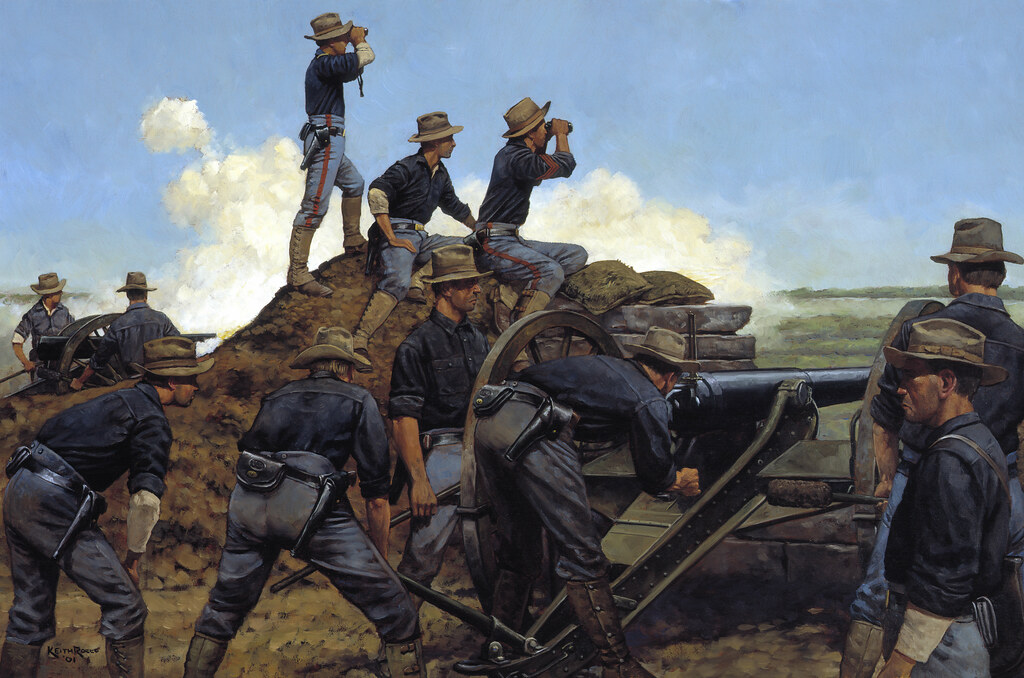
Utah Light Artillery in the Philippines, Spanish-American War

August 13, 2009

The Utah Light Artillery, painting by Keith Rocco -- August 13, 1898, Manila, Philippine Islands August 13, 1898, Manila, Philippine Islands  On April 6, 1898, Congress declared war on Spain and President William McKinley organized United States forces for the Splendid Little War. Of the tens of thousands of regular, volunteer and National Guard (Militia) troops who served, 343 Utah Guardsmen saw service in the Philippine Islands. On May 1st, after the Navys stunning victory at Manila Bay, McKinley authorized an invasion force to capture the Philippine archipelago from Spain. Organized into two batteries, the Utah Light Artillery mustered into federal service on May 9, 1898 at Fort Douglas, Utah. Shortly thereafter, at Camp Merritt near San Francisco, the Utah Artillery became part of Brig. Gen. Francis V. Greenes brigade of the U.S. VIII Corps under the command of Maj. Gen. Wesley Merritt.  Leaving San Francisco, Greenes brigade first raised the U.S. flag in Guam and then arrived on the island of Luzon on July 17, 1898. In the Philippines, 15,000 Americans not only faced 13,000 Spanish soldiers but a second army of some 12,000 Philippine rebels under Emilo Aguinaldo. The rebels had been fighting for national independence from Spain and hoping for American assistance. When Merritt ordered to keep the rebels out of the fight against Spain, the rebels became a second possible enemy.  On August 13th, the Utah Artillery supported Greenes brigade as it attacked towards the old city of Manila. The battle was predetermined to be a limited one in order to preserve Spanish honor and minimize casualties. The rebels, however, made this impossible. As American forces moved quickly against the Spanish defenses, a race to the old city center developed between the Americans and Aguinaldos rebels. The Utah batteries fired and re-deployed several times providing close and accurate support for the infantry attacks.  The Utah Light Artillery continued in federal service for another year and fought in the Philippine Insurrection until returning to Utah in August 1899. Todays 145th Field Artillery, Utah Army National Guard, carries on the history and traditions of the Utah Light Artillery.

Utah Light Artillery in the Spanish-American War – National Guard Heritage Gallery

On April 6, 1898, Congress declared war on Spain and President William McKinley organized United States forces for the “Splendid Little War.” Of the tens of thousands of regular, volunteer and National Guard (Militia) troops who served, 343 Utah Guardsmen saw service in the Philippine Islands. On May 1st, after the Navy’s stunning victory at Manila Bay, McKinley authorized an invasion force to capture the Philippine archipelago from Spain. Organized into two batteries, the Utah “Light” Artillery mustered into federal service on May 9, 1898 at Fort Douglas, Utah. Shortly thereafter, at Camp Merritt near San Francisco, the Utah Artillery became part of Brig. Gen. Francis V. Greene’s brigade of the U.S. VIII Corps under the command of Maj. Gen. Wesley Merritt.

Leaving San Francisco, Greene’s brigade first raised the U.S. flag in Guam and then arrived on the island of Luzon on July 17, 1898. In the Philippines, 15,000 Americans not only faced 13,000 Spanish soldiers but a second army of some 12,000 Philippine rebels under Emilo Aguinaldo. The rebels had been fighting for national independence from Spain and hoping for American assistance. When Merritt ordered to keep the rebels out of the fight against Spain, the rebels became a second possible enemy.

On August 13th, the Utah Artillery supported Greene’s brigade as it attacked towards the “old” city of Manila. The battle was predetermined to be a “limited” one in order to preserve Spanish honor and minimize casualties. The rebels, however, made this impossible. As American forces moved quickly against the Spanish defenses, a race to the old city center developed between the Americans and Aguinaldo’s rebels. The Utah batteries fired and re-deployed several times providing close and accurate support for the infantry attacks.

The Utah Light Artillery continued in federal service for another year and fought in the Philippine Insurrection until returning to Utah in August 1899. Today’s 145th Field Artillery, Utah Army National Guard, carries on the history and traditions of the Utah Light Artillery.

All text from the National Guard Heritage Gallery.


Bad guys of Baltimore

August 12, 2009

Or, “How a little study of history can make your visit to a city so much more entertaining and fun.”  At Clio Bluestocking Tales.

Why do visitors leave pennies at this gravesite?  Read the story at Clio Bluestocking Tales

Why do visitors leave pennies at this gravesite? Read the story at Clio Bluestocking Tales

For five weeks, I walked around the streets of Baltimore, or at least the distance between a certain major university known for its doctors, the Inner Harbor, and Fells Point — especially Fells Point — with some diversions elsewhere. As I walked, I began to notice landmarks of some very bad guys who have graced the streets of this interesting city.

Fans of “The Wire” will especially want to read it.  Did you catch the reason Clio is in Baltimore, for the full effect?

It’s not that history tells you how to live your life, or save it; it can make your life worth the living and saving.


Bathtub reading, health care and almost-back-to-school soak

August 10, 2009

Part-time blogging has its problems.  There’s a good post to be done on the trouble with superintendents in the Dallas area, but it requires more digging for links than I’ve had time to do.  There’s a post on test results that isn’t done.  There are a number of posts on teacher resources.

Health care needs  about 20 posts on specific facets, I figure.  Most of them will never get done.

Much of the weekend found our family at Baylor Medical Center in Dallas, doing an unintentional and surprise study on health care delivery in emergent situations.  This was prelude to a longer unintentional study on the delivery of rehabilitation following stroke.

Faith versus science: No real contest:  Science shines out, at every turn when the chips are down.  No one involved is a creationist, but of the six people in our family there including the kids, we’re talking three elders, a moderator, a patriarch.  Prayers form an adjunct to the medicine, and don’t get in the way of delivery of the medicine.  During one operation I mused on how the near-nanomachines that did the work were developed using the evolutionary paradigm.

Without evolution theory, almost all of modern medicine would be impossible, or haphazard at best.  On the day P. Z. Myers and the secular club investigated the Creationism Museum in Kentucky, I kept thinking “thank God for evolution.”  I don’t regard Ken Ham as the epitome of evil, but his work to spread false ideas about how the world works detracts from better health care in three ways:  First, it sucks money from the fight against disease and degeneration; second, it discourages good students from pursuing careers in healing people by leaving them wholly unprepared or unwilling to pursue knowledge; and third, it throws up  hurdles for research, by slandering the reputations and intentions of scientists who need our support to build the necessary instititions and do the required research, and discouraging contributors and other funding.

All of our prayers were directed to the benefit of science, contrary to Ken Ham’s evil hopes.

Stand up for good science in your schools. One of the kids in that class may invent a new clot busting, or artery-healing drug that will save your life, or the life and faculties of someone you love.

No kid who avoids evolution and hard science in school will invent life-saving devices or practices.

There were other lessons, too.

  • Speed counts in a stroke situation.  In an odd coincidence, my wife and I were by the fire station when the ambulance roared out.  It was good to see cars get out of the way and stop so the ambulance could pass.  Seconds save lives — pull over and get out of the way when an emergency vehicle comes up behind you.
  • All the talk of miracle drugs is just talk if there are medical reasons a particular miracle drug cannot be used.
  • It’s a lifesaver to have at hand a list of the pharmaceuticals one is prescribed.  Different kinds of strokes require different treatments; same with a variety of other afflictions.
  • Take a book to the hospital.  They are called “waiting rooms” for a very good reason.  There is no guarantee the program on the television will not be a brain-sucking intellectual vacuum.  No guarantee of a television.
  • Do you have emergency numbers on your cell-phone, as well as on a wall at home?  You should.  It makes things much, much easier.  Why don’t you add them right now?
  • Whiners who complain about the provisions in the health insurance reform bill that provide training for more doctors and nurses, think about what you would do on Saturday afternoon if you needed a crack neuro-radiologist/surgeon and a machine to give real-time images of blood-flow in a brain.
  • Fancy machines are expensive.  When the surgeon lays out the dangers and potential benefits of a procedure, you don’t want to have to think “will this cost more than $100?”  It will cost much more.  It’s unfair to your loved ones to have their life’s span or quality determined by how many Ben Franklins you have in your wallet at that moment.
  • Family are important.  Call yours today and let them know you care.

Update – more on stroke: You may want to view earlier posts on the remarkable story, TEDS lecture, book and writings of Jill Bolte Taylor, a brain researcher who herself experienced and much recovered from a devastating stroke.  Lecture here, more information here.

Other readings before the pages get too limp:

My fingers are all pruney now.  Enough reading for one soak.

Help your friends see things more cleanly, too:

Add to FacebookAdd to NewsvineAdd to DiggAdd to Del.icio.usAdd to StumbleuponAdd to RedditAdd to BlinklistAdd to TwitterAdd to TechnoratiAdd to Furl


Last use of atomic weapons in war – Nagasaki, Japan, August 9, 1945

August 9, 2009

Nuclear anniversaries have been ignored this year, it seems to me.

Ceremony in Nagasaki marked the remembrance of the victims of the second atomic weapon used in war, which was detonated over Nagasaki on August 9, 1945Agence France Press reports:

Nagasaki’s mayor, marking the 64th anniversary of his city’s atomic bombing by the United States, called on Sunday on the leaders of nuclear-armed powers to visit the site and build a nuclear-free world.

Hiroshima and Nagasaki, map by CNN

Hiroshima and Nagasaki, map by CNN

Tomihisa Tanoue urged world leaders from both declared nuclear powers and others such as Iran, Israel and North Korea to visit the city in southwestern Japan.

“I am sure anyone who visits here would feel the sorrow of the victims and be shaken by it,” the mayor said in an address at an annual ceremony commemorating the 1945 bombing.

A minute of silence was observed at 11:02 am (0202 GMT), when the US bomb exploded above the city, killing roughly 74,000 people. The bombing followed one a week before in Hiroshima and hastened Japan’s surrender in World War II.

Tanoue said an April speech by US President Barack Obama in Prague, where Obama pledged to build a world with no nuclear weapons, “impressed” the residents of Nagasaki.

“The Japanese government must support the Prague speech. As a nation that has come under nuclear attack, Japan must lead the international community” in abolishing the weapons, he said.

Similar appeals were made Thursday when Hiroshima marked the anniversary of its bombing, which killed 140,000 people.

At the Nagasaki ceremony, Prime Minister Taro Aso reiterated the Japanese government’s anti-nuclear stance, three weeks ahead of national elections that he is tipped to lose.

Aso raised eyebrows at the Hiroshima ceremony, when he pledged to work toward abolishing nuclear weapons but later told reporters that he thought it was “unimaginable” to attain a nuclear-free world.

Similar ceremonies, and similar pleas for nuclear non-proliferation marked the August 6 anniversary of the atomic bomb drop on Hiroshima.  The Chinese news agency Xinhua reported:

Some 50,000 people gathered Thursday at the peace park in Hiroshima to mourn the 64th anniversary of the atomic bombing of the city by U.S. forces during the World War II.

Hiroshima Mayor Tadatoshi Akiba delivered a peace declaration, calling for the abolition of nuclear weapons by 2020.

“The hibakusha still suffer a hell that continues,” said Akiba.

“The Japanese government should support hibakusha, including those who were victims of black rain and those who live overseas,” he said.

Japanese Prime Minister Taro Aso delivers a speech in front of the Memorial Cenotaph during the Hiroshima Peace Memorial Ceremony in Hiroshima, western Japan on Aug. 6, 2009. Hiroshima on Thursday mourned the 64th anniversary of the atomic bombing of the city by U.S. forces during the World War II. (Xinhua/Ren Zhenglai)

"Japanese Prime Minister Taro Aso delivers a speech in front of the Memorial Cenotaph during the Hiroshima Peace Memorial Ceremony in Hiroshima, western Japan on Aug. 6, 2009. Hiroshima on Thursday mourned the 64th anniversary of the atomic bombing of the city by U.S. forces during the World War II. (Xinhua/Ren Zhenglai)"

It was reported Wednesday that the Japanese government aims to come to an agreement with all atomic bomb survivors who have sued the government for financial support to help them pay medical bills for illnesses related to the bombings of Hiroshima and Nagasaki.

Akiba also said “The year 2020 is important as we want to enter a world without nuclear weapons with as many hibakusha as possible. We call on the world to join forces with us to eliminate all nuclear weapons by 2020.”

Referring to the movements such as the environmentalists, Akibasaid, “Global democracy that respects the will of the world and respects the power of the people has begun to grow.”

“We have the power. We have the responsibility. We are the Obamajority. And we can abolish nuclear weapons. Yes we can,” said the mayor.

On Wednesday, Akiba urged the people around the world to join the city’s efforts to abolish nuclear weapons in response to U.S. President Barack Obama’ s appeal for a world free of nuclear weapons.

During the 50-minute memorial ceremony, a moment of silence was observed at 8:15 a.m., the time the atomic bomb detonated over Hiroshima 64 years ago, killing nearly 100,000 people in a blink.

This in a week when two burgeoning new nuclear powers, Iran and North Korea, continue to claim they will flout non-proliferation agreements for their own self defense.

The question obtains on nuclear issues as well as genocides:  When does “never again” start?

Other related posts at Millard Fillmore’s Bathtub: