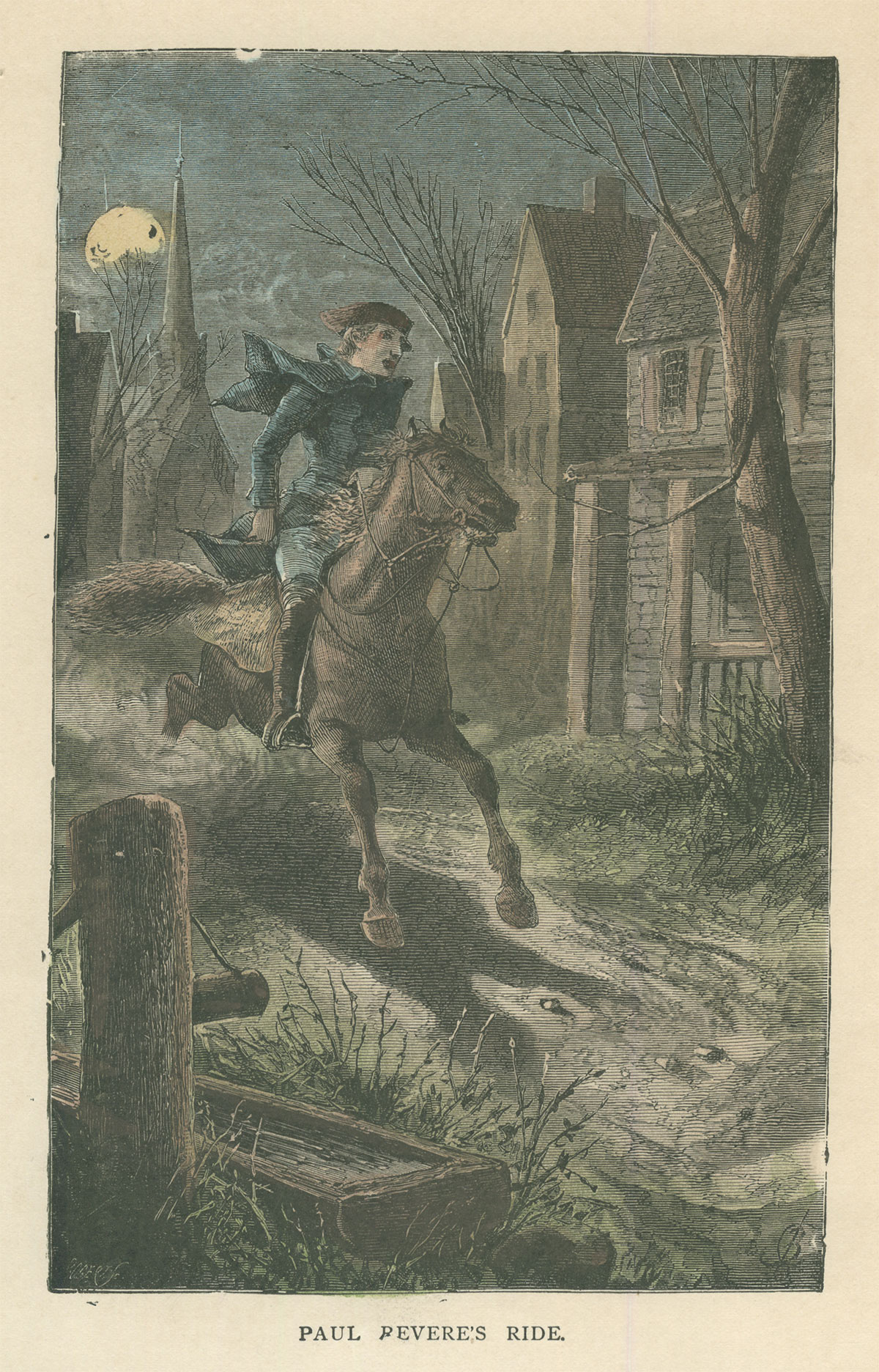
Anniversary of Paul Revere’s ride, in the middle of National Poetry Month

April 18, 2016

This is mostly an encore post.  Is there a good reason Paul Revere made his ride in the middle of National Poetry Month

Teachers, you may want to get copies of the poems for your U.S. history and literature classes.
I like to go through the poem again on the anniversary of the event, with students taking one verse each. It builds vocabulary (try it, you’ll see), and it gives an opportunity to discuss how history threads run long; this poem was written in 1860, when the “hour of darkness and peril” was a different war, not against Britain, and not concentrated along the nation’s Atlantic coast.

You may want to note that the Boston Marathon is traditionally run on Freedom Day in Massachusetts — the day that commemorates the ride of the patriots’ warning that Gen. Gage’s army was on the move, and of the battles at Lexington and Concord, the next day. 

_____________

April 18 and 19. Do the dates have significance?

Paul Revere's ride, from Paul Revere House

Paul Revere’s Ride, by Blake. Image from Paul Revere House.

Among other things, April 19 is the date of the firing of the “shot heard ’round the world,” the first shots in the American Revolution. On April 19, 1775, American Minutemen stood to protect arsenals they had created at Lexington and Concord, Massachusetts, against seizure by the British Army then occupying Boston.

American history does not have a rude bridge at Concord commemorated, without the ride of the patriots the night before to warn the colonists. Though its history may run aft agly, “Paul Revere’s Ride” celebrates particular characteristics of Americans who make history.

Plus, April is National Poetry Month. What have we done to celebrate poetry?

What have we done to properly acknowledge the key events of April 18 and 19, 1775? Happily, poetry helps us out in history studies. Or, it can do.

Was there a time when poetry inspired a nation to save itself?

In contrast to my childhood, when we as students had poems to memorize weekly throughout our curriculum, modern students too often come to my classes seeming wholly unaware that rhyming and rhythm are used for anything other than celebrating materialist, establishment values obtained sub rosa. Poetry, to them, is mostly rhythm, certainly not for polite company, and never for learning.

Poetry has  slipped from our national curriculum, dropped away from our national consciousness.  No national test adequately covers poetry, not in English, not in social studies — certainly not in math or science.

That is one small part of the reason that Aprils in the past two decades turned instead to memorials to violence, and fear that violence will break out again. We have allowed darker ideas to dominate April, and especially the days around April 19.

You and I have failed to properly commemorate the good, I fear. We have a duty to pass along these cultural icons, as touchstones to understanding America.

So, reclaim the high ground. Reclaim the high cultural ground.

Read a poem today. Plan to be sure to have the commemorative reading of “Paul Revere’s Ride” in your classes on April 18 or 19, and “The Concord Hymn” on April 19.

We must work to be sure our heritage of freedom is remembered, lest we condemn our students, our children and grandchildren to having to relearn these lessons of history, as Santayana warned.

Texts of the poems are below the fold, though you may be much better off to use the links and see those sites, the Paul Revere House, and the Minuteman National Historical Park.

Read the rest of this entry »


Happy birthday, Thomas Jefferson! Born April 13, 1743

April 13, 2016

Library of Congress's South Reading Room. Mural of Thomas Jefferson with his residence, Monticello, in the background, by Ezra Winter. Library of Congress John Adams Building, Washington, D.C.

South Reading Room. Mural of Thomas Jefferson with his residence, Monticello, in the background, by Ezra Winter. Library of Congress John Adams Building, Washington, D.C.; photo by the great photographic historian Carol Highsmith

So, what are you doing to celebrate the birthday of Thomas Jefferson on April 13?

You might visit the Library of Congress, and see Jefferson’s advice to President Obama on a variety of issues, including freedom, labor, kids today, education, and the difficulty of keeping our democratic republic:

Murals by Ezra Winter also decorate the South Reading Room. The theme for these four murals is drawn from Thomas Jefferson’s writings, which are inscribed on the paintings and reflect Jefferson’s thoughts on Freedom, Labor, the Living Generation, Education, and Democratic Government. The characters and costumes depicted are those of Jefferson’s time. A portrait of Jefferson with his residence, Monticello, in the background is in the lunette above the reference desk at the north end of the room; the words in the lower left- had corner explain that THIS ROOM IS DEDICATED TO THOMAS JEFFERSON .

On the left half of the panel on the east wall, Jefferson’s view on Freedom is depicted:

THE GROUND OF LIBERTY IS TO BE GAINED BY INCHES. WE MUST BE CONTENTED TO SECURE WHAT WE CAN GET FROM TIME TO TIME AND ETERNALLY PRESS FORWARD FOR WHAT IS YET TO GET. IT TAKES TIME TO PERSUADE MEN TO DO EVEN WHAT IS FOR THEIR OWN GOOD.

Jefferson to Rev. Charles Clay, January 27, 1790

Jefferson’s views on labor, also on the east wall, are taken from his Notes on Virginia:

THOSE WHO LABOR IN THE EARTH ARE THE CHOSEN PEOPLE OF GOD, IF HE EVER HAD A CHOSEN PEOPLE, WHOSE BREASTS HE HAS MADE THE PECULIAR DEPOSITS FOR SUBSTANTIAL AND GENUINE VIRTUE. IT IS THE FOCUS IN WHICH HE KEEPS ALIVE THAT SACRED FIRE WHICH OTHERWISE MIGHT NOT ESCAPE FROM THE EARTH.

From Notes on Virginia, 1782

On the south wall, the panel over the clock contains a quotation about the Living:

THE EARTH BELONGS ALWAYS TO THE LIVING GENERATION. THEY MAY MANAGE IT THEN AND WHAT PROCEEDS FROM IT AS THEY PLEASE DURING THEIR USUFRUCT. THEY ARE MASTERS TOO OF THEIR OWN PERSONS AND CONSEQUENTLY MAY GOVERN THEM AS THEY PLEASE.

Jefferson to James Madison, September 6, 1789

On the left half of the panel on the west wall, Jefferson’s view of Education is illustrated:

EDUCATE AND INFORM THE MASS OF THE PEOPLE. ENABLE THEM TO SEE THAT IT IS THEIR INTEREST TO PRESERVE PEACE AND ORDER, AND THEY WILL PRESERVE THEM. ENLIGHTEN THE PEOPLE GENERALLY, AND TYRANNY AND OPPRESSION OF THE BODY AND MIND WILL VANISH LIKE EVIL SPIRITS AT THE DAWN OF DAY.

Jefferson to James Madison, December 20, 1787 (first two sentences);
Jefferson to P.S. Dupont de Nemours, April 24, 18l6 (last sentence).

Usufruct,” the Word of the Day for April 13.

Jefferson was born April 2, 1843, under the old Julian calendar (O.S., or Old System) — April 13 on the Gregorian calendar, the calendar we use today.

How should we celebrate?

Is there a monument or memorial to Thomas Jefferson in your town? Please tell us about it, and give us a photo if you can, in comments.

More:

Yes, this is mostly an encore post. Fighting ignorance requires patience.

Yes, this is mostly an encore post. Fighting ignorance requires patience.


Good, abiding reasons some people support Hillary Clinton

April 7, 2016

This stuff gets left out, overshadowed by false claims and bogus charges. It shouldn’t.

Hillary Clinton didn’t get to the U.S. Senate, and to a solid run for president, and to Secretary of State and a second presidential run without good reason.  It the thick of campaigns, good reasons to vote for people often get shouted down.

Mrs. Clinton’s speech in China in 1995, at a United Nations conference on the status of women and women’s rights, is probably the most famous, though even it is often overlooked.

First Lady Hillary Clinton in China, in 1995.

First Lady Hillary Clinton in China, in 1995.

Look at this video and read this transcript, about Clinton’s lifetime support and hard work to expand human rights. Clinton’s long-time supporters remember, though they don’t speak about it often enough. Let us work to keep from interring the good work of people with the past.

http://www.dailykos.com/story/2013/10/18/1248523/-You-won-t-see-Hillary-Clinton-in-the-same-light-ever-again

Excerpt from the transcript of Meryl Streep’s introduction of Hillary Clinton at the 2012 Women in the World Conference:

Two years ago when Tina Brown and Diane von Furstenberg first envisioned this conference, they asked me to do a play, a reading, called – the name of the play was called “Seven.” It was taken from transcripts, real testimony from real women activists around the world. I was the Irish one, and I had no idea that the real women would be sitting in the audience while we portrayed them. So I was doing a pretty ghastly Belfast accent. I was just – I was imitating my friend Liam Neeson, really, and I sounded like a fellow. (Laughter). It was really bad.

So I was so mortified when Tina, at the end of the play, invited the real women to come up on stage and I found myself standing next to the great Inez McCormack. (Applause.) And I felt slight next to her, because I’m an actress and she is the real deal. She has put her life on the line. Six of those seven women were with us in the theater that night. The seventh, Mukhtaran Bibi [Mukhtaran Mai], couldn’t come because she couldn’t get out of Pakistan. You probably remember who she is. She’s the young woman who went to court because she was gang-raped by men in her village as punishment for a perceived slight to their honor by her little brother. All but one of the 14 men accused were acquitted, but Mukhtaran won the small settlement. She won $8,200, which she then used to start schools in her village. More money poured in from international donations when the men were set free. And as a result of her trial, the then president of Pakistan, General Musharraf, went on TV and said, “If you want to be a millionaire, just get yourself raped.”

But that night in the theater two years ago, the other six brave women came up on the stage. Anabella De Leon of Guatemala pointed to Hillary Clinton, who was sitting right in the front row, and said, “I met her and my life changed.” And all weekend long, women from all over the world said the same thing:

“I’m alive because she came to my village, put her arm around me, and had a photograph taken together.”

“I’m alive because she went on our local TV and talked about my work, and now they’re afraid to kill me.”

“I’m alive because she came to my country and she talked to our leaders, because I heard her speak, because I read about her.”

I’m here today because of that, because of those stores. I didn’t know about this. I never knew any of it. And I think everybody should know. This hidden history Hillary has, the story of her parallel agenda, the shadow diplomacy unheralded, uncelebrated — careful, constant work on behalf of women and girls that she has always conducted alongside everything else a First Lady, a Senator, and now Secretary of State is obliged to do.

And it deserves to be amplified. This willingness to take it, to lead a revolution – and revelation, beginning in Beijing in 1995, when she first raised her voice to say the words you’ve heard many times throughout this conference: “Women’s Rights Are Human Rights.”

When Hillary Clinton stood up in Beijing to speak that truth, her hosts were not the only ones who didn’t necessarily want to hear it. Some of her husband’s advisors also were nervous about the speech, fearful of upsetting relations with China. But she faced down the opposition at home and abroad, and her words continue to hearten women around the world and have reverberated down the decades.

She’s just been busy working, doing it, making those words “Women’s Rights are Human Rights” into something every leader in every country now knows is a linchpin of American policy. It’s just so much more than a rhetorical triumph. We’re talking about what happened in the real world, the institutional change that was a result of that stand she took.


New London’s 1937 school disaster, remembered on Twitter today

March 18, 2016

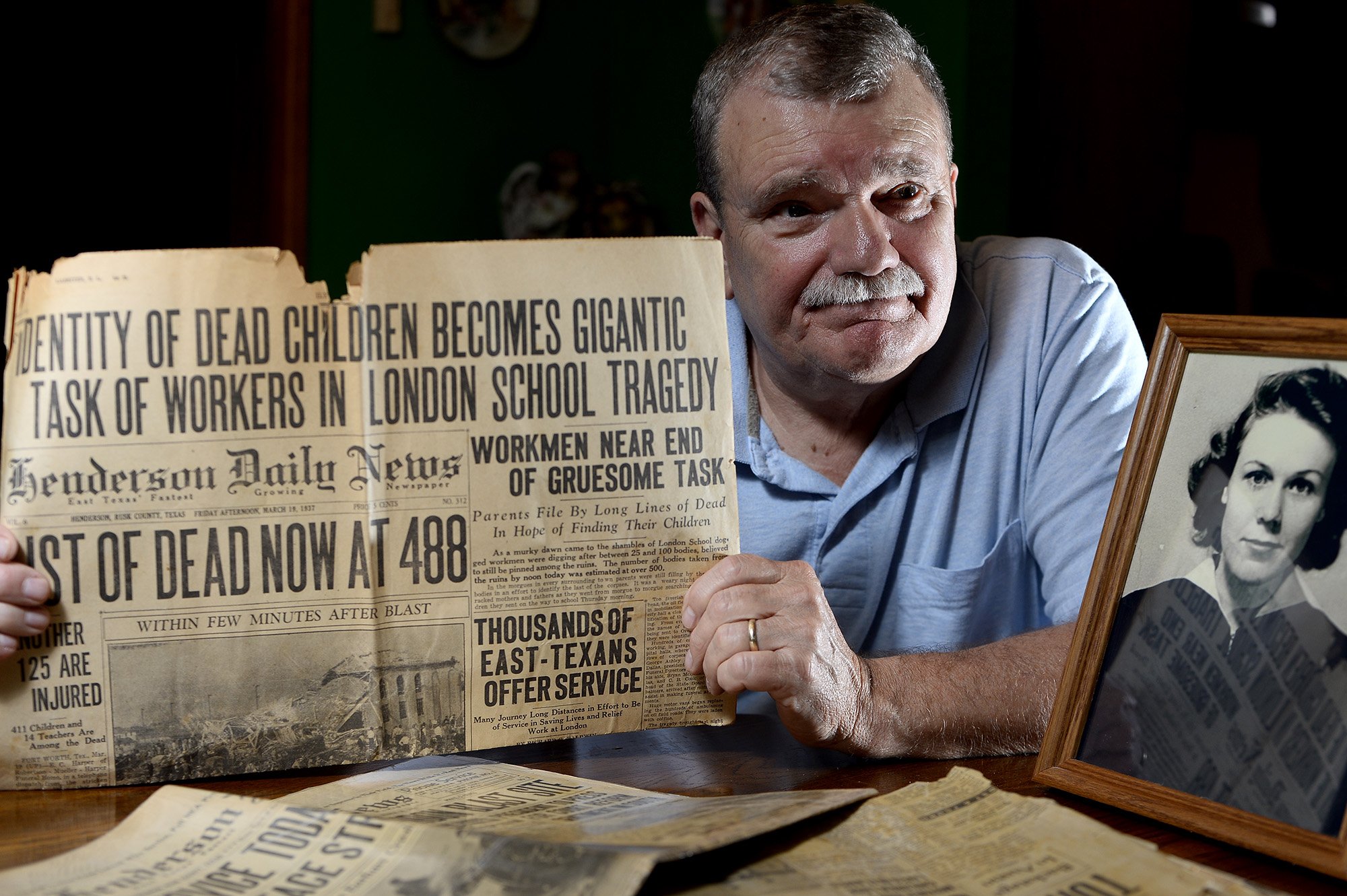
Bridge City resident Richard Schur's mother, Luna Louise Hudson, was a student at the New London School when it exploded on March 18, 1937. Hudson had missed school that day because she couldn't find one of her shoes, but her brother, Elisha, died in the explosion. Photo taken Wednesday 3/9/16 Ryan Pelham/The Enterprise

Bridge City resident Richard Schur’s mother, Luna Louise Hudson, was a student at the New London School when it exploded on March 18, 1937. Hudson had missed school that day because she couldn’t find one of her shoes, but her brother, Elisha, died in the explosion. Photo taken Wednesday 3/9/16 Ryan Pelham/The Enterprise, Beaumont, Texas

Some do work to keep the history alive. Good on them.

https://twitter.com/kblast523/status/710814889292472320

https://twitter.com/Wrschgn/status/710839691344539648

https://twitter.com/Wrschgn/status/710839691344539648

Have we learned? How do we explain the explosion in West, Texas? How do we explain the general lack of attention to school facilities nationally?

Did we forget?


Forgotten disasters in U.S. schools: March 18, 1937, New London, Texas, gas explosion

March 18, 2016

Most high school history students don’t know about it.  Most high school history students in Texas don’t know about it.

New London School, New London, Texas, before the 1937 disaster. Photo from the New London Museum

New London School, New London, Texas, before the 1937 disaster. Photo from the New London Museum

I wonder, sometimes, how many Texans remember at all.

I wonder, too, if there are lessons to be learned from the New London tragedy, while the nation debates what to do to prevent recurrences of school shootings.

No one in New London, Texas, bore ill-will towards children, or schools, or other New Londoners. Some good came of the disaster, but as we’ve seen, with animosity towards schools and school safety in Texas today, and a lackadaisical approach to dangerous substance control and accident prevention in West, Texas, and other places, lessons learned were not learned well.

The deadliest disaster ever to hit a public school in the U.S. struck on March 18, 1937, when a natural gas explosion destroyed the new school building at New London, Texas, killing about 300 people — 79 years ago today.

The remains of the London School after the exp...

The remains of the London School after the explosion of March 18, 1937. Mother Frances Hospital archives

Noise from the blast alerted the town, and many people in the oilfields for many miles.  Telephone and telegraph communication got word out.  Oil companies dismissed their employees, with their tools, to assist rescue and recovery efforts.  Notably, 20-year-old Walter Cronkite came to town to report the news for a wire service.

Investigation determined that a leak in a newly-installed tap into the waste gas pipe coming from nearby oil fields probably allowed natural gas to accumulate under the building.  A spark from a sander started a fire in gas-filled air, and that in turn exploded the cavern under the school.  School officials approved the tap to the waste gas line to save money.  (Hello, Flint, Michigan!) Natural gas is odorless.  One result of the disaster was a Texas law requiring all utility natural gas to be odorized with ethyl mercaptan.

Though the Great Depression still gripped the nation, wealth flowed in New London from oil extraction from nearby oil fields.  The  school district completed construction on a new building in 1939, just two years later — with a pink granite memorial cenotaph in front.

Today, disasters produce a wealth of litigation, tort suits trying to get money to make the injured whole, and to sting those at fault to change to prevent later disasters.  In 1937 official work cut off such lawsuits.

Three days after the explosion, inquiries were held to determine the cause of the disaster. The state of Texas and the Bureau of Mines sent experts to the scene. Hearings were conducted. From these investigations, researchers learned that until January 18, 1937, the school had received its gas from the United Gas Company. To save gas expenses of $300 a month, plumbers, with the knowledge and approval of the school board and superintendent, had tapped a residue gas line of Parade Gasoline Company. School officials saw nothing wrong because the use of “green” or “wet” gas was a frequent money-saving practice for homes, schools, and churches in the oilfield. The researchers concluded that gas had escaped from a faulty connection and accumulated beneath the building. Green gas has no smell; no one knew it was accumulating beneath the building, although on other days there had been evidence of leaking gas. No school officials were found liable.

These findings brought a hostile reaction from many parents. More than seventy lawsuits were filed for damages. Few cases came to trial, however, and those that did were dismissed by district judge Robert T. Brown for lack of evidence. Public pressure forced the resignation of the superintendent, who had lost a son in the explosion. The most important result of the disaster was the passage of a state odorization law, which required that distinctive malodorants be mixed in all gas for commercial and industrial use so that people could be warned by the smell. The thirty surviving seniors at New London finished their year in temporary buildings while a new school was built on nearly the same site. The builders focused primarily on safety and secondarily on their desire to inspire students to a higher education. A cenotaph of Texas pink granite, designed by Donald S. Nelson, architect, and Herring Coe, sculptor, was erected in front of the new school in 1939.  (Texas Handbook of History, Online, from the Texas State Historical Association)

Of about 500 students, more than 50% of them died.  Once the new school and memorial were built, and the law passed requiring utilities to odorize natural gas so leaks could be detected earlier, survivors and rescuers rather shut down telling the history.  A 1977 reunion of survivors was the first in 40 years.

New London School shortly after the March 18, 1937, explosion. Photo from the New London Museum.

New London School shortly after the March 18, 1937, explosion. Photo from the New London Museum.

Because of that scarring silence, the story slipped from the pages of most history books.

Trinity Mother Frances Hospital treated the victims; a 2012 film from the hospital offers one of the best short histories of the events available today.

New London, and the New London Museum, work to remember the dead and honor them.  Work continues on a film about the disaster, perhaps for release in 2013:

Now, more than 75 years later, the London Museum, across the highway from where the original school was destroyed, keeps alive the memory of much of a generation who died on that terrible day.

This video was produced by Michael Brown Productions of Arlington, TX as a prelude to a feature documentary on the explosion and its aftermath which is planned for
the spring of 2013.  . . .

www.newlondonschool.org/museum

What are the lessons of the New London Disaster?  We learned to remember safety, when dealing with natural gas.  A solution was found to alert people to the presence of otherwise-odorless, explosive gases, a solution now required by law throughout the U.S.  Natural gas explosions decreased in number, and in damages and deaths.  Wealthy schools districts, cutting corners, can create unintended, even disastrous and deadly consequences.  Quick rebuilding covers the wounds, but does not heal them.

Remembering history takes work; history not remembered through the work of witnesses, victims and survivors, is quickly forgotten — to the detriment of history, and to the pain of the witnesses, victims and survivors.

New, New London School and granite cenotaph memorial to the victims of the 1937 explosion

New, New London School and granite cenotaph memorial to the victims of the 1937 explosion. Photo from Texas Bob Travels.

More:

Houston’s KHOU-TV produced a short feature on the explosion in 2007:

Yes, this is mostly an encore post. Fighting ignorance requires patience.

Yes, this is mostly an encore post. Fighting ignorance requires patience.


Honoring James Madison, the go-to guy, on his birthday, March 16

March 16, 2016

James Madison, the fourth President of the United States, and the Father of the Constitution, was born March 16, 1751, in the Tidewater area of Virginia.

Is it sinful that we do not celebrate his birthday with a federal holiday, fireworks, picnics and speeches and concerts?

Maybe you could fly your flag today.  If the neighbors ask why, tell them you’re flying it for freedom on James Madison’s birthday.  They’ll say, “Oh,” and run off to Google Madison.  You will have struck a blow for the education that undergirds democracy.

Journalists honor Madison on his birthday, and through the week in which his birthday occurs, with tributes to the First Amendment which he wrote, and celebrations of Freedom of Information Laws and press freedoms, two issues dear to Madison’s heart.

There is much, much to celebrate about him.

A few years ago I was asked to talk about freedom to a group of freedom lovers in North Texas.  I chose to speak about James Madison’s remarkable, and too-often unremarked-upon life. Later, when I started this blog, I posted it here, with an introduction.  All of that is below, in honor of the birth of James Madison.

Did you know that Madison is the shortest man ever to have been president?  His stature is measured in freedom, not in feet and inches.

(Originally a post on July 31, 2006)

James Madison, 1783, by Charles Wilson Peale. Library of Congress collection

James Madison, 1783, miniature by Charles Wilson Peale. Madison would have been 32. Library of Congress collection

I don’t blame students when they tell me they “hate history.”  Heaven knows, they probably have been boringly taught boring stuff.

For example, history classes study the founding of the United States. Especially under the topical restrictions imposed by standardized testing, many kids will get a short-form version of history that leaves out some of the most interesting stuff.

Who could like that?

Worse, that sort of stuff does damage to the history and the people who made it, too.

James Madison gets short shrift in the current canon, in my opinion. Madison was the fourth president, sure, and many textbooks note his role in the convention at Philadelphia that wrote the Constitution in 1787. But I think Madison’s larger career, especially his advocacy for freedom from 1776 to his death, is overlooked.

Madison was the “essential man” in the founding of the nation, in many ways. He was able to collaborate with people as few others could, in order to get things done, including his work with George Mason on the Virginia Bill of Rights, with George Washington on the Constitution and national government structure, Thomas Jefferson on the structure and preservation of freedom, Alexander Hamilton on the Constitution and national bank, and James Monroe on continuing the American Revolution.

We need to look harder at the methods and philosophy, and life, of James Madison. This is an opinion I’ve held for a long time. Below the fold I reproduce a “sermon” I delivered to the North Texas Church of Freethought in November 2001.

James Madison White House portrait, John Vanderlyn, 1816

James Madison’s official White House portrait, by John Vanderlyn in 1816; in the White House collection

I have left this exactly as it was delivered, though I would change a few things today, especially emphasizing more the key role George Washington played in pushing Madison to get the Constitution — a view I came to courtesy of the Bill of Rights Insitute and their outstanding, week-long seminar, Shaping the Constitution: A View from Mount Vernon 1783-1789. The Bill of Rights Institute provides outstanding training for teachers, and this particular session, at Washington’s home at Mount Vernon, Virginia, is well worth the time (check with the Institute to see whether it will be offered next year — and apply!). I am especially grateful to have had the opportunity to discuss these times and issues with outstanding scholars like Dr. Gordon Lloyd of Pepperdine University, Dr. Adam Tate of Morrow College, and Dr. Stuart Leibiger of LaSalle University, during my stay at Mount Vernon.

James Madison by Gilbert Stuart c. 1821

James Madison, portrait by Gilbert Stuart c. 1821; National Portrait Gallery

My presentation to the skeptics of North Texas centered around the theme of what a skeptic might give thanks for at Thanksgiving. (It is available on the web — a misspelling of my name in the program carried over to the web, which has provided me a source of amusement for several years.)

Here is the presentation:

Being Thankful For Religious Liberty

As Presented at the November, 2001 Sunday Service of The North Texas Church of Freethought

Historians rethink the past at least every generation, mining history for new insights or, at least, a new book. About the founders of this nation there has been a good deal of rethinking lately. David McCullough reminds us that John Adams really was a good guy, and that we shouldn’t think of him simply as the Federalist foil to Thomas Jefferson’s more democratic view of the world. Jefferson himself is greatly scrutinized, and perhaps out of favor — “American Sphinx,” Joseph Ellis calls him. The science of DNA testing shows that perhaps Jefferson had more to be quiet about than even he confessed in his journals. While Jefferson himself questioned his own weakness in his not freeing his slaves in his lifetime, historians and fans of Jefferson’s great writings wrestle with the likelihood of his relationship with one of his own slaves (the old Sally Hemings stories came back, and DNA indicates her children were fathered by a member of the Jefferson clan; some critics argue that Jefferson was a hypocrite, but that was Jefferson’s own criticism of himself; defenders point out that the affair most likely was consensual, but could not be openly acknowledged in Virginia at that time). Hamilton’s gift to America was a financial system capable of carrying a noble nation to great achievement, we are told – don’t think of him simply as the fellow Aaron Burr killed in a duel. Washington is recast as one of the earliest guerrilla fighters, and in one book as a typical gentleman who couldn’t control his expenses. Franklin becomes in recent books the “First American,” the model after which we are all made, somehow.

Of the major figures of these founding eras, James Madison is left out of the rethinking, at least for now. There has been no major biography of Madison for a decade or more, not since Ralph Ketcham’s book for the University of Virginia press. Madison has a role in Joseph Ellis’s Founding Brothers, but he shares his spotlight with Hamilton and Jefferson. I think this is an oversight. As we enter into the first Thanksgiving season of the 21st century, we would do well to take a look back at Madison’s life. Madison gives us a model of reason, and more important, a model of action coupled to reason. America’s founding is often depicted as a time of great thunder — if not the thunder of the lightning Ben Franklin experimented with, an experiment he parlayed into worldwide respect for Americans, it is the thunder of the pronouncements of Thomas Jefferson in the Declaration of Independence, or of George Washington, just generally thundering through history.

The use of a bolt of lightning as a symbol for this group is inspired, I think. I’m a great fan of Mark Twain, and when I see that bolt of electricity depicted I think of Twain’s observation:

“Thunder is good; thunder is impressive. But it is lightning that does the work.”

Thunder at the founding is impressive; where was the lightning?

I’d like to point out two themes that run through Madison’s life, or rather, two activities that we find him in time and again. Madison’s life was marked by periods of reflection, followed by action as a result of that reflection.

We don’t know a lot about Madison’s youth. He was the oldest son of a wealthy Virginia planter, growing up in the Orange County area of Tidewater Virginia. We know he was boarded out for schooling with good teachers – usually clergymen, but occasionally to someone with expertise in a particular subject – and we know that he won admission to Princeton to study under the Rev. John Witherspoon, a recent Presbyterian transplant from across the Atlantic. Madison broke with tradition a bit in attending an American rather than an English school. And after completing his course of study he remained at Princeton for another year to study theology directly under Witherspoon, with an eye toward becoming a preacher.

Witherspoon is often held up as an example of how religion influenced the founders, but he was much more of a rationalist than some would have us believe. He persuaded the young Madison that a career in law and politics would be a great service to the people of Virginia and America, and might be a higher calling. After a year of this reflection, Madison returned to Virginia and won election to local government.

In his role as a county official Madison traveled the area. He inspected the works of government, including the jails. He was surprised to find in jail in Virginia people accused of — gasp! — practicing adult baptism. In fact Baptists and Presbyterians were jailed on occasion, because the Anglican church was the state church of Virginia, and their practicing their faith was against the common law. This troubled Madison greatly, and it directed an important part of his work for the rest of his life. In January of 1774, Madison wrote about it to another prominent Virginian, William Bradford:

“Poverty and Luxury prevail among all sorts: Pride ignorance and Knavery among the Priesthood and Vice and Wickedness among the Laity. This is bad enough. But it is not the worst I have to tell you. That diabolical Hell conceived principle of persecution rages among some and to their eternal infamy the Clergy can furnish their Quota of Imps for such business. This vexes me the most of any thing whatever. There are at this time in the adjacent County not less than 5 or 6 well meaning men in close Gaol for publishing their religious Sentiments which in the main are very orthodox. I have neither patience to hear talk or think of any thing relative to this matter, for I have squabbled and scolded abused and ridiculed so long about it, to so little purpose that I am without common patience. So I leave you to pity me and pray for Liberty of Conscience to revive among us.”

By April, Madison’s views on the matter had been boiled down to the essences, and he wrote Bradford again more bluntly:

“Religious bondage shackles and debilitates the mind and unfits it for every noble enterprise.”

Madison must have done a fine job at his county duties, whatever they were, because in 1776 when Virginia was organizing its government to survive hostilities with England, Madison was elected to the legislative body.

Madison was 25, and still raw in Virginia politics. He was appointed to the committee headed by George Mason to review the laws and charter of the colony. Another who would serve on this committee when he was back from Philadelphia was Thomas Jefferson. George Mason was already a giant in Virginia politics, and by the time Madison got to Williamsburg, Mason had already completed much of the work on a bill of rights to undergird the new Virginia government. Madison noted that freedom of religion was not among the rights enumerated in Mason’s version — but it was too late, Mason said. The work was done.

Madison quietly went to work on Mason, in committee, over dinner, during social occasions — noting the great injustice of jailing people solely because of their beliefs, and urging to Mason that it did Virginia no good to keep these fathers from providing for their families.

Mason ultimately agreed to accept the amendment.

The pattern was set.

Perhaps a better example of this reflection and action cycle occurred nearly a decade later. By 1785 the war was over, independence was won, but the business of government continued. While serving as governor of Virginia, Thomas Jefferson had drafted about 150 proposals for laws, really a blueprint for a free government. About half of these proposals had been passed into law. By 1785, Jefferson was away from Virginia, representing the Confederation of colonies in Paris. Jefferson had provided several laws to disestablish religion in Virginia, and to separate out the functions of church and state. With Jefferson gone, however, his old nemesis Patrick Henry sought to roll back some of that work. Henry proposed to bring back state support for the clergy, for the stated purpose of promoting education. (Yes, this is the same battle we fight today for church and state separation.) After Jefferson’s troubled term as governor, Virginia turned again to Henry – Henry ultimately served six terms as governor. His proposal was set for a quick approval in the Virginia assembly. It was late in the term, and everyone wanted to get home.

Henry was, of course, a thundering orator of great note. Madison was a small man with a nervous speaking style, but a man who knew the issues better than anyone else in almost any room he could be in. Madison came up with an interesting proposal. Picking the religion for the state was serious stuff, he said. A state doesn’t want to pick the wrong religion, and get stuck with the wrong god, surely – and such weighty matters deserve widespread support and discussion, Madison said. His motion to delay Henry’s bill until the next session, in order to let the public know and approve, was agreed to handily.

You probably know the rest of this story. With a year for the state to reflect on the idea, Madison wrote up a petition on the issue, which he called a “Memorial and Remonstrance.” In the petition he laid out 15 reasons why separation of church and state was a superior form of government, concluding that in the previous 1,500 years, every marriage of church and state produced a lazy and corrupt church, and despotic government. Madison’s petition circulated everywhere, and away from Patrick Henry’s thundering orations, the people of Virginia chose Madison’s cool reason.

When the legislature reconvened in 1786, it rejected Henry’s proposal. But Madison’s petition had been so persuasive, the legislature also brought up a proposal Thomas Jefferson had made six years earlier, and passed into law the Virginia Statue for Religious Freedom.

This was a great victory for Madison, and for Virginia. He celebrated by convening a convention to settle disputes between Virginia and Maryland about navigation on the Chesapeake Bay. Having reflected on the nature of this issue — a dispute between colonies — Madison had sought advice from others having the same problems, such as New York and New Jersey. In that effort he got the support of a New Yorker working on the same problems, Alexander Hamilton. In the course of these discussions Madison thought it clear that the difficulty lay with the form of government that bound the colonies together under the Articles of Confederation. Hamilton agreed, and they got their respective states and conferences to agree to meet in Philadelphia in 1787 to try to fix those problems. [Since I first wrote this, I’ve learned that it was George Washington’s desire to get a federal government, to facilitate the settling of the Ohio River Valley where Washington had several thousands of acres to sell, that prompted him to push Madison into the Annapolis Convention, and who made the introduction between Madison and Washington’s old aide and friend, Alexander Hamilton; Madison’s work with Washington runs much deeper than I orignally saw.]

James Madison, painted in 1792 by Charles Wilson Peale. Saatchi Gallery image

James Madison, painted in 1792 by Charles Wilson Peale. Saatchi Gallery image

Amending the Articles of Confederation was a doomed effort, many thought. The colonies would go their separate ways, no longer bound by the need to hang together against the Parliament of England. Perhaps George Washington could have got a council together to propose a new system, but Washington had stayed out of these debates. Washington’s model for action was the Roman general Cincinnatus, who went from his plow to lead the Romans to victory, then returned to his farm, and finding his plow where he had left it, took it up again.

Madison invited Washington, and persuaded Washington to attend. Washington was elected president of the convention, and in retrospect that election guaranteed that whatever the convention produced, the colonies would pay attention to it.

You know that history, too. The convention quickly decided the Articles of Confederation were beyond repair. Instead, they wrote a new charter for a new form of government. The charter was based in part on Jefferson’s Virginia Plan, with lots of modifications. Because the Constitution resembles so much the blueprint that Jefferson had written, and because Jefferson was a great founder, many Americans believe Jefferson was a guiding light at that Philadelphia convention. It’s often good to reflect that Jefferson was in Paris the entire time. While America remembers the thunder of Washington’s presiding, Franklin’s timely contributions and Jefferson’s ideas, it was Madison who did the heavy lifting, who got Washington and Franklin to attend the meeting Madison had set up, and got Jefferson’s ideas presented and explained.

It was Madison who decided, in late August of 1787, that the convention could not hang together long enough to create a bill of rights, and instead got approval for the basic framework of the U.S. government. In Virginia a few months later, while Patrick Henry thundered against what he described as a power grab by a new government, it was Madison who assembled the coalitions that got the Constitution ratified by the Virginia ratifying convention. And when even Jefferson complained that a constitution was dangerous without a bill of rights, it was Madison who first calmed Jefferson, then promised that one of the first actions of the new government would be a bill of rights. He delivered on that promise as a Member of the House of Representatives in 1789.

It is difficult to appreciate just how deeply insinuated into the creation of America was James Madison. In big ways and small, he made America work. He took the lofty ideas of Jefferson, and made them into laws that are still on the books, unamended and unedited, more than 200 years later.

When the ratification battle was won, when Madison had won election to the House over Patrick Henry’s strong objection, partly by befriending the man Henry had picked to defeat Madison, James Monroe, Madison could have savored the moment and been assured a place in history.

James Madison in 1804, by Gilbert Stuart

James Madison in 1804, by Gilbert Stuart. Colonial Williamsburg Foundation, Williamsburg, Virginia. Gift of Mrs. George S. Robbins

That’s not what a lightning bolt does. Journeying to New York for the opening of the First Congress and the inauguration of Washington as president, Madison stopped off at Mount Vernon to visit with Washington, apparently at Washington’s request. In what was a few hours, really, Madison wrote Washington’s inaugural address. While there at Mount Vernon, Madison stumbled into a discussion by several others on their way to New York, wondering what high honorific to apply to the new president. “Excellency” was winning out over “Your highness,” until Washington turned to Madison for an opinion. Madison said the president should be called, simply, “Mr. President.” We still do.

Once in New York, Madison saw to the organizing of the Congress, then to the organizing of the inauguration. And upon hearing Washington’s inauguration address — which Madison had ghosted, remember — Congress appointed Madison to write the official Congressional response.

Years later, in Washington, Madison engineered the candidacy of Thomas Jefferson for president, and after Jefferson was elected, Madison had the dubious honor as Secretary of State of lending his name to the Supreme Court case that established the Supreme Court as the arbiter of what is Constitutional under our scheme of government, in Marbury v. Madison.

Wherever there was action needed to make this government work, it seemed, there was James Madison providing the spark.

James Madison was the lightning behind the thunder of the founding of America. We should be grateful that he lived when he did, where he did, for we all share the fruits of the freedoms he worked to obtain. And in this Thanksgiving season, let us look for appropriate ways to honor his work.

James Madison circa 1829-1839, portrait by Chester Harding. Montpelier House, image by Builly Hathorn

James Madison, 1829, portrait by Chester Harding. Montpelier House, Billy Hathorn. “In 1829, Madison came out of retirement to attend a convention for revising Virginia’s constitution. While there, he posed for this portrait by the Massachusetts painter Chester Harding.”

The Madisonian model of thoughtful reflection leading to action is one that is solidly established in psychological research. It is the model for leadership taught in business schools and military academies.

I would compare religious liberty to a mighty oak tree, under which we might seek shade on a hot summer day, from which we might draw wood for our fires to warm us in winter, or lumber to build great and strong buildings. That big oak we enjoy began its life long before ours. We enjoy its shade because someone earlier planted the seed. We enjoy our freedoms today because of men like James Madison.

How do we give thanks? As we pass around the turkey to our family, our friends, we would do well to reflect on the freedoms we enjoy, and how we got them.

Finally, remembering that someone had to plant those seeds, we need to ask: What seeds must we plant now for those who will come after us? We can demonstrate our being grateful for the actions of those who came before us by giving to those who come after us, something more to be grateful for. A life like Madison’s is a rarity. Improving on the freedoms he gave us might be difficult. Preserving those freedoms seems to me a solemn duty, however. Speaking out to defend those freedoms is an almost-tangible way to thank James Madison, and as fate would have it, there is plenty of material to speak out about. A postcard to your senators and representative giving your reasoned views on the re- introduction of the Istook Amendment might be timely now – with America’s attention turned overseas for a moment, people have adopted Patrick Henry’s tactic of trying to undo religious freedom during the distraction. I have had a lot of fun, and done some good I hope, in our local school system by asking our sons’ science and biology teachers what they plan to teach about evolution. Whatever they nervously answer — and they always nervously answer that question — I tell them that I want them to cover the topic fully and completely, and if they have any opposition to that I would be pleased to lend my name to a suit demanding it be done. We might take a moment of reflection to ponder our views about a proposed Texas “moment of silence” bill to be introduced, and then let our state representatives have our thoughts on the issue.

Do you need inspiration? Turn to James Madison’s writings. In laying out his 15-point defense of religious freedom in 1785, Madison wrote that separation of church and state is essential to our form of government:

“The preservation of a free Government requires not merely, that the metes and bounds which separate each department of power be invariably maintained; but more especially that neither of them be suffered to overleap the great Barrier which defends the rights of the people.”

How can we express our gratitude for such a foundation for religious liberty? Let loose a few lightning bolts, in remembrance of Madison.

Copyright © 2001 and 2006 by Ed Darrell. You may reproduce with attribution. Links added in May 2013.

More:


Happy birthday, Albert Einstein! 137 years, March 14

March 14, 2016

How many ways can we say happy birthday to a great scientist born on Pi Day?  So, an encore post.
E=mcc - logo from AIP

E=energy; m=mass; c=speed of light

Happy Einstein Day! to us.  Albert’s been dead since 1955 — sadly for us.  Our celebrations now are more for our own satisfaction and curiosity, and to honor the great man — he’s beyond caring.

Almost fitting that he was born on π Day, no? I mean, is there an E=mc² Day?

Albert Einstein was born on March 14, 1879, in Ulm, Germany, to Hermann and Pauline Einstein.

26 years later, three days after his birthday, he sent off the paper on the photo-electric effect; that paper would win him the Nobel Prize in Physics in 1921.

In that same year of 1905, he published three other papers, solving the mystery of Brownian motion, describing what became known as the Special Theory of Relativity and solving the mystery of why measurements of the light did not show any effects of motion as Maxwell had predicted, and a final paper that noted a particle emitting light energy loses mass. This final paper amused Einstein because it seemed so ludicrous in its logical extension that energy and matter are really the same stuff at some fundamental point, as expressed in the equation demonstrating an enormous amount of energy stored in atoms, E=mc².

Albert Einstein as a younger man - Nobel Foundation image

Albert Einstein as a younger man – Nobel Foundation image

Any one of the papers would have been a career-capper for any physicist. Einstein dashed them off in just a few months, forever changing the fields of physics. And, you noticed: Einstein did not win a Nobel for the Special Theory of Relativity, nor for E=mc². He won it for the photo electric effect. Irony in history.

106 years later Einstein’s work affects us every day. Relativity theory at some level I don’t understand makes possible the use Global Positioning Systems (GPS), which revolutionized navigation and mundane things like land surveying and microwave dish placement. Development of nuclear power both gives us hope for an energy-rich future, and gives us fear of nuclear war. Sometimes, even the hope of the energy rich future gives us fear, as we watch and hope nuclear engineers can control the piles in nuclear power plants damaged by earthquakes and tsunami in Japan.

English: Albert Einstein on a 1966 US stamp

Albert Einstein on a 1966 US stamp (Photo credit: Wikipedia)

If Albert Einstein was a genius at physics, he was more dedicated to pacifism. He resigned his German citizenship to avoid military conscription. His pacifism made the German Nazis nervous; Einstein fled Germany in the 1930s, eventually settling in the United States. In the U.S., he was persuaded by Leo Szilard to write to President Franklin Roosevelt to suggest the U.S. start a program to develop an atomic weapon, because Germany most certainly was doing exactly that. But while urging FDR to keep up with the Germans, Einstein refused to participate in the program himself, sticking to his pacifist views. Others could, and would, design and build atomic bombs. (Maybe it’s a virus among nuclear physicists — several of those working on the Manhattan Project were pacifists, and had great difficulty reconciling the idea that the weapon they worked on to beat Germany, was deployed on Japan, which did not have a nuclear weapons program.)

English: USSR stamp dedicated to Albert Einste...

Everybody wanted to claim, and honor Einstein; USSR issued this stamp dedicated to Albert Einstein Русский: Почтовая марка СССР, посвящённая Альберту Эйнштейну (Photo credit: Wikipedia)

Einstein was a not-great father, and probably not a terribly faithful husband at first — though he did think to give his first wife, in the divorce settlement, a share of a Nobel Prize should he win it. Einstein was a good violinist, a competent sailor, an incompetent dresser, and a great character. His sister suffered a paralyzing stroke. For many months Albert spent hours a day reading to her the newspapers and books of the day, convinced that though mute and appearing unconscious, she would benefit from hearing the words. He said he did not hold to orthodox religions, but could there be a greater show of faith in human spirit?

Einstein in 1950, five years before his death

Einstein in 1950, five years before his death

When people hear clever sayings, but forget to whom the bon mots should be attributed, Einstein is one of about five candidates to whom all sorts of things are attributed, though he never said them. (Others include Lincoln, Jefferson, Mark Twain and Will Rogers). Einstein is the only scientist in that group. So, for example, we can be quite sure Einstein never claimed that compound interest was the best idea of the 20th century. This phenomenon is symbolic of the high regard people have for the man, even though so few understand what his work was, or meant.

A most interesting man. A most important body of work. He deserves more study and regard than he gets.

More, Resources:


March 4, 1801: Thomas Jefferson’s inauguration as 3rd president

March 4, 2016

Words to be sung at a service honoring the inauguration of Thomas Jefferson as President. Image from the Treasures of the Library of Congress.

Words to be sung at a service honoring the inauguration of Thomas Jefferson as President. Image from the Treasures of the Library of Congress. (If we only knew the music . . .)

Thomas Jefferson ascended the the presidency to save the American Revolution, and to celebrate American arts and sciences, his friends and supporters said. The lyrics to be sung at the service at the German Reformed Church reflect those views.

What joyful prospects rise before!
Peace, Arts, and Science hale our shore
      And thro’ the country spread.
Long may these blessings be preserv’d,
And by a virtuous land deserv’d
      With JEFFERSON our head.

1800’s election campaign was a bitter one. Because balloting was not for president and vice president, but instead with the second-leading vote-getter taking the vice presidency, the Electoral College deadlocked on Jefferson and his vice president running mate, Aaron Burr. The election then went to the House of Representatives — the holdover House, dominated by Federalists who supported the vanquished John Adams. The House had great difficulty choosing between Jefferson and Burr, but at length picked Jefferson when Alexander Hamilton pushed his influence, favoring his once-friend Jefferson, and snubbing his enemy and eventual killer, Burr.

The Library of Congress briefly described Jefferson’s inauguration:

Thomas Jefferson, the third president of the United States, was the first to be inaugurated in the capital city of Washington, D.C. The ceremonies took place on March 4, 1801, in the Senate wing of the not yet finished Capitol building. Chief Justice John Marshall administered the oath of office to Jefferson, the first of five presidents-elect he would induct. In his speech Jefferson attempted to assuage the bitter rivalry between the Federalist and Republicans that had culminated in a deadlock election broken by Congress’s election of Jefferson on the 36th ballot. Jefferson remarked: “but every difference of opinion is not a difference of principle. We have called by different names brethren of the same principles. We are all Republicans. We are all Federalists.” Jefferson’s sentiments notwithstanding, his predecessor, former president John Adams, did not attend the ceremony — the first president to do so.

Mathematicians and scientists celebrate the election of Jefferson as a triumph for reason and science in politics. Jefferson was an accomplished and proud American naturalist, and often turned to scientists for advice on issues. Ironically perhaps, he never did reconcile his belief that rocks could not “fall from the sky,” doubting the provenance of meteoroids; skeptic to the end.

Tip of the old scrub brush to Pat’s Blog.


Presidents’ Day 2016: Fly your flag today

February 15, 2016

It’s Presidents’ Day on most calendars, though the official U.S. holiday is “Washington’s Birthday.”

Presidents’ Day, or Washington’s Birthday, is celebrated on the third Monday in February. In 2016 this will overlap the period of mourning for Supreme Court Associate Justice Antonin Scalia.  President Barack Obama ordered flags to be flown half staff to honor Justice Scalia; if your flag pole allows, you should fly your flag at half staff, even on Washington’s Birthday.

You’re already flying your flag today, right?  Let’s recapitulate from last year.

Dr. Bumsted reminds us we need to emphasize that the federal holiday is Washington’s Birthday, not a day to honor presidents generically.  See the explanation from the U.S. National Archives.

Presidents Day is February 15, 2016 — fly your U.S. flag today.

National Park Service photo, Lincoln Memorial through flags at Washington Monument

The Lincoln Memorial, seen through flags posted at the Washington Monument, Washington, D.C.; National Park Service Photo via About.com

Oddly enough, some controversy arises from time to time over how to honor President Washington and President Lincoln, and other presidents.  Sometimes the controversy simmers over how to honor great Americans — if Lincoln deserves a day, why not FDR?  Why not Jefferson? — and sometimes the controversy covers more mundane ground — should the federal government give workers a day off?  Should it be on a Monday or Friday to create a three-day weekend to boost tourism?  About.com explains the history of the controversy:

Presidents’ Day is intended (for some) to honor all the American presidents, but most significantly George Washington and Abraham Lincoln. According to the Gregorian or “New Style” calendar that is most commonly used today, George Washington was born on February 22, 1732. But according to the Julian or “Old Style” calendar that was used in England until 1752, his birth date was February 11th. Back in the 1790s, Americans were split – some celebrated his birthday on February 11th and some on February 22nd.

When Abraham Lincoln became president and helped reshape our country, it was believed he, too, should have a special day of recognition. Tricky thing was that Lincoln’s birthday fell on February 12th. Prior to 1968, having two presidential birthdays so close together didn’t seem to bother anyone. February 22nd was observed as a federal public holiday to honor the birthday of George Washington and February 12th was observed as a public holiday to honor Abraham Lincoln’s birthday.

In 1968, things changed when the 90th Congress was determined to create a uniform system of federal Monday holidays. They voted to shift three existing holidays (including Washington’s Birthday) to Mondays. The law took effect in 1971, and as a result, Washington’s Birthday holiday was changed to the third Monday in February. But not all Americans were happy with the new law. There was some concern that Washington’s identity would be lost since the third Monday in February would never fall on his actual birthday. There was also an attempt to rename the public holiday “Presidents’ Day”, but the idea didn’t go anywhere since some believed not all presidents deserved a special recognition. [Take THAT you Franklin Pierce and Millard Fillmore fans!]

Even though Congress had created a uniform federal holiday law, there was not a uniform holiday title agreement among the individual states. Some states, like California, Idaho, Tennessee and Texas chose not to retain the federal holiday title and renamed their state holiday “President’s Day.” From that point forward, the term “Presidents’ Day” became a marketing phenomenon, as advertisers sought to capitalize on the opportunity for three-day or week-long sales.

In 1999, bills were introduced in both the U.S. House (HR-1363) and Senate (S-978) to specify that the legal public holiday once referred to as Washington’s Birthday be “officially” called by that name once again. Both bills died in committees.

Today, President’s Day is well accepted and celebrated. Some communities still observe the original holidays of Washington and Lincoln, and many parks actually stage reenactments and pageants in their honor. The National Park Service also features a number of historic sites and memorials to honor the lives of these two presidents, as well as other important leaders.

Fly your flag, read some history, enjoy the day.

More, Resources, and Related Articles:

English: Air Force One, the typical air transp...

President’s airplane, Air Force 1, flying over Mount Rushmore National Monument, in South Dakota – Image via Wikipedia; notice, contrary to Tea Party fears, the bust of Obama is not yet up on Rushmore (and also note there remains no room for another bust).

Yes, this is mostly an encore post.  This event occurs every year.


Flags at half-staff to honor Justice Antonin Scalia

February 15, 2016

U.S. Flag flew at half staff outside the Supreme Court on Sunday, February 14, 2016, in honor of Associate Justice Antonin Scalia, who died February 13.

U.S. Flag flew at half staff outside the Supreme Court on Sunday, February 14, 2016, in honor of Associate Justice Antonin Scalia, who died February 13. VOA image.

President Barack Obama ordered flags to be flown half-staff to honor Justice Antonin Scalia, who died February 13.  The half staff honor continues through the end of the day on which Justice Scalia is interred.

The order from the White House:

Presidential Proclamation: Death of Antonin Scalia

As a mark of respect for Antonin Scalia, Associate Justice of the United States, I hereby order, by the authority vested in me by the Constitution and laws of the United States of America, including section 7 of title 4, United States Code, that the flag of the United States shall be flown at half-staff at the White House and on all public buildings and grounds, at all military posts and naval stations, and on all naval vessels of the Federal Government in the District of Columbia and throughout the United States and its Territories and possessions until sunset, on the day of interment.  I also direct that the flag shall be flown at half-staff for the same period at all United States embassies, legations, consular offices, and other facilities abroad, including all military facilities and naval vessels and stations.

IN WITNESS WHEREOF, I have hereunto set my hand this thirteenth day of February, in the year of our Lord two thousand sixteen, and of the Independence of the United States of America the two hundred and fortieth.

BARACK OBAMA

# # #

The mourning period in which flags are to be flown half staff probably will include Presidents Day, February 15. Flags flown in honor of Presidents Day 2016 should be flown half staff. Where flags cannot be lowered, fly the flag as it is normally displayed.


Darwin and Lincoln and February 12: Cool coincidence or divine intervention?

February 12, 2016

Is it an unprecedented coincidence?  207 years ago today, just minutes (probably hours) apart according to unconfirmed accounts, Abraham Lincoln was born in a rude log cabin on Nolin Creek, in Kentucky, and Charles Darwin was born into a wealthy family at his family’s home  in Shrewsbury, England.

Gutzon Borglums 1908 bust of Abraham Lincoln in the Crypt of the U.S. Capitol - AOC photo

Gutzon Borglum’s 1908 bust of Abraham Lincoln in the Crypt of the U.S. Capitol – Architect of the Capitol photo

Lincoln would become one of our most endeared presidents, though endearment would come after his assassination.  Lincoln’s bust rides the crest of Mt. Rushmore (next to two slaveholders), with George Washington, the Father of His Country, Thomas Jefferson, the author of the Declaration of Independence, and Theodore Roosevelt, the man who made the modern presidency, and the only man ever to have won both a Congressional Medal of Honor and a Nobel Prize, the only president to have won the Medal of Honor. 

In his effort to keep the Union together, Lincoln freed the slaves of the states in rebellion during the civil war, becoming an icon to freedom and human rights for all history.  Upon his death the entire nation mourned; his funeral procession from Washington, D.C., to his tomb in Springfield, Illinois, stopped twelve times along the way for full funeral services.  Lying in state in the Illinois House of Representatives, beneath a two-times lifesize portrait of George Washington, a banner proclaimed, “Washington the Father, Lincoln the Savior.”

Charles Darwin statue, Natural History Museum, London - NHM photo

Charles Darwin statue, Natural History Museum, London – NHM photo

Darwin would become one of the greatest scientists of all time.  He would be credited with discovering the theory of evolution by natural and sexual selection.  His meticulous footnoting and careful observations formed the data for ground-breaking papers in geology (the creation of coral atolls), zoology (barnacles, and the expression of emotions in animals and man), botany (climbing vines and insectivorous plants), ecology (worms and leaf mould), and travel (the voyage of H.M.S. Beagle).  At his death he was honored with a state funeral, attended by the great scientists and statesmen of London in his day.  Hymns were specially written for the occasion.  Darwin is interred in Westminster Abbey near Sir Isaac Newton, England’s other great scientist, who knocked God out of the heavens.

Lincoln would be known as the man who saved the Union of the United States and set the standard for civil and human rights, vindicating the religious beliefs of many and challenging the beliefs of many more.  Darwin’s theory would become one of the greatest ideas of western civilization, changing forever all the sciences, and especially agriculture, animal husbandry, and the rest of biology, while also provoking crises in religious sects.

Lincoln, the politician known for freeing the slaves, also was the first U.S. president to formally consult with scientists, calling on the National Science Foundation (whose creation he oversaw) to advise his administration.  Darwin, the scientist, advocated that his family put the weight of its fortune behind the effort to abolish slavery in the British Empire.  Each held an interest in the other’s disciplines.

Both men were catapulted to fame in 1858. Lincoln’s notoriety came from a series of debates on the nation’s dealing with slavery, in his losing campaign against Stephen A. Douglas to represent Illinois in the U.S. Senate.  On the fame of that campaign, he won the nomination to the presidency of the fledgling Republican Party in 1860.  Darwin was spurred to publicly reveal his ideas about the power of natural and sexual selection as the force behind evolution, in a paper co-authored by Alfred Russel Wallace, presented to the Linnean Society in London on July 1, 1858.   On the strength of that paper, barely noticed at the time, Darwin published his most famous work, On the Origin of Species, in November 1859.

Darwin and Lincoln might have got along well, but they never met.

What unusual coincidences.

Go celebrate human rights, good science, and the stories about these men.

A school kid could do much worse than to study the history of these two great men.  We study them far too little, it seems to me.

Resources:

Charles Darwin:

Abraham Lincoln:

More:

Anybody know what hour of the day either of these men was born?

Yes, you may fly your flag today for Lincoln’s birthday, according to the Flag Code; the official holiday, Washington’s Birthday, is next Monday, February 15th — and yes, it’s usually called “Presidents Day” by merchants and calendar makers. You want to fly your flag for Charles Darwin? Darwin never set foot in North America, remained a loyal subject of Her Majesty, Queen Victoria, to the end of his days. But go ahead. Who would know?

Yes, this is mostly an encore post. Fighting ignorance requires patience.

Yes, this is mostly an encore post. Fighting ignorance requires patience.


February 12, Lincoln’s birthday: Fly your flag!

February 12, 2016

President’s Day is next week.  The U.S. Flag Code urges Americans to fly Old Glory on Lincoln’s birthday, on February 12, anyway.

That’s today!

Is your flag waving?

A flag used in 1860 during Lincoln's first campaign for the presidency. Under the modern flag code, such use of a flag is considered disrespectful -- and therefore not the flag to fly today. Granger Collection, New York City, via Britannica

A flag used in 1860 during Lincoln’s first campaign for the presidency. Under the modern flag code, such use of a flag is considered disrespectful — and therefore not the flag to fly today. Granger Collection, New York City, via Britannica

More:

Yes, this is mostly an encore post. Fighting ignorance requires patience.

Yes, this is mostly an encore post. Fighting ignorance requires patience.


#NationalLibrariesDay in Britain: Honor your local font of knowledge and civilization

February 6, 2016

British National Library. Image from All My Dreams Lead to London

British National Library. Image from All My Dreams Lead to London

What will we do when libraries are gone?

Way back in the Eisenhower administration, some Thinkers of Great Thoughts pondered what life would be like in America after a nuclear “exchange” with the Soviet Union. In other words, how would Americans carry on, get on with life, and, it was hoped, re-create civilization?

Realizing most major cities could be wiped out, the Thinkers determined it would be a good idea if information to make civilization were decentralized. They proposed the Eisenhower Library Program, legislation that provided money and assistance to be certain every county, borough and parish in America had at least one library, and a well stocked one. When New York, Washington, Boston, Chicago, San Francisco and Los Angeles were snuffed out, any local citizen could go to her local library and get access to all the information necessary to rebuild, technical information, and human information (humanities).

In the first year of the Eisenhower Libraries (1957 if I recall correctly), $100 million was appropriated to build and stock libraries.

Designers thought it would be a one-time appropriation, but it worked so well, by the Reagan administration, it was $100 million a year, to aid at least 3,143 county/borough/parish libraries. In 2016, there are more than 119,000 libraries of all kinds across the U.S.

The Reagan administration was a turning point. Books for civilization were deemed superfluous, and the program was killed to “save money,” letting civilization save itself if it needed to.

Once a year in America, we celebrate National Library Week, April 10 through 16 in 2016.

In Britain, it’s National Libraries Day. That day is today, February 6, 2016.

Twitter is all atwitter about it. See how they celebrate in Britain? Steal some of these ideas, librarians, and hold them for U.S. National Library Week. I especially like the cake idea.

http://twitter.com/gnei11/status/695964119594303488

All you Boy Scouts working on the Citizenship in the Community merit badge, nota bene:

http://twitter.com/jonathanfbell/status/695984101933891584

This one is a great thought:

Is the trend equally bad in the U.S.?

Did Einstein actually say this? Good on him, if he did.

http://twitter.com/InterestingLit/status/695912256228433920

Well, hee haw! and Buffalo Gals Won’t You Come Out Tonight!

Good heavens. At #NationalLibrariesDay, there are a thousand of ’em!

What was Andrew Carnegie thinking?


February 6, Massachusetts Statehood Day

February 6, 2016

Flag etiquette guides and the U.S. Flag Code urge residents of Massachusetts to fly U.S. flags today, to honor Massachusetts’s joining the Union.

U.S. flag flies at Quincy Market in Boston (a 4th of July celebration is pictured) - WHDH Channel 7 image

U.S. flag flies at Quincy Market in Boston (a 4th of July celebration is pictured) – WHDH Channel 7 image

Massachusetts’s statehood is figured as the date the colony ratified the U.S. Constitution. A convention ratified the document on February 6, 1788. Massachusetts was the 6th colony to ratify.

The next flag-flying date is February 12, in honor of Lincoln’s birthday.


February 2016 Dates to fly the U.S. flag

February 2, 2016

Photo #: 80-G-K-21225 (color)

Caption from the U.S. Navy, via Wikipedia: Photo #: 80-G-K-21225 (color) “First Recognition of the American Flag by a Foreign Government,” 14 February 1778. Painting in oils by Edward Moran, 1898. It depicts the Continental Navy Ship Ranger, commanded by Captain John Paul Jones, receiving the salute of the French fleet at Quiberon Bay, France, 14 February 1778. Earlier in the month, after receipt of news of the victory at Saratoga, France recognized the independence of the American colonies and signed a treaty of alliance with them. The original painting is in the U.S. Naval Academy Museum, Annapolis, Maryland. Official U.S. Navy Photograph, now in the collections of the National Archives. [A larger version is available for download at Wikipedia.]

You want to mark your calendar so you remember to put your U.S. flag up on those dates designated by law and tradition, right?

Which dates in February?

  • Massachusetts statehood, February 6 (6th state, 1788)
  • Lincoln’s birthday, February 12 (yes, it’s still designated in law as a date to fly the flag)
  • Oregon statehood, February 14 (33rd state, 1859)
  • Arizona statehood, February 14 (48th state, 1913)
  • Washington’s birthday, now designated President’s Day, the third Monday in February, February 16 in 2015

You may fly your flag on state holidays, too — which of those dates do we see in February?  Is there a good list?

Though we don’t mark it usually, February 14 is the anniversary of the first recognition of the Stars and Stripes by a foreign government, in 1778.  The French fleet recognized the ensign carried by Capt. John Paul Jones, at Quiberon Bay — painting of the event is at the top of this post.

February 23 is the anniversary of the raising of the U.S. flag on Iwo Jima, in 1945 — 71 years ago.  We should probably watch for proclamations to fly the flag on that date, an anniversary made more important simply because so few survivors of from among the veterans of that war and that fight can be expected to live to see the 80th anniversary. Regardless any official, formal proclamation to fly the flag for the Iwo Jima events, you may always fly your flag.

Please visit earlier posts at Millard Fillmore’s Bathtub, on the death of Joe Rosenthal, the photographer who took the widely-released iconic photo; on the death of Charles Lindberg, pictured in the first flag-raising on Mt. Suribachi; on the death of Raymond Jacobs, the last-surviving veteran from the flag raisings; and on my visit to the Sunset Parade at the Iwo Jima-themed U.S. Marine Memorial overlooking Washington, D.C.

A Youtube poster edited a part of the Army’s documentary, “To the Shores of Iwo Jima,” showing the flag raising on film, and added in some other images for a less-than-three-minute look.

Yes, this is mostly an encore post. Fighting ignorance requires patience.

Yes, this is mostly an encore post. Fighting ignorance requires patience.