A toast on Whiskey and Cigar Day 2015: Excelsior! to Mark Twain’s and Winston Churchill’s births (November 30)

November 30, 2015

Mark Twain, afloat

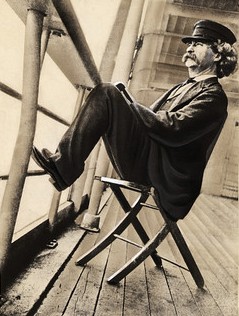
Mark Twain aboard a ship, on his way to Hawaii. Young Samuel Clemens apprenticed to be a Mississippi river boat pilot, and held a fascination for water-going vessels his entire life. His pilot years are documented, and analyzed, in Life on the Mississippi.
This photo of Twain remains one of my favorites.

(Whew! Nearly let the day get by without noting it.)

November 30 is the birthday of Mark Twain (1835), and Winston Churchill (1874).

This is the traditional Millard Fillmore’s Bathtub post to remind you. Both Twain and Churchill were lovers of good whiskey, and good cigars. Surely they would have toasted themselves with a drink and a smoke.

Even if we don’t, we can pretend we did.

In 2015, we have the benefit of having had a years to digest Twain’s Autobiography, and Volume II; and we have the benefit of new scholarship from a great book on Churchill, William Manchester’s and Paul Reid’s The Last Lion: Winston Spencer Churchill: Defender of the Realm, 1940-1965.

We have special need for the wisdom, and wit of each man in a year marked by terrorism and unholy war on educators.

Twain had a comment on the Texas Education Agency and State Board of Education:

In the first place God made idiots. This was for practice. Then He made School Boards.

Following the Equator; Pudd’nhead Wilson‘s New Calendar

The Nobel literature committees were slow. Twain never got a Nobel in Literature; he died in 1910. Churchill did win a Nobel in Literature, in 1953.

The Nobel Prize in Literature 1953 was awarded to Winston Churchill “for his mastery of historical and biographical description as well as for brilliant oratory in defending exalted human values.”

Both men were aficionados of good whiskey and good cigars. Both men suffered from depression in old age.

Both men made a living writing, early in their careers as newspaper correspondents. One waged wars of a kind the other campaigned against. Both were sustained by their hope for the human race, against overwhelming evidence that such hope was sadly misplaced.

churchill-time-cover-man-of-the-year-1941.jpg

Winston S. Churchill, Time Magazine’s Man of the Year for 1941, copyright 1941 by Time Magazine. Churchill’s career was built much on his work as First Lord of the Admiralty, a position he took in 1911.  While he was the goat of the Battle of the Dardanelles (and had to resign as a result), his earlier work to switch Britain’s Navy to oil power from coal, and to use airplanes in combat, kept the British Navy as an important and modern military organization through World War II.

Both endured fantastic failures that would have killed other people, and both rebounded.

Each possessed a great facility with words, and wit, and frequently said or wrote things that people like to remember and repeat again.

Both Churchill and Twain rank near the top of the list of people to whom almost any quote will be attributed, if the quote is witty and the speaker can’t remember or doesn’t know who actually said it.

Surely they said something like any piece of wisdom, at some point in their lives, right?

Both men are worth study. And wouldn’t you really love to have had them over to dinner?

Twain, on prisons versus education:

Every time you stop a school, you will have to build a jail. What you gain at one end you lose at the other. It’s like feeding a dog on his own tail. It won’t fatten the dog.” – Speech, November 23, 1900

Churchill on the evil men and nations do:

“No One Would Do Such Things”

“So now the Admiralty wireless whispers through the ether to the tall masts of ships, and captains pace their decks absorbed in thought. It is nothing. It is less than nothing. It is too foolish, too fantastic to be thought of in the twentieth century. Or is it fire and murder leaping out of the darkness at our throats, torpedoes ripping the bellies of half-awakened ships, a sunrise on a vanished naval supremacy, and an island well-guarded hitherto, at last defenceless? No, it is nothing. No one would do such things. Civilization has climbed above such perils. The interdependence of nations in trade and traffic, the sense of public law, the Hague Convention, Liberal principles, the Labour Party, high finance, Christian charity, common sense have rendered such nightmares impossible. Are you quite sure? It would be a pity to be wrong. Such a mistake could only be made once—once for all.”

—1923, recalling the possibility of war between France and Germany after the Agadir Crisis of 1911, inThe World Crisis,vol. 1, 1911-1914, pp. 48-49. (Obviously, and sadly, Churchill was wrong — twice wrong.)

Yet we continue to make those mistakes, and then to seek out the wisdom of Churchill or Twain to get out of the mess, and to tell us we won’t be in such a mess ever again.

Image of Twain aboard ship – origin unknown. Image of Winston S. Churchill, Time Magazine’s Man of the Year for 1941, copyright 1941 by Time Magazine.

More on Mark Twain

More on Winston Churchill

Orson Welles, with Dick Cavett, on Churchill, his wit, humor and grace (tip of the old scrub brush to the Churchill Centre):

Yeah, mostly this is an encore post from past years.

More, contemporary reports from 2012:

And in 2013:

2014:

Should you fly your flag today?  Congress doesn’t list this dual birthday as an event for flying the U.S. flag.  But you’re welcome to fly the flag any day.  Go ahead, if you want to.

If I get one, it will be the only cigar I’ve had this year. Or this decade.

I will break out the Scotch.

At a very minimum, click on some of the links and read the works of these two great writers. Nothing else today will be so profitable.

Yes, this is mostly an encore post. Fighting ignorance requires patience.

Yes, this is mostly an encore post. Fighting ignorance requires patience.

Save


December 2015, flag-flying days

November 28, 2015

Mural of Alexander Henson planting the American flag at North Pole, by Austin Mecklem, at the Recorder of Deeds building, built in 1943. 515 D St., NW, Washington, D.C. Library of Congress image

Mural of Alexander Henson planting the American flag at North Pole, by Austin Mecklem, at the Recorder of Deeds building, built in 1943. 515 D St., NW, Washington, D.C. Library of Congress image. Santa Claus may have been out of town when Henson was there.

November offers several flag flying days, especially in years when there is an election.

But December may be the month with the most flag-flying dates, when we include statehood days.

December 7 is Pearl Harbor Remembrance Day.  It’s not in the Flag Code, but public law (P.L. 103-308) urges that the president should issue a proclamation asking Americans to fly flags.

December 25 is Christmas Day, a federal holiday, and one of the score of dates designated in the Flag Code. If you watch your neighborhood closely, you’ll note even some of the most ardent flag wavers miss posting the colors on this day, as they do on Thanksgiving and New Years.

Other dates?

Nine states attained statehood in December, so people in those states should fly their flags (and you may join them).  Included in this group is Delaware, traditionally the “First State,” as it was the first colony to ratify the U.S. Constitution:

  • Illinois, December 3 (1818, 21st state)
  • Delaware, December 7 (1787, 1st state)
  • Mississippi, December 10 (1817, 20th state)
  • Indiana, December 11 (1816, 19th state)
  • Pennsylvania, December 12 (1787, 2nd state)
  • Alabama, December 14 (1819, 22nd state)
  • New Jersey, December 18 (1787, 3rd state)
  • Iowa, December 28 (1846, 29th state)
  • Texas, December 29 (1845, 28th state)

December 15 is Bill of Rights Day, marking the day in 1791 when the Bill of Rights was declared ratified; but though this event generally gets a presidential proclamation, there is no law or executive action that requires flags to fly on that date, for that occasion.

Eleven flag-flying dates in December.  Does any other month have as many flag flying opportunities?

Have I missed any December flag-flying dates?  11 events on 10 days (Delaware’s statehood falls on the anniversary of the Pearl Harbor attack).

Here’s a list of the days to fly the flag, under national law, in chronological order:

  1. Illinois, December 3 (1818, 21st state)
  2. Pearl Harbor Remembrance Day, December 7
  3. Delaware, December 7 (1787, 1st state) (shared with Pearl Harbor Remembrance Day)
  4. Mississippi, December 10 (1817, 20th state)
  5. Indiana, December 11 (1816, 19th state)
  6. Pennsylvania, December 12 (1787, 2nd state)
  7. Alabama, December 14 (1819, 22nd state)
  8. New Jersey, December 18 (1787, 3rd state)
  9. Christmas Day, December 25
  10. Iowa, December 28 (1846, 29th state)
  11. Texas, December 29 (1845, 28th state)

Fly your flag with respect to the flag, for the republic it represents, and for all those who sacrificed that it may wave on your residence.

Appropriate to a snowy December.

Appropriate to a snowy December. “The Barn on Grayson-New Hope Road. This barn with its old truck and ever-present American flag, is often the subject of photographs and paintings by the locals.” Photo and copyright by Melinda Anderson


With fondness, wishing it were true in 2015: Remembering “Uncle Sam’s Thanksgiving” by Thomas Nast, 1869

November 25, 2015

November 1869, in the first year of the Grant administration — and Nast put aside his own prejudices enough to invite the Irish guy to dinner, along with many others.

With a nation whose emotions are raw from events in Ferguson, Missouri, and Paris, France, and rejections of desperate refugees from was being rejected in their calls for asylum, could there be a better, more timely reminder of what we’re supposed to be doing?

(Click for a larger image — it’s well worth it.)

Thomas Nast's "Uncle Sam's Thanksgiving," 1869 - Ohio State University's cartoon collection

Thomas Nast’s “Uncle Sam’s Thanksgiving,” 1869 – Ohio State University’s cartoon collection, and HarpWeek

As described at the Ohio State site:

“Uncle Sam’s Thanksgiving Dinner” marks the highpoint of Nast’s Reconstruction-era idealism. By November 1869 the Fourteenth Amendment, which secures equal rights and citizenship to all Americans, was ratified. Congress had sent the Fifteenth Amendment, which forbade racial discrimination in voting rights, to the states and its ratification appeared certain. Although the Republican Party had absorbed a strong nativist element in the 1850s, its commitment to equality seemed to overshadow lingering nativism, a policy of protecting the interests of indigenous residents against immigrants. Two national symbols, Uncle Sam and Columbia, host all the peoples of the world who have been attracted to the United States by its promise of self-government and democracy. Germans, African Americans, Chinese, Native Americans, Germans, French, Spaniards: “Come one, come all,” Nast cheers at the lower left corner.

One of my Chinese students identified the Oriental woman as Japanese, saying it was “obvious.” Other friends say both are Chinese.  Regional differences.  The figure at the farthest right is a slightly cleaned-up version of the near-ape portrayal Nast typically gave Irishmen.

If Nast could put aside his biases to celebrate the potential of unbiased immigration to the U.S. and the society that emerges, maybe we can, too.

Hope your day is good; hope you have good company and good cheer, turkey or not. Happy Thanksgiving.  And of course, remember to fly your flag!

More: Earlier posts from Millard Fillmore’s Bathtub

And in 2013:

Yes, if you’re a faithful reader here, you’ve seen it before.


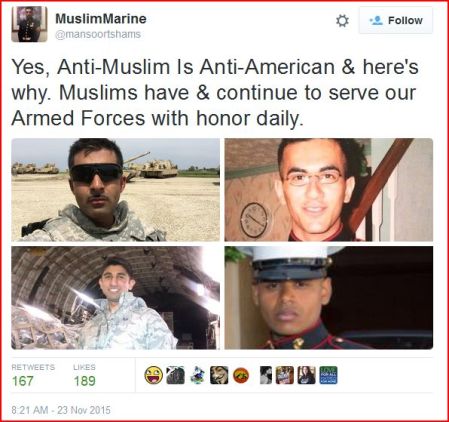
Muslims carrying special IDs challenge Trump to show his

November 22, 2015

Tweet showing several Muslims serving in U.S. military, in response to calls for Muslims to get "special ID" or be tracked on a "special registry."

Tweet showing several Muslims serving in U.S. military, in response to calls for Muslims to get “special ID” or be tracked on a “special registry.”

Donald Trump keeps talking about a “registry” of Muslims, and forcing them to carry “special identification.”

Several Muslims have taken to Twitter and other social media to note they ALREADY DO carry special ID, and wondering, where is Trump’s?

According to Trump, he performed his military service at a special facility along the Hudson River, before he was 18 — pranking people.

Ouch.

See also:

https://twitter.com/intricateizzy/status/667461728372924416

And be sure you see this:


Strange crossings: Booth asked the president for an umbrella

November 17, 2015

This is just so odd that it merits our attention, something I found a while ago researching about presidents and umbrellas.

On November 17, 1864, John Wilkes Booth wrote to President Abraham Lincoln asking for money to purchase an umbrella.

Yes, Booth, the man who would eventually assassinate that same Abraham Lincoln.

Page 1 of John Wilkes Booth's 1864 letter to President Abraham Lincoln

Page 1 of John Wilkes Booth’s 1864 letter to President Abraham Lincoln

Booth to Lincoln, page 2

Booth to Lincoln, page 2

Booth to Lincoln, page 3

Booth to Lincoln, page 3

Booth to Lincoln, page 4

Booth to Lincoln, page 4

Booth to Lincoln, page 5

Booth to Lincoln, page 5

Booth to Lincoln, page 6

Booth to Lincoln, page 6

The letter is in the collection of Lincoln papers at the Library of Congress, described as “John Wilkes to Abraham Lincoln, Thursday, November 17, 1864 (Congratulations; request that Lincoln send him money to buy an umbrella).”

I have found no official transcript of the letter.

Of all the richochets of umbrellas in the history of the American presidency, this must be the strangest.

Tinfoil hatters, conspiracy nuts, historical psychanalyzers, and the rest of us, might wonder if this played any role in the sad crossing of these two people almost exactly six months later, in Ford’s Theatre.

More:

Yes, this is mostly an encore post. Fighting ignorance requires patience.

Yes, this is mostly an encore post. Fighting ignorance requires patience.


President Obama’s Veterans Day Proclamation, 2015

November 11, 2015

A message written by First Lady is seen on a U.S. Marine Corps flag at Walter Reed National Military Medical Center in Bethesda, Md., April 4, 2012.

A message written by First Lady is seen on a U.S. Marine Corps flag at Walter Reed National Military Medical Center in Bethesda, Md., April 4, 2012. From a White House blog post, “5 Ways You Can Thank a Veteran.”


From the office of the Press Secretary of the White House:

November 05, 2015

Presidential Proclamation — Veterans Day, 2015

VETERANS DAY, 2015

– – – – – – –

BY THE PRESIDENT OF THE UNITED STATES OF AMERICA

A PROCLAMATION

The United States military is the strongest, most capable fighting force the world has ever known.  The brave men and women of our Army, Navy, Air Force, Marine Corps, and Coast Guard demonstrate a resolute spirit and unmatched selflessness, and their service reminds us there are few things more American than giving of ourselves to make a difference in the lives of others.  On Veterans Day, we reflect on the immeasurable burdens borne by so few in the name of so many, and we rededicate ourselves to supporting those who have worn America’s uniform and the families who stand alongside them.

Our true strength as a Nation is measured by how we take care of our veterans when they return home, and my Administration is committed to ensuring our heroes and their loved ones have every chance to share in the promise they risked their lives to defend.  We have made it easier for veterans to convert their military skills to the civilian workforce, enabled more veterans and their family members to attain Federal education benefits, and expanded access to timely, quality health care for all veterans.  Just as every veteran deserves the support and benefits they have earned, those who have given everything to defend our homeland deserve a place of their own to call home.  To uphold this ideal, First Lady Michelle Obama and Dr. Jill Biden’s Joining Forces initiative has forged partnerships with local leaders across America to uphold the dignity of every veteran and work to end veterans’ homelessness.  No one who fights for our country should have to fight for the care they deserve.  Earlier this year, I was proud to sign the Clay Hunt Suicide Prevention for American Veterans Act, which fills critical gaps in mental health care by raising awareness and taking steps to improve access to care for those suffering from the invisible wounds of war.

Our veterans left everything they knew and loved and served with exemplary dedication and courage so we could all know a safer America and a more just world.  They have been tested in ways the rest of us may never fully understand, and it is our duty to fulfill our sacred obligation to our veterans and their families.  On Veterans Day, and every day, let us show them the extraordinary gratitude they so rightly deserve, and let us recommit to pledging our full support for them in all they do.

With respect for, and in recognition of, the contributions our service members have made to the cause of peace and freedom around the world, the Congress has provided (5 U.S.C. 6103(a)) that November 11 of each year shall be set aside as a legal public holiday to honor our Nation’s veterans.

NOW, THEREFORE, I, BARACK OBAMA, President of the United States of America, do hereby proclaim November 11, 2015, as Veterans Day.  I encourage all Americans to recognize the valor and sacrifice of our veterans through appropriate public ceremonies and private prayers.  I call upon Federal, State, and local officials to display the flag of the United States and to participate in patriotic activities in their communities.  I call on all Americans, including civic and fraternal organizations, places of worship, schools, and communities to support this day with commemorative expressions and programs.

IN WITNESS WHEREOF, I have hereunto set my hand this fifth day of November, in the year of our Lord two thousand fifteen, and of the Independence of the United States of America the two hundred and fortieth.

BARACK OBAMA

First Lady Michelle Obama, in support of the Joining Forces initiative, greets members of the military following remarks at Al Udeid Air Base in Qatar, Nov. 3, 2015. (Official White House Photo by Amanda Lucidon)

First Lady Michelle Obama, in support of the Joining Forces initiative, greets members of the military following remarks at Al Udeid Air Base in Qatar, Nov. 3, 2015. (Official White House Photo by Amanda Lucidon)


Tearing down historic Chipman’s Department Store, American Fork Utah, 1992

November 11, 2015

Caption on photo from American Fork Public Library:

Caption on photo from American Fork Public Library: “This photo was taken February, 1992, just before final demolition of the Chipman store. The last thing to fall was the front part, with the C H I P M A N name still intact.”

In 1962, a position for my father heading the furniture department at Chipman’s Mercantile in American Fork, Utah, prompted our family’s move from Burley, Idaho. We found a home in Pleasant Grove, about five miles south and east of American Fork.

I was rather surprised to find this photo in digital collections I was searching through the Provo, Utah, public library.

Description of the photo:

Title Partial demolition of Chipman’s, formerly Chipman’s Mercantile, on the corner of Main Street, Merchant Street and Center Street. Built in 1884, demolished in 1992.
Description Partial demolition of Chipman’s, formerly Chipman’s Mercantile, on the corner of Main Street, Merchant Street and Center Street. Built in 1884 by James and Stephen L. Chipman. The store was once the biggest department store in Utah County. It was demolished in 1992.
Subject American Fork, (Utah); Business enterprises; Department stores; Wrecking;
Date 1992-02-01
Photographer Peterson, Wanda S.
Rights Copyright 1992 American Fork City. This work is licensed under a Creative Commons Attribution-NonCommercial-NoDerivatives 4.0 International License, http://creativecommons.org/licenses/by-nc-nd/4.0/
Publisher Published by American Fork Public Library; Digitized and hosted by Utah Valley University

It’s symbolic of the history of places we lose all too easily.

Plus, it brings back so many memories of the small towns in which I grew up.

Chipman’s played a big role in the development of American Fork, and northern Utah County. The store was an early success, and the Chipman family became locally prominent, and played an interesting role in the development of science education at two Utah universities.

Two Chipman sisters (daughters of James or Stephen Chipman?) married scientists. One married the great chemist, Henry Eyring, who took a position at the University of Utah to stay close to his wife’s family. The other married the great physicist Harvey Fletcher, who took a position at Brigham Young University, again to stay close to his wife’s family.  Harvey Fletcher served on the board of Chipman’s for a time, and bought furniture there. My father asked me to accompany him on a delivery to the Fletcher’s Provo home, probably trying to prompt an interest in science in me. A few years later in Chipman’s store, my father introduced me to the Fletchers’ son, James C. Fletcher, who would later become president of the University of Utah, and then twice head NASA.

Mrs. Fletcher made great cookies. I wasn’t prescient enough to get even autographs from any of them.

On a July day, probably about 1968, during a street fair, the band I played in performed from the back of a flatbed truck on the street to the right of the photo. We discovered Dick Gardiner’s Farfisa organ lost its tuning in the sun.

The site of the store was turned into a parking lot. The Bank of American Fork put up some drive-up tellers on the site later.


Poster for Veterans Day 2015

November 10, 2015

2015’s poster from the Veterans Administration, for Veterans Day — tomorrow!

2015 Veterans Day poster from the Veterans Administration. Veterans Day always falls on November 11, this year on a Wednesday.

2015 Veterans Day poster from the Veterans Administration. Veterans Day always falls on November 11, this year on a Wednesday.

Both high-res and low-res versions are available from the VA’s poster site.

Teachers, several good sites with a history of Veterans Day, and suggested ways of honoring veterans, have material for your classrooms and students. VA’s history of Veterans Day is below:

History of Veterans Day

World War I – known at the time as “The Great War” – officially ended when the Treaty of Versailles was signed on June 28, 1919, in the Palace of Versailles outside the town of Versailles, France. However, fighting ceased seven months earlier when an armistice, or temporary cessation of hostilities, between the Allied nations and Germany went into effect on the eleventh hour of the eleventh day of the eleventh month. For that reason, November 11, 1918, is generally regarded as the end of “the war to end all wars.”

Soldiers of the 353rd Infantry near a church at Stenay, Meuse in France.

Soldiers of the 353rd Infantry near a church at Stenay, Meuse in France, wait for the end of hostilities. This photo was taken at 10:58 a.m., on November 11, 1918, two minutes before the armistice ending World War I went into effect

In November 1919, President Wilson proclaimed November 11 as the first commemoration of Armistice Day with the following words: “To us in America, the reflections of Armistice Day will be filled with solemn pride in the heroism of those who died in the country’s service and with gratitude for the victory, both because of the thing from which it has freed us and because of the opportunity it has given America to show her sympathy with peace and justice in the councils of the nations…”

The original concept for the celebration was for a day observed with parades and public meetings and a brief suspension of business beginning at 11:00 a.m.

The United States Congress officially recognized the end of World War I when it passed a concurrent resolution on June 4, 1926, with these words:

Whereas the 11th of November 1918, marked the cessation of the most destructive, sanguinary, and far reaching war in human annals and the resumption by the people of the United States of peaceful relations with other nations, which we hope may never again be severed, and

Whereas it is fitting that the recurring anniversary of this date should be commemorated with thanksgiving and prayer and exercises designed to perpetuate peace through good will and mutual understanding between nations; and

Whereas the legislatures of twenty-seven of our States have already declared November 11 to be a legal holiday: Therefore be it Resolved by the Senate (the House of Representatives concurring), that the President of the United States is requested to issue a proclamation calling upon the officials to display the flag of the United States on all Government buildings on November 11 and inviting the people of the United States to observe the day in schools and churches, or other suitable places, with appropriate ceremonies of friendly relations with all other peoples.

An Act (52 Stat. 351; 5 U. S. Code, Sec. 87a) approved May 13, 1938, made the 11th of November in each year a legal holiday—a day to be dedicated to the cause of world peace and to be thereafter celebrated and known as “Armistice Day.” Armistice Day was primarily a day set aside to honor veterans of World War I, but in 1954, after World War II had required the greatest mobilization of soldiers, sailors, Marines and airmen in the Nation’s history; after American forces had fought aggression in Korea, the 83rd Congress, at the urging of the veterans service organizations, amended the Act of 1938 by striking out the word “Armistice” and inserting in its place the word “Veterans.” With the approval of this legislation (Public Law 380) on June 1, 1954, November 11th became a day to honor American veterans of all wars.

Later that same year, on October 8th, President Dwight D. Eisenhower issued the first “Veterans Day Proclamation” which stated: “In order to insure proper and widespread observance of this anniversary, all veterans, all veterans’ organizations, and the entire citizenry will wish to join hands in the common purpose. Toward this end, I am designating the Administrator of Veterans’ Affairs as Chairman of a Veterans Day National Committee, which shall include such other persons as the Chairman may select, and which will coordinate at the national level necessary planning for the observance. I am also requesting the heads of all departments and agencies of the Executive branch of the Government to assist the National Committee in every way possible.”

President Eisenhower signing HR7786, changing Armistice Day to Veterans Day.

President Eisenhower signing HR7786, changing Armistice Day to Veterans Day. From left: Alvin J. King, Wayne Richards, Arthur J. Connell, John T. Nation, Edward Rees, Richard L. Trombla, Howard W. Watts

On that same day, President Eisenhower sent a letter to the Honorable Harvey V. Higley, Administrator of Veterans’ Affairs (VA), designating him as Chairman of the Veterans Day National Committee.

In 1958, the White House advised VA’s General Counsel that the 1954 designation of the VA Administrator as Chairman of the Veterans Day National Committee applied to all subsequent VA Administrators. Since March 1989 when VA was elevated to a cabinet level department, the Secretary of Veterans Affairs has served as the committee’s chairman.

The Uniform Holiday Bill (Public Law 90-363 (82 Stat. 250)) was signed on June 28, 1968, and was intended to ensure three-day weekends for Federal employees by celebrating four national holidays on Mondays: Washington’s Birthday, Memorial Day, Veterans Day, and Columbus Day. It was thought that these extended weekends would encourage travel, recreational and cultural activities and stimulate greater industrial and commercial production. Many states did not agree with this decision and continued to celebrate the holidays on their original dates.

The first Veterans Day under the new law was observed with much confusion on October 25, 1971. It was quite apparent that the commemoration of this day was a matter of historic and patriotic significance to a great number of our citizens, and so on September 20th, 1975, President Gerald R. Ford signed Public Law 94-97 (89 Stat. 479), which returned the annual observance of Veterans Day to its original date of November 11, beginning in 1978. This action supported the desires of the overwhelming majority of state legislatures, all major veterans service organizations and the American people.

Veterans Day continues to be observed on November 11, regardless of what day of the week on which it falls. The restoration of the observance of Veterans Day to November 11 not only preserves the historical significance of the date, but helps focus attention on the important purpose of Veterans Day: A celebration to honor America’s veterans for their patriotism, love of country, and willingness to serve and sacrifice for the common good.

Remember to fly your U.S. flag tomorrow, to honor veterans.


Kristallnacht survivor begs us to remember

November 10, 2015

USHMM: Shattered storefront of a Jewish-owned shop destroyed during Kristallnacht (the

USHMM: Shattered storefront of a Jewish-owned shop destroyed during Kristallnacht (the “Night of Broken Glass”). Berlin, Germany, November 10, 1938. — National Archives and Records Administration, College Park, Md.

I get e-mail from time to time from the U.S. Holocaust Memorial Museum (USHMM) in Washington, D.C.

Tonight, November 9, is the anniversary of Kristallnacht in 1938. Jill Pauly lived through it. She tells her story so that we will remember, that we will never forget. “Kristallnacht” is German for “night of crystal.” But in this case, the crystal was broken glass, the broken windows of Jewish shops and homes.  Kristallnacht was the “Night of Broken Glass.”

Dear friend,

I’ll never forget how scared I was 77 years ago on Kristallnacht.

This wave of antisemitic attacks throughout Germany and Austria caused my family to flee our small German town. We drove to a relative’s apartment in Cologne, and my grandparents forced my sister and me to sit on the car floor so we wouldn’t see the violence on the streets.

That evening and for many following it, the men in my family drove all night to evade German officers and avoid becoming some of the 30,000 men who were arrested just for being Jewish.

This was a major turning point for my family, when our lives became dangerous and our future uncertain. Learn more about experiences of families like mine, as well as the origins and aftermath of Kristallnacht.

LEARN MORE

Jill Pauly speaks with Museum visitors. US Holocaust Memorial Museum

LEARN MORE

Kristallnacht was a watershed moment in Nazi Germany’s persecution of Jews, indicating an increase in radical, violent antisemitism. Many Jews tried to emigrate as soon as possible after the pogroms.

Today, Kristallnacht is seen as a warning sign of the Holocaust—an indicator of the horrors to come that far too many people ignored.

The Museum strives to learn from this history in order to prevent atrocities in the future. This is why we recently launched, in partnership with Dartmouth College, the Early Warning Project. It aims to give leaders from around the world more reliable information on the risk of mass atrocities to inspire action and help save lives.

On this anniversary, I encourage you to learn more about Kristallnacht and reflect on how we can respond to threats of genocide today.

Sincerely,

Jill Pauly
Holocaust Survivor and Museum Volunteer

Photo: Jill Pauly speaks with Museum visitors. US Holocaust Memorial Museum

“Never again” starts now, if we start it.


Dakotans fly your flags today, celebrate 126 years of statehood

November 2, 2015

56 flags from all U.S. states and territories fly at Mount Rushmore National Monument, South Dakota. This photo of Mount Rushmore National Memorial is courtesy of TripAdvisor.

56 flags from all U.S. states and territories fly at Mount Rushmore National Monument, South Dakota. This photo of Mount Rushmore National Memorial is courtesy of TripAdvisor.

Residents of North Dakota and South Dakota should fly their U.S. flags today in honor of your state’s being admitted to the union, on November 2, 1889.

Most sites note simply that both states were admitted on the same day; some sites, especially those that lean toward North Dakota, claim that state is Number 39, because President Harrison signed their papers first, after shuffling to avoid playing favorites.

Does anyone really care?

More:


8 events on 6 days to fly the U.S. flag in November 2015

November 1, 2015

Voice of America caption from November 16, 2012:

The U.S. flag is popular the world over, especially when the president visits a foreign nation, as President Barack Obama visited Burma (Myanmar) in November 2012. Voice of America caption from November 16, 2012: “A shopkeeper waves an American flag at a roadside shop in Rangoon, Burma. U.S. President Barack Obama will visit Burma on Monday, becoming the first U.S. president to visit the country. (AP)”

Eight events spread over six different days come with urgings to fly the U.S. flag in November:  Six states celebrate statehood, Veterans Day falls as always on November 11, and Thanksgiving Day on November 26.

Two states, North Dakota and South Dakota, celebrate their statehood on the same date. Washington’s statehood day falls on Veterans Day, November 11 — so there are only six days covering eight events.

In calendar order for 2015, these are the seven days:

  • North Dakota statehood day, November 2 (1889, 39th or 40th state)
  • South Dakota statehood day, November 2 (1889, 39th or 40th state) (shared with North Dakota)
  • Montana statehood day, November 8 (1889, 41st state)
  • Veterans Day, November 11
  • Washington statehood day, November 11 (1889, 42nd state) (shared with Veterans Day)
  • Oklahoma statehood day, November 16 (1907, 46th state)
  • North Carolina statehood day, November 21 (1789, 12th state)
  • Thanksgiving Day, fourth Thursday in November (November 26 in 2015)

Most Americans will concern themselves only with Veterans Day and Thanksgiving Day. Is flying the U.S. flag for statehood day a dying tradition?

More:


He really said it, October 29, 1941: Churchill, ‘never give in’ (Quote of the Moment)

October 29, 2015

The statue of Churchill (1973) by Ivor Roberts-Jones in Parliament Square, London. Wikipedia image. Photo by Eluveitie.

The statue of Churchill (1973) by Ivor Roberts-Jones in Parliament Square, London. Wikipedia image. Photo by Eluveitie.

In late 1941, at the height of Britain’s troubles as the sole surviving, able-to-fight exponent of democratic government in Europe, Winston Churchill paid a visit to his old school, to hear the students sing and join them in song. He was asked to speak.

It was a short speech, wholly extemporaneous, but one phrase went on to become one of the most-quoted parts of any speech ever given, anywhere.

Never give in, never give in, never, never, never, never — in nothing, great or small, large or petty — never give in except to convictions of honour and good sense!

Winston S. Churchill, address to the boys of Harrow School, October 29, 1941.

More:

Yes, this is mostly an encore post. Fighting ignorance requires patience.

Yes, this is mostly an encore post. Fighting ignorance requires patience.


Urban sprawl works differently in China

October 27, 2015

Much of our flight to China we fond the ground, or ocean, obscured by clouds. About an hour out of Beijing, we caught glimpses of China’s countryside.

It’s different there.

If you’ve flown much over the U.S., you’re familiar with agricultural regions having identifiable features such as the large circles created by irrigation systems, or the grid-pattern fields laid out across much of the American Midwest. Those fields are punctuated, especially at night, by farmhouses, smaller crossroads featuring a few more buildings, small towns, and increasing urbanization along the highways going into bigger cities.

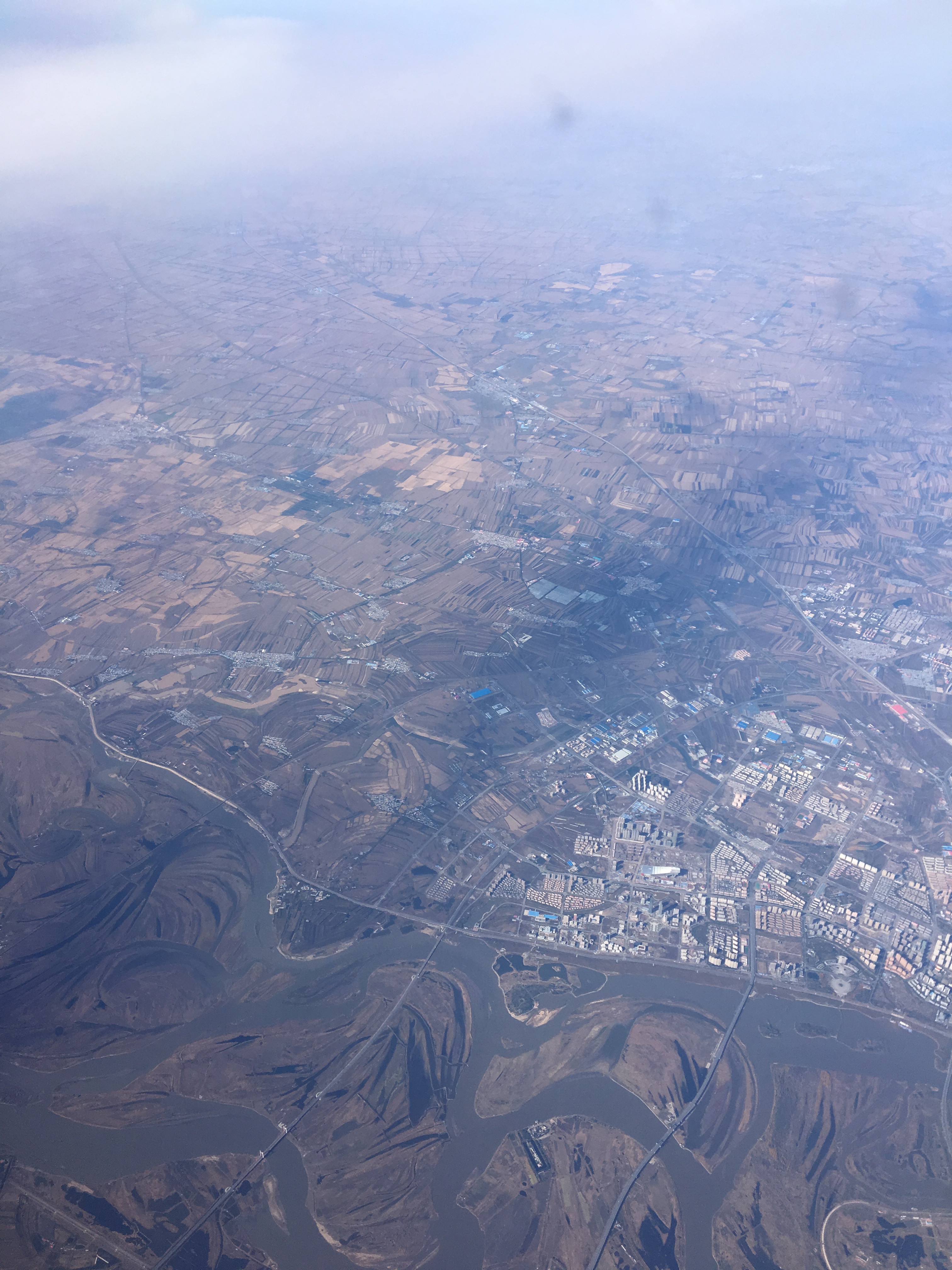
In China, north of Beijing, human habitations are much more dense than small U.S. farm towns, and the fields themselves appear almost wholly absent of human habitation.

Semi-rural area north of Beijing, from 30,000 feet or so. Note new, high-rise apartment buildings in the small town. Photo by Ed Darrell
Semi-rural area north of Beijing, from 30,000 feet or so. Note new, high-rise apartment buildings in the small town. Photo by Ed Darrell
Here’s a photo I took from our airplane window, looking to the west, over China at least 100 miles north of Beijing. ChinaCom’s system doesn’t identify locations to my iPhone as Verizon’s system does in the U.S.; I have not yet identified the river, though I think it may be the north-flowing Songhua-Amur Rivers complex.

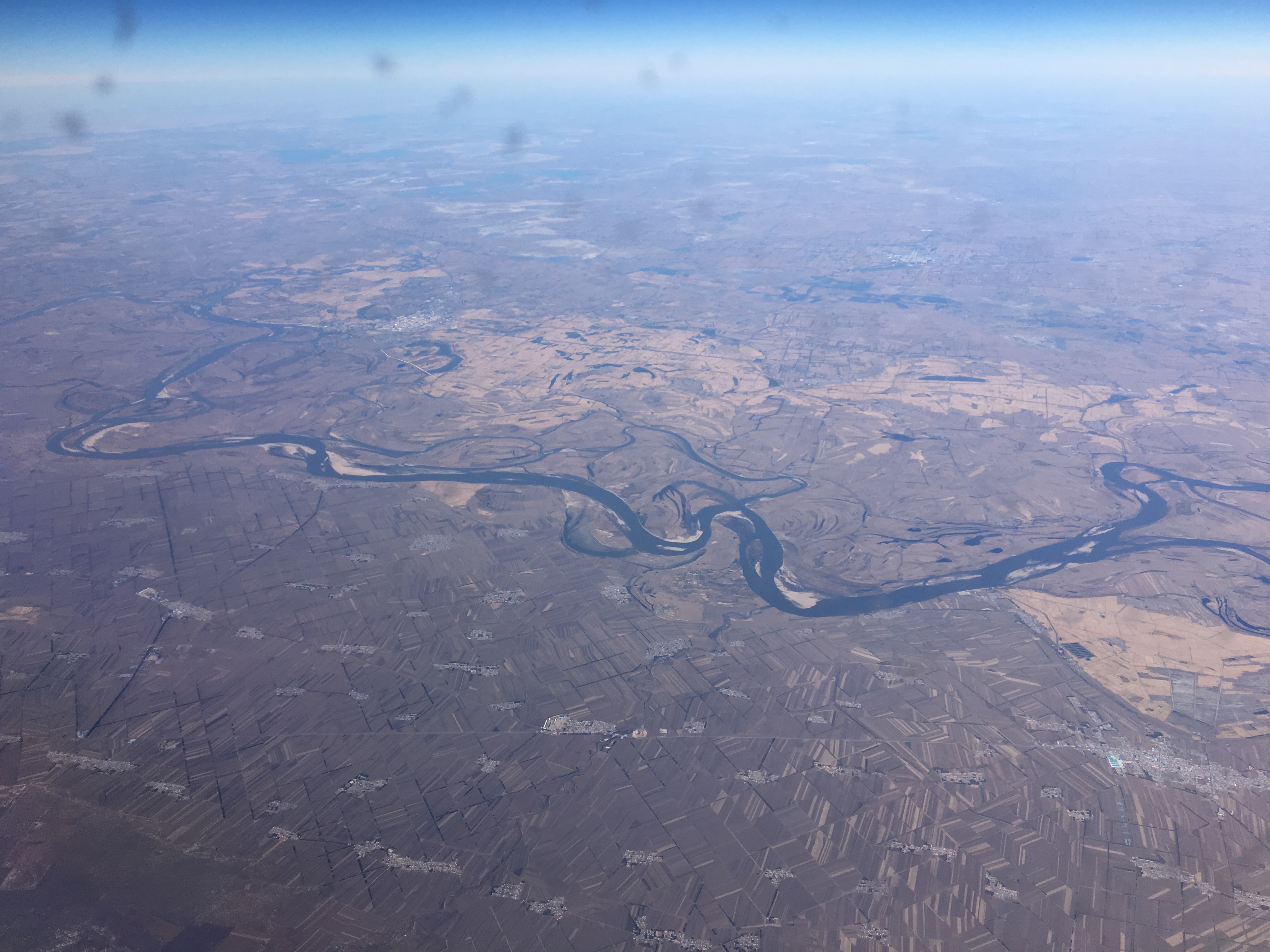
Agricultural fields are neatly laid out. Notice there is no room left for wild lands, where wildlife might find a home.

Agricultural fields are neatly laid out. Notice there is no room left for wild lands, where wildlife might find a home.

I was struck by the lack of uncultivated, unplowed or undeveloped land. Fields abut each other tightly, without even hedgerows between them. We noticed a marked lack of wildlife on other parts of our trip; without even space for weeds to grow between the fields, wildlife habitat is reduced essentially to nil. Does that harm or benefit agricultural production, and other production?

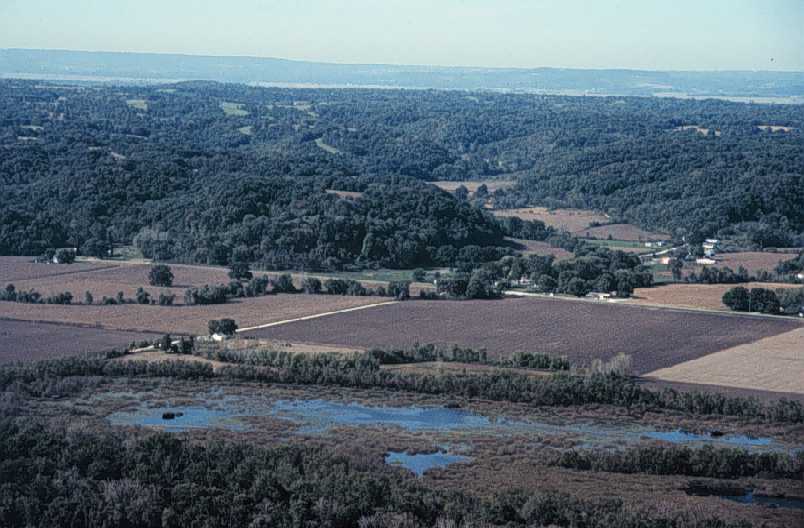
Not a perfect comparison, but here is a nearly-randomly-selected USGS aerial photo of farmland in the U.S., near Jerseyville, Illinois (from much lower airplane elevation):

USGS photo of land near Jerseyville, Illinois, near the Illinois River. Hills are unplowed now (they may have been farmed in the past), and waterways have banks of brush and trees for some distance, partly to control erosion. Notice wild tree and shrub growth between some fields.

USGS photo of land near Jerseyville, Illinois, near the Illinois River. Hills are unplowed now (they may have been farmed in the past), and waterways have banks of brush and trees for some distance, partly to control erosion. Notice wild tree and shrub growth between some fields.

This photos are not an exact comparison, but you can get the idea that worries me.

China’s tightly-controlled development policies over the past five decades, coupled with a thousand years or so of continued, developed and intentional habitation on these lands, leaves little room for something that is not planned.

Little room for nature. Someone would argue China’s land use is required in order to feed a massive population. Is that so?

On the trip I ran into a fellow working for a company trying to figure out ways to bioremediate polluted rivers in China, since the government came to realize polluted water harms human health and agricultural and riparian production downstream. One way would be to establish buffer lands along the banks of rivers. Can China change policies to allow that to happen, in time?

Pretty from an airplane window. Reflective of wise land use policies? There’s a rich discussion.

More:


Look closely, you can (almost) see Teddy Roosevelt on his birthday

October 27, 2015

Theodore Roosevelt was born in Manhattan on October 27, 1858.

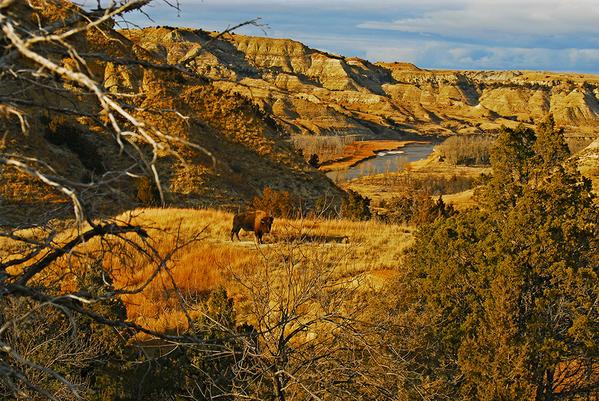
Among many other things in his life, he was for a time a cowboy in the Dakota Territory, in the area of North Dakota where today resides the Theodore Roosevelt National Park.

Look closely at the picture.  You can almost see Teddy.  He was a powerful, guiding force behind the movement to protect precious, historic, scientifically valuable and beautiful lands, by the federal government.

Happy birthday, Theodore Roosevelt! Let's celebrate with a great shot of @TRooseveltNPS #NorthDakota

Happy birthday, Theodore Roosevelt! Let’s celebrate with a great shot of @TRooseveltNPS #NorthDakota

Happy Theodore Roosevelt’s birthday, America.

More:

A short, mostly accurate history of Teddy Roosevelt, from some guy named Jeremiah:

Yes, this is mostly an encore post. Fighting ignorance requires patience.

Yes, this is mostly an encore post. Fighting ignorance requires patience.


Honor the Navy October 27, fly the flag

October 27, 2015

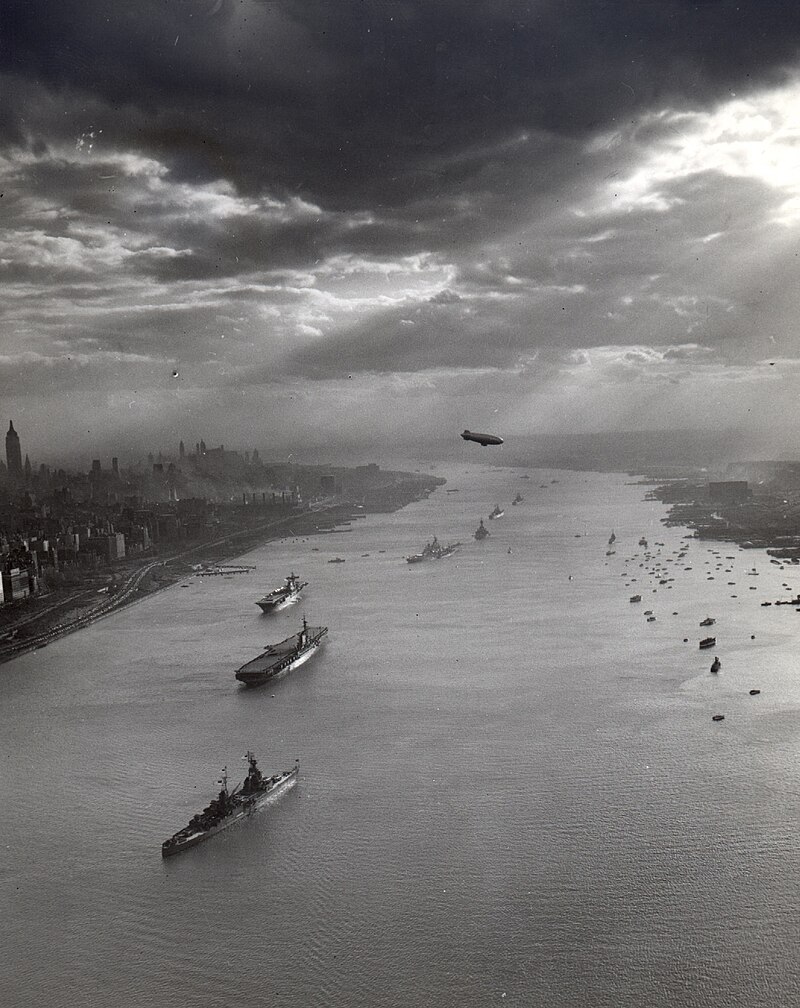
Tugboats and U.S. Navy warships pictured in the Hudson River with the New York City skyline in the background for the Navy Day celebrations on 27 October 1945. Visible in the foreground are the anchored warships USS Augusta (CA-31), USS Midway (CVB-41), USS Enterprise (CV-6), USS Missouri (BB-63), USS New York (BB-34), USS Helena (CA-75), and USS Macon (CA-132)

Ships anchored on the Hudson River for Navy Day 1945, perhaps the largest ever celebration. U.S. Navy photo via Wikipedia: “U.S. Navy – U.S. Navy National Museum of Naval Aviation photo No. 2001.256.009 [1] Tugboats and U.S. Navy warships pictured in the Hudson River with the New York City skyline in the background for the Navy Day celebrations on 27 October 1945. Visible in the foreground are the anchored warships USS Augusta (CA-31), USS Midway (CVB-41), USS Enterprise (CV-6), USS Missouri (BB-63), USS New York (BB-34), USS Helena (CA-75), and USS Macon (CA-132)”

October 27 is Navy Day, one of the score of dates listed in the U.S. Flag Code for flying the flag.

Fly the flag to honor the U.S. Navy Today.  Use #NavyDay as a hashtag on social media posts honoring the Navy.  Hey, take an Admiral to lunch. Take any Seaman to dinner.

Navy Day history has a few interesting turns. Why do we even celebrate it? See Wikipedia’s straightforward explanation:

In the United States, the Navy League of the United States organized the first Navy Day in 1922, holding it on October 27 because it was the birthday of President Theodore Roosevelt, who was a naval enthusiast. Although meeting with mixed reviews the first year, in 1923 over 50 major cities participated, and the United States Navy sent a number of its ships to various port cities for the occasion. The 1945 Navy Day was an especially large celebration, with President Harry S. Truman reviewing the fleet in New York Harbor.

In 1949, Louis A. Johnson, secretary of the newly created Department of Defense, directed that the U.S. Navy’s participation occur on Armed Forces Day in May, although as a civilian organization the Navy League was not affected by this directive, and continued to organize Navy Day celebrations as before. In the 1970s, the “birthday” of the Continental Navy was found to be October 13, 1775, and so CNO Admiral Elmo R. Zumwalt worked with the Navy League to define October 13 as the new date of Navy Day. However, Navy Day in the United States is still largely recognized as October 27.

A few other accounts say Navy Day was supposed to fade away with the establishment of Armed Forces Day. The Department of Defense history said Navy Day was last officially celebrated in 1949. Whoever put together the text in U.S. law for the U.S. Flag Code included Navy Day on October 27, and it’s stuck. With recent Congresses, there has been no hope of any change.

Break out your flag, hoist it up!

More:

Navy Day Poster from the 1940s, perhaps

Navy Day Poster from the 1940s, perhaps