Who said it? ‘Better to die on your feet, than live on your knees’

October 22, 2015

A Tweet from Tim Fargo reminded me of a collection of leadership quotes I put together years ago, and of the digging I did on one particular quote urging action rather than capitulation:

https://twitter.com/alphabetsuccess/status/657054791672176640

That was the quote I got to, but it’s only attributed to to Zapata so far as I know. I started with the quote cited to Franklin Roosevelt’s speech when he got an honorary Doctor of Laws from Oxford in 1941, when Britain badly needed such inspiration to fight on, in a war for freedom in which the U.S. was not yet actively engaged:

We, too, born to freedom, and believing in freedom, are willing to fight to maintain freedom. We, and all others who believe as deeply as we do, would rather die on our feet than live on our knees.

Franklin Delano Roosevelt (1882-1945), upon receiving the degree of Doctor of Civil Law from Oxford University, June 19, 1941; special convocation ceremony held at Harvard University, with FDR’s remarks delivered by secretary to the President, Major General Edwin M. Watson

One of a set of ten postcards printed by the Spanish Red Cross, the subjects shown, favor the republican cause. | Spanish. | Wolfsonian Exhibit: Library Vestibule Complement to: Revolutionary Tides, the Art of the Political Poster, 1914-1989; February 25 - August 24, 2006.

One of a set of ten postcards printed by the Spanish Red Cross, the subjects shown, favor the republican cause. | Spanish. | Wolfsonian Exhibit: Library Vestibule Complement to: Revolutionary Tides, the Art of the Political Poster, 1914-1989; February 25 – August 24, 2006. [Untranslated from Spanish:] Dolores Ibarruri (Pasionaria): Representante de Asturias en el Parlamento de España y figura destacadísima entre las mujeres de la Revolución; Spain Cruz Roja. | Garcia, A. (illustrator.) | Edit. R. Molero (publisher)

When I checked it in the then-current Bartlett’s Quotations I learned it was a common expression during the Spanish Civil War, and attributed to a radio propagandist on the Republican side. It’s likely FDR and his research aides knew that.

It is better to die on your feet than to live on your knees.

Dolores Ibårruri, “La Pasionaria” (1895-1989), Speech in Paris, September 3, 1936

Checking that one out, I found a reference to Mexico’s revolutionary Zapata, whose work was likely familiar to the Spanish Republicans.

Mejor morir a pie que vivir en rodillas.
Men of the South! It is better to die on your feet than to live on your knees!

Emiliano Zapata (c. 1877-1919), attributed

That’s as far as I took it 20 years ago. Can we get a better attribution, or find Zapata’s likely inspiration, if there is one?

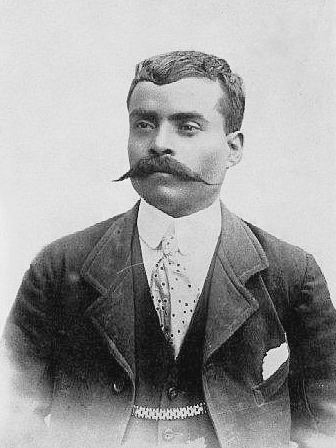
Mexico revolutionary Emiliano Zapata, studio portrait perhaps in 1914. Wikipedia image

Mexico revolutionary Emiliano Zapata, studio portrait perhaps in 1914. Wikipedia image

N.B.: Looked for a photo of FDR at Oxford, but quickly discovered he was nowhere near England on June 19, 1941 — hadn’t thought he would be with the Battle of Britain not really over. Found references to Watson’s delivering of the speech at Harvard, but little else. Good people at the FDR Library’s Pare Lorentz Center confirm that FDR was at the White House the entire day. There’s a story there, about the awarding of the degree.

Update 2017: It was not George Washington.

Especially in 2017, would you do us the favor of saying in comments how you got to this article? Thank you.

Save


Fly your flag today: Columbus Day, 2015

October 11, 2015

http://www.latinospost.com/articles/29636/20131014/columbus-day-parade-2013-new-york-city-chicago-live-streaming.htm

A color guard will lead off most Columbus Day parades, as this one in New York City, in 2013. Latinospost.com image

Feel free to put your political brickbats in comments.

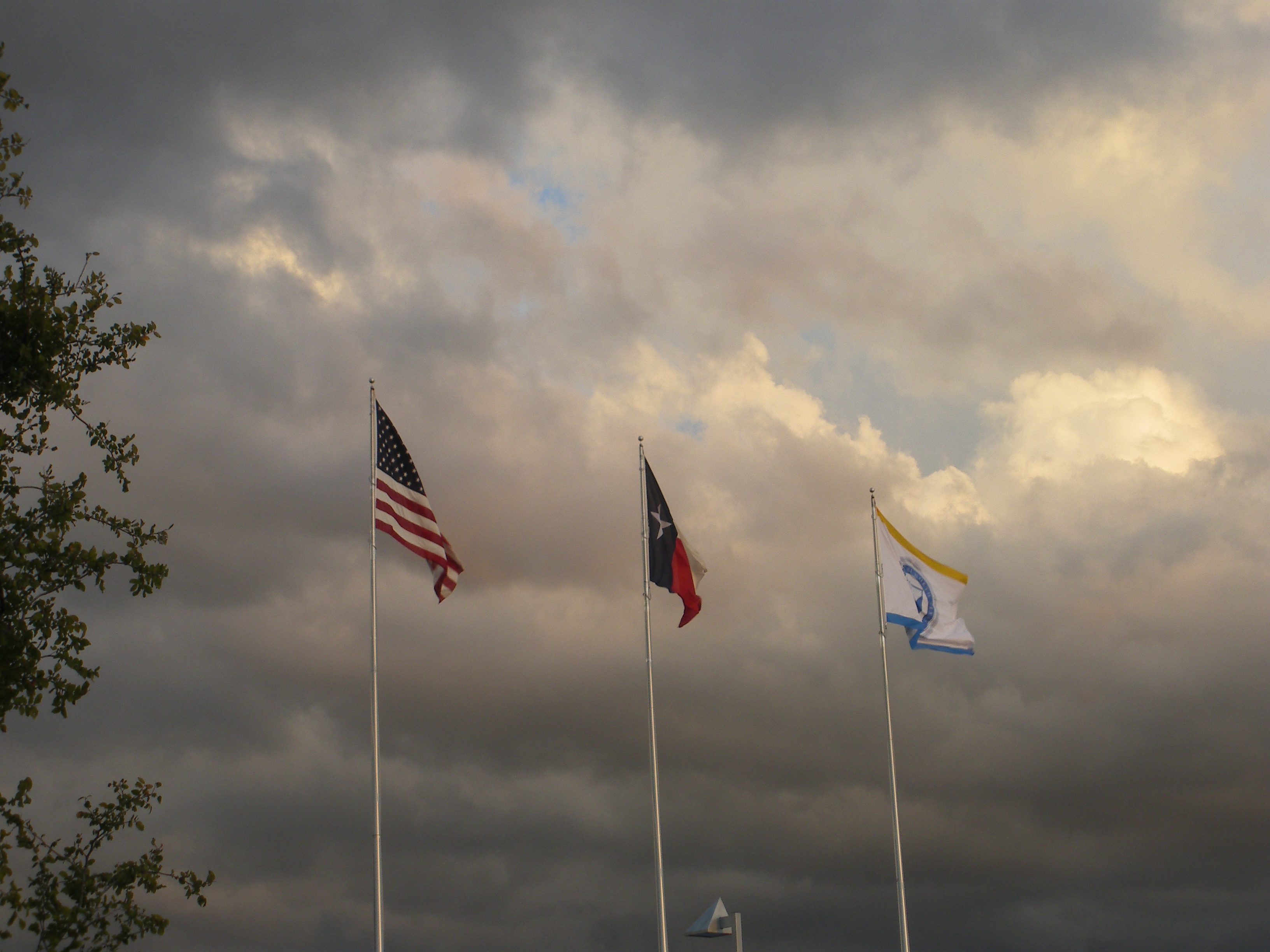
U.S., Texas and University of North Texas at Dallas flags flying on campus, with storm clouds to the South. Photo by Ed Darrell; use encouraged with attribution.

U.S., Texas and University of North Texas at Dallas flags flying on campus, with storm clouds to the South. Photo by Ed Darrell; use encouraged with attribution.

October 12 is the traditional, old calendar date upon which Columbus’s journals show he “discovered” land west of the Atlantic, after sailing from Spain. (Surely there is an explanation for why the date was not altered to conform with the new calendar, but I digress.)  In the finite wisdom of Congress, the holiday is designated on the “second Monday of October,” in order to promote three-day weekends and avoid holidays in the middle of the week.

Happily for traditionalists, the second Monday of October 2015 falls on October 12.

The U.S. Flag Code urges Americans to fly their U.S. flags in honor of certain days.  Columbus Day is a traditional (since the 19th century) holiday (especially for descendants of Italian immigrants), and one of the score of dates denoted in the Flag Code.

Fly your flag today.

At some parades on Columbus Day the Italian colors outnumber the U.S. colors. New York Daily News photo.

At some parades on Columbus Day the Italian colors outnumber the U.S. colors. New York Daily News photo.

More:

Or, if you’re in South Dakota, fly your flag for Native American Day.

http://twitter.com/The_AncientSage/status/521687617012645888


October 9, 2015 – St. Denis’s Day, patron saint for those who have lost their head

October 8, 2015

Dear Reader: My apologies. As Cecil might say, we’ve been fighting ignorance since 1973, and it’s taking longer than we thought.  My hopes to retire this post have not been realized.  Heck, it doesn’t even need much editing from past years. Saints save us, please!

We might pause to reflect, too:  Recent years have seen the media rise of actual beheadings.  This practice, which now strikes many of us as barbaric, occurs in reality as well as memory and literature; unlike St. Denis, those beheaded do not usually carry on to do anything at all; like St. Denis, they are martyred. Vote well in your local elections, and national elections.  Your vote should be directed at preventing anyone’s losing their head, even just figuratively.

October 9 is the Feast Day of St. Denis.

Who?  He’s the patron saint of Paris (and France, by some accounts), and possessed people.   Take a look at this statue, from the “left door” of the Cathedral of Notre Dame  in Paris (Cathédrale Notre-Dame de Paris: portail de gauche).  He was martyred by beheading, in about 250 C.E.

English: Cathédrale Notre-Dame de Paris: porta...

St. Denis greets vistors to the Cathedral of Notre Dame, Paris (Cathédrale Notre-Dame de Paris: portail de gauche)

Our trusty friend Wikipedia explains:

According to the Golden Legend, after his head was chopped off, Denis picked it up and walked two miles, preaching a sermon the entire way.[6] The site where he stopped preaching and actually died was made into a small shrine that developed into the Saint Denis Basilica, which became the burial place for the kings of France. Another account has his corpse being thrown in the Seine, but recovered and buried later that night by his converts.[2]

Clearly, he is the guy to pray to about Donald Trump, Ben Carson, Rush Limbaugh, Todd Akin, Paul Ryan, intelligent design, and the Texas State Board of Education, no?  In 2013, we added Ted Cruz, Mike Lee, Louis Gohmert, the entire Tea Party, and the entire GOP crew of the House of Representatives.  You catch my drift.

Perhaps you can use this factoid to some advantage, enlightenment, and perhaps humor.  In Catholic lore, St. Denis is one of the “14 Holy Helpers,” and his aid is sought to help people with headaches, or who have been possessed.

Crazy GOP members who I suspect of having been possessed give me and America a headache.  St. Denis seems to be our man. Or saint.

Who else do you know of in this modern, vexatious time, who keeps talking after losing his/her head?

As Rod Stewart sang, just “let your imagination run wild.”  Maybe St. Denis is listening.

More:

Statue to St. Denis, in Cluny

Another portrayal, in sculpture, of St. Denis. Notice how this one’s face doesn’t really look like the one above? Ouvre du Musée de Cluny, Wikipedia photo by Guillaume Blanchard (Aoineko), June 2001, FinePix 1400Z.

Yes, this is mostly an encore post. I had hoped to have to retire this post someday.  I still hope.  Perhaps this will be the last year we’ll have so many wackaloons running loose. Pray to St. Denis.


Mike Mansfield’s been gone 14 years

October 5, 2015

Senate Majority Leader Mike Mansfield, D-Montana

Senate Majority Leader Mike Mansfield, D-Montana; oil on canvas by Aaron Shikler, 1978 – Wikimedia image

Mike Mansfield was born on March 16, 1903.  Best boss I ever had.

Mansfield died 14 years ago on this day, October 5. Rarely a day goes by I don’t read the newspaper and think we could sure use a few more people like him today.  He’s been gone 14 years, and I miss him. I hope I’m not alone in that.

Robert A. Nowlan’s Born This Day attributed this quote to Mansfield:

After all, even a politician is human.

Laconic as he was, Mansfield didn’t say anything more meaty than that?

Read about Mansfield at the Bathtub, here.  Mansfield died on October 5, 2001.  He is interred at  Arlington National Cemetery in a soldier’s grave, reflecting his unique view of the world from an ordinary grunt soldier. Mansfield served as a Seaman in the U.S. Navy, enlisting at the age of 14; he served then as a Private in the U.S. Army; then he served as a private in the U.S. Marine Corps. His history proved a delightful prelude when, as Majority Leader of the U.S. Senate,  he met with the Joint Chiefs of Staff at the Pentagon on issues of soldiers’ welfare.

At our current sad time, when the political agenda of activist republic destroyers includes bitterly working hard to wipe out the history of great men like Mansfield, it’s important we remember him.

English: Senate desk X, used by Democratic lea...

This is a photo of one of the rarest views of history one can see, visible only to those few people who get onto the floor of the U.S. Senate, and only if someone opens a desk for them.  One of the more interesting, odd, and sentimental traditions developed in the U.S. Senate is the signing of the desks.  Sometime in the 19th century senators began signing the inside of the desks they were assigned to on the Senate floor.  Sometimes a desk gets associated with a particular state and a senator from that class; sometimes a desk get associated with family (Sens. John, Ted and Robert Kennedy, for example).  Here is Senate desk X, used by Democratic leaders (Joseph T. Robinson, Alben W. Barkley, Scott W. Lucas, Ernest McFarland, Lyndon B. Johnson, Mike Mansfield, Robert Byrd, George J. Mitchell, Tom Daschle and Harry Reid) (Photo credit: Wikipedia)

More:

Mike Mansfield on the cover of Time Magazine, March 20, 1964. This cover story reminds us that the Democrats were a fractious majority in the 1960s, which lends an even greater patina to Mansfield's reputation as a wrangler of Senators and the Senate Majority, at one of the most productive times in Congress's history, a sharp comparison to 2015.

Mike Mansfield on the cover of Time Magazine, March 20, 1964. This cover story reminds us that the Democrats were a fractious majority in the 1960s, which lends an even greater patina to Mansfield’s reputation as a wrangler of Senators and the Senate Majority, at one of the most productive times in Congress’s history, a sharp comparison to 2015.


Yes, this is mostly an encore post. Fighting ignorance requires patience.

Yes, this is mostly an encore post. Fighting ignorance requires patience.


October 5, 1964: Heart of Atlanta Motel asked Supreme Court for right to discriminate

October 5, 2015

PG posted this photo in one of his collections at Chamblee54:

Heart of Atlanta Motel, 1956 - Special Collections and Archives,Georgia State University Library

Heart of Atlanta Motel, 1956 – Special Collections and Archives,Georgia State University Library

I wondered whether this is the motel in the case testing the 1964 Civil Rights Act — and sure enough, it is.  The case was decided, finally, by the U.S. Supreme Court in 1964, Heart of Atlanta Motel, Inc., v. United States, 379 U.S. 241 (1964) .

This important case represented an immediate challenge to the Civil Rights Act of 1964, the landmark piece of civil rights legislation which represented the first comprehensive act by Congress on civil rights and race relations since the Civil Rights Act of 1875. For much of the 100 years preceding 1964, race relations in the United States had been dominated by segregation, a system of racial separation which, while in name providing for “separate but equal” treatment of both white and black Americans, in truth perpetuated inferior accommodation, services, and treatment for black Americans.

During the mid-20th century, partly as a result of cases such as Powell v. Alabama, 287 U.S. 45 (1932); Smith v. Allwright, 321 U.S. 649 (1944); Shelley v. Kraemer, 334 U.S. 1 (1948); Sweatt v. Painter, 339 U.S. 629 (1950); McLaurin v. Oklahoma State Regents, 339 U.S. 637 (1950); NAACP v. Alabama, 357 U.S. 449 (1958); Boynton v. Virginia, 364 U.S. 454 (1960) and probably the most famous, Brown v. Board of Education of Topeka, 347 U.S. 483 (1954), the tide against segregation began to turn. However, segregation remained in full effect into the 1960s in parts of the southern United States, where the Heart of Atlanta Motel was located, despite these decisions.

The Atlanta Time Machine, a great collection of photos in the history of Atlanta and Georgia, has more photos, and this description of the site:

The Heart of Atlanta motel, located at 255 Courtland Street NE, was owned by Atlanta attorney Moreton Rolleston Jr.  Rolleston, a committed segregationist, refused to rent rooms at his hotel to black customers.  Upon passage of the Civil Rights Act of 1964, Rolleston immediately filed suit in federal court to assert that the law was the result of an overly broad interpretation of the U.S. Constitution’s commerce clause.  Rolleston represented himself in the case, HEART OF ATLANTA MOTEL, INC. v. UNITED STATES ET AL., which  went all the way to the United States Supreme Court.  Rolleston lost when the Supreme Court ruled that Congress was well within its powers to regulate interstate commerce in such a manner.  The Hilton Hotel now stands on the former site of the Heart of Atlanta Motel.

Texts in law school rarely have illustrations.  I know the motel mostly as a citation on pages of text, great grey oceans of somnambulent text.  This case is important in civil rights, though it is mentioned almost never in history texts.  What are these cases really about?  These photos offer us insight.

The Heart of Atlanta Motel aspired to greatness in the late 1950s and 1960s — evidenced by this publicity flyer photo from the Atlanta Time Machine; notice the flag flying for the motel’s Seahorse Lounge (Atlanta is landlocked):

Heart of Atlanta Motel publicity photo - Atlanta Time Machine

Heart of Atlanta Motel publicity photo – Atlanta Time Machine; not just a podunk “motor lodge,” but a “resort motel.”  Click for larger image.

For the 1960s, this place offered great amenities, including two swimming pools and in-room breakfast service.

Flyer for the Heart of Atlanta Motel, circa 1960 - Atlanta Time Machine image

Flyer for the Heart of Atlanta Motel, circa 1960 – Atlanta Time Machine image

This photo is amusing — I can just imagine the difficulties of launching a motor boat of this size in one of the swimming pools, obviously for a publicity stunt.  The photo is dated February 27, 1960, in the Pullen Library Collection.

Boat in the pool at the Heart of Atlanta Motel, 1960 - Atlanta Time Machine image

Boat in the pool at the Heart of Atlanta Motel, 1960 – Atlanta Time Machine image

To compare how times have changed, you may want to look at this aerial photo of the area, including the Heart of Atlanta Hotel, and compare it with modern photos which show the Hilton Hotel that replaced the property.

Rolleston appears to have had a big ego.  As noted above, he represented himself in this case, and he argued it in the Supreme Court.  Here’s a picture from about that time, from the University of Missouri-Kansas City Law School “Famous Trials” site:

Moreton Rolleston, Jr., owner of the Heart of Atlanta Motel and the attorney who argued the case at the Supreme Court - UMKC Law School image

Moreton Rolleston, Jr., owner of the Heart of Atlanta Motel and the attorney who argued the case at the Supreme Court – UMKC Law School image; photo: Wayne Wilson/Leviton-Atlanta

You may decide for yourself whether this fits the old legal aphorism that a lawyer who represents himself in a case has a fool for a client.  The Oyez site at the University of Chicago provides access to the audio of the oral arguments.  Did Rolleston argue ably?  Rolleston argued against Archibald Cox, who went on to fame in the Watergate scandals.  This appears to have been Rolleston’s only appearance before the Supreme Court; it was Cox’s ninth appearance (he argued 20 cases before the Court in his career, several well known and notable ones).

Heart of Atlanta vs. United States was argued on October 5, 1964The opinion was issued on December 14, 1964, a 9-0 decision against Rolleston and segregation authored by Justice Tom C. Clark (one of Dallas’s earliest Eagle Scouts).

This was a fight Mr. Rolleston picked.  He was not cited nor indicted for violation of the Civil Rights Act, but instead asked for an injunction to prevent the law’s enforcement; according to the published decision,

Appellant, the owner of a large motel in Atlanta, Georgia, which restricts its clientele to white persons, three-fourths of whom are transient interstate travelers, sued for declaratory relief and to enjoin enforcement of the Civil Rights Act of 1964, contending that the prohibition of racial discrimination in places of public accommodation affecting commerce exceeded Congress’ powers under the Commerce Clause and violated other parts of the Constitution. A three-judge District Court upheld the constitutionality of Title II, §§ 201(a), (b)(1) and (c)(1), the provisions attacked, and, on appellees’ counterclaim, permanently enjoined appellant from refusing to accommodate Negro guests for racial reasons.

Oyez summarizes the case question:

Facts of the Case 

Title II of the Civil Rights Act of 1964 forbade racial discrimination by places of public accommodation if their operations affected commerce. The Heart of Atlanta Motel in Atlanta, Georgia, refused to accept Black Americans and was charged with violating Title II.

Question 

Did Congress, in passing Title II of the 1964 Civil Rights Act, exceed its Commerce Clause powers by depriving motels, such as the Heart of Atlanta, of the right to choose their own customers?

The decision turned on the commerce clause, and the reach of Congressional power to regulate interstate commerce.

Decision: 9 votes for U.S., 0 vote(s) against
Legal provision: Civil Rights Act of 1964, Title II

The Court held that the Commerce Clause allowed Congress to regulate local incidents of commerce, and that the Civil Right Act of 1964 passed constitutional muster. The Court noted that the applicability of Title II was “carefully limited to enterprises having a direct and substantial relation to the interstate flow of goods and people. . .” The Court thus concluded that places of public accommodation had no “right” to select guests as they saw fit, free from governmental regulation.

Good decision. As my law professors described it, Americans enjoy the right to travel, a penumbral right of the Constitution. Inherent in that right is the right to rest in a hotel or motel at the end of the day, especially along a federally-funded highway, part of the U.S. Highway system or National Defense Interstate Highway System.

Heart of Atlanta Motel is gone.  The site is occupied by the Hilton Atlanta, today.

Interstate travel, and sleeping in hotels, continues.

Yes, this is mostly an encore post. Fighting ignorance requires patience.

Yes, this is mostly an encore post. Fighting ignorance requires patience.


Angry Texas mom backs down social studies text publisher, frustrates Texas School Board’s bias

October 3, 2015

Cover of the Texas edition of McGraw-Hill's World Geography (image from Birdville ISD site)

Cover of the Texas edition of McGraw-Hill’s World Geography (image from Birdville ISD site)

Oh, the power of one angry mother!

It’s not like we weren’t warned, by people like the Texas Freedom Network. The last round of “book approvals” by the Texas State Board of Education introduced some stunning inaccuracies into books used in Texas history, geography and economics classrooms. GOP appointees and board members worked hard to make sure even correct history standards could be skewed in actual texts.

One Houston-area mother saw her son’s text for world geography, videoed the thing and put it up on Facebook. Surprisingly, the publisher, McGraw-Hill, backed down, and promised fixes.

Here’s the video, from Rusty Styles:

The good news? This one angry mom got McGraw-Hill to take the ethical path, and promise to fix the caption. On Facebook again, McGraw-Hill said:

This week, we became aware of a concern regarding a caption reference to slavery on a map in one of our world geography programs. This program addresses slavery in the world in several lessons and meets the learning objectives of the course. However, we conducted a close review of the content and agree that our language in that caption did not adequately convey that Africans were both forced into migration and to labor against their will as slaves.

We believe we can do better. To communicate these facts more clearly, we will update this caption to describe the arrival of African slaves in the U.S. as a forced migration and emphasize that their work was done as slave labor. These changes will be reflected in the digital version of the program immediately and will be included in the program’s next print run.

McGraw-Hill Education is committed to developing the highest quality educational materials and upholding the academic integrity of our products. We value the insight the public brings to discussions of our content.

World geography was usually taught in the 9th grade in Texas; recent changes in requirements pushed world geography to a lesser status; many Texas kids get to pick between world geography and world history (both used to be required).

Students are old enough to need to know the truth on these issues. That is not to say that history books should stretch or chop the truth at any time, but it is to note that students in early high school are developing an ethical outlook on their lives. Adults, including book publishers, need to lead exemplary lives.

What other errors didn’t get the public scrutiny they deserved a few years ago?

Any other angry moms out there?


More:

And:


Happy birthday, Jimmy Carter (he’s 91)

October 1, 2015

Photo and caption from the Atlanta Journal-Constitution: It’s been a busy few days for former President Jimmy Carter, who turns 91 today. This past Saturday, he was out and about at the annual Plains Festival, including watching the parade with his wife, Rosalynn , from the balcony of the Plains Inn. Ben Gray / bgray@ajc.com

Photo and caption from the Atlanta Journal-Constitution: It’s been a busy few days for former President Jimmy Carter, who turns 91 today. This past Saturday, he was out and about at the annual Plains Festival, including watching the parade with his wife, Rosalynn , from the balcony of the Plains Inn. Ben Gray / bgray@ajc.com


Jimmy Carter was born 91 years ago today in Plains, Georgia.

The Nobel Peace Prize winner still lives there, today. Maybe there are exceptions to Thomas Wolfe’s rule? Especially for those who stay at home.

A short note in the Atlanta Journal-Constitution website suggests celebration activities, if you’re in Atlanta:

Jimmy Carter turns a youthful 91 today. While the former Georgia governor and president of the United States celebrates with family and friends, the Jimmy Carter Presidential Library and Museum in Atlanta has a way for everyone to join the fun. Admission is reduced to 91 cents all day Thursday (those 16 and under are always admitted free of charge), and there’ll be a special drawing for a signed copy of Carter’s book, “Keeping Faith.” In addition, if you bring a birthday card along with you, the library says they’ll make sure President Carter sees it.

The Jimmy Carter Presidential Library and Museum is located at 441 Freedom Parkway, and is open from 9 a.m. to 4:45 p.m Mondays-Saturdays, and from noon to 4:45 p.m. on Sundays. For more information call (404) 865-7100 or go to www.jimmycarterlibrary.gov.


October’s dates to fly U.S. colors

October 1, 2015

Knights of Columbus of New Haven, Connecticut, present the U.S. flag at the start of New Haven's Columbus Day Parade, 2006. 28 flags demonstrated the history of the U.S. flag. KofC photo

Knights of Columbus of New Haven, Connecticut, present the U.S. flag at the start of New Haven’s Columbus Day Parade, 2006. 28 flags demonstrated the history of the U.S. flag. KofC photo

October is not a big month for dates to fly the U.S. flag.  Only one state joined the union in October, and only two other dates have merited Congress’s designation for flag-flying.

Here are October’s three flag-flying days, in chronological order:

  • Columbus Day, October 12 —  tradition puts Columbus Day on October 12, but in law it is designated as the second Monday in October (to make a three-day weekend for workers who get a holiday); in 2015, October 12 is the second Monday of the month.
  • Navy Day, October 27
  • Nevada Statehood Day, October 31; Nevada joined the union during the Civil War, in 1864, the 36th state.

Federal law also designates October 9 as Leif Erickson Day, a concession to Scandanavian-descended Americans who argue Erickson beat Columbus to the Americas by a few hundred years. Congress’s recognition does not include an urging to fly the flag, though the President may issue such a proclamation.

More:


September 30, 1794: George Washington marches on tax protesters

September 30, 2015

On September 30, 1794, President George Washington mounted his horse to lead a 13,000-man all-volunteer army, against Americans who refused to pay, or threatened to not pay taxes on whiskey.

Tea Partiers and Republicans might do well to spend a few minutes refreshing their memories from history class — or getting the information they didn’t get the first time around.  Citizens in western Pennsylvania, and that part of Virginia that would be come West Virgina, and the Ohio Territory, complained that federal taxes on whiskey were “theft.”

No, taxes are not “stealing.”  Here’s an offending but explanatory poster I found on Facebook:

Who are the history-illiterates who make these offensive posters? Taxes are not

Who are the history-illiterates who make these offensive posters? Taxes are not “stolen,” at least, not according to patriots like George Washington.

I told one guy who posted it that I thought it was a crude misrepresentation of George Washington, there on the left — but that I had always suspected he didn’t like the “founders,” and was grateful to have any doubts I may have had, removed.

He said, “Huh?”

This Prominent Americans series stamp of the U...

Pay your taxes, maybe they’ll put you on a stamp. This Prominent Americans series stamp of the United States from 1968 features Oliver Wendell Holmes. Wikipedia image

One could always refer to that wonderful line from Justice Oliver Wendell Holmes, Jr., about how he liked to pay taxes because “with them I buy civilization.”  But I suspect most tax revolters in the U.S. don’t much like civilization (and they have the guns to prove it).

Instead I simply told the story of George Washington and the Whiskey Rebellion, the first, and mostly-forgotten, case of U.S. tax rebels.  You know the story.

I wrote:

Yeah, in 1794, a bunch of farmers out in western Pennsylvania got ticked off at taxes. They said paying taxes was like the government stealing from them. And, they had their representatives explain to President George Washington, didn’t they fight a war against paying taxes?

Washington, you may recall, was the Commander in Chief of the Continental Army in the great American Revolution against Great Britain. “No taxes without representation” was one of the original war cries.

Washington said, ‘It takes money to run the government, and that money is collected from the people in taxes fairly levied by their elected representatives.’

The farmers weren’t having any of that. They were way out in western Pennsylvania, near the wilderness Fort Pittsburgh. The federal government, what little bit of it there was, was in Philadelphia. ‘How are they going to make us pay taxes?’ the rebel leaders shouted to crowds.

George Washington

A more friendly portrayal of George “Pay Your Taxes or Swing” Washington – Wikipedia image (which bust is this? Library of Congress?)

Washington got a dozen nooses, and a volunteer army of 13,000 Americans, and marched to western Pennsylvania to hang anyone who wouldn’t pay the tax. Oddly, by the time Washington got there with the nooses, the rebels decided maybe it was a good idea to be patriotic about it after all.

So I assumed you just updated the pictures a little. [In the poster] There’s George Washington on the left, with his Smith and Wesson “noose,” telling the big corporate farmer to pay his taxes.I think your portrayal of Washington is a bit crude, but it’s historically accurate, with regard to taxes.

I always suspected you didn’t like George Washington. Now I know for sure you don’t.

You could have looked it up: The Whiskey Rebellion – http://www.pbs.org/wgbh/amex/duel/peopleevents/pande22.html

And it was on this day in 1794, September 30, that Washington and the army set out to put down the rebellion.

How would Washington have dealt with secession, or the Texas Republic movement?

I don’t much like crude political dysfunction and disinformation from people who don’t know U.S. history, and won’t defend American principles.  Am I being unreasonable?

More:

Gen. Washington, astride his favorite white horse, reviewing his troops at Carlisle, Pennsylvania, before the march to the western part of the state to put down the Whiskey Rebellion. Image from the Department of the Treasury, Alcohol and Tobacco Tax and Trade Bureau.

Gen. Washington, astride his favorite white horse, reviewing his troops at Carlisle, Pennsylvania, before the march to the western part of the state to put down the Whiskey Rebellion. Image from the Department of the Treasury, Alcohol and Tobacco Tax and Trade Bureau. (Just try to find who painted it!)

” . . . to execute the laws . . .” a painting by Donna Neary for the National Guard, on the Whiskey Rebellion. National Guard Caption: In September 1791 the western counties of Pennsylvania broke out in rebellion against a federal excise tax on the distillation of whiskey. After local and federal officials were attacked, President Washington and his advisors decided to send troops to pacify the region. It was further decided that militia troops, rather than regulars, would be sent. On August 7, 1794, under the provisions of the newly-enacted militia law, Secretary of War Henry Knox called upon the governors of Virginia, Maryland, New Jersey, and Pennsylvania for 12,950 troops as a test of the President’s power to enforce the law. Numerous problems, both political and logistical, had to be overcome and by October, 1794 the militiamen were on the march. The New Jersey units marched from Trenton to Harrisburg, Pennsylvania. There they were reviewed by their Commander-in Chief, President George Washington, accompanied by Secretary of the Treasury and Revolutionary war veteran Alexander Hamilton. By the time troops reached Pittsburgh, the rebellion had subsided, and western Pennsylvania was quickly pacified. This first use of the Militia Law of 1792 set a precedence for the use of the militia to “execute the laws of the union, (and) suppress insurrections”. New Jersey was the only state to immediately fulfill their levy of troops to the exact number required by the President. This proud tradition of service to state and nation is carried on today by the New Jersey Army and Air National Guard.

Tip of the old scrub brush to the historians and other fine people at Mount Vernon, for the reminder:

Yes, this is mostly an encore post. Fighting ignorance requires patience.

Yes, this is mostly an encore post. Fighting ignorance requires patience.


September 29, 1936: FDR warned Republicans would try to take away Social Security

September 29, 2015

How can this still be true, 79 years later to the day?

FDR warned us in 1936, that Republicans would try to gut federal programs that help people and make America great. It’s as if we have a haunting by Santayana‘s Ghost, on Social Security, unemployment insurance, job training, job creation and budget deficits:

Update: Shorter excerpt of speech, leaving out the parts I really wanted; the video originally featured is not available. Rats.

Our friend SBH pointed us to the text of the speech.  FDR addressed the New York State Democratic Convention, in Syracuse, on September 29, 1936  (Can you imagine — does any state have such thing still —  state party conventions so late in the year, today?).  He found it at UC-Santa Barbara‘s American Presidency Project website.  Here’s the text of the excerpt above, plus a little:

In New York and in Washington, Government which has rendered more than lip service to our Constitutional Democracy has done a work for the protection and preservation of our institutions that could not have been accomplished by repression and force.

Let me warn you and let me warn the Nation against the smooth evasion which says, “Of course we believe all these things; we believe in social security; we believe in work for the unemployed; we believe in saving homes. Cross our hearts and hope to die, we believe in all these things; but we do not like the way the present Administration is doing them. Just turn them over to us. We will do all of them — we will do more of them, we will do them better; and, most important of all, the doing of them will not cost anybody anything.”

But, my friends, these evaders are banking too heavily on the shortness of our memories. No one will forget that they had their golden opportunity—twelve long years of it.

Remember, too, that the first essential of doing a job well is to want to see the job done. Make no mistake about this: the Republican leadership today is not against the way we have done the job. The Republican leadership is against the job’s being done.

Read more at the American Presidency Project: Franklin D. Roosevelt: Address at the Democratic State Convention, Syracuse, N.Y. http://www.presidency.ucsb.edu/ws/index.php?pid=15142&st=Roosevelt&st1#ixzz1T2VHx1tx

More:

Social Security Poster: old man

Social Security Poster: old man (Photo from the Social Security Board, via Wikipedia)

Yes, this is mostly an encore post. Fighting ignorance requires patience.

Yes, this is mostly an encore post. Fighting ignorance requires patience.


Gold Star Mothers Day, 2015

September 27, 2015

President Barack Obama hugs Gold Star mother Michelle DeFord following a roundtable with veterans and Gold Star mothers regarding the Iran nuclear agreement, in the Roosevelt Room of the White House, Sept. 10, 2015. Secretary of State John Kerry also participated. (Official White House Photo by Pete Souza)

President Barack Obama hugs Gold Star mother Michelle DeFord following a roundtable with veterans and Gold Star mothers regarding the Iran nuclear agreement, in the Roosevelt Room of the White House, Sept. 10, 2015. Secretary of State John Kerry also participated. (Official White House Photo by Pete Souza)

Ceremonies and gatherings mark Gold Star Mothers Day in cities across the United States. Gold Star Mothers Day officially is the last Sunday in September, September 27 in 2015.

The Tampa Tribune offers an article covering several meetings in the Tampa area, and the families honored and affected.

Photo and caption from the Tampa Tribune: Thea Kurz became a Gold Star mother on Aug. 20, 2014, when her son, Army Sgt. 1st Class Matthew Leggett, 39, was killed in Afghanistan. She says she gets helpful support from other Tampa Bay families who have lost loved ones serving in the military.

Photo and caption from the Tampa Tribune: Thea Kurz became a Gold Star mother on Aug. 20, 2014, when her son, Army Sgt. 1st Class Matthew Leggett, 39, was killed in Afghanistan. She says she gets helpful support from other Tampa Bay families who have lost loved ones serving in the military.

Photo and caption from the Emporia (Kansas) Gazette: Kendra Johnson/Gazette Maria Lane holds her son's dog tags on Tuesday. These were the dog tags David was wearing when he passed and Lane has since worn them everyday in memory of him.

Photo and caption from the Emporia (Kansas) Gazette:  Maria Lane holds her son’s dog tags on Tuesday. These were the dog tags David was wearing when he passed and Lane has since worn them everyday in memory of him. Photo: Kendra Johnson/Gazette


Gold Star Mothers Day 2015 – fly your flag today, September 27

September 27, 2015

Fly your U.S. flag on September 27, 2015, in honor of the Gold Star Mothers of fallen U.S. soldiers.

Gold Star mother Jennifer Owens views a photo of her daughter Spc. Ember Marie Alt at the Survivor Outreach Services Remembrance Hall in Fort Hood, Texas. Owens credits Survivor Outreach Services staff members for helping her cope with her loss of her daughter. U.S. Army photo

‘Gold Star Mothers’ become bedrocks of support for survivors of the fallen’: Gold Star mother Jennifer Owens views a photo of her daughter Spc. Ember Marie Alt at the Survivor Outreach Services Remembrance Hall in Fort Hood, Texas. Owens credits Survivor Outreach Services staff members for helping her cope with her loss of her daughter. U.S. Army photo and caption

Gold Star Mothers Day is the last Sunday in September, designated under U.S. law, 36 U.S.C. §111:

The President is requested to issue a proclamation calling on United States Government officials to display the flag of the United States on all Government buildings, and the people of the United States to display the flag and hold appropriate meetings at homes, churches, or other suitable places, on Gold Star Mother’s Day as a public expression of the love, sorrow, and reverence of the people for Gold Star Mothers.

Gold Star Mothers grew out of the grief and charity of mothers of soldiers who died in World War I, gaining formal organization in 1928.

The American Gold Star Mothers Inc. was formed in the United States shortly after World War I to provide support for mothers who lost sons or daughters in the war. The name came from the custom of families of servicemen hanging a banner called a Service Flag in the window of their homes. The Service Flag had a star for each family member in the United States Armed Forces. Living servicemen were represented by a blue star, and those who had lost their lives were represented by a gold star. Gold Star Mothers are often socially active but are non-political. Today, membership in the Gold Star Mothers is open to any American woman who has lost a son or daughter in service to the United States. On the last Sunday in September, Gold Star Mother’s Day is observed in the U.S. in their honor.[1] The group holds a congressional charter under Title 36 of the United States Code.

Proclamation from President Obama for Gold Star Mothers Day, 2015:

Presidential Proclamation — Gold Star Mother’s and Family’s Day, 2015

GOLD STAR MOTHER’S AND FAMILY’S DAY, 2015

– – – – – – –

BY THE PRESIDENT OF THE UNITED STATES OF AMERICA, A PROCLAMATION

At every crossroads in the American story, courageous individuals of all backgrounds and beliefs have answered our Nation’s call to serve.  Today, the sacrifices of our fallen heroes echo in safer towns and cities, countries and continents — resonating throughout a world they forever made freer.  Their legacies are solemnly enshrined in the history of our eternally grateful Nation, as well as in the hearts of all who loved them.  Today, we honor the Gold Star Mothers and Families who carry forward the memories of those willing to lay down their lives for the United States and the liberties for which we stand.

The proud patriots of our Armed Forces never serve alone.  Standing with each service member are parents, spouses, children, siblings, and friends, providing support and love and helping uphold the ideals that bind our Nation together.  While most Americans may never fully comprehend the price paid by those who gave their last full measure of devotion, families of the fallen know it intimately and without end.  Their sleepless nights allow for our peaceful rest, and the folded flags they hold dear are what enable ours to wave.  The depth of their sorrow is immeasurable, and we are forever indebted to them for all they have given for us.

Despite their broken hearts, the families of these warriors are full of love and they continue to serve their communities and comfort our troops, veterans, and other military families. Our country is constantly inspired by their incredible resilience, and in their example we see the very best of America.  On this day of remembrance, we honor our Gold Star Mothers and Families by living fully the freedom for which they have given so much, and by rededicating ourselves to our enduring obligation to serve them as well as they have served us.

The Congress, by Senate Joint Resolution 115 of June 23, 1936 (49 Stat. 1985 as amended), has designated the last Sunday in September as “Gold Star Mother’s Day.”

NOW, THEREFORE, I, BARACK OBAMA, President of the United States of America, by virtue of the authority vested in me by the Constitution and the laws of the United States, do hereby proclaim September 27, 2015, as Gold Star Mother’s and Family’s Day.  I call upon all Government officials to display the flag of the United States over Government buildings on this special day.  I also encourage the American people to display the flag and hold appropriate ceremonies as a public expression of our Nation’s gratitude and respect for our Gold Star Mothers and Families.

IN WITNESS WHEREOF, I have hereunto set my hand this twenty-fourth day of September, in the year of our Lord two thousand fifteen, and of the Independence of the United States of America the two hundred and fortieth.

BARACK OBAMA

Here is a series of short videos on Gold Star Mothers, Gold Star Parents, and even notes on Veterans Benefits available to survivors of soldiers lost in conflict.

From Montana's Daily Interlake: Sgt. Chuck Lewis, U.S. Marine Corps, of Ronan folds the American Flag at the Gold Star Mother's Day event at Brockman Park in Ronan on Sunday, September 28 (2013). (Brenda Ahearn/Daily Inter Lake)

From Montana’s Daily Interlake: Sgt. Chuck Lewis, U.S. Marine Corps, of Ronan [Montana] folds the American Flag at the Gold Star Mother’s Day event at Brockman Park in Ronan on Sunday, September 28 (2013). (Photo by Brenda Ahearn/Daily Inter Lake)

More:


September 23, 1858: DON’T wash your hands!

September 23, 2015

Ignaz Semmelweiss

Dr. Ignaz Semmelweis

This is one of the classic stories of public health, an issue that most U.S. history and world history texts tend to ignore, to the detriment of the students and the classroom outcomes.

This is the story as retold by Christopher Cerf and Victor Navasky in The Experts Speak:

In the 1850s a Hungarian doctor and professor of obstetrics named Ignaz Semmelweis [pictured at left] ordered his interns at the Viennese Lying-in Hospital to wash their hands after performing autopsies and before examining new mothers. The death rate plummeted from 22 out of 200 to 2 out of 200, prompting the following reception from one of Europe’s most respected medical practitioners:

“It may be that it [Semmelweis’ procedure] does contain a few good principles, but its scrupulous application has presented such difficulties that it would be necessary, in Paris for instance, to place in quarantine the personnel of a hospital during the great part of a year, and that, moreover, to obtain results that remain entirely problematical.”

Dr. Charles Dubois (Parisian obstetrician), memo to the French Academy
September 23, 1858

Semmelweiss’ superiors shared Dubois’ opinion; when the Hungarian physician insisted on defending his theories, they forced him to resign his post on the faculty.

Gotta wonder what Dr. Dubois would make of the suits and sanitation procedures required today for health professionals who treat Ebola victims.

More: 

Yes, this is mostly an encore post. Fighting ignorance requires patience.

Yes, this is mostly an encore post. Fighting ignorance requires patience.


Constitution Day 2015 – Fly your flag

September 17, 2015

Happy Constitution day!  (Remember to fly your flag today.)

Have you read the U.S. Constitution lately?

Contrary to what your local Tea Party claims, it hasn’t changed.  But most people need a refresher from time to time.

First page of the U.S. Constitution, National Archives and Records Administration photo

First page of the U.S. Constitution, National Archives and Records Administration photo

Okay, maybe that’s a little tough to read.  Check out the on-line display of the National Archives and Records Administration in the Charters of Freedom section:

The Constitution Center in Philadelphia plans a full day of celebration, much of it streamed online for classroom use:

Watch as we kick off the day with a rousing reading of the Preamble of the Constitution of the United States on the museum’s front lawn!
Supreme Court Justice Stephen Breyer meets with students for a town hall conversation about his work with the Constitution and the ins and outs of his job!
Join a virtual tour of the museum, including Signers’ Hall and The Story of We the People, followed by a conversation with Judge Marjorie O. Rendell of the U.S. Court of Appeals for the Third Circuit!
Justice Stephen Breyer returns to discuss his latest book, The Court and the World: American Law and the New Global Realities, as well as how American law applies in international contexts.
Catch the newest edition of our award-winning video series and join our staff for a live discussion about Constitution Day! The chat will be available until September 23, from 7 AM to 6 PM EDT.
Follow along with our festivities on social media and share your own celebration! Join the conversation with @ConstitutionCtr and #ConstitutionDay!

Justice Stephen Breyer’s interview alone should be worth the price of admission. He’s taking on the bizarre notion that U.S. judges should never look to see what foreign courts and legislatures do. That view has led to state laws recently that claim to ban local courts’ use of foreign law.

In the year of the 800th anniversary of the Magna Carta? Hello?

Odd fact for Constitution Day: There is no direct mention of a U.S. flag in the Constitution.

More:


Rotunda for the charters of Freedom at Nationa...

Rotunda for the charters of Freedom at National Archives (NARA) building in Washington, D.C. Here displayed are the Declaration of Independence, the Bill of Rights, and the U.S. Constitution. (Photo credit: Wikipedia)

#ConstitutionDay

This is an encore post.

This is an encore post.


September 16, 2015, Mexican Independence Day celebrated: Grito de Dolores!

September 16, 2015

It’s almost painful how much residents of the U.S. don’t know about our neighbor to the south, Mexico.

No, Cinco de Mayo is not Mexican Independence Day. That would be September 16.

Mexico’s Independence Day is celebrated on September 16.

Dolores Hidalgo Church at night.

Dolores Hidalgo Church at night. Wikipedia image

But just to confuse things more, Mexico did not get independence on September 16.

September 16 is the usual date given for the most famous speech in Mexico’s history — a speech for which no transcript survives, and so, a speech which no one can really describe accurately.  A Catholic priest who was involved in schemes to create an armed revolution to throw out Spanish rule (then under Napoleon), thought his plot had been discovered, and moved up the call for the peasants to revolt.  At midnight, September 15, 1810, Father Miguel Hidalgo y Costilla declaimed the need for Mexicans to rise in revolution, from his church in the town of Dolores, near Guanajuato.  The cry for freedom is known in Spanish as the Grito de Dolores.

Hidalgo himself was hunted down, captured and executed.  Mexico didn’t achieve independence from Spain for another 11 years, on September 28, 1821.

To commemorate Father Hidalgo’s cry for independence, usually the President of Mexico repeats the speech at midnight, in Mexico City, or in Dolores.  If the President does not journey to Dolores, some other official gives the speech there.  Despite no one’s knowing what was said, there is a script from tradition used by the President:

Mexicans!
Long live the heroes that gave us the Fatherland!
Long live Hidalgo!
Long live Morelos!
Long live Josefa Ortiz de Dominguez!
Long live Allende!
Long live Galena and the Bravos!
Long live Aldama and Matamoros!
Long live National Independence!
Long Live Mexico! Long Live Mexico! Long Live Mexico!

Political history of Mexico is not easy to explain at all.

Hidalgo’s life was short after the speech, but the Spanish still feared the power of his ideas and names.  In Hidalgo’s honor, a town in the Texas territory of Mexico was named after him, but to avoid provoking authorities, the name was turned into an anagram:  Goliad.

In one of those twists that can only occur in real history, and not in fiction, Goliad was the site of a Mexican slaughter of a surrendered Tejian army during the fight for Texas independence.  This slaughter so enraged Texans that when they got the drop on Mexican President and Gen. Santa Ana’s army a few days later at San Jacinto, they offered little quarter to the Mexican soldiers, though Santa Ana’s life was spared.

Have a great Grito de Dolores Day, remembering North American history that we all ought to know.

Check out my earlier posts on the Grito, for a longer and more detailed explanation of events, and more sources for teachers and students.

Father Hidalgo: Antonio Fabres, Miguel Hidalgo, oil on canvas, image taken from: Eduardo Baez, military painting in the nineteenth century Mexico, Mexico, National Defense Secretariat, 1992, p.23. Wikipedia image

Father Hidalgo: Antonio Fabres, Miguel Hidalgo, oil on canvas, image taken from: Eduardo Baez, military painting in the nineteenth century Mexico, Mexico, National Defense Secretariat, 1992, p.23. Wikipedia image

More:

Yes, this is mostly an encore post. Fighting ignorance requires patience.

Yes, this is mostly an encore post. Fighting ignorance requires patience.