Keep your flags clean and dry for September

September 4, 2013

Labor Day passed, so you can put your flags away until . . . what, Thanksgiving?

Not so fast, patriot!

U.S. Flag Code rules list specific days for flying the flag, and Constitution Day on September 17 is one of those dates.

Also, the Flag Code urges flying the U.S. flag on the anniversary of a state’s entering the union, in that state.  California’s statehood day is September 9 (next week!)

California flag

California flag flies on the same pole as the U.S. flag; photo from tumblr deepspaceromans.

Stay ready, patriots.

More:


Quiz answer: Who ratted out the Republicans like this, and when?

September 3, 2013

I said earlier that you may wish to file this under o tempora, o mores; or perhaps under plus ça change.  

These words seem oddly, perhaps astonishingly appropriate to political discussion today.  They come from the past, from more than a half-century ago, but they refer to issues that have not yet been solved, and to issues that were resolved, but have come undone, or just come around again.

GOP vs. Dems. Image from Addicting Information.

GOP vs. Dems. Image from Addicting Information, “15 differences between Democrats and Republicans.”

I posed this a quiz in a post a couple of days ago.

Does history repeat itself?  George Santayana said history repeats for those who forget what happened before.

Here’s a political speech given in Minnesota.  Without hitting Google, can you tell who said this, and when?

Democracy does not work that way. Democracy is a matter of faith–a faith in the soul of man–a faith in human rights. That is the kind of faith that moves mountains–that’s the kind of faith that hurled the Iron Range at the Axis and shook the world at Hiroshima.

Faith is much more than efficiency. Faith gives value to all things. Without faith, the people perish.

Today the forces of liberalism face a crisis. The people of the United States must make a choice between two ways of living–a decision, which will affect us the rest of our lives and our children and our grandchildren after us.

On the other side, there is the Wall Street way of life and politics. Trust the leader! Let big business take care of prices and profits! Measure all things by money! That is the philosophy of the masters of the Republican Party.

Well, I have been studying the Republican Party for over 12 years at close hand in the Capital of the United States. And by this time, I have discovered where the Republicans stand on most of the major issues.

Since they won’t tell you themselves, I am going to tell you.

They approve of the American farmer-but they are willing to help him go broke.

They stand four-square for the American home–but not for housing.

They are strong for labor–but they are stronger for restricting labor’s rights.

They favor a minimum wage–the smaller the minimum the better.

They indorse educational opportunity for all–but they won’t spend money for teachers or for schools.

They think modern medical care and hospitals are fine–for people who can afford them.

They approve of social security benefits-so much so that they took them away from almost a million people.

They believe in international trade–so much so that they crippled our reciprocal trade program, and killed our International Wheat Agreement.

They favor the admission of displaced persons–but only within shameful racial and religious limitations.

They consider electric power a great blessing-but only when the private power companies get their rake-off.

They say TVA is wonderful–but we ought never to try it again.

They condemn “cruelly high prices”–but fight to the death every effort to bring them down.

They think the American standard of living is a fine thing–so long as it doesn’t spread to all the people.

And they admire the Government of the United States so much that they would like to buy it.

Now, my friends, that is the Wall Street Republican way of life. But there is another way–there is another way–the Democratic way, the way of the Democratic Party.

Of course, the Democratic Party is not perfect. Nobody ever said it was. But the Democratic Party believes in the people. It believes in freedom and progress, and it is fighting for its beliefs right now.

In the Democratic Party, you won’t find the kind of unity where everybody thinks what the boss tells him to think, and nothing else.

But you will find an overriding purpose to work for the good of mankind. And you will find a program–a concrete, realistic, and practical program that is worth believing in and fighting for.

Now, I call on all liberals and progressives to stand up and be counted for democracy in this great battle. I call on the old Farmer-Labor Party, the old Wisconsin Progressives, the Non-Partisan Leaguers, and the New Dealers to stand up and be counted in this fight.

What clues does that passage contain that it wasn’t said in the past year?  Or was it?

I’ll post the answer in a day or so — take a guess in comments.

James said it was Harry Truman, and indeed it was.

President Harry S Truman, image from UCSB American Presidency Project

President Harry S Truman, image from UCSB American Presidency Project

Truman spoke to a crowd in Minnesota, in the St. Paul Municipal Auditorium, on October 13, 1948, about three weeks before the 1948 election in which he “upset” New York Gov. Thomas Dewey.  This was part of Truman’s famous Whistle Stop speaking tour of the U.S.

If the words look like they could have been said today, perhaps we should pay attention to them today, no?

Surely someone has a photograph of Truman speaking in St. Paul — but I haven’t found it yet.

More:


Quote of the moment: Mark Twain, “death was an exaggeration”

September 3, 2013

Words of encouragement in tough times, from Samuel Clemens, writing as Mark Twain:

” . . . the report of my death was an exaggeration.” Mark Twain

The note was published in the New York Journal, June 2, 1897.  While it’s true that Twain wrote this, most popular citations have added and rearranged words.

Text of the note:

James Ross Clemens, a cousin of mine was seriously ill two or three weeks ago in London, but is well now.  The report of my illness grew out of his illness, the report of my death was an exaggeration.

Mark Twain with kitten, in 1907 - Wikipedia image

Mark Twain with kitten, in 1907 – Wikipedia image

Save

Save


Who ratted out the Republicans like this, and when?

September 2, 2013

You may wish to file this under o tempora, o mores; or perhaps under plus ça change.  

GOP vs. Dems. Image from Addicting Information.

GOP vs. Dems. Image from Addicting Information, “15 differences between Democrats and Republicans.”


Does history repeat itself?  George Santayana said history repeats for those who forget what happened before.

Here’s a political speech given in Minnesota.  Without hitting Google, can you tell who said this, and when?

Democracy does not work that way. Democracy is a matter of faith–a faith in the soul of man–a faith in human rights. That is the kind of faith that moves mountains–that’s the kind of faith that hurled the Iron Range at the Axis and shook the world at Hiroshima.

Faith is much more than efficiency. Faith gives value to all things. Without faith, the people perish.

Today the forces of liberalism face a crisis. The people of the United States must make a choice between two ways of living–a decision, which will affect us the rest of our lives and our children and our grandchildren after us.

On the other side, there is the Wall Street way of life and politics. Trust the leader! Let big business take care of prices and profits! Measure all things by money! That is the philosophy of the masters of the Republican Party.

Well, I have been studying the Republican Party for over 12 years at close hand in the Capital of the United States. And by this time, I have discovered where the Republicans stand on most of the major issues.

Since they won’t tell you themselves, I am going to tell you.

They approve of the American farmer-but they are willing to help him go broke.

They stand four-square for the American home–but not for housing.

They are strong for labor–but they are stronger for restricting labor’s rights.

They favor a minimum wage–the smaller the minimum the better.

They indorse educational opportunity for all–but they won’t spend money for teachers or for schools.

They think modern medical care and hospitals are fine–for people who can afford them.

They approve of social security benefits-so much so that they took them away from almost a million people.

They believe in international trade–so much so that they crippled our reciprocal trade program, and killed our International Wheat Agreement.

They favor the admission of displaced persons–but only within shameful racial and religious limitations.

They consider electric power a great blessing-but only when the private power companies get their rake-off.

They say TVA is wonderful–but we ought never to try it again.

They condemn “cruelly high prices”–but fight to the death every effort to bring them down.

They think the American standard of living is a fine thing–so long as it doesn’t spread to all the people.

And they admire the Government of the United States so much that they would like to buy it.

Now, my friends, that is the Wall Street Republican way of life. But there is another way–there is another way–the Democratic way, the way of the Democratic Party.

Of course, the Democratic Party is not perfect. Nobody ever said it was. But the Democratic Party believes in the people. It believes in freedom and progress, and it is fighting for its beliefs right now.

In the Democratic Party, you won’t find the kind of unity where everybody thinks what the boss tells him to think, and nothing else.

But you will find an overriding purpose to work for the good of mankind. And you will find a program–a concrete, realistic, and practical program that is worth believing in and fighting for.

Now, I call on all liberals and progressives to stand up and be counted for democracy in this great battle. I call on the old Farmer-Labor Party, the old Wisconsin Progressives, the Non-Partisan Leaguers, and the New Dealers to stand up and be counted in this fight.

What clues does that passage contain that it wasn’t said in the past year?  Or was it?

I’ll post the answer in a day or so — take a guess in comments.


2-minute history of labor video

September 2, 2013

From the Pennsylvania AFL-CIO, a two-minute history of labor.

Yes, it’s a pro-labor film — but unbiased, and it covers national standards for social studies.

More:

Union leader Albert Shanker marching with teachers.  Undated photo via PBS NewsHour

Union leader Albert Shanker marching with teachers. Undated photo via PBS NewsHour


Fly your flag today, Labor Day 2013

September 2, 2013

Still important in 2013: Fly your flag for American labor today.

Free Labor Will Win, poster from 1942, (Library of Congress)

Poster from the Office of War Information, 1942

It’s Labor Day 2013 in the United States, a federal holiday, and one of those days Americans are urged to fly the U.S. flag.

“Free Labor Will Win,” the poster said, encouraging a theme important during World War II, when unions were encouraged to avoid strikes or any action that might interrupt work to build the “arsenal of democracy” believed necessary to win the war.  Labor complied, the war was won, and organized labor was the stronger for it. In 2012, some have difficulty remembering when all Americans knew that our future rides on the backs of organized labor.

The poster was issued by the Office of War Information in 1942, in full color. A black-and-white version at the Library of Congress provides a few details for the time:

Labor Day poster. Labor Day poster distributed to war plants and labor organizations. The original is twenty-eight and one-half inches by forty inches and is printed in full color. It was designed by the Office of War Information (OWI) from a photograph especially arranged by Anton Bruehl, well-known photographer. Copies may be obtained by writing the Distribution Section, Office of War Information [alas, you can’t get a copy from the Office of War Information in 2012]

Even down here in deepest, darkest-right-to-work Texas, patriots fly their flags to honor Labor today. It’s heartening.

Flags fly all around in 1882 at the first Labor Day Parade in New York City’s Union Square; lithograph from USC’s Dornsife History Center, via Wikipedia, artist unidentified

This is partly an encore post, a Labor Day tradition.

More, Other Resources:


Quote of the moment: Potter Stewart, on the freedom to procreate without government intrusion

August 31, 2013

Justice Potter Stewart, official portrait in the U.S. Supreme Court. Artist: Ruth A. Nestor Hamilton. Oyez image.

Justice Potter Stewart, official portrait in the U.S. Supreme Court. Artist: Ruth A. Nestor Hamilton. Oyez image.

Several decisions of this Court make clear that freedom of personal choice in matters of marriage and family life is one of the liberties protected by the Due Process Clause of the Fourteenth Amendment. […] As recently as last Term, in Eisenstadt v. Baird, 405 U. S. 438, 405 U. S. 453, we recognized “the right of the individual, married or single, to be free from unwarranted governmental intrusion into matters so fundamentally affecting a person as the decision whether to bear or beget a child.” That right necessarily includes the right of a woman to decide whether or not to terminate her pregnancy.

Potter Stewart (1915-1985) US Supreme Court Justice (1959-81)
Roe v. Wade, 410 U.S. 113, 169-170 (1973) [Concurring]
(Source)

Links added here, except “Source.”  Handing the scrub brush to WIST, so WIST may tip it to itself.


Immigration policy: Surprise answers from the Dallas Branch, Federal Reserve

August 30, 2013

Did you miss this interview last spring?

Pia Orrenius knows more about the economic effects of immigration on the modern U.S. than almost any other person alive — her job is to study immigration economics for the Dallas Branch of the Federal Reserve Bank.  As a dull economics researcher, she can be quite lively — in a bank of economics presentations, Orrenius will deliver the goods and keep you wide awake.  To deserved astonishment, Orrenius’s work is occasionally published by the right-wing generally isolationist American Enterprise Institute.

Pia Orrenius, Dallas Federal Reserve economist, Photo by David Woo, Dallas Morning News

Caption from the Dallas Morning News: Dallas Federal Reserve economist Pia Orrenius co-wrote a book on immigration reform with economist Madeline Zavodny. (Photo by David Woo/DMN)

Last spring the Dallas Morning News interviewed Dr. Orrenius, with a short version published in the Sunday “Viewpoints” section.  You could learn a lot from her.  In its entirety, for study purposes, the interview  from June 21, 2013 (links added):

Prepare to have your preconceived notions about immigration challenged. Pia Orrenius, 45, was born in Sweden and raised and educated in the U.S. She is a labor economist with the Dallas Federal Reserve Bank who has been studying the impact of immigration for two decades. Orrenius sees immigration through the prism of research, resulting in views that buck much of today’s accepted political dogma. She supports relaxing immigration restrictions for high-skilled workers and extending portable work visas to low-skilled workers, and warns of the unintended consequences of increased border enforcement.

It seems when we talk about immigration from a political perspective, much of the focus is on border enforcement. How important is border enforcement?

In terms of the immigration debate, border enforcement — while it’s very necessary and an important component of immigration policy and national security policy and defense policy — has unintended consequences. I know some people like to argue that border enforcement is not effective. It is, actually, effective. It’s just that you need a lot of it for it to be effective. And it’s very expensive. So you put all this costly border enforcement in place, and what happens? Fewer people get in. When fewer people get in, the wages of illegal immigrants go up. So if you’re lucky enough to get in, the reward is higher. That’s one unintended consequence.

I’ve heard you speak before about cyclical migration patterns and how, by making it so difficult to get in, people who once came alone now bring families. And families are what create the negative economic impact, because they use up education and health care dollars.

It reduces the circularity [of migration patterns] so people stay here longer. And they are also more likely to try to reunify with their families by bringing them here. So you actually have this unintended consequence of initially increasing the permanent population of illegal immigrants when you implement tough border enforcement. Whereas people before were more likely to leave their families in, say, Mexico and just migrate for work and then migrate home.

Last week, the Senate killed John Cornyn’s amendment to the immigration reform bill, which would have required raising the current 45 percent apprehension rate to 90 percent. What do you think a 90 percent rate would do?

If you put a border patrol agent every other meter on the border with Mexico, yes, you will not have any illegal immigration because they will be standing there in the way. But the question that’s not being asked is: At what price? At what cost to the taxpayers? And what else could you do with that money?

Then what do we do about illegal immigration?

Interior enforcement. Interior enforcement policies are, in so many ways, superior. They’re not nearly as expensive and are more efficient. If you have sensible interior enforcement policy, like universal E-Verify, then you’re really going to reduce the pressure on the border and save resources.

What’s the impact of illegal immigration on U.S. workers?

For native workers who compete closely with low-skilled immigrants, there is an adverse wage effect. But it’s quite small, smaller than you would think. And you don’t really find any adverse effects with high-skilled immigrants. Other forces drive wages to a much greater extent. Labor economists generally agree the most detrimental force on low-skilled wages, especially blue-collar men, is technology. And globalization — the offshoring of jobs that were traditionally high-paying. There are other things like the decline of unionization and in the real value of the minimum wage.

There have also been changes in the U.S.-born workforce — the aging that people talk a lot about and the increased education levels. The supply of U.S.-born workers who have less than a high school degree has been falling over time and is continuing to fall. These workers coming from Mexico and other countries are filling a niche.

Demographer Steve Murdoch has often said that, because of the graying of the U.S. workforce, we need a significant in-flow of immigration.

Does the economy need immigration? Do we need faster economic growth, do we need a more efficient, productive economy? Do we need it, or do we want it? That’s the distinction. If we want the economy to grow at potential, if we want to continue to rely on the services we’re accustomed to at a cost we’re accustomed to, if we want to continue living the way we have been living, yes, we need these workers. It’s just that the word need is tricky in this context.

A lot of the back story to what’s happening in Washington today has to do with what happened with the Immigration Reform and Control Act of 1986. There’s a feeling that we gave illegal immigrants a path to citizenship and now we have three or four times as many.

What happened with IRCA is that we legalized 2.7 million undocumented immigrants and then, 25 years later, we have 11 million more. But there are several reasons why what happened under IRCA is not going to happen again. First, look at the supply. Look at where people were coming from. They were overwhelmingly coming from Mexico. Well, that supply push has gone away. Mexican fertility has fallen from six to eight children per woman down to two to 21/2 per woman. (Don’t ask me how you can have half a child.)

Yeah, the poor mother. Actually, the figure you cited in your report is 2.2.

OK, 2.2. So you don’t have that demographic pressure coming from Mexico.

Another reason is technology. In the ’80s and ’90s, it was so hard to enforce the border because we didn’t have the technology to process these people. We couldn’t take their fingerprints and keep them in a database. It was a revolving door. Nowadays, we know exactly who they are, who’s getting caught two, three, four times. And we can implement interior enforcement as well. And pretty cheaply, like an E-Verify program. That was not possible 20 years ago. With technology, we will never go back to where we were before, where a half a million or a million undocumented immigrants were coming in, on net, in a given year. We’ll never go back to that.

This Q&A was conducted and condensed by editorial writer Ralph De La Cruz. His email address is rdelacruz@dallasnews.com. Pia Orrenius’ email address is pia.orrenius@dal.frb.org.

More: 

Federal Reserve Bank of Dallas, Pearl Street (...

Federal Reserve Bank of Dallas, Pearl Street (Uptown), Dallas, Texas; Wikipedia image. The Dallas FRB has a wonderful collection of regional art — all unfortunately out of public view.


Exact spot – a place to dream

August 28, 2013

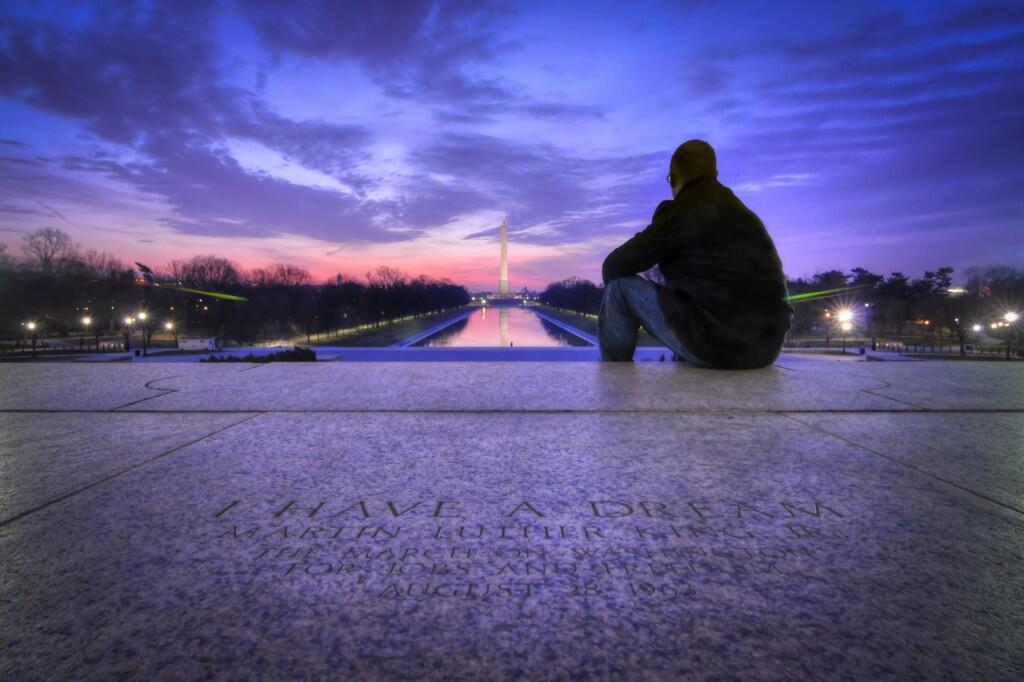
Pic Tweet from the National Park Service: Beautiful photo of the exact spot Dr. King delivered his

Pic Tweet from the National Park Service: Beautiful photo of the exact spot Dr. King delivered his “I Have a Dream speech” 50 years ago today. #MLKdream50 pic.twitter.com/MHwWsY7Hwp

Nice photo from the Lincoln Memorial looking toward the Washington Monument across the length of the Reflecting Pool.

This photo was taken at least several months ago, before the scaffolding went up on the Washington Monument for repairs for damage from the 2011 earthquake.  It’s a winter or fall picture, I’m guessing from the bare trees, and taken early in the morning, as the sun rises in the east over the Capitol and Washington Monument.  That is one of the best times to be at the Lincoln Memorial, in my experience.  The man in the photo has the historic spot very much to himself at that time.

Engraving on the stone says:

I HAVE A DREAM
MARTIN LUTHER KING, JR.
THE MARCH ON WASHINGTON
FOR JOBS AND FREEDOM
AUGUST 28, 1963

More:


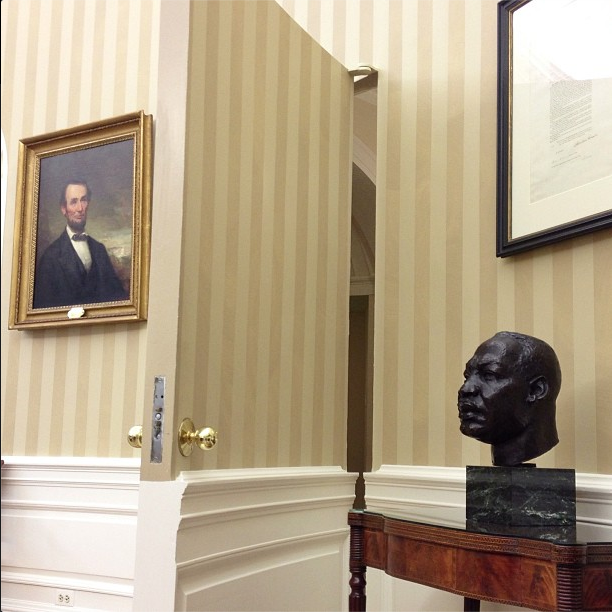
President Lincoln and Rev. Dr. Martin Luther King, Jr., in the Oval Office

August 28, 2013

I remember, just a year ago, when the GOP candidate for president promised to make this photo impossible, replacing King with an Englishman.

150 years later, 50 years later, change gotta come, still.

A better version of the photo:

Painting of Abraham Lincoln, bust of Rev. Dr. Martin Luther King, Jr., together in the Oval Office, White House. (Pete Souza photo?)

Painting of Abraham Lincoln, bust of Rev. Dr. Martin Luther King, Jr., together in the Oval Office, White House. (Pete Souza photo?) Photo published on August 28, 2013, the 50th anniversary of the March on Washington.

Oval office, Martin Luther King, March on Washington, Abraham Lincoln

More:


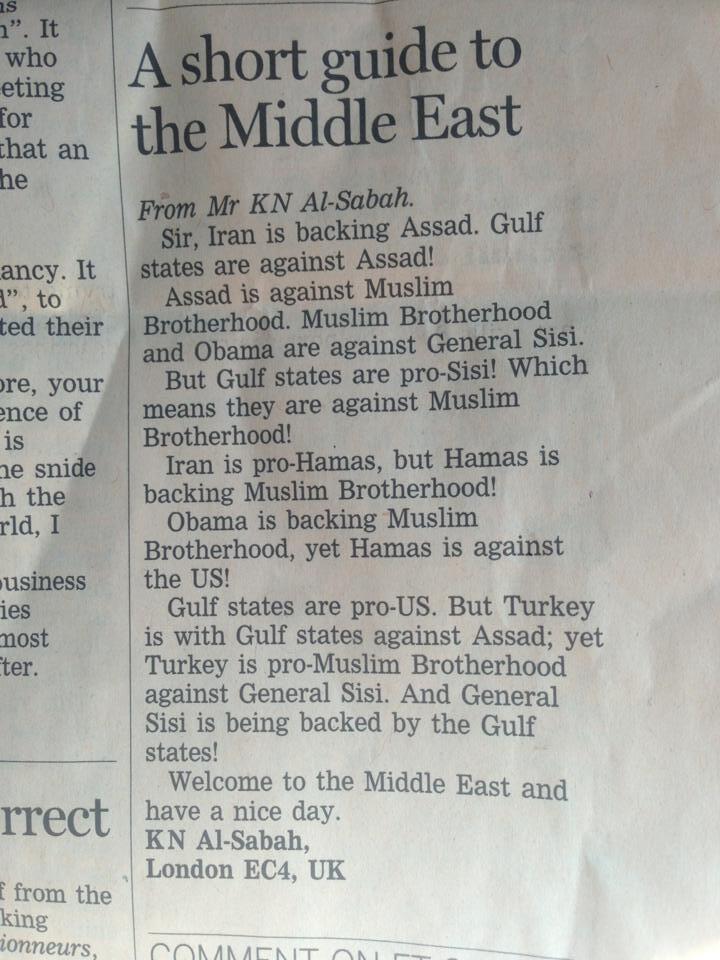
Middle East politics explained, for the novice or anyone else, in six short paragraphs

August 26, 2013

Seven paragraphs, if one counts the cheery close.

Letter to the editor of a London newspaper (trying to track that down), explaining who is who and who is whose enemy, in the Middle East.

Letter to the editor of the Financial Times of London, explaining who is who and who is whose enemy, in the Middle East. August 22, 2013, captured by Randy Prine

A woman named Randy Prine (@RandyPrine) Tweeted this photo, and said:

THIS is why we Voted for an analytical and not ‘shoot from the hip’ McCain or ‘How can I make money’ Romney.

Most of the ObamaH8ers I run into can be stopped on almost all Middle East issues simply by asking them whether the group they rant at, at that moment, is Sunni or Shiite.  For some odd reason, they never know.

Read the rest of this entry »


Taxes are “stolen?” Those who don’t know history, shouldn’t pretend to complain about taxes

August 24, 2013

No, taxes are not “stealing.”  Here’s the offending poster I found on Facebook:

Who are the history-illiterates who make these offensive posters? Taxes are not "stolen," at least, not according to patriots like George Washington.

Who are the history-illiterates who make these offensive posters? Taxes are not “stolen,” at least, not according to patriots like George Washington.

I told one guy who posted it that I thought it was a crude misrepresentation of George Washington, there on the left — but that I had always suspected he didn’t like the “founders,” and was grateful to have any doubts I may have had, removed.

He said, “Huh?”

This Prominent Americans series stamp of the U...

Pay your taxes, maybe they’ll put you on a stamp. This Prominent Americans series stamp of the United States from 1968 features Oliver Wendell Holmes. Wikipedia image

One could always refer to that wonderful line from Justice Oliver Wendell Holmes, Jr., about how he liked to pay taxes because “with them I buy civilization.”  But I suspect most tax revolters in the U.S. don’t much like civilization (and they have the guns to prove it).

Instead I simply told the story of George Washington and the Whiskey Rebellion, the first, and mostly-forgotten, case of U.S. tax rebels.  You know the story.

I wrote:

Yeah, in 1794, a bunch of farmers out in western Pennsylvania got ticked off at taxes. They said paying taxes was like the government stealing from them. And, they had their representatives explain to President George Washington, didn’t they fight a war against paying taxes?

Washington, you may recall, was the Commander in Chief of the Continental Army in the great American Revolution against Great Britain. “No taxes without representation” was one of the original war cries.

Washington said, ‘It takes money to run the government, and that money is collected from the people in taxes fairly levied by their elected representatives.’

The farmers weren’t having any of that. They were way out in western Pennsylvania, near the wilderness Fort Pittsburgh. The federal government, what little bit of it there was, was in Philadelphia. ‘How are they going to make us pay taxes?’ the rebel leaders shouted to crowds.

George Washington

A more friendly portrayal of George “Pay Your Taxes or Swing” Washington – Wikipedia image (which bust is this? Library of Congress?)

Washington got a dozen nooses, and a volunteer army of 13,000 Americans, and marched to western Pennsylvania to hang anyone who wouldn’t pay the tax. Oddly, by the time Washington got there with the nooses, the rebels decided maybe it was a good idea to be patriotic about it after all.

So I assumed you just updated the pictures a little. [In the poster] There’s George Washington on the left, with his Smith and Wesson “noose,” telling the big corporate farmer to pay his taxes.I think your portrayal of Washington is a bit crude, but it’s historically accurate, with regard to taxes.

I always suspected you didn’t like George Washington. Now I know for sure you don’t.

You could have looked it up: The Whiskey Rebellion – http://www.pbs.org/wgbh/amex/duel/peopleevents/pande22.html

I don’t much like crude political dysfunction and disinformation from people who don’t know U.S. history, and won’t defend American principles.  Am I being unreasonable?

More:

Gen. Washington, astride his favorite white horse, reviewing his troops at Carlisle, Pennsylvania, before the march to the western part of the state to put down the Whiskey Rebellion. Image from the Department of the Treasury, Alcohol and Tobacco Tax and Trade Bureau.

Gen. Washington, astride his favorite white horse, reviewing his troops at Carlisle, Pennsylvania, before the march to the western part of the state to put down the Whiskey Rebellion. Image from the Department of the Treasury, Alcohol and Tobacco Tax and Trade Bureau. (Just try to find who painted it!)

https://www.nationalguard.mil/Resources/Image-Gallery/Historical-Paintings/Heritage-Series/To-Execute-the-Laws/FileId/319464/

” . . . to execute the laws . . .” a painting by Donna Neary for the National Guard, on the Whiskey Rebellion. National Guard Caption: In September 1791 the western counties of Pennsylvania broke out in rebellion against a federal excise tax on the distillation of whiskey. After local and federal officials were attacked, President Washington and his advisors decided to send troops to pacify the region. It was further decided that militia troops, rather than regulars, would be sent. On August 7, 1794, under the provisions of the newly-enacted militia law, Secretary of War Henry Knox called upon the governors of Virginia, Maryland, New Jersey, and Pennsylvania for 12,950 troops as a test of the President’s power to enforce the law. Numerous problems, both political and logistical, had to be overcome and by October, 1794 the militiamen were on the march. The New Jersey units marched from Trenton to Harrisburg, Pennsylvania. There they were reviewed by their Commander-in Chief, President George Washington, accompanied by Secretary of the Treasury and Revolutionary war veteran Alexander Hamilton. By the time troops reached Pittsburgh, the rebellion had subsided, and western Pennsylvania was quickly pacified. This first use of the Militia Law of 1792 set a precedence for the use of the militia to “execute the laws of the union, (and) suppress insurrections”. New Jersey was the only state to immediately fulfill their levy of troops to the exact number required by the President. This proud tradition of service to state and nation is carried on today by the New Jersey Army and Air National Guard.


Burqas forced on Texas students?

August 23, 2013

Come the CSCOPE critics from the wilds of Texas:

Of course, if you ask DanaSomething, or any other CSCOPE critic, when and where that burqa event took place, she produces no evidence.

For three weeks now I’ve made a practice of asking CSCOPE critics for evidence of the evils of Texas teachers and curriculum planners they claim occur.

Not a single example has checked out.

If you’re familiar with the “burqa” controversy in Lumberton, Texas, you know the facts don’t square with the CSCOPE critics’ shorthand version.

Monday, February 25th, 2013

Lumberton ISD Response to CSCOPE and Promotion of Islam

Recently a picture had surfaced showing five students dressed in burqas (Islamic attire) in a World Geography classroom at Lumberton High School. The lesson that was offered was not a written CSCOPE lesson; however it informed students to the customary culture of the people in the Middle East. The lesson that occurred was presented on February 1, 2013. As part of the curriculum from the World Geography TEKS (as prescribed by the state of Texas), the students are to study the culture (TEKS number 17):

“Culture. The student understands the distribution, patterns, and characteristics of different cultures.” The student is expected to:

(A)  describe and compare patterns of culture such as language, religion, land use, education, and customs that make specific regions of the world distinctive;

(B)  describe major world religions, including animism, Buddhism, Christianity, Hinduism, Islam, Judaism, and Sikhism, and their spatial distribution;

(C)  compare economic, political, or social opportunities in different cultures for women, ethnic and religious minorities, and other underrepresented populations; and

(D)  evaluate the experiences and contributions of diverse groups to multicultural societies.”

The lesson that was offered focused on exposing students to world cultures, religions, customs, and belief systems. A description on the whiteboard behind the students show the splits in religions: Islam (Sunni and Shia), Judaism (Reform, Conservatives, and Orthodox), and Christianity (Catholic, Orthodox, and Protestant). Clothing expresses the individual culture. The lesson is not teaching a specific religion, and the students volunteered to wear the clothing.

The portrait focused only on Middle Eastern attire and the students are wearing variations of this customary attire found in the Middle Eastern culture. This portrait does not reflect the entire aspect of the lesson. The lesson encompassed diversity education so students receive a firm understanding of our world and why people are motivated differently.

Lumberton ISD has purchased the CSCOPE curriculum however; the teachers are not required to teach the lessons that are provided. The school district follows the Year at a Glance, a scope and sequence of the adopted Texas Essential Knowledge and Skills, as well as the Instructional Focus Document which explains the Rationale, Common Misconceptions for students, TEKS, and the Key Academic Vocabulary that supports conceptual development. The district has great teachers and supports the teachers and their individuality in methods of instructional delivery.

Lumberton is a small  town of about 12,000 people (2010 Census) a few miles north of Beaumont.  Lumberton Independent School District (ISD) schools are “recognized” under the old, just-outdated school and district rating system Texas used, suggesting that student achievement was above average.  State test scores tend to show the same. If this is their example, we should note that in addition to characterizing the lesson wrong, getting wrong the facts of students trying on clothes of other cultures, and the fact that this exercise is not at all related to CSCOPE, the students seem to be learning well.

Kudos to Lumberton, and to CSCOPE, right? Not for the Right Wing Crazies.

Remember, when Glenn Back went on national unwatched television to complain about the “Marxist” lesson in economics, when we finally got the slide, it showed clearly that it favored free marketry.

On this burqa thing?  I’m willing to say no kid has ever been “forced” to wear a burqa for any school purpose — though some may have put on a costume for a report (is that bad?).

In short, I find the critics of CSCOPE to be at odds with the facts, making stuff up to yell about.  Almost every single one of the criticisms for how the Texas standards on Islam are taught, involves the fact that Islam is taught about at all.  CSCOPE critics claim “indoctrination” when it’s clear from lesson plans, support materials, texts, state standards, and test results, that students are simply learning about history, geography and culture.

Shame on any politician who acts on such unhinged, false rants.

There’s a “debate” between Texas State Sen. Dan Patrick, R-Bedlam, and the most sane member of the Texas State Board of Education, Thomas Ratliff, set for this Saturday, in Tyler. One wonders how absurd it can get. Will Patrick tell us which Texas school forced kids to wear burqas?  Don’t bet on it.  Will Patrick provide any other evidence of rampant socialism or Marxism in Texas schools?  No, don’t bet on that, either.

More (good and bad information here; caveat emptor:

The world is still safe for fairness.

The world is still safe for fairness.  Joseph McCarthy remains in his grave on the banks of the Fox River in Appleton, Wisconsin; Texas critics of schools and teachers should leave McCarthy’s scurrilous methods and false claims buried, too.


Fly your flag August 21, for Hawaii Statehood

August 21, 2013

A newsboy happily hawks the Honolulu Star-Bulletin with the headline showing the state had achieved statehood, August 21, 1959.  Star-Bulletin photo

13-year-old paperboy Chester Kahapea happily hawks a commemorative edition of the Honolulu Star-Bulletin with the headline showing the state had achieved statehood after the U.S. House of Representatives passed the law authorizing Hawaii as a state. Star-Bulletin photo by Murray Befeler.

Hawaii’s official statehood day is August 21, commemorating the day in 1959 when Hawaii was recognized as a member of the union of the United States of America.  Hawaiians should fly their flags to day in honor of the date (you may, too).

Hawaii formally celebrates the day on the third Friday in August — oops, last Friday, for 2013.  I hope you joined in the festivities (it’s a holiday in Hawaii) — but under the U.S. Flag Code, you may certainly fly your flags on August 21, regardless which day of the week that is.

Specimen copy of the ballot used by Hawaiians in a June 27, 1959, plebiscite to approve conditions of statehood.  Image from Hawaii Magazine, 2009

Specimen copy of the ballot used by Hawaiians in a June 27, 1959, plebiscite to approve conditions of statehood. Image from Hawaii Magazine, 2009

After the U.S. annexed Hawaii in 1898 (in action separate from the Spanish-American War) attempts at getting Hawaii admitted as a state got rolling.  After World War II, with the strategic importance of the islands firmly implanted in Americans’ minds, the project picked up some steam.  Still, it was 14 years after the end of the war that agreements were worked out between the people of Hawaii, the Hawaiian royal family, Congress and the executive branch.  The deal passed into law had to be ratified by a plebiscite among Hawaiian citizens.  The proposition won approval with 94% of votes in favor.

Some native Hawaiian opposition to statehood arose later, and deference to those complaints has muted statehood celebrations in the 21st century.

Other than the tiny handful of loudmouth birthers, most Americans today are happy to have Hawaii as a state, the fifth richest in the U.S. by personal income.  The nation has a lot of good and great beaches, but the idea of catching sun and surf in Hawaii on vacation might be considered an idealized part of the American dream.

Hawaiian and U.S. flags fly from the stern of a boat touring Hawaii. Are these flags displayed properly, under the U.S. flag code?

Hawaiian and U.S. flags fly from the stern of a boat touring Hawaii. Are these flags displayed properly, under the U.S. flag code?

More:

From Prologue, the blog of the National Archives: This petition, rolled onto a wooden spool, was signed by 116,000 supporters of Hawaii statehood and presented to the U.S. Senate on February 26, 1954. (RG 46, Records of the U.S. Senate)

From Prologue, the blog of the National Archives: This petition, rolled onto a wooden spool, was signed by 116,000 supporters of Hawaii statehood and presented to the U.S. Senate on February 26, 1954. (RG 46, Records of the U.S. Senate)

U.S. postage stamp issued in 2009 commemorating the 50th anniversary of Hawaii's admission to the union.

U.S. postage stamp issued in 2009 commemorating the 50th anniversary of Hawaii’s admission to the union.

English: August 21, 1959 7¢ Rose Hawaii Stateh...

Contrast the first class postage price above with the airmail postage price of this stamp issued in 1959 — August 21, 1959 7¢ Rose Hawaii Statehood C55 26432. Wikipedia image


Lost history: Groucho Marx died on August 19, 1977

August 19, 2013

1958 Publicity photo of Groucho Marx from the television program You Bet Your Life.  NBC Television-NBC Photo/Photographer:  Elmer Holloway

1958 Publicity photo of Groucho Marx from the television program You Bet Your Life. NBC Television-NBC Photo/Photographer: Elmer Holloway

36 years ago?  Grouch Marx died on August 19, 1977? 

cropped version of Image:Grouchoicon.jpg - &qu...

The man became an icon, though too few know the great history behind the icon. “Self-made caricature of Groucho Marx” Wikipedia image


That means that not only have your high school history students probably never seen much, or anything, of Groucho Marx and his comic genius; it means their parents don’t know him, either.

What a great tragedy.

Groucho Marx brought genius to American comedy films, to radio, and then to television.  His genius was of a sort that does not age, but remains fresh to audiences of today — get a group of teenagers to view Duck Soup or A Day at the Races and you’ll find them laughing heartily at even some of Marx’s more cerebral jokes.  It is symbolic that the films that brought writer Norman Cousins to laughter, and a lack of pain, were Marx Brothers movies (in the day when one had to rent a projector to show the film, long before VCR).  Cousins went on to a grand second career talking about hope in healing, starting with the book, Head First: The Biology of Hope and the Healing Power of the Human Spirit.  I recommend these films to anyone seriously injured or ill, or recovering.  We got VHS, and then DVD copies of several of the films when our kids were ill, with great effect.

Groucho Marx should be in the pantheon of great Americans, of the 20th century, if not all time, studied by children in high school, for history and for literature purposes.

Groucho’s been gone for 36 years, and we are much poorer for his passing.

More:

Groucho grills Ray Bradbury and a woman named Leticia on You Bet Your Life in a 1955 episode:

English: Groucho Marx & anonymous blogging

“I intend to live forever, or die trying.” ― Groucho Marx (Wikipedia image)