Even when he’s almost correct, David Barton doctors his accounts of history to make them false: Misquoting John Adams

July 5, 2013

Here’s David Barton‘s screw-up of a John Adams letter:

David Barton cuts John Adams's words off

David Barton’s “Wallbuilders” website featured John Adams’s description of July 2 — but conveniently edited out Adams’s own words, to make it appear as something else. Barton misses the history! What sort of anti-American cuts the words of John Adams when Adams defends liberty’s heritage?
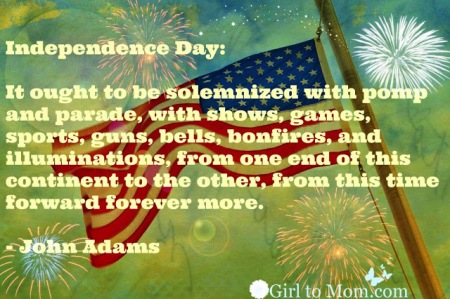
Other groups make the same error as David Barton's Wallbuilders, but without obvious cover ups, restricting their comments to "Independence Day." Accuracy helps, always.

Other groups make the same error as David Barton’s Wallbuilders, but without obvious cover ups, restricting their comments to “Independence Day.” Accuracy helps, always.

“The . . . day of July, 1776?”  What day?

[Barton’s site changes annually, but it keeps repeating the cover-up.]

Faithful readers, and good students of history know that John Adams thought, in 1776, that July 2 would be celebrated as Independence Day.  Why?  July 2, 1776, was the day the 2nd Continental Congress voted to declare the colonies independent of Britain, and no longer under the rule of the Crown or Parliament.

The Declaration of Independence — the press release explaining Richard Henry Lee’s resolution for independence — sat ready to be discussed.  The Congress did not adopt the Declaration until two days later, on July 4.

Our Independence Day celebration falls on the date of the adoption of the Declaration, not the date of the actual resolution declaring independence.

This is a point of great humor among historians.  Even John Adams, more prescient than most soothsayers, could not predict accurately when Americans would celebrate independence.  Here at Millard Fillmore’s Bathtub, we often make a post on or about July 2, noting that humorous discrepancy.

That’s interesting.  It’s inspiring to know these august figures, near-gods in the American pantheon of the 21st century, got things wrong.  It’s humorous.  It’s good history.

What in the hell was David Barton thinking?

What evil purpose is he trying to serve by hiding real history, in such a bizarrely petty way?  Why create a hoax when the words themselves support the point you’re wishing to make, that John Adams thought Americans should celebrate independence?

Screenshot of David Barton's webpage, showing his bizarre butchery of Adams's words.

Screenshot of David Barton’s webpage, showing his bizarre butchery of Adams’s words.

Sheesh! He comes so close to getting something accurate, but he can’t resist monkeying with the words of the Founders.  David Barton reminds me of the guy who cheated at golf so much that, one day when he hit a hole-in-one, he wrote “0!” on the scorecard.  A man who will lie to us about one of the most famous letters in American history will lie about anything, for fun.

More:

John Adams, ca 1816, by Samuel F.B. Morse (Bro...

‘David Barton said what?’ By the time this portrait was painted, Adams knew Americans would celebrate the 4th, and not the 2nd; he seems to be glaring right at David Barton, to tell Barton to quit jerking around with history – John Adams, ca 1816, by Samuel F.B. Morse (Brooklyn Museum) Wikipedia image


Fly your flag today! July 4, 2013, 237 years since the Declaration of Independence

July 4, 2013

It’s a day of tradition — oddly enough, since we are in reality a very new nation, and Lee’s resolution to declare independence from Britain came on July 2.

A soak in Millard Fillmore’s Bathtub is nothing if not a steeping in tradition.  Fly your flag today, to celebrate the independence of the American colonies of Britain.

Fourth of July: NPR has already read the Declaration of Independence (or will soon, if you’re up early), PBS is ready to broadcast the Capitol Fourth concert  (maybe a rebroadcast is available, if you’re off at your own town’s fireworks — check your local listings), your town has a parade somewhere this weekend, or a neighboring community does, and fireworks are everywhere.

At the White House, traditionally, new citizens are sworn in — often people who joined our armed forces and fought for our nation, before even getting the privileges of citizenship.  Fireworks on the Capital Mall will be grand, with the White House hosting a few thousand military people and their families from some of the best views.  Traditionally, five photographers, chosen by lottery, get to shoot photos of the fireworks from the windows of the Washington Monument; will that occur, with the Monument shut down from public view for repair from the earthquake?

There will be great fireworks also in Baltimore Harbor over Fort McHenry, the fort whose siege inspired Francis Scott Key to write the “Star-spangled Banner” from his boat in the harbor, in 1814. Firworks will frighten the bluebirds nesting at Yorktown National Battlefield.  I suspect there will be a grand display at Gettysburg, on the 150th anniversary of the end of that battle. July 4, 1863, also marked the end of the Siege of Vicksburg; tradition holds that Vicksburg did not celebrate the 4th of July for 83 years after that. I’ll wager there will be fireworks there tonight.  In Provo, Utah, the city poobahs will have done all they can to try to live up to their self-proclaimed reputation as having the biggest Independence Day celebration in the nation.  The celebration in Prescott, Arizona, is muted by the tragic deaths of 19 Hot Shot firefighters last week; will drought halt the fireworks, too?  There will be fireworks around the Golden Gate Bridge, in Anchorage, Alaska, reflecting on the waters of Pearl Harbor, and probably in Guam, American Samoa, and the Northern Marianas Islands.

Fireworks on the Fourth is a long tradition — a tradition that kept John Adams and Thomas Jefferson alive, until they both died on the 50th anniversary of the Declaration of Independence, in 1826, the sounds of the fireworks letting Adams know the celebration had begun (Adams erroneously celebrated that Jefferson, the Declaration’s author, still lived, unable to know Jefferson had passed just hours earlier).

Remember to put your flag up today.

Astronaut Eugene Cernan and the U.S. Flag -- Apollo 17 on the Moon (NASA photo)

Last flag on the Moon: Astronaut Eugene Cernan and the U.S. Flag — Apollo 17 on the Moon (NASA photo)

If you’re not on the Moon, here are some tips on flag etiquette, how to appropriately fly our national standard.

Also:

Lunar Reconnaissance Orbiter photo of Apollo 17 landing site

Lunar Reconnaissance Orbiter photo of Apollo 17 landing site

This is mostly an encore post, but I so love that photo of the flag with the Earth in the distance.

Happy birthday, Kathryn!

Fireworks in Duncanville, Texas, for July 4

Fireworks in Duncanville, Texas, for July 4 — Kathryn Knowles’s birthday. We’re always happy the town chimes in with the celebratory spirit.

Tip of the old scrub brush to Thomas Jefferson, Richard Henry Lee, John Adams, Benjamin Franklin, Roger Sherman, Robert Livingston, and the cast of thousands of patriots including George Washington.


One more time: Basic climate science with Bill Nye

July 4, 2013

What year is this? 2013?

Shouldn’t the Sputnik Revolution in science education have obviated the need for this video, like 30 years ago?

One more time, the basics of climate change/global warming, with Bill Nye the Science Guy explaining; from the ClimateRealityProject.org:

http://vimeo.com/climatereality/climate101

climate change, CO2, global warming, science, Bill Nye, environmental protection, Clean Air, Air Pollution

More:

Newsweek, March 4, 1957,

Cover of Newsweek Magazine, from March 4, 1957; notice this concern about U.S. science competency came seven months before Sputnik was launched by the Soviet Union. Science deniers then delayed action until after the Soviets demonstrated clearly that the U.S. was behind. (Image from Computer History.org)


Quote of the moment, still: John Adams, July 2 “the most memorable Epocha in the History of America”

July 2, 2013

“The Second Day of July 1776 will be the most memorable Epocha, in the History of America. . . . It ought to be solemnized with Pomp and Parade, with Shews, Games, Sports, Guns, Bells, Bonfires, and Illuminations from one End of this Continent to the other from this Time forward forever more.”
John Adams to Abigail Adams, July 3, 1776

1776 filled the calendar with dates deserving of remembrance and even celebration. John Adams, delegate from Massachusetts to the Second Continental Congress, wrote home to his wife Abigail that future generations would celebrate July 2, the date the Congress voted to approve Richard Henry Lee’s resolution declaring independence from Britain for 13 of the British colonies in America.

Continental congress DSC_0607

Scene of the crime — Independence Hall in Philadelphia, where the Second Continental congress approved the resolution to declare the colonies independent from Britain – (Photo credit: diablodale)

Two days later, that same Congress approved the wording of the document Thomas Jefferson had drafted to announce Lee’s resolution to the world.

Today, we celebrate the date of the document Jefferson wrote, and Richard Henry Lee is often a reduced to a footnote, if not erased from history altogether.

Who can predict the future?

(You know, of course, that Adams and Jefferson both died 50 years to the day after the Declaration of Independence, on July 4, 1826. In the 50 intervening years, Adams and Jefferson were comrades in arms and diplomacy in Europe, officers of the new government in America, opposing candidates for the presidency, President and Vice President, ex-President and President, bitter enemies, then long-distance friends writing almost daily about how to make a great new nation. Read David McCullough‘s version of the story, if you can find it.)

(Yes, this is mostly an encore post.)

More, and Related articles:

The Lee Resolution.

The Lee Resolution, passed by the Second Continental Congress on July 2, 1776 – Wikipedia image (Wait a minute: Are those numbers added correctly? What are they?)


Texas State Capitol Rotunda — all quiet on the former front, for now

June 28, 2013

A vertical panorama — neat idea.

Joe Deshotel  - Panorama of empty rotunda at Texas Capitol - dome to floor. Posted on Twitter June 27, 2013

Joe Deshotel – Panorama of empty rotunda at Texas Capitol – dome to floor. Posted on Twitter June 27, 2013

This is the building that, just hours before, had been crowded by thousands of people hoping to get into the Texas Senate Chamber to see Sen. Wendy Davis’s filibuster.

Star on the dome of the Texas State Capitol; a similar star is five very long stories below, on the floor.

Star on the dome of the Texas State Capitol; a similar star is five very long stories below, on the floor. Image via Shapleigh.org, “Grover’s Tub.”

Look carefully, and you can see that the guides in the Capitol don’t lie — the star on the dome reflects the star on the floor (or vice versa).

Can you get a similar shot of the rotunda of your state capitol? Would you do it and send it in, or post it and give us the link?

Tip of the old scrub brush to Reeve Hamilton.


Amazon haiku to Sen. Wendy Davis’s pink Mizuno shoes

June 27, 2013

(Yes, you’re right — the shoes are red, not pink.)

Texas State Sen. Wendy Davis‘s filibuster so insinuated itself into our culture already that it is now a part of shoe reviews at Amazon.com:

Mizuno running shoes for sale at Amazon.com -- the same shoes Sen. Wendy Davis wore during her filibuster on June 25, 2012.

Mizuno running shoes for sale at Amazon.com — the same shoes Sen. Wendy Davis wore during her filibuster on June 25, 2012.

Customer Review


147 of 150 people found the following review helpful

5.0 out of 5 stars SHOES HAIKUS, June 27, 2013

By

mistersnoid “mistersnoid”

This review is from: Mizuno Women’s Wave Rider 16 Running Shoe (Apparel)

Wendy wore these, and
she wasn’t even running.
Here’s hopes she soon will!

Standing and talking,
one needs a lot of support.
You have all of ours.

More:

Mizuno's red running shoes, worn by Texas Sen. Wendy Davis.  Image from Outside the Beltway

Mizuno’s red running shoes, worn by Texas Sen. Wendy Davis. Image from Outside the Beltway


Annals of global warming: Keeling Curve gone vertical

June 22, 2013

What is the Keeling Curve?

What does it look like now?  See this graphic from the New York Times:

Keeling Curve graph and grahic, New York Times, May 11, 2013

New York Times, May 11, 2013

See the daily update of the Keeling Curve at the Scripps Institute site, University of California at San Diego.

More:


Unintentional dry humor from CBO; don’t make a Denali out of a molehill, though

June 21, 2013

A mountain by any other name would be just as high. Image of Denali from Tiny Green Cabins

A mountain by any other name would be just as high. Image of Denali from Tiny Green Cabins

I get e-mail from the Congressional Budget Office.  I asked them to keep me posted on the studies they do, and they have.

Today, this:

S. 155, a Bill to Designate a Mountain in the State of Alaska as Denali

cost estimate

June 21, 2013
read complete document  (pdf, 27 kb)

As ordered reported by the Senate Committee on Energy and Natural Resources on June 18, 2013.

CBO estimates that enacting this legislation to name a peak in Alaska would have no significant impact on the federal budget and would not affect direct spending or revenues; therefore, pay-as-you-go procedures do not apply. S. 155 contains no intergovernmental or private-sector mandates as defined in the Unfunded Mandates Reform Act and would not affect the budgets of state, local, or tribal governments.

Calling a mountain by its name won’t affect the budget?  Good news, I’m sure.  Shakespeare was right.

The testimony of National Park Service Deputy Director Peggy O’Dell is instructive:

STATEMENT OF PEGGY O’DELL, DEPUTY DIRECTOR FOR OPERATIONS, NATIONAL PARK SERVICE, DEPARTMENT OF THE INTERIOR, BEFORE THE SUBCOMMITTEE ON NATIONAL PARKS OF THE SENATE ENERGY AND NATURAL RESOURCES COMMITTEE, CONCERNING S. 155, TO DESIGNATE A MOUNTAIN IN THE STATE OF ALASKA AS DENALI.

April 23, 2013

Mr. Chairman, thank you for the opportunity to present the Department of the Interior’s views on S. 155, a bill to designate a mountain in the State of Alaska as Denali.

The National Park Service appreciates the long history and public interest for both the name Mount McKinley and the traditional Athabascan name, Denali. The Department respects the choice made by this legislation, and does not object to S. 155.

Located in what is now Denali National Park and Preserve, the highest peak in North America has been known by many names. The National Park Service’s administrative history of the park notes that, “The Koyukon called it Deenaalee, the Lower Tanana named it Deenaadheet or Deennadhee, the Dena’ina called it Dghelay Ka’a, and at least six other Native groups had their own names for it.

“In the late 18th century various Europeans came calling, and virtually everyone who passed by was moved to comment on it. The Russians called it Bulshaia or Tenada, and though explorers from other nations were less specific, even the most hard-bitten adventurers were in awe of its height and majesty.

“No American gave it a name until Densmore’s Mountain appeared in the late 1880s, and the name that eventually stuck—Mount McKinley—was not applied until the waning days of the nineteenth century,” a gesture of support to then-President William McKinley.

In 1975, the State of Alaska officially recognized Denali as the name of the peak, and requested action by the U.S. Board on Geographic Names to do the same.

In 1980, Congress changed the name of Mount McKinley National Park to Denali National Park and Preserve (P.L. 96-487, Section 202), but did not act on the name change for the mountain.

In Washington, Congress designates mountains.  In Alaska, mountains designate you.

More:

Mount McKinley

Near-antique poster advertising Ranger Services at the National Park Formerly Known as Mount McKinley. Photo by Kirt Baab


Time to raise the minimum wage

June 21, 2013

Illustration for Bloomberg News by Rand Renfrow: $15 Minimum Wage

Illustration for Bloomberg News by Rand Renfrow: $15 Minimum Wage

Robert Reich put it succinctly at his Facebook site [links added here]:

Nick Hanauer, one of the nation’s most successful businessmen, proposed yesterday that the minimum wage be raised to $15 an hour. But wouldn’t that cause employers not to hire workers who were “worth” less, and thereby lead to higher unemployment? No, says Hanauer. By putting more money into the hands of more people, it would stimulate more buying — which would generate more jobs than any jobs that might be lost. Hanauer understands that the basic reason the economy is still limping along is workers are consumers, and workers continue to get shafted, which means consumers lack the purchasing power to get the economy off the ground. A minimum wage of $15 an hour, combined with basic worker standards such as paid sick leave and a minimum of 3 weeks paid vacation per year, should all be in a national campaign for better jobs and a better economy in the 2014 election.

That’s the case, in brief.

Last March Reich said raising the minimum wage to $9/hour was a “no brainer.”

Alas, he didn’t account enough for the anti-brain lobby.

What do you think?

More:

Also good, an update:


Why are flags flying in West Virginia today? Statehood

June 20, 2013

On June 20, 1863, West Virginia joined the fractured union as the 35th state.

Yes, that was during the Civil War.  Yes, West Virginia had been the northwestern counties of Virginia.  No, I’m not sure of the history of how Congress decided Virginia had consented to be divided.

In any case, per the guidelines in the U.S. Flag Code, West Virginians should fly the U.S. flag today in honor of their statehood, 150 years ago.  Lots of celebrations, reenactments, and general festive events are planned in West Virginia this weekend.

West Virginia's State Capitol in Charleston, West Virginia, on December 11, 2011

West Virginia’s State Capitol in Charleston, West Virginia, on December 11, 2011 — built in 1931. From O Palsson’s Flickr collection: “As I was traveling through Charleston, the capital of West Virgina, during blue hour (my favorite time of day) a couple of days after Thanksgiving, I happened upon this beautiful sight of the State Capitol Building reflected in the Kanawha River flowing by in total stillness, so I just had to stop and capture the scene. I didn’t have a tripod handy, so this is not a long-exposure nightshot, just a regular hand-held shot accomplished by bumping up the ISO as much as I dared to get correct exposure at acceptable shutter speed (ended up being 1/40 sec) and doing my best to keep the camera steady.”

Kathryn and I have a few fond memories of Charleston.  Then-West Virginia Attorney General Charlie Brown was one of the few with enough wisdom to offer me a job, when I graduated from the National Law Center at George Washington University as an older student.  Brown promised to clean up West Virginia politics, and he had a lively, very young crew of attorneys fighting coal companies, oil companies, loggers, shady real estate people, and corrupt city, county and state officials.  One fellow in the office complained that he’d “had to argue eight cases” at the State Supreme Court that year, in his first year out of law school.

But the corrupt officials knew what they were doing.  Brown could only offer $25,000 a year, and in Charleston it was unlikely we’d be able to find any work for Kathryn.  Tough to attract crime fighters at less-than crime-fighting rates. It would have been a more than 75% cut in income.  We made a trip there to mull it over, baby on the way (pre-digital photographs buried here in the archives).  Brown got a special dispensation to offer $5,000 more.

Great tour of the Capitol, great interviews with the office lawyers.  Kathryn and I sat for a long while in the deserted West Virginia Supreme Court (sort of tucked into an attic of the Capitol) discussing how in the world we could afford to move the Charleston and take on the work.  We drove around the city, looking at houses for sale and rent; we gazed at the Kanawha River and discussed the future for the city.

We went to dinner in a tiny restaurant touted as Charleston’s finest, which was a long way from good eateries in D.C.  We discussed with our host the cultural pickings in Charleston.  We could give up the symphony but get back to fishing and practice fly fishing . . .

A few tables over, the maitre ‘d brought in a few extra chairs, and then seated Muhammed Ali and his party.  Our waiter asked that we not make a scene.

I don’t remember for what charitable purpose Ali was in Charleston, but the event was over and his hosts took him out to the good restaurant in Charleston, too.

Ali was a slower, sedate and gentle version of the fiery fighter he’d been.  Parkinson’s disease already had him in its grip.  His voice, soft as it could be at times, was still strong enough to carry across a table.  There was a young boy with the group, under five years old.  Ali had lost steps, but not spirit.  He produced a couple of balls from a pocket and proceeded to dazzle the kid with sleight-of-hand magic tricks.  He picked one of the balls from behind the kid’s ear, and the kid giggled wonderfully.  Balls appeared here, disappeared there — I remember thinking how much easier those tricks could be with hands that big; but Ali also had difficulty dealing with a knife and fork.  Working magic tricks pulled years away from Ali, and he seemed much younger, much more deft than he really was.  The little boy laughed and giggled through the meal.  It was a happy affair.

Our dinners finished about the same time.  As we got up, Ali looked over at us and said, “You wonder why I spend so much time with children?  They are the future.”

I turned down the offer from West Virginia.  A job I’d hoped for at American Airlines fell through, but a position opened up at the Office of Educational Research and Improvement (OERI) at Bill Bennett’s Department of Education.  A year or so later I saw small item in the Washington Post that Charlie Brown had been indicted on some charge.  Coal companies still have a lot of clout in West Virginia.

This is an anniversary day for Ali, too:  June 20, 1967, Muhammed Ali was convicted in Houston, Texas, of evading the draft.  That conviction was overturned by the U.S. Supreme Court.

Fly those flags in West Virginia.

More:

U.S. and West Virginia flags flying together.  Photo by Stephen-KarenConn

U.S. and West Virginia flags flying together. Photo by Stephen-KarenConn


Rachel Carson project won first at National History Day competition

June 19, 2013

News from the San Ramon (California) Express [links added here, except for reporter’s contact]:

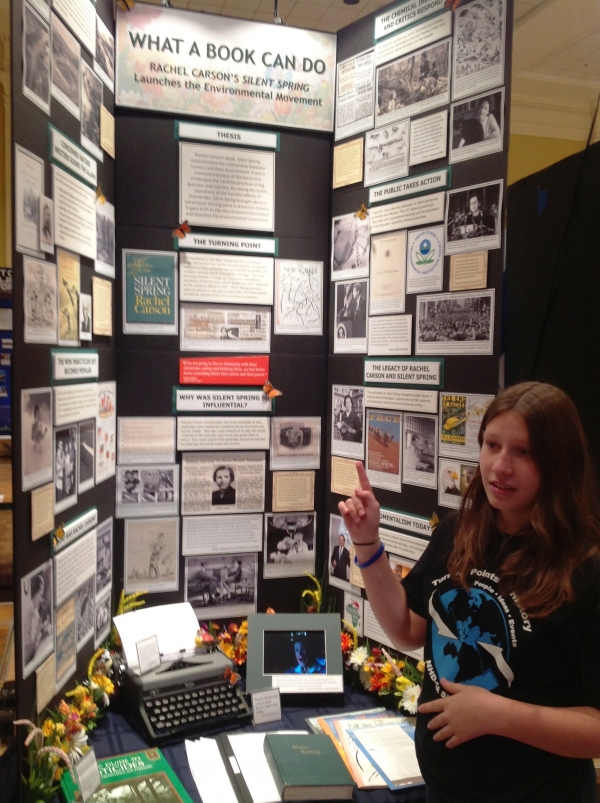
Julienne Sauer in front of her project,

Julienne Sauer in front of her project, “What a book can do — Rachel Carson‘s Silent Spring Launches the Environmental Movement.” (© 2013 San Ramon Express)

San Ramon student takes first at National History Day contest

by Jessica Lipsky

Windemere Ranch Middle School student was one of 30 recognized by the National Endowment for the Humanities (NEH) for their impressive use of historic newspapers in projects presented at National History Day.

Julienne Sauer, who graduated from eighth grade last week, took first place in NEH’s individual exhibit junior division for her project titled “What a book can do — Rachel Carson’s Silent Spring Launches the Environmental Movement.” This year’s National History Day theme was “Turning Points in History: People, Ideas, Events.”

Julienne was also named a National Endowment Humanities Scholar.

The annual event is the culmination of a year-long academic program in which students in middle and high school conduct original historical research for papers, exhibits, websites, documentaries and public performances. Each year more than 600,000 students compete in local, regional and state competitions for a chance to win a spot at the national finals.

This year was the first time NEH awarded prizes to students who incorporated into their projects research using Chronicling America, a free online database of 5 million pages of historic US newspapers dating from 1836 to 1922, digitized through a partnership between NEH and the Library of Congress.

Julienne won a national finalist award at the 2011 National History Day exhibit for her exhibit titled “The Cable Car Wars: A City Debates to Preserve its Character.”

Carson’s work was good enough that, even 49 years after her death, 51 years after the publication of Silent Spring, Carson and the book still inspire students to heights of excellence in study.

More:


Querying the Rachel Carson Critics (who turned out the light?)

June 19, 2013

Another question of mine that will probably never see the light of day.  This group has no answer, so why would they allow the question?

I stumbled across a blog-looking page from the American Council on Science and Health, an industry apologist propaganda site, on World Malaria Day, which was April 25.  You may recognize the name of the group as one of the industry-funded sites that constantly attacks Rachel Carson, and often the World Health Organization, with the unscientific and false claims that environmentalists bannned DDT and thereby condemned millions of Africans to die from malaria — which, ASCH claims, could have easily been eradicated with more DDT poisoning of Africa.

On World Malaria Day, ASCH took note, flirted with the facts (that DDT doesn’t work as it once was thought to work), but then backed away from the facts — that the ban on DDT in the U.S. came years AFTER WHO suspended the malaria eradication campaign in Africa when it was discovered DDT couldn’t kill DDT-adapted mosquitoes, already subject to years of abuse of DDT by agriculture and other industries.  ASCH said:

DDT kills mosquitoes, although not as well as it did 60 years ago. But it also irritates them and repels them, so the small amount sprayed inside homes effectively reduces the transmission of the malarial microbe substantially. The banning of DDT, based upon political anti-chemical bureaucrats and “environmentalists” inspired by Carson’s “Silent Spring” who ran our EPA in 1972, helped to impede the malaria control program led by the UN’s WHO.

Impede?  Impossible for a 1972 ban to have been responsible for the earlier suspension of the WHO campaign, not to mention EPA’s ban ended at the U.S. borders.  So I asked:

Screen capture of query to ACSH on how EPA's ban "impeded" WHO's campaign against malaria, ended years earlier.

Screen capture of query to ACSH on how EPA’s ban “impeded” WHO’s campaign against malaria, ended years earlier.

Ed Darrell Reply

June 19, 2013 at 5:16 am

Your comment is awaiting moderation.

I would be very interested in just how the 1972 ban on DDT in the U.S. “impeded” the UN’s antimalaria campaign, which stopped using DDT heavily seven years earlier, and was suspended in 1969.

After the ban on U.S. use of DDT, all of U.S. manufacture was dedicated to export to Africa and Asia, which greatly increased DDT supplies available there.

How did this impede?

Want to wager a guess as to whether they’ll ever allow the comment to see the light of day at their site, let alone answer it?

More:

Wall of Shame – Sites that continue to spread the pro-DDT hoax as fact:

DDT is good for me advertisement

“DDT is good for me advertisement” from circa 1955.  Photo image from the Crossett Library Bennington College.  This ad today is thought to be emblematic of the propaganda overkill that led to environmental disasters in much of the U.S. and the world.  DDT cleanups through the Superfund continue to cost American taxpayers millions of dollars annually.


June 15: Magna Carta anniversary, #798

June 15, 2013

In 2015 we’ll celebrate the 800th anniversary of the signing of the Magna Carta.  I predict that, beginning in late 2014, pseudo-historians will begin an assault on the history of the document, attempting to convince us that the document banned income taxes, banished the poor from hospitals and job finding agencies, and said children should have to work for their meals and never get food stamps. 

I hope I’m wrong.

Today, June 15, 2013, is the 798th anniversary of the signing of the Magna Carta.  The document laid a foundation for freedom, almost 800 years ago, upon which we stand today.

Runnymede, Magna Carta Isle, photo by Wyrdlight, Antony McCallum, 2008 (Wikimedia)

What event critical to western history and the development of the democratic republic in the U.S. happened here in 1215?

A teacher might use some of these photos explaining the steps to the Constitution, in English law and the heritage of U.S. laws. Other than the Magna Carta, all the events of Runnymede get overlooked in American studies of history. Antony McCallum, working under the name Wyrdlight, took these stunning shots of this historic meadow. (He photographs stuff for studies of history, it appears.)

Maybe it’s a geography story.

View of Runnymede Meadow from Engham Village -- Wyrdlight photo through Wikimedia

View of Runnymede Meadow from Engham Village — Wyrdlight photo through Wikimedia

Several monuments to different events of the past millennium populate the site. The American Bar Association dedicated a memorial to the Magna Carta there — a small thing open to the air, but with a beautiful ceiling that is probably worth the trip to see it once you get to England.

Wikipedia explains briefly, with a note that the ABA plans to meet there again in 2015, the 800th anniversary of the Great Charter:

Magna Carta Memorial


The Magna Carta Memorial & view towards the ‘medes’


Engraved stone recalling the 1985 ABA visit

Situated in a grassed enclosure on the lower slopes of Cooper’s Hill, this memorial is of a domed classical style, containing a pillar of English granite on which is inscribed “To commemorate Magna Carta, symbol of Freedom Under Law”. The memorial was created by the American Bar Association to a design by Sir Edward Maufe R.A., and was unveiled on 18 July 1957 at a ceremony attended by American and English lawyers.[5]

Since 1957 representatives of the ABA have visited and rededicated the Memorial renewing pledges to the Great Charter. In 1971 and 1985 commemorative stones were placed on the Memorial plinth. In July 2000 the ABA came:

to celebrate Magna Carta, foundation of the rule of law for ages past and for the new millennium.

In 2007 on its 50th anniversary the ABA again visited Runnymede and during the convention installed as President Charles Rhyne who devised Law Day which seeks in the USA an annual reaffirmation of faith in the forces of law for peace.

The ABA will be meeting at Runnymede in 2015 on the 800th anniversary of the sealing of the original charter.

The Magna Carta Memorial is administered by the Magna Carta Trust, which is chaired by the Master of the Rolls.[10]

In 2008, flood lights were installed to light the memorial at night, but due to vandalism they now lie smashed.

I’ll wager the lights get fixed before 2015.

Detail of the Magna Carta monument at Runnymed...

Detail of the Magna Carta monument at Runnymede. I took this photo some time in the early Eighties. (Photo credit: Wikipedia)

This is mostly an encore post.

More:


Flag Day 2013 – Fly your flag today!

June 14, 2013

Of course, you’re already flying your Stars and Stripes, right?

I’ve been on the road, mostly without internet access; I’m tardy in my reminder.

June 14th marks the anniversary of the resolution passed by the Second Continental Congress in 1777, adopting the Stars and Stripes as the national flag.

Fly your flag today. This is one of the score of dates upon which Congress suggests we fly our flags.

Flag Day 1916, parade in Washington, D.C. - employees of National Geographic Society march - photo by Gilbert Grosvenor

Flag Day 1916, parade in Washington, D.C. – employees of National Geographic Society march – photo by Gilbert Grosvenor

The photo above drips with history. Here’s the description from the National Geographic Society site:

One hundred and fifty National Geographic Society employees march in the Preparedness Parade on Flag Day, June 14, in 1916. With WWI underway in Europe and increasing tensions along the Mexican border, President Woodrow Wilson marched alongside 60,000 participants in the parade, just one event of many around the country intended to rededicate the American people to the ideals of the nation.

Not only the anniversary of the day the flag was adopted by Congress, Flag Day is also the anniversary of President Dwight Eisenhower’s controversial addition of the words “under God” to the Pledge of Allegiance in 1954.

(Text adapted from “:Culture: Allegiance to the Pledge?” June 2006, National Geographic magazine)

The first presidential declaration of Flag Day was 1916, by President Woodrow Wilson. Wilson won re-election the following November with his pledge to keep America out of World War I, but by April of 1917 he would ask for a declaration of war after Germany resumed torpedoing of U.S. ships. The photo shows an America dedicated to peace but closer to war than anyone imagined. Because the suffragettes supported Wilson so strongly, he returned the favor, supporting an amendment to the Constitution to grant women a Constitutional right to vote. The amendment passed Congress with Wilson’s support and was ratified by the states.

The flags of 1916 should have carried 48 stars. New Mexico and Arizona were the 47th and 48th states, Arizona joining the union in 1913. No new states would be added until Alaska and Hawaii in 1959. That 46-year period marked the longest time the U.S. had gone without adding states, until today. No new states have been added since Hawaii, more than 49 years ago. (U.S. history students: Have ever heard of an essay, “Manifest destiny fulfilled?”)

150 employees of the National Geographic Society marched, and as the proud CEO of any organization, Society founder Gilbert H. Grosvenor wanted a photo of his organization’s contribution to the parade. Notice that Grosvenor himself is the photographer.

I wonder if Woodrow Wilson took any photos that day, and where they might be hidden.

History of Flag Day from a larger perspective, from the Library of Congress:

Since 1916, when President Woodrow Wilson issued a presidential proclamation establishing a national Flag Day on June 14, Americans have commemorated the adoption of the Stars and Stripes by celebrating June 14 as Flag Day. Prior to 1916, many localities and a few states had been celebrating the day for years. Congressional legislation designating that date as the national Flag Day was signed into law by President Harry Truman in 1949; the legislation also called upon the president to issue a flag day proclamation every year.

According to legend, in 1776, George Washington commissioned Philadelphia seamstress Betsy Ross to create a flag for the new nation. Scholars debate this legend, but agree that Mrs. Ross most likely knew Washington and sewed flags. To date, there have been twenty-seven official versions of the flag, but the arrangement of the stars varied according to the flag-makers’ preferences until 1912 when President Taft standardized the then-new flag’s forty-eight stars into six rows of eight. The forty-nine-star flag (1959-60), as well as the fifty-star flag, also have standardized star patterns. The current version of the flag dates to July 4, 1960, after Hawaii became the fiftieth state on August 21, 1959.

Fly your flag with pride today.

Elmhurst Flag Day 1939, DuPage County Centennial - Posters From the WPA

Elmhurst flag day, June 18, 1939, Du Page County centennial / Beauparlant.
Chicago, Ill.: WPA Federal Art Project, 1939.
By the People, For the People: Posters from the WPA, 1936-1943

This is an encore post, from June 14, 2009, and other previous Flag Days.

More, and Other Voices:


Do Nothing GOP Congress

June 13, 2013

Poorly-attended hearing of Congressional Joint Economic Committee hearing on jobs, 2013

“Do Nothing Congress?” How about “Missing in Inaction Congress?” Photo and caption from National Journal: When the Joint Economic Committee’s hearing on fixing the nation’s long-term unemployment problem kicked off on April 24, only one lawmaker was in attendance: Sen. Amy Klobuchar, the committee’s vice chair who was holding the hearing. (Niraj Chokshi)

National Journal’s article fairly damns Congress and especially the House for doing very little this year about jobs.

Probably more damning is this little fact:  In a period of time that historically might see 50 or 100 laws passed, Congress has passed into law only 13 measures.  The “Do Nothing” 80th Congress Truman campaigned against passed nearly 900 laws.  The current Congress is on track to pass 52.  Most important, probably, are the authorization and appropriations bills for the different departments of the federal government, much more important than the non-binding budget resolutions conservatives whine about.  Republicans have successfully blocked almost all authorization and appropriations action.  Appropriations bills, of course, must originate in the GOP-shackled House of Representatives.

In the six months and four days since the 113th Congress began, it has passed 13 laws. And, despite lawmakers constantly beating the drum on boosting jobs, none of the new measures have been focused on employment. Here’s a list of what the 113th Congress has passed in its first six months:

  1. H.R.41: To temporarily increase the borrowing authority of the Federal Emergency Management Agency for carrying out the National Flood Insurance Program.
    Sponsor: Rep Garrett, Scott [NJ-5] (introduced 1/3/2013) Cosponsors (44)
  2. H.R.152: Disaster Relief Appropriations Act, 2013
    Sponsor: Rep Rogers, Harold [KY-5] (introduced 1/4/2013) Cosponsors (None)
  3. H.R.325: No Budget, No Pay Act of 2013
    Sponsor: Rep Camp, Dave [MI-4] (introduced 1/21/2013) Cosponsors (1)
  4. S.47: Violence Against Women Reauthorization Act of 2013
    Sponsor: Sen Leahy, Patrick J. [VT] (introduced 1/22/2013) Cosponsors (61)
  5. H.R.307: Pandemic and All-Hazards Preparedness Reauthorization Act of 2013
    Sponsor: Rep Rogers, Mike J. [MI-8] (introduced 1/18/2013) Cosponsors (5)
  6. H.R.933: Consolidated and Further Continuing Appropriations Act, 2013
    Sponsor: Rep Rogers, Harold [KY-5] (introduced 3/4/2013) Cosponsors (None)
  7. S.716: A bill to modify the requirements under the STOCK Act regarding online access to certain financial disclosure statements and related forms.
    Sponsor: Sen Reid, Harry [NV] (introduced 4/11/2013) Cosponsors (None)
  8. H.R.1246: District of Columbia Chief Financial Officer Vacancy Act
    Sponsor: Rep Norton, Eleanor Holmes [DC] (introduced 3/19/2013) Cosponsors (None)
  9. H.R.1765: Reducing Flight Delays Act of 2013
    Sponsor: Rep Latham, Tom [IA-3] (introduced 4/26/2013) Cosponsors (None)
  10. H.R.1071: To specify the size of the precious-metal blanks that will be used in the production of the National Baseball Hall of Fame commemorative coins.
    Sponsor: Rep Hanna, Richard L. [NY-22] (introduced 3/12/2013) Cosponsors (2)
  11. H.R.360: To award posthumously a Congressional Gold Medal to Addie Mae Collins, Denise McNair, Carole Robertson, and Cynthia Wesley to commemorate the lives they lost 50 years ago in the bombing of the Sixteenth Street Baptist Church, where these 4 little Black girls’ ultimate sacrifice served as a catalyst for the Civil Rights Movement.
    Sponsor: Rep Sewell, Terri A. [AL-7] (introduced 1/23/2013) Cosponsors (301)
  12. H.R.258: Stolen Valor Act of 2013
    Sponsor: Rep Heck, Joseph J. [NV-3] (introduced 1/15/2013) Cosponsors (127)
  13. S.982: Freedom to Fish Act
    Sponsor: Sen Alexander, Lamar [TN] (introduced 5/16/2013) Cosponsors (3)

Freedom to Fish Act?  No doubt it is important to someone.  But even that someone, or those somebodies, would benefit from a jobs bill, more than from the Freedom to Fish Act.

When I worked for Lamar Alexander, I found him to be among the more fair and forward thinking of elected politicians.  It’s good to see he can still move a bill.

It’s tragic he’s been unable to push the GOP to move on more important matters.

The “Do-Nothing Congress” Harry Truman successfully indicted in 1948 looks like Wilma Rudolph streaking over the finish line in the 1960 Rome Olympics, by comparison.

I recall sitting up to get the news out to Utah, and anyone else interested in the nation, when Congress would pass 13 laws in a night.  At no point did it occur to me to think “these are the good old days of America,” then.

More:

taken by yours truly during 2007 hof induction...

Baseball Hall of Fame on Induction Weekend, 2007, crowded with people who now need jobs.  Congress passed a bill dealing with the Baseball Hall of Fame.  Ironic, no? All inductees in Cooperstown got there by doing something, doing it with hustle, and doing a lot, a sharp contrast to the 2013-2014 U.S. Congress.  Wikipedia image