Forgotten disasters in U.S. schools: The New London, Texas, gas explosion

March 18, 2013

Most high school history students don’t know about it.  Most high school history students in Texas don’t know about it.

New London School, New London, Texas, before the 1937 disaster.  Photo from the New London Museum

New London School, New London, Texas, before the 1937 disaster. Photo from the New London Museum

I wonder, sometimes, how many Texans remember at all.

I wonder, too, if there are lessons to be learned from the New London tragedy, while the nation debates what to do to prevent recurrences of school shootings.

The deadliest disaster ever to hit a public school in the U.S. struck on March 18, 1937, when a natural gas explosion destroyed the new school building at New London, Texas, killing about 300 people — 76 years ago today.

The remains of the London School after the exp...

The remains of the London School after the explosion of March 18, 1937. Wikipedia photo

Noise from the blast alerted the town, and many people in the oilfields for many miles.  Telephone and telegraph communication got word out.  Oil companies dismissed their employees, with their tools, to assist with rescue and recovery efforts.  Notably, 20-year-old Walter Cronkite came town to report the news for a wire service.

Investigation determined that a leak in a newly-installed tap into the waste gas pipe coming from nearby oil fields probably allowed natural gas to accumulate under the building.  A spark from a sander started a fire in gas-filled air, and that in turn exploded the cavern under the school.  School officials approved the tap to the waste gas line to save money.  Natural gas is odorless.  One result of the disaster was a Texas law requiring all utility natural gas to be odorized with ethyl mercaptan.

Though the Great Depression still gripped the nation, wealth flowed in New London from oil extraction from the nearby oil fields.  The  school district completed construction on a new building in 1939, just two years later — with a pink granite memorial cenotaph in front.

Today, disasters produce a wealth of litigation, tort suits trying to get money to make the injured whole, and to sting those at fault to change to prevent later disasters.  In 1937 official work cut off such lawsuits.

Three days after the explosion, inquiries were held to determine the cause of the disaster. The state of Texas and the Bureau of Mines sent experts to the scene. Hearings were conducted. From these investigations, researchers learned that until January 18, 1937, the school had received its gas from the United Gas Company. To save gas expenses of $300 a month, plumbers, with the knowledge and approval of the school board and superintendent, had tapped a residue gas line of Parade Gasoline Company. School officials saw nothing wrong because the use of “green” or “wet” gas was a frequent money-saving practice for homes, schools, and churches in the oilfield. The researchers concluded that gas had escaped from a faulty connection and accumulated beneath the building. Green gas has no smell; no one knew it was accumulating beneath the building, although on other days there had been evidence of leaking gas. No school officials were found liable.

These findings brought a hostile reaction from many parents. More than seventy lawsuits were filed for damages. Few cases came to trial, however, and those that did were dismissed by district judge Robert T. Brown for lack of evidence. Public pressure forced the resignation of the superintendent, who had lost a son in the explosion. The most important result of the disaster was the passage of a state odorization law, which required that distinctive malodorants be mixed in all gas for commercial and industrial use so that people could be warned by the smell. The thirty surviving seniors at New London finished their year in temporary buildings while a new school was built on nearly the same site. The builders focused primarily on safety and secondarily on their desire to inspire students to a higher education. A cenotaph of Texas pink granite, designed by Donald S. Nelson, architect, and Herring Coe, sculptor, was erected in front of the new school in 1939.  (Texas Handbook of History, Online, from the Texas State Historical Association)

Of about 500 students, more than 50% of them died.  Once the new school and memorial were built, and the law passed requiring utilities to odorize natural gas so leaks could be detected earlier, survivors and rescuers rather shut down telling the history.  A 1977 reunion of survivors was the first in 40 years.

New London School shortly after the March 18, 1937, explosion.  Photo from the New London Museum.

New London School shortly after the March 18, 1937, explosion. Photo from the New London Museum.

Because of that healing silence, the story slipped from the pages of most history books.

Trinity Mother Frances Hospital treated the victims; a 2012 film from the hospital offers one of the best short histories of the events available today.

New London, and the New London Museum, work to remember the dead and honor them.  Work continues on a film about the disaster, perhaps for release in 2013:

Now, more than 75 years later, the London Museum, across the highway from where the original school was destroyed, keeps alive the memory of much of a generation who died on that terrible day.

This video was produced by Michael Brown Productions of Arlington, TX as a prelude to a feature documentary on the explosion and its aftermath which is planned for
the spring of 2013.  . . .

www.newlondonschool.org/museum

What are the lessons of the New London Disaster?  We learned to remember safety, when dealing with natural gas.  A solution was found to alert people to the presence of otherwise-odorless, explosive gases, a solution now required by law throughout the U.S.  Natural gas explosions decreased in number, and in damages and deaths.  Wealthy schools districts, cutting corners, can create unintended, even disastrous and deadly consequences.  Quick rebuilding covers the wounds, but does not heal them.

Remembering history takes work; history not remembered through the work of witnesses, victims and survivors, is quickly forgotten — to the detriment of history, and to the pain of the witnesses, victims and survivors.

New, New London School and granite cenotaph memorial to the victims of the 1937 explosion

New, New London School and granite cenotaph memorial to the victims of the 1937 explosion. Photo from Texas Bob Travels.

More:

Houston’s KHOU-TV produced a short feature on the explosion in 2007:


Quote of the moment: Mike Mansfield (b. March 16, 1903)

March 16, 2013

Senate Majority Leader Mike Mansfield, D-Montana

Senate Majority Leader Mike Mansfield, D-Montana; oil on canvas by Aaron Shikler, 1978 – Wikimedia image

Mike Mansfield was born on March 16, 1903.  Best boss I ever had.

Robert A. Nowlan’s Born This Day attributed this quote to Mansfield:

After all, even a politician is human.

Laconic as he was, Mansfield didn’t say anything more meaty than that?

Read about Mansfield at the Bathtub, here.  Mansfield died on October 5, 2001.

At a sad time when the political agenda of activist republic destroyers includes bitterly working hard to wipe out the history of great men like Mansfield, it’s important we remember him on his birthday.

English: Senate desk X, used by Democratic lea...

This is a photo of one of the rarest views of history one can see, visible only to those few people who get onto the floor of the U.S. Senate, and only if someone opens a desk for them.  One of the more interesting, odd, and sentimental traditions developed in the U.S. Senate is the signing of the desks.  Sometime in the 19th century senators began signing the inside of the desks they were assigned to on the Senate floor.  Sometimes a desk gets associated with a particular state and a senator from that class; sometimes a desk get associated with family (Sens. John, Ted and Robert Kennedy, for example).  Here is Senate desk X, used by Democratic leaders (Joseph T. Robinson, Alben W. Barkley, Scott W. Lucas, Ernest McFarland, Lyndon B. Johnson, Mike Mansfield, Robert Byrd, George J. Mitchell, Tom Daschle and Harry Reid) (Photo credit: Wikipedia)

More:


March 16, Freedoms Day – How to celebrate James Madison?

March 16, 2013

March 16 falls on Saturday this year, so celebrations of James Madison, who was born on March 16, 1751, will get lumped into the “something else to do” during Saturday errands, category.

March 16 is not a holiday.  It’s not even a Flag Flying Day (though, if you left your flag up for March 15th’s anniversary of Maine’s statehood . . . no one would notice).

Secretary of State James Madison, who won Marb...

Secretary of State James Madison, who won Marbury v. Madison, but lost Judicial review. Photo: Wikipedia

Should we leave James Madison out of our celebrations of history with such vengeance?

Madison left a great legacy.  The question is, how to honor it, and him?

  • Madison is known popularly, especially for elementary school history studies (the few that are done anymore), as the Father of the Constitution.  It’s fitting:  Madison engaged in a great, good conspiracy with George Washington and Alexander Hamilton to get the convention to “amend” the Articles of Confederation and create a better, probably stronger, national government.  But Washington stayed behind the scenes, and pulled very few strings Madison didn’t tell him to pull. Hamilton’s support from New York was weak; while Hamilton played a hugely important role in getting the convention called, and in getting New York to ratify the Constitution with the creation of the Federalist Papers project, the day-to-day operation of the convention and direction of the political forces to make it work, fell to Madison.
  • Madison’s notes on the Philadelphia convention give us the best record of the then-secret proceedings. 

    English: James Madison, fourth president of th...

    Notice the error in this caption:  “James Madison, fourth president of the United States wrote the Constitution at his estate near Orange Virginia, called Montpelier. Pictured here after an extensive renovation.” Photo from Wikipedia.  (James Madison didn’t write the Constitution; it was hammered out in Philadelphia, not Montpelier; the patriot and rake Gouverneur Morris wrote out the final draft.)

  • Madison devised the scheme of getting conventions to ratify the Constitution, instead of colonial/state legislatures.  He had Patrick Henry in mind.  Henry opposed any centralized government for the colonies, to the point that he refused to attend the Philadelphia convention when he was appointed a delegate; by the end of the convention, Henry was off to another term as governor where he hoped to orchestrate the defeat of ratification of the constitution in the Virginia legislature.  Madison circumvented that path, but Henry still threw up every hurdle he could.  (Henry organized the anti-federalist forces in the Virginia Convention, and hoping to kill the Constitution, called it fatally flawed for having no bill of rights; when Madison’s organizing outflanked him, especially with a promised to get a bill of rights in the First Congress, Henry blocked Madison’s election to the U.S. Senate, and organized forces to stop his popular election to the U.S. House.  That failed, ultimately, and Madison pushed the legislative package that became the Bill of Rights).
  • Andrew Hamilton started writing a series of newspaper columns, with John Jay, to urge New York to ratify of the Constitution; but after Jay was beaten nearly to death by an anti-federalist mob, Hamilton invited Madison to step in and help.  Madison ended up writing more than Hamilton and Jay put together, in that collection now known as The Federalist Papers.
  • Madison backed down George Mason, and got the great defender of citizens’ rights to add religious freedom to the Virginia Bill of Rights, in 1776.  Religious freedom and freedom of conscience became a life-long crusade for Madison, perhaps moreso than for Thomas Jefferson.
  • A sort of protege of Thomas Jefferson, Madison pushed much of Jefferson’s democratic and bureaucratic reforms through the Virginia legislature, into law.  Especially, it was Madison who stoppped Patrick Henry’s plan to have Virginia put preachers on the payroll, and instead pass Jefferson’s Statute for Religious Freedom into law in 1786.
  • Madison wrote the best defense of American religious freedom in the Memorial and Remonstrance, a petition to the Virginia legislature to get Jefferson’s bill passed.
  • Madison sponsored and passed more Constitutional Amendments than anyone else in history.  We have 27 amendments to our Constitution.  Madison pushed through the first 10, now known as the Bill of Rights.  In the original package proposed out of Congress were a dozen amendments.  One of those became salient again in the late 20th century, and was finally ratified in 1992 — the 27th Amendment.  Madison is the author of 11 of the 27 amendments, including the first ten and the last one.
  • Yeah, James Madison was the defendant in Marbury v. Madison; he made history even when he didn’t do anything
  • Madison is the only president to face enemy gunfire while president, commanding troops on the frontlines during the British invasion of Washington in 1814.
  • Madison took over the creation of the University of Virginia when Jefferson’s death prevented his following through.
  • Madison’s record as an effective, law-passing legislator is rivaled only by Lyndon Johnson among the 43 people we’ve had as president.  Both were masters at get stuff done.
  • Madison is the ultimate go-to-guy for a partner.  In his lifetime, to the great benefit of his partners, he collaborated with George Washington to get the convention in Philadelphia; he collaborated with Ben Franklin to get Washington to be president of the Philadelphia convention, without which it could not have succeeded; he collaborated with Hamilton on the Constitution and again on the Federalist papers; he collaborated with Jefferson to secure religious freedom in 1776, 1786, and 1789; Madison collaborated with Jefferson to establish our party political system (perhaps somewhat unintentionally), and to get Jefferson elected president; Madison collaborated with Jefferson and Jay to make the Louisiana Purchase; Madison took James Monroe out of the Patrick Henry camp, and brought Monroe along to be a great federalist democrat, appointing Monroe Secretary of State in Madison’s administration, and then pushing Monroe to succeed him as president.  Also, Madison was a prize student of the great John Witherspoon at what is now Princeton; Witherspoon took Madison, studying for the clergy, and convinced him God had a greater calling for him than merely to a pulpit.

As the ultimate Second Man — when he wasn’t the First Man — Madison’s role in history should not be downplayed, not forgotten.

March 16 is Madison’s birthday (“new style”).

What would be fitting ways to celebrate Madison’s life and accomplishments, on his birthday?  Nothing done so far in the history of the Republic adequately honors this man and his accomplishments, nor begins to acknowledge the great debt every free person owes to his work.

(Dolley Madison?  There are two topics for other, lengthy discussions — one on their marriage, and how they worked together; one on Dolley, a power in her own right.)

Previously, at Millard Fillmore’s Bathtub:

More:


Happy birthday, Albert Einstein!

March 14, 2013

How many ways can we say happy birthday to a great scientist born on Pi Day?  So, an encore post.

E=mcc - logo from AIP

E=energy; m=mass; c=speed of light

Happy Einstein Day! to us.  Albert’s been dead since 1955 — sadly for us.  Our celebrations now are more for our own satisfaction and curiosity, and to honor the great man — he’s beyond caring.

Almost fitting that he was born on π Day, no? I mean, is there an E=mc² Day?

Albert Einstein was born on March 14, 1879, in Ulm, Germany, to Hermann and Pauline Einstein. 26 years later, three days after his birthday, he sent off the paper on the photo-electric effect; that paper would win him the Nobel Prize in Physics in another five years, in 1921. In that same year of 1905, he published three other papers, solving the mystery of Brownian motion, describing what became known as the Special Theory of Relativity and solving the mystery of why measurements of the light did not show any effects of motion as Maxwell had predicted, and a final paper that noted a particle emitting light energy loses mass. This final paper amused Einstein because it seemed so ludicrous in its logical extension that energy and matter are really the same stuff at some fundamental point, as expressed in the equation demonstrating an enormous amount of energy stored in atoms, E=mc².

Albert Einstein as a younger man - Nobel Foundation image

Albert Einstein as a younger man – Nobel Foundation image

Any one of the papers would have been a career-capper for any physicist. Einstein dashed them off in just a few months, forever changing the fields of physics. And, you noticed: Einstein did not win a Nobel for the Special Theory of Relativity, nor for E=mc². He won it for the photo electric effect. Irony in history.

106 years later Einstein’s work affects us every day. Relativity theory at some level I don’t understand makes possible the use Global Positioning Systems (GPS), which revolutionized navigation and mundane things like land surveying and microwave dish placement. Development of nuclear power both gives us hope for an energy-rich future, and gives us fear of nuclear war. Sometimes, even the hope of the energy rich future gives us fear, as we watch and hope nuclear engineers can control the piles in nuclear power plants damaged by earthquakes and tsunami in Japan.

English: Albert Einstein on a 1966 US stamp

Albert Einstein on a 1966 US stamp (Photo credit: Wikipedia)

If Albert Einstein was a genius at physics, he was more dedicated to pacifism. He resigned his German citizenship to avoid military conscription. His pacifism made the German Nazis nervous; Einstein fled Germany in the 1930s, eventually settling in the United States. In the U.S., he was persuaded by Leo Szilard to write to President Franklin Roosevelt to suggest the U.S. start a program to develop an atomic weapon, because Germany most certainly was doing exactly that. But while urging FDR to keep up with the Germans, Einstein refused to participate in the program himself, sticking to his pacifist views. Others could, and would, design and build atomic bombs. (Maybe it’s a virus among nuclear physicists — several of those working on the Manhattan Project were pacifists, and had great difficulty reconciling the idea that the weapon they worked on to beat Germany, was deployed on Japan, which did not have a nuclear weapons program.)

English: USSR stamp dedicated to Albert Einste...

Everybody wanted to claim, and honor Einstein; USSR issued this stamp dedicated to Albert Einstein Русский: Почтовая марка СССР, посвящённая Альберту Эйнштейну (Photo credit: Wikipedia)

Einstein was a not-great father, and probably not a terribly faithful husband at first — though he did think to give his first wife, in the divorce settlement, a share of a Nobel Prize should he win it. Einstein was a good violinist, a competent sailor, an incompetent dresser, and a great character. His sister suffered a paralyzing stroke. For many months Albert spent hours a day reading to her the newspapers and books of the day, convinced that though mute and appearing unconscious, she would benefit from hearing the words. He said he did not hold to orthodox religions, but could there be a greater show of faith in human spirit?

Einstein in 1950, five years before his death

Einstein in 1950, five years before his death

When people hear clever sayings, but forget to whom the bon mots should be attributed, Einstein is one of about five candidates to whom all sorts of things are attributed, though he never said them. (Others include Lincoln, Jefferson, Mark Twain and Will Rogers). Einstein is the only scientist in that group. So, for example, we can be quite sure Einstein never claimed that compound interest was the best idea of the 20th century. This phenomenon is symbolic of the high regard people have for the man, even though so few understand what his work was, or meant.

A most interesting man. A most important body of work. He deserves more study and regard than he gets.

More, Resources:


Great obits, tribute: The Scoop on obit author Amanda Lewis

March 13, 2013

The Scoop, a blog of the Dallas Morning News, followed up on that great obit of Harry Stamps.  Reporter Eric Aasen tracked down Amanda Lewis, Stamps’s daughter, and the author of his obituary, which the Biloxi Sun-Herald judge “best ever.”

Harry Stamps and his daughter, Amanda Lewis

Harry Stamps with his daughter, Amanda Lewis, at her wedding in Dallas. Lewis wrote the great obituary for her father published last week in the Biloxi Sun-Herald. Photo from Amanda Lewis, via The Scoop

“He had a life-long love affair with deviled eggs, Lane cakes, boiled peanuts, Vienna [Vi-e-na] sausages on saltines, his homemade canned fig preserves, pork chops, turnip greens, and buttermilk served in martini glasses garnished with cornbread.”

Lewis tells The News she started writing the obituary Thursday morning, when she began the long drive from Dallas to Mississippi. She says her mother had given her some highlights, some bullet points in order to write the standard small-print farewell. But that’s not the kind of obituary she wanted to write.

“I don’t understand why people do a résumé for an obituary,” says Lewis. “It never captures the spirit of the person. My dad had such a big spirit. He had such a big personality. And I didn’t think listing where he went to college and his résumé would do him justice. I liked the idea of setting it up as kind of a contrast where at first you think it’ll be a pretentious obituary — everyone’s great when they die in an obituary — and then I tried to use what would have been his sense of humor to describe my dad. And clearly it worked. I was pleased with it.”

So was everyone else.

Aasen had a couple of great photos to add  (and it ran in this morning’s edition of the newspaper, too).

My father told the story of attending the funeral for a woman who had a bit of a checkered past, as he would euphemistically tell us, and who did not get along with everyone.  He said the pastor, delivering a eulogy, talked of fine Italian tapestries, famous for brilliant colors and even silver and gold used as thread.  “In every fine Italian tapestry, there are black threads woven in, to contrast with the silver and gold,” the pastor said.  “And so it was with the life of this woman.”

Some tributes to the departed capture their spirit — think of Teddy Kennedy quoting  a paraphrase of Bernard  Shaw at the funeral of his brother Robert.  Tributes provide deep, lasting memories, or change events on their own, sometimes.

Harry Stamps’s obit was a great oneI’ve posted two others that I think produced more smiles than tears, and I know there are other obituaries out there that are worthy of reading, spreading the news about, and perhaps, emulation.   Know of any?

More:


Annals of global warming: NASA finds amplified greenhouse effects shift northern growing seasons

March 11, 2013

Global warming affects plants in northern hemisphere, NASA chart

From NASA: Of the 10 million square miles (26 million square kilometers) of northern vegetated lands, 34 to 41 percent showed increases in plant growth (green and blue), 3 to 5 percent showed decreases in plant growth (orange and red), and 51 to 62 percent showed no changes (yellow) over the past 30 years. Satellite data in this visualization are from the AVHRR and MODIS instruments, which contribute to a vegetation index that allows researchers to track changes in plant growth over large areas. Credit: NASA’s Goddard Space Flight Center Scientific Visualization Studio; click image for original view; click here for greater detail

Press release from NASA, March 10, 2013 (links in text added here):

RELEASE : 13-069


Amplified Greenhouse Effect Shifts North’s Growing Seasons

WASHINGTON — Vegetation growth at Earth’s northern latitudes increasingly resembles lusher latitudes to the south, according to a NASA-funded study based on a 30-year record of land surface and newly improved satellite data sets.

An international team of university and NASA scientists examined the relationship between changes in surface temperature and vegetation growth from 45 degrees north latitude to the Arctic Ocean. Results show temperature and vegetation growth at northern latitudes now resemble those found 4 degrees to 6 degrees of latitude farther south as recently as 1982.

“Higher northern latitudes are getting warmer, Arctic sea ice and the duration of snow cover are diminishing, the growing season is getting longer and plants are growing more,” said Ranga Myneni of Boston University’s Department of Earth and Environment. “In the north’s Arctic and boreal areas, the characteristics of the seasons are changing, leading to great disruptions for plants and related ecosystems.”

The study was published Sunday in the journal Nature Climate Change.

Myneni and colleagues used satellite data to quantify vegetation changes at different latitudes from 1982 to 2011. Data used in this study came from NOAA’s Advanced Very High Resolution Radiometers (AVHRR) onboard a series of polar-orbiting satellites and NASA’s Moderate Resolution Imaging Spectroradiometer (MODIS) instruments on the Terra and Aqua satellites.

As a result of enhanced warming and a longer growing season, large patches of vigorously productive vegetation now span a third of the northern landscape, or more than 3.5 million square miles (9 million square kilometers). That is an area about equal to the contiguous United States. This landscape resembles what was found 250 to 430 miles (400 to 700 kilometers) to the south in 1982.

“It’s like Winnipeg, Manitoba, moving to Minneapolis-Saint Paul in only 30 years,” said co-author Compton Tucker of NASA’s Goddard Space Flight Center in Greenbelt, Md.

The Arctic’s greenness is visible on the ground as an increasing abundance of tall shrubs and trees in locations all over the circumpolar Arctic. Greening in the adjacent boreal areas is more pronounced in Eurasia than in North America.

An amplified greenhouse effect is driving the changes, according to Myneni. Increased concentrations of heat-trapping gasses, such as water vapor, carbon dioxide and methane, cause Earth’s surface, ocean and lower atmosphere to warm. Warming reduces the extent of polar sea ice and snow cover, and, in turn, the darker ocean and land surfaces absorb more solar energy, thus further heating the air above them.

“This sets in motion a cycle of positive reinforcement between warming and loss of sea ice and snow cover, which we call the amplified greenhouse effect,” Myneni said. “The greenhouse effect could be further amplified in the future as soils in the north thaw, releasing potentially significant amounts of carbon dioxide and methane.”

To find out what is in store for future decades, the team analyzed 17 climate models. These models show that increased temperatures in Arctic and boreal regions would be the equivalent of a 20-degree latitude shift by the end of this century relative to a period of comparison from 1951-1980.

However, researchers say plant growth in the north may not continue on its current trajectory. The ramifications of an amplified greenhouse effect, such as frequent forest fires, outbreak of pest infestations and summertime droughts, may slow plant growth.

Also, warmer temperatures alone in the boreal zone do not guarantee more plant growth, which also depends on the availability of water and sunlight.

“Satellite data identify areas in the boreal zone that are warmer and dryer and ¬¬other areas that are warmer and wetter,” said co-author Ramakrishna Nemani of NASA’s Ames Research Center in Moffett Field, Calif. “Only the warmer and wetter areas support more growth.”

Researchers did find found more plant growth in the boreal zone from 1982 to 1992 than from 1992 to 2011, because water limitations were encountered in the latter two decades.

Data, results and computer codes from this study will be made available on NASA Earth Exchange (NEX), a collaborative supercomputing facility at Ames. NEX is designed to bring scientists together with data, models and computing resources to accelerate research and innovation and provide transparency.

For more information and images associated with this release, visit:

http://go.nasa.gov/12Amv2s

– end –


text-only version of this release

More:


The Presidential Library that isn’t a Presidential Library

March 9, 2013

Campaign poster showing William McKinley holdi...

Campaign poster showing William McKinley holding U.S. flag and standing on gold coin “sound money”, held up by group of men, in front of ships “commerce” and factories “civilization”. (Photo credit: Wikipedia)

Things you learn looking for documents:  The U.S. National Archives now manages the presidential libraries and museums — except for one:  The William McKinley Memorial Library and Museum.

President William McKinley Memorial Library and Museum, in Niles, Ohio.

President William McKinley Memorial Library and Museum, in Niles, Ohio. McKinley was born in Niles. Photo from the LIbrary’s website.

To be more accurate and fair, National Archives manages the documents for the presidential libraries starting with Herbert Hoover, though there are usually special arrangements with each of the libraries.

Separately, the Ladies of Mount Vernon Association manages the research facilities at Mount Vernon, Virginia,  (and the rest of the grounds) associated with George Washington, and the Abraham Lincoln Presidential Library and Museum in Springfield, Illinois, is operated by a separate foundation, too.  The Teddy Roosevelt Center at Dickinson State University in North Dakota stands apart from the National Archives system, too (much TR material can be found at Harvard, too).

The idea of a specific library to hold papers from a president’s term is a mid-20th century idea.  Franklin Roosevelt and Herbert Hoover were the first, with the idea coming about the same time.  Private foundations built and operated them until after the Nixon library, and since then Congress authorized the National Archives to get into the act and coordinate the work, and then made the links official, for libraries from here on out.

For presidents prior to Hoover, papers generally became the property of the outgoing president.  Collection was spotty.  The idea of library dedicated to one president is such a good one, though, that private groups have gone back to set them up for Washington and Lincoln.

And McKinley.

Modern texts don’t show well the high regard McKinley had from Americans before he was assassinated.  Within a few years after his death, the people of Ohio and his birthplace, in Niles, got Congress to approve a memorial.  Eventually the local library moved into the memorial building.

The National McKinley Birthplace Memorial Association was incorporated by a special Act of Congress on March 4, 1911.  The purpose of the Association was to erect a suitable structure marking the birthplace of President William McKinley, the 25th President of the United States. The result was the National McKinley Birthplace Memorial.

McKinley was born in the city of Niles, Ohio on January 29, 1843. The city donated the site for the Memorial which consisted of an entire city square. The architects were McKim, Mead & White of New York and the erection of the Memorial was done by John H. Parker Company, also of New York. Groundbreaking began in 1915 with the corner stone being laid on November 20, 1915.

The building was dedicated on October 5, 1917.

The cost was more than half a million dollars, all of which was donated by the American public.

The 232 foot by 136 foot by 38 foot monument is constructed of Georgian marble with two lateral wings–
one wing houses the public library called the McKinley Memorial Library, and the other wing houses the
McKinley Museum and an auditorium. The Museum contains artifacts of the life and presidency of McKinley.

In the center of the Memorial is a Court of   Honor supported by 28 imposing columns. It features a heroic statue of McKinley sculptured by John Massey-Rhind. Surrounding the statue are busts and tablets dedicated to the members of    McKinley’s cabinet and other prominent men who were closely associated with him.  These bronze busts, mounted on marble pedestals, weigh between 800 and 1100 pounds each.

As a presidential library, the McKinley Memorial Library in Niles is unique.  While it does not offer the vast research resources of the National Archives, it does offer a memorial from the people of Ohio and the U.S., a more down-home look at  reverence for presidents and the keeping of the history of our heroes.

Memorial to President William McKinley in Niles, Ohio

The memorial to President McKinley in Niles. Photo from the McKinley Memorial Library and Museum.

The “official” list of other presidential libraries and museums in the National Archives’ network, listed at the American Presidency Project at the University of California – Santa Barbara:

Herbert Hoover Presidential Library and Museum
Herbert Hoover Presidential Library Association
Franklin D. Roosevelt Library and Digital Archives
Harry S. Truman Library and Museum
The Dwight D. Eisenhower Library
John F. Kennedy Library and Museum
Lyndon Baines Johnson Library and Museum
Richard Nixon Library and Museum
Richard Nixon Library Foundation
Gerald R. Ford Library and Museum
Jimmy Carter Library
Ronald Reagan Presidential Foundation and Library
George Bush Presidential Library and Museum
William J. Clinton Presidential Library and Museum
Clinton Presidential Center
George W. Bush Presidential Library
George W. Bush Presidential Center

More:


Millard Fillmore: Still dead, still misquoted, 139 years later

March 8, 2013

Millard Fillmore wax head

A wax likeness of Millard Fillmore’s head, appearing to be for sale for $950.00 back in 2007. Did anyone ever buy it? Yes, it does bear an unusual resemblance to Tom Peters.

March 8, 2013, is the 139th anniversary of Millard Fillmore’s death.  Famous lore claims Fillmore’s last words were, “The nourishment is palatable.”

What a crock!

Manus reprints the text from the New York Times obituary that appeared on March 9:

Buffalo, N.Y., March 8 — 12 o’clock, midnight. — Ex-President Millard Fillmore died at his residence in this city at 11:10 to-night. He was conscious up to the time. At 8 o’clock, in reply to a question by his physician, he said the nourishment was palatable; these were his last words. His death was painless.

First, I wonder how the devil the writer could possibly know whether Fillmore’s death was painless?

And second, accuracy obsessed as I am, I wonder whether this is the source of the often-attributed to Fillmore quote, “The nourishment is palatable.” Several sources that one might hope would be more careful attribute the quote to Fillmore as accurate — none with any citation that I can find. Thinkexist charges ahead full speed; Brainyquote removed the quote after I complained in 2007. Wikipedia lists it. Snopes.com says the quote is “alleged,” in a discussion thread.

I’ll wager no one can offer a citation for the quote. I’ll wager Fillmore didn’t say it.

Let’s be more stolid:  The quote alleged to be Fillmore’s last words, isn’t.  No one says “palatable” when they’re dying, not even the man about whom it is claimed that Queen Victoria pronounced him the hansomest man she ever met (just try tracking that one down), and whose strongest legacy is a hoax about a bathtub, started 43 years after he died.  No one calls soup “sustenance.”

The alleged quote, the misquote, the distortion of history, was stolen from the obituary in the New York Times.  Millard Fillmore did not say, “The sustenance is palatable.”

What were Millard Fillmore’s last words?  They may be buried in the notebook of one of his doctors.  They may be recorded in some odd notebook held in the Buffalo and Erie County Historical Society, or in the Library of SUNY Buffalo, or in the New York State Library‘s dusty archives.

But the dying President Fillmore did not say, “The sustenance is palatable.”

Millard Fillmore: We’d protect his legacy, if only anyone could figure out what it is.

This is partly an encore post, based on a post from 2007.

More:


Millard Fillmore’s links to March 8: Hurrah! and R.I.P.

March 8, 2013

I awoke from a particularly hard sleep after a night celebrating ten Cub Scouts’ earning their Arrow of Light awards and advancing into Boy Scout troops, to a missive from Carl Cannon (RealClear Politics) wondering why I’m asleep at the switch.

Millard Fillmore died on March 8, 1874, and he expected to see some note of that here at the Bathtub.  This blog is not the chronicler of all things Millard Fillmore, but can’t we at least get the major dates right?

Carl is right.  Alas, Millard Fillmore’s Bathtub is avocation, and at times like these an avocation that should be far down the list of avocations.

To mark the date, here is a post out of the past that notes two key events on March 8 that Fillmore had a hand in, the second being his death.  Work continues on several fronts, and more may splash out of the tub today, even about Fillmore.  Stay tuned.

Fillmore died on March 8, 1874; exactly 20 years earlier, Commodore Matthew C. Perry landed in Japan, in the process of what may be the greatest and most overlooked legacy of Millard Fillmore’s presidency, the opening of Japan to the world.  Here’s that post:

Commodore Matthew C. Perrys squadron in Japan, 1854 - CSSVirginia.org image

The Black Ships — Commodore Matthew C. Perry’s squadron in Japan, 1854 – CSSVirginia.org image from Gleason’s Pictorial Drawing Room Companion, Boston, May 15, 1852 (also, see BaxleyStamps.com); obviously the drawing was published prior to the expedition’s sailing.

On March 8, 1854, Commodore Matthew C. Perry landed for the second time in Japan, having been sent on a mission a year earlier by President Millard Fillmore.  On this trip, within 30 days he concluded a treaty with Japan which opened Japan to trade with the U.S. (the Convention of Kanagawa), and which began a cascade of events that opened Japan to trade with the world.

Commodore Matthew C. Perry in 1852 photograph, Library of Congress via WikiMedia

Commodore Matthew C. Perry in 1852 photograph, Library of Congress via WikiMedia

Within 50 years Japan would come to dominate the seas of the the Western Pacific, and would become a major world power.

1854 japanese woodblock print of U.S. Navy Commodore Matthew C. Perry. Peabody Museum: The characters located across the top read from right to left, A North American Figure and Portrait of Perry. According to the Peabody Essex Museum, this print may be one of the first depictions of westerners in Japanese art, and exaggerates Perrys western features (oblong face, down-turned eyes, bushy brown eyebrows, and large nose).  But compare with photo above, right.  Peabody Museum holding, image from Library of Congress via WikiMedia

1854 japanese woodblock print of U.S. Navy Commodore Matthew C. Perry. Peabody Museum: “The characters located across the top read from right to left, ‘A North American Figure’ and ‘Portrait of Perry.’ According to the Peabody Essex Museum, ‘this print may be one of the first depictions of westerners in Japanese art, and exaggerates Perry’s western features (oblong face, down-turned eyes, bushy brown eyebrows, and large nose).'” But compare with photo above, right. Peabody Museum holding, image from Library of Congress via WikiMedia

Then, 20 years later, on March 8, 1874, Millard Fillmore died in Buffalo, New York.

The Perry expedition to Japan was the most famous, and perhaps the greatest recognized achievement of Fillmore’s presidency.  Fillmore had started the U.S. on a course of imperialistic exploitation and exploration of the world, with other expeditions of much less success to Africa and South America, according to the story of his death in The New York Times.

The general policy of his Administration was wise and liberal, and he left the country at peace with all the world and enjoying a high degree of prosperity. His Administration was distinguished by the Lopez fillibustering expeditions to Cuba, which were discountenanced by the Government, and by several important expeditions to distant lands. The expedition to Japan under Commodore Perry resulted in a favorable treaty with that country, but that dispatched under Lieut. Lynch, in search of gold in the interior of Africa, failed of its object. Exploring expeditions were also sent to the Chinese seas, and to the Valley of the Amazon.

More:


Neil Tyson, still at it: We need to spend more in government research, in space, in science, in education

March 7, 2013

Here’s a guy who Paul Ryan, Eric Cantor and other “deficit hawks” refuse to debate.  Grover Norquist blanches when you mention his name, and hopes and prays you won’t listen to him:  Neil de Grasse Tyson.

The film was put together from several statements by Tyson, by Evan Schurr.

WRITE TO CONGRESS:
http://www.penny4nasa.org/take-action/

The intention of this project is to stress the importance of advancing the space frontier and is focused on igniting scientific curiosity in the general public.
Facebook cover: (not sure who made this but thank you!)
http://i.imgur.com/yqAGm.png

*FOR THOSE SAYING THE MUSIC IS TOO LOUD* This is the adjusted one http://youtu.be/Fl07UfRkPas

I give immense credit to The Sagan Series for providing the inspiration for this video.
http://www.youtube.com/user/damewse?f…

Copyright Disclaimer Under Section 107 of the Copyright Act 1976, allowance is made for “fair use” for purposes such as criticism, comment, news reporting, teaching, scholarship, and research. Fair use is a use permitted by copyright statute that might otherwise be infringing. Non-profit, educational or personal use tips the balance in favor of fair use. All copyrighted materials contained herein belong to their respective copyright holders, I do not claim ownership over any of these materials. In no way do I benefit either financially or otherwise from this video.

MUSIC:
Arrival of the Birds and Transformation by The Cinematic Orchestra http://www.amazon.com/The-Crimson-Win…

Credits
When We Left Earth http://dsc.discovery.com/tv/nasa/nasa…
The Daily Show with Jon Stewart http://www.thedailyshow.com/
HUBBLE 3D http://www.imax.com/hubble/
NASA TV http://www.nasa.gov/multimedia/nasatv…
The Amazing Meeting http://www.amazingmeeting.com/TAM2011/
“US Mint” http://www.youtube.com/watch?v=-ZzKDL…
“New $100 Note” http://www.youtube.com/watch?v=zgaytK…
Real Time with Bill Maher http://www.hbo.com/real-time-with-bil…
Pale Blue Dot – http://en.wikipedia.org/wiki/Pale_Blu…
STS-135 Ascent Imagery Highlights http://www.youtube.com/watch?v=ikzxtw…
CSPAN State of the Union Address http://www.c-span.org/
The Sagan Series http://www.facebook.com/thesaganseries
The Asteroid that Flattened Mars http://www.youtube.com/watch?v=JgMXPX…
University of Buffalo Communications http://www.communication.buffalo.edu/
Mars Curiosity Rover http://www.youtube.com/watch?v=hnlvvu…
Red Aurora Australis http://www.youtube.com/watch?v=hC7Qro…

Thank you to user florentgermain for the French subtitles

Hey, this is a year old.  Why are you sitting on your hands?  Our future, our children’s future, our great-great-grandchildren’s futures, are on the line.

Tip of the old scrub brush to Robert Krulwich at NPR, who pulled this out and started discussing it again.

More:


March 4, National Grammar Day 2013

March 4, 2013

Are you motivated to do something about grammar?  If you’re lucky enough to subscribe to the Chicago Tribune and you read the paper today, you probably know where this is going.

Every year on March 4 (also known as march forth! which will make sense in a second), language-minded folks raise their grammartini glasses and drink to National Grammar Day.

Established in 2008 by author and editor Martha Brockenbrough, who also founded the Society for the Promotion of Good Grammar, National Grammar Day is a celebration of words in all their written, spoken, tweeted, texted splendor.

Grammar police

Grammar police visited this sign — for National Grammar Day? Photo: the_munificent_sasquatch

Probably the best place to start would be Motivated Grammar:

It’s National Grammar Day 2013, which has really snuck up on me. If you’ve been here in previous years, you know that I like to do three things on March 4th: have a rambling speculative discussion about the nature of grammar and/or linguistics, link to some people’s posts I’ve liked, and link to some of my posts. Unfortunately, I’ve been so busy with dissertation work lately that I’m a bit worn out on discussion and haven’t been adequately keeping up with everyone’s blogs. So I hope you’ll forgive my breach of etiquette in making this year’s NGD post all Motivated Grammar posts.

Well, not entirely. Everyone in our little community gets in on National Grammar Day, so let me mention a few good posts I’ve seen so far. Kory Stamper discusses her mixed feelings on the day, as well as on correcting people’s language in general. Dennis Baron looks at the abandoned, paranoid, wartime predecessor of NGD, “Better American Speech Week”. And from last year, but only better from the aging process, Jonathon Owen and goofy had posts asking what counts as evidence for grammatical correctness or incorrectness, and why we’re so often content to repeat grammar myths.

Yeah, yeah.  He said “snuck.”  You and I know he should have said “sneaked,” but he’s probably go the new dictionaries that caved on the issue.  I think this breach of common sense and moral standards of grammar is the cause of our present political trouble in Washington, the Stupid Sequestration, and the Great Gridlock.

The rest of the post is pretty good, though, especially the debunking of ten more myths of grammar.  Go see.

An actual National Grammar Day website exists, courtesy of Grammar Girl, I think.

Excited yet?  Go back to that Chicago Tribune article:

A highlight of the holiday each year is the haiku contest, in which contestants are urged to tweet grammar- or usage-based haikus. Judges include Ben Zimmer, the Boston Globe language columnist and executive producer of Visual Thesaurus, Martha Barnette, who hosts a nationally syndicated public radio program called “A Way with Words,” Bill Walsh, a copy editor at the Washington Post and author of “Lapsing into a Comma,” and, of course, Brockenbrough.

Last year’s winner was Larry Kunz, a technical writer from Raleigh-Durham, N.C.. His winning poem:

Being a dangler,

Jane knew it would have to come

out of the sentence

Runners-up included this gem from one Charlie MacFadyen:

Wanted: one pronoun,

To take the place of he/she

“They” need not apply

And this, from Tom Freeman:

People shouldn’t say

“I could care less” when they mean

“I could care fewer”

The holiday is not, planners says, an opportunity to scold.

I understand Grammarly runs an annual photo contest.  I haven’t found it yet.  Will you let us know in comments, if you find the photos?  (This isn’t it, though there may be overlap).

(But, no, Dear Reader, I had not been aware of National Grammar Day, either, until just about an hour ago.  March 4th/March Forth!, is the link, I suppose.  We’re ten days away from International Pi Day, too:  3.14.)

Also, let me interject one of my favorite sentences.  In a long, sometimes bitter discussion about grammar and social reform way back in 1957, there were people who argued that grammar is essential to meaning, and that correct grammar could carry the entire meaning.  To that idea, Noam Chomsky came up with a rebuttal in the form of a sentence that, though completely correct grammatically, means absolutely nothing.  Watching politics, life and organizations, you will discover Prof. Chomsky’s sentence applies in way more places than it should, or than you can stand.  Chomsky’s grammatically perfect, though meaningless sentence?

Colorless green ideas sleep furiously.

More:


March 4, 1933: Frances Perkins sworn in as Secretary of Labor, first woman to serve in the cabinet

March 4, 2013

FDR’s administration hit the ground running.

On March 4, 1933, Frances Perkins was sworn in as his Secretary of Labor.  She became the first woman to serve in a president’s cabinet.

Frances Perkins, by Robert Shetterly

Frances Perkins, the first woman to serve in a president’s cabinet, was Secretary of Labor in Franklin Roosevelt’s Administration. Painting by Robert Shetterly, part of his series, Americans Who Tell the Truth, Models of Courageous Citizenship

The text on the portrait:

“Very slowly there evolved… certain basic facts, none of them new, but all of them seen in a new light. It was no new thing for America to refuse to let its people starve, nor was it a new idea that man should live by his own labor, but it had not been generally realized that on the ability of the common man to support himself hung the prosperity of everyone in the country.”

Perkins was one of the chief proponents of Social Security and the Social Security System.  She was a crusader for better working conditions long before joining FDR’s cabinet.

Perkins witnessed the March 25, 1911 Triangle Shirtwaist Factory Fire and watched the trapped young women pray before they leapt off the window ledges into the streets below. Her incessant work for minimum hours legislation encouraged Al Smith to appoint her to the Committee on Safety of the City of New York under whose authority she visited workplaces, exposed hazardous practices, and championed legislative reforms. Smith rewarded her work by appointing her to the State Industrial Commission in 1918 and naming her its chair in 1926. Two years later, FDR would promote her to Industrial Commissioner of New York.

Tip of the old scrub brush to Jim Stanley and Rep. Rosa DeLauro, D-Connecticut; Rep. DeLauro posted a Facebook note of the anniversary, which Jim called to my attention.

More:


A very young John Kennedy asks his father for a raise in his allowance, to cover Boy Scout dues

March 3, 2013

Can your students write this well?  This kid was 12:

JFK asking his father for a raise in his allowance

Letter from 12 year-old John Kennedy, asking his father for a raise in his allowance, in 1929.  Click image for larger view.  Photo from Peter Lenahan

Found the image at the U.S. Scouting Service Project site, part of their celebration of the history of Scouting.

John Fitzgerald Francis Kennedy, President of the United States, was a Scout in Troop 2 in the Bronxville, NY, from 1929 to 1931. This letter was written when he was 12 years old in 1929.

Transcript:   A Plea for a raise

By Jack Kennedy

Dedicated to my

Mr. J. P. Kennedy

     Chapter I

My recent allowance is 40¢. This I used for areoplanes and other playthings of child- hood but now I am a scout and I put away my childish things. Before I would spend 20¢ of my ¢.40 allowance and In five minutes I would have empty pockets and nothing to gain and 20¢ to lose. When I a a scout I have to buy canteens, haversacks, blankets, searchlidgs [searchlights] poncho things that will last for years and I can always use it while I cant use a cholcalote marshmellow sunday with vanilla ice cream and so I put in my plea for a raise of thirty cents for me to buy scout things and pay my own way more around.

Finis

John Fitzgerald Francis Kennedy

Contributed by: Peter Lenahan, Bronxville, NY


Punchline too brutal for work: Why it is that environmentalists are the real humanitarians (a necessary encore)

March 1, 2013

I wish it weren’t true.  I wish people didn’t appear to be getting stupider, less scientifically literate, and less knowledgeable of history (see Santayana‘s thoughts in the upper right-hand corner of the blog . . .).  My e-mail box is filling today with notes from people claiming environmentalists want to rid the Earth of humans, urging that we should oppose them and let poisoning of our air and water continue . . . oblivious to the irony of the claim coupled with their supposed opposition to the idea.  Here’s the truth, in large part, an encore post from several months ago (I apologize in advance for the necessary profanity):

The fictional but very popular memes that environmentalists hate humans, humanity and capitalism wouldn’t bother me so much if they didn’t blind their believers to larger truths and sensible policies on environmental protection.

One may argue the history of the environmental movement, how most of the originators were great capitalists and humanitarians — think Andrew Carnegie, Laurance Rockefeller, Theodore Roosevelt, Gifford Pinchot, and all the early medical doctors who warned of the dangers of pollution-caused diseases — but it falls on deaf ears on the other sides.

Here’s the 30-second response, from Humon, in cartoon form (or here, at Humon Comics):

First panel of cartoon by Humon at Deviant Art

Mother Gaia explains why environmental protection is important, from Humon at Deviant Art

Facts of life and environmental protection – from Humon at Deviant Art

Tip of the old scrub brush to P. Z. Myers, and Mia, whoever she is.  Myers noted, “Environmentalism is actually an act of self defense.”

More:

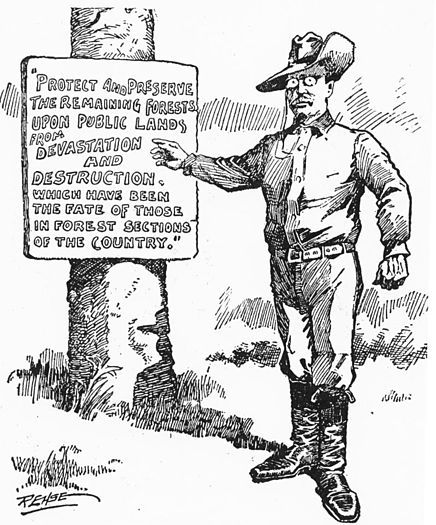
Wall of Shame; sites that don’t get it, or intentionally tell the error:

1908 editorial cartoon of President Theodore Roosevelt as “A Practical Forester.”  Source: St. Paul Minnesota “Pioneer Press”. Via GPO's Government Book Talk blog.

1908 Rense editorial cartoon of President Theodore Roosevelt as “A Practical Forester.” Source: St. Paul Minnesota “Pioneer Press”. Via GPO’s Government Book Talk blog.


Gun nuts at Fox pull a bait and switch; Obama already outflanks them

February 26, 2013

President Obama visits with survivors of the shooting in Aurora, Colorado. July 22, 2012

President Obama visits with survivors of the shooting in Aurora, Colorado. July 22, 2012 – White House photo. Click image to go to White House site, with more information on reducing gun violence.

Yeah, I know: Someone has sent you a post on Facebook claiming there are more murders from hammers than guns, and they quote Fox.

If they’re not complete nuts, they were careful and noted it was rifles being compared, and not all guns.

Here’s the Fox headline:

January 03, 2013

FBI: More People Killed with Hammers, Clubs Each Year Than Rifles

Then, just to rub it in, that person who sent you the link said something like, ‘so you propose hammer control, too?’

The best debaters in college learn to listen to what their opponents say, and not what they think their opponents should have said.  Good lawyers listen like that, too, in court, and in depositions.

See that last word in the headline?  “Rifles.”

Yeah, it’s a limited part of the total population of guns.

Total gun deaths in 2011 were 8,583 — continuing a five-year trend downward, thanks for small blessings.  Homicides only, not counting suicides — according to figures compiled by the FBI.

Did more than 8,500 people die from hammer assaults in 2011?

No, the same tally shows 496 people were murdered by use of  “Blunt objects (clubs, hammers, etc.).”

496 is 8,087 fewer than the 8,583 gun deaths.  But rifles?  Oh, yeah.

323 people died from rifle fire.  356 died from shotgun wounds.  6,220 died from handguns, 97 from “other guns,” and 1,587 died from gunshots where the type of gun was not recorded on the report to the FBI.  Add them up, you get 8,583 dead, murdered by gunfire.

Now, the gun advocates nuts say that it’s fair to compare rifle deaths only, since only the AR-15 is being questioned, and is the target for “taking guns away.”

That’s inaccurate.  President Obama laid out a plan of more than a score of actions, but only two refer to assault rifles, and only one refers to assault rifles directly:

Reinstate and strengthen the ban on assault weapons:  The shooters in Aurora and Newtown used the type of semiautomatic rifles that were the target of the assault weapons ban that was in place from 1994 to 2004. That ban was an important step, but manufacturers were able to circumvent the prohibition with cosmetic modifications to their weapons. Congress must reinstate and strengthen the prohibition on assault weapons.

And:

Limit ammunition magazines to 10 rounds:  The case for prohibiting high-capacity magazines has been proven over and over; the shooters at Virginia Tech, Tucson, Aurora, Oak Creek, and Newtown all used magazines holding more than 10 rounds, which would have been prohibited under the 1994 law. These magazines enable any semiautomatic weapon to be used as an instrument of mass violence, yet they are once again legal and now come standard with many handguns and rifles. Congress needs to reinstate the prohibition on magazines holding more than 10 rounds.

President Obama laid out a plan that will make it substantially more difficult for people who shouldn’t have guns suitable for mass killings, to have them.  More important, however, the President’s plan steps up the non-gun means available to stop mass shootings before a shooter gets to a campus armed and ready to kill.

The “discussion” will get more ugly, I predict, before it gets better.

More: