Remember: December 30 is Hubble Day

December 29, 2012

Get ready to look up!

Edwin Hubble.

Edwin Hubble. (Photo credit: snaphappygeek)

At Millard Fillmore’s Bathtub, for several years we’ve celebrated Hubble Day on December 30.

On December 30, 1924, Edwin Hubble announced he’d discovered other galaxies in distant space. Though it may not have been so clear at the time, it meant that, as a galaxy, we are not alone in the universe (whether we are alone as intelligent life is a separate question). It also meant that the universe is much, much bigger than most people had dared to imagine.

December 30, 2012 is the 82nd anniversary of the announcement.  When dealing with general science illiteracy, it’s difficult to believe we’ve been so well informed for more than eight decades.  In some quarters, news travels more slowly than sound in the vacuum of space.

I find hope in many places.  Just a few weeks ago the Perot Museum of Nature and Science opened in downtown Dallas.  It’s the old Dallas Museum of Science and Natural History, once cramped into a bursting building in historic Fair Park, now expanded into a beautiful new building downtown, and keeping the Fair Park building, too.  Considering the strength of creationism in Texas, the mere fact that private parties would put up $185 million for a museum dedicated to hard science.

Displays in the Perot border on brilliance at almost every stop.  Stuffy museum this is not — it’s designed to spark interest in science and engineering in kids, and I judge that it succeeds, though we need to wait 20 years or so to see just exactly what and who it inspires.

We visited the Perot last night.  As I was admiring a large map of the Moon, a family strolled by, and a little girl I estimate to be 8 or 9 pointed to the Moon and asked her maybe-30-something father where humans landed.  I had been working to see whether the very large photo showed any signs of activity — but the father didn’t hesitate, and pointed to the Sea of Tranquility.  “There,” he said.  The man was not old enough to have been alive at the time; I’d wager most of my contemporaries would hesitate, and maybe have to look it up.  Not that guy.

Visitors to the Perot Museum of Nature and Science, Dallas

On 32 flat-panel video displays hooked together to make one massive display, visitors to the Perot Museum of Nature and Science view Mars as our new Mars Rover’s friend might see it, in a section of the museum devoted to astronomy, physics, astronomy and planetary exploration. Photo by Ed Darrell; use encouraged with attribution.

Still, kids today need this museum and the knowledge and excitement it imparts.  Last July I accompanied a group of Scouts from Troop 355 to summer camp in Colorado, to Camp Cris Dobbins in the foothills just east of Colorado Springs.  Near lights out one night I hiked the half-mile to our campsite admiring the Milky Way and other bright displays of stars that we simply do not get in light-polluted Dallas County.  I expected that our older Scouts would have already started on the Astronomy merit badge, but the younger ones may not have been introduced.  So I asked how many of them could find the Milky Way.  Not a hand went up.

“Dowse the lights, let’s have a five minute star lesson,” I said.  we trekked out to a slight opening in the trees, and started looking up.  I had just enough time to point out the milky fog of stars we see of our own galaxy, when one of the Scouts asked how to tell the difference between an airplane and a satellite.  Sure enough, he’d spotted a satellite quietly passing overhead — and just to put emphasis on the difference, a transcontinental jet passed over flying west towards Los Angeles or San Francisco.

Then, when we were all looking up, a meteoroid streaked from the south across almost the whole length of the visible Milky Way.  Teenaged kids don’t often go quiet all at once, but after the oohs and aahs we had a few moments of silence.  They were hooked already.  Less than five minutes in, they’d seen the Milky Way, found the Big Dipper, seen a satellite, a jet, and a shooting star.

Perfection!

Edwin Hubble’s discovery can now be the stuff of elementary school science, that the blobs in the sky astronomers had pondered for a century were really galaxies like our own, which we see only through a faint fuzz we call the Milky Way.

Do kids get that kind of stuff in elementary school?  Not enough, I fear.

We named a great telescope after the guy; shouldn’t we do a bit more to celebrate his discovery?

More:


Texas Statehood, December 29, 1845 – 167 years ago

December 28, 2012

texas our texas

U.S. and Texas flags at the Texas Capitol – photo: jmtimages

167 years ago today: Rub your pet armadillo’s belly, slaughter the fatted longhorn, crank up the barbecue pit with the mesquite wood, put Willie Nelson and Bob Wills on the mp3 player, put the “Giant” DVD on the television, and raise your glass of Big Red, Dr. Pepper, or Lone Star Beer (or Pearl, or Shiner Bock, or Llano Wine).

U.S. Flag Code rules urge flying the U.S. flag on the anniversary of a state’s joining the Union — even as much as that will frost the tiny band of desperate Texas secessionists.  (Will the secessionists fly the Texas flag at half-staff?)

Texas was admitted to the union of the United States of America on December 29, 1845.

President Polk's authorization to affix Great Seal of the U.S. to Texas Statehood documents

President Polk’s Authorization to Affix the Great Seal to Texas Statehood documents – Texas Memorial Museum, University of Texas at Austin

The text of Polk’s message:

I hereby authorize and direct the Secretary of State to affix the Seal of the United States to an authenticated copy of “an act to extend the laws of the United States over the State of Texas and for other purposes” approved Dec. 29, 1845 dated this day, and signed by me and for so doing this shall be his warrant.

James K. Polk
Washington, Dec. 29, 1845

Seal of the U.S. affixed to Texas Statehood Proclamation

Great Seal of the United States of America, affixed to the Texas Statehood Proclamation – image from State Archives Division, Texas State Library

Resources:

More:


Iowa Statehood, December 28, 1846 – Iowans, fly your flags today

December 28, 2012

Iowans may fly their flags today in celebration of the anniversary of Iowa statehood.  Iowa’s admission to the Union came on December 28, 1846; Iowa was the 29th state admitted.

The Flag Code, 4 USC §6 (d), notes that the U.S. flag may be flown on “the birthdays of States (date of admission),” in addition to the other score of dates specifically written into law.

Randy Olson photo of flags at rodeo in Spencer, Iowa, 1996

American Flag, Spencer, Iowa, 1996caption from the National Geographic Society: A man rolls up U.S. flags at the end of the Clay County Fair in Spencer, Iowa. “Although the population of Spencer is only about 12,000, the fair draws some 300,000 visitors. Once a year, rising from the endless flatness of the Iowa countryside, a crowd forms—to stroll, to hear big country music acts like the Statler Brothers, to sell a grand champion boar, to buy a new silo.” (Photographed on assignment for, but not published in, “County Fairs,” October 1997, National Geographic magazine) Photograph by Randy Olson; copyright National Geographic Society


A neglected 95th anniversary of Mencken and Millard Fillmore’s Bathtub – National Bathtub and Presidential Obscurity Day

December 28, 2012

A Millard Fillmore’s Bathtub December 28 tradition; mostly encore post, but worthy of note on National Bathtub and Presidential Obscurity Day

95 years ago today, on December 28, 1917, this column by H. L. Mencken was published in The New York Evening Mail:

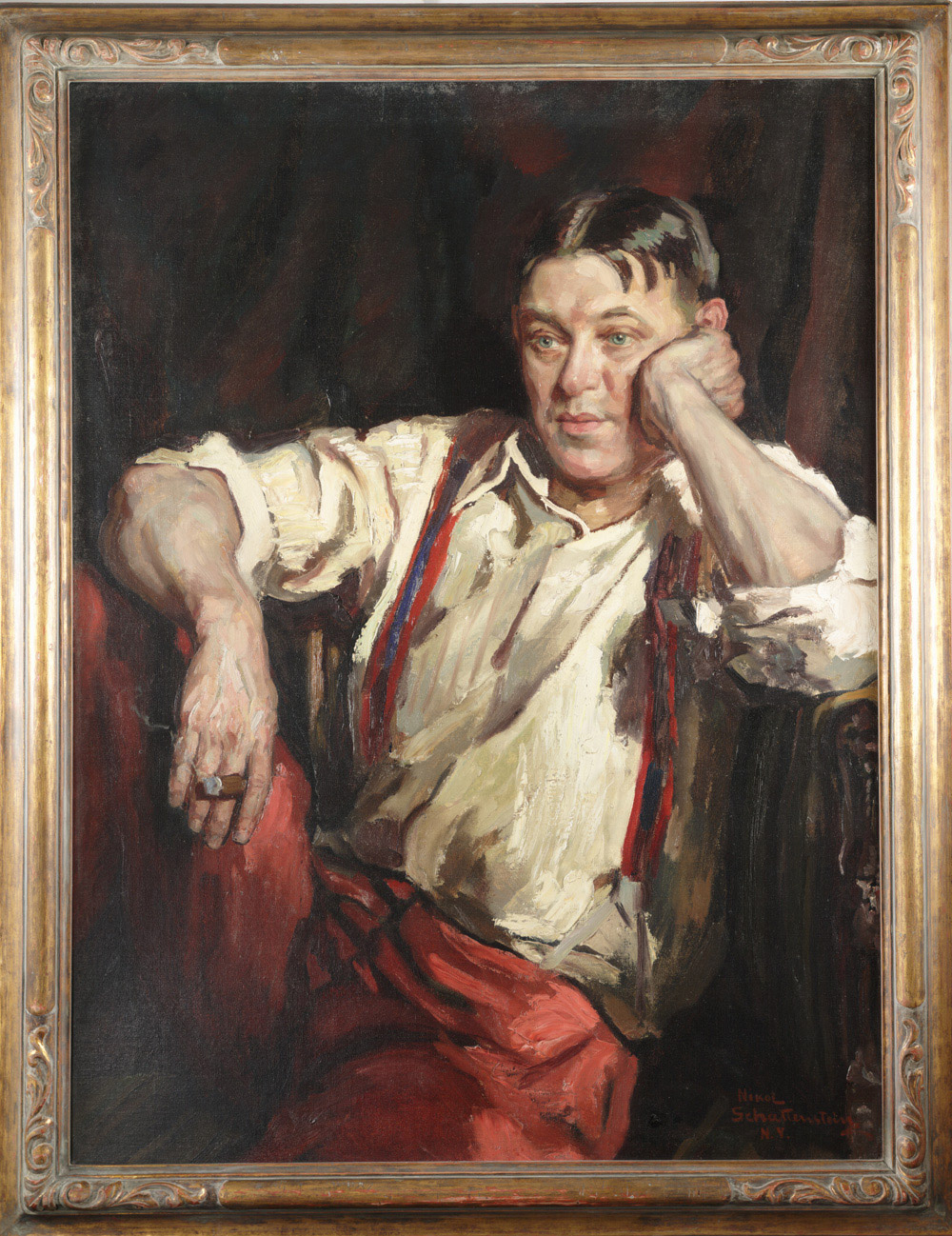
Portrait of H. L. Mencken

1927 Portrait of H. L. Mencken by Nikol Schattenstein; Enoch Pratt Free Library, Baltimore

A Neglected Anniversary

On December 20 there flitted past us, absolutely without public notice, one of the most important profane anniversaries in American history, to wit, the seventy-fifth anniversary of the introduction of the bathtub into These States. Not a plumber fired a salute or hung out a flag. Not a governor proclaimed a day of prayer. Not a newspaper called attention to the day.

True enough, it was not entirely forgotten. Eight or nine months ago one of the younger surgeons connected with the Public Health Service in Washington happened upon the facts while looking into the early history of public hygiene, and at his suggestion a committee was formed to celebrate the anniversary with a banquet. But before the plan was perfected Washington went dry (This was war-time Prohibition, preliminary to the main catastrophe. — HLM), and so the banquet had to be abandoned. As it was, the day passed wholly unmarked, even in the capital of the nation.

Bathtubs are so common today that it is almost impossible to imagine a world without them. They are familiar to nearly everyone in all incorporated towns; in most of the large cities it is unlawful to build a dwelling house without putting them in; even on the farm they have begun to come into use. And yet the first American bathtub was installed and dedicated so recently as December 20, 1842, and, for all I know to the contrary, it may still be in existence and in use.

Curiously enough, the scene of its setting up was Cincinnati, then a squalid frontier town, and even today surely no leader in culture. But Cincinnati, in those days as in these, contained many enterprising merchants, and one of them was a man named Adam Thompson, a dealer in cotton and grain. Thompson shipped his grain by steamboat down the Ohio and Mississippi to New Orleans, and from there sent it to England in sailing vessels. This trade frequently took him to England, and in that country, during the ’30s, he acquired the habit of bathing.

The bathtub was then still a novelty in England. It had been introduced in 1828 by Lord John Russell and its use was yet confined to a small class of enthusiasts. Moreover, the English bathtub, then as now, was a puny and inconvenient contrivance — little more, in fact, than a glorified dishpan — and filling and emptying it required the attendance of a servant. Taking a bath, indeed, was a rather heavy ceremony, and Lord John in 1835 was said to be the only man in England who had yet come to doing it every day.

Thompson, who was of inventive fancy — he later devised the machine that is still used for bagging hams and bacon — conceived the notion that the English bathtub would be much improved if it were made large enough to admit the whole body of an adult man, and if its supply of water, instead of being hauled to the scene by a maid, were admitted by pipes from a central reservoir and run off by the same means. Accordingly, early in 1842 he set about building the first modern bathroom in his Cincinnati home — a large house with Doric pillars, standing near what is now the corner of Monastery and Orleans streets.

There was then, of course, no city water supply, at least in that part of the city, but Thompson had a large well in his garden, and he installed a pump to lift its water to the house. This pump, which was operated by six Negroes, much like an old-time fire engine, was connected by a pipe with a cypress tank in the garret of the house, and here the water was stored until needed. From the tank two other pipes ran to the bathroom. One, carrying cold water, was a direct line. The other, designed to provide warm water, ran down the great chimney of the kitchen, and was coiled inside it like a giant spring.

The tub itself was of new design, and became the grandfather of all the bathtubs of today. Thompson had it made by James Cullness, the leading Cincinnati cabinetmaker of those days, and its material was Nicaragua mahogany. It was nearly seven feet long and fully four feet wide. To make it water-tight, the interior was lined with sheet lead, carefully soldered at the joints. The whole contraption weighed about 1,750 pounds, and the floor of the room in which it was placed had to be reinforced to support it. The exterior was elaborately polished.

In this luxurious tub Thompson took two baths on December 20, 1842 — a cold one at 8 a.m. and a warm one some time during the afternoon. The warm water, heated by the kitchen fire, reached a temperature of 105 degrees. On Christmas day, having a party of gentlemen to dinner, he exhibited the new marvel to them and gave an exhibition of its use, and four of them, including a French visitor, Col. Duchanel, risked plunges into it. The next day all Cincinnati — then a town of about 100,000 people — had heard of it, and the local newspapers described it at length and opened their columns to violent discussions of it.

The thing, in fact, became a public matter, and before long there was bitter and double- headed opposition to the new invention, which had been promptly imitated by several other wealthy Cincinnatians. On the one hand it was denounced as an epicurean and obnoxious toy from England, designed to corrupt the democratic simplicity of the Republic, and on the other hand it was attacked by the medical faculty as dangerous to health and a certain inviter of “phthisic, rheumatic fevers, inflammation of the lungs and the whole category of zymotic diseases.” (I quote from the Western Medical Repository of April 23, 1843.)

The noise of the controversy soon reached other cities, and in more than one place medical opposition reached such strength that it was reflected in legislation. Late in 1843, for example, the Philadelphia Common Council considered an ordinance prohibiting bathing between November 1 and March 15, and it failed of passage by but two votes. During the same year the legislature of Virginia laid a tax of $30 a year on all bathtubs that might be set up, and in Hartford, Providence, Charleston and Wilmington (Del.) special and very heavy water rates were levied upon those who had them. Boston, very early in 1845, made bathing unlawful except upon medical advice, but the ordinance was never enforced and in 1862 it was repealed.

This legislation, I suspect, had some class feeling in it, for the Thompson bathtub was plainly too expensive to be owned by any save the wealthy; indeed, the common price for installing one in New York in 1845 was $500. Thus the low caste politicians of the time made capital by fulminating against it, and there is even some suspicion of political bias in many of the early medical denunciations. But the invention of the common pine bathtub, lined with zinc, in 1847, cut off this line of attack, and thereafter the bathtub made steady progress.

The zinc tub was devised by John F. Simpson, a Brooklyn plumber, and his efforts to protect it by a patent occupied the courts until 1855. But the decisions were steadily against him, and after 1848 all the plumbers of New York were equipped for putting in bathtubs. According to a writer in the Christian Register for July 17, 1857, the first one in New York was opened for traffic on September 12, 1847, and by the beginning of 1850 there were already nearly 1,000 in use in the big town.

After this medical opposition began to collapse, and among other eminent physicians Dr. Oliver Wendell Holmes declared for the bathtub, and vigorously opposed the lingering movement against it in Boston. The American Medical Association held its annual meeting in Boston in 1849, and a poll of the members in attendance showed that nearly 55 per cent of them now regarded bathing as harmless, and that more than 20 per cent advocated it as beneficial. At its meeting in 1850 a resolution was formally passed giving the imprimatur of the faculty to the bathtub. The homeopaths followed with a like resolution in 1853.

But it was the example of President Millard Fillmore that, even more than the grudging medical approval, gave the bathtub recognition and respectability in the United States. While he was still Vice-President, in March, 1850, he visited Cincinnati on a stumping tour, and inspected the original Thompson tub. Thompson himself was now dead, but his bathroom was preserved by the gentlemen who had bought his house from the estate. Fillmore was entertained in this house and, according to Chamberlain, his biographer, took a bath in the tub. Experiencing no ill effects, he became an ardent advocate of the new invention, and on succeeding to the Presidency at Taylor’s death, July 9, 1850, he instructed his secretary of war, Gen. Charles M. Conrad, to invite tenders for the construction of a bathtub in the White House.

This action, for a moment, revived the old controversy, and its opponents made much of the fact that there was no bathtub at Mount Vernon, or at Monticello, and that all the Presidents and other magnificoes of the past had got along without any such monarchical luxuries. The elder Bennett, in the New York Herald, charged that Fillmore really aspired to buy and install in the White House a porphyry and alabaster bath that had been used by Louis Philippe at Versailles. But Conrad, disregarding all this clamor, duly called for bids, and the contract was presently awarded to Harper & Gillespie, a firm of Philadelphia engineers, who proposed to furnish a tub of thin cast iron, capable of floating the largest man.

This was installed early in 1851, and remained in service in the White House until the first Cleveland administration, when the present enameled tub was substituted. The example of the President soon broke down all that remained of the old opposition, and by 1860, according to the newspaper advertisements of the time, every hotel in New York had a bathtub, and some had two and even three. In 1862 bathing was introduced into the Army by Gen. McClellan, and in 1870 the first prison bathtub was set up at Moyamensing Prison, in Philadelphia.

So much for the history of the bathtub in America. One is astonished, on looking into it, to find that so little of it has been recorded. The literature, in fact, is almost nil. But perhaps this brief sketch will encourage other inquirers and so lay the foundation for an adequate celebration of the centennial in 1942.

(Text courtesy of Poor Mojo’s Almanac(k))

The entire history was a hoax composed by Mencken.

Even conservative wackoes appreciate the column.

Content with his private joke, Mencken remained silent about the hoax until a follow-up article, “Melancholy Reflections,” appeared in the Chicago Tribune on May 23, 1926, some eight years later. This was Mencken’s confession. It was also an appeal for reason to the American public.

His hoax was a joke gone bad. “A Neglected Anniversary” had been printed and reprinted hundreds of times in the intervening years. Mencken had been receiving letters of corroboration from some readers and requests for more details from others. His history of the bathtub had been cited repeatedly by other writers and was starting to find its way into reference works. As Mencken noted in “Melancholy Reflections,” his “facts” “began to be used by chiropractors and other such quacks as evidence of the stupidity of medical men. They began to be cited by medical men as proof of the progress of public hygiene.” And, because Fillmore’s presidency had been so uneventful, on the date of his birthday calendars often included the only interesting tidbit of information they could find: Fillmore had introduced the bathtub into the White House. (Even the later scholarly disclosure that Andrew Jackson had a bathtub installed there in 1834—years before Mencken claimed it was even invented—did not diminish America’s conviction that Fillmore was responsible.)

(No, dear reader, probably not correct; surely John Adams brought a bathtub with him when he moved into the White House, then called the President’s Mansion.  Plumbing, hot water, and finally hot water to a bathtub in the president’s residence, were installed between 1830 and 1853, as best I can determine.)

Mencken wrote an introduction to the piece in a later bookA Mencken Chrestomathy (Alfred A. Knopf, 1949):

The success of this idle hoax, done in time of war, when more serious writing was impossible, vastly astonished me. It was taken gravely by a great many other newspapers, and presently made its way into medical literature and into standard reference books. It had, of course, no truth in it whatsoever, and I more than once confessed publicly that it was only a jocosity… Scarcely a month goes by that I do not find the substance of it reprinted, not as foolishness but as fact, and not only in newspapers but in official documents and other works of the highest pretensions.

There’s a moral to the story:  Strive for accuracy!

So, Dear Reader, check for accuracy, and question authority.

Fact checks — what else might need to be corrected in this story?

Resources:

Finally, Dear Readers — have you noticed someone falling victim to the hoax of Millard Fillmore’s Bathtub recently?  Give us details in comments, please.


December 27, Great Beginnings Day: Darwin, Apollo

December 27, 2012

December 27 is one of those days — many of us are off work, but it’s after Boxing Day, and it’s not yet on to New Year’s Eve or Day. We should have celebrated, maybe.

We should celebrate December 27 as a day of portent: A good embarkation, and a good, safe end to a nation-encouraging trip to almost touch the Moon.

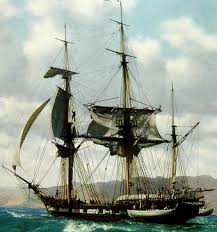
HMS Beagle, Darwin's ship

HMS Beagle, on a voyage of discovery

On December 27, 1831, Charles Darwin and H.M.S. Beagle set sail on an around-the-world voyage of discovery that would change all of science, and especially biology, forever.

December 27 1831
After a few delays, H.M.S. Beagle headed out from Plymouth with a crew of 73 under clear skies and a good wind. Darwin became sea-sick almost immediately.

Darwin never fully overcame his seasickness, but he fought it well enough to become the single greatest collector of specimens in history for the British Museum and British science, a distinction that won him election to science societies even before his return from the trip — and cemented his life in science, instead of in the church. Darwin’s discoveries would have revolutionized biology in any case. In analyzing what he had found, a few years later and with the aid of experts at the British Museum, Darwin realized he had disproved much of William Paley’s hypotheses about life and its diversity, and that another, more basic explanation was possible. This led to his discovery of evolution by natural and sexual selection.

Mini-sheet from the Royal Mail honoring Darwin's discoveries in the Galapagos Islands

Mini-sheet from the Royal Mail in 2009 honoring Darwin’s discoveries in the Galapagos Islands

On December 27, 1968, Apollo 8 splashed down after a successful and heartening trip to orbit the Moon. The three crewmen, Commander Frank Borman, James A. Lovell, Jr., and William A. Anders, had orbited the Moon, a very important milestone in the methodological race to put humans on the Moon (which would be accomplished seven months later). 1968 was a terrible year for the U.S., with the North Korean capture of the U.S.S. Pueblo, assassinations of Rev. Martin Luther King, Jr., and Sen. Robert F. Kennedy during the presidential campaign, riots in dozens of American cities, nasty political conventions with riots at the Democratic Convention in Chicago, a contentious and bitter election making sore the nation’s divide over Vietnam policy, and other problems. On Christmas Eve, Borman, Lovell and Anders broadcast from orbit around the Moon, a triumphant and touching moment for the Apollo Program and Americans around the world. Their safe return on December 27 raised hopes for a better year in 1969.

Motherboard.tv has a great write up from Alex Pasternack:

In 1968, NASA engineers were scrambling to meet President Kennedy’s challenge to land a man on the moon by decade’s end. Because delays with the lunar module were threatening to slow the Apollo program, NASA chose to change mission plans and send the crew of Apollo 8 all the way to the moon without a lunar module.

Exactly 43 years ago, the three astronauts of Apollo 8 became the first humans to orbit another celestial object. As they came around the dark side of the Moon for the third time, Frank Borman, the commander, finally turned their capsule around. And then they saw the Earth.

Borman: Oh my God! Look at that picture over there! Here’s the Earth coming up. Wow, is that pretty.
Anders: Hey, don’t take that, it’s not scheduled.
Borman: (laughing) You got a color film, Jim?
Anders: Hand me that roll of color quick, will you…

One of the resulting photos taken by Anders on a Hasselblad camera became one of the world’s most iconic images.

As Bill Anders recalls it:

I just happened to have one with color film in it and a long lens. All I did was to keep snapping… It’s not a very good photo as photos go, but it’s a special one. It was the first statement of our planet Earth and it was particularly impressive because it’s contrasted against this startling horizon… After all the training and studying we’d done as pilots and engineers to get to the moon safely and get back, [and] as human beings to explore moon orbit, what we really discovered was the planet Earth.

Plan to raise a glass today, December 27, 2012, to Great Beginnings Day for the human race. December 27 is a day we should remember, for these achievements.

Also on December 27:

Adapted from a post from 2010.

More:


When the decision NOT to use a gun changed the world

December 24, 2012

Sometimes it doesn’t take a gun at all.

Nelson Mandela in 1962

Nelson Mandela outside of Westminster Abbey in 1962 — this trip, without permission from the South Africa government, led to his indictment and arrest.

Impressive story about the mystery of Nelson Mandela’s arrest in 1962, at The Wall Street Journal — a story by Peter Wonacott, on December 22, 2012, page C3.  After all these years, how the South African government was tipped off that Mr. Mandela would be where he was, posing as who he posed as, remains a mystery.  Mandela was arrested, tried and convicted of several crimes, ultimately spending 27 years in jail, refusing to give up his cause to gain his freedom.  When the system bent to his wishes, he was released from jail and elected president of his nation.

The key paragraph in the story, the point where the long arc of history was forcefully bent to justice and peace:

Mr. Mandela has described how he had hidden a loaded revolver in the car that day in 1962 but decided not to use it. Choosing not to fight his way out began a journey that would take him through prison to the presidency on a platform of peace, forgiveness and reconciliation among the nation’s races.

Increasing the number of people with an increasing number of guns, however, does not offer more opportunities to change history like that.


FactCheck comes clean on political affiliations

December 23, 2012

It was some time ago, but a lot of people appear not to have noticed.

Annenbergs and Reagan in the White House

President Reagan talking to Leonore Annenberg and Walter Annenberg at the President’s birthday party in the East Room, February 6, 1981. Photo from the Ronald Reagan Library

FactCheck.org, the group at the University of Pennsylvania that checks the accuracy of political ads and political statements, made a disclosure of its political leanings — in a post way back in 2009.

The truth?  Right here:

President Reagan, in 1981, spent all or part of 42 days away from the White House “on vacation” at his home in Santa Barbara, Calif, according to Knoller. President Reagan and his wife, Nancy, also spent three or four days around New Year’s Day each year in Palm Springs, Calif., at the home of philanthropist Walter Annenberg. (In 1993 the late Mr. Annenberg founded the nonpartisan Annenberg Public Policy Center of the University of Pennsylvania, which is FactCheck.org’s parent organization.)

So there you have it, in FactCheck’s own words — they’re connected to Ronald Reagan through Walter Annenberg.

So, the next time someone tells you FactCheck.org is founded and run by “libruls,” send ’em here to see the real photographic evidence.

More:

Walter Annenberg, Ronald Reagan, and hangers on, December 31, 1985

Official White House photo: From left, Walter Annenberg, President Ronald Reagan, Charles Price, William French Smith, George Shultz, and Donald Regan, December 31, 1985. Photo taken at Annenberg’s estate, Sunnylands: “Sunnylands, the impeccably haute-moderne Shangri-la completed in Rancho Mirage, California, in 1966 by the late billionaire publisher, philanthropist, and power broker Walter Annenberg and his wife, Lee, was a haven for presidents and monarchs, stars and tycoons: the history-makers of the late 20th century.”


In 2012, do we know who invented Santa Claus? Who really wrote the “Night Before Christmas?”

December 23, 2012

An encore post and Millard Fillmore’s Bathtub tradition from 2007

Thomas Nast invented Santa Claus? Clement C. Moore didn’t write the famous poem that starts out, “‘Twas the night before Christmas, and all through the house . . . ?”

The murky waters of history from Millard Fillmore’s Bathtub soak even our most cherished ideas and traditions.

But isn’t that part of the fun of history?

Santa Claus delivers to Union soldiers, "Santa Claus in Camp" - Thomas Nast, Harper's Weekly, Jan 3, 1863

In Janaury 1863, Thomas Nast portraye Santa Claus delivered gifts to Union troops in Washington, D.C., wearing a blue, star-spangled coat, just a few days earlier.

Yes, Virginia (and California, too)! Thomas Nast created the image of Santa Claus most of us in the U.S. know today. Perhaps even more significant than his campaign against the graft of Boss Tweed, Nast’s popularization of a fat, jolly elf who delivers good things to people for Christmas makes one of the great stories in commercial illustration. Nast’s cartoons, mostly for the popular news publication Harper’s Weekly, created many of the conventions of modern political cartooning and modeled the way in which an illustrator could campaign for good, with his campaign against the graft of Tammany Hall and Tweed. But Nast’s popular vision of Santa Claus can be said to be the foundation for the modern mercantile flurry around Christmas.

Nast is probably ensconced in a cartoonists’ hall of fame. Perhaps he should be in a business or sales hall of fame, too.  [See also Bill Casselman’s page, “The Man Who Designed Santa Claus.]

Nast’s drawings probably drew some inspiration from the poem, “Account of a Visit from St. Nicholas,” traditionally attributed to Clement C. Moore, a New York City lawyer, published in 1822. The poem is among the earliest to describe the elf dressed in fur, and magically coming down a chimney to leave toys for children; the poem invented the reindeer-pulled sleigh.

Modern analysis suggests the poem was not the work of Moore, and many critics and historians now attribute it to Major Henry Livingston, Jr. (1748-1828) following sleuthing by Vassar College Prof. Don Foster in 2000. Fortunately for us, we do not need to be partisans in such a query to enjoy the poem (a complete copy of which is below the fold).

The Library of Congress still gives Moore the credit. When disputes arise over who wrote about the night before Christmas, is it any wonder more controversial topics produce bigger and louder disputes among historians?

Moore was not known for being a poet. The popular story is that he wrote it on the spur of the moment:

Moore is thought to have composed the tale, now popularly known as “The Night Before Christmas,” on December 24, 1822, while traveling home from Greenwich Village, where he had bought a turkey for his family’s Christmas dinner.

Inspired by the plump, bearded Dutchman who took him by sleigh on his errand through the snow-covered streets of New York City, Moore penned A Visit from St. Nicholas for the amusement of his six children, with whom he shared the poem that evening. His vision of St. Nicholas draws upon Dutch-American and Norwegian traditions of a magical, gift-giving figure who appears at Christmas time, as well as the German legend of a visitor who enters homes through chimneys.

Again from the Library of Congress, we get information that suggests that Moore was a minor celebrity from a well-known family with historical ties that would make a good “connections” exercise in a high school history class, perhaps (”the link from Aaron Burr’s treason to Santa Claus?”): (read more, below the fold)

Clement Moore was born in 1779 into a prominent New York family. His father, Benjamin Moore, president of Columbia University, in his role as Episcopal Bishop of New York participated in the inauguration of George Washington as the nation’s first president. The elder Moore also administered last rites to Alexander Hamilton after he was mortally wounded in a tragic duel with Aaron Burr.

A graduate of Columbia, Clement Moore was a scholar of Hebrew and a professor of Oriental and Greek literature at the General Theological Seminary in Manhattan. [See comment from Pam Bumsted below for more on Moore.] He is said to have been embarrassed by the light-hearted verse, which was made public without his knowledge in December 1823. Moore did not publish it under his name until 1844.

Tonight, American children will be tucked in under their blankets and quilts and read this beloved poem as a last “sugarplum” before slipping into dreamland. Before they drift off, treat them to a message from Santa, recorded by the Thomas Edison Company in 1922.

Santa Claus Hides in Your Phonograph
By Arthur A. Penn, Performed by Harry E. Humphrey.
Edison, 1922.
Coupling date: 6/20/1922. Cutout date: 10/31/1929.
Inventing Entertainment: The Motion Pictures and Sound Recordings of the Edison Companies

Listen to this recording (RealAudio Format)

Listen to this recording (wav Format, 8,471 Kb)

But Henry Livingston was no less noble or historic. He hailed from the Livingstons of the Hudson Valley (one of whose farms is now occupied by Camp Rising Sun of the Louis August Jonas Foundation, a place where I spent four amazing summers teaching swimming and lifesaving). Livingston’s biography at the University of Toronto site offers another path for a connections exercise (”What connects the Declaration of Independence, the American invasion of Canada, the famous poem about a visit from St. Nick, and George W. Bush?”):

Henry Livingston Jr. was born in Poughkeepsie, New York, on Oct. 13, 1748. The Livingston family was one of the important colonial and revolutionary families of New York. The Poughkeepsie branch, descended from Gilbert, the youngest son of Robert Livingston, 1st Lord of Livingston Manor, was not as well off as the more well-known branches, descended from sons Robert and Philip. Two other descendants of Gilbert Livingston, President George Walker Herbert Bush and his son, President-Elect George W. Bush, though, have done their share to bring attention to this line. Henry’s brother, Rev. John Henry Livingston, entered Yale at the age of 12, and was able to unite the Dutch and American branches of the Dutch Reformed Church. At the time of his death, Rev. Livingston was president of Rutgers University. Henry’s father and brother Gilbert were involved in New York politics, and Henry’s granduncle was New York’s first Lt. Governor. But the law was the natural home for many of Henry’s family. His brother-in-law, Judge Jonas Platt, was an unsuccessful candidate for governor, as was his daughter Elizabeth’s husband, U.S. Supreme Court Justice Smith Thompson. Henry’s grandson, Sidney Breese, was Chief Justice of the Illinois Supreme Court.

Known for his encyclopedic knowledge and his love of literature, Henry Livingston was a farmer, surveyor and Justice of the Peace, a judicial position dealing with financially limited criminal and civil cases. One of the first New Yorkers to enlist in the Revolutionary Army in 1775, Major Henry Livingston accompanied his cousin’s husband, General Montgomery, in his campaign up the Hudson River to invade Canada, leaving behind his new wife, Sarah Welles, and their week-old baby, on his Poughkeepsie property, Locust Grove. Baby Catherine was the subject of the first poem currently known by Major Livingston. Following this campaign, Livingston was involved in the War as a Commissioner of Sequestration, appropriating lands owned by British loyalists and selling them for the revolutionary cause. It was in the period following Sarah’s early death in 1783, that Major Livingston published most of his poems and prose, anonymously or under the pseudonym of R. Ten years after the death of Sarah, Henry married Jane Patterson, the daughter of a Dutchess County politician and sister of his next-door neighbor. Between both wives, Henry fathered twelve children. He published his good-natured, often occasional verse from 1787 in many journals, including Political Barometer, Poughkeepsie Journal, and New-York Magazine. His most famous poem, “Account of a Visit from St. Nicholas,” was until 2000 thought to have been the work of Clement Clarke Moore (1779-1863), who published it with his collected poems in 1844. Livingston died Feb. 29, 1828.

More on Henry Livingston and his authorship of the Christmas poem here.
Thomas Nast, Merry Old Santa Claus, Harper's Weekly, Jan 1, 1881

Our views of Santa Claus owe a great deal also to the Coca-Cola advertising campaign. Coca-Cola first noted Santa’s use of the drink in a 1922 campaign to suggest Coke was a year-round drink (100 years after the publication of Livingston’s poem). The company’s on-line archives gives details:

In 1930, artist Fred Mizen painted a department store Santa in a crowd drinking a bottle of Coke. The ad featured the world’s largest soda fountain, which was located in the department store of Famous Barr Co. in St. Louis, Mo. Mizen’s painting was used in print ads that Christmas season, appearing in The Saturday Evening Post in December 1930.

1936 Coca-Cola Santa cardboard store display

  • 1936 Coca-Cola Santa cardboard store display

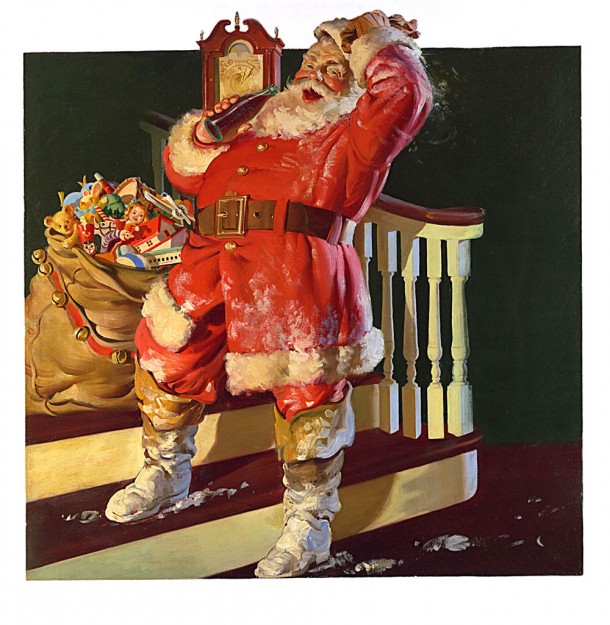
Archie Lee, the D’Arcy Advertising Agency executive working with The Coca-Cola Company, wanted the next campaign to show a wholesome Santa as both realistic and symbolic. In 1931, The Coca-Cola Company commissioned Michigan-born illustrator Haddon Sundblom to develop advertising images using Santa Claus — showing Santa himself, not a man dressed as Santa, as Mizen’s work had portrayed him.
1942 original oil painting - 'They Remembered Me'

  • 1942 original oil painting – ‘They Remembered Me’

For inspiration, Sundblom turned to Clement Clark Moore’s 1822 poem “A Visit From St. Nicholas” (commonly called “‘Twas the Night Before Christmas”). Moore’s description of St. Nick led to an image of Santa that was warm, friendly, pleasantly plump and human. For the next 33 years, Sundblom painted portraits of Santa that helped to create the modern image of Santa — an interpretation that today lives on in the minds of people of all ages, all over the world.

Santa Claus is a controversial figure. Debates still rage among parents about the wisdom of allowing the elf into the family’s home, and under what conditions. Theologians worry that the celebration of Christmas is diluted by the imagery. Other faiths worry that the secular, cultural impact of Santa Claus damages their own faiths (few other faiths have such a popular figure, and even atheists generally give gifts and participate in Christmas rituals such as putting up a decorated tree).

For over 100 years, Santa Claus has been a popular part of commercial, cultural and religious life in America. Has any other icon endured so long, or so well?

________________________
Below:
From the University of Toronto Library’s Representative Poetry Online

Major Henry Livingston, Jr. (1748-1828)

Account of a Visit from St. Nicholas

1 ‘Twas the night before Christmas, when all thro’ the house,

2 Not a creature was stirring, not even a mouse;

3 The stockings were hung by the chimney with care,

4 In hopes that St. Nicholas soon would be there;

5 The children were nestled all snug in their beds,

6 While visions of sugar plums danc’d in their heads,

7 And Mama in her ‘kerchief, and I in my cap,

8 Had just settled our brains for a long winter’s nap –

9 When out on the lawn there arose such a clatter,

10 I sprang from the bed to see what was the matter.

11 Away to the window I flew like a flash,

12 Tore open the shutters, and threw up the sash.

13 The moon on the breast of the new fallen snow,

14 Gave the lustre of mid-day to objects below;

15 When, what to my wondering eyes should appear,

16 But a miniature sleigh, and eight tiny rein-deer,

17 With a little old driver, so lively and quick,

18 I knew in a moment it must be St. Nick.

19 More rapid than eagles his coursers they came,

20 And he whistled, and shouted, and call’d them by name:

21 “Now! Dasher, now! Dancer, now! Prancer, and Vixen,

22 “On! Comet, on! Cupid, on! Dunder and Blixem;

23 “To the top of the porch! to the top of the wall!

24 “Now dash away! dash away! dash away all!”

25 As dry leaves before the wild hurricane fly,

26 When they meet with an obstacle, mount to the sky;

27 So up to the house-top the coursers they flew,

28 With the sleigh full of Toys — and St. Nicholas too:

29 And then in a twinkling, I heard on the roof

30 The prancing and pawing of each little hoof.

31 As I drew in my head, and was turning around,

32 Down the chimney St. Nicholas came with a bound:

33 He was dress’d all in fur, from his head to his foot,

34 And his clothes were all tarnish’d with ashes and soot;

35 A bundle of toys was flung on his back,

36 And he look’d like a peddler just opening his pack:

37 His eyes — how they twinkled! his dimples how merry,

38 His cheeks were like roses, his nose like a cherry;

39 His droll little mouth was drawn up like a bow.

40 And the beard of his chin was as white as the snow;

41 The stump of a pipe he held tight in his teeth,

42 And the smoke it encircled his head like a wreath.

43 He had a broad face, and a little round belly

44 That shook when he laugh’d, like a bowl full of jelly:

45 He was chubby and plump, a right jolly old elf,

46 And I laugh’d when I saw him in spite of myself;

47 A wink of his eye and a twist of his head

48 Soon gave me to know I had nothing to dread.

49 He spoke not a word, but went straight to his work,

50 And fill’d all the stockings; then turn’d with a jerk,

51 And laying his finger aside of his nose

52 And giving a nod, up the chimney he rose.

53 He sprung to his sleigh, to his team gave a whistle,

54 And away they all flew, like the down of a thistle:

55 But I heard him exclaim, ere he drove out of sight –

56 Happy Christmas to all, and to all a good night.

Online text copyright © 2005, Ian Lancashire for the Department of English, University of Toronto. Published by the Web Development Group, Information Technology Services, University of Toronto Libraries. Be sure to visit this site for more information on this poem, on Maj. Livingston, and on poetry in general.

More:


Split in environmental movement? No. Facts still matter

December 21, 2012

Rachel Carson was right in her claims against DDT in Silent Spring, of course, as all subsequent research shows. Drawing by New York Magazine's immortal David Levine.

Rachel Carson was right in her claims against DDT in Silent Spring, of course, as all subsequent research shows. Drawing by New York Magazine‘s immortal David Levine.

Chris Clarke took on Keith Kloor at Pharyngula.  Kloor fell victim to the idea that there is a great split between old “tree-hugger” environmentalists and a newer breed of greens who are willing to work with business and industry to get actual solutions.  Kloor seems to be cheering those he calls “modernists.”

It’s not a new idea, nor is a particularly useful one.  There has long been a minor rift between people who believe it’s impossible to cut deals with polluters, and those who get into the trenches to hammer out or shoot out deals that result in practical legislation.  The group who called for a legislated end to personal automobiles, for example, are still around — but they applaud those who forged the Clean Air Act that drove the invention and development of catalytic converters and cleaned up urban air, even though it left America awash in cars.

Clarke wrote:

Kloor summarizes the better, smarter, more stylish and less embarrassing side’s position thusly:

Modernist greens don’t dispute the ecological tumult associated with the Anthropocene. But this is the world as it is, they say, so we might as well reconcile the needs of people with the needs of nature. To this end, [controversial environmentalist Peter] Kareiva advises conservationists to craft “a new vision of a planet in which nature—forests, wetlands, diverse species, and other ancient ecosystems—exists amid a wide variety of modern, human landscapes.”

That doesn’t seem all that unreasonable on its face, if for no other reason that that it’s currently the best case scenario. You would be extremely hard-pressed to find even the most wilderness-worshipping enviro who disagreed.

In fact, were I to have to rebut Kloor’s whole piece in one sentence, it would be this:  the U.S. non-profit The Wilderness Society, founded by the authors of the Wilderness Act of 1964, is aggressively pushing for industrial development of solar and wind energy generating capacity on intact habitat on the public lands of the American west.

President Lyndon B. Johnson signing the Wilder...

President Lyndon B. Johnson signing the Wilderness Act in 1964 (Photo credit: Wikipedia)

I replied at Pharyngula, noting that the rift Kloor talks about could be exemplified by Rachel Carson and DDT and “modernists” who don’t object to the use of DDT in Indoor Residual Spraying (IRS) to fight malaria — except, those are the same people, working on the same issue.  In short, I sorta agree with Clarke.  There’s no rift, only a lot of misunderstanding.

Heck, if I’m going to that trouble, I may as well capture it here for my indexing purposes.  Here’s my response — I may add links in the body that don’t appear at Pharyngula.

Interesting view of a bit of an inside-baseball (environmental protection politics) issue, but not particularly incisive. Other than its being published at Slate, should we worry about Kloor’s views much?

The piece completely ignores that the views of those he labels “modernists” and “pragmatists” come wholly out of the research demanded by those he ignores in the old movement, whom he unfairly ridicules as hippies.

For example: It’s politically correct (in some circles) today to say (1) Rachel Carson was too strident, and (2) probably wrong about DDT “since it’s (3) not carcinogenic, we now know.” Malaria fighters around the world (4) now have DDT in their arsenal again, this view holds, because (5) pragmatists in the environmental movement finally listened. “(6) Sorry about those ‘unnecessary’ malaria deaths,” some claim the pragmatists would say.

But that view is founded on, grown in, and spreads, historical, legal and scientific error. And the progress made was based on understanding the science, history and law accurately. It’s not that pragmatists finally succeeded where the tree-huggers failed. It’s that the tree-huggers hung in there for 50 years and the world has come around to recognizing good effects, even if it can’t or won’t acknowledge the true heroes who got the work done.

Carson was dead right about DDT. She urged the use of Integrated Vector (Pest) Management (IVM, or IPM) in place of DDT, but she forecasted (in 1962!) that unless DDT use were severely curtailed, it would cease to be useful to fight malaria and other diseases (because, as Carson understood, evolution works, and the bugs evolve defenses to DDT). By 1965, WHO had to end its ambitious campaign to eradicate malaria because, as Carson predicted, mosquitoes in Africa turned up resistant and immune to DDT because of abuse and overuse of the stuff in other applications. Notice, 1965 was seven years BEFORE the U.S. banned DDT use on agricultural crops, and 19 years before the last U.S. DDT manufacturer scurrilously fled to bankruptcy protection to avoid penalties under Al Gore’s SuperFund cleanup bill.

Carson did not claim DDT causes cancer. So the basis of the argument that DDT is “safe for human use” because it doesn’t cause cancer, is an historical non-starter. Research since Carson’s death shows that DDT does indeed cause cancer, though we think its a weak carcinogen in humans. DDT was banned because it’s a deadly poison (else it wouldn’t work!), and it kills for a long time, and it is nonspecific — so it will kill an entire ecosystem before it can eradicate some insect pests. It was in 1971, and it still is.

Photo taken at Rachel Carson's 100th Birthday ...

Photo taken at Rachel Carson’s 100th Birthday celebration at Rachel Carson Homestead in Springdale, Pennsylvania (Photo credit: Wikipedia)

Carson did note that DDT kills birds, in vitro, by incapacitating chicks to thrive, by outright poisoning insect-eating and predatory birds (or anything near the top of the trophic levels) and through a then-mysterious scrambling of reproductive abilities. About ten years after her death, it was discovered DDT also rendered female fowl unable to make competent eggshells, and that provided a fifth path for death for birds.

Much of the research Carson cited formed the foundation for the science-based regulation EPA came up with in late 1971 that ended in the ban on DDT in the U.S. None of those studies has ever been seriously challenged by any later research. In fact, when Discover Magazine looked at the issue of DDT and birds and malaria in 2007, they found more than a thousand peer-review follow-up studies on DDT confirming Carson’s writings.

Over the past decade we’ve seen a few bird species come off of the Endangered Species List. Recovery of at least four top predators should be credited squarely to the ban on crop use of DDT in the U.S, brown pelicans, peregrine falcons, osprey, and bald eagles. 40 years of non-use, coupled with habitat protection and captive breeding programs, brought these birds back. (Five years ago I sat on the lawn of Mt. Vernon and watched a bald eagle cross the Potomac to a snag 100 yards from George Washington’s porch; the director told me they’d been watching several eagles there for a couple of years. 15 years earlier, one nesting pair existed in the whole Potomac region, at a secret site; now tourists are told where to go see them. A friend wrote today he saw a bald eagle in Ft. Worth, Texas. The gains from the DDT ban are real.)

Meanwhile, in Africa and Asia, the war on malaria continued. After the DDT advocates screwed up the malaria eradication program of WHO in the 1960s, progress against malaria continued, but slowed; in the late 1980s malaria flared up in some regions where the malaria parasites themselves had developed resistance to the most commonly-used pharmaceuticals (as Darwin would have predicted, as Carson would have predicted). After struggling to keep malaria from exploding, about 1999 malaria fighters latched on to Integrated Pest Management (IPM), which couples occasional spraying of homes and other residences, even with DDT (which was never banned in Africa or Asia) — but calls for spraying only when it is very effective, and requires that no one pesticide be used to the point that it drives mosquitoes to evolve resistance, and pushes all other means to prevent disease-spreading bug bites.

Largely without DDT (though DDT is not banned), malaria infections fell from peak DDT-use years of 1959 and 1960, from 500 million infections per year, to fewer than 250 million infections today — that’s a decrease of 50%. Phenomenal when we consider the population of the world has doubled in the same time. Deaths dropped from 4 million annually in those peak-DDT-use years to fewer than 800,000 per year today — a decrease of more than 75%. Progress continues, with IPM; bednets now do better, and more cheaply, what DDT used to do but largely cannot anymore — stop the bites. Better medicines, and better educated health care workers, clean up the disease among humans so mosquitoes can’t find a well of infection to draw from.

Notice that at no point was progress made contrary to the “tree-hugger” model, but instead was made at every point because of the tree-hugger model. No compromises enabled the recovery of the bald eagle, but strict enforcement of the environmental laws. No compromises with Rachel Carson’s Silent Spring helped beat malaria, but finally applying what Rachel Carson actually wrote.

Now along comes Kloor to say that Carson and her de facto acolytes block progress, and people who argue for compromise instead have the lighted path to the future?

Let’s review:

  1. Carson was not too strident; in fact the President’s Science Advisory Committee’s report, “Use of Pesticides,” in 1963 called for more immediate and more draconian action than Carson did.
  2. Carson was not wrong about DDT; it is still a deadly poison, and it still kills ecosystems; however, as Carson urged, careful use can provide benefits in a few cases.
  3. Human carcinogenicity was not an issue in DDT’s being banned in the U.S. in 1972, and it’s being only a weak carcinogen now does not rescue DDT from the scientifically-justified ban; we now know DDT is even more insidious, since it acts as an endocrine disruptor in nature, scrambling reproductive organs of fish, amphibians, reptiles and mammals, and probably birds, too.
  4. Malaria fighters always had DDT in their arsenal; no reason to use DDT where it won’t work, nor where it’s harms outweigh its benefits (as the National Academy of Sciences said, in 1970, in a call to get rid of the stuff).
  5. If there were any pragmatists in this story, they abandoned malaria-affected areas of the world years ago and have not returned; they did nothing to help save the birds; to claim they listened is to suggest they did something and can do more. Not sure that’s a case that can be made.
  6. There were not deaths to malaria “unnecessary” due to a ban on DDT which never occurred in Africa or Asia, while DDT was plentiful and cheap to anyone who wanted to use it (still pretty much the case today). Let’s repeat that:  DDT has never been banned in Africa or Asia.  We can’t claim great disease exacerbation when the disease actually was abated so greatly over the period of time in discussion — can’t make that claim and also claim to be honest.

It was the hard-core, wilderness-loving, science-following environmentalists who were responsible for every lick of progress on that issue.

Is DDT unique as an issue? I don’t think so. And I think a fair history of the environmental movement from 1975 to today would point out that it was hard-core, save-the-planet-because-it’s-the-only-home-humans-have types who pulled things out. Do we have great canyons to hike in Colorado and Utah? Yeah, but keeping Exxon from digging up huge portions of those states for a now-failed oil-shale extraction scheme should get some of the credit. Is there wildlife in cities? Sure, but only because we had wilderness areas to protect those species in their darkest hours, and we may need those places again. Do we have other needs for wilderness? Only if we need clean air, clean water, huge sinks for CO2 emissions, and places to dream about so we stay sane and focused, and American (Frederick Jackson Turner was correct enough — Americans are more noble, more creative, wiser and more productive, if we have a frontier and a wild).

Isn’t it required that we compromise on standards to get energy independence, and economic prosperity? Don’t look now, but oil and natural gas production, and exploration, are at highs, under our “tough environmental laws.” If we look around the world, we see that future prosperity is best protected by such laws, even if they sometimes seem to slow some industrial process or other.

New generation of conservationist? Possible only because of the old generation, the Pinchots, Roosevelts (esp. the two presidents), the Lincolns and Grants, the Muirs, the Leopolds, the Bob Marshalls, the Udalls, the Morans, the Douglases (Marjory Stoneman and Justice William, both), the Rockefellers, the Nelsons, the Muskies, the Gores, the Powells, and thousands of others who were then ridiculed for being unpragmatic, and whose methods often required that they not “compromise.” We can’t talk about protecting wilderness today unless the Sierra Club was there to actually do it, earlier. We can’t talk about private efforts, or public-private partnerships, without standing on the ground already protected by the Nature Conservancy. We can’t talk about saving the birds without relying on the history of the Audubon Society. We can’t talk sensibly about protecting humans from cancer or poisons without touching every rhetorical string Rachel Carson plucked.

Get the science right. Keep your history accurate. Read the fine print on the law, and on the pesticide label. Conservation isn’t for the birds, bees, bears, trout and flowers — it’s for humans. That’s news to Kloor? Maybe that’s why his view is skewed.

Progress is made by unreasonable and stubborn people, sometimes? No, Martin Luther King, Jr., said — those are the only people who make progress.

We aren’t going to build a future conservation movement by giving away what has been conserved to now.

More:


Best editorial quote ever: “Yes, Virginia, there is a Santa Claus” (2012 remembrance)

December 20, 2012

“Papa says, ‘If you see it in the Sun, it’s so.'”

Do we, you and I in 2012, stand as witnesses to the end of newspapers in America?  In recent months we’ve seen body blows to the New Orleans Times-Picayune, the San Diego Union, and The Cleveland Plain Dealer, and others.

It’s been a grand history. Newspapering gave us great leaders like Benjamin Franklin. Newspapering gave us wars, like the Spanish-American War. Newspapering gave us Charlie Brown, Ann Landers, the Yellow Kid, Jim Murray, Red Smith, Thomas Nast (and Santa Claus), the Federalist Papers, Watergate, Herblock, news of Vietnam and Pearl Harbor, Neil Armstrong on the Moon, the Pentagon Papers, and coupons to save money on laundry soap.

It’s been a curious history, too. An 1897 editorial vouching for Santa Claus rates as the most popular editorial of all time, according to the Newseum in Washington, D.C.  That’s 115 years ago, and that’s quite some staying power.

Francis Pharcellus Church, New York Sun writer who wrote "Yes Virginia, there is a Santa Claus" - Newseum

The man who saved Christmas, at least for Virginia O’Hanlon: Francis Pharcellus Church – Newseum image

In autumn, 1897, 8-year-old Virginia O’Hanlon of 115 West 59th Street in New York, wrote to the New York Sun with this simple question:

“Please tell me the truth; is there a Santa Claus?”

In the age of Yellow Journalism, the fiercely competitive Sun‘s editors turned the letter to Francis Pharcellus. He responded to little Virginia on September 21, 1897:

Yes, Virginia, there is a Santa Claus.”

Church’s brother, William Conant Church, owned and published the newspaper. Both had followed their father into the news business. They co-founded The Army-Navy Journal in 1863, and went on to a series of journalistic collaborations. Francis was 58 years old when he answered Virginia’s letter. (He died at age 67, in 1906.)

The New York Sun held down the conservative corner in New York journalism at the time, versus the New York Times and the New York Herald-Tribune. But it also had an interesting history, to a blogger intrigued by hoaxes. In 1835 the paper published a series of six newspaper stories falsely attributed to Sir John Herschel, a well-known astronomer, claiming to describe a civilization on the Moon — the Great Moon Hoax. The discovery was credited to a new, very powerful telescope.

In 1844 the paper published a hoax written by Edgar Allen Poe, the Balloon Hoax. Under a pseudonym, Poe wrote that a gas balloon had crossed the Atlantic in three days.

The Sun also featured outstanding reporting. A 1947 and 1948 series about crime on the docks of New York City won a Pulitzer Prize for writer Malcolm Johnson. That series inspired Elia Kazan’s 1954 movie On the Waterfront starring Marlon Brando, Rod Steiger, Eva Marie Saint, Karl Malden and Lee J. Cobb.

The New York Sun ceased publication in 1950.

For all of its history, the Sun and the Churches are most remembered for that defense of belief in Santa Claus.
Virginia O’Hanlon grew up, graduated from Hunter College, got a masters at Columbia, and earned a Ph.D. from Fordham. She taught in the New York City Public School system, from which she retired in 1959. She died in 1971.

Birth of tradition

Columbia University was Church’s alma mater, as well as O’Hanlon’s. Her letter and his response get a reading each year at the Yule Log Ceremony at Columbia College, along with the poem “A Visit from St. Nicholas.” Animated, live-acting, and other television productions have been mounted in 1974, 1991, and 2009.

Is there a Santa Claus? Did Church write a credible defense? The text of the letter and answer, below the fold.

More:  

Read the rest of this entry »


NRA reputation damaged

December 19, 2012

An observer of American politics may wonder whether the past few days have changed any of the old political lines on gun control issues and the Second Amendment.

Does a view from Canada tell us anything?  Here’s Aislin‘s cartoon, from the Montreal Gazette,  for December 18, 2012:

Aislin cartoon, Montreal Gazette, 12-18-2012

Aislin, Montreal Gazette, December 18, 2012

Too brutal, or too close to the truth?

A little history quiz in a cartoon, yes?  Can you identify all six symbols?  How many must one know to understand the cartoon?

More:

Summer's End. Lexington Green, 11 September 20...

U.S. flag at half-staff, at the Minuteman Memorial in Lexingon, Massachusetts (Summer’s End. Lexington Green, 11 September 2002. Photo taken in Minute Man National Historical Park. Sculpture : “Minuteman” by sculptor Henry Hudson Kitson (1863-1947), dedicated April 19, 1900. Erected 1899 : SIRIS Image: Wikipedia)


Prisons, or schools? Prisons, or mental health care? Prisons, or freedom?

December 19, 2012

Here’s one from a maybe-odd source, but with relatively good citations.

If we have limited money to spend in government, can we put spending on a balance to see where it should be spent?  This is one example out of many pending before the U.S. Congress and state legislatures, today — right now, and for the coming several months.  When you hear elected representatives say “we must cut spending to reduce deficits,” you need to understand that their proposal is to cut spending for education, for job training, for employment assistance, for unemployment payments, for health care, for mental health care, for drug rehabilitation programs, but generally NOT for incarceration programs.  In short, they are saying we must cut off the education of poor kids, to build jails to house them if they run afoul of the criminal justice system after being unable to get the education and training to get a job that will produce the income that would have made them great parents and taxpayers.

If we have limited money to spend in government, can we put spending on a balance to see where it should be spent?

  • Prisons, or schools?
  • Prisons, or mental health care?
  • Prisons, or drug rehabilitation?
  • Justice, or incarceration?
No Justice For All poster, prisons vs. education - OnlineJusticeDegree.com

From OnlineJusticeDegree.com; check references listed on the chart.

What do you think?

More:


Education, unions, guns and Superman: A few random thoughts

December 18, 2012

Here, I’ve been quiet for a few days on these issues.  I like to have more facts before forming opinions.  Others don’t feel so constricted, though, and one of the key lessons of life we must learn over and over is that too often we must act without knowing all the facts we’d wish to know.

Ryan Houck, Broken Pencil for Bach

Borrowed art: A Broken Pencil for Bach, drawing by Ryan Houck

This is one of those times.  In Michigan, the governor has been presented bills which he has signed which take away rights of teachers to stand up for themselves, part of a long-standing GOP war on education and teachers.  He has other bills intended to legalize carrying guns in schools, which he has not yet signed.   In several states, legislatures gear up for sessions starting early next year, with pre-filed bills to put the screws to teachers, cut back education spending, take money from public schools and give it to private groups under a pretext of improving education (I say pretext because all research indicates the public schools perform better, but I digress).  In Congress, the GOP demands cuts to health care, mental health care, education, roads, aid to any workers, employed, under-employed or unemployed, and especially in payments to people in poverty or otherwise in economic distress (“no pain to others, no GOP gain”).

Highlighting the intentional sloth the GOP insists on in government, Hurricane/Tropical Storm Sandy hammered one of our nation’s largest cities and most important regions for technology, manufacturing, business, finance and news, and the GOP opposes federal aid to speed up recovery; and in Newtown, Connecticut, a man with learning difficulties and/or behavioral issues broke into an elementary school over-armed with human-killling automatic and semi-automatic weapons legally purchased and legally owned, with which he had legally trained, and murdered 26 people, including 20 children.

My few random thoughts:

  • The unions demonized in Michigan, Texas and Wisconsin, saved children’s lives in Newtown.  (Yes, teachers; cops and firefighters, too.)
  • The teachers who “don’t deserve the pay they get,” according to many speakers in the public fora, laid down their lives in Newtown.
  • Teachers who ask for parental support, chaperones for a trip to the art gallery, a working copier, a full set of books for the students, a working grading machine, enough pencils so every kid can write, a working projector and ten minutes to set it up — and too often don’t get any of that, let alone ten minutes for a body break — now are asked by the crazy gun lobby to arm themselves and take on other beneficiaries of crazy gun lobbyists in the halls of the schools.
  • Waiting for Superman” was a film about how teachers are animals, teachers unions are monsters.  Turns out Superman was already teaching first grade, in Newtown, but is demonized by the filmmakers as someone or something else.
  • Maybe we should rethink who are the monsters, who is Superman, and who deserves our support.  Superman’s already in our schools — what are we waiting for?  Somehow I doubt that Superman’s merely showing up will be enough to resolve the issues and “fix” our schools.

What are your thoughts?

More, and related material:


Kill Devil Hills, North Carolina: Wright Bros. National Memorial

December 17, 2012

Kill Devil Hills monument to theWright Brothers

Wikipedia description: Standing sixty feet (18.3 meters) tall and perched atop a ninety foot (27.4 meters) stabilized sand dune known as Kill Devil Hill, this monument towers over Wright Brothers National Memorial Park in Kill Devil Hills, NC. The park commemorates and preserves the site where the Wright brothers launched the world’s first successful sustained, powered flights in a heavier-than-air machine. The inscription that wraps around the base of the monument states “In commemoration of the conquest of the air by the brothers Wilbur and Orville Wright. Conceived by genius, achieved by dauntless resolution and unconquerable faith.” Photo by Ken Thomas, taken with a Panasonic Lumix DMC-FZ50 in Dare County, NC, USA.

At this site, on December 17, 1903, Wilbur and Orville Wright first achieved flight in a heavier-than-air machine.


December 17, history written in the wind

December 17, 2012

Ten feet in altitude, 120 feet traveled, 12 seconds long. That was the first flight in a heavier-than-air machine achieved by Orville and Wilbur Wright of Dayton, Ohio, at Kittyhawk, North Carolina, on December 17, 1903.

Few witnesses observed the flight.  Though the brothers Wright fully understood the potential of the machine they had created, even they waited before revealing to their supporters, and then the world, what they had accomplished.

From the Library of Congress:

On the morning of December 17, 1903, Wilbur and Orville Wright took turns piloting and monitoring their flying machine in Kill Devil Hills, North Carolina. Orville piloted the first flight that lasted just twelve seconds. On the fourth and final flight of the day, Wilbur traveled 852 feet, remaining airborne for 57 seconds. That morning the brothers became the first people to demonstrate sustained flight of a heavier-than-air machine under the complete control of the pilot.

No lost luggage, no coffee, no tea, no meal in a basket, either.  No ATC (Air Traffic Control) delays.  Neither brother endured a TSA screening.

Resources on the Wright Brothers’ first flight:

(I almost always forget the big dates until the end of the day.  This is mostly an encore post.)