Typewriter anniversary: July 23, 1829, William Austin Burt’s “typographer”

July 23, 2012

An encore post, history we need to remember.

National Typewriter Day, July 23?  Type a letter to your mom, to celebrate.

William Austin Burt received a patent on a typographer on July 23, 1829 — signed personally by President Andrew Jackson.

First patent issued for a typewriter, July 23, 1829, to William Austin Burt -- signed by Andrew Jackson

Image of the first patent issued for a typewriter, July 23, 1829, to William Austin Burt, a Michigan surveyor and inventor. It was signed personally by President Andrew Jackson.

The typographer is considered the forerunner to the typewriter.

Burt’s chief reputation came from his work as a surveyor in Michigan. He discovered the massive iron ore deposits for which Michigan became famous, the iron that fueled much of American industrialization in the 19th and 20th centuries. He discovered one of the world’s largest deposits of copper, the Calumet and Hecla Mine. He invented the solar compass, to survey areas where iron deposits made magnetic compasses inaccurate.

English: Typographer patent 1829 by William Au...


Patent drawing of W. A. Burt’s typographer, the first patented typewriter – Wikimedia image

Some of Burt’s biographies do not mention his invention of the typewriter.

Burt was born in an era of great technological development and invention. People in all walks of life invented devices to aid their work, or just for the joy of invention. Even future president Abraham Lincoln invented a device to float cargo boats in shallow water, hoping to increase river commerce to his home county, Sangamon County, Illinois.

William Austin Burt

William Austin Burt (Photo: Wikipedia)

Burt invented devices to aid his work in surveying, a very important service industry in frontier America. Because surveyors often worked on the frontier, they were famous for discovering natural resources in the course of their work. So it was that Burt, working in the Upper Peninsula of Michigan, found his magnetic compasses spinning wildly. Suspecting a natural phenomenon, Burt ordered his crew to look for ferrous rocks, and they quickly determined they were in an area rife with iron deposits.

It was to further surverying in such areas that Burt invented the solar compass.

Even uninteresting frontiersmen could lead lives that fascinate us today. Was it Burt’s inventiveness that led him to such a life as a surveyor, or was it his work that pushed him to invent?

First typewritten letter, 1829 - Wikimedia Image

First letter ever written on a typewriter, in 1829 — to Martin Van Buren, then Vice President of the U.S., and future president. Notice the letter was written nearly two months prior to the patent being issued on the device upon which it was written. Wikimedia image


War is no piece of cake: First Battle of Bull Run, July 21, 1861

July 21, 2012

Only after the Civil War did Gen. William Tecumsah Sherman become famous for telling military academy graduates that “War is hell.”

In the summer of 1861, both Unionists and Confederates expected a short fight to settle what would come to be known as the American Civil War.  South Carolina fired on the Union Ft. Sumter in April.  But the first major action did not sully history until July.  Confederate forces and Union forces massed for a battle near Manassas, Virginia, at a little creek called Bull Run.

Spectators came out from Washington, D.C., bringing the family and picnic lunches, expecting a great drama to unfold — but they were surprised by the actual carnage.  What did they expect?

This battle gave rise to the famous story of farmer Wilmer McLean.  His house backed up on what would become the battlefield.  His summer kitchen took a cannonball.  Hoping to avoid further entanglement in the war, McLean moved his family and his farming farther south, to the unlikely-named town of Appomattox Court.

There, in 1865, Gen. U.S. Grant’s entourage asked to borrow McLean’s parlor, for the surrender of Gen. Robert E. Lee.  McLean was able to say, with some high accuracy, that the war began in his back yard, and ended in his front room.

Details from the Library of Congress:

The First Battle of Bull Run

Bull Run, 1st battle of, map from LOC

Battle field of Bull Run, Va. July 21st 1861, Showing the positions of both armies at 4 o’clock, P.M.,
Map Collections: Military Battles and Campaigns

On July 21, 1861, a dry summer Sunday, Union and Confederate troops clashed outside Manassas, Virginia, in the first major engagement of the Civil War, the First Battle of Bull Run.

Union General Irvin McDowell hoped to march his men across a small stream called Bull Run in the vicinity of Manassas, Virginia, which was well-guarded by a force of Confederates under General P. G. T. Beauregard. McDowell needed to find a way across the stream and through the Southern line that stretched for over six miles along the banks of Bull Run.

McDowell launched a small diversionary attack at the Stone Bridge while marching the bulk of his force north around the Confederates’ left flank. The march was slow, but McDowell’s army crossed the stream near Sudley Church and began to march south behind the Confederate line. Some of Beauregard’s troops, recognizing that the attack at Stone Bridge was just a diversion, fell back just in time to meet McDowell’s oncoming force.

First Battle of Bull Run- Bull Run, Virginia

View of the Stone House
Matthews’ or the Stone House

Ruins of Cub Run Bridge
Cub Run, with Destroyed Bridge
George N. Barnard, photographer,
March 1862.
Selected Civil War Photographs

These photographs of First Bull Run were not made at the time of the battle on July 21, 1861; the photographers had to wait until the Confederate Army evacuated Centreville and Manassas in March 1862. Their views of various landmarks of the previous summer are displayed here according to the direction of the Federal advance, a long-flanking movement along Sudley’s Ford.

When Beauregard learned of the attack, he sent reinforcements to aid the small group of Southerners, but they were unable to hold back the oncoming tide of Union troops. As more Union soldiers joined the fray, the Southerners were slowly pushed back past the Stone House and up Henry Hill.

The battle raged for several hours around the home of Mrs. Judith Henry on top of Henry Hill, with each side taking control of the hill more than once. Slowly, more and more Southern men poured onto the field to support the Confederate defense, and Beauregard’s men pushed the Northerners back.

At this point in the battle, Confederate General Barnard Bee attempted to rally his weary men by pointing to Brigadier General Thomas Jackson, who proudly stood his ground in the face of the Union assault. Bee cried, “There stands Jackson like a stone wall!” From that moment on, Thomas Jackson was known as “Stonewall” Jackson.

As the day wore on, the strength of McDowell’s troops was sapped by the continuous arrival of fresh Southern reinforcements. Eventually, the stubborn Confederates proved more than a match for McDowell’s men, and the Northerners began to retreat across Bull Run.

The Union pullout began as an orderly movement. However, when the bridge over Cub Run was destroyed, cutting off the major route of retreat, it degenerated into a rout. The narrow roads and fords, clogged by the many carts, wagons, and buggies full of people who had driven out from Washington, D.C., to see the spectacle, hampered the withdrawal of the Union Army. The Southerners tried to launch a pursuit, but were too tired and disorganized from the day’s fighting to be effective.

The morning of July 22 found most of the soldiers of the Union Army on their way back to Washington or already there. It was more than a year before the Northerners attempted once again to cross the small stream outside of Manassas named Bull Run.

Beauregard Bull Run Quick Step
J. A. Rosenberger, music,
1862.
Historic American Sheet Music, 1850-1920


Religious liberty in America: July 21, 1591, baptism of Anne Marbury (Hutchinson)

July 21, 2012

Do we overlook her because she was female?  Do we overlook her because she stands for religious freedom?  Either way, Anne Marbury Hutchinson gets the cold shoulder from most U.S. history texts used in high schools.

She was a woman to celebrate, and the Library of Congress explains why in detail:

Anne Marbury Hutchinson

Although her exact birth date is uncertain, on July 20, 1591, the infant Anne Marbury was baptized in Alford, Lincolnshire, England.1 The first female religious leader among North America’s early European settlers, Anne Marbury Hutchinson was the daughter of an outspoken clergyman silenced for criticizing the Church of England. Better educated than most men of the day, she spent her youth immersed in her father’s library.

At twenty-one, Anne Marbury married William Hutchinson and began bearing the first of their fourteen children. The Hutchinsons became adherents of the preaching and teachings of John Cotton, a Puritan minister who left England for America. In 1634, the Hutchinson family followed Cotton to New England, where religious and political authority overlapped.

The General Laws and Liberties of the Massachusetts Colony: Revised and Reprinted [right page]      The General Laws and Liberties of the Massachusetts Colony: Revised and Reprinted [left page]
The General Laws and Liberties of the Massachusetts Colony:
Revised and Reprinted,
Cambridge, Massachusetts: Samuel Green, 1672.
Religion and the Founding of the American Republic, Section I. Part 1
Many criminal laws in the early New England colonies were based on the Bible, especially the Old Testament. Often called “Bible Commonwealths,” the New England colonies sought guidance from the scriptures in regulating the lives of their citizens.

Serving as a skilled herbalist and midwife in the Massachusetts Bay Colony, Anne Hutchinson began meeting with other women for prayer and religious discussion. Her charisma and intelligence soon also drew men, including ministers and magistrates, to her gatherings, where she developed an emphasis on the individual’s relationship with God, stressing personal revelation over institutionalized observances and absolute reliance on God’s grace rather than on good works as the means to salvation. Hutchinson’s views challenged religious orthodoxy, while her growing power as a female spiritual leader threatened established gender roles.

Mary Dyer
Mary Dyer Led to Execution on Boston Common,
Color Engraving,
Nineteenth Century.
Courtesy of The Granger Collection.
Religion and the Founding of the American Republic, Section I. Part 2
Like Anne Hutchinson, Mary Dyer was banished from Massachusetts. Eventually, she was hanged for challenging Puritan orthodoxy.

Called for a civil trial before the General Court of Massachusetts in November 1637, Hutchinson ably defended herself against charges that she had defamed the colony’s ministers and as a woman had dared to teach men. Her extensive knowledge of Scripture, her eloquence, and her intelligence allowed Hutchinson to debate with more skill than her accusers. Yet because Hutchinson claimed direct revelation
from God and argued that “laws, commands, rules, and edicts are for those who have not the light which makes plain the pathway,” she was convicted and banished from the colony, a sentence confirmed along with formal excommunication in the ecclesiastical trial that followed.

Refusing to recant, Hutchinson accepted exile and in 1638 migrated with her family to Roger Williams’ new colony of Rhode Island, where she helped found the town of Portsmouth. After her husband died in 1642, Hutchinson moved to Dutch territory near Long Island Sound (an area now known as Co-op City, along New York’s Hutchinson River Parkway, which is named for Anne Hutchinson). There in 1643 Hutchinson and all but one of her younger children were killed by Siwanoy Indians, possibly with the encouragement of Puritan authorities. “Proud Jezebel has at last been cast down,” was the supposed comment of Hutchinson’s nemesis, Massachusetts Governor John Winthrop.

Learn more about early America in American Memory:

More:


Scouting: In Baden-Powell’s footsteps

July 20, 2012


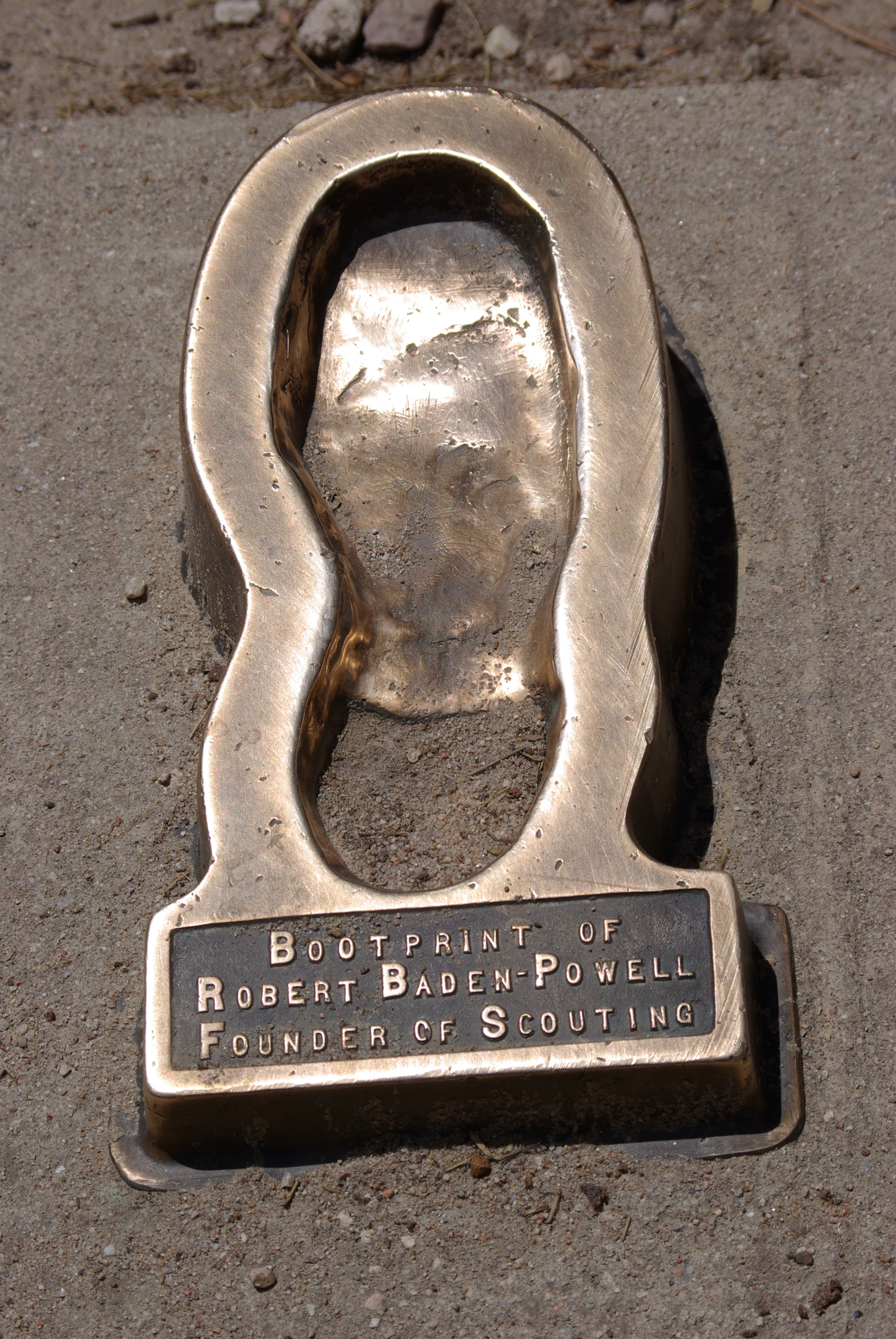
Cast of Baden-Powell's footprint, at Camp Chris Dobbins, Peaceful Valley Scout Ranch, Colorado

Cast of Baden-Powell’s footprint with the brass worn bright from Scouts seeing how they measure up, at Camp Chris Dobbins, Peaceful Valley Scout Ranch, Colorado

Another in a series of where and how people interact with sculpture.

At Peaceful Valley Scout Ranch in Colorado, at Camp Chris Dobbins, there is a cast of a footprint from Lord Robert Baden-Powell, the founder of the International Scouting Movement.

Of course, every Scout must check it out to see whether his or her foot measures up, you can tell from the bright brass color where the piece is touched by hundreds of boots.


July 19, 2012

Found this at Under the Lobsterscope — our incarceration rates form a testament to one of the greatest failures of the U.S. over the past two decades. Live links added here for your convenience.

(This may be the last time we use the reblog feature — it’s very clunky!)

btchakir's avatarUnder The LobsterScope


Here are the facts… you make your own conclusion. Personally, I think making prisons a private industry sucks— I wonder when they’ll be exporting the prisoners to China.


View original post


Ty Cobb’s 4,000th hit, July 18, 1927

July 18, 2012

Once again, this comes directly from the Library of  Congress’s great “Today in History” site.

You’ve seen the news, about the discovery of a complete set of baseball cards in an attic in Defiance, Ohio.  The collection should make its owners very, very rich.  It includes rare cards of Honus Wagner, and Ty Cobb, The Georgia Peach.

Ty Cobb, the Georgia Peach

Cobb Triptych
Hugh Jennings/Ty Cobb
Left: Hugh Jennings
Center: Ty Cobb Steals Third
Right: Ty Cobb, 1912.
Baseball Cards, 1887-1914

On July 18, 1927, Ty Cobb recorded his 4,000th career hit. Cobb finished out his Major League Baseball career in 1928 with a grand total of 4,191 hits. Cobb stood as the all-time hit leader until his total was surpassed by Pete Rose in 1985.

Cobb and Jackson
Ty Cobb, Detroit, and Joe Jackson, Cleveland,
circa 1913.
Jackie Robinson and Baseball Highlights, 1860s-1960s

Cobb began his professional career at the age of eighteen with the Detroit Tigers with which he played twenty-two of his twenty-four seasons. Like the careers of baseball greats Pete Rose and “Shoeless” Joe Jackson, Cobb’s was marred by scandal. He was allowed to resign in 1926 in lieu of being banned for alleged gambling violations. However, Cobb was subsequently exonerated and reinstated by baseball’s first commissioner, Judge Kenesaw Mountain Landis.

Cobb, born on December 18, 1886, in Narrows, Georgia, and nicknamed “The Georgia Peach,” was known for his temper as well as for his outstanding athletic ability. He stole home fifty-four times—fifty times with the Detroit Tigers and four times with the Philadelphia Athletics, won twelve batting average titles, and managed the Detroit Tigers for six seasons while also playing center field. His lifetime batting average was .367. Cobb made use of his reputation as an aggressive (often dirty) base runner to intimidate infielders, stealing 892 bases during his professional career. Ty Cobb was one of the first five players elected to the in Cooperstown, New York, in 1936, along with Walter Johnson, Christy Mathewson, Babe Ruth, and Honus Wagner.

Chas O'Leary and Tyrus Cobb    Chas O'Leary and Tyrus Cobb

Chas. O’Leary and Tyrus Cobb,
1912.
Baseball Cards, 1887-1914
This baseball card featuring Chas O’Leary and Tyrus Cobb, produced by the American Tobacco Company in 1912, shows Cobb sliding into third base. Click on the back of the card to read a description of Cobb’s base running statistics.

For more about baseball and its legendary players, search the following American Memory collections:


American naval hero John Paul Jones died in Paris, July 18, 1792, lost in obscurity

July 18, 2012

This comes directly from the Library of Congress’s “Today in History” site — you should subscribe if you don’t already:

John Paul Jones
John Paul Jones,
photograph of an engraving,
between 1895 and 1915.
Touring Turn-of-the-Century America: Photographs from the Detroit Publishing Company, 1880-1920

John Paul Jones, naval hero of the American Revolution, died in Paris on July 18, 1792. Born John Paul in Scotland on July 6, 1747, he apprenticed at age thirteen to a shipowner and sailed to Barbados. Owing to problems on another voyage to the West Indies (in 1773 he killed a sailor during a mutiny in Tobago, claiming self-defense), he fled to Virginia and changed his name—first to John Jones, and later to John Paul Jones.

Jones was commissioned a first lieutenant in the Continental Navy in December 1775 and the following year was commissioned a captain. His achievements at sea during the war were spectacular. Jones distinguished himself in action in the Atlantic Ocean during 1776 and 1777 in command of the naval ships the Alfred, the Providence, and the Ranger, taking many British ships as prizes.

John Paul Jones's home
John Paul Jones’ home in Fredericksburg, Virginia,
Theodor Horydczak, photographer, circa 1920-1950.
Washington as It Was: Photographs by Theodor Horydczak, 1923-1959

On September 23, 1779, Jones achieved his most famous victory off the coast of England. With his flagship the Bonhomme Richard, which he had renamed in honor of his patron Benjamin Franklin, and accompanied by four other vessels, Jones engaged the British merchant fleet led by the Serapis in heavy combat for over three-and-one-half hours. During the battle, Jones answered the enemy’s demand that he surrender with the immortal words, “I have not yet begun to fight!”

After heavy losses of life on both sides, the British surrendered. Jones and his crew left their sinking ship and transferred to the captured Serapis. Congress passed a resolution thanking Jones and he received a sword and the Order of the Military Merit from King Louis XVI of France.

John Paul Jones held no further appointments in the United States Navy, but he served as rear admiral in the Russian Navy under Empress Catherine II of Russia from 1788-90. After his discharge, he resided in Paris in obscurity until his death and was buried in an unmarked grave. More than a hundred years later, the remains of the Navy’s first hero—lionized for his brilliant naval career, were identified and brought back to the United States with a full naval escort. His body is interred in a marble crypt, modeled on Napoleon’s tomb, in the chapel of the U.S. Naval Academy in Annapolis, Maryland.

Statue of John Paul Jones
Statue of John Paul Jones,
Washington, D.C.,
Theodor Horydczak, photographer, circa 1920-1950.
Washington as It Was: Photographs by Theodor Horydczak, 1923-1959


Walter Cronkite – gone three years

July 17, 2012

Walter Cronkite died on July 17, 2009.

I miss his broadcasts, still, and they were gone a good 20 years earlier.

Here’s an earlier post on Cronkite:

Walter Cronkite at his office typewriter:

Walter Cronkite at his typewriter, in his office

Walter Cronkite at his typewriter, in his office – from The Typewriter blog

Pipe rack to his left, on the shelf above; full set of the Encyclopedia Britannica to his right (probably a 1960s set); A lot of books, some dealing with space exploration, among his favorite topics; models of the X-15 and early versions of the Space Shuttle; award from the Boy Scouts to his right, where he can see it easily.

When was this photo taken? 1970s? Earlier? Maybe someone who follows Dixie Cups could date the cup to Cronkite’s left.

This is probably the same office, redecorated, and stripped down to move – and with a different typewriter (a Smith-Corona electric?):

Cronkite in his office minutes before his final broadcast.  SF Chronicle photo

Caption from the San Francisco Chronicle website: “In this March 6, 1981 file photo, Walter Cronkite talks on the phone at his office, prior to his final newscast as CBS anchorman in New York City. Behind him is a framed Mickey Mouse cartoon and his Emmy award. Famed CBS News anchor Walter Cronkite, known as the ‘most trusted man in America’ has died, Friday, July 17, 2009. He was 92.”

More:


Peter Schickele – 77 on July 17, 2012

July 17, 2012


Peter Schickele is 77 today yesterday.

Peter Schickele, a.k.a. P. D. Q. Bach

Peter Schickele, born July 17, 1935

May he live to be a happy, robust, still-composing, still performing 137, at least.

Some people know him as a great disk jockey. Some people know him as the singer of cabaret tunes. Some people know and love him as a composer of music for symphony orchestra, or to accompany Where the Wild Things Are.

Peter Shickele, left, and P. D. Q. Bach, together, in happier times.

Then there are those happy masses who know him for his historical work, recovering the works of Johann Sebastian Bach’s final and most wayward child, P. D. Q. Bach.

Tip of the old bathtub-hardened conductor’s baton to Eric Koenig.

This is mostly an encore post.  It was scheduled to run on time, not sure why it didn’t — problems of being on the road, you know.


July 16, 1945 – Trinity test, world’s first atomic bomb

July 16, 2012

Another good reason to follow the National Archives on Twitter, Tumblr and other media:  Great updates.

Like this one on the explosive arrival of the Atomic Age:

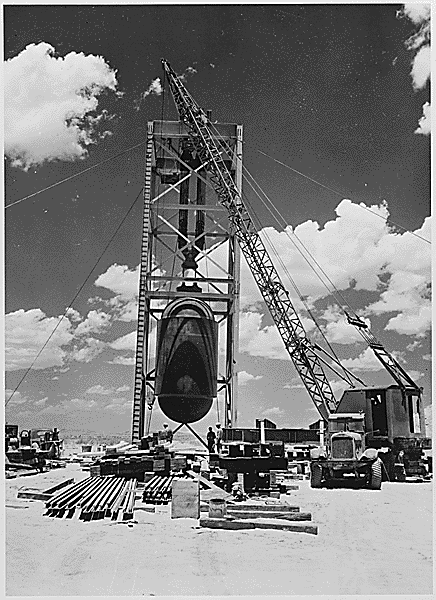
 Atomic Age Begins

"Trinity" atomic device being positioned at White Sands, New Mexico - National Archives

Jumbo” atomic device being positioned
PreviousNext

Atomic Age Begins

On July 16, 1945 the United States tested a nuclear device, code named “Trinity”, for the first time in White Sands Proving Ground, New Mexico.

Left: [“Jumbo” atomic device being positioned for “Trinity” test at Alamogordo, New Mexico.], 1945

Right: [“Trinity” explosion], 07/16/1945

Source: research.archives.gov

English: Rare color photograph of the first nu...

Rare color photograph of the first nuclear test at Trinity site, July 16, 1945. Blurriness is in the original photograph (done when color photography was still fairly new). (Photo credit: Wikipedia)


Woody Guthrie’s 100th birthday

July 14, 2012

Woody Guthrie singing, Smithsonian Folkways image

Woody Guthrie singing, Smithsonian Folkways image – The sticker on Woody’s guitar reads, “This Machine Kills Fascists.”  Woody regarded music as a great tool of democracy and freedom.

July 14, 2012, marks the 100th anniversary of the birth of Woody Guthrie, folksinger, union organizer, chronicler of American values, troubles and change.

We’re already more than halfway through Woody’s centennial year — and what celebration took place at Millard Fillmore’s Bathtub?  History slips by so fast.

Much celebration remains.  Get out your calendar and figure out which events you can join in.

Poster for the 2012 Woody Guthrie Folk Festival in Okemah, Oklahoma

Poster for the 2012 Woody Guthrie Folk Festival in Okemah, Oklahoma

Wonderfully, a website celebrates Woody’s 100th:

Perhaps fittingly, Millard Fillmore’s Bathtub hits the road again, today — off through Oklahoma.

In the interim, get out there, get the history, and join in the chorus!

More, Other Sources:

Page from booklet of Woody Guthrie sheet music...

Page from booklet of Woody Guthrie sheet music and lyrics (Photo credit: Wikipedia)


July 12, 1855 – Liberty proposed for U.S. Capitol

July 13, 2012

Liberty statue, atop U.S. Capitol - Library of Congress photo

On top of the Capitol Dome, the Statue of Freedom faces east away from the National Mall and the White House. Image courtesy of Library of Congress

History from the Clerk of the U.S. House of Representatives:

The Statue of Freedom

July 12, 1855

Statue of Freedom

Statue of Freedom (Liberty) which appears atop the U.S. Capitol (Photo credit: Wikipedia)

On this date, Architect of the Capitol, Montgomery C. Meigs received the conceptual drawings from Thomas Crawford, an American neoclassical artist, for the Statue of Freedom.  The statue was to be the crown jewel of the dome atop the Capitol Rotunda.  The first sketch of the statue featured a woman with a liberty cap. When Secretary of War Jefferson Davis objected to the allegorical allusion to a freed Roman slave, the artist revised the drawing to feature a statue with a helmet.  Although construction on the dome began in 1856, the dome and its final accouterments were not in place until December 2, 1863. Freedom’s story contains an ironic twist; a slave named Philip Reid played an integral part in placing Freedom atop the dome.  A contract dispute threatened to halt the project’s progress until Reid determined how to complete the complicated casting of the statue.  As a result, he oversaw the remainder of the its construction.  To commemorate the completion of the statue and its crowning of the dome, officials organized a dramatic ceremony with a 35-gun military salute echoed by salutes from the 12 forts ringing the federal city.

The dome of the US Capitol building. Français ...

The dome of the US Capitol building. (Photo credit: Wikipedia)


British Airways: Crazy-like-a-fox patriotism in advertising

July 13, 2012

This television advertisement is circulating among airline and travel folk:

Why would British Airways make an ad that encourages Britons to stay at home during the Olympics?

Join the conversation and see the plane on your own street at http://www.facebook.com/britishairways #HomeAdvantage

This summer, the greatest sports event on Earth comes to London. And our best sportsmen and women have a once in a lifetime opportunity, to compete at the highest level with the whole country behind them. That’s why we’re asking the nation to join together, to give our athletes the greatest home advantage we can give them. It could be the difference in seconds and millimetres, turning silver into gold. This summer, there’s nowhere else in the world to be.

Even more analysis:

Millard Fillmore traveled to London after his presidency.  One story claims that, upon meeting Fillmore, Queen Victoria proclaimed him “the handsomest man” she had ever met.

After the death of his daughter Mary, Fillmore went abroad. While touring Europe in 1855, Fillmore was offered an honorary Doctor of Civil Law (D.C.L.) degree by the University of Oxford. Fillmore turned down the honor, explaining that he had neither the “literary nor scientific attainment” to justify the degree.[22] He is also quoted as having explained that he “lacked the benefit of a classical education” and could not, therefore, understand the Latin text of the diploma, adding that he believed “no man should accept a degree he cannot read.”[9]

Tip of the small, folding travel scrub brush to Gil Brassard, believe it or not.

More:


Tyson figures out how to make astronomy popular: Name it “Manhattanhenge,” watch the millions flock to see it

July 12, 2012

Sunrise over Stonehenge on the summer solstice...

Sunrise over Stonehenge on the summer solstice, June 21, 2005 — the analogy of Manhattan’s skyscrapers to the rocks of Stonehenge is obvious (Photo credit: Wikipedia)

Dr. at the November 29, 2005 meeting of the NA...

Dr. Tyson at the November 29, 2005 meeting of the NASA Advisory Council, in Washington, D.C. (Photo credit: Wikipedia)

Some time ago astronomy phenom Neil de Grasse Tyson mentioned the twice-a-year happenstance of the sun’s setting perfectly in line with New York City’s east-west gridded streets.  On many streets, on most streets, you can watch the sun all the way down to the horizon, between the massive “rocks” of Manhattan skyscrapers, almost like watching the solstices at Stonehenge.

Tyson called it “Manhattan henge.”

July 11, 2012, the crowds turn out to see the phenomenon.  How many years ago was it no one bothered to give it a second glance?

Have you seen it?

In your hometown or city, what dates would the sun set right down the east-west axis of some street, if there are any?

Manhattanhenge 2011 | The Commuter

Manhattanhenge 2011 | The Commuter (Photo credit: MichaelTapp)

Michael Tapp photographs a lot of stuff around Manhattan, and he also provided a link to an NPR Science Friday video in which Tyson explains the phenomenon.  So, go see Tapp’s work (hey, maybe buy some of it); and go see Tyson’s explanation.

Manhattanhenge on 42d Street - Bloomberg Businessweek photo - Xinhua News

The sun shines down 42nd Street in New York City at sunset during “Manhattanhenge,” May 30, 2011. Photographer: Xinhua News Agency/eyevine/Redux

According to Bloomberg/Businessweek:

On May 30 at 8:16 p.m. and again on July 11 at 8:24 p.m., Manhattanhenge reaches its point of perfection as the full setting sun aligns with the city’s grid of East-West streets, according to the American Museum of Natural History’s Hayden Planetarium. The best places to view the fiery canyon of skyscrapers are at 14th, 23rd, 34th, 42nd, 57th Streets. The Empire State Building and the Chrysler Building offer especially good views.

Manhattanhenge on 34th Street, by Chaitanya Kapadia / UGC

Manhattanhenge on 34th Street, by Chaitanya Kapadia / UGC – Here’s what Chaitanya Kapadia says about this picture: “I had set up on a nice spot right in the middle of 34th Street, between the double yellow lines with a few photographers wanting to get the Empire State Building in my shot. However, I should have anticipated photographers to just swarm the streets when the sun lined up with the grid. Minutes later, the police drove down the middle of the road, getting everyone out, which only meant stepping to the side until they passed you, and then right back. Took this using three exposures hand-held.”

Manhattanhenge, July 11, 2012, by Andy Dallos

Manhattanhenge, July 11, 2012, by Andy Dallos

More:


Meanwhile, back in reality, Superfund cleanup of Torrance DDT site continues

July 11, 2012

English: Map of Superfund sites in the US stat...

Map of Superfund sites in California. Red indicates sites currently on final National Priority List, yellow is proposed for the list, green means a site deleted (usually due to having been cleaned up). Data from United States Environmental Protection Agency CERCLIS database available at http://www.epa.gov/superfund/sites/phonefax/products.htm. Retrieved April 24, 2010 with last update reported as March 31, 2010. (Photo credit: Wikipedia)

It’s near midsummer, so the sputtering of right-wing and anti-science propaganda calls for a “return to DDT” should begin to abate, absent a serious outbreak of West Nile Virus human infections, or some fit of stupidity on the part of DDT advocates.

DDT remains a deadly poison, and you, American Taxpayer, are on the hook for millions of dollars needed to clean up legacy DDT manufacturing sites across the nation.  Contrary to bizarre claims, DDT really is a poison.

U.S. Environmental Protection Agency (EPA) works constantly at these cleanups.  Comes this press release from EPA talking about a small success, a $14.6 million settlement with past property owners or users of sites in Torrance, California, designated for cleanup under the Superfund.  The money will pay for cleanup of groundwater at the sites.

Links to sources other than EPA, and illustrations are added here.

EPA Reaches $14.6 million Settlement for Groundwater Cleanup at Torrance Superfund Sites

Release Date: 07/10/2012
Contact Information: Nahal Mogharabi, mogharabi.nahal@epa.gov, 213-244-1815

Plant will Treat a Million Gallons per Day, Prevent Spread of Contamination

LOS ANGELES – The U.S. Environmental Protection Agency has reached a $14.6 million settlement with four companies for the construction of a groundwater treatment system at the Montrose and Del Amo Superfund sites in Torrance, Calif. Construction of the treatment system is the first step in the cleanup of groundwater contaminated by chemicals used to manufacture DDT and synthetic rubber over three decades.

Once operational, the system will extract up to 700 gallons of water per minute, or a total of a million gallons each day, removing monochlorobenzene and benzene, and re-injecting the cleaned, treated water back into the aquifer. The treated water will not be served as drinking water, but will instead be re-injected to surround the contamination and prevent it from any further movement into unaffected groundwater areas. Construction of the treatment system is expected to be completed in 18 months. EPA will pursue further settlements with the four companies and other parties to ensure that additional cleanup actions are taken and the groundwater treatment system is operated and maintained until cleanup levels are met.

“One of the toxic legacies of DDT and synthetic rubber manufacturing is polluted groundwater,” said Jared Blumenfeld, EPA’s Regional Administrator for the Pacific Southwest. “The treatment plant will be a milestone for the site, protecting the groundwater resources for the thousands of people who live or work near these former facilities.”

Montrose Chemical Corporation of California manufactured the pesticide DDT from 1947 until 1982. Monochlorobenzene was a raw material used in making DDT. The Montrose site was placed on the EPA’s National Priorities List (NPL) in 1989. The Del Amo Superfund site, located adjacent to the Montrose site, was formerly a synthetic rubber manufacturing facility that used benzene, naphthalene and ethyl benzene. The Del Amo site was placed on the NPL in September of 2002. Groundwater contamination from both sites has co-mingled and will be cleaned up by this single treatment system.

The four responsible parties for this settlement are: Montrose, Bayer CropScience Inc., News Publishing Australia Limited, and Stauffer Management Company LLC. In addition to constructing the treatment system, these parties will also pay oversight costs incurred by EPA and the California Department of Toxic Substances Control.

To date, extensive investigations and cleanup actions have been performed at both sites. EPA’s DDT soil removal actions in the neighborhood near the Montrose site were completed in 2002. In 1999, Shell began cleaning-up the Del Amo Superfund site, constructing a multi-layer impermeable cap over the waste pits and installation of the soil-vapor extraction and treatment system. Additional soil and soil gas cleanups at the Del Amo site are slated to begin in 2013.

The proposed consent decree for the settlement, lodged with the federal district court by the U.S. Department of Justice on July 9, 2012, is subject to a 30-day comment period and final court approval. A copy of the proposed decree is available on the Justice Department website at: http://www.justice.gov/enrd/Consent_Decrees.html

For more information on the Del Amo and Montrose Superfund Sites, please visit: http://www.epa.gov/socal/superfund/index.html

###

Follow the U.S. EPA’s Pacific Southwest region on Twitter: http://twitter.com/EPAregion9
And join the LinkedIn group: http://www.linkedin.com/e/vgh/1823773/

More: 

Map of NPL sites in contiguous US

Map of NPL sites in contiguous US (Photo credit: Wikipedia)