Quote Jeremiad of the moment: Sen. Bill Bradley, do the right thing, the moral thing

May 8, 2012

Former Sen. Bill BradleyRhodes Scholar, All-American college basketball player, NBA Champion with the New York Knicks, and all-around good guy — has a book out, We Can All Do Better.  I’m reading it now, and I hope thousands of others will read it before we vote in November.

Did you know Bradley is an Eagle Scout?  If you didn’t know that, you should be able to tell from this excerpt from his book that he shares the values of Eagle Scouts, and works to practice them.

This is excerpted with express permission.

We Can All Do Better

Adapted excerpt from WE CAN ALL DO BETTER, by Bill Bradley. Published in May 2012 by Vanguard Press. 

Just as no one guaranteed that the Greek, Roman, or Ottoman Empires would last forever, no one has guaranteed America its continued dominance in the world. If overreaching abroad and decay at home cause us to falter, the world will be a place with considerably less hope.

America’s idealism, optimism, and spirit of self-reliance — all these have created the unique American character, a character that has inspired people around the globe. But the America of today is in a state of confusion. We don’t see our problems clearly, or if we do, we often — out of inertia, fear, or greed — fail to deal with them. The federal government has amassed an enormous debt in just the last ten years. Many of our state and local governments, have pursued the “free lunch,” spending lavishly on pensions and health care and then handing on the bill to future state administrations. The corporate sector is consumed with the short term, trapped in a financial prison of stock buybacks and quarterly earnings reports, unable to invest or hire in its own long-term interest. Ten years ago, sixty-one U.S. companies had triple-A bond ratings; today there are four.

As long as you act a hair’s width within your lawyer’s definition of the law, you get a pass that exempts you from doing what is not just legal, but also right. I had a friend who worked at the highest levels in three major investment banks over twenty-five years. He told me that once when he refused to work on a deal because he didn’t think it was right, the head of the firm came to him and said, “I know what we’re doing is unethical, even immoral, but I can assure you it’s not illegal.”

Exacerbating these failings is a mass media that champions the superficial, sensational, and extreme view. Only a few major newspapers, all of them under relentless financial pressure and apparently unable to reinvent themselves in order to attain a level of profitability, still attempt to ferret out the truth, but reporting, the craft of going out to discover what isn’t known, too often gives way to opinion pieces.

The losers here are the people, who would like to know: What happened in the city council meeting? Or in the congressional committee room? How was the money for schools spent? How did that special-interest tax break make it into the tax code? Who agreed to the pensions that bankrupted our town? What did corporation X do for the ten thousand workers it just fired? How will the latest technological innovation affect jobs? These are the kinds of questions that rarely get answered, at least on television. If people in power are not held responsible for what they do, it will be easier for them to abuse that power. Without facts to challenge a government official or a CEO, the peoples’ questions and accusations are parried by elementary public relations tactics.

Copyright © 2012 by Bill Bradley

This is a busy, busy month for me.  I hope to finish Bradley’s book and have more to say, soon.  It’s in bookstores now, if you want to get a copy and beat me to it.


1950 Boy Scout National Jamboree, on film

May 7, 2012

Turn up the sound, the recorded level is not high:  Film showing a Scout’s trip to the 1950 National Scout Jamboree in Valley Forge, Pennsylvania.

Scouts traveling to the new Summit Bechtel Reserve site in West Virginia in 2013 will have a much, much different experience.  How many differences can a student find, just watching the film?

http://www.scoutinghotfinds.com (turn up the volume all the way!) This great video was shot by the Boy Scouts and was released as an old strip on 1″ magnetic film after the 1950 National Scout Jamboree. The original film was digitized by Scouter Rick Maples and he has given me permission to post it on YouTube for all to see. There are lots of great pieces of history here and any Scout who has had the Jamboree experience will appreciate this tale of American history. Watching this it makes you wonder how much have changed as the 2013 National Scout Jamboree at the Summit is coming up soon.

189

(This is labeled “Part 1.”  Is there a Part 2?)

It’s almost 20 minutes of film, but fascinating to watch just to see how much is different.  Trains?  No sunscreen?

President Harry Truman appears about 13 minutes into the film.  His speech would probably be considered too political by today’s standards, and it’s interesting to see the reaction of the Scouts and leaders Truman (who was  awarded the Silver Buffalo, Scouting’s highest honor for a leader).

Interesting to see the re-enactment of the retreat of Washington’s forces to Valley Forge.  Interesting way to learn history.

47,000 Scouts participated in the 1950 National Jamboree.  2013 will be a bit bigger, and in a more wild location.


51 years they’ve pursued this woman who marched with Dr. King . . .

May 6, 2012

. . . and now they’ve figured out how to keep her from voting:  A “voter I.D. law” in Pennsylvania.  Viviette Applewhite is suing to keep her right to vote.

From the website of ACLU of Pennsylvania:

On May 1, 2012, the ACLU of Pennsylvania, the Advancement Project, the Public Interest Law Center of Philadelphia (PILCOP), and the Washington, DC law firm of Arnold & Porter LLP filed a lawsuit in the Commonwealth Court of Pennsylvania to overturn the voter ID law passed by the General Assembly in March 2012.

The lawsuit alleges that the state’s voter photo ID law violates the Pennsylvania Constitution by depriving citizens of their most fundamental constitutional right – the right to vote. The plaintiffs are asking the Commonwealth Court to issue an injunction blocking enforcement of the law before November’s election. If the law is not overturned, most of the plaintiffs will be unable to cast ballots in the fall, despite the fact that many of them have voted regularly for decades.

Voter identification laws passed through several legislatures in the past half decade frequently cause more voters to lose their voting privileges than frauds prevented.  While there is no evidence of significant voter fraud caused by someone stealing another’s identity to vote — the only voter fraud voter identification laws is aimed at — there are thousands, or tens of thousands of people in every state where these laws are passed who cannot get suitable identification papers to vote.

Although these citizens often are long-time voters, good citizen parents who have raised outstanding children and performed their civic duties thr0ughout their lives, they often lack the technically picky identity documents to get a voter identification card.  Their stories are not unique, but surprisingly common, shared by millions of Americans:

  • Many were born outside hospitals, and lack birth certificates.  Though no one doubts their life history, the voter laws do not allow usual forms of identification to get a voter card.  These people can get credit cards, can buy and sell property, and can cash checks in their towns.  But the identification used to secure financial transactions do not satisfy the voter identification laws.
  • A significant portion of these people are simply elderly, and gave up driving.  Consequently they lack a current drivers license.  Clearly they cannot get a new drivers license, but they also cannot get a voter identification card without great effort, sometimes without great cost, and almost always, in time to vote in this year’s elections.
  • In Texas, the now-stayed-by-a-federal-court voter ID law allows a handgun license to be used as identification, but not a photo identification from a state college or university.  Among other arguments the courts found convincing in staying the law, in 81 of Texas’s 254 counties, there is no office of any state agency that can issue an accepted voter identification card.  In other words, in a third of Texas counties, it’s impossible to get a valid voter identification card if you don’t already have one.
  • (Updated; see comments) Young people — students, soldiers at basic training, high school graduates still living at home to save money while working to make money — frequently cannot produce the documentation the voter identification laws ask for, like a utility bill in their name.  See the story at Radula, where Dorid discusses one state’s rejecting another state’s birth certificates (as if we hadn’t known that would happen . . .) and other problems; young voters don’t vote as they should, and now we know many who want to vote, will probably be denied.

Meanwhile, from time to time a real case of voter fraud shows up.  I have yet to find one that could have been prevented by voter identification laws.

How many of the voter identification laws were drafted in the smoke-filled, alcohol-laced backrooms of ALEC conferences?

Resources: 

More (with help from Zemanta):


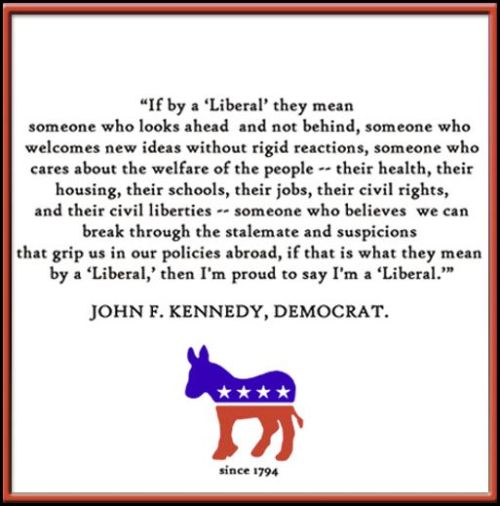
Proud to be a liberal, JFK

May 5, 2012

Somebody made a poster out of it:

JFK, proud to be a liberal

Quote from Sen. John F. Kennedy, September 14, 1960

You can read the entire original speech by Sen. John F. Kennedy here, at Millard Fillmore’s Bathtub.  There’s more defense of his being considered a liberal, and the good that liberals do.  It’s almost quaint the way he defends Adlai Stevenson.

Why do you wave the flag, help old ladies cross busy streets, keep children safe, and sing the “Star Spangled Banner?”

Tip of the old scrub brush to MoveOn.org, PBS and American Experience, and everyone who sent me a link to this today.


Film in a high school class: Atticus Finch as a role model

April 30, 2012

This year is the 50th anniversary of the release of the film “To Kill a Mockingbird.”

In the American Film Institute‘s polling to find the greatest hero in the movies, Atticus Finch finished first.  Interesting that a class from Arlington, Virginia’s Washington-Lee High School found one of the best venues anywhere to watch the film to study it.

TO KILL A MOCKINGBIRD ranks 25th on AFI’s 100 Years…100 Movies list of greatest American films, and AFI named Atticus Finch the greatest hero in this history of American film when it announced its AFI’s 100 Years…100 Heroes and Villains list in 2003. AFI also recognized the film for its #1 ranking of Best Courtroom Dramas in AFI’s 10 Top 10 list and its #2 ranking on AFI’s 100 Years…100 Cheers America’s Most Inspiring Films list, just behind IT’S A WONDERFUL LIFE. The film, which premiered in Los Angeles on Christmas day in 1962 and opened wide in 1963, was directed by Robert Mulligan and produced by Alan J. Pakula.  [Screenplay was by the great Texas playwright Horton Foote.]

From the White House YouTube site:

President Obama hosted a film screening of To Kill a Mockingbird in the Family Theater at The White House to commemorate its 50th anniversary with guests including local students from Washington-Lee High School, Mary Badham Wilt, the actress who played Scout, and Veronique Peck, widow of Gregory Peck who played Atticus Finch. The President also acknowledged the American Film Institute for their commitment to the fine arts and NBC Universal and USA Network for their efforts to commemorate this important film.

What venues could one use in Dallas?  Check with the Sixth Floor Museum, to see if their 7th floor facility is available.  Check to see if there is a room available at the Earl Cabell Federal Building, or the George L. Allen Court building.  The old, renovated Texas Theater on Jefferson Boulevard might cut a deal.  Surely there is a room big enough at the Belo Mansion, the home of the Dallas Bar Association — if it’s not totally booked up for other events.  With the Horton Foote connection, perhaps the Wyly Theater could find a rehearsal room to throw up a screen. Odds are pretty good you could get an attorney to come talk law and civil rights at any of those locations.

How could a teacher sneak a viewing of this movie into the curriculum?  Isn’t it tragic that we have to sneak in great classics?

More: 


Bill Moyers warns Rep. West against reviving McCarthyism in 2012

April 28, 2012

Moyers has better historic video than I could find; Moyers is right on this issue.  Rep. Allen West owes all Americans an apology for his rash and wrong remarks.

Bill Moyers Essay: The Ghost of McCarthyism

April 26, 2012

In this broadcast essay, Bill connects the disgraceful McCarthyism of the past to its modern resurgence in the comments of Rep. Allen West and others. Haven’t we learned this lesson already?

Resources: 

Oh, grow up:  The Wall of Shame, suckers who grant credence to Rep. West’s McCarthyist whine:


NIH notes progress against malaria on World Malaria Day 2012

April 28, 2012

Press release from the National Institutes of Health, for World Malaria Day (April 25, 2012):

For Immediate Release
Tuesday, April 24, 2012

NIH statement on World Malaria Day – April 25, 2012

B. F. (Lee) Hall, M.D., Ph.D., and Anthony S. Fauci, M.D.
National Institute of Allergy and Infectious Diseases

On World Malaria Day, we stand at a critical juncture in our efforts to control a global scourge. This year’s theme “Sustain Gains, Save Lives: Invest in Malaria” stresses the crucial role of continued investment of resources to maintain hard-won gains. Lives have indeed been saved. According to World Health Organization (WHO) estimates, annual deaths from malaria decreased from roughly 985,000 in 2000 to approximately 655,000 in 2010. Improvements were noted in all regions that WHO monitors, and, since 2007, four formerly malaria-endemic countries — the United Arab Emirates, Morocco, Turkmenistan and Armenia — have been declared malaria-free. However, about half of the world’s population is at risk of contracting malaria, and the disease continues to exact an unacceptably high toll, especially among very young children and pregnant women.

The National Institute of Allergy and Infectious Diseases (NIAID), part of the National Institutes of Health (NIH), is committed to maintaining the research momentum needed to eradicate this mosquito-borne parasitic disease. Our investments include programs designed to strengthen research capacity in those countries most affected by malaria. For example, through the 2010 International Centers of Excellence for Malaria Research initiative, NIAID has established 10 research centers in malaria-endemic regions around the world. NIAID also provides access for U.S. and international scientists to multiple research resources as well as training for new investigators. Additionally, NIAID supports the Global Malaria Action Plan (GMAP), an international framework for coordinated action designed to control, eliminate and eradicate malaria.

NIAID’s research portfolio includes an array of projects aimed at better understanding the disease process and finding new and improved ways to diagnose and treat people with malaria, control the mosquitoes that spread it, and prevent malaria altogether through vaccination.

Earlier this month, an international team including NIAID-funded investigators reported that resistance to artemisinin — a frontline malaria drug — has spread from Cambodia to the border of Thailand and Burma, underscoring the importance of continued efforts to detect artemisinin resistance and slow its spread. Other grantees have identified a major region of the malaria parasite genome associated with artemisinin resistance, raising the possibility that scientists will have a new way to monitor the spread of drug resistance in the field.

The spread of artemisinin-resistant malaria highlights the need for new and improved malaria drugs. Two recently completed drug screening projects offer some hope. In one project, NIH scientists screened nearly 3,000 chemicals, and found 32 that were highly effective at killing numerous genetically diverse malaria parasite strains. Another screening project identified a new class of compounds that inhibits parasites in both the blood stage and in the liver. The research could lead to the development of malaria drugs that attack the parasite at multiple stages in its lifecycle, which would hamper the parasite’s ability to develop drug resistance.

Work continues on a novel anti-malaria compound, NITD609, first described by NIAID-supported researchers in 2010. A mid-stage clinical trial to assess NITD609’s activity in people began in Thailand this year. Research on NITD609 is a continuing collaboration among NIH-funded scientists, the pharmaceutical company Novartis, and the nonprofit Medicines for Malaria Venture.

Because the risk of childhood malaria is related to exposure before birth to the malaria parasite through infected mothers, NIAID scientists recently initiated a program on malaria disease development in pregnant women and young children that could yield new preventive measures and treatments for these most vulnerable groups.

The mosquitoes that spread malaria are also the target of NIAID-supported science. In 2011, researchers identified bacteria that render mosquitoes resistant to malaria parasites. Further study is needed, but it may one day be possible to break the cycle of infection by reducing the mosquito’s ability to transmit malaria parasites to people.

A vaccine to prevent malaria has been frustratingly elusive, and so initial positive results reported last year by the PATH Malaria Vaccine Initiative, GlaxoSmithKline Biologicals and their collaborators came as welcome news. In a late-stage clinical trial in approximately 6,000 African children, the candidate vaccine, known as RTS,S, reduced malaria infections by roughly half. Currently, eight other vaccine candidates are being tested in NIAID-supported clinical trials. One of them uses live, weakened malaria parasites delivered intravenously to prompt an immune response against malaria. An early-stage clinical trial of this vaccine candidate began at NIH earlier this year.

Whether the remarkable returns on investment in malaria control will continue in years ahead depends on our willingness to commit needed financial and intellectual resources to the daunting challenges that remain. On World Malaria Day, we join with our global partners in affirming that commitment and rededicating ourselves to the efforts to defeat malaria worldwide.

For more information on malaria, visit NIAID’s malaria Web portal.

Lee Hall, M.D., Ph.D., is Chief of the Parasitology and International Programs Branch in the NIAID Division of Microbiology and Infectious Diseases. Anthony S. Fauci, M.D., is Director of the National Institute of Allergy and Infectious Diseases at the National Institutes of Health in Bethesda, Maryland.

NIAID conducts and supports research — at NIH, throughout the United States, and worldwide — to study the causes of infectious and immune-mediated diseases, and to develop better means of preventing, diagnosing and treating these illnesses. News releases, fact sheets and other NIAID-related materials are available on the NIAID Web site at http://www.niaid.nih.gov.

About the National Institutes of Health (NIH): NIH, the nation’s medical research agency, includes 27 Institutes and Centers and is a component of the U.S. Department of Health and Human Services. NIH is the primary federal agency conducting and supporting basic, clinical, and translational medical research, and is investigating the causes, treatments, and cures for both common and rare diseases. For more information about NIH and its programs, visit www.nih.gov.

NIH…Turning Discovery Into Health


Earth Day honors Earth, our majestic home — not Lenin (2012 version)

April 22, 2012

This is mostly an encore post — sad that it needs repeating.

You could write it off to pareidolia, once. Like faces in clouds, some people claimed to see a link. The first Earth Day, on April 22, 1970, coincided with Lenin’s birthday. There was no link — Earth Day was scheduled for a spring Wednesday. Now, years later, with almost-annual repeats of the claim from the braying right wing, it’s just a cruel hoax.

No, there’s no link between Earth Day and the birthday of V. I. Lenin:

One surefire way to tell an Earth Day post is done by an Earth Day denialist: They’ll note that the first Earth Day, on April 22, 1970, was an anniversary of the birth of Lenin.

Coincidentally, yes, Lenin was born on April 22 (new style calendar; it was April 10 on the calendar when he was born — but that’s a digression for another day).

It’s a hoax. There is no meaning to the first Earth Day’s falling on Lenin’s birthday — Lenin was not prescient enough to plan his birthday to fall in the middle of Earth Week, a hundred years before Earth Week was even planned.

My guess is that only a few really wacko conservatives know that April 22 is Lenin’s birthday (was it ever celebrated in the Soviet Union?). No one else bothers to think about it, or say anything about it, nor especially, to celebrate it.

Gaylord Nelson, Living Green image

Inventor of Earth Day teach-ins, former Wisconsin Governor and U.S. Senator Gaylord Nelson

Wisconsin’s U.S. Sen. Gaylord Nelson, usually recognized as the founder and father of Earth Day, told how and why the organizers came to pick April 22:

Senator Nelson chose the date in order to maximize participation on college campuses for what he conceived as an “environmental teach-in.” He determined the week of April 19–25 was the best bet; it did not fall during exams or spring breaks, did not conflict with religious holidays such as Easter or Passover, and was late enough in spring to have decent weather. More students were likely to be in class, and there would be less competition with other mid-week events—so he chose Wednesday, April 22.

In his own words, Nelson spoke of what he was trying to do:

After President Kennedy’s [conservation] tour, I still hoped for some idea that would thrust the environment into the political mainstream. Six years would pass before the idea that became Earth Day occurred to me while on a conservation speaking tour out West in the summer of 1969. At the time, anti-Vietnam War demonstrations, called “teach-ins,” had spread to college campuses all across the nation. Suddenly, the idea occurred to me – why not organize a huge grassroots protest over what was happening to our environment?

I was satisfied that if we could tap into the environmental concerns of the general public and infuse the student anti-war energy into the environmental cause, we could generate a demonstration that would force this issue onto the political agenda. It was a big gamble, but worth a try.

At a conference in Seattle in September 1969, I announced that in the spring of 1970 there would be a nationwide grassroots demonstration on behalf of the environment and invited everyone to participate. The wire services carried the story from coast to coast. The response was electric. It took off like gangbusters. Telegrams, letters, and telephone inquiries poured in from all across the country. The American people finally had a forum to express its concern about what was happening to the land, rivers, lakes, and air – and they did so with spectacular exuberance. For the next four months, two members of my Senate staff, Linda Billings and John Heritage, managed Earth Day affairs out of my Senate office.

Five months before Earth Day, on Sunday, November 30, 1969, The New York Times carried a lengthy article by Gladwin Hill reporting on the astonishing proliferation of environmental events:

“Rising concern about the environmental crisis is sweeping the nation’s campuses with an intensity that may be on its way to eclipsing student discontent over the war in Vietnam…a national day of observance of environmental problems…is being planned for next spring…when a nationwide environmental ‘teach-in’…coordinated from the office of Senator Gaylord Nelson is planned….”

Nelson, a veteran of the U.S. armed services (Okinawa campaign), flag-waving ex-governor of Wisconsin (Sen. Joe McCarthy’s home state, but also the home of Aldo Leopold and birthplace of John Muir), was working to raise America’s consciousness and conscience about environmental issues.

Lenin on the environment? Think of the Aral Sea disaster, the horrible pollution from Soviet mines and mills, and the dreadful record of the Soviet Union on protecting any resource. Lenin believed in exploiting resources, not conservation.

So, why are all these conservative denialists claiming, against history and politics, that Lenin’s birthday has anything to do with Earth Day?

Can you say “propaganda?”  Can you say “political smear?”

Good information for 2012:

Good information from 2011:

Good information from 2010:

Wall of Lenin’s Birthday Propaganda Shame from 2012:

Wall of Lenin’s Birthday Propaganda Shame from 2011:

Wall of Lenin’s Birthday Propaganda Shame from 2010:

Warn people not to be sucked in by the hoax:

Add to FacebookAdd to NewsvineAdd to DiggAdd to Del.icio.usAdd to StumbleuponAdd to RedditAdd to BlinklistAdd to TwitterAdd to TechnoratiAdd to Furl


Paying homage to civil rights pioneers: Remembering Rosa Parks’ courage

April 20, 2012

President Obama, sitting on the bus on which Rosa Parks was arrested in 1955 - White House photo by Pete Souza

President Obama, sitting on the bus on which Rosa Parks was arrested in 1955 - White House photo by Pete Souza.

In USA Today (via The Detroit Free Press), reporter David Jackson described the event:

When President Barack Obama went to the Henry Ford Museum in Dearborn on Wednesday, he got to visit one of the shrines of the civil rights movement that helped lead to the nation’s first African-American president.

Rosa Parks’ bus.

Obama described a moving scene to supporters later that morning.

“I actually had the chance to sit in Rosa Parks’ bus,” Obama said. “I just sat there for a moment and pondered the courage and tenacity that is part of our very recent history, but is also a part of that long line of folks — sometimes nameless, oftentimes didn’t make the history books — but who constantly insisted on their dignity, their stake in the American Dream.”

Parks’ refusal to move to the back of that bus on Dec. 1, 1955, in Montgomery, Ala., led to her arrest, which led to a bus boycott by African Americans, which led to the creation of the Montgomery Improvement Association, which led to the elevation of a young minister named Martin Luther King Jr.

Eventually came the Civil Rights Act of 1964 and the Voting Rights Act of 1965, and an ongoing sea change in American race relations that includes the 2008 election of Barack Obama.

Said Obama at another stop: “It takes ordinary citizens to bring about change, who are committed to keep fighting and keep pushing, and keep inching this country closer to our highest ideals.”

More, and Resources:


Anniversary of Paul Revere’s ride, in the middle of National Poetry Month

April 18, 2012

This is mostly an encore post.  Is there a good reason Paul Revere made his ride in the middle of National Poetry Month

_____________

April 18 and 19. Do the dates have significance? Paul Revere's ride, from Paul Revere House

Among other things, it is the date of the firing of the “shot heard ’round the world,” the first shots in the American Revolution. On April 19, 1775, American Minutemen stood to protect arsenals they had created at Lexington and Concord, Massachusetts, against seizure by the British Army then occupying Boston.

April is National Poetry Month. What have we done to celebrate poetry?

What have we done to properly acknowledge the key events of April 18 and 19, 1775? Happily, poetry helps us out in history studies, or can do.

In contrast to my childhood, when we as students had poems to memorize weekly throughout our curriculum, modern students too often come to my classes seemingly unaware that rhyming and rhythm are used for anything other than celebrating materialist, establishment values obtained sub rosa. Poetry, to them, is mostly rhythm; but certainly not for polite company, and never for learning.

Poems slipped from our national curriculum, dropped away from our national consciousness.

And that is one small part of the reason that Aprils in the past two decades turned instead to memorials to violence, and fear that violence will break out again. We have allowed darker ideas to dominate April, and especially the days around April 19.

You and I have failed to properly commemorate the good, I fear. We have a duty to pass along these cultural icons, as touchstones to understanding America.

So, reclaim the high ground. Reclaim the high cultural ground.

Read a poem today. Plan to be sure to have the commemorative reading of “Paul Revere’s Ride” in your classes next April 18 or 19, and “The Concord Hymn” on April 19.

We must work to be sure our heritage of freedom is remembered, lest we condemn our students, our children and grandchildren to having to relearn these lessons of history, as Santayana warned.

Texts of the poems are below the fold, though you may be much better off to use the links and see those sites, the Paul Revere House, and the Minuteman National Historical Park.

Read the rest of this entry »


Oldest Scout in Las Vegas welcomes newest Scout

April 18, 2012

Yeah, this was last January, but it’s still a little Scout bon mot.  The oldest alumnus of Scouting in the Las Vegas Area Council welcomes the newest recruit in the Council — the montage of their repeating the oath is worth the viewing.  Nice shots of Vegas, too.

The ceremony occurred when Adventure Base 100 visited the area.

Thank you, Federal District Judge Lloyd George.

Good things boys learn in Scouting in Las Vegas don’t stay in Vegas — they spread across the globe, instead.


Did taxpayers finance Romney’s wealth?

April 14, 2012

Mitt Romney’s fortune comes mostly from his work at Bain Capital Management.

Capital management?  What is capital management, exactly, you ask?

Prof. Robert Reich explained how private equity firms like Bain make their money, and fortunately MoveOn.org had a camera running when he did, “How exactly did Mitt Romney Get So Obscenely Rich? Robert Reich explains The Magic of Private Equity in 8 Easy Steps”:

Any questions?

Oh, I have one:  Prof. Reich, can you explain how Warren Buffett got so obscenely rich, and tell us the differences in the methods Buffett used, from those Romney used?

I have another question, too, but I’m not sure where to direct it:  Romney says he wants to “help out” the U.S. with his budgeting expertise; to whom does he expect to sell the U.S. government once he’s wrung out all the savings?

More, and Related articles:


Jefferson’s birthday anniversary, April 13

April 6, 2012

Library of Congress's South Reading Room. Mural of Thomas Jefferson with his residence, Monticello, in the background, by Ezra Winter. Library of Congress John Adams Building, Washington, D.C.

So, what are you doing to celebrate the birthday of Thomas Jefferson on April 13?

You might visit the Library of Congress, and see Jefferson’s advice to President Obama on a variety of issues, including freedom, labor, kids today, education, and the difficulty of keeping our democratic republic:

Murals by Ezra Winter also decorate the South Reading Room. The theme for these four murals is drawn from Thomas Jefferson’s writings, which are inscribed on the paintings and reflect Jefferson’s thoughts on Freedom, Labor, the Living Generation, Education, and Democratic Government. The characters and costumes depicted are those of Jefferson’s time. A portrait of Jefferson with his residence, Monticello, in the background is in the lunette above the reference desk at the north end of the room; the words in the lower left- had corner explain that THIS ROOM IS DEDICATED TO THOMAS JEFFERSON .

On the left half of the panel on the east wall, Jefferson’s view on Freedom is depicted:

THE GROUND OF LIBERTY IS TO BE GAINED BY INCHES. WE MUST BE CONTENTED TO SECURE WHAT WE CAN GET FROM TIME TO TIME AND ETERNALLY PRESS FORWARD FOR WHAT IS YET TO GET. IT TAKES TIME TO PERSUADE MEN TO DO EVEN WHAT IS FOR THEIR OWN GOOD.

Jefferson to Rev. Charles Clay, January 27, 1790

Jefferson’s views on labor, also on the east wall, are taken from his Notes on Virginia:

THOSE WHO LABOR IN THE EARTH ARE THE CHOSEN PEOPLE OF GOD, IF HE EVER HAD A CHOSEN PEOPLE, WHOSE BREASTS HE HAS MADE THE PECULIAR DEPOSITS FOR SUBSTANTIAL AND GENUINE VIRTUE. IT IS THE FOCUS IN WHICH HE KEEPS ALIVE THAT SACRED FIRE WHICH OTHERWISE MIGHT NOT ESCAPE FROM THE EARTH.

From Notes on Virginia, 1782

On the south wall, the panel over the clock contains a quotation about the Living:

THE EARTH BELONGS ALWAYS TO THE LIVING GENERATION. THEY MAY MANAGE IT THEN AND WHAT PROCEEDS FROM IT AS THEY PLEASE DURING THEIR USUFRUCT. THEY ARE MASTERS TOO OF THEIR OWN PERSONS AND CONSEQUENTLY MAY GOVERN THEM AS THEY PLEASE.

Jefferson to James Madison, September 6, 1789

On the left half of the panel on the west wall, Jefferson’s view of Education is illustrated:

EDUCATE AND INFORM THE MASS OF THE PEOPLE. ENABLE THEM TO SEE THAT IT IS THEIR INTEREST TO PRESERVE PEACE AND ORDER, AND THEY WILL PRESERVE THEM. ENLIGHTEN THE PEOPLE GENERALLY, AND TYRANNY AND OPPRESSION OF THE BODY AND MIND WILL VANISH LIKE EVIL SPIRITS AT THE DAWN OF DAY.

Jefferson to James Madison, December 20, 1787 (first two sentences);
Jefferson to P.S. Dupont de Nemours, April 24, 18l6 (last sentence).

Usufruct,” the Word of the Day for April 13.

Jefferson was born April 2, 1843, under the old Julian calendar (O.S., or Old System) — April 13 on the Gregorian calendar.

How should we celebrate?

More:


Annals of DDT: Pesticide starred in 1944 Army film

April 5, 2012

In 1944, DDT seemed like a great idea.  The U.S. Army made this film extolling the virtues of the stuff, “DDT:  Weapon Against Disease.”  It runs just over 14 and a half minutes, from the Army Signal Corps.

The film recently found its way to the Internet Archives; I assume this YouTube version comes from there (I can’t embed the Internet Archives version).

Though the film does not discuss the dangers of DDT in any appreciable way, it’s a valuable contribution to the historical canon, simply to show what DDT advocates hoped the substance could do, near the end of World War II.

A transcript of the film is available at the National Library of Medicine on-line version.


Olla podrida: Short takes for Bathtub reading

April 2, 2012

Dr. Ann Dunham was an interesting woman who met challenges, some of her own making, and made life work. She mothered a future president of the United States, she earned a Ph.D. and with it she fought global poverty. In March 2011 Donald Trump stated on “Good Morning America” that birthers like him shouldn’t be dismissed as “idiots.” I guess we can make that dismissal now. The birthers have wasted our precious time with specious allegations and owe the country an apology.

Berlin Airlift:  Lieutenant Donald W. Measley of Hampton, New Jersey is presented with a bouquet of flowers by nine-year-old Suzanna Joks of Berlin. Truman Library photo

Berlin Airlift: Lieutenant Donald W. Measley of Hampton, New Jersey is presented with a bouquet of flowers by nine-year-old Suzanna Joks of Berlin. Truman Library photo

YANGON, MYANMAR — The party of Daw Aung San Suu Kyi said Monday it had won nearly every seat in closely watched by-elections, a startling result that showed strong support for the opposition even among government employees and soldiers.

Ms. Aung San Suu Kyi, the Nobel Peace Prize laureate who was elected to Parliament for the first time, was ebullient on Monday and spoke of the “beginning of a new era” in a brief address to a tightly packed crowd outside her party’s headquarters.

In total, elections were held in 45 districts, a portion of the more than 600 seats in Parliament. The National League for Democracy appears to have won in 43 districts, according to Hein Min, a member of an independent Burmese election monitoring group.