Typewriter (film) of the moment: Nicholson and Lockett

September 2, 2011

Not a nostalgic look, Gary Nicholson and Christopher Lockett are making a documentary about typewriters, and people who use them in the 21st century.

Yeah, I’m interested.

Here’s their description of the project:

In May of 2010, Los Angeles-based filmmakers Christopher Lockett and Gary Nicholson read an article on Wired.com about “The Last Generation Of Typewriter Repairmen.” Casual conversation over coffee about the importance of the typewriter in world history eventually turned toward the inevitable conclusion that “this would make a good documentary.”

Lockett and Nicholson agreed that the passing of the typewriter, a portable printing press that moved the world’s communication technology from pen and ink to the QWERTY keyboards on today’s computers, along with the highly skilled technicians who service them, should be documented.

But as so often happens in documentaries, a funny thing happened on the way…  to paraphrase Mark Twain, news of the typewriter’s death is greatly exaggerated.  Three typewriter repairmen the filmmakers have interviewed all agree that their business is better than it has been in years.

Perhaps it is a reaction to the plugged in existence of today’s 24/7 communications world. Perhaps it is mere nostalgia and kitsch. Perhaps it is an admiration for the elegance of design and the value of time-tested workmanship. And for some, like typewriter collector Steve Soboroff, it is the appeal of owning machines on which American writers like Ernest Hemingway, Tennessee Williams, Ray Bradbury, John Updike and Jack London typed some of their finest work. (He also owns typewriters once owned by George Bernard Shaw and John Lennon)

But one thing is certain, from the Typosphere – an online community of bloggers who sometimes meet up for “Type-In” events, to vintage stores in fashionable neighborhoods in Brooklyn and Los Angeles, Portland and Philadelphia, to noted typewriter collector Tom Hanks, to teachers using typewriters to encourage young writers to focus their thoughts without benefit of a delete key – if the typewriter is on the way out, it’s going out with more appreciation that it’s seen in years.

So far, the filmmakers have documented two Type-in events, (Los Angeles and Phoenix, AZ) have interviewed three typewriter repairmen, one noted typewriter collector and already have arranged to interview at least one Hollywood screenwriter who still uses a typewriter. They have also interviewed journalists, authors, teachers, enthusiasts and people who use typewriters in their personal and professional life.

But there are other novelists, screenwriters and enthusiasts out there. And there are so many more typewriters they’d like to feature – typewriters that produced some of the finest works of 20th Century American literature.  They have also interviewed technicians with the L.A. County Sheriff’s Office who repair the typewriters the department still uses. They are handy for typing forms in triplicate and for such communications requiring a personal touch as letters of condolence.

Along with dozens of photographically gorgeous typewriters lovingly restored by repairmen Ruben Flores, Ermanno Manzorati and Bill Wahl, the filmmakers have interviewed Darryl Rehr, the author of the definitive book “Collecting Antique Typewriters” and an artist whose work features typewriters.

On the wish-list are an East Coast-based orchestra that uses typewriters in their music, the US Patent office holding Christopher Scholes original 1868 US Patent for the typewriter, a man in Philadelphia who has wired a manual typewriter to a computer screen via USB cable and a 15-year-old collector in West Virginia who has collected more than 200 machines and has written and published a book about collecting typewriters. A writer who got kicked out of the Writers Room in Grenwich Village for using his grandmother’s 1929 Royal typewriter and making too much noise. He was given an ultimatum: Use a laptop or get out. Also on that wish-list: an artist who creates her work by typing out portraits on the page, an “instant poet” who types spontaneous poetry on the street, and an author who has documented the feminist history of the typewriter’s early days – it was the first piece of office machinery that gave women the opportunity for employment outside the home.

All of which is currently beyond the filmmakers’ financial grasp. Travel isn’t cheap. In terms of technical skills and gear, the filmmakers are covered. Lockett holds an MFA in Cinematography from the American Film Institute and his credits include TV shows for every major TV network and most cable networks, indie features and PBS documentaries. Nicholson holds a BFA in Motion Pictures and Television from the Academy of Art University  and his producing credits include indie features, Broadway, and music. The team is shooting on Canon 7D and 60D DLSRs and editing in 1920 x 1080 full HD on Final Cut Pro and recording sound digitally on a Zoom H4N.

The Typewriter (In The 21st Century) – if the typewriter didn’t exist, the filmmakers couldn’t have typed this. And you probably wouldn’t be reading it on a computer screen. It’s that important.

The film will feature people who demonstrate much greater fanatacism towards typewriters than I do.

My ears are tintinnabulating in anticipation.


Christie’s Auctions: Astonishing Pair of Matching Singing Bird Pistols

August 28, 2011

Aurel Bacs, International Head of the Watch Department, shares his passion and knowledge of the only known matching pair of gold and enamel singing bird pistols, to be offered at Christie’s Hong Kong Important Watches sale on 30 May 2011.

This is the only known pair of matching singing bird pistols, thought to have been created by Frères Rochat, a Swiss watch, toy and machine maker.  Several people have sent me links and alerts to this video over the past several weeks — it’s worth seeing, just to admire the craftsmanship, and inventiveness required to make these things.

Vodpod videos no longer available.

Christie’s Auctions: The Only Pair of Matching…, posted with vodpod

Bloomberg News reported the pistols fetched a price of $5.8 million at the sale on May 30.  The purchaser’s name was not reported, but a Bacs said it was an “epic bidding war” between two of the most ardent collectors of such treasures.

Will these pieces be seen in public again in our lifetimes?

Tip of the old scrub brush to Gil Brassard, and others.


How deep is the stupid in Tea Party and among their fellow travelers?

August 28, 2011

Barack Obama has managed to tack on a bit over a trillion dollars to the national debt, mostly in a successful effort to keep the U.S. and the world from plunging into a Greater Depression.  We haven’t shaken off the harmful effects of the Republican assault on capitalism during the previous years’ assaults on the Constitution, science, education and other American institutions.

But in the alternate universe of conservative thought, Obama’s put $15 trillion in new debts on the books.  Being off by a factor of 10 to 15 is an accomplishment worthy of someone wholly unconnected with reality.  That would be Victor Davis Hanson in this case.  Not sure why, but some search took me to a blog called The Clue Batting Cage — batting away clues to reality is a sport to them, I suppose.  There I found this post:

Here’s some excellent wording from Victor Davis Hanson.

Despite nearly $15 trillion in federal debt, the administration apparently wants to defy the rules of logic and do more of what made things worse in the first place, under the euphemism of “investments.” American popular culture has coined all sorts of proverbial warnings about such mindless devotion to destructive rote: “Don’t flog a dead horse,” “If you are in a hole, stop digging,” and “Insanity is doing the same thing over and over and expecting different results.”

No matter: The administration still adheres to the logical fallacy that the toxic medicine cannot be proven to be useless or harmful, because there was supposedly never enough of it given. And the proof is that the worsening patient is still not quite dead.
:
That there is never enough spending is a seductive fallacy because it never requires any empirical proof: If millions of those supported by the state have lost their self-reliance and self-initiative, perhaps it is because millions supported by the state were not supported well enough, and so in response, some resorted to stealing things they could not afford.

How many others could possibly be with these yahoos, looking through the telescope backwards?

Looking through a telescope the wrong way. Unknown source.

Looking through a telescope the wrong way. Unknown source.

Here’s what I posted in comments:

It’s difficult to reconcile the idea of someone who recommends Bob Park’s blog, and approves of Victor Hanson’s blather at the same time.

But then I look closer. You missed the boat completely. You didn’t even recommend the right Bob Park, but some imposter named Parks. You missed reality by one letter.

Reality is not an opinion, not that I expect you’ll ever change your opinion on that.

Lay off of Morgan’s blog for a while, maybe read some science or something. You may not feel better in the morning, but soon, and for the rest of your life.

9:38 PM

Delete

The author complains that my comments are too acid, and that the National Science Foundation is a “government site.”

If you call a private foundation the government supports, independent from the government by design to keep its advice unbiased, does that make it a government site?

Or is it still a four-legged calf?

A wise person said that you can’t reason someone out of a position they didn’t get to by reason in the first place.  That’s the problem with the Tea Party in the first place.  It’s also the problem in the second place, and the third place, and on all issues.

To the Tea Party mindset, they are all five-legged dogs.

Tea Party's five-legged dog, by Esther Derby.com

Tea Party’s five-legged dog, by Esther Derby.com


Propaganda posters: J. C. Leyendecker’s Uncle Sam at bat

August 28, 2011


Get in the game with Uncle Sam, WWI poster by J. C. Leyendecker, Museum of Play image

“Get in the Game with Uncle Sam” poster from World War I, by J. C. Leyendecker — image from National Museum of Play

No matter how much the Texas State Board of Education wishes to run away from America’s heritage, we can’t.

Nor should we want to.

Propaganda is not a bad word.  There is bad propaganda, stuff that doesn’t work.  There is propaganda for bad purposes, stuff that promotes bad policies, or evil.  But good propaganda is stronger, long-lasting, often full of great artistic merit, and instructive.

Images of Uncle Sam provide clear pictures of what Americans were thinking, from the oldest versions to today.

This poster above is a World War I poster designed to convince Americans to get involved in the war effort.  J. C. Leyendecker, a noted illustrator, casts Uncle Sam as a baseball player up to bat.  The poster says simply, “Get in the game with Uncle Sam.”  Perhaps uniquely, this poster showed Sam in yellow-striped pants, instead of the more traditional red-striped.  Could an artist take such liberty today?

Nicolas Ricketts at the Strong Museum of National Play offered a good, concise description of the politics and history of the poster at the blog for the Museum:

Meanwhile, then-president Woodrow Wilson, who had won reelection in 1916 on an anti-war platform, faced the need for American participation in the terrible “Great War” raging in Europe. He and his cabinet knew that American involvement loomed. But how could the government convince the American public that this was necessary? One idea was to create a poster that urged Americans to metaphorically “Get in the Game,” along with their patriotic national symbol, Uncle Sam.

Artist J. C. Leyendecker (1874-1951) designed the poster, commissioned by the Publicity Committee of the Citizens Preparedness Association, a pro-war organization with federal support which also sponsored “preparedness parades” and other nationalistic activities. Leyendecker himself emigrated from Germany at age eight and was approaching the pinnacle of his career in 1917 when he created this work.

The poster just preceded James Montgomery Flagg’s famous “I Want You” image of Uncle Sam, which later became the best-known likeness of the country’s unofficial symbol. Leyendecker’s version, in spite of his baseball bat, is possibly less affable to contemporary eyes than Flagg’s friendlier Sam. But the bat he holds connected him to many Americans, who perhaps then decided that America should “get in the game.”

Some of this older propaganda had a humorous twist I think is too often missing from modern posters.  It was more effective for that, I think.

The image of Sam at bat shows up in many places in the internet world, but most often stripped of its identifying links to Leyendecker.  That does disservice to the art, to history, and to Leyendecker, who was one of our nation’s better illustrators for a very long time.

Visit the National Museum of Play in Rochester, New York.


Boston University: Writing history, a guide

August 26, 2011

AP history classes worry about writing more than most history classes.  But we really should do more writing in history class, both as a tool to learn about history in the past, and as an exercise in actually writing history.

Searching for something else, I stumbled on a guide published by thBoston University’s Department of History.  It’s not dull at all, but lively, and therefore quite useful, even though it starts out in French:

Raison d’être

Good, clear writing is, for most historians and professional writers, more of a process than a God-given talent. It begins with a blank piece of paper (or computer screen) and ends with a clearly organized and persuasive argument
in the form of a research paper, a published article, or a book manuscript.

History as a discipline is in its essence the discovery and interpretation of signs of the past as well as conventions of how to cite such evidence. It thus combines research (the search for historical evidence) and the organization of data into a convincing argument. Historical writing is one variety of written expression which seeks to inform and persuade the reader through the use of evidence organized around a central thesis or argument.  Good historical writing is not merely description, though it may employ illustrations and appeals to the reader’s imagination.

AP history teachers may find it useful for their classes.  Students working on National History Day projects may find it useful.  You may find it fun to read.  Check it out:  Boston University Department of History Writing Guide (in .pdf).


Sideshow of DDT and malaria

August 23, 2011

Not exactly a DDT/Malaria carnival.  Just enough for a sideshow.

First, the controversy over use of DDT in Uganda continues, even as DDT is applied daily there.  This demonstrates that DDT remains freely available for use in Africa.  It also demonstrates that Africans are not clamoring for more DDT.

Uganda offers a key proving ground for the propaganda campaign against environmentalists, against scientist, against medical care officials, and for DDT.  Though malaria plagues Uganda today and has done so for the past 200 years at least, it was not a target of the World Health Organization’s (WHO) campaign to eradicate malaria in the 1950s and 1960s, because the nation lacked the governmental structures to mount an effective campaign.  DDT was used to temporarily knock down mosquito populations, so that medical care could be improved quickly and malaria cured among humans.  Then, when the mosquitoes came roaring back as they always do with DDT, there would be no pool of the disease in humans from which the mosquitoes could get infected.  End of malaria problem.

Plus, for a too-long period of time, Uganda was ruled by the brutal dictator Idi Amin.  No serious anti-malaria campaigns could be conducted there, then.

Uganda today exports cotton and tobacco.  Cotton and tobacco interests claim they cannot allow any DDT use, because, they claim, European Union rules would then require that the tobacco and cotton imports be banned from Europe.  I can’t find any rules that require such a ban, and there are precious few incidents that suggest trace DDT residues would be a problem, but this idea contributes to the political turmoil in Uganda.  Businessmen there sued to stop the use of even the small amounts of DDT used for indoor residual spraying (IRS) in modern campaigns.  They lost.  DDT use continues in Uganda, with no evidence that more DDT would help a whit.

Malaria campaign posters from World War II, South Pacific - Mother Jones compilation

Much of the anti-malaria campaign aimed at soldiers, to convince them to use Atabrine, a preventive drug, or to use nets, or just to stay covered up at night, to prevent mosquito bites. Mother Jones compilation of posters and photos.

Second, the website for Mother Jones magazine includes a wonderful 12-slide presentation on DDT in history.  Malaria took out U.S. troops more effectively than the Japanese in some assaults in World War II.  DDT appeared to be a truly great miracle when it was used on some South Pacific islands.  Particularly interesting are the posters trying to get soldiers to help prevent the disease, some done by the World War II-ubiquitous Dr. Seuss.  Good history, there.  Warning:  Portrayals of Japanese are racist by post-War standards.

Third, a new book takes a look at the modern campaigns against malaria, those that use tactics other than DDT.  These campaigns have produced good results, leading some to hope for control of malaria, and leading Bill Gates, one of the biggest investors in anti-malaria campaigns, to kindle hopes of malaria eradication again.  Here is the New York Times  review of  Alex Perry’s Lifeblood: How to Change the World One Dead Mosquito at a Time (PublicAffairs, $25.99).   Perry is chief Africa correspondent for Time Magazine.

This little gem of a book heartens the reader by showing how eagerly an array of American billionaires, including Bill Gates and the New Jersey investor Ray Chambers (the book’s protagonist), are using concepts of efficient management to improve the rest of the world. “Lifeblood” nominally chronicles the global effort to eradicate malaria, but it is really about changes that Mr. Chambers, Mr. Gates and others are bringing to the chronically mismanaged system of foreign aid, especially in Africa.

These three snippets of reporting, snapshots of the worldwide war on malaria, all diverge dramatically from the usual false claims we see that, but for ‘environmentalist’s unholy and unjust war on DDT,’ millions or billions of African children could have been saved from death by malaria.

The real stories are more complex, less strident, and ultimately more hopeful.


Hey Obama: Defend the social safety net, win big in 2012

August 20, 2011

Historian Rick Perlstein told Chris Matthews on MSNBC’s Hardball that President Obama needs to go powerfully on the defensive, defending the social safety net Republicans are working hard to shred.

You’ll note Matthews opened up the discussion showing FDR’s defense of Social Security from 1936, the same one carried here at the bathtub a few weeks ago.

Good advice, I think.  I hope Obama and his advisors pay attention.

(You can watch it at Hardball’s site, here — better quality video.)

One of the triggers of this piece was Perlstein’s article in Time Magaizine’s Swampland, “How Democrats Win:  Defending the Social Safety Net.” 

Tip of the old scrub brush to Harold Pollack at the Reality-based Community.


Perry’s lack of business experience noted — by Republicans

August 17, 2011

If you followed at all the teapot tempest over the false claims that President Obama’s cabinet lacked business experience (also here and here), this headline must have made you guffaw:

Kay Bailey Hutchison won’t endorse Rick Perry for president, says she wants someone with private-sector experience

No love lost between Hutchison and Perry.  Hutchison opposed Perry for the Republican nomination for governor of Texas in 2010.  Perry was brutal in his criticism of her, and he defeated her in the primary.

Texas Gov. Rick Perry should not count on the support of his state’s seniority senator (and his 2010 Republican gubernatorial rival) if he decides to run for president.

(Polaroid photo by Sarah Tung/Hearst Newspapers)

Sen. Kay Bailey Hutchison, R-Dallas, told NBC’s Andrea Mitchell today that she is looking for a Republican candidate with private-sector experience as her choice for the party’s 2012 presidential nomination.

Perry is a career politician who has held elective office since 1985.

“He certainly has got government experience,” Hutchison told Mitchell on MSNBC’s “The Daily Rundown” this morning, adding that “we need people who have been in the private sector, as well.”

The Republican senator’s comments hint strongly that she’d prefer one of the GOP candidates who has run a business: former Winter Olympics organizer (and venture capitalist) Mitt Romney, former Godfather’s Pizza CEO Herman Cain or former chemical company executive Jon Huntsman.

Hutchison said she has no immediate plans to endorse any candidate.


Still quote of the moment: Martin Niemöller, “. . . I did not speak out . . .”

August 16, 2011

First they came for the communists, and I did not speak out—because I was not a communist;
Then they came for the trade unionists, and I did not speak out—because I was not a trade unionist;
Then they came for the Jews, and I did not speak out—because I was not a Jew;
Then they came for me—and there was no one left to speak out for me.

— Pastor Martin Niemöller

German theologian and Lutheran Pastor Martin Niemöller on a postage stamp, painted by Gerd Aretz in 1992 – Wikipedia

Some time this year school curricula turn to the Holocaust, in English, in world history, and in U.S. history.

Martin Niemöller’s poem registers powerfully for most people — often people do not remember exactly who said it. I have seen it attributed to Deitrich Bonhoeffer (who worked with Niemöller in opposing some Nazi programs), Albert Einstein, Reinhold Niebuhr, Albert Schweitzer, Elie Wiesel, and an “anonymous inmate in a concentration camp.”

Niemöller and his actions generate controversy — did he ever act forcefully enough? Did his actions atone for his earlier inactions? Could anything ever atone for not having seen through Hitler and opposing Naziism from the start? For those discussion reasons, I think it’s important to keep the poem attributed to Niemöller. The facts of his life, his times, and his creation of this poem, go beyond anything anyone could make up. The real story sheds light.

Resources:

Noted here last February.

Save

Save

Save


Howard Zinn: Bank bailout was trickle down economics run amok

August 14, 2011

You can disagree with him about every other sentence, but he speaks a lot of sense and a lot of stuff we need to think about.  Before his death in 2010, historian Howard Zinn talked about the bank bailouts that got us out of 2008:


August 13, 1961: The Berlin Wall’s 50th anniversary

August 13, 2011

August keeps handing us these dates:  How should the 50th anniversary of the construction of the Berlin Wall be remembered?

AP reports in the Seattle Post-Intelligencer that the current mayor of Berlin said we must use the Wall to remember that we must stand up for democracy.  Ceremonies in Berlin marked the anniversary and the creation of a new museum there.  I wrote before:

August 13 . . . [marks the 50th] “anniversary” of the erection of the Berlin Wall, the totem of the Cold War that came down in 1989, pushing the end of the Cold War. Residents of Berlin awoke on this day in 1961 to find the communist government of East Germany erecting what would become a 96-mile wall around the “western quarters” of the city — not so much to lay siege to the westerners (that had been tried in 1948, frustrated by the Berlin Airlift) as to keep easterners from “defecting” to the West. The Brandenburg Gate was closed on August 14, and all crossing points were closed on August 26.

From 1961 through 1991 1989, teachers could use the Berlin wall as a simple and clear symbol for the differences between the communist Eastern Bloc, the Soviet Union and her satellite states, and the free West, which included most of the land mass of Germany, England, France, Italy, the United States and other free-market nations — the North Atlantic Treaty Organization (NATO) countries. I suspect most high school kids today know very little about the Wall, why it was there, and what its destruction meant, politically.

This era of history is generally neglected in high school. Many courses fail to go past World War II; in many courses the Cold War is in the curriculum sequenced after the ACT, SAT and state graduation examinations, so students and teachers have tuned out.

But the Wall certain had a sense of drama to it that should make for good lessons. When I visited the wall, in early 1988, late at night, there were eight fresh wreaths honoring eight people who had died trying to cross the Wall in the previous few weeks (in some places it was really a series of walls with space in between to make it easier for the East German guards to shoot people trying to escape) — it’s an image I never forget. Within a year after that, East Germans could travel through Hungary to visit the West, and many “forgot” to return. Within 18 months the wall itself was breached.

The Wall was a great backdrop for speeches, too — President John F. Kennedy visited Berlin in June 1963, and expressed his solidarity with the walled-in people of both West and East Berlin, with the memorable phrase, “Ich bin ein Berliner, which produced astounding cheers from the tens of thousands who came to hear him. There are a few German-to-English translators who argue that some of the reaction was due to the fact that “Berliner” is also an idiomatic phrase in Berlin for a bakery confection like a jelly doughnut — so Kennedy’s words were a double entendre that could mean either “I am a citizen of Berlin,” or “I am a jelly doughnut.”  [Be sure to see the comments . . .  from Vince Treacy (9/28/2010).]  Ronald Reagan went to the same place Kennedy spoke to the Berlin Wall, too, to the Brandenburg Gate, in his famous June 1987 speech which included a plea to the Soviet Union’s Premier Mikhail Gorbachev: “Mr. Gorbachev, tear down this wall!”

What do we do appropriately with such memory?

What does the Berlin Wall, and its demise, mean to us today?  What should it mean?


Will any Republican stand up for America?

August 12, 2011

Ezra Klein’s on-line column this morning worries me more — will any Republican stand up for America?

No, I don’t mean  lip service, I don’t mean flag lapel pins.  I mean, will any Republican stand up for the policies we need to steer through the shoals of economic woe we face in the next 60 months?

At Wonkbook Klein said:

The most telling moment of Thursday’s GOP debate wasn’t when Michele Bachmann cooly stuck a knife between Tim Pawlenty’s ribs, or when Rick Santorum plaintively begged for more airtime, or when Mitt Romney easily slipped past questions about his record on health-care reform. It was when every single GOP candidate on the stage agreed that they would reject a budget deal that was $10 in spending cuts for every $1 in tax increases. Even Fox News’s Bret Baier couldn’t quite believe what he was seeing. He asked again just to make sure the assembled candidates had understood the question.

Primary debates are usually watched for what they say about the candidates, but they’re generally important for what they say about the party. This one was no different. With the notable exceptions of Ron Paul and Jon Huntsman, the candidates didn’t disagree over policy. They disagreed over fealty to policy.

Bachmann didn’t attack Pawlenty’s policy proposals. She attacked him for past statements suggesting he might believe in other policy proposals, like the individual mandate and cap-and-trade. Pawlenty’s assault on Romney took the same form. This debate wasn’t about what policies the candidates believed in. That was largely a given. This debate was about which of the candidates believed in those policies the most.

The best policy in this debate wasn’t the policy most likely to work, or the policy most likely to pass. It was the most orthodox policy. The policy least sullied by compromise. A world in which the GOP will not agree to deficit reduction with a 10:1 split between spending cuts and tax increases is a world where entitlement reform can’t happen. It’s a world where the “supercommittee” fails and the trigger is pulled, and thus a world in which $1 out of every $2 in cuts comes from the Pentagon. It’s not a world that fits what many in the GOP consider ideal policy. But it is a world in which none in the GOP need to traverse the treacherous politics of compromise.

Policies discussed weren’t mainline, capitalist economic policies, either.  They’re so far out in left field they can’t even see the pitcher’s mound from where they are.  Plus, they’re looking the wrong way.

Over and over again, [Michelle] Bachmann misstated basic facts. She said that Tim Pawlenty “implemented” cap-and-trade in Minnesota. He did no such thing. She said “we just heard from Standard Poor’s,” and “when they dropped our credit rating what they said was we don’t have an ability to repay our debt.” Simply not true.

S&P has never questioned our ability to repay our debt. That’s why we remain AA+. They have questioned whether political brinksmanship will stop us from paying our debt. The downgrade “was pretty much motivated by all of the debate about the raising of the debt ceiling,” said John Chambers, head of S&P’s sovereign ratings committee. That is to say, it was motivated by political brinksmanship from the likes of, well, Michele Bachmann.

It’s fitting that the candidate best able to resist compromise is the candidate who seems least able to correctly explain the policies at issue and the choices we face. It’s a lot easier to take a hard line if you don’t understand the consequences of your actions, and a lot simpler to belt out applause lines if you’re not slowed down by the messy complexities of the issues. But where Bachmann is leading, the other candidates are following. Mitt Romney knows perfectly well that a deal with $10 in spending cuts for every $1 in tax increases is a great deal for conservatives. What he probably doesn’t know is how he’s going to explain why he pretended otherwise when he was vying for the nomination.

Winners in the debate?  Unclear.  Losers?  You, me, and every American.

Can any Republican explain where in the world they got these nightmare economic policies?  Are they being made up on the spot?


Genesis 51 — Ben Franklin’s favorite part of the Bible

August 11, 2011

There’s a longer explanation, but this needs to be put out where it can be caught by search engines.

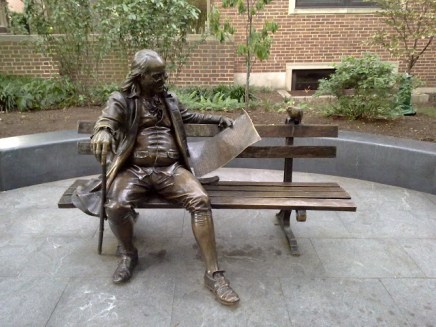
Ben Franklin reads to a bird, statue at the University of Pennsylvania - photo via Priyank

Benjamin Franklin reading the Pennsylvania Gazette, or “Ben on the Bench” (with a bird), statue at the University of Pennsylvania – photo via Priyank

This is the 51st chapter of the Book of Genesis, as related by Benjamin Franklin.  This copy of the text comes from a newspaper, The Otago Witness, December 2, 1887, page 35, courtesy of a website called Papers Past, maintained by the National Library of New Zealand.

Paste It in Your Bible.

A Chapter Verily Like the Original— How Benjamin Franklin Surprised Ms Friends.

Over 100 years ago the following so-called “Genesis 51” was used to puzzle Biblical scholars, and today, were it read aloud in any mixed company, it is questionable if its fraudulent nature would be discovered, so beautifully is the spirit and language of the Old Testament imitated : —

1. And it came to pass after these things, that Abraham sat in the door of his tent, about the going down of the sun.

2. And behold a man, bowed with age, came from the way of the wilderness leaning on a staff.

3. And Abraham arose and met him, and said unto him, Turn in, I pray thee, and wash thy feet, and tarry all night, and thou shalt arise early on the morrow, and go thy way.

4. But the man said, Nay, for I will abide under this tree.

5. And Abraham pressed him greatly; so he turned, and they went into the tent, and Abraham baked unleavened bread, and they did eat.

6. And when Abraham saw that the man blessed not God, he said unto him, Wherefore does thou not worship the most high God, Creator of heaven and earth?

7. And the man answered and said, I do not worship the God thou speakest of, neither do I call upon his name; for I have made to myself a God which abideth always in my house and provideth me with all things.

8. And Abraham’s zeal was kindled against the man, and he arose and drove him forth with  blows into the wilderness.

9. And at midnight God called unto Abraham, saying, Abraham, where is the stranger?

10. And Abraham answered and said, Lord, he would not worship Thee, neither would he call upon Thy name, therefore have I driven him out from before my face into the wilderness.

11. And God said, Have I not borne with him these hundred and ninety and eight years, and nourished him, and clothed him notwithstanding his rebellion against me, and couldst not thou, that art thyself a sinner, bear with him one night ?

12. And Abraham said. Let not the anger of my Lord wax against His servant; lo! I have sinned, forgive me, I pray thee.

13. And Abraham arose and went forth into the wilderness, and sought diligently for the man, and found him and returned with him to the tent, and when he had entreated him kindly, he sent him away on the morrow with gifts.

14, And God spake again unto Abraham, saying, For this thy sin shall thy seed be afflicted four hundred years in a strange land.

15. But for thy repentance will I deliver them, and they shall come forth with power, and with gladness of heart, and with much substance.

In 1759, when in England as agent for the colony of Pennsylvania, Benjamin Franklin privately printed this “Chapter,” as he always termed it.  Taking only a sheet of paper, he kept it laid in his Bible at the end of Genesis, and used to amuse himself by reading it aloud to his friends, and hearing them express their surprise that they had never recollected reading it, and their openly expressed admiration of the moral it carried with it. Its origin is unknown.  It has been traced back 700 years to a Persian poet, who simply says “it was so related.” It must be very old.

Ben Franklin’s version of Chapter 51 of the Book of Genesis is a hoax.  There is no such chapter.


August 9, 1945, at Nagasaki: The last use of atomic weapons in war

August 9, 2011

How much has changed since I wrote the post, below, in 2009?  The number of years, perhaps (and I’ve changed them in the text).

Stars and Stripes posted this short video of the cermonies held in 2011 in Peace Park in Nagasaki

21

Stars and Stripes said:

A memorial service was held at the Nagasaki Peace Park on Aug. 9, 2011, the 66th anniversary of the atomic bomb being dropped on the city at the tail end of World War II. The ceremony was attended by dignitaries from 44 countries – including an envoy from the United States – to honor the more than 155,000 people who were claimed by the bomb, including the 80,000 killed instantly.

The service came three days after one similar in Hiroshima, and marked the first time in history that an envoy from the United States attended both services.

In the wake of the March 11 disaster, Japanese officials called for the abolition of nuclear weapons and also for renewable sources of energy to replace nuclear power.

Below is mostly an encore post:

Nuclear anniversaries have been ignored this year, it seems to me.

Ceremony in Nagasaki marked the remembrance of the victims of the second atomic weapon used in war, which was detonated over Nagasaki on August 9, 1945. Agence France Press reported (in 2009):

Nagasaki’s mayor, marking the 64th anniversary [66th in 2011] of his city’s atomic bombing by the United States, called on Sunday on the leaders of nuclear-armed powers to visit the site and build a nuclear-free world.

Hiroshima and Nagasaki, map by CNN

Hiroshima and Nagasaki, map by CNN

Tomihisa Tanoue urged world leaders from both declared nuclear powers and others such as Iran, Israel and North Korea to visit the city in southwestern Japan.

“I am sure anyone who visits here would feel the sorrow of the victims and be shaken by it,” the mayor said in an address at an annual ceremony commemorating the 1945 bombing.

A minute of silence was observed at 11:02 am (0202 GMT), when the US bomb exploded above the city, killing roughly 74,000 people. The bombing followed one a week before in Hiroshima and hastened Japan’s surrender in World War II.

Tanoue said an April speech by US President Barack Obama in Prague, where Obama pledged to build a world with no nuclear weapons, “impressed” the residents of Nagasaki.

“The Japanese government must support the Prague speech. As a nation that has come under nuclear attack, Japan must lead the international community” in abolishing the weapons, he said.

Similar appeals were made Thursday when Hiroshima marked the anniversary of its bombing, which killed 140,000 people.

At the Nagasaki ceremony, Prime Minister Taro Aso reiterated the Japanese government’s anti-nuclear stance, three weeks ahead of national elections that he is tipped to lose.

Aso raised eyebrows at the Hiroshima ceremony, when he pledged to work toward abolishing nuclear weapons but later told reporters that he thought it was “unimaginable” to attain a nuclear-free world.

Similar ceremonies, and similar pleas for nuclear non-proliferation marked the August 6 anniversary of the atomic bomb drop on Hiroshima. The Chinese news agency Xinhua reported:

Some 50,000 people gathered Thursday at the peace park in Hiroshima to mourn the 64th anniversary of the atomic bombing of the city by U.S. forces during the World War II.

Hiroshima Mayor Tadatoshi Akiba delivered a peace declaration, calling for the abolition of nuclear weapons by 2020.

“The hibakusha still suffer a hell that continues,” said Akiba.

“The Japanese government should support hibakusha, including those who were victims of black rain and those who live overseas,” he said.

Japanese Prime Minister Taro Aso delivers a speech in front of the Memorial Cenotaph during the Hiroshima Peace Memorial Ceremony in Hiroshima, western Japan on Aug. 6, 2009. Hiroshima on Thursday mourned the 64th anniversary of the atomic bombing of the city by U.S. forces during the World War II. (Xinhua/Ren Zhenglai)

"Japanese Prime Minister Taro Aso delivers a speech in front of the Memorial Cenotaph during the Hiroshima Peace Memorial Ceremony in Hiroshima, western Japan on Aug. 6, 2009. Hiroshima on Thursday mourned the 64th anniversary of the atomic bombing of the city by U.S. forces during the World War II. (Xinhua/Ren Zhenglai)"

It was reported Wednesday that the Japanese government aims to come to an agreement with all atomic bomb survivors who have sued the government for financial support to help them pay medical bills for illnesses related to the bombings of Hiroshima and Nagasaki.

Akiba also said “The year 2020 is important as we want to enter a world without nuclear weapons with as many hibakusha as possible. We call on the world to join forces with us to eliminate all nuclear weapons by 2020.”

Referring to the movements such as the environmentalists, Akibasaid, “Global democracy that respects the will of the world and respects the power of the people has begun to grow.”

“We have the power. We have the responsibility. We are the Obamajority. And we can abolish nuclear weapons. Yes we can,” said the mayor.

On Wednesday, Akiba urged the people around the world to join the city’s efforts to abolish nuclear weapons in response to U.S. President Barack Obama’ s appeal for a world free of nuclear weapons.

During the 50-minute memorial ceremony, a moment of silence was observed at 8:15 a.m., the time the atomic bomb detonated over Hiroshima 64 years ago, killing nearly 100,000 people in a blink.

This in a week when two burgeoning new nuclear powers, Iran and North Korea, continue to claim they will flout non-proliferation agreements for their own self defense. [Still true in 2011, alas.]

The question obtains on nuclear issues as well as genocides: When does “never again” start?

Other related posts at Millard Fillmore’s Bathtub:


Climate denialists on Texas weather 2011: Ain’t no heat wave, on average

August 8, 2011

You couldn’t make this stuff up.

In defense of his claim that Texas has not warmed over the last century (“Texas temperatures not rising; Wisconsin temperatures not rising”) and, therefore, Texas does not suffer from global warming, and therefore there is no global warming and no ill effects from warming, Steve Goddard posted this today:

Year-To-Date In Texas

Posted on August 7, 2011 by stevengoddard

Almost as warm as 1927, 1925 and 1953. Only a degree cooler than 1911.

http://www.ncdc.noaa.gov/oa/climate/research/cag3/tx.html

It’s heading for 105°, but since it was 15° one day in February, that averages to 60°, so Texas is okay, according to Goddard.  In their drive to fuzz up the facts and surround policy debates with snark, the denialists will deny anything, leave no weather record untwisted, and deny the sweat on the nose on their face.  According to Goddard, snow in the Great Basin means no drought in Las Vegas, as shown by there being no drought affecting Lake Powell.

Remember Straight Dope’s Cecil Adams’s old line?  “Fighting ignorance since 1973 (it’s taking longer than we thought.)”  Yeah, that applies to climate denialists in quantity.

Here’s what’s going on in Texas right now:

Vodpod videos no longer available.

  •  Texas A&M says the drought of 2011 is the worst ever 1-year drought in Texas history; note how their press release describes the event, and the increasing heat:

    Preliminary reports from the National Climatic Data Center indicate that July 2011 was the warmest month ever recorded statewide for Texas, with data going back to 1895, [State Climatologist John] Nielsen-Gammon reports. The average temperature of 87.2 degrees broke the previous record of 86.5 degrees set in 1998. The June average temperature of 85.2 was a record for that month and now ranks fifth warmest overall.

    Rainfall totals were also unusually light across the state. The July monthly total of 0.72 inches ranks third driest, surpassed by the 0.69 inches recorded in both 1980 and 2000. This is the fifth consecutive month in which precipitation totals were among the 10 driest for that month, says the Texas A&M professor.

Drought and searing heat in Texas.  Caused by climate change?  That’s difficult to say, difficult to trace.  Made worse by climate change?  Most likely.

Dallas media track the consecutive days over 100° F.  It’s a form of misery index — people can recover from a day or two over the century mark.  But more than a couple of days and the heat begins to take a heavier toll on people, on plants and animals, on houses, on cars, on crops, on everything we do in Texas.  It’s difficult to make news make sense on weather stories.  Tracking the number of days over 100° gives a quick graphic for television news, and puts the story into the vein of a sports record story, a narrative people know.

Here’s how things stack up in Dallas, in terms of days over 100°:

Rank Year Consecutive 100° days
1 1980 42
2 2011 37 (and counting)
3 1998 29
4 1952 25
5 1999 24
6 1954 20
7 2006 19
8 2010 18
8 1978 18
10 1956 17

If one looks at the heat streaks, one cannot help but notice that all of the top ten streaks have come since 1952, and that three are in the last decade, five since 1998.  Brutal heat streaks appear to be coming more frequently, many close on the heels of previous heat streaks, and with greater severity.

That is what one would expect from global warming.

Moreover, the recent streaks show greater oscillations.  2011 also saw snow and freezing weather in Dallas, a rarity.  Greater oscillations in weather also would be expected from global warming.

Goddard offers a comparison of January to June temperatures — the coolest part of the calendar year, and leaving out most of the heat-streak days — and on that basis of a half-comparison, he suggests (doesn’t say — he doesn’t want to be caught lying outright) that there isn’t a warming problem in Dallas in 2011.

Heat stroke?  It’s a figment of your socialist imagination.  14 dead?  They probably were smokers.  Global warming?   Not if Steve Goddard can find a statistic somewhere that can be manipulated to appear to deny it.

What do his charts show for July and August of those years?

Finally, there is this:   Assume for a moment that there has been no significant warming in Texas as a complete landmass over the past 100 years:  Does that mean Texas is not battered by any warming that occurs elsewhere?

Of course not.  The current drought in Texas is thought to be triggered in no small part by the La Niña effect, a chilling of the surface of the Pacific in a broad band that stretches west of Peru for about 5,000 miles to the far South Pacific.  La Niña is a counterpart to El Niño, a warming of the same band of water that produces different, not-average weather effects.  The cycles are not well understood as to cause — there are good hypotheses being tested — but it has been observed that, especially in the latter part of the 20th century and the first decade of the 21st, these cycles are speeding up.  The best, not-disproven hypothesis is that these cycles react and speed up due to global warming.

So, to the best of our hypothesizing today, the Texas drought is a function of global warming, in timing, frequency and severity.

This demonstrates the ultimate problem with using a local temperature readings to make authoritative statements about global warming, even averaged over about a hundred million acres like Texas:  Problems of global warming are not always simply problems of temperature, and non-local causes may cause local effects that will not show up in temperature, especially local effects in precipitation, in timing and amounts.

Botanists, foresters, range scientists and biogeographers noticed effects of warming 50 years ago, with the migration of species northward, and up mountainsides.  Wildlife managers noticed altered migrations of game birds and non-game birds about the same time, migration alterations that continue to today.  Plant zones used by farmers and gardeners demonstrate a good deal of change, generally favoring warming, over the past century.  Evidence for warming is quite solid without a single temperature reading.

A bastion of average temperature non-increases, if Texas is one, may still be hammered by warming and its effects in the Pacific, and especially in the Gulf of Mexico.  Is it fair to say the entire system shows no signs of warming?

So we should ask:  Are temperatures and precipitation averages, frequencies, timing and totals, about average for the last century or two?  Then  the case for global warming is a bit weaker.

Dallas will eclipse the previous record string of 100° F days in the next week.  All of Texas is in severe drought, and most of the state is in extreme drought.  Sounds as if there is something going on with the climate.

Last year the denialism sites lit up with a report that a fourth grade student in South Texas had a science project that disproved global warming, and which won an award from the National Science Foundation.  It was a sad hoax.  The speed with which these sites pounced on the report should have warned us that a school of thought devoid of practical results from the lab bench or observation in nature gets too desperate for results, and will cut corners to claim them.  Goddard’s reports repeat the bad methodology of that hoax.

Richard Feynman once wrote, wryly, “Science is the belief in the ignorance of experts.”  Goddard and other denialists appear to read that wrongly, thinking that experts are not to be trusted, and that all experts are ignorant of all things, and therefore stupid.

Politics and especially the politics of science cry out for someone to read Feynman — actually read what he wrote.  Feynman said we should not assume all scientists are infallible.  He did not write that all scientists are fallible and wrong.