It’s cruel to people who want to fly U.S. flags often, but only on designated flag-flying dates. (April is also National Poetry Month, so it’s a good time to look up poetry references we should have committed to heart).
For 2019, these are the three dates for flying the U.S. flag; Easter is a national date, the other two are dates suggested for residents of the states involved.
One date, nationally, to fly the flag. That beats March, which has none (in a year with Easter in April and not March). But March has five statehood days, to April’s two.
Take heart! You may fly your U.S. flag any day you choose, or everyday as many people do in Texas (though, too many do not retire their flags every evening . . .).
April usually sees the opening of Major League Baseball’s season — some teams jumped into March in 2018. In this photo, U.S. Navy sailors assigned to the USS Bonhomme Richard practice for the San Diego Padres’ opening day flag ceremony in San Diego on April 5, 2011. The ship sent nearly 300 volunteers to unfurl an 800-pound U.S. flag that covered the entire field. The Bonhomme Richard was in dry-dock for maintenance and upgrades. Defense Department photo via Wikimedia.
In recitations of the presidents, some people forget Millard Fillmore, some forget Chet Arthur, and some forget John Tyler — which should be amusing, because Tyler served much longer than the man on whose ticket he was elected Vice President, and who died making Tyler the President.
In any case, our 10th President, John Tyler, was born on March 29, 1790, 229 years ago.
A restored daguerreotype of John Tyler in his later years, between 1855 and his death in 1862. Tyler assumed the presidency in 1841, just four years after photography was popularly invented. Very few photos of him are known to exist, all in formal poses. Wikimedia image from the Library of Congress collection of photographs.
Tyler was elected Vice President on the ticket with the hero of the Battle of Tippecanoe, William Henry Harrison. Harrison caught cold perhaps during the inauguration on a cold March morning. The cold turned to pneumonia and Harrison died with just 31 days of service, on April 4, 1841.
No president had died in office before. There was some confusion about whether Tyler would simply hold the office until a new election, or take the presidency and fill out the term. Tyler’s political genius may have been in having himself sworn in as president quickly, quashing much of the debate before opposition could muster.
But Tyler, a Whig, fell out of favor with his own party. He served one term. Tyler opposed key Whig Party policies, it turned out, and he lost favor with Whig giant Henry Clay.
A Virginian, Tyler tried to get a compromise on secession before the Civil War, but failed. He died in 1862, a member of the Confederate States’ House of Representatives. (Was he the only past President or Vice President to join the Confederacy? We need some research.)
Most high school history students don’t know about it. Most high school history students in Texas don’t know about it.
New London School, New London, Texas, before the 1937 disaster. Photo from the New London Museum
I wonder, sometimes, how many Texans remember at all.
I wonder, too, if there are lessons to be learned from the New London tragedy, while the nation debates what to do to prevent recurrences of school shootings.
No one in New London, Texas, bore ill-will towards children, or schools, or other New Londoners. Some good came of the disaster, but as we’ve seen, with animosity towards schools and school safety in Texas today, and a lackadaisical approach to dangerous substance control and accident prevention in West, Texas, and other places, lessons learned were not learned well.
The deadliest disaster ever to hit a public school in the U.S. struck on March 18, 1937, when a natural gas explosion destroyed the new school building at New London, Texas, killing about 300 people — 79 years ago today.
The remains of the London School after the explosion of March 18, 1937. Mother Frances Hospital archives
Noise from the blast alerted the town, and many people in the oilfields for many miles. Telephone and telegraph communication got word out. Oil companies dismissed their employees, with their tools, to assist rescue and recovery efforts. Notably, 20-year-old Walter Cronkite came to town to report the news for a wire service.
Investigation determined that a leak in a newly-installed tap into the waste gas pipe coming from nearby oil fields probably allowed natural gas to accumulate under the building. A spark from a sander started a fire in gas-filled air, and that in turn exploded the cavern under the school. School officials approved the tap to the waste gas line to save money. (Hello, Flint, Michigan!) Natural gas is odorless. One result of the disaster was a Texas law requiring all utility natural gas to be odorized with ethyl mercaptan.
Though the Great Depression still gripped the nation, wealth flowed in New London from oil extraction from nearby oil fields. The school district completed construction on a new building in 1939, just two years later — with a pink granite memorial cenotaph in front.
Today, disasters produce a wealth of litigation, tort suits trying to get money to make the injured whole, and to sting those at fault to change to prevent later disasters. In 1937 official work cut off such lawsuits.
Three days after the explosion, inquiries were held to determine the cause of the disaster. The state of Texas and the Bureau of Mines sent experts to the scene. Hearings were conducted. From these investigations, researchers learned that until January 18, 1937, the school had received its gas from the United Gas Company. To save gas expenses of $300 a month, plumbers, with the knowledge and approval of the school board and superintendent, had tapped a residue gas line of Parade Gasoline Company. School officials saw nothing wrong because the use of “green” or “wet” gas was a frequent money-saving practice for homes, schools, and churches in the oilfield. The researchers concluded that gas had escaped from a faulty connection and accumulated beneath the building. Green gas has no smell; no one knew it was accumulating beneath the building, although on other days there had been evidence of leaking gas. No school officials were found liable.
These findings brought a hostile reaction from many parents. More than seventy lawsuits were filed for damages. Few cases came to trial, however, and those that did were dismissed by district judge Robert T. Brown for lack of evidence. Public pressure forced the resignation of the superintendent, who had lost a son in the explosion. The most important result of the disaster was the passage of a state odorization law, which required that distinctive malodorants be mixed in all gas for commercial and industrial use so that people could be warned by the smell. The thirty surviving seniors at New London finished their year in temporary buildings while a new school was built on nearly the same site. The builders focused primarily on safety and secondarily on their desire to inspire students to a higher education. A cenotaph of Texas pink granite, designed by Donald S. Nelson, architect, and Herring Coe, sculptor, was erected in front of the new school in 1939. (Texas Handbook of History, Online, from the Texas State Historical Association)
Of about 500 students, more than 50% of them died. Once the new school and memorial were built, and the law passed requiring utilities to odorize natural gas so leaks could be detected earlier, survivors and rescuers rather shut down telling the history. A 1977 reunion of survivors was the first in 40 years.
New London School shortly after the March 18, 1937, explosion. Photo from the New London Museum.
Because of that scarring silence, the story slipped from the pages of most history books.
New London, and the New London Museum, work to remember the dead and honor them. Work continues on a film about the disaster, perhaps for release in 2013:
Now, more than 75 years later, the London Museum, across the highway from where the original school was destroyed, keeps alive the memory of much of a generation who died on that terrible day.
This video was produced by Michael Brown Productions of Arlington, TX as a prelude to a feature documentary on the explosion and its aftermath which is planned for the spring of 2013. . . .
What are the lessons of the New London Disaster? We learned to remember safety, when dealing with natural gas. A solution was found to alert people to the presence of otherwise-odorless, explosive gases, a solution now required by law throughout the U.S. Natural gas explosions decreased in number, and in damages and deaths. Wealthy schools districts, cutting corners, can create unintended, even disastrous and deadly consequences. Quick rebuilding covers the wounds, but does not heal them.
Remembering history takes work; history not remembered through the work of witnesses, victims and survivors, is quickly forgotten — to the detriment of history, and to the pain of the witnesses, victims and survivors.
New, New London School and granite cenotaph memorial to the victims of the 1937 explosion. Photo from Texas Bob Travels.
Maine joined the union on March 15, 1820, the 23rd state. It was created out of what had been lands of the colony of Massachusetts.
Maine gave us a Vice President, Hannibal Hamlin, under Abraham Lincoln. In Hamlin’s term he disappeared from Washington, D.C. At some length, a story goes, Hamlin was tracked back to Maine where he had enlisted in the Civil War effort, cooking for the troops.
James G. Blaine, a newspaper editor, got the Republican nomination for the presidency in 1884. He lost the election to Grover Cleveland, but gave us that memorable phrase from the college U.S. history survey courses: “Blaine, Blaine, James G. Blaine! The Son of a Bitch from the State of Maine.”
Despite its many natural wonders, Maine is one of four U.S. states I have not visited. (Where’s the invitation, Greg Marley?)
Lobster trap floats and Old, in Bar Harbor, Maine. Photo copyright by Greg A. Hartford, AcadiaMagic.com.
Maine has a lot of people flying U.S. colors, judging from photographs. Good on them all. I wonder whether Mainers celebrate statehood, or just let it pass?
Maine manufactures U.S. flags. Bangor Daily News: “Sherry Jewel, a production supervisor for Maine Stitching Specialties, stitches together an American flag at the former Dirigo Stitching factory that was restarted two years ago.” 2016 story, photo by Bill Swain.
How many ways can we say happy birthday to a great scientist born on Pi Day? An encore post.
Happy Einstein Day! to us. Albert’s been dead since
1955 — sadly for us. Our celebrations now are more for our own
satisfaction and curiosity, and to honor the great man — he’s beyond
caring.
Almost fitting that he was born on π Day, no? I mean, is there an E=mc² Day? He’s 140 years old today, and famous around the world for stuff that most people still don’t understand.
E=energy; m=mass; c=speed of light
Fittingly, perhaps, March 14 now is celebrated as Pi Day, in honor of that almost magical number, Pi, used to calculate the circumference of a circle. Pi is 3. 1415~, and so the American date 3/14 got tagged as Pi Day.
Albert Einstein was born on March 14, 1879, in Ulm, Germany, to Hermann and Pauline Einstein.
26 years later, three days after his birthday, he sent off the paper on the photo-electric effect; that paper would win him the Nobel Prize in Physics in 1921.
In that same year of 1905, he published three other papers, solving the mystery of Brownian motion, describing what became known as the Special Theory of Relativity and solving the mystery of why measurements of the light did not show any effects of motion as Maxwell had predicted, and a final paper that noted a particle emitting light energy loses mass. This final paper amused Einstein because it seemed so ludicrous in its logical extension that energy and matter are really the same stuff at some fundamental point, as expressed in the equation demonstrating an enormous amount of energy stored in atoms, E=mc².
Any one of the papers would have been a career-capper
for any physicist. Einstein dashed them all off in just a few months,
forever changing the fields of physics. And, you noticed: Einstein did not win a Nobel for the Special Theory of Relativity, nor for E=mc². He won it for the photo-electric effect. Irony in history. Nobel committee members didn’t understand Einstein’s other work much better than the rest of us today.
114 years later, Einstein’s work affects us every day. Relativity theory at some level I don’t fully understand makes possible the use Global Positioning Systems (GPS), which revolutionized navigation and mundane things like land surveying and microwave dish placement.
Development of nuclear power both gives us hope for an energy-rich future, and gives us fear of nuclear war. Sometimes, even the hope of the energy rich future gives us fear, as we watch and hope nuclear engineers can control the piles in nuclear power plants damaged by earthquakes and tsunami in Japan.
Albert Einstein on a 1966 US stamp (Photo credit: Wikipedia)
If Albert Einstein was a genius at physics, he was more dedicated to pacifism. He resigned his German citizenship to avoid military conscription. His pacifism made the German Nazis nervous; Einstein fled Germany in the 1930s, eventually settling in the United States. In the U.S., he was persuaded by Leo Szilard to write to President Franklin Roosevelt to suggest the U.S. start a program to develop an atomic weapon, because Germany most certainly was doing exactly that. But while urging FDR to keep up with the Germans, Einstein refused to participate in the program himself, sticking to his pacifist views. Others could, and would, design and build atomic bombs. (Maybe it’s a virus among nuclear physicists — several of those working on the Manhattan Project were pacifists, and had great difficulty reconciling the idea that the weapon they worked on to beat Germany, was deployed on Japan, which did not have a nuclear weapons program.)
Everybody wanted to claim, and honor Einstein; USSR issued this stamp dedicated to Albert Einstein Русский: Почтовая марка СССР, посвящённая Альберту Эйнштейну (Photo credit: HipStamp)
Einstein was a not-great father, and probably not a terribly faithful husband at first — though he did think to give his first wife, in the divorce settlement, a share of a Nobel Prize should he win it. Einstein was a good violinist, a competent sailor, an incompetent dresser, and a great character.
His sister suffered a paralyzing stroke. For many months Albert spent hours a day reading to her the newspapers and books of the day, convinced that though mute and appearing unconscious, she would benefit from hearing the words. He said he did not hold to orthodox religions, but could there be a greater show of faith in human spirit?
When people hear clever sayings, but forget to whom the bon mots should be attributed, Einstein is one of about five candidates to whom all sorts of things are attributed, though he never said them. (Others include Lincoln, Jefferson, Mark Twain and Will Rogers). Einstein is the only scientist in that group. So, for example, we can be quite sure Einstein never claimed that compound interest was the best idea of the 20th century. This phenomenon is symbolic of the high regard people have for the man, even though so few understand what his work was, or meant.
Einstein in 1950, five years before his death
A most interesting man. A most important body of work. He deserves more study and regard than he gets, in history, diplomacy and science.
Does anyone know? What was Albert Einstein’s favorite pie?
Members of the New York City Fire Department carry 343 U.S. flags honoring the 343 NYFD members killed on 9/11, in the St. Patrick’s Day Parade. New York Post caption: “Despite the cold and gray morning, parade-goers turned out for St. Patrick’s Day to celebrate Irish heritage in New York City on March 17, 2014. FDNY members set the pace as they marched down 5th Avenue holding American flags for the annual event. SHANNON STAPLETON/Reuters”
I usually put up a post near the first of the month listing the occasions upon which U.S. laws urge us to fly Old Glory. March sometimes slips by without such a post.
No good reason, other than in most years, March offers no regular national commemorations upon which flag flying is urged. The odd year is when Easter comes early. Easter is one of the holidays the Flag Code says flags should be flown.
But, most years, Easter falls in April, as it does in 2018.
The Flag Code urges residents of states to fly the U.S. flag on the anniversary of their state’s entering the union, on statehood day. Those are the only dates in March, most years. In March, we have four statehood days in the first four days of the month. If I dawdle, we miss most of the dates.
Flag fly dates, for March (some already past, in 2019):
March 1, Ohio statehood (1803, 17th state)
March 1, Nebraska statehood (1867, 37th state)
March 3, Florida (1845, 27th state)
March 4, Vermont statehood (1791, 14th state)
March 15, Maine statehood (1820, 23rd state)
Okay, all but one already past in March. Apologies to Ohio, Nebraska and Florida. Surely you can find the stories of their big parades and flyovers for statehood in Google News.
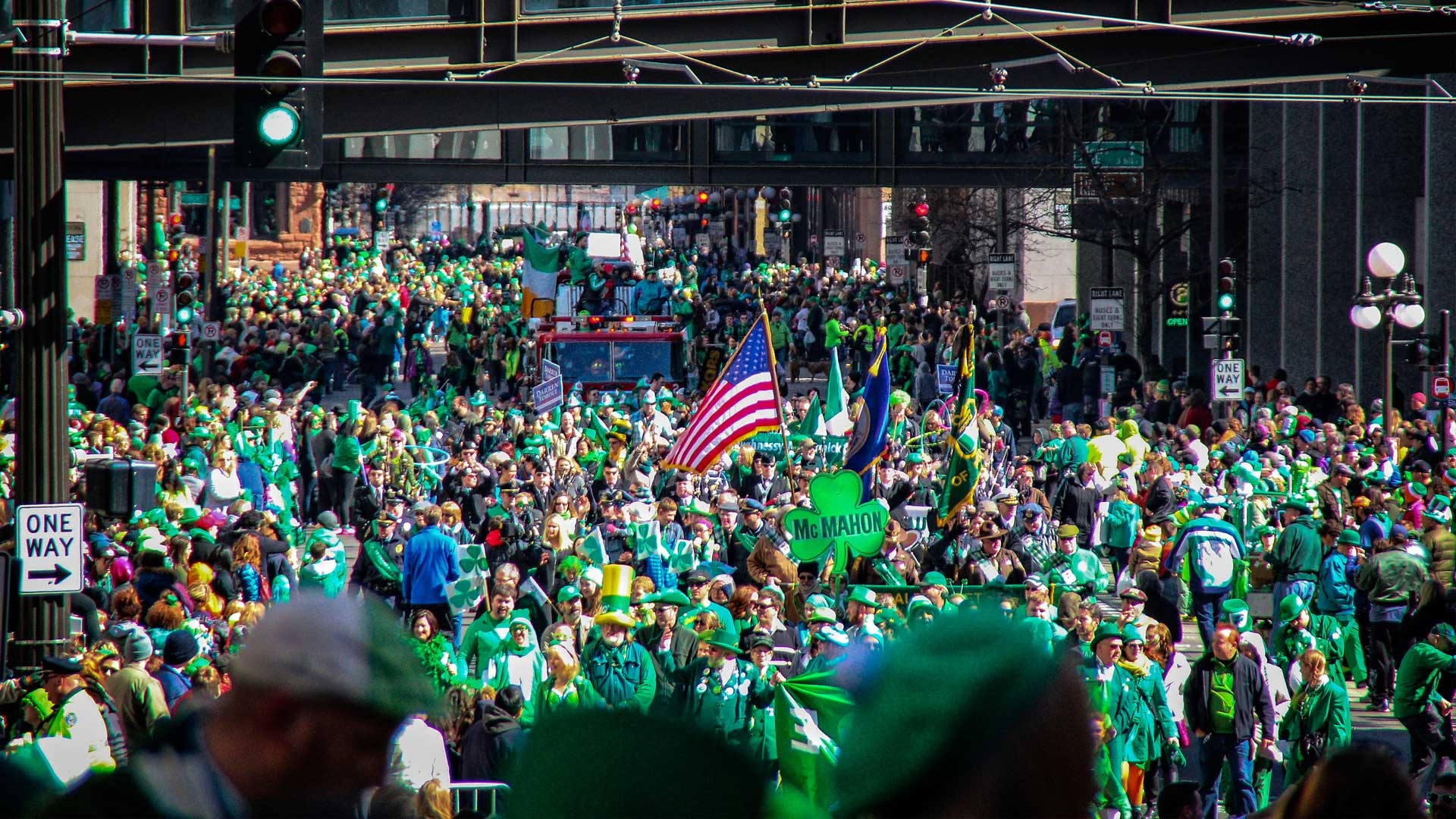
St. Patrick’s Day revelers and parade marchers display the U.S. flag, but it’s not an official U.S. observance.
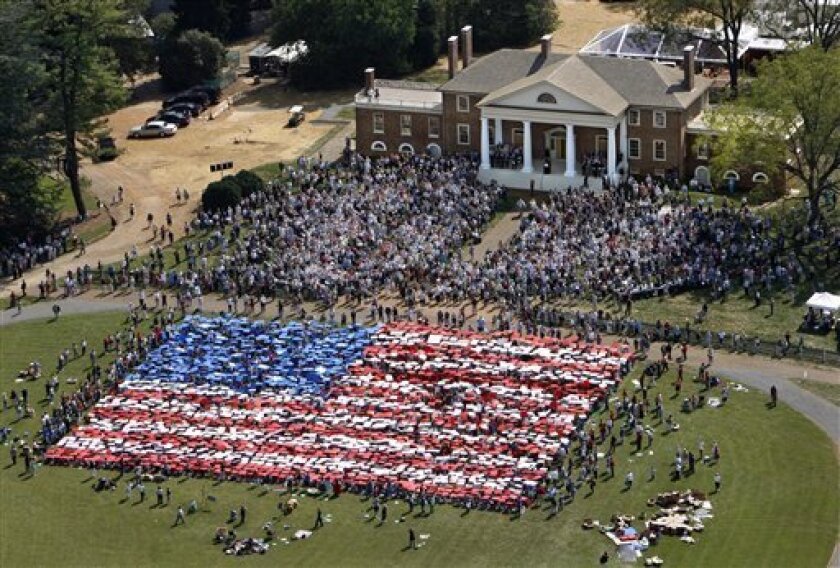
I keep hoping, but I get little traction for a law urging flying the flag to observe Freedom Day, on the birth anniversary of the Father of the Constitution, James Madison (he was born March 16, 1751).
People gathered on the lawn of James Madison’s home in Montpelier, Virginia, to display the U.S. flag in a card display, 2011. AP photo?
Much irony, and great history, in the U.S. colors being shown so dramatically on St. Patrick’s Day, a day relatively uncommemorated in Ireland, and commemorated in the U.S. chiefly to help overcome bias against Irish immigrants.
Some irony in the unmarked birthday of the Father of the Constitution.
Sure, you may fly the U.S. flag every day in March. You need not wait for sanction from a Presidential Proclamation or a Congressional Resolution. You may fly the flag every day. (Just follow flag etiquette when you do.)
I’ll try to keep up better, next year. (I said that last year.)
U.S. flag led the St. Patrick’s Day Parade in Seattle in 2014. Photo from IricsClub.org.
U.S. colors stood out in a field of green at the St. Paul, Minnesota, St. Patrick’s Day parade, 2015(?). Photo from VisitStPaul.com.
Design model for a statue of Barbara Jordan for the University of Texas. Sculpture by Bruce Wolfe; the installed statue is in bronze. I like this plaster model, too.
(Thanks to Pam for alerting me to the anniversary, back in 2008.)
A government is invigorated when each of us is willing to participate in shaping the future of this nation.
In this
election year we must define the common good and begin again to shape a
common good and begin again to shape a common future. Let each person
do his or her part. If one citizen is unwilling to participate, all of
us are going to suffer. For the American idea, though it is shared by
all of us, is realized in each one of us.
I covered that convention as a stringer for a western television
station. I recall the spirit in the hall when Jordan spoke, and the
great spirit that enveloped the entire convention and the City of New
York. After the convention every night the cops would stop taxis so
delegates could ride. I remember watching two cops help a woman out of a
wheel chair and into a cab, and the cabbie saying that the cops had
never done that before — and he liked it. Jimmy Carter came out of that
convention, and won the election, defeating Gerald Ford.
43 years ago. In 2008 I wrote: “Barbara Jordan didn’t live to see her party come up with a woman and an African American man as the top two candidates for the nomination. That’s too bad. She could have given a great, appropriate speech. Maybe the Dems oughtta just run a film of Jordan from 1976.”
Barack Obama won that election in 2008, and Hillary Clinton won the Democratic nomination in 2016. Jordan didn’t live to see that, either.
In 2019, we face a Constitutional crisis again, with a crook in the White House hoping Americans forget about the Constitution. If ever we needed ghosts to come back to help us, we need the ghost of Barbara Jordan now. We could just run a film of her speech at the House Judiciary Committee markup of the articles of impeachment for Richard Nixon.
Of course you’re already flying your flag today, for Presidents Day 2019.
Presidents Day is that hybrid holiday designed to create a three-day weekend, and consolidate previous practices of having two holidays, one on Lincoln’s birthday on February 12, and another on Washington’s birthday on February 22 (Gregorian, or New Calendar).
February 2019 marks the third year in a row the U.S. is without a functioning president, but we celebrate the day anyway.
This should be worthy of watching, and of future commentary
“The Incompetence Opera” appears to have been a production of the 2017 IgNobel Prize ceremony in 2017. “‘They don’t know that they don’t know!’ Ray Bauwens sings about the Dunning-Kruger effect at the 2017 Ignobel Prizes ceremony in Harvard 2017 (AIR)”
Bookmark this video. Sadly, you’ll have much use for it over the next two years.
Beto O’Rourke, to the Texas State Democratic Convention in Fort Worth, Texas.
Sound feed came from a microphone on the camera, and not from the arena sound system — so it’s rather crummy.
But I’m not finding the official Texas Democratic Party version of this speech all the way through. And I think it ought to be preserved.
It’s not a usual “thanks for supporting me; let’s go win” convention speech. It demonstrates what happens when a thinking candidate tailors remarks to the audience in the hall, somethings thinking as she or he goes.
It’s why Texas should have sent him to the Senate.
Beto O’Rourke keynote at the Texas State Democratic Party Convention in Fort Worth, in June 2018. Fort Worth Star-Telegram video, screen capture.
Spread the word; friends don't allow friends to repeat history.
U.S. flag on Mt. Suribachi, Iwo Jima Island – At sea with USS Kitty Hawk (CV-63) Jan. 16, 2003 — F-14 Tomcats assigned to the Black Knights of Fighter Squadron One Five Four (VF-154) fly by Mt. Suribachi on Iwo Jima Island. VF-154 is part of Carrier Air Wing Five (CVW-5) embarked aboard Kitty Hawk, conducting Carrier Readiness Certifications. Kitty Hawk is the Navy’s only permanently forward-deployed aircraft carrier and operates out of Yokosuka, Japan. Photo by U.S. Navy, Lt. j.g. Greg Kausner
You want to mark your calendar so you remember to put your U.S. flag up on those dates designated by law and tradition, right?
Which dates in February? Here at the Bathtub, we’re running behind on the news — we’ve missed marking Massachusetts statehood.
Massachusetts statehood, February 6 (6th state, 1788)
Lincoln’s birthday, February 12 (yes, it’s still designated in law as a date to fly the flag)
Oregon statehood, February 14 (33rd state, 1859)
Arizona statehood, February 14 (48th state, 1913)
Washington’s birthday, now designated President’s Day, the third Monday in February, February 18 in 2019
You may fly your flag on state holidays, too — which of those dates do we see in February? Is there a good list?
Though we don’t mark it usually, February 14 is the anniversary of the first recognition of the Stars and Stripes by a foreign government, in 1778. The French fleet recognized the ensign carried by Capt. John Paul Jones, at Quiberon Bay — painting of the event is at the top of this post.
February 23 is the anniversary of the raising of the U.S. flag on Iwo Jima, in 1945 — 74 years ago. We should probably watch for proclamations to fly the flag on that date, an anniversary made more important simply because so few survivors from among the veterans of that war and that fight can be expected to live to see the 80th anniversary. Regardless any official, formal proclamation to fly the flag for the Iwo Jima events, you may always fly your flag.
Caption from the U.S. Navy, via Wikipedia: Photo #: 80-G-K-21225 (color) “First Recognition of the American Flag by a Foreign Government,” 14 February 1778. Painting in oils by Edward Moran, 1898. It depicts the Continental Navy Ship Ranger, commanded by Captain John Paul Jones, receiving the salute of the French fleet at Quiberon Bay, France, 14 February 1778. Earlier in the month, after receipt of news of the victory at Saratoga, France recognized the independence of the American colonies and signed a treaty of alliance with them. The original painting is in the U.S. Naval Academy Museum, Annapolis, Maryland. Official U.S. Navy Photograph, now in the collections of the National Archives. [A larger version is available for download at Wikipedia.]
Yes, this is an encore post. Defeating ignorance takes patience and perseverance.
Spread the word; friends don't allow friends to repeat history.
Marchers from Selma to Montgomery carried the U.S. flag; you should fly yours today in honor of Martin Luther King, Jr. Image from 60s Survivors page on Joanna Bland, who was part of the march.
Citizens and residents of the U.S. should fly their U.S. flags today, on the holiday marking the birth of the Rev. Dr. Martin Luther King, Jr.
King’s actual birthday is January 15. In 2019, the legal holiday is January 21, today. It’s becoming common for Americans to fly their flags all weekend for a holiday on Friday or Monday.
In 2019, in a nation that seems again intolerant of immigrants and people of color, remembering and honoring the life and struggles of Martin Luther King, Jr., and serving others in real and symbolic ways, is more important than ever.
[We’ve been preoccupied here in Bathtubland, with family issues; but somehow I let Richard Nixon’s birthday go by without a comment. We really need to remember Nixon now, and why he left the presidency early. So, a couple days late.]
President Richard Milhous Nixon was born in Yorba Linda, California, on January 9, 1913.
Interesting to see so little public acknowledgement of Nixon’s presidency and his trials and vexations, which history offers insight and perhaps solutions to problems the nation has today.
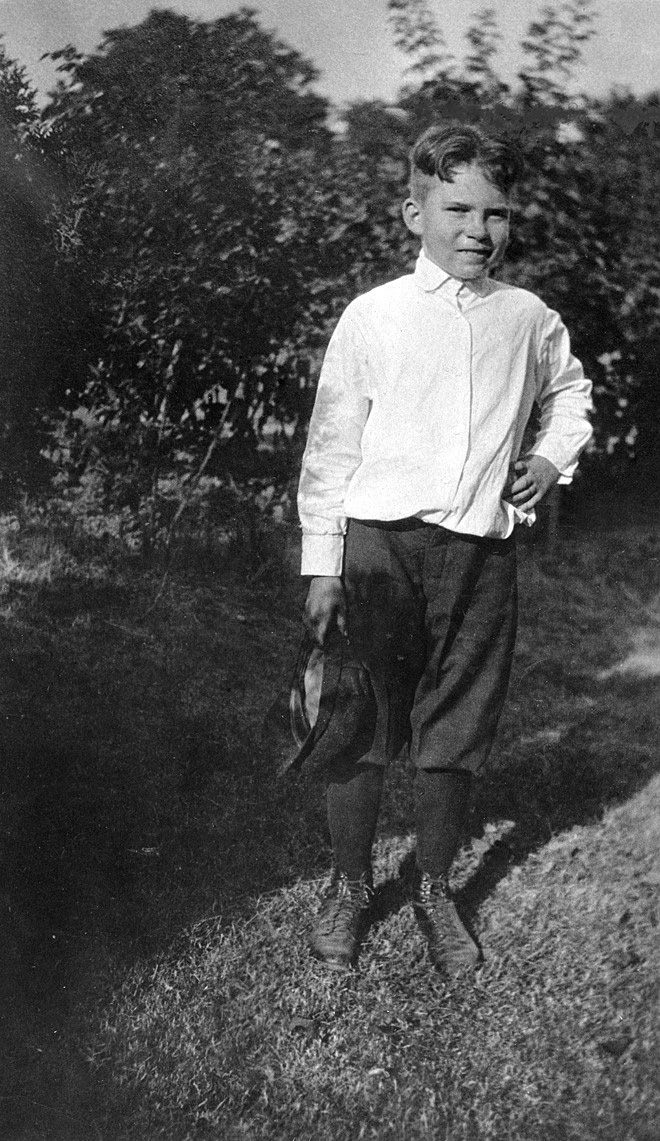
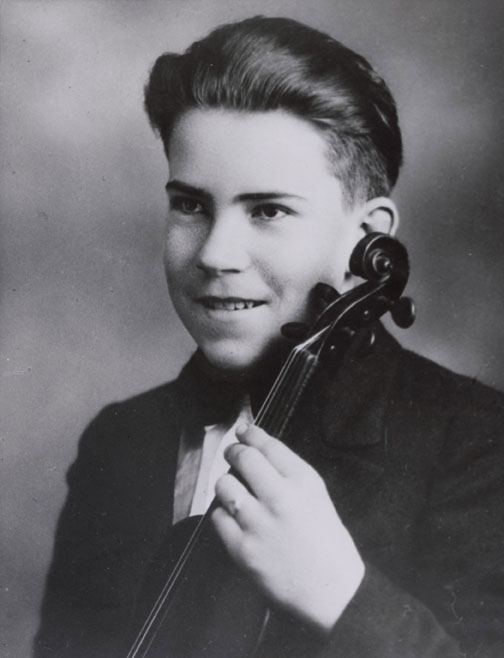
Some views of Richard Nixon.
National Archives and Records Administration image: Nine-year old Richard Nixon in Yorba Linda, 1922. National Archives Identifier: 306-PSD-68-3769.
Richard Nixon, age 15, holding his violin, ca 1927-1928. Richard Nixon learned to play the violin, clarinet, saxophone, piano, and the accordion. When he was 12, Richard was sent to live and study music with his mother’s sister in central California. He returned home six months later and eventually discontinued his studies, but his love of music continued. Richard Nixon Presidential Library & Museum.
Richard Nixon with two friends, Fullerton High School, Fullerton, CA, circa 1929. (Surely someone could identify the other two men. I wonder who they are? What happened to them?) Richard Nixon Presidential Library & Museum Identifier: WHPO-B-0199.
1945 photograph of Lt. Commander Richard Nixon wearing his Navy uniform. When Richard Nixon ran for Congress in 1946 he wore his Navy uniform as he declared at the time that he did not have a civilian suit. Richard Nixon Presidential Library and Museum, used with permission of the Richard Nixon Foundation and Julie Nixon Eisenhower.
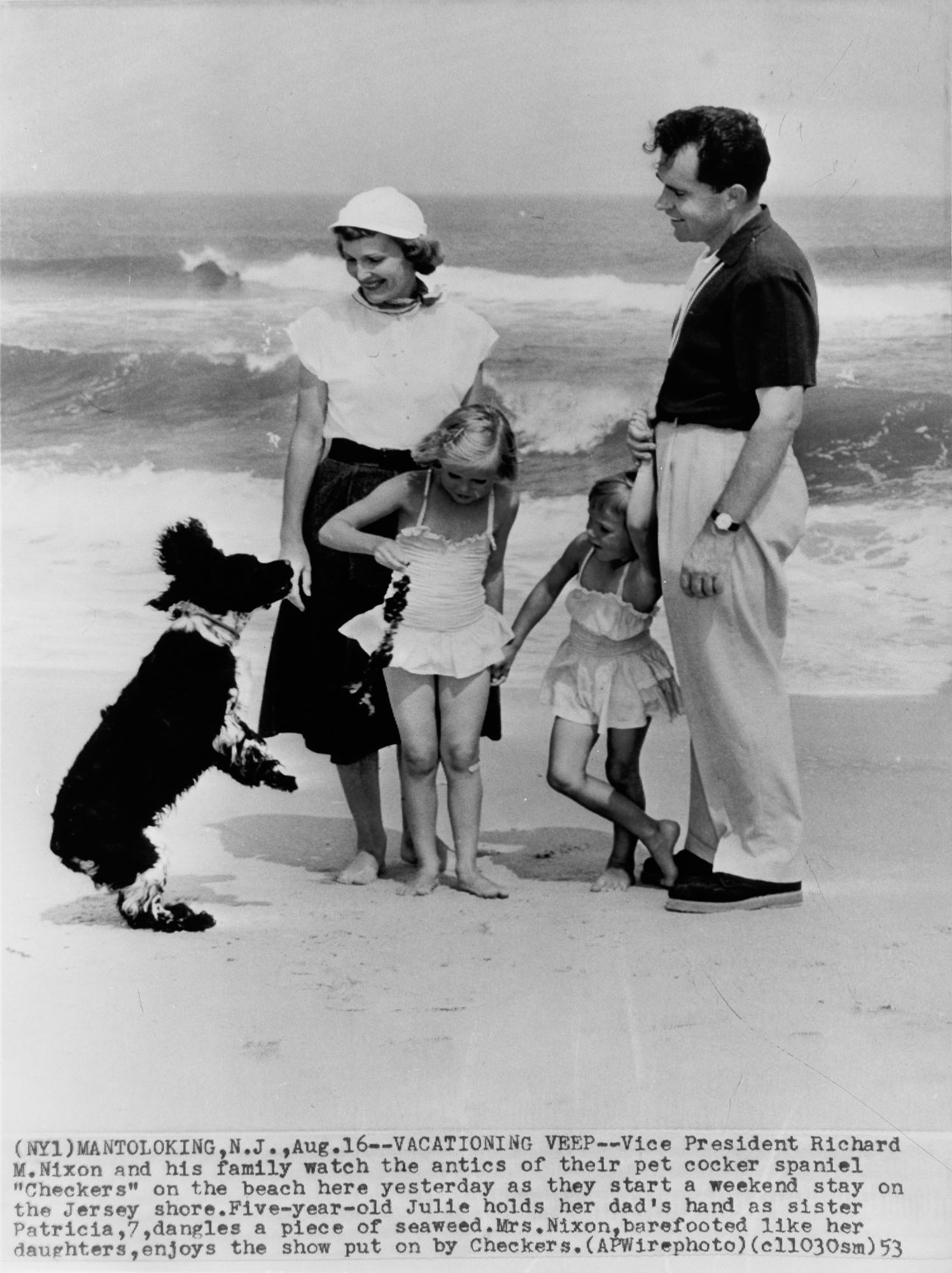
Vice-President Richard Nixon, with wife Pat and daughters Tricia and Julie, watch the antics of their pet cocker spaniel “Checkers” while on a weekend visit to the Jersey Shore in Mantoloking, NJ, August 16, 1953. Richard Nixon Presidential Library and Museum, used with permission of the Richard Nixon Foundation and Julie Nixon Eisenhower.
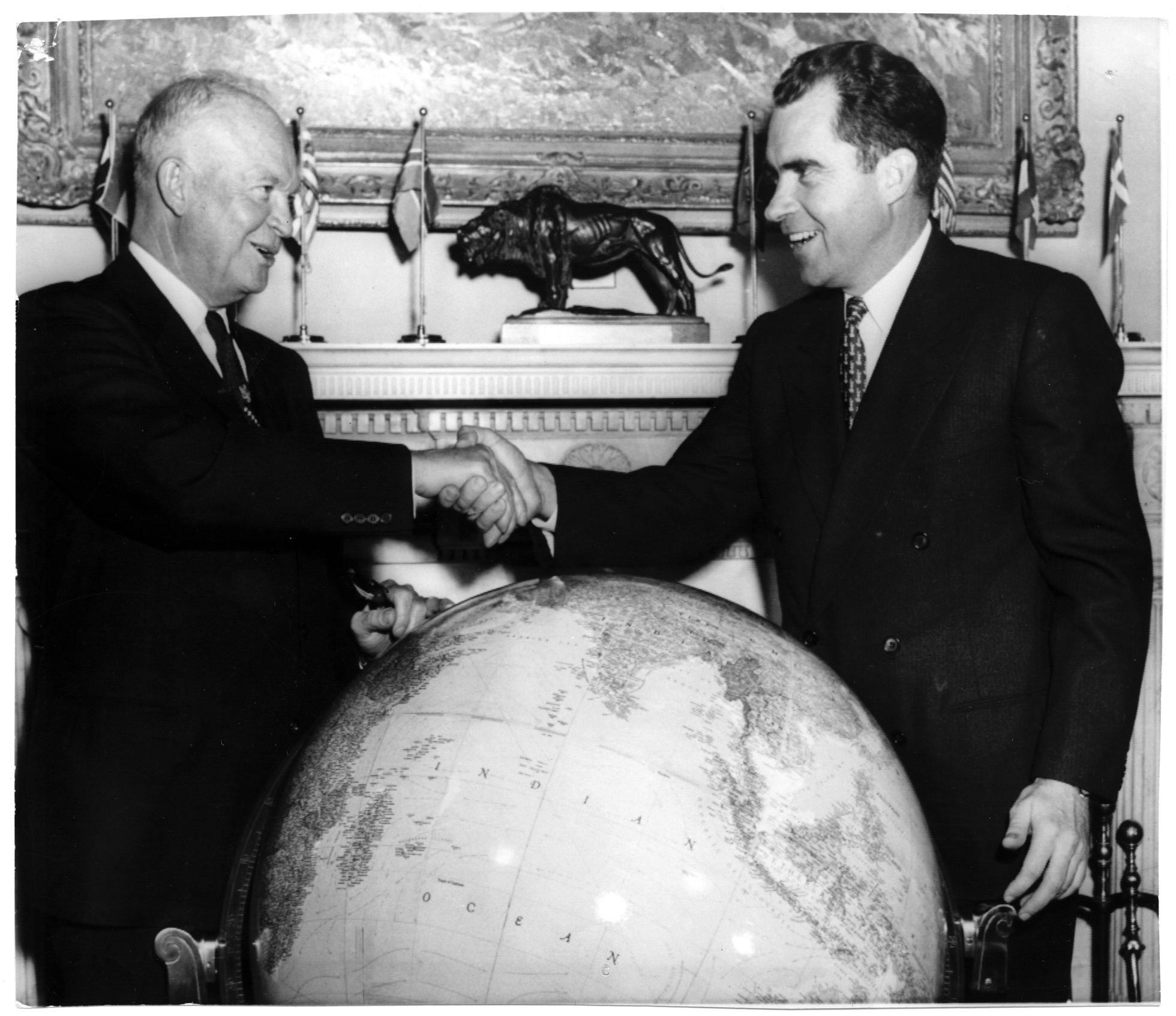
President Dwight D. Eisenhower and Vice President Richard Nixon at the White House before the Vice President’s Ambassador of Goodwill tour departure to the Far East, October 5, 1953. Richard Nixon Presidential Library and Museum, used with permission of the Richard Nixon Foundation and Julie Nixon Eisenhower.
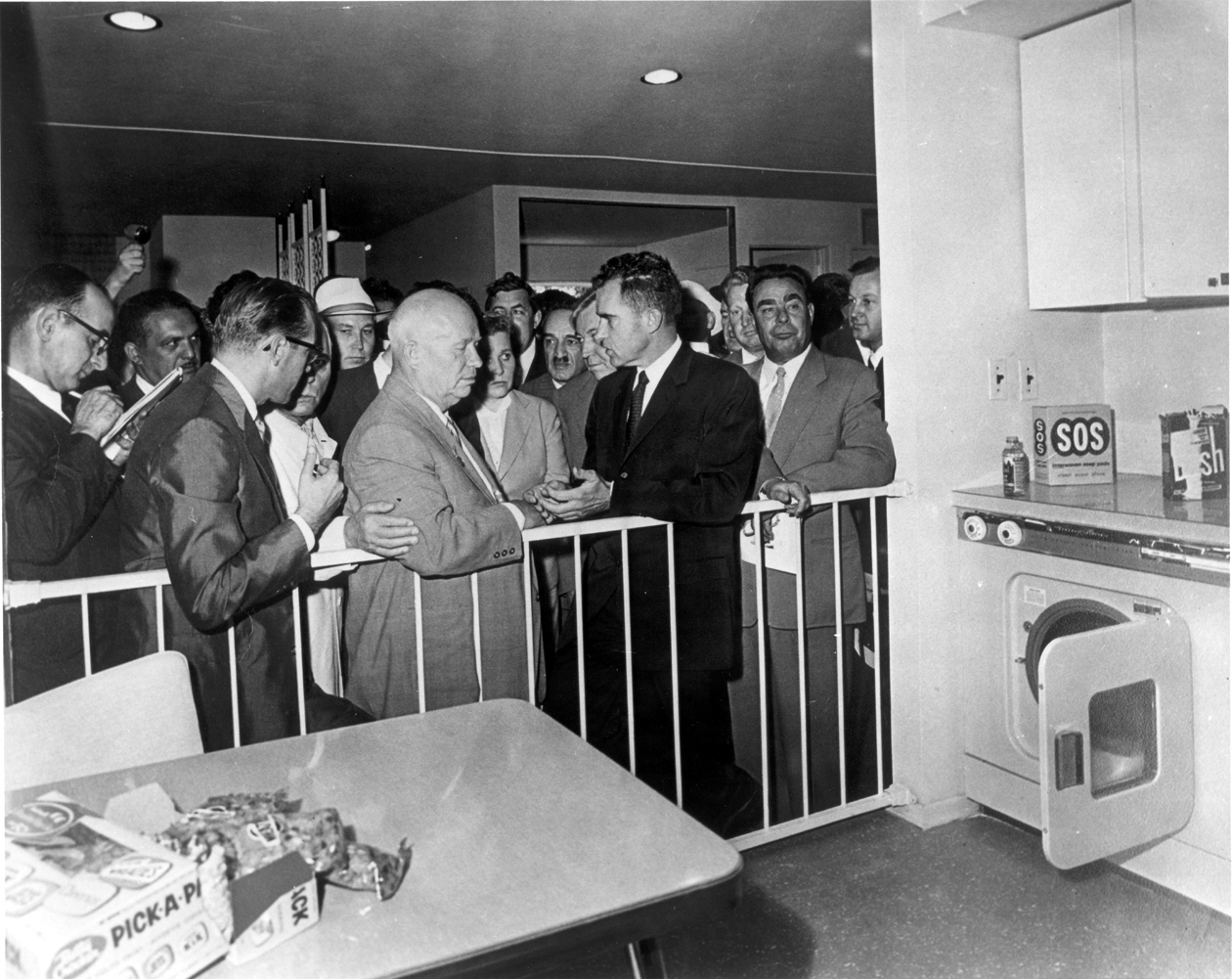
Vice-President Nixon spars with Premier Khrushchev before reporters and onlookers, including Politburo member Leonid Brezhnev at the American National Exhibition at Sokolniki Park, in Moscow, 1959. Nixon and Khrushchev are photographed in front of a kitchen display – the impromptu exchanges came to be known as the Kitchen Debate, July 24, 1959. Richard Nixon Presidential Library and Museum, used with permission of the Richard Nixon Foundation and Julie Nixon Eisenhower.
Nixon’s life offers many interesting twists and turns. His Watergate scandal rather overshadows much of the rest — I think high school textbooks do not spend enough time on telling why Nixon was considered a good candidate for the presidency after losing to John F. Kennedy in the 1960 election, nor do they dwell enough on the effect of the Cold War on his career, and his effect on the Cold War. Check your kid’s U.S. history book — is the Kitchen Debate even mentioned?
Nixon would have been 105 years old on January 9. We might pause to reflect, and learn, from his life and trials.
Wikipedia says Nixon said these wise words: “Always remember others may hate you but those who hate you don’t win unless you hate them. And then you destroy yourself.“
Orange County Register caption: A wreath-laying ceremony commemorating President Richard Nixon’s 105th birthday is moved indoors because of rain. The wreath was placed by a large photo of the 37th president in Yorba Linda on Tuesday, Jan 9, 2018. (Photo by Mindy Schauer, Orange County Register/SCNG)
Spread the word; friends don't allow friends to repeat history.
Millard Fillmore, future 13th President of the United States, was born on January 7, 1800, in upstate New York.
Victim of one of the most infamous hoaxes in history, Millard Fillmore’s good works are often forgotten.
It’s that hoax that gives the name to this blog, and preventing or stopping other similar hoaxes which is the hope of the author.
In the past 50 years residents of Buffalo revived the reputation of Fillmore, and started a tradition of celebrating his birthday.
Trumpeter plays taps at the grave site of President Millard Fillmore in Buffalo, New York’s Forest Lawn Cemetery, with a military honor guard and dignitaries from the University of Buffalo, which traces its founding to Fillmore. This is a Buffalo News photo of an earlier celebration, perhaps 2015.
But so far as I have found, no bathtub races occurred this year.
Or, until that account is unsuspended by the forces supporting Donald Trump: Follow @FillmoreWhite, the account of the Millard Fillmore White House Library
We've been soaking in the Bathtub for several months, long enough that some of the links we've used have gone to the Great Internet in the Sky.
If you find a dead link, please leave a comment to that post, and tell us what link has expired.
Thanks!
Retired teacher of law, economics, history, AP government, psychology and science. Former speechwriter, press guy and legislative aide in U.S. Senate. Former Department of Education. Former airline real estate, telecom towers, Big 6 (that old!) consultant. Lab and field research in air pollution control.
My blog, Millard Fillmore's Bathtub, is a continuing experiment to test how to use blogs to improve and speed up learning processes for students, perhaps by making some of the courses actually interesting. It is a blog for teachers, to see if we can use blogs. It is for people interested in social studies and social studies education, to see if we can learn to get it right. It's a blog for science fans, to promote good science and good science policy. It's a blog for people interested in good government and how to achieve it.
BS in Mass Communication, University of Utah
Graduate study in Rhetoric and Speech Communication, University of Arizona
JD from the National Law Center, George Washington University


 Posted by Ed Darrell







/arc-anglerfish-arc2-prod-tronc.s3.amazonaws.com/public/QCCDQF6OBQ5ZTK37HYFDQF6AG4.jpg)