Typewriter of the moment: Godrej & Boyce, the last manual ever made

April 30, 2011

Can this be correct?

The Daily Mail in London reports that the last manufacturer of manual typewriters in the world, Godrej & Boyce of India, is shutting down production.

Is this the last manual typewriter ever to be made?

Godrej and Boyce, Prima, the last manual typewriter manufactured in the world

The Prima, from Godrej & Boyce; in India, the last company making manual typewriters is closing down

According to the Daily Mail:

It’s an invention that revolutionised the way we work, becoming an essential piece of office equipment for the best part of a century.

But after years of sterling service, that bane for secretaries has reached the end of the line.

Godrej and Boyce – the last company left in the world that was still manufacturing typewriters – has shut down its production plant in Mumbai, India with just a few hundred machines left in stock.

Although typewriters became obsolete years ago in the west, they were still common in India  – until recently.  Demand for the machines has sunk in the last ten years as consumers switch to computers.

The company’s general manager, Milind Dukle, told India’s Business Standard newspaper: ‘We are not getting many orders now.

‘From the early 2000s onwards, computers started dominating. All the manufacturers of office typewriters stopped production, except us.

‘Till 2009, we used to produce 10,000 to 12,000 machines a year. But this might be the last chance for typewriter lovers. Now, our primary market is among the defence agencies, courts and government offices.’

The company is now down to its last  200 machines – the majority of which are Arabic language models.

The firm began production in the 1950s – when Prime Minister Jawaharlal Nehru described the typewriter as a symbol of India’s emerging independence and industrialisation. It was still selling 50,000 models annually in the early 1990s, but last year it sold less than 800 machines.

The first commercial typewriter was produced in the U.S. in 1867 and by the turn of the century had developed into the  standardised format – including a qwerty’ keyboard – that we know today.

Say it ain’t so, Mr. Christopher Latham Sholes!

Godrej & Boyce manufactures several different technology products in its conglomerate of factories — but the typewriter is already gone from their website’s listing of company products.

Electric typewriters will continue to roll off of foreign assembly lines, for companies like Swintec and Brother.

More, resources, etc.: 


Scouts Shooting for the Moon: The story of twelve Moon walkers, and Scouting

April 30, 2011

1cernan_jump_salutes_flag_-_gpn-2000-001273_0

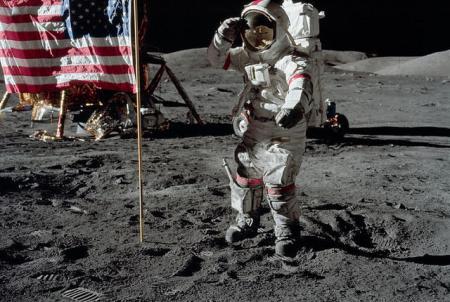
Astronaut and 2nd Class Boy Scout Eugene Cernan saluted the U.S. flag on the Moon, on the last Apollo mission, Apollo 17. Photography by Astronaut and Tenderfoot Scout Harrison Schmitt. NASA image.

A short piece I presented this morning to the Tom Harbin Scout Museum Symposium on Scout History, a great morning organized by Bob Reitz, the curator of the Tom Harbin Scout Museum at Camp Wisdom, in Dallas, Texas. Of course the material is copyrighted, but by all means you have permission to use the material at Courts of Honor or in recounting the better history of Boy Scouting.

Scouts Shooting for the Moon:  The story of twelve Moon walkers, and Scouting

This is a recreation with modern numbers of a presentation first used a decade ago. Searching for material for a speech to honor Eagles at our District Dinner, several people suggested in a short period of time, ‘Why not talk about the astronauts who landed on the Moon. I hear they were all Eagle Scouts.’  Was that accurate?  It would have been a good story if so. Research revealed something quite different. The true story can carry just as much inspiration, however. Scouting is shown to be a program that can lead to a lifetime of adventure and accomplishment. Also, Eagles may take some inspiration in knowing they have accomplished something most of the men who walked on the Moon did not.

Speakers constantly need good material for Eagle Scout Courts of Honor and other events honoring Scouts and Scouters. For one event honoring a group of new Eagle Scouts, several people urged that I research the facts behind the story they had heard, that most, or all of the men who walked on the Moon were Eagle Scouts. New Eagles would find comfort in knowing they had soared into the midst of such company, they reasoned.

So it came to pass that, before the advent of Wikipedia and Google, I spent hours on the telephone until a press person at NASA pointed out to me a collection of information on astronauts that NASA had thoughtfully put on-line. At some high cost I printed out the few pages that dealt with the Scouting experience of astronauts, and worked to correlate it with information about which of them had gone to the moon, and which had not.

Anyone can find that book online with ease, today. The NASA Astronaut Fact Book provides information on almost every detail about NASA’s crew of astronauts, past and present. It includes one-and-a-half pages on the Scouting background of people working as astronauts and payload specialists for NASA, and others NASA has launched into manned missions. Cross-indexing that information with lists of Apollo Mission astronauts, I created four short tables showing the Apollo astronauts who went to the Moon, their missions, and the Scout rank they achieved, if any.

Lunar Astronauts and Scouting Experience

Twelve Moon Walkers

Name Mission Dates on the Moon Scout Rank
1 Neil Armstrong Apollo 11 July 21, 1969 Eagle Scout
2 Buzz Aldrin Apollo 11 July 21, 1969 Tenderfoot Scout
3 Pete Conrad Apollo 12 November 19-20, 1969 Cub Scout
4 Alan Bean Apollo 12 November 19-20, 1969 1st Class
5 Alan Shepard Apollo 14 February 5-6, 1971 1st Class
6 Edgar Mitchell Apollo 14 February 5-6, 1971 Life Scout
7 David Scott Apollo 15 July 31-August 2, 1971 Life Scout
8 James Irwin Apollo 15 July 31-August 2, 1971 None
9 John Young Apollo 16 April 21-23, 1972 2nd Class
10 Charles Duke Apollo 16 April 21-23, 1972 Eagle Scout
11 Eugene Cernan Apollo 17 December 11-14, 1972 2nd Class
12 Harrison Schmitt Apollo 17 December 11-14, 1972 Tenderfoot Scout

Apollo 13

Name Mission Dates on the Moon Scout Rank
1 Jim Lovell Apollo 13 Lunar Swingby Eagle Scout
2 Jack Swigert Apollo 13 Lunar Swingby 2nd Class
3 Fred Haise Apollo 13 Lunar Swingby Star

Lunar Missions That Did Not Land

Name Mission Dates on the Moon Scout Rank
1 Frank Borman Apollo 8 Orbited only None
2 Jim Lovell Apollo 8 (&13) Orbited only Eagle Scout
3 William Anders Apollo 8 Orbited only Life Scout
4 Tom Stafford Apollo 10 Orbited only Star Scout
5 John Young Apollo 10 (& 16) Orbited only 2nd Class
6 Eugene Cernan Apollo 10 (& 17) Orbited only 2nd Class

Others Who Did Not Land

Name Mission Dates on the Moon Scout Rank
1 Michael Collins Apollo 11 Capsule pilot None
2 Dick Gordon Apollo 12 Capsule pilot Star Scout
3 Stewart Roosa Apollo 14 Capsule pilot None
4 Al Worden Apollo 15 Capsule pilot 1st Class
5 Ken Mattingly Apollo 16 Capsule pilot Life Scout
6 Ronald Evans Apollo 17 Capsule pilot Life Scout

In all, 24 men flew to the Moon. Twelve set foot on the lunar surface. Of the twelve, eleven were Scouts, two were Eagles. Of the 24, 20 were Scouts, three were Eagles.

At the time I originally researched, about 70% of all astronauts were alumni of Scouting, men and women. Officially, BSA lists 181 NASA astronauts as being alumni, 57.4%

NASA lists the colleges and universities astronauts attended. NASA lists military service, hometowns, and states of birth. But with the possible exception of a generic category of “public schools,” no category of astronauts is larger than the category of Scouting experience. If we were advising a young person on how to get to become an astronaut, we would be remiss if we did not advise him or her to join Scouting.

What can we conclude?

Three things became apparent to me in tracking these figures down. One, I learned once again that the true stories most often carry great value, more value than the stories people make up, or assume.

Two, I learned that Scouting by itself carries great value, without a Scout’s having earned Eagle. We know that not all the Moon walkers earned the Eagle rank. But we also notice that no flight ever went to the Moon without at least two Scouts aboard. Three of the 24 lunar voyagers are Eagles, 12.5%. Two of the dozen who actually set foot on the Moon are Eagles, 16.7%. Eleven of the twelve Moon walkers were Scouts, 91.7%. 21 of 24 lunar voyagers were Scouts, 87.5%.

So, while it was not necessary to be an Eagle, it certainly seemed to help. But simply having Scouting experience seemed to be the biggest help. There may be some magic in a boy’s having taken that oath that carries through his entire life, and spurs him to do daring and great things. That is important. A trend begins to emerge. Scouting by itself, without earning the highest rank, provides great value. When a boy signs up, he signs on for the adventure of a lifetime, and often that leads to a lifetime of adventure. That venturesome spirit carries on well past his Scouting years.

The story of Jim Lovell might carry some great weight with Scouts. Lovell is the only person to have gone to the Moon twice, but never set foot on it. He was the commander of Apollo 13, whose near-disaster was chronicled in the movie of the same name. Among other lessons that might be pulled out of the story:  When your Moon-bound spaceship explodes and loses power on the way to the Moon, it is often good to have an Eagle Scout handy to help get through the experience and return safely.

Is there inspiration here?

When I first presented these figures at a Scout meeting, a parent asked me whether these numbers would discourage boys from working for any rank advancement, since just being a Scout seems to carry such weight. This should not discourage Eagles, nor discourage any Scout from working to get the Eagle rank. We should look at it this way:  Every Scout who earns an Eagle has done what ten of the twelve who walked on the Moon did not do, perhaps could not do. Nine more Moon walkers started on that path to Eagle, but did not finish, or could not finish.

Not every Eagle can go to the Moon, but every Eagle has already won an award that most of those who did go to the Moon wish they had.

Especially in the circles of corporate and government leadership, character, what it is and how to get it, concerns people. What sort of character does it take to go to the Moon? Every Scout has a glimpse of what is required, and every Eagle can say, “I know what it takes to get such character.”

Bibliography

Human Spaceflight, “The Apollo Program,” NASA, July 2, 2009; accessed April 28, 2011; http://spaceflight.nasa.gov/history/apollo/

Astronaut Fact Book, NASA,  NP-2005-01-001JSC, January 2005; accessed April 27, 2011; spaceflight.nasa.gov/spacenews/factsheets/pdfs/astro.pdf

BSA, “Facts About Scouting,” 2009; accessed April 28, 2011; http://www.scouting.org/about/factsheets/scoutingfacts.aspx

“Astronauts With Scouting Experience,” Eagle Scout Information, U.S. Scouting Service Project, April 6, 2011; accessed April 29, 2011; http://www.usscouts.org/eagle/eagleastronauts.asp

About the author:

Ed Darrell teaches U.S. History at Moises E. Molina High School in Dallas. He has taught economics, government, world history and street law in high schools; he also taught at the University of Utah, University of Arizona, and DeVry University. He is a former speech writer for politicians. His degree in Mass Communication came from the University of Utah, and his law degree from George Washington University. This was presented to the Jack Harbin Museum Symposium of Scout History, April 30, 2011.

World Scout badge carried to the Moon by Astronaut Neil Armstrong.

World Scout badge carried to the Moon by Astronaut Neil Armstrong.


Save


Encore post: Quote of the moment: Education’s rising tide of mediocrity

April 28, 2011

National Commission on Excellence in Education meeting with President Reagan

With Ben Franklin’s bust looking on, National Commission on Excellence in Education met with President Ronald Reagan, in the White House (image from Lawrence-Berkeley Laboratories and Glenn Seaborg)

[2015 update: Here’s something to ponder about wonders of technology in education: If the internet is so good, what happened to the history of the Excellence in Education Commission, and this now-missing photo, above?]

White House, Washington, DC, 1983—Photo courtesy of The White House; Center for Studies in Higher Education, University of California - Berkeley

Secretary of Education Terrel Bell, President Ronald Reagan, David Gardner, White House, Washington, DC, 1983—Photo courtesy of The White House; Center for Studies in Higher Education, University of California – Berkeley (Click photo to link to a list of resources on the commission) (Photo added January 16, 2015)

“Our nation is at risk. The educational foundations of our society are presently being eroded by a rising tide of mediocrity. If an unfriendly foreign power had attempted to impose on America the mediocre educational performance that exists today, we might well have viewed it as an act of war. We have, in effect, been committing an act of unthinking, unilateral educational disarmament. History is not kind to idlers.”

Those warnings, grim and intentionally provocative, were issued last week by the 18-member National Commission on Excellence in Education in a 36-page report called A Nation at Risk: The Imperative for Educational Reform. Headed by University of Utah President David P. Gardner, the NCEE was set up 20 months ago by Secretary of Education Terrel Bell to examine U.S. educational quality.

– Ellie McGrath, “To Stem ‘A Tide of Mediocrity,'” Time, May 9, 1983.

This is an encore post from 2007 — we probably need to repeat this more often.  Milton Goldberg, the executive director of the National Commission on Excellence in Education, and Commission Chairman David P. Gardner probably wrote that paragraph.  It should be engraved over the doors of the administration buildings of every school district in America, I think.

Alas, it’s still true.  It’s more true now, with the full-bore War on Education waged by people like Texas Gov. Rick Perry, aided, sometimes intentionally but sometimes not, by Education Secretary Arne Duncan, and people like Michelle Rhee.

More: 


Obama’s birth certificate: Putting the sideshow freaks and carnival barkers on the hot seat

April 27, 2011

No, it’s not particularly important, especially since we knew from so many other sources that Obama was, indeed, Honolulu born.

The White House pried the old birth certificate out of the records of the State of Hawaii, and released copies to the world today.

The White House video:

ABC Television’s report:

View a .pdf of the form here:  President Obama\’s original Hawaiian birth certificate

I predict Orly Taitz, Donald Trump, and all the other sideshow freaks and carnival barkers, will continue to bark away.  Remember, when P. T. Barnum made a copy of the hoax “Cardiff Giant,” people paid a premium to see the fake of the hoax.  P. T. Barnum’s ghost stalks and stomps on Republican and birther grounds now.

More:

_____________

Boy, looking at this, you gotta know that Obama planned this all out, as Morgan claimed in comments below — just so he could get this story from Juan Williams and Shepard Smith at Fox News:

Oh, For Goodness Sake posted that video, without any other comment, as “National Mirror Moment.”  Birthers, Palinistas and Republicans must be choking on their dinners from that report.  Has the Fox turned on ’em?

Always a good site to expose the inanity and insanity of Obama’s critics, especially on the issues of Obama’s history, Oh, For Goodness Sake has a particular bead on the hypocrisy of those same critics:

How many times have you heard the promise: The president could end this today if he’d just release his long form birth certificate? So now they’ve got the f—ing long form birth certificate, is it done for the Birthers?

No. No. No. No. No. No. And Nope.

Bigots.  Probably no small amount of racism in there, too.  Plus, they’ve exposed themselves as genuinely opposed to America’s good health.  David Gardner and Milton Goldstein pegged it, even if we have to paraphrase them a bit:  Had a foreign government tried to do what the birthers are doing, we’d have considered it an act of war.  History is not kind to idlers, those who fail to call out injustice, nor idiots.


Pray that God will save Texas; it’s clear Rick Perry won’t

April 25, 2011

Texas doesn’t have a recall procedure for politicians in office.  If it did, would Texans have the guts to use it on Rick Perry?

You’ve probably seen it in the news:  Over the last ten days, Texas has been scorched by several large wildfires.  At least two firemen were killed.  Hundreds of homes and one state park burned away.  (See the Christian Science Monitor: “Texas wildfires:  Why this season is one of the worst in state history,” and “Can U.S. handle historic Texas wildfires?”)

Firefighters, mostly, come from small town, volunteer fire departments.  Most of the affected towns are too small to be able to afford a larger, professional fire-fighting department.

Gov. Rick Perry’s mathematical errors cost Texas $27 billion, a shortfall that Republicans propose to make up by cutting to the bone, and deeper, education programs, road building and maintenance, aid to the poor, and police and fire departments.

Yes, in the middle of one of the biggest fire disasters in Texas history, Rick Perry and the Texas Lege propose to cut the funding to the fire fighters.

If they don’t cut funding, they would have to roll back tax cuts to wealthy property owners granted six years ago, or dip into the states $9 billion “rainy day” fund.

Gov. Perry does have one other trick up his sleeve to help victims of the fires:  He’s asked Texans to pray for rain.  Fire departments need equipment, people and training, all of which cost money.  Gov. Perry asks for prayers instead.

Gov. Perry Issues Proclamation for Days of Prayer for Rain in Texas

Thursday, April 21, 2011  •  Austin, Texas  •  Proclamation

TO ALL TO WHOM THESE PRESENTS SHALL COME:

WHEREAS, the state of Texas is in the midst of an exceptional drought, with some parts of the state receiving no significant rainfall for almost three months, matching rainfall deficit records dating back to the 1930s; and

WHEREAS, a combination of higher than normal temperatures, low precipitation and low relative humidity has caused an extreme fire danger over most of the State, sparking more than 8,000 wildfires which have cost several lives, engulfed more than 1.8 million acres of land and destroyed almost 400 homes, causing me to issue an ongoing disaster declaration since December of last year; and

WHEREAS, these dire conditions have caused agricultural crops to fail, lake and reservoir levels to fall and cattle and livestock to struggle under intense stress, imposing a tremendous financial and emotional toll on our land and our people; and

WHEREAS, throughout our history, both as a state and as individuals, Texans have been strengthened, assured and lifted up through prayer; it seems right and fitting that the people of Texas should join together in prayer to humbly seek an end to this devastating drought and these dangerous wildfires;

NOW, THEREFORE, I, RICK PERRY, Governor of Texas, under the authority vested in me by the Constitution and Statutes of the State of Texas, do hereby proclaim the three-day period from Friday, April 22, 2011, to Sunday, April 24, 2011, as Days of Prayer for Rain in the State of Texas. I urge Texans of all faiths and traditions to offer prayers on that day for the healing of our land, the rebuilding of our communities and the restoration of our normal way of life.

IN TESTIMONY WHEREOF, I have hereunto signed my name and have officially caused the Seal of State to be affixed at my Office in the City of Austin, Texas, this the 21st day of April, 2011.

RICK PERRY
Governor of Texas

Perry’s call for prayer rightly earned ridicule.  Ed Brayton at Dispatches from the Culture Wars wondered about Jon Hagee and Pat Robertson weighing in, as they usually do, claiming big disasters to be the result of sinfulness in the local population.   P. Z. Myers at Pharyngula simply wonders about the effectiveness of a governor who does that.


Quote of the moment, and Rick Santorum: Langston Hughes, “Let America be America again”

April 25, 2011

Rick Santorum, CBS News image

Rick Santorum: Running with . . .

Harlem Renaissance poet Langston Hughes

. . . political philosopher, and Harlem Renaissance poet Langston Hughes?

News item: Rick Santorum is running for president. No, seriously — he is. In order to run, a candidate needs a catchy slogan.

Santorum’s campaign announced he is planning to use “Let America be America, again” as his slogan.

It’s a phrase borrowed from Langston Hughes.  One wonders if Rick Santorum reads any poetry, let alone someone from the Harlem Renaissance.

Did Santorum really intend to borrow from Hughes?  Does he think Hughes would approve?

O, let America be America again–
The land that never has been yet–
And yet must be–the land where every man is free.
The land that’s mine–the poor man’s, Indian’s, Negro’s, ME–
Who made America,
Whose sweat and blood, whose faith and pain,
Whose hand at the foundry, whose plow in the rain,
Must bring back our mighty dream again.

Sure, call me any ugly name you choose–
The steel of freedom does not stain.
From those who live like leeches on the people’s lives,
We must take back our land again,
America!

Full text of the poem here, at the American Academy of Poets.

No, it appears Santorum did not wish to affiliate with Langston Hughes. One more reason to vote against Santorum, as if anyone needed more.  Santorum even admits not being much of a poetry fan.

How about this for a Santorum slogan:  “All santorum, no guts or brains.”

Tip of the old scrub brush to Ed Brayton at Dispatches from the Culture Wars.


Two years, three months since the disaster . . .

April 24, 2011

Remembering, because we shouldn’t forget.  It was just two years and three months ago.  Rebuilding will take a long time.


Walt Kelly: “met the enemy, and he is us”

April 23, 2011

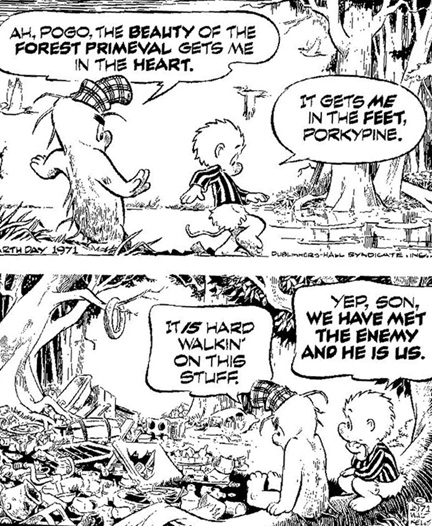
Walt Kelly's Pogo cartoon, from Earth Day 1971

Walt Kelly's Pogo daily cartoon strip, from Earth Day 1971

Walt Kelly’s little cartoon possum Pogo turned out to have been a sage observer, and adviser, for much of the 20th century.  This classic cartoon, on the second Earth Day, in 1971, well summarizes the problems of pollution, making historical allusion to that famous message from Master Commandant Oliver Hazard Perry after the Battle of Lake Erie in the War of 1812:  “We have met the enemy and he is us.”

It is a mark of what the internet lacks that I could find just one quick copy of this cartoon on my first search.  All of Kelly’s work should be available, but it’s largely missing from internet searches.  I’m sure this is still under copyright, but I haven’t yet found the information.

_____________

Oh, of course:  The line is too good to have been used just once.  Kelly used the idea for the quote in the forward to a book in the 1950s, and used it on a poster for the first Earth Day.  The famous comic strip followed in 1971.


What sort of crazy is the warming denialist?

April 21, 2011

I’ve got to stop looking over there.

Goddard’s got a post up showing the great disregard he has for the facts, and the law, and history, etc., etc., etc.  It may be an unintentional showing, but there it sits, “like a mackerel in the moonlight, both shining and stinking.”

Jerome Corsi, that serial fictionalizer of vital issues, has a book out promoting his slimy schemes besmirch President Obama.  Goddard urges people to buy it.

But they really pile on in the comments.  It’s almost as if Casey Luskin had a whole family just like himself, and they got together to whine about Judge Roberts again.

Warming denialism, creationism and birthers — is it all just three minor variations on the same brain-sucking virus?  Or could three different diseases produce the same sort of crazy on so many different issues?

I’m reminded of the old saw that you cannot reason a person out of a position he didn’t reach by reason.  These guys will never see the light.  Heaven knows, it ain’t evidence that gets ’em where they are now.

Previous posts at Millard Fillmore’s Bathtub:

Special kind of birther crazy:


Lake Powell drought ended? Don’t trust the warming denialists’ predictions

April 20, 2011

Every once in a while a factoid crosses the desk and/or mind of an otherwise badly-informed person who denies global warming is a problem, and without bothering to check the significance of the factoid, the denialist world ramps up The Crazy Rant.

And so, Steve Goddard (who should need no introduction) seized upon a chart that shows a momentary uptick in water in drought-ravaged Lake Powell.  Ignoring more than 50 years of history of the river flows, Goddard pronounced the case for global warming dead.

Former AGW poster child Lake Powell water levels have been rising rapidly over the last few years.

Goddard’s claim is a grand example of the triumph of ignorance over experience, science, data, history and the law, in discussions of climate change.

Did Goddard read his own chart?  It shows a decline in lake level from 2010.

Lake Powell levels, charted by Steve Goddard?

Goddard’s own chart shows a decline in Lake Powell’s March 20 level, from 2010; did he look at the chart? Even Goddard’s source says, “Lake Powell is 89.99 feet below Full Pool (Elevation 3,700).”

“Full pool” level is 3,700 feet elevation (the height of the surface of Lake Powell above sea level).  Goddard’s chart shows the lake hasn’t been at that level since 2000 (and it was declining for some time prior to that).  Goddard’s chart shows four years of rise compared to seven years of decline.

The U.S. Bureau of Reclamation isn’t as optimistic as the warming deniers, noting that drought conditions continue on the Colorado Plateau.

 Upper Colorado River Basin Hydrology

In the Upper Colorado River Basin during water year 2010, the overall precipitation accumulated through September 30, 2010 was approximately 90% of average based on the 30 year average for the period from 1971 through 2000.  For Water Year 2011 thus far, the estimated monthly precipitation within the Upper Colorado River Basin (above Lake Powell) as a percentage of average has been: (October – 135%, November – 95%, December – 225%, January – 50%, February – 100%, March – 90%)

The Climate Prediction Center outlook (dated March 17, 2010) for temperature over the next 3 months indicates that temperatures in the Upper Colorado River Basin are expected to be above average while precipitation over the next 3 months is projected to be near average in the northern reaches of the basin while below average in the southern reaches of the basin.

Upper Colorado River Basin Drought

The Upper Colorado River Basin continues to experience a protracted multi-year drought.  Since 1999, inflow to Lake Powell has been below average in every year except water years 2005 and 2008.  In the summer of 1999, Lake Powell was close to full with reservoir storage at 23.5 million acre-feet, or 97 percent of capacity.  During the next 5 years (2000 through 2004) unregulated inflow to Lake Powell was well below average.  This resulted in Lake Powell storage decreasing during this period to 8.0 million acre-feet (33 percent of capacity) which occurred on April 8, 2005.  During 2005, 2008 and 2009, drought conditions eased somewhat with near or above average inflow conditions and net gains in storage to Lake Powell.  2011 will be another above average inflow year so drought conditions are easing somewhat in the Colorado River Basin. As of April 18, 2011 the storage in Lake Powell was approximately 12.73 million acre-feet (52.3 % of capacity) which is below desired levels.  The overall reservoir storage in the Colorado River Basin as of April 18, 2011 is approximately 31.40 million acre-feet (52.8 % of capacity).
Updated: April 19, 2011

Rick Clayton

Goddard isn’t the first denier to stumble down this path — but can’t they learn from the stumblings of others?  Remember Australia’s “Jo Nova,” who used a photograph of drought-stricken Glen Canyon Dam and environs to claim that warming was not posing problems?  Remember Anthony Watts claiming Lake Powell as a “good proxy” for water in the entire area, and seizing on a momentary uptick?  (Oh, yeah — Watts based his glee on a Goddard note — even repeating Goddard’s error that Lake Powell’s low levels were due to increased use of water in Los Angeles . . .)

Oy.  Do they ever learn?

More, Resources:

The sources from my earlier post on Lake Powell still edify those who bother to read them:

More current sources:


Remembering April 18 and 19: Paul Revere’s Ride, and the “shot heard ’round the world”

April 18, 2011

This is mostly an encore post.

April 18 19. Do the dates have significance? Paul Revere's ride, from Paul Revere House

Among other things, it is the date of the firing of the “shot heard ’round the world,” the first shots in the American Revolution. On April 19, 1775, American Minutemen stood to protect arsenals they had created at Lexington and Concord, Massachusetts, against seizure by the British Army then occupying Boston.

April is National Poetry Month. What have we done to celebrate poetry?

What have we done to properly acknowledge the key events of April 18 and 19, 1775? Happily, poetry helps us out in history studies, or can do.

In contrast to my childhood, when we as students had poems to memorize weekly throughout our curriculum, modern students too often come to my classes seemingly unaware that rhyming and rhythm are used for anything other than celebrating materialist, establishment values obtained sub rosa. Poetry, to them, is mostly rhythm; but certainly not for polite company, and never for learning.

Poems slipped from our national curriculum, dropped away from our national consciousness.

And that is one small part of the reason that Aprils in the past two decades turned instead to memorials to violence, and fear that violence will break out again. We have allowed darker ideas to dominate April, and especially the days around April 19.

You and I have failed to properly commemorate the good, I fear. We have a duty to pass along these cultural icons, as touchstones to understanding America.

So, reclaim the high ground. Reclaim the high cultural ground.

Read a poem today. Plan to be sure to have the commemorative reading of “Paul Revere’s Ride” in your classes next April 18 or 19, and “The Concord Hymn” on April 19.

We must work to be sure our heritage of freedom is remembered, lest we condemn our students, our children and grandchildren to having to relearn these lessons of history, as Santayana warned.

Texts of the poems are below the fold, though you may be much better off to use the links and see those sites, the Paul Revere House, and the Minuteman National Historical Park.

Read the rest of this entry »


Anecdotal evidence: Malaria spreads to Tanzania highlands, warming climate blamed

April 16, 2011

Here’s one story that critics of science and scientists who study global warming will try to avoid mentioning:  Malaria’s spread in Tanzania appears to be due to deforestation plus a warming climate that altered historic rainfall patterns.

It’s anecdotal evidence, partly.  The case reinforces the point Al Gore made in An Inconvenient Truth, that climate change can smooth the path for the spread of diseases like malaria.

Via AllAfrica.com, from The Citizen in Dar es Salaam (Sunday Citizen News):

Malaria Threatens Nation’s Highlands

Felix Mwakyembe, 6 March 2011

Opinion

Mbeya — Tanzania’s southern highlanders have long worried about pneumonia and other respiratory illnesses brought on by the cool, wet weather. But as climate change contributes to warmer temperatures in the region, residents are facing a new health threat: malaria.

In Rungwe, a highland district in the south-western Mbeya region bordering Malawi and Zambia, malaria is fast replacing coughs, fever and pneumonia as the most serious local health problem. The change has taken by surprise the region’s residents, who live over 1,000 metres (3,200 feet) above sea level and outside Tanzania’s traditional malarial zones.

Ms Asha Nsasu, 32, of Isebe village, had no idea she had contracted malaria when she was sent to Makandana District Hospital in late December. “I felt weak. I thought it was pneumonia,” Nsasu said. “Then they told me it was malaria.”

In 2009, health centres in Rungwe district reported 100,966 malaria cases, a jump of 25 per cent from 2006, hospital records show.

Malaria is now the biggest public health threat facing Rungwe district, which lies about 940 kilometres (590 miles) southwest of Dar es Salaam, according to the Tukuyu Medical Research Centre, part of the National Institute for Medical Research. One third of outpatients visiting the hospital were diagnosed with the mosquito-borne illness in 2007, according to records from that year, making it the most common disease for outpatients.

Most highland areas in Tanzania are experiencing a growing burden of malaria cases, officials at the Tukuyu Centre said. Climatic changes brought on in part by local environmental degradation are contributing to the growing prevalence of malaria in the district, said Mr Gideon Ndawala, Rungwe district’s malaria coordinator.

“People have cleared the forests, rain has decreased, temperatures have risen,” Mr Ndawala said in an interview. “(When) I first reported on the district in 1983, it was very cold and it rained throughout the year except from mid-September to early November. The weather was not favourable for mosquito breeding,” he said.

Now, however, temperatures are higher and rain more erratic, he said, and mosquito populations – which thrive on warmer temperatures and breed in pools of stagnant water – are on the rise. Worst hit by the surge in malaria are Tukuyu district town, Ikuti, Rungwe Mission and Ilolo, according to district health officials.

Half a century ago, these traditionally cool areas saw no mosquitoes and did not register any malaria cases, but now the weather is warmer, said Mr Ambakisye Mwakatobe, a 76-year-old man from Bulyaga village in Rungwe.

“In the past, we never saw mosquito nets here. I saw a net for the first time at the age of 20, when I joined Butimba Teachers College in 1957,” he said, in an interview at his village home.

Mzee Mwakatobe said cases of malaria began to appear several decades ago but residents did not relate them to warming temperatures, believing the mosquitoes instead were arriving on buses from lower regions.

“It was in the 1970s when we started getting malaria here. I thought it was the buses from Kyela and Usangu that brought mosquitoes,” he admitted. But “the weather also started to change in those years,” he said.

A half-century ago, “it was very cold here and it rained throughout the year. Three things were compulsory: a sweater, pullover or heavy jacket; an umbrella or raincoat; and gumboots,” he added. “There was frost all day long and cars had to put their lights on.

“But today things have changed,” he said. “Look, now we even put on light shirts. There is no need for sweaters, gumboots or umbrellas.”

Scientists agree that the changing weather is feeding into Rungwe’s worsening malaria problem.

“Up until 1960, districts like Rungwe, Mbeya, Mufindi, Njombe, Makete and Iringa in the southern highland regions were malaria free. Today is quite different – malaria prevalence is high,” said Mr Akili Kalinga, a research scientist at Tukuyu Medical Research Centre.

Malaria accounts for 30 per cent of the burden of disease in Tanzania and is a huge drain on productivity, according to a report produced by research scientists for the Sixth Africa Malaria Day in 2006. In response to the rising malaria caseload, the government is taking steps to stem the disease’s expansion.

Measures include public health education in newly vulnerable districts on home cleanliness and water storage, how to eliminate the places of still water where mosquitoes live and breed, and the use of mosquito nets and fumigation, said Dr Sungwa Ndagabwene, Rungwe’s medical officer.

“The government is taking serious measures to fight malaria. We started with a ‘mosquito nets for all’ campaign – saying every person should sleep under bed nets,” Mr Ndagabwene said.

The government also has begun spraying the inside of homes with insecticide, first in the Kagera Region and now throughout the Lake zone, near Lake Victoria, he said. It plans to expand the spraying programme, which has helped cut malaria transmission in Zanzibar, to the rest of the Tanzania’s malaria-affected regions.

Such spraying programmes aim to kill mosquitoes that land on the inside walls of homes. Spraying can protect homes for between four to ten months depending on the insecticide, according to the World Health Organisation (WHO).

WHO has approved 12 insecticides it considers safe for such spraying programmes, including DDT – a controversial endocrine disruptor that has proved one of the most effective ways to control mosquito populations but that has also been linked to environmental damage and health problems including cancer.

Mr Ndagabwene said spraying the chemical only indoors limited its environmental impact. WHO officials have said they believe the benefits of using the pesticide outweigh its risks. The Stockholm Convention bans the use of DDT but exempts countries that choose to use the chemical to control malaria.

Tanzania is one of the world’s worst malaria-affected countries, recording 14 to 18 million clinical cases annually and 60,000 deaths, 80 per cent of them in children under five years old, according to a 2010 malaria reduction plan put together by USAID.

Children under five and pregnant women are most affected by the disease, official health figures show. (AlertNet)

The author is a freelance writer based in Dar es Salaam

More:


Quote of the moment: Doug Sahm on Texas music

April 14, 2011

Doug Sahm, Magnet Magazine photo

Doug Sahm, 1941-1999, Magnet Magazine photo

“I’m a part of Willie Nelson’s world and I love it, but at the same time, I’m part of the Grateful Dead’s world. One night I might be playing twin fiddles at the Broken Spoke and the next night I’ll be down at Antone’s playing blues. In that way Texas is a paradise, because all that music is here.”

Doug Sahm, 1975

Tip of the old scrub brush to Un Perla, Por Favor.


One Boy Scout’s story: Kazimierz Piechowski, “I escaped from Auschwitz”

April 14, 2011

Good reading:  An article by Homa Kahleeli in The Guardian from Tuesday, April 12, 2011:

I escaped from Auschwitz

Kazimierz Piechowski is one of just 144 prisoners to have broken out of the notorious Nazi camp and survive. Today aged 91, he tells his extraordinary story

Kazimierz Piechowski, Boy Scout who escaped Auschwitz - Guardian photo

Guardian caption: "Kazimierz Piechowski in 2011. 'We just planned that I would play the role of an SS officer so well that the guards would believe me.' Photograph: Christian Sinibaldi for the Guardian"


“Is that a poem in your pocket?” she asked.

April 13, 2011

Not only is April National Poetry Month, but April 14th is National Poem in Your Pocket Day.

Poem in Your Pocket Day logo, 2011

National Poem in Your Pocket Day 2011 - click for details

The idea is simple: select a poem you love during National Poetry Month then carry it with you to share with co-workers, family, and friends.

Poems from pockets will be unfolded throughout the day with events in parks, libraries, schools, workplaces, and bookstores. Create your own Poem In Your Pocket Day event using ideas below or let us know how your plans, projects, and suggestions for Poem In Your Pocket Day by emailing npm@poets.org.

Put Poems In Pockets

In this age of mechanical and digital reproduction, it’s easy to carry a poem, share a poem, or start your own PIYP day event. Here are some ideas of how you might get involved:

  • Start a “poems for pockets” give-a-way in your school or workplace
  • Urge local businesses to offer discounts for those carrying poems
  • Post pocket-sized verses in public places
  • Handwrite some lines on the back of your business cards
  • Start a street team to pass out poems in your community
  • Distribute bookmarks with your favorite immortal lines
  • Add a poem to your email footer
  • Post a poem on your blog or social networking page
  • Project a poem on a wall, inside or out
  • Text a poem to friends

Help us expand the list: send your ideas to npm@poets.org.

Poem In Your Pocket History

Poem In Your Pocket Day has been celebrated each April in New York City since 2004. Each year, city parks, bookstores, workplaces, and other venues burst with open readings of poems from pockets. Even the Mayor gets in on the festivities, reading a poem on the radio. For more information on New York City’s celebration, visit nyc.gov/poem.

Highlights from past Poem In Your Pocket Day events.

Poems have been stowed in pockets in a variety of ways, from the commonplace books of the Renaissance to the pocket-sized publications for Army soldiers in World War II. Have a story about the marriage of the poem and the pocket? Send them to npm@poets.org.

I just stumbled into National Poetry Month and National Poem in Your Pocket Day a few years ago, gearing up to use The Ride of Paul Revere on the anniversary of his famous ride.  How are you using poetry in your job?