May 11, 2007
Daily Kos I don’t get to daily. But here’s a post I did see that all history teachers ought to read, if only to raise their consciousness about the frauds that plague us every day: Help Fight Fake History that Powers the American Right.
 Chris Rodda needs help supporting her research against all the old dogs of history revisionism, and the post from Troutfishing goes through most of the dishonor roll: D. James Kennedy, David Barton, Catherine Millard, and Chuck Norris
Rodda’s blog series can be found at Talk2Action.
My interest in getting history done right was kindled when high school teachers mentioned early versions of David Barton’s work — stuff that showed up on tests, though anyone who had read our texts and had a passing knowledge of real history would have known was in error. As a staffer in the U.S. Senate I had to got to read letters from people who bought the Barton tales lock, stock, and monkey barrel, and who consequently felt that everyone else on Earth was lying to them.
I wish Rodda luck.
Spread the word; friends don't allow friends to repeat history.
 4 Comments |
  Accuracy, Bad Quotes, Bogus history, Capturing history, Citizenship, Current History, Curricula, Education, History, History Revisionism, Hoaxes | Tagged: Bogus history, Education, History, History Revisionism, Hoaxes, Quotes |
  Permalink
 Posted by Ed Darrell
March 14, 2007
The DVD release of the Texas Chainsaw Massacre’s latest cinema episode is probably driving the traffic to the post I did a while ago noting that the movies are not based on any Texas incidents (see “Based on a true story, except . . .). The original movie, in 1974, was billed as “based on a true story.” “The film which you are about to see is an account of the tragedy which befell a group of five youths, in particular Sally Hardesty and her invalid brother, Franklin,” the Narrator says opening the film.
The latest enfilmations apparently carry the same claim (I say apparently because I have never seen any of them through, and only a few snippets on television of any of them — I go by what I hear and see from others).
We have the testimony of the author of the original screenplay that it is fiction, loosely based on a famous case in Wisconsin which was also, very loosely, the basis for Alfred Hitchcock’s Psycho and the later, more horrifying Silence of the Lambs. Other internet sites say it’s fiction, such as Snopes.com (a favorite and very good hoax and error debunking site).
Still, the kids ask.
Why not turn this into a geography and/or history exercise? Read the rest of this entry »
Spread the word; friends don't allow friends to repeat history.
34 Comments | 100 Milestone Documents of U.S. History, Accuracy, Bogus history, Geography - Physical, History, Lesson plans, Movies, Texas | Tagged: Accuracy, Bogus history, geography, Hewitt Texas, Hoaxes, Lesson plans, Movies, Texas Chainsaw Massacre, Thomas Hewitt | Permalink
Posted by Ed Darrell
March 9, 2007
1968 brought one chunk of bad news after another to Americans. The year seemed to be one long, increasingly bad disaster. In several ways it was the mark of the times between the feel-good, post-war Eisenhower administration and the feel-good-despite-the-Cold-War Reagan administration. 1968 was depressing.
What was so bad? Vietnam manifested itself as a quagmire. Just when Washington politicians predicted an end in sight, Vietcong militia launched a nationwide attack in South Vietnam on the Vietnamese New Year holiday, Tet, at the end of January. Civil rights gains stalled, and civil rights leaders came out in opposition to the Vietnam war. President Johnson fared poorly in the New Hampshire primary election, and eventually dropped out of the race for the presidency (claiming he needed to devote time to making peace in Vietnam). Labor troubles roiled throughout the U.S., including a nasty strike by garbage collectors in Memphis. It didn’t help to settle the strike that the sanitation workers were almost 100% African American, the leadership of Memphis was almost 100% white, and race relations in the city were not so good as they might have been – the strike attracted the efforts of the Southern Christian Leadership Conference, and Martin Luther King, Jr. – who was assassinated there in early April. In response, riots broke out in 150 American cities.
More below the fold, including the key confession to “penetration.” Read the rest of this entry »
Spread the word; friends don't allow friends to repeat history.
6 Comments | 1968, Dissent, Elections, Free speech, Freedom - Economic, Freedom - Political, Heroes, History, Hoaxes, Space exploration, Vietnam | Tagged: 1968, Confessions, Elections, freedom, History, Hoaxes, Lloyd Bucher, North Korea, Space exploration, USS Pueblo, Vietnam | Permalink
Posted by Ed Darrell
January 22, 2007

Town Hall in Leuven, Belgium; image from Katholieke Universiteit Leuven
Did I really miss this last month? A television network in Belgium, RTBF, started out the morning reporting on the breakup of Belgium. Rather contrary to the rules of hoaxes set up by Orson Welles and the Mercury Theatre, no mention of a dramatization was made for at least a half-hour.
And of course, it was all a hoax. The network said they wanted to generate discussion about how Belgium works, etc., etc. Not everyone was happy with the kickoff to discussion.
I have no particular dog in that fight, though I’m fond of Belgium. My wife spent a year studying in Louvin (Louvain, Leuven) (before I knew her), and we have wonderful photos. My own business trip to Brussells was less than 24 hours, though we conducted our business in lightning fashion and were able to spend the evening in a wonderfully lit historic square sampling several brands of beer — okay, many brands. We all made it to the Oh-Dark-thirty airplane home the next morning (some in better shape than others).
It’s always an eye-opener to learn how little most people know about the country, though it plays a huge role in the European Union, in NATO, and in the history of the 20th century, especially World Wars I and II.
Now it appears even Belgians don’t know whether their nation would break up or not. Jacques Brel is no longer alive and well.
More:
Spread the word; friends don't allow friends to repeat history.
3 Comments | Current History, Geography - Political, History, Hoaxes, Humor, Music education, Travel | Tagged: Belgium, History, Hoaxes, Humor, Travel | Permalink
Posted by Ed Darrell
January 10, 2007
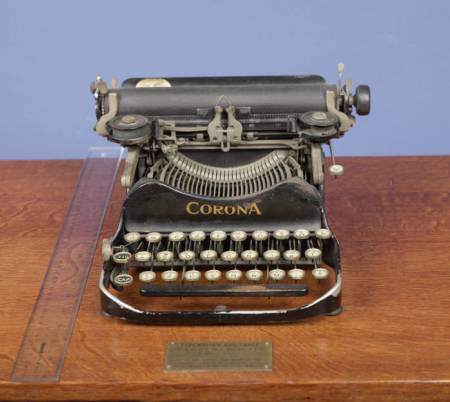
Mencken's Corona Typewriter, at the Mencken Room in the Enoch Pratt Library, Baltimore, Maryland
The typewriter that belonged to H. L. Mencken. Photo by the Enoch Pratt Free Library, Baltimore, Maryland. [Update, April 15, 2007: The photo has moved, and is restricted by copyright; you may follow the links to view the original photo of the typewriter, at the site of the Enoch Pratt Free Library. E.D.]
Was this the machine upon which Mencken composed the Millard Fillmore/Bathtub hoax? Perhaps. It was used prior to 1930.
Spread the word; friends don't allow friends to repeat history.
6 Comments | Fillmore's bathtub, H. L. Mencken, Hoaxes, Journalism, Newspapers | Tagged: Enoch Pratt Library, H. L. Mencken, History, Hoaxes, Journalism, Literature, Technology, Typewriters | Permalink
Posted by Ed Darrell
December 10, 2006

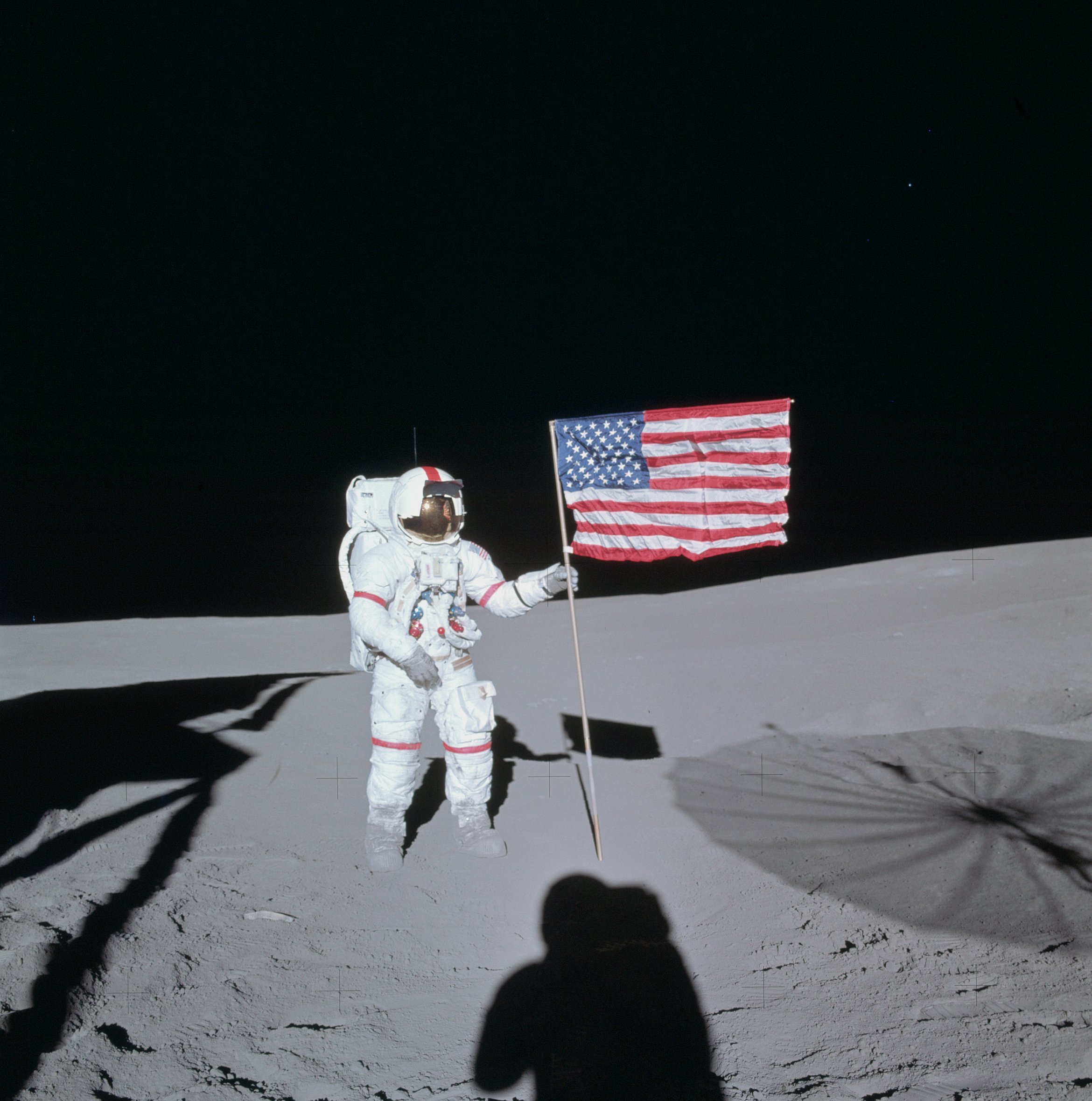
Photo from Apollo 14 Moon Mission
In a classroom discussion of “how do we know what we know” about history, another student brought up the allegations that the National Aeronautics and Space Administration (NASA) faked the manned Moon landings. That makes about a dozen times this year a kid has mentioned this claim (who thinks to start counting these things?). The kid was pretty unshakable in his convictions — after all, he said, how can a flag wave in a vacuum?
I usually mention a couple of things that the fake claimers leave out — that dozens, if not hundreds, of amateur astronomers tracked the astronauts on their way to the Moon, that many people intercepted the radio transmissions from the Moon, that one mission retrieved debris from an earlier unmanned landing, etc. Younger students who lack experience in serious critical thinking have difficulty with these concepts. They also lack the historic background — the last manned Moon landing occurred when their parents were kids, perhaps. They didn’t grow up with NASA launches on television, and the whole world holding its breath to see what wonders would be found in space.
Phil Plait runs a fine blog called Bad Astronomy. Five years ago he got fed up with the Fox Television program claiming the Moon landings were hoaxes, and he made a significant reply that should be in some hall of fame for debunking hoaxes. Since the claim that the Moon landings were hoaxes is, itself, a hoax, I have titled this “Debunking the Moon landing hoax hoax.”
In any case, if you’re wondering about whether the Moon landings were hoaxes, you need to see Phil Plait’s post. Phil writes:
From the very first moment to the very last, the program is loaded with bad thinking, ridiculous suppositions and utterly wrong science. I was able to get a copy of the show in advance, and although I was expecting it to be bad, I was still surprised and how awful it was. I took four pages of notes. I won’t subject you to all of that here; it would take hours to write. I’ll only go over some of the major points of the show, and explain briefly why they are wrong.
Also, consider these chunks of evidence, which Phil does not mention so far as I know:
First, the first Moon landing left a mirror on the surface, off of which Earth-bound astronomers may bounce laser transmissions in order to measure exactly the distance from the Earth to the Moon. Read the rest of this entry »
Spread the word; friends don't allow friends to repeat history.
20 Comments | Accuracy, Astronomy, History, Hoaxes, How do we know what we know, Moon, Reason, Science, Space exploration, Space Race, War on Science | Tagged: Apollo 11, Apollo Project, Astronomy, Bad Astronomy blog, Debunked Hoaxes, Flag on the Moon, History, Hoaxes, How do we know what we know, Jim Scotti, Moon, Moon Hoax, NASA, Phil Plait, Reason, Science, Space exploration, Space Race | Permalink
Posted by Ed Darrell
October 8, 2006

Cmdr. Lloyd Bucher and the Pueblo on the cover of Time Magazine, February 2, 1968 (substituted for the official portrait of Bucher, which is no longer available)
A good hoax? It could happen, right?
It did happen.
A U.S. spy ship, the U.S.S. Pueblo, under the command of Cmdr. Lloyd Bucher, was captured by North Korea on January 28, 1968 — the beginning of a very bad year in the U.S. that included Viet Cong’s Tet Offensive that revealed victory for the U.S. in Vietnam to be a long way off, the assassination of the Rev. Martin Luther King, Jr., the assassination of presidential candidate Sen. Robert F. Kennedy, riots during the Democratic National Convention in Chicago, a bitter election — and a wonderful television broadcast from astronauts orbiting the Moon on Christmas Eve.
North Korea held the crew of the Pueblo for eleven months. While holding the crew hostage — there was never any serious thought that the ship had in fact strayed into North Korean territorial waters, which might have lent some legitimacy to the seizure of the ship — North Korea (DPRK) tried to milk the event for all the publicity and propaganda possible. Such use of prisoners is generally and specifically prohibited by several international conventions. Nations make a calculated gamble when they stray from international law and general fairness.
To their credit, the crew resisted these propaganda efforts in ways that were particularly embarrassing to the North Koreans. DPRK threatened to torture the Americans, and did beat them — but then would hope to get photographs of the Americans “enjoying” a game of basketball, to show that the Americans were treated well. The crew discovered that the North Koreans were naive about American culture, especially profanity and insults. When posing for photos, the Americans showed what they told DPRK was the “Hawaiian good luck sign” — raised middle fingers. The photos were printed in newspapers around the world, except the United States, where they were considered profane. The indications were clear — the crew was dutifully resisting their captors. When the hoax was discovered, the Americans were beaten for a period of two weeks. Read the rest of this entry »
Spread the word; friends don't allow friends to repeat history.
39 Comments | 1968, Cold War, Heroes, History, History images, Hoaxes, Justice, Korea, veterans, Vietnam | Tagged: 1968, Cold War, Confessions, DPRK, History, Hoaxes, Lloyd Bucher, North Korea, Spying, USS Pueblo | Permalink
Posted by Ed Darrell
August 27, 2006
This might be a better topic for another blog I have in early creation stages — except that the difficulties with the anti-science program broadcast this weekend by D. James Kennedy’s Coral Ridge Ministries are exactly the same difficulties the same group has with history, and the concerns about revising history textbooks and history classes — to make them inaccurate and militantly polemic — also come from the same groups. The history errors alone in Kennedy’s program justify discussing it here. Read the rest of this entry »
Spread the word; friends don't allow friends to repeat history.
2 Comments | Bogus history, Charles Darwin, Creationism, Education, Evolution, History Revisionism, Hoaxes, Holocaust, Holocaust denial, Intelligent Design, Science, Science and faith, Voodoo history | Tagged: Bogus history, Charles Darwin, Creationism, D. James Kennedy, Educaiton, Evolution, History Revisionism, Hoaxes, Holocaust, Holocaust denial, Intelligent Design, Science, Science and Faith, Voodoo history | Permalink
Posted by Ed Darrell
July 19, 2006
Update, March 24, 2007: Be sure to see the updated flag ceremony, which you can find through this post on the news of the its release.
Yes, the flag amendment is dead, again. Yes, the Fourth of July is past. False history continues to plague the U.S. flag, however. When my wife forwarded to me the post below, it was the fourth time I had gotten it, recently. Bad history travels fast and far. Let’s see if we can steer people in a better direction with real facts.

A flag folding at a funeral for a military person carries great weight, without any script at all. Wikimedia image from DOD release: Members of the U.S. Navy Ceremonial Guard fold the American flag over the casket bearing the remains of sailors killed in the Vietnam War during a graveside interment ceremony at Arlington National Cemetery on May 2, 2013. Lt. Dennis Peterson, from Huntington Park, Calif.; Ensign Donald Frye, from Los Angeles; and Petty Officers 2nd Class William Jackson, from Stockdale, Texas, and Donald McGrane, from Waverly, Iowa, were killed when their SH-3A Sea King helicopter was shot down on July 19, 1967, over Ha Nam Province, North Vietnam. All four crewmembers were assigned to Helicopter Squadron 2.
Here is the post as it came to me each time — I’ve stripped it of the sappy photos that are occasionally added; note that this is mostly whole cloth invention:
Did You Know This About Our Flag
Meaning of Flag Draped Coffin.
All Americans should be given this lesson. Those who think that America is an arrogant nation should really reconsider that thought. Our founding fathers used God’s word and teachings to establish our Great Nation and I think it’s high time Americans get re-educated about this Nation’s history. Pass it along and be proud of the country we live in and even more proud of those who serve to protect our “GOD GIVEN” rights and freedoms.
To understand what the flag draped coffin really means……
Read the rest of this entry »
Spread the word; friends don't allow friends to repeat history.
28 Comments | 1776, 4th of July, Accuracy, Bogus history, Boy Scouts of America, Flag ceremony, Flag etiquette, Freedom - Political, History, Patriotism | Tagged: 1776, Accuracy, Bogus history, Boy Scouts of America, Flag etiquette, Flag Folding, Flage Ceremony, Fourth of July, History, Hoaxes, Patriotism, U.S. Flag | Permalink
Posted by Ed Darrell
July 3, 2006
History is a study of what happened and why. Often, high school and college studies of history are ruined by rote memorization of a long list of dates with a couple of words describing an event. That is not history. Often, studies of history are ruined through unreliable sources.
H. L. Mencken, the famous newspaper columnist from Baltimore, wrote a column published December 28, 1917, about the history of the bathtub, specifically that it was rare in the U.S., and how President Millard Fillmore introduced it to the White House, thereby making bathtubs and bathing popular. The column was brilliant, and it was a complete fabrication, a hoax. Within two years, however, Mencken’s column had found its way to reference books, encyclopedias, and bad history books. Here is Mencken’s original column: “A Neglected Anniversary.” [3/19/2009 – that link is dead; see Mencken’s column here.] You can read a history of the hoax and its spread at this site, Millard Fillmore’s Bathtub.
It’s a great story, about a do-nothing president, the press, and errors of history. To know the story, dates are unimportant. No one cares what years Fillmore was actually in office, no one cares exactly when Mencken’s column was published. Knowing lists of dates has never stopped a bad historian from reciting the erroneous claim that Millard Fillmore introduced the concept of bathing in a bathtub to the White House.
But now you know better.
This site is dedicated to knowing history, especially U.S. history, better.
Thank you for visiting. Noodle around, see what articles are here, leave some comments if you care to. Especially, if you find errors, leave a note of correction.
Spread the word; friends don't allow friends to repeat history.
23 Comments | Bogus history, Fillmore's bathtub, Hoaxes, Journalism, Millard Fillmore, Presidents | Tagged: Accuracy, bathtub, Bogus history, H. L. Mencken, History, Hoaxes, Journalism, Millard Fillmore | Permalink
Posted by Ed Darrell





 Millard Fillmore's Bathtub