Boston Tea Party: An anti-corporation protest?

April 3, 2011

Thom Hartmann said so.  In Hartmann’s reading, the 1773 Boston Tea Party was as much a protest against corporate oligarchy as a protest against government — quite the opposite of the way most Neo Tea Partiers see things.   Is he right?  Historians, what say you?

Hartmann relies on his copy of George R. T. Hewes’ book, A retrospect of the Boston tea-party, with a memoir of George R. T. Hewes, a survivor of the little band of patriots who drowned the tea in Boston harbour in 1773 (1834). Are you familiar with the book?

George R. T. Hewes in 1835, a veteran of the 1773 Boston Tea Party - CUNY image

George Robert Twelves Hewes in 1835 at age 93, a veteran of the 1773 Boston Tea Party. Painting by Joseph G. Cole. CUNY image

More, and resources:


Maybe, 4th grader disproves much warming in Beeville, not entire planet?

June 7, 2010

Hmmm.  News from Beeville is tough to come by when limited to calls that tend to catch school officials before they get to their office or after they go home (early, by most standards — but it’s summer, so we cut ’em some slack).

But we can find more information on what would be an astounding, groundbreaking study by 4th grader Julisa Castillo, which has been advertised as disproving global warming.

Again from the Beeville Bee-Picayune, about five months ago:

Conclusion: ‘pretty creative’

by Scott Reese Willey
As world leaders meet in Copenhagen to draft legislation to rein in the release of greenhouse gases and stem climate change, an R.A. Hall Elementary School student is questioning the science supporting global warming.

High school student judging R. A. Hall Elementary science fair projects

Caption from Beeville Bee-Picayune: A.C. Jones High School student Zachary Johnson, above, looks over a science experiment entered in R.A. Hall’s annual science fair. Zachary and other members of the high school’s science club judged the exhibits. Photo from, and read more at: mySouTex.com - Conclusion ‘pretty creative’

“There is not enough evidence to prove global warming is occurring,” fourth-grader Julisa Raquel Castillo concluded in a science project she entered in the campus’ annual science fair on Tuesday.

Julisa studied temperatures in Beeville for the past 109 years to develop her conclusion.

She researched online data basis of the National Oceanic and Atmospheric Administration, or NOAA, the National Weather Service, and checked out books on climate change at the Joe Barnhart Bee County Library.

Her findings:

• temperatures rose and fell from 1900 to 1950.

• temperatures in Beeville cooled down over a 20-year period beginning in 1955 and ending in 1975.

• Since 2001, temperatures in Beeville have grown cooler year after year.

Close to 200 R.A. Hall students entered projects in this year’s science fair, said organizer Denise Salvagno, who also teaches the school’s gifted and talented students.

Fourth- and fifth-graders were required to enter projects as part of class work; however, students in grades first, second and third could enter projects if they desired.

Students in Ben Barris’ science club at A.C. Jones High School judged the projects.

“Some of these projects are pretty creative,” said Zachary Johnson, a senior at A.C. Jones and one of the judges. “You can tell a lot of the students put a lot of effort into their projects. Some of them didn’t put much effort into it but a lot of them did and, overall, I’m impressed with what I am seeing.”

Fourth-grader Kaleb Maguire proved that all tap water in Beeville was the same quality.

He took samples of water at 10 different sites across town and came to the conclusion that because the water originated at the same source — the city’s fresh water plant — the samples contained the same amount of alkalinity, pH and free chlorine.

Fourth-grader Amber Martinez concluded that worms subjected to music were more alert than those not.

And fourth-grader Sam Waters’ project was no doubt much enjoyed by his pet pooch, Lucky.

Sam wanted to know which meat his dog would like more. Turns out Lucky preferred chicken over both hotdogs and sausage.

Fifth-grader Savannah Gonzales found out that ants prefer cheese over sugar, but classmate Misty Nienhouse concluded that ants preferred sugar over cheese. Tessa Giannini’s science project also seemed to prove that ants preferred sugar over cheese, bread or anything else.

However, fourth-grader Faith Hernandez conducted a similar experiment and concluded ants preferred cheese over ham.

Yet, Jose Vivesos, a fourth-grader, concluded that ants prefer sugar water over anything else.

Nathanial Martinez, also a fourth-grader, built a working seismograph and demonstrated how it detected and recorded earthquakes.

Fifth-grader Jamison Hunter decided to see if money in the hand made a difference in someone’s heart rate.

He recorded the heart rate of each volunteer without money in their hand, with one dollar bill in their hand, two one dollar bills in their hand and three one dollar bills in their hand.

His conclusion: “From this experiment, I learned that everyone’s heart rate is different by how much money they hold,” he said. “No two people had the same results even with the test being done the same way.”

Read more: mySouTex.com – Conclusion ‘pretty creative’

Temperatures may have cooled in Beeville.  Can we extrapolate Beeville to the entire planet?

The title of the project may be a little bit ambitious.

[See earlier post on the issue here.]

More:


Beeville fourth grader disproves global warming?

June 7, 2010

John Mashey alerted me to this news story from the online Beeville Bee-Picayune via mySouTex.com:

R.A. Hall fourth-grader is science national champion

R. A. Hall fourth grader Julisa Castillo, national science fair winner?

Caption from mySouTex: R.A. Hall fourth-grader Julisa Castillo (center) is the 2010 national junior division champion for the National Science Fair. Her project, “Disproving Global Warming,” beat more than 50,000 other projects from students all over the nation. She is pictured with her father, J.R. Castillo (left), and R.A. Hall Principal Martina Villarreal. Read more: mySouTex.com - R A Hall fourth grader is science national champion

R.A. Hall Elementary School fourth-grader Julisa Castillo has been named junior division champion for the 2010 National Science Fair.

Her project, “Disproving Global Warming,” beat more than 50,000 other projects submitted by students from all over the U.S.

Julisa originally entered her project in her school science fair before sending it to the National Science Foundation (NSF) to be judged at the national level.

The NSF panel of judges included former U.S. Vice President Al Gore, 14 recipients of the President’s National Medal of Science, and four former astronauts.

“Before she sent it off, she just had to add more details, citations for her research, and the amount of hours she spent working on it,” said Julisa’s father, J.R. Castillo.

In addition to a plaque, trophy and medal, Julisa has won an all-expenses-paid trip to Space Camp at the U.S. Space & Rocket Center in Huntsville, Ala., which she plans to attend this summer.
Read more: mySouTex.com – R A Hall fourth grader is science national champion

The blog of the North County Times (California) has doubts.  There are signs of hoax.  While the Beeville Independent School District does have an R. A. Hall elementary, the list of winners of last December’s science fair does not include Ms. Castillo.  To go from not placing at the local school to winning the national would be quite a feat!

I suspect an error somewhere, perhaps in the title of the project, or in the understanding of what the title implies.

Most of the obvious hoax signs check out against a hoax:  Beeville exists (improbably Texan as the name may be), R. A. Hall is an elementary school in Beeville ISD.  The principal of R. A. Hall is Martina Villareal.  Beeville has a guy named J. R. Castillo (listed as Julisa’s father in the photo caption), and his photos at the site promoting his music shows photos of a guy who looks a lot like the guy in the photo here.  Most hoaxers wouldn’t go so far for accuracy on details.

Fun little mystery.  I have made inquiries with the newspaper, and hope to follow up with the school.  Stay tuned.  There may be a great little science project somewhere in here.

_____________

See update here: Quick summary, big title, project not quite filling those shoes. I’ve made inquiries at the paper and school district without answers; there’s more to the story, but not much.  A good project with a misleading title, for those who would be misled by a 4th grade science fair project.


Speaking of Texas education policy

January 5, 2010

Moon landing and wrestling in America

from Funnyjunk

This is a troubling piece of humor.  From Funnyjunk.


Stubborn Birthers soldier on

January 4, 2010

Birther “Dr. Kate” sez there’s a case coming to a hearing in Pennsylvania that will go to the Supreme Court no matter how this hearing turns out.

Here’s the table of contents to Kerchner v. Obama. Here’s the full complaint, according to Dr. Kate.

Probably the best thing going for the plaintiffs is that Orly Taitz only appears by name in a bizarre accounting of everything ever said on the issue (except for the lack of evidence and reasons this case will fail which, oddly, isn’t included in the complaint; everything else is included).

I predict the case will be dismissed, but it may be dismissed with prejudice.  That is, if it really does come to a hearing.  Is that really possible?

Warn others so they don’t get trampled:

Add to FacebookAdd to NewsvineAdd to DiggAdd to Del.icio.usAdd to StumbleuponAdd to RedditAdd to BlinklistAdd to TwitterAdd to TechnoratiAdd to Furl


Yeah, it’s ironic (hacked e-mails and global warming)

November 26, 2009

James’s Empty Blog:

It is hard to miss the irony in people eagerly poring through illegally-obtained private email, looking for ethical breaches by the writers! I’m sure we can all imagine the outrage if one of the emails revealed that a scientist had hacked into one of the sceptics’ computers and was reading all their correspondence. So a bit of perspective is called for here.

James Is A Scientist (IANAS), and he has much good stuff to say (read some of the other posts about the hacked e-mails while you’re there) — but you gotta wonder about a blog that follows such a post with this:

Prawns, Jules Berry

Prawns not in their native habitat. Probably Tastimus deliciousus

Tip of the old scrub brush to Stoat.


Use of evidence in science: Homeopathy and nutritionists take a laughable hit

October 9, 2009

Dara O’Briain?  Never heard of him before.

But he’s spot on here, isn’t he?

(Warning:  Not exactly safe for work or school — the “f” word is spoken aloud.]

An ironic tip of the old scrub brush to Gandolf, in comments at Dunamis Word, in an otherwise futile discussion with creationists who claim to have an ounce of rationality left in them.


Michael Shermer’s baloney detection kit

June 25, 2009

Hmmmm.  May have to use this to start out the history classes next year, on the topic of “How do we know what we know?”

Michael Shermer explains the tools we use to detect baloney.  Shermer is the editor of Skeptic magazine; here he speaks in a video produced by the Richard Dawkins Foundation for Reason and Science, via Boing! Boing!:


Hall of Fame: Debunking the Moon landing hoax hoax

December 10, 2006

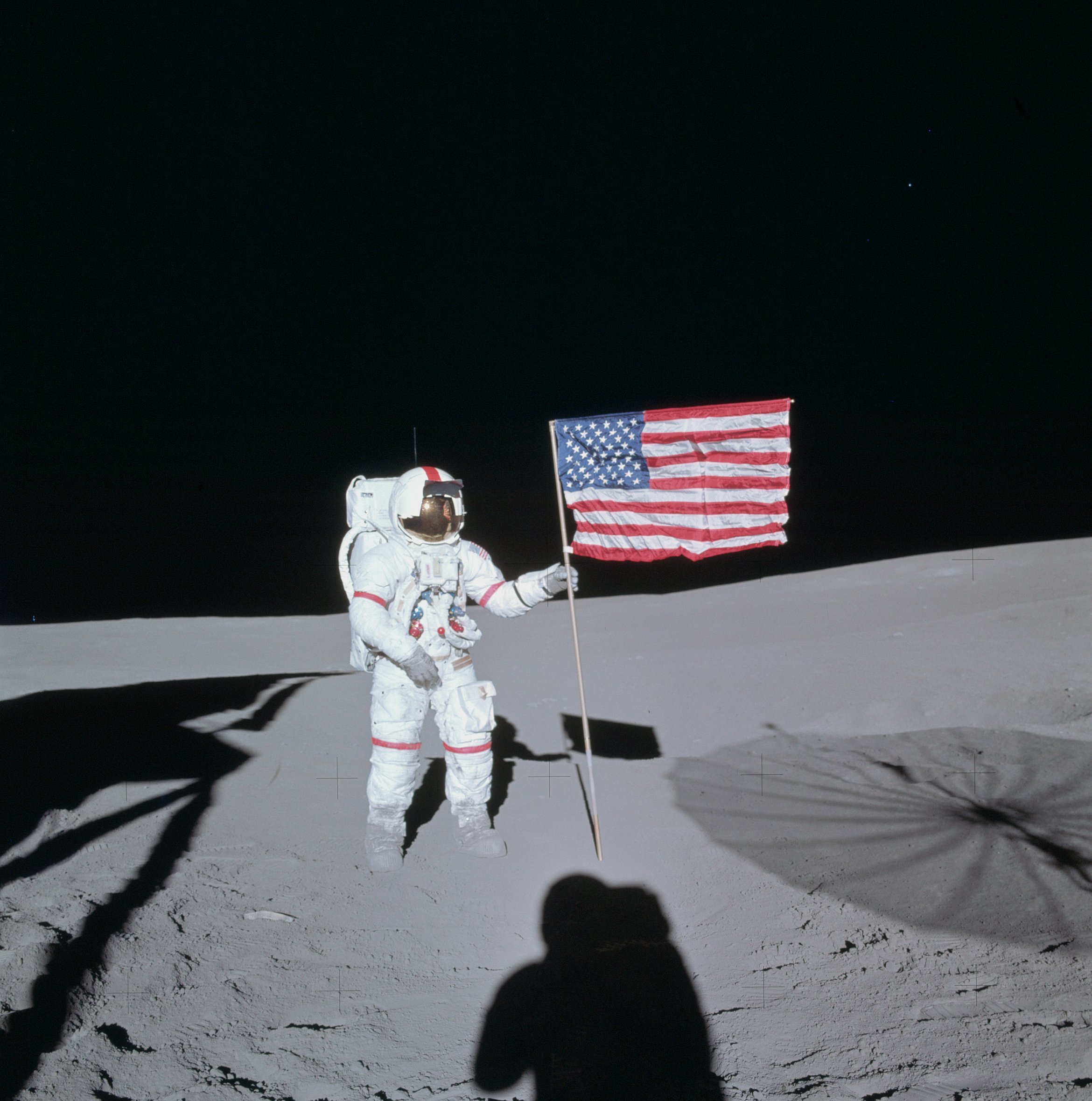
Apollo 14 on the moon - Alan Shepard?

Photo from Apollo 14 Moon Mission


In a classroom discussion of “how do we know what we know” about history, another student brought up the allegations that the National Aeronautics and Space Administration (NASA) faked the manned Moon landings. That makes about a dozen times this year a kid has mentioned this claim (who thinks to start counting these things?). The kid was pretty unshakable in his convictions — after all, he said, how can a flag wave in a vacuum?

I usually mention a couple of things that the fake claimers leave out — that dozens, if not hundreds, of amateur astronomers tracked the astronauts on their way to the Moon, that many people intercepted the radio transmissions from the Moon, that one mission retrieved debris from an earlier unmanned landing, etc. Younger students who lack experience in serious critical thinking have difficulty with these concepts. They also lack the historic background — the last manned Moon landing occurred when their parents were kids, perhaps. They didn’t grow up with NASA launches on television, and the whole world holding its breath to see what wonders would be found in space.

Phil Plait runs a fine blog called Bad Astronomy. Five years ago he got fed up with the Fox Television program claiming the Moon landings were hoaxes, and he made a significant reply that should be in some hall of fame for debunking hoaxes. Since the claim that the Moon landings were hoaxes is, itself, a hoax, I have titled this “Debunking the Moon landing hoax hoax.”

In any case, if you’re wondering about whether the Moon landings were hoaxes, you need to see Phil Plait’s post. Phil writes:

From the very first moment to the very last, the program is loaded with bad thinking, ridiculous suppositions and utterly wrong science. I was able to get a copy of the show in advance, and although I was expecting it to be bad, I was still surprised and how awful it was. I took four pages of notes. I won’t subject you to all of that here; it would take hours to write. I’ll only go over some of the major points of the show, and explain briefly why they are wrong.

Also, consider these chunks of evidence, which Phil does not mention so far as I know:

First, the first Moon landing left a mirror on the surface, off of which Earth-bound astronomers may bounce laser transmissions in order to measure exactly the distance from the Earth to the Moon. Read the rest of this entry »