October 25, 2007
Bush administration officials make the case more powerfully that we need to resurrect the Office of Technology Assessment (OTA).
Bushies, going against their earlier claims that they accept that the nation needs to do something about changing climate, “eviscerated” testimony of a government official designed to protect public health. More voodoo science from Bush. According to The Carpetbagger Report:
Dr. Julie Gerberding, director of the Centers for Disease Control and Prevention, told a Senate panel yesterday that climate change “is anticipated to have a broad range of impacts on the health of Americans.” If that sounds a little vague and non-specific, there’s a good reason — the White House refused to let her say what she wanted to say.
Sadly, Carpetbagger Report lists several other instances in which White House officials have gutted the release of important information on global warming’s dangers.
If Osama bin Laden did something like that, we’d invade a smaller nation to stop it. Preventing Americans from being prepared for disaster is a terroristic threat under the Homeland Security Act, isn’t it? Is there a clause for citizen suits in there somewhere? Who will stand up to the abuses by George Bush?
Here’s the Washington Post story on the event. Here’s my previous post, with links to Denialism and Pharyngula, and even John Wilkins (love that picture of Snowflake!).
Hillary Clinton specifically calls for the recreation of OTA, a clue some of us politicos use to indicate she really does know what government under the Constitution should be doing. Other Democrats are friendly to the idea, but so far I’ve not heard a peep from any of the Republican presidential candidates. Orrin? What about you?
Bring back the OTA. Exorcise the demons of totalitarian Bushism.
Spread the word; friends don't allow friends to repeat history.
 2 Comments |
  Accuracy, Junk science, Politics, Research, Santayana's ghost, Science, Technology, Voodoo science, War on Science, War on Terrorism | Tagged: Bush censorship, Climate change, Junk science, Office of Technology Assessment, Politics, Voodoo science |
  Permalink
 Posted by Ed Darrell
October 3, 2007
Information on DDT is scattered clouds of information, lately. Some of these really should get more comment — but time is quite short for me right now.
Here’s the news:
One more study on DDT and breast cancer. Stop the presses on this one. It’s a good study, and it shows a link. Effect Measure at the Seed Stables has a good post on it. One of the key differences here is that this study looked for childhood exposure. Exposure of children to DDT seems to be more damaging than exposure to adults. This should be especially worrying considering DDT’s daughter products and their ability to mimic estrogen in the wild.
Bill Moyers’ program on PBS looked at the recent campaign against Rachel Carson, and found the campaign ethically challenged. Moyers takes a more in-depth and gentle view of Carson, from a perspective from the arts. Solid information, interesting view.
All Africa.com had a news report on the current anti-malaria campaign in Malawi: “Rescuing children from malaria.” Real news — it doesn’t call for broadcast spraying of DDT. (Surprised?) In fact, it attacks the colleagues of the Rachel Carson critics, the tobacco companies.
A blogger named Aaron Swartz takes on the Rachel Carson critics rather directly: “Rachel Carson: Mass Murderer?”
A recent think piece out of the always-informative Christian Science Monitor: “Bring back DDT? Think again.”
Perhaps a minor blip: Plaintiffs ask damages against chemical companies and others because the DDT dumped next door has decreased the value of their properties. An Alabama appeals court ruled that plaintiffs may call in experts to testify that DDT dumping decreases property value. (Maybe Roger Bate would like to buy the property at market value? All that DDT would mean no mosquitoes forever, right?)
And from the lost-but-now-found archives, a story that demonstrates subtly the bias that Rachel Carson critics have — Roger Bate defending tobacco companies in a 1996 Wall Street Journal opinion piece. Perhaps one should not be surprised that people who defend tobacco against health regulators and health care education could turn around and argue for DDT and against Rachel Carson.
Spread the word; friends don't allow friends to repeat history.
4 Comments | DDT, Environmental protection, History, Malaria, Politics, Public health, Rachel Carson, Science, War on Science | Tagged: DDT, Environmental protection, Junk science, Malaria | Permalink
Posted by Ed Darrell
August 17, 2007
The Wall Street Journal‘s editorial page continues to exhibit signs of hysteria that can only be described as DDT poisoning. DDT has poisoned their view of what to do about malaria. (The article is now available by paid subscription.)
Malaria is a nasty disease that kills more than a million people every year. It is particularly brutal in attacking infants and pregnant women.
Malaria continues to rage because western nations with the resources to fight the disease spent their money on other things in the past 40 years, because the nations most affected lack the governmental adequacy or financial resources and willpower to mount effective campaigns against the disease, but mostly because malaria is a tough disease to fight.
Malaria is spread by several different species of mosquito, some of which have habits or constitutions which make mosquito eradication programs much less effective. Human malaria is really four different parasites, some of which have acquired resistance to the drugs used to fight it. The HIV/AIDS epidemics in tropical nations have not helped matters: What used to be minor cases of malaria now kill thousands who have compromised immune systems because of HIV/AIDS.
Hospitals in far too many nations are overwhelmed with malaria patients, and unable to provide care for many who could be saved. Most of those who die every year could live, with better distribution of health care, and with better prevention.
A few people have been afflicted with what can only be described as a different problem: DDT poisoning. Their views of malaria and what we need to do to fight the disease are poisoned by their anti-science political views. For at least five years there has been a nasty, persistent campaign to impugn “environmentalists” and Rachel Carson, claiming that DDT is the answer to all the world’s malaria woes. Though DDT has been available to fight malaria since 1946, these people complain that bans on spraying crops have discouraged the use of DDT against malaria, fatally.
Below the fold I’ll fisk the short piece from yesterday’s WSJ. It’s difficult to keep ahead of hoaxers, though — today they’ve got another call for DDT use, this time to fight West Nile Virus. Ironically, West Nile is most deadly against several species of bird, some of which are acutely subject to death by DDT.
Read the rest of this entry »
Spread the word; friends don't allow friends to repeat history.
5 Comments | DDT, Environmental protection, Junk science, Rachel Carson, Reason, Voodoo science | Tagged: DDT, endocrine disruptors, Junk science, Malaria, Voodoo science, West Nile | Permalink
Posted by Ed Darrell
August 12, 2007
Critics of Rachel Carson and sponsors of the anti-science, anti-environmentalist campaign to bring back DDT as a major killer, frequently misinform in very selective ways. For example, they like to mention DDT’s role in causing human cancers, because, they claim Rachel Carson was dead wrong about that link. Therefore, they say, DDT is a nice chemical and bans should be lifted.
In reality, carcinogenicity played a very small role in banning DDT. DDT was banned because it kills indiscriminately, killing beneficial insects along with the bad, killing untargeted species, like songbirds, along with the insect targets; and DDT was banned because once released into the wild, it is very long-lived, and its ultimate destructive effects cannot be known or controlled — though some harms, such as the devestation of America’s birds of prey, are extremely well documented.
Similarly, the anti-science crowd doesn’t like to talk about the third big area where DDT produces harms: Hormone disruption. In fact, Steven Milloy’s “100 things you should know about DDT” at the site that peddles junk science, JunkScience.com, does not even contain the word “hormone.”
They play down the fact that DDT and its by-products disrupt reproductive processes, and sometimes disrupt and deform reproductive organs, of nearly every animal it touches. They don’t want you to know about the hormonal effects of DDT and its breakdown products.
So, they never mention books like the National Academy of Sciences’ compilation of the harms of such chemicals, Hormonally Active Agents in the Environment.
Milloy will misquote the NAS when NAS mentions slightly the benefits of DDT; Milloy will not quote NAS when they cite the dangers of DDT. So this book on hormonally active agents, which mentions DDT specifically in 16 chapters for a total of 309 times, will never be mentioned in a discussion of DDT’s dangers — unless you bring it up.
Go see what the book says in the Executive Summary. If you debate the anti-Rachel Carson crowd, use this book frequently — they will have no answers.
And, Sen. Tom Coburn, are you listening? Since when do your constituents want you to defend a chemical which will ruin their farm animals, and especially the ducks they want to hunt? It’s time to quit trying to tarnish the memory of Rachel Carson, Sen. Coburn, and let that post office in Pennsylvania be named after her.
Spread the word; friends don't allow friends to repeat history.
2 Comments | DDT, Environmental protection, Politics, Rachel Carson, Science, Voodoo science, War on Science | Tagged: Accuracy, DDT, Endocrine Disruption, Environmental protection, Junk science, Politics, Propaganda, Rachel Carson, Rampant stupidity, Science, Voodoo science | Permalink
Posted by Ed Darrell
August 9, 2007
Another in a continuing series, showing the errors in JunkScience.com’s list of “100 things you should know about DDT.” (No, these are not in order.)
Steven Milloy and the ghost of entomologist J. Gordon Edwards listed this as point six in their list of “100 things you should know about DDT “[did Edwards really have anything to do with the list before he died?]:
6. “To only a few chemicals does man owe as great a debt as to DDT… In little more than two decades, DDT has prevented 500 million human deaths, due to malaria, that otherwise would have been inevitable.”
[National Academy of Sciences, Committee on Research in the Life Sciences of the Committee on Science and Public Policy. 1970. The Life Sciences; Recent Progress and Application to Human Affairs; The World of Biological Research; Requirements for the Future.]
In contrast to their citation for the Sweeney hearing record, which leads one away from the actual hearing record, for this citation, the publication actually exists, though it is no longer available in print. It’s available on-line, in an easily searchable format. [I urge you to check these sources out for yourself; I won’t jive you, but you should see for yourself how the critics of Rachel Carson and WHO distort the data — I think you’ll be concerned, if not outraged.] The quote, though troubled by the tell-tale ellipses of the science liar, is accurately stated so far as it goes.
The problems? It’s only part of the story as told in that publication. The National Academy of Science calls for DDT to be replaced in that book; NAS is NOT calling for a rollback of any ban, nor is NAS defending DDT against the claims of harm. The book documents and agrees with the harms Rachel Carson wrote about eight years earlier.
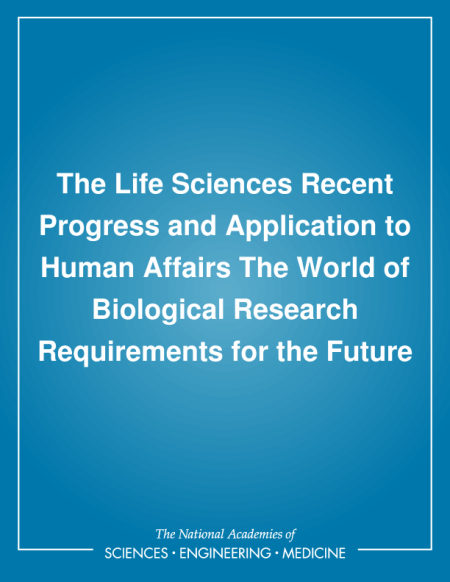
Cover of the electronic version of Life Sciences, the 1970 book looking to future needs in biology and agriculture.
Milloy (and Edwards, he claims), are trying to make a case that the National Academy of Sciences, one of the more reputable and authoritative groups of distinguished scientists in the world, thinks that DDT is just dandy, in contrast to the views of Rachel Carson and environmentalists (who are always cast as stupid and venal in Milloy’s accounts) who asked that DDT use be reduced to save eagles, robins and other songbirds, fish, and other wildlife, and to keep DDT useful against malaria.
First, there is no way that a ban on DDT could have been responsible for 500 million deaths due to malaria. Calculate it yourself, the mathematics are simply impossible: At about 1 million deaths per year, if we assume DDT could have prevented all of the deaths (which is not so), and had we assumed usage started in 1939 instead of 1946 (a spot of 7 years and 7 million deaths), we would have 69 million deaths prevented by 2008. As best I can determine, the 500 million death figure is a misreading from an early WHO report that noted about 500 million people are annually exposed to malaria, I’m guessing a bit at that conclusion — that’s the nicest way to attribute it to simple error and not malicious lie. It was 500 million exposures to malaria, not 500 million deaths. It’s unfortunate that this erroneous figure found its way into a publication of the NAS — I suppose it’s the proof that anyone can err.
Read the rest of this entry »
Spread the word; friends don't allow friends to repeat history.
16 Comments | Accuracy, Bogus history, Conservation, DDT, Environmental protection, History, Hoaxes, Junk science, Public health, Rachel Carson, Research, Voodoo history, Voodoo science, War on Science | Tagged: Bogus history, DDT, Environmental protection, History, Hoaxes, J. Gordon Edwards, Junk science, Malaria, National Academy of Science, Rachel Carson, Science, Steven Milloy | Permalink
Posted by Ed Darrell
August 4, 2007
Jay Ambrose retired from editing newspapers, and now writes commentary for the Scripps News chain of papers. Because of his experience in editing, I was suprised to see his commentary from last week which takes broad, inaccurate swipes at environmental groups (here from the Evansville, Indiana, Courier & Press).
Ambrose is victim of the “DDT and Rachel Carson bad” hoax.
His column addresses bias in reporting, bias against Christians, which he claims he sees in reporting on issues of stem cell research, and bias “in favor” of environmentalists, which has resulted in a foolish reduction in the use of DDT. I don’t comment here on the stem cell controversy, though Ambrose’s cartoonish presentation of how federally-funded research works invites someone to correct its errors.
Relevant excerpts of Ambrose’s column appear below the fold, with my reply (which I have posted to the Scripps News editorial section, and in an earlier version, to the on-line version of the Evansville paper).
Read the rest of this entry »
Spread the word; friends don't allow friends to repeat history.
55 Comments | Accuracy, Africa, Conservation, DDT, Journalism, Junk science, Malaria, Public health, Rachel Carson, Science, Voodoo science, War on Science | Tagged: Accuracy, Africa, DDT, Journalism, Junk science, Malaria, Public health, Rachel Carson, Science, Voodoo science | Permalink
Posted by Ed Darrell
July 10, 2007
The merry bands of hoaxsters at “JunkScience.com” and the Competitive Enterprise Institute hope you think DDT is a well-targeted, perfect solution to get rid of malaria. They ignore the devastating effects DDT has on birds, bats and other mammals (including humans), beneficial insects and fish. They don’t care about the difficulties in treating malaria in hospitals, which would continue or grow worse were DDT to be sprayed willy-nilly across the malaria-endemic world.

Plus, CEI is well-funded and has been hammering away on spreading the hoaxes for several years. You may have to dig hard to find the facts, such as the fact that the inventors of DDT as insecticide warned against over-use exactly as did Rachel Carson, (see the Dove Docs archives), or that the death of beneficial insects and beneficial animals can cause disasters, too — or did CEI tell you that DDT can cause your roof to cave in, in Borneo, and that they had to parachute cats in to prevent an epidemic of typhus, caused by DDT?
Read the rest of this entry »
Spread the word; friends don't allow friends to repeat history.
9 Comments | DDT, Geography - Economic, Hoaxes, Junk science, Lesson plans, Rachel Carson, Science, Voodoo science, War on Science | Tagged: Borneo Cats, DDT, geography, Hoaxes, Junk science, Lesson plans, Rachel Carson, Science | Permalink
Posted by Ed Darrell
June 25, 2007
Bug Girl sleuthed around a bit, and found information from official sources that really demonstrates the critics of Rachel Carson are using Gillette Foamy to make us think “mad dog!”

Chart from US Fish and Wildlife Service (USFWS) illustrates biomagnification, by which a minuscule dose of DDT to small plankton gets magnified a few million times by the time the top predators in the food chain get it.
So the evidence continues to pile up that Rachel Carson was simply a fine writer, a good scientist, and correct about DDT’s dangers.
Check out the Fish and Wildlife Service’s site, here; notice especially their structure of the site, to dispel the falsehoods.
FWS quotes Carson on DDT use:
In Audubon magazine she wrote, “We do not ask that all chemicals be abandoned. We ask moderation. We ask the use of other methods less harmful to our environment” (4). Countering claims that she was advocating a back-to-nature philosophy, she said, “We must have insect control. I do not favor turning nature over to insects. I favor the sparing, selective and intelligent use of chemicals. It is the indiscriminate, blanket spraying that I oppose” (5).
Evidence mounts that claims against Rachel Carson are sheer calumny. While the political motivations of this smear campaign are not clear, we don’t need to know for certain who is telling lies about a great American hero, or why. As Americans, as concerned citizens, as teachers and parents — as patriots — we only need to know that the claims against Rachel Carson are false.
And now it is our duty to call on Oklahoma’s Sen. Tom Coburn to stop the campaign against Carson. Coburn is the point man in the smear campaign right now: He has put a committee hold on the well-intentioned, justified bill to name a post office in her hometown after Rachel Carson. It is time for Tom Coburn to stand up and do the right thing for a great American. Sen. Coburn needs to lift his committee hold and allow committee action on this minor honor.
Other sources of note:
Bruce Watson, “Sounding the Alarm,” Smithsonian Magazine, September 2002. (Watson, Bruce. Sounding the alarm. Smithsonian, v. 33, Sept. 2002: 115-117. AS30.S6)
“The Berry and the Poison,” about methyl bromide and its ban, Smithsonian Magazine, December 1997.
- Image showing how DDT concentrations rise 10 million times from their introduction to the water to concentrate in raptors like the national symbol, the bald eagle, osprey, peregrine falcon and brown pelicans, from the U.S. Fish and Wildlife Service. Due to the effects of DDT, the bald eagle, peregrine falcon and brown pelican were all listed on the Endangered Species List. [Update, June 13, 2008 – USFWS has taken this page down. I’m leaving the links until they put it back, or until I find what they changed the page to.] [Update June 21, 2015 – Chart may also be found here: https://myorganicchemistry.wikispaces.com/DDT%5D
Spread the word; friends don't allow friends to repeat history.
3 Comments | Accuracy, Conservation, DDT, Environmental protection, Ethics, History, Hoaxes, Junk science, Natural history, Politics, Public health, Rachel Carson, Research, Science, Voodoo history, Voodoo science, War on Science | Tagged: DDT, Environmental protection, Ethics, History, Hoaxes, Junk science, Natural history, Rachel Carson, Science, War on Science | Permalink
Posted by Ed Darrell
October 9, 2006
We’re talking past each other now over at Right Reason[*], on a thread that started out lamenting Baylor’s initial decision to deny Dr. Francis Beckwith tenure last year, but quickly changed once news got out that Beckwith’s appeal of the decision was successful.
I noted that Beckwith’s getting tenure denies ID advocates of an argument that Beckwith is being persecuted for his ID views (wholly apart from the fact that there is zero indication his views on this issue had anything to do with his tenure discussions). Of course, I was wrong there — ID advocates have since continued to claim persecution where none exists. Never let the facts get in the way of a creationism rant, is the first rule of creationism.

Steve Sack cartoon in the Minneapolis Star-Tribune
Discussion has since turned to the legality of teaching intelligent design in a public school science class. This is well settled law — it’s not legal, not so long as there remains no undisproven science to back ID or any other form of creationism.
Read the rest of this entry »
Spread the word; friends don't allow friends to repeat history.
10 Comments | Accuracy, Charles Darwin, Creationism, denialism, Evolution, Intelligent Design, Junk science, Law, Voodoo history, Voodoo science | Tagged: Accuracy, Charles Darwin, Creationism, denialism, Evolution, Intelligent Design, Junk science, Law, Voodoo history, Voodoo science | Permalink
Posted by Ed Darrell




 Millard Fillmore's Bathtub