Bathtub reading near the end of spring break, 2011

March 18, 2011

No, they are not trying to get rid of unions, just trying to balance their budgets.  Right?

Other than Rand Paul, Republicans don’t need low-flow toilets, because when it comes to conservation, climate change and the facts, Republicans just don’t give a s—.

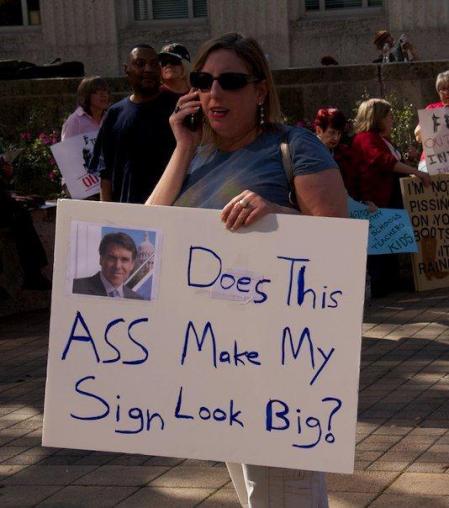
Oooh.  Signs from the teacher protests of budget cuts in Austin, Texas!

Does this ass, Rick Perry, make my sign look big?  Austin, March 2011

Protester in Austin, Texas, March 2011

Peace Corps celebrates 50 years this year.  Steve Mott tells of his first year as a Peace Corps volunteer in a remote corner of Nepal. (From the Norwell (Massachusetts) Mariner Wicked Local online.) (Suitable for a warm-up at least, teachers — maybe good for your unit on the 1960s and the Kennedy administration.  “In 1966 it was the Beach Boys and when I got back in ’68 it was Janis Joplin,” he said.  “A lot of social changes had taken place in two years.”

Oh, those jocular Tea Partiers!  Now they want to bring back child labor, in Maine, and in Missouri.  They’re serious when they say they oppose all the “progressive agenda” from the Progressive Era.  Look out Women’s Christian Temperance Union and anti-child abuse laws.  (Tea Partiers get all get their marching orders from Tea Bag Central — surely other states will follow; let us know if similar bills are in the hopper in your state legislature, eh?)

I keep finding good and interesting stuff in the Imperial War Museum.  Have you ever been there?  I wish they would do more online.  “War Shapes Lives,” a motto on their website.  An understatement of history.  This painting hangs in the museum, John Singer Sargent’s  “Gassed.”  At the museum, you may view it in its majesty, 20 feet along the wall, 7½ feet high.

Gassed, by John Singer Sargent.  Imperial War Museum

Gassed, by John Singer Sargent. Imperial War Museum


Civility? Doing lunch the rights way, North Carolina, February 1, 1960

February 1, 2011

Today is the 51st anniversary of the Greensboro sit-in. Be sure to read Howell Raines’ criticism of news media coverage of civil rights issues in last year’s New York Times: “What I am suggesting is that the one thing the South should have learned in the past 50 years is that if we are going to hell in a handbasket, we should at least be together in a basket of common purpose.”

Four young men turned a page of history on February 1, 1960, at a lunch counter in a Woolworth’s store in Greensboro, North Carolina.

Ezell A. Blair, Jr. (now Jibreel Khazan), Franklin E. McCain, Joseph A. McNeil, and David L. Richmond, sat down at the counter to order lunch. Because they were African Americans, they were refused service. Patiently, they stayed in their seats, awaiting justice.

On July 25, nearly six months later, Woolworth’s agreed to desegregate the lunch counter. One more victory for non-violent protest.


Ezell A. Blair, Jr. (now Jibreel Khazan), Franklin E. McCain, Joseph A. McNeil, and David L. Richmond leave the Woolworth store after the first sit-in on February 1, 1960. (Courtesy of Greensboro News and Record)

Ezell A. Blair, Jr. (now Jibreel Khazan), Franklin E. McCain, Joseph A. McNeil, and David L. Richmond leave the Woolworth store after the first sit-in on February 1, 1960. (Courtesy of Greensboro News and Record) (Smithsonian Institution)

News of the “sit-in” demonstration spread. Others joined in the non-violent protests from time to time, 28 students the second day, 300 the third day, and some days up to 1,000. The protests spread geographically, too, to 15 cities in 9 states.

On the second day of the Greensboro sit-in, Joseph A. McNeil and Franklin E. McCain are joined by William Smith and Clarence Henderson at the Woolworth lunch counter in Greensboro, North Carolina. (Courtesy of Greensboro News and Record)

Smithsonian caption: "On the second day of the Greensboro sit-in, Joseph A. McNeil and Franklin E. McCain are joined by William Smith and Clarence Henderson at the Woolworth lunch counter in Greensboro, North Carolina. (Courtesy of Greensboro News and Record)"

Part of the old lunch counter was salvaged, and today is on display at the Smithsonian Institution’s Museum of American History. The museum display was the site of celebratory parties during the week of the inauguration as president of Barack Obama.

Part of the lunchcounter from the Woolworths store in Greensboro, North Carolina, is now displayed at the Smithsonians Museum of American History, in Washington, D.C.

Part of the lunchcounter from the Woolworth's store in Greensboro, North Carolina, is now displayed at the Smithsonian's Museum of American History, in Washington, D.C.

Notes and resources:

Student video, American History Rules, We Were There – First person story related by Georgie N. and Greg H., with pictures:

Associated Press interview with Franklin E. McCain:

This is mostly an encore post.


The view from the seat of the pilot of the Enola Gay / Smithsonian National Air and Space Museum

December 19, 2010

Old friend and thorn in the side Gil Brassard in Baton Rouge alerted us to this wonderful marriage of modern technology and history from David Palermo Photography — an interactive, panoramic view of the cockpit of the Enola Gay, the B-29 from which the first atomic bomb used in war was dropped.

How can you use this in class, teachers?  Got a lesson plan that puts a student in the seat of the pilot?

Vodpod videos no longer available.

Enola Gay / Smithsonian National Air and Space …, posted with vodpod

For technical reasons beyond my ken, one may not make this a full screen image. No problem. Go to David Palermo’s site, and see this as big as your computer monitor. I recommend viewing it there — it’s better, really.

Palermo has a portfolio of cockpits he’s shot at the Smithsonian, including the French Concorde, Gemini VII, a Bell Huey helicopter, Mercury Friendship VII, and a Lockheed Martin X-35 — with spherical panoramas available of those and more (look for the link that says “HD360°” and look at the drop-down menu).  He sells massive prints of the cockpits — something special for aviation and space buffs.


Typewriter of the moment: William Saroyan

December 19, 2010

William Saroyan's typewriter, photo from the Bancroft Library, University of Caliornia - Berkeley

William Saroyan's typewriter, displayed at the Saroyan Museum at his home in San Francisco - photo from the Bancroft Library, University of California; Berkeley

William Saroyan’s niece, Jacqueline Kazarian, recently gifted the Bancroft Library with a significant part of the archives of Saroyan’s work.  The press release on the gift included a photo of Saroyan’s Fox typewriter, which is displayed at the Saroyan museum in San Francisco.

Saroyan came from an Armenian American family, born in Fresno, California in 1908.  His writings illuminated the experience of Californians and Armenian Americans, especially during the Great Depression.

In many ways Saroyan’s work symbolizes the uniqueness of the Armenian community in America, especially California.  [You still out there, Ben Davidian?]   Wikipedia strikes the right tone:

Saroyan’s stories celebrated optimism in the midst of the trials and tribulations of the Depression. Several of Saroyan’s works were drawn from his own experiences, although his approach to autobiographical fact contained a fair bit of poetic license.

His advice to a young writer was: “Try to learn to breathe deeply; really to taste food when you eat, and when you sleep really to sleep. Try as much as possible to be wholly alive with all your might, and when you laugh, laugh like hell.” Saroyan endeavored to create a prose style full of zest for life and seemingly impressionistic, that came to be called “Saroyanesque”.

The complete May 19, 2010,  press release from the University of California is below.

a sketch "from a Turkish admirer," a photo of the author in his youth, and a framed sketch of Saroyan

The Bancroft Library's new archival material on William Saroyan includes (left to right) a sketch "from a Turkish admirer," a photo of the author in his youth, and a framed drawing of Saroyan with a passage of his writing on Armenia. (Images courtesy of the Bancroft Library)

The Bancroft Library accepts gift of William Saroyan archives

By Kathleen Maclay, Media Relations | 19 May 2010

William Saroyan

William Saroyan (Photo courtesy of The Bancroft Library)

BERKELEY — The Bancroft Library at the University of California, Berkeley, has received a spectacular gift of hundreds of books, drawings, correspondence and other personal communications to and from one of America’s best-known writers, the Armenian-American author and playwright William Saroyan.

The rich collection includes approximately 48 cartons with 1,200 books and other archival materials assembled by his niece, Jacqueline Kazarian, of San Francisco, who also is the founder of the William Saroyan Literary Foundation International. A celebration of the gift is set for noon on Friday (May 21) at The Faculty Club on campus.

“UC Berkeley is such an incredible place of learning and growing and intellectual exploration,” said Kazarian, who earned degrees in communication and decorative arts at UC Berkeley in the early 1950s. “I know that my uncle wanted his library, manuscripts and galleys to go to Berkeley. Students will be inspired by the collection.”

Apart from this gift, The Bancroft Library already retains significant holdings of Saroyan’s work that it collected over the course of his life and career, and it continues to add to that collection. Most of the latest materials come from Saroyan’s home on San Francisco’s 15th Avenue that is now a Saroyan museum directed by Kazarian. Those materials were supplemented by Kazarian’s extensive personal collection, as well as by items of Saroyan’s that she acquired through a prominent Boston archivist and via a Saroyan friend.

“Jacqueline Kazarian’s new gift is the largest and most substantial augmentation to the Saroyan collections at Bancroft that we have ever received,” said Peter Hanff, Bancroft’s deputy director.

The author’s classic manual typewriter, as displayed at his San Francisco home

The author’s classic Fox manual typewriter, as displayed at his San Francisco home. (Photo courtesy of The Bancroft Library)

Saroyan, born in Fresno, Calif., in 1908, drew extensively on his Armenian-American heritage and childhood experiences for his books, plays and short stories. Much of his writing was considered impressionistic and reflected a hearty optimism often hard to find during the gritty Great Depression. He died in 1981 at the age of 72, with his niece at his side.When Story magazine editors Martha Foley and Whit Burnett printed Saroyan’s “The Daring Young Man on the Flying Trapeze” in 1934, it was an immediate success, triggering Saroyan’s fame and standing as one of his many literary achievements.

“Uncle Bill’s writing revolutionized the short story,” said Kazarian, adding that she has always found his work “almost spiritual and fable-like.”

His five-act play, “The Time of Your Life,” is the only American play to have won both the New York Drama Critics’ Circle Award and the Pulitzer Prize. Saroyan’s work as a screenwriter with Hollywood director Louis B. Mayer on the film “The Human Comedy” won an Academy Award in 1943, and Saroyan later wrote a widely acclaimed book with the same title.

Kazarian’s gift to The Bancroft Library includes multiple first editions of Saroyan’s works, such as “The Daring Young Man on the Flying Trapeze,” “My Name is Aram” (1940), “The Human Comedy” and “Obituaries” (1979), and many materials personally inscribed by the writer. Also among the new items according to Steven Black, the head of acquisitions for Bancroft, are letters, telegrams and notes written by Saroyan to relatives and others close to him, mostly during the 1930s and 1940s.

antiquarian book dealer Peter Howard of Berkeley, shown here poring through Saroyan materials

Antiquarian book dealer Peter Howard of Berkeley, poring through Saroyan materials. (Photo courtesy of The Bancroft Library)

“He personalized a lot of what passed through his hands,” Black said, noting that much of the material features marginalia reflecting Saroyan’s thoughts and interests.

There also is a copy of Henry Miller’s “Aller Retour New York,” an 80-page journal about a 1935 visit by Miller to New York City and his journey aboard a Dutch ship back to Europe. It is inscribed by Miller to Saroyan.

And a Saroyan scrapbook in the collection contains press announcements about the Pulitzer Prize for his book, “The Time of Your Life.” He scoffed at the award, contending that the arts should not be judged by commerce.

The new Bancroft collection also contains a pre-publication proof of “Burnt Norton,” the first poem of T.S. Eliot’s “Four Quartets,” which Black said the publisher may have given to Saroyan “when he crossed the pond” on a trip from his temporary home in France to England.

There also is a wide range of magazines, including issues of Horizon and the Partisan Review, a leading publication of the Anglo-American intelligentsia during the 1930s and ’40s, Black said.

The first major deposit at The Bancroft Library of Saroyan’s papers was recorded in October 1980, and the library agreed to organize the collection and give Saroyan a general description and an index. After Saroyan died in 1981, the Saroyan Foundation paid the library to continue assembling the papers for official archives, which the foundation ultimately decided to place at Stanford University. That happened in 1996.

William Saroyan's niece, Jacqueline Kazarian, surveys materials at his San Francisco home

William Saroyan's niece, Jacqueline Kazarian, surveys materials in his home. (Photo courtesy of The Bancroft Library)

Kazarian’s donation is in honor of Berkeley antiquarian book dealer Peter Howard, who has provided appraisal assistance to Bancroft on Saroyan materials and other collections for decades. While director of The Bancroft Library, the late James D. Hart also developed strong professional and personal ties to Saroyan over the years, according to Kazarian and Black.

“Now, the Saroyan family materials come to a place that Saroyan himself would have been happy to see accepting them,” Black said, noting that Bancroft is proud to have so much of Saroyan’s “intellectual remains” to be able to share with the public.

Scheduled to speak about the acquisition at Friday’s event are Jacqueline Kazarian; David Calonne, vice president of education for the Saroyan Literary Foundation International and a Saroyan scholar; San Francisco novelist Herbert Gold; theater director Val Hendrickson reading Saroyan’s short story, “Common Prayer,” and the credo to “The Time of Your Life”; and Charles Faulhaber, director of The Bancroft Library.

UC Berkeley already is home to an Armenian Studies Program, which is focused on contemporary Armenian history, politics, language and culture. And Bancroft, a rich, special collections library containing historical and literary documents and other materials relating to California, the West, Mexico and Latin America, is known for its strong collections on California writers, including Jack London, Robinson Jeffers, Bret Harte, Frank Norris and others.

More information about The Bancroft Library is online. Bancroft is celebrating its 150th anniversary this year.
More:

William Saroyan commemorative stamps from the U.S., and U.S.S.R.

On commemorative stamps issued in both the U.S. and the U.S.S.R., Saroyan wears the Armenian-style moustache he wore through most of his later life. For a stamp to honor a man in both the U.S. and the Soviet Union was extremely rare -- maybe unique.


Fort Worth area teachers: Amon Carter Museum workshop on art from the Gilded Age

November 29, 2010

From the Amon Carter Museum education department (in Fort Worth):

During the Gilded Age, the U.S. economy boomed, the population soared, and Americans flourished. Well, not all Americans; for some this time was not prosperous. During an educator workshop on December 9, [2010] explore both sides of this period using paintings and sculpture from the Amon Carter’s collection.  [Send a note of interest to: education@cartermuseum.org.]

Eastman Johnson, Bo-Peep (Amon Carter Museum)

Eastman Johnson (1824–1906), Bo-Peep, 1872, oil on canvas, Amon Carter Museum of American Art, Fort Worth, Texas, 1980.

Or just sign up:

Thursday, December 9, 2010 – 5:00pm – 7:00pm

The Gilded (or Not-So-Gilded) Age

Educator Workshop: $12 for museum members and $15 for nonmembers

During the Gilded Age (late 1800s to the early 1900s), the U.S. economy boomed, the population soared, and Americans prospered. Well, not all Americans; for some this time in American history was not prosperous. Explore both sides of this period using paintings and sculpture from the Amon Carter’s collection. This workshop is most appropriate for educators of all grade levels teaching English, language arts, social studies, U.S. history, and visual art, although others may benefit. Refreshments are provided from 4:30 to 5 p.m.

Download registration form


WWII veterans tell their stories – Central Florida WWII Museum

November 1, 2010

Part of the Veterans History Project, a museum in Florida interviews World War II veterans, and much of the material shows up on YouTube.

These interviews offer great resources for student projects, and are simply a grand way to capture history.

See this story about “Flying the Hump,” transporting war materiel over the Himalayas into China; it’s an interview with E. W. “Bill” Cutler, one of the fliers who survived:

This interview caught my attention for a personal reason.  My uncle, Bruce Davis, died flying the route.  His aircraft and remains were recovered more than 30 years later — someone stumbled on the wreckage accidentally.  When an aircraft went down for any reason (usually weather), the crews passed into a limbo that comprised a special hell for their families.  It was almost impossible that anyone would survive, as Cutler details.  But, with no wreckage and no remains, there were always questions.

Update: Brother Dwight informed me his father-in-law served at the last base before the airplanes went over the mountains.  We have more family Himalayan connections than I knew.

This interview has a mere 152 views as of this posting — pass it around, let’s bump the viewing total up, and get the story out.  At YouTube, the Central Florida WWII Museum has its own channel, listing several similar interviews.

I could see each student assigned to one interview, to tell the story of the interview to the class, to research the background of the theatre of war discussed, the battle, the incident, the armaments, the nations and people involved — to make a history narrative out of the interview, in other words.    What other uses do you see?

Here’s the rest of the story:  The museum has not yet been built.  This project, the video interviews, is a place-holder, a way to communicate while raising the money to build an edifice to honor the veterans more appropriately.  It’s a virtual museum — one your students may browse from the classroom.  How cool is that?


Chuck Yeager in Dallas

July 31, 2010

Brig. Gen. Chuck Yeager, C. R. Smith Museum, Ft. Worth Texas,  July 25, 2010

Can you tell at what angle his airplane was, at this moment of the story? Brig. Gen. Chuck Yeager, C. R. Smith Museum, Ft. Worth Texas, July 25, 2010 - (photo by Ed Darrell - use permitted with attribution)

Brig. Gen. Chuck Yeager accepted a donation of an old footlocker related to an old friend for the American Airlines C. R. Smith Museum, on Sunday, July 25, 2010, at the Museum in Fort Worth.  He spoke for nearly two hours, showing a film biography, and taking questions from the audience of nearly 300, including about 80 other pilots.

Do we need to introduce Yeager? He’s recognized as the first man to break the sound barrier in level flight, a veteran of flying in U.S. wars from World War II to Vietnam, and one of the most storied and respected test pilots ever, flying for low pay for the Air Force.  His exploits open the story of the Mercury Astronauts in Tom Wolfe’s The Right Stuff, and the movie that followed.

I’ve heard him speak briefly before, but this was a great treat.  I’m sure he can be caught sometime without a smile, but not on this day.  Yeager spoke about his great love, flying.   He minced no words — you won’t find an unedited video of this speech, I’ll wager.

Enthusiasm for a topic goes a long way to make a great speaker.  Yeager has enthusiasm.

In our family, we’ve always enjoyed laughing about our fighter pilot, Wes.  When he drove the delivery truck for my father’s furniture and appliance store, he’d vocalize the way he wished the engine sounded in a five-speed racer, and not the three-speed manual, six-cylinder 1955 GMC he was driving.  It was charming way back then, in the GMC.

We suspected he did the same thing when he was flying jets.  His co-pilots would never deny it.

I think all great pilots do little things they are not aware of when they really enjoy the flying, or the story about the flying.

See Gen. Yeager’s left hand in the photo above?  He’s talking about flying.  From his hand, you can tell the attitude of the airplane at that point of the story.

And in the photo below?  I think that’s the one where he’s explaining a dog fight.

See the story in his hands?

Yeager, explaining a dogfight - photo by Ed Darrell, use permitted with attribution

Chuck Yeager explains a dogfight to a DFW audience - photo by Ed Darrell, use permitted with attribution


Chess games of the rich and famous: Marcel Duchamp

July 6, 2010

Duchamp playing chess

Sculptor and conceptual artist Marcel Duchamp playing chess. Unknown photographer, via Concepts into Virtualities

Marcel Duchamp, according to Andrew Stafford:

Marcel Duchamp (1887-1968), the painter and mixed media artist, was associated with Cubism, Dadaism and Surrealism, though he avoided any alliances. Duchamp’s work is characterized by its humor, the variety and unconventionality of its media, and its incessant probing of the boundaries of art. His legacy includes the insight that art can be about ideas instead of worldly things, a revolutionary notion that would resonate with later generations of artists.

Also, he liked to play chess.

Marcel Duchamp with chess set designed by his friend, Max Ernst

Marcel Duchamp with chess set designed by his friend, Max Ernst

The photograph at left comes from ChessMate.com:

. . . Marcel Duchamp, enjoying a chess set designed and presented to him by fellow artist, Max Ernst.

To say that Duchamp was an avid chess player would be an understatement. He played at approximately expert to master strength, and it is well known that he had — during the later part of his formidable career as a visual artist — given up the pursuit of art in favor of chess.

Here is an interesting quote about art and chess that is attributed to Marcel Duchamp:

“I am still a victim of chess. It has all the beauty of art — and much more. It cannot be commercialized. Chess is much purer than art in its social position.”

You will also want to see:

  • “Half-naked Thursday:  Eve Babitz with Marcel Duchamp,” at You Can Hire An Artist.   Is it safe for work or school?  The photo shows Duchamp in a gallery filled with his works at in 1963, playing chess with Eve Babitz, who is nude.   (The museum is identified as the “Pasadena Art Museum,” which would be the Pasadena Museum of Art of California See the explanation from Kathleen Benton in comments; I think it more likely that the museum is the Norton Simon Museum, also in Pasadena, but showing much more modern art and European art. (The Pasadena Art Museum is wonderful, by the way — an outstanding place to spend an afternoon; the Norton Simon is one you must see in your lifetime.)
  • “Not Wanting to Say Anything About Marcel,” by John Cage, at the Norton Simon Museum in Pasadena.

Newseum’s interactive map of today’s headlines

June 2, 2010

This is cool.

Pam Harlow, an old friend from American Airlines, and a map and travel buff, e-mailed me with a link to the Newseum’s interactive headline map.  I can’t get a good screen shot to show you — so you gotta go to their site and see it for yourself.

When it comes up in your browser, it features a map of the continental 48 states, with dots marking major daily newspapers across the nation.  Put your pointer on any of those dots and you see the front page of the newspaper for today from that city.

Using the buttons at the top of the map, you can check newspapers on every continent except Antarctica.

How can I use this in class?

Update:  Here’s a screen shot of the Newseum feature:

Newseum's interactive front-page feature - showing the front page of the Idaho Statesman-Journal of Pocatello, Idaho, on December 15, 2013

Newseum’s interactive front-page feature –  on December 15, 2013


April 10th: High Hopes and Best of Intentions Day

April 10, 2010

RMS Titanic sailing from Southampton, England, April 10, 1912 - Wikipedia/public domain

RMS Titanic sailing from Southampton, England, April 10, 1912 - Wikipedia/public domain

On April 10, 1912, RMS Titanic sailed from England, heading to New York on her maiden voyage.

More:


Typewriter of the moment: Santa Claus, Indiana’s Post Office

December 27, 2009

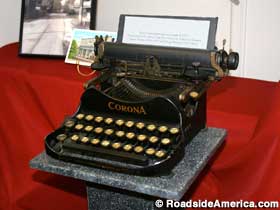
maybe a little late for Christmas:  Here’s the typewriter used to answer letters to Santa Claus, at the U.S. Post Office of Santa Claus, Indiana:

Typewriter used to answer letters to Santa Claus, from the U.S. Post Office in Santa Claus, Indiana - Roadside America photo

Typewriter used to answer letters to Santa Claus, from the U.S. Post Office in Santa Claus, Indiana - Roadside America photo

For 30 years, kids letters to Santa Claus were answered, with the responses typed on this Corona at the Post Office.  The machine rests on display at the Santa Claus Museum in Kris Kringle Plaza in Santa Claus, Indiana, about 40 miles east northeast from Evansville (south of Interstate 64).

Answers to letters to Santa Claus are answered from the museum today.

You can see the typewriter; Roadside America’s website says the museum is open 9:00 a.m. to 5:00 p.m. daily — but you may want to call ahead to confirm:

Santa Claus Museum

Address:
41 N. Kringle Place, Santa Claus, IN
Directions:
On the north side of Hwy 162/Christmas Blvd just west of Holiday World. In Kringle Plaza. Look for the Holiday Foods and the Post Office.
Admission:
Donations.
Hours:
9 am-5 pm daily. (Call to verify)
Phone:
812-937-2687

Spread Santa’s cheer!

Add to FacebookAdd to NewsvineAdd to DiggAdd to Del.icio.usAdd to StumbleuponAdd to RedditAdd to BlinklistAdd to TwitterAdd to TechnoratiAdd to Furl


Museum of North Texas History: 100 years of Scouting

October 3, 2009

Wondering what to do while you’re in Wichita Falls, Texas?

Through March 2010, you can view a display commemorating Scouting’s 100th anniversary in the United States, featuring nearly 100 years of Scouting history in Wichita Falls.

Stephanie Wood, assistant curator of the exhibit “Boy Scouts of America: 100 Years,” hangs Boy Scout uniforms at the Museum of North Texas History.  Photo by Photos by Marissa Millender/Times Record News

Stephanie Wood, assistant curator of the exhibit “Boy Scouts of America: 100 Years,” hangs Boy Scout uniforms at the Museum of North Texas History. Photo by Photos by Marissa Millender/Times Record News

Again showing the value of local “mainstream” media, the Wichita Falls Times-Record News featured a story on the exhibit on September 14, “Scouting through the ages.”

History teaches us if you learn from the past, you’ll be better prepared for the future. But being prepared is a quality also embraced by another organization — the Boy Scouts of America.

And so it seemed fitting that when the Boy Scouts reached their 100th anniversary this year, the Northwest Texas Council would commemorate the event at the Museum of North Texas History.

The downtown museum will open its latest exhibit, “Boy Scouts of America: 100 Years,” with a preview dinner at 6 p.m. Thursday at the dowtown museum, 720 Indiana, though more than 400 visitors got a sneak peek of the display Saturday during the Wichita Falls Museum Coalition’s Stroll ‘N’ Roll Museum Day.

The $40 preview dinner will include a viewing of the exhibit and a talk by Jim Hughes, George Adams and Darrell Kirkland.

Hughes, the Boy Scouts Chartered Organization Representative at Floral Heights United Methodist Church, has been involved in Scouting for about seven decades. A lot of his Scouting memorabilia peppers the exhibit, such as his Order of the Arrow badges and Boy Scout, Cub Scout and Explorer awards.

One of the most valuable pieces of memorabilia in the display, he said, is a flag hand-sewn by Scouts in 1913.

“Boys didn’t have money back then and had to make their own flag,” Hughes said.

Another impressive contribution to the exhibit is Bill McClure’s Eagle badge. McClure received his Eagle rank — the highest rank that can be achieved in the organization — in 1921. He was the first Eagle in the Wichita Falls Council to do so. He earned 21 merit badges and would eventually become a journalist for the Times Record News and sold advertising for KWFT before his death in 1982.

Hughes said what he treasures most among his scouting collection over the years is his own Eagle badge.

The exhibit, curated by Betsy O’Connor with Stephanie Wood as assistant curator, also includes a Pinewood Derby track on which visitors can race wooden cars, along with a display of a tent and camp fire.

Visitors will see Boy Scout, Cub Scout and Webelos uniforms on display, as well, such as the 1930s-era uniform of Billy Sims, the 1961 outfit of Tim Hunter and the 1998 uniform of Cory Wood, along with the “brag vest” of Cole Watson.

One area features information about Philmont Scout Ranch, a 137,493-acre ranch in the mountains of northeastern New Mexico in the Sangre de Christo Range of the Rockies, donated by Oklahoma oilman Waite Phillips.

Posters in the exhibit show various ropes and knots Scouts learn to tie, and things Scouts can do in nature conservation.

From left, Betsy O’Connor, curator, and Stephanie Wood, assistant curator, set up a camping display in the “Boy Scouts of America: 100 Years” exhibit at the Museum of North Texas History.  Photos by Marissa Millender/Times Record News

From left, Betsy O’Connor, curator, and Stephanie Wood, assistant curator, set up a camping display in the “Boy Scouts of America: 100 Years” exhibit at the Museum of North Texas History. Photos by Marissa Millender/Times Record News

Other items to look for: Carl Watson’s walking stick, an Order of the Arrow Native American headdress and Eagle Claw necklace and photographs of local scouts.

The Boy Scouts of America was incorporated on Feb. 8, 1910, by William D. Boyce and others. It was modeled after an organization in Great Britain founded by Lord Baden-Powell.

In 1911, Dr. J.L. McKee, pastor of First Presbyterian Church, organized the first troop in Wichita Falls with 27 members before the troop disbanded after McKee left town. But two years later, four more troops were organized. The Wichita Falls Council became the Northwest Texas Council in 1937.

All three of Jim Hughes’ sons, like their father, earned the rank of Eagle Scout. So has one of his grandsons. Another grandson is a Cub Scout who is continuing the tradition of Scouting in the Hughes family.

“I got so much out of it,” Hughes said. “I wanted to have my kids have the same experience.”

Following the exhibit’s opening, “Boy Scouts of America” can be viewed through March 2010.

Do museums in your area have Scouting exhibits planned, or already up?  Let us know in comments.

Share this post with others:

Add to FacebookAdd to NewsvineAdd to DiggAdd to Del.icio.usAdd to StumbleuponAdd to RedditAdd to BlinklistAdd to TwitterAdd to TechnoratiAdd to Furl


Let’s go to the zoo . . . kitchen

September 28, 2009

Kate closed down Radula, and moved all her blogging to Adventures of a Free Range Urban Primate.

Did you ever wonder what it’s like to work in the kitchen of a zoo?  Kate has the lowdown.

From Urban Primate:  Just to see the scope of whats stored there, in one hand Allyson is holding meatballs. In the other, whole frozen birds . . . complete with feathers.

From Urban Primate: "Just to see the scope of what's stored there, in one hand Allyson is holding meatballs. In the other, whole frozen birds . . . complete with feathers."

The photos from that post alone would make a good PowerPoint for some biology class, or a discussion of animals in an elementary class.


New blog from the Texas Historical Commission

June 8, 2009

Texas Parlor notes that the Texas Historical Commission has gotten into the blog business, with a blog called See the Sites.

New logo and slogan for the Texas Historical Commission

New logo and slogan for the Texas Historical Commission

A lot of photos from the sites the Historical Commission operates, news of special events, and links to the Commission’s sites’ websites.  As yet there are not any substantive historical analyses.

The new blog accompanies a redesign of the Texas Historical Commission’s website, and the creation of a new logo for the agency, with a new slogan.

The new website makes navigation a good bit easier, to get to information about cemeteries, or the LaSalle Projects, Texas’s remarkable collection of county courthouses, Civil War monuments, or any of a number of other categories.

Historians begin to make the internet a real tool for education and learning, and the practice of history recording.

Tip of the old scrub brush to Will’s Texas Parlor, a site every Texas history teacher should have bookmarked, and should visit often.


President Grant’s papers moving – to Mississippi

January 28, 2009

It’s either a sign of how old wounds have healed, or it’s another step in the cryptic and slow, cold war in which the South works to overcome the victory of the Union in the Civil War.

Ulysses S Grant as a Lt. General, Library of Congress image

Ulysses S Grant as a Lt. General; photo by Alexander Gardner, Library of Congress image

Associated Press reports (via Federal News Radio) the papers of President Ulysses S Grant will move from the University of Southern Illinois at Carbondale,  to Mississippi State University, in Starkville, Mississippi.

The fact that a collection about a Union hero who helped topple the Confederacy has wound up in Dixie is not lost on [John Marszalek, a Civil War scholar and Mississippi State history professor emeritus who’s now shepherding the collection].

“There’s an irony in it,” he said with a laugh. “People recognize this for its scholarly worth, and I think what has happened over time is that people have come to realize that the Civil War is over and we’re a united nation again.”

Still, Grant’s return to the South doesn’t thrill Cecil Fayard Jr., the Mississippi-based leader of the Sons of Confederate Veterans.

“U.S. Grant is not beloved in the state of Mississippi. Southern folks remember well his brutal and bloody tactics of war, and the South will never forget the siege of Vicksburg,” he said.

The Ulysses S. Grant Association, which owns the papers, decided to move them at the request of Marzsalek, who was named conservator after the death of John Y. Simon, the historian who had curated the collection during the publication of more than 30 volumes of Grants papers, beginning in 1962.  Simon lost his professorship at SIU last year, and died in July 2008.

The modern concept of a presidential library did not exist until 1939.  The first such library was the Franklin D. Roosevelt Library in Hyde Par, New York, established with papers donated in 1939.  There are now official libraries, parts of the U.S. National Archives system, for Herbert Hoover (who preceded FDR) in West Branch, Iowa, Harry Truman, in Independence, Missouri, Dwight Eisenhower, in Abilene, Kansas, John Kennedy, at Harvard University near Boston, Lyndon Johnson at the University of Texas, Austin, Richard Nixon at Yorba Linda, California, Gerald Ford library at Ann Arbor and museum (still under construction) in Grand Rapids, Michigan, Jimmy Carter in Atlanta, Ronald Reagan at Simi Valley, California, George H. W. Bush at Texas A&M University, College Station, Texas, and Bill Clinton in Little Rock.  George W. Bush is working to establish a library and institute at Southern Methodist University in Dallas, the library an extension of the National Archives, and the institute modeled roughly after the Herbert Hoover Institution affiliated with Stanford University in Palo Alto, California.

George Washington and Abraham Lincoln are honored with institutions, too.  Washington’s home at Mount Vernon, Virginia, is held by the Ladies of Mount Vernon Association, which originally saved the mansion; the Abraham Lincoln Presidential Library and Museum is in Springfield, Illinois.  Neither of those institutions has much formal tie to the federal library system.

Because of their places in history, even at the risk of enlarging the institutionalness and management problems of these libraries, I would like to see libraries established for Theodore Roosevelt, perhaps in South Dakota; for Woodrow Wilson; For Andrew Jackson, probably near his home in Tennessee; and for John Adams and/or John Quincy Adams, outside of Boston.  These institutions could bolster the spread of knowledge and preservation of history of our freedoms and liberties; if we were rich, it would be useful and productive to put libraries in Ohio — for William Howard Taft, or for Taft and Garfield and Buchanan — and far upstate New York for Millard Fillmore, perhaps at the University of Buffalo.  Libraries honoring James Madison and James Monroe could be useful, too, but would put a great concentration of such institutions close to Charlottesville, Virginia.

Resources:

Under the fold:  Quotations from U. S. Grant, from the Grant papers collection.

Read the rest of this entry »