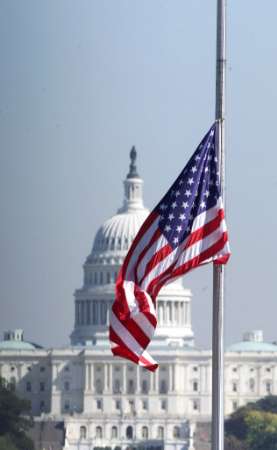
Fly your flag today: Columbus Day

October 13, 2008

Fly your U.S. flag today. Fly it to honor Columbus’s discovery of the Americas.

The second Monday in October is celebrated as Columbus Day, a federal holiday (though not widely honored in private enterprise).  Columbus made landfall in the Americas for the first time on October 12, 1492, 516 years ago.

John Vanderlyn Oil on canvas, 12 x 18 Commissioned 1836/1837; placed 1847 Rotunda    Christopher Columbus is shown landing in the West Indies, on an island that the natives called Guanahani and he named San Salvador, on October 12, 1492. He raises the royal banner, claiming the land for his Spanish patrons, and stands bareheaded, with his hat at his feet, in honor of the sacredness of the event. The captains of the Niña and Pinta follow, carrying the banner of Ferdinand and Isabella. The crew displays a range of emotions, some searching for gold in the sand. Natives watch from behind a tree.  John Vanderlyn (1775-1852) had studied with Gilbert Stuart and was the first American painter to be trained in Paris, where he worked on this canvas for ten years with the help of assistants.

John Vanderlyn, Oil on canvas, 12′ x 18′ – Commissioned 1836/1837; placed 1847 in the Rotunda of the Capitol. Christopher Columbus is shown landing in the West Indies, on an island that the natives called Guanahani and he named San Salvador, on October 12, 1492. He raises the royal banner, claiming the land for his Spanish patrons, and stands bareheaded, with his hat at his feet, in honor of the sacredness of the event. The captains of the Niña and Pinta follow, carrying the banner of Ferdinand and Isabella. The crew displays a range of emotions, some searching for gold in the sand. Natives watch from behind a tree. John Vanderlyn (1775-1852) had studied with Gilbert Stuart and was the first American painter to be trained in Paris, where he worked on this canvas for ten years with the help of assistants.


“The War Prayer” of Mark Twain

September 3, 2008


Here’s Twain’s stuff.

It’s largely forgotten now, especially in history texts in high schools.  After the Spanish-American War, when the U.S. wrested several territories from Spain, including Guam, Cuba, Puerto Rico and the Philippines, the U.S. quickly got mired in one of the original guerrilla wars in the Philippines.  It took 15 years, but the U.S. finally put down the rebellion — 15 brutal, bloody years.  The conduct of that war shocked many people, including Mark Twain.

This piece was written partly in response to that war.

Many Americans, like Twain, who questioned the war, in turn had their patriotism questioned.  Why wouldn’t they get on board with the war, and kill off those Filipino rebels? the critics asked.

Here’s a film in two parts, a stunning production, perhaps by Markos Kounalakis (who uploaded the thing); go to the film’s website for a copy of the text.

Part I:

Part II:


Need your help: Call Bush, tell him to let veterans vote

August 14, 2008

The thing with the flag? That was sorta funny. It was meant as humor.

This isn’t funny: The Bush administration is actively working to stop injured and ill veterans in Veterans Administration facilities from registering to vote.

These actions are most likely violations of the Voting Rights Act (under Section 2, or Section 11 – not my area of expertise, alas), but don’t expect Bush’s Justice Department to prosecute. These actions violate the VA’s own rules on helping veterans to vote. More pragmatically, there isn’t time for a big fight before the election. Veterans will be stopped from voting unless there is action now.

There is an easier, simpler solution — though we’re late. Bush should just rescind the order, encourage all veterans to vote, and help voter registration drives and attempts to get absentee ballots injured and ill veterans in VA facilities.

Susan Byseiwicz is Connecticut’s Secretary of State, the person charged with making sure the state’s voting system works. Among other things, she tries to get people to register to vote:

WHAT is the secretary of Veterans Affairs thinking? On May 5, the department led by James B. Peake issued a directive that bans nonpartisan voter registration drives at federally financed nursing homes, rehabilitation centers and shelters for homeless veterans. As a result, too many of our most patriotic American citizens — our injured and ill military veterans — may not be able to vote this November.

I have witnessed the enforcement of this policy. On June 30, I visited the Veterans Affairs Hospital in West Haven, Conn., to distribute information on the state’s new voting machines and to register veterans to vote. I was not allowed inside the hospital.

Outside on the sidewalk, I met Martin O’Nieal, a 92-year-old man who lost a leg while fighting the Nazis in the mountains of Northern Italy during the harsh winter of 1944. Mr. O’Nieal has been a resident of the hospital since 2007. He wanted to vote last year, but he told me that there was no information about how to register to vote at the hospital and the nurses could not answer his questions about how or where to cast a ballot.

Just a minor glitch, an information vacuum waiting to be filled? Go back and reread the last sentence in her second paragraph: “I was not allowed inside the hospital,” to register veterans to vote, she said.

Connecticut’s attorney general, Richard Blumenthal, and I wrote to [Veterans Affairs] Secretary [James B.] Peake in July to request that elections officials be let inside the department’s facilities to conduct voter education and registration. Our request was denied.

The department offers two reasons to justify its decision. First, it claims that voter registration drives are disruptive to the care of its patients. This is nonsense. Veterans can fill out a voter registration card in about 90 seconds.

Second, the department claims that its employees cannot help patients register to vote because the Hatch Act forbids federal workers from engaging in partisan political activities. But this interpretation of the Hatch Act is erroneous. Registering people to vote is not partisan activity.

If the department does not want to burden its staff, there are several national organizations with a long history of nonpartisan advocacy for veterans and their right to vote that are eager to help, as are elected officials like me.

The department has placed an illegitimate obstacle in the way of election officials across the country and, more important, in the way of veterans who want to vote.

Read the rest of her plea, which was carried in the New York Times last Monday, August 11.

And then take action. Bills have already been filed in Congress to force the Department of Veterans Affairs to allow veterans in its hospitals to register and vote. Frankly, time is running out. Many of these veterans will have to vote absentee — they need to be registered and have about a month to get the ballots and mail them back. There are 82 days to the election. Time is short.

So: Call George Bush and tell him to let veterans in hospitals register, and vote. George’s phone number for comments is 202-456-1111; if for any reason that does not work for you, try the general switchboard at 202-456-1414. Tell Bush I said to say “Howdy.”

The White House won’t put you through to George, but they will tally your opinion. If they give you a hard time, ask them: Why is George Bush afraid of the votes of wounded and ill veterans?

Ready to do more to support our veterans? Call the Secretary of Veterans Affairs: [::grumble:: Just try to find a general phone number for VA. Still looking. It appears the Secretary of Veterans Affairs doesn’t give a damn about veterans — they can’t call him, you can’t call him either. Still looking.]

Or you may write Sec. Peake at his office:

The Honorable James B. Peake
Secretary
U.S. Department of Veterans Affairs
810 Vermont Avenue NW
Washington, DC 20420

I do not recommend on-line messages, since they clog a bureaucracy that should be helping veterans, but VA does not make it easy to contact them. If you wish to write an electronic message to the VA, try here.

“The federal government should be doing everything it can to support our nation’s veterans who have served us so courageously. There can be no justification for any barrier that impedes the ability of veterans to participate in democracy’s most fundamental act, the vote,” Sec. of State Byseiwicz said.

Absolutely.

This is no small group. Veterans in hospitals are numerous enough to swing elections in many districts, and nationally. They fought for our nation, and they deserve to have their voices heard, and their votes registered.

In her request, [California Secretary of State Debra] Bowen cited a 1994 executive order by President Bill Clinton requiring federal agencies to undertake the responsibility of registration when asked to do so by state election officials. A spokeswoman for Ms. Bowen said she was considering litigation.

More than 100,000 people reside for a month or longer at the V.A. campuses nationally, a number that has grown in recent years as more soldiers return wounded from the war.

In California, the federal Department of Veterans Affairs runs eight major medical centers and 11 nursing homes that provide care for more than 200,000 veterans.

What would George Washington do?

More resources:

Tip of the old scrub brush to Ed Brayton at Dispatches From the Culture Wars.


Proof Bush has America backwards

August 13, 2008

Photographic proof that George Bush has America backwards. (Avert your Cub Scout’s eyes — he shouldn’t see his president doing that to the U.S. flag. Your Cub Scout knows that the union should always be displayed to its own right — to Bush’s right, the opposite of how he’s holding it here.)

President Bush displays U.S. flag backwards, at Beijing Olympics.  Ezra Shaw/Getty Images

President Bush displays U.S. flag backwards, at Beijing Olympics. Ezra Shaw/Getty Images

Worse, there’s more:

But, by God! He’s wearing his lapel pin! Wearing the pin makes one immune to the rules of respectful flag display, one would assume, from the complaints of Sen. Barack Obama’s not wearing the lapel pin, and the remarkable silence from those same people about Bush’s many insults to the flag.

George Bush makes the case: We don’t need a Constitutional Amendment to make flag desecration illegal. We need Americans who pay attention to flag etiquette, instead.

Tip of the old scrub brush to Larry Perez, and to BuzzFlash, “The Diplomatic Decathlon: Bush’s Marathon of Olympic Blunders”


Have a glorious Independence Day

July 4, 2008

Fireworks on the Mall, Washington, D.C.

July 4, 2006

Iwo Jima Memorial in the foreground; Washington Monument in background


Independence Day! Fly your flag

July 3, 2008

Remember to fly the flag on July 4, 2008, the 232nd anniversary of the Declaration of Independence. (Postcard above, from 1907, from collection of James R. Heintze)

Flags may be flown sun-up to sun-down. The U.S. flag should be run up the pole quickly, and be left to fly unfettered in the breeze. The flag may be left flying after sundown, if it is lighted.

Resources:


Independence Day quiz

June 30, 2008

An ISP called Toast.net has an interactive Independence Day Quiz — feeling patriotic? Go see how your knowledge of U.S. history and lore stacks up against others. The questions are very good, really.

Remember to fly your flag on the 4th of July!


June 14 – Flag Day

June 14, 2008

Did you fly your flag today?  Even without my reminding you?  Good!

Norman Rockwell painting, Scout saluting the flag

Painting by Norman Rockwell, Scout saluting the flag.

Flag Day celebrates the date of the first resolution passing the Continental Congress designating Stars and Stripes as the flag of the soon-to-be U.S., on June 14, 1777.


Memorial Day, 2008 – fly your flag in honor of our nation’s dead

May 26, 2008

(Much of this is reprise from Memorial Day 2007)

You may fly your flag the entire weekend.  Please fly your flag today.

Memorial Day, traditionally observed on May 30, now observed the last Monday in May, is a day to honor fallen veterans of wars. Traditionally, family members visit the cemetery where loved ones are interred and leave flowers on the grave.

On Memorial Day itself, flags on poles or masts should be flown at half-staff from sunrise to noon. At noon, flags should be raised to full-staff position.

When posting a flag at half-staff, the flag should be raised to the full-staff position first, with vigor, then slowly lowered to half-staff; when retiring a flag posted at half-staff, it should be raised to the full staff position first, with vigor, and then be slowly lowered. Some people attach black streamers to stationary flags, though this is not officially recognized by the U.S. Flag Code.

Got another week of school? Here’s a quiz about the history of Memorial Day that might make a warm-up, provided by Carolyn Abell writing in the Tifton (Georgia) Gazette:

1. Memorial Day was first officially proclaimed by a general officer. His name was: A. Robert E. Lee; B. John A. Logan; C. Douglas MacArthur D. George Washington.

2. The first state to officially recognize Memorial Day was A. Virginia; B. Rhode Island; C. New York; D. Georgia.

3. The use of poppies to commemorate Memorial Day started in A. 1870 B. 1915 C. 1948; D. 1967.

4. The original date of Memorial Day was A. May 30; B. July 4; C. May 28; D. Nov 11.

5. Which U.S. Senator has tried repeatedly to pass legislation that would restore the traditional day of Memorial Day observance? A. John McCain B. Ted Kennedy C. Saxby Chambliss D. Daniel Inouye.

The answers, again provided by the Tifton Gazette:

OK, now for the answers. General John Logan, national commander of the Grand Army of the Republic, proclaimed May 30, 1968 as Memorial Day in his General Order Number 11, issued on May 5, 1868. The purpose was to honor the dead from both sides in the War Between the States. Subsequently flowers were placed on the graves of both Union and Confederate soldiers in Arlington National Cemetery on May 30 of that year.

New York was the first state to officially recognize the Memorial Day, in 1873. Southern states, though paying tribute to their dead on separate dates, refused to use May 30 as the official date until after World War I, when the holiday was broadened to honor those who died in any war.

In 1915 a woman named Moina Michael, inspired by the poem, “In Flanders Fields,” (by Canadian Colonel John McRae) began wearing red poppies on Memorial Day to honor our nation’s war dead. The tradition grew and even spread to other countries. In 1922 the VFW became the first veterans’ organization to sell the poppies made by disabled veterans as a national effort to raise funds in support of programs for veterans and their dependents. In 1948 the US Post Office issued a red 3-cent stamp honoring Michael for her role in founding the national poppy movement.

As stated above, May 30 was the original Memorial Day. In 1971, with the passage of the national Holiday Act, Congress changed it so that Memorial Day would be celebrated on the last Monday of May. Some citizens feel that turning it into a “three-day weekend” has devalued the importance and significance of this special holiday. In fact, every time a new Congress has convened since 1989, Senator Daniel Inouye of Hawaii has introduced a bill to the Senate calling for the restoration of May 30th as the day to celebrate Memorial Day.

In his 1999 introductory remarks to the bill, Senator Inouye declared:

“Mr. President, in our effort to accommodate many Americans by making the last Monday in May, Memorial Day, we have lost sight of the significance of this day to our nation. Instead of using Memorial Day as a time to honor and reflect on the sacrifices made by Americans in combat, many Americans use the day as a celebration of the beginning of summer. My bill would restore Memorial Day to May 30 and authorize the flag to fly at half mast on that day.

In addition, this legislation would authorize the President to issue a proclamation designating Memorial Day and Veterans Day as days for prayer and ceremonies honoring American veterans. This legislation would help restore the recognition our veterans deserve for the sacrifices they have made on behalf of our nation.” (from the 1999 U.S. Congressional Record).

Flat at half-staff, U.S.Capitol in background - from Flag Bay

Other sources:

Image of flag and U.S. Capitol from Flags Bay.


Cubs’ Rick Monday saved the American flag

April 29, 2008

Odds are high that readers of any blog are too young to remember. Heck, I’d forgotten about it until Matthew Tabor reminded me.

April 25, 1976: Rick Monday, center fielder for the Chicago Cubs, saved the U.S. flag.

Rick Monday snatches the U.S. flag from burning

Get the story from Tabor’s blog. He offers credits to HotAir.com.

Major League Baseball was kind enough to preserve the story, which you may watch below.

Resources:


Sinclair Lewis on patriotism, the flag, and fascism

February 16, 2008

Oh, my.

Sun dog on US flag, Sinclair Lewis quote on fascism

When fascism comes to America, it will be wrapped in a flag and carrying a cross.

Sinclair Lewis

You can’t purchase the actual poster anywhere. It’s a photographic political cartoon. From our friends at Hot Dogs, Pretzels, and Perplexing Questions. (Bob, in Austin)

Did Lewis actually say that?  I’ve not sourced it yet.

Wave the flag for real:

Add to FacebookAdd to NewsvineAdd to DiggAdd to Del.icio.usAdd to StumbleuponAdd to RedditAdd to BlinklistAdd to TwitterAdd to TechnoratiAdd to Furl


15 stars, 15 stripes

January 13, 2008

January 13, 1794, President George Washington signed the law adding two stars and two stripes to the U.S. flag, after Vermont and Kentucky joined the union.

This was the only U.S. flag ever officially to have more than 13 stripes.

Replica of the flag flown during the War of 1812, with 15 stripes and 15 stars.  Very few examples of a 15-stripe flag remain.  The flag that flew over Ft. McHenry, the original

Replica of the flag flown during the War of 1812, with 15 stripes and 15 stars. Very few examples of a 15-stripe flag remain. The flag that flew over Ft. McHenry, the original “Star-spangled Banner,” is one. This replica flies in the peace garden in Oswego, New York.

The “Star-spangled Banner” that flew over Ft. McHenry, near Baltimore, which inspired Francis Scott Key to write the poem which was put to music to form our national anthem, had 15 stripes. President James Monroe signed a law in 1818 that specified 13 stripes, with a new star to be added on July 4 of any year after a new state was added, a practice which has held through our current 50-star, 13-stripe flag.

Tennessee was the 16th state. I have been unable to clarify what happened with the number of stripes between Tennessee’s admission to the union on June 1, 1796, and the law passed in the Monroe administration in 1818. Does anyone know? Got links?

More (added after August 2013):


Michigan officially remembers Pearl Harbor attack

December 6, 2007


Press release from Michigan Gov. Jennifer M. Granholm:

Flags to Fly Half-Staff Throughout Michigan on Friday in Honor of Pearl Harbor Day

LANSING – Governor Jennifer M. Granholm today encouraged Michigan citizens to observe Pearl Harbor Day on Friday, December 7, by lowering flags across the state to half-staff and remembering those who lost their lives in the attack on Pearl Harbor on December 7, 1941.

“On Pearl Harbor Day, we honor the lives lost in the attack 66 years ago and remember that we enjoy freedom thanks to their supreme sacrifices,” Granholm said. “This year, we also salute the men and women stationed around the world, including those fighting in Iraq and Afghanistan, who are defending and protecting our freedom today.”

In December 2005, Granholm signed Executive Order 2005-27 ordering the flag of the United States of America be flown half-staff on all state buildings and facilities throughout the state of Michigan on Pearl Harbor Day each December 7. Procedures for flag lowering, including on Pearl Harbor Day, were detailed by Governor Granholm in Executive Order 2006-10. The Legislature officially recognized the sacrifice of the servicemen and servicewomen who gave their lives at Pearl Harbor by enacting Public Act 157 of 2000, which declares that December 7 of each year be known as Pearl Harbor Day in the state.

On the morning of December 7, 1941, the Armed Forces of the United State of America stationed at Pearl Harbor, Hawaii, were attacked by the air and naval forces of Imperial Japan. The attack claimed the lives of 2,334 servicemen and servicewomen and wounded another 1,143.

When flown at half-staff or half-mast, the United States flag should be hoisted first to the peak for an instant and then lowered to the half-staff or half-mast position. The flag should again be raised to the peak before it is lowered for the day.

# # #

Michiganders, or anyone else, may subscribe to Flag Honors, the service notifying when flags in Michigan are to be flown half-staff. If you know of similar services for any other state, kindly make a note in comments.


Slap in the face for America’s soldiers

November 23, 2007

Put your coffee down. If you’re not ready to be outraged, don’t read any farther. Go on to the next post.

To demonstrate the barbarity and brutality of communist systems, or totalitarian governments, people often point to execution practices used in Stalinist Russia or, currently, in the People’s Republic of China. When a person is executed, usually with a bullet to the head, the family of the executed person is billed for the bullet.

Insult to injury, injury on injury, it’s heartless, the critics rightly say — and evidence of the inhumanity, the complete lack of human emotion in the government.

That’s not what this post is about. Can there be something worse?

U.S. soldiers disabled in Iraq and Afghanistan so that they cannot continue their military service are being billed by the Pentagon for their recruitment bonuses. Marty Griffin at KDKA television in Pittsburgh got the story, about a local Pennsylvania soldier (I have highlighted some parts of the story):

One of them is Jordan Fox, a young soldier from the South Hills.

He finds solace in the hundreds of boxes he loads onto a truck in Carnegie. In each box is a care package that will be sent to a man or woman serving in Iraq. It was in his name Operation Pittsburgh Pride was started.

Fox was seriously injured when a roadside bomb blew up his vehicle. He was knocked unconscious. His back was injured and lost all vision in his right eye.

A few months later Fox was sent home. His injuries prohibited him from fulfilling three months of his commitment. A few days ago, he received a letter from the military demanding nearly $3,000 of his signing bonus back.

“I tried to do my best and serve my country. I was unfortunately hurt in the process. Now they’re telling me they want their money back,” he explained.

It’s a slap for Fox’s mother, Susan Wardezak, who met with President Bush in Pittsburgh last May. He thanked her for starting Operation Pittsburgh Pride which has sent approximately 4,000 care packages.

He then sent her a letter expressing his concern over her son’s injuries, so she cannot understand the U.S. Government’s apparent lack of concern over injuries to countless U.S. Soldiers and demands that they return their bonuses.

No kidding.

See the video — it’s even more compelling.

Do you agree with me that this is an outrage? Do you agree this should not happen in the United States of America?

Should we act? Wait just a moment.

This is such a clear outrage, that when the news broke, the Pentagon and Veterans Affairs Department scrambled to say it is not so bad as it looks. Talking Points Memo Muckraker tracks the story; by now the government says it’s a mistake, and soldiers shouldn’t have to pay back the bonus.

So the official answer is that not as many soldiers were billed as Griffin claimed, and the Pentagon says they excuse the debts if the soldier complains.

What if the soldier doesn’t complain, but just pays?

How could any system do this in the first place?

Can we believe an administration that has lied to get out of accountability for so many other scrapes in this war?

Keep checking for followups.

Also, if you have received one of these letters, or if you know someone who has, please tell us.

Be ready to act by noting these numbers:

Watch the news.  If this outrage is not corrected, your voice will be important.

Tip of the old scrub brush to Ed Brayton at Dispatches from the Culture Wars.


Let Xerox help you thank a soldier

November 20, 2007

One of the lessons of Vietnam was that we need to honor and thank our soldiers especially when they get sent to execute bad foreign policy. So, regardless your views on current conflicts, you could perform a service, with the help of Xerox, by sending a card, from here.

No cost. Try it.

Card drawn by a kid, for Let's Say Thanks at Xerox

Tip of the old scrub brush to Brother Dwight.