More unintentional humor from Texas conservatives: Can’t read charts on economic systems

April 1, 2013

Mural in Adams Building of Library of Congress, Jefferson on Education

Mural in the Adams Building of the Library of Congress,m with Thomas Jefferson’s views on education, and education’s importance to liberty. (Click for larger version)

Under the standards for social studies the Texas State Board of Education promulgates, Texas high school kids must learn to read charts and extract information from them.

In the criticism of the small-school curriculum planning system, CSCOPE, conservative critics demonstrate both that they are not as smart as a Texas high school kid, OR they don’t know feces in economics.

Note the chart; it’s a fuzzy picture, but it shows an arrow indicating which economic systems have more government involvement, or control, or “interference” in Texas conservative talk; and note the comments:

So, in other words, the conservatives worry because a chart shows that socialism and communism have “more government control and planning,” and the conservatives come unglued.  They read the chart incorrectly; generally conservatives can be counted on to favor less government control in economic matters, which this chart shows is a virtue of free market economics systems.

Let me repeat:  They read the chart incorrectly.

Worse, there’s a guy who professes to teach economics in a California college who says he doesn’t teach this stuff.

What do they want, what does he teach?  That communism offers more economic freedom from government regulation than free enterprise?

Clearly they didn’t bother to read the chart.  These critics are the epitome of knee-jerk reactionaries:  If there is a word about something they don’t like, they assume the entire piece is tainted and biased against them.  If you said, “We say the Pledge of Allegiance every day as a defense against communism,” they’d claim you’re teaching communism.

BUT, this sort of criticism got Texas Sen. Dan Patrick, R-Mars, to call for an investigation, a witch-hunt, of the group that works to provide curriculum helps especially to smaller districts who don’t have curriculum planning staffs; SBOE and the directors of the Regional Education Centers agreed.  Directors of the Regional Education Centers have bent over backwards to be open about what goes into CSCOPE, and how each lesson and each unit, and each test is aligned with Texas standards, Texas Essential Knowledge and Skills (TEKS).

Yeah, I know:  The chart could have been done differently.  But this is EXACTLY the sort of stuff the Texas Education Agency favors on standardized tests students must pass to advance and graduate, to make sure students read the questions, and the charts.

Are you as smart as a Texas high school student?  Then you’re smarter than the critics of CSCOPE, at least in this case.

Still, CSCOPE, in an well-intentioned effort to be open about the curriculum materials they provide, and whether there is any bias in them, released this statement on their support of free enterprise:

CSCOPE Response to Lesson Regarding Economic Systems

CSCOPE strongly believes in the greatness of the free enterprise system and how it has helped build our country into the envy of all other nations. Free markets are a critical part of our American way of life. It is important to note that the activity in question is in a high school course and not in a grade 6 lesson. This twenty-minute activity is part of a six-day lesson on various economic systems at the high school level that are state required teaching standards set forth by the State Board of Education. The State Board of Education requires students to learn the following economic systems in World History:

  • WH.18: Economics. The student understands the historical origins of contemporary economic systems and the benefits of free enterprise in world history. The student is expected to:
    • WH.18A: Identify the historical origins and characteristics of the free enterprise system, including the contributions of Adam Smith, especially the influence of his ideas found in The Wealth of Nations.
    • WH.18B: Identify the historic origins and characteristics of communism, including the influences of Karl Marx.
    • WH.18C: Identify the historical origins and characteristics of socialism.

Furthermore, the State Board of Education establishes student expectations that focus on social studies skills. For the World History unit referenced above, the following social studies skills are included:

  • WH.30: Economics: The student communicates in written, oral, and visual forms. The student is expected to:
  • WH.30C: Interpret and create written, oral, and visual presentations of social studies information.

The goal of this activity is to address the content and skills standards that have been adopted by the State Board of Education, and it is absolutely not promoting a way of life contrary to what we value as Americans. In this activity, students examine four different flags, beginning with the US flag, and analyze the colors, the design, and the graphics as symbols of each country’s characteristics and economic systems. Students then design a flag to demonstrate their understanding of the characteristics of socialism, as the standard requires (WH.18C).

CSCOPE has a significant emphasis on the free enterprise system. The other economic systems are only addressed as required by State Board of Education. Additionally, every lesson and activity in our system is customizable. The teacher in the classroom is the final authority on whether or not the lesson should be customized for his or her students and community.

CSCOPE would also like to reassure parents and community members that there is a comparable activity in the lesson that focuses on free markets where students are asked to read about characteristics of free enterprise in The Wealth of Nations, complete an analysis chart, and discuss with their classmates the characteristics and benefits of the free enterprise system. In addition, in Texas History, World History, US History, and US Government courses, students are engaged extensively in studying the principles of the US free enterprise system and the role it plays in American society. Furthermore, Texas graduation requirements specify that students take an economics course, and this course focuses entirely on the American free market system.

CSCOPE staff takes great pride in helping educators teach the standards established by the State Board of Education. This dedicated staff works each day to ensure that teachers have the best resources available to help Texas school children succeed, and they continually focus on improving the system for the districts they serve. We are committed to helping every parent and community member better understand CSCOPE. Please contact CSCOPE through the http://www.cscope.us site if you have further questions or concerns.

The exercise with flag making is pretty lame, to me — with no note of irony that CSCOPE nor their critics would notice, it offers the grand opportunity to read all sorts of symbolism into the U.S. flag that was never intended by the flag’s designers, nor by any tradition.  That’s a pro-free enterprise bias if it occurs, however, and not a pro-communist or socialist bias.

One may wonder if the references to Adam Smith and Wealth of Nations threw the critics; more than once I’ve been confronted by a yahoo at a meeting in Texas who argues that we in the U.S. don’t need any foreign influences in our laws or economy, like that “socialist” Adam Smith!  (To be fair, he published in England . . .)

The charges from “Sharon” can’t help but remind you of that famous political smear campaign against then-U.S. Sen. Claude Pepper, of Florida, in which his opponent called him “Red” Pepper, and accused him of ::GASP!!:: matriculating while a student in college — and not just matriculating, but matriculating in public!

Yes, this is an attempted political smear of CSCOPE, Texas teachers, and Texas education.

P.S.:  I’d love to have a copy of that chart in a readable form; if you have access to the chart, especially to information that indicates where it really comes from (it looks like CSCOPE, but it’s fuzzy here), please send me a copy.  Thanks.

More:

Comments from people and groups who appear not as smart as a Texas high  school student:

And the original?  Screen shot from Glenn Beck’s show:


Obama Derangement Syndrome, described in 2013

March 24, 2013

Superman stands with President Obama

This photo will set off most sufferers of Obama Derangement Syndrome — who can’t stand Superman’s duplicating Obama’s stance. Can’t find details on this photo — I believe it was taken in Metropolis, Illinois, in 2008.

In my post drafts I have a longish one on various forms of crazy that, well, make me crazy.  It includes a lot of illogical things that populate the internet and political discussions like dysentery in a poorly-run refugee camp on the border of two third world nations at war with each other.

But it’s still hanging fire.  Plus, my description of the various anti-Obama crazinesses isn’t so cogent as our friend Jim provided in comments to an earlier post.

So, for your edification, and in the hopes that some sufferers of Obama Derangement Syndrome (ODS) may seek help on their own, or that you may be able to persuade them to seek help, here’s what Mr. Stanley wrote about it (all links added by me, here):

As with any mental illness, Obama Derangement Syndrome’s treatment must begin with an accurate diagnosis. It is certainly possible that what passes for ODS may actually be nothing more complicated than food poisoning. Got ahold of some bad clams? It will pass. It could be severe constipation. Nothing an enema can’t clear up. But if you’ve ruled out the usual suspects, follow this handy checklist to determine if you are an ODS sufferer. Remember, admitting you have a problem is the first step toward lucidity and wellness.

You may have Obama Derangement Syndrome…

  • . . .  if you believe he was a CIA operative fighting with the Afghan rebels and against the Soviets in the 1980s. Your case of ODS may be terminal if you believe this, and yet now believe Obama is, himself, a Marxist.
  • . . . if you suspect he had that great American patriot, Andrew Breitbart, murdered. Extra points if you are sure the Obamas have had as many people murdered as you believed the Clintons did. Still more bonus points if you think gay sex orgies were connected to his murder spree.
  • . . . if you are reasonably sure President Obama orchestrated Hurricane Sandy in order to improve his chances at the polls in 2012; planned and ordered either the Sandy Hook school massacre or Aurora Theater massacre to create a pretext for a giant “gun-grab”; and was behind the BP oil spill and/or the Massey Energy coal mine disaster in an effort to justify tighter regulation of business.
  • . . . if you believe the President used an executive order to hand over U.S. territory to Russia. [Or to the UN, or to anyone else.]
  • . . . if you have seen incontrovertible “proof” that Obama removed the American flag from Air Force One and replaced it with his campaign logo; has consistently refused to say the Pledge of Allegiance or salute the flag; seldom if ever wears an American flag lapel pin and steadfastly resists suggestions from staffers that he say “God bless America” at the end of his speeches.
  • . . . if you know that he was a member of the Black Panthers, the Weather Underground, the American Communist Party, the American Fascist/Third Way Movement, the Illuminati, the German-American Bund, the Campfire Girls of America and Friends of Ish Kabibble.
  • . . . if you believe President Obama has a “secret plan” to remove evangelical Christian young people from their homes and place them in FEMA or UN-run re-education camps.
  • . . . if you believe the birth certificate is a forgery, never existed in the first place or that it exists – but that it, upon careful examination, shows that Barack Obama was sired by a jackal.
  • . . . if you have seen “evidence” that he furnished the Oval Office with Islamic or Middle Eastern décor; that he has changed the name of the WH Christmas tree to the WH “Holiday” tree; that he wears jewelry with secret Koranic verses on it; or that he was sworn in on the Holy Koran and not the Bible.
  • . . . if you believe he had the October, 2012 jobs report altered.
  • . . . or if you believe President Obama is part lizard, the Antichrist or a former CIA operative who was teleported to Mars.

If any of these resonate with you as plausible, reasonable or outright true, seek help for ODS immediately. There is no shortage of treatment options. One might begin by cancelling subscriptions to Stormfront, Newsmax, Citizen Magazine, World Net Daily, Conservapedia and World Magazine. Additional recommendations include a Fox “News” fast, putting your “Left Behind” books in the recycle bin and avoiding those personalities who may function as enablers of ODS. Such individuals include Glenn Beck, James Dobson, Rush Limbaugh, Tom Sowell, Laura Ingraham, Texe Marrs, Hal Lindsey, Sean Hannity, Bill O’Reilly, Michelle Malkin, Ann Coulter, Allen West and Rick “Man on Dog” Santorum. (This is, of course, not an exhaustive list.)

Side effects resulting from successful ODS treatment may include increased lucidity, rationality, compassion and diminished feelings of inadequacy and self-loathing. People who have recovered from ODS report a significant reduction in suspicion and mistrust of those of different races, religions and cultures. Ask your mental health professional if receiving ODS treatment is right for you.

Mr. Stanley got through that entire list without mentioning  Kenya, Bill Ayers, or the Illinois Bar disciplinary procedures.

You may be suffering from Obama Derangement Syndrome, if the symptoms listed above describe you.

There’s hope for you, if you are a sufferer. ObamaCare covers treatment.

Obama Derangement Syndrome may be a lot more prevalent that he thinks!

More:


“Return to Madison,” urges James Madison U president on the great man’s birthday

March 22, 2013

What would Madison do?

James Madison’s work, not only on the Constitution, but on making the Constitution and new government work, and on creating the foundation pilings for that Constitution and society, should make his words and ideas key points of study for us, and his principles should be our guiding principles much more than they are today.

Madison is the forgotten founder, I’ve argued.

JMU President J. R. Alger and others present wreaths at tomb of James Madison, March 16, 2013 (Madison's birthday)

JMU press release caption: JMU President Jon Alger, second from left, presents a wreath at the tomb of President James Madison in honor of his 262nd birthday.

James Madison University President Jon Alger spoke at the ceremonies honoring Madison’s birthday last Saturday, March 16, at Madison’s mountain home, Montpelier, Virginia (a few miles from Jefferson’s Monticello).  In his speech, Alger urged a return to civility in discussion of politics, a return to focus on important ideas and the processes by which we discuss them, and make decisions in our national government.

Alger’s remarks deserve a much wider audience, I think.  I asked JMU for a copy, and they pointed to the university’s website where the entire speech is posted.  I repost it here.  Please spread the word.

Jon Alger’s Montpelier remarks

President Jonathan R. Alger
James Madison University
Remarks on the Occasion of James Madison’s 262nd Birthday
March 16, 2013
at James Madison’s Gravesite, Montpelier
Orange, Virginia
(Remarks interrupted by rain)

Good afternoon.  Honored guests, members of the Montpelier Board of Directors, President Imhoff and Montpelier staff, members of the James Madison University Board of Visitors, faculty, students and alumni, family, friends and fellow Madison enthusiasts, it is my great honor to speak at this hallowed place.  On this day 262 years ago, James Madison was born.  Perhaps more so than any other president or founder, James Madison is responsible for the creation and miraculous endurance of our republic.  Known as the Father of the U.S. Constitution, James Madison’s contributions to our nation should be remembered by every American.  The sacred fire of liberty lit by Madison’s ideas burns to this day and draws us here to honor him.

I came to Montpelier for the first time only a few months ago.  As a great admirer of James Madison, to me the trip here felt like a pilgrimage.  When the mansion first came into view as we made our way up the long sweeping drive, I was struck by the majesty of the moment—as we feel when in the presence of greatness.  During that visit, Montpelier board president Greg May invited me to speak at this annual event as we strode down a pathway that Madison himself must have walked many times.  I could not have been more honored.

Indeed, this is a dream come true for me.  As a political science major and history minor in college, I read many of the same texts Madison himself studied—as well as some of Madison’s own work.  Even as a young child, I admired the creative genius of our forefathers.  While other kids had stuffed animals or model airplanes displayed in their bedrooms, on my dresser I proudly exhibited a set of small ceramic statues of the American presidents.  I like to root for underdogs and was always partial to Madison, because his was the shortest statue.  Today his picture hangs proudly in my office.

As many of you know, Montpelier and James Madison University have long had a special bond.  It began when Dr. Clarence Geier, an archaeologist at Madison, arranged an archaeology field school here at Montpelier more than 25 years ago.  Our students and faculty have been coming to Montpelier ever since and have participated in digs all across the grounds. (Except for right here, of course.  They are not allowed to dig in this particular area.  You never know with undergraduates!)

From then the relationship between our two institutions has blossomed.  This past November a bus containing JMU faculty, staff and me – as well as my wife Mary Ann and daughter Eleanor – came here to spend a day brainstorming with the Montpelier leadership and staff on ways to deepen our relationship even further. The primary objective of this deeper relationship is to bring more attention to James Madison and his ideas.  This objective reflects the missions of our two great institutions, but it must go beyond those gathered here today.  As a nation, we are in great need of what I will call a Return to Madison.

It is true that, during the past few years, more and more American citizens are professing respect for the U.S. Constitution.  The document was read on the floor of the U.S. House of Representatives for only the second time in history this past January.  In fact, Representative Bob Goodlatte of Virginia’s Sixth District – JMU’s district – opened the reading with a delivery of the document’s Preamble.  That’s a good start, but as a nation we must go much further.  For this newfound reverence toward the U.S. Constitution to elevate us as a nation, we must explore and gain a deeper understanding of the principles on which the U.S. Constitution is based.  We must Return to Madison.

Now, by suggesting this return, I don’t mean that we become a nation of history buffs (although that would be OK with me).  Rather, a Return to Madison would provide us with very real and practical insights into how we as a society should confront issues facing us all.

Starting with a realistic view of human nature, Madison believed that politics was driven by “interest,” not by “virtue.”  In his excellent work, The Sacred Fire of Liberty, Madison scholar Lance Banning captured this core principle.  He wrote, “Madison did not assume that a republic could depend upon a superhuman readiness to sacrifice self-interest to the common good. Taking humans for the interested, opinionated creatures they are, Madison asserted that in a pluralistic, large republic, partial interests would be counterbalanced by competing interests.”

This was not new political thinking, of course.  During the 16th century in Florence, Machiavelli (whose work was more nuanced than is often remembered today) explored what he called the “effectual truth” of politics.  In other words, as Paul Rahe writes in his book, Machiavelli’s Liberal Republican Legacy, “[I]n order to avoid their ruin and achieve their preservation, men should govern themselves in accordance with how they do behave rather than in the distorting light of how they ought to.”

So Madison’s great innovation was to devise a system of government that sought to create political and civic conditions allowing the interests of individual citizens, groups, regions and other entities to balance one another so that no one of them could overtake the rest.  He recognized that we would be a society with diverse perspectives and experiences, and that we needed a structure to allow that diversity to flourish.

Today – while publicly professing faith in the Constitution as a document – we seem to have forgotten this essential element.  Far too often, our public discourse on the important challenges of our time degenerates into shallow shouting matches and name-calling in which we cry for the elimination of opposing views on political, social, economic and cultural issues. The people we despise across the political aisle, the fools on the television spouting their ridiculously wrongheaded opinions, the heathens who believe in a different god than we do – we not only hold them in utter contempt, we behave as if we want their ideas extinguished.  And if they were extinguished – oh, if only they were extinguished – we believe the world would be a better place.  If only we all agreed on everything – wouldn’t that be great!  Yet we must be careful what we wish for.  If that kind of wish were to come true, not only would our lives be much more boring—but our society would stop progressing and stagnate.

A Return to Madison would shine a light on the fact that the strength of our republic relies on the existence of opposing ideas and perspectives.  Voices who advocate for Wall Street and others who focus on Main Street?  They need each other.  Republicans and Democrats need each other.  Without the diversity of ideas and opinions, our civic balance would tilt and our system eventually would topple.  The great man we honor today knew this was true.  We as a society need to embrace this notion and continue debating the important issues of the day, but with reason and civility—not with hatred and hopes for total domination.  We need each other.  And I believe that spreading the understanding that our great Constitution is based squarely on this principle could lead to greater social harmony.  Boy, do we need a Return to Madison.

Madison’s Federalist 10 is recognized the world over as one of the great examples of political thought in history.  You might remember that Madison published the Federalist with Alexander Hamilton and John Jay in newspapers while the states were considering whether to ratify the proposed Constitution.  Of these 85 essays, Madison’s 10th is widely considered to be one of the best, and it’s about balancing competing interests.  I love it for the philosophy it expresses, but also because it contains one of his most elegant turns of a phrase.  If you’ve read much Madison, you know that his writing can be (to be honest) dense and elliptical.  He is not often quoted in today’s sound-bite culture.  But in the Federalist 10 he wrote, “liberty is to faction what air is to fire…”  Think about that for a moment.  “Liberty is to faction, what air is to fire…”  Madison was making the point that liberty creates a nourishing environment for faction.  At the time, great fear existed that too much liberty could lead to dangerous factions emerging.  Madison was resolute, however, and he completes the idea by writing, “But it could not be a less folly to abolish liberty, which is essential to political life, because it nourishes faction, than it would be to wish the annihilation of air, which is essential to animal life, because it imparts to fire its destructive agency.”

Madison is saying that even though liberty allows faction to thrive, it should not be curtailed.  He goes on to observe, “As long as the reason of man continues fallible, and he is at liberty to exercise it, different opinions will be formed.”

Thus even as Madison advocated for liberty despite its dangers, he was sure to remind his Federalist readers that man’s passionately held views are imperfect.  Therefore, if we claim to respect our Constitution and if we understand this fundamental premise, we have a responsibility to change the tone of much of our civic dialogue.  Now, to be clear, I am not arguing that we should hold our views any less dear.  Passion leads great people to act. And I am not suggesting that we all adopt a relativist perspective – right and wrong do exist.  As enlightened as Madison and his colleagues were for their time on so many issues, for example, even they were unable to come to grips with the tragic injustice of slavery

If Madison were here today, however, I believe he would remind us of our human limitations when we encounter and react to opinions that differ from our own.  We can all benefit from trying to listen to and understand the views of others with civility and respect, even as we hold and espouse our own cherished points of view.  As the president of the university named for James Madison, I feel strongly that our institution of higher education can best honor his legacy by embracing the diversity of perspectives and backgrounds in our society, while fostering and modeling civil and respectful discourse on the great issues of our time.  That is part of the reason why I began my own presidency with a “Listening Tour” to hear, and learn from, the richly diverse voices and opinions of our university community.

In my inaugural address yesterday at the university, I called for James Madison University to be the national model for the engaged university—an institution that combines a commitment to teaching and learning with a conviction that all humans are interconnected.  This combination embodies James Madison’s ideals.  If we enlighten ourselves through education and believe that we all are connected – even with those with whom we might passionately disagree – we honor Madison.  I intend for this idea to be a hallmark of my administration at JMU.

Another hallmark will be to continue deepening the relationship between the university and Montpelier.  Some of the ideas generated during our visit here in November already are taking shape.  For instance, staff in our department of History and our Adult Degree Program are working with faculty here in the Center for the Constitution to create a course about James Madison and his ideas that includes online and in-person instruction, as well as visits here. The course will be available to JMU students and the general public.  As we celebrated Madison Week on our campus these past few days, Montpelier has honored our university by loaning us several artifacts from its own collection.  These exchanges are reminders of the man to whom we owe so much.  Our educational initiatives can go a long way to motivate those who profess their faith in the U.S. Constitution to deepen their understanding of its underlying principles, and thus inspire a Return to Madison.

Let me share with you a personal story of my own heightened sense of Madison’s, and Montpelier’s, significance.  While inside the house, I was surprised by how moved I was when I sat in the modest room that is believed to be Madison’s study.  The thought that I was in the very room where James Madison read Machiavelli and Locke and Montesquieu and all the others; the room where he synthesized thousands of years of thinking into a framework for our most important founding document; the room looking west toward unsettled lands of great promise; the room in which James Madison addressed civilization’s most intractable problem – how to govern ourselves – I was filled with a sense of wonder and awe.

Yet another way in which the university will connect with Montpelier and its legacy will be to honor the memory of Dolley Madison, the great woman buried beside our 4th President.  Dolley was herself an intellectual and social force who played a profound leadership role by convening people of different backgrounds for civil discourse.  In fact, Yale University historian Catherine Allgor wrote, “Dolley’s assumption that compromise would be the salvation of the system marks her as one of the most sophisticated politicians of her time.”  Through a new initiative called Women for Madison, our university will celebrate the vital role women play in leadership and cultivating a culture of philanthropy.

Finally, as an advocate of education and an ardent student himself, I believe Madison would have enjoyed meeting today’s students who benefit from his legacy in this free and civil society.  I wonder how he would have felt meeting students attending the university named for him. We have several with us today – can you come and join me here?

As many of you know, JMU has a robust study abroad program. I will tour several of our study abroad programs this summer for the first time as president, and my second stop will be Florence, the great city where republican thought reemerged during the 16th century.  Machiavelli was the most influential Florentine political thinker of that time, and his work influenced Madison greatly.  In fact, Machiavelli appears in one of James Madison’s adolescent “commonplace” books.  A commonplace book was like an academic diary.  Students during the era when Madison grew up dutifully filled their commonplace books with notes, quotations and poetry.

Students of our era – such as these fine students – and I will visit Machiavelli’s gravesite at the Basilica di Santa Croce in central Florence this summer. We will take with us the moving experience of being here at James Madison’s gravesite, and reflect on the republican ideal with which both men—and so many other people throughout history—have grappled.  It is quite fitting that students attending a university named for James Madison make this journey, connect these two places and contemplate their meaning.

With this symbolic gesture, we hope to inspire all the students of James Madison University, the visitors to James Madison’s Montpelier and all who bear witness, to Return to Madison.  Let’s go from this ceremony with a renewed sense of our roles as citizens, and of the power we have to live the ideals James Madison handed down to us through the ages.  Thank you

Who in Congress listens?  Who in media and commentary listens?  Who in the academic life listens?

More:

Fireworks at James Madison U, at inauguration of President Jonathan R. Alger

Fireworks over James Madison University, on the inauguration of new University President Jonathan R. Alger, in early March 2013. Despite the somewhat tenuous links to this post, I like the photograph. Image from JMU’s UBeTheChange blog.


Vivid imagination at the Anti-Defamation League

March 21, 2013

Students of history will notice inaccuracies in this video right away.

They are dreams, an imagining of the great “if only.”

Santayana’s Ghost looks on, hoping we’ll get the message, remember history, and act accordingly.

“Imagine a World Without Hate,” from the ADL.

Join ADL in our Centennial Year as we Imagine a World Without Hate™, one where the hate crimes against Martin Luther King, Anne Frank, Matthew Shepard and others did not take place. Support us in the fight against bigotry and extremism by sharing this inspirational video and taking the pledge to create a world without hate at http://www.adl.org/imagine.

Imagine a World Without Hate™. We Do. Join Us.

Tip of the old scrub brush to Pat Carrithers and Upworthy.  Pat writes in to remind us of the great John Greenleaf Whittier poem, “Maud Muller”:

“For of all sad words of tongue or pen,
The saddest are these: “It might have been!”

More:

English: Photo of American poet John Greenleaf...

American poet John Greenleaf Whittier’s study at his home in Amesbury, Massachusetts. Scanned from The Works of John Greenleaf Whittier: illustrated with steel portraits and photogravures by John Greenleaf Whittier, edited by Elizabeth Hussey Whittier. Published by Houghton, Mifflin and Company, 1892. Item notes: v. 7 (Photo credit: Wikipedia)


White House Easter Egg Roll tickets go to kids of military

March 20, 2013

Not big news — they do this almost every year — but I want to put down the anchor on this story.

"EASTER EGG ROLLING, WHITE HOUSE" &q...

A photo from the distant, but indefinite past: “EASTER EGG ROLLING, WHITE HOUSE” “1 negative : glass ; 5 x 7 in. or smaller” (Photo credit: Wikipedia)

Why do I want to anchor it?  In about three days, if tradition holds, I’ll get an e-mail from some vet madder than hell that Obama shut out the kids of military veterans from the Easter Egg Roll; the story he sends will probably claim Obama changed it to a Ramadan Relleno Roll, or something.

I post it here so I can find it quickly, then.  Obama H8ers will distort every piece of good news.  You can see the drumbeat start in the “More” section below.  A Continuing Resolution passed the Senate today, and is expected to win approval in the House tomorrow, providing funds to continue the Easter Egg roll on April 13, as well as the rest of the government through the end of the Fiscal Year.

President Barack Obama cheers on children part...

President Barack Obama cheers on children participating in rolling eggs across the South Lawn Monday, April 13, 2009, during the White House Easter Egg Roll. (Photo credit: Wikipedia)

More:

Update:  Turns out that Fox News had already slammed Obama, falsely, for keeping the Egg Roll on the calendar.  As Mediaite reported, Fox News’s Megyn Kelly charged it was all politics, prompting White House press guy Jay Carney to explain the event is paid for out of donations, not out of the budget.


Annals of global warming: No, polar bears are not “fine” — suffer from loss of sea ice

March 20, 2013

Press release from The Journal of Animal Ecology (links added here):

For polar bears, it’s survival of the fattest

One of the most southerly populations of polar bears in the world – and the best studied – is struggling to cope with climate-induced changes to sea ice, new research reveals. Based on over 10 years’ data the study, published in the British Ecological Society‘s Journal of Animal Ecology, sheds new light on how sea ice conditions drive polar bears’ annual migration on and off the ice.

Led by Dr. Seth Cherry of the University of Alberta, the team studied polar bears in western Hudson Bay, where sea ice melts completely each summer and typically re-freezes from late November to early December. “This poses an interesting challenge for a species that has evolved as a highly efficient predator of ice-associated seals,” he explains. “Because although polar bears are excellent swimmers compared with other bear species, they use the sea ice to travel, hunt, mate and rest.”

Polar bear and two cubs wait for ice to reform

Caption from EurekAlert: An adult female polar bear wearing a GPS-satellite linked collar with her two 10-month-old cubs waits for the sea ice to re-form onshore in western Hudson Bay, Manitoba, Canada. Photo Copyright Andrew Derocher, Univeristy of Alberta.

Polar bears have adapted to the annual loss of sea ice by migrating onto land each summer. While there, they cannot hunt seals and must rely on fat reserves to see them through until the ice returns.

Dr. Cherry and colleagues wanted to discover how earlier thawing and later freezing of sea ice affects the bears’ migration. “At first glance, sea ice may look like a barren, uniform environment, but in reality, it’s remarkably complex and polar bears manage to cope, and even thrive, in a habitat that moves beneath their feet and even disappears for part of the year. This is an extraordinary biological feat and biologist still don’t fully understand it,” he says.

From 1991-97 and 2004-09, they monitored movements of 109 female polar bears fitted with satellite tracking collars. They tagged only females because males’ necks are wider than their heads, so they cannot wear a collar. During the same period, the team also monitored the position and concentration of sea ice using satellite images.

“Defining precisely what aspects of sea ice break-up and freeze-up affect polar bear migration, and when these conditions occur, is a vital part of monitoring how potential climate-induced changes to sea ice freeze-thaw cycles may affect the bears,” he says.

The results reveal the timing of polar bears’ migration can be predicted by how fast the sea ice melts and freezes, and by when specific sea ice concentrations occur within a given area of Hudson Bay.

According to Dr. Cherry: “The data suggest that in recent years, polar bears are arriving on shore earlier in the summer and leaving later in the autumn. These are precisely the kind of changes one would expect to see as a result of a warming climate and may help explain some other studies that are showing declines in body condition and cub production.”

Recent estimates put the western Hudson Bay polar bear population at around 900 individuals. The population has declined since the 1990s, as has the bears’ body condition and the number of cubs surviving to adulthood.

Young polar bear challenged by lack of sea ice, Andrew Derocher photo

Caption from EurekAlert: This is a subadult polar bear on a lake on the shores of Hudson Bay in Manitoba, Canada in November waiting for the sea ice to re-form. Copyright Andrew Derocher, Univeristy of Alberta.

Because polar bears’ main food source is seals, and these are hunted almost exclusively on sea ice, the longer bears spend on land, the longer they must go without energy-rich seals. “Climate-induced changes that cause sea ice to melt earlier, form later, or both, likely affect the overall health of polar bears in the area. Ultimately, for polar bears, it’s survival of the fattest,” says Dr. Cherry.

He hopes the results will enable other scientists and wildlife managers to predict how potential climate-induced changes to sea ice freeze-thaw cycles will affect the ecology, particularly the migration patterns, of this iconic species.

###

Seth Cherry et al (2013). ‘Migration phenology and seasonal fidelity of an Arctic marine predator in relation to sea ice dynamics’, doi: 10.1111/1365-2656.12050, is published in the Journal of Animal Ecology on Wednesday 20 March 2013.

More:


Quote of the moment: Richard Feynman, “nature cannot be fooled”

March 18, 2013

Feynman speaking from the grave? You decide:

Feynman uses a glass of ice water to show the Challenger's O-ring problem, 1986

Richard Feynman, at a hearing of the Rogers Commission, demonstrates with a glass of ice water and a piece of O-ring material, how cold makes the O-rings inflexible; photo credit unknown

For a successful technology, reality must take precedence over public relations, for nature cannot be fooled.

Richard Feynman, in the Rogers Commission Report on the Space Shuttle Challenger Accident, appendix (1986)

More:


Neil Tyson, still at it: We need to spend more in government research, in space, in science, in education

March 7, 2013

Here’s a guy who Paul Ryan, Eric Cantor and other “deficit hawks” refuse to debate.  Grover Norquist blanches when you mention his name, and hopes and prays you won’t listen to him:  Neil de Grasse Tyson.

The film was put together from several statements by Tyson, by Evan Schurr.

WRITE TO CONGRESS:
http://www.penny4nasa.org/take-action/

The intention of this project is to stress the importance of advancing the space frontier and is focused on igniting scientific curiosity in the general public.
Facebook cover: (not sure who made this but thank you!)
http://i.imgur.com/yqAGm.png

*FOR THOSE SAYING THE MUSIC IS TOO LOUD* This is the adjusted one http://youtu.be/Fl07UfRkPas

I give immense credit to The Sagan Series for providing the inspiration for this video.
http://www.youtube.com/user/damewse?f…

Copyright Disclaimer Under Section 107 of the Copyright Act 1976, allowance is made for “fair use” for purposes such as criticism, comment, news reporting, teaching, scholarship, and research. Fair use is a use permitted by copyright statute that might otherwise be infringing. Non-profit, educational or personal use tips the balance in favor of fair use. All copyrighted materials contained herein belong to their respective copyright holders, I do not claim ownership over any of these materials. In no way do I benefit either financially or otherwise from this video.

MUSIC:
Arrival of the Birds and Transformation by The Cinematic Orchestra http://www.amazon.com/The-Crimson-Win…

Credits
When We Left Earth http://dsc.discovery.com/tv/nasa/nasa…
The Daily Show with Jon Stewart http://www.thedailyshow.com/
HUBBLE 3D http://www.imax.com/hubble/
NASA TV http://www.nasa.gov/multimedia/nasatv…
The Amazing Meeting http://www.amazingmeeting.com/TAM2011/
“US Mint” http://www.youtube.com/watch?v=-ZzKDL…
“New $100 Note” http://www.youtube.com/watch?v=zgaytK…
Real Time with Bill Maher http://www.hbo.com/real-time-with-bil…
Pale Blue Dot – http://en.wikipedia.org/wiki/Pale_Blu…
STS-135 Ascent Imagery Highlights http://www.youtube.com/watch?v=ikzxtw…
CSPAN State of the Union Address http://www.c-span.org/
The Sagan Series http://www.facebook.com/thesaganseries
The Asteroid that Flattened Mars http://www.youtube.com/watch?v=JgMXPX…
University of Buffalo Communications http://www.communication.buffalo.edu/
Mars Curiosity Rover http://www.youtube.com/watch?v=hnlvvu…
Red Aurora Australis http://www.youtube.com/watch?v=hC7Qro…

Thank you to user florentgermain for the French subtitles

Hey, this is a year old.  Why are you sitting on your hands?  Our future, our children’s future, our great-great-grandchildren’s futures, are on the line.

Tip of the old scrub brush to Robert Krulwich at NPR, who pulled this out and started discussing it again.

More:


How wealth inequality crowds out America’s success

March 4, 2013

What happens when a lot of money — I mean, a lot of money — is concentrated in a few hands?

The nation runs the risk of economic failure.

This short video says that more money is concentrated in fewer hands than we think.

Description from the maker, Politizane:

Infographics on the distribution of wealth in America, highlighting both the inequality and the difference between our perception of inequality and the actual numbers. The reality is often not what we think it is.

This is just one facet of the figures necessary for having rational discussions about tax reform, federal budget and deficit cutting, tax policy, and economic and monetary policy.

But it’s an ugly portrait, isn’t it?  How much does it differ from the France of Louis XVI and Marie Antoinette?  How much does it differ from the going-to-hell-in-an-accelerating-handbasket U.S. of 1929?  Wealth’s concentration in the hands of a tiny few literally crowds out hundreds of millions of Americans from the ability to successfully accumulate modest nest eggs.

What do you think?

I wish the film’s creator had provided citations.

Have things improved since 2007?  Look at this chart based on Institute for Policy Studies figures:

Maldistribution of U.S. wealth, 2007; Inst for Policy Studies

Source: Institute for Policy Studies, via BusinessInsider

More:

More, since the original posting:

Update March 9, 2013:  This is funny, to me:  Some people think just talking about this stuff is “class warfare.”  How are they so familiar with class warfare, you wonder?  That’s a self-answering question, isn’t it?


Punchline too brutal for work: Why it is that environmentalists are the real humanitarians (a necessary encore)

March 1, 2013

I wish it weren’t true.  I wish people didn’t appear to be getting stupider, less scientifically literate, and less knowledgeable of history (see Santayana‘s thoughts in the upper right-hand corner of the blog . . .).  My e-mail box is filling today with notes from people claiming environmentalists want to rid the Earth of humans, urging that we should oppose them and let poisoning of our air and water continue . . . oblivious to the irony of the claim coupled with their supposed opposition to the idea.  Here’s the truth, in large part, an encore post from several months ago (I apologize in advance for the necessary profanity):

The fictional but very popular memes that environmentalists hate humans, humanity and capitalism wouldn’t bother me so much if they didn’t blind their believers to larger truths and sensible policies on environmental protection.

One may argue the history of the environmental movement, how most of the originators were great capitalists and humanitarians — think Andrew Carnegie, Laurance Rockefeller, Theodore Roosevelt, Gifford Pinchot, and all the early medical doctors who warned of the dangers of pollution-caused diseases — but it falls on deaf ears on the other sides.

Here’s the 30-second response, from Humon, in cartoon form (or here, at Humon Comics):

First panel of cartoon by Humon at Deviant Art

Mother Gaia explains why environmental protection is important, from Humon at Deviant Art

Facts of life and environmental protection – from Humon at Deviant Art

Tip of the old scrub brush to P. Z. Myers, and Mia, whoever she is.  Myers noted, “Environmentalism is actually an act of self defense.”

More:

Wall of Shame; sites that don’t get it, or intentionally tell the error:

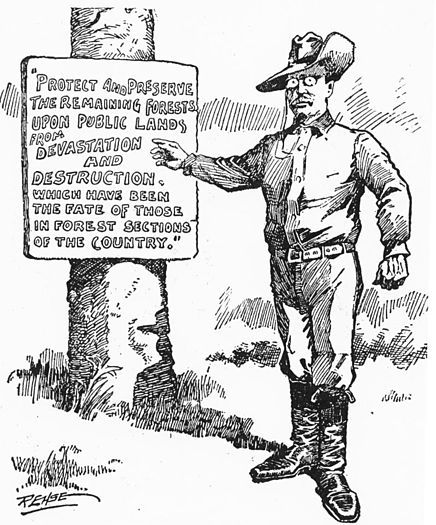
1908 editorial cartoon of President Theodore Roosevelt as “A Practical Forester.”  Source: St. Paul Minnesota “Pioneer Press”. Via GPO's Government Book Talk blog.

1908 Rense editorial cartoon of President Theodore Roosevelt as “A Practical Forester.” Source: St. Paul Minnesota “Pioneer Press”. Via GPO’s Government Book Talk blog.


Post-Valentine’s Day olla podrida

February 22, 2013

How’s the NRA going to spin this one?

Psy got more than 7 billion views on one video.  Can you help Sesame Street get to one billion, total?  It’s a better cause.  And it may frost the heck out of Sal Khan, too.

Sesame Street actually has a lot of video up for YouTube use — that is, for your use.  This is one of the most important educational sites on the entire internet. 992,469,603 total views at this moment.

Whose educational video works best, Sal Khan’s or Cookie Monsters?

U.S. Rep. Marsha Blackburn, R-Tennessee, said she doesn’t think we need an increase in the minimum wage, especially not to the $9 level President Obama asked.  She said her $2.15 minimum wage was enough . . .

Oops:

At that time, the minimum wage was $1.60, equivalent to $10.56 in today’s terms. Today’s minimum wage is equivalent to just $1.10 an hour in 1968 dollars, meaning the teenage Blackburn managed to enter the workforce making almost double the wage she now says is keeping teenagers out of the workforce.

Do Republicans ever learn history, or make the minor mathematical calculations to adjust for historic inflation?  Pretty tough to flunk history, math and economics in such a short statement.

Is there a rational reason that Wisconsin Rep. Paul Ryan’s  solutions to U.S. problems always involve economic pain to others?  Will cuts in food and health care make these 600,000 children smarter, too?

Here you go, Mittens in winter:

The Mittens in winter, by Howard Noel, via National Wildlife Federation

Caption from the National Wildlife Federation: Howard Noel’s photo of Monument Valley captures the East and West Mitten Buttes, as well as Merrick’s Butte on the right. These natural sandstone and shale structures are just a few of the world-famous geological features in Monument Valley Navajo Tribal Park, located along the Arizona-Utah state line within the Navajo Nation Reservation. The Utah resident used a Canon EOS 5D Mark II camera and a 24-105mm lens.

Where in Utah does Howard Noel hail from?  While I’ve been by these formations in winter, it was never with a camera to catch the snow.  This park is an ideal place to spend a couple of days learning landscape photography, if you’re looking for a place to try out your new camera.  Great place to be anytime, for me.

Hey, if you’re planning drive to see the Mittens, you should be aware that part of Highway 89 is out of commission due to a slump off the roadway between Flagstaff and Page, Arizona — the Navajo Reservation being as large as it is, and as unroaded as it is, when a main road goes out, detours can be spectacularly long.   Earthly Musings carries geological explanations, history and great photos.  How much detour?  This one requires a job to the east, through Tuba City, probably adding about an hour to the trip between those two cities.

The Arizona Department of Transportation says traffic will detour around the closure by using U.S. 160 and State Route 98, adding 45 miles of driving. (emphasis added here)

Meanwhile, in the rest of America? This is okay.  America is ashamed of Rush Limbaugh’s ranting, too.  Fair, no?

Why was the death toll so high in season 3 of “Downton Abbey?”  Writer Julian Fellowes explained it’s a kind of contract issue — anti-regulation types will no doubt crawl out of the woodwork to complain about government interference in the right of contract in English theatre.


Quote of the moment repeat: Robert C. Lieberman, “Why the Rich Are Getting Richer: American Politics and the Second Gilded Age”

February 20, 2013

What? You missed this, on February 20, 2011? Well, here it is again. Please pay attention this time.

The U.S. economy appears to be coming apart at the seams.  Unemployment remains at nearly ten percent, the highest level in almost 30 years; foreclosures have forced millions of Americans out of their homes; and real incomes have fallen faster and further than at any time since the Great Depression.  Many of those laid off fear that the jobs they have lost — the secure, often unionized, industrial jobs that provided wealth, security and opportunity — will never return.  They are probably right.

Cover of Winner-Take-All Politics, by Jacob Hacker and Paul Pierson

Cover of Winner-Take-All Politics, by Jacob Hacker and Paul Pierson

And yet a curious thing has happened in the midst of all this misery.  The wealthiest Americans, among them presumably the very titans of global finance whose misadventures brought about the financial meltdown, got richer.  And not just a little bit richer; a lot richer.  In 2009, the average income of the top five percent of earners went up, while on average everyone else’s income went down.  This was not an anomaly but rather a continuation of a 40-year trend of ballooning incomes at the very top and stagnant incomes in the middle and at the bottom.  The share of total income going to the top one percent has increased from roughly eight percent in the 1960s to more than 20 percent today.

This what the political scientists Jacob Hacker and Paul Pierson call the “winner-take-all economy.”  It is not a picture of a healthy society.  Such a level of economic inequality, not seen in the United States since the eve of the Great Depression, bespeaks a political economy in which the financial rewards are increasingly concentrated among a tiny elite and whose risks are borne by an increasingly exposed and unprotected middle class.  Income inequality in the United States is higher than in any other advanced democracy and by conventional measures comparable to that in countries such as Ghana, Nicaragua, and Turkmenistan.

Robert C. Lieberman, reviewing the book Winner-Take-All Politics:  How Washington Made the Rich Richer — and Turned Its Back on the Middle Class, by Jacob S. Hacker and Paul Pierson, Simon and Schuster, 2010, 368 pages.  $27.00.; review appears in Foreign Affairs, January/February 2011, pp. 154-158.

More:

Two years later, even more:


Obama H8rs complain, “Obama’s not emperor!”

February 18, 2013

President Obama at 2nd Google+ Fireside Hangout, February 14, 2013

Obama’s got good answers and is willing to discuss policy with American citizens; critics keep making stuff up to complain about. Caption from the White House: President Barack Obama participates in a “Fireside Hangout” on Google+ with Americans from around the country to discuss his State of the Union Address, in the Roosevelt Room of the White House. February 14, 2013. (Official White House Photo by Pete Souza)

Can’t make this stuff up as fast as the unthinking anti-Obama folks can dish it out.

Their criticisms often vaporize at the slightest investigation, though.  Why not talk serious policy?  They won’t do it.

Wednesday night, President Obama participated in a Google+ ” Fireside Hangout.”  These sessions take their cue in part from FDR’s Fireside Chats.  In the modern, Google+ version, it’s not just the president talking.  He takes questions from a panel of interrogators, and from people who send in questions by Tweet or e-mail.  Obama took questions from citizens.

One woman, Jackie Guerrero (sp?) complained that the Obama administration enforces our immigration laws with much more toughness than any previous administration, ever.  She said too many people who shouldn’t be deported, are being deported.  She asked President Obama to explain why his administration has done that.

Obama said he’s the executive, and he’s required to carry out the laws.  He urged the woman to support changes in the laws, but he pointed out that must come from Congress.  His answer took two-and-a-half minutes, and he outlined the need for immigration reform.  In a few seconds, he started his answer with this:

“This is something I’ve struggled with throughout my presidency,” said Obama. “The problem is that I’m the president of the United States, I’m not the emperor of the United States. My job is to execute laws that are passed.”

You as a reasonably intelligent and perceptive Dear Reader recognize that Obama is asking for citizen pressure on Congress to pass reform of our immigration laws.

You as a reasonably intelligent and perceptive Dear Reader are also well aware there is a group of people loose in America who say that, whatever Obama says, Obama is wrong.

So, what do those Obama H8rs say?  Do they complain about immigration reform, saying we don’t need it?

No, they don’t even give their listeners and viewers the dignity of talking about the issues. Here’s how Michael Savage butchered the video of the Google session:

Savage posted this wan explanation:

Published on Feb 15, 2013

In a Google hangout last evening February 14, 2013, President Barack Obama explained that his problem is that he’s “not the emperor of the United States”: “This is something I’ve struggled with throughout my presidency,” said Obama. “The problem is that I’m the president of the United States, I’m not the emperor of the United States. My job is to execute laws that are passed.”

In a very technical sense, that’s accurate reporting of part of Obama’s statement.

But it’s not the whole truth, as you can see.  There is no mention whatsoever of the issue at hand, immigration reform, for example.  How can they report it correctly, if they don’t even report what happened?

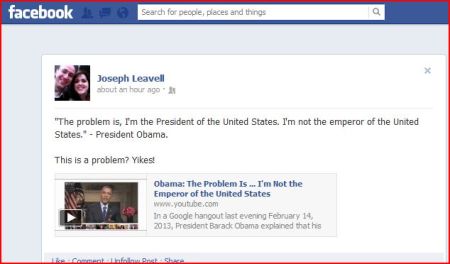
How have others reacted?  Our old friend Joe Leavell leapt at the opening Michael Savage provided, with a Facebook post linking to the video:

“The problem is, I’m the President of the United States. I’m not the emperor of the United States.” – President Obama.
This is a problem? Yikes!

Can you tell Joe’s views on immigration reform?  On enforcing laws?  On not enforcing laws?  Just try to pin him down.

Leavell on Obama as emperor

On Facebook, a complaint leaving the impression that Obama said he wants to be emperor, though of course, that’s not at all what Obama said.

One more demonstration we don’t need that people who truly hate Obama with no good reason will make up crap to claim against him, regardless what he says.

Some wag said, “I hope President Obama comes out tomorrow with a warning against eating yellow snow, just so I can see these guys explain the benefits of eating yellow snow.”

I wish they’d just wake up, read the old Boy Scout Citizenship Merit Badge booklet, and be good citizens without all the hoax complaints.

No, Obama did not say he wants to be emperor.  No, he did not.

No, he didn’t.

Alas, Joe Leavell on Facebook is not the only one who had what should be embarrassing conniptions over the mined quote.

Wall of shame, commenters who fuzzed up the news and ran with the political smear; count ’em:

  1. Weekly Standard (apparently all their fact checkers died; I didn’t realize they really have no regard for the accuracy of stuff they report, before).
  2. Obama: ‘The Problem is … I’m not the Emperor of the United States’ (radio.foxnews.com)
  3. Obama Says the “The Problem Is…I’m Not Emperor of the United States” (gunmartblog.com)
  4. Obama: “The Problem Is I’m President of the United States, I’m Not the Emperor” (Video) (thegatewaypundit.com)
  5. Obama: ‘The Problem Is … I’m Not the Emperor of the United States’ (givemeliberty01.com)
  6. Obama Says ‘The Problem Is That I’m Not The Emperor Of The United States’ (vineoflife.net)
  7. ‘The Problem Is … I’m Not the Emperor of the United States’ (ConservativeActionAlerts.com)
  8. I’m Not The Emperor of the USA (tarpon.wordpress.com)
  9. “The Problem is I’m not Emperor:” Obama’s Freudian Slip (rjblack.wordpress.com)
  10. Barack Obama: ‘The Problem Is … I’m Not the Emperor of the United States’ (ijreview.com)
  11. Obama: ‘The Problem Is I’m Not The Emperor Of The United States’ (conservativebyte.com)
  12. Barack Obama: I’m not emperor of the United States (Twitchy)
  13. Obama made a Freudian slip, The Rio Norte Line
  14. Of course The Blaze misreported it, too
  15. Washington Times blog screwed it up
  16. Victor Medina, a Dallas Republican operative, in the Examiner
  17. TeaParty.org copied the Weekly Standard, a weakly slandering practice of theirs
  18. WeaselZippers honestly stated they got the report “scouring the bowels of the internet” and came up with the same old offal; this is the quality of reporting we’re talking about here
  19. Before It’s News reported it, though it wasn’t news at all
  20. Nothing but the Truth misses its named target, copying the false report at Gateway Pundit

Some of you may remember Spike Jones’s send-up of that classic show tune, “I’m in the Mood for Love.”  One verse of the lyric is, “Funny, but when I’m near you, I’m in the mood for love.”  In Spike’s version, an indignant voice interrupts with, “Funny butt!  Who’se got a funny butt?”

That’s rather what Savage and others have done with Obama’s answer here.

How many of those sites do you think would like it if Obama had said, “Okay, we’ll stop deportations of all but criminal and dangerous undocumented aliens tomorrow?”  How many of those sites will favor action on immigration reform?  How many of them will want their children to know they wrote these things, in ten years?

This cheap and misleading criticism ignored the two-and-a-half-minute response Obama gave to the immigration and deportation question, in which he concisely explained the problems and the urgent need for immigration reform to benefit the U.S. economy.  See the complete answer in the video of the entire session, at the bottom of this post.

Obama’s critics don’t dare allow him a fair chance to state his position.  They have no answers for his clearly thought-out plans.

More:

See for yourself how Obama’s views were covered up and his meanings distorted.  Here’s the entire Google Fireside Hangout, all 47 minutes of it (in HD and stereo); the question on immigration comes about 19 minutes in, and Obama’s answer took about two and a half minutes, all ignored completely by Obama’s H8rs:

Update, post script:  CBS’s guy who keeps all the records, Mark Knoller, accurately reported Obama’s words in a Tweet, with just 140 characters; why can’t conservative wackoes get it right with 1,000 words and video?  They probably don’t intend to get it right, like Knoller works to get it right every day, day in, and day out.


Barack Obama’s State of the Union speech, 2013

February 12, 2013

Transcript of President Obama’s speech, as released from the White House:

The White House
Office of the Press Secretary

For Immediate Release

February 12, 2013

President Barack Obama’s State of the Union Address

Remarks of President Barack Obama – As Prepared for Delivery

State of the Union Address

Tuesday, February 12, 2013

Washington, DC

Mr. Speaker, Mr. Vice President, Members of Congress, fellow citizens:

Fifty-one years ago, John F. Kennedy declared to this Chamber that “the Constitution makes us not rivals for power but partners for progress…It is my task,” he said, “to report the State of the Union – to improve it is the task of us all.”

Tonight, thanks to the grit and determination of the American people, there is much progress to report.  After a decade of grinding war, our brave men and women in uniform are coming home.  After years of grueling recession, our businesses have created over six million new jobs.  We buy more American cars than we have in five years, and less foreign oil than we have in twenty.  Our housing market is healing, our stock market is rebounding, and consumers, patients, and homeowners enjoy stronger protections than ever before.

Together, we have cleared away the rubble of crisis, and can say with renewed confidence that the state of our union is stronger.

But we gather here knowing that there are millions of Americans whose hard work and dedication have not yet been rewarded.  Our economy is adding jobs – but too many people still can’t find full-time employment.  Corporate profits have rocketed to all-time highs – but for more than a decade, wages and incomes have barely budged.

It is our generation’s task, then, to reignite the true engine of America’s economic growth – a rising, thriving middle class.

It is our unfinished task to restore the basic bargain that built this country – the idea that if you work hard and meet your responsibilities, you can get ahead, no matter where you come from, what you look like, or who you love.

It is our unfinished task to make sure that this government works on behalf of the many, and not just the few; that it encourages free enterprise, rewards individual initiative, and opens the doors of opportunity to every child across this great nation.

The American people don’t expect government to solve every problem.  They don’t expect those of us in this chamber to agree on every issue.  But they do expect us to put the nation’s interests before party.  They do expect us to forge reasonable compromise where we can.  For they know that America moves forward only when we do so together; and that the responsibility of improving this union remains the task of us all.

Our work must begin by making some basic decisions about our budget – decisions that will have a huge impact on the strength of our recovery.

Over the last few years, both parties have worked together to reduce the deficit by more than $2.5 trillion – mostly through spending cuts, but also by raising tax rates on the wealthiest 1 percent of Americans.  As a result, we are more than halfway towards the goal of $4 trillion in deficit reduction that economists say we need to stabilize our finances.

Now we need to finish the job.  And the question is, how?

In 2011, Congress passed a law saying that if both parties couldn’t agree on a plan to reach our deficit goal, about a trillion dollars’ worth of budget cuts would automatically go into effect this year.  These sudden, harsh, arbitrary cuts would jeopardize our military readiness.  They’d devastate priorities like education, energy, and medical research. They would certainly slow our recovery, and cost us hundreds of thousands of jobs.  That’s why Democrats, Republicans, business leaders, and economists have already said that these cuts, known here in Washington as “the sequester,” are a really bad idea.

Now, some in this Congress have proposed preventing only the defense cuts by making even bigger cuts to things like education and job training; Medicare and Social Security benefits.

That idea is even worse.  Yes, the biggest driver of our long-term debt is the rising cost of health care for an aging population.  And those of us who care deeply about programs like Medicare must embrace the need for modest reforms – otherwise, our retirement programs will crowd out the investments we need for our children, and jeopardize the promise of a secure retirement for future generations.

But we can’t ask senior citizens and working families to shoulder the entire burden of deficit reduction while asking nothing more from the wealthiest and most powerful.  We won’t grow the middle class simply by shifting the cost of health care or college onto families that are already struggling, or by forcing communities to lay off more teachers, cops, and firefighters.  Most Americans – Democrats, Republicans, and Independents – understand that we can’t just cut our way to prosperity.  They know that broad-based economic growth requires a balanced approach to deficit reduction, with spending cuts and revenue, and with everybody doing their fair share.   And that’s the approach I offer tonight.

On Medicare, I’m prepared to enact reforms that will achieve the same amount of health care savings by the beginning of the next decade as the reforms proposed by the bipartisan Simpson-Bowles commission.  Already, the Affordable Care Act is helping to slow the growth of health care costs.  The reforms I’m proposing go even further.  We’ll reduce taxpayer subsidies to prescription drug companies and ask more from the wealthiest seniors.  We’ll bring down costs by changing the way our government pays for Medicare, because our medical bills shouldn’t be based on the number of tests ordered or days spent in the hospital – they should be based on the quality of care that our seniors receive.  And I am open to additional reforms from both parties, so long as they don’t violate the guarantee of a secure retirement.  Our government shouldn’t make promises we cannot keep – but we must keep the promises we’ve already made.

To hit the rest of our deficit reduction target, we should do what leaders in both parties have already suggested, and save hundreds of billions of dollars by getting rid of tax loopholes and deductions for the well-off and well-connected.  After all, why would we choose to make deeper cuts to education and Medicare just to protect special interest tax breaks?  How is that fair?  How does that promote growth?

Now is our best chance for bipartisan, comprehensive tax reform that encourages job creation and helps bring down the deficit.  The American people deserve a tax code that helps small businesses spend less time filling out complicated forms, and more time expanding and hiring; a tax code that ensures billionaires with high-powered accountants can’t pay a lower rate than their hard-working secretaries; a tax code that lowers incentives to move jobs overseas, and lowers tax rates for businesses and manufacturers that create jobs right here in America.  That’s what tax reform can deliver.  That’s what we can do together.

I realize that tax reform and entitlement reform won’t be easy.  The politics will be hard for both sides.  None of us will get 100 percent of what we want.  But the alternative will cost us jobs, hurt our economy, and visit hardship on millions of hardworking Americans.  So let’s set party interests aside, and work to pass a budget that replaces reckless cuts with smart savings and wise investments in our future.  And let’s do it without the brinksmanship that stresses consumers and scares off investors.  The greatest nation on Earth cannot keep conducting its business by drifting from one manufactured crisis to the next.  Let’s agree, right here, right now, to keep the people’s government open, pay our bills on time, and always uphold the full faith and credit of the United States of America.  The American people have worked too hard, for too long, rebuilding from one crisis to see their elected officials cause another.

Now, most of us agree that a plan to reduce the deficit must be part of our agenda.  But let’s be clear: deficit reduction alone is not an economic plan.  A growing economy that creates good, middle-class jobs – that must be the North Star that guides our efforts.  Every day, we should ask ourselves three questions as a nation:  How do we attract more jobs to our shores?  How do we equip our people with the skills needed to do those jobs?  And how do we make sure that hard work leads to a decent living?

A year and a half ago, I put forward an American Jobs Act that independent economists said would create more than one million new jobs.  I thank the last Congress for passing some of that agenda, and I urge this Congress to pass the rest.  Tonight, I’ll lay out additional proposals that are fully paid for and fully consistent with the budget framework both parties agreed to just 18 months ago.  Let me repeat – nothing I’m proposing tonight should increase our deficit by a single dime.  It’s not a bigger government we need, but a smarter government that sets priorities and invests in broad-based growth.

Our first priority is making America a magnet for new jobs and manufacturing.

After shedding jobs for more than 10 years, our manufacturers have added about 500,000 jobs over the past three. Caterpillar is bringing jobs back from Japan.  Ford is bringing jobs back from Mexico. After locating plants in other countries like China, Intel is opening its most advanced plant right here at home.  And this year, Apple will start making Macs in America again.

There are things we can do, right now, to accelerate this trend.  Last year, we created our first manufacturing innovation institute in Youngstown, Ohio.  A once-shuttered warehouse is now a state-of-the art lab where new workers are mastering the 3D printing that has the potential to revolutionize the way we make almost everything.  There’s no reason this can’t happen in other towns.  So tonight, I’m announcing the launch of three more of these manufacturing hubs, where businesses will partner with the Departments of Defense and Energy to turn regions left behind by globalization into global centers of high-tech jobs.  And I ask this Congress to help create a network of fifteen of these hubs and guarantee that the next revolution in manufacturing is Made in America.

If we want to make the best products, we also have to invest in the best ideas.  Every dollar we invested to map the human genome returned $140 to our economy. Today, our scientists are mapping the human brain to unlock the answers to Alzheimer’s; developing drugs to regenerate damaged organs; devising new material to make batteries ten times more powerful.  Now is not the time to gut these job-creating investments in science and innovation.  Now is the time to reach a level of research and development not seen since the height of the Space Race.  And today, no area holds more promise than our investments in American energy.

After years of talking about it, we are finally poised to control our own energy future.  We produce more oil at home than we have in 15 years.  We have doubled the distance our cars will go on a gallon of gas, and the amount of renewable energy we generate from sources like wind and solar – with tens of thousands of good, American jobs to show for it.  We produce more natural gas than ever before – and nearly everyone’s energy bill is lower because of it.  And over the last four years, our emissions of the dangerous carbon pollution that threatens our planet have actually fallen.

But for the sake of our children and our future, we must do more to combat climate change.  Yes, it’s true that no single event makes a trend.  But the fact is, the 12 hottest years on record have all come in the last 15.  Heat waves, droughts, wildfires, and floods – all are now more frequent and intense.  We can choose to believe that Superstorm Sandy, and the most severe drought in decades, and the worst wildfires some states have ever seen were all just a freak coincidence.  Or we can choose to believe in the overwhelming judgment of science – and act before it’s too late.

The good news is, we can make meaningful progress on this issue while driving strong economic growth.  I urge this Congress to pursue a bipartisan, market-based solution to climate change, like the one John McCain and Joe Lieberman worked on together a few years ago.  But if Congress won’t act soon to protect future generations, I will.  I will direct my Cabinet to come up with executive actions we can take, now and in the future, to reduce pollution, prepare our communities for the consequences of climate change, and speed the transition to more sustainable sources of energy.

Four years ago, other countries dominated the clean energy market and the jobs that came with it.  We’ve begun to change that.  Last year, wind energy added nearly half of all new power capacity in America.  So let’s generate even more.  Solar energy gets cheaper by the year – so let’s drive costs down even further.  As long as countries like China keep going all-in on clean energy, so must we.

In the meantime, the natural gas boom has led to cleaner power and greater energy independence.  That’s why my Administration will keep cutting red tape and speeding up new oil and gas permits.  But I also want to work with this Congress to encourage the research and technology that helps natural gas burn even cleaner and protects our air and water.

Indeed, much of our new-found energy is drawn from lands and waters that we, the public, own together.  So tonight, I propose we use some of our oil and gas revenues to fund an Energy Security Trust that will drive new research and technology to shift our cars and trucks off oil for good.  If a non-partisan coalition of CEOs and retired generals and admirals can get behind this idea, then so can we.  Let’s take their advice and free our families and businesses from the painful spikes in gas prices we’ve put up with for far too long.  I’m also issuing a new goal for America: let’s cut in half the energy wasted by our homes and businesses over the next twenty years.  The states with the best ideas to create jobs and lower energy bills by constructing more efficient buildings will receive federal support to help make it happen.

America’s energy sector is just one part of an aging infrastructure badly in need of repair.  Ask any CEO where they’d rather locate and hire: a country with deteriorating roads and bridges, or one with high-speed rail and internet; high-tech schools and self-healing power grids.  The CEO of Siemens America – a company that brought hundreds of new jobs to North Carolina – has said that if we upgrade our infrastructure, they’ll bring even more jobs.  And I know that you want these job-creating projects in your districts.  I’ve seen you all at the ribbon-cuttings.

Tonight, I propose a “Fix-It-First” program to put people to work as soon as possible on our most urgent repairs, like the nearly 70,000 structurally deficient bridges across the country.  And to make sure taxpayers don’t shoulder the whole burden, I’m also proposing a Partnership to Rebuild America that attracts private capital to upgrade what our businesses need most: modern ports to move our goods; modern pipelines to withstand a storm; modern schools worthy of our children.  Let’s prove that there is no better place to do business than the United States of America.  And let’s start right away.

Part of our rebuilding effort must also involve our housing sector.  Today, our housing market is finally healing from the collapse of 2007.  Home prices are rising at the fastest pace in six years, home purchases are up nearly 50 percent, and construction is expanding again.

But even with mortgage rates near a 50-year low, too many families with solid credit who want to buy a home are being rejected.  Too many families who have never missed a payment and want to refinance are being told no.  That’s holding our entire economy back, and we need to fix it.  Right now, there’s a bill in this Congress that would give every responsible homeowner in America the chance to save $3,000 a year by refinancing at today’s rates.  Democrats and Republicans have supported it before.  What are we waiting for?  Take a vote, and send me that bill.  Right now, overlapping regulations keep responsible young families from buying their first home.  What’s holding us back?  Let’s streamline the process, and help our economy grow.

These initiatives in manufacturing, energy, infrastructure, and housing will help entrepreneurs and small business owners expand and create new jobs.  But none of it will matter unless we also equip our citizens with the skills and training to fill those jobs.  And that has to start at the earliest possible age.

Study after study shows that the sooner a child begins learning, the better he or she does down the road.  But today, fewer than 3 in 10 four year-olds are enrolled in a high-quality preschool program.  Most middle-class parents can’t afford a few hundred bucks a week for private preschool.  And for poor kids who need help the most, this lack of access to preschool education can shadow them for the rest of their lives.

Tonight, I propose working with states to make high-quality preschool available to every child in America.  Every dollar we invest in high-quality early education can save more than seven dollars later on – by boosting graduation rates, reducing teen pregnancy, even reducing violent crime.  In states that make it a priority to educate our youngest children, like Georgia or Oklahoma, studies show students grow up more likely to read and do math at grade level, graduate high school, hold a job, and form more stable families of their own.  So let’s do what works, and make sure none of our children start the race of life already behind.  Let’s give our kids that chance.

Let’s also make sure that a high school diploma puts our kids on a path to a good job.  Right now, countries like Germany focus on graduating their high school students with the equivalent of a technical degree from one of our community colleges, so that they’re ready for a job.  At schools like P-Tech in Brooklyn, a collaboration between New York Public Schools, the City University of New York, and IBM, students will graduate with a high school diploma and an associate degree in computers or engineering.

We need to give every American student opportunities like this.  Four years ago, we started Race to the Top – a competition that convinced almost every state to develop smarter curricula and higher standards, for about 1 percent of what we spend on education each year.  Tonight, I’m announcing a new challenge to redesign America’s high schools so they better equip graduates for the demands of a high-tech economy.  We’ll reward schools that develop new partnerships with colleges and employers, and create classes that focus on science, technology, engineering, and math – the skills today’s employers are looking for to fill jobs right now and in the future.

Now, even with better high schools, most young people will need some higher education.  It’s a simple fact: the more education you have, the more likely you are to have a job and work your way into the middle class.  But today, skyrocketing costs price way too many young people out of a higher education, or saddle them with unsustainable debt.

Through tax credits, grants, and better loans, we have made college more affordable for millions of students and families over the last few years.  But taxpayers cannot continue to subsidize the soaring cost of higher education.  Colleges must do their part to keep costs down, and it’s our job to make sure they do.  Tonight, I ask Congress to change the Higher Education Act, so that affordability and value are included in determining which colleges receive certain types of federal aid.  And tomorrow, my Administration will release a new “College Scorecard” that parents and students can use to compare schools based on a simple criteria: where you can get the most bang for your educational buck.

To grow our middle class, our citizens must have access to the education and training that today’s jobs require.  But we also have to make sure that America remains a place where everyone who’s willing to work hard has the chance to get ahead.

Our economy is stronger when we harness the talents and ingenuity of striving, hopeful immigrants.  And right now, leaders from the business, labor, law enforcement, and faith communities all agree that the time has come to pass comprehensive immigration reform.

Real reform means strong border security, and we can build on the progress my Administration has already made – putting more boots on the southern border than at any time in our history, and reducing illegal crossings to their lowest levels in 40 years.

Real reform means establishing a responsible pathway to earned citizenship – a path that includes passing a background check, paying taxes and a meaningful penalty, learning English, and going to the back of the line behind the folks trying to come here legally.

And real reform means fixing the legal immigration system to cut waiting periods, reduce bureaucracy, and attract the highly-skilled entrepreneurs and engineers that will help create jobs and grow our economy.

In other words, we know what needs to be done.  As we speak, bipartisan groups in both chambers are working diligently to draft a bill, and I applaud their efforts.  Now let’s get this done.  Send me a comprehensive immigration reform bill in the next few months, and I will sign it right away.

But we can’t stop there.  We know our economy is stronger when our wives, mothers, and daughters can live their lives free from discrimination in the workplace, and free from the fear of domestic violence.  Today, the Senate passed the Violence Against Women Act that Joe Biden originally wrote almost 20 years ago.  I urge the House to do the same.  And I ask this Congress to declare that women should earn a living equal to their efforts, and finally pass the Paycheck Fairness Act this year.

We know our economy is stronger when we reward an honest day’s work with honest wages.  But today, a full-time worker making the minimum wage earns $14,500 a year.  Even with the tax relief we’ve put in place, a family with two kids that earns the minimum wage still lives below the poverty line.  That’s wrong.  That’s why, since the last time this Congress raised the minimum wage, nineteen states have chosen to bump theirs even higher.

Tonight, let’s declare that in the wealthiest nation on Earth, no one who works full-time should have to live in poverty, and raise the federal minimum wage to $9.00 an hour.  This single step would raise the incomes of millions of working families.  It could mean the difference between groceries or the food bank; rent or eviction; scraping by or finally getting ahead.  For businesses across the country, it would mean customers with more money in their pockets.  In fact, working folks shouldn’t have to wait year after year for the minimum wage to go up while CEO pay has never been higher.  So here’s an idea that Governor Romney and I actually agreed on last year: let’s tie the minimum wage to the cost of living, so that it finally becomes a wage you can live on.

Tonight, let’s also recognize that there are communities in this country where no matter how hard you work, it’s virtually impossible to get ahead.  Factory towns decimated from years of plants packing up.  Inescapable pockets of poverty, urban and rural, where young adults are still fighting for their first job.  America is not a place where chance of birth or circumstance should decide our destiny.  And that is why we need to build new ladders of opportunity into the middle class for all who are willing to climb them.

Let’s offer incentives to companies that hire Americans who’ve got what it takes to fill that job opening, but have been out of work so long that no one will give them a chance.  Let’s put people back to work rebuilding vacant homes in run-down neighborhoods.  And this year, my Administration will begin to partner with 20 of the hardest-hit towns in America to get these communities back on their feet.  We’ll work with local leaders to target resources at public safety, education, and housing.  We’ll give new tax credits to businesses that hire and invest.  And we’ll work to strengthen families by removing the financial deterrents to marriage for low-income couples, and doing more to encourage fatherhood – because what makes you a man isn’t the ability to conceive a child; it’s having the courage to raise one.

Stronger families.  Stronger communities.  A stronger America.  It is this kind of prosperity – broad, shared, and built on a thriving middle class – that has always been the source of our progress at home.  It is also the foundation of our power and influence throughout the world.

Tonight, we stand united in saluting the troops and civilians who sacrifice every day to protect us. Because of them, we can say with confidence that America will complete its mission in Afghanistan, and achieve our objective of defeating the core of al Qaeda.  Already, we have brought home 33,000 of our brave servicemen and women.  This spring, our forces will move into a support role, while Afghan security forces take the lead.  Tonight, I can announce that over the next year, another 34,000 American troops will come home from Afghanistan.  This drawdown will continue.  And by the end of next year, our war in Afghanistan will be over.

Beyond 2014, America’s commitment to a unified and sovereign Afghanistan will endure, but the nature of our commitment will change.  We are negotiating an agreement with the Afghan government that focuses on two missions: training and equipping Afghan forces so that the country does not again slip into chaos, and counter-terrorism efforts that allow us to pursue the remnants of al Qaeda and their affiliates.

Today, the organization that attacked us on 9/11 is a shadow of its former self.  Different al Qaeda affiliates and extremist groups have emerged – from the Arabian Peninsula to Africa.  The threat these groups pose is evolving.  But to meet this threat, we don’t need to send tens of thousands of our sons and daughters abroad, or occupy other nations.  Instead, we will need to help countries like Yemen, Libya, and Somalia provide for their own security, and help allies who take the fight to terrorists, as we have in Mali.  And, where necessary, through a range of capabilities, we will continue to take direct action against those terrorists who pose the gravest threat to Americans.

As we do, we must enlist our values in the fight.  That is why my Administration has worked tirelessly to forge a durable legal and policy framework to guide our counterterrorism operations.  Throughout, we have kept Congress fully informed of our efforts.  I recognize that in our democracy, no one should just take my word that we’re doing things the right way.  So, in the months ahead, I will continue to engage with Congress to ensure not only that our targeting, detention, and prosecution of terrorists remains consistent with our laws and system of checks and balances, but that our efforts are even more transparent to the American people and to the world.

Of course, our challenges don’t end with al Qaeda.  America will continue to lead the effort to prevent the spread of the world’s most dangerous weapons.  The regime in North Korea must know that they will only achieve security and prosperity by meeting their international obligations.  Provocations of the sort we saw last night will only isolate them further, as we stand by our allies, strengthen our own missile defense, and lead the world in taking firm action in response to these threats.

Likewise, the leaders of Iran must recognize that now is the time for a diplomatic solution, because a coalition stands united in demanding that they meet their obligations, and we will do what is necessary to prevent them from getting a nuclear weapon.  At the same time, we will engage Russia to seek further reductions in our nuclear arsenals, and continue leading the global effort to secure nuclear materials that could fall into the wrong hands – because our ability to influence others depends on our willingness to lead.

America must also face the rapidly growing threat from cyber-attacks.  We know hackers steal people’s identities and infiltrate private e-mail.  We know foreign countries and companies swipe our corporate secrets.  Now our enemies are also seeking the ability to sabotage our power grid, our financial institutions, and our air traffic control systems.  We cannot look back years from now and wonder why we did nothing in the face of real threats to our security and our economy.

That’s why, earlier today, I signed a new executive order that will strengthen our cyber defenses by increasing information sharing, and developing standards to protect our national security, our jobs, and our privacy.  Now, Congress must act as well, by passing legislation to give our government a greater capacity to secure our networks and deter attacks.

Even as we protect our people, we should remember that today’s world presents not only dangers, but opportunities.  To boost American exports, support American jobs, and level the playing field in the growing markets of Asia, we intend to complete negotiations on a Trans-Pacific Partnership.  And tonight, I am announcing that we will launch talks on a comprehensive Transatlantic Trade and Investment Partnership with the European Union – because trade that is free and fair across the Atlantic supports millions of good-paying American jobs.

We also know that progress in the most impoverished parts of our world enriches us all.  In many places, people live on little more than a dollar a day.  So the United States will join with our allies to eradicate such extreme poverty in the next two decades: by connecting more people to the global economy and empowering women; by giving our young and brightest minds new opportunities to serve and helping communities to feed, power, and educate themselves; by saving the world’s children from preventable deaths; and by realizing the promise of an AIDS-free generation.

Above all, America must remain a beacon to all who seek freedom during this period of historic change.  I saw the power of hope last year in Rangoon – when Aung San Suu Kyi welcomed an American President into the home where she had been imprisoned for years; when thousands of Burmese lined the streets, waving American flags, including a man who said, “There is justice and law in the United States.  I want our country to be like that.”

In defense of freedom, we will remain the anchor of strong alliances from the Americas to Africa; from Europe to Asia.  In the Middle East, we will stand with citizens as they demand their universal rights, and support stable transitions to democracy.  The process will be messy, and we cannot presume to dictate the course of change in countries like Egypt; but we can – and will – insist on respect for the fundamental rights of all people.  We will keep the pressure on a Syrian regime that has murdered its own people, and support opposition leaders that respect the rights of every Syrian.  And we will stand steadfast with Israel in pursuit of security and a lasting peace.  These are the messages I will deliver when I travel to the Middle East next month.

All this work depends on the courage and sacrifice of those who serve in dangerous places at great personal risk – our diplomats, our intelligence officers, and the men and women of the United States Armed Forces.  As long as I’m Commander-in-Chief, we will do whatever we must to protect those who serve their country abroad, and we will maintain the best military in the world.  We will invest in new capabilities, even as we reduce waste and wartime spending.  We will ensure equal treatment for all service members, and equal benefits for their families – gay and straight.  We will draw upon the courage and skills of our sisters and daughters, because women have proven under fire that they are ready for combat.  We will keep faith with our veterans – investing in world-class care, including mental health care, for our wounded warriors; supporting our military families; and giving our veterans the benefits, education, and job opportunities they have earned.  And I want to thank my wife Michelle and Dr. Jill Biden for their continued dedication to serving our military families as well as they serve us.

But defending our freedom is not the job of our military alone.  We must all do our part to make sure our God-given rights are protected here at home.  That includes our most fundamental right as citizens:  the right to vote.  When any Americans – no matter where they live or what their party – are denied that right simply because they can’t wait for five, six, seven hours just to cast their ballot, we are betraying our ideals.  That’s why, tonight, I’m announcing a non-partisan commission to improve the voting experience in America.  And I’m asking two long-time experts in the field, who’ve recently served as the top attorneys for my campaign and for Governor Romney’s campaign, to lead it.  We can fix this, and we will.  The American people demand it.  And so does our democracy.

Of course, what I’ve said tonight matters little if we don’t come together to protect our most precious resource – our children.

It has been two months since Newtown.  I know this is not the first time this country has debated how to reduce gun violence.  But this time is different.  Overwhelming majorities of Americans – Americans who believe in the 2nd Amendment – have come together around commonsense reform – like background checks that will make it harder for criminals to get their hands on a gun.  Senators of both parties are working together on tough new laws to prevent anyone from buying guns for resale to criminals.  Police chiefs are asking our help to get weapons of war and massive ammunition magazines off our streets, because they are tired of being outgunned.

Each of these proposals deserves a vote in Congress.  If you want to vote no, that’s your choice.  But these proposals deserve a vote.  Because in the two months since Newtown, more than a thousand birthdays, graduations, and anniversaries have been stolen from our lives by a bullet from a gun.

One of those we lost was a young girl named Hadiya Pendleton.  She was 15 years old.  She loved Fig Newtons and lip gloss.  She was a majorette.  She was so good to her friends, they all thought they were her best friend.  Just three weeks ago, she was here, in Washington, with her classmates, performing for her country at my inauguration.  And a week later, she was shot and killed in a Chicago park after school, just a mile away from my house.

Hadiya’s parents, Nate and Cleo, are in this chamber tonight, along with more than two dozen Americans whose lives have been torn apart by gun violence.  They deserve a vote.

Gabby Giffords deserves a vote.

The families of Newtown deserve a vote.

The families of Aurora deserve a vote.

The families of Oak Creek, and Tucson, and Blacksburg, and the countless other communities ripped open by gun violence – they deserve a simple vote.

Our actions will not prevent every senseless act of violence in this country.  Indeed, no laws, no initiatives, no administrative acts will perfectly solve all the challenges I’ve outlined tonight.  But we were never sent here to be perfect.  We were sent here to make what difference we can, to secure this nation, expand opportunity, and uphold our ideals through the hard, often frustrating, but absolutely necessary work of self-government.

We were sent here to look out for our fellow Americans the same way they look out for one another, every single day, usually without fanfare, all across this country.  We should follow their example.

We should follow the example of a New York City nurse named Menchu Sanchez.  When Hurricane Sandy plunged her hospital into darkness, her thoughts were not with how her own home was faring – they were with the twenty precious newborns in her care and the rescue plan she devised that kept them all safe.

We should follow the example of a North Miami woman named Desiline Victor.  When she arrived at her polling place, she was told the wait to vote might be six hours.  And as time ticked by, her concern was not with her tired body or aching feet, but whether folks like her would get to have their say.  Hour after hour, a throng of people stayed in line in support of her.  Because Desiline is 102 years old.  And they erupted in cheers when she finally put on a sticker that read “I Voted.”

We should follow the example of a police officer named Brian Murphy.  When a gunman opened fire on a Sikh temple in Wisconsin, and Brian was the first to arrive, he did not consider his own safety.  He fought back until help arrived, and ordered his fellow officers to protect the safety of the Americans worshiping inside – even as he lay bleeding from twelve bullet wounds.

When asked how he did that, Brian said, “That’s just the way we’re made.”

That’s just the way we’re made.

We may do different jobs, and wear different uniforms, and hold different views than the person beside us.  But as Americans, we all share the same proud title:

We are citizens.  It’s a word that doesn’t just describe our nationality or legal status.  It describes the way we’re made.  It describes what we believe.  It captures the enduring idea that this country only works when we accept certain obligations to one another and to future generations; that our rights are wrapped up in the rights of others; and that well into our third century as a nation, it remains the task of us all, as citizens of these United States, to be the authors of the next great chapter in our American story.

Thank you, God bless you, and God bless the United States of America.

More:


Especially on his birthday, don’t call Darwin racist — he wasn’t

February 12, 2013

Creationists, Intelligent Design proponents, and several other anti-science and historical revisionist groups come unglued every February about this time — February 12 is Charles Darwin’s birthday.  He was born in 1809, on the exact same day as Abraham Lincoln.

Part of creationists’ coming unglued revolves around that fact that the science behind evolution grows stronger year by year, and at this point no argument exists that creationists can make against evolution that has not been soundly, roundly and thoroughly.  This makes creationists nervous in a discussion, because even they recognize when they lose arguments.   Creationists don’t like to lose arguments about how well Darwin’s theories work, because they erroneously believe that if Darwin is right, God and Jesus are wrong.

God and Jesus cannot be wrong, in their view, but intellectually they see they are losing the argument, and they grow desperate.  In their desperation they grasp for claims that shock uneducated or unfamiliar viewers.  Since about 1970, among the more shocking arguments one can make is to claim one’s opponent is racist.

Claiming Darwin, and hence evolution, boost racism, slaps history with irony.  Creationism’s roots were in denying that Europeans and Africans are evolutionarily equal, a claim necessary to allow slave holders to enslave Africans and go to church on Sundays.  The Civil War is 150 years away, the Emancipation Proclamation 148 years old, and even die-hard creationists generally have forgotten their own history.

Creationists accuse Darwin of being a racist, they claim evolution theory is racist, and they claim, therefore, it cannot be scientifically accurate.  There are a lot of holes in that chain of logic.

This is Darwin’s birthday.  Let me deal with major wrong premise, and give creationists room to correct their views with accurate history, so we don’t have a shouting match.

Way back in 2008, nominally-liberal evangelical preacher Tony Campolo got suckered in by a conservative evangelicals claim to him that evolution and Darwin are racist.  Below is my answer to him then — I think Campolo learned his lesson — but this builds on the claims Campolo made which are really copied from creationists.

In short, Darwin is not racist, and here are some explanations why, with a few updated links and minor edits for Darwin’s birthday, and Lincoln’s birthday, in 2013:

Tony Campolo is an evangelical Christian, a sociology professor and preacher who for the past 15 years or so has been a thorn in the side of political conservatives and other evangelicals, for taking generally more liberal stands, against poverty, for tolerance in culture and politics, and so on. His trademark sermon is an upbeat call to action and one of the more plagiarized works in Christendom, “It’s Friday, but Sunday’s Coming” (listen to it here). 

Tony Campolo

Rev. Tony Campolo

Since he’s so close to the mainstream of American political thought, Campolo is marginalized by many of the more conservative evangelists in the U.S. Campolo is not a frequent guest on the Trinity Broadcast Network, on Pat Robertson’s “700 Club,” nor on the white, nominally-Christian, low-budget knock-off of “Sabado Gigante!,” “Praise the Lord” (with purple hair and everything).

Campolo came closest to real national fame when he counseled President Bill Clinton on moral and spiritual issues during the Lewinsky scandal.

His opposite-editorial piece in the Philadelphia Inquirer back in 2008, “The real danger in Darwin is not evolution, but racism,” is out of character for Campolo as a non-conservative evangelistic thinker — far from what most Christians expect from Campolo either from the pulpit or in the college classroom. The piece looks as though it was lifted wholesale from Jerry Falwell or D. James Kennedy, showing little familiarity with the science or history of evolution, and repeating canards that careful Christians shouldn’t repeat.

Campolo’s piece is inaccurate in several places, and grossly misleading where it’s not just wrong. He pulls out several old creationist hoaxes, cites junk science as if it were golden, and generally gets the issue exactly wrong.

Evolution science is a block to racism. It has always stood against racism, in the science that undergirds the theory and in its applications by those scientists and policy makers who were not racists prior to their discovery of evolution theory. Darwin himself was anti-racist. One of the chief reasons the theory has been so despised throughout the American south is its scientific basis for saying whites and blacks are so closely related. This history should not be ignored, or distorted.

Shame on you, Tony Campolo.

Read the rest of this entry »