Lincoln and Darwin, born hours apart, February 12, 1809

February 12, 2013

Is it an unprecedented coincidence?  204 years ago today, just minutes apart according to unconfirmed accounts, Abraham Lincoln was born in a rude log cabin on Nolin Creek, in Kentucky, and Charles Darwin was born into a wealthy family at the family home  in Shrewsbury, England.

Gutzon Borglums 1908 bust of Abraham Lincoln in the Crypt of the U.S. Capitol - AOC photo

Gutzon Borglum’s 1908 bust of Abraham Lincoln in the Crypt of the U.S. Capitol – Architect of the Capitol photo

Lincoln would become one of our most endeared presidents, though endearment would come after his assassination.  Lincoln’s bust rides the crest of Mt. Rushmore (next to two slaveholders), with George Washington, the Father of His Country, Thomas Jefferson, the author of the Declaration of Independence, and Theodore Roosevelt, the man who made the modern presidency, and the only man ever to have won both a Congressional Medal of Honor and a Nobel Prize, the only president to have won the Medal of Honor.  In his effort to keep the Union together, Lincoln freed the slaves of the states in rebellion during the civil war, becoming an icon to freedom and human rights for all history.  Upon his death the entire nation mourned; his funeral procession from Washington, D.C., to his tomb in Springfield, Illinois, stopped twelve times along the way for full funeral services.  Lying in state in the Illinois House of Representatives, beneath a two-times lifesize portrait of George Washington, a banner proclaimed, “Washington the Father, Lincoln the Savior.”

Charles Darwin statue, Natural History Museum, London - NHM photo

Charles Darwin statue, Natural History Museum, London – NHM photo

Darwin would become one of the greatest scientists of all time.  He would be credited with discovering the theory of evolution by natural and sexual selection.  His meticulous footnoting and careful observations formed the data for ground-breaking papers in geology (the creation of coral atolls), zoology (barnacles, and the expression of emotions in animals and man), botany (climbing vines and insectivorous plants), ecology (worms and leaf mould), and travel (the voyage of H.M.S. Beagle).  At his death he was honored with a state funeral, attended by the great scientists and statesmen of London in his day.  Hymns were specially written for the occasion.  Darwin is interred in Westminster Abbey near Sir Isaac Newton, England’s other great scientist, who knocked God out of the heavens.

Lincoln would be known as the man who saved the Union of the United States and set the standard for civil and human rights, vindicating the religious beliefs of many and challenging the beliefs of many more.  Darwin’s theory would become one of the greatest ideas of western civilization, changing forever all the sciences, and especially agriculture, animal husbandry, and the rest of biology, while also provoking crises in religious sects.

Lincoln, the politician known for freeing the slaves, also was the first U.S. president to formally consult with scientists, calling on the National Science Foundation (whose creation he oversaw) to advise his administration.  Darwin, the scientist, advocated that his family put the weight of its fortune behind the effort to abolish slavery in the British Empire.  Each held an interest in the other’s disciplines.

Both men were catapulted to fame in 1858. Lincoln’s notoriety came from a series of debates on the nation’s dealing with slavery, in his losing campaign against Stephen A. Douglas to represent Illinois in the U.S. Senate.  On the fame of that campaign, he won the nomination to the presidency of the fledgling Republican Party in 1860.  Darwin was spurred to publicly reveal his ideas about the power of natural and sexual selection as the force behind evolution, in a paper co-authored by Alfred Russel Wallace, presented to the Linnean Society in London on July 1, 1858.   On the strength of that paper, barely noticed at the time, Darwin published his most famous work, On the Origin of Species, in November 1859.

The two men might have got along well, but they never met.

What unusual coincidences.  Today is the first day of a year-long commemoration of the lives of both men.  Wise historians and history teachers, and probably wise science teachers, will watch for historical accounts in mass media, and save them.

Go celebrate human rights, good science, and the stories about these men.

Resources:

Charles Darwin:

Abraham Lincoln:

More:

Anybody know what hour of the day either of these men was born?

This is mostly an encore post.


Anthony Watts’s political push poll, “Gore or Obama?”

February 9, 2013

Al Gore and Barack Obama together in Detroit, June 2012, Rebecca Cook photo for Reuters, via NBC News photo

Al Gore and Barack Obama don’t appear to be on the opposite side of most issues, especially not climate change. Here they appear together in Detroit, circa June 11, 2012 – Rebecca Cook photo for Reuters, via NBC News photo

Anthony Watts strays farther and further from science with every passing day, and most of his new posts.

At the moment he’s got a doozy of a post, citing a bovine excrement question on a CFACT billboard, and offering a push-poll with three choices designed to push Watts’s preferred political answer, that ‘Obama and Gore go in different directions on global warming and climate change, and maybe they are both wrong.’   The end message Watts pushes is wrong, as you can see in the full texts below.(Morgan, here’s the link so you don’t have to flounder around with Google.)

Who do you believe?

◊  Barack Obama
◊  Neither one
◊  Al Gore

It’s based on these two quote mine products from the CFACT billboard:

WHAT DO YOU BELIEVE?

“Hurricane Sandy is a disturbing sign of things to come.”  — Al Gore, 10/30/2012

“We can’t attribute any particular weather event to global warming.”  — Barack Obama, 11/14/2012

Lying with quotes, demonstrated by CFACT

Propaganda group CFACT’s quote mining billboard, on which Anthony Watts’s push-poll is based.

Watts doesn’t offer a “both correct” choice.  That would be the accurate answer.

Gore’s comment at his blog on October 30, 2012, noted that while we can’t attribute the formation of Sandy to climate change, the effects of the storm were magnified by climate change.  Gore called that “disturbing.”

Obama, noting that while we can’t say for certain that any particular storm is caused entirely from human-created global warming, the long-term effects clearly have human causation and we need to act to stop it.

In short, Gore and Obama take the same side on this issue, the side of science and making sound public policy.  Watts works the old tobacco company strategy, suggesting that wherever studies showing health harms from tobacco differ from each other in the slightest jot or tittle, that means scientists can’t decide whether tobacco is harmful — substitute “human-caused climate change” for tobacco in that argument, and you see what Watts is trying to do.

Meanwhile, the Earth still warms:

Gore’s blog post in full:

Statement on Hurricane Sandy October 30, 2012 : 1:21 PM

This week, our nation has anxiously watched as Hurricane Sandy lashed the East Coast and caused widespread damage–affecting millions. Now more than ever, our neighbors need our help. Please consider donating or volunteering for your local aid organizations.

The images of Sandy’s flooding brought back memories of a similar–albeit smaller scale– event in Nashville just two years ago. There, unprecedented rainfall caused widespread flooding, wreaking havoc and submerging sections of my hometown. For me, the Nashville flood was a milestone. For many, Hurricane Sandy may prove to be a similar event: a time when the climate crisis—which is often sequestered to the far reaches of our everyday awareness became a reality.

While the storm that drenched Nashville was not a tropical cyclone like Hurricane Sandy, both storms were strengthened by the climate crisis. Scientists tell us that by continually dumping 90 million tons of global warming pollution into the atmosphere every single day, we are altering the environment in which all storms develop. As the oceans and atmosphere continue to warm, storms are becoming more energetic and powerful. Hurricane Sandy, and the Nashville flood, were reminders of just that. Other climate-related catastrophes around the world have carried the same message to hundreds of millions.

Sandy was also affected by other symptoms of the climate crisis. As the hurricane approached the East Coast, it gathered strength from abnormally warm coastal waters. At the same time, Sandy’s storm surge was worsened by a century of sea level rise. Scientists tell us that if we do not reduce our emissions, these problems will only grow worse.

Hurricane Sandy is a disturbing sign of things to come. We must heed this warning and act quickly to solve the climate crisis. Dirty energy makes dirty weather.

President Obama’s statement, excerpted from his November 14, 2012, press conference:

THE PRESIDENT:  Mark Landler.  Where’s Mark?  There he is right in front of me.

Q    Thank you, Mr. President.  In his endorsement of you a few weeks ago, Mayor Bloomberg said he was motivated by the belief that you would do more to confront the threat of climate change than your opponent.  Tomorrow you’re going up to New York City where you’re going to, I assume, see people who are still suffering the effects of Hurricane Sandy, which many people say is further evidence of how a warming globe is changing our weather.  What specifically do you plan to do in a second term to tackle the issue of climate change?  And do you think the political will exists in Washington to pass legislation that could include some kind of a tax on carbon?

THE PRESIDENT:  As you know, Mark, we can’t attribute any particular weather event to climate change.  What we do know is the temperature around the globe is increasing faster than was predicted even 10 years ago.  We do know that the Arctic ice cap is melting faster than was predicted even five years ago.  We do know that there have been extraordinarily — there have been an extraordinarily large number of severe weather events here in North America, but also around the globe.

And I am a firm believer that climate change is real, that it is impacted by human behavior and carbon emissions.  And as a consequence, I think we’ve got an obligation to future generations to do something about it.

Now, in my first term, we doubled fuel efficiency standards on cars and trucks.  That will have an impact.  That will take a lot of carbon out of the atmosphere.  We doubled the production of clean energy, which promises to reduce the utilization of fossil fuels for power generation.  And we continue to invest in potential breakthrough technologies that could further remove carbon from our atmosphere.  But we haven’t done as much as we need to.

So what I’m going to be doing over the next several weeks, next several months, is having a conversation, a wide-ranging conversation with scientists, engineers, and elected officials to find out what can — what more can we do to make a short-term progress in reducing carbons, and then working through an education process that I think is necessary — a discussion, a conversation across the country about what realistically can we do long term to make sure that this is not something we’re passing on to future generations that’s going to be very expensive and very painful to deal with.

I don’t know what either Democrats or Republicans are prepared to do at this point, because this is one of those issues that’s not just a partisan issue; I also think there are regional differences.  There’s no doubt that for us to take on climate change in a serious way would involve making some tough political choices.  And understandably, I think the American people right now have been so focused, and will continue to be focused on our economy and jobs and growth, that if the message is somehow we’re going to ignore jobs and growth simply to address climate change, I don’t think anybody is going to go for that.  I won’t go for that.

If, on the other hand, we can shape an agenda that says we can create jobs, advance growth, and make a serious dent in climate change and be an international leader, I think that’s something that the American people would support.

So you can expect that you’ll hear more from me in the coming months and years about how we can shape an agenda that garners bipartisan support and helps move this agenda forward.

Q    Sounds like you’re saying, though, in the current environment, we’re probably still short of a consensus on some kind of attack.

THE PRESIDENT:  That I’m pretty certain of.  And, look, we’re still trying to debate whether we can just make sure that middle-class families don’t get a tax hike.  Let’s see if we can resolve that.  That should be easy.  This one is hard — but it’s important because one of the things that we don’t always factor in are the costs involved in these natural disasters; we just put them off as something that’s unconnected to our behavior right now.  And I think what — based on the evidence we’re seeing, is that what we do now is going to have an impact and a cost down the road if we don’t do something about it.

In context, can you point to any points of conflict between what Al Gore said in October, and what President Obama said a couple of weeks later?  To me it looks as if they’re singing very much from the the same hymnal or songbook, and they’re in harmony, if not unison, especially in what I’ve turned into red-letter text.

Here’s the video of the entire Obama press conference (climate question comes at 42:19 in the video transcript):

More:


Odd juxtaposition of images — but it gives me some hope

January 29, 2013

A great photo from Pete Souza, the current White House photographer.  I’m hoping to track down I’ve tracked down even more details on this, because not all sources like to post all the credit information or other stuff a newspaper or blog should have . . .

Pete Souza photo, lunch in the White House, Obama, Boehner, Pelosi, Reid, McConnell

Photo of a lunch in an anteroom of the President’s office, with President Obama, House Speaker John Boehner, House Minority Leader Nancy Pelosi, Senate Majority Leader Harry Reid, and Senate Minority Leader Mitch McConnell.

Consolidated News published the photo for its clients with this information:

United States President Barack Obama has lunch with members of the Congressional Leadership in the Oval Office Private Dining Room, May 16, 2012. The President served hoagies from Taylor Gourmet, which he purchased after a small business roundtable earlier in the day. Seated, clockwise from the President, are: U.S. Senate Majority Leader Harry Reid (Democrat of Nevada), U.S. Senate Republican Leader Mitch McConnell (Republican of Kentucky), U.S. House Minority Leader Nancy Pelosi (Democrat of California), and U.S. House Speaker John Boehner (Republican of Ohio)..Mandatory Credit: Pete Souza – White House via CNP

At least we know where to get sandwiches like that, now. (Here’s the photo in the White House Flickr set.)

Senate Majority Leader Mike Mansfield

Senate Majority Leader Mike Mansfield; oil on canvas by Aaron Shikler, 1978;  photo of painting from Wikipedia

Way back in the Early Holocene, when I first interned with the U.S. Senate, Majority Leader Mike Mansfield, D-Montana, held a close friendship with Sen. George Aiken, R-Vermont.  Many mornings they breakfasted together in the staff carry-out in the basement of the Capitol; their wives were friends, too.  One morning we got a question on some hot political issue at the Democratic Policy Committee (where I shared the best office I ever had in the third floor of the Capitol); I was dispatched to find Mansfield at breakfast and get an answer.  I found him dining with Aiken.

I forget the issue, but it was highly politically charged, something about policy on Vietnam.  Republicans and Democrats were much at war on the issue.  Mansfield read the note, and showed it to Aiken.  They discussed the issue while Mansfield penned an answer and handed it to me.  No big deal — two senators dealing with an important issue, talking it over.

When I joined Senate staff in a permanent position, life was much different among the senators.  The easy camradery between Mansfield and Aiken couldn’t be found anywhere.  That was in the late 1970s.  Partisanship was much sharper and nastier than I had seen earlier.  Vietnam was over, and that was probably a good thing.  The divisiveness I found would not have lent itself to any resolution of Vietnam.

At the RARE II conference at the University of Montana, in 1978, I heard a presentation from a staffer to Montana’s Sen. Paul Hatfield, if I recall correctly, a guy who had staffed for Sen. Lee Metcalf before.  He described the difficulties in getting serious legislation done on public lands issues.  As he described it, especially before the installation of air conditioning in the Capitol, the Senate would recess for the insufferable summer heat.  Senators, who had developed working relationships, if not friendships, would visit each other in their home states, for hunting and sight-seeing, among other things.  A Montana senator might show his colleague from Vermont how different the Rocky Mountains are from the Appalachians.  A Louisana senator might show his colleagues from western states how different is flood control on the Mississippi than on the Colorado or Sacramento, or Columbia.  By the time the Senate got back to business in the fall, legislation had been worked out, key alliances formed to get things done for various states, and though opposition was expressed to many projects, it was genuine difference of opinion expressed to friends.

That’s gone.  In 2013, it’s rare a Member of Congress can develop those kinds of relationships with other Members, especially with the fund-raising requirements for re-election.  Members travel back to their states and districts as many weekends as they can; they get to know their staff on each end, but they don’t know the other senators, or members of Congress.

President Warren G. Harding doesn’t have a reputation as a great president; but his poker parties were famous.  Lyndon Johnson didn’t play poker a lot (though I understand he did on occasion), but his presidency’s record in photographs show that he invited Members of Congress individually for afternoon meetings, often punctuated with a drink, always slathered in business and the potential for favors or arm-twisting.  Those sessions are legendary for the legislation they greased into law.

When I saw that photo at the top, I was put in mind of another famous image.

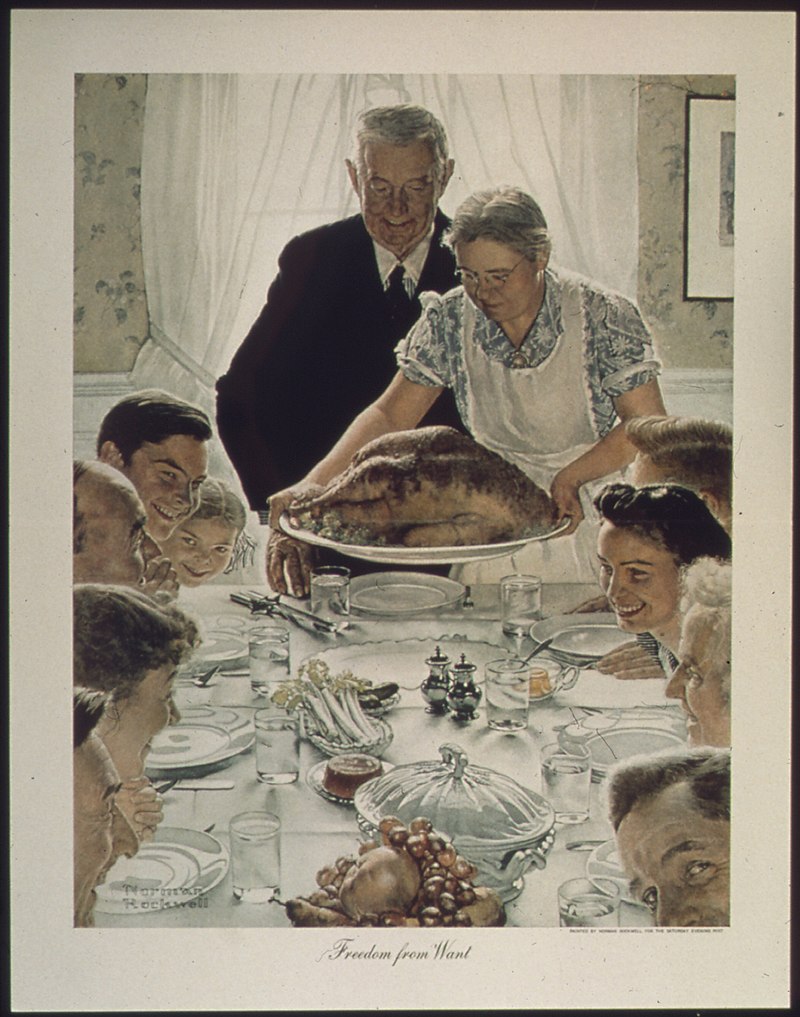
Norman Rockwell's Freedom from Want

Norman Rockwell’s painting, “Freedom from Want,” part of a quartet based on the Four Freedoms State of the Union Speech of Franklin Roosevelt, in January 1941.

Did Souza have that Rockwell painting in mind when he framed that shot?

Rockwell’s work was more than just iconic, really.  In the simple history, from Wikipedia:

The Four Freedoms or Four Essential Human Freedoms is a series of oil paintings produced in 1943 by the American artist Norman Rockwell. The paintings are approximately equal in dimension with measurements of 45.75 inches (116.2 cm) × 35.5 inches (90 cm).[1] The series, now in the Norman Rockwell Museum, was made for reproduction in The Saturday Evening Post over the course of four consecutive weeks in 1943 alongside essays by prominent thinkers of the day. Later they were the highlight of a touring exhibition sponsored by the Saturday Evening Post and the United States Department of the Treasury. The touring exhibition and accompanying sales drives raised over US$132 million in the sale of war bonds.[2]

The Four Freedoms theme was derived from the 1941 State of the Union Address by United States President Franklin Roosevelt delivered to the 77th United States Congress on January 6, 1941.[3] During the speech he identified four essential human rights (Freedom of Speech, Freedom of Worship, Freedom From Want and Freedom From Fear) that should be universally protected and should serve as a reminder of the American motivation for fighting in World War II.[4]

The theme was incorporated into the Atlantic Charter,[5] and it became part of the charter of the United Nations.[6] Roosevelt’s message was as follows: “In the future days which we seek to make secure, we look forward to a world founded upon four essential human freedoms.”[3][7]

Torpedo sandwiches from Taylor’s don’t exactly make a Thanksgiving dinner, but that’s not the point.  Rockwell portrayed an American family — at Thanksgiving, perhaps — sitting down to enjoy dinner together, breaking bread together as a Christian preacher might put it in a sermon.  President Johnson famously invited, “Come, let us reason together.”  Around Obama’s smaller-than-Rockwell’s table, the smiles are not so evident.  But I still see hope.

I see some hope for friendship, for the relationships that might move legislation, for the legislation that might move the nation.  God and Norman Rockwell know we could use it.

We can hope, can’t we?

More, perhaps related:


GOP “no-budget” hoax

January 28, 2013

If you repeat some hoary old falsehood often enough, people will begin to assume it’s got some accuracy to it, right?

Paul Ryan and Eric Cantor are at it again, complaining that the Senate hasn’t passed a budget.

But that’s false.  In fact, no only did the Senate pass a budget, but so did the House — and then (perhaps stupidly), they made it a law instead of the budget resolution the Congressional Budgeting process calls for.

Then-Senate Budget Committee Chairman Kent Conrad, D-North Dakota, explained last April how this worked:

We’ve got a budget, by law — and it’s a disaster.

We don’t need a budget resolution nearly so badly as we need some Congressional leadership who understand supply and demand, and who are committed to good government and not the destruction of America (even if unintentional).

Oliphant cartoon on GOP leading nation over fiscal cliff

Cartoon by Pulitzer Prize winner Pat Oliphant, syndicated by Go Comics

More:

Text of Sen. Conrad’s remarks, below the fold.

Read the rest of this entry »


Darrell’s corollaries of education + technology: No good work goes unpunished, most opportunities missed

January 27, 2013

Aristotle, and his pupil Alexander
Does this 19th century engraving show the perfect learning situation? Alexander had no iPhone, no laptop; Aristotle used no PowerPoint, no grading machines, not even a chalkboard. Have we come a long way, or is this a measure of how far we’ve fallen? “Aristotle and his pupil, Alexander (c. 340 BCE)” (original source?)

David Warlick‘s blog serves up a lot of stuff to make teachers think (cynically, I wonder whether education administrators can be shoved into thinking at all . . . but I digress).

David Warlick
David Warlick, formerly pictured in a taxi in Shanghai, probably off at some education conference or other, until that photo went away from the internet.

Recently he pondered his own son’s use of several different kinds of media at once.  In a longer discussion that would be worth your while, someone asked, “Has the nature of information influenced the emerging ‘appropriate technologies’ like the digital learning object called an iBook?”  David responded:

My knee-jerk response is, “Not nearly enough.” This current push toward digital textbooks, urged on by our Secretary of Education, concerns me. I worry that we’re engaged in a race to modernize schooling, rather than a sober and thoughtful imagining and designing of learning materials and practices that are more relevant to today’s learners (ourselves include), today’s information landscape and a future that has lost the comforts of certainty, but become rich with wondrous opportunities.

What I enjoyed, though, about my experience in publishing an iBook was learning to hack some features into the book that were not part of Apples general instructions for using their publishing tool. This is the ultimate opportunity of digital learning objects and environments, that they can be hacked into new and better learning experiences by information artisans who see what’s there and what it can become.

In a cynical mood, I commented on an earlier statement Warlick made, about how technology has changed the education landscape:

“… we live in a time of no unanswered questions.”

BUT:

1.  The internet and especially portable devices have exponentially increased the probability that difficult questions will be answered incorrectly.

2.  For teachers, no longer is it possible to ask a simple, factual question as a teaser to get students to search for the answer, and thereby learn something deeper along the way.  Portable computer devices present one more non-print medium in which education appears to be abdicating its duties, and the war.  (We missed radio, film, television, recorded television, and desk-top computing; now we’re missing portable devices.)

English: Cropped picture of Jaime Escalante
Legendary AP calculus teacher Jaime Escalante; pencil, paper, chalkboard and chalk, maybe a slide rule, made up his technology kit. Photo: Wikipedia

3.  No question goes unanswered, but what is really rare is a question that is worth answering; even more rare, that good question that can be answered well from free internet sources.

Darrell’s Education Technology Corollary:  When administrators and policy makers tell educators (especially teachers) they wish to utilize “new technology,” they mean they want new ways to figure out ways to fire teachers, because they don’t have a clue how technology can be used in education, nor have they thought broadly enough about what education is.

Darrell’s Education Technology Corollary Corollary: When a teacher effectively uses technology in a classroom, it will be at the teacher’s instigation, the teacher’s expense, and administrators will get revenge on the teacher for having done so.

I’ve wondered whether I wasn’t too cynical; David offered a solid response.

A couple of weeks later, my cynicism is growing.  I’m warning you, teachers, you adopt new technologies at your risk, often — especially in some school districts like Dallas ISD.

It’s a caution only.  Teachers, being teachers, will continue to push the envelopes, as Fionna Larcom related at Warlick’s blog.  Good on ’em.  One out of 500,000 will get accolades outside the education system, like Jaime Escalante did.  Many others will face reprimand.

But if education is to improve, this experimentation by teachers must continue.  So teachers slog on, under-appreciated and often opposed in their attempts to fix things.

Someday a school system will figure out how to unlock teachers’ creativity, knowledge and skills.  Not soon enough.

Teacher in primary school in northern Laos
Teacher in primary school in northern Laos.  Photo: Wikipedia

(Can someone explain to me how Warlick’s blog, with much better stuff than I do here, gets fewer hits?  Teachers, not enough of you are reading broadly enough.)

More, not necessarily the opinion of this blog:


Swearing-in stew: Inauguration week olla podrida – Where are the dung beetles when you need them?

January 25, 2013

In no particular order, nor in any particular ardor, stuff of interest and consequence we should be talking about instead of soaking in Millard Fillmore’s bathtub and admiring the plumbing:

More:


Lyndon Johnson as visionary: Great Society, speech at University of Michigan

January 25, 2013

President Lyndon B. Johnson during commencemen...

President Lyndon B. Johnson during commencement exercises at the University of Michigan on May 22, 1964 (Photo via Wikipedia, or LBJ Museum and Library in Austin, Texas)

May 22, 1964 — Lyndon Johnson laid out his vision of a much better America. At the University of Michigan Johnson discussed what a great nation in the 20th and 21st centuries should be, the Great Society speech.

This is the Lyndon Johnson speech Republicans wish had never been given, and which they hope to ignore as much as possible, laying out dreams for a better American they hope to frustrate.

More information from the LBJ Library in Austin:

Audio from President Johnson’s speech at the University of Michigan May 22, 1964, also called “the Great Society speech.” Audio is WHCA_83_2, photo is c387-8-wh64. Both are in the public domain. For more images of this speech, please see http://youtu.be/WqP037Pe5i0, which is B Roll of the same speech.

Full text of this speech at the University of Michigan is available at The American Presidency Project, at the site of the University of California – Santa Barbara (UCSB).

January 4, 1965 — Lyndon Johnson laid out the legislative plan for the Great Society.  Back then, even after crushing defeats in the 1964 elections, Republicans shared Johnson’s and the Democrats’ dreams for a better America.

Full text of this 1965 State of the Union speech can be found at The American Presidency Project at the UCSB.

From calls for international peace to a call for great expansion of federal support of education, to calls for aid for the sick and aged, is there a single area where the GOP agrees today?

How can we get the GOP to dream again?

More:


Obamacare: Still the better way, still saving money, still a good deal

January 20, 2013

A guy named William Duncan at a blog called Sensible Thoughts posted something I found inherently unsensible a while back.  He listed six reasons why he thought the Affordable Care Act should be repealed. (“A while?” “Yeah, July 2012 is ‘a while.'”)

His sixth point was the old canard about Congress and the President being exempt.  Of course they are not exempt, and so I told him.

Your sixth reason is in error. There is no provision to exempt either the president or Congress from the act. There is no language in the bill such as you describe. Language from page 114 can be found here:

https://timpanogos.wordpress.com/2012/04/17/obamacare-making-stuff-up-to-complain-about/

At some length, Mr. Duncan removed that point, but said he still thinks the law should be repealed on the other five points I hadn’t dealt with.

Ed:
Thank you for the correction on point #6. I have gone back and looked at this, and you are absolutely right. Although the Wall Street Journal and folks like Sean Hannity reported that the President and members of Congress are exempt from participation in the Affordable Care Act, in the end that did NOT make it into the language of the legislation. I have deleted point #6 from the post as a result. Thank you for the correction. Now, if you copuld only prove me wrong on the rest of the points listed…. Unfortunately, this remains a bill the the American public did not want, and was purchased by shenanigans that the Administration should be ashamed of.

A quick and dirty response; we may need to put more meat on these response bones in the next couple of months, because the opposition to ObamaCare relies on severely distorted claims about the law and what it actually does.  Much if not most of the good stuff in the law is completely ignored by these critics, and we should point that out, too.

I responded (images added here):

Disproof?

What makes you think Americans didn’t want it? There was a whale of an anti-health care campaign after the act passed, but when it passed, it enjoyed a majority of support. And, when we take each provision of the bill and ask people about that provision, they approve overwhelmingly.

English: Depiction of the House vote on H.R. 3...

Depiction of the House vote on H.R. 3590 (the Patient Protection and Affordable Care Act) on March 21, 2010, by congressional district. Democratic yea, dark blue; Democratic nay, light blue; Republican nay, red; No representative seated, white. Image from Wikipedia

For example, not even you are opposed to continuing the Reagan-era program that encourages medical schools to train more general practitioners. No one seriously objects to the provisions that pay physicians to practice in under-served areas, like West Texas, Iowa, and West Virginia. No one objects to the provisions that train more nurses. Only the most rabid racists complain about continuing and expanding the health care clinics on Indian reservations.

The law has dozens of provisions like those, and no one in their right mind objects to them.

Your other five points?

  1. The Supreme Court killed that one for you. They said that, even if you call it a fine, it’s a tax. And at that, it’s a helluva bargain. For those who do not purchase health insurance because they can’t afford to, they must pay $695 additional tax, per year. That’s about what I’d pay monthly on the open market.In any case, there are no fines, according to the Supreme Court.

    English: Depiction of the Senate vote on H.R. ...

    Depiction of the Senate vote on H.R. 3590 (the Patient Protection and Affordable Care Act) on December 24, 2009, by state. Color code is difficult to decipher; let it suffice that if there are two Democratic yea votes, the state is colored deep blue; if two Republican nay votes, very red. Image from Wikipedia

    But I can’t imagine why you oppose bargains in health care, especially when they lower the costs of health care to the insured, who will no longer pay the 15% to 25% premium to cover indigent care.

  2. With all the “new taxes,” CBO, the non-partisan group that scores these issues for Congress, projects the bill will decrease federal spending and cut the deficits annually, when fully enacted in 2014 and all out years.Do you oppose deficits or not?All the other taxes are fair, strike only the tippy-top income tiers, and are cheap at that.These taxes make the system more fair. It’s stacked against anyone making less than $150,000 a year, now. That’s most of us. I don’t like it when government helps the rich, at the expense of the poor — that’s contrary to moral standards my church holds, for example, and it tends to damage the economy.So I think more fair taxes, and lower costs, will be quite popular, once we see them.So, new taxes aren’t a good justification to oppose the law.
  3. Speaking of fallacious accounting — CBO, the group you cite, says the bill will reduce the deficits. You assume the Law won’t work, while small portions of it have already slashed inflation in health care costs, from 20% in 2009 to 4% in 2011 and 2012.But, what about repeal? CBO looked at that, too — repeal of the law will increase deficits, not decrease them. It’s only $109 billion increase in deficits, but these number directly refute all claims that repeal would be cheaper. See the analysis gateway here: http://www.cbo.gov/publication/43471
  4. This Medicare issue was hashed out, accurately and well I thought, in the campaign. Medicare costs will be reduced by holding costs down — benefits will not be reduced. Eric Cantor and Paul Ryan ran into some difficulty with this, because their budget plans assumed the savings from the Affordable Care Act, while eliminating the law that produced the savings.I’m sure there will be some adjustments required. Medicare seems a little ham-fisted when it comes to dealing with local and regional cost differences, but nationwide, over the past 40 years, enormous savings have been realized by reducing some reimbursements for procedures that once were uncommon and expensive, to a less expensive rate, now that they are more common. On the whole, over 40 years, over thousands of procedures, physicians have changed their expectations, and things have worked fine. Oh, there have been grumblings, I know. But the cuts in costs, without cuts in benefits, have stuck.Under the Affordable Care Act, we hope a lot more people will move to company plans from Medicare, or at least to the exchange plans offered in each state.One of the changes already introduced is working [link added here]. Rather than pay providers for each procedure, Medicare now reimburses hospitals for effective hospitalization — that is, when a patient is discharged and then re-enters a hospital for the same complaint, the hospital will lose money. Hospitals are keeping patients a few days longer on many procedures, to insure that one hospitalization is all that is required. Savings are already being made in costs, while improvements have resulted in the health care – better health in the patients!In all, CBO says costs will come down with the Affordable Care Act, as advertised, and costs will rise and deficits will rise if the Act is repealed.
  5. Your abortion argument is too metaphysical, and not enough real-world. Do you want to reduce the number of abortions? Then provide health care, make sure contraception is freely available (not for free, but freely), and stand back. Those two things reduce abortions, as they did during the Clinton administration.Restrictions on abortion, on the other hand, make it more likely a woman will choose to terminate a pregnancy under a number of circumstances: She doesn’t have health care coverage, her coverage does not cover pre-natal care, her coverage won’t cover a new infant, the pregnancy is unplanned due to lack of good information on family planning or lack of access to affordable contraception.You can choose: Restrict abortions and increase the number of abortions, or provide health care, and reduce the number of abortions.It may be a bit counter-intuitive, but you’d better study the issue. The Affordable Care Act’s provisions, Obamacare, have over the years reduced abortions where applied; cutting off that care has increased the number of abortions.My advice would be, don’t kill the babies to make a political point.

I am concerned that you don’t appear much familiar with what the bill actually does. Here are a few reasons to keep the law.

  1. We need more physicians, and the bill provides them.
  2. We need more physicians in underserved areas, and the bill provides them.
  3. We need more nurses, and the bill provides them.
  4. We need more community clinics in underserved urban areas [link added here], where illnesses and injuries frequently go untreated until extreme trauma results, and the victim must get extremely expensive care in an emergency room. This will be one of the biggest cost savers — and the law provides those clinics.
  5. The law will cut the private bureaucracy, and completely dismantle the private death panels set up by insurance companies, saving at least 10% of every health care dollar, applying that money to care instead of bureaucracy. This is already occurring.
  6. Preventive care under the Act is greatly encouraged — if we can boost flu vaccines by another 10%, it will save thousands of lives annually, and millions of dollars in hospitalization costs. Flu shots came with no co-pay this year — did you notice? — so that anyone with any insurance at all could drop by any pharmacy offering flu shots and get one with no out-of-pocket expenses.
    This is huge. Everyone agrees the cheapest health care is for healthy people. The Affordable Care Act changes the way health care is delivered, to emphasize prevention of disease and injury, instead of triage. Prevention usually costs about 10% what the triage would cost.
  7. Removing the lifetime cap on insurance payments, per patient, will save a few thousands of lives, annually. It should kill the phenomenon where many families, hit with a costly disease or accident, had to declare bankruptcy as a result. A significant portion of all bankruptcies have been “not adequately-insured” cases. Those should almost disappear.
  8. Allowing children to stay insured, on a parent’s plan, for those critical years after high school and college and into the second job, with benefits has already benefited millions of Americans, saving millions of dollars and probably a few lives.

I cannot imagine why anyone would want to go back to 20% annual health care cost inflation, the highest per capita health care costs in the world by a factor of two, while leaving one out of every seven people uninsured even though we were paying amounts more than the insurance would have cost.

Obamacare reduces the deficits, and puts our health system on the path to catch up to the rest of the industrialized world, with better care for less cost.

I’ll keep it, thank you.

(See this, too: “More good news about Obamacare: CBO says it will save money”

More:


You need to watch this: Paul Krugman, ‘Jobs NOW, the key to our recovery’

January 15, 2013

As so often the case, Bill Moyers finds THE expert, who has the real answers.  Hint:  Cutting deficits now could bring economic disaster; Paul Krugman carefully and clearly explains why.

Description at Vimeo:

Krugman's book End This Depression Now!

Cover of Paul Krugman’s book, End This Depression Now!

Nobel Prize-winning economist and New York Times columnist Paul Krugman explains why our top priority should be getting America back to work – if only Congress and the President would stop throwing distractions in the way. He also details the catastrophic impact the economic downturn continues to have on average Americans, as well as avenues of hope and recovery. Krugman’s latest book, End This Depression Now!, is both a warning of the fiscal perils ahead and a prescription to safely avoid them.

Yeah, yeah, I know — this thing is 47 minutes long!  Watch ten minutes now, and come back to it.

It’s only the fate of our nation, and the planet, that rides on this information.

Moyers explained on his blog:

Nobel Prize-winning economist and New York Times columnist Paul Krugman argues that saving money is not the path to economic recovery. Instead, he tells Bill, we should put aside our excessive focus on the deficit, try to overcome political recalcitrance, and spend money to put America back to work. Krugman offers specific solutions to not only end what he calls a “vast, unnecessary catastrophe,” but to do it more quickly than some imagine possible. His latest book, End This Depression Now!, is both a warning of the fiscal perils ahead and a prescription to safely avoid them.

Some moments from the conversation:

ON JACK LEW, NOT KRUGMAN HIMSELF, AS POSSIBLY THE NEXT TREASURY SECRETARY
“I probably have more influence doing what I do now than I would if I were inside trying to do the court power games that come with any White House, which I don’t think I’d be any good at… What the president needs right now is he needs a hard-nosed negotiator. And rumor has it that’s what he’s got.” Watch this clip.

ON SAVING VERSUS SPENDING
“We’re awash in excess savings. And if you decide to save more, it’s not actually going to help society… If there’s one crucial thing to understand about all this it is that the global economy, money moves around in a circle. And my spending is your income, and your spending is my income. And if all of us try to spend less because we want to save more, we don’t succeed. All we end up doing is creating a global depression… the thing that all the evidence of history says works in a situation like this is the private sector won’t spend, government can step in and provide the spending that we need in order to keep this economy afloat.”

ON THE POWER OF JOB CREATION
“The only obstacles to putting people to work, to having those lives restored, to producing hundreds of billions, probably $900 billion a year or so of extra valuable stuff in our economy, is in our minds. If I could somehow convince the members of Congress and the usual suspects that deficit spending, for the time being, is okay, and that what we really need is a big job creation program, and let’s worry about the deficit after we’ve had a solid recovery, it would all be over. It would be no problem at all… All the productive capacity is there. All that’s lacking is the intellectual clarity and the political will.”

ON WHAT SHOULD BE OBAMA’S ECONOMIC PRIORITY
“[Obama’s] policy priority right now should be doing whatever he can to at least move in the direction of the kinds of policies that we want for full employment, that we need for full employment. And that the obsessions of Washington about a grand bargain on the deficit are really pretty much beside the point right now. That, if given a choice between doing something that will help the economy in the next two years, and something that will allegedly settle our budget problems for all, you know, for all time, which it wouldn’t, that he should go for the stuff that will help the economy now…

Great Depression

In the Great Depression, people listened to Franklin D. Roosevelt urge full employment, on their radios; this statue is part of the FDR Memorial in Washington, D.C. – Photo credit: Koshyk

We happen to have a very intelligent man as president. He’s for real. And he does understand. You can have real discussions with him. And I think he understands that, although things have improved some… it’s a glacial pace, compared with the way we should be… We cannot allow ourselves to be blackmailed into spending cuts, partly because blackmail should not be part of how the U.S. operates, and partly because spending cuts would be disastrous right now. So Obama’s right to say he doesn’t negotiate. I’d like to know exactly what he will do if it turns out that there is not a quorum of sane people in the Republican party.”

ON THE LONG-TERM DAMAGE OF A BAD JOB MARKET
“We have pretty good evidence on how long does it take to make up for the fact that you happen to graduate from college into a bad labor market. And the answer is forever… You’ll miss years getting onto the career ladder. By the time you get a chance to get a job that makes any sense, you know, that makes any use of your skills, you will already be tarred as somebody, ‘Well, you’re 28 years old and you haven’t held a responsible position?’ ‘Well, yeah, I couldn’t because there were no jobs.’ It just shadows your whole life. And it’s very clear in the evidence from past recessions, which have been nowhere near as bad as this one.” Watch this clip.

ON COVERING BOTH THE ECONOMY AND POLITICS
“If you write about economics right now and implicitly adopt the perspective, ‘Well, let’s get reasonable people together in Washington and reach a solution here,’ you’re paying no attention to reality. And, of course, if you talk about the politics without talking about the economics, you’re also missing everything. So how could I not be writing about both?”

More:


Annals of global warming: “Federal Advisory Committee Draft Climate Assessment Report Released for Public Review”

January 12, 2013

It’s taken too long, but the reports on climate change, required by a 1990 law, flow down the government report-to-the-public pipeline once again.  Mother Jones reports six chief points in the draft document, for which comments are invited before a final document will be issued:

  1. Climate change is definitely caused by human activities. Always nice to hear government officials acknowledge this essential fact. And the report concedes that our only hope of curbing warming is to kick our addiction to greenhouse-gas spewing fossil fuels.

  2. Extreme weather is increasing, and that’s our fault, too.  In particular, searing temperatures, heavy rain, and prolonged drought.

  3. Weather isn’t the only threat we have to worry about. The list sounds like the side-effect warnings at the end of a prescription drug commercial: decreased air quality, insect-borne diseases, and “threats to mental health” are all on the docket for the coming decades.

  4. Our infrastructure is getting hammered, and we’re not spending enough to save it. Floods are destroying farmland; extreme heat is damaging roads, rail lines, and airports; and military installations are at risk.

  5. Food and water security will be up in the air. Especially in water-scarce regions like the Southwest, decreasing snowpack and shrinking groundwater supplies will spark competition for water between “agricultural, municipal, and environmental” uses. At the same time, heavy floods could put water quality at risk with sediment and chemical contaminates. And by mid-century, efforts to artificially protect agriculture (like expanded irrigation) could be over-ridden by temperature and precipitation extremes.

  6. Climate change is hitting plants and animals just as hard as us. Beaches, forests, wetlands, and other ecosystems could shrink or disappear, especially a problem when they play a role in mitigating the impact from extreme weather. And warming, acidifying seas could slam sea life.

The document is available to read online; public comments are invited, but must come in a specific form to be analyzed (the authors expect a lot of comments, and a lot of detailed comments).  Here’s the transmission document from the agency (a few links added here):

Federal Advisory Committee Draft Climate Assessment Report Released for Public Review

A 60-person Federal Advisory Committee (The “National Climate Assessment and Development Advisory Committee” or NCADAC) has overseen the development of this draft climate report.

The NCADAC, whose members are available here (and in the report), was established under the Department of Commerce in December 2010 and is supported through the National Oceanic and Atmospheric Administration (NOAA). It is a federal advisory committee established as per the Federal Advisory Committee Act of 1972. The Committee serves to oversee the activities of the National Climate Assessment. Its members are diverse in background, expertise, geography and sector of employment. A formal record of the committee can be found at the NOAA NCADAC website.

The NCADAC has engaged more than 240 authors in the creation of the report. The authors are acknowledged at the beginning of the chapters they co-authored.

Following extensive review by the National Academies of Sciences and by the public, this report will be revised by the NCADAC and, after additional review, will then be submitted to the Federal Government for consideration in the Third National Climate Assessment (NCA) Report.  For more information on the NCA process and background, previous assessments and other NCA information, please explore the NCA web-pages. The NCA is being conducted under the auspices of the Global Change Research Act of 1990 and is being organized and administered by the Global Change Research Program.

To simply access and read the draft report, please download the chapters below. However, if you would like to submit comments on the report as part of the public process, you will need to enter the “review and comment system” and register with your name and e-mail address and agree to the terms.  All comments must be submitted through the review and comment system.

Contents of the report, chapter by chapter, for your download:

Download Chapters of the NCADAC Draft Climate Assessment Report! 
Download the Full Report (warning, 147Mb. Very large file)Between chapters, there are some page numbers that are not used. This is intentional and does not reflect missing pages.or download each chapter separately:

Cover page

Introduction: Letter to the American People

1. Executive Summary

2. Our Changing Climate

Introduction to Sectors

3. Water Resources

4. Energy Supply and Use

5. Transportation

6. Agriculture

7. Forestry

8. Ecosystems, Biodiversity, and Ecosystem Services

9. Human Health

10. Water, Energy, and Land Use

11. Urban Systems, Infrastructure, and Vulnerability

12. Impacts of Climate Change on Tribal, Indigenous, and Native Lands and Resources

13. Land Use and Land Cover Change

14. Rural Communities

15. Interactions of Climate Change and Biogeochemical Cycles

Introduction to Regions

16. Northeast

17. Southeast and Caribbean

18. Midwest

19. Great Plains

20. Southwest

21. Northwest

22. Alaska and the Arctic

23. Hawaii and the U.S. Affiliated Pacific Islands

24. Oceans and Marine Resources

25. Coastal Zone Development and Ecosystems

Introduction to Response Strategies

26. Decision Support: Supporting Policy, Planning, and Resource Management Decisions in a Climate Change Context

27. Mitigation

28. Adaptation

29. Research Agenda for Climate Change Science

30. The NCA Long-Term Process: Vision and Future Development

Appendix I: NCA Climate Science – Addressing Commonly Asked Questions from A to Z

Appendix II: The Science of Climate Change

To provide comments:

Between January 14th and April 12th only: Please go to the Review and Comment System to provide comments on the draft.

You must register and accept the terms in the Review and Comment System in order to review this document. Comments will only be accepted through this system.

NOTE: You will not be allowed to create an account in the system prior to 9am ET January 14th, 2013, and the comment period ends at 5pm ET on April 12th, 2013

If 2012 was, indeed, the year excrement got real in climate change, perhaps 2013 can be the year we start to do something about it.

More:


It’s raining crazy

January 12, 2013

Sheesh! Did climate change boost the crazy crop, or what?

Without much comment, a few stories that cropped up in the browser today; as the comic writer Dave Barry says, you can’t make this stuff up.  If you were trying to sell it as fiction, they’d laugh you out of the room.  Nobody could be that crazy . . . and yet:

  1. Creationists visited the Perot Museum of Nature and Science in Dallas.  Perhaps unsurprisingly, they found they don’t like what science knows about nature, especially evolution.  Why did they even bother to go?  Story at the Sensuous Curmudgeon.
  2. At Slate, David Weigel wrote about Virginia Gov. Bob McDonnell’s plan to eliminate the state tax on gasoline — the tax that pays for roads and bridges — and instead tax hybrid cars.   It’s stupid, because it dramatically increases taxes on clean air machines, and it creates the wrong incentives for a tax system.  But it’s dramatically crazy because it sucks money out of the funds to build and repair roads and bridges.  As best I can tell, it takes a tax that collects about $100/vehicle now, and imposes a tax on about 5% of cars, of about $100.  There can’t be enough money coming in to replace the tax.  In short, McDonnell’s plan damages jobs, hurts business, and leaves Virginia in the back row of well-run states.  With patriot plans like McDonnell’s, who needs al Quaeda, the Soviet Union, or China?

    RawStory image of Fox News Eric Bolling flunking math on national teleivision

    Fox News’s Eric Bolling calls the distributive property of multiplication “liberal bias.” It must be embarrassing to flunk algebra so publicly on national television. RawStory image

  3. Sometimes the excess of stupid makes you feel embarrassed for them.  Fox News distorter Eric Bolling accused teachers (natch!) of indoctrinating students in algebra classes.  (See what I mean?  You can’t make up this sort of crazy — oh, you don’t see what I mean?  Read on).  Seems Mr. Bolling has discovered — this is exclusive — that there are problems in algebra books that teach the distributive property of multiplication! Can you get much more liberal that that? Bolling wonders.  The rest of us wonder, can Fox News sink any lower in the stupid sump.  (Distributive property.)
  4. Meanwhile, in Tennessee, James Yeager who claims to be a consultant and instructor in security, urges people to arm up for civil war because, Yeager is sure, Obama is coming to get everybody’s guns.  His profanity-laced YouTube rant is off of his site, but preserved for us (fortunately? unfortunately?) at RawStory.  This is a bit too crazy even for West Tennessee — the state suspended the man’s handgun carry permits. (Would he have been so persecuted, had he been living in East Tennessee?)
  5. Hackers exploited a flaw they found in Java 7 — the U.S. Department of Homeland Security can’t figure a fix, and neither has Oracle, so Homeland Security urges businesses to disable Java on their browsers.

    Bildbeschreibung: Frank Zappa-Statue von Vacla...

    There’s a statue to Frank Zappa in Europe, another in Baltimore; Rep. Gingrey, not so much. Frank Zappa-Statue von Vaclav Cesak in Bad Doberan Quelle: selbst fotographiert Fotograf/Zeichner: Hei_ber Datum: 2003 Sonstiges: (Photo credit: Wikipedia)

  6. Another Republican Member of the House of Representatives made a burro of himself with comments about rape.  In a bad paraphrase of Frank Zappa, “Rep. Phil Gingrey, what’s gotten into you?”  Gingrey misrepresents a district in Georgia.
  7. The House GOP is still threatening to shoot America’s economy in the head unless Democrats agree to crash the economy in the ditch with draconian, unnecessary and damaging spending cuts.
  8. Anthony Watts already has a half-dozen posts up denying the recent findings that 2012 was the warmest year on record for the contiguous 48 United States.  James Delingpole, at The Daily Mail is just making stuff up.  (Should it be “Gourdian?”) I hadn’t realized there was a King of Denial crown up for grabs.

    Update, January 15, 2013:  Greg Laden reported that the Watts blog has taken crazy to cosmic proportions.

There is good information out there.  I hope there is an army of sane people to get the good information, and sort it from the bad.

I’m going to sleep on it.  Good night!

More:

This one’s for you, Eric Bollinger; from Khan Academy, the Distributive Property of Multiplication:

(Did you notice that the answer was the same under the “liberal” distributive law as it was without its use?)


Banksy’s modern Nativity, revisited in 2012

December 25, 2012

An encore post, from 2008.

Thomas Nast helped bring down the crooks at Tammany Hall with cartoons. Boss Tweed, the chief antagonist of Nast, crook and leader of the Tammany Gang, understood that Nast’s drawings could do him in better than just hard hitting reporting — the pictures were clear to people who couldn’t read.

But a cartoon has to get to an audience to have an effect.

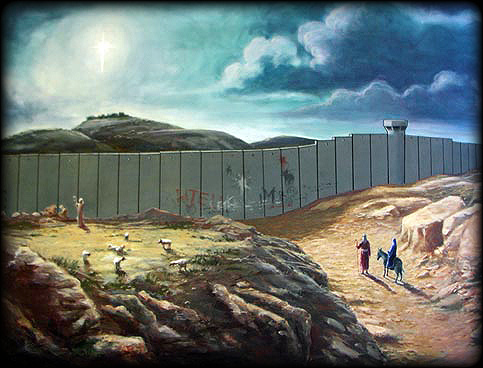
Here’s a cartoon below, a comment on the security wall being built in Israel, that got very little circulation in the west at Christmas time. Can you imagine the impact had this drawing run in newspapers in Europe, the U.S., and Canada?

It’s a mashup of a famous oil painting* related to the Christian Nativity, from a London-based artist who goes by the name Banksy. (Warning: Banksy pulls no punches; views shown are quite strong, often very funny, always provocative, generally safe for work unless you work for an authoritarian like Dick Cheney who wants no counter opinions.)

banksy-israels-wall-77721975_fda236f91a.jpg

Banksy’s modern nativity — does he ever bother to copyright his stuff, or would he rather you broadcast it?

*  At least I thought so in 2008.  I can’t find the painting now.  Anybody recognize a work underneath Banksy’s re-imagining?  Let us know in comments, eh?  Perhaps this one, by David Roberts?  Perhaps this engraving after Joseph M. W. TurnerTurner’s original?

Tip of the old scrub brush to Peoples Geography.

More, in 2011: 

More in 2012:


FactCheck comes clean on political affiliations

December 23, 2012

It was some time ago, but a lot of people appear not to have noticed.

Annenbergs and Reagan in the White House

President Reagan talking to Leonore Annenberg and Walter Annenberg at the President’s birthday party in the East Room, February 6, 1981. Photo from the Ronald Reagan Library

FactCheck.org, the group at the University of Pennsylvania that checks the accuracy of political ads and political statements, made a disclosure of its political leanings — in a post way back in 2009.

The truth?  Right here:

President Reagan, in 1981, spent all or part of 42 days away from the White House “on vacation” at his home in Santa Barbara, Calif, according to Knoller. President Reagan and his wife, Nancy, also spent three or four days around New Year’s Day each year in Palm Springs, Calif., at the home of philanthropist Walter Annenberg. (In 1993 the late Mr. Annenberg founded the nonpartisan Annenberg Public Policy Center of the University of Pennsylvania, which is FactCheck.org’s parent organization.)

So there you have it, in FactCheck’s own words — they’re connected to Ronald Reagan through Walter Annenberg.

So, the next time someone tells you FactCheck.org is founded and run by “libruls,” send ’em here to see the real photographic evidence.

More:

Walter Annenberg, Ronald Reagan, and hangers on, December 31, 1985

Official White House photo: From left, Walter Annenberg, President Ronald Reagan, Charles Price, William French Smith, George Shultz, and Donald Regan, December 31, 1985. Photo taken at Annenberg’s estate, Sunnylands: “Sunnylands, the impeccably haute-moderne Shangri-la completed in Rancho Mirage, California, in 1966 by the late billionaire publisher, philanthropist, and power broker Walter Annenberg and his wife, Lee, was a haven for presidents and monarchs, stars and tycoons: the history-makers of the late 20th century.”


Split in environmental movement? No. Facts still matter

December 21, 2012

Rachel Carson was right in her claims against DDT in Silent Spring, of course, as all subsequent research shows. Drawing by New York Magazine's immortal David Levine.

Rachel Carson was right in her claims against DDT in Silent Spring, of course, as all subsequent research shows. Drawing by New York Magazine‘s immortal David Levine.

Chris Clarke took on Keith Kloor at Pharyngula.  Kloor fell victim to the idea that there is a great split between old “tree-hugger” environmentalists and a newer breed of greens who are willing to work with business and industry to get actual solutions.  Kloor seems to be cheering those he calls “modernists.”

It’s not a new idea, nor is a particularly useful one.  There has long been a minor rift between people who believe it’s impossible to cut deals with polluters, and those who get into the trenches to hammer out or shoot out deals that result in practical legislation.  The group who called for a legislated end to personal automobiles, for example, are still around — but they applaud those who forged the Clean Air Act that drove the invention and development of catalytic converters and cleaned up urban air, even though it left America awash in cars.

Clarke wrote:

Kloor summarizes the better, smarter, more stylish and less embarrassing side’s position thusly:

Modernist greens don’t dispute the ecological tumult associated with the Anthropocene. But this is the world as it is, they say, so we might as well reconcile the needs of people with the needs of nature. To this end, [controversial environmentalist Peter] Kareiva advises conservationists to craft “a new vision of a planet in which nature—forests, wetlands, diverse species, and other ancient ecosystems—exists amid a wide variety of modern, human landscapes.”

That doesn’t seem all that unreasonable on its face, if for no other reason that that it’s currently the best case scenario. You would be extremely hard-pressed to find even the most wilderness-worshipping enviro who disagreed.

In fact, were I to have to rebut Kloor’s whole piece in one sentence, it would be this:  the U.S. non-profit The Wilderness Society, founded by the authors of the Wilderness Act of 1964, is aggressively pushing for industrial development of solar and wind energy generating capacity on intact habitat on the public lands of the American west.

President Lyndon B. Johnson signing the Wilder...

President Lyndon B. Johnson signing the Wilderness Act in 1964 (Photo credit: Wikipedia)

I replied at Pharyngula, noting that the rift Kloor talks about could be exemplified by Rachel Carson and DDT and “modernists” who don’t object to the use of DDT in Indoor Residual Spraying (IRS) to fight malaria — except, those are the same people, working on the same issue.  In short, I sorta agree with Clarke.  There’s no rift, only a lot of misunderstanding.

Heck, if I’m going to that trouble, I may as well capture it here for my indexing purposes.  Here’s my response — I may add links in the body that don’t appear at Pharyngula.

Interesting view of a bit of an inside-baseball (environmental protection politics) issue, but not particularly incisive. Other than its being published at Slate, should we worry about Kloor’s views much?

The piece completely ignores that the views of those he labels “modernists” and “pragmatists” come wholly out of the research demanded by those he ignores in the old movement, whom he unfairly ridicules as hippies.

For example: It’s politically correct (in some circles) today to say (1) Rachel Carson was too strident, and (2) probably wrong about DDT “since it’s (3) not carcinogenic, we now know.” Malaria fighters around the world (4) now have DDT in their arsenal again, this view holds, because (5) pragmatists in the environmental movement finally listened. “(6) Sorry about those ‘unnecessary’ malaria deaths,” some claim the pragmatists would say.

But that view is founded on, grown in, and spreads, historical, legal and scientific error. And the progress made was based on understanding the science, history and law accurately. It’s not that pragmatists finally succeeded where the tree-huggers failed. It’s that the tree-huggers hung in there for 50 years and the world has come around to recognizing good effects, even if it can’t or won’t acknowledge the true heroes who got the work done.

Carson was dead right about DDT. She urged the use of Integrated Vector (Pest) Management (IVM, or IPM) in place of DDT, but she forecasted (in 1962!) that unless DDT use were severely curtailed, it would cease to be useful to fight malaria and other diseases (because, as Carson understood, evolution works, and the bugs evolve defenses to DDT). By 1965, WHO had to end its ambitious campaign to eradicate malaria because, as Carson predicted, mosquitoes in Africa turned up resistant and immune to DDT because of abuse and overuse of the stuff in other applications. Notice, 1965 was seven years BEFORE the U.S. banned DDT use on agricultural crops, and 19 years before the last U.S. DDT manufacturer scurrilously fled to bankruptcy protection to avoid penalties under Al Gore’s SuperFund cleanup bill.

Carson did not claim DDT causes cancer. So the basis of the argument that DDT is “safe for human use” because it doesn’t cause cancer, is an historical non-starter. Research since Carson’s death shows that DDT does indeed cause cancer, though we think its a weak carcinogen in humans. DDT was banned because it’s a deadly poison (else it wouldn’t work!), and it kills for a long time, and it is nonspecific — so it will kill an entire ecosystem before it can eradicate some insect pests. It was in 1971, and it still is.

Photo taken at Rachel Carson's 100th Birthday ...

Photo taken at Rachel Carson’s 100th Birthday celebration at Rachel Carson Homestead in Springdale, Pennsylvania (Photo credit: Wikipedia)

Carson did note that DDT kills birds, in vitro, by incapacitating chicks to thrive, by outright poisoning insect-eating and predatory birds (or anything near the top of the trophic levels) and through a then-mysterious scrambling of reproductive abilities. About ten years after her death, it was discovered DDT also rendered female fowl unable to make competent eggshells, and that provided a fifth path for death for birds.

Much of the research Carson cited formed the foundation for the science-based regulation EPA came up with in late 1971 that ended in the ban on DDT in the U.S. None of those studies has ever been seriously challenged by any later research. In fact, when Discover Magazine looked at the issue of DDT and birds and malaria in 2007, they found more than a thousand peer-review follow-up studies on DDT confirming Carson’s writings.

Over the past decade we’ve seen a few bird species come off of the Endangered Species List. Recovery of at least four top predators should be credited squarely to the ban on crop use of DDT in the U.S, brown pelicans, peregrine falcons, osprey, and bald eagles. 40 years of non-use, coupled with habitat protection and captive breeding programs, brought these birds back. (Five years ago I sat on the lawn of Mt. Vernon and watched a bald eagle cross the Potomac to a snag 100 yards from George Washington’s porch; the director told me they’d been watching several eagles there for a couple of years. 15 years earlier, one nesting pair existed in the whole Potomac region, at a secret site; now tourists are told where to go see them. A friend wrote today he saw a bald eagle in Ft. Worth, Texas. The gains from the DDT ban are real.)

Meanwhile, in Africa and Asia, the war on malaria continued. After the DDT advocates screwed up the malaria eradication program of WHO in the 1960s, progress against malaria continued, but slowed; in the late 1980s malaria flared up in some regions where the malaria parasites themselves had developed resistance to the most commonly-used pharmaceuticals (as Darwin would have predicted, as Carson would have predicted). After struggling to keep malaria from exploding, about 1999 malaria fighters latched on to Integrated Pest Management (IPM), which couples occasional spraying of homes and other residences, even with DDT (which was never banned in Africa or Asia) — but calls for spraying only when it is very effective, and requires that no one pesticide be used to the point that it drives mosquitoes to evolve resistance, and pushes all other means to prevent disease-spreading bug bites.

Largely without DDT (though DDT is not banned), malaria infections fell from peak DDT-use years of 1959 and 1960, from 500 million infections per year, to fewer than 250 million infections today — that’s a decrease of 50%. Phenomenal when we consider the population of the world has doubled in the same time. Deaths dropped from 4 million annually in those peak-DDT-use years to fewer than 800,000 per year today — a decrease of more than 75%. Progress continues, with IPM; bednets now do better, and more cheaply, what DDT used to do but largely cannot anymore — stop the bites. Better medicines, and better educated health care workers, clean up the disease among humans so mosquitoes can’t find a well of infection to draw from.

Notice that at no point was progress made contrary to the “tree-hugger” model, but instead was made at every point because of the tree-hugger model. No compromises enabled the recovery of the bald eagle, but strict enforcement of the environmental laws. No compromises with Rachel Carson’s Silent Spring helped beat malaria, but finally applying what Rachel Carson actually wrote.

Now along comes Kloor to say that Carson and her de facto acolytes block progress, and people who argue for compromise instead have the lighted path to the future?

Let’s review:

  1. Carson was not too strident; in fact the President’s Science Advisory Committee’s report, “Use of Pesticides,” in 1963 called for more immediate and more draconian action than Carson did.
  2. Carson was not wrong about DDT; it is still a deadly poison, and it still kills ecosystems; however, as Carson urged, careful use can provide benefits in a few cases.
  3. Human carcinogenicity was not an issue in DDT’s being banned in the U.S. in 1972, and it’s being only a weak carcinogen now does not rescue DDT from the scientifically-justified ban; we now know DDT is even more insidious, since it acts as an endocrine disruptor in nature, scrambling reproductive organs of fish, amphibians, reptiles and mammals, and probably birds, too.
  4. Malaria fighters always had DDT in their arsenal; no reason to use DDT where it won’t work, nor where it’s harms outweigh its benefits (as the National Academy of Sciences said, in 1970, in a call to get rid of the stuff).
  5. If there were any pragmatists in this story, they abandoned malaria-affected areas of the world years ago and have not returned; they did nothing to help save the birds; to claim they listened is to suggest they did something and can do more. Not sure that’s a case that can be made.
  6. There were not deaths to malaria “unnecessary” due to a ban on DDT which never occurred in Africa or Asia, while DDT was plentiful and cheap to anyone who wanted to use it (still pretty much the case today). Let’s repeat that:  DDT has never been banned in Africa or Asia.  We can’t claim great disease exacerbation when the disease actually was abated so greatly over the period of time in discussion — can’t make that claim and also claim to be honest.

It was the hard-core, wilderness-loving, science-following environmentalists who were responsible for every lick of progress on that issue.

Is DDT unique as an issue? I don’t think so. And I think a fair history of the environmental movement from 1975 to today would point out that it was hard-core, save-the-planet-because-it’s-the-only-home-humans-have types who pulled things out. Do we have great canyons to hike in Colorado and Utah? Yeah, but keeping Exxon from digging up huge portions of those states for a now-failed oil-shale extraction scheme should get some of the credit. Is there wildlife in cities? Sure, but only because we had wilderness areas to protect those species in their darkest hours, and we may need those places again. Do we have other needs for wilderness? Only if we need clean air, clean water, huge sinks for CO2 emissions, and places to dream about so we stay sane and focused, and American (Frederick Jackson Turner was correct enough — Americans are more noble, more creative, wiser and more productive, if we have a frontier and a wild).

Isn’t it required that we compromise on standards to get energy independence, and economic prosperity? Don’t look now, but oil and natural gas production, and exploration, are at highs, under our “tough environmental laws.” If we look around the world, we see that future prosperity is best protected by such laws, even if they sometimes seem to slow some industrial process or other.

New generation of conservationist? Possible only because of the old generation, the Pinchots, Roosevelts (esp. the two presidents), the Lincolns and Grants, the Muirs, the Leopolds, the Bob Marshalls, the Udalls, the Morans, the Douglases (Marjory Stoneman and Justice William, both), the Rockefellers, the Nelsons, the Muskies, the Gores, the Powells, and thousands of others who were then ridiculed for being unpragmatic, and whose methods often required that they not “compromise.” We can’t talk about protecting wilderness today unless the Sierra Club was there to actually do it, earlier. We can’t talk about private efforts, or public-private partnerships, without standing on the ground already protected by the Nature Conservancy. We can’t talk about saving the birds without relying on the history of the Audubon Society. We can’t talk sensibly about protecting humans from cancer or poisons without touching every rhetorical string Rachel Carson plucked.

Get the science right. Keep your history accurate. Read the fine print on the law, and on the pesticide label. Conservation isn’t for the birds, bees, bears, trout and flowers — it’s for humans. That’s news to Kloor? Maybe that’s why his view is skewed.

Progress is made by unreasonable and stubborn people, sometimes? No, Martin Luther King, Jr., said — those are the only people who make progress.

We aren’t going to build a future conservation movement by giving away what has been conserved to now.

More:


NRA reputation damaged

December 19, 2012

An observer of American politics may wonder whether the past few days have changed any of the old political lines on gun control issues and the Second Amendment.

Does a view from Canada tell us anything?  Here’s Aislin‘s cartoon, from the Montreal Gazette,  for December 18, 2012:

Aislin cartoon, Montreal Gazette, 12-18-2012

Aislin, Montreal Gazette, December 18, 2012

Too brutal, or too close to the truth?

A little history quiz in a cartoon, yes?  Can you identify all six symbols?  How many must one know to understand the cartoon?

More:

Summer's End. Lexington Green, 11 September 20...

U.S. flag at half-staff, at the Minuteman Memorial in Lexingon, Massachusetts (Summer’s End. Lexington Green, 11 September 2002. Photo taken in Minute Man National Historical Park. Sculpture : “Minuteman” by sculptor Henry Hudson Kitson (1863-1947), dedicated April 19, 1900. Erected 1899 : SIRIS Image: Wikipedia)