Bush/Romney-onomics: Disaster redux?

July 2, 2012

BushRomney-onomics.  It worked so well in 2008, didn’t it?

Mike Peters in the Dayton Daily News - King Features Syndicate, "Miss me yet"

Mike Peters in the Dayton Daily News, and King Features Syndicate, May 25, 2012. Did your local newspaper carry this cartoon? Why not? Call them and ask.  More editorial cartoons, click the cartoon.

Peters’s editorial cartoons in the Dayton Daily News is one feature that distinguishes the newspaper, still, as one of America’s great daily papers.  Here’s to the editors who keep doing it right.


Go to the original source: Supreme Court’s decision on Obamacare

June 28, 2012

You can read the entire decision here:  http://www.supremecourt.gov/opinions/11pdf/11-393c3a2.pdf

5-4 decision, Chief Justice Roberts voting to uphold the bill, Kennedy voting against and leading the dissent.

Official 2005 photo of Chief Justice John G. R...

Official 2005 photo of Chief Justice John G. Roberts (Photo credit: Wikipedia)

Syllabus from the case (links added for your convenience, not in the original):

NATIONAL FEDERATION OF INDEPENDENT BUSINESS ET AL. v. SEBELIUS, SECRETARY OF
HEALTH AND HUMAN SERVICES, ET AL.
CERTIORARI TO THE UNITED STATES COURT OF APPEALS FOR THE ELEVENTH CIRCUIT
No. 11–393. Argued March 26, 27, 28, 2012—Decided June 28, 2012*

*Together with No. 11–398, Department of Health and Human Services et al. v. Florida et al., and No. 11–400, Florida et al. v. Department of Health and Human Services et al., also on certiorari to the same court.

In 2010, Congress enacted the Patient Protection and Affordable Care Act in order to increase the number of Americans covered by health insurance and decrease the cost of health care. One key provision is the individual mandate, which requires most Americans to maintain“minimum essential” health insurance coverage. 26 U. S. C. §5000A.For individuals who are not exempt, and who do not receive health insurance through an employer or government program, the means of satisfying the requirement is to purchase insurance from a private company. Beginning in 2014, those who do not comply with the mandate must make a “[s]hared responsibility payment” to the Federal Government. §5000A(b)(1). The Act provides that this “penalty”will be paid to the Internal Revenue Service with an individual’s taxes, and “shall be assessed and collected in the same manner” as tax penalties. §§5000A(c), (g)(1). Another key provision of the Act is the Medicaid expansion. The current Medicaid program offers federal funding to States to assist pregnant women, children, needy families, the blind, the elderly, and the disabled in obtaining medical care. 42 U. S. C. §1396d(a). The Affordable Care Act expands the scope of the Medicaid program and increases the number of individuals the States must cover. For example, the Act requires state programs to provide Medicaid coverage by 2014 to adults with incomes up to 133 percent of the federal poverty level, whereas many States now cover adults with children only if their income is considerably lower, and do not cover childless adults at all. §1396a(a)(10)(A)(i)(VIII). The Act increases federal funding to cover the States’ costs in expanding Medicaid coverage. §1396d(y)(1). But if a State does not comply with the Act’s new coverage requirements, it may lose not only the federal funding for those requirements, but all of its federal Medicaid funds. §1396c.

Twenty-six States, several individuals, and the National Federation of Independent Business brought suit in Federal District Court,challenging the constitutionality of the individual mandate and the Medicaid expansion. The Court of Appeals for the Eleventh Circuit upheld the Medicaid expansion as a valid exercise of Congress’s spending power, but concluded that Congress lacked authority to enact the individual mandate. Finding the mandate severable from the Act’s other provisions, the Eleventh Circuit left the rest of the Act intact.

Held: The judgment is affirmed in part and reversed in part.
648 F. 3d 1235, affirmed in part and reversed in part.

1. CHIEF JUSTICE ROBERTS delivered the opinion of the Court with respect to Part II, concluding that the Anti-Injunction Act does not bar this suit.
The Anti-Injunction Act provides that “no suit for the purpose of restraining the assessment or collection of any tax shall be maintained in any court by any person,” 26 U. S. C. §7421(a), so that those subject to a tax must first pay it and then sue for a refund. The present challenge seeks to restrain the collection of the shared responsibility payment from those who do not comply with the individual mandate. But Congress did not intend the payment to be treated as a “tax” for purposes of the Anti-Injunction Act. The Affordable Care Act describes the payment as a “penalty,” not a “tax.” That label cannot control whether the payment is a tax for purposes of the Constitution, but it does determine the application of the Anti-Injunction Act. The Anti-Injunction Act therefore does not bar this suit. Pp. 11–15.

2. CHIEF JUSTICE ROBERTS concluded in Part III–A that the individual mandate is not a valid exercise of Congress’s power under the Commerce Clause and the Necessary and Proper Clause. Pp. 16–30.

(a) The Constitution grants Congress the power to “regulate Commerce.” Art. I, §8, cl. 3 (emphasis added). The power to regulate commerce presupposes the existence of commercial activity to be regulated. This Court’s precedent reflects this understanding: As expansive as this Court’s cases construing the scope of the commerce power have been, they uniformly describe the power as reaching “activity.” E.g., United States v. Lopez, 514 U. S. 549, 560. The individual mandate, however, does not regulate existing commercial activity. It instead compels individuals to become active in commerce by purchasing a product, on the ground that their failure to do so  affects commerce.

Construing the Commerce Clause to permit Congress to regulate individuals precisely because they are doing nothing would open a new and potentially vast domain to congressional authority. Congress already possesses expansive power to regulate what people do. Upholding the Affordable Care Act under the Commerce Clause would give Congress the same license to regulate what people do not do. The Framers knew the difference between doing something and doing nothing. They gave Congress the power to regulate commerce, not to compel it. Ignoring that distinction would undermine the principle that the Federal Government is a government of limited and enumerated powers. The individual mandate thus cannot be sustained under Congress’s power to “regulate Commerce.” Pp. 16–27.

(b) Nor can the individual mandate be sustained under the Necessary and Proper Clause as an integral part of the Affordable Care Act’s other reforms. Each of this Court’s prior cases upholding laws under that Clause involved exercises of authority derivative of, and in service to, a granted power. E.g., United States v. Comstock, 560 U.S. ___. The individual mandate, by contrast, vests Congress with the extraordinary ability to create the necessary predicate to the exercise of an enumerated power and draw within its regulatory scope those who would otherwise be outside of it. Even if the individual mandate is “necessary” to the Affordable Care Act’s other reforms, such an expansion of federal power is not a “proper” means for making those reforms effective. Pp. 27–30.

3. CHIEF JUSTICE ROBERTS concluded in Part III–B that the individual mandate must be construed as imposing a tax on those who do not have health insurance, if such a construction is reasonable.

The most straightforward reading of the individual mandate is that it commands individuals to purchase insurance. But, for the reasons explained, the Commerce Clause does not give Congress that power.It is therefore necessary to turn to the Government’s alternative argument: that the mandate may be upheld as within Congress’s power to “lay and collect Taxes.” Art. I, §8, cl. 1. In pressing its taxing power argument, the Government asks the Court to view the mandate as imposing a tax on those who do not buy that product. Because “every reasonable construction must be resorted to, in order to save a statute from unconstitutionality,” Hooper v. California, 155 U. S. 648, 657, the question is whether it is “fairly possible” to interpret the mandate as imposing such a tax, Crowell v. Benson, 285 U. S. 22, 62. Pp. 31–32.

4. CHIEF JUSTICE ROBERTS delivered the opinion of the Court with respect to Part III–C, concluding that the individual mandate may be upheld as within Congress’s power under the Taxing Clause. Pp. 33–44.

(a) The Affordable Care Act describes the “[s]hared responsibility payment” as a “penalty,” not a “tax.” That label is fatal to the application of the Anti-Injunction Act. It does not, however, control whether an exaction is within Congress’s power to tax. In answering that constitutional question, this Court follows a functional approach,“[d]isregarding the designation of the exaction, and viewing its substance and application.” United States v. Constantine, 296 U. S. 287,
294. Pp. 33–35.

(b) Such an analysis suggests that the shared responsibility payment may for constitutional purposes be considered a tax. The payment is not so high that there is really no choice but to buy health insurance; the payment is not limited to willful violations, as penalties for unlawful acts often are; and the payment is collected solely by the IRS through the normal means of taxation. Cf. Bailey v. Drexel Furniture Co., 259 U. S. 20, 36–37. None of this is to say that payment is not intended to induce the purchase of health insurance. But the mandate need not be read to declare that failing to do so is unlawful. Neither the Affordable Care Act nor any other law attaches negative legal consequences to not buying health insurance, beyond requiring a payment to the IRS. And Congress’s choice of language—stating that individuals “shall” obtain insurance or pay a “penalty”—does not require reading §5000A as punishing unlawful conduct. It may also be read as imposing a tax on those who go without insurance. See New York v. United States, 505 U. S. 144, 169–174. Pp. 35–40.

(c) Even if the mandate may reasonably be characterized as a tax, it must still comply with the Direct Tax Clause, which provides:“No Capitation, or other direct, Tax shall be laid, unless in Proportion to the Census or Enumeration herein before directed to be taken.” Art. I, §9, cl. 4. A tax on going without health insurance is not like a capitation or other direct tax under this Court’s precedents. It therefore need not be apportioned so that each State pays in proportion to its population. Pp. 40–41.

5. CHIEF JUSTICE ROBERTS, joined by JUSTICE BREYER and JUSTICE KAGAN, concluded in Part IV that the Medicaid expansion violates the Constitution by threatening States with the loss of their existing Medicaid funding if they decline to comply with the expansion. Pp. 45–58.

(a) The Spending Clause grants Congress the power “to pay the Debts and provide for the . . . general Welfare of the United States.” Art. I, §8, cl. 1. Congress may use this power to establish cooperative state-federal Spending Clause programs. The legitimacy of Spending Clause legislation, however, depends on whether a State voluntarily and knowingly accepts the terms of such programs. Pennhurst State School and Hospital v. Halderman, 451 U. S. 1, 17. “[T]he Constitution simply does not give Congress the authority to require the States to regulate.” New York v. United States, 505 U. S. 144, 178. When Congress threatens to terminate other grants as a means of pressuring the States to accept a Spending Clause program, the legislation runs counter to this Nation’s system of federalism. Cf. South Dakota v. Dole, 483 U. S. 203, 211. Pp. 45–51.

(b) Section 1396c gives the Secretary of Health and Human Services the authority to penalize States that choose not to participate in the Medicaid expansion by taking away their existing Medicaid funding. 42 U. S. C. §1396c. The threatened loss of over 10 percent of a State’s overall budget is economic dragooning that leaves the States with no real option but to acquiesce in the Medicaid expansion. The Government claims that the expansion is properly viewed as only a modification of the existing program, and that this modification is permissible because Congress reserved the “right to alter, amend, or repeal any provision” of Medicaid. §1304. But the expansion accomplishes a shift in kind, not merely degree. The original program was designed to cover medical services for particular categories of vulnerable individuals. Under the Affordable Care Act, Medicaid is transformed into a program to meet the health care needs of the entire nonelderly population with income below 133 percent of the poverty level. A State could hardly anticipate that Congress’s reservation of the right to “alter” or “amend” the Medicaid program included the power to transform it so dramatically. The Medicaid expansion thus violates the Constitution by threatening States with the loss of their existing Medicaid funding if they decline to comply with the expansion. Pp. 51–55.

(c) The constitutional violation is fully remedied by precluding the Secretary from applying §1396c to withdraw existing Medicaid funds for failure to comply with the requirements set out in the expansion. See §1303. The other provisions of the Affordable Care Act are not affected. Congress would have wanted the rest of the Act to stand, had it known that States would have a genuine choice whether to participate in the Medicaid expansion. Pp. 55–58.

6. JUSTICE GINSBURG, joined by JUSTICE SOTOMAYOR, is of the view that the Spending Clause does not preclude the Secretary from withholding Medicaid funds based on a State’s refusal to comply with the expanded Medicaid program. But given the majority view, she agrees with THE CHIEF JUSTICE’s conclusion in Part IV–B that the Medicaid Act’s severability clause, 42 U. S. C. §1303, determines the appropriate remedy. Because THE CHIEF JUSTICE finds the withholding—not the granting—of federal funds incompatible with the Spending Clause, Congress’ extension of Medicaid remains available to any State that affirms its willingness to participate. Even absent §1303’scommand, the Court would have no warrant to invalidate the funding offered by the Medicaid expansion, and surely no basis to tear down the ACA in its entirety. When a court confronts an unconstitutional statute, its endeavor must be to conserve, not destroy, the legislation. See, e.g., Ayotte v. Planned Parenthood of Northern New Eng., 546 U. S. 320, 328–330. Pp. 60–61.

Read the entire decision, and its dissents, for the authoritative view . . .

Earlier related articles:


Activist Supreme Court?

June 25, 2012

Today’s the day, most likely, the Supreme Court will announce the results of the legal challenges to what has come to be called ObamaCare.

English: West face of the United States Suprem...

West face of the United States Supreme Court building in Washington, D.C. (Photo credit: Wikipedia)

In a twist of fate, conservatives are praying for an activist court to go against precedent, and strike the plan down.  They hope that will improve their chances of getting into the driver’s seat of federal government again in November, because a fiscal ditch is looming and they find the temptation too strong to resist.

Ezra Klein’s Wonkbook noted:

Most legal scholars think the mandate is constitutional, but few are confident it will be upheld. ”The U.S. Supreme Court should uphold a law requiring most Americans to have health insurance if the justices follow legal precedent, according to 19 of 21 constitutional law professors who ventured an opinion on the most-anticipated ruling in years. Only eight of them predicted the court would do so…Five of the 21 professors who responded, including Whitman, said the court is likely to strike down the coverage requirement. Underscoring the high stakes and complexity of the debate, eight described the outcome as a toss-up..” Bob Drummond in Bloomberg.

Klein’s post is titled “Everything you need to know about health care and SCOTUS in one post.”  He covers the waterfront — you should read it.

Interesting day.  I’ll be traveling.


School reform: 250,000 teachers fired?

June 11, 2012

Is this any way to run education reform?

Plugging his own jobs creation bill, President Obama said that 250,000 teachers lost jobs in state budget cuts in the last few months.  NEA’s news line reported:

Obama Cites Teacher Layoffs In Push For Jobs Bill.

The AP (6/9) reports President Obama “wants Congress to help states rehire teachers and act on a key part of last year’s jobs bill.” In his weekly address, the President said “many states have been squeezed by the economic recession and have been forced to lay off teachers — about 250,000 across the nation.”

The Los Angeles Times (6/10, Reston) reports the President “renewed his push for his stalled jobs bill in his weekly address Saturday, arguing that the legislation could play a critical role in preventing teachers around the country from being pink-slipped in cash-strapped states.” He said, “It should concern everyone that right now — all across America — tens of thousands of teachers are getting laid off. … When there are fewer teachers in our schools, class sizes start climbing up. Our students start falling behind. And our economy takes a hit.” The Times notes that he cited “the shrinking pool of teachers in the swing states of Pennsylvania and Ohio.”

Politico (6/9, Boak) says the President “told voters to send Republicans to the principal’s office,” calling on Congress “to pass a measure to stop teacher layoffs that he first proposed last September. The $30 billion package to fill in the gaps left by slashed state education budgets failed to get a passing grade from Capitol Hill.” The President said, “In Pennsylvania alone, there are 9,000 fewer educators in our schools today than just a year ago. In Ohio, the number is close to 7,000. And nationwide, over the past three years, school districts have lost over 250,000 educators.”

The Hill (6/9, Sink) says his “messaging largely echoed his remarks at an unplanned press conference Friday at the White House. But that effort was overshadowed” by his “remark that ‘the private sector is doing fine’ in terms of job growth, drawing immediate criticism from Republicans.” The Hill (6/9, Sink) also reports the Obama campaign also released a new web video criticizing Mitt Romney “for saying Friday that the federal government shouldn’t move forward with legislation that would give cash-strapped states money for teachers and emergency responders.”

Meanwhile, The Hill (6/9, Pecquet) reports in the Republican address, Rep. Erik Paulsen (R-MN) criticized the Affordable Care Act, saying, “The President’s policies are standing in the way of a stronger economy. His healthcare law well may be the worst offender, driving up costs and making it harder for small businesses to hire workers. It’s making things worse in our economy, and it needs to be fully repealed.”

It’s difficult to find an analogy about just how contrary to wisdom is the idea of laying off teachers in a national economic recession.  Imagine Mitt Romney saying, “We need to keep Americans safe, so I propose we lay off policemen and firefighters.”   It wouldn’t make any sense.  Surely Americans would rise up in protest.

What’s that?


More good news about Obamacare: No pre-existing conditions clause

May 31, 2012

More:


Texas: No voter identification required for May 29 primary

May 13, 2012

Early voting for the twice-delayed* Texas primary elections opens this week.  The election is set for May 29.

Happy to see the Texas Democratic Party sending out notices that voters won’t be turned away from the polls.  It’s a clear effort to deflate the voting discouragement campaign of State Attorney General Greg Abbott, Gov. Rick Perry, and the Republicans of the Texas Lege.

Letter from the Texas Democrats:

TDP Banner

Dear Ed,

On Monday, the polls will open for early voting for the May 29th Democratic Primary Election. We’ll be selecting the Democratic nominees who will lead the charge towards taking back our state in 2012.

Here’s how you can make your voice heard:

Confirm that you’re registered to vote.  You can verify your registration on the Secretary of State’s website.

Find your early voting location by contacting your county elections office.  Early voting for the Primary Election runs from Monday, May 14th through Friday, May 25th.

Request to have a ballot mailed to you.  Your application for a mail ballot must be received no later than Tuesday, May 22nd.

Use the same documents that you’ve used in the past to vote. No photo ID is required! The photo voter id legislation is not in effect for this election. All you need is:

  • Your voter registration card;
  • A driver’s license or personal identification card issued to you by Texas or another state (even if the license or card has expired);
  • A form of identification that contains your photograph and establishes your identity;
  • A birth certificate or other document confirming birth that is admissible in a court of law and establishes your identity;
  • Your United States citizenship papers;
  • Your United States passport;
  • Official mail addressed to you by a governmental entity; or
  • A copy of a current utility bill, bank statement, government check, paycheck, or other government document that shows your name and address.

Want to know who’s on the ballot? A list of the Democratic candidates is available on our website.

Want to know more about voting in Texas? Visit VoteTexas.gov.

Want to help elect Democrats in your county? Have questions about local races? Contact your Democratic County Chair.

Sincerely,

Boyd L. Richie

Boyd L. Richie
Chairman
Texas Democratic Party

I’d be interested to see that the Republican Party in Texas is doing something similar. They keep booting me off their lists. Anybody got a similar letter from them, especially one showing how the Texas Voter Identification law does not apply to this primary election?

_____________

*  The elections were delayed by federal court orders.  Texas is a place that historically discriminated against minority voters, and so under the 1965 Voting Rights Act, reapportionments by the legislature must be approved by the Justice Department or a federal court as complying with the nondiscrimination laws.  AG Abbott tried to do an end run around Justice, suing for approval as a first step.  As part of its War on Democracy, the Texas Lege wrote a spectacularly Gerrymandered reapportionment plan, depriving Texas Hispanics from new representation despite the dramatic increase in their populations.  Consequently the federal courts balked at quick approval.  Instead, they asked for more information.  In the delay, the Washington courts ordered the federal court in San Antonio to draw up a more fair plan, giving at least three new seats to districts where Hispanics hold broad sway.

Litigation against the Texas Jim Crow Voter Identification law is separate.


Infographics creation by students, as a tool of learning

May 13, 2012

Infographic-a-Day describes this TEDx video (I added the links):

Perhaps one of the bigest and most listened to advocates of using infographics and data vis in the classroom is Diana Laufinberg, from The Science Leadership Academy. Diana, a History teacher, is a long time user of geographic information systems (GIS). She has recently, however, started helping her students to create their own infographics from complex issues that are part of her course of study and/or part of current events.

Here is a video of Diana’s talk at a recent TEDx…

Tip of the old scrub brush to David Warlick at 2¢ Worth.


I get e-mail from Barack Obama

May 10, 2012

He’s talking about marriage:

Ed —

Today, I was asked a direct question and gave a direct answer:

I believe that same-sex couples should be allowed to marry.

I hope you’ll take a moment to watch the conversation, consider it, and weigh in yourself on behalf of marriage equality:

http://my.barackobama.com/Marriage

I’ve always believed that gay and lesbian Americans should be treated fairly and equally. I was reluctant to use the term marriage because of the very powerful traditions it evokes. And I thought civil union laws that conferred legal rights upon gay and lesbian couples were a solution.

But over the course of several years I’ve talked to friends and family about this. I’ve thought about members of my staff in long-term, committed, same-sex relationships who are raising kids together. Through our efforts to end the “Don’t Ask, Don’t Tell” policy, I’ve gotten to know some of the gay and lesbian troops who are serving our country with honor and distinction.

What I’ve come to realize is that for loving, same-sex couples, the denial of marriage equality means that, in their eyes and the eyes of their children, they are still considered less than full citizens.

Even at my own dinner table, when I look at Sasha and Malia, who have friends whose parents are same-sex couples, I know it wouldn’t dawn on them that their friends’ parents should be treated differently.

So I decided it was time to affirm my personal belief that same-sex couples should be allowed to marry.

I respect the beliefs of others, and the right of religious institutions to act in accordance with their own doctrines. But I believe that in the eyes of the law, all Americans should be treated equally. And where states enact same-sex marriage, no federal act should invalidate them.

If you agree, you can stand up with me here.

Thank you,

Barack

A serendipitous campaign issue.  Something that actually was not planned!

Here’s an ABC-made YouTube clip of the critical part of the interview President Obama gave them yesterday:


More, and Related Articles


Quote Jeremiad of the moment: Sen. Bill Bradley, do the right thing, the moral thing

May 8, 2012

Former Sen. Bill BradleyRhodes Scholar, All-American college basketball player, NBA Champion with the New York Knicks, and all-around good guy — has a book out, We Can All Do Better.  I’m reading it now, and I hope thousands of others will read it before we vote in November.

Did you know Bradley is an Eagle Scout?  If you didn’t know that, you should be able to tell from this excerpt from his book that he shares the values of Eagle Scouts, and works to practice them.

This is excerpted with express permission.

We Can All Do Better

Adapted excerpt from WE CAN ALL DO BETTER, by Bill Bradley. Published in May 2012 by Vanguard Press. 

Just as no one guaranteed that the Greek, Roman, or Ottoman Empires would last forever, no one has guaranteed America its continued dominance in the world. If overreaching abroad and decay at home cause us to falter, the world will be a place with considerably less hope.

America’s idealism, optimism, and spirit of self-reliance — all these have created the unique American character, a character that has inspired people around the globe. But the America of today is in a state of confusion. We don’t see our problems clearly, or if we do, we often — out of inertia, fear, or greed — fail to deal with them. The federal government has amassed an enormous debt in just the last ten years. Many of our state and local governments, have pursued the “free lunch,” spending lavishly on pensions and health care and then handing on the bill to future state administrations. The corporate sector is consumed with the short term, trapped in a financial prison of stock buybacks and quarterly earnings reports, unable to invest or hire in its own long-term interest. Ten years ago, sixty-one U.S. companies had triple-A bond ratings; today there are four.

As long as you act a hair’s width within your lawyer’s definition of the law, you get a pass that exempts you from doing what is not just legal, but also right. I had a friend who worked at the highest levels in three major investment banks over twenty-five years. He told me that once when he refused to work on a deal because he didn’t think it was right, the head of the firm came to him and said, “I know what we’re doing is unethical, even immoral, but I can assure you it’s not illegal.”

Exacerbating these failings is a mass media that champions the superficial, sensational, and extreme view. Only a few major newspapers, all of them under relentless financial pressure and apparently unable to reinvent themselves in order to attain a level of profitability, still attempt to ferret out the truth, but reporting, the craft of going out to discover what isn’t known, too often gives way to opinion pieces.

The losers here are the people, who would like to know: What happened in the city council meeting? Or in the congressional committee room? How was the money for schools spent? How did that special-interest tax break make it into the tax code? Who agreed to the pensions that bankrupted our town? What did corporation X do for the ten thousand workers it just fired? How will the latest technological innovation affect jobs? These are the kinds of questions that rarely get answered, at least on television. If people in power are not held responsible for what they do, it will be easier for them to abuse that power. Without facts to challenge a government official or a CEO, the peoples’ questions and accusations are parried by elementary public relations tactics.

Copyright © 2012 by Bill Bradley

This is a busy, busy month for me.  I hope to finish Bradley’s book and have more to say, soon.  It’s in bookstores now, if you want to get a copy and beat me to it.


Jim Morin at the Miami Herald demonstrates why gasoline prices rise

May 6, 2012

Jim Morin of the Miami Herald, via the National Journal.  Here’s  a near-real-time demonstration of why gasoline prices rise so dramatically.

Vodpod videos no longer available.

Jim Morin at the Miami Herald demonstrates why …, posted with vodpod

51 years they’ve pursued this woman who marched with Dr. King . . .

May 6, 2012

. . . and now they’ve figured out how to keep her from voting:  A “voter I.D. law” in Pennsylvania.  Viviette Applewhite is suing to keep her right to vote.

From the website of ACLU of Pennsylvania:

On May 1, 2012, the ACLU of Pennsylvania, the Advancement Project, the Public Interest Law Center of Philadelphia (PILCOP), and the Washington, DC law firm of Arnold & Porter LLP filed a lawsuit in the Commonwealth Court of Pennsylvania to overturn the voter ID law passed by the General Assembly in March 2012.

The lawsuit alleges that the state’s voter photo ID law violates the Pennsylvania Constitution by depriving citizens of their most fundamental constitutional right – the right to vote. The plaintiffs are asking the Commonwealth Court to issue an injunction blocking enforcement of the law before November’s election. If the law is not overturned, most of the plaintiffs will be unable to cast ballots in the fall, despite the fact that many of them have voted regularly for decades.

Voter identification laws passed through several legislatures in the past half decade frequently cause more voters to lose their voting privileges than frauds prevented.  While there is no evidence of significant voter fraud caused by someone stealing another’s identity to vote — the only voter fraud voter identification laws is aimed at — there are thousands, or tens of thousands of people in every state where these laws are passed who cannot get suitable identification papers to vote.

Although these citizens often are long-time voters, good citizen parents who have raised outstanding children and performed their civic duties thr0ughout their lives, they often lack the technically picky identity documents to get a voter identification card.  Their stories are not unique, but surprisingly common, shared by millions of Americans:

  • Many were born outside hospitals, and lack birth certificates.  Though no one doubts their life history, the voter laws do not allow usual forms of identification to get a voter card.  These people can get credit cards, can buy and sell property, and can cash checks in their towns.  But the identification used to secure financial transactions do not satisfy the voter identification laws.
  • A significant portion of these people are simply elderly, and gave up driving.  Consequently they lack a current drivers license.  Clearly they cannot get a new drivers license, but they also cannot get a voter identification card without great effort, sometimes without great cost, and almost always, in time to vote in this year’s elections.
  • In Texas, the now-stayed-by-a-federal-court voter ID law allows a handgun license to be used as identification, but not a photo identification from a state college or university.  Among other arguments the courts found convincing in staying the law, in 81 of Texas’s 254 counties, there is no office of any state agency that can issue an accepted voter identification card.  In other words, in a third of Texas counties, it’s impossible to get a valid voter identification card if you don’t already have one.
  • (Updated; see comments) Young people — students, soldiers at basic training, high school graduates still living at home to save money while working to make money — frequently cannot produce the documentation the voter identification laws ask for, like a utility bill in their name.  See the story at Radula, where Dorid discusses one state’s rejecting another state’s birth certificates (as if we hadn’t known that would happen . . .) and other problems; young voters don’t vote as they should, and now we know many who want to vote, will probably be denied.

Meanwhile, from time to time a real case of voter fraud shows up.  I have yet to find one that could have been prevented by voter identification laws.

How many of the voter identification laws were drafted in the smoke-filled, alcohol-laced backrooms of ALEC conferences?

Resources: 

More (with help from Zemanta):


Bagley, and the thinking Republican’s fear that President Obama will say “God bless America”

May 5, 2012

Former Sen. Alan Simpson told Charlie Rose that he’s grateful President Obama didn’t offer the Simpson-Bowles budget balancing plan, since Republicans would then have to oppose every part of it, reflexively, as part of their “hate Obama completely” policy.

Pat Bagley uncoded the formula, too.

Pat Bagley, Primordial gas politics, Salt Lake Tribune, May 3, 2012

Pat Bagley, Primordial gas politics, Salt Lake Tribune, May 3, 2012

The danger?  The danger is Obama will propose something to save America, and the Republicans will oppose it in a knee-jerk fashion.  Some say it’s happened already.

And all of a sudden, you find yourself naked, cold and wet, and stuck in a swamp.  Can you console yourself that the flies are tasty?


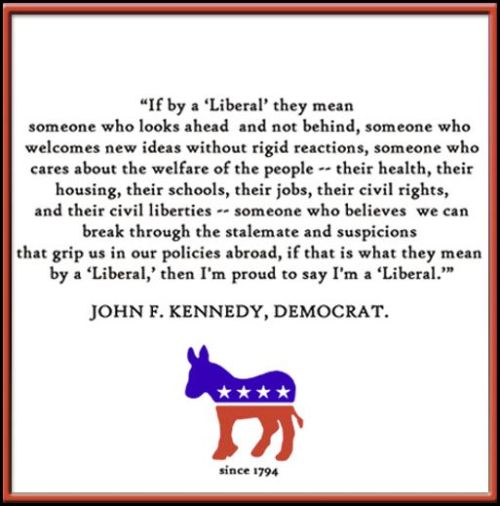
Proud to be a liberal, JFK

May 5, 2012

Somebody made a poster out of it:

JFK, proud to be a liberal

Quote from Sen. John F. Kennedy, September 14, 1960

You can read the entire original speech by Sen. John F. Kennedy here, at Millard Fillmore’s Bathtub.  There’s more defense of his being considered a liberal, and the good that liberals do.  It’s almost quaint the way he defends Adlai Stevenson.

Why do you wave the flag, help old ladies cross busy streets, keep children safe, and sing the “Star Spangled Banner?”

Tip of the old scrub brush to MoveOn.org, PBS and American Experience, and everyone who sent me a link to this today.


“And yet, here you stand.” Give Pat Bagley a hug, and a Pulitzer

May 1, 2012

Pat Bagley cartoon from the Salt Lake Tribune, May 2, 2012:

Pat Bagley cartoon, Salt Lake Tribune, May 2, 2012

Pat Bagley cartoon, Salt Lake Tribune, May 2, 2012

Wow.
More:


Plot to destroy the U.S. economy?

April 29, 2012

Clearly Rep. Allen West got duped.

I hope this is a hoax — but I can’t even find a denial, yet.  Got the rebuttal that works?

Copied in its entirety from Daily Kos, a post by CC:

    It’s no secret now that GOP in Congress literally plotted to undermine U.S. economy during President Obama’s Inauguration.

     In Robert Draper’s book, “Do Not Ask What Good We Do: Inside the U.S. House of Representatives” Draper wrote that during a four hour, “invitation only” meeting with GOP Minister of Propaganda, Frank Luntz, Senior GOP Congressmen plotted to undermine and destroy America’s Economy.

The Guest List:
Frank Luntz – GOP Minister of Propaganda
Rep. Paul Ryan (R-WI)
Rep. Eric Cantor (R-VA)
Rep. Kevin McCarthy (R-CA),
Rep. Pete Sessions (R-TX),
Rep. Jeb Hensarling (R-TX),
Rep. Pete Hoekstra (R-MI)
Rep. Dan Lungren (R-CA),
Sen. Jim DeMint (SC-R),
Sen. Jon Kyl (AZ-R),
Sen. Tom Coburn (OK-R),
Sen. John Ensign (NV-R) and
Sen. Bob Corker (TN-R).

Non-lawmakers present Newt Gingrich

During the four hour meeting, the senior GOP members plotted to bring Congress to a standstill regardless how much it would hurt the American Economy by pledging to obstruct and block President Obama on all legislation.

   These members of Congress were not simply airing their complaints regarding the other party’s political platform for four long hours.  No, these men were literally plotting to undermine and destroy the U.S. Economy.

        On that date, January 20, 2009, America had been losing over 750,000 jobs per month because of policies these Congressional Leaders had enacted and their goal, their goal that night, was to plot ways to undermine any and all legislation that would pull American families up and out of the economic calamity they had helped create.

       Everyone of these members of Congress supported the very Bush/Cheney policies that caused America to teeter on the brink of the 2nd Great Depression and caused the 2007 US Economic Meltdown.

      These guys can’t say they were sitting at dinner for four hours discussing any objection to Stimulus Legislation and raising the Debt Ceiling because of political ideology as each one of them voted yes on Bush/Cheney Stimulus Bills and yes every time Bush/Cheney wanted to raise the Debt Ceiling.

Here’s how they all voted:
— “Yes” to Bush/Cheney January 2008 Stimulus
— “Yes” to Bush/Cheney bailing out Bear Stern
— “Yes” to Bush/Cheney bailing out AIG
— “Yes” to Bush/Cheney TARP (sept 2008)
— “Yes” to Bush/Cheney TARP (oct 2008)

    And these same members of Congress:
— Supported Bush/Cheney keeping cost of two wars out of the Budget
— Supported Bush/Cheney spending $4Trillion on Top 1% Tax Cuts while trying to pay down Debt on Two Wars

Ahhh … but at their dinner they plotted to suddenly stop supporting any stimulus legislation:

Show united and unyielding opposition to the president’s economic policies.

Rep Kevin McCarthy said,
We’ve gotta challenge them on every single bill.”

Not only did these Senior members of Congress plot to destroy the American Economy more than it already was destroyed? They actually carried out their mission:

– Every one of these Senior members of Congress have threatened Government Shutdown over things like:
not funding planned parenthood, not raising the Debt Ceiling which, in-and-of-itself, would cause US Economic turmoil.

… oh, and stay current, these same House GOP members of Congress are still, today, threatening a Government Shutdown.

Senators: Jim DeMint, Jon Kyl, Tom Coburn, John Ensign, and Bob Corker have
Filibustered more Bills than any Congress combined in US History.
Voted NO on every single piece of Legislation brought to the Floor including: NO on Al Franken’s Anti-Rape Amendment, NO on Lilly Ledbetter, NO on Fair Pay Act.

Representatives: Paul Ryan, Eric Cantor, Kevin McCarthy, Rep. Pete Sessions, Jeb Hensarling, Pete Hoekstra and Dan Lungren
– Voted NO on every single piece of Legislation; including NO on increasing FEMA during natural disasters.
– Have been on tv constantly chanting the lie that they were guilty of … the lie that “President Obama’s policies undermine the US Economy.”

     Yes, these Republican Congressional leaders used Karl Rove’s playbook and falsely accused the President of what they were guilty of: Intentionally Undermining the US Economy.  And, again, in keeping with Karl Rove propaganda, they chant the same lie over and over and over again.

    America had been at war since 2001.  The Constitution says a person can only be guilty of “Treason” while America is engaged in war — we are at war.  The Constitution says “Treason against the United States, shall consist only in levying war against them, or in adhering to their enemies, giving them aid and comfort.  I believe that plotting to undermine the President of the United States by destroying and weakening the US Economy directly aids the enemy. Treason?

    As for impeachment, only one Senator has ever been impeached.

    These members of Congress, are paid to do The People’s work.  They are not paid to plot ways to undermine American families by destroying the US Economy.

    Their acts that night are disgusting, repulsive, unbecoming of a member of Congress and they should be expelled from Congress for their covert plot to destroy and weaken America’s Economy and for obstructing The People’s work from getting done.

     I urge everyone to contact Darrell Issa and tell him to:

Hold Hearings to Expel the following people from Congress for plotting to undermine the President by destroy to the US Economy:
Rep. Paul Ryan (R-WI)
Rep. Eric Cantor (R-VA)
Rep. Kevin McCarthy (R-CA),
Rep. Pete Sessions (R-TX),
Rep. Jeb Hensarling (R-TX),
Rep. Pete Hoekstra (R-MI)
Rep. Dan Lungren (R-CA),
Sen. Jim DeMint (SC-R),
Sen. Jon Kyl (AZ-R),
Sen. Tom Coburn (OK-R),
Sen. John Ensign (NV-R) and
Sen. Bob Corker (TN-R).

I don’t know if they committed Treason, but I do know they are Traitors and Traitors have no business writing or voting on US Laws.

Oh, the next time you hear the GOP say “Obama wants to destroy the economy” or “Government Shutdown” … remember … as Newt Gingrich said after their four hour dinner on January 20, 2009 “You’ll remember this as the day the seeds of 2012 were sown.”

   To Translate GINGRICH:
You’ll remember this day as they day we became Traitors to the United States.

Originally posted to cc on Fri Apr 27, 2012 at 09:26 AM PDT.

Pete Sessions from Texas?  That great free marketeer, promised to do what he could to kill our economic recovery?  Do his constituents, especially those who work at the General Motors plant in Arlington, Texas, know about that?

More: