Jailing the teachers . . .

April 13, 2011

. . . who ruined Wall Street.  Or something.

When teachers and NPR crashed the stock market

Teachers are not to blame - pass it on

Our nation faces real crises.  While much of the wealth destroyed by the Crash of 2008 has been recovered, it’s been reallocated from working families to large banks and the wealthy.  We still have a crisis in the Gulf of Mexico, not least over how and whether we can explore for ever-more-precious oil in ever-more-dangerous places — Congress cut the money to improve regulations to prevent future spills.  We need secure pensions for people who work for their entire lives, and want to retire so a younger person can have their job — heck our economy needs people to retire earlier, not later.  We need secure funding for education, for primary and secondary education, and for college, which is increasingly a necessity.

None of those problems was created by teachers, NPR, Planned Parenthood, Head Start, PBS, the guy next door who lost his job, nor the many immigrants who came to this nation to build our economy while building their own little store of wealth.

Ronald Reagan said that for every difficult problem, there is a solution that is simple, easy to understand, popular — and wrong.  I wish people would quit endorsing those solutions to problems we don’t have, and work for real solutions to the problems we do have.


Republican policy: Forward to the Gilded Age

April 10, 2011

Cover of "The Gilded Age"

Cover of "The Gilded Age," a novel by Mark Twain and Charles Dudley Warner published in 1873. Image courtesy of the Center for Mark Twain Studies, Elmira College.

You know why it was called the Gilded Age, right?

Santayana’s Ghost keeps telling me the Republicans don’t know why.  Republicans as a rule do not read Mark Twain, so it’s a cinch they’ve never read Mark Twain plus Charles Dudley Warner.

Mark Twain, PBS image from Mark Twain House

Mark Twain, who wrote the novel, The Gilded Age, with Charles Dudley Warner. Twain wrote of the Republican Manifesto earlier: "What is the chief end of man?--to get rich. In what way? -- dishonestly if we can; honestly if we must." Image from Mark Twain House, Hartford, Connecticut, via PBS

Still, don’t you recall with some fondness the Eisenhower, Nixon and Ford years, when Republicans at least pretended not to be grand misanthropes?  Do you remember that?  Nixon tried to make nicey-nice with conservationists and environmentalists, expanding the National Parks and creating the Environmental Protection Agency (fitting, since the environmental movement had been born among and from wealthy  and smart Republicans); even after killing the air traffic controllers union, Ronald Reagan enjoyed easy camradary with Teamsters, and to some degree, even with the heads of the AFL-CIO.    Reagan encouraged and signed a jobs training bill, and signed our first home health care law, making it possible for people to go home to die, where they ironically lived much longer than in hospitals, but at much reduced cost to Medicare.

Forget those days.  Forget that human compassion.  Today’s conservatives don’t have time for the wimpiness of Ronald Reagan.

Did you see the full list of proposed agency cuts the Republicans tried to pin on the 2011 appropriations bill, H.R. 1?

Here’s the entire list, from OMB Watch:  OMB_Watch-HR1_Policy_Riders (April 7, 2011).  I’m sure OMB Watch  has a bias, but the descriptions of the cuts are so balanced and neutral that they may hide some of the more unscrupulous, Scroogey actions.

In consumer protection, for example, Republicans inexplicably oppose the creation of watchdogs to prevent another housing bubble — are Republicans protecting criminals here?

Prohibits the Federal Reserve from transferring more than $80 million to the new Bureau of Consumer Financial Protection, Sec. 1517
Prohibits funds for a government sponsored “consumer products complaints database,” Sec. 4046.

No one to prevent new crimes, and no collecting of information to warn consumers of dangerous products.  Wonderful.

Prohibits funds to take any action to effect or implement the disestablishment, closure or realignment of the US Joint Forces Command.  Sec. 4020

No, no, don’t want the Pentagon to save money — heaven knows, wasting money at the Pentagon is flag-waving patriotism — so let’s ban the Secretary of Defense, Robert Gates, from making changes that save money.  It’s in the Bible that this must be done, I’m sure.

Prohibits funds for implementing a provision specific to the State of Texas in the “Education Job Fund.”  Sec. 4051

After claiming he wouldn’t accept “bailouts” from the federal government, Texas Gov. Rick Perry accepted money from Congress to prevent the loss of teaching jobs — but then threw the money into a different pot, so teachers were not protected.  U.S. Rep. Lloyd Doggett, D-Texas, amended the last appropriation bill to say that Texas can’t take money from the teachers — but the Republicans want to allow Perry to take the money, and keep it from the teachers, again.  It’s the old playground game where the big kids play keep away from a little kid.  It’s vicious, of course, and should be criminal — but the older kids have a lot of fun.

Prohibits funding for the Weatherization Assistance Program or the State Energy Program.  Sec. 1434

Let the poor people freeze in the dark — they all vote Democratic, anyway.  But wait!  Tea Partiers, fresh from the Mad Hatter’s, say that global warming will take care of the poor people!   No need for weatherization.

Prohibits funding for various environmental projects in California.  Sec. 1475
Prohibits funding for a climate change czar in the White House.  Sec. 1535
Prohibits funding for EPA efforts to regulate greenhouse gases.  Sec. 1746

Oh, well, maybe there isn’t any global warming.  Yeah, this is contrary to what the Republicans said about warming keeping the poor from needing weatherization — but they’re just poor people, the Republicans say.  Let ’em get a job!  (Where?  Not the problem of Republicans; Republicans identified that the poor need to get a job, and that should be the limit of federal action . . .).

This morning on CBS, New York Sen. Charles Schumer said he would not list cuts until he sees a final copy of the bill.  Probably wise — but it’s also almost a cinch that almost all of the cuts will be mean-spirited, worthy of Ebenezer Scrooge before his conversion, and damaging to the U.S. people and the U.S. economy.

What in the hell is going on in Washington?

Tip of the old scrub brush to Jean Detjen, protecting the nation from being over-run by Canadians up there in the north, in Wisconsin.


More wisdom: From Burlington, Vermont, grassroots ideas on fighting global warming

April 10, 2011

Another local newspaper op-ed, this time from Burlington, Vermont (yeah, I know — a Gannett paper — still, smaller than Dallas). This comes from the March 4 edition of the Burlington Free Press’s “I Believe” series:

I Believe: ‘We have a responsibility to learn about climate change

by Joan Knight

“If politicians remain at loggerheads, citizens must lead.”
— Dr. James E. Hansen, physicist, director of NASA Goddard Institute

I was impressed when I attended a recent meeting with a group of volunteer activists forming a Vermont chapter of the Citizens Climate Lobby. This group is different, I thought. It might actually work. As a newly retired 72-year-old, I was looking for a new focus, and found it.

Religious groups use the word “creation.” Most people say “nature.” Academics speak of global ecology. Deep ecologists who view Earth as one living being say “Gaia,” in reverential tones, meaning our planet and its atmosphere is a living “body.” Its “cells” include us humans, plants, forests, microbes. All life is tied together by dynamic, interdependent relationships. Most native peoples sense that all beings are like sisters and brothers — members of the same family.

I understand. It started for me as a young child with what Rachel Carlson called a sense of wonder. Grasses back-lit by the setting sun; starfish in tide pools crawling about among colorful mats of living plants and fungi. It was a more spiritual experience than was going to church under parental orders. Nature really mattered.

Growing older, I revered the writing of Rachel Carson, David Brower, John Muir, Aldo Leopold, Wendell Berry and so many more. I still feel abiding love for it all. I believe in Earth as a planetary living being.

It is clear that our family of All Beings is suffering.

Climate change. Global warming. Is it real? Is it a problem? Why are the changes happening? There is controversy about the answers to these questions. The collapse of climate and energy legislation last year in Congress was a relief to some in big business.

Natural laws or physics and chemistry are in action. The climate is warming faster than it ever has. Weather patterns are strange and tragic. Species are becoming extinct. Predictions of the end of nature (Bill McKibben’s 1984 book title) are common now. What if the scientists are right? We don’t need all the answers to figure out that something awful is going on.

Can we slow down the rate of change? Yes. Can we stop the climate from warming too much? It’s not likely, but I believe we must try. Should we let it happen while we enjoy our greenhouse-gas-producing lifestyles? Some family members deny the reality that their loved one has a serious illness and is likely to die prematurely. We humans have an interesting default to denial. This does happen. Might some of us, similarly, deny that our planet is critically ill?

Most of us agree that conservation of energy and resources is good for us and for the environment. We are changing our personal lifestyles. We have changed our light bulbs to compact fluorescents; we vacation closer to home; we’re working to improve the efficiency of our buildings.

Many of us also become members of environmental organizations. We read their magazines, put in bird feeders to enjoy nature, donate money and sign petitions in the attempt to show our legislators how we would like them to vote. Here in Vermont, we even talk with state legislators and are proud we are the “green state” — cherishing our remaining cows in pastoral landscapes and our forests for both wildlife and recreation. We’re thankful our delegation to the Congress “gets it.”

There are many grassroots activists successfully influencing lawmakers on a town and state level. But we know that states tend to make changes in laws and budgets in response to constraints brought on by federal legislation and financing. Are there ways to really influence federal representatives and senators? Paid lobbyists do it on a massive scale. Money speaks. But what about us?

The Citizens Climate Lobby believes in an approach by which ordinary people influence the federal “deciders” enough to sometimes change their votes. The influential people take the trouble to learn about and appreciate some things an individual legislator has done, seek to discover common ground, listen respectfully and talk in a collaborative way. After discovering what information would be relevant, they come back to provide it. In this comfortable way of relating, ordinary people do make a difference.

As citizens of this country we have a responsibility to learn about climate change, solutions and how to take part in the democratic process. We can sit down for a conversation and tell our legislators what we care about and why. We can write letters. It’s really our job as citizens to share these thoughts with our legislators, if we ever hope to be truly represented by them.

That’s where the new Citizens’ Climate Lobby comes in. The group gives us the tools we need. There is a monthly conference call with a leading thinker who will help keep us informed of the latest issues, and an opportunity to practice speaking with each other about those issues. We work together to help our legislators hear the non-confrontational message: We want a healthy planet for our kids and grandkids.

If I dare to step forward to lobby my representative, I want to learn how, to practice, to feel supported by kindred spirits, to know it’s OK to make mistakes and keep on gaining new knowledge and skills. I’m up for it. And I hope many of you will consider joining us as we begin making our voices heard where it matters most.

Check out the Citizens Climate Lobby website, and get information about how to join in on the next national conference call. This one will be focused on messaging — the importance of context and delivery. This organization seeks to empower each of us to have breakthroughs in our personal power, to be heard and to be counted. It feels good to be a part of a supportive web of passionate citizens.

Join us. Talk with an active member on the phone, go to the website (www.citizensclimatelobby.org), find the lobby on Facebook.

It’s not too late to make a difference. We have been lazy in hoping someone else would do the right thing, that sending a check to an organization and signing an online petition was enough. It’s time for folks, including myself, to step up and be heard.

Real grass roots politics, from a woman concerned enough about the issue to think historically, and to read broadly about it.

Citizenship is wonderful to behold, when it is practiced so nobly and elegantly.

What else might we learn, if we really listened to the people?

Citizens Climate Lobby masthead

Masthead for the home page of Citizens Climate Lobby - click to see


It’s on: Obama opened the campaign for 2012

April 4, 2011

I get e-mail — with a few million others, I’m sure:

2012

Ed —

Today, we are filing papers to launch our 2012 campaign.

We’re doing this now because the politics we believe in does not start with expensive TV ads or extravaganzas, but with you — with people organizing block-by-block, talking to neighbors, co-workers, and friends. And that kind of campaign takes time to build.

So even though I’m focused on the job you elected me to do, and the race may not reach full speed for a year or more, the work of laying the foundation for our campaign must start today.

We’ve always known that lasting change wouldn’t come quickly or easily. It never does. But as my administration and folks across the country fight to protect the progress we’ve made — and make more — we also need to begin mobilizing for 2012, long before the time comes for me to begin campaigning in earnest.

As we take this step, I’d like to share a video that features some folks like you who are helping to lead the way on this journey. Please take a moment to watch:

In the coming days, supporters like you will begin forging a new organization that we’ll build together in cities and towns across the country. And I’ll need you to help shape our plan as we create a campaign that’s farther reaching, more focused, and more innovative than anything we’ve built before.

We’ll start by doing something unprecedented: coordinating millions of one-on-one conversations between supporters across every single state, reconnecting old friends, inspiring new ones to join the cause, and readying ourselves for next year’s fight.

This will be my final campaign, at least as a candidate. But the cause of making a lasting difference for our families, our communities, and our country has never been about one person. And it will succeed only if we work together.

There will be much more to come as the race unfolds. Today, simply let us know you’re in to help us begin, and then spread the word:

http://my.barackobama.com/2012

Thank you,

Barack


Texas House votes to maim education, cripple health care, send the aged off to ice floes

April 4, 2011

Where anyone can find an ice floe in Texas is a powerful question, but the search will be on to find some soon, if the budget approved by the Texas House of Representatives cannot be fixed.

Texas House Democrats sent out a notice shortly after the vote, explaining some of the cuts:

An hour ago, Texas House Republicans forced through some of the most destructive budget cuts in Texas history.  On a party line vote, 101 House Republicans trampled on the priorities of regular, middle-class Texas families. [1]

Tonight, Republicans voted to:

  • Eliminate 335,000 Texas jobs in both the public and private sectors, threatening our fragile economic recovery [2]
  • Lay off up to 100,000 teachers and school support workers, crowding dozens of kids into unruly classrooms [3]
  • Kick 100,000 kids out of full day Pre-Kindergarten [4]
  • Close half of the state’s nursing homes, leaving thousands of seniors with no place to go [5]
  • Create a ripple effect that will force local governments like cities, counties and local school districts to raise taxes [6]
  • Cut off access to financial aid for thousands of graduating high school seniors [7], while forcing up college tuition through cuts. [8]

They didn’t have to cut this deeply into the priorities set by most Texas families.  They chose to make the deepest cuts public education since the creation of our school finance system in 1949. [9]

For months, Republicans have been yelling “Cuts! Cuts!” and they have ignored the thousands of office visits, letters, emails and phone calls of average Texans protesting these hurtful cuts.

Democrats offered plenty of creative solutions that would keep schools open, spare nursing homes from closing, and keep our promise to graduating seniors who have worked hard for a chance to earn a college education. Republicans shot them down one by one in favor of deeper cuts.
Anybody can swing an axe and slash budgets across the board.  Texas needs people who can lead, set priorities, and protect those priorities.

Remember, Republicans chose to make these cuts. Help us hold them accountable for costing jobs, hurting families, and for choosing to sacrifice the future of too many Texas kids.

Sincerely,

Cliff Walker
Texas HDCC

  1. http://www.capitol.state.tx.us/BillLookup/History.aspx?LegSess=82R&Bill=HB1
  2. http://www.beaumontenterprise.com/news/article/Budget-cuts-could-slash-hundreds-of-thousands-of-1291051.php
  3. http://www.kvue.com/home/117522288.html
  4. http://www.newschannel10.com/Global/story.asp?S=14368977
  5. http://www.reporternews.com/news/2011/mar/09/democrats-cuts-will-hit-homes/?print=1
  6. http://www.star-telegram.com/2011/03/08/2906285/unfunded-mandates-from-the-texas.html
  7. http://blog.mysanantonio.com/texas-politics/2011/03/house-budget-writers-ok-bill-that-would-trim-23-billion/
  8. http://www.newswest9.com/Global/story.asp?S=14310923
  9. http://www.businessweek.com/ap/financialnews/D9MBC0PG1.htm

Fewer teachers when more are needed, bigger classrooms when smaller classrooms are needed, less health care in the state with the largest uninsured population of any state, the highest proportion of uninsured people.

Cleaver prop from YourProps.com

Texas Republicans chose the meat cleaver over the scalpel to try to balance Gov. Rick Perry's $27 billion deficit. Many cuts appear targeted to do the most damage possible to education and other "liberal" state functions. Cleaver prop from YourProps.com

Prisons, highways, state parks, and other programs suffered serious cuts, too.

Had a foreign power done this to Texas, it would be considered an act of war.  How will Texas citizens respond?

More:


Boston Tea Party: An anti-corporation protest?

April 3, 2011

Thom Hartmann said so.  In Hartmann’s reading, the 1773 Boston Tea Party was as much a protest against corporate oligarchy as a protest against government — quite the opposite of the way most Neo Tea Partiers see things.   Is he right?  Historians, what say you?

Hartmann relies on his copy of George R. T. Hewes’ book, A retrospect of the Boston tea-party, with a memoir of George R. T. Hewes, a survivor of the little band of patriots who drowned the tea in Boston harbour in 1773 (1834). Are you familiar with the book?

George R. T. Hewes in 1835, a veteran of the 1773 Boston Tea Party - CUNY image

George Robert Twelves Hewes in 1835 at age 93, a veteran of the 1773 Boston Tea Party. Painting by Joseph G. Cole. CUNY image

More, and resources:


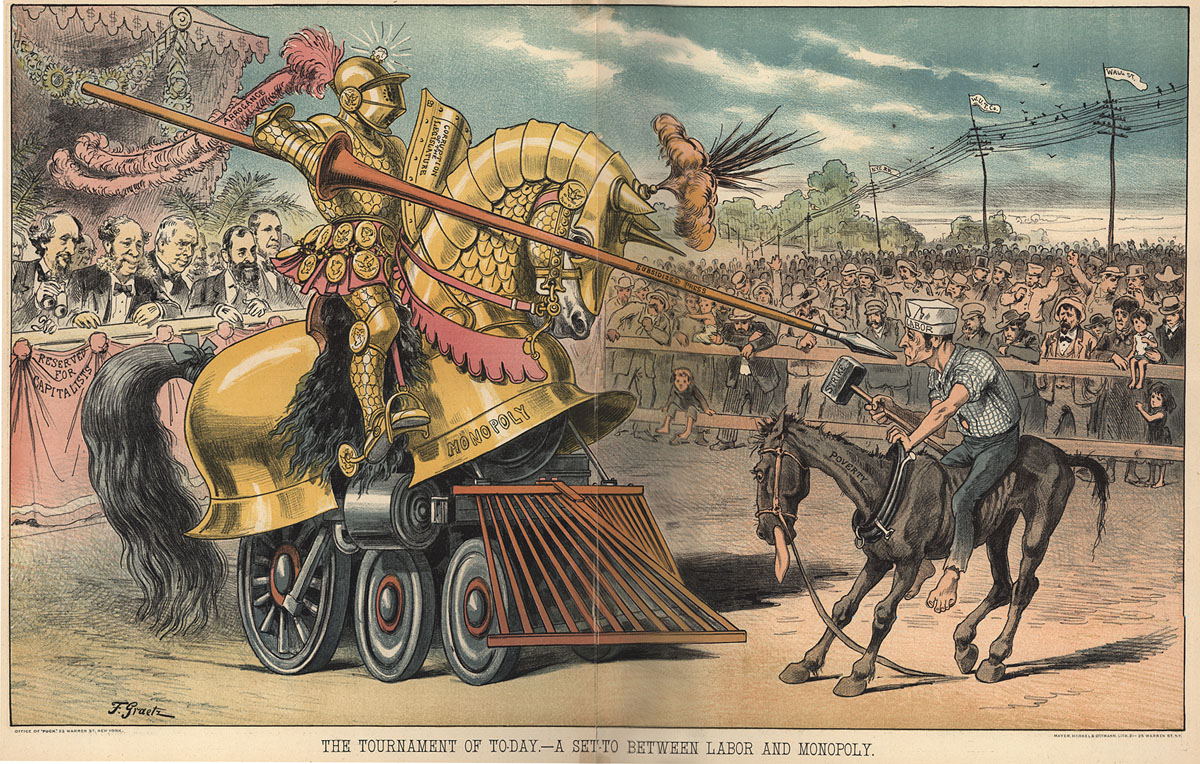
Then and now: Capitalism vs. Labor 1883, and today

April 2, 2011

Alas, it’s almost exactly the same now as then:

"Tournament of Today:  A set-to between Labor and Monopoly," Cartoon by Frederick Graetz, Puck Magazine, August 1, 1883 (from files of Georgia State University); click image for a larger view at Georgia State

“Tournament of Today: A set-to between Labor and Monopoly,” Cartoon by Frederick Graetz, Puck Magazine, August 1, 1883 (from files of Georgia State University); click image for a larger view at Georgia State

Information on the cartoon, from SuperITCH: Frederick Graetz, a chromolithograph that was the center spread for Puck Magazine‘s issue of August 1, 1883.  Monopolists portrayed are, from left to right, “businessman, financier and telecommunications pioneer Cyrus Field; railroad tycoon William Vanderbilt; shipbuilding magnate John Roach; financier, railroad mogul, and speculator Jay Gould; and an unknown monopolist.”  Some might say that the “unknown monopolist” bears a striking resemblance to one of the Koch brothers, but that’s fanciful thinking.

Cartoon - Labor vs Monopoly, Graetz, Puck 8-1-1883 (GSU image)

Labor vs Monopoly – click on this image for a larger version of this historic Puck Magazine cartoon

Tip of the old scrub brush to One Penny Sheet’s “condemned to repeat” feature.

More:


Updates on Wisconsin, the War on Education, the War on Americans in Unions, the assault on public employees by Wisconsin Republicans, etc., etc.

April 1, 2011

First, be sure to read Zeno’s work over at Halfway There.  Zeno’s writing will make your mouth water, your pupils expand, your pulse quicken, your hands go all Galvanic on you, and otherwise get your attention — but in this case, his topic is important, too.  Zeno explains the American Legislative Exchange Council (ALEC) with a peek inside ALEC’s  sumptuous, legislator-seducing red tent.   He’s got documents from ALEC, secured through not completely legitimate means (but neither are they illegal), and he lays the group bare.  It’s not a pleasant sight if you’re not fond of adipose tissue and necrosis.

Second, at Desmogblog you should check out John Mashey’s work on loose political organizations joined to politically oppose scientists learning about global warming, to oppose publication of findings about global warming, and to oppose government action to do anything to stop global warming.  Interestingly enough, Mashey informs me, the current cast of malefactors in Wisconsin, appear earlier as malefactors in the discussions and actions about global warming.  Coincidence?

And then stay tuned.  There is more to come on the issue of the Republican Party’s rebirth of McCarthyism, and the witch hunt they wish to conduct against historian Bill Cronon, I’m sure.


Now is the time for all good citizens to phone legislators for the sake of their country . . .

March 31, 2011

Ready to start dialing?  It’s time to dial to save your country.

MoveOn.org asks Texans to phone their U.S. senators for help:

Dear Ed,

Heads up: Congress is debating a budget plan that would be devastating to Texas. Will you pass this along?

Senators Kay Hutchison and John Cornyn need to hear from all of us about it right now, before they cut a deal in the next few days.

Please spread the word about all of these proposed cuts to Texas:

  • $98 million would be cut from federal funds for clean and safe water in Texas.1
  • 12,000 Texas children would be immediately cut from Head Start, which provides comprehensive early childhood development services for at-risk children ages zero to five.2
  • $391 million would be cut from Pell Grants, affecting all 664,000 higher education students with those grants in Texas.3
  • Job training and employment services would be effectively eliminated for 5,800 dislocated workers, 99,000 low-income adults, and 16,000 youths age 14 to 21.4
  • $10 million would be cut from law enforcement assistance, taking cops off the beat.5

It’s especially galling when the same budget protects tax breaks for corporations like GE and the very rich.

Just last night the news broke that Congress may be close to striking a deal on the budget. Now is the only time we can influence the outcome.

Can you call Sens. Hutchison and Cornyn and ask them to oppose these cuts in the budget? You can pick one of the cuts in this list to highlight in your call.

Senator Kay Hutchison
Phone: 202-224-5922

Senator John Cornyn
Phone: 202-224-2934

Click to report your call. Then pass this email along locally!

http://pol.moveon.org/call?tg=FSTX_1.FSTX_2&cp_id=1547&id=26722-5763840-yqXs_sx&t=2

The cuts that the Republicans are proposing would disproportionately hit those who can least afford it in Texas, and it’s up to us to stop them.

Thanks for all you do.

-Daniel, Amy, Milan, Tate, and the rest of the team

Sources:

1. “House Bill Means Fewer Children in Head Start, Less Help for Students to Attend College, Less Job Training, and Less Funding for Clean Water,” Center on Budget and Policy Priorities, March, 1, 2010
http://www.cbpp.org/cms/index.cfm?fa=view&id=3405

2. “Projected Reduction in Children Served in Head Start Based on H.R. 1—Fiscal Year 2011 Continuing Resolution,” Center for Law and Social Policy
http://www.moveon.org/r?r=207278&id=26722-5763840-yqXs_sx&t=3

3. “House Bill Means Fewer Children in Head Start, Less Help for Students to Attend College, Less Job Training, and Less Funding for Clean Water,” Center on Budget and Policy Priorities, March, 1, 2010
http://www.cbpp.org/cms/index.cfm?fa=view&id=3405

4. Ibid

5. Ibid

Want to support our work? We’re entirely funded by our 5 million members—no corporate contributions, no big checks from CEOs. And our tiny staff ensures that small contributions go a long way. Chip in here.

Meanwhile, the Texas House of Representatives scheduled the start of debate on H. 1 for Friday, April 1 — the budget resolution that would gut Texas schools and higher education, and set Texas on a course of decline that will make California’s troubles look serene by comparison.

NEA’s Texas affiliate, the Texas State Teachers’ Association, asks teachers to call their Texas representatives to weigh in against the drastic budget cuts (and you can call, too):

March 30, 2011

House Bill 1 is an assault on the public schools!

This Friday, April 1, the Texas House of Representatives is scheduled to begin debate on House Bill 1, its version of the state budget for 2012-2013. If this bill were to become law in its present form, it would cut almost $8 billion from public education and, with it, tens of thousands of school district jobs.

Unfortunately, this is no April Fool’s joke.

It is, instead, the proposal of a state leadership that would rather plug a huge hole in the state budget by firing teachers, packing kids into overcrowded classrooms and closing neighborhood schools than by adequately investing in our state’s future.

NOW is the time to call your legislator and let him or her know what these budget cuts will mean in your classroom, your school and your community. We must stop House Bill 1, and your call is critical!

To contact your state representative, call 800-260-5444, and we will connect you [That’s the number for TSTA members, but try it — I’ll bet they’ll accept your help!]. You can call any time, day or night, but you need to call before Friday. Leaving a voice message with your representative’s office is just as good as talking to a staff member.

It is important to include the following points in your conversation or message:

  • Your name, that you are a TSTA member and that you live and vote in their district.
  • An overwhelming number of people in your community – parents, teachers and other taxpayers – oppose cuts that would harm public schools.
  • Your own story, how laying off educators, cramming children into crowded classrooms and closing neighborhood schools would have a harmful impact on your students and community.
  • Ask your representative to find the revenue necessary to avoid harmful budget cuts, restore full education funding and end this assault on our public schools.

This will take only a few minutes of your time, and it will be time well spent. Your representative needs to hear from you before Friday!

Pick up your telephone and strike a blow for freedom, democracy, education and sanity in government.


FOIA “request” in Wisconsin could be violation of whistleblower protection law

March 27, 2011

Wisconsinite Jean Detjen sent me a note correcting my misinformation:  Wisconsin does indeed have a whistleblower protection act.  The law protects Wisconsin state employees, against retaliation for disclosing information about wrongdoing.

William Cronon, Frederick Jackson Turner Professor of History, University of Wisconsin

William Cronon, Frederick Jackson Turner Professor of History, University of Wisconsin - University of Wisconsin photo

My reading suggests that, since professors are not specifically exempted, Prof. Cronon, at the University of Wisconsin, is specifically protected.

If the University of Wisconsin gives that answer to the Wisconsin Republican Party, however, the Party will argue that it is not a government official prevented from retaliating against a government employee.  That would be ample reason for the state to deny the FOIA request of the Party flatly and completely.

There is another, potentially more pernicious angle here:  The Republican Party in Wisconsin is, in this case, an agent of the Republicans in the state legislature, those whose tails are on the line for violating Wisconsin law, and as Prof. Cronon outlines it, Wisconsin tradition and historical norms.  It’s likely that the Party is acting at the direction of legislators.

In short, it’s kind of an organized crime action.  I think that the federal Racketeer Influenced and Corrupt Organization Act (RICO) would cover this sort of action — any retaliation for hire, or by an agent, which creates a pattern or practice of organized crime activities.  Worse for the Wisconsin Republicans, if there were an ambitious U.S. attorney out there somewhere, there is no scienter requirement on RICO actions — that is, there need not be a clear formation of criminal intent.  The mere actions of an organized crime group, even with no intent to break the law, can be a RICO violation.

Even worse for the Republicans, RICO is available for anyone to use.  Were I Prof. Cronon, and were the Republicans to press their FOIA request to court, I’d counterclaim in federal court with the RICO statute.

That’s a nasty escalation.  But in these days, in this case, where a state party organization has gone to the employer of a university professor to get his job after he merely reported history, I wouldn’t take chances that the Republicans would later play fair or nice.

Every step against Cronon, every press release, every statement from a legislator or party apparatchik, provides more evidence of the coordinated effort, and establishes further the “pattern and practice” of organized crime activity.

Maybe cool heads will soon prevail, maybe patriotism and love of the First Amendment will break out among Wisconsin Republicans, and they will retract their demand that Prof. Cronon deliver them all of his e-mails as a professor at  the University of Wisconsin.

Maybe badgers will fly.

“Badger” is supposed to be the mascot of Wisconsin’s top-flight university, not a tool of partisan politics.


Canada? It’s in North America? What?

March 27, 2011

And in other news that didn’t make most U.S. local newspapers today, the government of Canada fell yesterday.

Canada government falls, Politically-Illustrated

"The Conservative government in Canada was toppled on Friday after a vote of no-confidence passed in the parliament by 156 to 145." Cartoon at Politically Illustrated by Cam Cardow

You know:  Canada.  That nation north of North Dakota, the one that keeps Alaska stuck to the North American Continent.  Remember?   It’s got about 20% of the world’s fresh water.  Those guys who helped us whip Hitler on D-Day.

Oh, c’mon.  Google the place, will you?  It’s the nation where, when you go there, ‘those bastards with the drug problem south of the border’ is the United States.

No, no, it’s probably not important.  We buy a lot of our oil from Canada.  Canada is our biggest trading partner.  They buy a lot of the goods that we still produce here.

And the conservative government there, under a parliamentary system that kids in the U.S. are never tested on in Texas, lost a vote of confidence Friday, in Ottawa.

Ottawa?  It’s the capital of Canada.  No, Montreal isn’t even the capital of Quebec.

Oh, come on! Quebec.  Quebec! It’s the province of Canada with all the French speakers. Yeah, Quebec City is the capital of Quebec.

Ottawa’s in Ontario.  No, Ottawa is the capital of the whole nation, Canada.  Ontario’s capital is Toronto.

Lone Ranger?  No, Toronto has nothing to do with the Lone Ranger.  It’s the biggest city in Canada.

Anyway, to get back to the topic, Canada’s government failed.  Conservatives lost a vote because of ethics issues.

Ethics issues, conservatives.  No news there.  No wonder it wasn’t covered better.

Elections in May. You’d know this, if you read the blogs of the Natural Resources Defense Council.

As if anyone cared.

Hey, get this:  Ontario alone has more than 250,000 lakes, natural lakes.  In a good, very wet year, Texas has two, maybe three natural lakes.

You could look it up.

No, NATO won’t intervene.  Canada is part of NATO.

More seriously:

Energy- and environment-interested people should take note. Canada is our largest source of imported oil at about 2 million barrels a day — more than Mexico and Saudi Arabia imports combined — and we share two ocean coasts with the nation.  See what Susan Casey-Lefkowitz said at her blog:

Hopefully, whoever takes over next in Canada will be a bigger proponent of clean energy and fighting climate change than the Harper government has been. The Harper government has been a vocal proponent of tar sands oil expansion – pushing this dirty fuel in the United States and in Europe. In fact, the Harper government has been instrumental in undermining clean energy efforts at home and abroad all to promote the tar sands oil industry. A fresh approach in Canada gives the country a chance to get back to its green roots and to listen to its provincial governments such as Ontario, Quebec, Manitoba and British Columbia who have been developing innovative ways to promote clean energy and fight climate change. A fresh approach also provides an opportunity to lessen Canada’s dependence on the oil and gas sector and its heavy control over the Canadian dollar leading many to fear “Dutch disease.”

Clean energy and fighting climate change are critical issues now and in the coming decades. Hopefully, Canada can step forward as a leader on both in the future.

We can overlook the abuse of the word “hopefully” to extract important information, I think.  Did your local paper cover this story today?

More, resources:


Surely ALEC wouldn’t be purging e-mails that are now evidence, would they?

March 26, 2011

You could write a soap opera about this stuff.

You remember Wisconsin?  Remember the teachers, cops, firefighters and other public employee unions?

Of course.  And it’s still a mess.  Gov. Scott  “Ahab” Walker signed into law a bill that would have the effect of abrogating union contracts without any bargaining, but the skullduggery used to sneak the bill through the Wisconsin legislature opened the door to charges that Wisconsin open meetings laws were violated, and a judge has stayed the implementation of the law.

In the meantime, a Wisconsin historian stepped up to lend historical perspective to the whole affair.  He thought he was turning on some lights, but Wisconsin Republicans have treated it like great heat.

[Off-topic note:  Some creatures are negatively photo-tropic, which means they avoid light.  You know, like the way the cockroaches in your first New York apartment scattered when you’d turn on the light.]

So, just as Virginia Attorney General and Chief Inquisitor and Witch Hunter Ken Cucinelli tried with those pesky scientists who keep finding the global temperature rising, Wisconsin Republican legislators have turned on the historian.  Here’s how the  New York Times‘ editorial, “A Shabby Crusade in Wisconsin,”  described it:

The historian, William Cronon, is the Frederick Jackson Turner and Vilas research professor of history, geography and environmental studies at the University of Wisconsin, and was recently elected president of the American Historical Association. Earlier this month, he was asked to write an Op-Ed article for The Times on the historical context of Gov. Scott Walker’s effort to strip public-employee unions of bargaining rights. While researching the subject, he posted on his blog several critical observations about the powerful network of conservatives working to undermine union rights and disenfranchise Democratic voters in many states.

In particular, he pointed to the American Legislative Exchange Council, a conservative group backed by business interests that circulates draft legislation in every state capital, much of it similar to the Wisconsin law, and all of it unmatched by the left. Two days later, the state Republican Party filed a freedom-of-information request with the university, demanding all of his e-mails containing the words “Republican,” “Scott Walker,” “union,” “rally,” and other such incendiary terms. (The Op-Ed article appeared five days after that.)

American Legislative Exchange Council.  ALEC, in K Street lobbyist parlance.

But, Dear Reader, do you see the potential problem here for Republicans in Wisconsin?  They have based their request on a Wisconsin law that prohibits private use of state-supplied e-mail — no politicking, no religious proselytizing.

What about all those ALEC e-mails to Wisconsin Republican legislators?  Sure, they’re more than fair-game for such a witch hunt, too.  And, since it’s the state Republican Party, and not a state or other public official making the FOIA request, surely that means the Republicans would not mind a similar request to cover contacts legislators had with the Wisconsin Republican Party, to the National Republican Party, or even ALEC itself.

Fair is fair, right?

ALEC generally has better lawyers than state legislators, and so we’d expect a group like that to recognize they could be in trouble.

Of course, purging of e-mails now would be a crime, a Watergate-style cover-up, destruction of evidence and obstruction of justice — after it’s become clear that there could be court action and claims of violation of law.

Jean Detjen provided links to the stories of the attacks on the distinguished Prof. Cronon over the last couple of days.  In a Facebook exchange, I noted that ALEC is fair game for such a witch hunt fishing expedition FOIA inquiry, too.

Don’t look now, Ms. Detjen said — but the ALEC site is down.

Server Error

The server encountered an internal error and was unable to complete your request.

JRun closed connection.

[Here’s a general link — try it, and let me know when the site is back up, if Paul Weyrich and the other ALEC-ians don’t skip to Brazil.]

Surely ALEC wouldn’t be illegally purging e-mails to Wisconsin, New York, Ohio, Texas, Idaho, Washington, California, Arizona, Florida, Kentucky, Louisiana and Florida legislators, would it?

Update:  As of this evening, March 26, 2011, the ALEC site is back up.  Why was it down?

The NYT editorial closed with this:

The party refuses to say why it wants the messages; Mr. Cronon believes it is hoping to find that he is supporting the recall of Republican state senators, which would be against university policy and which he denies. This is a clear attempt to punish a critic and make other academics think twice before using the freedom of the American university to conduct legitimate research.

Professors are not just ordinary state employees. As J. Harvie Wilkinson III, a conservative federal judge on the Fourth Circuit Court of Appeals, noted in a similar case, state university faculty members are “employed professionally to test ideas and propose solutions, to deepen knowledge and refresh perspectives.” A political fishing expedition through a professor’s files would make it substantially harder to conduct research and communicate openly with colleagues. And it makes the Republican Party appear both vengeful and ridiculous.

Well, yeah, Wisconsin’s Republicans wouldn’t want to be caught stifling discussion, nor taking revenge on a whistle-blower — because certainly if Cronon’s e-mails are discoverable with an FOIA request, he is a Wisconsin state employee.  “Whew,” the Wisconsin Republicans might wheeze:  Wisconsin has no specific whistleblower protection.  Ah, the plot thickens:  There are general laws that would appear, to me, a no-longer-practicing-in-that-area lawyer, to offer some protections for any employee engaged in general political speech, or in speech protecting the employee’s rights, or in speech designed to shed light on a wrongful or wrongfully executed official act — that is, Cronon’s evidence showing the unsavory and potentially illegal links of legislators to businessmen and business groups, and the potential conspiracy issues of ALEC’s nationally-directed efforts to use state legislators to gut union laws.

I wish Ahab would just get Jesus and quit thickening the plot.

More, resources, links from Jean Detjen and others:

Obviously, big tip of the old scrub brush to Jean Detjen, in Wisconsin.


Annals of global warming: Records from Mauna Loa show continuing rise in atmospheric CO2

March 26, 2011

NOAA's Mauna Loa Observatory, NOAA photo, 1982, Cmdr. John Bortniak

NOAA's Mauna Loa Observatory, from NOAA At the Ends of the Earth Collection, 1982 NOAA photo by Commander John Bortniak

John Adams observed, and Ronald Reagan was fond of quoting, “Facts are stubborn things . . .”

Here are the facts on atmospheric carbon dioxide (CO2):


Monthly CO2 levels since 1960, Mauna Loa Observatory (Scripps Inst of Oceanography)

Mauna Loa Observatory, Scripps Institution of Oceanography, UCSD (University of Calfornia-San Diego); CO2 concentrations in parts per million (ppm)

As described at the Scripps Institution of Oceanography site:

Description:
Monthly average atmospheric carbon dioxide concentration versus time at Mauna Loa Observatory, Hawaii (20°N, 156°W) where CO2 concentration is in parts per million in the mole fraction (p.p.m.). The curve is a fit to the data based on a stiff spline plus a 4 harmonic fit to the seasonal cycle with a linear gain factor.

Data from Scripps CO2 Program.

For perspective, here’s a chart from Scripps that shows why there is concern over current levels of CO2:

CO2 over the past 420,000 years - Scripps Institution of Oceanography

CO2 over the past 420,000 years - Scripps Institution of Oceanography

Resources, More:


EDUSolidarity Day After, Part 3: Why would a teacher like me hang with a union?

March 23, 2011

I mean, really.  I have two degrees after attending three colleges.  I’ve taught at three different universities.  My parents were (nominally) Republicans.  I worked the Republican side of the U.S. Senate, for Orrin Anti-Labor-Law-Reform Hatch, for heaven’s sake.  I sat  through the hearings on the graft in the Operating Engineers local, the graft in the welders union in Pennsylvania that provided workers to the nuclear reactors, and the graft in the Central States Teamsters Pension Fund.  Two of my staff colleagues went on to chair the National Labor Relations Board, one is a well-known anti-labor lobbyist, and I’ve sat through the “no union here, ever” courses at three different corporations as a member of management.

What gives?

Why do I and other teachers stick with the union?

Diagram of a Liberty Ship

Diagram of a Liberty Ship

My father did carry a union card, though he was a Republican.  He had lots of stories about the difficulty of working with unions from his days with the United Cigar Stores in Los Angeles, and he probably had plenty of reason  to dislike them — but he got a job as a pipefitter building Liberty Ships.  He had to join the pipefitters union, and so he did.

Deep at heart, my father wanted to be a successful businessman.  After the war, he went back to sales.  He wound up in Burley, Idaho, managing a Western Auto store, when he struck out on his own.  Well, he and a partner.  Sedam and Darrell Furniture.  They had a disagreement, and it ended up as Sedam’s on one side of town, and Paul Darrell Hotpoint on the other.

Liberty Ships under construction during World War II

Liberty Ships under construction during World War II

It was about that time that he got a lung x-ray for something, and they found the spot.  He’d given up smoking in the 1930s, but as a pipefitter, he put a lot of asbestos on pipes to shield merchant marines from heat, to insulate the pipes, to prevent shipboard fires.  That was before the dangers of asbestos were well understood.  On the x-ray, it looked like cancer.

But it didn’t grow.  The spot just stayed there, for years.

The store in Burley fell victim to a bad economy when the union at J. R. Simplot Potatoes struck one year, in November.  The strikers weren’t buying Christmas gifts.  There were about 16 furniture and appliance stores in a county with about 16,000 people total.  Several of them didn’t survive the strike and my father’s was one of them.  A lot of people in town cursed the union for causing the strike.  On one of our trips moving to Utah, I rode with Dad and asked him about it, and why the union went on strike.  As a victim of the strike, he could have unloaded.  But he didn’t.

He explained how workers organized to get power to negotiate with big businesses.  Jack Simplot was a man we knew, a good man and a customer from all we knew — but the workers were good people, too, my father explained.  Sometimes workers and employers can’t agree.  My father explained that a strike was one of the few tools workers could use to get an employer to change his position against his will.  I told him I thought it was unfair that workers could strike and force other businesses out.  My father explained that it was tougher on the workers who didn’t buy from us — they needed the stuff they didn’t buy.

Over the next few years I watched as my father got screwed over by good people running good companies, people who were anti-union, but more, anti-employee.  He lost guaranteed bonuses.  He lost promised promotions.  He didn’t get promised raises.  My father never again owned his own business.  Instead he was an employee, unprotected by unions in a string of positions where union protection would have been a good deal for him.  He could not strike, as the workers at J. R. Simplot had.

One of the investigators for the Senate Labor Committee was a character of great proportion — no central casting bureau could have thought up a character like Frank Silbey.  Silbey headed Orrin Hatch’s investigations into unions, and he was a marvel to watch.  Soon after Hatch took over as chair of Labor, Silbey and I had a long lunch to work out just how we would work together.  I expressed to him my concern that any investigation of a union might hurt unions, and hurt workers.

Silbey thought for a minute, and took in a deep breath.  He started to put his finger in my face, but he stopped, and used it to doodle on the table cloth at the old Monocle, near his office in an odd building the Senate owned.

“Listen,” he said.  “You need to know that I am not anti-union.  I can’t be.”  And he told me about his own father.

I don’t remember the business.  I remember that Frank talked about how his family was not rich by any stretch, and his father worked hard at a union job.  The old man had not a lot of time for friends off the job, not after spending the time he wanted to with his wife and kids.  And so it was that, when he died unexpectedly, too young, Frank’s mother knew that it would be a sad funeral, with very few people attending.

When they got to the synagogue for the funeral, though, there was a huge crowd.  The place was literally overflowing with people.  The union had closed the business in honor of Mr. Silbey, and the union turned out for the funeral.  Each of the workers spent time meeting the widow, and telling her what a great man and good friend her husband had been.

“And that’s why I can’t ever be anti-union,” Frank said.  “When all is said and done, the union will stick by you when nobody else does.”

Over the next five years we found a few unions where that was not exactly true, but in most of those cases, those people who made that not true, went to jail.

The health care side of the Senate Labor Committee had a hearing into lung diseases, including black lung, brown lung, and the mesothelioma, the disease pipefitters got from asbestos.  One of the witnesses came from a pipefitters union.  Among other things, he testified to the astonishing rates of illness and untimely deaths among the pipefitters on the World War II Liberty Ships.

On the way out of the hearing I mentioned to the guy that my father had worked on the Liberty Ships, as a pipefitter.  He looked stricken, and paled.  He pulled me off to the side of the hallway, and said, “I am so sorry for you.  Your father did heroic work and the nation owes him a deep debt.”  No one had ever spoken about my father like that to me before, and I teared up.

“How long has he been gone,” the guy asked.

“Well, he’s got a spot on his lung, but it hasn’t changed.  He’s still alive,” I said (my father would die within the decade).

The pipefitters representative smiled, then laughed.  “He’s one of a very small band of survivors.  He’s still a hero, though.”

Throughout his life, my father was a very good man.  Think of the character Jimmy Stewart played in “It’s a Wonderful Life.”  That was my father.  He organized across party lines for local elections.  He organized blood drives.  During the Korean War he headed the local program to take care of soldiers passing through town who ran out of money, or got sick, or got thrown in jail.  My father served on more Troop Committees for the various Boy Scout units my brothers and I joined than anyone had a right to expect.

For all his good work, he didn’t get anything but his own satisfaction out of it.

It was a staffer who never met him, for a union he hadn’t worked in for 40 years who called him the hero he was.

“When all is said and done, the union will stick by you when no one else does,” Frank Silbey said.

It’s still true.  In America, we still need that kind of loyalty to working people, especially to teachers.  We need it now more than ever.


EDUSolidarity Day, Part 2: Stanley Fish, formerly opposed to teacher unions, changed his mind — “We’re all badgers now”

March 22, 2011

WordPress was down for a few hours this afternoon, and I had a longish meeting this evening.  I’m running behind.

While I’m gearing up to get my promised comments up, take a look at Stanley Fish’s post at his New York Times blog:

In over 35 years of friendship and conversation, Walter Michaels and I have disagreed on only two things, and one of them was faculty and graduate student unionization. He has always been for and I had always been against. I say “had” because I recently flipped and what flipped me, pure and simple, was Wisconsin.

When I think about the reasons (too honorific a word) for my previous posture I become embarrassed. They are by and large the reasons rehearsed and apparently approved by Naomi Schaefer Riley in her recent op-ed piece “Why unions hurt higher education” (USA Today). The big reason was the feeling — hardly thought through sufficiently to be called a conviction — that someone with an advanced degree and scholarly publications should not be in the same category as factory workers with lunch boxes and hard hats. As Riley points out, even the American Association of University Professors (AAUP) used to be opposed to unionization because of “the commonly held belief that universities were not corporations and faculty were not employees.”

Good discussion from smart guys.  Go see.