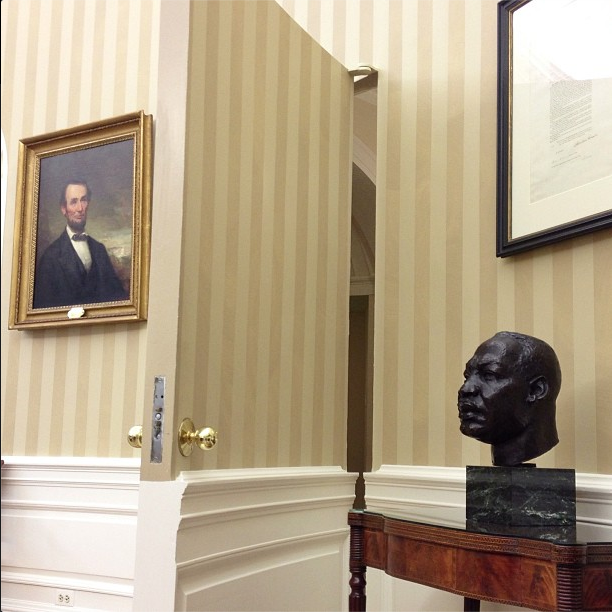
President Lincoln and Rev. Dr. Martin Luther King, Jr., in the Oval Office

August 28, 2013

I remember, just a year ago, when the GOP candidate for president promised to make this photo impossible, replacing King with an Englishman.

150 years later, 50 years later, change gotta come, still.

A better version of the photo:

Painting of Abraham Lincoln, bust of Rev. Dr. Martin Luther King, Jr., together in the Oval Office, White House. (Pete Souza photo?)

Painting of Abraham Lincoln, bust of Rev. Dr. Martin Luther King, Jr., together in the Oval Office, White House. (Pete Souza photo?) Photo published on August 28, 2013, the 50th anniversary of the March on Washington.

Oval office, Martin Luther King, March on Washington, Abraham Lincoln

More:


90 years ago: Harding died in San Francisco; Coolidge rose to presidency

August 11, 2013

It’s another one of those mostly-unexplored crevices of history.  90 years ago this August, President Warren G. Harding died in a San Francisco hotel, while on a trip visiting western states.  Harding’s death promoted Calvin Coolidge to the presidency.  They were Republican presidents in one of the hottest stock market eras of all time, during the Roaring ’20s.  Their policies probably helped lead the nation to the financial ruin after the dramatic stock market crash of 1929.

Perhaps its no wonder people would like to forget that fascinating time — but shouldn’t we really give Harding and Coolidge some diligent study?  Consider: Harding and Coolidge would be the last ticket to defeat Franklin Delano Roosevelt for anything; FDR’s reputation rests on his rollback of Harding-Coolidge-Hoover policies.  But in 1920, FDR’s ticket ran on policies more similar to those policies than opposed to them.  Odd how history turns sometimes.

Warren Gamaliel Harding won the election to succeed Woodrow Wilson, some said simply because he looked like a president.  Harding was a little laid back for the times — considering McKinley was assassinated, his successor, the hyper-caffeinated Teddy Roosevelt would die young of a heart attack, obesity nearly took out Teddy’s successor, William H. Taft, and Wilson had suffered a stroke about half-way through his second term.  It was an era when high blood pressure had no particular treatment, and the Type A men who presided over the nation could suffer from all the syndromes high blood pressure can cause.  At the White House website [links added here]:

In 1921, President Warren Harding spoke into a recording apparatus to create a phonographic copy of one of his speeches.  Photo from the Miller Center, University of Virginia

In 1921, President Warren Harding spoke into a recording apparatus to create a phonographic copy of one of his speeches. Photo from the Miller Center, University of Virginia

Before his nomination, Warren G. Harding declared, “America’s present need is not heroics, but healing; not nostrums, but normalcy; not revolution, but restoration; not agitation, but adjustment; not surgery, but serenity; not the dramatic, but the dispassionate; not experiment, but equipoise; not submergence in internationality, but sustainment in triumphant nationality….”

A Democratic leader, William Gibbs McAdoo, called Harding’s speeches “an army of pompous phrases moving across the landscape in search of an idea.” Their very murkiness was effective, since Harding’s pronouncements remained unclear on the League of Nations, in contrast to the impassioned crusade of the Democratic candidates, Governor James M. Cox of Ohio and Franklin D. Roosevelt.

Thirty-one distinguished Republicans had signed a manifesto assuring voters that a vote for Harding was a vote for the League. But Harding interpreted his election as a mandate to stay out of the League of Nations.

Harding took office promising to be a business-friendly president, meaning he supported the big money guys.  Laying out a lesson of history that too many today never learned, Harding led Washington to cut taxes on the upper income levels and bigger businesses, and set up the Roaring ’20s economy that would lead to the financial collapse of the U.S. in 1929, plunging the nation into the Great Depression.  Off the job, he played poker at the White House with bootleg whiskey on the table.  No Treasury “revenuer” would bust the President and his high-rolling friends.

In 1923, Harding’s luck started to run out.  Stories of corruption in his administration began to circulate.  The Miller Center describes what led to his unexpected death:

Death of the President

Shaken by the talk of corruption among the friends he had appointed to office, Warren and Florence Harding began a tour on June 20, 1923 of the West and Alaska. He hoped to get out and meet people, to shake hands and explain his policies. Although suffering from high blood pressure and an enlarged heart, he seemed to enjoy himself—especially in Alaska. On his return journey, he became ill with what was then attributed to a touch of ptomaine (food) poisoning. The presidential train rushed to San Francisco, where his condition worsened. On August 2, he most likely suffered a heart attack in the evening, while his wife was reading to him. He died quietly and instantaneously.

Word quickly spread that Mrs. Harding, the last person to be with him that evening, had poisoned him to prevent him from being brought up on charges of corruption that soon engulfed his administration. A sensationalist book published in 1930 detailed the allegations against her. Her refusal to allow an autopsy of the President only fed the rumors. Harding left the bulk of his estate, valued at $850,000, to his wife.

It was August, after all.  Coolidge retreated from Washington to his home in Vermont.  The Miller Center’s account is a good one:

On August 2, 1923, John Coolidge woke his vacationing son and daughter-in-law at the family home in Plymouth Notch, Vermont, to tell them of President Harding’s death from a heart attack. Coolidge knelt, prayed, and went downstairs. Although the old house had no phone, it was soon abuzz with reporters. At 2:24 a.m., with the newspaper men settled and a copy of the Constitution retrieved, the elder Coolidge, a justice of the peace, administered the oath of office to his son by the light of a kerosene lamp. Soon after, Calvin Coolidge went back to bed as the 30th President of the United States.

Coolidge is the only president to have been sworn in by a close family member.  The “Constitution retrieved”  should be a point of study of presidential aides.  After the assassination of President John Kennedy in Dallas, federal Judge Sarah Hughes got a call to administer the oath of office to Lyndon Johnson before Johnson flew back to Washington.  Hughes said she’d do it, but she needed a copy of the oath.  Apparently not giving adequate thought, this spurred a furious search for a copy of the oath.  After too long, a lawyer in the U.S. attorney’s office recalled the oath is in the Constitution, and a copy in a law book was taken to where Johnson and the presidential entourage awaited aboard Air Force 1 at Love Field.

You never know when you’re going to need to remember history, and know where to retrieve some bit of law.

Coolidge used a calm hand at the tiller during his presidency, continuing what he and others thought to be wise policies to encourage the growth of business.  He’s always struck me as one of the better balanced men in the White House.  Coolidge brought Scouting into the mansion, for his two sons, John, and Calvin, Jr. — he was devoted to his family, and to outdoor recreation (though usually in a coat and tie — the fashion of the time).  John attended Amherst College during his father’s term.

He won his own term of office in 1924, but lost his younger son.  Calvin, Jr., played his brother in tennis, but developed a blister on his foot from the match.  The blister got infected, and the boy developed blood poisoning, which took his life on July 7, 1924.  Although Coolidge, Sr., won the election that fall, after his son’s death he appeared anxious to get out of the White House.  Using the “two-term” precedent as his excuse, and claiming the small part of Harding’s term as his first, Coolidge did not run for re-election in 1928.

Coolidge enjoyed wearing various hats, and did not blanch at posing in clothing created for him, which means we have a rich (though limited) catalog of photographs of Coolidge in strange attire.  Campaign staffs for presidential candidates since at least 1960 have made a study of this, working hard to avoid such photos, failing with some consequences.

President Calvin Coolidge and a 10-gallon hat.  Library of Congress image

President Calvin Coolidge and a 10-gallon hat. Library of Congress image

More:


Presidents and umbrellas, continued: Lincoln and John Wilkes Booth

May 20, 2013

This is just so odd that it merits our attention, so long as we’re talking about presidents and umbrellas.

In 1864, John Wilkes Booth wrote to President Abraham Lincoln asking for money to purchase an umbrella.

Yes, Booth, the man who would eventually assassinate that same Abraham Lincoln.

Page 1 of John Wilkes Booth's 1864 letter to President Abraham Lincoln

Page 1 of John Wilkes Booth’s 1864 letter to President Abraham Lincoln

Booth to Lincoln, page 2

Booth to Lincoln, page 2

Booth to Lincoln, page 3

Booth to Lincoln, page 3

Booth to Lincoln, page 4

Booth to Lincoln, page 4

Booth to Lincoln, page 5

Booth to Lincoln, page 5

Booth to Lincoln, page 6

Booth to Lincoln, page 6

The letter is in the collection of Lincoln papers at the Library of Congress, described as “John Wilkes to Abraham Lincoln, Thursday, November 17, 1864 (Congratulations; request that Lincoln send him money to buy an umbrella).”

I have found no official transcript of the letter.

Of all the richochets of umbrellas in the history of the American presidency, this must be the strangest.

More:


Presidents and umbrellas

May 19, 2013

A few photos from history:

President Dwight D. Eisenhower:

President Dwight D. Eisenhower with Indian President Rajendra Prasad, in India

Two Countries, One Umbrella – President Dwight D. Eisenhower with Indian President Rajendra Prasad, in India, December 11, 1959 (anyone have the year?)

President John F. Kennedy

Aide holds umbrella for First Lady Jacqueline and President John F. Kennedy, inaugural night, 1961.

Aide holds umbrella for First Lady Jacqueline and President John F. Kennedy, inaugural night, 1961.

President Lyndon B. Johnson

Johnson in Honololulu 1966, with umbrella

President Lyndon B. Johnson arrives for church services in Honolulu, February 6, 1966, during Vietnam negotiations. To Johnson’s immediate right, Rep. Spark Matsunaga; on Johnson’s left, a Secret Service agent. National Archives photo

President Richard M. Nixon

Nixon campaigning in the rain in Hawaii, 1960

Caption from The AtlanticWire: In 1960, Richard Nixon pledged to campaign in all 50 states. He was not even rewarded for this foolishness with nice weather in Hawaii.

My memory is that no other presidential candidate has campaigned in Hawaii since then.  Has any other candidate campaigned in Alaska?

NASA Administrator Dr. Thomas Paine holding umbrella for Nixon

Collection: NASA Great Images in Nasa Collection Title: Nixon and Paine at Apollo 12 Launch Full Description: Dr. Thomas Paine, NASA Administrator, shields First Lady, Mrs. Richard M. Nixon, from rain while the President and daughter Tricia, foreground, watch Apollo 12 prelaunch activities at the Kennedy Space Center viewing area. Following the successful liftoff, the President congratulated the launch crew from within the control center. Date: 11/14/1969 NASA photo, on Flickr

The image of Nixon in the rain was captured several times.

Nixon, staff and security, in the rain

From the AtlanticWire: Even amid his staff and security, Nixon looks like a lonely man helpless against the elements. (AP photo?)

President Gerald R. Ford

Gerald Ford in the rain

Wally McNamee photo, University of Texas Center for American History.  UPI caption for their photos:  As Betty Ford holds the umbrella, a military aide rushes forward to assist President Ford as he trips and falls on the lower steps of the plane ramp following his arrival in Salzburg, Austria on June 1, 1975. (UPI Photo/Files)

President Ronald Reagan:

President Reagan in the rain

Undated photo of First Lady Nancy and President Ronald Reagan being sheltered on an airport in an unnamed place. Image from BigotBasher.

Reagan at the White House, in the rain:

White House staff shelter President Reagan's waving.  Freakout Nation image

White House staff shelter President Reagan’s waving. Freakout Nation image

President George H. W. Bush:

G H W Bush in the rain July 1989, AtlanticWire

Barbara Bush held the umbrella for President George H. W. Bush in July 1989 (in Italy?). From The AtlanticWire.

G H W Bush in the rain, late 1989

President George H. W. Bush found himself in the rain again, in late 1989. AtlanticWire image

President Barack Obama:

Obama at Lincoln National Cemetery, Memorial Day 2010

President Barack Obama took the stage amidst a downpour at Abraham Lincoln National Cemetery in Elwood, Illinois, on Memorial Day. He announced that the event was being canceled because of the severe weather, and he told the crowd to seek shelter, May 31, 2010. (Official White House Photo by Pete Souza)

More:


Millard Fillmore waxes on

April 5, 2013

Millard Fillmore at Madame Tussaud's, D.C.

President Millard Fillmore, as displayed at Madame Tussaud’s Wax Museum, Washington, D.C.; photo from About.com

Ever on the lookout for images of Millard Fillmore, I found this photo at About.com.  This is the “wax” sculpture of Fillmore displayed at Madame Tussaud’s Wax Museum – D.C.

Is it art?

More:


Monument to brevity: Remembering William Henry Harrison

April 4, 2013

(There are a few minutes left in April 4, at least in the Central Time Zone.  Bad day for posting, here.)

William Henry Harrison died on April 4, 1841, 31 days after his inauguration as president of the United States.

Perhaps during the cold and rainy inauguration, perhaps from a well-wisher, Harrison caught a cold. The cold developed into pneumonia. The pneumonia killed him.

William Henry Harrison, circa 1813, painted by Rembrandt Peale.  Naitonal Portrait Gallery

William Henry Harrison, circa 1813, painted by Rembrandt Peale. National Portrait Gallery

Harrison, a Whig, was the first president to die in office. His vice president, John Tyler, was a converted Democrat who abandoned the Whig platform as president.

Harrison won fame pushing Indians off of lands coveted by white settlers in the Northwest Territories. Harrison defeated Tecumseh’s Shawnee tribe without Tecumseh at the Battle of Tippecanoe, then beat Tecumseh in a battle with the English in which Tecumseh died in the War of 1812.

Schoolchildren of my era learned Harrison’s election slogan: “Tippecanoe, and Tyler, too!”

Congress voted Harrison’s widow a payment of $25,000 since he had died nearly penniless. This may be the first example of a president or his survivors getting a payment from the government after leaving office.

In the annals of brief presidencies, there is likely to be none shorter than Harrison’s for a long time. As you toast him today, you can honestly say he did not overstay his White House tenure. Others could have learned from his example.

This is an encore post, from 2008; new links added.

More:


Millard Fillmore: Still dead, still misquoted, 139 years later

March 8, 2013

Millard Fillmore wax head

A wax likeness of Millard Fillmore’s head, appearing to be for sale for $950.00 back in 2007. Did anyone ever buy it? Yes, it does bear an unusual resemblance to Tom Peters.

March 8, 2013, is the 139th anniversary of Millard Fillmore’s death.  Famous lore claims Fillmore’s last words were, “The nourishment is palatable.”

What a crock!

Manus reprints the text from the New York Times obituary that appeared on March 9:

Buffalo, N.Y., March 8 — 12 o’clock, midnight. — Ex-President Millard Fillmore died at his residence in this city at 11:10 to-night. He was conscious up to the time. At 8 o’clock, in reply to a question by his physician, he said the nourishment was palatable; these were his last words. His death was painless.

First, I wonder how the devil the writer could possibly know whether Fillmore’s death was painless?

And second, accuracy obsessed as I am, I wonder whether this is the source of the often-attributed to Fillmore quote, “The nourishment is palatable.” Several sources that one might hope would be more careful attribute the quote to Fillmore as accurate — none with any citation that I can find. Thinkexist charges ahead full speed; Brainyquote removed the quote after I complained in 2007. Wikipedia lists it. Snopes.com says the quote is “alleged,” in a discussion thread.

I’ll wager no one can offer a citation for the quote. I’ll wager Fillmore didn’t say it.

Let’s be more stolid:  The quote alleged to be Fillmore’s last words, isn’t.  No one says “palatable” when they’re dying, not even the man about whom it is claimed that Queen Victoria pronounced him the hansomest man she ever met (just try tracking that one down), and whose strongest legacy is a hoax about a bathtub, started 43 years after he died.  No one calls soup “sustenance.”

The alleged quote, the misquote, the distortion of history, was stolen from the obituary in the New York Times.  Millard Fillmore did not say, “The sustenance is palatable.”

What were Millard Fillmore’s last words?  They may be buried in the notebook of one of his doctors.  They may be recorded in some odd notebook held in the Buffalo and Erie County Historical Society, or in the Library of SUNY Buffalo, or in the New York State Library‘s dusty archives.

But the dying President Fillmore did not say, “The sustenance is palatable.”

Millard Fillmore: We’d protect his legacy, if only anyone could figure out what it is.

This is partly an encore post, based on a post from 2007.

More:


A very young John Kennedy asks his father for a raise in his allowance, to cover Boy Scout dues

March 3, 2013

Can your students write this well?  This kid was 12:

JFK asking his father for a raise in his allowance

Letter from 12 year-old John Kennedy, asking his father for a raise in his allowance, in 1929.  Click image for larger view.  Photo from Peter Lenahan

Found the image at the U.S. Scouting Service Project site, part of their celebration of the history of Scouting.

John Fitzgerald Francis Kennedy, President of the United States, was a Scout in Troop 2 in the Bronxville, NY, from 1929 to 1931. This letter was written when he was 12 years old in 1929.

Transcript:   A Plea for a raise

By Jack Kennedy

Dedicated to my

Mr. J. P. Kennedy

     Chapter I

My recent allowance is 40¢. This I used for areoplanes and other playthings of child- hood but now I am a scout and I put away my childish things. Before I would spend 20¢ of my ¢.40 allowance and In five minutes I would have empty pockets and nothing to gain and 20¢ to lose. When I a a scout I have to buy canteens, haversacks, blankets, searchlidgs [searchlights] poncho things that will last for years and I can always use it while I cant use a cholcalote marshmellow sunday with vanilla ice cream and so I put in my plea for a raise of thirty cents for me to buy scout things and pay my own way more around.

Finis

John Fitzgerald Francis Kennedy

Contributed by: Peter Lenahan, Bronxville, NY


Quote of the moment: Should we reconsider Millard Fillmore?

February 23, 2013

For an accidental president, a man who no one expected to take the office; for a guy whose term was marked by his party’s rejection of his policies so much that they did not even entertain the idea he might be the nominee in the next election; for the last Whig president, an obvious dinosaur of a dying political view; for a guy so obscure that a hoax more than a half-century later remains his greatest acknowledged point of reference, Millard Fillmore left the U.S. in good shape.

Should that be his real legacy?

Millard Fillmore for President, campaign poster from 1856 (American Party)

Campaign poster for Millard Fillmore, running for president in 1856 on the American Party ticket. He carried Maryland, which is probably ironic, considering Maryland’s Catholic roots, and the American Party’s anti-Catholic views, views probably not entirely shared by Fillmore; the American Party is more often known as the “Know-Nothings.”  Image from the Library of Congress American Memory files.

These are the last two paragraphs of his final State of the Union message, delivered on paper on December 6, 1852.  Perhaps establishing a tradition, he made the message a listing of current zeitgeist, starting out mourning the recent passing of Daniel Webster, and the abatement of epidemics of mosquito-borne plagues in several cities.  He recited activities of the government, including the abolishment of corporal punishment in the Navy and improvements in the Naval Academy; he mentioned U.S. exploration around the world, in the Pacific, in the Amazon River, in Africa, and especially his project to send a fleet to Japan to open trade there.  He noted great opportunities for trade, domestically across an expanded, Atlantic-to-Pacific United States, and in foreign markets reachable through both oceans.

The last two paragraphs would be considered greatly exaggerated had any president in the 20th century delivered them; but from Millard Fillmore, they were not.  He gave credit for these achievements to others, not himself.

In closing this my last annual communication, permit me, fellow-citizens, to congratulate you on the prosperous condition of our beloved country. Abroad its relations with all foreign powers are friendly, its rights are respected, and its high place in the family of nations cheerfully recognized. At home we enjoy an amount of happiness, public and private, which has probably never fallen to the lot of any other people. Besides affording to our own citizens a degree of prosperity of which on so large a scale I know of no other instance, our country is annually affording a refuge and a home to multitudes, altogether without example, from the Old World.

We owe these blessings, under Heaven, to the happy Constitution and Government which were bequeathed to us by our fathers, and which it is our sacred duty to transmit in all their integrity to our children. We must all consider it a great distinction and privilege to have been chosen by the people to bear a part in the administration of such a Government. Called by an unexpected dispensation to its highest trust at a season of embarrassment and alarm, I entered upon its arduous duties with extreme diffidence. I claim only to have discharged them to the best of an humble ability, with a single eye to the public good, and it is with devout gratitude in retiring from office that I leave the country in a state of peace and prosperity.

What president would not have been happy to have been able to claim as much?  Historians often offer back-handed criticism to Fillmore for the Compromise of 1850; in retrospect it did not prevent the Civil War.  In the circumstances of 1850, in the circumstances of Fillmore’s presidential career, should we expect more?  Compared to Buchanan’s presidency and the events accelerating toward war, did Fillmore do so badly?

Have we underestimated Millard Fillmore?  Discuss.

More:


Barack Obama’s State of the Union speech, 2013

February 12, 2013

Transcript of President Obama’s speech, as released from the White House:

The White House
Office of the Press Secretary

For Immediate Release

February 12, 2013

President Barack Obama’s State of the Union Address

Remarks of President Barack Obama – As Prepared for Delivery

State of the Union Address

Tuesday, February 12, 2013

Washington, DC

Mr. Speaker, Mr. Vice President, Members of Congress, fellow citizens:

Fifty-one years ago, John F. Kennedy declared to this Chamber that “the Constitution makes us not rivals for power but partners for progress…It is my task,” he said, “to report the State of the Union – to improve it is the task of us all.”

Tonight, thanks to the grit and determination of the American people, there is much progress to report.  After a decade of grinding war, our brave men and women in uniform are coming home.  After years of grueling recession, our businesses have created over six million new jobs.  We buy more American cars than we have in five years, and less foreign oil than we have in twenty.  Our housing market is healing, our stock market is rebounding, and consumers, patients, and homeowners enjoy stronger protections than ever before.

Together, we have cleared away the rubble of crisis, and can say with renewed confidence that the state of our union is stronger.

But we gather here knowing that there are millions of Americans whose hard work and dedication have not yet been rewarded.  Our economy is adding jobs – but too many people still can’t find full-time employment.  Corporate profits have rocketed to all-time highs – but for more than a decade, wages and incomes have barely budged.

It is our generation’s task, then, to reignite the true engine of America’s economic growth – a rising, thriving middle class.

It is our unfinished task to restore the basic bargain that built this country – the idea that if you work hard and meet your responsibilities, you can get ahead, no matter where you come from, what you look like, or who you love.

It is our unfinished task to make sure that this government works on behalf of the many, and not just the few; that it encourages free enterprise, rewards individual initiative, and opens the doors of opportunity to every child across this great nation.

The American people don’t expect government to solve every problem.  They don’t expect those of us in this chamber to agree on every issue.  But they do expect us to put the nation’s interests before party.  They do expect us to forge reasonable compromise where we can.  For they know that America moves forward only when we do so together; and that the responsibility of improving this union remains the task of us all.

Our work must begin by making some basic decisions about our budget – decisions that will have a huge impact on the strength of our recovery.

Over the last few years, both parties have worked together to reduce the deficit by more than $2.5 trillion – mostly through spending cuts, but also by raising tax rates on the wealthiest 1 percent of Americans.  As a result, we are more than halfway towards the goal of $4 trillion in deficit reduction that economists say we need to stabilize our finances.

Now we need to finish the job.  And the question is, how?

In 2011, Congress passed a law saying that if both parties couldn’t agree on a plan to reach our deficit goal, about a trillion dollars’ worth of budget cuts would automatically go into effect this year.  These sudden, harsh, arbitrary cuts would jeopardize our military readiness.  They’d devastate priorities like education, energy, and medical research. They would certainly slow our recovery, and cost us hundreds of thousands of jobs.  That’s why Democrats, Republicans, business leaders, and economists have already said that these cuts, known here in Washington as “the sequester,” are a really bad idea.

Now, some in this Congress have proposed preventing only the defense cuts by making even bigger cuts to things like education and job training; Medicare and Social Security benefits.

That idea is even worse.  Yes, the biggest driver of our long-term debt is the rising cost of health care for an aging population.  And those of us who care deeply about programs like Medicare must embrace the need for modest reforms – otherwise, our retirement programs will crowd out the investments we need for our children, and jeopardize the promise of a secure retirement for future generations.

But we can’t ask senior citizens and working families to shoulder the entire burden of deficit reduction while asking nothing more from the wealthiest and most powerful.  We won’t grow the middle class simply by shifting the cost of health care or college onto families that are already struggling, or by forcing communities to lay off more teachers, cops, and firefighters.  Most Americans – Democrats, Republicans, and Independents – understand that we can’t just cut our way to prosperity.  They know that broad-based economic growth requires a balanced approach to deficit reduction, with spending cuts and revenue, and with everybody doing their fair share.   And that’s the approach I offer tonight.

On Medicare, I’m prepared to enact reforms that will achieve the same amount of health care savings by the beginning of the next decade as the reforms proposed by the bipartisan Simpson-Bowles commission.  Already, the Affordable Care Act is helping to slow the growth of health care costs.  The reforms I’m proposing go even further.  We’ll reduce taxpayer subsidies to prescription drug companies and ask more from the wealthiest seniors.  We’ll bring down costs by changing the way our government pays for Medicare, because our medical bills shouldn’t be based on the number of tests ordered or days spent in the hospital – they should be based on the quality of care that our seniors receive.  And I am open to additional reforms from both parties, so long as they don’t violate the guarantee of a secure retirement.  Our government shouldn’t make promises we cannot keep – but we must keep the promises we’ve already made.

To hit the rest of our deficit reduction target, we should do what leaders in both parties have already suggested, and save hundreds of billions of dollars by getting rid of tax loopholes and deductions for the well-off and well-connected.  After all, why would we choose to make deeper cuts to education and Medicare just to protect special interest tax breaks?  How is that fair?  How does that promote growth?

Now is our best chance for bipartisan, comprehensive tax reform that encourages job creation and helps bring down the deficit.  The American people deserve a tax code that helps small businesses spend less time filling out complicated forms, and more time expanding and hiring; a tax code that ensures billionaires with high-powered accountants can’t pay a lower rate than their hard-working secretaries; a tax code that lowers incentives to move jobs overseas, and lowers tax rates for businesses and manufacturers that create jobs right here in America.  That’s what tax reform can deliver.  That’s what we can do together.

I realize that tax reform and entitlement reform won’t be easy.  The politics will be hard for both sides.  None of us will get 100 percent of what we want.  But the alternative will cost us jobs, hurt our economy, and visit hardship on millions of hardworking Americans.  So let’s set party interests aside, and work to pass a budget that replaces reckless cuts with smart savings and wise investments in our future.  And let’s do it without the brinksmanship that stresses consumers and scares off investors.  The greatest nation on Earth cannot keep conducting its business by drifting from one manufactured crisis to the next.  Let’s agree, right here, right now, to keep the people’s government open, pay our bills on time, and always uphold the full faith and credit of the United States of America.  The American people have worked too hard, for too long, rebuilding from one crisis to see their elected officials cause another.

Now, most of us agree that a plan to reduce the deficit must be part of our agenda.  But let’s be clear: deficit reduction alone is not an economic plan.  A growing economy that creates good, middle-class jobs – that must be the North Star that guides our efforts.  Every day, we should ask ourselves three questions as a nation:  How do we attract more jobs to our shores?  How do we equip our people with the skills needed to do those jobs?  And how do we make sure that hard work leads to a decent living?

A year and a half ago, I put forward an American Jobs Act that independent economists said would create more than one million new jobs.  I thank the last Congress for passing some of that agenda, and I urge this Congress to pass the rest.  Tonight, I’ll lay out additional proposals that are fully paid for and fully consistent with the budget framework both parties agreed to just 18 months ago.  Let me repeat – nothing I’m proposing tonight should increase our deficit by a single dime.  It’s not a bigger government we need, but a smarter government that sets priorities and invests in broad-based growth.

Our first priority is making America a magnet for new jobs and manufacturing.

After shedding jobs for more than 10 years, our manufacturers have added about 500,000 jobs over the past three. Caterpillar is bringing jobs back from Japan.  Ford is bringing jobs back from Mexico. After locating plants in other countries like China, Intel is opening its most advanced plant right here at home.  And this year, Apple will start making Macs in America again.

There are things we can do, right now, to accelerate this trend.  Last year, we created our first manufacturing innovation institute in Youngstown, Ohio.  A once-shuttered warehouse is now a state-of-the art lab where new workers are mastering the 3D printing that has the potential to revolutionize the way we make almost everything.  There’s no reason this can’t happen in other towns.  So tonight, I’m announcing the launch of three more of these manufacturing hubs, where businesses will partner with the Departments of Defense and Energy to turn regions left behind by globalization into global centers of high-tech jobs.  And I ask this Congress to help create a network of fifteen of these hubs and guarantee that the next revolution in manufacturing is Made in America.

If we want to make the best products, we also have to invest in the best ideas.  Every dollar we invested to map the human genome returned $140 to our economy. Today, our scientists are mapping the human brain to unlock the answers to Alzheimer’s; developing drugs to regenerate damaged organs; devising new material to make batteries ten times more powerful.  Now is not the time to gut these job-creating investments in science and innovation.  Now is the time to reach a level of research and development not seen since the height of the Space Race.  And today, no area holds more promise than our investments in American energy.

After years of talking about it, we are finally poised to control our own energy future.  We produce more oil at home than we have in 15 years.  We have doubled the distance our cars will go on a gallon of gas, and the amount of renewable energy we generate from sources like wind and solar – with tens of thousands of good, American jobs to show for it.  We produce more natural gas than ever before – and nearly everyone’s energy bill is lower because of it.  And over the last four years, our emissions of the dangerous carbon pollution that threatens our planet have actually fallen.

But for the sake of our children and our future, we must do more to combat climate change.  Yes, it’s true that no single event makes a trend.  But the fact is, the 12 hottest years on record have all come in the last 15.  Heat waves, droughts, wildfires, and floods – all are now more frequent and intense.  We can choose to believe that Superstorm Sandy, and the most severe drought in decades, and the worst wildfires some states have ever seen were all just a freak coincidence.  Or we can choose to believe in the overwhelming judgment of science – and act before it’s too late.

The good news is, we can make meaningful progress on this issue while driving strong economic growth.  I urge this Congress to pursue a bipartisan, market-based solution to climate change, like the one John McCain and Joe Lieberman worked on together a few years ago.  But if Congress won’t act soon to protect future generations, I will.  I will direct my Cabinet to come up with executive actions we can take, now and in the future, to reduce pollution, prepare our communities for the consequences of climate change, and speed the transition to more sustainable sources of energy.

Four years ago, other countries dominated the clean energy market and the jobs that came with it.  We’ve begun to change that.  Last year, wind energy added nearly half of all new power capacity in America.  So let’s generate even more.  Solar energy gets cheaper by the year – so let’s drive costs down even further.  As long as countries like China keep going all-in on clean energy, so must we.

In the meantime, the natural gas boom has led to cleaner power and greater energy independence.  That’s why my Administration will keep cutting red tape and speeding up new oil and gas permits.  But I also want to work with this Congress to encourage the research and technology that helps natural gas burn even cleaner and protects our air and water.

Indeed, much of our new-found energy is drawn from lands and waters that we, the public, own together.  So tonight, I propose we use some of our oil and gas revenues to fund an Energy Security Trust that will drive new research and technology to shift our cars and trucks off oil for good.  If a non-partisan coalition of CEOs and retired generals and admirals can get behind this idea, then so can we.  Let’s take their advice and free our families and businesses from the painful spikes in gas prices we’ve put up with for far too long.  I’m also issuing a new goal for America: let’s cut in half the energy wasted by our homes and businesses over the next twenty years.  The states with the best ideas to create jobs and lower energy bills by constructing more efficient buildings will receive federal support to help make it happen.

America’s energy sector is just one part of an aging infrastructure badly in need of repair.  Ask any CEO where they’d rather locate and hire: a country with deteriorating roads and bridges, or one with high-speed rail and internet; high-tech schools and self-healing power grids.  The CEO of Siemens America – a company that brought hundreds of new jobs to North Carolina – has said that if we upgrade our infrastructure, they’ll bring even more jobs.  And I know that you want these job-creating projects in your districts.  I’ve seen you all at the ribbon-cuttings.

Tonight, I propose a “Fix-It-First” program to put people to work as soon as possible on our most urgent repairs, like the nearly 70,000 structurally deficient bridges across the country.  And to make sure taxpayers don’t shoulder the whole burden, I’m also proposing a Partnership to Rebuild America that attracts private capital to upgrade what our businesses need most: modern ports to move our goods; modern pipelines to withstand a storm; modern schools worthy of our children.  Let’s prove that there is no better place to do business than the United States of America.  And let’s start right away.

Part of our rebuilding effort must also involve our housing sector.  Today, our housing market is finally healing from the collapse of 2007.  Home prices are rising at the fastest pace in six years, home purchases are up nearly 50 percent, and construction is expanding again.

But even with mortgage rates near a 50-year low, too many families with solid credit who want to buy a home are being rejected.  Too many families who have never missed a payment and want to refinance are being told no.  That’s holding our entire economy back, and we need to fix it.  Right now, there’s a bill in this Congress that would give every responsible homeowner in America the chance to save $3,000 a year by refinancing at today’s rates.  Democrats and Republicans have supported it before.  What are we waiting for?  Take a vote, and send me that bill.  Right now, overlapping regulations keep responsible young families from buying their first home.  What’s holding us back?  Let’s streamline the process, and help our economy grow.

These initiatives in manufacturing, energy, infrastructure, and housing will help entrepreneurs and small business owners expand and create new jobs.  But none of it will matter unless we also equip our citizens with the skills and training to fill those jobs.  And that has to start at the earliest possible age.

Study after study shows that the sooner a child begins learning, the better he or she does down the road.  But today, fewer than 3 in 10 four year-olds are enrolled in a high-quality preschool program.  Most middle-class parents can’t afford a few hundred bucks a week for private preschool.  And for poor kids who need help the most, this lack of access to preschool education can shadow them for the rest of their lives.

Tonight, I propose working with states to make high-quality preschool available to every child in America.  Every dollar we invest in high-quality early education can save more than seven dollars later on – by boosting graduation rates, reducing teen pregnancy, even reducing violent crime.  In states that make it a priority to educate our youngest children, like Georgia or Oklahoma, studies show students grow up more likely to read and do math at grade level, graduate high school, hold a job, and form more stable families of their own.  So let’s do what works, and make sure none of our children start the race of life already behind.  Let’s give our kids that chance.

Let’s also make sure that a high school diploma puts our kids on a path to a good job.  Right now, countries like Germany focus on graduating their high school students with the equivalent of a technical degree from one of our community colleges, so that they’re ready for a job.  At schools like P-Tech in Brooklyn, a collaboration between New York Public Schools, the City University of New York, and IBM, students will graduate with a high school diploma and an associate degree in computers or engineering.

We need to give every American student opportunities like this.  Four years ago, we started Race to the Top – a competition that convinced almost every state to develop smarter curricula and higher standards, for about 1 percent of what we spend on education each year.  Tonight, I’m announcing a new challenge to redesign America’s high schools so they better equip graduates for the demands of a high-tech economy.  We’ll reward schools that develop new partnerships with colleges and employers, and create classes that focus on science, technology, engineering, and math – the skills today’s employers are looking for to fill jobs right now and in the future.

Now, even with better high schools, most young people will need some higher education.  It’s a simple fact: the more education you have, the more likely you are to have a job and work your way into the middle class.  But today, skyrocketing costs price way too many young people out of a higher education, or saddle them with unsustainable debt.

Through tax credits, grants, and better loans, we have made college more affordable for millions of students and families over the last few years.  But taxpayers cannot continue to subsidize the soaring cost of higher education.  Colleges must do their part to keep costs down, and it’s our job to make sure they do.  Tonight, I ask Congress to change the Higher Education Act, so that affordability and value are included in determining which colleges receive certain types of federal aid.  And tomorrow, my Administration will release a new “College Scorecard” that parents and students can use to compare schools based on a simple criteria: where you can get the most bang for your educational buck.

To grow our middle class, our citizens must have access to the education and training that today’s jobs require.  But we also have to make sure that America remains a place where everyone who’s willing to work hard has the chance to get ahead.

Our economy is stronger when we harness the talents and ingenuity of striving, hopeful immigrants.  And right now, leaders from the business, labor, law enforcement, and faith communities all agree that the time has come to pass comprehensive immigration reform.

Real reform means strong border security, and we can build on the progress my Administration has already made – putting more boots on the southern border than at any time in our history, and reducing illegal crossings to their lowest levels in 40 years.

Real reform means establishing a responsible pathway to earned citizenship – a path that includes passing a background check, paying taxes and a meaningful penalty, learning English, and going to the back of the line behind the folks trying to come here legally.

And real reform means fixing the legal immigration system to cut waiting periods, reduce bureaucracy, and attract the highly-skilled entrepreneurs and engineers that will help create jobs and grow our economy.

In other words, we know what needs to be done.  As we speak, bipartisan groups in both chambers are working diligently to draft a bill, and I applaud their efforts.  Now let’s get this done.  Send me a comprehensive immigration reform bill in the next few months, and I will sign it right away.

But we can’t stop there.  We know our economy is stronger when our wives, mothers, and daughters can live their lives free from discrimination in the workplace, and free from the fear of domestic violence.  Today, the Senate passed the Violence Against Women Act that Joe Biden originally wrote almost 20 years ago.  I urge the House to do the same.  And I ask this Congress to declare that women should earn a living equal to their efforts, and finally pass the Paycheck Fairness Act this year.

We know our economy is stronger when we reward an honest day’s work with honest wages.  But today, a full-time worker making the minimum wage earns $14,500 a year.  Even with the tax relief we’ve put in place, a family with two kids that earns the minimum wage still lives below the poverty line.  That’s wrong.  That’s why, since the last time this Congress raised the minimum wage, nineteen states have chosen to bump theirs even higher.

Tonight, let’s declare that in the wealthiest nation on Earth, no one who works full-time should have to live in poverty, and raise the federal minimum wage to $9.00 an hour.  This single step would raise the incomes of millions of working families.  It could mean the difference between groceries or the food bank; rent or eviction; scraping by or finally getting ahead.  For businesses across the country, it would mean customers with more money in their pockets.  In fact, working folks shouldn’t have to wait year after year for the minimum wage to go up while CEO pay has never been higher.  So here’s an idea that Governor Romney and I actually agreed on last year: let’s tie the minimum wage to the cost of living, so that it finally becomes a wage you can live on.

Tonight, let’s also recognize that there are communities in this country where no matter how hard you work, it’s virtually impossible to get ahead.  Factory towns decimated from years of plants packing up.  Inescapable pockets of poverty, urban and rural, where young adults are still fighting for their first job.  America is not a place where chance of birth or circumstance should decide our destiny.  And that is why we need to build new ladders of opportunity into the middle class for all who are willing to climb them.

Let’s offer incentives to companies that hire Americans who’ve got what it takes to fill that job opening, but have been out of work so long that no one will give them a chance.  Let’s put people back to work rebuilding vacant homes in run-down neighborhoods.  And this year, my Administration will begin to partner with 20 of the hardest-hit towns in America to get these communities back on their feet.  We’ll work with local leaders to target resources at public safety, education, and housing.  We’ll give new tax credits to businesses that hire and invest.  And we’ll work to strengthen families by removing the financial deterrents to marriage for low-income couples, and doing more to encourage fatherhood – because what makes you a man isn’t the ability to conceive a child; it’s having the courage to raise one.

Stronger families.  Stronger communities.  A stronger America.  It is this kind of prosperity – broad, shared, and built on a thriving middle class – that has always been the source of our progress at home.  It is also the foundation of our power and influence throughout the world.

Tonight, we stand united in saluting the troops and civilians who sacrifice every day to protect us. Because of them, we can say with confidence that America will complete its mission in Afghanistan, and achieve our objective of defeating the core of al Qaeda.  Already, we have brought home 33,000 of our brave servicemen and women.  This spring, our forces will move into a support role, while Afghan security forces take the lead.  Tonight, I can announce that over the next year, another 34,000 American troops will come home from Afghanistan.  This drawdown will continue.  And by the end of next year, our war in Afghanistan will be over.

Beyond 2014, America’s commitment to a unified and sovereign Afghanistan will endure, but the nature of our commitment will change.  We are negotiating an agreement with the Afghan government that focuses on two missions: training and equipping Afghan forces so that the country does not again slip into chaos, and counter-terrorism efforts that allow us to pursue the remnants of al Qaeda and their affiliates.

Today, the organization that attacked us on 9/11 is a shadow of its former self.  Different al Qaeda affiliates and extremist groups have emerged – from the Arabian Peninsula to Africa.  The threat these groups pose is evolving.  But to meet this threat, we don’t need to send tens of thousands of our sons and daughters abroad, or occupy other nations.  Instead, we will need to help countries like Yemen, Libya, and Somalia provide for their own security, and help allies who take the fight to terrorists, as we have in Mali.  And, where necessary, through a range of capabilities, we will continue to take direct action against those terrorists who pose the gravest threat to Americans.

As we do, we must enlist our values in the fight.  That is why my Administration has worked tirelessly to forge a durable legal and policy framework to guide our counterterrorism operations.  Throughout, we have kept Congress fully informed of our efforts.  I recognize that in our democracy, no one should just take my word that we’re doing things the right way.  So, in the months ahead, I will continue to engage with Congress to ensure not only that our targeting, detention, and prosecution of terrorists remains consistent with our laws and system of checks and balances, but that our efforts are even more transparent to the American people and to the world.

Of course, our challenges don’t end with al Qaeda.  America will continue to lead the effort to prevent the spread of the world’s most dangerous weapons.  The regime in North Korea must know that they will only achieve security and prosperity by meeting their international obligations.  Provocations of the sort we saw last night will only isolate them further, as we stand by our allies, strengthen our own missile defense, and lead the world in taking firm action in response to these threats.

Likewise, the leaders of Iran must recognize that now is the time for a diplomatic solution, because a coalition stands united in demanding that they meet their obligations, and we will do what is necessary to prevent them from getting a nuclear weapon.  At the same time, we will engage Russia to seek further reductions in our nuclear arsenals, and continue leading the global effort to secure nuclear materials that could fall into the wrong hands – because our ability to influence others depends on our willingness to lead.

America must also face the rapidly growing threat from cyber-attacks.  We know hackers steal people’s identities and infiltrate private e-mail.  We know foreign countries and companies swipe our corporate secrets.  Now our enemies are also seeking the ability to sabotage our power grid, our financial institutions, and our air traffic control systems.  We cannot look back years from now and wonder why we did nothing in the face of real threats to our security and our economy.

That’s why, earlier today, I signed a new executive order that will strengthen our cyber defenses by increasing information sharing, and developing standards to protect our national security, our jobs, and our privacy.  Now, Congress must act as well, by passing legislation to give our government a greater capacity to secure our networks and deter attacks.

Even as we protect our people, we should remember that today’s world presents not only dangers, but opportunities.  To boost American exports, support American jobs, and level the playing field in the growing markets of Asia, we intend to complete negotiations on a Trans-Pacific Partnership.  And tonight, I am announcing that we will launch talks on a comprehensive Transatlantic Trade and Investment Partnership with the European Union – because trade that is free and fair across the Atlantic supports millions of good-paying American jobs.

We also know that progress in the most impoverished parts of our world enriches us all.  In many places, people live on little more than a dollar a day.  So the United States will join with our allies to eradicate such extreme poverty in the next two decades: by connecting more people to the global economy and empowering women; by giving our young and brightest minds new opportunities to serve and helping communities to feed, power, and educate themselves; by saving the world’s children from preventable deaths; and by realizing the promise of an AIDS-free generation.

Above all, America must remain a beacon to all who seek freedom during this period of historic change.  I saw the power of hope last year in Rangoon – when Aung San Suu Kyi welcomed an American President into the home where she had been imprisoned for years; when thousands of Burmese lined the streets, waving American flags, including a man who said, “There is justice and law in the United States.  I want our country to be like that.”

In defense of freedom, we will remain the anchor of strong alliances from the Americas to Africa; from Europe to Asia.  In the Middle East, we will stand with citizens as they demand their universal rights, and support stable transitions to democracy.  The process will be messy, and we cannot presume to dictate the course of change in countries like Egypt; but we can – and will – insist on respect for the fundamental rights of all people.  We will keep the pressure on a Syrian regime that has murdered its own people, and support opposition leaders that respect the rights of every Syrian.  And we will stand steadfast with Israel in pursuit of security and a lasting peace.  These are the messages I will deliver when I travel to the Middle East next month.

All this work depends on the courage and sacrifice of those who serve in dangerous places at great personal risk – our diplomats, our intelligence officers, and the men and women of the United States Armed Forces.  As long as I’m Commander-in-Chief, we will do whatever we must to protect those who serve their country abroad, and we will maintain the best military in the world.  We will invest in new capabilities, even as we reduce waste and wartime spending.  We will ensure equal treatment for all service members, and equal benefits for their families – gay and straight.  We will draw upon the courage and skills of our sisters and daughters, because women have proven under fire that they are ready for combat.  We will keep faith with our veterans – investing in world-class care, including mental health care, for our wounded warriors; supporting our military families; and giving our veterans the benefits, education, and job opportunities they have earned.  And I want to thank my wife Michelle and Dr. Jill Biden for their continued dedication to serving our military families as well as they serve us.

But defending our freedom is not the job of our military alone.  We must all do our part to make sure our God-given rights are protected here at home.  That includes our most fundamental right as citizens:  the right to vote.  When any Americans – no matter where they live or what their party – are denied that right simply because they can’t wait for five, six, seven hours just to cast their ballot, we are betraying our ideals.  That’s why, tonight, I’m announcing a non-partisan commission to improve the voting experience in America.  And I’m asking two long-time experts in the field, who’ve recently served as the top attorneys for my campaign and for Governor Romney’s campaign, to lead it.  We can fix this, and we will.  The American people demand it.  And so does our democracy.

Of course, what I’ve said tonight matters little if we don’t come together to protect our most precious resource – our children.

It has been two months since Newtown.  I know this is not the first time this country has debated how to reduce gun violence.  But this time is different.  Overwhelming majorities of Americans – Americans who believe in the 2nd Amendment – have come together around commonsense reform – like background checks that will make it harder for criminals to get their hands on a gun.  Senators of both parties are working together on tough new laws to prevent anyone from buying guns for resale to criminals.  Police chiefs are asking our help to get weapons of war and massive ammunition magazines off our streets, because they are tired of being outgunned.

Each of these proposals deserves a vote in Congress.  If you want to vote no, that’s your choice.  But these proposals deserve a vote.  Because in the two months since Newtown, more than a thousand birthdays, graduations, and anniversaries have been stolen from our lives by a bullet from a gun.

One of those we lost was a young girl named Hadiya Pendleton.  She was 15 years old.  She loved Fig Newtons and lip gloss.  She was a majorette.  She was so good to her friends, they all thought they were her best friend.  Just three weeks ago, she was here, in Washington, with her classmates, performing for her country at my inauguration.  And a week later, she was shot and killed in a Chicago park after school, just a mile away from my house.

Hadiya’s parents, Nate and Cleo, are in this chamber tonight, along with more than two dozen Americans whose lives have been torn apart by gun violence.  They deserve a vote.

Gabby Giffords deserves a vote.

The families of Newtown deserve a vote.

The families of Aurora deserve a vote.

The families of Oak Creek, and Tucson, and Blacksburg, and the countless other communities ripped open by gun violence – they deserve a simple vote.

Our actions will not prevent every senseless act of violence in this country.  Indeed, no laws, no initiatives, no administrative acts will perfectly solve all the challenges I’ve outlined tonight.  But we were never sent here to be perfect.  We were sent here to make what difference we can, to secure this nation, expand opportunity, and uphold our ideals through the hard, often frustrating, but absolutely necessary work of self-government.

We were sent here to look out for our fellow Americans the same way they look out for one another, every single day, usually without fanfare, all across this country.  We should follow their example.

We should follow the example of a New York City nurse named Menchu Sanchez.  When Hurricane Sandy plunged her hospital into darkness, her thoughts were not with how her own home was faring – they were with the twenty precious newborns in her care and the rescue plan she devised that kept them all safe.

We should follow the example of a North Miami woman named Desiline Victor.  When she arrived at her polling place, she was told the wait to vote might be six hours.  And as time ticked by, her concern was not with her tired body or aching feet, but whether folks like her would get to have their say.  Hour after hour, a throng of people stayed in line in support of her.  Because Desiline is 102 years old.  And they erupted in cheers when she finally put on a sticker that read “I Voted.”

We should follow the example of a police officer named Brian Murphy.  When a gunman opened fire on a Sikh temple in Wisconsin, and Brian was the first to arrive, he did not consider his own safety.  He fought back until help arrived, and ordered his fellow officers to protect the safety of the Americans worshiping inside – even as he lay bleeding from twelve bullet wounds.

When asked how he did that, Brian said, “That’s just the way we’re made.”

That’s just the way we’re made.

We may do different jobs, and wear different uniforms, and hold different views than the person beside us.  But as Americans, we all share the same proud title:

We are citizens.  It’s a word that doesn’t just describe our nationality or legal status.  It describes the way we’re made.  It describes what we believe.  It captures the enduring idea that this country only works when we accept certain obligations to one another and to future generations; that our rights are wrapped up in the rights of others; and that well into our third century as a nation, it remains the task of us all, as citizens of these United States, to be the authors of the next great chapter in our American story.

Thank you, God bless you, and God bless the United States of America.

More:


Getting a more complete picture of Herbert Hoover: His dog liked him

February 6, 2013

Not sure how to file this.  Should it go under “Things we didn’t know about Herbert Hoover,” or “Hoover the mensch,” or “Some campaign photo ops never change?”

This is a campaign photo from 1928, Herbert Hoover and his dog, King Tut:

Herbert Hoover and dog, King Tut, in 1928 campaign photo

Campaign photo from 1928, of Republican candidate Herbert Hoover and his dog, King Tut. Image from Hoover Presidential Library and Museum, National Archives.

Tip of the old scrub brush to The Hoover Blackboard, a blog of the Hoover Library.

More:

Hoover Library

Herbert Hoover was Secretary of Commerce in the Harding and Coolidge administrations. What else don’t we remember about Hoover, most of the time? Hoover Library display, photo by akasped.


Flash mob honored Millard Fillmore’s 211th birthday in Moravia, New York

January 7, 2013

Jeff Kramer, who usually is a a humor columnist, in the Syracuse, New York, Post-Standard:

Millard Fillmore flash mob commemorating birthday is a snow-smashing success

Published: Monday, January 10, 2011, 6:00 AM

Kramer sisters lead flash mob dance in honor of Millard Fillmore's 211th Birthday, Moravia, New York

Peter Chen / The Post-Standard More than 50 people followed the dance moves of the Kramer sisters, Miranda, 10, and Lily, 8, Friday at a flash mob in the parking lot of Moravia’s Modern Market. They danced to “Birthday” by the Beatles to celebrate former US President Millard Fillmore’s birthday, which was on Jan. 7, 1800. Fillmore was born in Moravia. The girls are the daughters of The Post-Standard humor columnist Jeff Kramer.

Moravia, NY — You know your legacy is in trouble when your biggest claim to fame is having a bathtub installed in the White House, and even that’s a lie.

So it has always been with Millard Fillmore. Americans remember their 13th president as mediocre, wishy-washy and fat — if they remember him at all.

Still, a president is a president, and for a few minutes this past Friday, even Millard found his posthumous mojo. At least 50 people gathered in his hometown of Moravia for a flash mob birthday boogie choreographed and led by my daughters Miranda, 10, and Lily, 8. The event was organized by me as part of my New Year’s resolution to reach out to techno-savvy young people before one of them remotely shuts off my oxygen.

Everyone was in a great mood. “Happy Birthday, Millard!” the crowd shouted after churning up the slush in the parking lot of Modern Market with a dazzling display of grapevines, sprinklers, funky chickens and more.

Among the celebrants was Mr. Jan Hunsinger, a history/government teacher at Moravia High School. He brought a group of students to be part of the gala, plying them with extra credit.

“Thanks for doing this,” Hunsinger said to me. At least I think he said it. Truth is I didn’t take notes. Note-taking is Old Media (lame) and poor flash mob etiquette. The whole point of a flash mob is to convene en masse as directed by viral media, commit a planned public act and disperse. The last thing you want is some mainstream media dork asking questions like “Can you spell your name for me again?” and “How does this flash mob change your perceptions of Millard Fillmore?”

I also learned that Millard took Peru’s side when American entrepreneurs were stealing that country’s bird droppings for fertilizer. Instead of coming to the aid of the American businessmen, Fillmore insisted that no one should take Peru’s bird turds without Peru’s permission. Peru was deeply grateful, and America gained international cred. A statue of Fillmore was erected in Peru. Predictably, it became obscured by the very substance he had helped to protect.

Moravia High School Students at Millard Fillmore's 211th birthday bash in Moravia, New York, - Syracuse Post-Standard

Caption from the Syracuse Post-Standard; photo by Peter Chen / The Post-Standard – Moravia High School students (left to right) Amy Richards, 16, a junior; Melinda Heath, 16, a junior; Gabrielle Amos, 17, a junior; and Mattea Hilliard, 16, a sophomore, took part in a flash mob in the parking lot of Moravia’s Modern Market on Friday.

That’s all I have to say about Fillmore for now. I’m grateful to him, Moravia, my girls, the nice lady who bought them flowers and to everyone who made the flash mob rock. I’ll close with Fillmore’s inspiring last words, uttered as he was being fed soup.

“The nourishment is palatable,” he said. Then he died.

Here’s hoping that somewhere up there in that great bathtub in the sky, Millard — happily stuffed with palatable nourishment — was looking down on us last Friday and smiling.

Jeff Kramer’s humor column runs Mondays in CNY. E-mail him at jeffmkramer@gmail.com.


Fillmore wasn’t a total washout as President, contrary to his reputation.  Among other things, he was the guy who dispatched Commodore Perry to Japan, to open that reclusive nation to trade, and to stop them from executing random sailors from America washed up on their shores.  In a direct way, we might say Fillmore was responsible for World War II in the Pacific — once awakened to the thrills and advantages of international trade, Japan went after it with a vengeance, and then after empire.  That is to say the opening of Japan was momentous; history and commerce would never be the same again, in the Pacific.

And that quote, “The nourishment is palatable.”  Fillmore probably didn’t say that.  Even in death his words get little respect.  The story of Fillmore’s death in the New York Times mentioned that he had been ill, and that at what turned out to be his last meal, some soup, Fillmore had said it was okay.  The paper reported that Fillmore had said that the nourishment was palatable.  Someone, later, put quotes around the reporter’s words, and made them Fillmore’s.  You’d think someone would remember him for the Peruvian guano remarks instead, no?  (Gee, I’m not sure Mr. Kramer described that episode accurately.)


Happy 213th Birthday, Millard Fillmore!

January 7, 2013

January 7 is Millard Fillmore‘s birthday.

Statue of President Millard Fillmore, a Buffal...

Statue of President Millard Fillmore, a Buffalo native, on southeast corner of the administration building of the University of Buffalo. Photo credit: Wikipedia

Why isn’t it a national holiday?

UB celebrates Fillmore’s birthday

BUFFALO, N.Y. (WIVB) [Monday, January 7, 2013] – The University at Buffalo is celebrating one of its Founding Fathers. Monday would be Millard Fillmore’s 213th birthday, and to mark the occasion, UB helped host a ceremony at the former president’s grave site.

A wreath from the White House was placed at the grave sit, to honor the former leader for his services to the nation and western New York.

After his presidency, Fillmore returned to Buffalo, New York, and a life of good citizenship. He founded the Buffalo and Erie County Historical Society, for example. And though he himself was about a third-grade dropout, and though he refused an honorary degree from Oxford because he said no man should get a degree he can’t read (it was in Latin), he founded what is now the University at Buffalo.

There’s a moral there, somewhere.

More:

Cake for Millard Fillmore's 213th birthday, Summerhill, New York

Birthday celebration for President Millard Fillmore in Summerhill, New York; caption from the Auburn, New York, Citizen: Sue Stoyell, treasurer of the Cayuga-Owasco Lakes Historical Society, serves a slice of Millard Filmore’s birthday cake to Roger Stoyell during a celebration of Fillmore’s 213th birthday Sunday at the town hall in Summerhill.

There was music:

Flock of Free Range Children sing for Millard Fillmore's 213th Birthday, Summerhill, New York

Fillmore’s 213th birthday bash in Summerhill, New York; photo by Michelle Bixby, Auburn Citizen: From left, John Davis, Ron Van Nostrand and Don Watkins, three of the seven members of the band “Flock of Free Range Children,” entertain attendees of Millard Filmore’s 213th birthday celebration Sunday at the town hall in Summerhill.


A neglected 95th anniversary of Mencken and Millard Fillmore’s Bathtub – National Bathtub and Presidential Obscurity Day

December 28, 2012

A Millard Fillmore’s Bathtub December 28 tradition; mostly encore post, but worthy of note on National Bathtub and Presidential Obscurity Day

95 years ago today, on December 28, 1917, this column by H. L. Mencken was published in The New York Evening Mail:

Portrait of H. L. Mencken

1927 Portrait of H. L. Mencken by Nikol Schattenstein; Enoch Pratt Free Library, Baltimore

A Neglected Anniversary

On December 20 there flitted past us, absolutely without public notice, one of the most important profane anniversaries in American history, to wit, the seventy-fifth anniversary of the introduction of the bathtub into These States. Not a plumber fired a salute or hung out a flag. Not a governor proclaimed a day of prayer. Not a newspaper called attention to the day.

True enough, it was not entirely forgotten. Eight or nine months ago one of the younger surgeons connected with the Public Health Service in Washington happened upon the facts while looking into the early history of public hygiene, and at his suggestion a committee was formed to celebrate the anniversary with a banquet. But before the plan was perfected Washington went dry (This was war-time Prohibition, preliminary to the main catastrophe. — HLM), and so the banquet had to be abandoned. As it was, the day passed wholly unmarked, even in the capital of the nation.

Bathtubs are so common today that it is almost impossible to imagine a world without them. They are familiar to nearly everyone in all incorporated towns; in most of the large cities it is unlawful to build a dwelling house without putting them in; even on the farm they have begun to come into use. And yet the first American bathtub was installed and dedicated so recently as December 20, 1842, and, for all I know to the contrary, it may still be in existence and in use.

Curiously enough, the scene of its setting up was Cincinnati, then a squalid frontier town, and even today surely no leader in culture. But Cincinnati, in those days as in these, contained many enterprising merchants, and one of them was a man named Adam Thompson, a dealer in cotton and grain. Thompson shipped his grain by steamboat down the Ohio and Mississippi to New Orleans, and from there sent it to England in sailing vessels. This trade frequently took him to England, and in that country, during the ’30s, he acquired the habit of bathing.

The bathtub was then still a novelty in England. It had been introduced in 1828 by Lord John Russell and its use was yet confined to a small class of enthusiasts. Moreover, the English bathtub, then as now, was a puny and inconvenient contrivance — little more, in fact, than a glorified dishpan — and filling and emptying it required the attendance of a servant. Taking a bath, indeed, was a rather heavy ceremony, and Lord John in 1835 was said to be the only man in England who had yet come to doing it every day.

Thompson, who was of inventive fancy — he later devised the machine that is still used for bagging hams and bacon — conceived the notion that the English bathtub would be much improved if it were made large enough to admit the whole body of an adult man, and if its supply of water, instead of being hauled to the scene by a maid, were admitted by pipes from a central reservoir and run off by the same means. Accordingly, early in 1842 he set about building the first modern bathroom in his Cincinnati home — a large house with Doric pillars, standing near what is now the corner of Monastery and Orleans streets.

There was then, of course, no city water supply, at least in that part of the city, but Thompson had a large well in his garden, and he installed a pump to lift its water to the house. This pump, which was operated by six Negroes, much like an old-time fire engine, was connected by a pipe with a cypress tank in the garret of the house, and here the water was stored until needed. From the tank two other pipes ran to the bathroom. One, carrying cold water, was a direct line. The other, designed to provide warm water, ran down the great chimney of the kitchen, and was coiled inside it like a giant spring.

The tub itself was of new design, and became the grandfather of all the bathtubs of today. Thompson had it made by James Cullness, the leading Cincinnati cabinetmaker of those days, and its material was Nicaragua mahogany. It was nearly seven feet long and fully four feet wide. To make it water-tight, the interior was lined with sheet lead, carefully soldered at the joints. The whole contraption weighed about 1,750 pounds, and the floor of the room in which it was placed had to be reinforced to support it. The exterior was elaborately polished.

In this luxurious tub Thompson took two baths on December 20, 1842 — a cold one at 8 a.m. and a warm one some time during the afternoon. The warm water, heated by the kitchen fire, reached a temperature of 105 degrees. On Christmas day, having a party of gentlemen to dinner, he exhibited the new marvel to them and gave an exhibition of its use, and four of them, including a French visitor, Col. Duchanel, risked plunges into it. The next day all Cincinnati — then a town of about 100,000 people — had heard of it, and the local newspapers described it at length and opened their columns to violent discussions of it.

The thing, in fact, became a public matter, and before long there was bitter and double- headed opposition to the new invention, which had been promptly imitated by several other wealthy Cincinnatians. On the one hand it was denounced as an epicurean and obnoxious toy from England, designed to corrupt the democratic simplicity of the Republic, and on the other hand it was attacked by the medical faculty as dangerous to health and a certain inviter of “phthisic, rheumatic fevers, inflammation of the lungs and the whole category of zymotic diseases.” (I quote from the Western Medical Repository of April 23, 1843.)

The noise of the controversy soon reached other cities, and in more than one place medical opposition reached such strength that it was reflected in legislation. Late in 1843, for example, the Philadelphia Common Council considered an ordinance prohibiting bathing between November 1 and March 15, and it failed of passage by but two votes. During the same year the legislature of Virginia laid a tax of $30 a year on all bathtubs that might be set up, and in Hartford, Providence, Charleston and Wilmington (Del.) special and very heavy water rates were levied upon those who had them. Boston, very early in 1845, made bathing unlawful except upon medical advice, but the ordinance was never enforced and in 1862 it was repealed.

This legislation, I suspect, had some class feeling in it, for the Thompson bathtub was plainly too expensive to be owned by any save the wealthy; indeed, the common price for installing one in New York in 1845 was $500. Thus the low caste politicians of the time made capital by fulminating against it, and there is even some suspicion of political bias in many of the early medical denunciations. But the invention of the common pine bathtub, lined with zinc, in 1847, cut off this line of attack, and thereafter the bathtub made steady progress.

The zinc tub was devised by John F. Simpson, a Brooklyn plumber, and his efforts to protect it by a patent occupied the courts until 1855. But the decisions were steadily against him, and after 1848 all the plumbers of New York were equipped for putting in bathtubs. According to a writer in the Christian Register for July 17, 1857, the first one in New York was opened for traffic on September 12, 1847, and by the beginning of 1850 there were already nearly 1,000 in use in the big town.

After this medical opposition began to collapse, and among other eminent physicians Dr. Oliver Wendell Holmes declared for the bathtub, and vigorously opposed the lingering movement against it in Boston. The American Medical Association held its annual meeting in Boston in 1849, and a poll of the members in attendance showed that nearly 55 per cent of them now regarded bathing as harmless, and that more than 20 per cent advocated it as beneficial. At its meeting in 1850 a resolution was formally passed giving the imprimatur of the faculty to the bathtub. The homeopaths followed with a like resolution in 1853.

But it was the example of President Millard Fillmore that, even more than the grudging medical approval, gave the bathtub recognition and respectability in the United States. While he was still Vice-President, in March, 1850, he visited Cincinnati on a stumping tour, and inspected the original Thompson tub. Thompson himself was now dead, but his bathroom was preserved by the gentlemen who had bought his house from the estate. Fillmore was entertained in this house and, according to Chamberlain, his biographer, took a bath in the tub. Experiencing no ill effects, he became an ardent advocate of the new invention, and on succeeding to the Presidency at Taylor’s death, July 9, 1850, he instructed his secretary of war, Gen. Charles M. Conrad, to invite tenders for the construction of a bathtub in the White House.

This action, for a moment, revived the old controversy, and its opponents made much of the fact that there was no bathtub at Mount Vernon, or at Monticello, and that all the Presidents and other magnificoes of the past had got along without any such monarchical luxuries. The elder Bennett, in the New York Herald, charged that Fillmore really aspired to buy and install in the White House a porphyry and alabaster bath that had been used by Louis Philippe at Versailles. But Conrad, disregarding all this clamor, duly called for bids, and the contract was presently awarded to Harper & Gillespie, a firm of Philadelphia engineers, who proposed to furnish a tub of thin cast iron, capable of floating the largest man.

This was installed early in 1851, and remained in service in the White House until the first Cleveland administration, when the present enameled tub was substituted. The example of the President soon broke down all that remained of the old opposition, and by 1860, according to the newspaper advertisements of the time, every hotel in New York had a bathtub, and some had two and even three. In 1862 bathing was introduced into the Army by Gen. McClellan, and in 1870 the first prison bathtub was set up at Moyamensing Prison, in Philadelphia.

So much for the history of the bathtub in America. One is astonished, on looking into it, to find that so little of it has been recorded. The literature, in fact, is almost nil. But perhaps this brief sketch will encourage other inquirers and so lay the foundation for an adequate celebration of the centennial in 1942.

(Text courtesy of Poor Mojo’s Almanac(k))

The entire history was a hoax composed by Mencken.

Even conservative wackoes appreciate the column.

Content with his private joke, Mencken remained silent about the hoax until a follow-up article, “Melancholy Reflections,” appeared in the Chicago Tribune on May 23, 1926, some eight years later. This was Mencken’s confession. It was also an appeal for reason to the American public.

His hoax was a joke gone bad. “A Neglected Anniversary” had been printed and reprinted hundreds of times in the intervening years. Mencken had been receiving letters of corroboration from some readers and requests for more details from others. His history of the bathtub had been cited repeatedly by other writers and was starting to find its way into reference works. As Mencken noted in “Melancholy Reflections,” his “facts” “began to be used by chiropractors and other such quacks as evidence of the stupidity of medical men. They began to be cited by medical men as proof of the progress of public hygiene.” And, because Fillmore’s presidency had been so uneventful, on the date of his birthday calendars often included the only interesting tidbit of information they could find: Fillmore had introduced the bathtub into the White House. (Even the later scholarly disclosure that Andrew Jackson had a bathtub installed there in 1834—years before Mencken claimed it was even invented—did not diminish America’s conviction that Fillmore was responsible.)

(No, dear reader, probably not correct; surely John Adams brought a bathtub with him when he moved into the White House, then called the President’s Mansion.  Plumbing, hot water, and finally hot water to a bathtub in the president’s residence, were installed between 1830 and 1853, as best I can determine.)

Mencken wrote an introduction to the piece in a later bookA Mencken Chrestomathy (Alfred A. Knopf, 1949):

The success of this idle hoax, done in time of war, when more serious writing was impossible, vastly astonished me. It was taken gravely by a great many other newspapers, and presently made its way into medical literature and into standard reference books. It had, of course, no truth in it whatsoever, and I more than once confessed publicly that it was only a jocosity… Scarcely a month goes by that I do not find the substance of it reprinted, not as foolishness but as fact, and not only in newspapers but in official documents and other works of the highest pretensions.

There’s a moral to the story:  Strive for accuracy!

So, Dear Reader, check for accuracy, and question authority.

Fact checks — what else might need to be corrected in this story?

Resources:

Finally, Dear Readers — have you noticed someone falling victim to the hoax of Millard Fillmore’s Bathtub recently?  Give us details in comments, please.


Quote of the moment: John Adams, on government debt

December 12, 2012

John Adams, by Asher B. Durand

President John Adams, painted by Asher B. Durand; U.S. Navy image, via Wikipedia

Our second President, the author of the Constitution and Bill of Rights of Massachusetts, John Adams was quite pragmatic about debt — use it when you have to, don’t use it too much. In his first Annual Message to Congress, on November 22, 1797, Adams said:

Since the decay of the feudal system, by which the public defense was provided for chiefly at the expense of individuals, the system of loans has been introduced, and as no nation can raise within the year by taxes sufficient sums for its defense and military operations in time of war the sums loaned and debts contracted have necessarily become the subjects of what have been called funding systems. The consequences arising from the continual accumulation of public debts in other countries ought to admonish us to be careful to prevent their growth in our own. The national defense must be provided for as well as the support of Government; but both should be accomplished as much as possible by immediate taxes, and as little as possible by loans.

Taxes over loans.  Who would have guessed that?

In contrast to some of the things circulating around the internet today attributed to John Adams, he actually wrote this in his message to Congress.