December 8, 2007
It’s a long passage, but worth the read. Go to the Audubon site for the full essay; it’s longer, and worth more. (Photo: Bald eagle, from the US Fish and Wildlife Service)

This is from an essay the great conservation curmudgeon Ted Williams published in Audubon in December 2004.
I envy young environmentalists of the 21st century, but I feel bad for them, too. They don’t know what it feels like to win big against seemingly impossible odds. When I started out, America and the world were environmentally lawless. There was no Endangered Species Act, no Convention on International Trade in Endangered Species, no Clean Water Act, no Clean Air Act, no National Environmental Policy Act, no National Forest Management Act. In 1970 I remember standing on the steps of the Massachusetts Division of Fisheries and Wildlife field headquarters and arguing with a colleague, Joe, about the banning of DDT. “It will never happen,” he told me. When DDT was banned two years later, he said, “It won’t make any difference.”
For a while it didn’t. The March 1976 Audubon reported “considerable gloomy speculation” about the plight of endangered bald eagles in the Lower 48—more birds dying than hatching, fewer than a thousand nesting pairs. Today there are an estimated 7,000 nesting pairs. The September 1975 Audubon reported that 300 brown pelicans transplanted from Florida to Louisiana—”the Pelican State”—had died from lethal doses of DDT and other chlorinated hydrocarbons. Today Louisiana has more than 13,000 nesting pairs. In 1972 I was assigned by the Massachusetts Division of Fisheries and Wildlife to write an article on the peregrine falcon in the East—a history piece, because the species had been extirpated from the region. By 1999 peregrines had fully recovered, and they were removed from the Endangered Species List.
The hopelessness I felt about DDT in 1970 was nothing compared with what Rachel Carson felt when she started her campaign against this World War II hero. Writing a book about DDT seemed impossible; she was a nature writer, not an investigative reporter. Barely had she taken pen to paper when she was assailed by arthritis, flu, intestinal virus, sinus infections, staph infections, ulcers, phlebitis, and breast cancer. She didn’t get discouraged; she got mad. Her ulcers, she told her editor, “might have waited till the book was done.” Radiation treatments were “a serious diversion of time.” She found the phlebitis that prevented her from walking “quite trying””not for herself but for “poor Roger,” her adopted son.
When Silent Spring appeared in 1962, Chemical World News condemned it as “science fiction.” Time magazine dismissed it as an “emotional and inaccurate outburst.” Reader’s Digest canceled a contract for a 20,000-word condensation and ran the Time piece instead. But only seven years later Time used a photo of Carson to illustrate its new Environment section. Silent Spring was not a prediction, as anti-environmentalists profess; it was a warning, full of hope. “No,” Carson wrote her friend Lois Crisler, “I myself never thought the ugly facts would dominate. . . . The beauty of the living world I was trying to save has always been uppermost in my mind.” If Rachel Carson could find hope in the face of what and who were closing in on her, no environmentalist has the right to feel discouraged in 2004.
Spread the word; friends don't allow friends to repeat history.
 Leave a Comment » |
  Environmental protection, History, History and art, Politics, Quotes, Rachel Carson, Science, Science and faith | Tagged: environment, hope, Politics, Quotes, Rachel Carson, Science |
  Permalink
 Posted by Ed Darrell
December 2, 2007
Who will do something about global warming (weirding)?
Spread the word; friends don't allow friends to repeat history.
Leave a Comment » | Climate change, Economics, Environmental protection, Famous quotes, Global warming, Leadership, Quotes, Student projects | Tagged: Business, Climate change, Global warming, Leadership, Quotes | Permalink
Posted by Ed Darrell
December 1, 2007

Rosa Parks: “Why do you push us around?”
Officer: “I don’t know but the law is the law and you’re under arrest.”
From Rosa Parks with Gregory J. Reed, Quiet Strength
(Grand Rapids, MI: Zondervan Pub. House, 1994), page 23.
Photo: Mrs. Parks being fingerprinted in Montgomery, Alabama; photo from New York World-Telegram & Sun Collection, Library of Congress
Today in History at the Library of Congress states the simple facts:
On the evening of December 1, 1955, Rosa Parks, an African American, was arrested for disobeying an Alabama law requiring black passengers to relinquish seats to white passengers when the bus was full. Blacks were also required to sit at the back of the bus. Her arrest sparked a 381-day boycott of the Montgomery bus system and led to a 1956 Supreme Court decision banning segregation on public transportation.
Rosa Parks made a nearly perfect subject for a protest on racism. College-educated, trained in peaceful protest at the famous Highlander Folk School, Parks was known as a peaceful and respected person. The sight of such a proper woman being arrested and jailed would provide a schocking image to most Americans. Americans jolted awake.
Often lost in the retelling of the story are the threads that tie together the events of the civil rights movement through the 1940s, 1950s and 1960s. As noted, Parks was a trained civil rights activist. Such training in peaceful and nonviolent protest provided a moral power to the movement probably unattainable any other way. Parks’ arrest was not planned, however. Parks wrote that as she sat on the bus, she was thinking of the tragedy of Emmet Till, the young African American man from Chicago, brutally murdered in Mississippi early in 1955. She was thinking that someone had to take a stand for civil rights, at about the time the bus driver told her to move to allow a white man to take her seat. To take a stand, she remained seated. [More below the fold] Read the rest of this entry »
Spread the word; friends don't allow friends to repeat history.
10 Comments | Civil Rights, Dissent, Famous quotes, Heroes, History, Human Rights, Politics, Quotes | Tagged: Civil Rights, Famous quotes, History, Human Rights, Politics, Quotes, Rosa Parks | Permalink
Posted by Ed Darrell
November 21, 2007
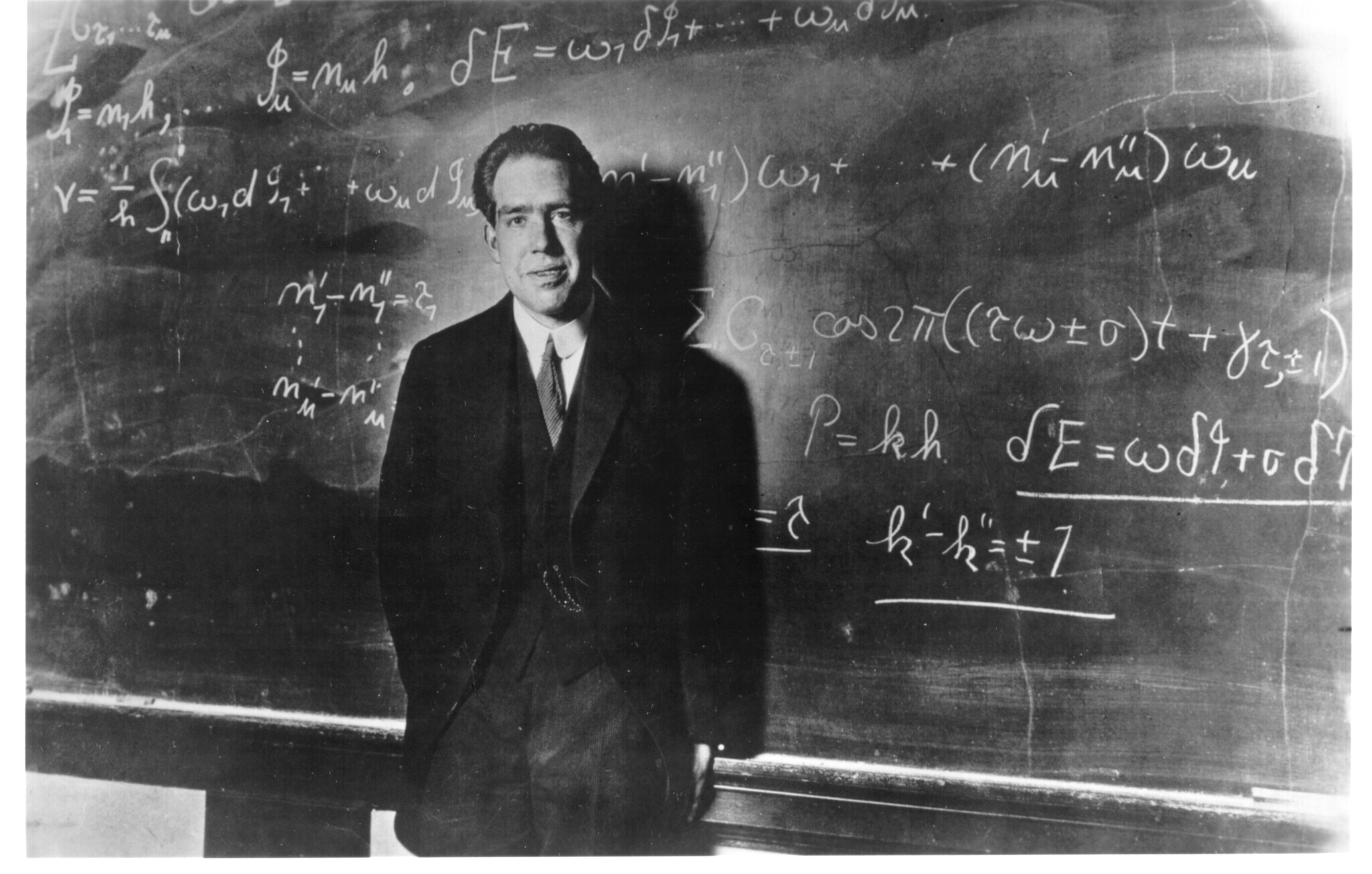
Niels Bohr, as a younger man, at the chalkboard. Atomic Archives
It is difficult to predict, especially the future.
- Niehls Bohr, Danish physicist, 1885-1962 – attributed by Mark Kac, Statistics, 1975. Other sources say it is a Danish pun (anybody here speak Danish?) famous in the Danish parliament in the 1930s.
And as if in tribute to Bohr, Ed Brayton at Dispatches from the Culture Wars has a collection of creationist predictions that evolution theory will soon be dead — a series of predictions starting in 1904. Santayana’s Ghost urges you to read them, to avoid repeating history.
Spread the word; friends don't allow friends to repeat history.
Leave a Comment » | Famous quotes, Quotes, Santayana's ghost, Science | Tagged: Creationism, Evolution, predictions, Quotes | Permalink
Posted by Ed Darrell
November 4, 2007
Several years ago I found a quote attributed to business consulting guru Tom Peters, that ascribed success to hard work — if a lot of other things didn’t get in the way. I lost the quote, and the citation, and have sorely wanted to have it a hundred times since then when I found executives and administrators admonishing people for their failure to soar when the bosses themselves had anchored their employees to the ground.
Ah, the Glories of Google! I have found it again. Turns out it’s not Tom Peters after all; he quotes a passage from novelist Ann Beattie’s novel, Picturing Will.
It’s still worthy of noting; here is an excerpt from a Tom Peters column in 1990 featuring the passage:
“Do everything right, all the time, and the child will prosper. It’s as simple as that, except for fate, luck, heredity, chance, the astrological sign under which the child was born, his order of birth, his first encounter with evil, the girl who jilts him in spite of his excellent qualities, the war that is being fought when he is a young man, the drugs he may try once or too many times, the friends he makes, how he scores on tests, how well he endures kidding about his shortcomings, how ambitious he becomes, how far he falls behind, circumstantial evidence, ironic perspective, danger when it is least expected, difficulty in triumphing over circumstance, people with hidden agendas, and animals with rabies.”
The quote is from Ann Beattie’s latest novel, Picturing Will. It speaks directly to an increasingly important corporate issue — the peril of overestimating our ability to influence outcomes. In short, the way we recruit, organize, plan and act very much depends on how much we feel that we are in control. The problem is ageless, though as the world becomes less predictable the consequences of personal or corporate hubris are increasingly severe.
Systematically review a stack of annual reports. Without fail, a good year is explained as “the fruits of the strategic planning process your management put in place five (three, seven) years ago.” A bad year, however, is invariably the result of “the unanticipated rise in interest rates (unexpected foreign competition, etc.) which upset our planning assumptions.” But our corporate chiefs are hardly alone. A sizable branch of psychology, called attribution theory, examines the way human beings explain events to themselves. In short, we attribute good outcomes to skill and hard work; bad ones to bad luck.
For centuries, Cartesian cause and effect thinking has dominated our science — and management — paradigms. The causeless, effectless, probabilistic world of quantum mechanics that informs today’s scientific thought has still not permeated our psyches — or our approach to making corporate strategy.
Beattie’s novel is listed as an academic selection now, by Random House. Do you, or does anyone at your school, use this book?
Spread the word; friends don't allow friends to repeat history.
3 Comments | Best practices, Books, Business, Business Ethics, Education success, Literature, Quotes | Tagged: Ann Beattie, Business, Education, Quotes, success, Tom Peters | Permalink
Posted by Ed Darrell
September 23, 2007

This is one of the classic stories of public health, an issue that most U.S. history and world history texts tend to ignore, to the detriment of the students and the classroom outcomes.
This is the story as retold by Christopher Cerf and Victor Navasky in The Experts Speak:
In the 1850s a Hungarian doctor and professor of obstetrics named Ignaz Semmelweis (pictured at left) ordered his interns at the Viennese Lying-in Hospital to wash their hands after performing autopsies and before examining new mothers. The death rate plummeted from 22 out of 200 to 2 out of 200, prompting the following reception from one of Europe’s most respected medical practitioners:
“It may be that it [Semmelweis’ procedure] does contain a few good principles, but its scrupulous application has presented such difficulties that it would be necessary, in Paris for instance, to place in quarantine the personnel of a hospital during the great part of a year, and that, moreover, to obtain results that remain entirely problematical.”
– Dr. Charles Dubois (Parisian obstetrician), memo to the French Academy
September 23, 1858
Semmelweiss’ superiors shared Dubois’ opinion; when the Hungarian physician insisted on defending his theories, they forced him to resign his post on the faculty.
Update, September 26, 2007: Stephen J. Dubner at the Freakonomics blog pointed to a video, to an essay by Semmelweis, and to a column he and Steven D. Levitt had done earlier on handwashing. Maybe things aren’t as good as we had hoped.
Spread the word; friends don't allow friends to repeat history.
1 Comment | Famous quotes, History, Public health, Quotes, Research, Science | Tagged: Famous quotes, hand washing, medical research, Quotes, wash your hands | Permalink
Posted by Ed Darrell
September 12, 2007
People in literature are different from you and me.
University of Texas history professor David Oshinsky pulled back the curtain on some of the biggest blunders in the history of literature, in an article for the New York Times a couple of days ago: “No Thanks, Mr. Nabokov.”
He documents rejection letters that, in retrospect, perhaps publisher Alfred A. Knopf would rather had not been written — despite the fact that Knopf was enormously successful otherwise. For example, about a book on teen-aged angst:
In the summer of 1950, Alfred A. Knopf Inc. turned down the English-language rights to a Dutch manuscript after receiving a particularly harsh reader’s report. The work was “very dull,” the reader insisted, “a dreary record of typical family bickering, petty annoyances and adolescent emotions.” Sales would be small because the main characters were neither familiar to Americans nor especially appealing. “Even if the work had come to light five years ago, when the subject was timely,” the reader wrote, “I don’t see that there would have been a chance for it.”
Knopf wasn’t alone. “The Diary of a Young Girl,” by Anne Frank, would be rejected by 15 others before Doubleday published it in 1952. More than 30 million copies are currently in print, making it one of the best-selling books in history.
The goof examples roll out of the files:
Nothing embarrasses a publisher more than the public knowledge that a literary classic or a mega best seller has somehow slipped away. One of them turned down Pearl Buck’s novel “The Good Earth” on the grounds that Americans were “not interested in anything on China.” Another passed on George Orwell’s “Animal Farm,” explaining it was “impossible to sell animal stories in the U.S.A.” (It’s not only publishers: Tony Hillerman was dumped by an agent who urged him to “get rid of all that Indian stuff.”)
Thousands of high school students would agree with the difficulty of selling animal stories.
Oshinsky is working from the files of Knopf, recently donated to the Harry Ransom Humanities Research Center (HRC) at the University of Texas, in Austin. University libraries push and shove each other to get troves of private correspondence, and the HRC has worked to get special grants to help things along. Sometimes these treasures lie buried in library archives. In this case, a grant from the National Endowment for the Humanities helped fund the cataloging operation.
And Oshinsky, who won the Pulitzer for his book Polio: An American Story, has done a bit of history mining. The few nuggets of history gold he reveals in the newspaper will be “classic examples” of why authors, and students and people in the pews of a church, should keep trying in the face of adversity. You’ll see these examples in Readers Digest and inspirational speeches for years to come, count on it.
Literature teachers should find these quotes useful in comforting students who don’t like the classics they are assigned to read. Preachers will find them useful for a variety of reasons. Others of us will like them for the goofiness, and sheer acidity of harsh criticism that, often, proved wrong. We’re Americans; we like it when the underdog wins, and when the pundits get so exactly wrong.
More examples from Oshinsky’s article, below the fold.
Read the rest of this entry »
Spread the word; friends don't allow friends to repeat history.
3 Comments | Books, History, Humor, Literature, Quotes | Tagged: Books, David Oshinsky, History, Humor, Isaac Bashevis Singer, James Baldwin, Kerouac, Literature, Quotes | Permalink
Posted by Ed Darrell
September 8, 2007
Famous quotations often get cited to the wrong famous person. ‘Somebody said something about standing on the shoulders of giants — who was it? Edison? Lincoln? Einstein? Jefferson?’ It may be possible someday to use Google or a similar service to track down the misquotes.
The inspiration, perhaps
A dwarf standing on the shoulders of a giant may see farther than a giant himself.
Robert Burton (February 8, 1577-January 25, 1640), vicar of Oxford University, who wrote The Anatomy of Melancholy to ward off his own depressions
The famous quote
If I have seen further (than you and Descartes) it is by standing on the shoulders of Giants.
Sir Isaac Newton, letter to Robert Hooke, February 5, 1675, Julian/February 15, 1676, Gregorian
Other references:
- On the Shoulders of Giants, title of a book by physicist Stephen Hawking
- On the Shoulders of Giants: The Post-Italianate Edition, by sociologist Robert K. Merton, a humorous send-up of academicism
- On the Shoulders of Giants: New Approaches to Numeracy (1990), from the Mathematical Sciences Education Board of the National Research Council, published by the National Academies Press
- The quotation is reproduced on the edge of the British £2.00 coin, since 1997
- Galileo: On the Shoulders of Giants, 1997 movie about Galileo, by HBO
- Theologian John of Salisbury wrote a similar line, in Latin, in Metalogicon, in 1159.
- Standing on the Shoulders of Giants, 1990, fourth studio album by the British band Oasis; band member Noel Gallagher cribbed the quote from the £2.00 coin, while drunk in a pub.
- On the Shoulders of Giants: The Power of History Told Through Basketball and Music, a story of the Harlem Rens, the first all-black basketball team, with the story of the Harlem Renaissance — a book, movie and CD project by basketball legend Kareem Abdul-Jabbar.
- Even more trivia
Spread the word; friends don't allow friends to repeat history.
3 Comments | Accuracy, Famous quotes, History, Physics, Quotes, Science | Tagged: Accuracy, Famous quotes, History, Isaac Newton, Physics, Quotes, Robert Newton, Science | Permalink
Posted by Ed Darrell
July 9, 2007

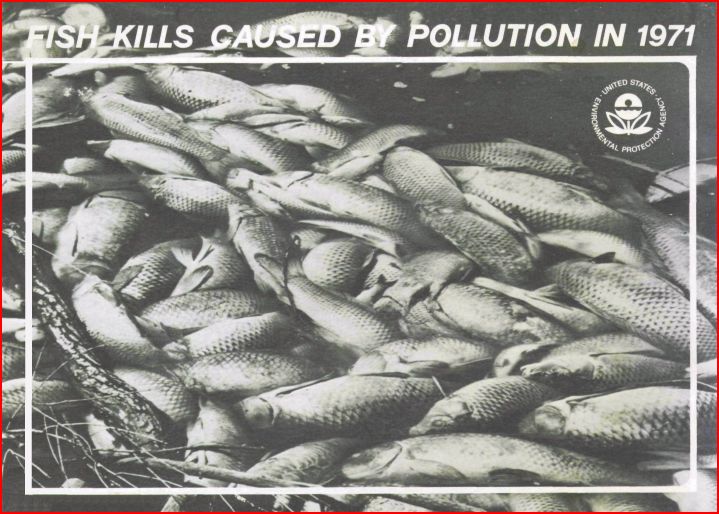
Cover of 1971 EPA publication, Fish Kills Caused By Pollution in 1971. According to the publication, in Texas, in 1971, 16 million fish died in just 6 pollution-caused incidents. (page 9 of the report).
One of the most spectacular fish kills of recent years occurred in the Colorado River below Austin, Texas, in 1961. Shortly after daylight on Sunday morning, January 15, dead fish appeared in the new Town Lake in Austin and in the river for a distance of about 5 miles below the lake. None had been seen the day before. On Monday there were reports of dead fish 50 miles downstream. . . . By January 21, fish were being killed 100 miles downstream. . . . During the last week of January the locks on the Intracoastal Waterway were closed to exclude the toxic waters from Matagorda Bay and divert them into the Gulf of Mexico.
. . . investigators in Austin noticed an odor associated with the insecticides. . . The manager of the (chemical) plant admitted that quantities of powdered insecticide had been washed into the storm sewer recently and, more significantly, he acknowledged that such disposal of insecticide spillage and residues had been common practice for the past 10 years.
. . . For 140 miles downstream from the lake the kill of fish must have been almost complete, for when seines were used later in an effort to discover whether any fish had escaped they came up empty. Dead fish of 27 species were observed, totaling about 1000 pounds to a mile of riverbank.
Rachel Carson, 1962, Silent Spring
Cribbed from the US Geological Survey site.
Spread the word; friends don't allow friends to repeat history.
Leave a Comment » | Accuracy, DDT, Famous quotes, Quotes, Rachel Carson, War on Science | Tagged: DDT, Quotes, Rachel Carson, Texas, Wildlife | Permalink
Posted by Ed Darrell
May 23, 2007
It’s a delightful story I’ve heard dozens of times, and retold a few times myself: Abraham Lincoln faced with some thorny issue that could be settled by a twist of language, or a slight abuse of power, asks his questioner how many legs would a dog have, if we called the dog’s tail, a leg. “Five,” the questioner responds confident in his mathematical ability to do simple addition.

Sunrise at the Lincoln Memorial. National Park Service photo.
“No,” Lincoln says. “Calling a dog’s tail a leg, doesn’t make it a leg.”
But there is always the doubt: Is the story accurate? Is this just another of the dozens of quotes that are misattributed to Lincoln in order to lend credence to them?
I have a source for the quote: Reminiscences of Abraham Lincoln by distinguished men of his time / collected and edited by Allen Thorndike Rice (1853-1889). New York: Harper & Brothers Publishers, 1909. This story is found on page 242. Remarkably, the book is still available in an edition from the University of Michigan Press. More convenient for us, the University of Michigan has the entire text on-line, in the Collected Works of Abraham Lincoln, an on-line source whose whole text is searchable.
However, Lincoln does not tell the story about a dog — he uses a calf. Read the rest of this entry »
Spread the word; friends don't allow friends to repeat history.
46 Comments | Abraham Lincoln, Accuracy, Famous quotes, Good Quotes, History, On-line education, Quotes | Tagged: Abraham Lincoln, Accuracy, Aphorisms, Famous quotes, History, On-line education, Quotes | Permalink
Posted by Ed Darrell
May 11, 2007
Daily Kos I don’t get to daily. But here’s a post I did see that all history teachers ought to read, if only to raise their consciousness about the frauds that plague us every day: Help Fight Fake History that Powers the American Right.
 Chris Rodda needs help supporting her research against all the old dogs of history revisionism, and the post from Troutfishing goes through most of the dishonor roll: D. James Kennedy, David Barton, Catherine Millard, and Chuck Norris
Rodda’s blog series can be found at Talk2Action.
My interest in getting history done right was kindled when high school teachers mentioned early versions of David Barton’s work — stuff that showed up on tests, though anyone who had read our texts and had a passing knowledge of real history would have known was in error. As a staffer in the U.S. Senate I had to got to read letters from people who bought the Barton tales lock, stock, and monkey barrel, and who consequently felt that everyone else on Earth was lying to them.
I wish Rodda luck.
Spread the word; friends don't allow friends to repeat history.
4 Comments | Accuracy, Bad Quotes, Bogus history, Capturing history, Citizenship, Current History, Curricula, Education, History, History Revisionism, Hoaxes | Tagged: Bogus history, Education, History, History Revisionism, Hoaxes, Quotes | Permalink
Posted by Ed Darrell
April 11, 2007

Churchill speaking at the Albert Hall in London, 1944, at an American Thanksgiving Celebration. Churchill Centre image
Never give in, never give in, never, never, never, never — in nothing, great or small, large or petty — never give in except to convictions of honour and good sense!
Winston S. Churchill, address to the boys of Harrow School, October 29, 1941.
Spread the word; friends don't allow friends to repeat history.
6 Comments | Famous quotes, Good Quotes, Leadership, Quotes, Winston Churchill | Tagged: Famous quotes, Great Speeches, History, Leadership, Quotes, Winston Churchill, World War II | Permalink
Posted by Ed Darrell
March 24, 2007

What fairy story, what tale from the Arabian Nights of the jinns, is a hundredth part as wonderful as this true fairy story of simians! It is so much more heartening, too, than the tales we invent. A universe capable of giving birth to many such accidents is — blind or not — a good world to live in, a promising universe. . . . We once thought we lived on God’s footstool; it may be a throne.
Clarence Day (1874-1935), This Simian World (1920), XIX
More from that chapter, below the fold
Read the rest of this entry »
Spread the word; friends don't allow friends to repeat history.
Leave a Comment » | Evolution, History, Natural history, Quotes, Science | Tagged: Evolution, Famous quotes, Natural history, Quotes, Science | Permalink
Posted by Ed Darrell
March 19, 2007

Winston Churchill delivering the “Iron Curtain” speech, Westminster College, Fulton, Missouri, March 5, 1946 – Photo by George Skadding
“From Stettin in the Baltic to Trieste in the Adriatic, an iron curtain has descended across the Continent. Behind that line lie all the capitals of the ancient states of Central and Eastern Europe. Warsaw, Berlin, Prague, Vienna, Budapest, Belgrade, Bucharest and Sofia, all these famous cities and the populations around them lie in what I must call the Soviet sphere, and all are subject in one form or another, not only to Soviet influence but to a very high and, in many cases, increasing measure of control from Moscow.”
Sir Winston S. Churchill, in a speech at Westminster College, Fulton, Missouri, on March 5, 1946, titled “The Sinews of Peace.”
Some historians mark the beginning of the Cold War from this speech, in which a respected world leader first spelled out the enormous stakes at issue, and also pointed out that Russian, communist totalitarian governments were replacing more democratic governments in nations only recently freed from the spectre of Nazi rule, in World War II.
Oh, why not: Below the fold is the speech in its entirety, from the transcript at the Churchill Centre. Read the rest of this entry »
Spread the word; friends don't allow friends to repeat history.
5 Comments | Accuracy, Cold War, Democracy, Freedom - Economic, Freedom - Political, Quotes, Winston Churchill | Tagged: Accura, Accuracy, Cold War, Democracy, Famous quotes, freedom, Quotes, Westminster College, Winston Churchill | Permalink
Posted by Ed Darrell
March 14, 2007
After the same-day deaths in 1884 of his beloved wife Alice, in childbirth, and his mother, who lived with the family, Teddy Roosevelt went into a depression. To beat the depression, he moved to South Dakota and became a cowboy, a very good cowboy.
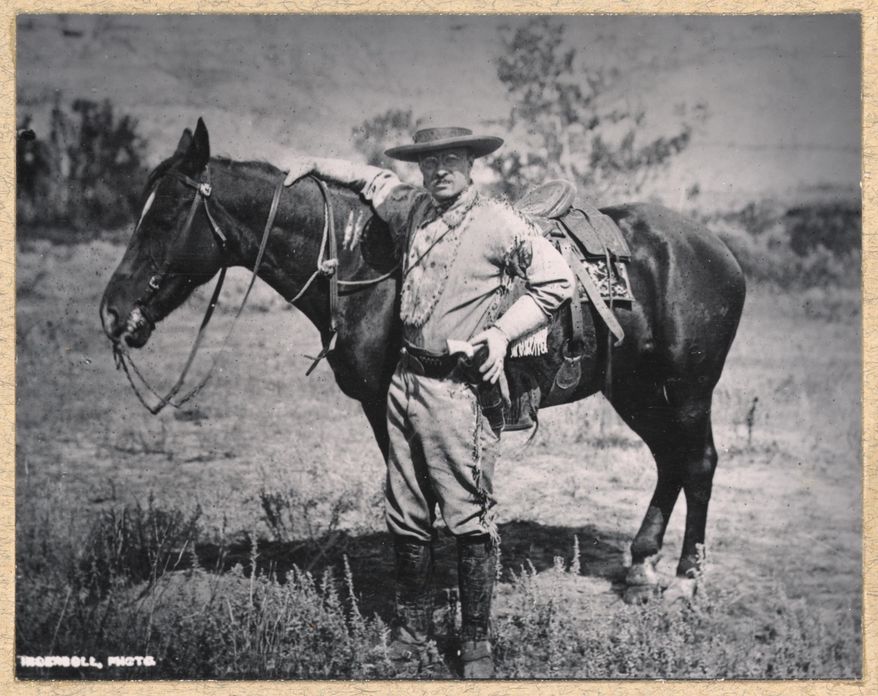
Black care rarely sits behind a rider whose pace is fast enough.
— Attributed to Teddy Roosevelt by David McCullough, on the frontispiece for McCullough’s biography of Roosevelt, Mornings on Horseback (Simon & Schuster, 1981).
Save
Spread the word; friends don't allow friends to repeat history.
6 Comments | Famous quotes, History, Quotes, Theodore Roosevelt | Tagged: Famous quotes, History, Quotes, Theodore Roosevelt | Permalink
Posted by Ed Darrell




 Millard Fillmore's Bathtub