Quote of the moment: Books as lighthouses in the dark sea of time

July 3, 2010

Jeffrey Robbins, a human character in the animated cartoon series,

Jeffrey Robbins, a human character in the animated cartoon series, “The Gargoyles”

The written word is all that stands between memory and oblivion. Without books as our anchors, we are cast adrift, neither teaching nor learning. They are windows on the past, mirrors on the present, and prisms reflecting all possible futures. Books are lighthouses, erected in the dark sea of time.

Jeffrey Robbins, a character in the cartoon series, “The Gargoyles”

Now available on Youtube.  To get the quote above, to go to 21:30 in this video:

Tip of the old scrub brush to James Kessler.


Ed Brayton on the unbearable lightness of anti-Obama thought

July 1, 2010

This is why I like Ed Brayton’s blog, and why you should be reading him with some regularity: his ability to distinguish dross from gold, sometimes even without turning on his solid gold Hemingway s— detector.

Today’s example comes from Brayton’s Dumb[burro] Quote of the Day feature:

From Rick “Man on Dog” Santorum:

“Obama is detached from the American experience. He just doesn’t identify with the average American because of his own background. Indonesia and Hawaii. His view is from the viewpoint of academics and the halls of the Ivy league schools that he went to and it’s not a love of this country and an understanding of the basic values and wants and desires of its people.”

Isn’t that amazing? He’s unable to understand “the American experience” both because of his humble upbringing and because of his elite Ivy League education.

That leaves completely unexplained Rick Santorum’s detachment from the American experience, and detachment from reality.

One non-explanation at a time, I suppose.


Quote of the moment: Frank Zappa, on hydrogen or stupidity

June 29, 2010

Some scientists claim that hydrogen, because it is so plentiful, is the basic building block of the universe. I dispute that. I say there is more stupidity than hydrogen, and that is the basic building block of the universe.

Cover of The Real Frank Zappa Book

Cover of The Real Frank Zappa Book - Wikimedia image

—  Frank Zappa and Peter Occhiogrosso: The Real Frank Zappa Book , 1989, page 239

Actually, I think the claim is that hydrogen is the most common element in the universe, since it’s so simple.  Its abundance is a result of that simplicity.

Physics in 2010 would probably go for dark matter as even more plentiful than hydrogen, but so little is known about dark matter.  As we learn more about dark matter, we could discover Zappa was a physics theorist before his time.  It’s a short line from Zappa to Zwicky.

______________

I’m relieved to have a credible source for the quote — I had found it attributed to Einstein, another case of Darrell’s Law of Quote Misattribution (“any good quote whose source is unknown will be attributed to Jefferson, Lincoln or Einstein; consequently any quote attributed to those people should be sourced before being taken as accurate”).

A couple more I’d like to put to bed, both attributed to Einstein:

  • “The difference between genius and stupidity is that genius has its limits” (from a coffee mug I got years ago at the late Shakespeare, Beethoven & Co.).
  • “Coffee makes me smart” (from another coffee mug).
Simulation of the distribution of dark matter haloes - Max Planck Institute

Simulation of the distribution of dark matter haloes - Max Planck Institute

Like this post? Please share:

Add to FacebookAdd to NewsvineAdd to DiggAdd to Del.icio.usAdd to StumbleuponAdd to RedditAdd to BlinklistAdd to TwitterAdd to TechnoratiAdd to Furl


Quote of the moment: William Faulkner, on the passing of the past

June 24, 2010

William Faulkner, with dogs

William Faulkner, with dogs

The past is never dead.  It’s not even past.

— William Faulkner’s character Gavin Stevens, Requiem for a Nun, 1951

Tip of the old scrub brush to Michael Sacasas at The Frailest Thing

See also:


Encore quote of the moment: George Washington on religious freedom

June 3, 2010

August 17, 1790, found U.S. President George Washington traveling the country, in Newport, Rhode Island.

Washington met with “the Hebrew Congregation” (Jewish group), and congregation leader (Rabbi?) Moses Seixas presented Washington with an address extolling Washington’s virtues, and the virtues of the new nation. Seixas noted past persecutions of Jews, and signalled a hopeful note:

Deprived as we heretofore have been of the invaluable rights of free citizens, we now (with a deep sense of gratitude to the Almighty disposer of all events) behold a government erected by the Majesty of the People–a Government which to bigotry gives no sanction, to persecution no assistance, but generously affording to All liberty of conscience and immunities of Citizenship, deeming every one, of whatever Nation, tongue, or language, equal parts of the great governmental machine.

George Washingtons reply to the Newport, RI, Hebrew congregation, August 17, 1790 - Library of Congress image

George Washington's reply to the Newport, RI, "Hebrew congregation," August 17, 1790 - Library of Congress image

President Washington responded with what may be regarded as his most powerful statement in support of religious freedom in the U.S. — and this was prior to the ratification of the First Amendment:

It is now no more that toleration is spoken of as if it was the indulgence of one class of people that another enjoyed the exercise of their inherent natural rights. For happily, the government of the United States, which gives to bigotry no sanction, to persecution no assistance, requires only that they who live under its protection should demean themselves as good citizens, in giving it on all occasions their effectual support.

Below the fold, more history of the events and religious freedom, from the Library of Congress.

Read the rest of this entry »


Utah report: More false “founders’ quotes” plague American discourse

April 25, 2010

Utah has a movement out to slander education and the Constitution, with a pointless claim that the Constitution cannot be called a “democracy,” damn Lincoln, Hamilton, Madison, Washington, both Roosevelts, and Reagan.

Sadly, it started in my old school district, the one where I got the last nine years of public school education, Alpine District, in the north end of Utah County.

They even have a website, Utah’s Republic. (No, Utah was never an independent republic before it was a state — it’s not like the Texas Republic wackoes, except in their wacko interpretations of law and history, where they are indistinguishable.)

At the blog from that site, there is a silly discussion on how a republic is a much superior form of government to a democracy.  Never mind that sheer numbers in our nation have always made democracy impossible (can’t get 150 million voters in one hall), or that distance makes it impossible to work (vote tomorrow in Washington, D.C.?  Everybody call the airlines, see if you can make it.)

So, I pointed out how a republic can also suggest tyranny.  And the response?  A flurry of “quotes from the founders.”

Can you vouch for any of these “quotes?”  Is any one of them accurate?

The Jefferson “mob rule” quote isn’t in any Jefferson data base that I can find. I find it also attributed to George Washington — but almost always without any citation, so you can’t check.

That maneuver is one of the key indicators of Bogus Quotes, the lack of any citation to make it difficult to track down.  All of these quotes come without citation:

As for a moral people, Washington said there could be no morality without religion and called it the “indispensable support,” not education. Obviously Jefferson and the Founders wanted education of the constitution to take place but we are very far removed from it in our education system.

Democracy… while it lasts is more bloody than either aristocracy or monarchy. Remember, democracy never lasts long. It soon wastes, exhausts, and murders itself. There is never a democracy that did not commit suicide. – John Adams

A democracy is nothing more than mob rule, where fifty-one percent of the people may take away the rights of the other forty-nine. – Thomas Jefferson

The democracy will cease to exist when you take away from those who are willing to work and give to those who would not. – Thomas Jefferson

Democracy is two wolves and a lamb voting on what to have for lunch. Liberty is a well-armed lamb contesting the vote. – Benjamin Franklin

Democracy is the most vile form of government… democracies have ever been spectacles of turbulence and contention: have ever been found incompatible with personal security or the rights of property: and have in general been as short in their lives as they have been violent in their deaths. – James Madison

As I would not be a slave, so I would not be a master. This expresses my idea of democracy. – Abraham Lincoln

The last one is probably accurate, but irrelevant to this discussion (nice red herring, there, Oak).  Can you offer links to verify any of them?

Is this what I suspect?  The “Utah Republic” drive is not only a tempest in a teapot (though perhaps caused by other more serious maladies), but also a tempest based on false readings of history?

The website for “Utah Republic” is maintained by a guy named Oak Norton, who is obviously in thrall to the voodoo histories of David Barton and Cleon Skousen (I think Barton stole a lot of his voodoo history from Skousen, but that’s another topic for another day).

Funny:  Nowhere do these guys discuss one of the greatest drivers of the republic, over more egalitarian and more democratic forms of government.  Remember, Hamilton preferred to have an aristocracy, an elite-by-birth group, who would rule over the peasants.  He didn’t trust the peasants, the people who he saw as largely uneducated, to make critical decisions like, who should be president.  Norton doesn’t trust the peasants to get it right, and so he wants to dictate to them what they are supposed to know, in Nortonland.

Just because Oak Norton slept through high school history and government is no reason to shut down Utah’s Alpine School District or any other school; he’s not offered much evidence that everyone else missed that day in class, nor evidence that it has any significant effect.
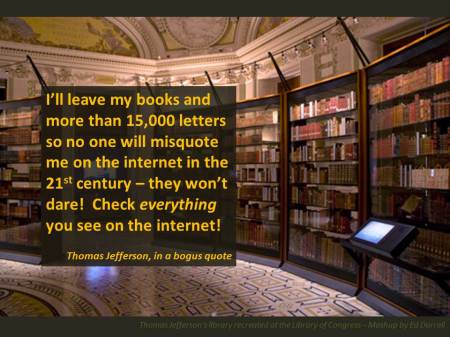
Jefferson's advice on quotes found on the internet

Jefferson’s advice on quotes found on the internet, backdropped by his books now held by the Library of Congress.


Quote of the moment, still: Oliver Wendell Holmes, Jr., on taxes as the price for civilization

April 15, 2010

The frequently quotable Oliver Wendell Holmes, Jr., circa 1930. Edited photograph from the Library of Congress Prints and Photographs Division. Original photo by Harris & Ewing. LC-USZ62-47817.  Copyright expired.

The frequently quotable Oliver Wendell Holmes, Jr., circa 1930. Edited photograph from the Library of Congress Prints and Photographs Division. Original photo by Harris & Ewing. LC-USZ62-47817. Copyright expired.

I like paying taxes. With them I buy civilization.

Justice Oliver Wendell Holmes, Jr., attributed. (see Felix Frankfurter, Mr. Justice Holmes and the Supreme Court, Harvard University Press, 1961, page 71.)

Did Holmes say that?

The quote was all over the internet in early October 2008 (and later), after New York Times op-ed writer Tom Friedman noted it in his column criticizing Alaska Gov. Sarah Palin for her assertion that paying taxes is not patriotic.

I found reference to the quote in a book about eminent economists, through Google Scholar:

Eminent Economists: Their Life Philosophies
By Michael Szenberg
Published by Cambridge University Press, 1993
320 pages

On page 201, Szenberg refers Holmes’s view of “taxation as the price of liberty.” In a footnote, he points to Justice Frankfurter’s book. The quote is dolled up a little. According to Szenberg’s footnote:

More precisely, he rebuked a secretary’s query of “Don’t you hate to pay taxes?” with “No, young fellow, I like paying taxes, with them I buy civilization.”

Frankfurter is a reliable source. It’s likely Holmes said something very close to the words Friedman used.

This is mostly an encore post.

Urge others to give a dime and give a damn for civilization:

Add to FacebookAdd to NewsvineAdd to DiggAdd to Del.icio.usAdd to StumbleuponAdd to RedditAdd to BlinklistAdd to TwitterAdd to TechnoratiAdd to Furl


Quote of the moment: Bertrand Russell, on the Dunning-Kruger Effect, 64 years prescient

March 14, 2010

Lord Bertrand Russell in a BBC Radio studio

Lord Bertrand Russell in a BBC Radio studio,circa 1940 – BBC Radio 4 image

The trouble with the world
is that the stupid are cocksure
and the intelligent
are full of doubt.

– Bertrand Russell, The Triumph of Stupidity in Mortals and Others: Bertrand Russell’s American Essays, 1931-1935 (Routledge, 1998), p. 28

With these words Russell stated, in 1935, a phenomenon observed and chronicled by Justin Kruger and David Dunning, in research at Cornell University, published in 1999 in the Journal of Personality and Social Psychology. “Unskilled and unaware of it:  How difficulties in recognizing one’s own incompetence lead to inflated self-assessments” reported on research they had conducted on subjects at Cornell.  The effect they observed is generally called, after them, the Dunning-Kruger Effect.  According to the abstract:

People tend to hold overly favorable views of their abilities in many social and intellectual domains. The authors suggest that this overestimation occurs, in part, because people who are unskilled in these domains suffer a dual burden: Not only do these people reach erroneous conclusions and make unfortunate choices, but their incompetence robs them of the metacognitive ability to realize it. Across 4 studies, the authors found that participants scoring in the bottom quartile on tests of humor, grammar, and logic grossly overestimated their test performance and ability. Although their test scores put them in the 12th percentile, they estimated themselves to be in the 62nd. Several analyses linked this miscalibration to deficits in metacognitive skill, or the capacity to distinguish accuracy from error. Paradoxically, improving the skills of the participants, and thus increasing their metacognitive competence, helped them recognize the limitations of their abilities. (PsycINFO Database Record (c) 2009 APA, all rights reserved)

In other words,

  1. Incompetent individuals tend to overestimate their own level of skill.
  2. Incompetent individuals fail to recognize genuine skill in others.
  3. Incompetent individuals fail to recognize the extremity of their inadequacy.
  4. If they can be trained to substantially improve their own skill level, these individuals can recognize and acknowledge their own previous lack of skill.

Thus, the Dunning-Kruger effect explains the existence and arguments of creationists, climate change denialists, Tea Baggers and birthers, and the actions of the right-wing historical revisionist faction of the Texas State Board of Education, and provides Monty Python’s Flying Circus with volumes of new material each month, should they ever care to revive the program.

More: 

Tip of the old scrub brush to Mal Adapted, commenting at Open Mind.

Broadcast the news:

Add to FacebookAdd to NewsvineAdd to DiggAdd to Del.icio.usAdd to StumbleuponAdd to RedditAdd to BlinklistAdd to TwitterAdd to TechnoratiAdd to Furl


Quote of the moment: Martin Niemöller, “. . . I did not speak out . . .”

February 26, 2010

First they came for the communists, and I did not speak out—because I was not a communist;
Then they came for the trade unionists, and I did not speak out—because I was not a trade unionist;
Then they came for the Jews, and I did not speak out—because I was not a Jew;
Then they came for me—and there was no one left to speak out for me.

— Pastor Martin Niemöller

Martin Niemoller on a postage stamp, painted by Gerd Aretz in 1992 - Wikipedia

German theologian and Lutheran Pastor Martin Niemöller on a postage stamp, painted by Gerd Aretz in 1992 – Wikipedia

It’s spring, and school curricula turn to the Holocaust, in English, in world history, and in U.S. history.

Martin Niemöller’s poem registers powerfully for most people — often people do not remember exactly who said it.  I have seen it attributed to Deitrich Bonhoeffer (who worked with Niemöller in opposing some Nazi programs), Albert Einstein, Reinhold Niebuhr, Albert Schweitzer, Elie Wiesel, and an “anonymous inmate in a concentration camp.”

Niemöller and his actions generate controversy — did he ever act forcefully enough?  Did his actions atone for his earlier inactions?  Could anything ever atone for not having seen through Hitler and opposing Naziism from the start?  For those discussion reasons, I think it’s important to keep the poem attributed to Niemöller.  The facts of his life, his times, and his creation of this poem, go beyond anything anyone could make up.  The real story sheds light.

Resources:

Save

Save


“Who remembers Paul’s tweet to the Romans?”

January 13, 2010

It’s just such a brilliant question about technology, human communication and history, that I had to make it into it’s own post.

In response to this post about Edith Wharton’s extensive writings and what she’d have done today with e-mail, Mark posted the comment:

Who remembers Paul’s tweet to the Romans?

Helluva question.  What does your Sunday school class say?  What does your literature professor say?  What does your history teacher say?  Send ’em a tweet and see.

Mark also posts occasionally at The Divine Afflatus.


Quote of the moment: Mark Twain, a majority of fools

December 7, 2009

Illustration from The Adventures of Huckleberry Finn, 1884 edition - the King, "Travelling by Rail" - Wikimedia

Illustration from The Adventures of Huckleberry Finn, 1884 edition - the King, "Travelling by Rail" - Wikimedia. (The "King" is being tarred, feathered, and "ridden out of town on a rail.")

Well, the king he talked him blind; so at last he give in, and said all right, but said he believed it was blamed foolishness to stay, and that doctor hanging over them.

But the king says: “Cuss the doctor! What do we k’yer for HIM? Hain’t we got all the fools in town on our side? And ain’t that a big enough majority in any town?”

Mark Twain, The Adventures of Huckleberry Finn, Chapter XXVI


Quote of the moment: Robert F. Kennedy, on what matters in economies

November 8, 2009

Cribbing completely from Harry Clarke (with a few corrections in the text):

Robert F. Kennedy speech at the University of Kansas, Lawrence, March 18, 1968

Robert F. Kennedy speech at the University of Kansas, Lawrence, March 18, 1968 - Photo by George Silk, Time-Life Pictures/Getty Images

RFK said this in 1968.  In a speech I heard today it was quoted and it stirred me.

Too much and for too long, we seem to have surrendered personal excellence and community value in the mere accumulation of material things. Our Gross National Product, now, is over eight hundred billion dollars a year, but that GNP — if we judge the United States of America by that — that GNP counts air pollution and cigarette advertising and ambulances to clear our highways of carnage. It counts special locks for our doors and the jails for the people who break them. It counts the destruction of the redwoods and the loss of our natural wonder in chaotic sprawl. It counts napalm and it counts nuclear warheads, and armored cars for the police to fight the riots in our cities. It counts Whitman’s rifle and Speck’s knife, and the television programs which glorify violence in order to sell toys to our children.

Yet the Gross National Product does not allow for the health of our children, the quality of their education, or the joy of their play. It does not include the beauty of our poetry or the strength of our marriages, the intelligence of our public debate or the integrity of our public officials. It measures neither our wit nor our courage, neither our wisdom nor our learning, neither our compassion nor our devotion to our country; it measures everything, in short, except that which makes life worthwhile. And it can tell us everything about America except why we are proud that we are Americans.

Kennedy delivered these words in an address at the University of Kansas, Lawrence, Kansas, on March 18, 1968.

Here’s a video production from the Glaser Progress Foundation which includes an audio recording of the speech:

More resources:

Add to FacebookAdd to NewsvineAdd to DiggAdd to Del.icio.usAdd to StumbleuponAdd to RedditAdd to BlinklistAdd to TwitterAdd to TechnoratiAdd to Furl


Quote of the moment: Eric Blair (George Orwell) on lies becoming history

October 25, 2009

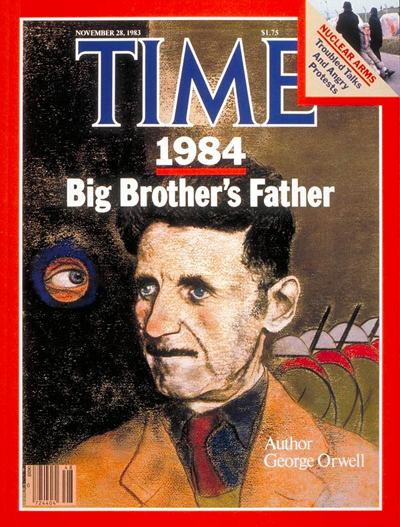
George Orwell (Eric Blair) on cover of Time Magazine, Novmber 28, 1983

George Orwell (Eric Blair) on cover of Time Magazine, Novmber 28, 1983

And if all others accepted the lie which the Party imposed—if all records told the same tale—then the lie passed into history and became truth. ‘Who controls the past’ ran the Party slogan, ‘controls the future: who controls the present controls the past.’

— George Orwell, 1984

Tip of the old scrub brush to Kate at The Urban Primate

If Big Brother is watching, why not let him watch all of us? Spread the word:

Add to FacebookAdd to NewsvineAdd to DiggAdd to Del.icio.usAdd to StumbleuponAdd to RedditAdd to BlinklistAdd to TwitterAdd to TechnoratiAdd to Furl


Quote of the moment: Victor Hugo, telescope vs. microscope

September 23, 2009

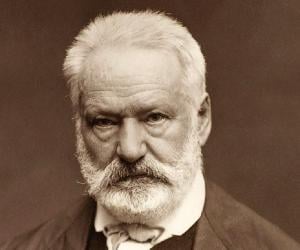
Victor Hugo

Victor Hugo

Where the telescope ends, the microscope begins. Which of the two has a grander view?

— Victor Hugo, Les Miserables, St. Denis, bk. III, ch. 3


Quote of the Moment: George Washington, “to bigotry, no sanction”

August 17, 2009

August 17, 1790, found U.S. President George Washington traveling the country, in Newport, Rhode Island.

Washington met with “the Hebrew Congregation” (Jewish group), and congregation leader (Rabbi?) Moses Seixas presented Washington with an address extolling Washington’s virtues, and the virtues of the new nation.  Seixas noted past persecutions of Jews, and signalled a hopeful note:

Deprived as we heretofore have been of the invaluable rights of free citizens, we now (with a deep sense of gratitude to the Almighty disposer of all events) behold a government erected by the Majesty of the People–a Government which to bigotry gives no sanction, to persecution no assistance, but generously affording to All liberty of conscience and immunities of Citizenship, deeming every one, of whatever Nation, tongue, or language, equal parts of the great governmental machine.

George Washingtons reply to the Newport, RI, Hebrew congregation, August 17, 1790 - Library of Congress image

George Washington's reply to the Newport, RI, "Hebrew congregation," August 17, 1790 - Library of Congress image

President Washington responded with what may be regarded as his most powerful statement in support of religious freedom in the U.S. — and this was prior to the ratification of the First Amendment:

It is now no more that toleration is spoken of as if it was the indulgence of one class of people that another enjoyed the exercise of their inherent natural rights. For happily, the government of the United States, which gives to bigotry no sanction, to persecution no assistance, requires only that they who live under its protection should demean themselves as good citizens, in giving it on all occasions their effectual support.

Below the fold, more history of the events and religious freedom, from the Library of Congress.

Read the rest of this entry »