Depending on your perspective, the world looks pretty good

January 2, 2011

If you’re a few dozen miles from the Earth, for example:
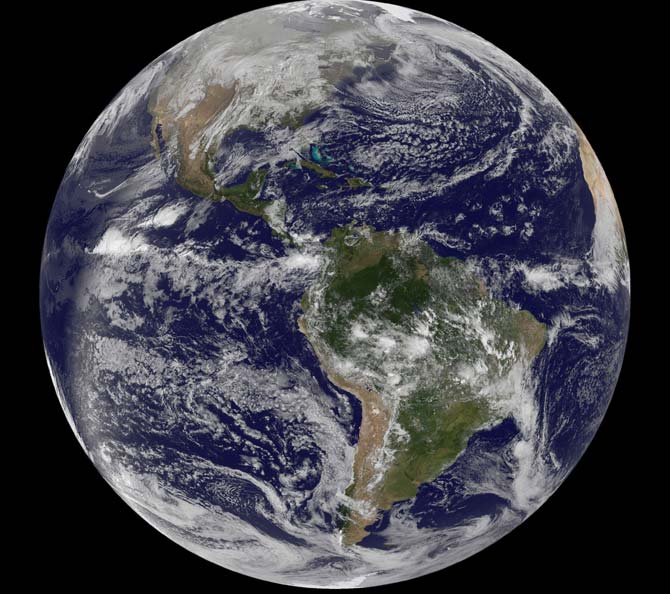
Earth full disc, December 30, 2010 - NASA, GOES

From NASA: The GOES-13 satellite captured a "full-disk image" of North and South America in an image created December 30 at 1445 UTC (9:45 a.m. EST), as the world awaits the new year. Credit: NOAA/NASA GOES Project; click on picture for larger view

Press information from NASA:

As the World Turns to 2011 GOES Satellites Watch its Approach and Look Back at 2010

The GOES series of satellites keep an eye on the weather happening over the continental U.S. and eastern Pacific and Atlantic Oceans and had a busy time with wild weather in 2010. Today, GOES-13 captured one of the last images of North and South America in 2010 as the world continues to turn toward 2011.

The Geostationary Operational Environmental Satellite called GOES-13 satellite captured a “full-disk image” of North and South America in an image created December 30 at 1445 UTC (9:45 a.m. EST) as the world awaits the new year. The stunning image shows cloud cover associated low pressure areas over the upper Midwestern U.S. and Colorado’s Rocky Mountains.

NASA’s GOES Project, located at NASA’s Goddard Space Flight Center in Greenbelt, Md., procures and manages the development and launch of the GOES series of satellites for NOAA on a cost-reimbursable basis. NASA’s GOES Project also creates some of the GOES satellite images and GOES satellite imagery animations. NOAA manages the operational environmental satellite program and establishes requirements, provides all funding and distributes environmental satellite data for the United States.

NASA’s GOES Project was very busy this year. GOES-13 monitors the eastern continental U.S., Atlantic Ocean, Gulf of Mexico and Caribbean, while GOES-11 monitors weather conditions over the western U.S. and the Eastern Pacific Ocean.

In 2010, GOES satellites were busy providing images and animations of weather systems from nor’easters to tropical cyclones that caused blizzards, flooding and wind damage.

Most recently, the GOES project used satellite data to create an impressive animation of the great Christmas weekend blizzard that pummeled the northeastern U.S. Prior to that, GOES imagery showed travel conditions for the holiday weekend when that low was over the Colorado Rockies.

On Dec. 19, the GOES-11 satellite captured an image of the famous “Pineapple Express.” Occasionally in the winter, a large jet stream forms across the mid-Pacific, carrying a continuous flow of moisture from the vicinity of Hawaii to California, bringing heavy rain and snow to the Sierra-Nevada for several days.

On Dec. 8 GOES-13 satellite imagery revealed a snow-covered, winter-like upper Midwest, several weeks before astronomical winter. On Nov. 24, GOES satellites helped Thanksgiving travelers figure out where delays may be happening.

During the summer, on July 25, GOES-13 imagery tracked one of the most destructive storms in years to strike Washington, D.C. and the surrounding area. Strong winds downed trees and power lines, leaving hundreds of thousands of residents without power, stopping elevators, and darkening malls and movie theaters. Falling trees killed at least two people. The NASA GOES Project created a satellite animation of the storm as moved through the region.

GOES-13 was busy in the Atlantic during the 2010 hurricane season. The Atlantic season started on June 1 and ended on November 30. The Atlantic season tied for third with two other years (1995 and 1887) as having the largest number of named storms at 19, and tied with two other seasons (1969 and 1887) for the second largest number of hurricanes, with 12. GOES-13 covered all of those tropical cyclones. GOES-11 didn’t see the action in the Eastern Pacific tropics that GOES-13 did, however. Because of a La Niña event, the 2010 Pacific hurricane season (which began May 15 and ended Nov. 30) was the least active season in terms of the number of named storms and hurricanes on record. All tropical cyclones can be seen at NASA’s Hurricane page archives for 2010 at: http://www.nasa.gov/mission_pages/hurricanes/archives/index.html.

On April 14, months before hurricane season started, GOES-13 became the official GOES-EAST satellite. GOES-13 was moved from on-orbit storage and into active duty. It is perched 22,300 miles above the equator to spot potentially life-threatening weather, including tropical storm activity in the Atlantic Ocean and Gulf of Mexico..

Before GOES-13 moved into the position previously occupied by GOES-12, GOES-12 captured a parade of three large storms the flooded the upper Midwest and Northeast in the second half of March. In the first half of March, GOES-12 covered storms as they dumped heavy rainfall in the Northeastern U.S.

On March 12, GOES-12 captured a very rare event in the tropics: the second–ever known tropical cyclone called Tropical Storm 90Q formed in the South Atlantic Ocean off the coast of Argentina.

During the first two weeks of February 2010, the GOES-12 weather satellite also observed a record-setting series of “Nor’easter” snow storms which blanketed the mid-Atlantic coast in two blizzards.

Whatever and wherever the weather in 2011, the GOES series of satellites will always go.

Related Links:

› GOES-POES web site
› NOAA web site

Rob Gutro
NASA’s Goddard Space Flight Center, Greenbelt, Md.


December 31: Bright Idea Day, anniversary of Edison’s light bulb

December 31, 2010

100,000 people gather in Times Square, New York City, tonight, and millions more around the world, in festivities for the new year made possible by the work of Thomas Alva Edison.

Here it is, the invention that stole sleep from our grasp, made clubbing possible, and launched 50,000 cartoons about ideas:

The light bulb Thomas Edison demonstrated on December 31, 1879, at Menlo Park, New Jersey - Wikimedia image

The light bulb Thomas Edison demonstrated on December 31, 1879, at Menlo Park, New Jersey - Wikimedia image (GFDL)

The light bulb. It’s an incandescent bulb.

It wasn’t the first bulb. Edison a few months earlier devised a bulb that worked with a platinum filament. Platinum was too expensive for mass production, though — and Edison wanted mass production. So, with the cadre of great assistants at his Menlo Park laboratories, he struggled to find a good, inexpensive filament that would provide adequate life for the bulb. By late December 1879 they had settled on carbon filament.

Edison invited investors and the public to see the bulb demonstrated, on December 31, 1879.

Thomas Edison in 1878, the year before he demonstrated a workable electric light bulb.  Library of Congress image

Thomas Edison in 1878, the year before he demonstrated a workable electric light bulb. CREDIT: Thomas Edison, head-and-shoulders portrait, facing left, 1880. Prints and Photographs Division, Library of Congress. Reproduction number LC-USZ62-98067

Edison’s successful bulb indicated changes in science, technology, invention, intellectual property and finance well beyond its use of electricity. For example:

  • Edison’s Menlo Park, New Jersey, offices and laboratory were financed with earlier successful inventions. It was a hive of inventive activity aimed to make practical inventions from advances in science. Edison was all about selling inventions and rights to manufacture devices. He always had an eye on the profit potential. His improvements on the telegraph would found his laboratory he thought, and he expected to sell the device to Western Union for $5,000 to $7,000. Instead of offering it to them at a price, however, he asked Western Union to bid on it. They bid $10,000, which Edison gratefully accepted, along with the lesson that he might do better letting the marketplace establish the price for his inventions. Other inventive labs followed Edison’s example, such as the famous Bell Labs, but few equalled his success, or had as much fun doing it.  (Economics teachers:  Need an example of the marketplace in action?)
  • While Edison had some financial weight to invest in the quest for a workable electric light, he also got financial support, $30,000 worth, from some of the finance giants of the day, including J. P. Morgan and the Vanderbilts who established the Edison Light Company.
  • Edison didn’t invent the light bulb — but his improvements on it made it commercial. “In addressing the question ‘Who invented the incandescent lamp?’ historians Robert Friedel and Paul Israel list 22 inventors of incandescent lamps prior to Joseph Wilson Swan and Thomas Edison. They conclude that Edison’s version was able to outstrip the others because of a combination of three factors: an effective incandescent material, a higher vacuum than others were able to achieve (by use of the Sprengel pump) and a high resistance lamp that made power distribution from a centralized source economically viable.”
  • Edison’s financial and business leadership acumen is partly attested to by the continuance of his organizations, today — General Electric, one of the world’s most successful companies over the past 40 years, traces its origins to Edison.

Look around yourself this evening, and you can find a score of ways that Edison’s invention and its descendants affect your life. One of the more musing effects is in cartooning, however. Today a glowing lightbulb is universally accepted as a nonverbal symbol for ideas and inventions. (See Mark Parisi’s series of lightbulb cartoons, “Off the Mark.”)

Even with modern, electricity-saving bulbs, the cartoon shorthand hangs on, as in this Mitra Farmand cartoon.

Fusilli has an idea, Mitra Farmand, Fuffernutter

Brilliant cartoon from Mitra Farmand, Fuffernutter

Or see this wonderful animation, a video advertisement for United Airlines, by Joanna Quinn for Fallon — almost every frame has the symbolic lightbulb in it.

Other resources:

Patent drawing for Thomas Edison's successful electric lamp.  Library of Congress

Thomas Edison's electric lamp patent drawing and claim for the incandescent light bulb CREDIT: “New Jersey--The Wizard of Electricity--Thomas A. Edison's System of Electric Illumination,” 1880. Prints and Photographs Division, Library of Congress. Reproduction Number LC-USZ62-97960.

Yeah, this is mostly an encore post.


Make a creationist crazy: Celebrate Hubble “Looking Up” Day!

December 30, 2010

Here’s another way to drive creationists absolutely up the wall:  Lift a glass of champagne today in tribute to Edwin Hubble and his great discovery.

Ultraviolet image of the Andromeda Galaxy, first known to be a galaxy by Edwin Hubble on December 30, 1924 - Galaxy Evolution Explorer image courtesy NASA

Ultraviolet image of the Andromeda Galaxy, first known to be a galaxy by Edwin Hubble on December 30, 1924 - Galaxy Evolution Explorer image courtesy NASA

Today is a good day to celebrate the universe in all it’s glory – December 30.

On December 30, 1924, Edwin Hubble announced he’d discovered other galaxies in distant space. Though it may not have been so clear at the time, it meant that, as a galaxy, we are not alone in the universe (whether we are alone as intelligent life is a separate question). It also meant that the universe is much, much bigger than most people had dared to imagine.


Below, mostly an encore post.

In 2008  for Hubble Day, Wired picked up on the story (with a gracious link to 2007’s post here at the Bathtub). Wired includes several links to even more information, a good source of information. See Wired’s 2009 post here.

Hubble was the guy who showed us the universe is not only bigger than we imagined, it’s probably much bigger and much more fantastic than we can imagine. Hubble is the guy who opened our imaginations to the vastness of all creation.

How does one celebrate Hubble Day? Here are some suggestions:

  • Easier than Christmas cards: Send a thank-you note to your junior high school science teacher, or whoever it was who inspired your interest in science. Mrs. Hedburg, Mrs. Andrews, Elizabeth K. Driggs, Herbert Gilbert, Mr. Willis, and Stephen McNeal, thank you.
  • Rearrange your Christmas/Hanukkah/Eid/KWANZAA lights in the shape of the Andromeda Galaxy — or in the shape of any of the great photos from the Hubble Telescope (Andromeda Galaxy pictured above; Hubble images here)

    A few of the images from the Hubble Telescope

    A few of the images from the Hubble Telescope

  • Go visit your local science museum; take your kids along – borrow somebody else’s kids if you have to (take them along, too)
  • Spend two hours in your local library, just looking through the books on astronomy and the universe
  • Anybody got a good recipe for a cocktail called “The Hubble?” “The Andromeda?” Put it in the comments, please

The encore post, from 2007:

December 30, 1924, Edwin Hubble announced the results of his observations of distant objects in space.

PBS

Edwin Hubble - source: PBS

In 1924, he announced the discovery of a Cepheid, or variable star, in the Andromeda Nebulae. Since the work of Henrietta Leavitt had made it possible to calculate the distance to Cepheids, he calculated that this Cepheid was much further away than anyone had thought and that therefore the nebulae was not a gaseous cloud inside our galaxy, like so many nebulae, but in fact, a galaxy of stars just like the Milky Way. Only much further away. Until now, people believed that the only thing existing outside the Milky Way were the Magellanic Clouds. The Universe was much bigger than had been previously presumed.

Later Hubble noted that the universe demonstrates a “red-shift phenomenon.” The universe is expanding. This led to the idea of an initial expansion event, and the theory eventually known as Big Bang.

Hubble’s life offered several surprises, and firsts:

Hubble was a tall, elegant, athletic, man who at age 30 had an undergraduate degree in astronomy and mathematics, a legal degree as a Rhodes scholar, followed by a PhD in astronomy. He was an attorney in Kentucky (joined its bar in 1913), and had served in WWI, rising to the rank of major. He was bored with law and decided to go back to his studies in astronomy.

In 1919 he began to work at Mt. Wilson Observatory in California, where he would work for the rest of his life. . . .
Hubble wanted to classify the galaxies according to their content, distance, shape, and brightness patterns, and in his observations he made another momentous discovery: By observing redshifts in the light wavelengths emitted by the galaxies, he saw that galaxies were moving away from each other at a rate constant to the distance between them (Hubble’s Law). The further away they were, the faster they receded. This led to the calculation of the point where the expansion began, and confirmation of the big bang theory. Hubble calculated it to be about 2 billion years ago, but more recent estimates have revised that to 20 billion years ago.

An active anti-fascist, Hubble wanted to joined the armed forces again during World War II, but was convinced he could contribute more as a scientist on the homefront. When the 200-inch telescope was completed on Mt. Palomar, Hubble was given the honor of first use. He died in 1953.

“Equipped with his five senses, man explores the universe around him and calls the adventure Science.”

That news on December 30, 1924, didn’t make the first page of the New York Times. The Times carried a small note on February 25, 1925, that Hubble won a $1,000 prize from the American Academy for the Advancement of Science.

(Does anyone have a suitable citation for that video? Where did it come from? Who produced it? Is there more somewhere?)

Happy Hubble Day! Look up!

Resources:

Hubble Space Telescope - NASA image

Hubble Space Telescope, working homage to Edwin Hubble - NASA image


Celestial holiday ornament – I mean, supernova bubble

December 28, 2010

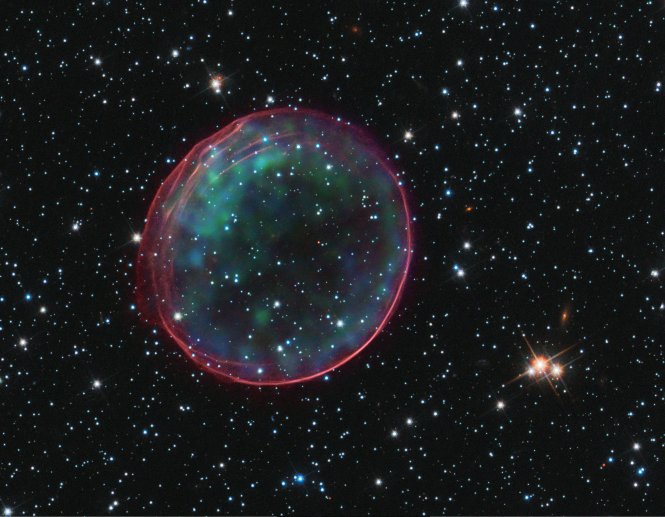
Supernova SNR 0509-67.5, image a composite of Hubble Space Telescope and CHANDRA X-ray Observatory images - image from NASA (click on image for larger view)

Supernova SNR 0509-67.5, image a composite of Hubble Space Telescope and CHANDRA X-ray Observatory images - image from NASA (click on image for larger view)

Press release from NASA:

This colorful creation was made by combining data from two of NASA’s Great Observatories. Optical data of SNR 0509-67.5 and its accompanying star field, taken with the Hubble Space Telescope, are composited with X-ray energies from the Chandra X-ray Observatory. The result shows soft green and blue hues of heated material from the X-ray data surrounded by the glowing pink optical shell which shows the ambient gas being shocked by the expanding blast wave from the supernova. Ripples in the shell’s appearance coincide with brighter areas of the X-ray data.

The Type 1a supernova that resulted in the creation of SNR 0509-67.5 occurred nearly 400 years ago for Earth viewers. The supernova remnant, and its progenitor star reside in the Large Magellanic Cloud (LMC), a small galaxy about 160,000 light-years from Earth. The bubble-shaped shroud of gas is 23 light-years across and is expanding at more than 11 million miles per hour (5,000 kilometers per second).

Data from Hubble’s Advanced Camera for Surveys, taken in 2006 with a filter that isolates light from glowing hydrogen were combined with visible-light images of the surrounding star field that were imaged with Hubble’s Wide Field Camera 3 in 2010. These data were then merged with X-ray data from the Chandra X-ray Observatory taken with the Advanced CCD Imaging Spectrometer (ACIS) in 2000 and 2007.

Credits: X-ray: NASA/CXC/SAO/J.Hughes et al, Optical: NASA/ESA/Hubble Heritage Team (STScI/AURA)


December 27, Good Trip Day: Darwin and Apollo 8

December 28, 2010

December 27 is one of those days — many of us are off work, but it’s after Boxing Day, and it’s not yet on to New Year’s Eve or Day.  We should have celebrated, maybe.

We should celebrate it as a day of portent:  A good embarkation, and a good, safe end to a nation-encouraging trip to almost touch the Moon.

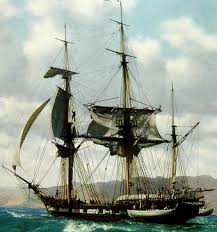
HMS Beagle, Darwin's ship

HMS Beagle, on a voyage of discovery

On December 27, 1831, Charles Darwin and H.M.S. Beagle set sail on an around-the-world voyage of discovery that would change all of science, and especially biology, forever.

December 27 1831
After a few delays, H.M.S. Beagle headed out from Plymouth with a crew of 73 under clear skies and a good wind. Darwin became sea-sick almost immediately.

Darwin never fully overcame his seasickness, but he fought it well enough to become the single greatest collector of specimens in history for the British Museum and British science, a distinction that won him election to science societies even before his return from the trip — and cemented his life in science, instead of in the church.  Darwin’s discoveries would have revolutionized biology in any case.  In analyzing what he had found, a few years later and with the aid of experts at the British Museum, Darwin realized he had disproved much of William Paley’s hypotheses about life and its diversity, and that another, more basic explanation was possible.  This led to his discovery of evolution by natural and sexual selection.

Mini-sheet from the Royal Mail honoring Darwin's discoveries in the Galapagos Islands

Mini-sheet from the Royal Mail in 2009 honoring Darwin's discoveries in the Galapagos Islands

On December 27, 1968, Apollo 8 splashed down after a successful and heartening trip to orbit the Moon.  The three crewmen, Commander Frank Borman, James A. Lovell, Jr., and William A. Anders, had orbited the Moon, a very important milestone in the methodological race to put humans on the Moon (which would be accomplished seven months later).  1968 was a terrible year for the U.S., with the North Korean capture of the U.S.S. Pueblo, assassinations of Rev. Martin Luther King, Jr., and Sen. Robert F. Kennedy during the presidential campaign, riots in dozens of American cities, nasty political conventions with riots at the Democratic Convention in Chicago, a contentious and bitter election making sore the nation’s divide over Vietnam policy, and other problems.  On Christmas Eve, Borman, Lovell and Anders broadcast from orbit around the Moon, a triumphant and touching moment for the Apollo Program and Americans around the world.   Their safe return on December 27 raised hopes for a better year in 1969.

Motherboard.tv has a great write up from Alex Pasternack:

In 1968, NASA engineers were scrambling to meet President Kennedy’s challenge to land a man on the moon by decade’s end. Because delays with the lunar module were threatening to slow the Apollo program, NASA chose to change mission plans and send the crew of Apollo 8 all the way to the moon without a lunar module.

Exactly 42 years ago, the three astronauts of Apollo 8 became the first humans to orbit another celestial object. As they came around the dark side for the third time, Frank Borman, the commander, finally turned their capsule around. And then they saw the Earth.

Borman: Oh my God! Look at that picture over there! Here’s the Earth coming up. Wow, is that pretty.
Anders: Hey, don’t take that, it’s not scheduled.
Borman: (laughing) You got a color film, Jim?
Anders: Hand me that roll of color quick, will you…

One of the resulting photos taken by Anders on a Hasselblad camera became one of the world’s most iconic images.

As Bill Anders recalls it:

I just happened to have one with color film in it and a long lens. All I did was to keep snapping… It’s not a very good photo as photos go, but it’s a special one. It was the first statement of our planet Earth and it was particularly impressive because it’s contrasted against this startling horizon… After all the training and studying we’d done as pilots and engineers to get to the moon safely and get back, [and] as human beings to explore moon orbit, what we really discovered was the planet Earth.

Yeah, we missed toasting it on time in 2010.  Plan to raise a glass on December 27, 2011, to Good Trip Day for the human race.  December 27 is a day we should remember, for these achievements.


Lens incompetence: Watts Up looks through the wrong end of the telescope

December 27, 2010

The wags and denialists over at Anthony Watts’ joint are up to their old tricks, accusing others of their own errors.  Today it’s a guest post by Bernie Lewin, in which he claims that climate warming was all psychological, a “scare”:

Yet we can find precedents to this science-base scare in many health scares of recent decades, and also in environmental scares since the DDT cancer scare triggered by Silent Spring, politicised by the EDF and legalized by the newly formed EPA. (See Scared to Death which finds a repeating pattern to these science-based scares.)

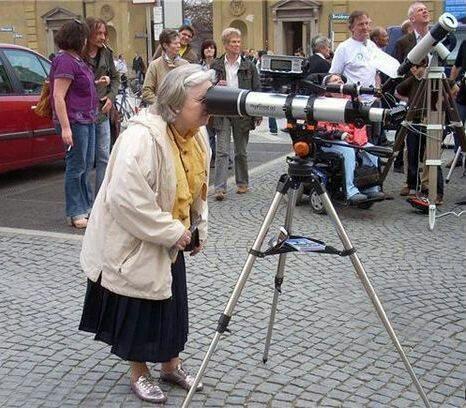
Woman looking through the wrong end of a telescope

This woman might be corrected; global warming denialists will staunchly insist she knows what she’s doing and doesn’t need YOUR advice.

He fails to even think that Rachel Carson was right.  Lewin demonstrates incompetence at history, law and science, and the first point of the Scout Law, all in one sentence.

So much error.  So little time to correct.

  1. Carson didn’t claim DDT caused cancer. She noted that we create thousands of chemicals that may cause cancer, that cancers were rising in frequency, and that there was no testing of the new substances prior to their marketing.   Was there a DDT/cancer scare?  Lewin doesn’t offer any evidence.  (We had to correct Matt Ridley on this a couple of weeks ago — see his post here.)
  2. EDF (Environmental Defense Fund, now known as Environmental Defense) was on DDT without Carson — suing to stop DDT spraying (for no good reason) on Long Island in 1968.  EDF relied on science that was courtroom ready.  (I had misremembered the year of EDF’s suit in an earlier version of this post; my apologies to the two or three who may have read it.)  EDF’s suits established, on the basis of science, that DDT is an uncontrollable poison in the wild.  Lewin ignores science and law in his off-hand indictment of Carson’s book and ED.
  3. EPA didn’t act against DDT until 1972.  EPA banned DDT use on agricultural crops in the U.S. because DDT kills non-target species and, basically, entire ecosystems.  EPA was specific:  The ban had nothing to do with cancer.  Once again, Lewin ignores history, science and law.

So, in Lewin’s guest post, we see the pattern that continues at Watts’s place — unfair and wrong indictments of science, ignorance of history, little understanding of law.

All while trying to mock scientists:  ‘Of course scientists are almost always wrong,’ Watts’s blog argues, once again.

Watts won’t let me correct his errors there, even though he’s still coddling those who misdescribe Rachel Carson as a mass murderer, while denying he does it himself.  Consequently his readers won’t be alerted to this post because Watts or his minions will edit out the automatic ping his blog gets that this post is here.  Propaganda promoting falsehood can’t stand the sunlight of fact and truth.

Just because there’s a scare doesn’t mean there’s not a reason to be scared.  DDT is a deadly toxin, so long-lived that it almost cannot ever be eradicated from the environment.  It kills everything small, quickly, unless so much of it is used that the small things evolve quickly to be resistant and immune to it.

So, if we are to assume, as Lewin wrote, that the anti-warming bunch is to warming what the campaign against Rachel Carson by the DDT manufacturers was to DDT’s harms, we get a hint of what’s really up at Watts Up:  Any anti-warming claim is a hoax.  Why put it so cryptically, if that’s what they meant to say?

When Lewin looks at the history of DDT and Rachel Carson, he’s looking at the false history, and he draws the wrong conclusions.  Should we trust a guy so sloppy with the facts to be right on anything else?


Nuclear weapons: History and policy, in a poster

December 23, 2010

Wish I knew who created this poster, and how.  Some minor inaccuracies — can you find them?  Could you prevail on the Big Format Printer person at your school to print one of these full size for your U.S. history, world history or government class?

Nuclear Weapons, a poster

Nuclear Weapons, a poster

How about a similar poster for the Cold War?  Vietnam War?  Civil Rights Movement?  Gilded Age?

Tip of the old scrub brush to Kenny, cold in Pinggu.


60-second climate skeptic: A 20-second refutation (in about a minute)

December 22, 2010

Back in the life as a corporate consultant and occasional (too-seldom) lecturer, Perry W. Buffington and I got some good mileage out of our observation that, were you in need of delicate brain surgery, you’d probably cross off your list of potential surgeons the guy who had a copy of The One-Minute Brain Surgeon on his desk.  You wouldn’t trust your future to anyone who displayed The One-Minute Financial Planner.

Why in the world would you be ecstatic when your boss read a copy of The One-Minute Manager?

My recollection is that the first time I actually heard Buff use the line, he got an immediate standing ovation from the very large assembly of workers and middle managers (hey, he’s good — audiences really like his stuff). Someone whose study of their profession is limited to one-minute bon mots, should be regarded with great skepticism, or perhaps be ignored completely,  no matter how bon the motsOne-Minute [insert your profession here] makes a catchy title, and may even carry some good value in new ideas and good ideas reduced to readable length.  Ken Blanchard, the lead author of the One-Minute Manager series, did not intend his book to be the only text anyone used on a path to an MBA.  It’s frosting, it’s not the cake.  It’s quip, not quote, not prose.  Remember that.

One-minute experts do not exist.  (Some experts may refresh themselves with one-minute reviews of material — but you won’t take pharmaceuticals from the “One-Minute Pharmacist,” if you’re wise.)

Now comes Coyote Blog with a post, “The 60-second Climate Skeptic.”

One minute climate expert?  No.  That dog won’t hunt.

And here’s why, in 20 seconds:  Our concern for global warming is not produced by charts that show rising temperatures, but by two centuries of observations that natural plants and animals, and ice and weather, show effects from climate warming, and the thermometer measurements confirm that the planet is warming.  The Earth still warms, regardless what any chart says.

Here’s the 60 second explanation for the 20-second rebuttal.  Coyote blog makes eight statements or observations, all of them based on the science of carbon dioxide, a science which the author himself appears not to have mastered (he argues that additional carbon dioxide molecules in the atmosphere are immune from absorbing energy, if there are a lot of carbon dioxide molecules already present, apparently due to some magic mechanism he never mentions)

For 200 years scientists have measured carbon dioxide in the atmosphere — since at least 1960, with special concern for getting the measurements done accurately and right, because our industrial cultures dump a lot of CO2 waste into the air and any scientist understands that wastes cannot be absorbed without effect forever.  (Newton, Coyote.  You’ve heard of Newton?)  These measurements show increasing CO2.

Separately, botanists, zoologists, other biologists and especially those practicing ecology observed that plants and animals migrate north in the Northern Hemisphere, and south in the Southern Hemisphere, plus up mountain slopes where mountains exist, as if climate were warming, and it this warming were changing their climates, and hence, their habitat.

Beginning about 1965, atmospheric scientists have discussed what might be causing this warming.  At great length, after having eliminated every other known explanation (in true science and Sherlock Holmes fashion), CO2 is left as the likely culprit, the one changing thing that best explains the rise in global temperatures well past the time that paleoclimatologists rather expected a turn toward the cooler.

In short, the charts are used to try to explain the actual observations and measurements, and no matter how badly those charts may have been botched, the plants and animals have really moved, and the measured temperatures have really risen.

Coyote Blog tries to explain away reality as a figment of a scientist’s imagination.  But the Earth is still here.  As Galileo is reputed to have observed, regardless your religious views on heliocentricity, the Earth, she still moves.  Similarly, regardless one’s views on the dastardliness of scientists who carp in e-mails about unfair attacks on them, regardless how  badly one misunderstands CO2 chemistry, regardless any errors in creating charts for a UN agency, the Earth, she still warms.

Coyote Blog fails to discuss any of the effects or observations which lead to the charts on CO2.

“One-minute climate skeptics” can make a great contribution to science:  They are models of the Dunning-Kruger effect, and may be studied to understand that science.


Christopher Monckton out of focus

A dictionary could save space, using the same photo for definitions of "climate warming skeptic" and "Dunning-Kruger Effect." In the photo, Monckton is not quite so out-of-focus as usual.


Eclipse! Fun watching, little success photographing

December 21, 2010

Joni Mitchell warned us:  Clouds get in the way:

Lunar eclipse 12-21-2010 - beginning, with clouds - Photo by Ed Darrell - IMGP5738

A clouded view for openers

A long eclipse — more than an hour of almost-total coverage of the Moon’s disk.  Clouds came and went, with a few good viewing times.  With the naked eye, the view was spectacular.  Through the 200 mm Pentax zoom, not quite as spectacular, even with the tripod mount.  Photographing eclipses takes some skill that I don’t yet possess.

Solstice eclipse - clouds took a break IMGP5760 - Photo by Ed Darrell

Clouds took a break

Eclipse totality, with clouds - IMGP5778 - Photo by Ed Darrell

Eclipse totality

A better shot, near the end - IMGP5798 - photo by Ed Darrell

Eclipse nearing its end

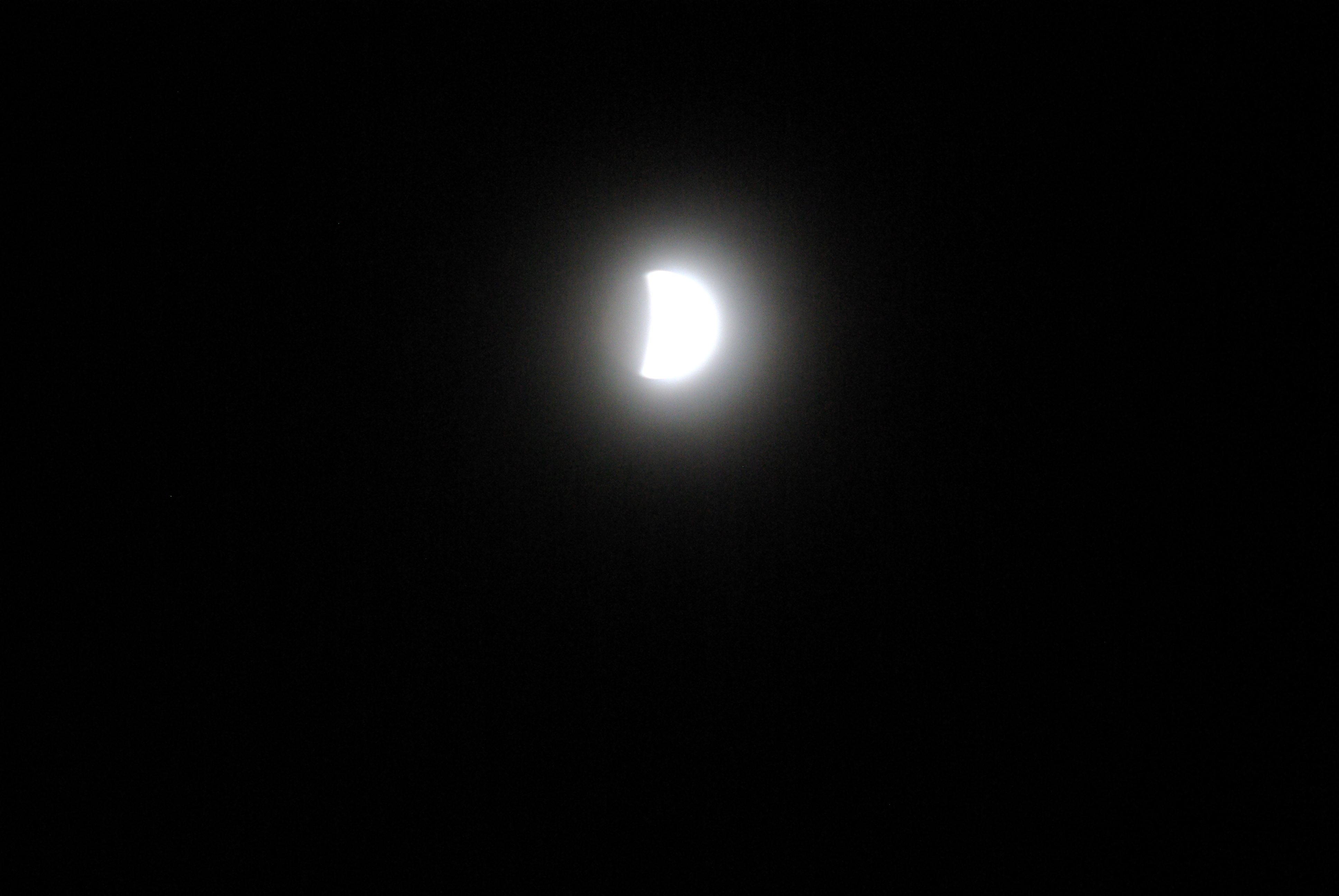
Near the end of totality, where the shadow slips away from the full Moon, a bright white light provides a dazzlying view that confounds the light meters.

Bright sliver as eclipse totality ends - IMGP5813 - Ed Darrell photo

Celestial orange, tinged in silver

Ending eclipse with more of the sky - IMGP5822 - Ed Darrell photo

Step back, see a few of the starts, even from inside Dallas city limits

Bright light at the edge of Earth's shadow - IMGP5844 Ed Darrell photo

To every Earth shadow, there's a silver lining to confuse the built-in light meter

Blood-tinge gone, Earth's shadow retreats - IMGP5881 Ed Darrell photo

Blood-tinge gone, Earth's shadow retreats (all photos by Ed Darrell)

Eclipse over, clouds again fog the view - IMGP5884 - Ed Darrell photo

Eclipse nearly over, clouds again fog the view

Longer lens, better tripod next time.  (Heh.  We should live so long.)


Monkey Day 4 Stone Hearth

December 21, 2010

What the heck is Monkey Day?

The 108th edition of 4 Stone Hearth is up at This is Serious Monkey Business.

A sample:

Over at her blog, Barbara J. King writes about The Cognitive Watershed and Nut-Cracking Monkey Pushback wherein she explains one of the finer (and, in my personal opinion, coolest) aspects of primatology, nut-cracking, and uses bearded capuchin monkeys (Cebus libidosus) to exemplify these foraging techniques. Pretty timely as the holidays approach, eh?

DNApes has also got a fantastic article that’s been hitting the news recently about Monitoring the Health of Endangered, Wild Chimpanzees. I’m particularly interested in disease ecology in primates, so this article was a special treat for me given that it looks at the potential for retroviral diseases in chimpanzees and the risks posed to hunters as a result.

How did humans get HIV, anyway?

Does it seem to you we have fewer blog carnivals coming to town these days?


President’s Malaria Initiative: Plans for FY 2011

December 14, 2010

Barack Obama continued George W. Bush’s Africa-oriented fight against malaria.  The President’s Malaria Initiative (PMI)continues to target malaria for control and, if possible, eradication.

PMI announced today plans for work in 2011, country by country:

Malaria Operational Plans for Fiscal Year 2011

These Malaria Operational Plans have been endorsed by the U.S. Global Malaria Coordinator and reflect collaborative discussions with the national malaria control programs and partners in country. If any further changes are made to these plans, it will be reflected in revised postings.

How long before some wag complains that Obama’s program is anti-Africa because it doesn’t propose enough poisoning of the place?  “Not enough DDT!” they will complain, I wager.  And, for the record, I make this prediction not having read any of the country operational plans — in nearly complete ignorance of what the plans actually propose.  Can you find “enough” DDT in any country’s plan?

More:


Ducking the quacks on DDT

December 9, 2010

Howard Stern may not re-up with Sirius, I hear.  That would make it easier to avoid the quackings of one of the latest and greatest cranks on DDT and malaria.

Rutledge Taylor, the erstwhile (still?) beauty-cream peddler to the stars, spoke with Stern on the telephone the day after the Pearl Harbor anniversary, apparently on the air, and demonstrated greater lunacy about DDT and malaria than in the past; the conversation was posted to YouTube.  Among other things Taylor gets dead wrong he claims:

  • Bedbugs did not develop resistance to DDT as reported in the 1950s and confirmed by recent detailed studies
  • No one studied bedbugs in the past three decades or so
  • DDT was banned to kill people, not due to any danger
  • Mosquito nets are “antiquated”
  • DDT doesn’t harm birds, doesn’t thin eggshells
  • Linus Pauling’s vitamin C studies show that DDT works
  • William Ruckelshaus completely banned DDT use everywhere, by himself, with no science to back the action

Taylor claims to have five file cabinets full of the studies on DDT, but it becomes clear that he hasn’t read any of them.  For example, he cites the erroneous claim that DDT saved 500 million lives, from a 1970 study by the National Academy of Sciences — but he’s not got the honor to tell his listeners that NAS then concluded that despite its value, DDT is too dangerous to keep using.

Stern’s newsletter said, for the December 8, 2010 program:

THE DUDE WHO DRANK DDT

Howard got Dr. Rutledge Taylor on the line to discuss his DDT advocacy: “This is the guy who believes in DDT.” Robin remembered Dr. Rutledge’s infamous YouTube video: “He drank it!” Dr. Rutledge said anti-DDT activists cited faulty–or just plain old–research: “There’s not been a study on DDT and bedbugs in 30 years…it’s the safest pesticide on the planet.” Howard asked about the common claim that DDT thins bird eggs, so Dr. Rutledge said he’d never seen proof: “Total bullshit. I’ve got every study going back to 1940.”
Howard asked if Dr. Rutledge was really dating 80s pop star Debbie Gibson, and the doc confirmed it: “She’s right here. Right now.” Debbie grabbed the phone: “I’m the crazy-supportive girlfriend up in the middle of the night making this phone call with him. Look, he’s saving the world and I wrote ‘Shake Your Love.’ It’s a match made in heaven.” Howard joked: “Does Dr. Rutledge ever bring DDT into the bedroom? Rub it on you?” The doc laughed: “It’s better than chocolate.”

Back in the olden days, broadcasters had to demonstrate that they broadcast in the public interest.  Sirius needs to make no such demonstration.  Otherwise, Stern’s Know-Nothing rants on DDT, alone, would put their license into question.

Instead of urging people to donate $10 to Nothing But Nets to save a kid from malaria, Taylor insists that people should go see his movie, “3 Billion and Counting,” instead.

Fortunately, the movie is no longer in release.  So, Dear Reader, make Howard Stern apoplectic, and save a kid’s life, by sending $10 to Nothing But Nets, and ignore Stern completely.

The facts?  You can’t get them from Stern or Taylor:


Ohio news: No creationist right to burn crosses on junior high science students

December 1, 2010

Oops!  Update and correction, from NCSE, applies equally here:

Update and correction (December 1, 2010): The case is apparently not officially settled after all. What was approved was not the overall proposed settlement, but the terms of the settlement as it concerns Zachary Dennis (a minor) — the “James Doe” of the suit — and it was approved not by the judge presiding over the case, Gregory L. Frost of the Federal District Court for the Southern District of Ohio, but by Licking County Probate Judge Robert Hoover, acting in his role as Juvenile Court Judge for the county. The settlement still needs to be approved by Judge Frost.

John Freshwater’s side finally agreed to a settlement in the suit against him and the local school district prompted by his using an electrical device, a small Tesla coil testing device, to burn crosses on the arms of students.  Thus mostly ends one of the more bizarre stories of creationism and misguided religion in a public school classroom.

Here is the entire story in all its anticlimactic wonder, from the Mount Vernon (Ohio) News:

Judge approves settlement in civil lawsuit

NEWARK — Licking County Probate Judge Robert Hoover on Nov. 23 approved a settlement agreement with regard to the civil lawsuit filed on behalf of Zachary Dennis against suspended Mount Vernon Middle School teacher John Freshwater.

The lawsuit was originally filed in the U.S District Court on June 13, 2008, and included as defendants the Mount Vernon City Schools Board of Education and various school employees. The suit alleged that Freshwater violated the constitutional rights of Zachary Dennis and those of his parents, Stephen and Jennifer Dennis, by, among other things, displaying religious items in his classroom, by teaching intelligent design and by expressing his own religious beliefs to students in the classroom.

The board’s portion of the lawsuit was resolved on or about Aug. 26, 2009, and Freshwater was the sole remaining defendant.

With Judge Hoover’s ruling last Tuesday, the suit against Freshwater was officially settled. The settlement of $475,000 to the Dennis family includes $25,000 for attorney fees, $150,000 each to Stephen and Jennifer, and $150,000 to be used for an annuity for Zachary.

At Panda’s Thumb, Richard B. Hoppe’s complete covering of the case notes that we still await the decision of the referee in the proceeding of John Freshwater’s appeal of his firing, and school board action on that recommendation.

At length, then, officially, it’s a bad idea for a creationist science teacher to burn crosses on the arms of supposedly-willing students using a Tesla coil, in any configuration. Yet to be determined:  May a school board fire a teacher who does that anyway?

More:


Happy Origin Day!

November 24, 2010

On November 24, 1859, Charles Darwin’s book was published, On the Origin of Species.

Title page, 1859 edition of Darwin's Origin of Species - University of Sydney/Wikimedia image

Title page, 1859 edition of Darwin's Origin of Species - image from the University of Sydney via Wikimedia image

How to celebrate?  You could read a summary of Ernst Mayr’s shorthand version of Darwin’s theory, and understand it really for the first time  (I hope not the first time, but there are a lot of people who really don’t understand what Darwin said — especially among critics of evolution):

Darwin’s theory of evolution is based on key facts and the inferences drawn from them, which biologist Ernst Mayr summarised as follows:[3]

  • Every species is fertile enough that if all offspring survived to reproduce the population would grow (fact).
  • Despite periodic fluctuations, populations remain roughly the same size (fact).
  • Resources such as food are limited and are relatively stable over time (fact).
  • A struggle for survival ensues (inference).
  • Individuals in a population vary significantly from one another (fact).
  • Much of this variation is inheritable (fact).
  • Individuals less suited to the environment are less likely to survive and less likely to reproduce; individuals more suited to the environment are more likely to survive and more likely to reproduce and leave their inheritable traits to future generations, which produces the process of natural selection (inference).
  • This slowly effected process results in populations changing to adapt to their environments, and ultimately, these variations accumulate over time to form new species (inference).
Darwin's original sketch of a "tree of life," from Darwin's journals

Charles Darwin's 1837 sketch, his first diagram of an evolutionary tree from his First Notebook on Transmutation of Species (1837) on view at the the Museum of Natural History in Manhattan. Interpretation of handwriting: "I think case must be that one generation should have as many living as now. To do this and to have as many species in same genus (as is) requires extinction . Thus between A + B the immense gap of relation. C + B the finest gradation. B+D rather greater distinction. Thus genera would be formed. Bearing relation" (next page begins) "to ancient types with several extinct forms." Wikimedia image


Annals of Global Warming: Lakes warming in temperate regions worldwide

November 24, 2010

While we were trying (unsuccessfully) to find the criminals who hacked the e-mails of scientists, and trying (unsuccessfully for the most part) to point out that being victims of a crime does not mean a group’s research is faulty, and watching the disastrous results of the cynical assault on American politics by e-mail thieves and modern enemies of Hypatia, the world continues to spin.  Galileo so aptly described the news:  Eppur si muove!

Lake Tahoe, Emerald Bay - one of the world's warming lakes - NASA photo

Lake Tahoe, seen here from Emerald Bay, was one of the primary validation sites for the global lake study. The lake, which straddles the borders of California and Nevada, is the largest alpine lake in North America. Image credit: NASA-JPL

Against those religiously inclined to ignore the facts, a modern Galileo could say:  Eppure, lei si scalda!

Just a few months ago critics of science told us that the Copenhagen conference on climate change was unnecessary, because the world is cooling, and not warming.  Eleven months ago, supporters of the theft of e-mails from the Hadley Climate Research Unit in Britain claimed that researchers had goofed about global warming, and then covered it up.  The sad old Earth kept turning and orbiting . . .

Comes now this news from NASA:

November 23, 2010

Jet Propulsion Laboratory, Pasadena, Calif.

RELEASE : 10-308

NASA Study Finds Earth’s Lakes Are Warming

WASHINGTON — In the first comprehensive global survey of temperature trends in major lakes, NASA researchers determined Earth’s largest lakes have warmed during the past 25 years in response to climate change.

Researchers Philipp Schneider and Simon Hook of NASA’s Jet Propulsion Laboratory in Pasadena, Calif., used satellite data to measure the surface temperatures of 167 large lakes worldwide.

They reported an average warming rate of 0.81 degrees Fahrenheit per decade, with some lakes warming as much as 1.8 degrees Fahrenheit per decade. The warming trend was global, and the greatest increases were in the mid- to high-latitudes of the Northern Hemisphere.

“Our analysis provides a new, independent data source for assessing the impact of climate change over land around the world,” said Schneider, lead author of the study published this week in the journal Geophysical Research Letters. “The results have implications for lake ecosystems, which can be adversely affected by even small water temperature changes.”

Small changes in water temperature can result in algal blooms that can make a lake toxic to fish or result in the introduction of non-native species that change the lake’s natural ecosystem.

Scientists have long used air temperature measurements taken near Earth’s surface to compute warming trends. More recently, scientists have supplemented these measurements with thermal infrared satellite data that can be used to provide a comprehensive, accurate view of how surface temperatures are changing worldwide.

The NASA researchers used thermal infrared imagery from National Oceanic and Atmospheric Administration and European Space Agency satellites. They focused on summer temperatures (July-September in the Northern Hemisphere and January-March in the Southern Hemisphere) because of the difficulty in collecting data in seasons when lakes are ice-covered and/or often hidden by clouds. Only nighttime data were used in the study

The bodies studied were selected from a global database of lakes and wetlands based on size (typically at least 193 square miles or larger) or other unique characteristics of scientific merit. The selected lakes also had to have large surface areas located away from shorelines, so land influences did not interfere with the measurements. Satellite lake data were collected from the point farthest from any shoreline.

The largest and most consistent area of warming was northern Europe. The warming trend was slightly weaker in southeastern Europe, around the Black and Caspian seas and Kazakhstan. The trends increased slightly farther east in Siberia, Mongolia and northern China.

In North America, trends were slightly higher in the southwest United States than in the Great Lakes region. Warming was weaker in the tropics and in the mid-latitudes of the Southern Hemisphere. The results were consistent with the expected changes associated with global warming.

The satellite temperature trends largely agreed with trends measured by nine buoys in the Great Lakes, Earth’s largest group of freshwater lakes in terms of total surface area and volume.

The lake temperature trends were also in agreement with independent surface air temperature data from NASA’s Goddard Institute for Space Studies in New York. In certain regions, such as the Great Lakes and northern Europe, water bodies appear to be warming more quickly than surrounding air temperature.

For more information about NASA and agency programs, visit:

http://www.nasa.gov

– end –


Warming trends in temperate zone lakes, 1985-2009 - NASA image, JPL

Global trends in seasonal nighttime lake surface temperatures, 1985-2009. Image credit: NASA/JPL-Caltec

World wide, a few lakes show not a great deal of warming, but none of the lakes sampled showed any cooling over the past two-and-a-half decades.