If only hysteric, misplaced paranoia could reduce greenhouse gases . . .

December 10, 2009

“I got this idea for a movie!”

“Not another vampire who sucks the sap of only endangered species plants, please, Bob.”

“No, really, you gotta hear this!  Heck, it might even be real.”

“Whaddya mean by that, Bob?”

“I mean this whole Copenhagen thing!  World leaders getting together in secret to plot the destruction of world industry!”

“Copenhagen’s meetings are wide open, Bob.  It’s on the news everywhere.  And did you ever notice that most of the world leaders there are capitalists, and that they owe their election to other capitalists, frequently of the oil-drilling and coal-mining sort?”

“That’s what they want you to think!”

“Well, I think that way whether they want me to or not, Bob.  Money, you know?  I love it.  I follow it.  There’s no money in controlling climate change.  If there were, I’d be Copenhagen right now.”

“You’re missing the point!  These guys are meeting to take the money away from guys like you.”

“Pierre, here at the restaurant, does a pretty good job of taking money from guys like me, in return for a good arugula salad and a chunk of rare roast beef.”

“That’s not what I mean!”

“I think you’ve got another crazy idea that won’t make a good movie.  I’ll let you talk through the arugula, Bob.  When the roast beef comes, I don’t want stupid plots that won’t sell on the table — so it better be good, or we’ll change the topic.”

“Okay, here goes:  Mad climate scientists create a scare about global warming, and everybody gives them their money, and they the rest of the movie is about the chase to catch them before they get to a secret beach in the Maldives or Marshall Islands where they’ll hide forever in their secret lair.”

“I’m not impressed yet, Bob.  Why would anyone think a climate scientist would be so power hungry?

“They meet in Al Gore’s mansion.  Al Gore’s the power-hungry villain!”

“Al Gore?  He lost an election to George F. Bush, for cryin’ out loud.  Nobody would believe that.”

“You mean W — ‘George W. Bush.'”

“Have you seen what the stock market’s been like lately, Bob?  No, of course not.  You don’t own stocks in regular companies — gun makers and gold dealers only — but after what happened to my portfolio, I mean F.  He’s George F. Bush to me.”

“C’mon, it’s ripped from the headlines!”

“It’s about as exciting as the crossword puzzle, Bob.  That’s not a movie — it’s a new sleep drug.  I couldn’t sell it to a religious group trying to make a movie about Charles Darwin, even if we dressed Gore up as Darwin.  Even they’d see through the plot, Bob.”

“Archie!  It’s a great movie!  Think of the special effects!”

“Think of the NoDoz concession.  Theatres don’t have ’em.  Climate scientists taking over the world is like the Joffrey Ballet as the perps on the St. Valentine’s Day Massacre.  It’d be like getting toe-shoed to death.”

Oh, c’mon, Arch.  I got half the screenplay already done!”

“Well you need more research.”

“What?”

MaldivesMarshall Islands.  They’re the poster islands for climate change.  They’re the first nations to go as the sea rises.  All the geeks will know that, and so they’ll laugh at your movie.  Geeks laughing at you isn’t good box office.”

“We can do it like Superman!  You know a Fortress of Solitude somewhere in the ice.”

“No ice would kinda make that plot device not work, wouldn’t it, Bob?”

“Oh, c’mon.  No one really thinks the ice is disappearing!”

“Bob — remember our agreement?”

“What?”

“Beef’s here.  Shuttup.”

“Huh?  Oh, yeah.  Oh.  Yeah.”

“Okay, Archie.  How about this:  There really are gods, and hysteria makes them happy.”

“Hysteria.  Yeah.  There’s value in that.”

“No, I mean it.  Hysteria makes the gods happy, and so then they do good things for people.”

“Like what?”

“Well . . . like . . . like cleaning up global warming.  Yeah, that’s it!  Blind hysteria makes global warming go away!”

“Nobody’ll believe that, either, Bob.  If that worked, global warming would have been gone ten years ago.  Shuttup and eat your beef.”


The Curse of “Not Evil, Just Wrong” — still evil and wrong

December 10, 2009

At the first post on this material, the thread got a little long — not loading well in some browsers, I hear.

So the comments are closed there, and open here.

In fashion we wish were different but seems all too typical, so-called skeptics of global warming defend their position with invective and insult.  But they are vigorous about it.  What do you think?  What information can you contribute?

Here’s the post that set off the denialists, anti-science types and DDT sniffers, and a tiny few genuinely concerned but under-informed citizens:

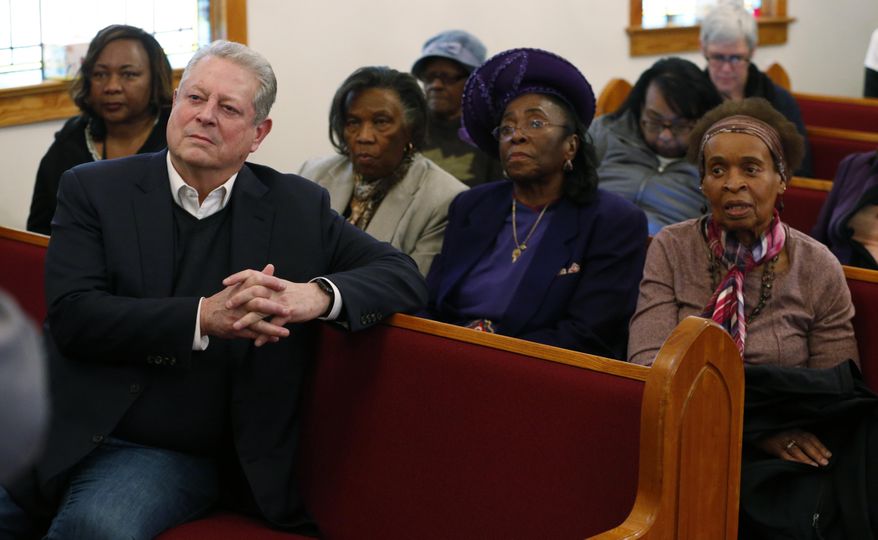
AP caption: Former Vice President Al Gore, left, listens to speakers during a meeting at the Grove Missionary Baptist Church in Buckingham, Va., Tuesday, Feb. 19, 2019. Gore visited the area that is the proposed site for a compressor station for the Atlantic Coast Pipeline. (AP Photo/Steve Helber)
Should be obviously silly for anyone to argue former divinity student Al Gore is evil, as this film implies despite the demurrer. It should also be obviously that it’s evil to call Gore wrong on these issues; but that doesn’t stop brown Earther critics of scientists and Al Gore.

I warned you about it earlier. Crank science sites across the internet feature news of another cheap hit on Rachel Carson and science in movie form.

“Not Evil, Just Wrong” is slated for release on October 18. This is the film that tried to intrude on the Rachel Carson film earlier this year, but managed to to get booked only at an elementary school in Seattle, Washington — Rachel Carson Elementary, a green school where the kids showed more sense than the film makers by voting to name the school after the famous scientist-author.

The film is both evil and wrong.

Errors just in the trailer:

  1. Claims that Al Gore said sea levels will rise catastrophically, “in the very near future.” Not in his movie, not in his writings or speeches. Not true. That’s a simple misstatement of what Gore said, and Gore had the science right.
  2. ” . . . [I]t wouldn’t be a bad thing for this Earth to warm up. In fact, ice is the enemy of life.” “Bad” in this case is a value judgment — global warming isn’t bad if you’re a weed, a zebra mussel, one of the malaria parasites, a pine bark beetle, any other tropical disease, or a sadist. But significant warming as climatologists, physicists and others project, would be disastrous to agriculture, major cities in many parts of the world, sea coasts, and most people who don’t live in the Taklamakan or Sahara, and much of the life in the ocean. Annual weather cycles within long-established ranges, is required for life much as we know it. “No ice” is also an enemy of life.
  3. “They want to raise our taxes.” No, that’s pure, uncomposted bovine excrement.
  4. “They want to close our factories.” That’s more effluent from the anus of male bovines.
  5. The trailer notes the usual claim made by Gore opponents that industry cannot exist if it is clean, that industry requires that we poison the planet. Were that true, we’d have a need to halt industry now, lest we become like the yeast in the beer vat, or the champagne bottle, manufacturing alcohol until the alcohol kills the yeast. Our experience with Rivers and Harbors Act of 1899, the Clean Air Acts and the Clean Water Act is that cleaning the environment produces economic growth, not the other way around. A city choked in pollution dies. Los Angeles didn’t suffer when the air got cleaner. Pittsburgh’s clean air became a way to attract new industries to the city, before the steel industry there collapsed. Cleaning Lake Erie didn’t hurt industry. The claim made by the film is fatuous, alarmist, and morally corrupt.

    When the human health, human welfare, and environmental effects which could be expressed in dollar terms were added up for the entire 20-year period, the total benefits of Clean Air Act programs were estimated to range from about $6 trillion to about $50 trillion, with a mean estimate of about $22 trillion. These estimated benefits represent the estimated value Americans place on avoiding the dire air quality conditions and dramatic increases in illness and premature death which would have prevailed without the 1970 and 1977 Clean Air Act and its associated state and local programs. By comparison, the actual costs of achieving the pollution reductions observed over the 20 year period were $523 billion, a small fraction of the estimated monetary benefits.

  6. “Some of the environmental activists have not come to accept that the human is also part of the environment.” Fatuous claim. Environmentalists note that humans uniquely possess the ability to change climate on a global scale, intentionally, for the good or bad; environmentalists choose to advocate for actions that reduce diseases like malaria, cholera and asthma. We don’t have to sacrifice a million people a year to malaria, in order to be industrial and productive. We don’t have to kill 700,000 kids with malaria every year just to keep cars.
  7. “They want to go back to the Dark Ages and the Black Plague.” No, that would be the film makers. Environmentalists advocate reducing filth and ignorance both. Ignorance and lack of ability to read, coupled with religious fanaticism, caused the strife known as “the Dark Ages.” It’s not environmentalists who advocate an end to cheap public schools.
  8. The trailer shows a kid playing in the surf on a beach. Of course, without the Clean Water Act and other attempts to keep the oceans clean, such play would be impossible. That we can play again on American beaches is a tribute to the environmental movement, and reason enough to grant credence to claims of smart people like Al Gore and the scientists whose work he promotes.
  9. “I cannot believe that Al Gore has great regard for people, real people.” So, this is a film promoting the views of crabby, misanthropic anal orifices who don’t know Al Gore at all? Shame on them. And, why should anyone want to see such a film? If I want to see senseless acts of stupidity, I can rent a film by Quentin Tarantino and get some art with the stupidity. [Update, November 23, 2009: This may be one of the most egregiously false charges of the film. Gore, you recall, is the guy who put his political career and presidential ambitions on hold indefinitely when his son was seriously injured in an auto-pedestrian accident; Gore was willing to sacrifice all his political capital in order to get his son healed. My first dealings directly with Gore came on the Organ Transplant bill. Gore didn’t need a transplant, didn’t have need for one in his family, and had absolutely nothing to gain from advocacy for the life-saving procedure. It was opposed by the chairman of his committee, by a majority of members of his own party in both Houses of Congress, by many in the medical establishment, by many in the pharmaceutical industry, and by President Reagan, who didn’t drop his threat to veto the bill until he signed it, as I recall. Gore is a man of deep, human-centered principles. Saying “I can’t believe Al Gore has great regard for real people” only demonstrates the vast ignorance and perhaps crippling animus of the speaker.]

That’s a whopper about every 15 seconds in the trailer — the film itself may make heads spin if it comes close to that pace of error.

Where have we seen this before? Producers of the film claim as “contributors” some of the people they try to lampoon — people like Ed Begley, Jr., and NASA’s James E. Hansen, people who don’t agree in any way with the hysterical claims of the film, and people who, I wager, would be surprised to be listed as “contributors.”

It’s easy to suppose these producers used the same ambush-the-scientist technique used earlier by the producers of the anti-science, anti-Darwin film “Expelled!

Here, see the hysteria, error and alarmism for yourself:

Ann McElhinney is one of the film’s producers. Her past work includes other films against protecting environment and films for mining companies. She appears to be affiliated with junk science purveyors at the Competitive Enterprise Institute, an astro-turf organization in Washington, D.C., for whom she flacked earlier this year (video from Desmogblog):

Remember, too, that this film is already known to have gross inaccuracies about Rachel Carson and DDT, stuff that high school kids could get right easily.

Anyone have details on McElhinney and her colleague, Phelim McAlee?

More:

Related posts, at Millard Fillmore’s Bathtub:


Cool stuff: Richard Wiseman’s Top 10 Science Party Tricks for Christmas

December 9, 2009

I especially like pouring the carbon dioxide to put out the candles:

Wiseman’s blog is worth visiting from time to time — especially if you’re a teacher.


What if Al Gore were wrong about global warming? That would be great news.

December 6, 2009

It’s a point that the denialists just don’t get.  If Gore were wrong, if warming isn’t occurring, or if the warming were found to be part of a deeper cycle and all we need to do is hang on for another five or six years until the cycle shifts, that would be great news.

No one would complain about a study that actually showed that.

But no study shows that.  And the e-mails that somebody purloined from an English research center, if the worst allegations about scientists were true, can’t affect warming.  In fact, as I understand it, the chart that was “doctored” got its new, non-tree-ring data from actual thermometer readings — which, of course, show warming.

Worse, the chart’s predictions for following years turn out to be low!  Warming is outpacing some of the pessimists’ predictions.

Johann Hari, a columnist with the internet-fueled London Independent, discusses how good the news would be, in a missive at Huffington Post.

Every day, I pine for the global warming deniers to be proved right. I loved the old world – of flying to beaches wherever we want, growing to the skies, and burning whatever source of energy came our way. I hate the world to come that I’ve seen in my reporting from continent after continent – of falling Arctic ice shelves, of countries being swallowed by the sea, of vicious wars for the water and land that remains. When I read the works of global warming deniers like Nigel Lawson or Ian Plimer, I feel a sense of calm washing over me. The nightmare is gone; nothing has to change; the world can stay as it was.

But then I go back to the facts. However much I want them to be different, they sit there, hard and immovable. Nobody disputes that greenhouse gases trap heat in the atmosphere, like a blanket holding in the Sun’s rays. Nobody disputes that we are increasing the amount of those greenhouse gases in the atmosphere. And nobody disputes that the world has become considerably hotter over the past century. (If you disagree with any of these statements, you’d fail a geography GCSE).

Alas, there is no significant or credible evidence that warming is not occurring, nor that we humans are not playing a huge role.

So, in Copenhagen where the world’s leaders and other policy makers are meeting this week to discuss the situation, there will be no champagne to toast an end to global warming.

That would be good news.  It’s not the news we get.

Also see:


Nathan Wolfe’s jungle search for viruses | Video on TED.com (Why it’s important to beat H1N1, now)

November 29, 2009

Here’s Nathan Wolfe explaining how viruses work, quickly and at a high enough level to be entertaining, and explaining why we need to worry about H1N1.

Vodpod videos no longer available.

more about “Nathan Wolfe’s jungle search for viru…“, posted with vodpod

Wolfe also explained a lot at the TED Blog:

Take us back a step or two: How did swine flu enter into the human population?

Swine flu has been known since at least the early part of the 20th century, since the 1930s. It was originally a virus of bird origin — all influenza viruses were originally bird viruses — and it probably spread to humans before it was in pigs.

Now, we still haven’t received definitive information on the underlying genetics of this particular virus. But initial reports suggest that it may be what’s known as a “mosaic virus,” which includes components of swine influenzas, bird influenzas and human influenzas. A cosmopolitan virus like that wouldn’t be unprecedented. (Editor’s Note: see Joe DeRisi’s 2006 TEDTalk for more on state-of-the-art virus detection.)

But in any case, this is a virus that appears to come from pigs, and pigs in close proximity spread the flu in much the same way that humans do — coughing, sneezing, and so on. The virus probably initially entered into human populations through people who work with livestock.

Is swine flu here to stay?

Whether this particular virus will sustain itself and become a permanent part of the human landscape is unclear, but that’s certainly what we’re watching for. As it is, the virus may just disappear because of the weather; summers aren’t good for flu viruses.

So this heat wave is working in our favor?

It might be. The virus has had a good start, from the flu perspective, considering that this is really the end of the season. But the unseasonably hot weather may bode poorly for this virus’ potential to establish itself definitively and cause a pandemic. Had this happened in September or October, it would be much more concerning.

Having said that, it’s not impossible that a virus like this might “go into hiding” — in the southern hemisphere or the tropics — and might come to light again next year. So there will be a lot of discussion about expanding the fall flu vaccine to try to control it next cycle.

Is it really possible for us to prevent future outbreaks like this?

Yes, I believe it is. We spend tons of money trying to predict complex phenomena like tsunamis, hurricanes, earthquakes. There’s no reason to believe that a pandemic is harder to predict than a tsunami. And we’d be foolish not to include forecasting and prevention as part of our overall portfolio to fight these pandemics.

More resources:

Help this post go viral:

Add to FacebookAdd to NewsvineAdd to DiggAdd to Del.icio.usAdd to StumbleuponAdd to RedditAdd to BlinklistAdd to TwitterAdd to TechnoratiAdd to Furl


Starlings of climate change denial do about-face on data-corruption and fraud

November 29, 2009

Funny.  Zumwalt never complained when the data-corruption and fraud were all on the denialists’ side.

I am reminded that, as of the end of November 2009, there are incredibly few science papers (see CCPO’s note) — meaning papers based on research, published in peer-review journals — which make any case contrary to global warming occurring, nor even against the link that much of current warming is caused by human activities.

Under softball rules, the game would have been called against denialists long ago.  Now they want to claim victory on a disqualification, when they violated that rule with gusto through the entire game so far?


Yeah, it’s ironic (hacked e-mails and global warming)

November 26, 2009

James’s Empty Blog:

It is hard to miss the irony in people eagerly poring through illegally-obtained private email, looking for ethical breaches by the writers! I’m sure we can all imagine the outrage if one of the emails revealed that a scientist had hacked into one of the sceptics’ computers and was reading all their correspondence. So a bit of perspective is called for here.

James Is A Scientist (IANAS), and he has much good stuff to say (read some of the other posts about the hacked e-mails while you’re there) — but you gotta wonder about a blog that follows such a post with this:

Prawns, Jules Berry

Prawns not in their native habitat. Probably Tastimus deliciousus

Tip of the old scrub brush to Stoat.


150 years ago, a book that changed history: Charles Darwin, Origin of Species

November 25, 2009

150 years ago today Charles Darwin’s “big book,” On the Origin of Species, was first published.  The entire publication run of more than a thousand copies sold out within a few days, making it a certified best-seller of its day.

A rare copy of the first edition, found in the loo of an old house, sold at auction at Christie’s for US$172,000.

Olivia Judson’s already got her day-after blog post up at the New York Times site, talking about a key issue in evolution:  Extinction.  She already blogged on the importance of the Big Book.

And the “Origin” changed everything. Before the “Origin,” the diversity of life could only be catalogued and described; afterwards, it could be explained and understood. Before the “Origin,” species were generally seen as fixed entities, the special creations of a deity; afterwards, they became connected together on a great family tree that stretches back, across billions of years, to the dawn of life. Perhaps most importantly, the “Origin” changed our view of ourselves. It made us as much a part of nature as hummingbirds and bumblebees (or humble-bees, as Darwin called them); we, too, acquired a family tree with a host of remarkable and distinguished ancestors.

The reason the “Origin” was so powerful, compelling and persuasive, the reason Darwin succeeded while his predecessors failed, is that in it he does not just describe how evolution by natural selection works. He presents an enormous body of evidence culled from every field of biology then known. He discusses subjects as diverse as pigeon breeding in Ancient Egypt, the rudimentary eyes of cave fish, the nest-building instincts of honeybees, the evolving size of gooseberries (they’ve been getting bigger), wingless beetles on the island of Madeira and algae in New Zealand. One moment, he’s considering fossil animals like brachiopods (which had hinged shells like clams, but with a different axis of symmetry); the next, he’s discussing the accessibility of nectar in clover flowers to different species of bee.

At the same time, he uses every form of evidence at his disposal: he observes, argues, compares, infers and describes the results of experiments he has read about, or in many cases, personally conducted. For example, one of Darwin’s observations is that the inhabitants of islands resemble — but differ subtly from — those of the nearest continents. So: birds and bushes on islands off the coast of South America resemble South American birds and bushes; islands near Africa are populated by recognizably African forms.

Of course you –you cognescenti, you — know Judson is the wit behind Dr. Tatiana’s Sex Advice to All Creation, a thoroughly delightful, funny and scientifically accurate book.  Which brings to my mind this question:  Why are scientists, and especially evolutionary scientists, so funny and charming, in stark contrast to the dull proles of creationism?

And, were he not ill at the time, can you imagine what a fantastic dinner guest Charles Darwin himself would be?

Darwin's hand-drawn "tree of life"

Darwin's hand-drawn "tree of life"

Meanwhile, at PBS, NOVA already featured “Darwin’s Darkest Hour” earlier this year.  NOVA research Gaia Remerowski alerts us to a coming production, “What Darwin Never Knew,” featuring progress made in evolutionary development, “evo-devo.”   Science marches on.

Remerowski illustrated her post with Darwin’s quick, hand drawing of a “tree of life,” a drawing that has become iconic in biology circles — like the one to your right.  This one comes from the website of “Speaking of Faith,” another PBS production that featured Darwin earlier this year.  SOF offered an online tour of some of the work of Darwin, too — other drawings from Darwin’s own hand.  Nice exhibit.

Our country’s advocates for good science education, the National Center for Science Education (NCSE) carried Origin Day greetings and a rundown of a dozen projects commemorating the 150th year of the book, and the 200th anniversary of Darwin’s birth.

Happy Origin Day, indeed.


Purloined CRU e-mails on climate science: One scientist pleads for accuracy

November 24, 2009

Here is what he said.  Edward Cook, one of the world’s foremost authorities on ancient trees and how to learn from them (Dendrochronology),  wrote to Michael Mann, both men scientists involved in making their science understandable and available to the public and the International Panel on Climate Change (IPCC).  Both men thought their communication would be private, probably forever.  When no one is looking, this is what they say to one another:

From: Edward Cook <drdendro@xxxxxxxxx.xxx>
To: “Michael E. Mann” <mann@xxxxxxxxx.xxx>
Subject: Re: hockey stick
Date: Wed, 2 May 2001 15:25:41 -0400
Cc: tom crowley <tom@xxxxxxxxx.xxx>, esper@xxxxxxxxx.xxx, Jonathan Overpeck <jto@u.arizona.edu>, Keith Briffa <k.briffa@xxxxxxxxx.xxx>, mhughes@xxxxxxxxx.xxx, rbradley@xxxxxxxxx.xxx, p.jones@xxxxxxxxx.xxx, srutherford@xxxxxxxxx.xxx

Hi Mike,

No problem. I am quite happy to work this stuff through in a careful way and am happy to discuss it all with you. I certainly don’t want the work to be viewed as an attack on previous work such as yours. Unfortunately, this global change stuff is so politicized by both sides of the issue that it is difficult to do the science in a dispassionate environment. I ran into the same problem in the acid rain/forest decline debate that raged in the 1980s. At one point, I was simultaneous accused of being a raving tree hugger and in the pocket of the coal industry. I have always said that I don’t care what answer is found as long as it is the truth or at least bloody close to it.

Cheers,

Ed

This note appeared at the end of a rough-and-tumble debate over what data can be trusted, the motives of scientists involved, and how to make the best use of data collected, clear and unclear, in order to make an accurate portrayal of what is happening in our atmosphere.

I’ll wager no critic of these scientists bothered to quote this one today, nor will they.  In toto, the purloined e-mails show a devotion to science, and the requisite devotion to accuracy and ethical behaviors.  But in a political debate where television weathermen feel compelled to demonize scientists to promote their political beliefs, who can afford to look at the big picture?

My apologies to Dr. Cook for the purloining of the e-mail (though of course I had no role in the hacking); my appreciation to Dr. Cook for standing up for what’s right, damn the critics, when he th0ught no one was looking.

That’s the definition of character, isn’t it?

E-mail this:

Add to FacebookAdd to NewsvineAdd to DiggAdd to Del.icio.usAdd to StumbleuponAdd to RedditAdd to BlinklistAdd to TwitterAdd to TechnoratiAdd to Furl


Smoking guns in the CRU stolen e-mails: A real tale of real ethics in science

November 22, 2009

Climate skeptics fear that some climate scientists have cooked their data in order to produce a pre-ordained outcome from their research.  Many of these people are excited this weekend at the public release of e-mails purloined from Climate Research Unit at East Anglia University in England, from one of the leading climate research labs.  Every crank science and crackpot political site has a story touting the end of research on global warming.

Sure enough, with just a few minutes of searching the e-mails, I found references to ethical breaches in cooking of data, and a discussion about how to talk about  the data and the issue in public.

The paper involved is this one:

David H. Douglass, John R. Christy, Benjamin D. Pearsona and S. Fred Singer, “A comparison of tropical temperature trends with model predictions,” INTERNATIONAL JOURNAL OF CLIMATOLOGY, Int. J. Climatol. (2007).  Published online in Wiley InterScience (www.interscience.wiley.com) DOI: 10.1002/joc.1651

Unless you follow this issue closely, you probably don’t see the problem with publicizing the ethical breaches scientists thought they saw in this paper and its publication.  Also, if you are a “skeptic” who is chronically apoplectic over Al Gore’s success in informing people about climate change and winning prizes and making money, you may be thrilled that there is a scientist anywhere worried about ethical lapses by scientists involved in this controversy, and you can’t wait to see them brought to justice (cooking data is a federal crime in the U.S., if done with federal research money).

[Yes, I think there are ethical questions about publishing anything from these e-mails, let alone links so the viewing public can read them completely.  However, since much of this material has already been cherry picked and quote mined by political activists who hope to stop action to mediate and stop global warming, I think a good case can be made that, to be fair, we should look at the entire collection to see what they really reveal.  There may be criminal liability for some of the disclosures I’m discussing here — but that liability does not fall on the scientists who have been unfairly impugned in the last few days.  The liability falls instead on the critics of warming.  Let’s be fair.  In  a fair fight, truth wins.]

So, hold your high-fives and “I-told-you-sos” until you look at the data, at the information found.

One of the e-mails is quite explicit:

I think the scientific fraud committed by Douglass needs to be exposed. His co-authors may be innocent bystanders, but I doubt it.

Fraud?  Right there in front of everyone?  In the climate debate?

In the end, the scientists in the discussion determined not to hold a press conference to announce a finding of fraud, but instead to hunker down and work on publishing datasets that would contradict the alleged fraudulent paper, and establish their case with data instead of invective and press conferences.

They even declined to rush to inform the public of the fraud after a lengthy series of attempts to duplicate the results with well-known, accurate methods on accepted data:

Bottom line: Douglass et al. claim that “In all cases UAH and RSS satellite trends are inconsistent with model trends.” (page 6, lines 61-62). This claim is categorically wrong. In fact, based on our results, one could justifiably claim that THERE IS ONLY ONE CASE in which model T2LT and T2 trends are inconsistent with UAH and RSS results! These guys screwed up big time. [emphasis added by MFB]

Anthony Watts and others may be justified in asking that the scientists who wrote this fraudulent paper should be summarily dismissed, and in questioning why other scientists dallied in exposing the fraud.

But there is this to consider:  The paper in question is a paper critical of warming hypotheses, and it was co-authored by at least a couple of the most strident critics of Al Gore, James Hansen, the International Panel on Climate Change (IPCC).

The smoking gun was used to shoot down a hasty effort to brand climate-change critics as unprofessional and wrong.  The smoking gun was used to enforce the hard ethical rules of science:  Don’t speak until your data allow a fair conclusion.

The smoking gun e-mails show correct and careful behavior by the scientists who contributed to the IPCC report, but unethical behavior by the critics whose backers, we might assume, stole the e-mails in the first place, and published them without understanding the depth of moral character demonstrated by most scientists in the conduct of their professions.

Now, I have not analyzed every possible permutation of this thread, only those with the title shown.  I used the “Alleged CRU e-mails — searchable” cited by Anthony Watts and others.  I stumbled into the thread discussing the paper by “Douglass, et al.”  I then did a search for e-mails discussing “Douglass,” and limited it to the thread on this point.  I suspect there are other e-mails in that thread in which Douglass’s name is wholly missing, and which did not turn up  in the search.

Now you know the rest of the story.  Fred Singer is a leading denialist, one of the organizers of the political campaign to blunt the publication and discussion of evidence of global warming and what to do about it.  The Douglass, et al. paper under discussion was a key component of the denialists’ campaign in 2007.  The purloined e-mails point to unethical behaviors by the scientists on the anti-warming side, the so-called “skeptics.”

So, from a quick dive into the data we learn:

  1. Climate scientists talk like Boy Scouts trying to impress a Board of Review.
  2. Climate scientists are extremely careful with data.
  3. When they think no one is looking, climate scientists behave ethically.
  4. When they think have found a piece of fraud, climate scientists are careful to recheck their numbers several times and in several ways before saying anything.
  5. Instead of holding a press conference, climate scientists like to keep the fisticuffs in the confines of juried journals.
  6. Climate “skeptics” are full of themselves, and probably wrongly accuse climate scientists of fixing data.
  7. Fraud in climate science may occur, but generally on the side of those who argue against warming or who advocate inaction as a response.
  8. The claims of smoking guns that negate the case for doing something about global warming are most likely hoaxes.

Here are the texts I looked at:

Update, November 25, 2009: Be sure to check out these posts, at George Monbiot’s blog in the comments, at Stoat,  and here at the Bathtub. This is the best judgment on the affair, I think, from Our Kingdom at Open DemocracyRespect to any climate-deniers who invest all their pension funds in seashore hotels in the Maldives… otherwise, they should step aside, and let the work of saving the future begin.”

Smoke this:

Add to FacebookAdd to NewsvineAdd to DiggAdd to Del.icio.usAdd to StumbleuponAdd to RedditAdd to BlinklistAdd to TwitterAdd to TechnoratiAdd to Furl


Newtongate shakes anthropogenically-generated mathematics at the foundation

November 22, 2009

Satire, hoax, fact — how can we tell the difference?

Maybe more importantly, how can we tell early on that the “Climategate” kerfuffle, involving purloined, but otherwise dull e-mails from climate scientists, is nothing to worry about?

Look at history!  Remember Newtongate?  Read it here, at Carbon Fixated.

If you own any shares in companies that produce reflecting telescopes, use differential and integral calculus, or rely on the laws of motion, I should start dumping them NOW. The conspiracy behind the calculus myth has been suddenly, brutally and quite deliciously exposed after volumes of Newton’s private correspondence were compiled and published.

When you read some of these letters, you realise just why Newton and his collaborators might have preferred to keep them confidential. This scandal could well be the biggest in Renaissance science. These alleged letters – supposedly exchanged by some of the most prominent scientists behind really hard math lessons – suggest:

Conspiracy, collusion in covering up the truth, manipulation of data, private admissions of flaws in their public claims and much more.

But perhaps the most damaging revelations are those concerning the way these math nerd scientists may variously have manipulated or suppressed evidence to support their cause.

What kind of conspiracy keeps calculus being taught to innocent children today?  Exactly the same conspiracy that causes scientists to sound the alarms about climate change.

Tip of the old scrub brush to Tim Lambert at Deltoid.


Leonid meteor scattered showers

November 18, 2009

Meteors from the Leonid shower could have been good viewing — generally, as I predicted, it was not spectacular.  At least BBC said so.

But if you can make the time, it’s almost always profitable — psychologically and spiritually — to look up at the sky.

Some who did look up got great photographs of the not-spectacular views.

Leonid meteor shower in Grafton Park, Ontario, Canada - Malcolm Park photo

"A fireball seems to shoot right through a house in Grafton, Ontario. Malcolm Park captured the image as he was setting up to photograph meteors on Monday night." (MSNBC caption)

If this isn’t spectacular, can you imagine what would be?


Leonid meteor shower tonight: Don’t wait up in Dallas

November 16, 2009

Space.com’s story on tonight’s Leonid meteor shower doesn’t encourage me to stay up, or get up to watch (tomorrow morning’s meteor shower, really).  A “strong show,” but not spectacular numbers, and our living so close to Dallas will help obscure much of what would be visible normally.

The first cloud of comet dust was released from the nucleus of Tempel-Tuttle back in the year 1567. North America will be turned toward the constellation Leo when these particles begin pelting the upper layers of our atmosphere, some 80 to 100 miles (130 to 160 km.) above us. Earth’s encounter with the comet dust is going to be brief – possibly no more than several hours long.

Unfortunately, we won’t be going directly through the center of cloud, but rather skim through its outer edge on Nov. 17, chiefly between about 4:30 and 10:30 GMT. As a consequence, the meteor rate is not expected to get much higher than 20 or 30 per hour (on average about one meteor sighting every two or three minutes). Still, this is about two to three times the normal Leonid rate.

At the beginning of this window, it will still be dark across Europe and western Africa with Leo high up in the southeast sky, but within an hour the sky will be brightening as sunrise approaches, soon putting an end to meteor watching.

North Americans – especially those living near and along the Atlantic Seaboard – will be able to watch for Leonids from after 1 a.m. local time right on until the first light of dawn, which comes soon after 5 a.m. local time.

I’ll wager more people will be up watching the new movie 2012 about a wholly fictional collision with Earth than will watch the real collisions from parts of an old comet (Tempel-Tuttle).

More data

2008 Leonids, Chris Peterson at Cloudbait

A composite, all-sky image of the 2008 Leonid outburst over Colorado. Credit: Chris Peterson, Cloudbait Observatory. (NASA) This is a composite image of 141 meteors collected over four evenings, November 16-19 UT. Because the images were collected over many hours, the radiant of the shower is spread out. The Moon was present during the peak activity period each night, so only bright meteors have been recorded. The Moon has been removed from the composite image. (Cloudbait)

Add to FacebookAdd to NewsvineAdd to DiggAdd to Del.icio.usAdd to StumbleuponAdd to RedditAdd to BlinklistAdd to TwitterAdd to TechnoratiAdd to Furl


Stealth malaria promotion in favoring DDT over brown pelicans

November 14, 2009

Another blogger decided to take some potshots at the environmental protection success that banning DDT was is.

edwinleap.com laments that the brown pelican flew off the Endangered Species List this week.  “Brown pelicans 1, brown human beings 0,” the headline reads.  The piece claims that banning DDT use in America has somehow increased malaria, or prolonged it, in Africa and Asia.

Clearly the writer can’t didn’t read a map, or figure distances, and knows nothing knew little about the migratory habits of mosquitoes.  Stopping the spraying of DDT in Arkansas didn’t stop the use or manufacture of DDT in Africa nor Asia, anywhere.  Nor did mosquitoes not killed in America fly to Africa to infect kids.  Someone who has decided to rail against wise science probably isn’t interested much in the facts, though.

I responded there:

DDT has never been banned in Africa, nor Asia.  Today, China and India together manufacture thousands of tons of DDT for use around the world.

Odd — in the nations where DDT was banned (for use on agriculture, never to fight malaria), malaria is eradicated or all but eradicated.  In those nations where DDT is still legal, still manufactured, and still used in great quantities, malaria runs rampant.

Perhaps a lack of DDT doesn’t have anything to do with the spread of malaria.

There are very few, if any, serious malaria fighters asking for DDT.  Improved medical care is the basis for beating malaria in humans.  Malaria is a parasite that must live for part of its life cycle in mosquitoes, and for part of its life cycle in humans.  If your goal is to wipe out malaria, you could do it more effectively by wiping out the humans that harbor the parasite.  That would be stupid and cruel, and very expensive.

Fortunately, DDT is not a powerful acute poison to use against the mammals where malaria breeds.  Perhaps unfortunately, it’s no panacea against malaria, either.

Why did African malaria fighters stop using DDT in the middle 1960s?  Mosquitoes had become resistant and immune to DDT.

Ronald Reagan once said for every serious problem there is a solution that is simple, easy, and wrong.  DDT is that simple, easy and wrong solution for malaria.

Why is this man so bigoted Let’s hope it’s ignorance of the issue and not bigotry against brown beings that he thinks leads anyone to think the brown pelican should have been sacrificed, and that  he thinks brown Africans are too stupid to figure out how to fight malaria with DDT, if DDT would in fact save them?  [See Mr. Leap’s comment below. Not stupid at all, he just didn’t have the facts.  Great to find someone willing to admit error.  Clearly, I was wrong assuming he knew better — see edits throughout the post.  It’s actually pleasant to discover one was wrong in a case like this.]

Rachel Carson was right: We should have restricted the use of DDT to save wild populations of animals, and to have preserved its efficacy for fighting malaria in carefully planned and delivered programs to fight malaria and other insect-borne diseases around the world.  Carson proposed we use integrated pest management (IPM) to fight disease, and this is the program and process Africans and Asians have turned to over the past decade as other slap-dash methods of fighting disease faltered.

In diverting attention from improving medical care to fight malaria, to a hopeless campaign to reintroduce DDT where it would not work the miracle claimed, edwinleap.com favors too many people favor  malaria over the kids in reality.  Odd position for a health professional to take, and we can be relatively certain that he’s responding to political hackery, and not basing his views on any sound science or history.

The brown pelicansmigration from the Endangered Species List pays high tribute to Rachel Carson’s views on saving life in the wild, and verification once again that she was right.  Perhaps its time more people paid attention to her accurate and effective ideas about how to fight human disease, without trying to poison all of Africa.

Add to FacebookAdd to NewsvineAdd to DiggAdd to Del.icio.usAdd to StumbleuponAdd to RedditAdd to BlinklistAdd to TwitterAdd to TechnoratiAdd to Furl


Surely we’ve found everything by now

November 4, 2009

Well, no, we haven’t.  Nice little post by a photographer urging people to go look to see what they can find, with a brilliantly concise set of arguments about big things discovered just in the past few years.

Nice photos, too — go see.