God blessed February 12, 1809, with Darwin and Lincoln

February 12, 2015

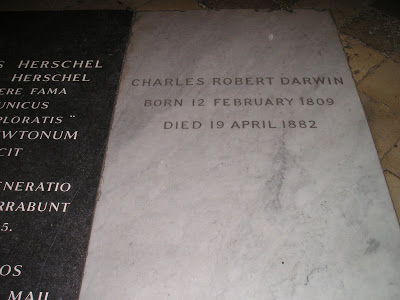
Is it an unprecedented coincidence?  206 years ago today, just minutes (probably hours) apart according to unconfirmed accounts, Abraham Lincoln was born in a rude log cabin on Nolin Creek, in Kentucky, and Charles Darwin was born into a wealthy family at the family home  in Shrewsbury, England.

Gutzon Borglums 1908 bust of Abraham Lincoln in the Crypt of the U.S. Capitol - AOC photo

Gutzon Borglum’s 1908 bust of Abraham Lincoln in the Crypt of the U.S. Capitol – Architect of the Capitol photo

Lincoln would become one of our most endeared presidents, though endearment would come after his assassination.  Lincoln’s bust rides the crest of Mt. Rushmore (next to two slaveholders), with George Washington, the Father of His Country, Thomas Jefferson, the author of the Declaration of Independence, and Theodore Roosevelt, the man who made the modern presidency, and the only man ever to have won both a Congressional Medal of Honor and a Nobel Prize, the only president to have won the Medal of Honor.  In his effort to keep the Union together, Lincoln freed the slaves of the states in rebellion during the civil war, becoming an icon to freedom and human rights for all history.  Upon his death the entire nation mourned; his funeral procession from Washington, D.C., to his tomb in Springfield, Illinois, stopped twelve times along the way for full funeral services.  Lying in state in the Illinois House of Representatives, beneath a two-times lifesize portrait of George Washington, a banner proclaimed, “Washington the Father, Lincoln the Savior.”

Charles Darwin statue, Natural History Museum, London - NHM photo

Charles Darwin statue, Natural History Museum, London – NHM photo

Darwin would become one of the greatest scientists of all time.  He would be credited with discovering the theory of evolution by natural and sexual selection.  His meticulous footnoting and careful observations formed the data for ground-breaking papers in geology (the creation of coral atolls), zoology (barnacles, and the expression of emotions in animals and man), botany (climbing vines and insectivorous plants), ecology (worms and leaf mould), and travel (the voyage of H.M.S. Beagle).  At his death he was honored with a state funeral, attended by the great scientists and statesmen of London in his day.  Hymns were specially written for the occasion.  Darwin is interred in Westminster Abbey near Sir Isaac Newton, England’s other great scientist, who knocked God out of the heavens.

Lincoln would be known as the man who saved the Union of the United States and set the standard for civil and human rights, vindicating the religious beliefs of many and challenging the beliefs of many more.  Darwin’s theory would become one of the greatest ideas of western civilization, changing forever all the sciences, and especially agriculture, animal husbandry, and the rest of biology, while also provoking crises in religious sects.

Lincoln, the politician known for freeing the slaves, also was the first U.S. president to formally consult with scientists, calling on the National Science Foundation (whose creation he oversaw) to advise his administration.  Darwin, the scientist, advocated that his family put the weight of its fortune behind the effort to abolish slavery in the British Empire.  Each held an interest in the other’s disciplines.

Both men were catapulted to fame in 1858. Lincoln’s notoriety came from a series of debates on the nation’s dealing with slavery, in his losing campaign against Stephen A. Douglas to represent Illinois in the U.S. Senate.  On the fame of that campaign, he won the nomination to the presidency of the fledgling Republican Party in 1860.  Darwin was spurred to publicly reveal his ideas about the power of natural and sexual selection as the force behind evolution, in a paper co-authored by Alfred Russel Wallace, presented to the Linnean Society in London on July 1, 1858.   On the strength of that paper, barely noticed at the time, Darwin published his most famous work, On the Origin of Species, in November 1859.

The two men might have got along well, but they never met.

What unusual coincidences.

Go celebrate human rights, good science, and the stories about these men.

A school kid could do much worse than to study the history of these two great men.  We study them far too little, it seems to me.

Resources:

Charles Darwin:

Abraham Lincoln:

More:

Anybody know what hour of the day either of these men was born?

Yes, you may fly your flag today for Lincoln’s birthday, according to the Flag Code; the official holiday, Washington’s Birthday, is next Monday, February 16th — and yes, it’s usually called “President’s Day” by merchants and calendar makers. You want to fly your flag for Charles Darwin? Darwin never set foot in North America, remained a loyal subject of Her Majesty, Queen Victoria, to the end of his days. But go ahead. Who would know?

Yes, this is mostly an encore post.  Fighting ignorance requires patience.

Yes, this is mostly an encore post. Fighting ignorance requires patience.


God uses kitsch to tell conservative Christians to give science a break

February 9, 2015

Look what the Hubble Telescope found!

Look what the Hubble Telescope found!

Photo from Hubble Telescope (via Washington Post) suggests “conservative Christians” can lay off their hatred of science, and especially astronomy, and let funding for NASA increase again.


Charles Darwin, evolution of morality; excerpt from Descent of Man

February 6, 2015

Charles Darwin’s work is misunderstood and misrepresented most often on issues that pertain to human morals and the way humans treat one another as humans. Among the most often misunderstood and almost-always misquoted texts are his thoughts on the rise of morality among humans, from Chapter 5 of his work on human evolution, Descent of Man.

Below is the entire text of Chapter 5, in an easily machine searchable fashion. This version comes from Project Gutenberg, and has been reformatted only to remove extraneous line returns. (Images added here, unless otherwise noted.)

I had thought I posted this before, but discovered it was here in “page” format, which keeps it out of many indexing engines.  I’m posting it again today because, shortly before Darwin Sunday 2015 (February 8), I expect creationists will release a flurry of posts, Tweets, Facebook rantings and other notes, claiming Darwin didn’t write about morality, or claiming Darwin said something that is not really here.

Happy reading.

Charles Darwin

Descent of Man

Two volumes of the first edition of Charles Darwin's Descent of Man. Photo from Manhattan Rare Books.

The two volumes of the first edition of Charles Darwin’s Descent of Man. Photo from Manhattan Rare Books.

From Project Gutenberg; see legal notices at end of this file

CHAPTER V.

ON THE DEVELOPMENT OF THE INTELLECTUAL AND MORAL FACULTIES DURING PRIMEVAL AND CIVILISED TIMES.

Advancement of the intellectual powers through natural selection– Importance of imitation–Social and moral faculties–Their development within the limits of the same tribe–Natural selection as affecting civilised nations–Evidence that civilised nations were once barbarous.

The subjects to be discussed in this chapter are of the highest interest, but are treated by me in an imperfect and fragmentary manner. Mr. Wallace, in an admirable paper before referred to (1. Anthropological Review, May 1864, p. clviii.), argues that man, after he had partially acquired those intellectual and moral faculties which distinguish him from the lower animals, would have been but little liable to bodily modifications through natural selection or any other means. For man is enabled through his mental faculties “to keep with an unchanged body in harmony with the changing universe.” He has great power of adapting his habits to new conditions of life. He invents weapons, tools, and various stratagems to procure food and to defend himself. When he migrates into a colder climate he uses clothes, builds sheds, and makes fires; and by the aid of fire cooks food otherwise indigestible. He aids his fellow-men in many ways, and anticipates future events. Even at a remote period he practised some division of labour.

The lower animals, on the other hand, must have their bodily structure modified in order to survive under greatly changed conditions. They must be rendered stronger, or acquire more effective teeth or claws, for defence against new enemies; or they must be reduced in size, so as to escape detection and danger. When they migrate into a colder climate, they must become clothed with thicker fur, or have their constitutions altered. If they fail to be thus modified, they will cease to exist. The case, however, is widely different, as Mr. Wallace has with justice insisted, in relation to the intellectual and moral faculties of man. These faculties are variable; and we have every reason to believe that the variations tend to be inherited.

Therefore, if they were formerly of high importance to primeval man and to his ape-like progenitors, they would have been perfected or advanced through natural selection. Of the high importance of the intellectual faculties there can be no doubt, for man mainly owes to them his predominant position in the world. We can see, that in the rudest state of society, the individuals who were the most sagacious, who invented and used the best weapons or traps, and who were best able to defend themselves, would rear the greatest number of offspring. The tribes, which included the largest number of men thus endowed, would increase in number and supplant other tribes. Numbers depend primarily on the means of subsistence, and this depends partly on the physical nature of the country, but in a much higher degree on the arts which are there practised. As a tribe increases and is victorious, it is often still further increased by the absorption of other tribes. (2. After a time the members or tribes which are absorbed into another tribe assume, as Sir Henry Maine remarks (‘Ancient Law,’ 1861, p. 131), that they are the co-descendants of the same ancestors.) The stature and strength of the men of a tribe are likewise of some importance for its success, and these depend in part on the nature and amount of the food which can be obtained. In Europe the men of the Bronze period were supplanted by a race more powerful, and, judging from their sword-handles, with larger hands (3. Morlot, ‘Soc. Vaud. Sc. Nat.’ 1860, p. 294.); but their success was probably still more due to their superiority in the arts.

All that we know about savages, or may infer from their traditions and from old monuments, the history of which is quite forgotten by the present inhabitants, shew that from the remotest times successful tribes have supplanted other tribes. Relics of extinct or forgotten tribes have been discovered throughout the civilised regions of the earth, on the wild plains of America, and on the isolated islands in the Pacific Ocean. At the present day civilised nations are everywhere supplanting barbarous nations, excepting where the climate opposes a deadly barrier; and they succeed mainly, though not exclusively, through their arts, which are the products of the intellect. It is, therefore, highly probable that with mankind the intellectual faculties have been mainly and gradually perfected through natural selection; and this conclusion is sufficient for our purpose. Undoubtedly it would be interesting to trace the development of each separate faculty from the state in which it exists in the lower animals to that in which it exists in man; but neither my ability nor knowledge permits the attempt.

Illustration from Chapter 1 of Descent of Man, showing similarities in embryos of mammals. From Darwin Online

Illustration from Chapter 1 of Descent of Man, showing similarities in embryos of mammals. From Darwin Online

It deserves notice that, as soon as the progenitors of man became social (and this probably occurred at a very early period), the principle of imitation, and reason, and experience would have increased, and much modified the intellectual powers in a way, of which we see only traces in the lower animals. Apes are much given to imitation, as are the lowest savages; and the simple fact previously referred to, that after a time no animal can be caught in the same place by the same sort of trap, shews that animals learn by experience, and imitate the caution of others. Now, if some one man in a tribe, more sagacious than the others, invented a new snare or weapon, or other means of attack or defence, the plainest self- interest, without the assistance of much reasoning power, would prompt the other members to imitate him; and all would thus profit. The habitual practice of each new art must likewise in some slight degree strengthen the intellect. If the new invention were an important one, the tribe would increase in number, spread, and supplant other tribes. In a tribe thus rendered more numerous there would always be a rather greater chance of the birth of other superior and inventive members. If such men left children to inherit their mental superiority, the chance of the birth of still more ingenious members would be somewhat better, and in a very small tribe decidedly better. Even if they left no children, the tribe would still include their blood-relations; and it has been ascertained by agriculturists (4. I have given instances in my Variation of Animals under Domestication, vol. ii. p. 196.) that by preserving and breeding from the family of an animal, which when slaughtered was found to be valuable, the desired character has been obtained.

Turning now to the social and moral faculties. In order that primeval men, or the ape-like progenitors of man, should become social, they must have acquired the same instinctive feelings, which impel other animals to live in a body; and they no doubt exhibited the same general disposition. They would have felt uneasy when separated from their comrades, for whom they would have felt some degree of love; they would have warned each other of danger, and have given mutual aid in attack or defence. All this implies some degree of sympathy, fidelity, and courage. Such social qualities, the paramount importance of which to the lower animals is disputed by no one, were no doubt acquired by the progenitors of man in a similar manner, namely, through natural selection, aided by inherited habit. When two tribes of primeval man, living in the same country, came into competition, if (other circumstances being equal) the one tribe included a great number of courageous, sympathetic and faithful members, who were always ready to warn each other of danger, to aid and defend each other, this tribe would succeed better and conquer the other. Let it be borne in mind how all- important in the never-ceasing wars of savages, fidelity and courage must be. The advantage which disciplined soldiers have over undisciplined hordes follows chiefly from the confidence which each man feels in his comrades. Obedience, as Mr. Bagehot has well shewn (5. See a remarkable series of articles on ‘Physics and Politics,’ in the ‘Fortnightly Review,’ Nov. 1867; April 1, 1868; July 1, 1869, since separately published.), is of the highest value, for any form of government is better than none. Selfish and contentious people will not cohere, and without coherence nothing can be effected. A tribe rich in the above qualities would spread and be victorious over other tribes: but in the course of time it would, judging from all past history, be in its turn overcome by some other tribe still more highly endowed. Thus the social and moral qualities would tend slowly to advance and be diffused throughout the world.

But it may be asked, how within the limits of the same tribe did a large number of members first become endowed with these social and moral qualities, and how was the standard of excellence raised? It is extremely doubtful whether the offspring of the more sympathetic and benevolent parents, or of those who were the most faithful to their comrades, would be reared in greater numbers than the children of selfish and treacherous parents belonging to the same tribe. He who was ready to sacrifice his life, as many a savage has been, rather than betray his comrades, would often leave no offspring to inherit his noble nature. The bravest men, who were always willing to come to the front in war, and who freely risked their lives for others, would on an average perish in larger numbers than other men. Therefore, it hardly seems probable, that the number of men gifted with such virtues, or that the standard of their excellence, could be increased through natural selection, that is, by the survival of the fittest; for we are not here speaking of one tribe being victorious over another.

Although the circumstances, leading to an increase in the number of those thus endowed within the same tribe, are too complex to be clearly followed out, we can trace some of the probable steps. In the first place, as the reasoning powers and foresight of the members became improved, each man would soon learn that if he aided his fellow-men, he would commonly receive aid in return. From this low motive he might acquire the habit of aiding his fellows; and the habit of performing benevolent actions certainly strengthens the feeling of sympathy which gives the first impulse to benevolent actions. Habits, moreover, followed during many generations probably tend to be inherited. But another and much more powerful stimulus to the development of the social virtues, is afforded by the praise and the blame of our fellow-men. To the instinct of sympathy, as we have already seen, it is primarily due, that we habitually bestow both praise and blame on others, whilst we love the former and dread the latter when applied to ourselves; and this instinct no doubt was originally acquired, like all the other social instincts, through natural selection. At how early a period the progenitors of man in the course of their development, became capable of feeling and being impelled by, the praise or blame of their fellow- creatures, we cannot of course say. But it appears that even dogs appreciate encouragement, praise, and blame. The rudest savages feel the sentiment of glory, as they clearly shew by preserving the trophies of their prowess, by their habit of excessive boasting, and even by the extreme care which they take of their personal appearance and decorations; for unless they regarded the opinion of their comrades, such habits would be senseless.

They certainly feel shame at the breach of some of their lesser rules, and apparently remorse, as shewn by the case of the Australian who grew thin and could not rest from having delayed to murder some other woman, so as to propitiate his dead wife’s spirit. Though I have not met with any other recorded case, it is scarcely credible that a savage, who will sacrifice his life rather than betray his tribe, or one who will deliver himself up as a prisoner rather than break his parole (6. Mr. Wallace gives cases in his ‘Contributions to the Theory of Natural Selection,’ 1870, p. 354.), would not feel remorse in his inmost soul, if he had failed in a duty, which he held sacred.

We may therefore conclude that primeval man, at a very remote period, was influenced by the praise and blame of his fellows. It is obvious, that the members of the same tribe would approve of conduct which appeared to them to be for the general good, and would reprobate that which appeared evil. To do good unto others — to do unto others as ye would they should do unto you — is the foundation-stone of morality. It is, therefore, hardly possible to exaggerate the importance during rude times of the love of praise and the dread of blame. A man who was not impelled by any deep, instinctive feeling, to sacrifice his life for the good of others, yet was roused to such actions by a sense of glory, would by his example excite the same wish for glory in other men, and would strengthen by exercise the noble feeling of admiration. He might thus do far more good to his tribe than by begetting offspring with a tendency to inherit his own high character. [emphasis added]

With increased experience and reason, man perceives the more remote consequences of his actions, and the self-regarding virtues, such as temperance, chastity, etc., which during early times are, as we have before seen, utterly disregarded, come to be highly esteemed or even held sacred. I need not, however, repeat what I have said on this head in the fourth chapter. Ultimately our moral sense or conscience becomes a highly complex sentiment–originating in the social instincts, largely guided by the approbation of our fellow-men, ruled by reason, self-interest, and in later times by deep religious feelings, and confirmed by instruction and habit.

It must not be forgotten that although a high standard of morality gives but a slight or no advantage to each individual man and his children over the other men of the same tribe, yet that an increase in the number of well-endowed men and an advancement in the standard of morality will certainly give an immense advantage to one tribe over another. A tribe including many members who, from possessing in a high degree the spirit of patriotism, fidelity, obedience, courage, and sympathy, were always ready to aid one another, and to sacrifice themselves for the common good, would be victorious over most other tribes; and this would be natural selection. At all times throughout the world tribes have supplanted other tribes; and as morality is one important element in their success, the standard of morality and the number of well-endowed men will thus everywhere tend to rise and increase.

It is, however, very difficult to form any judgment why one particular tribe and not another has been successful and has risen in the scale of civilisation. Many savages are in the same condition as when first discovered several centuries ago. As Mr. Bagehot has remarked, we are apt to look at progress as normal in human society; but history refutes this. The ancients did not even entertain the idea, nor do the Oriental nations at the present day. According to another high authority, Sir Henry Maine (7. ‘Ancient Law,’ 1861, p. 22. For Mr. Bagehot’s remarks, ‘Fortnightly Review,’ April 1, 1868, p. 452.), “the greatest part of mankind has never shewn a particle of desire that its civil institutions should be improved.” Progress seems to depend on many concurrent favourable conditions, far too complex to be followed out. But it has often been remarked, that a cool climate, from leading to industry and to the various arts, has been highly favourable thereto. The Esquimaux, pressed by hard necessity, have succeeded in many ingenious inventions, but their climate has been too severe for continued progress. Nomadic habits, whether over wide plains, or through the dense forests of the tropics, or along the shores of the sea, have in every case been highly detrimental. Whilst observing the barbarous inhabitants of Tierra del Fuego, it struck me that the possession of some property, a fixed abode, and the union of many families under a chief, were the indispensable requisites for civilisation. Such habits almost necessitate the cultivation of the ground; and the first steps in cultivation would probably result, as I have elsewhere shewn (8. ‘The Variation of Animals and Plants under Domestication,’ vol. i. p. 309.), from some such accident as the seeds of a fruit-tree falling on a heap of refuse, and producing an unusually fine variety. The problem, however, of the first advance of savages towards civilisation is at present much too difficult to be solved.

NATURAL SELECTION AS AFFECTING CIVILISED NATIONS.

I have hitherto only considered the advancement of man from a semi-human condition to that of the modern savage. But some remarks on the action of natural selection on civilised nations may be worth adding. This subject has been ably discussed by Mr. W.R. Greg (9. ‘Fraser’s Magazine,’ Sept. 1868, p. 353. This article seems to have struck many persons, and has given rise to two remarkable essays and a rejoinder in the ‘Spectator,’ Oct. 3rd and 17th, 1868. It has also been discussed in the ‘Quarterly Journal of Science,’ 1869, p. 152, and by Mr. Lawson Tait in the ‘Dublin Quarterly Journal of Medical Science,’ Feb. 1869, and by Mr. E. Ray Lankester in his ‘Comparative Longevity,’ 1870, p. 128. Similar views appeared previously in the ‘Australasian,’ July 13, 1867. I have borrowed ideas from several of these writers.), and previously by Mr. Wallace and Mr. Galton. (10. For Mr. Wallace, see ‘Anthropological Review,’ as before cited. Mr. Galton in ‘Macmillan’s Magazine,’ Aug. 1865, p. 318; also his great work, ‘Hereditary Genius,’ 1870.) Most of my remarks are taken from these three authors. With savages, the weak in body or mind are soon eliminated; and those that survive commonly exhibit a vigorous state of health. We civilised men, on the other hand, do our utmost to check the process of elimination; we build asylums for the imbecile, the maimed, and the sick; we institute poor-laws; and our medical men exert their utmost skill to save the life of every one to the last moment. There is reason to believe that vaccination has preserved thousands, who from a weak constitution would formerly have succumbed to small-pox. Thus the weak members of civilised societies propagate their kind. No one who has attended to the breeding of domestic animals will doubt that this must be highly injurious to the race of man. It is surprising how soon a want of care, or care wrongly directed, leads to the degeneration of a domestic race; but excepting in the case of man himself, hardly any one is so ignorant as to allow his worst animals to breed.

The aid which we feel impelled to give to the helpless is mainly an incidental result of the instinct of sympathy, which was originally acquired as part of the social instincts, but subsequently rendered, in the manner previously indicated, more tender and more widely diffused. Nor could we check our sympathy, even at the urging of hard reason, without deterioration in the noblest part of our nature. The surgeon may harden himself whilst performing an operation, for he knows that he is acting for the good of his patient; but if we were intentionally to neglect the weak and helpless, it could only be for a contingent benefit, with an overwhelming present evil. We must therefore bear the undoubtedly bad effects of the weak surviving and propagating their kind; but there appears to be at least one check in steady action, namely that the weaker and inferior members of society do not marry so freely as the sound; and this check might be indefinitely increased by the weak in body or mind refraining from marriage, though this is more to be hoped for than expected.

In every country in which a large standing army is kept up, the finest young men are taken by the conscription or are enlisted. They are thus exposed to early death during war, are often tempted into vice, and are prevented from marrying during the prime of life. On the other hand the shorter and feebler men, with poor constitutions, are left at home, and consequently have a much better chance of marrying and propagating their kind. (11. Prof. H. Fick (‘Einfluss der Naturwissenschaft auf das Recht,’ June 1872) has some good remarks on this head, and on other such points.)

Man accumulates property and bequeaths it to his children, so that the children of the rich have an advantage over the poor in the race for success, independently of bodily or mental superiority. On the other hand, the children of parents who are short-lived, and are therefore on an average deficient in health and vigour, come into their property sooner than other children, and will be likely to marry earlier, and leave a larger number of offspring to inherit their inferior constitutions. But the inheritance of property by itself is very far from an evil; for without the accumulation of capital the arts could not progress; and it is chiefly through their power that the civilised races have extended, and are now everywhere extending their range, so as to take the place of the lower races. Nor does the moderate accumulation of wealth interfere with the process of selection. When a poor man becomes moderately rich, his children enter trades or professions in which there is struggle enough, so that the able in body and mind succeed best. The presence of a body of well-instructed men, who have not to labour for their daily bread, is important to a degree which cannot be over-estimated; as all high intellectual work is carried on by them, and on such work, material progress of all kinds mainly depends, not to mention other and higher advantages. No doubt wealth when very great tends to convert men into useless drones, but their number is never large; and some degree of elimination here occurs, for we daily see rich men, who happen to be fools or profligate, squandering away their wealth.

Primogeniture with entailed estates is a more direct evil, though it may formerly have been a great advantage by the creation of a dominant class, and any government is better than none. Most eldest sons, though they may be weak in body or mind, marry, whilst the younger sons, however superior in these respects, do not so generally marry. Nor can worthless eldest sons with entailed estates squander their wealth. But here, as elsewhere, the relations of civilised life are so complex that some compensatory checks intervene. The men who are rich through primogeniture are able to select generation after generation the more beautiful and charming women; and these must generally be healthy in body and active in mind. The evil consequences, such as they may be, of the continued preservation of the same line of descent, without any selection, are checked by men of rank always wishing to increase their wealth and power; and this they effect by marrying heiresses. But the daughters of parents who have produced single children, are themselves, as Mr. Galton (12. ‘Hereditary Genius,’ 1870, pp. 132-140.) has shewn, apt to be sterile; and thus noble families are continually cut off in the direct line, and their wealth flows into some side channel; but unfortunately this channel is not determined by superiority of any kind.

Although civilisation thus checks in many ways the action of natural selection, it apparently favours the better development of the body, by means of good food and the freedom from occasional hardships. This may be inferred from civilised men having been found, wherever compared, to be physically stronger than savages. (13. Quatrefages, ‘Revue des Cours Scientifiques,’ 1867-68, p. 659.) They appear also to have equal powers of endurance, as has been proved in many adventurous expeditions. Even the great luxury of the rich can be but little detrimental; for the expectation of life of our aristocracy, at all ages and of both sexes, is very little inferior to that of healthy English lives in the lower classes. (14. See the fifth and sixth columns, compiled from good authorities, in the table given in Mr. E.R. Lankester’s ‘Comparative Longevity,’ 1870, p. 115.)

We will now look to the intellectual faculties. If in each grade of society the members were divided into two equal bodies, the one including the intellectually superior and the other the inferior, there can be little doubt that the former would succeed best in all occupations, and rear a greater number of children. Even in the lowest walks of life, skill and ability must be of some advantage; though in many occupations, owing to the great division of labour, a very small one. Hence in civilised nations there will be some tendency to an increase both in the number and in the standard of the intellectually able. But I do not wish to assert that this tendency may not be more than counterbalanced in other ways, as by the multiplication of the reckless and improvident; but even to such as these, ability must be some advantage.

It has often been objected to views like the foregoing, that the most eminent men who have ever lived have left no offspring to inherit their great intellect. Mr. Galton says, “I regret I am unable to solve the simple question whether, and how far, men and women who are prodigies of genius are infertile. I have, however, shewn that men of eminence are by no means so.” (15. ‘Hereditary Genius,’ 1870, p. 330.) Great lawgivers, the founders of beneficent religions, great philosophers and discoverers in science, aid the progress of mankind in a far higher degree by their works than by leaving a numerous progeny. In the case of corporeal structures, it is the selection of the slightly better-endowed and the elimination of the slightly less well-endowed individuals, and not the preservation of strongly-marked and rare anomalies, that leads to the advancement of a species. (16. ‘Origin of Species’ (fifth edition, 1869), p. 104.) So it will be with the intellectual faculties, since the somewhat abler men in each grade of society succeed rather better than the less able, and consequently increase in number, if not otherwise prevented. When in any nation the standard of intellect and the number of intellectual men have increased, we may expect from the law of the deviation from an average, that prodigies of genius will, as shewn by Mr. Galton, appear somewhat more frequently than before.

In regard to the moral qualities, some elimination of the worst dispositions is always in progress even in the most civilised nations. Malefactors are executed, or imprisoned for long periods, so that they cannot freely transmit their bad qualities. Melancholic and insane persons are confined, or commit suicide. Violent and quarrelsome men often come to a bloody end. The restless who will not follow any steady occupation–and this relic of barbarism is a great check to civilisation (17. ‘Hereditary Genius,’ 1870, p. 347.)–emigrate to newly-settled countries; where they prove useful pioneers. Intemperance is so highly destructive, that the expectation of life of the intemperate, at the age of thirty for instance, is only 13.8 years; whilst for the rural labourers of England at the same age it is 40.59 years. (18. E. Ray Lankester, ‘Comparative Longevity,’ 1870, p. 115. The table of the intemperate is from Neison’s ‘Vital Statistics.’ In regard to profligacy, see Dr. Farr, ‘Influence of Marriage on Mortality,’ ‘Nat. Assoc. for the Promotion of Social Science,’ 1858.) Profligate women bear few children, and profligate men rarely marry; both suffer from disease. In the breeding of domestic animals, the elimination of those individuals, though few in number, which are in any marked manner inferior, is by no means an unimportant element towards success. This especially holds good with injurious characters which tend to reappear through reversion, such as blackness in sheep; and with mankind some of the worst dispositions, which occasionally without any assignable cause make their appearance in families, may perhaps be reversions to a savage state, from which we are not removed by very many generations. This view seems indeed recognised in the common expression that such men are the black sheep of the family.

With civilised nations, as far as an advanced standard of morality, and an increased number of fairly good men are concerned, natural selection apparently effects but little; though the fundamental social instincts were originally thus gained. But I have already said enough, whilst treating of the lower races, on the causes which lead to the advance of morality, namely, the approbation of our fellow-men–the strengthening of our sympathies by habit–example and imitation–reason–experience, and even self-interest–instruction during youth, and religious feelings.

A most important obstacle in civilised countries to an increase in the number of men of a superior class has been strongly insisted on by Mr. Greg and Mr. Galton (19. ‘Fraser’s Magazine,’ Sept. 1868, p. 353. ‘Macmillan’s Magazine,’ Aug. 1865, p. 318. The Rev. F.W. Farrar (‘Fraser’s Magazine,’ Aug. 1870, p. 264) takes a different view.), namely, the fact that the very poor and reckless, who are often degraded by vice, almost invariably marry early, whilst the careful and frugal, who are generally otherwise virtuous, marry late in life, so that they may be able to support themselves and their children in comfort. Those who marry early produce within a given period not only a greater number of generations, but, as shewn by Dr. Duncan (20. ‘On the Laws of the Fertility of Women,’ in ‘Transactions of the Royal Society,’ Edinburgh, vol. xxiv. p. 287; now published separately under the title of ‘Fecundity, Fertility, and Sterility,’ 1871. See, also, Mr. Galton, ‘Hereditary Genius,’ pp. 352-357, for observations to the above effect.), they produce many more children. The children, moreover, that are borne by mothers during the prime of life are heavier and larger, and therefore probably more vigorous, than those born at other periods. Thus the reckless, degraded, and often vicious members of society, tend to increase at a quicker rate than the provident and generally virtuous members. Or as Mr. Greg puts the case: “The careless, squalid, unaspiring Irishman multiplies like rabbits: the frugal, foreseeing, self-respecting, ambitious Scot, stern in his morality, spiritual in his faith, sagacious and disciplined in his intelligence, passes his best years in struggle and in celibacy, marries late, and leaves few behind him. Given a land originally peopled by a thousand Saxons and a thousand Celts–and in a dozen generations five-sixths of the population would be Celts, but five- sixths of the property, of the power, of the intellect, would belong to the one-sixth of Saxons that remained. In the eternal ‘struggle for existence,’ it would be the inferior and LESS favoured race that had prevailed–and prevailed by virtue not of its good qualities but of its faults.”

There are, however, some checks to this downward tendency. We have seen that the intemperate suffer from a high rate of mortality, and the extremely profligate leave few offspring. The poorest classes crowd into towns, and it has been proved by Dr. Stark from the statistics of ten years in Scotland (21. ‘Tenth Annual Report of Births, Deaths, etc., in Scotland,’ 1867, p. xxix.), that at all ages the death-rate is higher in towns than in rural districts, “and during the first five years of life the town death-rate is almost exactly double that of the rural districts.” As these returns include both the rich and the poor, no doubt more than twice the number of births would be requisite to keep up the number of the very poor inhabitants in the towns, relatively to those in the country. With women, marriage at too early an age is highly injurious; for it has been found in France that, “Twice as many wives under twenty die in the year, as died out of the same number of the unmarried.” The mortality, also, of husbands under twenty is “excessively high” (22. These quotations are taken from our highest authority on such questions, namely, Dr. Farr, in his paper ‘On the Influence of Marriage on the Mortality of the French People,’ read before the Nat. Assoc. for the Promotion of Social Science, 1858.), but what the cause of this may be, seems doubtful. Lastly, if the men who prudently delay marrying until they can bring up their families in comfort, were to select, as they often do, women in the prime of life, the rate of increase in the better class would be only slightly lessened.

It was established from an enormous body of statistics, taken during 1853, that the unmarried men throughout France, between the ages of twenty and eighty, die in a much larger proportion than the married: for instance, out of every 1000 unmarried men, between the ages of twenty and thirty, 11.3 annually died, whilst of the married, only 6.5 died. (23. Dr. Farr, ibid. The quotations given below are extracted from the same striking paper.) A similar law was proved to hold good, during the years 1863 and 1864, with the entire population above the age of twenty in Scotland: for instance, out of every 1000 unmarried men, between the ages of twenty and thirty, 14.97 annually died, whilst of the married only 7.24 died, that is less than half. (24. I have taken the mean of the quinquennial means, given in ‘The Tenth Annual Report of Births, Deaths, etc., in Scotland,’ 1867. The quotation from Dr. Stark is copied from an article in the ‘Daily News,’ Oct. 17, 1868, which Dr. Farr considers very carefully written.) Dr. Stark remarks on this, “Bachelorhood is more destructive to life than the most unwholesome trades, or than residence in an unwholesome house or district where there has never been the most distant attempt at sanitary improvement.” He considers that the lessened mortality is the direct result of “marriage, and the more regular domestic habits which attend that state.” He admits, however, that the intemperate, profligate, and criminal classes, whose duration of life is low, do not commonly marry; and it must likewise be admitted that men with a weak constitution, ill health, or any great infirmity in body or mind, will often not wish to marry, or will be rejected. Dr. Stark seems to have come to the conclusion that marriage in itself is a main cause of prolonged life, from finding that aged married men still have a considerable advantage in this respect over the unmarried of the same advanced age; but every one must have known instances of men, who with weak health during youth did not marry, and yet have survived to old age, though remaining weak, and therefore always with a lessened chance of life or of marrying. There is another remarkable circumstance which seems to support Dr. Stark’s conclusion, namely, that widows and widowers in France suffer in comparison with the married a very heavy rate of mortality; but Dr. Farr attributes this to the poverty and evil habits consequent on the disruption of the family, and to grief. On the whole we may conclude with Dr. Farr that the lesser mortality of married than of unmarried men, which seems to be a general law, “is mainly due to the constant elimination of imperfect types, and to the skilful selection of the finest individuals out of each successive generation;” the selection relating only to the marriage state, and acting on all corporeal, intellectual, and moral qualities. (25. Dr. Duncan remarks (‘Fecundity, Fertility, etc.’ 1871, p. 334) on this subject: “At every age the healthy and beautiful go over from the unmarried side to the married, leaving the unmarried columns crowded with the sickly and unfortunate.”) We may, therefore, infer that sound and good men who out of prudence remain for a time unmarried, do not suffer a high rate of mortality.

If the various checks specified in the two last paragraphs, and perhaps others as yet unknown, do not prevent the reckless, the vicious and otherwise inferior members of society from increasing at a quicker rate than the better class of men, the nation will retrograde, as has too often occurred in the history of the world. We must remember that progress is no invariable rule. It is very difficult to say why one civilised nation rises, becomes more powerful, and spreads more widely, than another; or why the same nation progresses more quickly at one time than at another. We can only say that it depends on an increase in the actual number of the population, on the number of men endowed with high intellectual and moral faculties, as well as on their standard of excellence. Corporeal structure appears to have little influence, except so far as vigour of body leads to vigour of mind.

It has been urged by several writers that as high intellectual powers are advantageous to a nation, the old Greeks, who stood some grades higher in intellect than any race that has ever existed (26. See the ingenious and original argument on this subject by Mr. Galton, ‘Hereditary Genius,’ pp. 340-342.), ought, if the power of natural selection were real, to have risen still higher in the scale, increased in number, and stocked the whole of Europe. Here we have the tacit assumption, so often made with respect to corporeal structures, that there is some innate tendency towards continued development in mind and body. But development of all kinds depends on many concurrent favourable circumstances. Natural selection acts only tentatively. Individuals and races may have acquired certain indisputable advantages, and yet have perished from failing in other characters. The Greeks may have retrograded from a want of coherence between the many small states, from the small size of their whole country, from the practice of slavery, or from extreme sensuality; for they did not succumb until “they were enervated and corrupt to the very core.” (27. Mr. Greg, ‘Fraser’s Magazine,’ Sept. 1868, p. 357.) The western nations of Europe, who now so immeasurably surpass their former savage progenitors, and stand at the summit of civilisation, owe little or none of their superiority to direct inheritance from the old Greeks, though they owe much to the written works of that wonderful people.

Who can positively say why the Spanish nation, so dominant at one time, has been distanced in the race. The awakening of the nations of Europe from the dark ages is a still more perplexing problem. At that early period, as Mr. Galton has remarked, almost all the men of a gentle nature, those given to meditation or culture of the mind, had no refuge except in the bosom of a Church which demanded celibacy (28. ‘Hereditary Genius,’ 1870, pp. 357- 359. The Rev. F.W. Farrar (‘Fraser’s Magazine,’ Aug. 1870, p. 257) advances arguments on the other side. Sir C. Lyell had already (‘Principles of Geology,’ vol. ii. 1868, p. 489), in a striking passage called attention to the evil influence of the Holy Inquisition in having, through selection, lowered the general standard of intelligence in Europe.); and this could hardly fail to have had a deteriorating influence on each successive generation. During this same period the Holy Inquisition selected with extreme care the freest and boldest men in order to burn or imprison them. In Spain alone some of the best men–those who doubted and questioned, and without doubting there can be no progress–were eliminated during three centuries at the rate of a thousand a year. The evil which the Catholic Church has thus effected is incalculable, though no doubt counterbalanced to a certain, perhaps to a large, extent in other ways; nevertheless, Europe has progressed at an unparalleled rate.

The remarkable success of the English as colonists, compared to other European nations, has been ascribed to their “daring and persistent energy”; a result which is well illustrated by comparing the progress of the Canadians of English and French extraction; but who can say how the English gained their energy? There is apparently much truth in the belief that the wonderful progress of the United States, as well as the character of the people, are the results of natural selection; for the more energetic, restless, and courageous men from all parts of Europe have emigrated during the last ten or twelve generations to that great country, and have there succeeded best. (29. Mr. Galton, ‘Macmillan’s Magazine,’ August 1865, p. 325. See also, ‘Nature,’ ‘On Darwinism and National Life,’ Dec. 1869, p. 184.) Looking to the distant future, I do not think that the Rev. Mr. Zincke takes an exaggerated view when he says (30. ‘Last Winter in the United States,’ 1868, p. 29.): “All other series of events–as that which resulted in the culture of mind in Greece, and that which resulted in the empire of Rome–only appear to have purpose and value when viewed in connection with, or rather as subsidiary to…the great stream of Anglo- Saxon emigration to the west.” Obscure as is the problem of the advance of civilisation, we can at least see that a nation which produced during a lengthened period the greatest number of highly intellectual, energetic, brave, patriotic, and benevolent men, would generally prevail over less favoured nations.

Natural selection follows from the struggle for existence; and this from a rapid rate of increase. It is impossible not to regret bitterly, but whether wisely is another question, the rate at which man tends to increase; for this leads in barbarous tribes to infanticide and many other evils, and in civilised nations to abject poverty, celibacy, and to the late marriages of the prudent. But as man suffers from the same physical evils as the lower animals, he has no right to expect an immunity from the evils consequent on the struggle for existence. Had he not been subjected during primeval times to natural selection, assuredly he would never have attained to his present rank. Since we see in many parts of the world enormous areas of the most fertile land capable of supporting numerous happy homes, but peopled only by a few wandering savages, it might be argued that the struggle for existence had not been sufficiently severe to force man upwards to his highest standard. Judging from all that we know of man and the lower animals, there has always been sufficient variability in their intellectual and moral faculties, for a steady advance through natural selection. No doubt such advance demands many favourable concurrent circumstances; but it may well be doubted whether the most favourable would have sufficed, had not the rate of increase been rapid, and the consequent struggle for existence extremely severe. It even appears from what we see, for instance, in parts of S. America, that a people which may be called civilised, such as the Spanish settlers, is liable to become indolent and to retrograde, when the conditions of life are very easy. With highly civilised nations continued progress depends in a subordinate degree on natural selection; for such nations do not supplant and exterminate one another as do savage tribes. Nevertheless the more intelligent members within the same community will succeed better in the long run than the inferior, and leave a more numerous progeny, and this is a form of natural selection. The more efficient causes of progress seem to consist of a good education during youth whilst the brain is impressible, and of a high standard of excellence, inculcated by the ablest and best men, embodied in the laws, customs and traditions of the nation, and enforced by public opinion. It should, however, be borne in mind, that the enforcement of public opinion depends on our appreciation of the approbation and disapprobation of others; and this appreciation is founded on our sympathy, which it can hardly be doubted was originally developed through natural selection as one of the most important elements of the social instincts. (31. I am much indebted to Mr. John Morley for some good criticisms on this subject: see, also Broca, ‘Les Selections,’ ‘Revue d’Anthropologie,’ 1872.)

ON THE EVIDENCE THAT ALL CIVILISED NATIONS WERE ONCE BARBAROUS.

The present subject has been treated in so full and admirable a manner by Sir J. Lubbock (32. ‘On the Origin of Civilisation,’ ‘Proceedings of the Ethnological Society,’ Nov. 26, 1867.), Mr. Tylor, Mr. M’Lennan, and others, that I need here give only the briefest summary of their results. The arguments recently advanced by the Duke of Argyll (33. ‘Primeval Man,’ 1869.) and formerly by Archbishop Whately, in favour of the belief that man came into the world as a civilised being, and that all savages have since undergone degradation, seem to me weak in comparison with those advanced on the other side. Many nations, no doubt, have fallen away in civilisation, and some may have lapsed into utter barbarism, though on this latter head I have met with no evidence. The Fuegians were probably compelled by other conquering hordes to settle in their inhospitable country, and they may have become in consequence somewhat more degraded; but it would be difficult to prove that they have fallen much below the Botocudos, who inhabit the finest parts of Brazil.

The evidence that all civilised nations are the descendants of barbarians, consists, on the one side, of clear traces of their former low condition in still-existing customs, beliefs, language, etc.; and on the other side, of proofs that savages are independently able to raise themselves a few steps in the scale of civilisation, and have actually thus risen. The evidence on the first head is extremely curious, but cannot be here given: I refer to such cases as that of the art of enumeration, which, as Mr. Tylor clearly shews by reference to the words still used in some places, originated in counting the fingers, first of one hand and then of the other, and lastly of the toes. We have traces of this in our own decimal system, and in the Roman numerals, where, after the V, which is supposed to be an abbreviated picture of a human hand, we pass on to VI, etc., when the other hand no doubt was used. So again, “when we speak of three-score and ten, we are counting by the vigesimal system, each score thus ideally made, standing for 20–for ‘one man’ as a Mexican or Carib would put it.” (34. ‘Royal Institution of Great Britain,’ March 15, 1867. Also, ‘Researches into the Early History of Mankind,’ 1865.) According to a large and increasing school of philologists, every language bears the marks of its slow and gradual evolution. So it is with the art of writing, for letters are rudiments of pictorial representations. It is hardly possible to read Mr. M’Lennan’s work (35. ‘Primitive Marriage,’ 1865. See, likewise, an excellent article, evidently by the same author, in the ‘North British Review,’ July 1869. Also, Mr. L.H. Morgan, ‘A Conjectural Solution of the Origin of the Class, System of Relationship,’ in ‘Proc. American Acad. of Sciences,’ vol. vii. Feb. 1868. Prof. Schaaffhausen (‘Anthropolog. Review,’ Oct. 1869, p. 373) remarks on “the vestiges of human sacrifices found both in Homer and the Old Testament.”) and not admit that almost all civilised nations still retain traces of such rude habits as the forcible capture of wives. What ancient nation, as the same author asks, can be named that was originally monogamous? The primitive idea of justice, as shewn by the law of battle and other customs of which vestiges still remain, was likewise most rude. Many existing superstitions are the remnants of former false religious beliefs. The highest form of religion– the grand idea of God hating sin and loving righteousness–was unknown during primeval times.

Origin of Species and Descent of Man in one volume, Modern Library edition. Image from RareLibrary.com

Origin of Species and Descent of Man in one volume, Modern Library edition. Image from RareLibrary.com

Turning to the other kind of evidence: Sir J. Lubbock has shewn that some savages have recently improved a little in some of their simpler arts. From the extremely curious account which he gives of the weapons, tools, and arts, in use amongst savages in various parts of the world, it cannot be doubted that these have nearly all been independent discoveries, excepting perhaps the art of making fire. (36. Sir J. Lubbock, ‘Prehistoric Times,’ 2nd edit. 1869, chaps. xv. and xvi. et passim. See also the excellent 9th Chapter in Tylor’s ‘Early History of Mankind,’ 2nd edit., 1870.) The Australian boomerang is a good instance of one such independent discovery. The Tahitians when first visited had advanced in many respects beyond the inhabitants of most of the other Polynesian islands. There are no just grounds for the belief that the high culture of the native Peruvians and Mexicans was derived from abroad (37. Dr. F. Muller has made some good remarks to this effect in the ‘Reise der Novara: Anthropolog. Theil,’ Abtheil. iii. 1868, s. 127.); many native plants were there cultivated, and a few native animals domesticated. We should bear in mind that, judging from the small influence of most missionaries, a wandering crew from some semi-civilised land, if washed to the shores of America, would not have produced any marked effect on the natives, unless they had already become somewhat advanced. Looking to a very remote period in the history of the world, we find, to use Sir J. Lubbock’s well-known terms, a paleolithic and neolithic period; and no one will pretend that the art of grinding rough flint tools was a borrowed one. In all parts of Europe, as far east as Greece, in Palestine, India, Japan, New Zealand, and Africa, including Egypt, flint tools have been discovered in abundance; and of their use the existing inhabitants retain no tradition. There is also indirect evidence of their former use by the Chinese and ancient Jews. Hence there can hardly be a doubt that the inhabitants of these countries, which include nearly the whole civilised world, were once in a barbarous condition. To believe that man was aboriginally civilised and then suffered utter degradation in so many regions, is to take a pitiably low view of human nature. It is apparently a truer and more cheerful view that progress has been much more general than retrogression; that man has risen, though by slow and interrupted steps, from a lowly condition to the highest standard as yet attained by him in knowledge, morals and religion. _________________

The Project Gutenberg Etext The Descent of Man by Charles Darwin

Copyright laws are changing all over the world, be sure to check the copyright laws for your country before posting these files!!

Please take a look at the important information in this header. We encourage you to keep this file on your own disk, keeping an electronic path open for the next readers. Do not remove this.

**Welcome To The World of Free Plain Vanilla Electronic Texts**

**Etexts Readable By Both Humans and By Computers, Since 1971**

*These Etexts Prepared By Hundreds of Volunteers and Donations* Information on contacting Project Gutenberg to get Etexts, and further information is included below. We need your donations.

The Descent of Man and Selection in Relation to Sex

by Charles Darwin August 2000 [Etext #2300]

The Project Gutenberg Etext The Descent of Man by Charles Darwin
******This file should be named dscmn10.txt or dscmn10.zip******

Corrected EDITIONS of our etexts get a new NUMBER, dscmn11.txt
VERSIONS based on separate sources get new LETTER, dscmn10a.txt

This etext was prepared by Sue Asscher <asschers@satcom.net.au>

Project Gutenberg Etexts are usually created from multiple editions, all of which are in the Public Domain in the United States, unless a copyright notice is included. Therefore, we usually do NOT keep these books in compliance with any particular paper edition.

We are now trying to release all our books one month in advance of the official release dates, for time for better editing.

Please note: neither this list nor its contents are final till midnight of the last day of the month of any such announcement. The official release date of all Project Gutenberg Etexts is at Midnight, Central Time, of the last day of the stated month. A preliminary version may often be posted for suggestion, comment and editing by those who wish to do so. To be sure you have an up to date first edition [xxxxx10x.xxx] please check file sizes in the first week of the next month. Since our ftp program has a bug in it that scrambles the date [tried to fix and failed] a look at the file size will have to do, but we will try to see a new copy has at least one byte more or less.

Information about Project Gutenberg (one page)

We produce about two million dollars for each hour we work. The fifty hours is one conservative estimate for how long it we take to get any etext selected, entered, proofread, edited, copyright searched and analyzed, the copyright letters written, etc. This projected audience is one hundred million readers. If our value per text is nominally estimated at one dollar then we produce $2 million dollars per hour this year as we release thirty-six text files per month, or 432 more Etexts in 1999 for a total of 2000+. If these reach just 10% of the computerized population, then the total should reach over 200 billion Etexts given away this year.

The Goal of Project Gutenberg is to Give Away One Trillion Etext Files by the December 31, 2001. [10,000 x 100,000,000=Trillion] This is ten thousand titles each to one hundred million readers, which is only ~5% of the present number of computer users.

At our revised rates of production, we will reach only one-third of that goal by the end of 2001, or about 3,333 Etexts unless we manage to get some real funding; currently our funding is mostly from Michael Hart’s salary at Carnegie-Mellon University, and an assortment of sporadic gifts; this salary is only good for a few more years, so we are looking for something to replace it, as we don’t want Project Gutenberg to be so dependent on one person.

We need your donations more than ever!

All donations should be made to “Project Gutenberg/CMU”: and are tax deductible to the extent allowable by law. (CMU = Carnegie-Mellon University).

For these and other matters, please mail to: Project Gutenberg P. O. Box 2782 Champaign, IL 61825

When all other email fails try our Executive Director: Michael S. Hart <hart@pobox.com> We would prefer to send you this information by email.

******

To access Project Gutenberg etexts, use any Web browser to view http://promo.net/pg. This site lists Etexts by author and by title, and includes information about how to get involved with Project Gutenberg. You could also download our past Newsletters, or subscribe here. This is one of our major sites, please email hart@pobox.com, for a more complete list of our various sites.

To go directly to the etext collections, use FTP or any Web browser to visit a Project Gutenberg mirror (mirror sites are available on 7 continents; mirrors are listed at http://promo.net/pg).

Mac users, do NOT point and click, typing works better.

Example FTP session:

ftp sunsite.unc.edu
login: anonymous
password: your@login
cd pub/docs/books/gutenberg
cd etext90 through etext99
dir [to see files] get or mget [to get files. . .set bin for zip files]
GET GUTINDEX.?? [to get a year’s listing of books, e.g., GUTINDEX.99]
GET GUTINDEX.ALL [to get a listing of ALL books]

***

**Information prepared by the Project Gutenberg legal advisor** (Three Pages)

***START**THE SMALL PRINT!**FOR PUBLIC DOMAIN ETEXTS**START***

Why is this “Small Print!” statement here? You know: lawyers. They tell us you might sue us if there is something wrong with your copy of this etext, even if you got it for free from someone other than us, and even if what’s wrong is not our fault. So, among other things, this “Small Print!” statement disclaims most of our liability to you. It also tells you how you can distribute copies of this etext if you want to.

*BEFORE!* YOU USE OR READ THIS ETEXT
By using or reading any part of this PROJECT GUTENBERG-tm etext, you indicate that you understand, agree to and accept this “Small Print!” statement. If you do not, you can receive a refund of the money (if any) you paid for this etext by sending a request within 30 days of receiving it to the person you got it from. If you received this etext on a physical medium (such as a disk), you must return it with your request.

ABOUT PROJECT GUTENBERG-TM ETEXTS
This PROJECT GUTENBERG-tm etext, like most PROJECT GUTENBERG-tm etexts, is a “public domain” work distributed by Professor Michael S. Hart through the Project Gutenberg Association at Carnegie-Mellon University (the “Project”). Among other things, this means that no one owns a United States copyright on or for this work, so the Project (and you!) can copy and distribute it in the United States without permission and without paying copyright royalties. Special rules, set forth below, apply if you wish to copy and distribute this etext under the Project’s “PROJECT GUTENBERG” trademark.

To create these etexts, the Project expends considerable efforts to identify, transcribe and proofread public domain works. Despite these efforts, the Project’s etexts and any medium they may be on may contain “Defects.” Among other things, Defects may take the form of incomplete, inaccurate or corrupt data, transcription errors, a copyright or other intellectual property infringement, a defective or damaged disk or other etext medium, a computer virus, or computer codes that damage or cannot be read by your equipment.

LIMITED WARRANTY; DISCLAIMER OF DAMAGES
But for the “Right of Replacement or Refund” described below, [1] the Project (and any other party you may receive this etext from as a PROJECT GUTENBERG-tm etext) disclaims all liability to you for damages, costs and expenses, including legal fees, and [2] YOU HAVE NO REMEDIES FOR NEGLIGENCE OR UNDER STRICT LIABILITY, OR FOR BREACH OF WARRANTY OR CONTRACT, INCLUDING BUT NOT LIMITED TO INDIRECT, CONSEQUENTIAL, PUNITIVE OR INCIDENTAL DAMAGES, EVEN IF YOU GIVE NOTICE OF THE POSSIBILITY OF SUCH DAMAGES.

If you discover a Defect in this etext within 90 days of receiving it, you can receive a refund of the money (if any) you paid for it by sending an explanatory note within that time to the person you received it from. If you received it on a physical medium, you must return it with your note, and such person may choose to alternatively give you a replacement copy. If you received it electronically, such person may choose to alternatively give you a second opportunity to receive it electronically.

THIS ETEXT IS OTHERWISE PROVIDED TO YOU “AS-IS”. NO OTHER WARRANTIES OF ANY KIND, EXPRESS OR IMPLIED, ARE MADE TO YOU AS TO THE ETEXT OR ANY MEDIUM IT MAY BE ON, INCLUDING BUT NOT LIMITED TO WARRANTIES OF MERCHANTABILITY OR FITNESS FOR A PARTICULAR PURPOSE.

Some states do not allow disclaimers of implied warranties or the exclusion or limitation of consequential damages, so the above disclaimers and exclusions may not apply to you, and you may have other legal rights.

INDEMNITY
You will indemnify and hold the Project, its directors, officers, members and agents harmless from all liability, cost and expense, including legal fees, that arise directly or indirectly from any of the following that you do or cause: [1] distribution of this etext, [2] alteration, modification, or addition to the etext, or [3] any Defect.

DISTRIBUTION UNDER “PROJECT GUTENBERG-tm”
You may distribute copies of this etext electronically, or by disk, book or any other medium if you either delete this “Small Print!” and all other references to Project Gutenberg, or:

[1] Only give exact copies of it. Among other things, this requires that you do not remove, alter or modify the etext or this “small print!” statement. You may however, if you wish, distribute this etext in machine readable binary, compressed, mark-up, or proprietary form, including any form resulting from conversion by word processing or hypertext software, but only so long as *EITHER*:

[*] The etext, when displayed, is clearly readable, and does *not* contain characters other than those intended by the author of the work, although tilde (~), asterisk (*) and underline (_) characters may be used to convey punctuation intended by the author, and additional characters may be used to indicate hypertext links; OR

[*] The etext may be readily converted by the reader at no expense into plain ASCII, EBCDIC or equivalent form by the program that displays the etext (as is the case, for instance, with most word processors); OR

[*] You provide, or agree to also provide on request at no additional cost, fee or expense, a copy of the etext in its original plain ASCII form (or in EBCDIC or other equivalent proprietary form).

[2] Honor the etext refund and replacement provisions of this “Small Print!” statement.

[3] Pay a trademark license fee to the Project of 20% of the net profits you derive calculated using the method you already use to calculate your applicable taxes. If you don’t derive profits, no royalty is due. Royalties are payable to “Project Gutenberg Association/Carnegie-Mellon University” within the 60 days following each date you prepare (or were legally required to prepare) your annual (or equivalent periodic) tax return.

WHAT IF YOU *WANT* TO SEND MONEY EVEN IF YOU DON’T HAVE TO?
The Project gratefully accepts contributions in money, time, scanning machines, OCR software, public domain etexts, royalty free copyright licenses, and every other sort of contribution you can think of. Money should be paid to “Project Gutenberg Association / Carnegie-Mellon University.”

*END*THE SMALL PRINT! FOR PUBLIC DOMAIN ETEXTS*Ver.04.29.93*END*

This etext was prepared by Sue Asscher <asschers@aia.net.au>

THE DESCENT OF MAN AND SELECTION IN RELATION TO SEX

Works by Charles Darwin, F.R.S.
Life and Letters of Charles Darwin. With an Autobiographical Chapter.
Edited by Francis Darwin. Portraits. 3 volumes 36s. Popular Edition.
Condensed in 1 volume 7s 6d.


December 31, 2014: Bright Idea Day, anniversary of the Day the Lights Went On

December 31, 2014

Between Christmas and New Year’s Day, here at Millard Fillmore’s Bathtub we celebrate a variety of historically holy days.  December 31, by tradition, is Bright Idea Day, the anniversary of the day Thomas Edison demonstrated for the public a working light bulb, in 1879.

100,000 people gather in Times Square, New York City, tonight, and millions more around the world, in festivities for the new year made possible by the work of Thomas Alva Edison.

Here it is, the invention that stole sleep from our grasp, made clubbing possible, and launched 50,000 cartoons about ideas:

The light bulb Thomas Edison demonstrated on December 31, 1879, at Menlo Park, New Jersey - Wikimedia image

The light bulb Thomas Edison demonstrated on December 31, 1879, at Menlo Park, New Jersey – Wikimedia image (GFDL)

The light bulb. It’s an incandescent bulb.

It wasn’t the first bulb. Edison a few months earlier devised a bulb that worked with a platinum filament. Platinum was too expensive for mass production, though — and Edison wanted mass production. So, with the cadre of great assistants at his Menlo Park laboratories, he struggled to find a good, inexpensive filament that would provide adequate life for the bulb. By late December 1879 they had settled on carbon filament.

Edison invited investors and the public to see the bulb demonstrated, on December 31, 1879.

Thomas Edison in 1878, the year before he demonstrated a workable electric light bulb. Library of Congress image

Thomas Edison in 1878, the year before he demonstrated a workable electric light bulb. CREDIT: Thomas Edison, head-and-shoulders portrait, facing left, 1880. Prints and Photographs Division, Library of Congress. Reproduction number LC-USZ62-98067

Edison’s successful bulb indicated changes in science, technology, invention, intellectual property and finance well beyond its use of electricity. For example:

  • Edison’s Menlo Park, New Jersey, offices and laboratory were financed with earlier successful inventions. It was a hive of inventive activity aimed to make practical inventions from advances in science. Edison was all about selling inventions and rights to manufacture devices. He always had an eye on the profit potential. His improvements on the telegraph would found his laboratory he thought, and he expected to sell the device to Western Union for $5,000 to $7,000. Instead of offering it to them at a price, however, he asked Western Union to bid on it. They bid $10,000, which Edison gratefully accepted, along with the lesson that he might do better letting the marketplace establish the price for his inventions. Other inventive labs followed Edison’s example, such as the famous Bell Labs, but few equalled his success, or had as much fun doing it.  (Economics teachers:  Need an example of the marketplace in action?)
  • While Edison had some financial weight to invest in the quest for a workable electric light, he also got financial support, $30,000 worth, from some of the finance giants of the day, including J. P. Morgan and the Vanderbilts who established the Edison Light Company.
  • Edison didn’t invent the light bulb — but his improvements on it made it commercial. “In addressing the question ‘Who invented the incandescent lamp?’ historians Robert Friedel and Paul Israel list 22 inventors of incandescent lamps prior to Joseph Wilson Swan and Thomas Edison. They conclude that Edison’s version was able to outstrip the others because of a combination of three factors: an effective incandescent material, a higher vacuum than others were able to achieve (by use of the Sprengel pump) and a high resistance lamp that made power distribution from a centralized source economically viable.”
  • Edison’s financial and business leadership acumen is partly attested to by the continuance of his organizations, today — General Electric, one of the world’s most successful companies over the past 40 years, traces its origins to Edison.

Look around yourself this evening, and you can find a score of ways that Edison’s invention and its descendants affect your life. One of the more musing effects is in cartooning, however. Today a glowing lightbulb is universally accepted as a nonverbal symbol for ideas and inventions. (See Mark Parisi’s series of lightbulb cartoons, “Off the Mark.”)

Even with modern, electricity-saving bulbs, the cartoon shorthand hangs on, as in this Mitra Farmand cartoon.

Fusilli has an idea, Mitra Farmand, Fuffernutter

Brilliant cartoon from Mitra Farmand, Fuffernutter

Or see this wonderful animation, a video advertisement for United Airlines, by Joanna Quinn for Fallon — almost every frame has the symbolic lightbulb in it.

Electrification of America, and the consequent spread of electric lighting and electrical machines to make domestic and industrial life more productive, and the spread of great public works to enable these and other inventions to spread, were made possible by a people roughly united in advancing progress, what historians now call “the progressive agenda” and the great advances of the Progressive Era.

Could we get such agreement among workers, corporate bosses and many levels of government today? When we celebrate anniversaries, like the demonstration of the light bulb, we celebrate the united polity that made such things possible, too.

Other resources:

Patent drawing for Thomas Edison's successful electric lamp. Library of Congress

Thomas Edison’s electric lamp patent drawing and claim for the incandescent light bulb CREDIT: “New Jersey–The Wizard of Electricity–Thomas A. Edison’s System of Electric Illumination,” 1880. Prints and Photographs Division, Library of Congress. Reproduction Number LC-USZ62-97960.

Yeah, this is mostly an encore post. ‘Tis the season for tradition, especially good, wise tradition.

Even More, in 2012 and 2013:


December 30, Hubble Day 2014: Look to the stars for our future

December 30, 2014

[Today is actually the day!  You may fly your flag if you choose.  This is the traditional Millard Fillmore’s Bathtub Hubble Day post.]

Lift a glass of champagne today in tribute to Edwin Hubble and his great discovery. Not sure what to call it — Hubble Day, Looking Up Day, Endless Possibilities Day — whatever, this is the anniversary of Edwin Hubble’s announcement that he had discovered the universe is much, much larger than anyone had imagined, containing far more stars than anyone had dared guess.

It’s a big universe out there.

Ultraviolet image of the Andromeda Galaxy. Wired caption: Photo: Edwin Hubble’s 1920s observations of Andromeda (whose ultraviolet spectrum is rendered here) expanded our notions of the size and nature of a universe that is itself expanding. Galaxy Evolution Explorer image courtesy NASA.

Ultraviolet image of the Andromeda Galaxy. Wired caption: “Photo: Edwin Hubble’s 1920s observations of Andromeda (whose ultraviolet spectrum is rendered here) expanded our notions of the size and nature of a universe that is itself expanding. Galaxy Evolution Explorer image courtesy NASA.”

So, today is a good day to celebrate the universe in all it’s glory – December 30.

On December 30, 1924, Edwin Hubble announced he’d discovered other galaxies in distant space. Though it may not have been so clear at the time, it meant that, as a galaxy, we are not alone in the universe (whether we are alone as intelligent life is a separate question). It also meant that the universe is much, much bigger than most people had dared to imagine.

90 years ago today.

I keep trying to get people to celebrate.

In 2008 for Hubble Day, Wired picked up on the story (with a gracious link to 2007’s post here at the Bathtub). Wired includes several links to even more information, a good source of information. See Wired’s 2009 post here.

Hubble was the guy who showed us the universe is not only bigger than we imagined, it’s probably much bigger and much more fantastic than we can imagine. (See J. B. S. Haldane’s “queerer” quote.) Hubble is the guy who opened our imaginations to the vastness of all creation.

Hubble’s work would have been impossible without the earlier work of one of the great, unsung women of science, Henrietta Leavitt, as Wired explained:

He trained the powerful new 100-inch telescope at Mount Wilson in Southern California on spiral nebulae. These fuzzy patches of light in the sky were generally thought to be clouds of gas or dust within our galaxy, which was presumed to include everything in the universe except the Magellanic Clouds. Some nebulae seemed to contain a few stars, but nothing like the multitudes of the Milky Way.

Hubble not only found a number of stars in Andromeda, he found Cepheid variable stars. These stars vary from bright to dim, and a very smart Harvard computationist named Henrietta Leavitt had discovered in 1912 that you could measure distance with them. Given the brightness of the star and its period — the length of time it takes to go from bright to dim and back again — you could determine how far away it is.

Hubble used Leavitt’s formula to calculate that Andromeda was approximately 860,000 light years away. That’s more than eight times the distance to the farthest stars in the Milky Way. This conclusively proved that the nebulae are separate star systems and that our galaxy is not the universe.

How does one celebrate Hubble Day? Here are some suggestions:

  • Easier than Christmas cards: Send a thank-you note to your junior high school science teacher, or whoever it was who inspired your interest in science. Mrs. Hedburg, Mrs. Andrews, Elizabeth K. Driggs, Herbert Gilbert, Mr. Willis, and Stephen McNeal, thank you.
  • Rearrange your Christmas/Hanukkah/Eid/KWANZAA lights in the shape of the Andromeda Galaxy — or in the shape of any of the great photos from the Hubble Telescope (Andromeda Galaxy pictured above; Hubble images here)

    A few of the images from the Hubble Telescope

    A few of the images from the Hubble Telescope

  • Go visit your local science museum; take your kids along – borrow somebody else’s kids if you have to (take them along, too); this year, in Dallas, you can visit the Perot Museum of Nature and Science — it’s a doozy
  • Spend two hours in your local library, just looking through the books on astronomy and the universe
  • Write a letter to your senators and congressman; tell them space exploration takes a minuscule portion of our federal budget, but it makes us dream big; tell them we need to dream big, and so they’d better make sure NASA is funded well.  While you’re at it, put in a plug for funding Big Bird and the rest of public broadcasting, too.  Science education in this nation more and more becomes the science shows on NPR and PBS, watched by kids who learned to read and think by watching Big Bird.
  • Anybody got a good recipe for a cocktail called “The Hubble?” “The Andromeda?” Put it in the comments, please.  “The Hubble” should have bubbles in it, don’t you think?  What was it the good monk said?  He was working to make great wine, but goofed somewhere, and charged the wine with another dose of yeast.  When he uncorked the very first bottle of what would come to be called champagne, Benedictine Monk Dom Pierre Perignon said “I am drinking stars!”  Only in French.  In any case, a Hubble cocktail should have bubbles, some of Perignon’s stars.

The encore post, from 2007:

December 30, 1924, Edwin Hubble announced the results of his observations of distant objects in space.

PBS

Edwin Hubble

In 1924, he announced the discovery of a Cepheid, or variable star, in the Andromeda Nebulae. Since the work of Henrietta Leavitt had made it possible to calculate the distance to Cepheids, he calculated that this Cepheid was much further away than anyone had thought and that therefore the nebulae was not a gaseous cloud inside our galaxy, like so many nebulae, but in fact, a galaxy of stars just like the Milky Way. Only much further away. Until now, people believed that the only thing existing outside the Milky Way were the Magellanic Clouds. The Universe was much bigger than had been previously presumed.

Later Hubble noted that the universe demonstrates a “red-shift phenomenon.” The universe is expanding. This led to the idea of an initial expansion event, and the theory eventually known as Big Bang.

Hubble’s life offered several surprises, and firsts:

Hubble was a tall, elegant, athletic, man who at age 30 had an undergraduate degree in astronomy and mathematics, a legal degree as a Rhodes scholar, followed by a PhD in astronomy. He was an attorney in Kentucky (joined its bar in 1913), and had served in WWI, rising to the rank of major. He was bored with law and decided to go back to his studies in astronomy.

In 1919 he began to work at Mt. Wilson Observatory in California, where he would work for the rest of his life. . . .
Hubble wanted to classify the galaxies according to their content, distance, shape, and brightness patterns, and in his observations he made another momentous discovery: By observing redshifts in the light wavelengths emitted by the galaxies, he saw that galaxies were moving away from each other at a rate constant to the distance between them (Hubble’s Law). The further away they were, the faster they receded. This led to the calculation of the point where the expansion began, and confirmation of the big bang theory. Hubble calculated it to be about 2 billion years ago, but more recent estimates have revised that to 20 billion years ago.

An active anti-fascist, Hubble wanted to joined the armed forces again during World War II, but was convinced he could contribute more as a scientist on the homefront. When the 200-inch telescope was completed on Mt. Palomar, Hubble was given the honor of first use. He died in 1953.

“Equipped with his five senses, man explores the universe around him and calls the adventure Science.”

That news on December 30, 1924, didn’t make the first page of the New York Times. The Times carried a small note on February 25, 1925, that Hubble won a $1,000 prize from the American Academy for the Advancement of Science.

(Does anyone have a suitable citation for that video? Where did it come from? Who produced it? Is there more somewhere?)

Happy Hubble Day! Look up!

Resources:

Hubble Space Telescope - NASA image

Hubble Space Telescope, working homage to Edwin Hubble – NASA image

Even More Resources:

Andromeda as we can see it today. Wikimedia image: The Andromeda Galaxy is a spiral galaxy approximately 2.5 million light-years away in the constellation Andromeda. The image also shows Messier Objects 32 and 110, as well as NGC 206 (a bright star cloud in the Andromeda Galaxy) and the star Nu Andromedae. This image was taken using a hydrogen-alpha filter.

Andromeda as we can see it today. Wikimedia image: The Andromeda Galaxy is a spiral galaxy approximately 2.5 million light-years away in the constellation Andromeda. The image also shows Messier Objects 32 and 110, as well as NGC 206 (a bright star cloud in the Andromeda Galaxy) and the star Nu Andromedae. This image was taken using a hydrogen-alpha filter.


Time lapse of latest eruption of Mexico’s Popocatépetl Volcano

December 30, 2014

It’s a 17-second video, a compilation of photos (over how much time?) showing the December 29, 2014 eruption of Popocatépetl.

Published on Dec 29, 2014

Eruptions are captured by webcamsdemexico, which is another indication that good, inexpensive electronic imaging devices change the way we study and experience natural events in the world today.

17 seconds of great drama. Are there other good images from this eruption?

Satellite photo of Popocatepetl, earlier. Image via CNN/Mexico

Satellite photo of Popocatepetl, earlier. Image via CNN/Mexico

More:


World Malaria Report 2014: Dramatic progress (no call for DDT)

December 9, 2014

World Malaria Report 2014 dropped this week.  It’s the annual report from the World Health Organization (WHO) on the fight against malaria, the problems, critical needs — and this year, wonderful news of progress.

Cover of WHO's World Malaria Report 2014, a child, and the red blood cells the malaria parasites attack.

Cover of WHO’s World Malaria Report 2014, a child, and the red blood cells the malaria parasites attack.

Copies of the report in .pdf format come in English, French and Spanish.  A host of supplemental materials and statistical compilations accompany the report every year.

The World Malaria Report 2014 summarizes information received from malaria-endemic countries and other sources, and updates the analyses presented in the 2013 report.

It assesses global and regional malaria trends, highlights progress towards global targets, and describes opportunities and challenges in controlling and eliminating the disease. The report was launched in the United Kingdom Houses of Parliament on 9 December 2014.

The press release on the report, from WHO:

Scale-up in effective malaria control dramatically reduces deaths

News release

The number of people dying from malaria has fallen dramatically since 2000 and malaria cases are also steadily declining, according to the World malaria report 2014. Between 2000 and 2013, the malaria mortality rate decreased by 47% worldwide and by 54% in the WHO African Region – where about 90% of malaria deaths occur.

New analysis across sub-Saharan Africa reveals that despite a 43% population increase, fewer people are infected or carry asymptomatic malaria infections every year: the number of people infected fell from 173 million in 2000 to 128 million in 2013.

“We can win the fight against malaria,” says Dr Margaret Chan, Director-General, WHO. “We have the right tools and our defences are working. But we still need to get those tools to a lot more people if we are to make these gains sustainable.”

Between 2000 and 2013, access to insecticide-treated bed nets increased substantially. In 2013, almost half of all people at risk of malaria in sub-Saharan Africa had access to an insecticide-treated net, a marked increase from just 3% in 2004. And this trend is set to continue, with a record 214 million bed nets scheduled for delivery to endemic countries in Africa by year-end.

Access to accurate malaria diagnostic testing and effective treatment has significantly improved worldwide. In 2013, the number of rapid diagnostic tests (RDTs) procured globally increased to 319 million, up from 46 million in 2008. Meanwhile, in 2013, 392 million courses of artemisinin-based combination therapies (ACTs), a key intervention to treat malaria, were procured, up from 11 million in 2005.

Moving towards elimination

Globally, an increasing number of countries are moving towards malaria elimination, and many regional groups are setting ambitious elimination targets, the most recent being a declaration at the East Asia Summit to eliminate malaria from the Asia-Pacific region by 2030.

In 2013, 2 countries reported zero indigenous cases for the first time (Azerbaijan and Sri Lanka), and 11 countries succeeded in maintaining zero cases (Argentina, Armenia, Egypt, Georgia, Iraq, Kyrgyzstan, Morocco, Oman, Paraguay, Uzbekistan and Turkmenistan). Another 4 countries reported fewer than 10 local cases annually (Algeria, Cabo Verde, Costa Rica and El Salvador).

Fragile gains

But significant challenges remain: “The next few years are going to be critical to show that we can maintain momentum and build on the gains,” notes Dr Pedro L Alonso, Director of WHO’s Global Malaria Programme.

In 2013, one third of households in areas with malaria transmission in sub-Saharan Africa did not have a single insecticide treated net. Indoor residual spraying, another key vector control intervention, has decreased in recent years, and insecticide resistance has been reported in 49 countries around the world.

Even though diagnostic testing and treatment have been strengthened, millions of people continue to lack access to these interventions. Progress has also been slow in scaling up preventive therapies for pregnant women, and in adopting recommended preventive therapies for children under 5 years of age and infants.

In addition, resistance to artemisinin has been detected in 5 countries of the Greater Mekong subregion and insufficient data on malaria transmission continues to hamper efforts to reduce the disease burden.

Dr Alonso believes, however, that with sufficient funding and commitment huge strides forward can still be made. “There are biological and technical challenges, but we are working with partners to be proactive in developing the right responses to these. There is a strong pipeline of innovative new products that will soon transform malaria control and elimination. We can go a lot further,” he says.

While funding to combat malaria has increased threefold since 2005, it is still only around half of the US$ 5.1 billion that is needed if global targets are to be achieved.

“Against a backdrop of continued insufficient funding the fight against malaria needs a renewed focus to ensure maximum value for money,” says Fatoumata Nafo-Traoré, Executive Director of the Roll Back Malaria Partnership. “We must work together to strengthen country ownership, empower communities, increase efficiencies, and engage multiple sectors outside health. We need to explore ways to do things better at all levels.”

Ray Chambers, who has served as the UN Secretary-General’s Special Envoy for Malaria since 2007, highlights the remarkable progress made in recent years. “While staying focused on the work ahead, we should note that the number of children dying from malaria today is markedly less than 8 years ago. The world can expect even greater reductions in malaria cases and mortality by the end of 2015, but any death from malaria remains simply unacceptable,” he says.

Gains at risk in Ebola-affected countries

At particular risk is progress on malaria in countries affected by the Ebola virus. The outbreak in West Africa has had a devastating impact on malaria treatment and the roll-out of malaria interventions. In Guinea, Sierra Leone and Liberia, the 3 countries most severely affected by the epidemic, the majority of inpatient health facilities remain closed, while attendance at outpatient facilities is down to a small fraction of rates seen prior to the outbreak.

Given the intense malaria transmission in these 3 countries, which together saw an estimated 6.6 million malaria cases and 20 000 malaria deaths in 2013, WHO has issued new guidance on temporary measures to control the disease during the Ebola outbreak: to provide ACTs to all fever patients, even when they have not been tested for malaria, and to carry out mass anti-malaria drug administration with ACTs in areas that are heavily affected by the Ebola virus and where malaria transmission is high. In addition, international donor financing is being stepped up to meet the further recommendation that bednets be distributed to all affected areas.

Note to editors

Globally, 3.2 billion people in 97 countries and territories are at risk of being infected with malaria. In 2013, there were an estimated 198 million malaria cases worldwide (range 124-283 million), 82% of which were in the WHO African region. Malaria was responsible for an estimated 584 000 deaths worldwide in 2013 (range: 367 000 – 755 000), killing an estimated 453 000 children under five years of age.

Based on an assessment of trends in reported malaria cases, a total of 64 countries are on track to meet the Millennium Development Goal target of reversing the incidence of malaria. Of these, 55 are on track to meet Roll Back Malaria and World Health Assembly targets of reducing malaria case incidence rates by 75% by 2015.

The World malaria report 2014 will be launched on 9 December 2014 in the United Kingdom Houses of Parliament. The event will be co-hosted by the All-Party Parliamentary Group on Malaria and Neglected Tropical Diseases (APPMG) and Malaria No More UK.

Contacts for press queries will be found at the link above.

Canadian-educated, Dr. Margaret Chan of the Peoples Republic of China heads the World Health Organization.

Canadian-educated, Dr. Margaret Chan of the Peoples Republic of China heads the World Health Organization, the world’s leading anti-malaria organization.

You may note that the press release says nothing about DDT, the pesticide most famous in the malaria fight after World War II.  WHO abandoned its ambitious campaign to eradicate malaria from the Earth, in the mid-1960s, when it was discovered that mosquitoes in central Africa and other malaria-endemic regions near the tropics were already resistant or immune to the pesticide.  DDT had been used by super-mosquito fighter Fred Soper, in campaigns by the Rockefeller Foundation and WHO, to knock down mosquito populations temporarily, to get breathing room to beat malaria.  While the populations were temporarily reduced, health workers would frantically work to diagnose and completely treat to a cure, malaria infections in humans. Then, when the mosquito populations came roaring back, the bugs would have no well of disease from which to draw parasites for new infections.

Soper’s methods used DDT sprayed on walls of homes, to specifically get those mosquitoes that bite humans. Anopheles spp. mosquitoes carry malaria parasites through a critical part of the parasites’ life cycle; those mosquitoes typically bite from about dusk to just after midnight.  After a blood meal, mosquitoes pause to rest on nearby vertical structures — walls in this case — to squeeze out excess water from the blood they’ve ingested, so they’re light enough to fly.  When the mosquito encounters DDT on the walls, the hope is that the DDT kills the mosquito, ending the transmission cycle.

A brutal public relations campaign in Africa, the U.S. and Europe through the late 1990s to now, has vilified science writer Rachel Carson for her indictment of DDT in Silent Spring, her brilliant book on the dangers of indiscriminate use of untested new chemicals.

So it’s important to note that the world’s leading organization that fights malaria makes no call for more DDT.  Professional health care workers worldwide have not been hornswoggled by pro-DDT, anti-environment, anti-science, anti-WHO propaganda.  That’s good news, too.

More:


November 24 is Origin of Species Day 2014

November 24, 2014

November 24, 2014, marks the 155th anniversary of a day that quietly changed all of science, should have changed much of theology, and brought much of the world into the future, though many people don’t know it yet.

On November 24, 1859, Charles Darwin’s book was published, On the Origin of Species.

Title page, 1859 edition of Darwin's Origin of Species - University of Sydney/Wikimedia image

Title page, 1859 edition of Darwin’s Origin of Species – image from the University of Sydney via Wikimedia image

How to celebrate?  You could read a summary of Ernst Mayr’s shorthand version of Darwin’s theory, and understand it really for the first time  (I hope not the first time, but there are a lot of people who really don’t understand what Darwin said — especially among critics of evolution):

[The Five (5) Facts or Observations, and Two Inferences of Evolution Theory]

Darwin’s theory of evolution is based on key facts and the inferences drawn from them, which biologist Ernst Mayr summarised as follows:[3]

  • Every species is fertile enough that if all offspring survived to reproduce the population would grow (fact).
  • Despite periodic fluctuations, populations remain roughly the same size (fact).
  • Resources such as food are limited and are relatively stable over time (fact).
  • A struggle for survival ensues (inference).
  • Individuals in a population vary significantly from one another (fact).
  • Much of this variation is inheritable (fact).
  • Individuals less suited to the environment are less likely to survive and less likely to reproduce; individuals more suited to the environment are more likely to survive and more likely to reproduce and leave their inheritable traits to future generations, which produces the process of natural selection (inference).
  • This slowly effected process results in populations changing to adapt to their environments, and ultimately, these variations accumulate over time to form new species (inference).
Darwin's original sketch of a "tree of life," from Darwin's journals

Charles Darwin’s 1837 sketch, his first diagram of an evolutionary tree from his First Notebook on Transmutation of Species (1837) on view at the the Museum of Natural History in Manhattan. Interpretation of handwriting: “I think case must be that one generation should have as many living as now. To do this and to have as many species in same genus (as is) requires extinction . Thus between A + B the immense gap of relation. C + B the finest gradation. B+D rather greater distinction. Thus genera would be formed. Bearing relation” (next page begins) “to ancient types with several extinct forms.”  Wikimedia image

This is mostly an encore post — hey, it’s a history blog — with tips of the old scrub brush justified to Larry Moran and P. Z. Myers, and especially the recently retired Eugenie Scott, and the National Center for Science Education.

More:


Oh, look: EPA ordered DDT to be used to fight malaria in 1972!

October 29, 2014

U.S. Environmental Protection Agency did not start a “worldwide ban” on using DDT to fight malaria. EPA instead lifted a court imposed ban on use of the pesticide to fight disease.

At least a couple of times a week I run into someone who claims that environmentalists are evil people, led by Rachel Carson (who, they say, may be as evil as Stalin, Hitler and Mao put together), and that their hysteria-and-n0t-fact-based “worldwide ban” on DDT use led to tens of millions of people dying from malaria.

Each point of the rant is false.

air pollution control activities in the Four Corners area of the U.S., in the 1970s -- soon after the agency completed its hearings and rule making on the pesticide DDT.  EPA photo.

EPA Administrator William Rucklshaus during an airplane tour of air pollution control activities in the Four Corners area of the U.S., in the 1970s — soon after the agency completed its hearings and rule making on the pesticide DDT. EPA photo.

But lack of truth to claims doesn’t stop them from being made.

Serious students of history know better, of course.  Federal agencies, like EPA, cannot issue orders on science-based topics, without enough hard science behind the order to justify it.  That’s the rule given by courts, inscribed in law for all agencies in the Administrative Procedure Act (5 USC Chapter 5), and required of EPA specifically in the various laws delegating authority to EPA for clean air, clean water, toxics clean up, pesticides, etc.   Were an agency to issue a rule based on whim, the courts overturn it on the basis that it is “arbitrary and capricious.”  EPA’s 1972 ban on DDT use on certain crops was challenged in court, in fact — and the courts said the science behind the ban is sufficient.  None of that science has been found faulty, or the DDT manufacturers and users would have been back in court to get the EPA order overturned.

Reading the actual documents, you may discover something else, too:  Not only did the EPA order apply only to certain crop uses, not only was the order restricted to the jurisdiction of the EPA (which is to say, the U.S., and not Africa, Asia, nor any area outside U.S. jurisdiction), but the order in fact specifically overturned a previously-imposed court ruling that stopped DDT use to fight malaria.

That’s right: Bill Ruckelshaus ordered that use of DDT fight malaria is okay, in the U.S., or anywhere else in the world.

Quite the opposite of the claimed “worldwide ban on DDT to fight malaria,” it was, and is, an order to allow DDT to be used in any disease vector tussle.

How did the ranters miss that?

Here are the relevant clauses from the 1972 order, from a short order following a few pages of explanation and justification:

Administrator’s Order Regarding DDT

Order. Before the Environmental Protection Agency. In regard: Stevens Industries, Inc., et al. (Consolidated DDT Hearings). I.F.&R. Docket No. 83 et al.

In accordance with the foregoing opinion, findings and conclusions of law, use of DDT on cotton, beans (snap, lima and dry), peanuts, cabbage, cauliflower, brussel sprouts, tomatoes, fresh market corn, garlic, pimentos, in commercial greenhouses, for moth-proofing and control of bats and rodents are hereby canceled as of December 31, 1972.

Use of DDT for control of weevils on stored sweet potatoes, green peppers in the Del Marva Peninsula and cutworms on onions are canceled unless without 30 days users or registrants move to supplement the record in accordance with Part V of my opinion of today. In such event the order shall be stayed, pending the completion of the record, on terms and conditions set by the Hearing Examiner: Provided, That this stay may be dissolved if interested users or registrants do not present the required evidence in an expeditious fashion. At the conclusion of such proceedings, the issue of cancellation shall be resolved in accordance with my opinion today.

Cancellation for uses of DDT by public health officials in disease control programs and by USDA and the military for health quarantine and use in prescription drugs is lifted. [emphasis added]

In order to implement this decision no DDT shall be shipped in interstate commerce or within the District of Columbia or any American territory after December 31, 1972, unless its label bears in a prominent fashion in bold type and capital letters, in a manner satisfactory to the Pesticides Regulation Division, the following language:

  1. For use by and distribution to only U.S. Public Health Service Officials or for distribution by or on approval by the U.S. Public Health Service to other Health Service Officials for control of vector diseases;
  2. For use by and distribution to the USDA or Military for Health Quarantine Use;
  3. For use in the formulation for prescription drugs for controlling body lice;
  4. Or in drug; for use in controlling body lice – to be dispensed only by physicians. [emphasis added]

Use by or distribution to unauthorized users or use for a purpose not specified hereon or not in accordance with directions is disapproved by the Federal Government; This substance is harmful to the environment.

The Pesticides Regulation Division may require such other language as it considers appropriate.

This label may be adjusted to reflect the terms and conditions for shipment for use on green peppers in Del Marva, cutworms on onions, and weevils on sweet potatoes if a stay is in effect.

Dated: June 2, 1972

William D. Ruckelshaus

[FR Doc.72-10340 Filed 7-6-72; 8:50 am]
Federal Register, Vol. 37, No. 131 – Friday, July 7, 1972 pp. 13375-13376

Here is the entire order, in .pdf format. ddt-ruckelshaus order

More:


Peppered moths, evidence for natural selection and evolution

September 20, 2014

In 2007, as part of the continuing series explaining evolution and how it should be taught in public schools, I wrote this piece on the controversy over peppered moths as part of the basic information pages for this blog.  With modest edits, I repeat it here, both to re-emphasize the importance of the examples, and to make it easier for internet search engines to index the material.

Among creationists, in the past decade or so it has become popular to claim that much of evolution is less than sound science. In order to support that claim, specific points of evolution theory are often distorted, and specific evidence that strongly supports the theory are questioned and denied.

In a famous hoax, Jonathan Wells wrote a book, Icons of Evolution, in which he claimed ten popular stories about evolution were false.

Wells spent a chapter denying the work of H. B. Kettlewell — the famous peppered moth research, in which Kettlewell discovered a classic case of natural selection at work over a 150-year period in England. When air pollution darkened the bark of trees, peppered moths in industrialized areas with the darkened trunks, also darkened. Kettlewell ran several experiments to see whether predation by birds might be a driver of this selection event, and concluded that the lighter moths stood out on darkened tree bark, and that it was likely that predation by birds or other moth predators pushed the rise of the darker moths.

Kettlewell’s conclusions were spectacularly borne out when cleaner air lightened the trunks of the trees, and lighter moths reappeared. The selective pressure ran back toward lighter moths.

The two most common variants of the peppered moth, the one on the left showing how it got is name, and the one on the right showing the variant that became more common when air pollution darkened the bark on trees where the moth rests.  BBC image

The two most common variants of the peppered moth, the one on the left showing how it got is name, and the one on the right showing the variant that became more common when air pollution darkened the bark on trees where the moth rests. BBC image

Kettlewell’s research was groundbreaking in its pioneering of new ways to study evolution in the wild. But because he was at the cutting edge, questions arose about the exact nature of his conclusions. Kettlewell tried several different methods to count moth predation, finally settling on a system of release and recapture, and counting the moths that were not recaptured as casualties to the predator. Kettlewell released moths in the presence of English titmice, who promptly found moths colored wrongly to hide, and ate them. Tits are not the chief predators of these moths, some argue, and critics wondered whether Kettlewell could accurately conclude what the predator was. Ultimately, it has become clear that Kettlewell’s conclusions are accurate regardless the predator. Scientists like Majerus and Jerry Coyne — fierce rivals now, showing the unanimity of science support for Kettlewell’s conclusions across the spectrum of science views — urge more research to refine what we know about the moths.

Critics claimed some of the steps in some of the experiments as faulty, and extrapolated that the entire conclusions are faulty. In reality, because Kettlewell got similar results with different methods, his conclusions are more robust.

When I took Wells’ chapter on moths and tracked down the citations, I discovered that each person he cited disputed Wells’ conclusions — some quite violently.  The hoax, it turns out, is Wells’s claim that the story is false.

Over the past decade, while Wells and the Discovery Institute have continued their assault on science, some of the refutations of his work have fallen by the wayside.

In this page, I hope to preserve the arguments showing Wells’ work’s problems, and preserve some of the publications that have become difficult to find.

Creationism controversy in Pratt, Kansas

In 1999 the school board in Pratt, Kansas, considered biology curriculum and book changes. In what now appears to be practice for future fights, the Discovery Institute of Seattle, Washington, descended on Pratt with Jonathan Wells and others , urging the school board to dilute evolution in the curriculum or eliminate it, and using a variety of unusual arguments on the science to buttress their claims that the science of evolution was somehow in question.

Specifically, Wells introduced his claims on Kettlewell’s work. When they heard of the incident, some researchers scrambled to present the view of science. Bruce Grant of William and Mary College, and Jerry Coyne of the University of Chicago, wrote letters to the local newspaper, The Pratt Tribune, defending Kettlewell’s work and questioning Wells’ tactics and conclusions. Evolution is solid science, they said, and should be taught undiluted to students.

These letters were available on the internet at the time, but have recently become difficult to find. I reproduce them here:

Dr. Jerry Coyne is professor of ecology and evolution at the University of Chicago.

The Pratt Tribune, December 06, 2000

Original:
http://www.pratttribune.com/archives/index.inn?loc=detail&doc=/2000/December/06-663-news91.txt Accessed in 2003

Jerry A. Coyne: Criticism of moth study no challenge to evolution

I have learned that the Pratt school board, apparently responding to creationist pressure, has recently revised its tenth-grade biology curriculum to include material that encourages students to question the theory of evolution. In reading the standards, I see that one of my articles – an article constantly misrepresented by creationists – is included as a supplementary reading used to cast doubt on evolution.

Dr. Jerry Coyne's Skeptic Trump card.  He is a professor at the University of Chicago.

Dr. Jerry Coyne’s Skeptic Trump card. He is a professor at the University of Chicago.

Except for a few creationist dissenters, the community of professional biologists has long accepted evolution as an essential theory supported by innumerable pieces of evidence. To make students think otherwise is as harmful as urging them to question the value of antibiotics because there are a few people who believe in spiritual healing.

My article appended to the Pratt standards is a re-evaluation of a classic evolutionary story in which rapid changes in the proportions of color forms of peppered moths occurred in only about 100 years. This evolutionary change is thought to be a response to air pollution, changes in the colors of trees, and increased bird predation. My only problem with the peppered-moth story is that I am not certain whether scientists have identified the precise agent causing the natural selection and evolutionary change. It may well be bird predators, but the experiments leave room for doubt.

Creationists such as Jonathan Wells claim that my criticism of these experiments casts strong doubt on Darwinism. But this characterization is false. All of us in the peppered moth debate agree that the moth story is a sound example of evolution produced by natural selection. My call for additional research on the moths has been wrongly characterized by creationists as revealing some fatal flaw in the theory of evolution.

In reality, the debate over what causes natural selection on moths is absolutely normal in our field. It is not uncommon for scientists to reexamine previous work and find it incomplete, or even wrong. This is the normal self-correcting mechanism of science. Textbook examples may be altered as additional data are found. Creationists, on the other hand, neither air their disagreements in public or admit that they were wrong. This is because their goal is not to achieve scientific truth, but to expel evolution from the public schools.

It is a classic creationist tactic (as exemplified in Wells’ book, “Icons of Evolution”) to assert that healthy scientific debate is really a sign that evolutionists are either committing fraud or buttressing a crumbling theory. In reality, evolution and natural selection are alive and well, with new supporting evidence arriving daily.

I strongly object to the use of my article by the Pratt school board to cast doubt on Darwinism. And I feel sorry for the students who are being misled by creationists into doubting one of the most vigorous and well-supported theories in biology.

Jerry A. Coyne
Professor of Ecology & Evolution
The University of Chicago

Dr. Bruce Grant was professor of biology at William and Mary University, now emeritus.

The Pratt Tribune, December 13, 2000
Original:
http://www.pratttribune.com/archives/index.inn?loc=detail&doc=/2000/December/13-653-news92.txt
Accessed 2003

Bruce Grant: Charges of fraud misleading

In recent weeks your newspaper has printed letters debating revisions in high school biology curricula. Some of the correspondents have leveled charges of fraud directed at evolutionists for attributing changes in the colors of peppered moths to natural selection. As I am one of the evolutionary biologists who study peppered moths, I feel obliged to comment. Charges of fraud cannot be left unchallenged.

Some background about peppered moths is necessary. The common form of this moth species is pale gray. About 150 years ago, a black specimen was discovered near an industrial city in England. Over the years, the black (melanic) form became ever more common as the pale form became rare. By 1900 the black form exceeded 90 percent in peppered moth populations throughout the industrialized regions of England. The phenomenon was dubbed industrial melanism.

Bruce Grant, Professor of Biology, Emeritus, College of William and Mary

Bruce Grant, Professor of Biology, Emeritus, College of William and Mary

Because people knew that birds eat insects, scientists as early as 1896 suspected that birds were eating the different color forms of peppered moths selectively based on their degree of conspicuousness in habitats variously blackened by industrial soot. Extensive experimental work supports this view, although questions remain. Other scientists proposed that moths responded to the presence of pollutants by developing darker body colors. We now know from genetic analysis that the colors of adult peppered moths are determined by genes; thus, the changes in the percentages of pale to black moths over generations reflect changes in the genetic makeup of moth populations.

As industrial practices have changed in many regions, we have observed black moths plummet from 90 percent to 10 percent in the just the past few decades. Once again, we have observed significant genetic changes occur in moth populations. Evolution is defined at the operational level as genetic change over time, so this is evolution. Of the several factors known to produce evolutionary change, only natural selection is consistent with the patterns of the changes we see occurring in moth populations. Evolution examined at this level is as well established as any fact in science.

We still have work to do. We do not all agree about the relative roles of contributing factors, such as the flow of genes between moth populations in different regions, the importance of lichens on trees, where on trees moths might hide from predators, how important is differential predation, and so on. As in any branch of science, participants endlessly debate interpretations. Such wrangling is the norm, and it stimulates additional research. That is how we make progress.

Our debates have never been secret. For recent overviews of the controversies, please see http://www.wm.edu/biology/melanism.pdf [now at http://bsgran.people.wm.edu/melanism.pdf] or www.els.net/elsonline/html/A0001788.html [ now http://mrw.interscience.wiley.com/emrw/9780470015902/els/article/a0001788/current/abstract, subscription required]. Yet, unwarranted charges of fraud, fakery and cover-ups repeatedly appear in letters printed in newspapers. In your paper, Ms. Katrina Rider “asserts” the peppered moth story is a hoax. She conveys the impression that dead moths were glued to trees as part of a conspiracy of deception. She seems unaware that moths were glued to trees in an experiment to assess the effect of the density (numbers) of moths on the foraging practices of birds. Taken out of the context of the purpose of the experiment, the procedure does sound ludicrous.

But, should we blame Ms. Rider for her outrage upon learning that moths were glued to trees? No. Instead, I blame Dr. Jonathan Wells, who wrote the article she cites as her source of information. While he has done no work on industrial melanism, he has written opinion about the work. To one outside the field, he passes as a scholar, complete with Ph.D. Unfortunately, Dr. Wells is intellectually dishonest. When I first encountered his attempts at journalism, I thought he might be a woefully deficient scholar because his critiques about peppered moth research were full of errors, but soon it became clear that he was intentionally distorting the literature in my field. He lavishly dresses his essays in quotations from experts (including some from me) which are generally taken out of context, and he systematically omits relevant details to make our conclusions seem ill founded, flawed, or fraudulent. Why does he do this? Is his goal to correct science through constructive criticism, or does he a have a different agenda? He never mentions creationism in any form. To be sure, he sticks to the scientific literature, but he misrepresents it. Perhaps it might be kinder to suggest that Wells is simply incompetent, but I think his errors are by intelligent design.

Bruce Grant
Professor of Biology
College of William and Mary
Williamsburg, Virginia

_____________

Update, September 2012: Creationists appear never to learn. The hoaxed “controversy” on peppered moths continued well after these exchanges back in 2000, which I collected when creationists tried to block science in textbooks in the great Texas State Board of Education Wars of 2003. Even after losing that fight, creationists continued to carp.

Publication of Of Moths and Men, nominally a history of Kettlewell and his experiments, revived the creationist claims of error — without evidence, as the author of the book noted, but since when have creationists ever changed course because of evidence?

In the midst of the flap, Michael Majerus went back to basics. He re-ran Kettlewell’s experiments, essentially. Of course, he discovered Kettlewell was right. I blogged about it earlier, but I failed to update this post. See these other posts at Millard Fillmore’s Bathtub:

Also, WordPress has improved since 2007; it finds relevant links, and related stories through Zemanta. I’ve added links above, and related articles below.

More, and Further Reading:


Go read, “The Enduring Relevance of Rachel Carson”

September 3, 2014

Seriously, go read this whole essay — especially if you’re looking for some snarky way to complain about the ban on DDT.

It is tough for a single publication or its author to have an impact across nations, cultures, genres, and disciplines. It is tougher still for their appearance on the world stage to spark a social movement, rekindle human values and awareness, and create new mandates for action. And toughest of all is when the author is a woman, a scientist, who must overcome the prejudices of her time−of gender, of notions of progress, of the omnipotence of untrammelled industry−to articulate a clear-eyed, renewed vision of a better world, a cleaner environment, where people do not merely live, but flourish.

If I had to pick one exemplary work from the environmental canon that does this and does it well, it would be the one that burst on the scene on this day, 16 June, all of 52 years ago, in the United States of America and then swiftly encompassed, in its scope and sweep, the rest of the world. The book, Silent Spring, and its author, marine biologist Rachel Carson, are widely credited to be the sparks that lit the fire of the global environmental movement. Carson, whose 107th birth anniversary came and passed quietly on May 27, with little fanfare other than a commemorative Google Doodle, died fifty years ago after a battle with breast cancer. Why should we bother to remember Rachel Carson and Silent Spring? What could a woman, a book, from over five decades ago have to do with the enormously changed world we live in today? Yet, over the last few weeks, during fieldwork and travels in India’s northeast and the Western Ghats mountains, I thought frequently of Rachel Carson and her prescient words in Silent Spring.

Google Doodle on Rachel Carson's birthday, 27 May 2014 (Courtesy: Google)


Why no one believes in evolution, why faith in creationism isn’t Christian doctrine, and why we know Noah’s flood is false

September 2, 2014

I keep forgetting.

Millard Fillmore’s Bathtub was born in 2006.  That was three years after my first great forays into education policy in Texas, working to make sure science stayed in the science books — and probably about a decade after I started explaining evolution to creationists, patiently at first, and then with a great deal of snark, on the internet.  A lot of that discussion, and some good posts, died when AOL pulled the plug on archiving discussion threads (the schmucks!).

Another sign of AOL’s doom, perhaps.

From time to time I run into an earnest creationist, and rather than re-explain, I start looking for my old explanations here at this blog . . . and then I remember.  The explanations largely do not exist here.

Heck, 2006 was even after the decision in the Dover, Pennsylvania case, Kitzmiller v. Dover Area School District. (Read the decision in the case here, key documents and a chronology, here at the venerable TalkOrigins.)

We saw an uptick in creationist activity recently, in 2012, continuing into 2013.  We’ve seen eruptions of ignorance, blind faith and malice, sometimes, that warrant having explanations of evolution around.  So, even though it’s repeating stuff from elsewhere, even though this discussion should have been over by 50 years ago, here we are trying to establish a trail of information explaining why evolution is hard science, and needs to be taught in public schools (and all other schools, too), and why creationism and its mutant clone “intelligent design” are not science, but are instead religious beliefs that have no place in school science classes (nor any classes, IMHO).

There are good sites living in the tubes of the ‘net these days that didn’t exist even nine years ago — but creationists won’t find them quickly or willingly, and they will dismiss them if they do find them at all.   You can find good stuff there, and I highly recommend writings on evolution at these sites:

Recently I provided a brief correction to a post I fell across in some search or other, at a blog by a guy named Daniel Lovett.  He urged that we reject science with regard to evolution.  I responded, and he responded at a greater length.  I had hoped to point him quickly so something I’d written here, and found I hadn’t written it here.

These issues are simmering even in Texas again; I want to create a record.  Here’s a step.

Three points need to be made to the neo-creationists:

  • Evolution is not a faith, it’s based in science and observations of nature.  Consequently, one does not “believe” in evolution; one follows the evidenceThe old creationist snark that “it takes more faith to believe evolution than to be a Christian” is only a statement that one refuses to look at or acknowledge evidence, how evidence works.  It is a confession that one is biased against evidence in reality.
  • Creationism cannot be found in scripture, nor in most Christian tradition.  Creationism is a mostly-American invention falling out of a rather new form of scriptural interpretation called “literalism” which refuses to recognize scripture as documents written by humans about human history.  Creationism starts with an assumption, contrary to tradition and scripture, that God dictated much of the Bible.  In this way it confuses Moslem and Mormon doctrine with traditional Christian doctrine.  This is a long discussion that will only be touched on here even if it seems long.  Creationism claims incorrect authorship of scripture, inaccurately claims only one creation story is told, and assumes as Christian doctrine that the age of the Earth is of importance to the faith, and that contrary to scripture’s claims, one can determine how old the Earth is by following one family tree in the Bible.  Or maybe another family tree.  Serious students of the Bible know that at no place is there anything close to a statement that says, “God created in the Earth in a rush, in six days of slap-dash whim, and one must ignore science in order to be Christian.”
  • Noah’s flood, if it occurred at all, was regional, and not worldwide; assuming a greater cataclysm should not be a point of faith, when it requires one to deny physical reality.

With those preliminaries out of the way, I can answer Mr. Lovett’s arguments specifically, I think.  I stumbled into his blog, and I provided a very brief response to a post of his that makes several erroneous claims about science, about evolution and Christianity, and concludes that creationism is superior to evolution, scientifically.  Mr. Lovett responded, and called me “friend.”

Dear Friend Daniel, you wrote:

I am of the opinion that the Bible is true and accurate in every respect, scientific and otherwise. It can be trusted because Jesus can be trusted. Though I don’t pretend to know “how” God accomplished the creation in 6 days, I know that he did because he revealed that to us (see my other blog post: http://daniellovett.wordpress.com/2011/10/11/creation-science-oxymoron/).

Let’s be clear that the credibility of Jesus is not on the line here.  Jesus didn’t write any of the books we know as “the Bible” today.  So far as we know, Jesus wrote nothing that survives, no text at all.  Could Jesus write?  We don’t know.

So, for all of those reasons which tell us Jesus had nothing to do with the authoring of the Bible, especially the Old Testament, but also the New Testament, putting trust in Jesus has nothing to do with scientific accuracy in the Bible.  If you’re trusting the Bible because you trust Jesus, you’re projecting where projection is not logically required, and where the faith doesn’t ask it.

Evolution is not faith - Global Secular Humanist Movement on Facebook

If the evidence is there, no faith is required. Faith is what we use to substitute for evidence, for things we cannot prove in any rational fashion. In the picture: St. Mary’s Church, the Episcopal Church in Downe where Darwin’s family attended, and several are buried.

While you say “I don’t pretend to know ‘how’ God accomplished the creation in 6 days,” you assume God worked in a fast slap-dash fashion, and your entire post is dedicated to denying that God could have used natural processes of chemistry, physics and biology.  So you do pretend to know how God did it; and you make pretense to knowing that all of science is in error, for theological reasons that escape me.  For Jesus to be right about philosophy, or sin, or any other topic expounded on in Christian scripture, it is not necessary that science be in error.

As with Jesus not being the author of scripture, so we know — in Christian tradition — that God is not the author of scripture, either.  The earliest books we know were written by Jews; the first five books of the modern canon, in both Judaism and most sects of Christianity, we attribute to Moses by tradition, but by the words of the books themselves not to God.  In those books we find the clear command from God to Moses and the Jews to ‘write it down’ with regard to their history and laws.  Nowhere, according to scripture, does God say, “This is what to write down.”  Nowhere does God say, “Here is what I have written.”  The Old Testament was not written by God, was not dictated by God, nor is it the biography of God.

In a few places in those texts is there a claim that God revealed the when and why of creation.  In no place is there a claim God revealed the how of creation.   There are several places where various, different and frequently conflicting creation stories are told, however.  We get the history of creation, though, perhaps like Billy Pilgrim it is “unstuck in time.”  Creation occurred sometime before each story is told — but how long before is never a topic of scripture.  Depending on the version of the Bible one chooses, especially Catholic versus Protestant, there are four to eight different creation stories in scripture.  In Genesis 1 and 2, we find two different, often contradictory creation stories.  In Job, we find a story that is wholly different from both of the Genesis stories — and this is the one that is said by the author to be from God’s lips, explaining to Job what happened at the beginning when God wrestled a dragon to see who would have control of the Earth — no six day creation at all, no day of rest, no Eden, no Adam and Eve.

How can you “know” God revealed something when scripture doesn’t support that claim?  Do you claim to be a prophet?

Wholly apart from what you don’t know about science, I fear you’re unfamiliar with scripture, or you’re hiding those parts that simply do not support your own beliefs.  If the Bible is “true in every respect,” one should respect it; I don’t think you do.  How can you be said to respect scripture, when you ignore all the other creation stories, and the actual instructions of scripture as you do?

Daniel Lovett wrote:

So why do we believe Jesus or the word of God? Short answer: Because Jesus has been proven to be the Son of God and the Messiah, having fulfilled over 300 prophecies, lived a sinless life, worked miracles (all of which went unquestioned – people could have verified the facts by interviewing eyewitnesses), and finally the clincher – he rose from the dead.

I see.  You believe that you are correct, not for any rational reason, but because you believe what you believe.  Faith is a powerful quality; its exercise can be a bold act of tenacity, or a foolish act of stubbornness.  We need to take care when resting on faith, that which can be fact checked, lest we become the poster child of the Dunning Kruger Effect.

We don’t need to contradict your claim that the Bible is correct, but instead we might observe that at no place does the Bible claim to provide a literal and scientifically accurate story of creation.  Your trust in the Bible may be well placed.  Your claim that it presents a creation story in scientific accuracy, however, is not correct on the Bible’s own terms.

You have stretched the Bible to cover material it does not claim to cover, to make claims it does not claim to make.  At no point does the Bible, read as a complete collection, deny evolution, nor an old Earth, nor physics, nor chemistry.

Title page of James Ussher's Annales veteris t...

Title page of James Ussher’s Annales veteris testamenti, a prima mundi origine — the text upon which 6-day creationism is based. No, it’s not in scripture. (Photo: Wikipedia)

For example, at no place does the Bible claim that the Earth is young.  That conclusion was misapprehended through a misreading of the work of an Irish bishop, in the 17th century.  Bishop James Ussher, who passed for a geologist in his day. Studying nature was believed to be a rather divine calling for people who claimed faith in God in that time. Learning about nature was learning about God’s creation from a testament unsullied by mistranslation, church politics, or language difficulties.  Nature provided a solid, irrefutably correct second testament of God, and direct from God with God’s fingerprints on it.  In short, Ussher, and Darwin 200 years later, studied nature because of their belief that God was the creating force behind it.

Isn’t it ironic that, today, you reject the traditional Christian view of nature and its study, and instead adopt a more Pharisaic stance, that scripture written by men trumps God’s own creation?

Lovett wrote:

Jesus believed in creation:
“Haven’t you read,” he replied, “that at the beginning the Creator ‘made them male and female,’” Matthew 19:4

Now I grow concerned.  You say you put your faith in the Bible, but then you cite this passage as somehow evidence that Jesus disputed Darwin and geology and cosmology and biology.

Jesus was talking about divorce.  How in the world could you have missed the plain meaning of that passage, and how could you have confused it to say anything about science, and the science of creation of the planet?  In context, it’s clear Jesus was rebuking the Pharisees for their clinging too strongly to scripture and not paying attention to reality; but at no point does Jesus pause and say, “By the way, the Earth was created in 6 days just a few thousand years ago.”  Jesus mentions a shorthand version of biological observation (I say shorthand because he ignores species with no gender, species with gender other that male and female, transgender, misgender, and species with more than two genders — if he’s relying on biology being accurate here, this passage would nullify all Abramic faith-based questioning of homosexual rights, since God also made them Adam and Steve, and Alice and Eve; but by now I’m digressing).  Jesus says mating is from God, and men shouldn’t create laws to undo it.

Jesus talks about divorce, and how it’s not part of the plan.  He says nothing against Darwin, and in fact appears to be relying on Darwin-style science, what we actually see in nature, to ground his argument against divorce.

I find it interesting that Jesus does not appeal solely to scripture here, but instead to nature.  If we stick to the words recorded, and the events, we get Jesus denying the religious laws of the day and saying, ‘Hey, Pharisees, haven’t you noticed that in nature things pair off; in humans, people naturally pair off in opposite-gender couples most of the time?  That’s an indication of God’s plan.  Divorce isn’t a key value of God’s scheme of marriage.  Don’t muck it up with a misinterpretation of scripture.’  You appeal to scripture, as the Pharisees did, to deny nature, where Jesus based his argument.  Plus, you do that on a topic that was nowhere mentioned in those 12 verses.

Let’s check the text.

In the King James version (so the fundies won’t squawk about mistranslations from Jesus’s English):

Matthew 19

King James Version (KJV)

19 And it came to pass, that when Jesus had finished these sayings, he departed from Galilee, and came into the coasts of Judaea beyond Jordan;

And great multitudes followed him; and he healed them there.

The Pharisees also came unto him, tempting him, and saying unto him, Is it lawful for a man to put away his wife for every cause?

And he answered and said unto them, Have ye not read, that he which made them at the beginning made them male and female,

And said, For this cause shall a man leave father and mother, and shall cleave to his wife: and they twain shall be one flesh?

Wherefore they are no more twain, but one flesh. What therefore God hath joined together, let not man put asunder.

They say unto him, Why did Moses then command to give a writing of divorcement, and to put her away?

He saith unto them, Moses because of the hardness of your hearts suffered you to put away your wives: but from the beginning it was not so.

And I say unto you, Whosoever shall put away his wife, except it be for fornication, and shall marry another, committeth adultery: and whoso marrieth her which is put away doth commit adultery.

10 His disciples say unto him, If the case of the man be so with his wife, it is not good to marry.

11 But he said unto them, All men cannot receive this saying, save they to whom it is given.

12 For there are some eunuchs, which were so born from their mother’s womb: and there are some eunuchs, which were made eunuchs of men: and there be eunuchs, which have made themselves eunuchs for the kingdom of heaven’s sake. He that is able to receive it, let him receive it.

Indirectly, Jesus bases his argument on creation; you stretch that to say He was putting his faith in creation, something that Jesus does not say there.  Then you stretch that farther to suggest it means He also believed in creationism.  We can fairly deduce a belief in the existence of creation and some natural order; but it’s adding much to the text, to claim that passage contradicts science.  I find that an unfair and unholy twisting of scripture.

At no place is there anything close to “Darwin goofed.”  At no place is there a testament from Jesus to the short slap-dash creation you insist.

Lovett said:

He also believed in the flood:
‘Just as it was in the days of Noah, so also will it be in the days of the Son of Man.People were eating, drinking, marrying and being given in marriage up to the day Noah entered the Ark. Then the Flood came and destroyed them all.’ Luke 17:26–27

Again, I think you ignore what Jesus intended, and instead try to stretch a small part to say something else.

During the time Christians believe that Jesus lived and ministered, one of the divisions in Judaism broke over the issue of whether there is an afterlife, and what will be the signs of the Messiah’s coming, and later, of the end of the Earth.  Again, Pharisees try to hold Jesus to scripture, and again Jesus suggests different interpretations.  Notice that, again, neither side is talking about how the Earth as we know it was created.  That’s your add-on.

Again, from the King James Version, much of that chapter of Luke:

20 And when he was demanded of the Pharisees, when the kingdom of God should come, he answered them and said, The kingdom of God cometh not with observation:

21 Neither shall they say, Lo here! or, lo there! for, behold, the kingdom of God is within you.

22 And he said unto the disciples, The days will come, when ye shall desire to see one of the days of the Son of man, and ye shall not see it.

23 And they shall say to you, See here; or, see there: go not after them, nor follow them.

24 For as the lightning, that lighteneth out of the one part under heaven, shineth unto the other part under heaven; so shall also the Son of man be in his day.

25 But first must he suffer many things, and be rejected of this generation.

26 And as it was in the days of Noe, so shall it be also in the days of the Son of man.

27 They did eat, they drank, they married wives, they were given in marriage, until the day that Noah entered into the ark, and the flood came, and destroyed them all.

28 Likewise also as it was in the days of Lot; they did eat, they drank, they bought, they sold, they planted, they builded;

29 But the same day that Lot went out of Sodom it rained fire and brimstone from heaven, and destroyed them all.

30 Even thus shall it be in the day when the Son of man is revealed.

31 In that day, he which shall be upon the housetop, and his stuff in the house, let him not come down to take it away: and he that is in the field, let him likewise not return back.

32 Remember Lot’s wife.

33 Whosoever shall seek to save his life shall lose it; and whosoever shall lose his life shall preserve it.

34 I tell you, in that night there shall be two men in one bed; the one shall be taken, and the other shall be left.

35 Two women shall be grinding together; the one shall be taken, and the other left.

36 Two men shall be in the field; the one shall be taken, and the other left.

37 And they answered and said unto him, Where, Lord? And he said unto them, Wheresoever the body is, thither will the eagles be gathered together.

Jesus is reported to have referred to a flood here, the flood of Noah.  As we noted earlier, Jesus is not the author of scripture, particularly not the author of the scriptures of the Pentateuch, in which the story of Noah is found.

But he’s not talking about whether a flood actually occurred.  Jesus uses literary allusion here.  Jews had their scriptures (not yet bound into the Torah), and observant and non-observant Jews, including especially the Pharisees, would have been familiar with the story of the flood of Noah.  When challenged about which side of the dispute he was on with regard to afterlife, Jesus didn’t fall into the trap.  He said, just like in the story of Noah when most people had no clue about the pending disaster, no one can know when “the Kingdom of God” will come (let alone exactly what that means).

So Jesus wasn’t saying, “By the way, the whole world was covered by a flood that can be pinpointed in time.”  Jesus was saying, “You Pharisees know the story of Noah; here’s an analogy:  The Kingdom of God will come when people don’t expect it, and they will be caught by surprise, as in the story of Noah people were caught by surprise by the flood.”

Critically, Jesus nowhere claims that the story is wholly, scientifically accurate.

Which is good, because that would make Jesus out to be a liar — and in your schema, where your faith seems to rest on whether Jesus is trustworthy in all things, that would destroy the basis of your faith, right?

I think perhaps you don’t understand what Christians mean by “faith.”  That colors your reasoning, and it clouds your understanding of scripture, and it completely fogs your view of science.  We call it faith because we don’t have the evidence to back it up.

If we did have the evidence, none of us could be anything more than agnostics — the agnostic position is that belief will come when the evidence is sufficient.  Christians believe, despite that lack of evidence.  We call the process a “leap of faith.”  We call it “stepping out on the word of God.”  It’s risky.  It takes faith, which is why we call it that.  (Jews and Muslims also make such leaps.)

It must be faith, because the evidence is not there — as the Bible occasionally acknowledges (see 2 Corinthians 4.18, or Hebrews 11.1; faith is in the things “unseen,” as they are eternal).

Built around the story of the flood of Noah, there is a trap a lot of people of faith fall into, a false dichotomy that, if divinely inspired, surely was intended by evil forces to turn otherwise faithful people away from knowledge and science.  I fear you’ve fallen into it.

Daniel said:

So to cling to a belief that Creation or the Flood is not true is to say that Jesus was a liar.

Quite to the contrary, to claim that Jesus said creationism is true, or that Jesus vouched for the historicity of Noah’s flood, is false.  Jesus didn’t intend that, as we can see from the context, and stretching his meaning to topics way beyond what Jesus was discussing puts us in the uncomfortable and unholy position of adding words to scripture that are not there.

[Hmmm. There’s supposed to be a brief explanation of the science that disproves the idea of a worldwide flood as many creationists believe the Bible describes . . . pending. Maybe later.]

Sorry if I offended you by saying your religion has blinded you, but my position is that a Godless scientific world view is a religion. An unbiased look at science will always reveal the Designer. The scandal of the Gospel is that this Designer then became the man Jesus who died for your sin and rebellion and to restore you to your loving heavenly Father. I pray you find him.

your friend Daniel

Then what is a godful scientific position?  As creationists are too often wrongly happy to remind us, many scientists of the past were faithful, often good Christians.  Darwin, for example, studied for the clergy, and stuck with the church to his death.

Claiming that science is godless, or Godless, is a biased and inaccurate view of science, and as we have seen here, a biased and inaccurate view of  Christian religion, too.

Scripture tells us that regardless how the universe, matter, stars, galaxies, planets and life were created, God is behind it.  The scandal of creationism is the denying that God can be behind what the universe shows us to be true and accurate.  Jesus died for your sin and rebellion, too, Daniel — even your rebellion against God’s creation and the science that explains how and why it works.  You can’t find God if you refuse to look.

More:

The grave of Charles Darwin, in the Nave of the Collegiate Chapel at Westminster Abbey. Darwin is interred near Sir Isaac Newton. Bishop James Ussher is interred in the St. Paul's Chapel, a few dozen yards away. Photo from Laurence Moran's The Sandwalk Blog

The grave of Charles Darwin, in the Nave of the Collegiate Chapel at Westminster Abbey. Darwin is interred near Sir Isaac Newton. Bishop James Ussher is interred in the St. Paul’s Chapel, a few dozen yards away. Photo from Laurence Moran’s The Sandwalk Blog

Darwin's grave in Westminster Abbey

The grave of Charles Darwin, in the Nave of the Collegiate Chapel at Westminster Abbey. Darwin is interred near Sir Isaac Newton. Bishop James Ussher is interred in the St. Paul’s Chapel, a few dozen yards away. Photo via Graveyard Database.

(Yeah, this one’s kicked around in the draft file for a long, long time.)

Save


If great scientists had logos . . .

August 11, 2014

These are quite creative.  I wonder who invented them?

Other possibilities?

Maybe:

Edison's logo?

Edison’s logo?


Rachel Carson: Pen Against Poison (U.S. State Department bio)

August 4, 2014

Especially for international audiences, often distributed by U.S. Embassies in foreign nations, the U.S. State Department offers a wealth of information about the United States, our businesses and heritage, and our history and national heroes.

For several years State has made available a 20 page booklet on Rachel Carson, one of the great drivers of the modern conservation movement after 1960. It was created in 2007, to celebrate the 100th anniversary of Carson’s birth.

Cover of the 20-page pamphlet, Rachel Carson: Pen Against Poison

Cover of the 20-page pamphlet, Rachel Carson: Pen Against Poison

It keeps moving.  Today I’m unable to find it at the site of the U.S. State Department, except through our Embassy to South Korea.  I fear the document may go away, and I frequently refer people to it.

I’m making it available here, as insurance against its going away from State Department sites.

If you haven’t read it, take a look.  If you’re a teacher of literature, or biology or science, or history, consider this as a resource for your students.

Three extended essays make up the substance of the book.  Phyllis McIntosh wrote, “A Quiet Woman Whose Book Spoke Loudly.”  Michael Jay Friedman discussed the effects of Carson’s work and writings, “A Book That Changed a Nation.”  And distinguished entomologist May Berenbaum contributed an essay on the actual controversies about the hard choices involved in dealing with pesticide safety, “A Persistent Controversy, A Still Valid Warning.”  There is a photo essay covering 50 years, and a series of links and other sources, good for students.

If you find those links no longer work, please comment below — and maybe send me an e-mail.


Annals of DDT: Study implicates DDT in human obesity and diabetes

August 2, 2014

Press report from the University of California at Davis (unedited here):

Exposure of pregnant mice to the pesticide DDT is linked to an increased risk of obesity, diabetes, high cholesterol and related conditions in female offspring later in life, according to a study led by the University of California, Davis.

White mouse looking at camera

Caption from UC-Davis: The study is the first to show that developmental exposure to DDT increases the risk of females later developing a cluster of conditions that include increased body fat, blood glucose and cholesterol.

The study, published online July 30 in the journal PLOS ONE, is the first to show that developmental exposure to DDT increases the risk of females later developing metabolic syndrome — a cluster of conditions that include increased body fat, blood glucose and cholesterol.

DDT was banned in the United States in the 1970s but continues to be used for malaria control in countries including India and South Africa.

Scientists gave mice doses of DDT comparable to exposures of people living in malaria-infested regions where it is regularly sprayed, as well as of pregnant mothers of U.S. adults who are now in their 50s.

“The women and men this study is most applicable to in the United States are currently at the age when they’re more likely to develop metabolic syndrome, because these are diseases of middle- to late adulthood,” said lead author Michele La Merrill, assistant professor of environmental toxicology at UC Davis.

The scientists found that exposure to DDT before birth slowed the metabolism of female mice and lowered their tolerance of cold temperature. This increased their likelihood of developing metabolic syndrome and its host of related conditions.

“As mammals, we have to regulate our body temperature in order to live,” La Merrill said. “We found that DDT reduced female mice’s ability to generate heat. If you’re not generating as much heat as the next guy, instead of burning calories, you’re storing them.”

The study found stark gender differences in the mice’s response to DDT. Females were at higher risk of obesity, Type 2 diabetes and cholesterol, but in males, DDT exposure did not affect obesity or cholesterol levels and caused only a minor increase in glucose levels.

A high fat diet also caused female mice to have more problems with glucose, insulin and cholesterol but was not a risk factor for males. The sex differences require further research, the authors said.

The study was funded by the National Institute of Environmental Health Sciences.

Co-authors include Emma Karey and Michael La Frano of UC Davis; John Newman of UC Davis and the U.S. Department of Agriculture; and Erin Moshier, Claudia Lindtner, and Christoph Buettner of Mount Sinai School of Medicine.

About UC Davis

UC Davis is a global community of individuals united to better humanity and our natural world while seeking solutions to some of our most pressing challenges. Located near the California state capital, UC Davis has more than 34,000 students, and the full-time equivalent of 4,100 faculty and other academics and 17,400 staff. The campus has an annual research budget of over $750 million, a comprehensive health system and about two dozen specialized research centers. The university offers interdisciplinary graduate study and 99 undergraduate majors in four colleges and six professional schools.

Additional information:

In the past five decades, the case that DDT and its daughter metabolites damage human health in subtle but extremely destructive ways constantly mounted. Perhaps Rachel Carson was right to urge much more study of the stuff, in Silent Spring.  Perhaps the National Academy of Sciences was right when it called for a rapid phasing out of DDT use in 1970, after noting it had been one of the greatest lifesaving pesticides ever known.

In 1972 the U.S. Environmental Protection Agency prohibited use of DDT in agriculture.  Use in day-to-day indoor extermination had ended earlier; bedbugs had become almost wholly immune to DDT by 1960.  The U.S. ban was predicated on damage to wildlife, not human health.  The order allowed U.S. DDT manufacturers to continue to make the stuff for export to other nations.  Exports continued from 1972 to 1984, when the Superfund required manufacturers to clean up any pollution they may have caused.